Do Artificial Intelligence Investments, Financial Development, and Energy Security Risks Promote Renewable Energy Transition? Evidence from the United States


Abstract
1. Introduction
- To what extent does artificial intelligence (AI) influence renewable energy consumption (REC) across different quantiles and time horizons in the United States?
- How does energy security risk (ESR) affect renewable energy consumption in the short, medium, and long term?
2. Theoretical Underpinning and Literature Review
2.1. Theoretical Underpinning
2.2. Literature Review
2.3. Gap in the Literature
3. Data Sources and Methodological Construction
3.1. Data Sources
3.2. Methodological Construction
- Steps For Executing Wavelet Cross-Quantile Regression
- (1)
- Wavelet Decomposition: Decompose both using MODWT to obtain components at different scales .
- (2)
- Quantile Estimation: For each scale , calculate the quantiles of the wavelet-decomposed series for .
- (3)
- Cross-Quantile Regression at Each Scale: Perform cross-quantile regression between Y’s -th -th quantile for each wavelet scale .
3.2.1. ARDL Model Specification (Robustness Check)
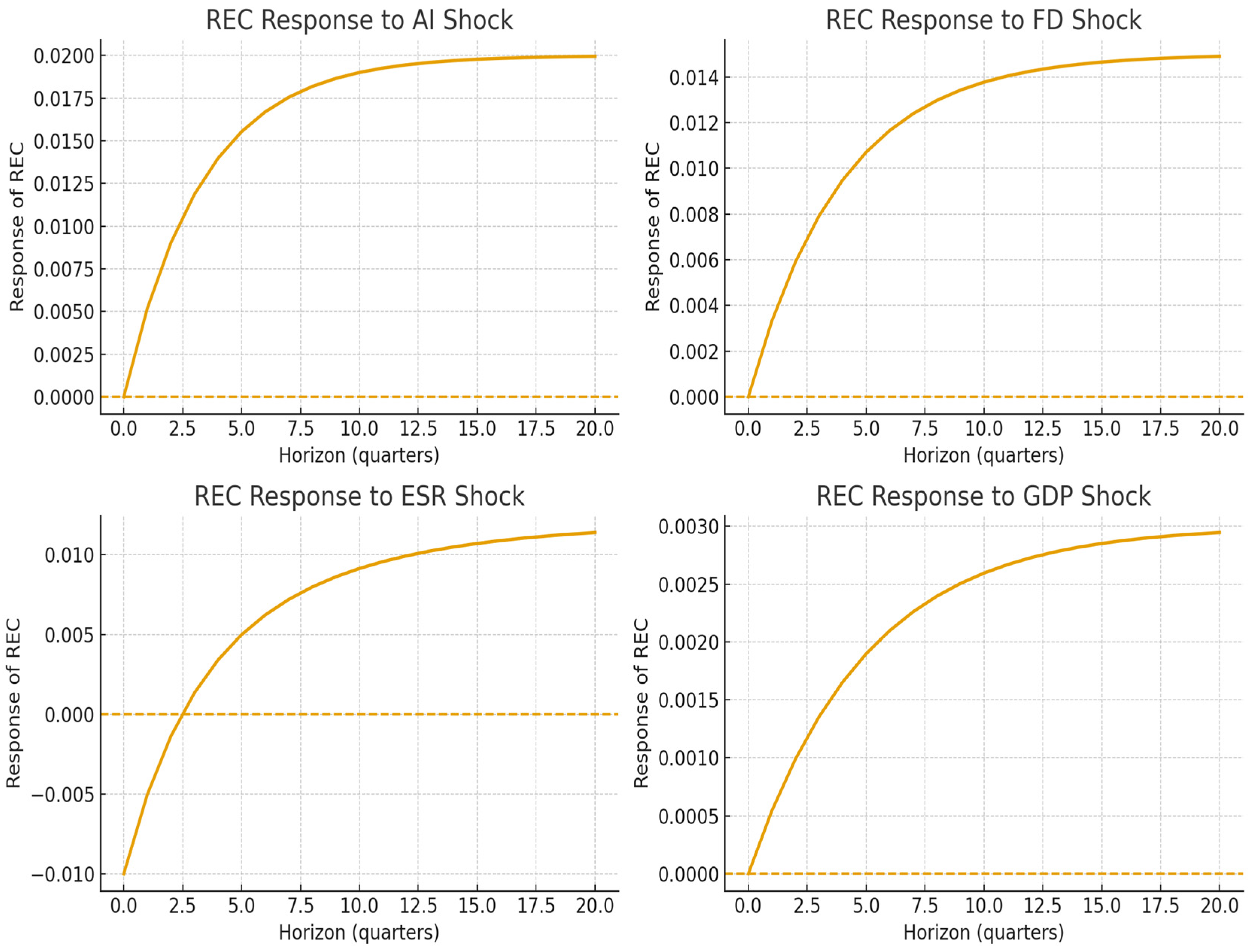
3.2.2. TVP-SV-VAR Model Specification (Time-Varying Robustness)
4. Empirical Results
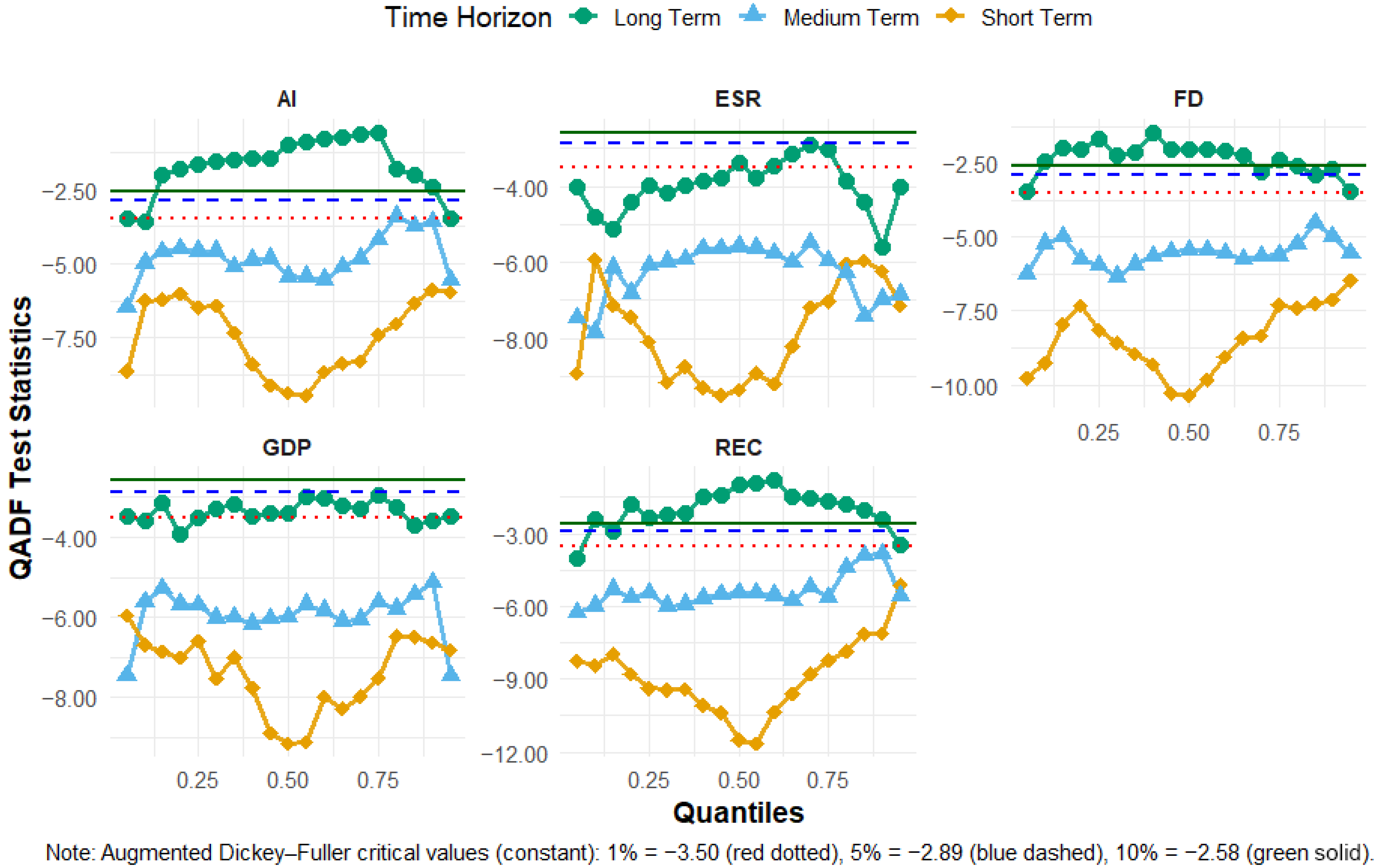
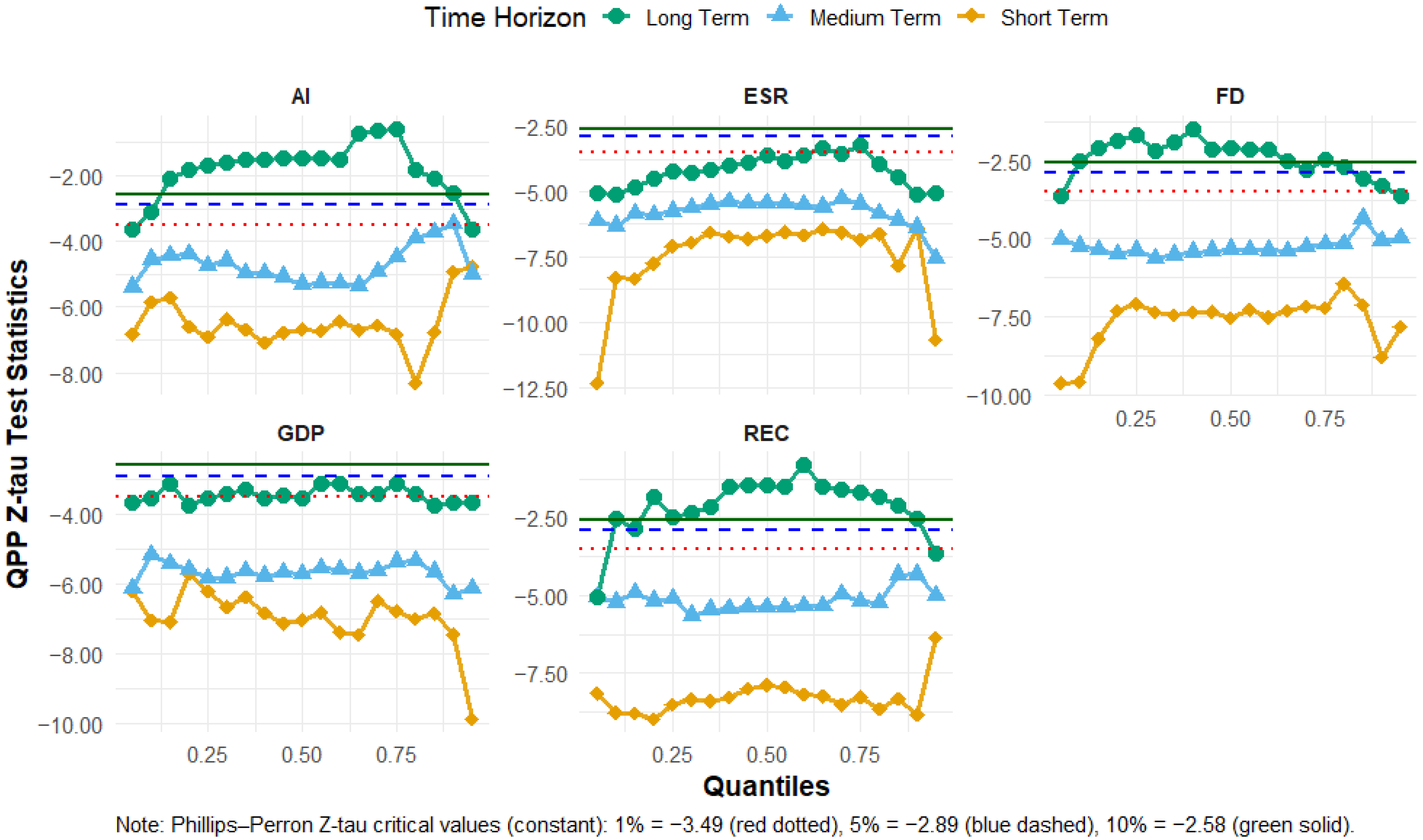
4.1. Wavelet Quantile Unit Root Test Results
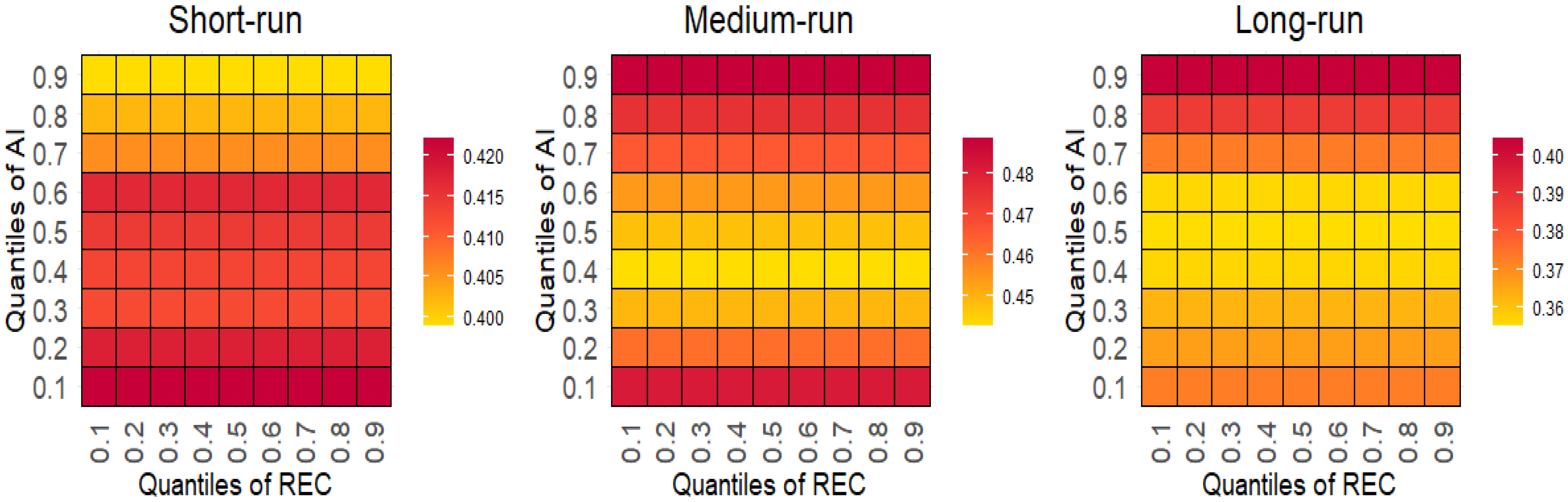
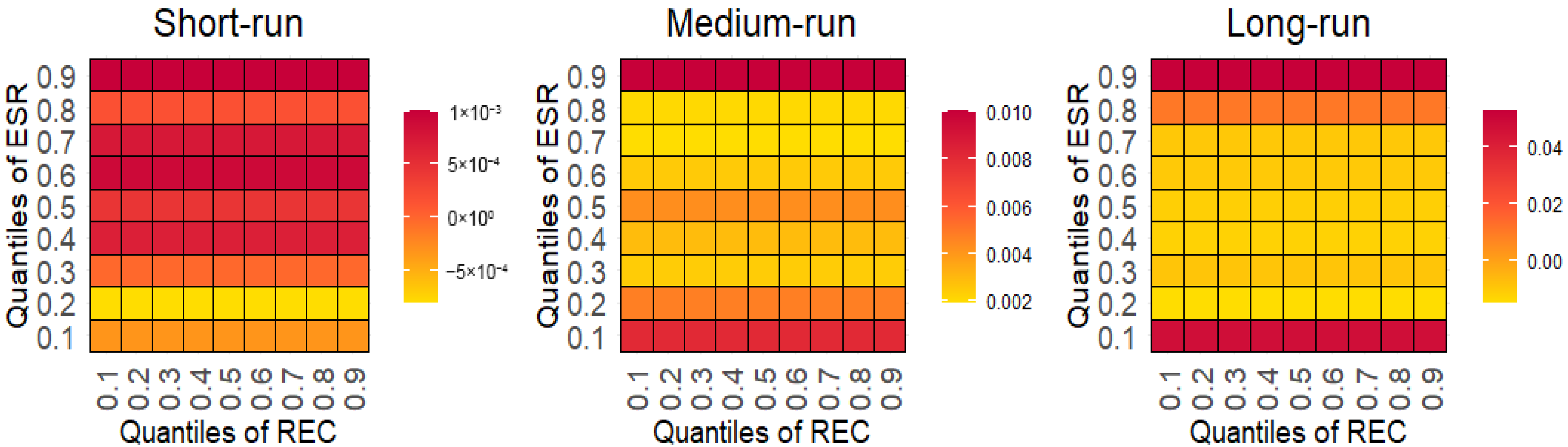
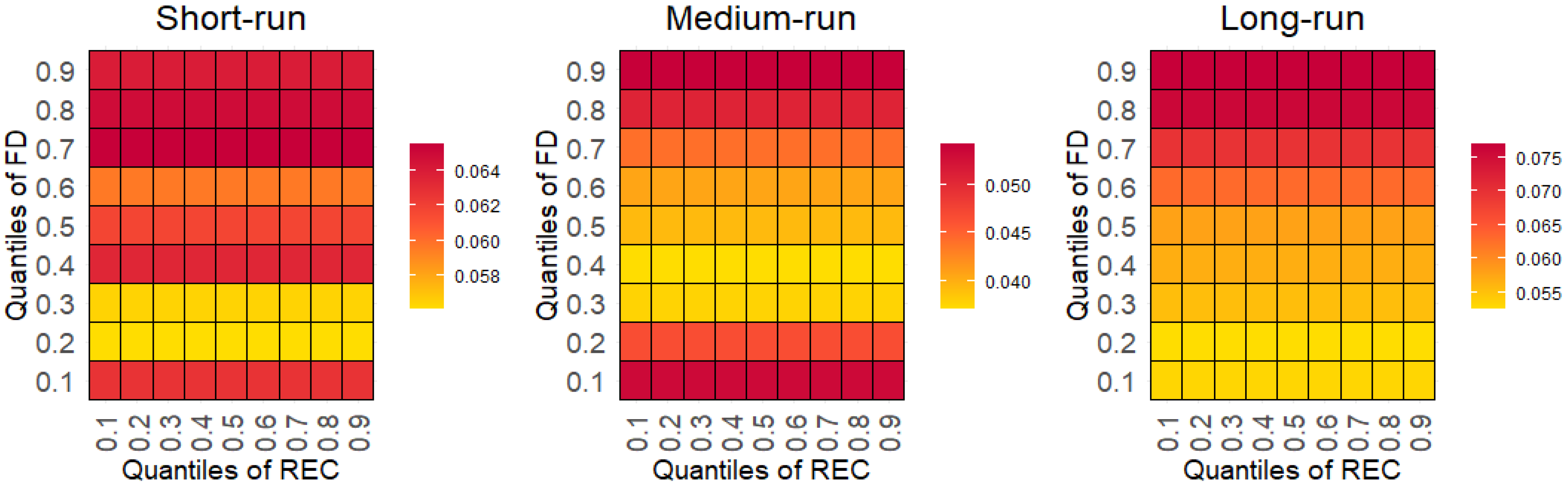
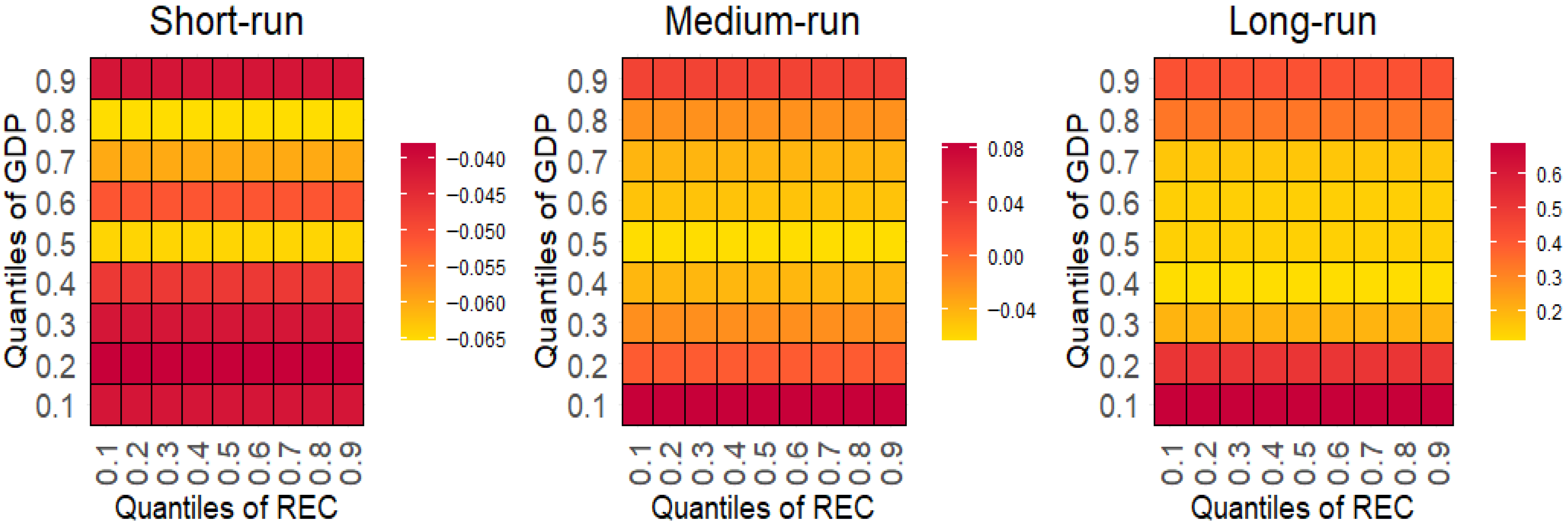
4.2. Wavelet Cross-Quantile Regression
4.3. Robustness Tests
Discussion of the Findings
5. Conclusions and Policy Implications
5.1. Conclusions
5.2. Policy Implications
5.3. Future Research Directions
Author Contributions
Funding
Institutional Review Board Statement
Informed Consent Statement
Data Availability Statement
Conflicts of Interest
References
- EIA. Energy Information Administration. Renewable Energy Explained; United States Renewable Energy: Washington, DC, 2024. Available online: https://www.eia.gov/energyexplained/renewable-sources (accessed on 1 March 2024).
- Eurostat. EU and Russia Trade Profile. 2023. Available online: https://ec.europa.eu/eurostat/statistics-explained/index.php?oldid=558089#:~:text=The%20value%20of%20exports%20to,2023%20at%20%E2%82%AC0.2%20billion (accessed on 3 December 2024).
- European Commission A European Green Deal, Striving to Be the First Climate-Neutral Continent. 2024. Available online: https://ec.europa.eu/info/strategy/priorities-2019-2024/european-green-deal_en (accessed on 2 April 2024).
- Shahbaz, M.; Hye, Q.M.A.; Tiwari, A.K.; Leitão, N.C. Economic growth, energy consumption, financial development, international trade and CO2 emissions in Indonesia. Renew. Sustain. Energy Rev. 2013, 25, 109–121. [Google Scholar] [CrossRef]
- Adebayo, T.S.; Eweade, B.S.; Özkan, O.; Uzun Ozsahin, D. Effects of energy security and financial development on load capacity factor in the USA: A wavelet kernel-based regularized least squares approach. Clean Technol. Environ. Policy 2025, 27, 4215–4232. [Google Scholar] [CrossRef]
- Shahbaz, M.; Solarin, S.A.; Ozturk, I. Environmental Kuznets Curve Hypothesis and the Role of Globalization in Selected African Countries. Ecol. Indic. 2016, 67, 623–636. [Google Scholar] [CrossRef]
- Abbasi, K.R.; Hussain, K.; Haddad, A.M.; Salman, A.; Ozturk, I. The Role of Financial Development and Technological Innovation Towards Sustainable Development in Pakistan: Fresh Insights from Consumption and Territory-Based Emissions. Technol. Forecast. Soc. Change 2022, 176, 121444. [Google Scholar] [CrossRef]
- Ivanovski, K.; Marinucci, N. Policy uncertainty and renewable energy: Exploring the implications for global energy transitions, energy security, and environmental risk management. Energy Res. Soc. Sci. 2021, 82, 102415. [Google Scholar] [CrossRef]
- Tansel Tugcu, C.; Menegaki, A.N. The impact of renewable energy generation on energy security: Evidence from the G7 countries. Gondwana Res. 2024, 125, 253–265. [Google Scholar] [CrossRef]
- Huang, S.-W.; Chung, Y.-F.; Wu, T.-H. Analyzing the relationship between energy security performance and decoupling of economic growth from CO2 emissions for OECD countries. Renew. Sustain. Energy Rev. 2021, 152, 111633. [Google Scholar] [CrossRef]
- Gaur, L.; Afaq, A.; Arora, G.K.; Khan, N. Artificial intelligence for carbon emissions using system of systems theory. Ecol. Inform. 2023, 76, 102165. [Google Scholar] [CrossRef]
- Liu, L.; Yang, K.; Fujii, H.; Liu, J. Artificial intelligence and energy intensity in China’s industrial sector: Effect and transmission channel. Econ. Anal. Policy 2021, 70, 276–293. [Google Scholar] [CrossRef]
- Huynh, T.L.D.; Hille, E.; Nasir, M.A. Diversification in the age of the 4th industrial revolution: The role of artificial intelligence, green bonds and cryptocurrencies. Technol. Forecast. Soc. Change 2020, 159, 120188. [Google Scholar] [CrossRef]
- Tiwari, A.K.; Abakah, E.J.A.; Le, T.-L.; Leyva-de la Hiz, D.I. Markov-switching dependence between artificial intelligence and carbon price: The role of policy uncertainty in the era of the 4th industrial revolution and the effect of COVID-19 pandemic. Technol. Forecast. Soc. Change 2021, 163, 120434. [Google Scholar] [CrossRef]
- Akintande, O.J.; Olubusoye, O.E.; Adenikinju, A.F.; Olanrewaju, B.T. Modeling the determinants of renewable energy consumption: Evidence from the five most populous nations in Africa. Energy 2020, 206, 117992. [Google Scholar] [CrossRef]
- Ameli, N.; Brandt, N. Determinants of households’ investment in energy efficiency and renewables: Evidence from the OECD survey on household environmental behaviour and attitudes. Environ. Res. Lett. 2015, 10, 044015. [Google Scholar] [CrossRef]
- Amin, A.; Altinoz, B.; Dogan, E. Analyzing the determinants of carbon emissions from transportation in European countries: The role of renewable energy and urbanization. Clean Technol. Environ. Policy 2020, 22, 1725–1734. [Google Scholar] [CrossRef]
- Bekun, F.V.; Alola, A.A. Determinants of renewable energy consumption in agrarian Sub-Sahara African economies. Energy Ecol. Environ. 2022, 7, 227–235. [Google Scholar] [CrossRef]
- Przychodzen, W.; Przychodzen, J. Determinants of renewable energy production in transition economies: A panel data approach. Energy 2020, 191, 116583. [Google Scholar] [CrossRef]
- Adebayo, T.S.; Olanrewaju, V.O.; Uzun, B. Safe havens or fragile investments? Navigating sustainable energy assets in times of policy uncertainty. Investig. Anal. J. 2025, 1–22. [Google Scholar] [CrossRef]
- Eweade, B.S.; Akadiri, A.C.; Olusoga, K.O.; Bamidele, R.O. The symbiotic effects of energy consumption, globalization, and combustible renewables and waste on ecological footprint in the United Kingdom. In Natural Resources Forum; Blackwell Publishing Ltd.: Oxford, UK, 2024; Volume 48, pp. 274–291. [Google Scholar] [CrossRef]
- Romer, P.M. The Origins of Endogenous Growth. J. Econ. Perspect. 1994, 8, 3–22. [Google Scholar] [CrossRef]
- Sadorsky, P. The impact of financial development on energy consumption in emerging economies. Energy Policy 2010, 38, 2528–2535. [Google Scholar] [CrossRef]
- Lu, X.; Guo, J.; Zhou, H. Digital financial inclusion development, investment diversification, and household extreme portfolio risk. Account. Finance 2021, 61, 6225–6261. [Google Scholar] [CrossRef]
- Eweade, B.S. Do Investments in Artificial Intelligence, Economic Policy Uncertainty and Economic Growth Hurt or Help Biodiversity in the United States? Geol. J. 2025, gj.70056. [Google Scholar] [CrossRef]
- Chu, L.K.; Doğan, B.; Abakah, E.J.A.; Ghosh, S.; Albeni, M. Impact of economic policy uncertainty, geopolitical risk, and economic complexity on carbon emissions and ecological footprint: An investigation of the E7 countries. Environ. Sci. Pollut. Res. 2022, 30, 34406–34427. [Google Scholar] [CrossRef]
- Adebayo, T.S.; Özkan, O.; Olanrewaju, V.O.; Uzun, B. Do fossil-fuel subsidies, Fintech innovation, and digital ICT transform ecological quality in Turkey? Evidence from modified cross-quantile regression. Appl. Econ. 2025, 1–19. [Google Scholar] [CrossRef]
- Adebayo, T.S.; Acheampong, A.O. Modelling the globalization-CO2 emission nexus in Australia: Evidence from quantile-on-quantile approach. Environ. Sci. Pollut. Res. 2022, 29, 9867–9882. [Google Scholar] [CrossRef] [PubMed]
- Koenker, R.; Bassett, G. Regression Quantiles. Econometrica 1978, 46, 33. [Google Scholar] [CrossRef]
- Sim, N.; Zhou, H. Oil prices, US stock return, and the dependence between their quantiles. J. Bank. Finance 2015, 55, 1–8. [Google Scholar] [CrossRef]
- Troster, V. Testing for Granger-causality in quantiles. Econom. Rev. 2018, 37, 850–866. [Google Scholar] [CrossRef]
- Chu, L.K.; Ghosh, S.; Doğan, B.; Nguyen, N.H.; Shahbaz, M. Energy security as new determinant of renewable energy: The role of economic complexity in top energy users. Energy 2023, 263, 125799. [Google Scholar] [CrossRef]
- Doğan, B.; Shahbaz, M.; Bashir, M.F.; Abbas, S.; Ghosh, S. Formulating energy security strategies for a sustainable environment: Evidence from the newly industrialized economies. Renew. Sustain. Energy Rev. 2023, 184, 113551. [Google Scholar] [CrossRef]
- Athari, S.A.; Eweade, B.S.; Awosusi, A.A.; Kirikkaleli, D. Beyond Fossil Fuels: How Iceland’s Oil Efficiency, Hydro Energy, and Fiscal Decentralization Propel a Cleaner Environment: Evidence from Wavelet Quantile Methods. Environ. Sustain. Indic. 2025, 28, 101040. [Google Scholar] [CrossRef]
- Anton, S.G.; Afloarei Nucu, A.E. The effect of financial development on renewable energy consumption. A panel data approach. Renew. Energy 2020, 147, 330–338. [Google Scholar] [CrossRef]
- Dou, J.; Li, K.; Qin, M.; Albu, L.L. Towards energy security: Could renewable energy endure uncertainties in the energy market? Econ. Anal. Policy 2025, 86, 461–474. [Google Scholar] [CrossRef]
- Su, C.-W.; Wu, Y.; Qin, M. Preserving energy security: Can renewable energy withstand the energy-related uncertainty risk? Energy 2025, 320, 135349. [Google Scholar] [CrossRef]
- Sohail, M.T.; Ullah, S.; Sohail, S. How does the circular economy affect energy security and renewable energy development? Energy 2025, 320, 135348. [Google Scholar] [CrossRef]
- Çetin, M.; Sarıgül, S.S.; Topcu, B.A.; Alvarado, R.; Karataser, B. Does globalization mitigate environmental degradation in selected emerging economies? assessment of the role of financial development, economic growth, renewable energy consumption and urbanization. Environ. Sci. Pollut. Res. 2023, 30, 100340–100359. [Google Scholar] [CrossRef]
- Khan, A.; Chenggang, Y.; Hussain, J.; Kui, Z. Impact of technological innovation, financial development and foreign direct investment on renewable energy, non-renewable energy and the environment in belt & Road Initiative countries. Renew. Energy 2021, 171, 479–491. [Google Scholar] [CrossRef]
- Sevinç, H.; Kizildere, C.; Eweade, B.S.; Gyamfi, B.A. Drivers of ecological quality: Do environmental policy stringency and urbanization play a role? Environ. Sci. Eur. 2025, 37, 148. [Google Scholar] [CrossRef]
- Maslej, N.; Fattorini, L.; Perrault, R.; Gil, Y.; Parli, V.; Kariuki, N.; Capstick, E.; Reuel, A.; Brynjolfsson, E.; Etchemendy, J.; et al. Artificial Intelligence Index Report 2025. arXiv 2025. [Google Scholar] [CrossRef]
- Mukhtarov, S.; Yüksel, S.; Dinçer, H. The impact of financial development on renewable energy consumption: Evidence from Turkey. Renew. Energy 2022, 187, 169–176. [Google Scholar] [CrossRef]
- Behera, P.; Sethi, L.; Sethi, N. Balancing India’s energy trilemma: Assessing the role of renewable energy and green technology innovation for sustainable development. Energy 2024, 308, 132842. [Google Scholar] [CrossRef]
- Olanrewaju, V.O.; Adebayo, T.S.; Uzun, B. Navigating the impact of ESG sustainability uncertainty on fossil fuel prices: Evidence from wavelet cross-quantile regression. Appl. Econ. 2025, 1–17. [Google Scholar] [CrossRef]
- Iqbal, S.; Wang, Y.; Ali, S.; Haider, M.A.; Amin, N. Shifting to a green economy: Asymmetric macroeconomic determinants of renewable energy production in Pakistan. Renew. Energy 2023, 202, 234–241. [Google Scholar] [CrossRef]
- Wen, J.; Okolo, C.V.; Ugwuoke, I.C.; Kolani, K. Research on influencing factors of renewable energy, energy efficiency, on technological innovation. Does trade, investment and human capital development matter? Energy Policy 2022, 160, 112718. [Google Scholar] [CrossRef]
- Khan, D.; Nouman, M.; Popp, J.; Khan, M.A.; Ur Rehman, F.; Oláh, J. Link between Technically Derived Energy Efficiency and Ecological Footprint: Empirical Evidence from the ASEAN Region. Energies 2021, 14, 3923. [Google Scholar] [CrossRef]
- Ozkan, O.; Usman, O.; Eweade, B.S. Global evidence on the energy–environment dilemma: The role of energy-related uncertainty across diverse environmental indicators. Int. J. Sustain. Dev. World Ecol. 2024, 31, 1128–1144. [Google Scholar] [CrossRef]
- Chishti, M.Z.; Xia, X.; Du, A.M.; Özkan, O. Digital financial inclusion, the belt and road initiative, and the Paris agreement: Impacts on energy transition grid costs. Finance Res. Lett. 2025, 72, 106517. [Google Scholar] [CrossRef]
- Pesaran, M.H.; Shin, Y.; Smith, R.J. Bounds testing approaches to the analysis of level relationships. J. Appl. Econom. 2001, 16, 289–326. [Google Scholar] [CrossRef]
- Pesaran, M.H.; Shin, Y. Cointegration and speed of convergence to equilibrium. J. Econom. 1996, 71, 117–143. [Google Scholar] [CrossRef]
- Adebayo, T.S.; Özkan, O. Investigating the influence of socioeconomic conditions, renewable energy and eco-innovation on environmental degradation in the United States: A wavelet quantile-based analysis. J. Clean. Prod. 2024, 434, 140321. [Google Scholar] [CrossRef]
- Polanco-Martínez, J.M. VisualDom: An R package for estimating dominant variables in dynamical systems. Softw. Impacts 2023, 16, 100514. [Google Scholar] [CrossRef]
- Percival, D.B.; Walden, A.T. Wavelet Methods for Time Series Analysis; Cambridge University Press: Cambridge, UK, 2000; 628p, ISBN 978-0-521-68508-5. [Google Scholar]
- Li, T.; Shi, C.; Lu, Z.; Li, Y.; Zhu, H. Evaluating Dynamic Conditional Quantile Treatment Effects with Applications in Ridesharing. J. Am. Stat. Assoc. 2024, 119, 1736–1750. [Google Scholar] [CrossRef]
- Broock, W.A.; Scheinkman, J.A.; Dechert, W.D.; LeBaron, B. A test for independence based on the correlation dimension. Econom. Rev. 1996, 15, 197–235. [Google Scholar] [CrossRef]
- Belaïd, F.; Elsayed, A.H.; Omri, A. Key drivers of renewable energy deployment in the MENA Region: Empirical evidence using panel quantile regression. Struct. Change Econ. Dyn. 2021, 57, 225–238. [Google Scholar] [CrossRef]
- Koenker, R.; Xiao, Z. Unit Root Quantile Autoregression Inference. J. Am. Stat. Assoc. 2004, 99, 775–787. [Google Scholar] [CrossRef]
- Abdalla, A.N.; Nazir, M.S.; Tao, H.; Cao, S.; Ji, R.; Jiang, M.; Yao, L. Integration of energy storage system and renewable energy sources based on artificial intelligence: An overview. J. Energy Storage 2021, 40, 102811. [Google Scholar] [CrossRef]
- Şerban, A.C.; Lytras, M.D. Artificial Intelligence for Smart Renewable Energy Sector in Europe—Smart Energy Infrastructures for Next Generation Smart Cities. IEEE Access 2020, 8, 77364–77377. [Google Scholar] [CrossRef]
- Ahmed, M.; Galal, M. Using Artificial neural networks to recognize the determinants of economic growth: New approach “evidence from developing countries”. Indian J. Econ. Bus. 2021, 20. [Google Scholar] [CrossRef]
- Bai, Y.; Eweade, B.S.; Aghazadeh, S.; Bamidele, R.O.; Xu, Y. Pathways to environmental sustainability: Do fintech, natural resources, and environmental patents matter in E−7 nations? Renew. Energy 2025, 247, 122987. [Google Scholar] [CrossRef]
- Eren, B.M.; Taspinar, N.; Gokmenoglu, K.K. The impact of financial development and economic growth on renewable energy consumption: Empirical analysis of India. Sci. Total Environ. 2019, 663, 189–197. [Google Scholar] [CrossRef]
- Kirikkaleli, D.; Adebayo, T.S.; Khan, Z.; Ali, S. Does globalization matter for ecological footprint in Turkey? Evidence from dual adjustment approach. Environ. Sci. Pollut. Res. 2021, 28, 14009–14017. [Google Scholar] [CrossRef]
- Zafar, S.; Rana, N. The Convergence of Nanotechnology and Artificial Intelligence: Unlocking Future Innovations. Recent Innov. Chem. Eng. Former. Recent Pat. Chem. Eng. 2025, 18, 85–99. [Google Scholar] [CrossRef]
- Javed, A.; Yong, L.; Ashraf, J. Financial development and energy security risk: Do human capital and institutional quality make a difference? Borsa Istanb. Rev. 2025, 25, 692–699. [Google Scholar] [CrossRef]
- Ben Ali, M.S.; Al-Maadid, A.; Bergougui, B. Climate Change and Energy Security Risk: Do Green Patents, Institutional Quality, and Human Capital Make a Difference? Sustain. Dev. 2025, sd.70244. [Google Scholar] [CrossRef]
- Zhang, S.; Ramzan, M.; Awosusi, A.A.; Eweade, B.S.; Ojekemi, O.S. Unraveling causal dynamics: Exploring resource efficiency and biomass utilization in Malaysia’s context. Renew. Energy 2024, 226, 120368. [Google Scholar] [CrossRef]
- Zhang, H.; Khan, K.A.; Eweade, B.S.; Adebayo, T.S. Role of eco-innovation and financial globalization on ecological quality in China: A wavelet analysis. Energy Environ. 2025, 36. [Google Scholar] [CrossRef]
- Zhou, D.; Siddik, A.B.; Guo, L.; Li, H. Dynamic relationship among climate policy uncertainty, oil price and renewable energy consumption—Findings from TVP-SV-VAR approach. Renew. Energy 2023, 204, 722–732. [Google Scholar] [CrossRef]



| Symbols | Variables | Measurement Unit | Source(s) |
|---|---|---|---|
| REC | Renewable Energy Consumption (https://data.worldbank.org/indicator/EG.FEC.RNEW.ZS. accessed on 4 December 2024) | Renewable energy consumption (% of total final energy consumption) | WB |
| AI | Artificial Intelligence (https://ourworldindata.org/artificial-intelligence. accessed on 4 December 2024) | Artificial intelligence index report 2025 | [42] |
| GDP | Economic Growth (https://ourworldindata.org/economic-growth. accessed on 4 December 2024) | GDP per capita, PPP (constant 2021 international $ | OWD |
| ESR | Energy Security Risk (https://www.legistorm.com/organization/summary/41261/Global_Energy_Institute.html. accessed on 4 December 2024) | Index | GEI |
| FD | Financial Development (https://data.worldbank.org/indicator/FD.AST.PRVT.GD.ZS?locations=US. accessed on 4 December 2024) | Domestic credit to private sector by banks (% of GDP) | WB |
| REC | AI | GDP | ESR | FD | |
|---|---|---|---|---|---|
| M2 | 14.452 *** | 19.00 *** | 43.285 *** | 11.739 *** | 15.347 *** |
| M3 | 20.523 *** | 41.125 *** | 14.316 *** | 43.623 *** | 34.910 *** |
| M4 | 21.302 *** | 30.567 *** | 13.258 *** | 44.804 *** | 25.234 *** |
| M5 | 28.467 *** | 35.271 *** | 37.200 *** | 37.336 *** | 31.082 *** |
| M6 | 10.101 *** | 32.720 *** | 40.965 *** | 40.118 *** | 16.532 *** |
| Variables | Long Run | Variables | Short Run | ||||
|---|---|---|---|---|---|---|---|
| Coefficients | t-Statistics | p-Value | Coefficients | t-Statistics | p-Value | ||
| REC | 0.38 ** | 0.61 | 0.043 | ΔREC (dependent) | 0.44 ** | 3.45 | 0.000 |
| AI | 0.35 *** | 3.20 | 0.002 | ΔAI | 0.12 *** | 2.85 | 0.003 |
| ESR | 0.18 ** | 2.10 | 0.040 | ΔESR | −0.07 ** | −2.25 | 0.070 |
| FD | 0.42 *** | 4.00 | 0.001 | ΔFD | 0.21 ** | 3.10 | — |
| GDP | 0.15 * | 1.95 | 0.060 | ΔGDP | −0.05 * | −1.90 | 0.0002 |
| Constant | 0.80 | 1.60 | 0.110 | ECM (−1) | −0.32 ** | −4.50 | 0.005 |
Disclaimer/Publisher’s Note: The statements, opinions and data contained in all publications are solely those of the individual author(s) and contributor(s) and not of MDPI and/or the editor(s). MDPI and/or the editor(s) disclaim responsibility for any injury to people or property resulting from any ideas, methods, instructions or products referred to in the content. |
© 2025 by the authors. Licensee MDPI, Basel, Switzerland. This article is an open access article distributed under the terms and conditions of the Creative Commons Attribution (CC BY) license (https://creativecommons.org/licenses/by/4.0/).
Share and Cite
He, C.; Tu, Y.; Li, X.; Dai, W. Do Artificial Intelligence Investments, Financial Development, and Energy Security Risks Promote Renewable Energy Transition? Evidence from the United States. Sustainability 2025, 17, 11067. https://doi.org/10.3390/su172411067
He C, Tu Y, Li X, Dai W. Do Artificial Intelligence Investments, Financial Development, and Energy Security Risks Promote Renewable Energy Transition? Evidence from the United States. Sustainability. 2025; 17(24):11067. https://doi.org/10.3390/su172411067
Chicago/Turabian StyleHe, Chao, Yulin Tu, Xing Li, and Wanci Dai. 2025. "Do Artificial Intelligence Investments, Financial Development, and Energy Security Risks Promote Renewable Energy Transition? Evidence from the United States" Sustainability 17, no. 24: 11067. https://doi.org/10.3390/su172411067
APA StyleHe, C., Tu, Y., Li, X., & Dai, W. (2025). Do Artificial Intelligence Investments, Financial Development, and Energy Security Risks Promote Renewable Energy Transition? Evidence from the United States. Sustainability, 17(24), 11067. https://doi.org/10.3390/su172411067