1. Introduction
As global economies transition toward decarbonization and environmental resilience, the tourism sector, as one of the world’s largest and most visible service industries, is under increasing pressure to adapt. Sustainability is no longer confined to destination marketing or environmental certification schemes; it is now embedded in consumer expectations about the operations, culture and workforce of tourism enterprises. Tourists are no longer evaluating only the ecological footprint of their experiences but also projecting expectations about how tourism employees embody sustainability values through knowledge, ethics and behavior.
This shift underscores the rising importance of green skills in tourism competencies that enable service staff, guides, hosts and frontline workers to contribute meaningfully to sustainable tourism development. These include technical skills such as energy and water efficiency practices, waste reduction techniques and sustainable sourcing, alongside soft skills such as environmental communication, cultural sensitivity and ethical guest interaction [
1,
2]. For tourism businesses to remain competitive, these skills must be visible and authentic, especially in an industry where service delivery is personal and often experiential.
In response to these evolving expectations, tourism companies are increasingly embedding environmental concerns into their organizational sustainability strategies. These include commitments to carbon reduction, circular economy principles, sustainable supply chains and transparent sustainability reporting [
3]. To strengthen credibility, such strategies are communicated through eco-labeling schemes and green marketing initiatives [
4]. However, achieving alignment between external messaging and internal workforce competencies remains a key challenge.
The concept of green consumer behavior (GCB), defined as the intentional purchase of environmentally friendly products and services, has received significant attention in sustainability literature [
5,
6,
7]. While prior studies have explored its influence on marketing, branding and eco-product design [
8], limited research has examined how environmentally conscious tourists influence internal organizational development, particularly the formation of expectations for green skills among tourism employees.
Based on Stakeholder Theory [
9], Stimulus–Organism–Response (S-O-R) Theory [
10] and Human Capital Theory [
11], this study positions tourists not simply as consumers but as stakeholders with the potential to shape strategic and workforce-level decisions within tourism businesses. When tourists perceive a tour operator, eco-lodge or hotel as environmentally credible, they increasingly expect that sustainability to be reflected in employee behavior, service delivery and staff knowledge. This expectation creates dual pressure: tourism organizations must demonstrate external environmental performance while investing in internal green capabilities.
The present study investigates these dynamics through an empirical model that examines the relationships between green tourist behavior, perceptions of organizational sustainability strategy (OSS) and green skills expectation (GSE) in the tourism workforce. Using primary data collected from domestic tourists in Albania and analyzed via structural equation modeling (SEM) and cluster analysis, this study seeks to answer the following questions:
- 1.
Does green consumer behavior shape perceptions of organizational sustainability strategies?
- 2.
Do these strategies, in turn, influence expectations for employee green competencies?
- 3.
Can these expectations be empirically modeled as a latent construct?
- 4.
Do consumer values directly or indirectly drive workforce transformation?
By addressing these questions, this research contributes to a deeper understanding of how tourism consumers drive workforce transformation in the sustainability era. The findings offer important implications for tourism operators, policymakers and education providers seeking to align employee training and development with the growing demand for responsible, ethical and environmentally competent tourism experiences.
2. Literature Review
Understanding how environmentally conscious tourists’ preferences influence the development of green skills within tourism organizations requires a foundation in both behavioral and organizational theories. This study integrates three key theoretical perspectives—Stimulus–Organism–Response (S-O-R) Theory, Human Capital Theory and Stakeholder Theory—to conceptualize the pathway through which green tourist behavior causes internal organizational change.
2.1. Stimulus–Organism–Response (S-O-R) Theory in Tourism
The Stimulus–Organism–Response (S-O-R) model [
10] provides a useful framework for understanding how external stimuli lead to internal responses and visible outcomes. In sustainable tourism, the stimulus (S) represents green tourist preferences for eco-certified accommodations, low-impact activities and environmentally transparent operators. Organism (O) is a tourism organization (e.g., a hotel, tour agency or eco-lodge) that perceives these signals and adapts through strategic, operational and human resource changes. The response (R) is reflected in outcomes such as the visible greening of services, eco-innovation in offerings and the development of green workforce competencies.
This model positions tourists not merely as consumers of tourism products but as initiators of internal organizational transformation. Their preferences exercise direct pressure on firms to realign internal systems, including HR practices, employee training and service protocols, to meet rising expectations for sustainability [
12,
13,
14]. In tourism, where service encounters are personal and brand credibility is often judged through staff behavior, this dynamic is especially pronounced.
Based on this framework, we propose the following hypothesis:
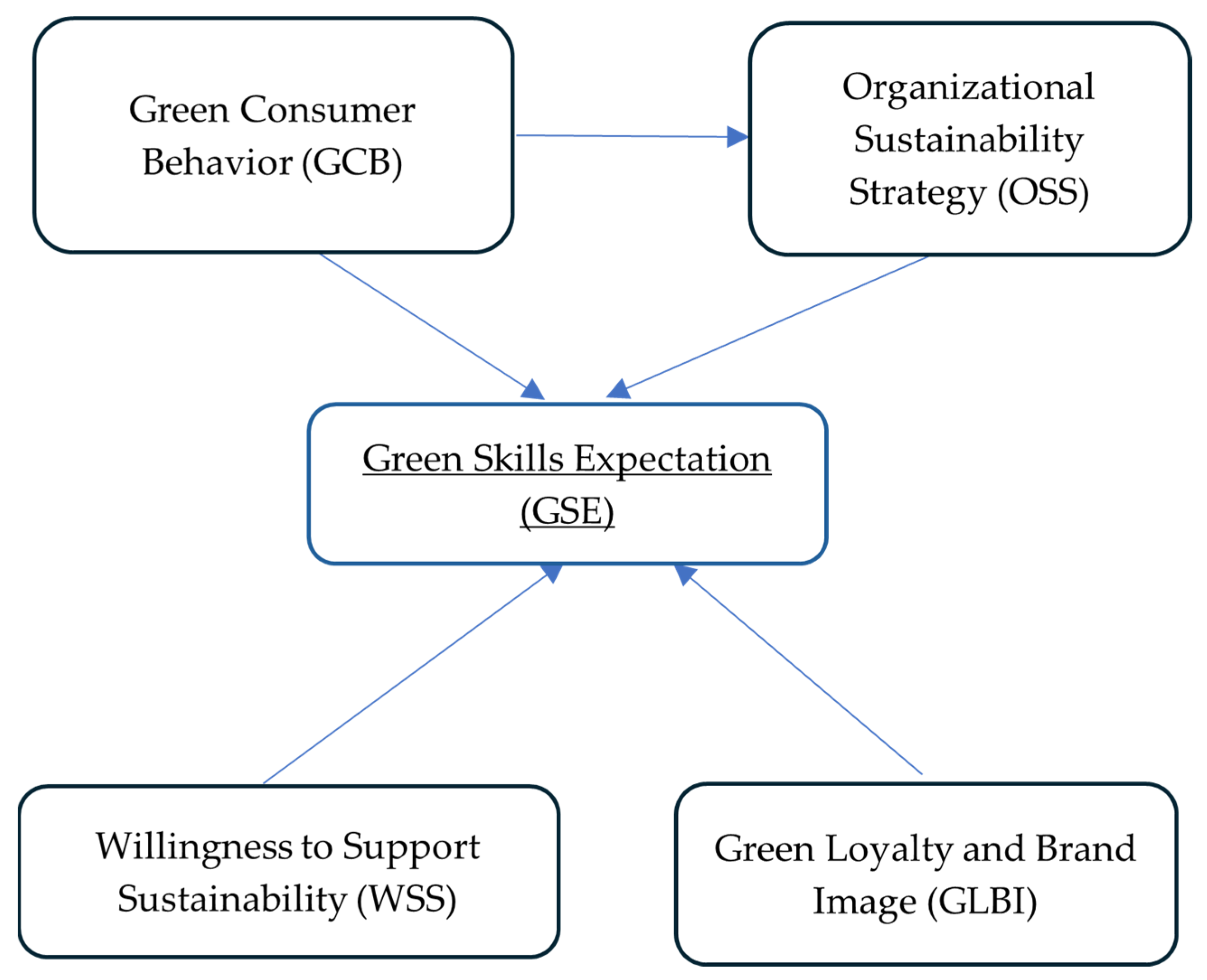
H1. Green consumer behavior (GCB) positively influences organizational sustainability strategy (OSS).
2.2. Human Capital Theory and Green Skills in Tourism
Human Capital Theory [
11] argues that investment in employee education and skill development leads to improved organizational performance, innovation and long-term competitiveness. Applied to tourism sustainability, this theory supports the rationale for tourism businesses to invest in green skills: a combination of technical abilities (e.g., waste management, energy efficiency and sustainable procurement) and soft competencies (e.g., environmental communication, cultural sensitivity and ethical guest relations) necessary for responsible service delivery [
1,
15]. Tourism research demonstrates that service quality and guest experience depend heavily on employee capabilities across the service product, service setting, and service delivery system, highlighting the role of staff skills in shaping consumer perceptions [
16]
Tourism operators increasingly recognize green human capital as a strategic asset. Employees who can authentically represent sustainability values enhance both brand credibility and guest satisfaction [
15]. In response to green tourist expectations, firms are called upon to build internal capabilities through structured workforce development, aligning with Human Capital Theory’s argument that organizational investments in skills are key to securing both market advantage and legitimacy [
12,
13]. The following hypothesis is proposed in line with this theoretical foundation:
H2. Organizational sustainability strategy (OSS) positively influences green skills expectation (GSE).
2.3. Stakeholder Theory: Tourists as Co-Creators of Workforce Strategy
Stakeholder Theory [
9] asserts that organizations are accountable not only to shareholders but also to a broad range of stakeholders, including customers, employees, communities and the environment. In tourism, green tourists act as powerful stakeholders who shape legitimacy criteria and influence organizational priorities. Prior destination marketing research emphasizes that tourists co-create the tourism experience and shape organizational strategies related to image, service quality and sustainability commitments [
17]. When sustainable practices become a baseline expectation, rather than a point of differentiation, tourism organizations must embed environmental values into their operations, including hiring practices, staff training and performance management [
18,
19].
This theory reframes tourists from external observers to co-creators of organizational behavior. As they seek authenticity and ethical alignment between service promises and staff behavior, green tourists drive tourism organizations to integrate sustainability into their workforce strategy, including requiring frontline staff to be competent in eco-tourism principles, respect for local culture and environmental communication, thus directly influencing which skills are prioritized in workforce development [
20]. Accordingly, the following hypothesis is proposed:
H3. Green consumer behavior (GCB) has a direct effect on green skills expectation (GSE).
2.4. Green Marketing, Green Branding and Eco-Labeling as Internal Drivers of Workforce Transformation
Green marketing, green branding and eco-labeling are commonly presented as instruments for communicating sustainability to environmentally conscious tourists [
21,
22]. Research consistently shows that these instruments not only influence external brand perceptions but also reshape internal organizational processes [
23] argues that firms move from symbolic environmental messaging to structural change once sustainability has become part of their competitive positioning. In tourism, this shift occurs rapidly because service delivery is personal and highly visible: tourists evaluate an organization not by reading environmental commitments on a website but through direct contact with frontline staff [
24].
For this reason, sustainability communication cannot be detached from employee competencies. Green branding requires congruence between what an organization promises and what its employees demonstrate during service encounters [
25,
26]. When employees lack knowledge of sustainability practices, tourists perceive a mismatch between brand claims and actual behavior, which undermines trust and increases perceptions of greenwashing. Thus, green branding becomes effective only when employees are equipped to communicate environmental values confidently and authentically.
Eco-labels reinforce this tension between external expectations and internal capability. Certification schemes such as Green Key, Travelife, and EarthCheck require documentation, continuous monitoring and evidence of employee participation [
18,
27,
28]. These systems necessitate structured internal procedures such as waste-sorting routines, performance indicators and environmental reporting, which depend on employees’ understanding of and applying sustainability standards. Studies on certification implementation confirm that meeting eco-label requirements demands cross-departmental coordination and sustained employee training [
29,
30]. As a result, eco-labels function not simply as marketing tools but as operational capability-building mechanisms, driving organizations to institutionalize sustainability knowledge and skills.
Research on green marketing, green branding and eco-labeling demonstrates that sustainability-oriented practices generate real competitive value only when supported by employee competencies and behavioral alignment [
19,
24,
25,
30,
31]. A green brand or eco-label is not perceived as credible unless frontline staff can enact sustainability principles during service encounters, indicating that certification and marketing tools are insufficient without skill development [
29]. In this sense, external sustainability mechanisms (e.g., eco-labels, green positioning and environmental messaging) create demands for internal capability, and firms must redesign staff training, performance expectations and internal routines so that their employees can deliver the brand’s environmental value as promised. Consequently, consumer-driven sustainability pressure pushes firms to adopt sustainability strategies (OSSs); these strategies, in turn, require systematic workforce training and green skills development. This proposed mechanism aligns with H2, since sustainability strategies compel organizations to invest in employee competencies, and H3, as green consumers expect observable sustainability-related behavior from staff. It is also in agreement with the logic of the mediation effect in H5, where OSS is hypothesized to function as the channel that converts consumer expectations into workforce transformation.
2.5. Conceptualizing GSE: GLBI and WSS as Indicators of Consumer Expectations of Green Workforce Transformation
In this study, the two dimensions of green loyalty and brand image (GLBI) and willingness to support sustainability (WSS) are used to capture tourists’ expectations regarding employees’ green skills.
GLBI reflects the emotional attachment tourists have toward a green brand and their perception of the brand’s credibility. In tourism, it indicates the extent to which employee behavior aligns with the advertised environmental commitments. Reference [
26] emphasized that tourists trust a brand more when staff demonstrate sincerity, transparency and sustainability fluency. Therefore, GLBI acts as a proxy for expectations around employee behavior, training and competency in sustainability.
WSS indicates the degree to which tourists are willing to support sustainability efforts financially or behaviorally, such as by paying more, staying longer or choosing low-impact options. Tourists with high WSS tend to expect firms to practice what they preach, including equipping staff with the knowledge and attitude necessary to deliver sustainable services. Hence, WSS is a signal of market pressure for internal workforce transformation.
Together, these indicators signal consumer-driven expectations for green workforce competencies. As confirmed by [
26], tourists’ trust in a brand increases when staff demonstrate environmental fluency and ethical behavior. Similarly, refs. [
14,
32] argue that willingness to support sustainability correlates with expectations for green performance across all touchpoints, including human resources.
These two constructs serve as robust proxies for the latent variable green skills expectation.
H4. GLBI and WSS are significant indicators of the latent variable GSE.
2.6. Mediating Role of Organizational Strategy: From Expectations to Competences
While tourists increasingly articulate expectations for environmentally responsible staff behavior, this demand does not automatically translate into workforce change. Tourist pressure must first be interpreted and institutionalized at the strategic level. Organizations respond to these external signals by formalizing sustainability as part of their strategic agenda, typically through certification commitments and development of environmental goals or structured sustainability programs. Once sustainability has become part of the organizational strategy, it generates concrete operational implications, including role redesign, new procedures and the need for workforce upskilling.
Empirical research confirms that compliance with sustainability frameworks is not possible without systematic employee training. The authors of [
29,
30] demonstrate that eco-labels and certification schemes impose specific procedural and documentation requirements that oblige firms to embed sustainability into daily work routines. Meeting these requirements demands not only technical knowledge (e.g., waste management protocols and resource monitoring) but also coordination across departments and new expectations regarding employee behavior. Thus, skills development is not an optional or parallel activity; it is a structural consequence of adopting a sustainability strategy.
In this study, organizational sustainability strategy (OSS) is hypothesized to function as the mechanism that translates market expectations into internal capability building. While green consumer behavior (GCB) creates pressure, it is organizational sustainability strategy (OSS) that converts this pressure into staff training, competency development and performance criteria, ultimately shaping green skills expectation (GSE). The sequence of GCB → OSS → GSE reflects a mediated pathway in which organizational sustainability strategy operates as an obligatory transformation layer rather than a passive reaction.
Accordingly, the final hypothesis is proposed as follows:
H5. Organizational sustainability strategy (OSS) mediates the relationship between green consumer behavior (GCB) and green skills expectation (GSE).
The proposed research model based on the literature review is presented in
Figure 1.
3. Methodology
This study utilized a quantitative, cross-sectional research design to investigate the relationships between green consumer behavior (GCB), organizational sustainability strategy (OSS) and green skills expectation (GSE). A structured questionnaire was developed and administered to domestic tourists in Albania to empirically examine these constructs.
The survey instrument included 16 items adapted from established instruments in the green marketing and sustainability literature [
23,
26,
31] and were rated on a 5-point Likert scale ranging from 1 = Strongly Disagree to 5 = Strongly Agree. The questionnaire was pretested with five academic experts in tourism sustainability and human resource management to ensure content validity and clarity.
Data were collected between June and August 2025. A total of 376 responses were collected from a random probability sample. After removing incomplete or inconsistent entries, 326 valid questionnaires were analyzed.
3.1. GSE Measurement
Green skills expectation (GSE) was modeled as a latent construct, indirectly derived from two observed variables: green loyalty and brand image (GLBI) and willingness to support sustainability (WSS). These proxies reflect consumer trust and support of a brand’s sustained behavioral commitment to environmentally responsible tourism services. However, it is acknowledged that this approach does not fully capture specific expectations regarding employees’ level in green skills, such as environmental knowledge, guest education or ethical behavior. This conceptual limitation is addressed in the Limitations section below, and future studies are advised to incorporate direct measures of workforce competencies in sustainability, particularly those relevant to frontline tourism roles.
3.2. Data Analysis and Reliability
The analytical framework adopted in this study combined descriptive statistics, reliability and factor analysis, cluster segmentation and structural modeling. These procedures allowed for the identification of latent dimensions, segmentation of behavioral profiles and empirical testing of hypothesized relationships using a mediation framework.
Descriptive statistics were first computed to profile the demographic characteristics of the sample and to summarize responses to each item. The statistics included means, standard deviations and frequency distributions for variables such as age, gender, education and behavioral indicators of green consumption.
To ensure the survey instrument’s internal consistency, Cronbach’s alpha coefficients were calculated for each latent construct identified through factor analysis. The reliability analysis showed strong internal consistency across all constructs, with Cronbach’s alpha coefficients ranging from 0.79 to 0.88 and an overall scale reliability of 0.93. These results meet the threshold established by [
33], confirming the robustness and reliability of the constructs analyzed in this study.
Principal component analysis (PCA) with Varimax rotation was conducted to identify the latent structure of the 16 Likert-scale items. In line with the guidelines of [
33], the following criteria were applied to retain factors: Eigenvalues > 1.0, factor loadings ≥ 0.50, and cross-loading difference ≥ 0.30. The analysis extracted four factors that explained 78.89% of the total variance, indicating a strong factorial structure. To identify distinct consumer typologies based on behavioral dimensions, a K-means clustering algorithm was employed using the four composite factor scores (GCB, OSS, GLBI and WSS). The optimal number of clusters was determined via silhouette analysis, which supported a two-cluster solution. This segmentation added behavioral context to the structural model, illustrating how different types of consumers exert varying degrees of influence on an organization’s sustainability strategies and expectations of employee green skills.
A structural equation model (SEM) was constructed to test the hypothesized relationships among the latent constructs, including the potential mediating effect of OSS on the relationship between GCB and GSE. The SEM approach allowed for simultaneous estimation of direct and indirect effects and strengthened the empirical testing of the theoretical model.
4. Results
The present study surveyed a total of 326 individuals representing diverse sociodemographic profiles. Analysis of gender distribution indicated a predominance of female participants. Of the total sample, 184 respondents (56%) were female, and 142 respondents (44%) were male.
The study participants were drawn from multiple age groups, as summarized in
Table 1.
As shown in the table, 89% of the respondents were below 35 years old, indicating a young and environmentally conscious sample, which is consistent with global findings that younger cohorts are more sustainability-oriented.
4.1. Factor Analysis
To explore the latent structure of the 16-item survey and validate construct integrity, exploratory factor analysis (EFA) was performed using principal component analysis (PCA) with Varimax rotation. The KMO score of 0.820 and significant Bartlett’s test (p < 0.001) confirmed sampling adequacy.
Initially, four components emerged, cumulatively explaining 78.9% of the total variance (
Table 2). However, two components (PC3 and PC4) had eigenvalues below 1.0, which violates Kaiser’s criterion. We complemented the EFA with parallel analysis and then proceeded to confirmatory factor analysis (CFA) to validate the factor structure prior to SEM [
32].
The internal consistency of the instrument was confirmed using Cronbach’s alpha. All constructs exhibited strong internal consistency (Cronbach’s alpha > 0.79) and met the threshold for Composite Reliability (CR > 0.70) and Average Variance Extracted (AVE > 0.50) (
Table 3). Discriminant validity was confirmed for each construct according to the Fornell–Larcker and HTMT criteria. Specifically, the square root of the Average Variance Extracted (AVE) for each construct was greater than its correlations with any other constructs. HTMT analysis was performed to cross-validate discriminant validity. All HTMT ratios were below the conservative threshold of 0.85, indicating that the constructs were empirically distinct from one another, thus confirming discriminant validity (
Table A1 and
Table A2).
The four extracted factors were interpreted and labeled based on the item loadings and theoretical alignment:
- (1)
Green consumer behavior (GCB)—tourists’ eco-preferences, including brand switching for environmental reasons.
- (2)
Organizational sustainability strategy (OSS)—perceived transparency, sustainability certifications and green marketing credibility.
- (3)
Green loyalty and brand image (GLBI)—tourists’ emotional trust and resonance with environmentally responsible tourism providers.
- (4)
Willingness to support sustainability (WSS)—tourists’ economic and moral commitment to support sustainable services.
4.2. Latent Variable: Green Skills Expectation (GSE)
Although the original instrument did not directly measure employee green skills, GSE was modeled as a second-order latent variable derived from GLBI and WSS. This approach conceptualizes expectations for employee green competencies, such as sustainability literacy, ethical behavior and environmental service practices, as embedded in broader tourist perceptions and behavioral intentions.
These factor loadings validated the use of GSE as a latent construct reflecting the demand for sustainable workforce capabilities in tourism.
By taking the average of GLBI and WSS, the GSE construct captures both the perceptual (attitudinal) dimension, reflecting what consumers believe about green brands and their trust in these brands’ image (GLBI), and the behavioral/economic dimension, reflecting the extent to which consumers are willing to act on those beliefs, even at a cost (WSS).
This integrated approach reflects a dual-layer demand signal: consumers who trust green brands and are willing to support them financially are more likely to expect those brands to be internally consistent, especially in terms of employee capabilities and ethics. GSE, as constructed, reflects an empirically grounded and conceptually coherent construct of consumer-driven demand for green skills within organizations.
These factors formed the basis for the subsequent cluster analysis and structural modeling, providing a valid and reliable structure for examining how green consumer behavior influences organizational sustainability strategy and green skills expectation.
4.3. Behavioral Segmentation: K-Means Clustering of Green Consumer Profiles
To better understand heterogeneity in green consumer behavior, a K-means cluster analysis was conducted, using standardized scores of key variables related to environmental attitudes and behavior. Silhouette analysis and the elbow method were used to determine the optimal number of clusters. Although a three-cluster solution showed improved balance, the two-cluster solution offered the clearest differentiation, with acceptable silhouette width and conceptual interpretability. However, it is acknowledged that the distribution was asymmetric (82.82% in Cluster 1 and 17.18% in Cluster 2), suggesting that further research is needed for validation (
Table 4).
Cluster 1: Committed Eco-Tourists. Participants in this cluster exhibited high scores across all four dimensions, particularly in WSS and GLBI. This profile reflects deep engagement with sustainability at both the behavioral and attitudinal levels. Consumers in this group not only choose green products but also exhibit brand loyalty and a willingness to incur additional costs to support sustainability. Demographically, participants in this cluster were younger (18–24) and predominantly female, indicating a generational and gender-driven orientation toward sustainability leadership.
Cluster 2: Green-Adaptive Tourists. Participants in this cluster reported moderate GCB and OSS perceptions, with lower scores on WSS. Although they show awareness of environmental issues and some responsiveness to green marketing, their financial and emotional commitment to sustainability is less pronounced. This group represents a more pragmatic orientation, potentially influenced by price sensitivity or lack of trust in green claims.
These results reinforce the idea that green consumers are not a homogeneous group. Committed eco-tourists send stronger behavioral and symbolic signals to organizations, which may, in turn, incentivize organizations to invest in green workforce development, while the green-adaptive segment may require more credible organizational communication to deepen engagement.
4.4. Structural Equation Modeling (SEM): Latent Construct Approach
To empirically examine the conceptual framework, a structural equation modeling (SEM) approach was used, treating green skills expectation (GSE) as a second-order latent variable defined by two first-order observed constructs: green loyalty and brand image (GLBI) and willingness to support sustainability (WSS). This approach allowed us to analyze both direct and indirect (mediated) relationships between green consumer behavior (GCB), organizational sustainability strategy (OSS), and green skills expectation (GSE).
As shown in
Table 5, the standardized path coefficient for H1 (GCB → OSS) was β = 0.743, with a standard error of 0.035 and a t-statistic of 21.23 (
p < 0.001), supporting a strong and statistically significant relationship. This confirms that the strong green values and behaviors of consumers significantly influence how they perceive organizational efforts toward sustainability.
For H2 (OSS → GSE), the path coefficient was β = 0.863, with a standard error of 0.042 and a t-statistic of 20.55 (p < 0.001), providing robust support for the hypothesis that consumer perceptions of organizations’ sustainability-oriented strategies lead to higher expectations for green workforce competencies.
The direct path in H3 (GCB → GSE) also showed a significant positive relationship (β = 0.660, SE = 0.040, t = 16.50, p < 0.001), suggesting that consumers not only evaluate external sustainability efforts but also form direct expectations regarding the internal capabilities and ethical training of employees.
The R2 values for the dependent variables were substantial: 0.724 for OSS, 0.677 for GSE (when predicted by OSS only) and 0.821 for GSE (when predicted by both OSS and GCB). These values indicate that the model explains a considerable amount of variance in consumers’ perceptions of an organization’s sustainability strategies and workforce expectations.
The measurement model confirmed the validity of modeling green skills expectation (GSE) as a latent construct (H4). As shown in
Table 6, both GLBI and WSS exhibited strong loadings onto GSE, with λ = 0.801 and λ = 0.849, respectively. These factor loadings were statistically significant (
p < 0.001), confirming that the latent construct was well represented by these observed variables.
A bootstrapped mediation test confirmed the indirect effect of GCB on GSE via OSS (β = 0.24, Bootstrap CI = [0.22, 0.45], p < 0.001), supporting H5. This indicates that organizational sustainability strategies partially mediate the influence of consumer behavior on their expectation of employee sustainability, functioning as a translational mechanism of consumer-driven pressure into internal priorities.
Model fit was assessed using several standard indices, as presented in
Table 7. The results confirm that the SEM model achieved excellent fit: CFI = 0.963 and TLI = 0.951, with both being above the 0.95 threshold for excellent fit, while RMSEA = 0.045 and SRMR = 0.039, indicating strong approximation and residual fit. While the χ
2 value (121.45) was statistically significant (
p = 0.001), it indicated poor fit; however, this is expected in large-sample models and does not undermine the good fit shown by the other indices.
These results empirically confirm that green consumer behavior plays a critical role in shaping not only perceptions of organizational sustainability efforts but also expectations for internal competencies, effectively acting as a driver of green workforce transformation. The strength of the direct and indirect paths highlights the influence of consumer behavior through external market signaling and internal behavioral demand.
5. Discussion
This study examined the role of green consumer behavior in shaping organizational sustainability strategies and expectations of employee competencies, particularly the development of green skills. The results of the SEM analysis provide several insights, with significant implications for theory and practice.
5.1. Consumers as Agents of Organizational Transformation
The results clearly demonstrate that green consumer behavior (GCB) exerts a significant influence on how consumers perceive organizations’ sustainability strategies. This aligns with Stakeholder Theory [
9], where consumers function as key stakeholders capable of shaping strategic priorities. When organizations recognize this pressure, they are more likely to adapt not only their marketing but also their internal operations and training systems to align with sustainability values.
Moreover, the significant path from GCB to OSS suggests that environmentally engaged consumers critically evaluate companies based on their transparency, packaging, eco-claims and promotional ethics. This reaffirms earlier research [
4] indicating that green branding is no longer limited to surface-level tactics but demands credible, systemic alignment across organizational functions, including human resources and employee conduct.
5.2. From Strategy to Skills: The Mediating Role of OSS
A second key finding is that organizational sustainability strategy significantly predicts GSE. Consumers who perceive a company as genuinely committed to sustainability have higher expectations for its employees’ competencies, behavior and knowledge. This supports the Human Capital Theory framework [
11], which states that consumer demand acts as an informal signal for firms to invest in workforce training, reskilling and ethical development.
Interestingly, the indirect pathway (GCB → OSS → GSE) confirms that perceptions of a company’s sustainability strategy moderate and enhance the relationship between consumer behavior and expectation of employee green skills. This also aligns with the S-O-R Theory [
10], where the stimulus (consumer behavior) triggers the organism (OSS), leading to a behavioral response (workforce transformation).
5.3. The Direct Effect of Consumer Expectation
Beyond organizational sustainability strategy, the direct effect of GCB on GSE was strong and statistically significant. This suggests that green consumers are not passive observers; they actively form expectations about an organization’s internal competencies based on their values, irrespective of what the organization claims externally. This reflects a higher-order cognitive association between sustainable consumption and perceived ethical integrity within firms, as discussed by Norton et al., 2015 [
34].
This finding is particularly important because it places consumer expectation on par with traditional institutional or regulatory pressures in driving green skills development. When a consumer supports a green brand, they implicitly expect every aspect of that brand, from products to personnel, to reflect those values.
5.4. Validating the Latent Construct of GSE
The use of GSE as a latent construct combining GLBI and WSS was both theoretically and empirically justified. Validated through factor loadings, AVE, CR, Fornell–Larcker and HTMT ratios, GSE emerges as a reliable indicator of consumer-driven human capital expectations, providing a novel contribution to the intersection of marketing, HR and sustainability research.
6. Conclusions
This study advances our understanding of how tourists, as environmentally conscious stakeholders, shape internal strategic priorities within tourism organizations. By integrating the Stimulus–Organism–Response (S-O-R) framework with Human Capital and Stakeholder theories, the research highlights how green consumer behavior acts not only as a market signal but also as a driver of organizational responsiveness, particularly in shaping employee competencies to align with sustainability values.
The proposed model demonstrates that tourists’ sustainability expectations extend beyond external branding or eco-certifications. Instead, they manifest as a demand for authentic behavior, ethical communication and green competencies among frontline employees. This expands the theoretical discourse on stakeholder influence, positioning tourists as agents of transformation who indirectly guide human resource development strategies.
Practically, the findings offer clear implications for tourism managers, educators and policymakers. Investing in employee training with a focus on green competencies is no longer a symbolic gesture but a strategic necessity in response to consumer expectations. Aligning internal workforce development, such as onboarding programs, service protocols and ethical standards, with external sustainability messaging enhances organizational credibility and consumer trust. Furthermore, collaboration with public institutions to promote eco-labeling and sustainability education, as well as to develop sectoral guidelines, can reinforce sustainability behaviors on both the demand and supply sides.
Future research can build on these findings by deepening the measurement of green skills expectation and by exploring consumer influence through qualitative methods that capture motivation, interpretation and contextual nuances. Comparative and cross-cultural studies can also shed light on variability in consumer-driven influence across different tourism contexts. As sustainability becomes a core value proposition in tourism, understanding and operationalizing the green demands of consumers will be essential for long-term competitiveness, workforce transformation and systemic change.
7. Study Limitations
Despite its contributions, this study has several limitations. The green skills expectation (GSE) construct, while theoretically grounded, was modeled indirectly through consumer-based indicators, rather than through direct measures of employee competencies. This operationalization captures the perceived dimension of green skills expectation but not the technical or behavioral specifics of employee green skills.
This study employed a cross-sectional survey design, which prevents causal inference and does not capture how consumer expectations and organizational strategies change over time. Future longitudinal or mixed-method studies would allow for stronger validation of the causal and dynamic nature of these relationships.
The sample was primarily composed of young, domestic Albanian tourists, limiting external validity. The inclusion of broader and more diverse samples, including international respondents and varied age groups, would strengthen generalizability.
Finally, the exclusive use of self-reported data may introduce response bias. Integrating additional data sources such as observational measures, secondary data or organizational audits could mitigate this limitation and improve construct validity.