Benefit Allocation Strategies for Electric–Hydrogen Coupled Virtual Power Plants with Risk–Reward Tradeoffs


Abstract
1. Introduction
- (1)
- It proposes a benefit correction scheme integrating economic, environmental, and risk loss factors to overcome the limitation of single-margin revenue focus.
- (2)
- It develops a cascaded framework to address computational challenges in large-scale alliances while balancing equity and efficiency.
- (3)
- It quantifies the multifaceted benefits of hydrogen storage in EHCVPPs and evaluates corresponding allocation effects.
2. Architecture and System Modeling of Electro–Hydrogen Coupled Virtual Power Plants
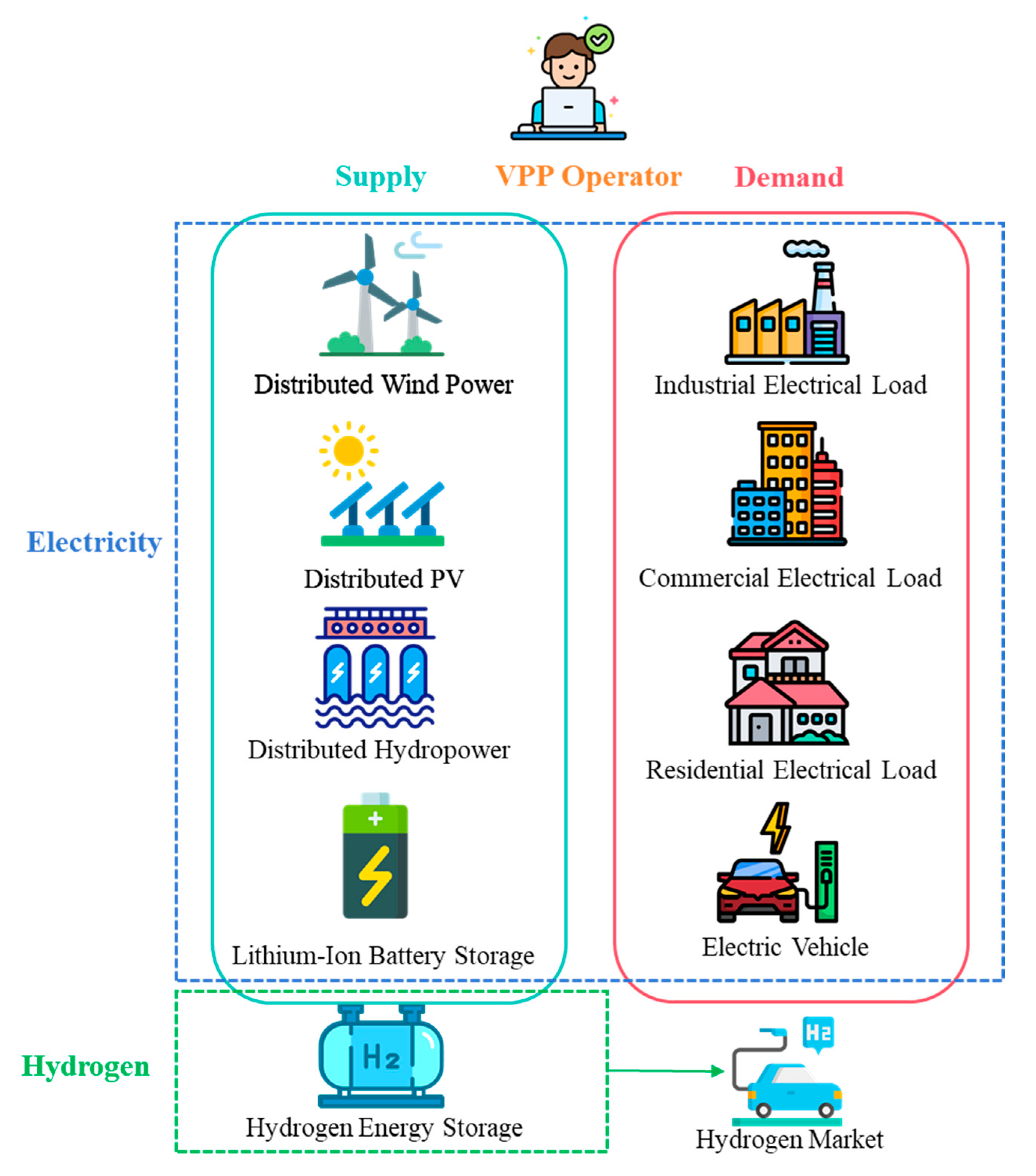
2.1. Architecture of the Electro–Hydrogen Coupled Virtual Power Plant
2.2. Modeling of the EHCVPP
2.2.1. Distributed Renewable Energy Generation
- (1)
- Distributed Wind Power Generation
- (2)
- Distributed Photovoltaic
2.2.2. Controllable Loads
- (1)
- Industrial Flexible Loads
- (2)
- Commercial Flexible Loads
- (3)
- Residential Flexible Loads
- (4)
- Electric Vehicles
2.2.3. Energy Storage System
3. Benefit Allocation Optimization Strategy for the EHCVPP
3.1. Benefit Allocation Influence Factor
3.1.1. Risk Loss
3.1.2. Economic Benefit
3.1.3. Environmental Benefit
3.2. Benefit Allocation Method
3.2.1. Conventional Shapley Value-Based Benefit Allocation Method
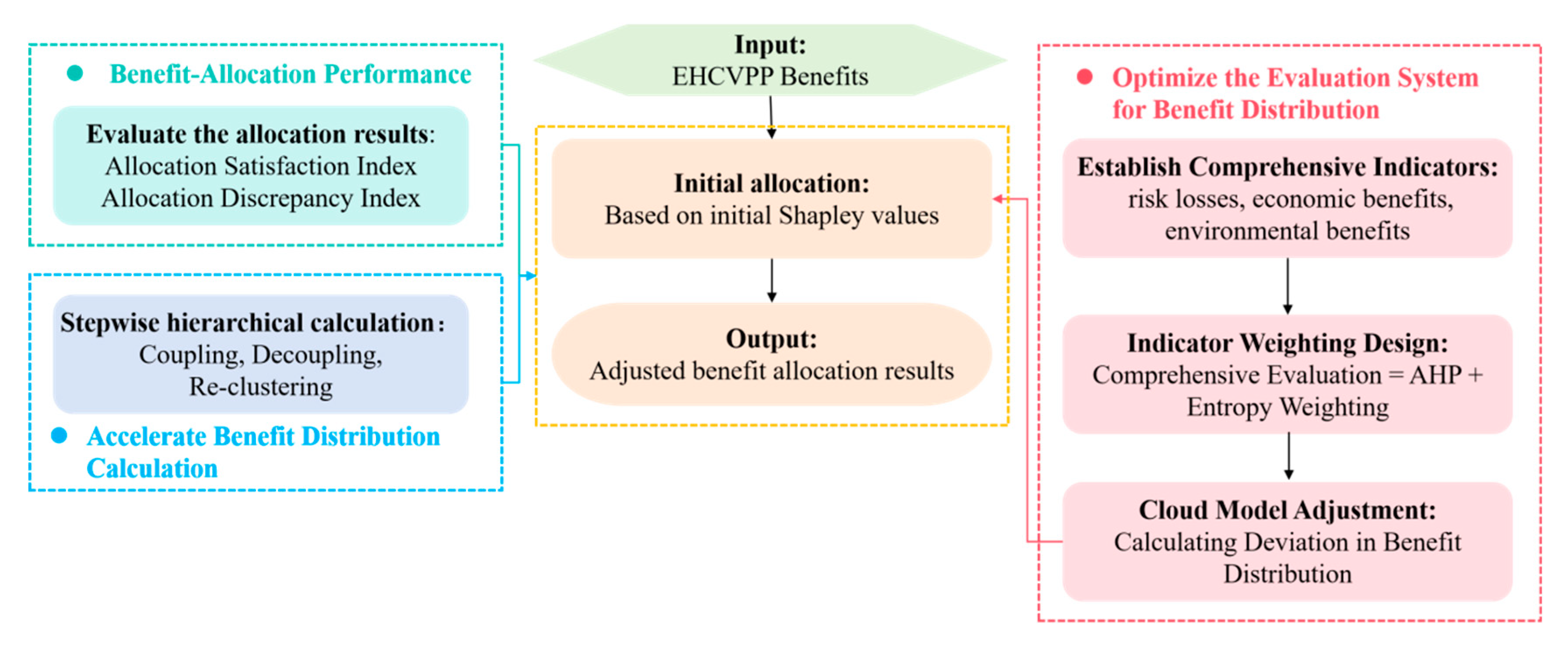
3.2.2. Modified Shapley Value-Based Benefit Allocation Method
- (1)
- AHP-based subjective weighting
- (2)
- Entropy-weight-based objective weighting
- (3)
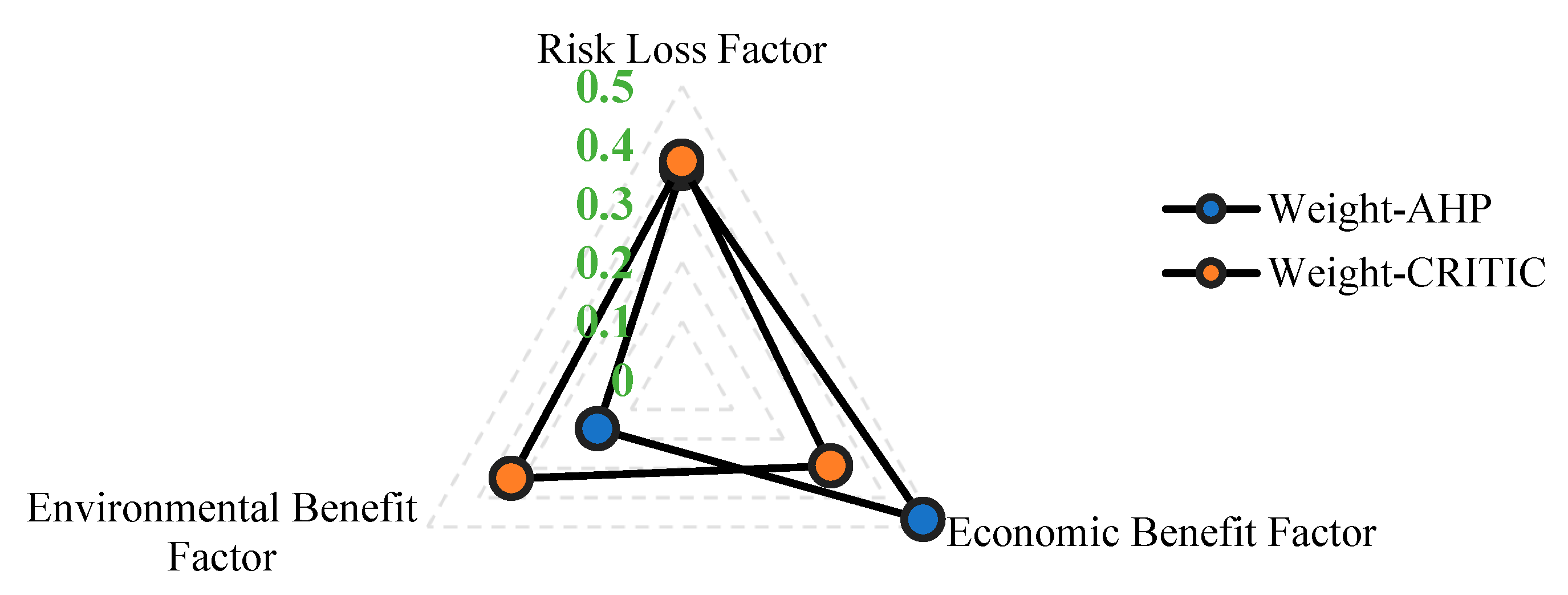
- Combined weighting
- (4)
- Determining the deviation degree via the cloud gravity-center method
- (5)
- Benefit allocation adjustment
3.2.3. Quantitative Model of Benefit Allocation Performance
- (1)
- Allocation Satisfaction Index
- (2)
- Allocation Discrepancy Index
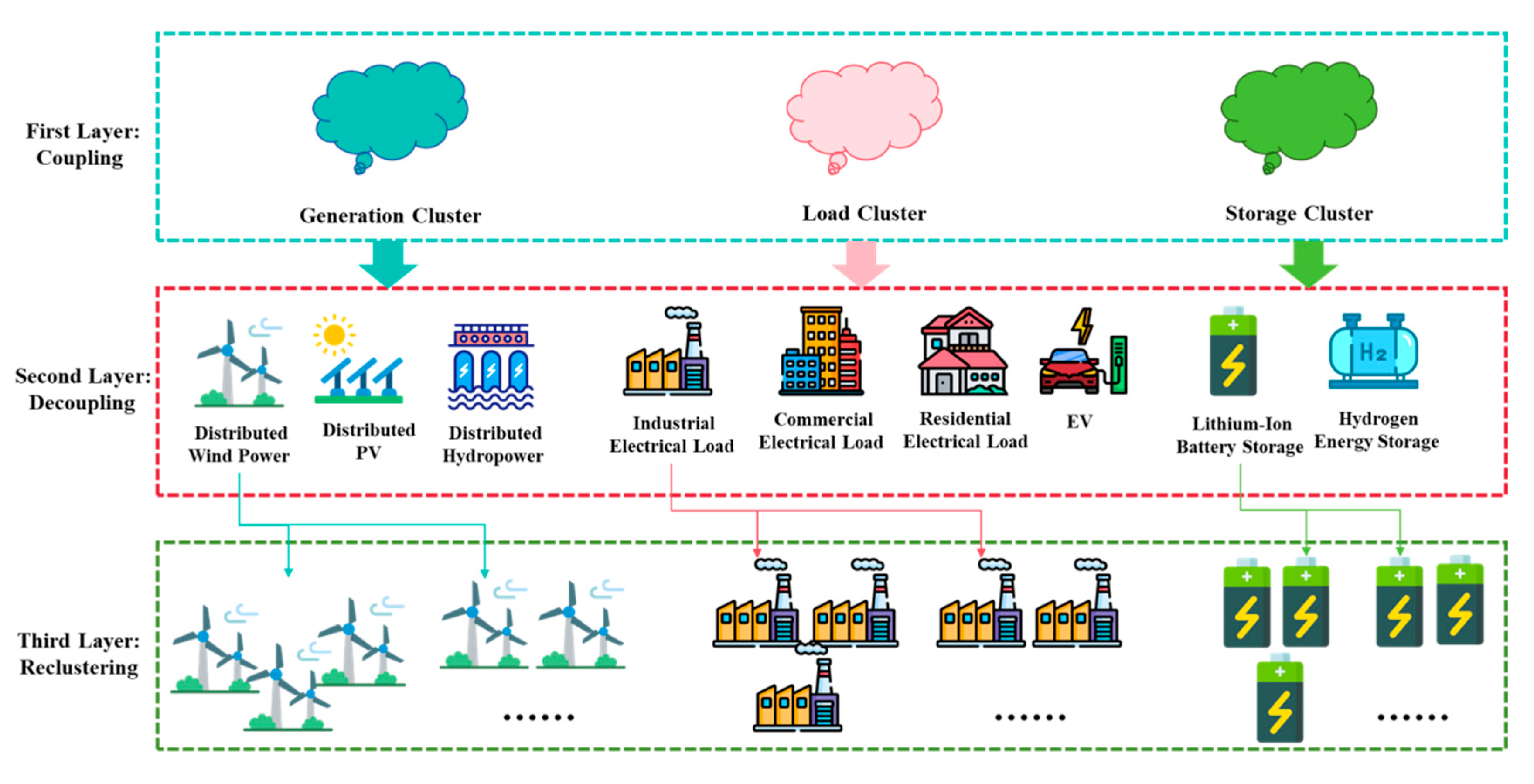
3.3. Benefit Allocation Computational Framework
- Coupling: Group highly homogeneous distributed resources into functional clusters, reducing the n-dimensional entity space to three dimensions: power source clusters, load clusters, and energy storage clusters.
- Decoupling: Further subdivide each functional cluster into “sub-clusters” based on technical attributes. For example, power source clusters are divided into distributed wind, solar, and hydro sub-clusters, expanding the dimensionality to a controllable k (k ≪ n).
- Re-clustering: Within each sub-cluster, use random sampling and clustering to aggregate similar units into meta-entities, compressing the dimensionality of each sub-cluster to m ≈ log2n.
4. Case Study
4.1. Basic Design
4.2. Computation of Benefit Allocation Deviation
4.2.1. First-Level Deviation
4.2.2. Second-Level Deviation
4.3. Benefit Allocation Results
4.3.1. First-Level Benefit Allocation Results
4.3.2. Second-Level Benefit Allocation Results
4.4. Benefit Allocation Performance Evaluation
5. Conclusions
- (1)
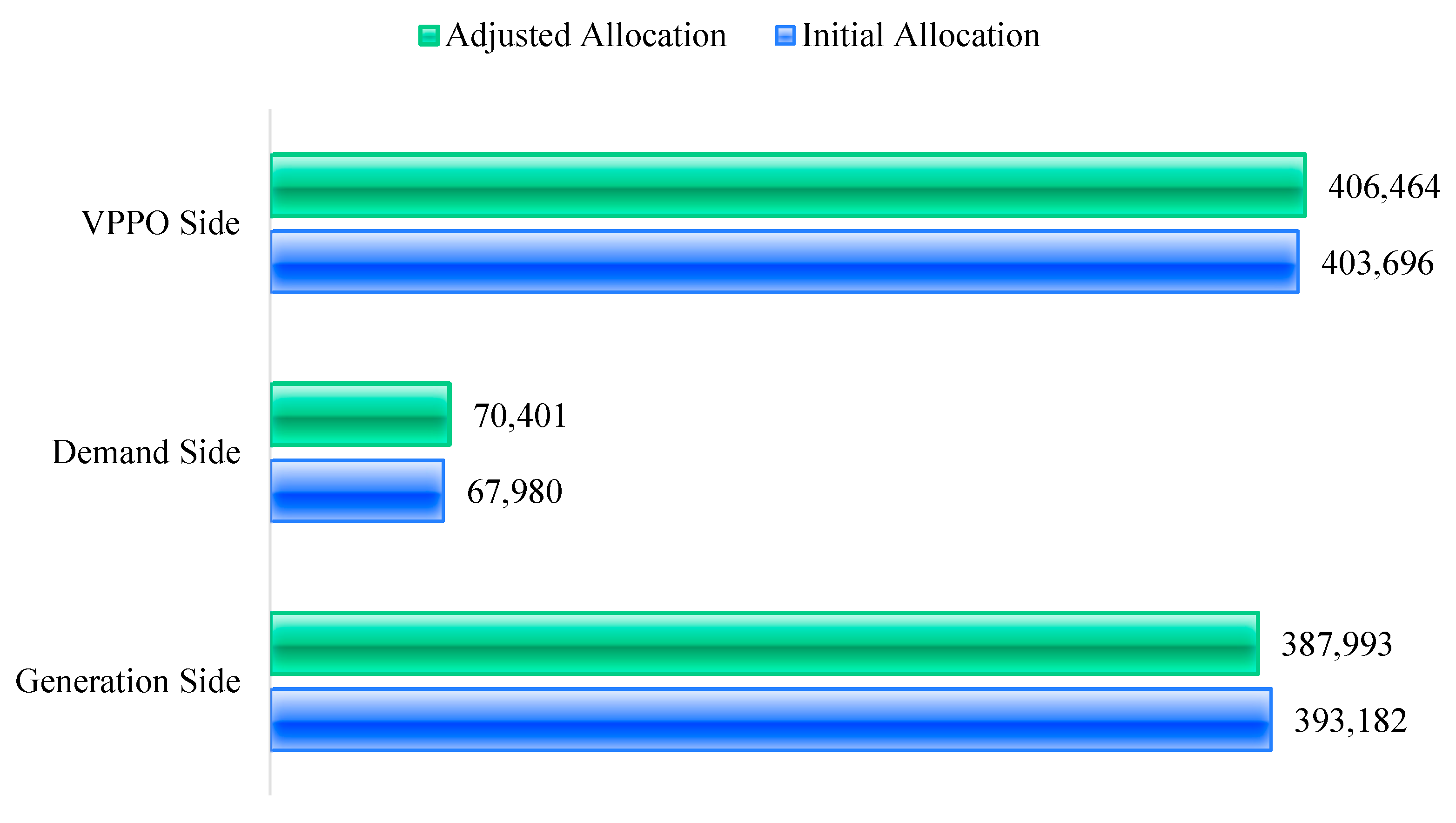
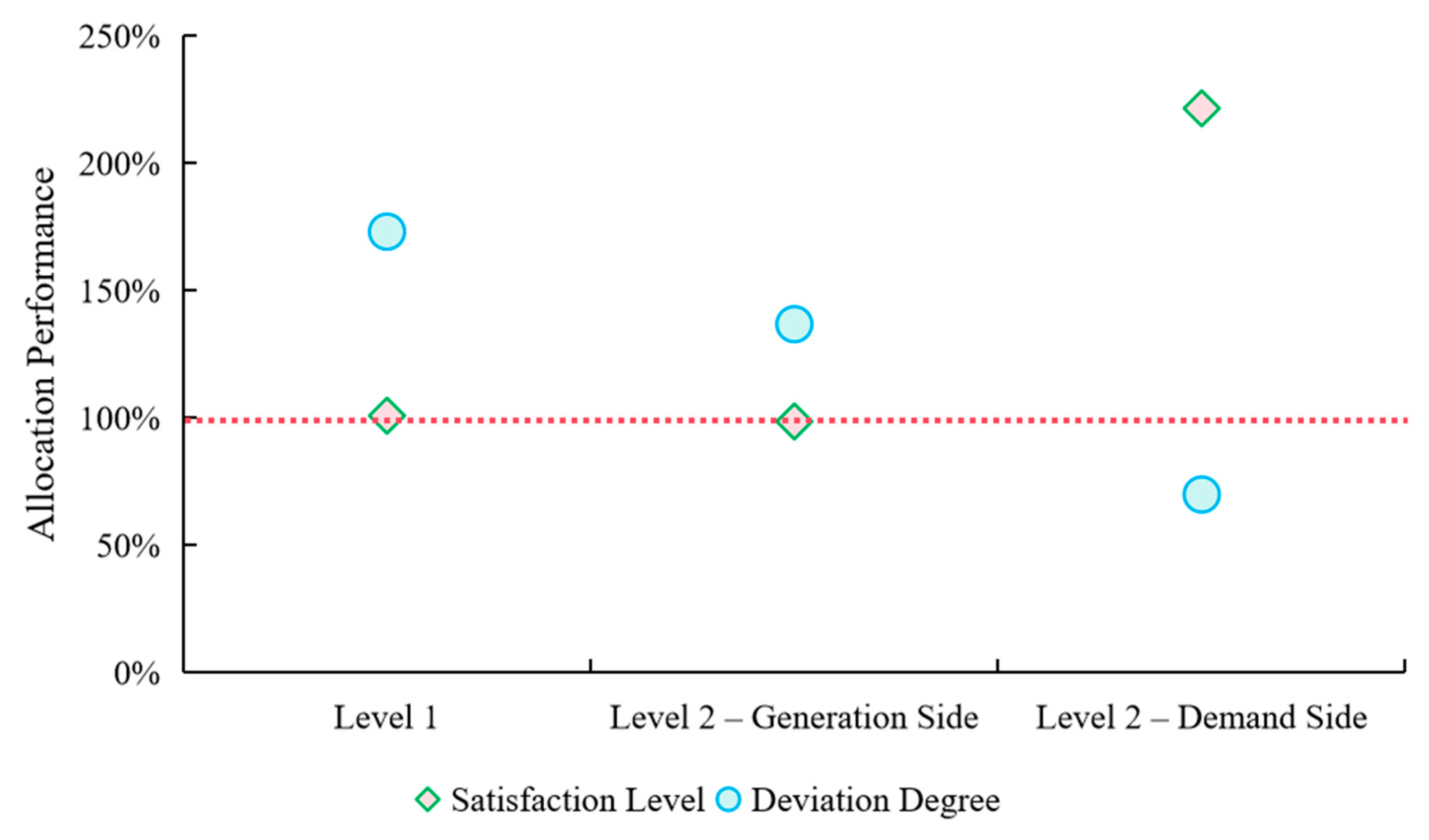
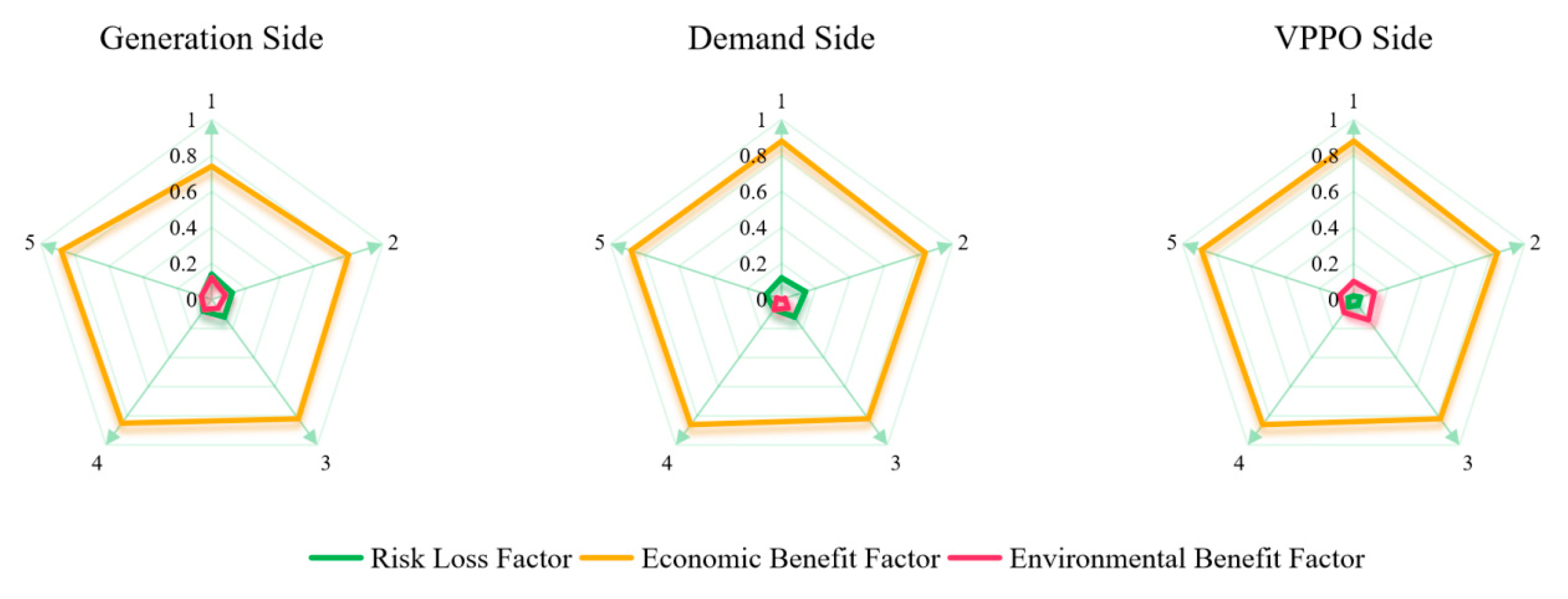
- After applying comprehensive factor adjustments, benefits shift from the generation side to the load side and EHCVPP operators. This stems from the generation side’s higher uncertainty relative to the load side, coupled with the lower weighting of green benefit gains compared to risk losses.
- (2)
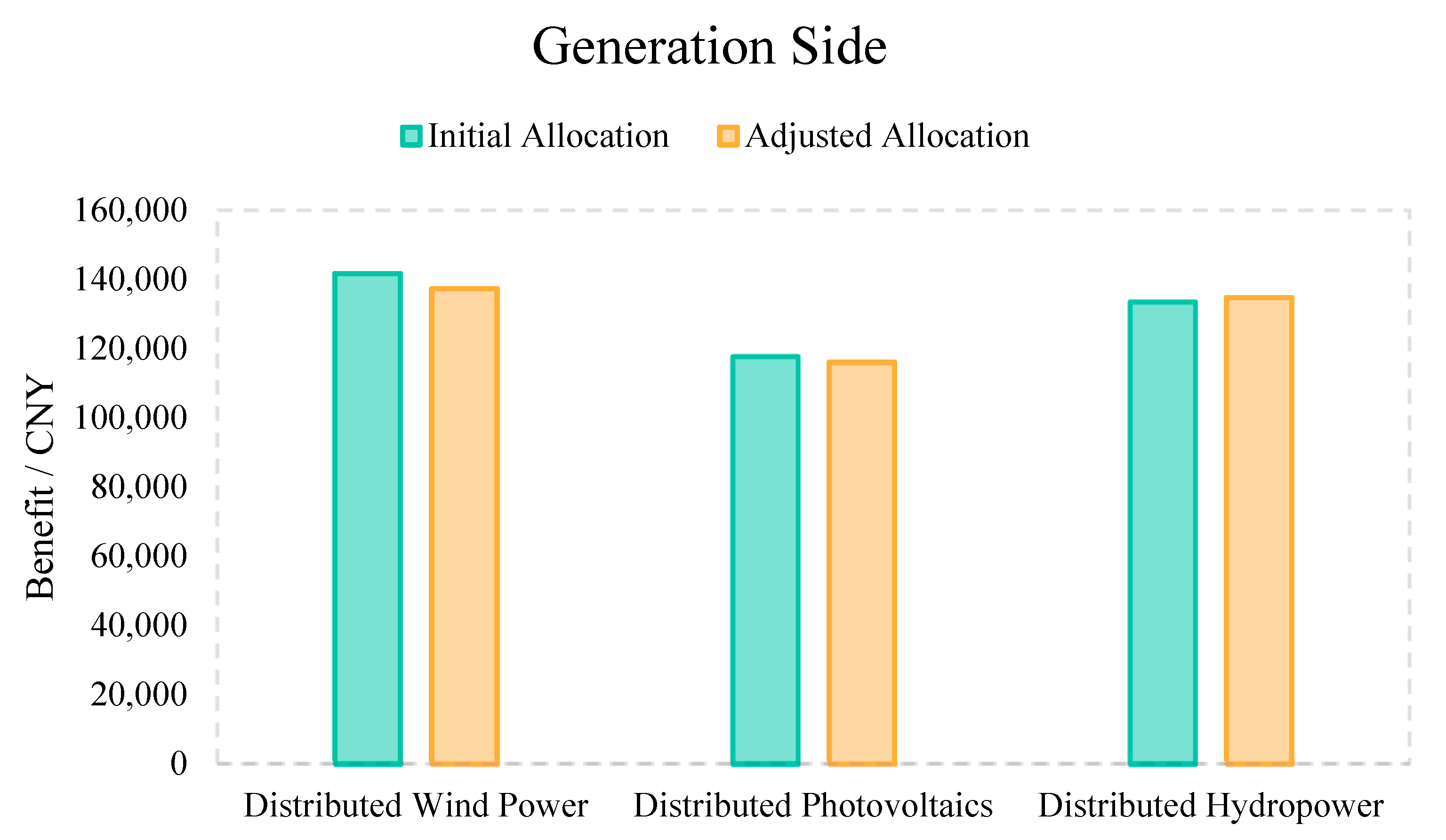
- After adjusting for comprehensive factors, benefit allocation tilts toward EHCVPP operators relative to power generation entities. This stems from EHCVPP operators’ lower probability of risk losses while matching power-focused entities in green environmental gains. For the second-tier power generation side, since all power sources are renewable, the environmental benefits in terms of green value are relatively similar. However, due to the significantly higher output uncertainty of wind and solar power compared to hydropower, a portion of the benefits from wind and solar power is transferred to hydropower.
- (3)
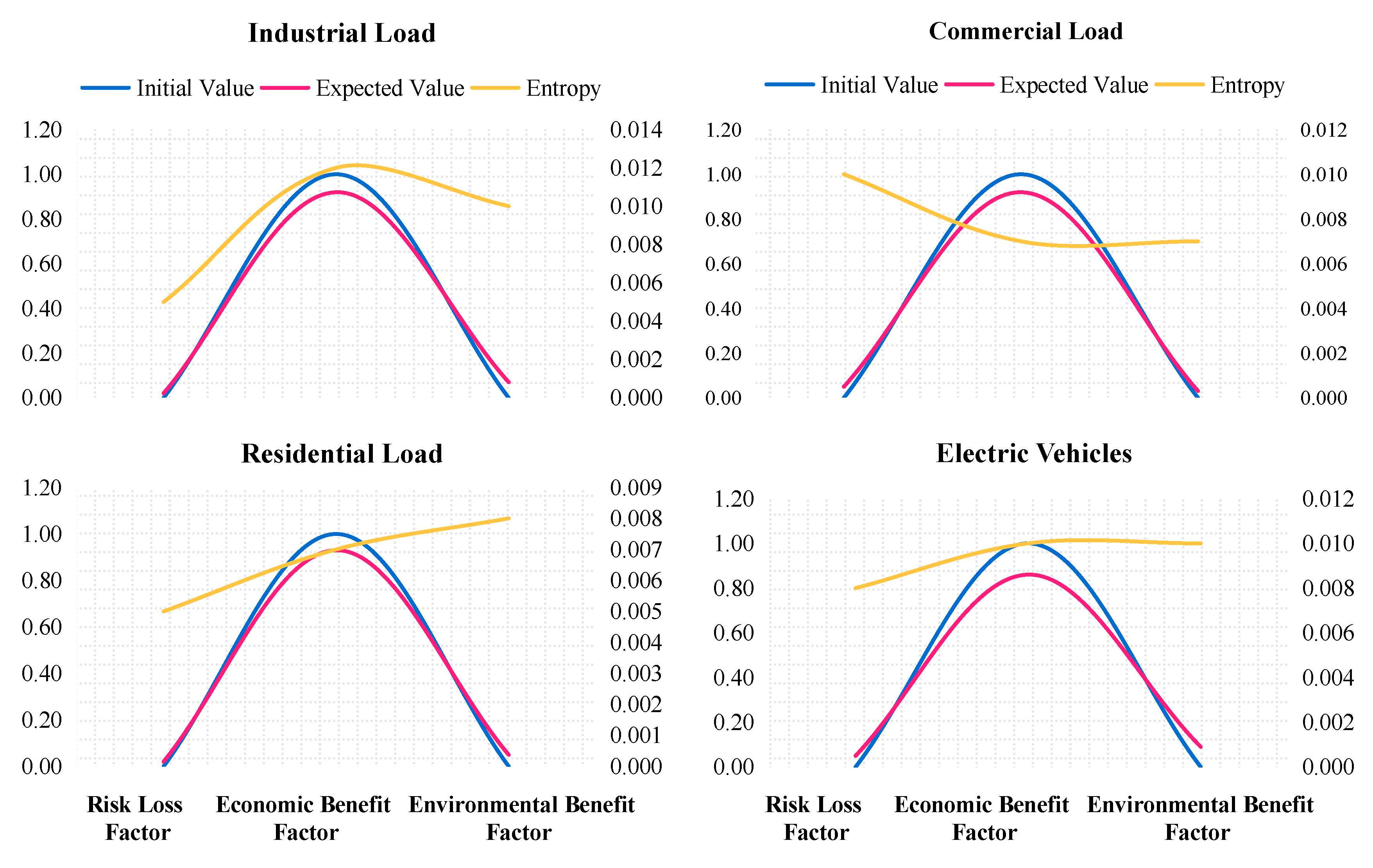
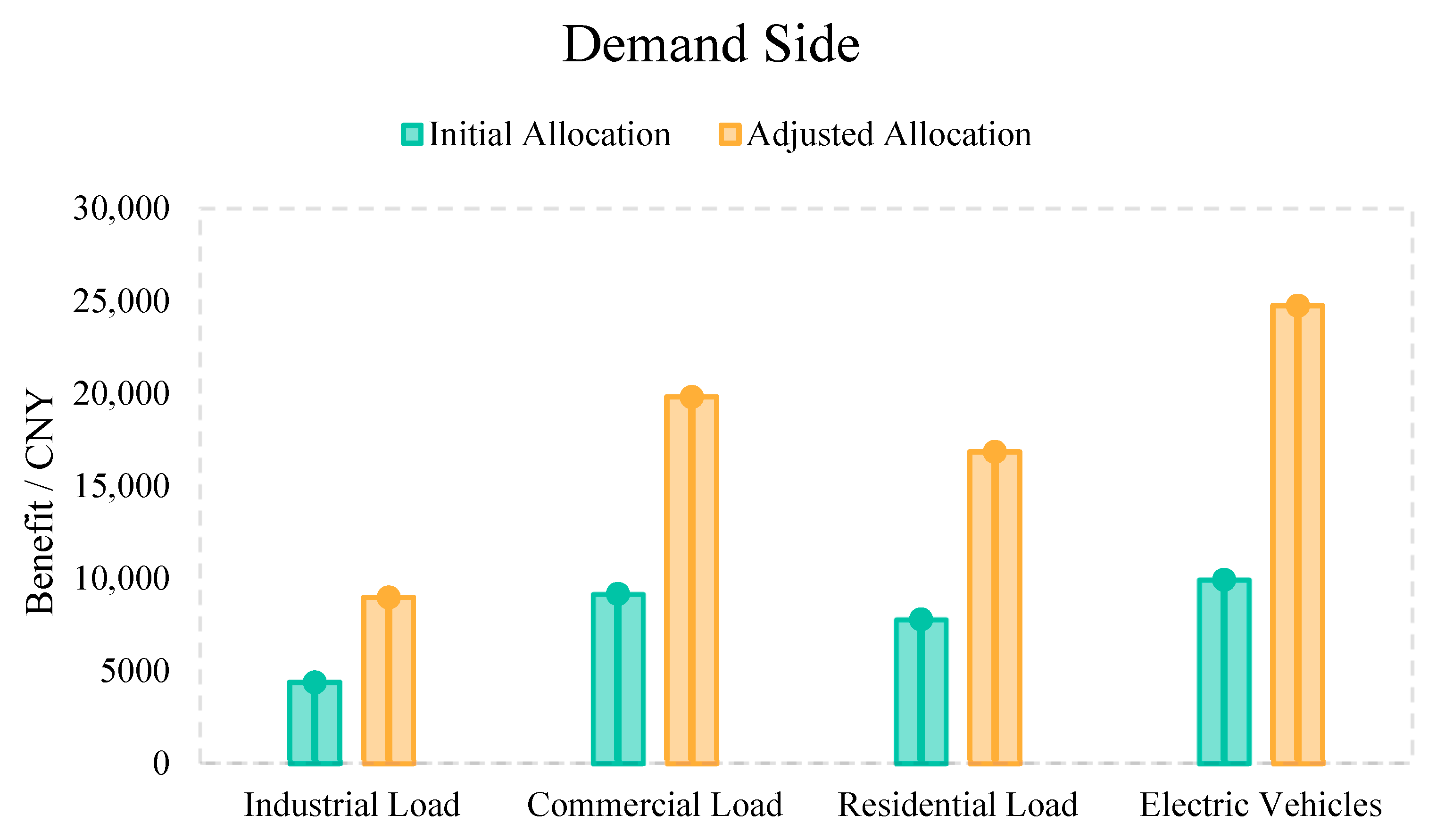
- Compared to the load side, EHCVPP operators possess higher green environmental value and lower risk loss probability. Therefore, benefits from the load side should be transferred to EHCVPP operators. For load-side entities in the second tier of load-based EHCVPPs, benefit distribution—considering risk and green benefit value-added—should be tilted toward electric vehicle loads from industrial, commercial, and residential loads.
Author Contributions
Funding
Institutional Review Board Statement
Informed Consent Statement
Data Availability Statement
Conflicts of Interest
References
- Lv, X.; Li, X.; Tan, Q.; Jia, D. Does coordination with renewable energy through virtual power plants enhance the transition willingness of coal-fired power plants? An evidence from city in China. Energy Econ. 2025, 148, 108675. [Google Scholar] [CrossRef]
- Mengshu, S.; Yuansheng, H. Research on investment planning of power-hydrogen system considering the multi-stakeholder benefit. Renew. Energy 2022, 199, 1408–1423. [Google Scholar] [CrossRef]
- Rego, N.; Castro, R.; Lagarto, J. Sustainable energy trading and fair benefit allocation in renewable energy communities: A simulation model for Portugal. Util. Policy 2025, 96, 101986. [Google Scholar] [CrossRef]
- Schmeidler, D. The Nucleolus of a Characteristic Function Game. Soc. Ind. Appl. Math. (SIAM) 1969, 17, 1163–1170. [Google Scholar] [CrossRef]
- Basilico, P.; Biancardi, A.; D’ADamo, I.; Gastaldi, M.; Yigitcanlar, T. Renewable energy communities for sustainable cities: Economic insights into subsidies, market dynamics and benefits distribution. Appl. Energy 2025, 389, 125752. [Google Scholar] [CrossRef]
- Ju, L.; Lv, S.; Zhang, Z.; Li, G.; Gan, W.; Fang, J. Data-driven two-stage robust optimization dispatching model and benefit allocation strategy for a novel virtual power plant considering carbon-green certificate equivalence conversion mechanism. Appl. Energy 2024, 362, 122974. [Google Scholar] [CrossRef]
- Bao, P.; Xu, Q.; Yang, Y.; Zhao, X. Cooperative game-based solution for power system dynamic economic dispatch considering uncertainties: A case study of large-scale 5G base stations as virtual power plant. Appl. Energy 2024, 368, 123463. [Google Scholar] [CrossRef]
- Li, N.; Lu, X.L.; Yang, S.B.; Li, F.; Xu, D.C. An optimized equilibrium-allocation model for the operational benefits of rural virtual power plants considering carbon recycling. Smart Power 2023, 51, 78–85, 107. [Google Scholar]
- He, Z.; Li, K.; Sun, Z.; Yan, Y.; Zhang, C. Optimal scheduling of multi-energy hubs considering carbon trading and its benefit allocation. Int. J. Green Energy 2024, 21, 904–918. [Google Scholar] [CrossRef]
- Li, J.; Chen, H.; Qi, Y.; Wang, Y.; Lei, J. Collaborative optimization for cross-regional integrated energy systems producing electricity-heat-hydrogen based on generalized Nash bargaining. Energy 2025, 333, 137444. [Google Scholar] [CrossRef]
- Mengshu, S.; Yuansheng, H.; Hongyu, L. Research on power to hydrogen optimization and profit distribution of microgrid cluster considering shared hydrogen storage. Energy 2023, 264, 126113. [Google Scholar] [CrossRef]
- Liang, W.; Wang, S.; Li, X.; Li, X.; Xu, K. Optimization method of low carbon park integrated energy system based on multi-agent game. Electr. Power Syst. Res. 2025, 243, 111484. [Google Scholar] [CrossRef]
- Machado, A.A.; Fiorotti, R.; Villaça, R.d.S.; Rocha, H.R. Profit distribution through blockchain solution from battery energy storage system in a virtual power plant using intelligence techniques. J. Energy Storage 2024, 98, 113150. [Google Scholar] [CrossRef]
- Tan, Z.-F.; Li, H.-H.; Ju, L.-W.; Tan, Q.-K. Joint Scheduling Optimization of Virtual Power Plants and Equitable Profit Distribution Using Shapely Value Theory. Math. Probl. Eng. 2018, 2018, 3810492. [Google Scholar] [CrossRef]
- Lao, J.; Qin, Z. A Modified Shapley Value Model for Equitable Benefit Distribution in Design-Led EPC Consortia. Buildings 2025, 15, 2024. [Google Scholar] [CrossRef]
- Matrenin, P.V.; Gamaley, V.V.; Khalyasmaa, A.I.; Stepanova, A.I. Solar Irradiance Forecasting with Natural Language Processing of Cloud Observations and Interpretation of Results with Modified Shapley Additive Explanations. Algorithms 2024, 17, 150. [Google Scholar] [CrossRef]
- Jia, H.P.; Guo, Y.C.; Yu, T.; Yang, J.; Huang, Y.P.; Liu, D.N. Revenue-allocation strategy for virtual power plants considering output deviation and risk control. Electr. Power Constr. 2024, 45, 27–36. [Google Scholar]
- Cheng, Y.Y.; Gao, H.J.; Wang, R.J.; Gao, Y.; Liu, J. Two-stage quasi-linear demand response optimization and benefit-sharing/risk-bearing decision-making for virtual power plants. Power Syst. Technol. 2024, 48, 799–809. [Google Scholar] [CrossRef]
- Fan, W.; Fan, Y.; Tan, Z.F.; Ju, L.; Yao, X. Distributionally robust optimization model for virtual power plants participating in electricity–carbon markets based on multi-layer benefit sharing. Syst. Eng. Theory Pract. 2024, 44, 661–683. [Google Scholar]
- Wu, D.F.; Xu, T.T.; Zhang, N.; Gao, Y.; Han, Y.; Zheng, C.; Wang, C. A multi-agent bi-level optimal dispatch method for park-level integrated energy systems based on carbon trading and Stackelberg game. Power Big Data 2024, 27, 9–18. [Google Scholar] [CrossRef]
- Shang, Y.; Li, X.; Xu, T.; Cui, L. Uncertainty-output virtual power plant participates in multi-electricity market considering the improved Shapley value distribution method. Int. J. Electr. Power Energy Syst. 2025, 165, 110462. [Google Scholar] [CrossRef]
- Fan, H.; Li, M.; Zhang, Z.; Cheng, L.; Ye, Y.; Liu, W.; Liu, D. M2WLLM: Multi-modal multi-task ultra-short-term wind power prediction algorithm based on large language model. Inf. Fusion 2025, 126, 103541. [Google Scholar] [CrossRef]
- Kihel, E.B.; Elyamani, K.E.E.N.; Chillali, A. Evaluation of Weibull parameters for wind energy analysis in the eastern region of the Kingdom of Morocco. Wind Eng. 2024, 48, 687–707. [Google Scholar] [CrossRef]
- Li, X.; Wen, H.; Hu, Y.; Jiang, L.; Xiao, W. Modified Beta Algorithm for GMPPT and Partial Shading Detection in Photovoltaic Systems. IEEE Trans. Power Electron. 2018, 33, 2172–2186. [Google Scholar] [CrossRef]
- Fatima, S.; Bashir, A.A.; Jokinen, I.; Lehtonen, M.; Pourakbari-Kasmaei, M. Synchronizing flexible loads with wind energy via Stackelberg game for renewable integration and economic efficiency. Appl. Energy 2025, 397, 126398. [Google Scholar] [CrossRef]
- Ma, Z.; Cui, S.; Chen, J. Demand response through ventilation and latent load adjustment for commercial buildings in humid climate zones. Appl. Energy 2024, 373, 123940. [Google Scholar] [CrossRef]
- Cao, W.; Liu, H.; Zhang, X.; Zeng, Y.; Ling, X. Short-Term Residential Load Forecasting Based on the Fusion of Customer Load Uncertainty Feature Extraction and Meteorological Factors. Sustainability 2025, 17, 1033. [Google Scholar] [CrossRef]
- Ramalingeswar, J.T.; Subramanian, K. A novel energy management strategy to reduce gird dependency usingelectric vehicles storage in coordination with solar power. J. Intell. Fuzzy Syst. 2021, 41, 2207–2223. [Google Scholar]
- Shi, M.; Vasquez, J.C.; Guerrero, J.M.; Huang, Y. Smart communities—Design of integrated energy packages considering incentive integrated demand response and optimization of coupled electricity-gas-cooling-heat and hydrogen systems. Int. J. Hydrogen Energy 2023, 48, 31063–31077. [Google Scholar] [CrossRef]
- Vega, L.D.L.C.; Urrutia, A.; Volij, O. An axiomatic characterization of the Theil inequality ordering. Econ. Theory 2013, 54, 757–776. [Google Scholar] [CrossRef]
- Qin, S.W. Application of Shapley Value Method in Profits Allocation of Cooperation of Enterprises, Colleges and Institutes. Appl. Mech. Mater. 2010, 40, 425–429. [Google Scholar] [CrossRef]
- Malinić, V.; Durlević, U.; Brašanac-Bosanac, L.; Novković, I.; Joksimović, M.; Golić, R.; Krstić, F. A Hybrid Fuzzy AHP–MULTIMOORA Approach for Solar Energy Development on Rural Brownfield Sites in Serbia. Sustainability 2025, 17, 7988. [Google Scholar] [CrossRef]
- Ma, Y.; Huang, D.; Wang, Y. A risk classification method for contract performance based on G1-improved entropy weight two-dimensional cloud model. Int. J. Model. Simul. Sci. Comput. 2025, 2550056. [Google Scholar] [CrossRef]
- Xu, X.; Gu, X.; Huang, W.; Liu, S.; Zhang, X.; Zhang, J.; Xu, B. A cloud-based intelligent reconstruction method for low-sampling-rate signals in remote condition monitoring of hydraulic pumps. Expert Syst. Appl. 2025, 294, 128758. [Google Scholar] [CrossRef]





| Energy Storage Technology | Response Speed | Energy Density | Efficiency | Cycle Life/Cycles | Cost/RMB kW−1 | Application Scenario |
|---|---|---|---|---|---|---|
| Pumped-hydro storage | Seconds–minutes | Very Low | 75–85 | >10,000 | 1000–6000 | Large-scale Energy Storage /Peak Shaving and Valley Filling /Enhance Power Supply Reliability |
| Lithium-ion battery | Milliseconds | Very High | 90–100 | 2000–3000 | 2000–3000 | Standby /Frequency regulation /Enhance Power Supply Reliability |
| Lead–acid battery | Milliseconds | High | 60–95 | 2500–3000 | 500–1000 | Standby /Frequency regulation /Enhance Power Supply Reliability |
| Compressed-air energy storage | Seconds–minutes | Moderately Low | 80 | >10,000 | 3000–4000 | Peak Shaving and Valley Filling /Improve Power Supply Reliability |
| Thermal energy storage | Seconds–minutes | Moderate | 50–90 | >10,000 | 500–4000 | Peak shaving and valley filling/renewable energy accommodation |
| Hydrogen energy storage | Seconds | Moderately High | 25–85 | 1000 | 20,000–50,000 | Renewable energy integration and seasonal energy storage |
| Type | Time Period | Price |
|---|---|---|
| Peak period | 10:00–15:00; 18:00–21:00 | 1.03 CNY/kWh |
| Off-peak period | 07:00–10:00; 15:00–18:00; 21:00–23:00 | 0.70 CNY/kW |
| Valley period | 21:00–07:00 | 0.33 CNY/kW |
| Certificate Type | Wind-Power Green Certificate | PV-Power Green Certificate | Hydro-Power Green Certificate |
|---|---|---|---|
| Maximum price | 84.17 | 50.00 | 33.67 |
| Minimum price | 37.20 | 30.00 | 14.88 |
| Average price | 50.48 | 41.15 | 20.19 |
Disclaimer/Publisher’s Note: The statements, opinions and data contained in all publications are solely those of the individual author(s) and contributor(s) and not of MDPI and/or the editor(s). MDPI and/or the editor(s) disclaim responsibility for any injury to people or property resulting from any ideas, methods, instructions or products referred to in the content. |
© 2025 by the authors. Licensee MDPI, Basel, Switzerland. This article is an open access article distributed under the terms and conditions of the Creative Commons Attribution (CC BY) license (https://creativecommons.org/licenses/by/4.0/).
Share and Cite
Liu, Q.; Zhao, Y.; Wu, W.; Zhai, Z.; Shi, M.; Cai, Y. Benefit Allocation Strategies for Electric–Hydrogen Coupled Virtual Power Plants with Risk–Reward Tradeoffs. Sustainability 2025, 17, 9861. https://doi.org/10.3390/su17219861
Liu Q, Zhao Y, Wu W, Zhai Z, Shi M, Cai Y. Benefit Allocation Strategies for Electric–Hydrogen Coupled Virtual Power Plants with Risk–Reward Tradeoffs. Sustainability. 2025; 17(21):9861. https://doi.org/10.3390/su17219861
Chicago/Turabian StyleLiu, Qixing, Yuzhu Zhao, Wenzu Wu, Zhe Zhai, Mengshu Shi, and Yuanji Cai. 2025. "Benefit Allocation Strategies for Electric–Hydrogen Coupled Virtual Power Plants with Risk–Reward Tradeoffs" Sustainability 17, no. 21: 9861. https://doi.org/10.3390/su17219861
APA StyleLiu, Q., Zhao, Y., Wu, W., Zhai, Z., Shi, M., & Cai, Y. (2025). Benefit Allocation Strategies for Electric–Hydrogen Coupled Virtual Power Plants with Risk–Reward Tradeoffs. Sustainability, 17(21), 9861. https://doi.org/10.3390/su17219861