Smart, Connected, and Sustainable: The Transformation of Maritime Ports Through Electrification, IoT, 5G, and Green Energy

 , and
, and 
Abstract
1. Introduction
- Energy and environmental challenges (comprehensive scope);
- Technological approaches (including emerging technologies);
- Operational strategies (efficiency measures and practices);
- Modern port infrastructure (charging stations, microgrids, smart systems);
- Integration of emerging technologies (IoT, EMS, 5G).
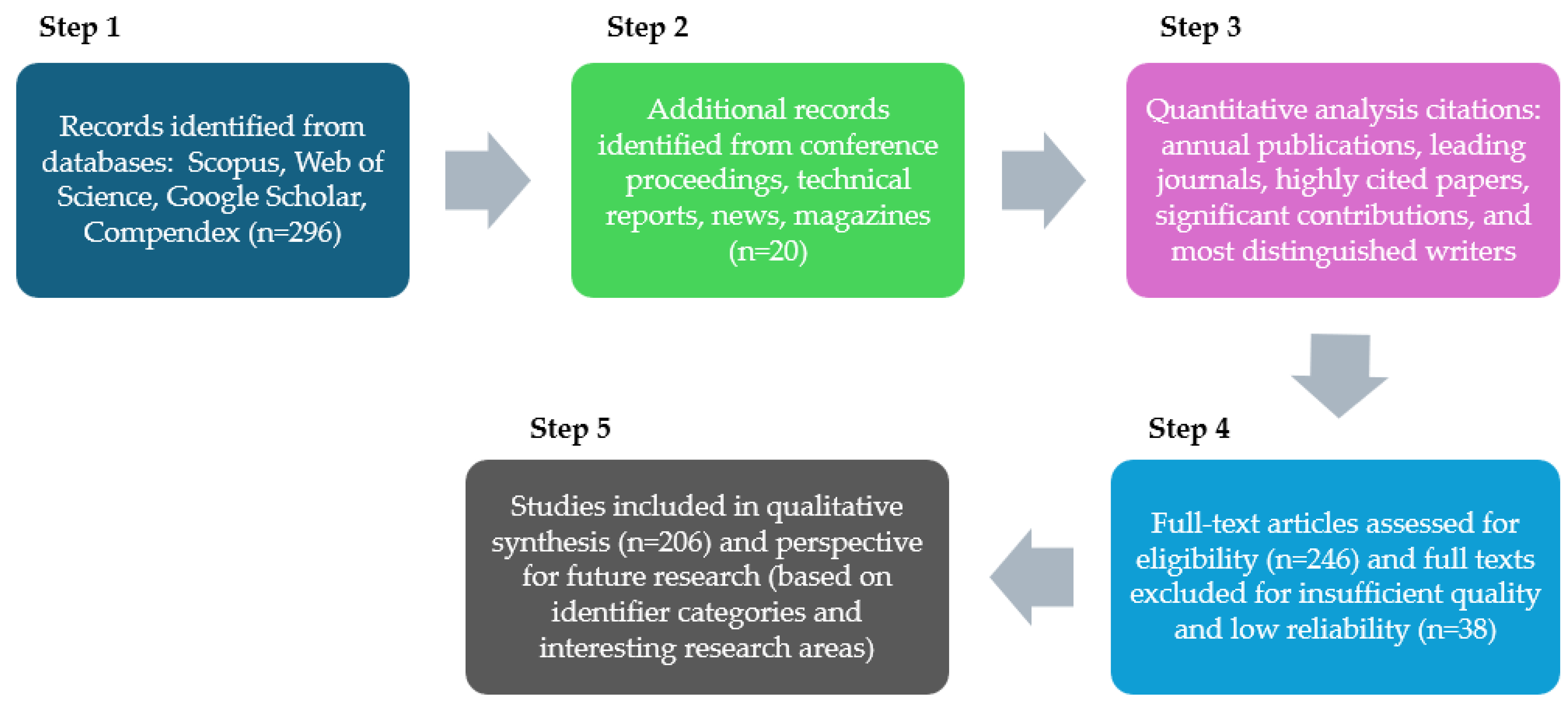
2. Research Methodology
3. The Challenges That Modern Ports Face
3.1. Environmental Issues
3.2. Legislative and Regulatory
- Plan: Create an action plan, goals, and performance metrics after establishing an energy baseline through audits.
- Do: Put certain technological or operational measures into action.
- Verify: Keep an eye on operations and procedures that affect energy performance.
- Act: Take calculated actions to guarantee ongoing progress.
- Cost savings related to potential upgrades for the consumption of energy savings in their entity.
- Priority scales for energy factors that facilitate the identification of those that require more thorough analysis.
- Identification of which of the company’s staff members may exhibit higher energy usage behavior.
3.3. Improved Energy Efficiency
- Ensuring reliable energy supply;
- Implementing cutting-edge communication systems;
- Ensuring environmental sustainability;
- Addressing grid stability and power quality issues;
- Controlling energy expenses.
3.4. Integrating Renewable Energy Sources
- Improved land utilization;
- Reduced project development costs;
- Cost-effective distribution evacuation;
- Supplementary production of energy;
- Cost-sharing for operations and maintenance.
4. Technologies and Energy Efficiency Strategies
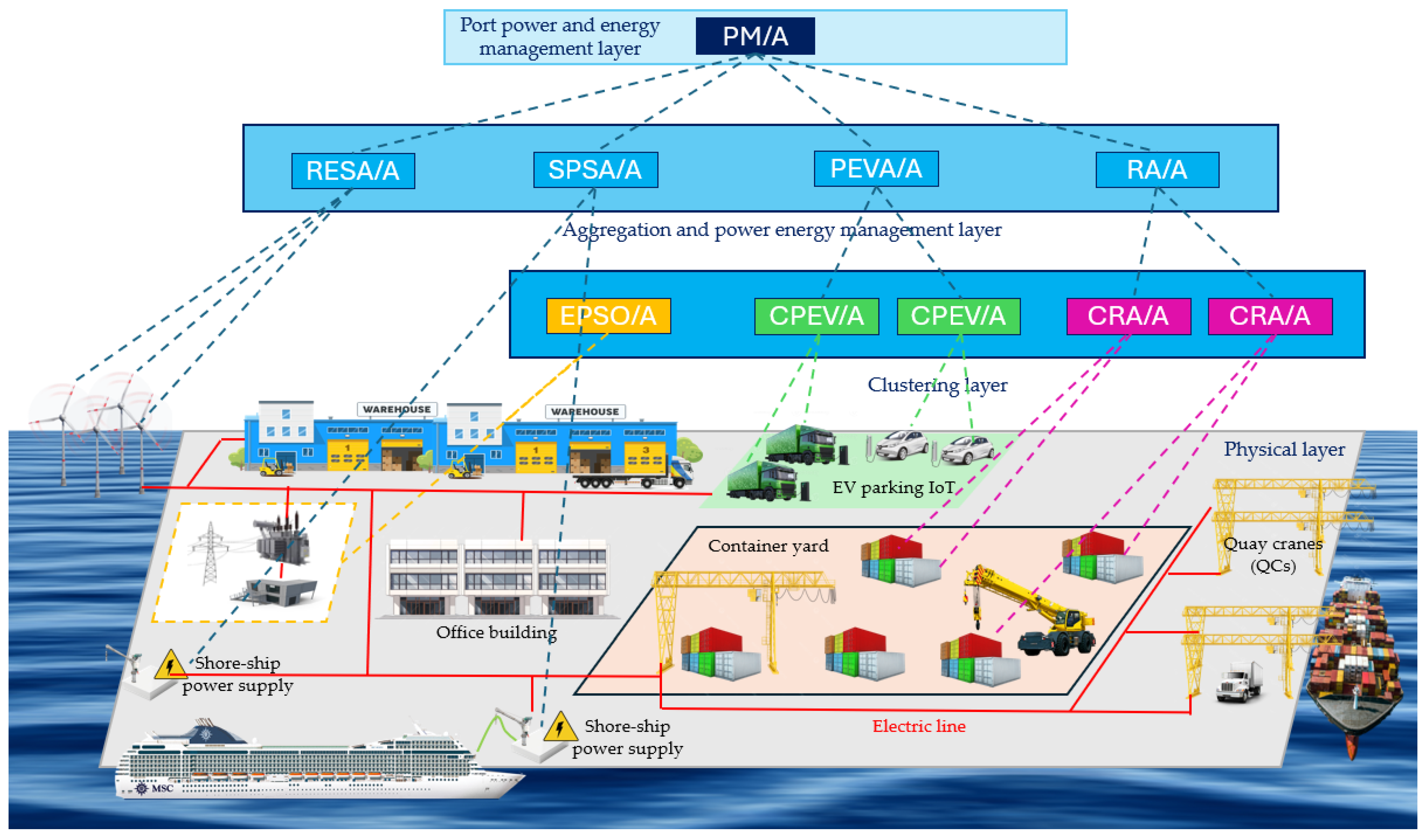
4.1. MAS-Based Energy Management
4.2. Electrification
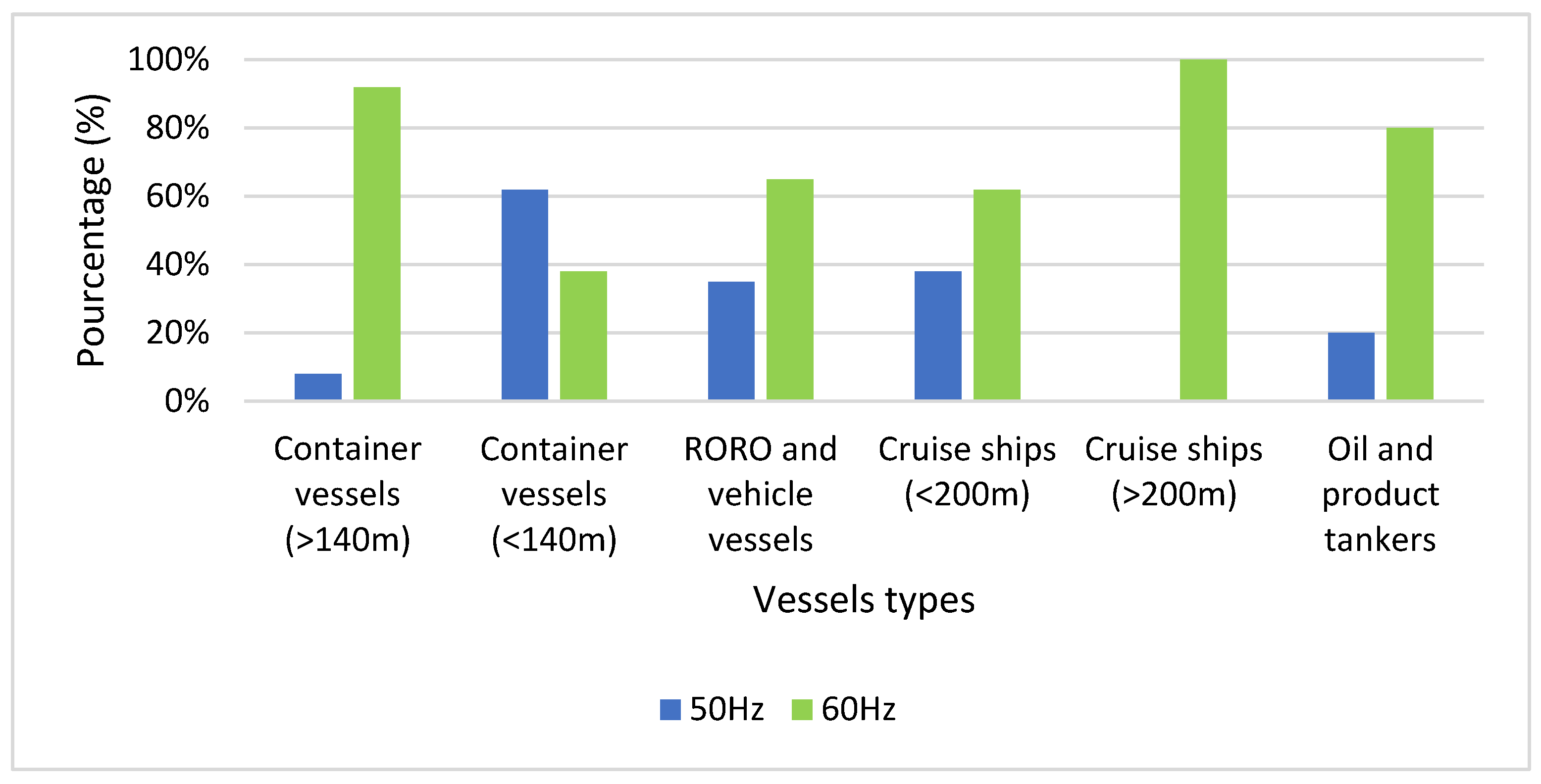
4.3. Onshore Power Supply (OPS)
4.4. Digitalization
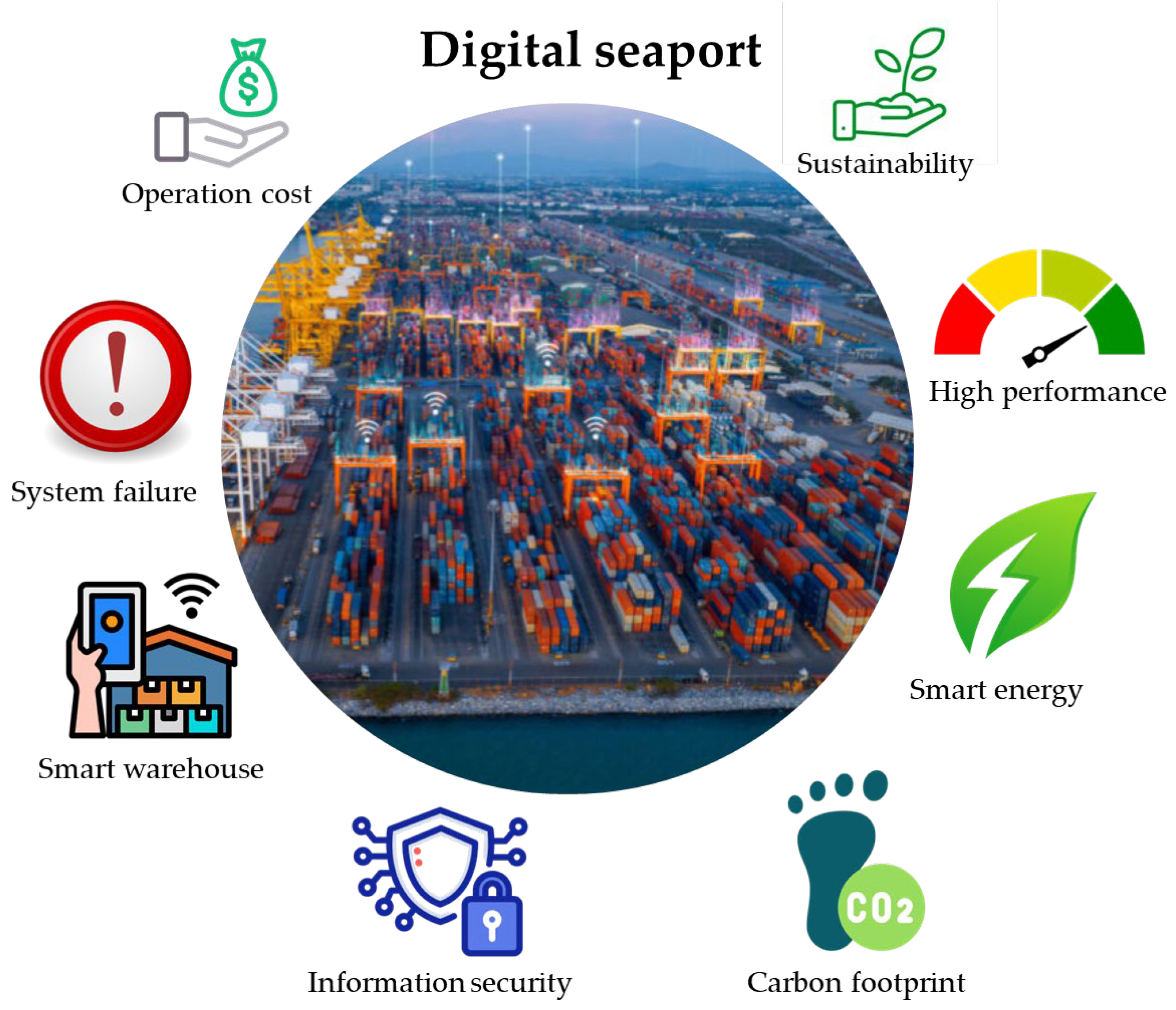
- Operation cost: Represented by the hand and dollar sign, this highlights the importance of cost-effectiveness, both in capital and operating expenditures. Smart port systems must balance investment with long-term financial returns.
- Sustainability: Denoted by the plant symbol, sustainability underscores the growing demand for environmentally friendly operations through reduced emissions, noise, and resource consumption.
- Smart energy: Indicated by the green energy leaf icon, this reflects the necessity of optimizing energy use, especially by shifting from diesel to electric systems and integrating renewable sources.
- Carbon footprint: The CO2 footprint icon stresses the environmental imperative to reduce greenhouse gas emissions, aligning port operations with international climate targets.
- Information security: Highlighted by the shield and lock symbol, this acknowledges that increased digitalization requires robust cybersecurity frameworks to safeguard critical infrastructure.
- Smart warehouse: The mobile-device icon represents the deployment of digital tools and automated systems for real-time decision-making, improved asset utilization, and predictive maintenance.
- System failure: Illustrated by the warning symbol, this acknowledges the operational uncertainties associated with system complexity, technology integration, and supply chain disruptions.
- High performance: The colored gauge indicates the continuous need to monitor and enhance key performance indicators (KPIs) such as throughput, dwell time, and fleet utilization.
4.5. Energy Storage Systems (ESSs) in Seaports
4.6. Peak-Shaving
4.7. Energy-Aware Operational Management
5. Modern Seaport Infrastructure
5.1. Seaport Microgrids
5.2. Smart Port Microgrids
5.3. Charging Stations in Smart Seaports for Electrical Vehicles and Hybrid Ferry Vessels
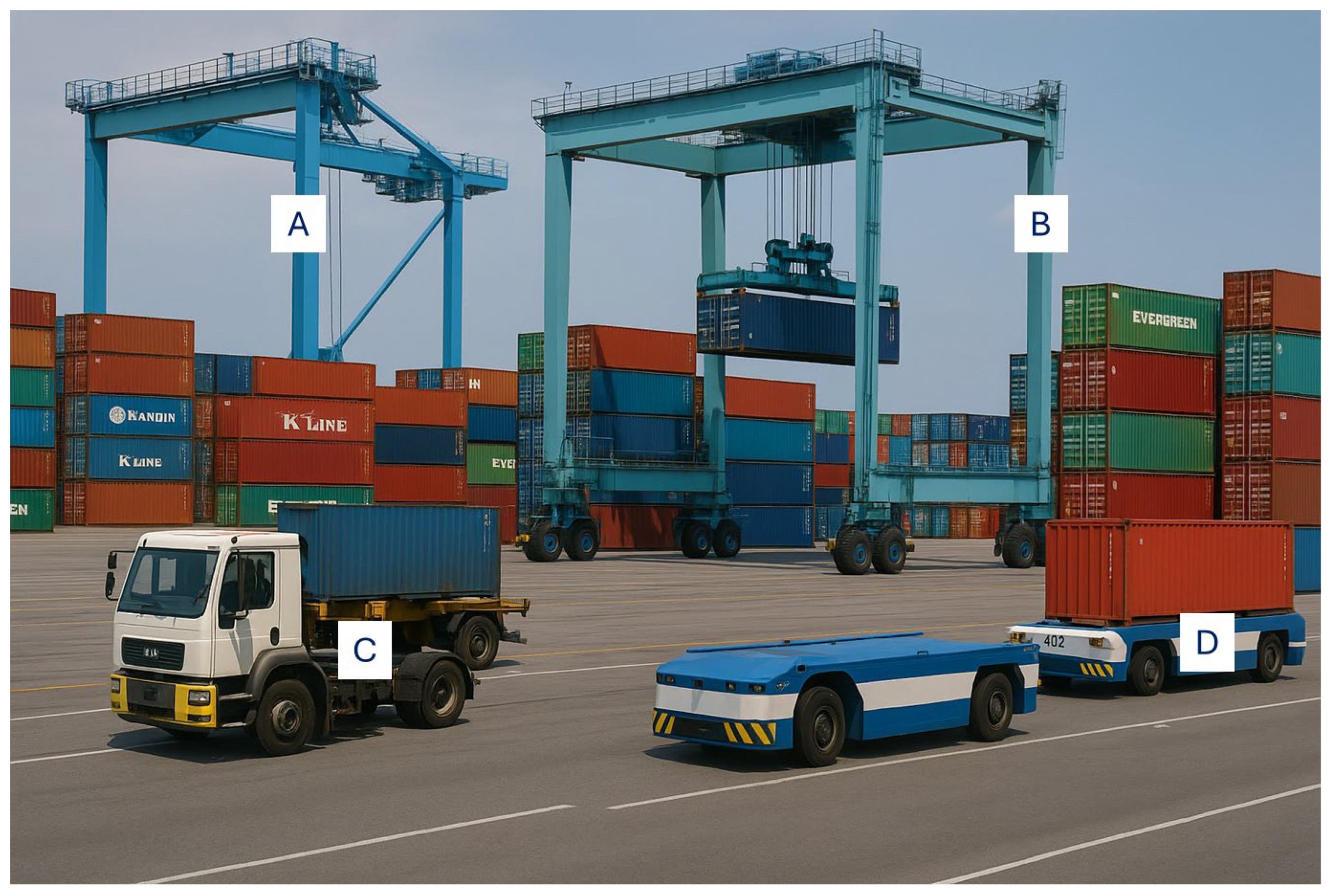
5.4. Hybrid Options for Modern Seaport Equipment
6. Modern Technologies in Leading Global Seaports
6.1. IoT Applications in Contemporary Seaports
6.2. The Use of 5G Services in Contemporary Seaports
6.3. The Socio-Economic Impact of 5G in Maritime Ports
6.4. Job Displacement and Workforce Transformation
6.5. Real-World 5G Deployments in Modern Ports and Lessons Learned
7. Discussion
7.1. Significant Achievements and Technological Progress
7.2. Emerging Synergetic Opportunities and Integration Potential
7.3. Integration Gaps and Implementation Challenges
7.4. Economic Validation and Investment Challenges
7.5. Social Transformation and Workforce Development Opportunities
7.6. Regulatory and Standardization Vacuum
7.7. Future Research Imperatives
8. Conclusions
Author Contributions
Funding
Data Availability Statement
Conflicts of Interest
References
- UNTACD. Review of Maritime Transport 2024. Available online: https://unctad.org/publication/review-maritime-transport-2024 (accessed on 13 December 2024).
- Issa, M.; Ilinca, A.; Martini, F. Ship energy efficiency and maritime sector initiatives to reduce carbon emissions. Energies 2022, 15, 7910. [Google Scholar] [CrossRef]
- 2023 IMO Strategy on Reduction of GHG Emissions from Ships. Available online: https://www.imo.org/en/OurWork/Environment/Pages/2023-IMO-Strategy-on-Reduction-of-GHG-Emissions-from-Ships.aspx (accessed on 13 December 2024).
- The Associated Press (AP). Head of International Shipping Regulator Says Industry Must Do More to Cut Carbon Pollution. 2024. Available online: https://apnews.com/article/international-shipping-greenhouse-gas-emissionsinternational-maritime-organization-933147f1bba7f4851134f128b07e6917 (accessed on 13 December 2024).
- Hossain, T.; Adams, M.; Walker, T.R. Role of sustainability in global seaports. Ocean. Coast. Manag. 2021, 202, 105435. [Google Scholar] [CrossRef]
- Bali, S.; Thangalakshmi, S.; Balaji, R. Renewable energy options for seaports. In Proceedings of the OCEANS 2022-Chennai, Chennai, India, 21–24 February 2022; IEEE: New York, NY, USA, 2022; pp. 1–6. [Google Scholar]
- Iris, Ç.; Lam, J.S.L. A review of energy efficiency in ports: Operational strategies, technologies and energy management systems. Renew. Sustain. Energy Rev. 2019, 112, 170–182. [Google Scholar] [CrossRef]
- Hoang, A.T.; Foley, A.M.; Nižetić, S.; Huang, Z.; Ong, H.C.; Ölçer, A.I.; Nguyen, X.P. Energy-related approach for reduction of CO2 emissions: A critical strategy on the port-to-ship pathway. J. Clean. Prod. 2022, 355, 131772. [Google Scholar] [CrossRef]
- Xiao, G.; Wang, Y.; Wu, R.; Li, J.; Cai, Z. Sustainable maritime transport: A review of intelligent shipping technology and green port construction applications. J. Mar. Sci. Eng. 2024, 12, 1728. [Google Scholar] [CrossRef]
- Mi, J.J.; Wang, Y.; Zhang, N.; Zhang, C.; Ge, J. A Bibliometric Analysis of Green Shipping: Research Progress and Challenges for Sustainable Maritime Transport. J. Mar. Sci. Eng. 2024, 12, 1787. [Google Scholar] [CrossRef]
- Darbra Roman, R.M.; Wooldridge, C.; Puig Duran, M. ESPO Environmental Report 2020-EcoPortsinsights 2020; Universitat Politècnica de Catalunya—BarcelonaTech: Barcelona, Spain, 2020. [Google Scholar]
- Sugimura, Y. Climate Change Countermeasures in Ports Toward Carbon Neutrality; Springer Nature: Cham, Switzerland, 2023. [Google Scholar] [CrossRef]
- Bielenia, M.; Dubisz, D.; Czermański, E. Methodological introduction to the carbon footprint evaluation of intermodal transport. Front. Environ. Sci. 2023, 11, 1237763. [Google Scholar] [CrossRef]
- Alamoush, A.S.; Ballini, F.; Ölçer, A.I. Ports’ technical and operational measures to reduce greenhouse gas emission and improve energy efficiency: A review. Mar. Pollut. Bull. 2020, 160, 111508. [Google Scholar] [CrossRef]
- Loukili, A.; Elhaq, S.L. A model integrating a smart approach to support the national port strategy for a horizon of 2030. In Proceedings of the 2018 International Colloquium on Logistics and Supply Chain Management (LOGISTIQUA), Tangier, Morocco, 26–27 April 2018; IEEE: New York, NY, USA, 2018; pp. 81–86. [Google Scholar]
- Belmoukari, B.; Audy, J.F.; Forget, P. Smart port: A systematic literature review. Eur. Transp. Res. Rev. 2023, 15, 4. [Google Scholar] [CrossRef]
- Sadiq, M.; Su, C.L.; Terriche, Y.; Aragon, C.A.; Ali, S.W.; Buzna, L.; Parise, G. Towards Next-Generation Smart Ports: A Review on Seaport Microgrid, Smart Architecture, and Future Prospects. In Proceedings of the 2023 IEEE Industry Applications Society Annual Meeting (IAS), Nashville, TN, USA, 29 October–2 November 2023; IEEE: New York, NY, USA, 2023; pp. 1–8. [Google Scholar]
- Szymanowska, B.B.; Kozłowski, A.; Dąbrowski, J.; Klimek, H. Seaport innovation trends: Global insights. Mar. Policy 2023, 152, 105585. [Google Scholar] [CrossRef]
- Huybrechts, M.; Meersman, H.; Van de Voorde, E.; Van Hooydonk, E.; Verbeke, A.; Winkelmans, W. Port Competitiveness: An Economic and Legal Analysis of the Factors Determining the Competitiveness of Seaports; Intersentia Ltd.: Cambridge, UK, 2002. [Google Scholar]
- Kosiek, J.; Kaizer, A.; Salomon, A.; Sacharko, A. Analysis of modern port technologies based on literature review. TransNav Int. J. Mar. Navig. Saf. Sea Transp. 2021, 15, 667–674. [Google Scholar] [CrossRef]
- Sdoukopoulos, E.; Boile, M.; Tromaras, A.; Anastasiadis, N. Energy efficiency in European ports: State-of-practice and insights on the way forward. Sustainability 2019, 11, 4952. [Google Scholar] [CrossRef]
- Li, K.X.; Li, M.; Zhu, Y.; Yuen, K.F.; Tong, H.; Zhou, H. Smart port: A bibliometric review and future research directions. Transp. Res. Part E Logist. Transp. Rev. 2023, 174, 103098. [Google Scholar] [CrossRef]
- Sadiq, M.; Ali, S.W.; Terriche, Y.; Mutarraf, M.U.; Hassan, M.A.; Hamid, K.; Ali, Z.; Sze, J.Y.; Su, C.L.; Guerrero, J.M. Future greener seaports: A review of new infrastructure, challenges, and energy efficiency measures. IEEE Access 2021, 9, 75568–75587. [Google Scholar] [CrossRef]
- Lim, S.; Pettit, S.; Abouarghoub, W.; Beresford, A. Port sustainability and performance: A systematic literature review. Transp. Res. Part D Transp. Environ. 2019, 72, 47–64. [Google Scholar] [CrossRef]
- Zhang, Z.; Song, C.; Zhang, J.; Chen, Z.; Liu, M.; Aziz, F.; Kurniawan, T.A.; Yap, P.S. Digitalization and innovation in green ports: A review of current issues, contributions and the way forward in promoting sustainable ports and maritime logistics. Sci. Total Environ. 2024, 912, 169075. [Google Scholar] [CrossRef] [PubMed]
- Innovative Power Distribution for Ports and Harbors, Siemens, Munich, Germany, 2017. Available online: https://assets.new.siemens.com/siemens/assets/api/uuid:f84910715dee678afb345336007734e1cf41c49b/brochure-innovative-power-distribution-for-ports.pdf (accessed on 16 December 2024).
- Issa, M.; Ilinca, A.; Ibrahim, H.; Rizk, P. Maritime autonomous surface ships: Problems and challenges facing the regulatory process. Sustainability 2022, 14, 15630. [Google Scholar] [CrossRef]
- Izaguirre, C.; Losada, I.J.; Camus, P.; Vigh, J.L.; Stenek, V. Climate change risk to global port operations. Nat. Clim. Change 2021, 11, 14–20. [Google Scholar] [CrossRef]
- Cheshmehzangi, A.; Tang, T. Tianjin: From Coastal Advantages to Large-Scale Urban Transformation. In 30 Years of Urban Change in China’s 10 Core Cities; Springer: Singapore, 2024; pp. 187–203. [Google Scholar]
- Lawer, E.T.; Herbeck, J.; Flitner, M. Selective adoption: How port authorities in Europe and West Africa Engage with the globalizing ‘Green Port’idea. Sustainability 2019, 11, 5119. [Google Scholar] [CrossRef]
- Aregall, M.G.; Bergqvist, R.; Monios, J. A global review of the hinterland dimension of green port strategies. Transp. Res. Part D Transp. Environ. 2018, 59, 23–34. [Google Scholar] [CrossRef]
- Port of Helsinki. A Neutral Carbon Port. Available online: https://www.portofhelsinki.fi/en/about-us/responsibility/environmental-responsibility/a-carbon-neutral-port/ (accessed on 18 December 2024).
- Port of Antwerp Takes Step Towards Methanol, Hydrogen, Bunkers—S & P Global Platts. 2020. Available online: https://www.spglobal.com/commodity-insights/en/news-research/latest-news/chemicals/092220-port-of-antwerp-takes-step-towards-methanol-hydrogen-bunkers (accessed on 18 December 2024).
- Ports Providing Financial Incentives for Green Vessels. The Maritime Executive. 2022. Available online: https://maritime-executive.com/index.php/article/ports-providing-financial-incentives-for-green-vessels (accessed on 18 December 2024).
- Alamoush, A.S.; Ölçer, A.I.; Ballini, F. Port greenhouse gas emission reduction: Port and public authorities’ implementation schemes. Res. Transp. Bus. Manag. 2022, 43, 100708. [Google Scholar] [CrossRef]
- US EPA. Northwest Ports Achievements in Reducing Emissions and Improving Performance. 2020. Available online: https://www.epa.gov/ports-initiative/northwest-ports-achievements-reducing-emissions-and-improving-performance (accessed on 18 December 2024).
- Wang, J.; Li, H.; Yang, Z.; Ge, Y.E. Shore power for reduction of shipping emission in port: A bibliometric analysis. Transp. Res. Part E Logist. Transp. Rev. 2024, 188, 103639. [Google Scholar] [CrossRef]
- Eddrgash, T. Port Congestion Problem, Causes and Solutions. Ph.D. Dissertation, Cardiff University, Cardiff, UK, 2022. Available online: https://orca.cardiff.ac.uk/id/eprint/156501 (accessed on 4 January 2025).
- Lam, J.S.L.; Notteboom, T. The greening of ports: A comparison of port management tools used by leading ports in Asia and Europe. Transp. Rev. 2014, 34, 169–189. [Google Scholar] [CrossRef]
- Bjerkan, K.Y.; Seter, H. Reviewing tools and technologies for sustainable ports: Does research enable decision making in ports? Transp. Res. Part D Transp. Environ. 2019, 72, 243–260. [Google Scholar] [CrossRef]
- ISO 50001. Available online: https://www.iso.org/iso-50001-energy-management.html (accessed on 29 July 2025).
- EN 16001. 2009. Available online: https://standards.iteh.ai/catalog/standards/cen/b037d4e4-722e-4370-b725-8d36ee972a9d/en-16001-2009?srsltid=AfmBOor6mCRHivm71Rkt8yTFU5_vAblwxjP_k8snl00dvaeyxY8oLfNs (accessed on 29 July 2025).
- Pandin, M.; Sumaedi, S.; Yaman, A.; Ayundyahrini, M.; Supriatna, N.K.; Hesty, N.W. ISO 50001 based energy management system: A bibliometric perspective. Int. J. Energy Sect. Manag. 2024, 18, 1938–1963. [Google Scholar] [CrossRef]
- Siemens. Smart Ports; Competitive Cities Global Center of Competence Cities-Urban Development; Siemens: Munich, Germany, 2017; Available online: https://assets.new.siemens.com/siemens/assets/api/uuid:98cbdde4-cdec-452f-8189-39ee507cafc5/version:1558131663/smart-ports-web-version.pdf (accessed on 7 April 2025).
- Styhre, L.; Winnes, H.; Black, J.; Lee, J.; Le-Griffin, H. Greenhouse gas emissions from ships in ports–Case studies in four continents. Transp. Res. Part D Transp. Environ. 2017, 54, 212–224. [Google Scholar] [CrossRef]
- Wang, B.; Liu, Q.; Wang, L.; Chen, Y.; Wang, J. A review of the port carbon emission sources and related emission reduction technical measures. Environ. Pollut. 2023, 320, 121000. [Google Scholar] [CrossRef] [PubMed]
- Seyhan, A. A Novel Study for Machine-Learning-Based Ship Energy Demand Forecasting in Container Port. Sustainability 2025, 17, 5612. [Google Scholar] [CrossRef]
- The European Energy Efficiency Scoreboard. 2023. Available online: https://www.odyssee-mure.eu/publications/policy-brief/eu-efficiency-scoreboard.html? (accessed on 7 April 2025).
- Agostinelli, S.; Neshat, M.; Majidi Nezhad, M.; Piras, G.; Astiaso Garcia, D. Integrating renewable energy sources in Italian port areas towards renewable energy communities. Sustainability 2022, 14, 13720. [Google Scholar] [CrossRef]
- Montoya, L.T.C.; Lain, S.; Issa, M.; Ilinca, A. Renewable energy systems. In Hybrid Renewable Energy Systems and Microgrids; Academic Press: Cambridge, MA, USA, 2021; pp. 103–177. [Google Scholar]
- Alam, M.S.; Al-Ismail, F.S.; Salem, A.; Abido, M.A. High-level penetration of renewable energy sources into grid utility: Challenges and solutions. IEEE Access 2020, 8, 190277–190299. [Google Scholar] [CrossRef]
- Issa, M.; Rezkallah, M.; Ilinca, A.; Ibrahim, H. Grid integrated non-renewable based hybrid systems: Control strategies, optimization, and modeling. In Hybrid Technologies for Power Generation; Academic Press: Cambridge, MA, USA, 2022; pp. 101–135. [Google Scholar]
- Ismail, A.M.; Ballini, F.; Ölçer, A.I.; Alamoush, A.S. Integrating ports into green shipping corridors: Drivers, challenges, and pathways to implementation. Mar. Pollut. Bull. 2024, 209, 117201. [Google Scholar] [CrossRef]
- Wang, S.; Notteboom, T. The role of port authorities in the development of LNG bunkering facilities in North European ports. WMU J. Marit. Aff. 2015, 14, 61–92. [Google Scholar] [CrossRef]
- Venkataraman, S.; Ziesler, C.; Johnson, P.; Van Kempen, S. Integrated wind, solar, and energy storage: Designing plants with a better generation profile and lower overall cost. IEEE Power Energy Mag. 2018, 16, 74–83. [Google Scholar] [CrossRef]
- Seddiek, I.S. Application of renewable energy technologies for eco-friendly sea ports. Ships Offshore Struct. 2020, 15, 953–962. [Google Scholar] [CrossRef]
- Obaideen, K.; AlMallahi, M.N.; Alami, A.H.; Ramadan, M.; Abdelkareem, M.A.; Shehata, N.; Olabi, A.G. On the contribution of solar energy to sustainable developments goals: Case study on Mohammed bin Rashid Al Maktoum Solar Park. Int. J. Thermofluids 2021, 12, 100123. [Google Scholar] [CrossRef]
- El-Amary, N.H.; Balbaa, A.; Swief, R.A.; Abdel-Salam, T.S. A reconfigured whale optimization technique (RWOT) for renewable electrical energy optimal scheduling impact on sustainable development applied to Damietta seaport, Egypt. Energies 2018, 11, 535. [Google Scholar] [CrossRef]
- Song, S.; Poh, K.L. Solar PV leasing in Singapore: Enhancing return on investments with options. In IOP Conference Series: Earth and Environmental Science; IOP Publishing: Bristol, UK, 2017; Volume 67, p. 012020. [Google Scholar]
- HPA Hamburg Port Authority. HPA Sustainability Report; HPA Port Authority: Hamburg, Germany, 2020; Available online: https://static1.squarespace.com/static/6155b5bdada6ea1708c2c74d/t/6342d1302ceea01a8bd2fbbc/1725278536726/Sustainability_Report_2020.pdf (accessed on 27 May 2025).
- Fayyazbakhsh, A.; Bell, M.L.; Zhu, X.; Mei, X.; Koutný, M.; Hajinajaf, N.; Zhang, Y. Engine emissions with air pollutants and greenhouse gases and their control technologies. J. Clean. Prod. 2022, 376, 134260. [Google Scholar] [CrossRef]
- Poulsen, R.T.; Sornn-Friese, H. Achieving energy efficient ship operations under third party management: How do ship management models influence energy efficiency? Res. Transp. Bus. Manag. 2015, 17, 41–52. [Google Scholar] [CrossRef]
- Winnes, H.; Styhre, L.; Fridell, E. Reducing GHG emissions from ships in port areas. Res. Transp. Bus. Manag. 2015, 17, 73–82. [Google Scholar] [CrossRef]
- Kang, D.; Kim, S. Conceptual model development of sustainability practices: The case of port operations for collaboration and governance. Sustainability 2017, 9, 2333. [Google Scholar] [CrossRef]
- Blackman, J. Seven practical challenges for port authorities and terminal operators. Enterprise IoT Insights Tech. Rep. 2019. Available online: https://www.rcrwireless.com/20190729/5g/seven-practical-challenges-for-smart-ports (accessed on 5 May 2025).
- Liao, H.T.; Lo, T.M.; Pan, C.L. Knowledge mapping analysis of intelligent ports: Research facing global value chain challenges. Systems 2023, 11, 88. [Google Scholar] [CrossRef]
- Williams, L. 7 ways seaports are adapting to modern challenges. Eng. Technol. 2020, 15, 36–39. [Google Scholar] [CrossRef]
- Durlik, I.; Miller, T.; Kostecka, E.; Łobodzińska, A.; Kostecki, T. Harnessing AI for sustainable shipping and green ports: Challenges and opportunities. Appl. Sci. 2024, 14, 5994. [Google Scholar] [CrossRef]
- Kanellos, F.D. Real-time control based on multi-agent systems for the operation of large ports as prosumer microgrids. IEEE Access 2017, 5, 9439–9452. [Google Scholar] [CrossRef]
- Kyriakou, D.G.; Kanellos, F.D.; Ipsakis, D. Multi-agent-based real-time operation of microgrids employing plug-in electric vehicles and building prosumers. Sustain. Energy Grids Netw. 2024, 37, 101229. [Google Scholar] [CrossRef]
- Kanellos, F.D.; Volanis, E.S.M.; Hatziargyriou, N.D. Power management method for large ports with multi-agent systems. IEEE Trans. Smart Grid 2017, 10, 1259–1268. [Google Scholar] [CrossRef]
- Pham, T.Y. A smart port development: Systematic literature and bibliometric analysis. Asian J. Shipp. Logist. 2023, 39, 57–62. [Google Scholar] [CrossRef]
- Han, Y.; Zhang, K.; Li, H.; Coelho, E.A.A.; Guerrero, J.M. MAS-based distributed coordinated control and optimization in microgrid and microgrid clusters: A comprehensive overview. IEEE Trans. Power Electron. 2017, 33, 6488–6508. [Google Scholar] [CrossRef]
- de Gauna, D.E.R.; Villalonga, C.; Sánchez, L.E. Multi-agent systems in the field of urbane-mobility: A Systematic Review. IEEE Lat. Am. Trans. 2021, 18, 2186–2195. [Google Scholar] [CrossRef]
- Jordán, J.; Palanca, J.; del Val, E.; Julian, V.; Botti, V. Masev: A mas for the analysis of electric vehicle charging stations location. In Advances in Practical Applications of Agents, Multi-Agent Systems, and Complexity: The PAAMS Collection, Proceedings of the 16th International Conference, PAAMS 2018, Toledo, Spain, 20–22 June 2018; Springer International Publishing: Cham, Switzerland, 2018; Proceedings 16; pp. 326–330. [Google Scholar]
- He, J.; Huang, Y.; Yan, W.; Wang, S. Integrated internal truck, yard crane and quay crane scheduling in a container terminal considering energy consumption. Expert Syst. Appl. 2015, 42, 2464–2487. [Google Scholar] [CrossRef]
- Carlo, H.J.; Vis, I.F.; Roodbergen, K.J. Storage yard operations in container terminals: Literature overview, trends, and research directions. Eur. J. Oper. Res. 2014, 235, 412–430. [Google Scholar] [CrossRef]
- Steenken, D.; Voß, S.; Stahlbock, R. Container terminal operation and operations research-a classification and literature review. OR Spectr. 2004, 26, 3–49. [Google Scholar]
- Yang, Y.C.; Lin, C.L. Performance analysis of cargo-handling equipment from a green container terminal perspective. Transp. Res. Part D Transp. Environ. 2013, 23, 9–11. [Google Scholar] [CrossRef]
- Schmidt, J.; Meyer-Barlag, C.; Eisel, M.; Kolbe, L.M.; Appelrath, H.J. Using battery-electric AGVs in container terminals—Assessing the potential and optimizing the economic viability. Res. Transp. Bus. Manag. 2015, 17, 99–111. [Google Scholar] [CrossRef]
- Rodrigues, F.; Agra, A. Berth allocation and quay crane assignment/scheduling problem under uncertainty: A survey. Eur. J. Oper. Res. 2022, 303, 501–524. [Google Scholar] [CrossRef]
- Yang, Y.C.; Chang, W.M. Impacts of electric rubber-tired gantries on green port performance. Res. Transp. Bus. Manag. 2013, 8, 67–76. [Google Scholar] [CrossRef]
- Issa, M.; Ibrahim, H.; Ilinca, A.; Hayyani, M.Y. A review and economic analysis of different emission reduction techniques for marine diesel engines. Open J. Mar. Sci. 2019, 9, 148. [Google Scholar] [CrossRef]
- Zis, T.P. Prospects of cold ironing as an emissions reduction option. Transp. Res. Part A Policy Pract. 2019, 119, 82–95. [Google Scholar] [CrossRef]
- Krämer, I.; Czermański, E. Onshore power one option to reduce air emissions in ports. In Sustainability Management Forum | NachhaltigkeitsManagementForum; Springer: Berlin/Heidelberg, Germany, 2020; Volume 28, pp. 13–20. [Google Scholar]
- Bakar, N.N.A.; Bazmohammadi, N.; Vasquez, J.C.; Guerrero, J.M. Electrification of onshore power systems in maritime transportation towards decarbonization of ports: A review of the cold ironing technology. Renew. Sustain. Energy Rev. 2023, 178, 113243. [Google Scholar] [CrossRef]
- Nastasi, M.; Fredianelli, L.; Bernardini, M.; Teti, L.; Fidecaro, F.; Licitra, G. Parameters affecting noise emitted by ships moving in port areas. Sustainability 2020, 12, 8742. [Google Scholar] [CrossRef]
- Ericsson, P.; Fazlagic, I. Shore-Side Power Supply. Master’s Thesis, Chalmers University of Technology, Gothenburg, Sweden, 2008. [Google Scholar]
- Kemper, J. Siemens Builds Germany’s Largest Power Outlet for Ships for Port of Kiel. 2020. Available online: https://press.siemens.com/global/en/pressrelease/siemens-builds-germanys-largest-power-outlet-ships-port-kiel#:~:text=The%20Port%20of%20Kiel%20commissioned,by%20more%20than%208%2C000%20tons (accessed on 16 June 2025).
- Innes, A.; Monios, J. Identifying the unique challenges of installing cold ironing at small and medium ports–The case of Aberdeen. Transp. Res. Part D: Transp. Environ. 2018, 62, 298–313. [Google Scholar] [CrossRef]
- Zis, T.; North, R.J.; Angeloudis, P.; Ochieng, W.Y.; Harrison Bell, M.G. Evaluation of cold ironing and speed reduction policies to reduce ship emissions near and at ports. Marit. Econ. Logist. 2014, 16, 371–398. [Google Scholar] [CrossRef]
- Wang, L.; Li, Y. Estimation methods and reduction strategies of port carbon emissions-what literatures say? Mar. Pollut. Bull. 2023, 195, 115451. [Google Scholar] [CrossRef] [PubMed]
- Ballini, F.; Bozzo, R. Air pollution from ships in ports: The socio-economic benefit of cold-ironing technology. Res. Transp. Bus. Manag. 2015, 17, 92–98. [Google Scholar] [CrossRef]
- Yu, J.; Tang, G.; Voß, S.; Song, X. Berth allocation and quay crane assignment considering the adoption of different green technologies. Transp. Res. Part E Logist. Transp. Rev. 2023, 176, 103185. [Google Scholar] [CrossRef]
- ABB. ABB Provides Innovative Shore Power Solution for Ships in The Netherlands. 2018. Available online: https://new.abb.com/news/detail/12156/abb-provides-innovative-shore-power-solution-for-ships-in-the-netherlands#:~:text=ABB%20provides%20innovative%20shore%20power%20solution%20for%20ships%20in%20the%20Netherlands,-Article%20%7C%20Zurich%2C%20Switzerland&text=Stena%20Line%2C%20one%20of%20the,in%20the%20Hoek%20of%20Holland (accessed on 17 June 2025).
- Khersonsky, Y.; Islam, M.; Peterson, K. Challenges of connecting shipboard marine systems to medium voltage shoreside electrical power. IEEE Trans. Ind. Appl. 2007, 43, 838–844. [Google Scholar] [CrossRef]
- Bechtsis, D.; Tsolakis, N.; Vlachos, D.; Iakovou, E. Sustainable supply chain management in the digitalisation era: The impact of Automated Guided Vehicles. J. Clean. Prod. 2017, 142, 3970–3984. [Google Scholar] [CrossRef]
- Minh, T.T.N.; Hoang, H.T.H.; Nam, H.S.; Alamoush, A.S.; Duong, P.A. Revisiting Port Decarbonization for Advancing a Sustainable Maritime Industry: Insights from Bibliometric Review. Sustainability 2025, 17, 4302. [Google Scholar] [CrossRef]
- Jayabal, R. Hydrogen energy storage in maritime operations: A pathway to decarbonization and sustainability. Int. J. Hydrog. Energy 2025, 109, 1133–1144. [Google Scholar] [CrossRef]
- Bae, H.Y.; Choe, R.; Park, T.; Ryu, K.R. Comparison of operations of AGVs and ALVs in an automated container terminal. J. Intell. Manuf. 2011, 22, 413–426. [Google Scholar] [CrossRef]
- Yue, L.; Fan, H.; Ma, M. Optimizing configuration and scheduling of double 40 ft dual-trolley quay cranes and AGVs for improving container terminal services. J. Clean. Prod. 2021, 292, 126019. [Google Scholar] [CrossRef]
- Weerasinghe, B.A.; Perera, H.N.; Bai, X. Optimizing container terminal operations: A systematic review of operations research applications. Marit. Econ. Logist. 2024, 26, 307–341. [Google Scholar] [CrossRef]
- Yu, Y.U.; Lee, C.H.; Ahn, Y.J. Developing a Competency-Based Transition Education Framework for Marine Superintendents: A DACUM-Integrated Approach in the Context of Eco-Digital Maritime Transformation. Sustainability 2025, 17, 6455. [Google Scholar] [CrossRef]
- Faro, M.L.; Barbera, O.; Giacoppo, G. (Eds.) Hybrid Technologies for Power Generation; Academic Press: Cambridge, MA, USA, 2021. [Google Scholar]
- Niu, W.; Huang, X.; Yuan, F.; Schofield, N.; Xu, L.; Chu, J.; Gu, W. Sizing of energy system of a hybrid lithium battery RTG crane. IEEE Trans. Power Electron. 2016, 32, 7837–7844. [Google Scholar] [CrossRef]
- Yang, A.; Zhang, Y.; He, R.; Wang, Q.; Gao, J. Transitioning towards hydrogen powered seaport yard cranes for low carbon transformation based on a multiple factor real option model. Sci. Rep. 2025, 15, 17524. [Google Scholar] [CrossRef]
- Short, M.; Hassan, F.; Kidd, A.; Amrouche, F.; Segovia, E.; Coleman, D.; Walker, M. A feasibility study on regeneration capture on a seaport electrified gantry crane. In Proceedings of the 2022 26th International Conference on Circuits, Systems, Communications and Computers (CSCC), Crete, Greece, 19–22 July 2022; IEEE: New York, NY, USA, 2022; pp. 196–203. [Google Scholar]
- Uddin, M.; Romlie, M.F.; Abdullah, M.F.; Abd Halim, S.; Bakar, A.H.A.; Kwang, T.C. A review on peak load shaving strategies. Renew. Sustain. Energy Rev. 2018, 82, 3323–3332. [Google Scholar] [CrossRef]
- Geerlings, H.; Heij, R.; van Duin, R. Opportunities for peak shaving the energy demand of ship-to-shore quay cranes at container terminals. J. Shipp. Trade 2018, 3, 3. [Google Scholar] [CrossRef]
- Parise, G.; Parise, L.; Malerba, A.; Pepe, F.M.; Honorati, A.; Chavdarian, P.B. Comprehensive peak-shaving solutions for port cranes. IEEE Trans. Ind. Appl. 2016, 53, 1799–1806. [Google Scholar] [CrossRef]
- Chen, S.; Zeng, Q.; Li, Y. Integrated operations planning in highly electrified container terminals considering time-of-use tariffs. Transp. Res. Part E Logist. Transp. Rev. 2023, 171, 103034. [Google Scholar] [CrossRef]
- van Duin, J.R.; Geerlings, H.H.; Verbraeck, A.A.; Nafde, T.T. Cooling down: A simulation approach to reduce energy peaks of reefers at terminals. J. Clean. Prod. 2018, 193, 72–86. [Google Scholar] [CrossRef]
- Wilmsmeier, G.; Spengler, T. Energy Consumption and Container Terminal Efficiency. 2016. Available online: https://www.researchgate.net/publication/313405671_Energy_consumption_and_container_terminal_efficiency#:~:text=The%20performance%20of%20container%20terminals,performance%20is%20not%20yet%20well (accessed on 17 June 2025).
- Lee, D.H.; Cao, Z.; Meng, Q. Scheduling of two-transtainer systems for loading outbound containers in port container terminals with simulated annealing algorithm. Int. J. Prod. Econ. 2007, 107, 115–124. [Google Scholar] [CrossRef]
- He, J.; Huang, Y.; Yan, W. Yard crane scheduling in a container terminal for the trade-off between efficiency and energy consumption. Adv. Eng. Inform. 2015, 29, 59–75. [Google Scholar] [CrossRef]
- He, J. Berth allocation and quay crane assignment in a container terminal for the trade-off between time-saving and energy-saving. Adv. Eng. Inform. 2016, 30, 390–405. [Google Scholar] [CrossRef]
- Zheng, H.; Negenborn, R.R.; Lodewijks, G. Closed-loop scheduling and control of waterborne AGVs for energy-efficient inter terminal transport. Transp. Res. Part E Logist. Transp. Rev. 2017, 105, 261–278. [Google Scholar] [CrossRef]
- Liu, D.; Ge, Y.E. Modeling assignment of quay cranes using queueing theory for minimizing CO2 emission at a container terminal. Transp. Res. Part D Transp. Environ. 2018, 61, 140–151. [Google Scholar] [CrossRef]
- Uddin, M.; Mo, H.; Dong, D.; Elsawah, S.; Zhu, J.; Guerrero, J.M. Microgrids: A review, outstanding issues and future trends. Energy Strategy Rev. 2023, 49, 101127. [Google Scholar] [CrossRef]
- Yoldaş, Y.; Önen, A.; Muyeen, S.M.; Vasilakos, A.V.; Alan, I. Enhancing smart grid with microgrids: Challenges and opportunities. Renew. Sustain. Energy Rev. 2017, 72, 205–214. [Google Scholar] [CrossRef]
- Akter, A.; Zafir, E.I.; Dana, N.H.; Joysoyal, R.; Sarker, S.K.; Li, L.; Muyeen, S.M.; Das, S.K.; Kamwa, I. A review on microgrid optimization with meta-heuristic techniques: Scopes, trends and recommendation. Energy Strategy Rev. 2024, 51, 101298. [Google Scholar] [CrossRef]
- Shahgholian, G. A brief review on microgrids: Operation, applications, modeling, and control. Int. Trans. Electr. Energy Syst. 2021, 31, e12885. [Google Scholar] [CrossRef]
- Parise, G.; Parise, L.; Martirano, L.; Chavdarian, P.B.; Su, C.L.; Ferrante, A. Wise port and business energy management: Port facilities, electrical power distribution. IEEE Trans. Ind. Appl. 2015, 52, 18–24. [Google Scholar] [CrossRef]
- de la Peña Zarzuelo, I.; Soeane, M.J.F.; Bermúdez, B.L. Industry 4.0 in the port and maritime industry: A literature review. J. Ind. Inf. Integr. 2020, 20, 100173. [Google Scholar] [CrossRef]
- Acciaro, M.; Ghiara, H.; Cusano, M.I. Energy management in seaports: A new role for port authorities. Energy Policy 2014, 71, 4–12. [Google Scholar] [CrossRef]
- Fang, S.; Wang, Y.; Gou, B.; Xu, Y. Toward future green maritime transportation: An overview of seaport microgrids and all-electric ships. IEEE Trans. Veh. Technol. 2019, 69, 207–219. [Google Scholar] [CrossRef]
- Ibrahim, A.M. The impact of neurotechnology on maritime port security—Hypothetical port. J. Transp. Secur. 2022, 15, 119–139. [Google Scholar] [CrossRef]
- Muhtadi, A.; Pandit, D.; Nguyen, N.; Mitra, J. Distributed energy resources based microgrid: Review of architecture, control, and reliability. IEEE Trans. Ind. Appl. 2021, 57, 2223–2235. [Google Scholar] [CrossRef]
- Meng, L.; Sanseverino, E.R.; Luna, A.; Dragicevic, T.; Vasquez, J.C.; Guerrero, J.M. Microgrid supervisory controllers and energy management systems: A literature review. Renew. Sustain. Energy Rev. 2016, 60, 1263–1273. [Google Scholar] [CrossRef]
- US EPRI. Methodological Approach for Estimating the Benefits and Costs of Smart Grid Demonstration Projects; US EPRI: Palo Alto, CA, USA, 2010. [Google Scholar]
- Corr, E.G. Societal transformation for peace in El Salvador. Ann. Am. Acad. Political Soc. Sci. 1995, 541, 144–156. [Google Scholar] [CrossRef]
- Shittu, E.; Tibrewala, A.; Kalla, S.; Wang, X. Meta-analysis of the strategies for self-healing and resilience in power systems. Adv. Appl. Energy 2021, 4, 100036. [Google Scholar] [CrossRef]
- SaberiKamarposhti, M.; Kamyab, H.; Krishnan, S.; Yusuf, M.; Rezania, S.; Chelliapan, S.; Khorami, M. A comprehensive review of AI-enhanced smart grid integration for hydrogen energy: Advances, challenges, and future prospects. Int. J. Hydrogen Energy 2024, 67, 1009–1025. [Google Scholar] [CrossRef]
- Kataray, T.; Nitesh, B.; Yarram, B.; Sinha, S.; Cuce, E.; Shaik, S.; Vigneshwaran, P.; Roy, A. Integration of smart grid with renewable energy sources: Opportunities and challenges—A comprehensive review. Sustain. Energy Technol. Assess. 2023, 58, 103363. [Google Scholar] [CrossRef]
- Raihan, A.; Al Hasnat, M.; Rahman, S.M.; Ridwan, M.; Rahman, M.M.; Islam, M.T.; Sarker, T.; Dhar, B.K.; Bari, A.M. Recent advancements in alternative energies, technological innovations, and optimization strategies for seaport decarbonization. Innov. Green Dev. 2025, 4, 100252. [Google Scholar] [CrossRef]
- Lalla-Ruiz, E.; Heilig, L.; Voß, S. Environmental sustainability in ports. In Sustainable Transportation and Smart Logistics; Elsevier: Amsterdam, The Netherlands, 2019; pp. 65–89. [Google Scholar]
- Zhou, Y.; Li, X.; Yuen, K.F. Sustainable shipping: A critical review for a unified framework and future research agenda. Mar. Policy 2023, 148, 105478. [Google Scholar] [CrossRef]
- Kumar, J.; Parthasarathy, C.; Västi, M.; Laaksonen, H.; Shafie-Khah, M.; Kauhaniemi, K. Sizing and allocation of battery energy storage systems in Åland islands for large-scale integration of renewables and electric ferry charging stations. Energies 2020, 13, 317. [Google Scholar] [CrossRef]
- Kumar, J.; Memon, A.A.; Kumpulainen, L.; Kauhaniemi, K.; Palizban, O. Design and analysis of new harbour grid models to facilitate multiple scenarios of battery charging and onshore supply for modern vessels. Energies 2019, 12, 2354. [Google Scholar] [CrossRef]
- Karimi, S.; Zadeh, M.; Suul, J.A. Shore charging for plug-in battery-powered ships: Power system architecture, infrastructure, and control. IEEE Electrif. Mag. 2020, 8, 47–61. [Google Scholar] [CrossRef]
- Yilmaz, M.; Krein, P.T. Review of battery charger topologies, charging power levels, and infrastructure for plug-in electric and hybrid vehicles. IEEE Trans. Power Electron. 2012, 28, 2151–2169. [Google Scholar] [CrossRef]
- Maritime Cleantech. World’s First Electric Ferry Celebrates 10 Years of Success. 2025. Available online: https://maritimecleantech.no/2025/02/18/worlds-first-electric-ferry-celebrates-10-years-of-success/#:~:text=Today%2C%20102%20electric%20ferries%20and,next%20generation%20of%20clean%20ferries (accessed on 22 June 2025).
- Marinetraffic. Festoya; Ro-Ro/Passenger Ship, IMO: 9863132. Available online: https://www.marinetraffic.com/en/ais/details/ships/shipid:6205309/mmsi:257090560/imo:9863132/vessel:FESTOEYA (accessed on 22 June 2025).
- Marinetraffic. Hinnoy; Ro-Ro/Passenger Ship, IMO: 9969766. Available online: https://www.marinetraffic.com/en/ais/details/ships/shipid:9142487/mmsi:258030970/imo:9969766/vessel:HINNOY (accessed on 22 June 2025).
- Marinetraffic. The Elektra; Ro-Ro/Passenger Ship, IMO: 9806328. Available online: https://www.marinetraffic.com/en/ais/details/ships/shipid:4922073/mmsi:230668000/imo:9806328/vessel:ELEKTRA (accessed on 22 June 2025).
- Marinetraffic. Tapana Catamaran; Passenger Ship, IMO: 567000479. Available online: https://www.marinetraffic.com/en/ais/details/ships/shipid:6873769/mmsi:567000479/imo:0/vessel:TAPANA_CATAMARAN (accessed on 22 June 2025).
- Marinetraffic. Hallaig; Ro-Ro/Passenger Ship, IMO: 965832. Available online: https://www.marinetraffic.com/en/ais/details/ships/shipid:4471320/mmsi:235099235/imo:9652832/vessel:HALLAIG (accessed on 22 June 2025).
- Marinetraffic. Faehrbaer 2; inland ferry, MMSI: 211800170. Available online: https://www.marinetraffic.com/en/ais/details/ships/shipid:5604421/mmsi:211800170/imo:0/vessel:FAEHRBAER_2 (accessed on 22 June 2025).
- Marinetraffic. Elektra; Inland barge pusher, MMSI: 211828680. Available online: https://www.marinetraffic.com/en/ais/details/ships/shipid:6827948/mmsi:211828680/imo:0/vessel:ELEKTRA (accessed on 22 June 2025).
- Marinetraffic. Sea Change; Passenger Ship, MMSI: 368227810. Available online: https://www.marinetraffic.com/en/ais/details/ships/shipid:6976550/mmsi:368227810/imo:0/vessel:SEA_CHANGE (accessed on 22 June 2025).
- California Environmental Protection Agency. Technology Assessment: Mobile Cargo Handling Equipment. 2015. Available online: https://ww2.arb.ca.gov/sites/default/files/classic/msprog/tech/techreport/che_tech_report.pdf (accessed on 22 June 2025).
- Zhao, N.; Schofield, N.; Niu, W.; Suntharalingam, P.; Zhang, Y. Hybrid power-train for port crane energy recovery. In Proceedings of the 2014 IEEE Conference and Expo Transportation Electrification Asia-Pacific (ITEC Asia-Pacific), Beijing, China, 31 August–3 September 2014; IEEE: New York, NY, USA, 2014; pp. 1–6. [Google Scholar]
- Asia-Pacific Economic Cooperation (APEC). Study on the Reduction of Energy Consumption and Prevention of Harmful Exhaust Emissions from International Shipping in the APEC Region. 2014. Available online: https://www.apec.org/Publications/2014/09/Study-on-the-Reduction-of-Energy-Consumption-and-Prevention-of-Harmful-Exhaust-Emissions-from-Intern (accessed on 22 June 2025).
- Tran, T.K. Study of Electrical Usage and Demand at the Container Terminal. Ph.D. Dissertation, Deakin University, Burwood, Victoria, 2012. [Google Scholar]
- Parise, G.; Honorati, A. Port cranes with energy balanced drive. In Proceedings of the 2014 AEIT Annual Conference-From Research to Industry: The Need for a More Effective Technology Transfer (AEIT), Trieste, Italy, 18–19 September 2014; IEEE: New York, NY, USA, 2014; pp. 1–5. [Google Scholar]
- Parise, G.; Parise, L.; Pepe, F.M.; Ricci, S.; Su, C.L.; Chavdarian, P. Innovations in a container terminal area and electrical power distribution for the service continuity. In Proceedings of the 2016 IEEE/IAS 52nd Industrial and Commercial Power Systems Technical Conference (I&CPS), Detroit, MI, USA, 1–5 May 2016; IEEE: New York, NY, USA, 2016; pp. 1–6. [Google Scholar]
- Hong-lei, W.; Wei, G.; Jian-Xin, C. The dynamic power control technology for the high power lithium battery hybrid rubber-tired gantry (RTG) crane. IEEE Trans. Ind. Electron. 2018, 66, 132–140. [Google Scholar] [CrossRef]
- Antonelli, M.; Ceraolo, M.; Desideri, U.; Lutzemberger, G.; Sani, L. Hybridization of rubber tired gantry (RTG) cranes. J. Energy Storage 2017, 12, 186–195. [Google Scholar] [CrossRef]
- Tan, K.H.; Yap, F.F. Reducing Fuel Consumption Using Flywheel Battery Technology for Rubber Tyred Gantry Cranes in Container Terminals. Master’s Thesis, Nanyang Technological University, Singapore, 2017. [Google Scholar]
- Papaioannou, V.; Pietrosanti, S.; Holderbaum, W.; Becerra, V.M.; Mayer, R. Analysis of energy usage for RTG cranes. Energy 2017, 125, 337–344. [Google Scholar] [CrossRef]
- Wang, W.; Peng, Y.; Li, X.; Qi, Q.; Feng, P.; Zhang, Y. A two-stage framework for the optimal design of a hybrid renewable energy system for port application. Ocean. Eng. 2019, 191, 106555. [Google Scholar] [CrossRef]
- Vlahopoulos, D.; Bouhouras, A.S. Solution for RTG crane power supply with the use of a hybrid energy storage system based on literature review. Sustain. Energy Technol. Assess. 2022, 52, 102351. [Google Scholar] [CrossRef]
- Corral-Vega, P.J.; García-Triviño, P.; Fernández-Ramírez, L.M. Design, modelling, control and techno-economic evaluation of a fuel cell/supercapacitors powered container crane. Energy 2019, 186, 115863. [Google Scholar] [CrossRef]
- Kermani, M.; Shirdare, E.; Parise, G.; Bongiorno, M.; Martirano, L. A comprehensive technoeconomic solution for demand control in ports: Energy storage systems integration. IEEE Trans. Ind. Appl. 2022, 58, 1592–1601. [Google Scholar] [CrossRef]
- Rekola, J. JUUSO KUKKARO: Straddle Carrier Electric Powertrain Optimization. Master’s Thesis, Tampere University of Technology, Tampere, Finland, 2016. [Google Scholar]
- Pant, A. Proving the Eligibility of Cargo Handling Systems for Alignment with Climate Change Mitigation Objective of EU Taxonomy Regulation. Master’s Thesis, LUT University, Lappeenranta, Finland, 2021. [Google Scholar]
- Di Ilio, G.; Di Giorgio, P.; Tribioli, L.; Bella, G.; Jannelli, E. Preliminary design of a fuel cell/battery hybrid powertrain for a heavy-duty yard truck for port logistics. Energy Convers. Manag. 2021, 243, 114423. [Google Scholar] [CrossRef]
- 27.Group. Ports of the future-Smart and Green Ports. 2020. Available online: https://27.group/port-of-the-future-smart-and-green-port/ (accessed on 23 June 2025).
- Badurina, P.; Cukrov, M.; Dundović, Č. Contribution to the implementation of “Green Port” concept in Croatian seaports. Pomorstvo 2017, 31, 10–17. [Google Scholar] [CrossRef]
- Muñuzuri, J.; Onieva, L.; Cortés, P.; Guadix, J. Using IoT data and applications to improve port-based intermodal supply chains. Comput. Ind. Eng. 2020, 139, 105668. [Google Scholar] [CrossRef]
- Sun, Y.; Zheng, J.; Cui, D.; Liu, H. Carbon emission reduction by forming liner alliances under maritime emission trading system. Transp. Res. Part D Transp. Environ. 2025, 144, 104771. [Google Scholar] [CrossRef]
- Belfkih, A.; Duvallet, C.; Sadeg, B. The Internet of Things for smart ports: Application to the port of Le Havre. In Proceedings of the IPaSPort, Le Havre, France, 3–4 May 2017. [Google Scholar]
- Karaś, A. Smart port as a key to the future development of modern ports. TransNav Int. J. Mar. Navig. Saf. Sea Transp. 2020, 14, 27–31. [Google Scholar] [CrossRef]
- Bouhlal, A.; Aitabdelouahid, R.; Marzak, A. The internet of things for smart ports. Procedia Comput. Sci. 2022, 203, 819–824. [Google Scholar] [CrossRef]
- Mukomana, J. Employee Perceptions on Adoption of an Intelligent Port Terminal: A Case Study of Durban Port Terminals. Doctoral Dissertation, University of KwaZulu-Natal, Westville, South Africa, 2018. [Google Scholar]
- Liu, M.; Lai, K.H.; Wong, C.W.; Xin, X.; Lun, V.Y. Smart ports for sustainable shipping: Concept and practices revisited through the case study of China’s Tianjin port. Marit. Econ. Logist. 2025, 27, 50–95. [Google Scholar] [CrossRef]
- Yau, K.L.A.; Peng, S.; Qadir, J.; Low, Y.C.; Ling, M.H. Towards smart port infrastructures: Enhancing port activities using information and communications technology. IEEE Access 2020, 8, 83387–83404. [Google Scholar] [CrossRef]
- Sakty, K.G.E. Logistics road map for smart seaports. Renew. Energy Sustain. Dev. 2016, 2, 91–95. [Google Scholar] [CrossRef]
- Aslam, S.; Michaelides, M.P.; Herodotou, H. Internet of ships: A survey on architectures, emerging applications, and challenges. IEEE Internet Things J. 2020, 7, 9714–9727. [Google Scholar] [CrossRef]
- Singh, P.; Elmi, Z.; Meriga, V.K.; Pasha, J.; Dulebenets, M.A. Internet of Things for sustainable railway transportation: Past, present, and future. Clean. Logist. Supply Chain. 2022, 4, 100065. [Google Scholar] [CrossRef]
- Farah, M.B.; Ahmed, Y.; Mahmoud, H.; Shah, S.A.; Al-Kadri, M.O.; Taramonli, S.; Bellekens, X.; Abozariba, R.; Idrissi, M.; Aneiba, A. A survey on blockchain technology in the maritime industry: Challenges and future perspectives. Future Gener. Comput. Syst. 2024, 157, 618–637. [Google Scholar] [CrossRef]
- Zhang, J.; Tao, D. Empowering things with intelligence: A survey of the progress, challenges, and opportunities in artificial intelligence of things. IEEE Internet Things J. 2020, 8, 7789–7817. [Google Scholar] [CrossRef]
- Watson, R.; Holm, H.; Lind, M. Green steaming: A methodology for estimating carbon emissions avoided. In Proceedings of the International Conference on Information Systems, Fort Worth, TX, USA, 13–16 December 2015. [Google Scholar]
- Jović, M.; Tijan, E.; Aksentijević, S.; Čišić, D. An overview of security challenges of seaport IoT systems. In Proceedings of the 2019 42nd International Convention on Information and Communication Technology, Electronics and Microelectronics (MIPRO), Opatija, Croatia, 20–24 May 2019; IEEE: New York, NY, USA, 2019; pp. 1349–1354. [Google Scholar]
- Yedalla, J. Fortifying IoT security: The transformative role of AI in cyber threat mitigation. World J. Adv. Eng. Technol. Sci. 2025, 14, 049–057. [Google Scholar] [CrossRef]
- Wang, Y.; Potter, A.; Naim, M.; Vafeas, A.; Mavromatis, A.; Simeonidou, D. 5G enabled Freeports: A conceptual framework. IEEE Access 2022, 10, 91871–91887. [Google Scholar] [CrossRef]
- Deb, S.; Rathod, M.; Balamurugan, R.; Ghosh, S.K.; Singh, R.K.; Sanyal, S. Evaluating Conditional handover for 5G networks with dynamic obstacles. Comput. Commun. 2025, 233, 108067. [Google Scholar] [CrossRef]
- Ahmed, S.F.; Alam, M.S.B.; Afrin, S.; Rafa, S.J.; Taher, S.B.; Kabir, M.; Muyeen, S.M.; Gandomi, A.H. Toward a secure 5G-enabled internet of things: A survey on requirements, privacy, security, challenges, and opportunities. IEEE Access 2024, 12, 13125–13145. [Google Scholar] [CrossRef]
- Betancourt, C. The Main Barriers for 5G Deployment. 2021. Available online: https://d1wqtxts1xzle7.cloudfront.net/83137431/The_main_barriers_for_5G_deployment_RevA-libre.pdf?1648999917=&response-content-disposition=inline%3B+filename%3DThe_main_barriers_for_5G_deployment_RevA.pdf&Expires=1750888790&Signature=Bcm8jHbgUYLpCoE1n8q15YI3hSTtl8HyTatw2PK4gND2kgnbBZhM2v1~uhkCvjsOG~D5FXfFJfpnL-J0muKkxUu1z0XHhZ9S5QLBDe2PPQ5Fj5H1X~XBQOLVl7Lw4hQXN~o7Dyq5u8d~rAS0NUe-3OxvEZkatKYR-2G95QuYXpuQPwKPQ9KP0YIIaYnlDqb9n2cncVb6R5SPgzky6duWdmu8F01dLiOGNqDje7W-oxgbrxSoFdCz15Z36CqFKOn9BzCiAlfUOBcQmtR6uevrFiS5eB1h5P2U599bgJLtb1p8ZmihkEupiteY4pecojlTvubcHYjZ7EM-71JDRIwX-g__&Key-Pair-Id=APKAJLOHF5GGSLRBV4ZA (accessed on 25 June 2025).
- Potter, A.; Wang, Y.; Naim, M. Scaling-up 5G adoption in smart ports: Barriers and enablers. Marit. Policy Manag. 2025, 52, 517–534. [Google Scholar] [CrossRef]
- Hua, D.; Zhou, K.; Ou, J.; Li, F. 5G Signal Coverage Analysis in Port Container Stacking Scenario. In Proceedings of the 2023 IEEE 11th Joint International Information Technology and Artificial Intelligence Conference (ITAIC), Chongqing, China, 8–10 December 2023; IEEE: New York, NY, USA, 2023; Volume 11, pp. 1434–1438. [Google Scholar]
- Schneir, J.R.; Bradford, J.; Ajibulu, A.; Pearson, K.; Konstantinou, K.; Osman, H.; Zimmermann, G. A business case for 5G services in an industrial sea port area. Telecommun. Policy 2022, 46, 102264. [Google Scholar] [CrossRef]
- Slamnik-Kriještorac, N.; Vandenberghe, W.; Limani, X.; Oostendorp, E.; de Groote, E.; Maglogiannis, V.; Naudts, D.; Schackmann, P.-P.; Kusumakar, R.; Kural, K.; et al. 5G-enhanced Teleoperation in Real-Life Port Environments: Lessons Learned from the 5G-Blueprint Project. In Proceedings of the 2024 Joint European Conference on Networks and Communications & 6G Summit (EuCNC/6G Summit), Antwerp, Belgium, 3–6 June 2024; IEEE: New York, NY, USA, 2024; pp. 973–978. [Google Scholar]
- Santos, T.A. Sustainable Port Operations: Pollution Prevention and Mitigation Strategies. Sustainability 2025, 17, 4798. [Google Scholar] [CrossRef]
- Henríquez, R.; de Osés, F.X.M.; Marín, J.E.M. Technological drivers of seaports’ business model innovation: An exploratory case study on the port of Barcelona. Res. Transp. Bus. Manag. 2022, 43, 100803. [Google Scholar] [CrossRef]
- Cavalli, L.; Lizzi, G.; Guerrieri, L.; Querci, A.; De Bari, F.; Barbieri, G.; Ferrini, S.; Di Meglio, R.; Cardone, R.; Tardo, A.; et al. Addressing efficiency and sustainability in the port of the future with 5G: The experience of the livorno port. a methodological insight to measure innovation technologies’ benefits on port operations. Sustainability 2021, 13, 12146. [Google Scholar] [CrossRef]
- Parlikad, A.K.; Liu, L.; Brooks, R.; Poulter, K. Driving Port Efficiency Through 5G-Enabled Condition Monitoring of Quay Cranes. In 16th WCEAM Proceedings; Springer Nature: Berlin, Germany, 2023. [Google Scholar]
- Ezhilarasan, E.; Dinakaran, M. A review on mobile technologies: 3G, 4G and 5G. In Proceedings of the 2017 Second International Conference on Recent Trends and Challenges in Computational Models (ICRTCCM), Tamilnadu, India, 3–4 February 2017; IEEE: New York, NY, USA, 2017; pp. 369–373. [Google Scholar]
- Moysen, J.; Giupponi, L. From 4G to 5G: Self-organized network management meets machine learning. Comput. Commun. 2018, 129, 248–268. [Google Scholar] [CrossRef]
- Degambur, L.N.; Mungur, A.; Armoogum, S.; Pudaruth, S. Resource allocation in 4G and 5G networks: A review. Int. J. Commun. Netw. Inf. Secur. 2021, 13, 401–408. [Google Scholar] [CrossRef]
- Hajlaoui, E.; Zaier, A.; Khlifi, A.; Ghodhbane, J.; Hamed, M.B.; Sbita, L. 4G and 5G technologies: A Comparative Study. In Proceedings of the 2020 5th International Conference on Advanced Technologies for Signal and Image Processing (ATSIP), Sousse, Tunisia, 2–5 September 2020; IEEE: New York, NY, USA, 2020; pp. 1–6. [Google Scholar]
- The Maritime Executive. 5G Innovators Target Port Logistics. 2019. Available online: https://maritime-executive.com/article/5g-innovators-target-port-logistics (accessed on 29 July 2025).
- Charpentier, V.; Slamnik-Kriještorac, N.; Landi, G.; Caenepeel, M.; Vasseur, O.; Marquez-Barja, J.M. Paving the way towards safer and more efficient maritime industry with 5G and Beyond edge computing systems. Comput. Netw. 2024, 250, 110499. [Google Scholar] [CrossRef]
- Agarwala, N.; Guduru, S.S.K. The potential of 5G in commercial shipping. Marit. Technol. Res. 2021, 3, 254–267. [Google Scholar] [CrossRef]
- Ericson. Accelerating Smart Ports with 5G Connectivity. 2024. Available online: https://www.ericsson.com/en/blog/2024/3/accelerating-smart-ports (accessed on 29 July 2025).
- Rao, S.K. Socio-Economic Impact of 5G Technologies. Doctoral Dissertation, Department of Business Development and Technology, Aarhus University, Herning, Denmark, 2018. [Google Scholar]
- Raza, Z.; Woxenius, J.; Vural, C.A.; Lind, M. Digital transformation of maritime logistics: Exploring trends in the liner shipping segment. Comput. Ind. 2023, 145, 103811. [Google Scholar] [CrossRef]
- Limani, X.; Slamnik-Kriještorac, N.; Kusumakar, R.; Kia, G.; Marquez-Barja, J.M. Path to Deploy 5G-Based Teleoperation in Transport & Logistics: The 5G Blueprint Lessons Learned. In Proceedings of the 2024 Joint European Conference on Networks and Communications & 6G Summit (EuCNC/6G Summit), Antwerp, Belgium, 3–6 June 2024; pp. 1–5. [Google Scholar]
- Nwabuona, S.C.; Berger, M.S.; Ruepp, S.R.; Peng, H.; Kihl, M. Evaluation of 5G readiness for critical control of remote devices. In Proceedings of the 2024 9th International Conference on Fog and Mobile Edge Computing (FMEC), Malmö, Sweden, 2–5 September 2024; IEEE: New York, NY, USA, 2024; pp. 146–153. [Google Scholar]
- Zannat, A.A. 5G Networks in Port Operations: Case Study Pori. Master’s Thesis, Tampere University, Zannat, Asifa Aktar, 2025. [Google Scholar]
- Sadiq, M.; Su, C.L.; Ali, Z.; Micallef, A.; Apap, M.; Licari, J.; Caruana, C.; Sayler, K.; Parise, G. Roadmap to Greener Seaports: A Bibliographic Analysis. IEEE Trans. Ind. Appl. 2025, 61, 5725–5738. [Google Scholar] [CrossRef]
- Chang, W.; Zhao, Y.; Zheng, Y. Employment challenges and opportunities in the construction of smart ports. Res. Transp. Bus. Manag. 2025, 62, 101462. [Google Scholar] [CrossRef]



| Review Study | Energy and Environmental Challenges | Technological Approaches | Operational Strategies | Modern Port Infrastructure | Integration of Emerging Technologies | Simultaneous Integration |
|---|---|---|---|---|---|---|
| Iris & Lam (2019) [7] | ✓ | ✓ | ✓ | ✗ | ✗ | ✗ |
| Xiao et al. (2024) [9] | ✓ | ✓ | ✗ | ✗ | ✓ | ✗ |
| Alamoush et al. (2020) [14] | ✓ | ✓ | ✓ | ✗ | ✗ | ✗ |
| Belmoukari et al. (2023) [16] | ✗ | ✓ | ✗ | ✓ | ✓ | ✗ |
| Sadiq et al. (2021) [23] | ✓ | ✓ | ✗ | ✓ | ✗ | ✗ |
| Sdoukopoulos et al. (2019) [21] | ✓ | ✓ | ✓ | ✗ | ✗ | ✗ |
| Lim et al. (2019) [24] | ✓ | ✗ | ✓ | ✗ | ✗ | ✗ |
| Zhang et al. (2024) [25] | ✓ | ✗ | ✗ | ✓ | ✓ | ✗ |
| Li et al. (2023) [22] | ✗ | ✓ | ✗ | ✓ | ✓ | ✗ |
| This Review | ✓ | ✓ | ✓ | ✓ | ✓ | ✓ |
| Main Practical Issues | Description |
|---|---|
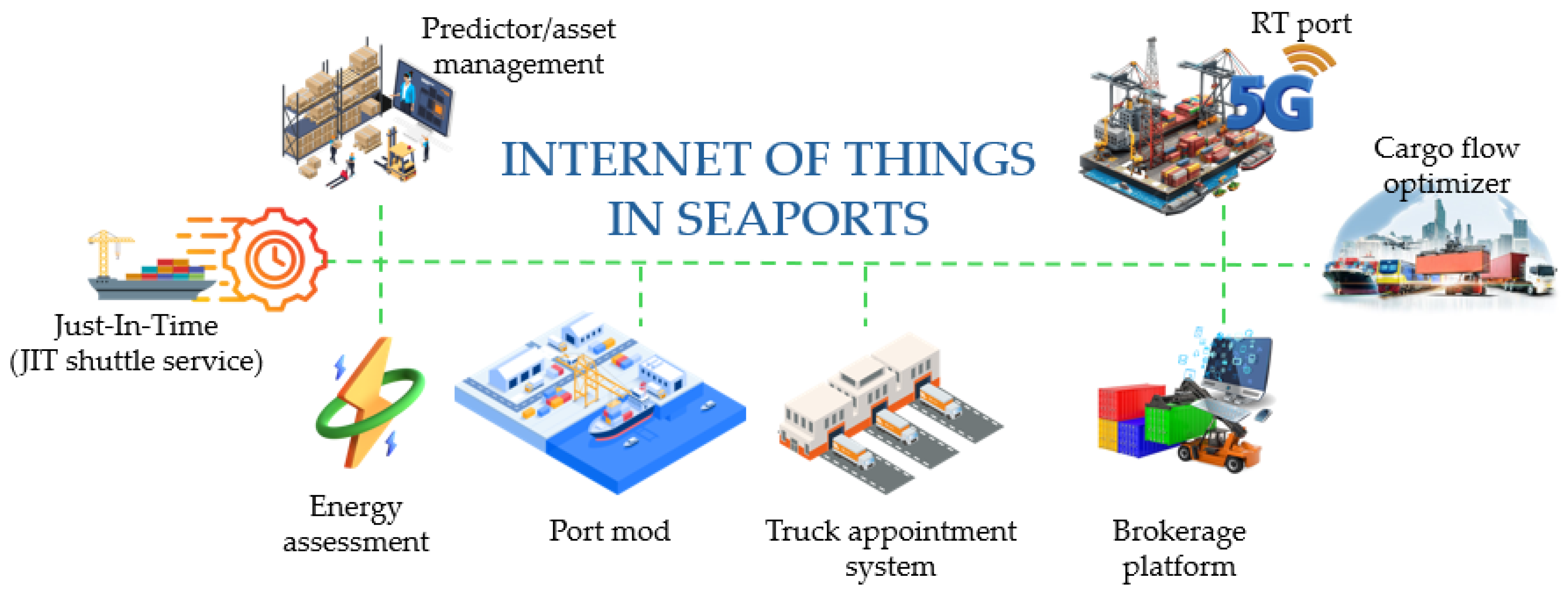
| Renewable energy integration | World maritime ports are reducing their reliance on fossil fuels and increasing their use of RESs. To achieve this objective, they are attempting to facilitate renewable energy integration with an energy storage system without updating existing infrastructure. |
| Energy storage capacity | Energy storage systems (ESSs) are critical, particularly during blackouts, since throughout the period of transition between the grid and generators, all data centers are temporarily powered by ESSs. As a result, ports are focused on developing affordable monitoring solutions for ESSs that will indicate when the battery needs to be replaced in the event of a malfunction. This method can reduce the need for battery replacements while also increasing the security of services. |
| Carbon footprint | Emissions of greenhouse gases are one of the most difficult concerns facing global ports. Many ports throughout the world are working to reduce their carbon footprints. The Marseille Port has launched a prototype of an eco-calculator to estimate the carbon footprint of every shipping container in transit. In a similar vein, the Port of Antwerp launched a hydrogen-powered tugboat as part of its aim of turning carbon neutral. Hydrotug boats employ a dual fuel hybrid engine which mostly runs on hydrogen, resulting in reduced CO2 emissions surrounding the facility. |
| Container flow | Shipping firms also encounter container flow issues because of growing port congestion, with trucks coming to a halt if there is a problem with the port cranes. CMA CGM Shipping firm is attempting to enhance container movement using real-time data analytics to improve its supply chain in partnership with Mistral AI. |
| Port orientation | Port orientations additionally pose a concern for modern ports due to larger fleet sizes. Problems arise from a mix of traffic, which includes public transportation and tourist automobiles. These difficulties can be solved using novel digital technologies, including applications and digital signs, which are particularly useful for cruise ships and passenger ferries. |
| Trailer collection | Several ports have developed a Radio-Frequency Identification (RFID) system to assist truckers in locating their docks via their cell phones. The interaction between the run management system and the RFID tag shown on the vehicle’s trailer is an obstacle. The goal of this service is to expedite traffic flow in the port region. |
| Fleet Configuration | Description | CapEx | OpEx | Infrastructure Cost | Battery Replacement Cost | NPC Summary |
|---|---|---|---|---|---|---|
| Diesel-powered AGV fleet | Conventional AGVs powered by diesel engines | Medium | High (fuel and maintenance) | Low | None | Highest NPC due to fuel emissions |
| Battery AGV fleet | Standard battery-powered AGVs with typical charging schedule | High | Low (electricity and maintenance) | Medium | Medium | Lower NPC than diesel AGVs |
| Battery AGV fleet (minimum vehicle-to-battery ratio) | Fewer batteries than AGVs, batteries swapped/12otator efficiently | Medium–High | Low | High (for swap stations) | High (due to faster cycling) | Balanced NPC with efficient operations |
| Battery AGV fleet (controlled charging) | Charging scheduled for periods with off-peak electricity rates | High | Lowest (optimized energy use) | Medium | Medium | Lowest NPC due to energy cost savings |
| Vessel Name | IMO No. | Type | Year | Country | Battery Capacity | Manufacturer |
|---|---|---|---|---|---|---|
| Festoya | 9863132 | Hybrid passenger/RO-RO cargo ship | 2020 | Norway | 1582 kW | Remontowa Shipbuilding SA, Gdansk |
| Hinnøy | 9969766 | RO-RO passenger ship | 2023 | Norway | 4750 kW | Cemre Shipyard, Altinova |
| Elektra | 9806328 | Hybrid ferry | 2017 | Finland | 1000 kW | Siemens, Munich |
| Tapana Catamaran | 567000479 | All-electric ferry | 2020 | Thailand | 175–192 kW | Danfoss, Nordborg |
| Hallaig | 9652832 | Hybrid ferry | 2013 | United Kingdom | 700 kW | Ferguson Shipbuilder, Glascow |
| Sea Change | - | Electric hybrid passenger ferry | 2023 | United States | 100 kW | All American Marine, Washington, DC |
| Elektra | - | Barge pusher | 2022 | Germany | 2500 kW | Schiffswerft Hermann Barthel, Derben |
| FaehrBaer 2 | 4811480 | Electric inland ferry | 2022 | Germany | 252 kW | Formstaal GmbH & Co. KG, Stralsund |
| Equipment Type | Hybridization Type | Energy Efficiency Gain | GHG Reduction | Key Advantages |
|---|---|---|---|---|
| Container crane (RTG) | Diesel–electric without ESS | 25–30% | 30% | Reduced fuel use, lower maintenance |
| Container crane (RTG) | Diesel–electric with ESS (Lithium-ion) | 40–50% | 50 to 60% | Energy recovery during braking and quiet operation |
| Terminal Tractor (Shunt truck, yard truck, etc.) | Hybrid without ESS | 15–20% | 20% | Electric startup assistance and torque support |
| Terminal Tractor (Shunt truck, yard truck, etc.) | Hybrid with ESS | 30–40% | 45% | Partial electric operation and better energy control |
| Straddle carrier | Hybrid without ESS | 20% | 25% | Reduced engine idling |
| Straddle carrier | Hybrid with ESS | 35% | 50% | Fast recharge, power boost capability |
| Reach Stacker (forklift designed for handling shipping containers) | Hybrid without ESS | 18–25% | 20 to 30% | Fuel consumption reduction |
| Reach Stacker | Hybrid with ESS | 35–45% | 50% | Energy regeneration during load-lowering |
| Continent | Country | Name of Seaport | Features |
|---|---|---|---|
| Africa | Morocco | Tanger Med | The port features a fully integrated digital platform for logistics, a Port Community System (PCS) connecting over 800 stakeholders, automated gates, IoT sensors, real-time cargo tracking, and digitized customs procedures—all with a strong emphasis on energy efficiency and emissions reduction. It was ranked among the world’s top 25 container ports by UNCTAD in 2023. |
| South Africa | Durban | The port is undergoing modernization through the implementation of automation systems, digital twin models, and smart scheduling tools. It also employs drone technology and automated cargo handling, with plans to introduce AI-driven logistics and predictive maintenance solutions. | |
| America | USA | Long Beach | Nearly USD 185 million has been spent by the Port of Long Beach on the development of port infrastructure, particularly shore electricity. |
| USA | Los Angeles | Implement real-time data analytics to integrate shipping data across the port eco-system to improve the efficiency of the supply chain. | |
| Asia | China | Yanshan | The port has installed automated container handling facilities with bridge cranes, AGVs, and remotely operated RMGs. |
| China | Tianjin | Improved incorporation of emerging technologies, including AI, 5G, and big data. | |
| Europe | Germany | Hamburg | RES’s shore power supply, real-time navigation tracking, and management of fleets using mobile GPS sensors. |
| Netherland | Rotterdam | IoT is used to improve ship berthing conditions. | |
| Spain | Barcelona | Quantifications of freight environmental footprints and weather prediction systems. | |
| Belgium | Antwerp | Incorporation of digital sensors and cameras to guarantee proper ship berthing and preventive maintenance, as well as blockchain technology to increase security between rival parties for digital trade. | |
| France | Le Havre | Concentrates on several initiatives pertaining to air quality enhancement, traffic monitoring and coordination, energy management, and energy efficiency. |
| Port | Country | 5G Applications/Initiatives |
|---|---|---|
| Rotterdam | The Netherlands | One of the most advanced ports; uses 5G for autonomous ship navigation, smart cameras, and IoT sensors. |
| Hamburg | Germany | Pilot zone with Deutsche Telekom; uses 5G for traffic control, augmented reality technology to assist in maintenance tasks, and IoT. |
| Antwerp | Belgium | Fifth generation-enabled drones, smart containers, and AI for logistics optimization. |
| Qingdao | China | Fully automated terminal using 5G for real-time crane and AGV (automated guided vehicle) control. |
| Tianjin | China | World’s first 5G smart terminal; fully automated container handling and digital twin systems. |
| Busan | South Korea | Testing 5G with KT Corporation for autonomous vehicles, AR inspection, and smart logistics. |
| Singapore | Singapore | Trialing 5G for smart yard management, predictive maintenance, and autonomous vehicles. |
| Livorno | Italy | EU-funded 5G pilot for safety systems, environmental monitoring, and real-time logistics data. |
| Barcelona | Spain | Uses 5G for remote crane control, port security, and smart environmental monitoring. |
| Felixstowe | United Kingdom | Implementing a 5G testbed project to boost cargo handling efficiency and real-time monitoring. |
| Criterion | 4G (LTE) | 5G |
|---|---|---|
| Maximum data rate | ~100 Mbps | Up to 10 Gbps |
| Average latency | 30–50 ms | 1–10 ms |
| Simultaneous connections | ~10 k devices/km2 | >1 M devices/km2 |
| IoT support | Moderate | Excellent (massive IoT) |
| Geolocation accuracy | Meters | Centimeters |
| Robotics and automation | Limited (with possible latency) | Optimal (real-time control, fine synchronization) |
| Connection reliability | Good, but congestion possible | Very high, even in high-density environments |
| Security | Moderate | Enhanced |
| Initial investment cost | Low to moderate (existing infrastructure) | High (5G antennas, edge servers, new equipment) |
| Typical applications | GPS tracking, video surveillance, VoIP calls | Autonomous cranes, AGVs, digital twins |
| Return on investment (ROI) | Moderate (already deployed) | Long-term, depends on automation and use cases |
Disclaimer/Publisher’s Note: The statements, opinions and data contained in all publications are solely those of the individual author(s) and contributor(s) and not of MDPI and/or the editor(s). MDPI and/or the editor(s) disclaim responsibility for any injury to people or property resulting from any ideas, methods, instructions or products referred to in the content. |
© 2025 by the authors. Licensee MDPI, Basel, Switzerland. This article is an open access article distributed under the terms and conditions of the Creative Commons Attribution (CC BY) license (https://creativecommons.org/licenses/by/4.0/).
Share and Cite
Issa, M.; Rizk, P.; Boulon, L.; Rezkallah, M.; Rizk, R.; Ilinca, A. Smart, Connected, and Sustainable: The Transformation of Maritime Ports Through Electrification, IoT, 5G, and Green Energy. Sustainability 2025, 17, 7568. https://doi.org/10.3390/su17177568
Issa M, Rizk P, Boulon L, Rezkallah M, Rizk R, Ilinca A. Smart, Connected, and Sustainable: The Transformation of Maritime Ports Through Electrification, IoT, 5G, and Green Energy. Sustainability. 2025; 17(17):7568. https://doi.org/10.3390/su17177568
Chicago/Turabian StyleIssa, Mohamad, Patrick Rizk, Loïc Boulon, Miloud Rezkallah, Rodrigue Rizk, and Adrian Ilinca. 2025. "Smart, Connected, and Sustainable: The Transformation of Maritime Ports Through Electrification, IoT, 5G, and Green Energy" Sustainability 17, no. 17: 7568. https://doi.org/10.3390/su17177568
APA StyleIssa, M., Rizk, P., Boulon, L., Rezkallah, M., Rizk, R., & Ilinca, A. (2025). Smart, Connected, and Sustainable: The Transformation of Maritime Ports Through Electrification, IoT, 5G, and Green Energy. Sustainability, 17(17), 7568. https://doi.org/10.3390/su17177568