Effects of Non-Inversion Tillage and Cover Crops on Weed Diversity and Density in Southeastern Romania


 , and
, and
Abstract
1. Introduction
2. Materials and Methods
2.1. Experimental Site, Design, and Crop Management
2.2. Weed and Cover Crop Assessment
2.3. Statistical Analyses
3. Results
4. Discussion
5. Conclusions
Author Contributions
Funding
Institutional Review Board Statement
Informed Consent Statement
Data Availability Statement
Conflicts of Interest
Abbreviations
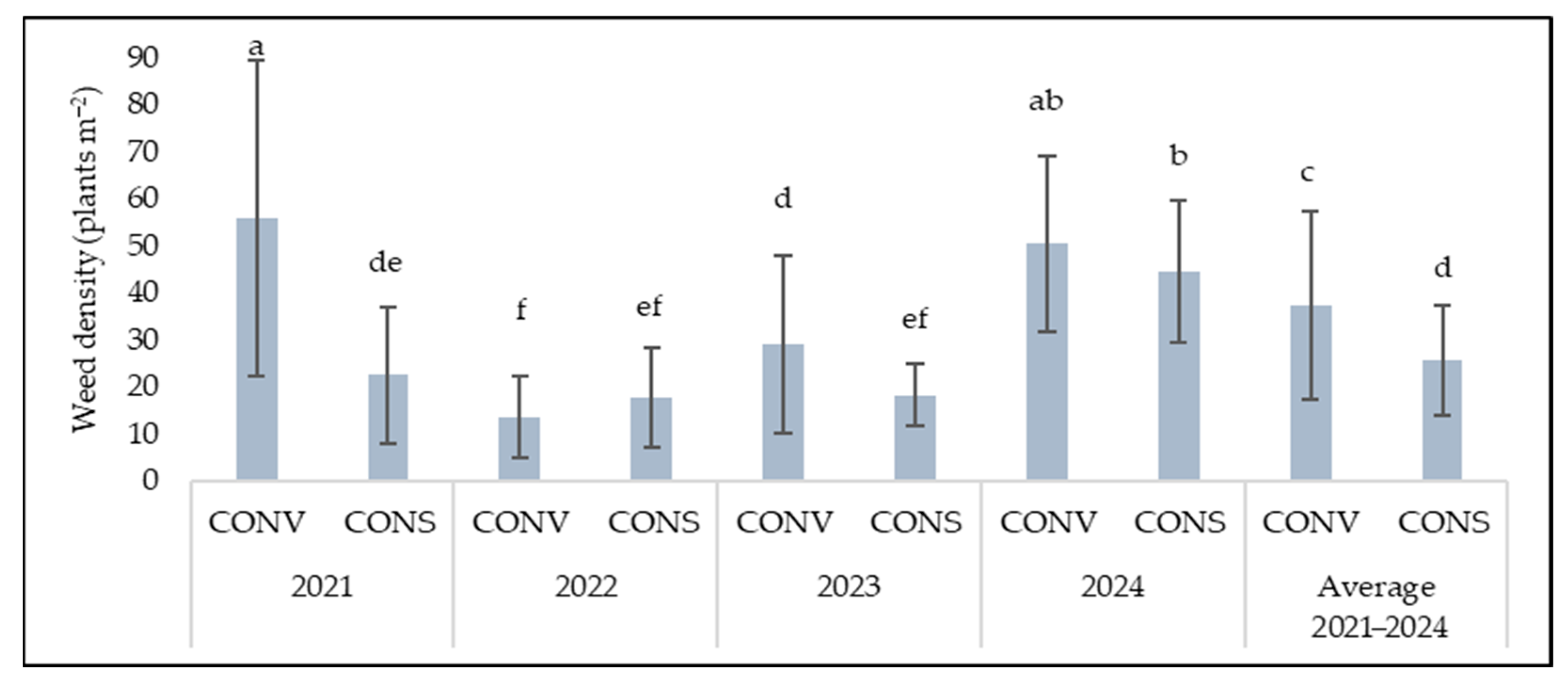
| CONV | Conventional crop management system based on ploughing tillage |
| CONS | Conservative crop management system using cover crops and non-inversion tillage (chiselling) |
References
- Friedrich, T. Degradation of natural resources and measures for mitigation. In Handbook of the International Seminar on Enhancing Extension of Conservation, Proceedings of the Agriculture Techniques in Asia and the Pacific, Zhengzhou, China, 24–26 October 2007; Asian and Pacific Centre for Agricultural Engineering and Machinery (APCAEM): Beijing, China; Ministry of Agriculture of the People’s Republic: Beijing, China, 2007; pp. 24–26. [Google Scholar]
- Kassam, A.; Friedrich, T.; Derpsch, R.; Kienzle, J. Overview of the worldwide spread of conservation agriculture. Field Actions Sci. Rep. 2015, 8, 1–11. [Google Scholar]
- Prestele, R.; Hirsch, A.L.; Davin, E.L.; Seneviratne, S.I.; Verburg, P.H. A spatially explicit representation of conservation agriculture for application in global change studies. Glob. Chang. Biol. 2018, 24, 4038–4053. [Google Scholar] [CrossRef] [Scilit] [PubMed]
- Verhulst, N.; Govaerts, B.; Verachtert, E.; Castellanos-Navarrete, A.; Mezzalama, M.; Wall, P.C.; Chocobar, A.; Deckers, J.; Sayre, K.D. Conservation agriculture, improving soil quality for sustainable production systems? In Advances in Soil Science: Food Security and Soil Quality; CRC Press eBooks: Boca Raton, FL, USA, 2010; pp. 137–208. [Google Scholar]
- Rhoton, F.E. Influence of time on soil response to No-Till practices. Soil Sci. Soc. Am. J. 2000, 64, 700–709. [Google Scholar] [CrossRef] [Scilit]
- McVay, K.A.; Budde, J.A.; Fabrizzi, K.; Mikha, M.M.; Rice, C.W.; Schlegel, A.J.; Peterson, D.E.; Sweeney, D.W.; Thompson, C. Management Effects on Soil Physical Properties in Long-Term Tillage Studies in Kansas. Soil Sci. Soc. Am. J. 2006, 70, 434–438. [Google Scholar] [CrossRef] [Scilit]
- Reicosky, D.C. Conservation tillage is not conservation agriculture. J. Soil Water Conserv. 2015, 70, 103A–108A. [Google Scholar] [CrossRef] [Scilit]
- Rusu, T.; Bogdan, I.; Moraru, P.I.; Pop, A.I.; Duda, B.M.; Coste, C. Research results on conservative tillage systems in the last 50 years at USAMV Cluj-Napoca. ProEnviron. Promediu 2015, 8, 105–111. [Google Scholar]
- Mubvumba, P.; DeLaune, P.B.; Hons, F.M. Enhancing long-term no-till wheat systems with cover crops and flash grazing. Soil Secur. 2022, 8, 100067. [Google Scholar] [CrossRef] [Scilit]
- Subbulakshmi, S.; Chandrasekaran, H.; Saravanan, N.; Subbian, P. Conservation tillage—An ecofriendly management practices for agriculture. Res. J. Agric. Biol. Sci. 2009, 5, 1098–1110. [Google Scholar]
- Pittelkow, C.M.; Liang, X.; Linquist, B.A.; Van Groenigen, K.J.; Lee, J.; Lundy, M.E.; Van Gestel, N.; Six, J.; Venterea, R.T.; Van Kessel, C. Productivity limits and potentials of the principles of conservation agriculture. Nature 2015, 517, 365–368. [Google Scholar] [CrossRef] [Scilit]
- Poeplau, C.; Don, A. Carbon sequestration in agricultural soils via cultivation of cover crops—A meta-analysis. Agric. Ecosyst. Environ. 2015, 200, 33–41. [Google Scholar] [CrossRef] [Scilit]
- Lal, R. Restoring soil quality to mitigate soil degradation. Sustainability 2015, 7, 5875–5895. [Google Scholar] [CrossRef] [Scilit]
- Nichols, V.; Verhulst, N.; Cox, R.; Govaerts, B. Weed dynamics and conservation agriculture principles: A review. Field Crops Res. 2015, 183, 56–68. [Google Scholar] [CrossRef] [Scilit]
- Marin, D.I.; Teodor, R.U.S.U.; Mihalache, M.; Ilie, L.; Nistor, E.; Bolohan, C. Influence of soil tillage upon production and energy efficiency in wheat and maize crops. AgroLife Sci. J. 2015, 4, 43–47. [Google Scholar]
- Rusu, T.; Bogdan, I.; Marin, D.I.; Moraru, P.I.; Pop, A.I.; Duda, B.M. Effect of conservation agriculture on yield and protecting environmental resources. AgroLife Sci. J. 2015, 4, 141–145. [Google Scholar]
- Weber, J.F.; Kunz, C.; Peteinatos, G.; Zikeli, S.; Gerhards, R. Weed control using conventional tillage, reduced tillage, No-Tillage, and cover crops in organic soybean. Agriculture 2017, 7, 43. [Google Scholar] [CrossRef] [Scilit]
- Sims, B.; Corsi, S.; Gbehounou, G.; Kienzle, J.; Taguchi, M.; Friedrich, T. Sustainable Weed Management for Conservation Agriculture: Options for Smallholder Farmers. Agriculture 2018, 8, 118. [Google Scholar] [CrossRef] [Scilit]
- Singh, V.P.; Barman, K.K.; Singh, R.; Sharma, A.R. Weed Management in Conservation Agriculture Systems. In Conservation Agriculture; Farooq, M., Siddique, K.H.M., Eds.; Springer International Publishing: Cham, Switzerland, 2015; pp. 39–77. [Google Scholar]
- Bo, M.; Nicolas, M.-J.; Raphaël, C.; Judith, W.; Jürgen, S.; van der Weide, R.; Ludovic, B.; Peter, K.J.; Per, K. European Perspectives on the Adoption of Nonchemical Weed Management in Reduced-Tillage Systems for Arable Crops. Weed Technol. 2013, 27, 231–240. [Google Scholar] [CrossRef] [Scilit]
- Aušra, S.; Vaclovas, B.; Alfredas, S.; Vaida, S.; Lenkis, A.; Rasa, K. Weed Abundance, Seed Bank in Different Soil Tillage Systems, and Straw Retention. Agronomy 2025, 15, 1105. [Google Scholar] [CrossRef] [Scilit]
- Derrouch, D.; Chauvel, B.; Cordeau, S.; Dessaint, F. Functional shifts in weed community composition following adoption of conservation agriculture. Weed Res. 2021, 62, 103–112. [Google Scholar] [CrossRef] [Scilit]
- Trichard, A.; Alignier, A.; Chauvel, B.; Petit, S. Identification of weed community traits response to conservation agriculture. Agric. Ecosyst. Environ. 2013, 179, 179–186. [Google Scholar] [CrossRef] [Scilit]
- Baraibar, B.; Hunter, M.C.; Schipanski, M.E.; Hamilton, A.; Mortensen, D.A. Weed suppression in cover crop monocultures and mixtures. Weed Sci. 2018, 66, 121–133. [Google Scholar] [CrossRef] [Scilit]
- Sharma, T.; Das, T.K.; Maity, P.P.; Biswas, S.; Sudhishri, S.; Govindasamy, P.; Raj, R.; Sen, S.; Singh, T.; Paul, A.K.; et al. Long-Term Conservation Agriculture Influences Weed Diversity, Water Productivity, Grain Yield, and Energy Budgeting of Wheat in North-Western Indo-Gangetic Plains. Sustainability 2023, 15, 7290. [Google Scholar] [CrossRef] [Scilit]
- Aliste, M.; Ros, C.; Garrido, I.; Martínez, C.M.; Vera, A.; Siles, J.; Contreras, F.; Flores, P.; Hellín, P.; Fenoll, J.; et al. Green manure from cover crops enhances pesticide degradation and soil biological health. J. Hazard. Mater. 2025, 495, 138984. [Google Scholar] [CrossRef] [Scilit]
- Kocira, A.; Staniak, M.; Tomaszewska, M.; Kornas, R.; Cymerman, J.; Panasiewicz, K.; Lipińska, H. Legume cover crops as one of the elements of strategic weed management and soil quality improvement. A review. Agriculture 2020, 10, 394. [Google Scholar] [CrossRef] [Scilit]
- Wittwer, R.A.; van der Heijden, M.G. Cover crops as a tool to reduce reliance on intensive tillage and nitrogen fertilization in conventional arable cropping systems. Field Crops Res. 2020, 249, 107736. [Google Scholar] [CrossRef] [Scilit]
- Kruidhof, H.M.; Bastiaans, L.; Kropff, M.J. Ecological weed management by cover cropping: Effects on weed growth in autumn and weed establishment in spring. Weed Res. 2008, 48, 492–502. [Google Scholar] [CrossRef] [Scilit]
- Kunz, C.; Strum, D.J.; Varnholt, D.; Walker, F.; Gerhards, R. Allelopathic effects and weed suppressive ability of cover crops. Plant Soil Environ. 2016, 62, 60–66. [Google Scholar] [CrossRef] [Scilit]
- Osipitan, O.A.; Dille, J.A.; Assefa, Y.; Knezevic, S.Z. Cover Crop for early Season Weed Suppression in Crops: Systematic Review and Meta-Analysis. Agron. J. 2018, 110, 2211–2221. [Google Scholar] [CrossRef] [Scilit]
- Leskovšek, R.; Eler, K.; Zamljen, S.A. Weed suppression and maize yield influenced by cover crop mixture diversity and tillage. Agric. Ecosyst. Environ. 2025, 383, 109530. [Google Scholar] [CrossRef] [Scilit]
- Gerhards, R.; Schappert, A. Advancing cover cropping in temperate integrated weed management. Pest Manag. Sci. 2020, 76, 42–46. [Google Scholar] [CrossRef] [Scilit]
- Zannopoulos, S.; Gazoulis, I.; Kokkini, M.; Antonopoulos, N.; Kanatas, P.; Kanetsi, M.; Travlos, I. The potential of three summer legume cover crops to suppress weeds and provide ecosystem Services—A review. Agronomy 2024, 14, 1192. [Google Scholar] [CrossRef] [Scilit]
- Schappert, A.; Schumacher, M.; Gerhards, R. Weed control ability of single sown cover crops compared to species mixtures. Agronomy 2019, 9, 294. [Google Scholar] [CrossRef] [Scilit]
- Wittwer, R.A.; Dorn, B.; Jossi, W.; Van Der Heijden, M.G.A. Cover crops support ecological intensification of arable cropping systems. Sci. Rep. 2017, 7, 41911. [Google Scholar] [CrossRef] [Scilit]
- Büchi, L.; Wendling, M.; Amossé, C.; Jeangros, B.; Charles, R. Cover crops to secure weed control strategies in a maize crop with reduced tillage. Field Crops Res. 2020, 247, 107583. [Google Scholar] [CrossRef] [Scilit]
- Vincent-Caboud, L.; Peigné, J.; Casagrande, M.; Silva, E.M. Overview of Organic Cover Crop-Based No-Tillage technique in Europe: Farmers’ practices and research challenges. Agriculture 2017, 7, 42. [Google Scholar] [CrossRef] [Scilit]
- Mihalașcu, C.; Bolohan, C.; Tudor, V.; Mihalache, M.; Teodorescu, R.I. Research on the growth and development of some varieties of Lavandula angustifolia (Mill.) in the south-east of Romania. Rom. Biotechnol. Lett. 2020, 25, 2180–2187. [Google Scholar] [CrossRef] [Scilit]
- Magurran, A.E. Ecological Diversity and Its Measurement; Princeton University Press: Princeton, NJ, USA, 1988. [Google Scholar]
- Vasileiadis, V.P.; van Dijk, W.; Verschwele, A.; Holb, I.J.; Vámos, A.; Urek, G.; Leskovsek, R.; Furlan, L.; Sattin, M. Farm-scale evaluation of herbicide band application integrated with inter-row mechanical weeding for maize production in four European regions. Weed Res. 2016, 56, 313–322. [Google Scholar] [CrossRef] [Scilit]
- Restuccia, A.; Scavo, A.; Lombardo, S.; Pandino, G.; Fontanazza, S.; Anastasi, U.; Abbate, C.; Mauromicale, G. Long-Term effect of cover crops on species abundance and diversity of weed flora. Plants 2020, 9, 1506. [Google Scholar] [CrossRef] [Scilit]
- Neblea, M.A.; Marian, M.C. Study concerning alien flora from Dâmbovița county (Romania). Curr. Trends Nat. Sci. 2022, 11, 178–194. [Google Scholar] [CrossRef] [Scilit]
- Camen-Comănescu, P.; Mihai, D.C.; Raicu, M.; Sîrbu, C.; Oprea, A.; Anastasiu, P. Alien flora from Buzău county—Romania. Acta Horti Bot. Bucurestiensis 2023, 49, 49–76. [Google Scholar] [CrossRef] [Scilit]
- Răduțoiu, D.; Simion, I.; Boruz, V. Alien flora from Dolj county, Romania/Flora alohtonă din județul Dolj, România. Ann. Univ. Craiova Ser. Geogr. 2024, 25, 48–75. [Google Scholar] [CrossRef] [Scilit]
- McKenzie-Gopsill, A.; Farooque, A. Incorporated cover crop residue suppresses weed seed germination. Weed Biol. Manag. 2023, 23, 48–57. [Google Scholar] [CrossRef] [Scilit]
- Rueda-Ayala, V.; Jaeck, O.; Gerhards, R. Investigation of biochemical and competitive effects of cover crops on crops and weeds. Crop Prot. 2015, 71, 79–87. [Google Scholar] [CrossRef] [Scilit]
- Sebastian, J.; Dinneny, J.R. Setaria viridis: A Model for Understanding Panicoid Grass Root Systems. In Genetics and Genomics of Setaria; Doust, A., Diao, X., Eds.; Springer: Cham, Switzerland, 2017; Volume 19, pp. 177–193. [Google Scholar]
- Fracchiolla, M.; Stellacci, A.M.; Cazzato, E.; Tedone, L.; Ali, S.A.; De Mastro, G. Effects of Conservative Tillage and Nitrogen Management on Weed Seed Bank after a Seven-Year Durum Wheat—Faba Bean Rotation. Plants 2018, 7, 82. [Google Scholar] [CrossRef] [Scilit] [PubMed]
- Weber, R.; Sekutowski, T.; Owsiak, Z. Variability of weed infestation of winter wheat cultivars in relation to tillage systems. Prog. Plant Prot. 2014, 54, 178–184. [Google Scholar] [CrossRef] [Scilit]
- Phan, H.T.; Wacker, T.S.; Thorup-Kristensen, K. Winter cover crops favor cereal crop in N competition against creeping thistle Cirsium arvense (L.) Scop. Soil Tillage Res. 2022, 216, 105261. [Google Scholar] [CrossRef] [Scilit]
- Bicksler, A.J.; Masiunas, J.B. Canada Thistle (Cirsium arvense) Suppression with Buckwheat or Sudangrass Cover Crops and Mowing. Weed Technol. 2009, 23, 556–563. [Google Scholar] [CrossRef] [Scilit]
- Dorn, B.; Jossi, W.; Van Der Heijden, M.G.A. Weed suppression by cover crops: Comparative on-farm experiments under integrated and organic conservation tillage. Weed Res. 2015, 55, 586–597. [Google Scholar] [CrossRef] [Scilit]
- Baskin, J.; Baskin, C.C.; Parr, J. Field emergence of Lamium amplexicaule L. and L. purpureum L. in relation to the annual seed dormancy cycle. Weed Res. 1986, 26, 185–190. [Google Scholar] [CrossRef] [Scilit]
- Karlsson, L.M.; Milberg, P. Variation within species and inter-species comparison of seed dormancy and germination of four annual Lamium species. Flora Morphol. Distrib. Funct. Ecol. Plants 2008, 203, 409–420. [Google Scholar] [CrossRef] [Scilit]
- Adeux, G.; Yvoz, S.; Biju-Duval, L.; Cadet, E.; Farcy, P.; Fried, G.; Guillemin, J.; Meunier, D.; Munier-Jolain, N.; Petit, S.; et al. Cropping system diversification does not always beget weed diversity. Eur. J. Agron. 2022, 133, 126438. [Google Scholar] [CrossRef] [Scilit]
- Hofmeijer, M.A.; Melander, B.; Salonen, J.; Lundkvist, A.; Zarina, L.; Gerowitt, B. Crop diversification affects weed communities and densities in organic spring cereal fields in northern Europe. Agric. Ecosyst. Environ. 2021, 308, 107251. [Google Scholar] [CrossRef] [Scilit]
- Adeux, G.; Rodriguez, A.; Penato, C.; Antichi, D.; Carlesi, S.; Sbrana, M.; Bàrberi, P.; Cordeau, S. Long-term cover cropping in tillage-based systems filters weed community phenology: A seedbank analysis. Field Crops Res. 2023, 291, 108769. [Google Scholar] [CrossRef] [Scilit]
- Gehrke, V.R.; Fipke, M.V.; Avila, L.A.d.; Camargo, E.R. Understanding the Opportunities to Mitigate Carryover of Imidazolinone Herbicides in Lowland Rice. Agriculture 2021, 11, 299. [Google Scholar] [CrossRef] [Scilit]
- Vischetti, C.; Casucci, C.; Perucci, P. Relationship between changes of soil microbial biomass content and imazamox and benfluralin degradation. Biol. Fertil. Soils 2002, 35, 13–17. [Google Scholar] [CrossRef] [Scilit]
- Buerge, I.J.; Kasteel, R.; Bächli, A.; Poiger, T. Behavior of the Chiral Herbicide Imazamox in Soils: Enantiomer Composition Differentiates between Biodegradation and Photodegradation. Environ. Sci. Technol. 2019, 53, 5733–5740. [Google Scholar] [CrossRef] [Scilit]
- Rani, D.; Duhan, A.; Punia, S.S.; Yadav, D.B.; Duhan, S. Behavior of pre-mix formulation of imazethapyr and imazamox herbicides in two different soils. Environ. Monit. Assess. 2018, 191, 33. [Google Scholar] [CrossRef] [Scilit]
- Quivet, E.; Faure, R.; Georges, J.; Païssé, J.-O.; Herbreteau, B.; Lantéri, P. Photochemical Degradation of Imazamox in Aqueous Solution: Influence of Metal Ions and Anionic Species on the Ultraviolet Photolysis. J. Agric. Food Chem. 2006, 54, 3641–3645. [Google Scholar] [CrossRef] [Scilit]
- Locke, M.A.; Zablotowicz, R.M.; Bauer, P.J.; Steinriede, R.W.; Gaston, L.A. Conservation cotton production in the southern United States: Herbicide dissipation in soil and cover crops. Weed Sci. 2005, 53, 717–727. [Google Scholar] [CrossRef] [Scilit]
- Moyer, J.R.; Coen, G.; Dunn, R.; Smith, A.M. Effects of Landscape Position, Rainfall, and Tillage on Residual Herbicides. Weed Technol. 2010, 24, 361–368. [Google Scholar] [CrossRef] [Scilit]
- Blackshaw, R.E.; Molnar, L.J. Integration of Conservation Tillage and Herbicides for Sustainable Dry Bean Production. Weed Technol. 2008, 22, 168–176. [Google Scholar] [CrossRef] [Scilit]
- Shrirao, T.; Kanase, N.; Goud, V.V.; Jadhao, S.; Konde, N.; Bhoyar, S.; Ravali, E. Effect of tillage and weed management on soil properties and yield of soybean in vertisols. Int. J. Adv. Biochem. Res. 2024, 8, 844–851. [Google Scholar] [CrossRef] [Scilit]
- Tóth, E.; Dorner, Z.; Nagy, J.G.; Zalai, M. How Weed Flora Evolves in Cereal Fields in Relation to the Agricultural Environment and Farming Practices in Different Sub-Regions of Eastern Hungary. Agronomy 2025, 15, 1033. [Google Scholar] [CrossRef] [Scilit]
- Roberts, H.; Lockett, P.M. Seed dormancy and periodicity of seedling emergence in Veronica hederifolia L. Weed Res. 1978, 18, 41–48. [Google Scholar] [CrossRef] [Scilit]
- Kolářová, M.; Tyšer, L.; Soukup, J. Weed vegetation of arable land in the Czech Republic: Environmental a management factors determining weed species composition. Biologia 2014, 69, 443–448. [Google Scholar] [CrossRef] [Scilit]
- Auškalnienė, O.; Auškalnis, A. The influence of tillage system on diversities of soil weed seed bank. Agron. Res. 2009, 7, 156–161. [Google Scholar]
- Lutman, P.J.W.; Wright, K.J.; Berry, K.; Freeman, S.E.; Tatnell, L. Estimation of seed production by Myosotis arvensis, Veronica hederifolia, Veronica persica and Viola arvensis under different competitive conditions. Weed Res. 2011, 51, 499–507. [Google Scholar] [CrossRef] [Scilit]
- Winkler, J.; Trojan, V.; Hrubešová, V. Effects of the tillage technology and the forecrop on weeds in stands of winter wheat. Acta Univ. Agric. Silvic. Mendel. Brun. 2015, 63, 477–483. [Google Scholar] [CrossRef] [Scilit]
- Pardo, G.; Cirujeda, A.; Perea, F.; Verdú, A.M.C.; Mas, M.T.; Urbano, J.M. Effects of reduced and conventional tillage on weed communities: Results of a long-term experiment in southwestern Spain. Planta Daninha 2019, 37, e019201336. [Google Scholar] [CrossRef] [Scilit]
- Mennan, H.; Zandstra, B.H. The Effects of Depth and Duration of Seed Burial on Viability, Dormancy, Germination, and Emergence of Ivyleaf Speedwell (Veronica hederifolia). Weed Technol. 2006, 20, 438–444. [Google Scholar] [CrossRef] [Scilit]
- Feledyn-Szewczyk, B.; Smagacz, J.; Kwiatkowski, C.A.; Harasim, E.; Woźniak, A. Weed flora and soil seed bank composition as affected by tillage system in Three-Year Crop rotation. Agriculture 2020, 10, 186. [Google Scholar] [CrossRef] [Scilit]
- Schmidt, J.H.; Junge, S.; Finckh, M.R. Cover crops and compost prevent weed seed bank buildup in herbicide-free wheat-potato rotations under conservation tillage. Ecol. Evol. 2019, 9, 2715–2724. [Google Scholar] [CrossRef] [Scilit] [PubMed]
- Liu, Y.; Wu, H.; Wang, C.; Cheng, J.; Qiang, S. A comparative study reveals the key biological traits causing bioinvasion differences among four alien species of genus Veronica in China. J. Plant Ecol. 2023, 16, rtac068. [Google Scholar] [CrossRef] [Scilit]
- Ahmed, H.T.; Francis, A.; Clements, D.R.; Dyck, E.; Ross, N.; Upadhyaya, M.K.; Hall, L.M.; Martin, S.L. The Biology of Canadian Weeds. 159. Capsella bursa-pastoris (L.) Medik. Can. J. Plant Sci. 2021, 102, 529–552. [Google Scholar] [CrossRef] [Scilit]
- Chauhan, B.S.; Gill, G.S.; Preston, C. Tillage system effects on weed ecology, herbicide activity and persistence: A review. Aust. J. Exp. Agric. 2006, 46, 1557–1570. [Google Scholar] [CrossRef] [Scilit]
- Sturm, D.J.; Kunz, C.; Gerhards, R. Inhibitory effects of cover crop mulch on germination and growth of Stellaria media (L.) Vill. , Chenopodium album L. and Matricaria chamomilla L. Crop Prot. 2016, 90, 125–131. [Google Scholar] [CrossRef] [Scilit]
- Anyoni, O.G.; Ekwangu, J.; Tumwebaze, S.; Obia, A. Minimum Tillage and Soil Surface Cover Reduced Weed Density but Not Diversity Over Four Growing Cycles. East. Afr. J. Agric. Biotechnol. 2024, 7, 39–58. [Google Scholar] [CrossRef] [Scilit]
- Hossain, M.M.; Begum, M.; Hashem, A.; Rahman, M.M.; Haque, M.E.; Bell, R.W. Continuous Practice of Conservation Agriculture for 3–5 Years in Intensive Rice-Based Cropping Patterns Reduces Soil Weed Seedbank. Agriculture 2021, 11, 895. [Google Scholar] [CrossRef] [Scilit]
- Nichols, V.; English, L.; Carlson, S.; Gailans, S.; Liebman, M. Effects of long-term cover cropping on weed seedbanks. Front. Agron. 2020, 2, 591091. [Google Scholar] [CrossRef] [Scilit]
- Osipitan, O.A.; Dille, J.A.; Assefa, Y.; Radicetti, E.; Ayeni, A.; Knezevic, S.Z. Impact of cover crop management on level of weed Suppression: A Meta-Analysis. Crop Sci. 2019, 59, 833–842. [Google Scholar] [CrossRef] [Scilit]



| Climatic Variable | Year | Oct * | Nov | Dec | Jan | Feb | Mar | Apr | May | Jun | Jul | Aug | Sep | Mean/Sum | |
|---|---|---|---|---|---|---|---|---|---|---|---|---|---|---|---|
| Oct–Apr *** | Oct–Sep | ||||||||||||||
| Temperature (°C) | 2020–2021 | 14.3 | 5.8 | 3.5 | 1.6 | 2.8 | 3.9 | 9.6 | 16.9 | 20.5 | 24.7 | 23.8 | 17.5 | 5.9 | 12.1 |
| 2021–2022 | 10.3 | 7.9 | 2.3 | 2 | 4.6 | 4.5 | 11.8 | 18.8 | 22.7 | 25.5 | 25.5 | 17.9 | 6.2 | 12.8 | |
| 2022–2023 | 10.1 | 7.4 | 2.5 | 4.4 | 3.4 | 8.3 | 10.6 | 16.6 | 21.8 | 25.7 | 26.2 | 22.1 | 6.7 | 13.3 | |
| 2023–2024 | 13.3 | 8.7 | 3.2 | 1.1 | 7.3 | 7.9 | 14.7 | 16.0 | 25.9 | 26.9 | 25.9 | 19.8 | 8.0 | 14.2 | |
| M. mean ** | 10.7 | 4.9 | −0.2 | −2 | 0 | 4.8 | 11.1 | 16.7 | 20.4 | 22.3 | 21.4 | 16.6 | 4.2 | 10.6 | |
| Precipitation (mm) | 2020–2021 | 37.8 | 11 | 118.6 | 102.4 | 15.4 | 87 | 50 | 90.4 | 115.4 | 81.2 | 3.4 | 51.7 | 422.2 | 764.3 |
| 2021–2022 | 68 | 33 | 87.5 | 5.4 | 4.2 | 17.2 | 63 | 32.0 | 32.8 | 10.6 | 0.0 | 30.0 | 278.3 | 383.7 | |
| 2022–2023 | 37.8 | 33 | 87.5 | 80 | 4 | 6 | 74 | 38.0 | 36.0 | 67.0 | 22.0 | 16.0 | 322.3 | 501.3 | |
| 2023–2024 | 7 | 61 | 11 | 26.8 | 1 | 57 | 43 | 22.0 | 15.0 | 52.4 | 49.0 | 76.6 | 206.8 | 421.8 | |
| M. mean ** | 36.5 | 33.2 | 40 | 46.9 | 66 | 77 | 67.7 | 57.4 | 52.9 | 41.6 | 48.2 | 43.5 | 367.3 | 610.9 | |
| Year | Management System | Species Richness (S) | Shannon’s Diversity (H′) | Pielou’s Evenness (E) |
|---|---|---|---|---|
| 2021 | CONV | 8.5 (±0.7) | 1.74 (±0.128) | 0.81 (±0.028) |
| CONS | 5.5 (±0.7) | 1.54 (±0.005) | 0.91 (±0.066) | |
| 2022 | CONV | 5 (±1.4) | 1.17 (±0.151) | 0.76 (±0.232) |
| CONS | 4 (±0) | 0.94 (±0.033) | 0.68 (±0.024) | |
| 2023 | CONV | 7.5 (±0.7) | 1.31 (±0.213) | 0.65 (±0.136) |
| CONS | 6 (±1.4) | 1.52 (±0.026) | 0.87 (±0.131) | |
| 2024 | CONV | 4 (±0) | 0.35 (±0.077) | 0.25 (±0.056) |
| CONS | 4.5 (±0.7) | 0.65 (±0.322) | 0.42 (±0.17) | |
| Average 2021–2024 | CONV | 6.3 (±0.7) | 1.14 (±0.142) | 0.62 (±0.113) |
| CONS | 5 (±0.7) | 1.16 (±0.097) | 0.72 (±0.098) |
| Species Name | Family | Life-Form | Frequency (F) (%) | |||||||
|---|---|---|---|---|---|---|---|---|---|---|
| Conventional | Conservation | |||||||||
| 2021 | 2022 | 2023 | 2024 | 2021 | 2022 | 2023 | 2024 | |||
| Veronica hederifolia L. | Plantaginaceae | Annual | 83.3 (±0) | 91.7 (±11.8) | 83.3 (±23.6) | 100 (±0) | 91.7 (±11.8) | 91.7 (±11.8) | 83.3 (±23.6) | 100 (±0) |
| Lamium purpureum L. | Lamiaceae | Annual | 83.3 (±23.6) | 0 | 83.3 (±23.6) | 58.3 (±35.4) | 91.7 (±11.8) | 0 | 83.3 (±23.6) | 41.7 (±35.4) |
| Polygonum aviculare L. | Polygonaceae | Annual | 66.7 (±0) | 66.7 (±0) | 50 (±23.6) | 16.7 (±23.6) | 66.7 (±0) | 50 (±0) | 50 (±23.6) | 8.3 (±11.8) |
| Capsella bursa-pastoris (L.) Medik. | Brassicaceae | Biennial | 75 (±11.8) | 0 | 50 (±23.6) | 25 (±11.8) | 83.3 (±23.6) | 0 | 91.7 (±11.8) | 66.7 (±23.6) |
| Matricaria chamomilla L. | Asteraceae | Annual | 25 (±11.8) | 8.3 (±11.8) | 41.7 (±11.8) | 25 (±35.4) | 41.7 (±11.8) | 33.3 (±0) | 50 (±0) | 66.7 (±47.1) |
| Cirsium arvense (L.) Scop. | Asteraceae | Perennial | 0 | 58.3 (±11.8) | 16.7 (±23.6) | 0 | 0 | 25 (±11.8) | 0 | 0 |
| Fumaria officinalis L. | Fumariaceae | Annual | 16.7 (±23.6) | 33.3 (±0) | 16.7 (±23.6) | 0 | 0 | 0 | 8.3 (±11.8) | 0 |
| Stellaria media (L.) Vill. | Caryophyllaceae | Biennial | 16.7 (±0) | 0 | 25 (±11.8) | 0 | 33.3 (±47.1) | 0 | 0 | 0 |
| Setaria viridis (L.) P. Beauv. | Poaceae | Annual | 33.3 (±0) | 0 | 0 | 0 | 0 | 0 | 0 | 0 |
| Rumex sp. L. | Polygonaceae | Perennial | 8.3 (±11.8) | 8.3 (±11.8) | 0 | 0 | 0 | 0 | 0 | 0 |
| Galium aparine L. | Rubiaceae | Annual | 0 | 0 | 8.3 (±11.8) | 0 | 0 | 0 | 0 | 0 |
| Chenopodium album L. | Amaranthaceae | Annual | 0 | 0 | 0 | 0 | 0 | 0 | 8.3 (±11.8) | 0 |
| Factors | Weed Density (Plants m−2) | |||
|---|---|---|---|---|
| DF | F | p | p-Value | |
| System * | 1 | 10.0 | ** | 0.002 |
| Year | 3 | 16.0 | *** | <0.001 |
| System × Year | 3 | 4.8 | ** | 0.004 |
| Error | 88 | |||
| Total | 95 | |||
| Cover Crop Density (Plants m−2) | Weed Density (Plants m−2) | |||||
|---|---|---|---|---|---|---|
| Factors | DF | F | p | DF | F | p |
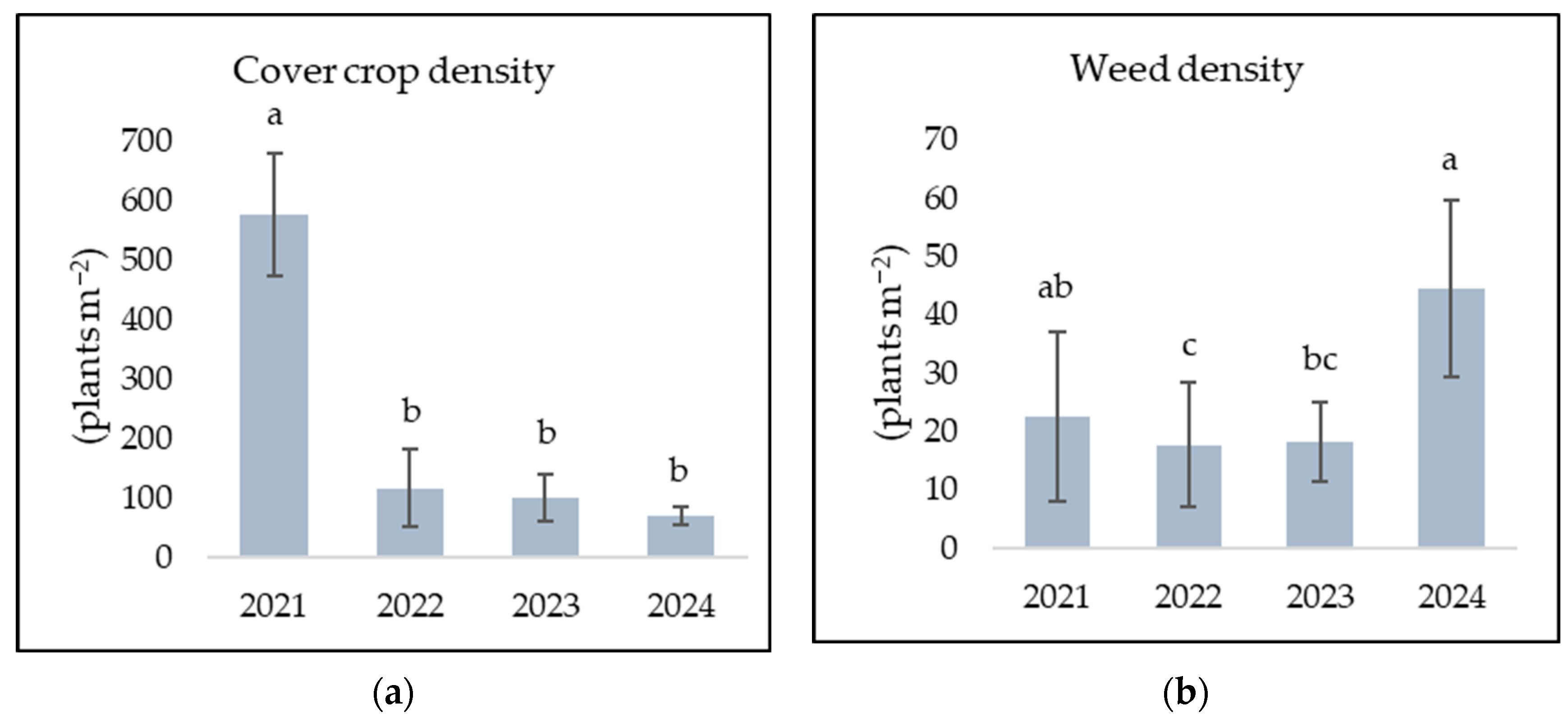
| Year | 1 | 3331.6 | *** | 1 | 700,783 | *** |
| Error | 92 | 92 | ||||
| Total | 93 | 93 | ||||
Disclaimer/Publisher’s Note: The statements, opinions and data contained in all publications are solely those of the individual author(s) and contributor(s) and not of MDPI and/or the editor(s). MDPI and/or the editor(s) disclaim responsibility for any injury to people or property resulting from any ideas, methods, instructions or products referred to in the content. |
© 2025 by the authors. Licensee MDPI, Basel, Switzerland. This article is an open access article distributed under the terms and conditions of the Creative Commons Attribution (CC BY) license (https://creativecommons.org/licenses/by/4.0/).
Share and Cite
Radu, M.; Bolohan, C.; Mihalașcu, C.; Măruțescu, A.; Newbert, M.J.; Vasileiadis, V.P. Effects of Non-Inversion Tillage and Cover Crops on Weed Diversity and Density in Southeastern Romania. Sustainability 2025, 17, 6204. https://doi.org/10.3390/su17136204
Radu M, Bolohan C, Mihalașcu C, Măruțescu A, Newbert MJ, Vasileiadis VP. Effects of Non-Inversion Tillage and Cover Crops on Weed Diversity and Density in Southeastern Romania. Sustainability. 2025; 17(13):6204. https://doi.org/10.3390/su17136204
Chicago/Turabian StyleRadu, Mădălin, Ciprian Bolohan, Costel Mihalașcu, Andrei Măruțescu, Max John Newbert, and Vasileios P. Vasileiadis. 2025. "Effects of Non-Inversion Tillage and Cover Crops on Weed Diversity and Density in Southeastern Romania" Sustainability 17, no. 13: 6204. https://doi.org/10.3390/su17136204
APA StyleRadu, M., Bolohan, C., Mihalașcu, C., Măruțescu, A., Newbert, M. J., & Vasileiadis, V. P. (2025). Effects of Non-Inversion Tillage and Cover Crops on Weed Diversity and Density in Southeastern Romania. Sustainability, 17(13), 6204. https://doi.org/10.3390/su17136204