Article

The Nonlinear Causal Effect Estimation of the Built Environment on Urban Rail Transit Station Flow Under Emergency

1
Shanghai Kev Laboratory of Rail Infrastructure Durability and System Safety, Tongji University, Shanghai 200092, China
2
College of Transportation, Tongji University, Shanghai 200092, China
*
Author to whom correspondence should be addressed.
Sustainability 2025, 17(13), 5829; https://doi.org/10.3390/su17135829
Submission received: 25 May 2025 / Revised: 14 June 2025 / Accepted: 18 June 2025 / Published: 25 June 2025
(This article belongs to the Special Issue Sustainable Transportation Systems and Travel Behaviors)

Abstract

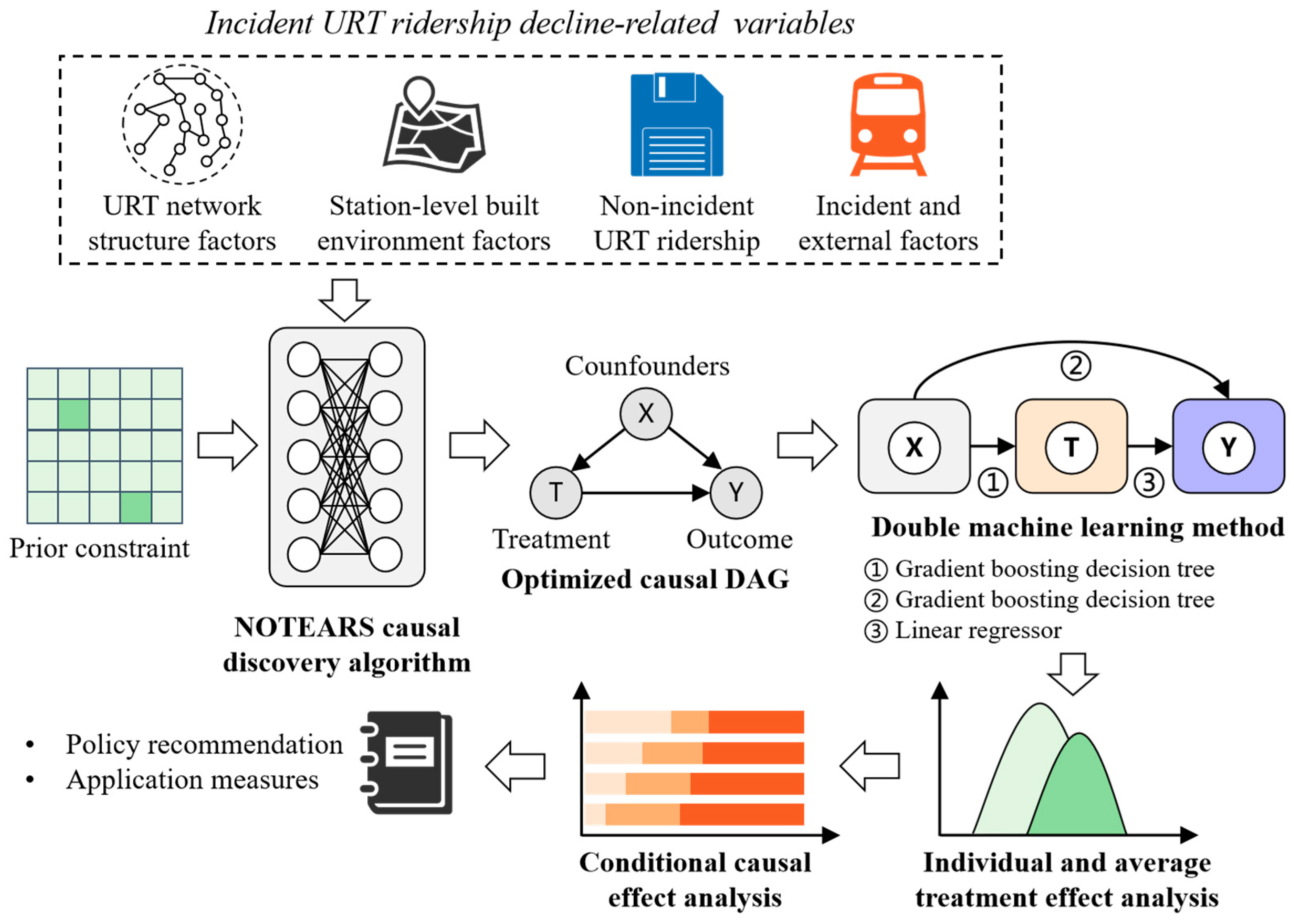
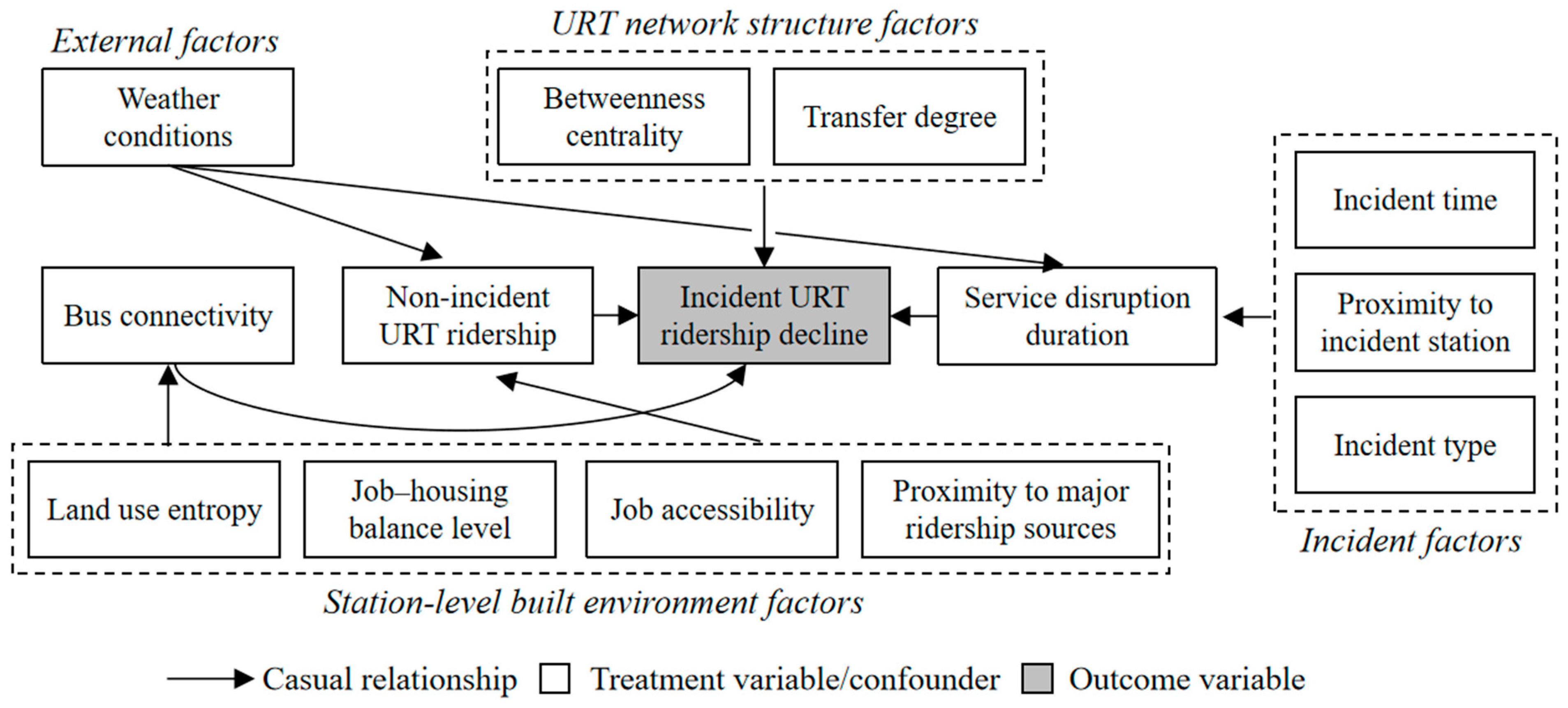
Urban rail transit (URT) systems are critical for sustainable urban mobility but are increasingly vulnerable to disruptions and emergencies. While extensive research has examined the built environment’s influence on transit demand under normal conditions, the nonlinear causal mechanisms shaping URT passenger flow during emergencies remain understudied. This study proposes an artificial intelligence-based causal machine learning framework integrating causal structure learning and causal effect estimation to investigate how the built environment, network structure, and incident characteristics causally affect URT station-level ridership during emergencies. Using empirical data from Shanghai’s URT network, this study uncovers dual pathways through which built environment attributes affect passenger flow: by directly shaping baseline ridership and indirectly influencing intermodal connectivity (e.g., bus connectivity) that mitigates disruptions. The findings demonstrate significant nonlinear and heterogeneous causal effects; notably, stations with high network centrality experience disproportionately severe ridership losses during disruptions, while robust bus connectivity substantially buffers such impacts. Incident type and timing also notably modulate disruption severity, with peak-hour incidents and severe disruptions (e.g., power failures) amplifying passenger flow declines. These insights highlight critical areas for policy intervention, emphasizing the necessity of targeted management strategies, enhanced intermodal integration, and adaptive emergency response protocols to bolster URT resilience under crisis scenarios.
Keywords: sustainable transportation; urban rail transit incident; station-level passenger flow; nonlinear causal effect; double machine learning; policy recommendation sustainable transportation; urban rail transit incident; station-level passenger flow; nonlinear causal effect; double machine learning; policy recommendation