


Abstract
As one of the most widely used modes of transportation worldwide, the standardization work of railways is of great significance for improving operational efficiency, enhancing service quality, and promoting sustainable development. Through research on railway enterprises, this paper proposes a standardization work solution applicable to railway enterprises of different sizes, which includes six steps. It is found that railway enterprises of different sizes can use the solution proposed in this study to carry out standardization work, but the results of different railway enterprises using this solution to carry out standardization work may be different, and the results of different units using this solution to carry out standardization work within the same railway enterprises are not comparable. Railway enterprises should strengthen cooperation and learn from each other’s advanced experience. Furthermore, the solution in this study can serve as a reference for different railway enterprises to carry out standardization work and contribute to the sustainable development of railway enterprises.
1. Introduction
Railway transportation, as one of the most indispensable modes of transportation in modern society, plays an irreplaceable role in the transportation system. Against the backdrop of the global economy shifting towards a low-carbon model and under the initiative of China’s Belt and Road, there is significant rejuvenation occurring in the international railway market. Standardization is a series of processes for developing and implementing technical standards [1]. During the rapid development of the railway industry, standardization work is an important approach to promoting modernization, standardization, scientization, and sustainability in railway enterprises, as well as an essential means to enhance their core competitiveness. By carrying out standardization work in railway enterprises, it is possible to regulate the management and operation behaviors of railway transportation, improve the overall efficiency and service quality of it, which is an inevitable requirement for achieving high-quality development of the railways, a fundamental approach to deepen the foundation and standardization of railways, and also helps to maximize the operational efficiency of railway enterprises, reduce operating costs, and inject new impetus into the development of the railway industry [2].
Based on this, this paper studies a standardization work solution which could promote the sustainable development of railway enterprises, aiming to provide references for promoting the standardization work of railway enterprises. It is of profound significance for enhancing the overall competitiveness of railway enterprises and achieving the sustainable development of the railway industry.
2. Literature Review
Currently, there are multiple international organizations dedicated to standardization work related to railways. The International Union of Railways (UIC), founded in 1922 and with 218 members, is the only worldwide railway organization that plays a significant role in promoting railway transportation globally and effectively addresses current and future challenges related to transportation and sustainable development. The UIC considers standardization as one of its five vital points in serving the global community, and technical harmonization has been and is at the heart of UIC’s mission [3,4,5]. The CEN, the European Committee for Standardization, is an association that brings together the National Standardization Bodies of 34 European countries; CENELEC, the European Electrotechnical Committee for Standardization is one of three European Standardization Organizations (together with CEN and ETSI) that have been officially recognized by the European Union and by the European Free Trade Association (EFTA) as being responsible for developing and defining voluntary standards at the European level [6]. The ETSI, the European Telecommunications Standards Institute, is a European Standards Organization, dealing with telecommunications, broadcasting, and other electronic communications networks and services [7]. CEN, CENELEC, and ETSI carry out railway standardization activities in different fields, develop and publish European railway standards, and actively cooperate with the UIC, ISO, and IEC to jointly promote the development of European railway standardization [8,9,10,11]. In addition, there are railway-related Technical Committees (TCs) within the ISO and IEC that engage in standardization work related to railways. For example, the scope of ISO/TC 269 is the standardization of all systems, products, and services specifically related to the railway sector [12,13], while the purpose of IEC/TC 9 is to prepare international standards for the railway field which include rolling stock, fixed installations, management systems (including supervision, information, communication, signaling, and processing systems) for railway operation, their interfaces, and their ecological environment [14,15]. Furthermore, many countries have established dedicated railway standardization-related institutions that are responsible for railway standardization duties and exercise relevant authorities, develop railway-related standards, and actively participate in international activities related to railway standardization [16,17,18,19]. Since the establishment of ISO/TC 269, Chinese organizations have fully participated in and actively promoted the internationalization of standards. A number of standard proposals provided by China have been authorized to carry out standard preparation, and Chinese experts have participated in the preparation of all ISO/TC269 standard projects under development [13].
Railway standardization work involves all aspects of railway enterprises; both railway-related standardization organizations and railway companies have adopted various measures to promote standardization work in the railway industry. At present, railway enterprises actively implement ISO-related standards, such as ISO 14001:2015 [20], Environmental management systems. Requirements with guidance for use; ISO 22163:2023 [21], Railway applications. Railway quality management system. ISO 9001:2015 and specific requirements for application in the railway sector [22,23], and so on. This not only enables railway enterprises to better participate in the internationalization of standards, but also promotes the smooth implementation of standardization in railway enterprises. In terms of multimodal transport, the UIC has the Combined Transport Group (CTG). To develop cooperation among railway enterprises with a view to advancing and promoting intermodal techniques and making them reliable, competitive, and better suited to the requirements of the market and the environment, the CTG has initiated necessary actions in areas such as productivity improvements, communication, business facilitation, and market knowledge, including developing common industry practices in customer management, acquiring new members, and monitoring trends in combined transport [24,25]. In terms of railway safety, railway transportation enterprises should conscientiously implement relevant requirements, promote standardization work, and establish a prevention mechanism. Based on the study of railway safety standardization work, the standardization and optimization measures of railway safety should be further explored, and the foundation of railway safety production should be consolidated [26,27,28]. In terms of railway construction engineering, some scholars [29,30] have studied the use of advanced digital and standardization methods (such as BIM standardized quantity calculation models and open building information models) to systematize information by digitalizing infrastructure; the whole process of project costing can be controlled scientifically and reasonably, thereby achieving the goal of improving efficiency and reducing costs. In terms of railway material planning and management, Wang et al. [31] analyzed the current situation and existing problems of railway material management, and proposed scientific and reasonable standardization solutions to achieve the goals of strengthening management, improving efficiency, enhancing quality, and serving the grassroots community. In the organization and management of integrated commissioning and testing of a high-speed railway, Fu [32] analyzed the existing problems and shortcomings in the current high-speed railway testing organization and management. Based on this, measures and strategies were proposed to improve the efficiency and level of high-speed railway testing work by establishing standardized management systems, strengthening testing personnel training, optimizing testing resource allocation, establishing emergency plans and risk assessment mechanisms, and applying information technology for integrated commissioning and testing operations. In terms of evaluation methods for railway standardization construction, Zeng [33] designed a standard evaluation process for railway transportation stations based on data self-collection. On this basis, corresponding standardization evaluation methods were proposed to provide effective support for the comprehensive evaluation of standardization construction in railway enterprises. Fei et al. [34] proposed a widely applicable definition of the stratified embankment substructure to provide a reference for standardized HSR substructure construction; moreover, he structured an infrastructure standard cluster by studying railway infrastructure standards in China, which provided a reference for the development of standardization work in terms of enhancing railroad efficiency [35].
By the end of 2023, China’s railway operating mileage reached 159,000 km, of which 45,000 km are high-speed railways, accounting for more than 70 percent of the world’s total high-speed rail mileage, and continues to rank first in the world. China is the country with the longest high-speed railway operating mileage, the largest amount of railway under construction, the highest commercial operation speed, the most comprehensive high-speed railway technology, and the most abundant operational scenarios in the world [36,37]. Taking China’s railway enterprises as an example, China’s railway implements a three-tier management model consisting of China State Railway Group Co., Ltd., the Railway Bureaus Group Co., Ltd., and Stations and Depots, which lays the foundation for improving the efficiency of railway operations and service quality. Wang et al. [38] studied and formulated a set of special line management systems by analyzing the operation status and existing problems of the Shenyang Railway Group Corporation. This effectively improved the Shenyang Railway Group Corporation’s loading and unloading of vehicles in terms of the safety control ability to ensure the safety of railway freight transportation. Chi et al. [39] analyzed the current situation of the standardization and normalization of railways and formulated the Loading and Unloading Operation Process and Standards, and through the normalization of its implementation, the professional level of freight management was improved, operation behaviors were standardized, standardization quality of on-site operations was improved, and the safety of railway freight transport was ensured.
It can be seen that the existing literature describes railway enterprises’ standardization work either on the basis of different specialties and develops a solution that applies only to that specialty without considering other specialties, or on the basis of the tier of that enterprise (e.g., one in the three-tier management model) and develops a solution that applies only to that tier without considering other tiers. Based on this, this study proposes a universal solution for standardized work that applies to both different specialties and different levels of railway enterprises.
3. Methodology
This study takes railway enterprises as the research object and aims to investigate a standardization work solution suitable for railway enterprises, thereby laying a foundation for the implementation of standardization work in different railway enterprises. It will enhance the overall efficiency of the railway industry and promote its high-quality development. The steps in this solution and the corresponding outputs are shown in Figure 1.
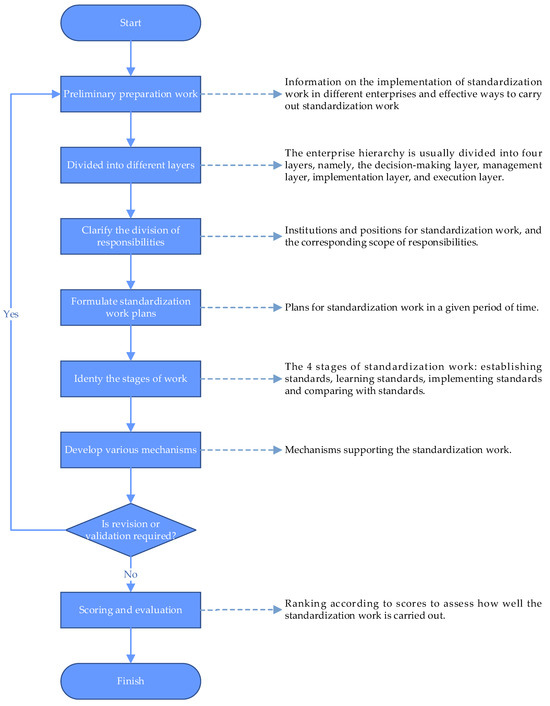
Figure 1.
The steps in this solution and the corresponding outputs.
3.1. Preliminary Preparation Work
The first step is to conduct preliminary preparations, such as on-site research. Through different methods such as on-site visits and communication with frontline employees, research could be conducted in different railway enterprises. Different professional departments could be randomly selected in the same railway enterprise in which to carry out research, or different railway enterprises of the same professional departments could be chosen in which to carry out research, but it should be noted that the choice of departments should have different levels of standardization work, so as to understand the current status of standardization work in the railway industry, problems and difficulties encountered in the process of promoting standardization work, as well as corresponding solutions. By consulting literature and materials, the development of standardization work in different enterprises in the railway industry, as well as in other industries, and effective methods for promoting standardization work could be understood, which can provide materials for investigating different experiences in standardization work and lay a foundation for subsequent research.
3.2. Divide the Enterprises into Different Layers
The second step is to divide the enterprises that formulate standardization work plans into different layers. In fact, any type of railway enterprise could develop its own standardization work plan. However, if the railway enterprise is very large and there are too many people in the enterprise, it will cause the implementation of the standardization work plan to become difficult. Therefore, the enterprise needs to be divided into several different layers based on the size of the enterprise in which the standardization work plan is developed in order to facilitate hierarchical management so that the entire enterprise can effectively implement the work plan. Typically, railway enterprises can be divided into four layers: decision-making layer, management layer, implementation layer, and execution layer, as shown in Figure 2. For extra-large railway enterprises, the execution layer can be further divided into decision-making layer, management layer, implementation layer, and execution layer.
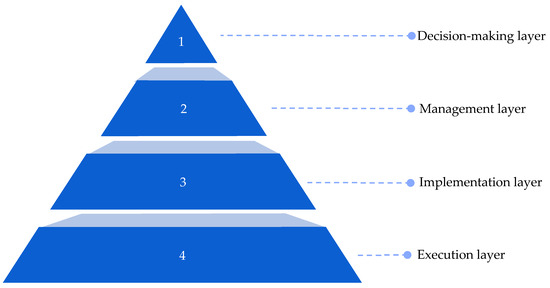
Figure 2.
Layer division of railway enterprises.
3.3. Clarify the Division of Responsibilities
The third step is to establish corresponding standardization institutions and positions based on the layered classification in the second step, and to clarify their scope of responsibilities, so as to have dedicated work institutions and employees with a clear division of labor that perform their respective duties, fully promoting the implementation of standardization work in their own layer (and the layers they manage). The standardization work of railway enterprises is a “head project” that plays a crucial role in improving the basic management level of railway frontline operations. The institutions, scope of responsibilities, positions, and job responsibilities for standardization work in railway enterprises can be set as shown in Table 1.

Table 1.
The institutions, scope of responsibilities, positions, and job responsibilities for standardization work in railway enterprises.
3.4. Formulate Standardization Work Plans
The fourth step is to set standardization work goals that each layer hopes to achieve within a specific period of time and break them down hierarchically. The content of the established goals should include the time nodes, the scope involved, the content to be achieved, and the degree of achievement required. An example of formulated standardization work plans for safety management is shown in Table 2.
Table 2.
An example of formulated standardization work plans for safety management.
Standardization work requires the participation and effort of all employees. From the chairman to common employees within the enterprise, they all need to deeply understand and implement the requirements of standardization. Only through the efforts of all employees can the standardization work goals of railway enterprises be achieved.
3.5. Identify the Stages of Work
The fifth step is to identify the stages for promoting standardization work. Standardization work covers all aspects of railway enterprises, from infrastructure construction, equipment maintenance, and operation management to service provision, which require clear, unified, and high-standard requirements. Only in this way can the operational efficiency and service quality of railway enterprises be ensured to meet market demands. Although there are many specialized fields and positions involved in railway enterprises, the essence remains the same. Overall, the process can be summarized into four stages: establishing standards, learning standards, implementing standards, and comparing standards. Through the iterative process of the four stages, the standardization work is promoted to form a closed-loop management system, achieving systematic management and continuous improvement of standardization work [40] (Figure 3).
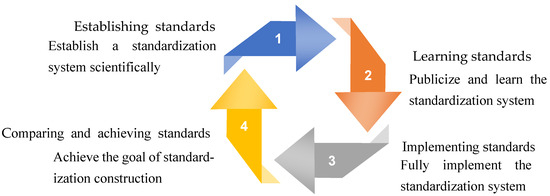
Figure 3.
The stages for promoting standardization work.
Establishing Standards: The indicator system should be established and improved by each layer which focuses on its respective tasks and responsibilities. In the process of establishing indicator systems and evaluation systems, the principles and drafting norms for standardization documents should be followed by all units to enhance the quality of standard establishment.
Learning Standards: In combination with the divided layer, focusing on evaluation indicators and their corresponding standards and regulations, an overall and phased learning plan for different layers can be formulated to achieve precise learning of standards. Specifically, various methods such as face-to-face teaching, multimedia learning, issuing publications, etc. (Table 3) can be used to conduct publicity and training for the employees involved, so that they can choose the appropriate way to learn the standards according to their needs and better understand how to perform standardization work in their respective positions.
Table 3.
Examples of learning standards [41].
Implementing Standards: Further strengthen the daily supervision, inspection, and guidance of standardization work to ensure the orderly operation of the creation mechanism, the effective implementation of the creation tasks, and promote the smooth development of standardization work at all layers. It should be noted that the supervision of standardization work should be carried out under the unified leadership of superior-layer departments, with the cooperation and coordination of relevant departments at all layers involved, and a joint effort to inspect and check the specific situation of standardization work. During the inspection and supervision process, any problems found should be recorded promptly, and the identified problems should be evaluated. If necessary, feasible rectification suggestions should be proposed, and the units inspected should be ordered to make corrections within a specified time limit and report on the rectification results. The results of the inspection and supervision can be used as an important criteria for evaluating and selecting outstanding units and conducting performance appraisal. This stage should focus on multi-pronged measures so that standards are internalized in the mind and norms are externalized in action.
Comparing Standards: On the basis of checking the implementation of the standardization work of each relevant institution or individual, the results of the inspection will be fed back to the superior authorities, so that the authorities know the situation of standardization work at each layer and the existing problems, so as to improve the shortcomings in the next work, so that, next time, the standard is more accurate and reasonable, and more conducive to the implementation of the standardization work of the enterprise. In the stage of “comparing and achieving standards”, attention should be paid to standardizing the comparison process and adhering to the problem’s orientation, strengthening the planning and arrangement, strengthening the implementation of the responsibility, strictly organizing the implementation, improving the process and methodology, and eliminating the phenomenon of disorganization, problematic inaccuracies, false achievements, and so on.
It should be noted that each step should be refined separately according to the characteristics and work content of different positions. Therefore, the actual steps are detailed and specific, rather than uniform.
3.6. Develop Various Mechanisms
The sixth step is to develop a variety of mechanisms that are compatible with standardization work, to guarantee the orderly promotion of standardization work, and to improve the management level and operational efficiency of railway enterprises, such as work promotion mechanisms, technical support mechanisms, supervision and inspection mechanisms, implementation and feedback mechanisms, safeguard incentive mechanisms, and so on (See Table 4). If the mechanisms need to be reworked or validated, or if the previous steps need to be improved, it is necessary to start with Section 3.1., Preliminary Preparation Work.
Table 4.
Examples of mechanisms.
3.7. Scoring and Evaluation
In order to evaluate the effect of standardization work, railway enterprises display results in the form of scores. Specifically, indexes and evaluation systems can be set up in railway enterprises. The total score is set at 100 points, of which 50 points are for general indicators and 50 points for professional indicators. General indicators are the same indicators in different professions, mainly used for evaluating daily management work, formulated by the decision-making layer; professional indicators are unique to different professions, mainly used for the completion of standardized work tasks in different professions, formulated by the relevant management layer of the railway enterprise in accordance with the actual situation of each profession. The scoring should be differentiated according to different professions, corresponding to different indicator systems. Different index systems for different professions can be converted by certain coefficients to obtain a total score, which can be ranked together with other professions in the whole enterprise. According to the ranking, corresponding reward and punishment measures can be formulated to promote the standardization work of employees and make the standardization work sustainable. Examples of indicators, evaluation systems, and reward and punishment measures are shown in Table 5.
Table 5.
Examples of indicators, evaluation systems, reward and punishment measures.
The scores of enterprises can be derived from the following equation:
among them,
4. Discussion
Promoting standardization work is an important direction for the development of railway enterprises, a necessary means to realize the standardization and refinement of the internal management of railway enterprises, an inevitable choice to adapt to the market demand and meet the needs of passengers, and an important way to achieve the high-quality development of the railway industry. In this paper, a standardized work solution applicable to railway enterprises is proposed, and six steps of the solution are introduced. Unlike other solutions, this study does not put forward a specific solution for a certain profession or field of railway enterprises, but a macro solution for railway enterprises. The following scenarios may occur in different railway enterprises in the process of using the solution proposed in this study:
- (1)
- Railway enterprises leading the standardization work are of different sizes and may be divided into different layers, e.g., after a large railway enterprise is divided into four layers, its executive layer may be divided into layers again. Although different sizes of railway enterprises may be divided into different layers, the steps of their standardization work are almost the same, and can be carried out according to the six steps in Section 3, Methodology.
- (2)
- Differences in various factors, such as geographic location, passenger volume, management level, and degree of awareness, have led to different railway enterprises having different focuses. Therefore, even if the standardization work is carried out by the same layer (or similar size) of railway enterprises, the results may not be the same.
- (3)
- There are a number of different units in the same railway enterprise, and there are great differences in the content of the work, types of work, and positions among different units; from this point of view, the standardization of different units within the same railway enterprise is not very comparable.
This being said, different railway enterprises can eventually be ranked by means of scoring, so that railway enterprises can be compared regardless of whether they have the same professions and whether they are in the same enterprise, which in turn provides an intuitive understanding of the results of standardization work carried out by railway enterprises. The score can be linked to employee performance, thus motivating employees to work hard to do a good job of standardization. In addition, according to the ranking of standardization work, appropriate reward and punishment measures can be developed in order to promote the standardization of staff to carry out their work. At the same time, the score comes from different indicators (such as general indicators, professional indicators, etc.), so the score (i.e., the score of each indicator) can be further analyzed or compared with different enterprises to analyze their own standardization strengths or weaknesses, and to promote the sustainable development of the standardization of the enterprise.
5. Conclusions
Based on the above analysis, we believe that each railway enterprise should strengthen their cooperation with others and actively learn from the experiences of other enterprises in order to improve their own standardization work level. Meanwhile, the standardization work level in different periods should be compared and analyzed to find out the direction that can be further optimized and improved.
Although the railway industry has made remarkable progress in standardization work, with the continuous progress of science and technology and the rapid development of the railway industry, the standardization work of railway enterprises will face more challenges and opportunities. In the face of the new market environment and economic situation, railway enterprises need to pay more attention to standardization work in different ways, such as strengthening standardization work, improving the standard system, and so on, to continuously improve their operational efficiency and service quality, in order to contribute to the sustainable development of the railway industry.
Author Contributions
Conceptualization, J.L.; methodology, J.L.; investigation, Z.P. and X.L.; writing—original draft preparation, J.L.; writing—review and editing, Z.P. and N.N.; funding acquisition, X.L. and B.Z. All authors have read and agreed to the published version of the manuscript.
Funding
This research was funded by the National Key R&D Program of China, grant number 2022YFF0608000 and the President’s Fund Project of the China National Institute of Standardization, grant number 572022Y-9397.
Institutional Review Board Statement
Not applicable.
Informed Consent Statement
Not applicable.
Data Availability Statement
Data are contained within the article.
Conflicts of Interest
The authors declare no conflicts of interest.
References
- Duan, R. A Comparative Study on Its (Intelligent Transport System) Standardization Policies in the U.S. and Europe. Heliyon 2023, 9, e21310. [Google Scholar] [CrossRef] [PubMed]
- Ding, H.L. On the Standardization and Standardization of Railway Construction. Gansu Sci. Technol. 2020, 36, 55–56+81. [Google Scholar]
- About Uic. Available online: https://uic.org/about/about-uic/ (accessed on 3 December 2023).
- Vademecum(Lsit of Uic Members). Available online: https://vademecum.uic.org/en/ (accessed on 3 December 2023).
- Uic Centenary. Available online: https://uic.org/timelines/ (accessed on 3 December 2023).
- Cen Cenelec. Available online: https://www.cencenelec.eu/ (accessed on 12 December 2023).
- ETSI. Available online: http://www.etsi.org/ (accessed on 12 December 2023).
- Li, W.X.; Yang, Z.Y.; Guo, D.H.; Zhang, J.H. Analysis and Study on the State and Characteristics of Railway Standardization in Europe. Stand. Sci. 2020, 129–134. [Google Scholar] [CrossRef]
- Xu, S.D.; Guo, D.H.; Zhang, J.G. Study on the Relationship of UIC Standards and European Standards about Railway. Stand. Sci. 2021, 124–128. [Google Scholar] [CrossRef]
- Cenelec and Iec Cooperation. Available online: https://www.cencenelec.eu/about-cenelec/cenelec-and-iec-cooperation/ (accessed on 12 December 2023).
- ETSI Worldwide. Available online: https://www.etsi.org/about/etsi-worldwide (accessed on 12 December 2023).
- Technical Committees ISO/TC 269 Railway Applications. Available online: https://www.iso.org/committee/661629.html (accessed on 15 December 2023).
- Chen, Y.; Yu, B.; Yang, H.Y.; Shang, D. Overview of the 11th Plenary Meeting of ISO/TC 269 and Consideration of International Standardization of China Railway. Railw. Qual. Control 2022, 50, 8–11. [Google Scholar]
- Cui, F.; Wang, Q.H.; Liu, G.; Wu, Q. Exploring the Development of Railway Equipment Technology from the Perspective of Standardization. In Proceedings of the 2022 IEEE Transportation Electrification Conference and Expo, Asia-Pacific (ITEC Asia-Pacific), Haining, China, 28–31 October 2022. [Google Scholar]
- TC 9 Electrical Equipment and Systems for Railways. Available online: https://www.iec.ch/dyn/www/f?p=103:7:614404130057025::::FSP_ORG_ID,FSP_LANG_ID:1248,25 (accessed on 15 December 2023).
- Meng, Q.; Gu, X.X.; Sheng, T.T.; Xu, J. Development Status and Enlightenment of Railway Traffic Standardization in France. China Stand. 2020, 250–255. [Google Scholar] [CrossRef]
- Shi, J.L.; Zhang, J.C.; Li, N. Study on the Internationalization Strategy of Japanese Railway Technical Standards. China Railw. 2015, 81–85. [Google Scholar] [CrossRef]
- Zhu, F.X.; Ni, G.B. To push forward the opening-up of China railway standard by conducting standard comparison and analysis between China and Germany. Railw. Econ. Res. 2010, 5–9. [Google Scholar] [CrossRef]
- Jing, G.Q.; Zhang, H.P.; Wang, H.Y.; Wang, C. Trends and Suggestions to the Development of International Railway Standards. J. Railw. Eng. Soc. 2022, 39, 100–105. [Google Scholar]
- ISO 14001:2015; Environmental Management Systems. Requirements with Guidance for Us. ISO: Geneva, Switzerland, 2015.
- ISO 22163:2023; Railway Applications. Railway quality Management System. ISO 9001:2015 and Specific Requirements for Application in the Railway Sector. ISO: Geneva, Switzerland, 2023.
- Han, Y.; Li, J.T.; Zhang, Z.; Liu, J.Y. Quality Control Method in Railway Industry Based on ISO/TS 22163 Standard. Urban Mass Transit. 2018, 21, 86–90. [Google Scholar]
- Wang, J.Z.; Shang, D.; Gao, Y.; Yu, B.; Cui, B.X.; Jia, Z.Y. Analyze ISO 22163:2023 Railway applications Railway quality management system ISO 9001: 2015 and specific requirements for application in the railway sector. Railw. Qual. Control 2023, 51, 3–9,13. [Google Scholar]
- Combined Transport Group. Available online: https://uic.org/special-groups/combined-transport-group/ (accessed on 3 December 2023).
- Zhu, J.L.; Gao, J.L.; Shang, D. Study Made by UIC on Standardizing International Multimodal Transport. Railw. Qual. Control 2017, 45, 1–4. [Google Scholar]
- Yang, C.; Liu, J.H.; Li, X.Y.; Wang, P.H.; Qi, Y.K. Research on Optimization Measures for Standardization Management of Railway Work Safety. China Railw. 2023, 131–136. [Google Scholar] [CrossRef]
- Hendratama, I.; Denov, B.; Zoro, R. Lightning Protection System Standardization on Indonesian Railway Operation Facilities. In Proceedings of the 2019 2nd International Conference on High Voltage Engineering and Power Systems (ICHVEPS), Denpasar, Indonesia, 1–4 October 2019. [Google Scholar]
- Liu, X.L.; Wang, W.Q. A Study into the Standardization of Using Fire Detectors in Rail Vehicles for China. Procedia Eng. 2013, 52, 240–244. [Google Scholar] [CrossRef][Green Version]
- Li, C.N.; Li, D.; Chen, W.F. Research on Standardization and Digital Transformation of Railway Comprehensive Housing Investment Control. Railw. Eng. Technol. Econ. 2022, 37, 53–56. [Google Scholar]
- Ciccone, A.; Stasio, S.D.; Asprone, D.; Salzano, A.; Nicolella, M. Application of openBIM for the Management of Existing Railway Infrastructure: Case Study of the Cancello–Benevento Railway Line. Sustainability 2022, 14, 2283. [Google Scholar] [CrossRef]
- Wang, Z.H.; Zhuang, T.J.; Li, S.; Wang, Y.; Ji, X.; Qu, H.S. Research on the standardization of railway material plan management. Railw. Purch. Logist. 2022, 17, 28–30. [Google Scholar]
- Fu, X.B. Research on Standardization of Organization Management of Integrated Commissioning & Test of High Speed Railway. Railw. Tech. Innov. 2023, 67–70. [Google Scholar] [CrossRef]
- Zeng, Q.L. Research on Evaluation Method of Standard Construction of Railway Transportation Stations and Depots. Railw. Transp. Econ. 2023, 45, 156–162+187. [Google Scholar]
- Fei, J.B.; Jie, Y.X.; Hong, C.Y.; Yang, C.S. Comparative Analysis of Design Parameters for High-Speed Railway Earthworks in Different Countries and a Unified Definition of Embankment Substructure. Balt. J. Road Bridge Eng. 2020, 15, 127–144. [Google Scholar] [CrossRef]
- Fei, J.B.; Ni, G.B.; Wang, X.T.; Jie, Y.X. Cluster Analysis on Railway Infrastructure Standards in China and Its Application to Railway Efficiency Improvement. IOP Conf. Ser. Earth Environ. Sci. 2020, 467, 012191. [Google Scholar] [CrossRef]
- China’s High-Speed Rail Operating Mileage Reaches 45,000 Kilometers. Available online: http://www.china-railway.com.cn/xwzx/zhxw/202401/t20240112_132652.html (accessed on 12 March 2024).
- People’s Daily: Passengers Sent from 23 Million to 480 Million. Spring Festival 70 Years, the Railway Speed to Witness the Change of the Times (2024 Spring Festival Front Line). Available online: http://www.china-railway.com.cn/xwzx/mtjj/rmrb/rmrb/202402/t20240222_134076.html (accessed on 12 March 2024).
- Wang, S.Z.; Meng, X.L.; An, Y.; Wang, W.Y. Exploring the Promotion of Special Line Standardization Construction in Shenyang Railway Group Corporation. Railw. Freight Transp. 2023, 41, 42–45. [Google Scholar]
- Chi, C.Z.; Yu, Y.H.; Xin, J.; Xu, Y.F. Practical Exploration of Loading and Unloading Standardization Construction of Freight Stations and Depots. Railw. Freight Transp. 2023, 41, 27–30. [Google Scholar]
- Xiao, L. Discussion on Standardization Work of Standards Establishment at Railway Stations and Depots. Railw. Qual. Control 2021, 49, 6–9. [Google Scholar]
- Kang, J.S.; Yan, S.Q.; Han, J.; Ma, N.; Lu, H.H. Talk about China’s standardization publicity training system. Pop. Stand. 2017, 2, 42–45. [Google Scholar]
Disclaimer/Publisher’s Note: The statements, opinions and data contained in all publications are solely those of the individual author(s) and contributor(s) and not of MDPI and/or the editor(s). MDPI and/or the editor(s) disclaim responsibility for any injury to people or property resulting from any ideas, methods, instructions or products referred to in the content. |
© 2024 by the authors. Licensee MDPI, Basel, Switzerland. This article is an open access article distributed under the terms and conditions of the Creative Commons Attribution (CC BY) license (https://creativecommons.org/licenses/by/4.0/).