


Abstract
Compared to air, rail, and road transport, shipping is a more energy-efficient and environmentally friendly way to transport goods over a long distance. However, the unprecedented growth of global seaborne trade has had a significant impact on the environment. The process of shipping transportation, through exhaust gas, wastewater discharge, fuel leakage, etc., has caused very serious environmental pollution. In response to this issue, the International Maritime Organization introduced the International Convention for the Prevention of Pollution from Ships (MARPOL) Convention to regulate the discharge of pollution from ships. Given that there are few studies discussing policy effectiveness, this study comprehensively considers and reviews the implementation effectiveness of all annexed policies under the MARPOL Convention. After discussing the differences between these policies based on the implementation conditions, requirements, strictness, and scope of adoption, the empirical analysis method of time-varying differences-in-differences model is adopted to analyze the policy effectiveness of each annex. It further puts forward suggestions and references for the formulation of effective maritime policies in the future that should be targeted, comprehensive, contingency-based, and proactive. This will help design or revise policies in the shipping industry, thereby promoting the early achievement of shipping emission reduction targets and contributing to the sustainability of the shipping industry.
1. Introduction
Maritime transport is a vital method of transporting goods, accounting for over 80% of global trade [1]. According to the 2023 Review of Maritime Transport released by the United Nations Conference on Trade and Development (UNCTAD), there are nearly 105,500 ships with a gross tonnage of more than 100 tons worldwide, with a total deadweight of about 2.3 billion tons [1]. Maritime transport plays a critical role in the world economy and is a fundamental component of international trade and globalization. With the increasing emphasis on environmentally sustainable development, promoting the utilization of clean energy and reducing carbon emissions have become the general consensus in the international community [2,3,4,5], and many countries have successively proposed the goal of net-zero greenhouse gas emissions or achieving carbon neutrality (Wang et al., 2021) [6]. Although maritime transport is considered a more environmentally friendly mode of transporting goods than other methods, greenhouse gas emissions cannot be ignored [2,7]. To address this issue, the International Maritime Organization (IMO) adopted a preliminary strategy for reducing greenhouse gas emissions from shipping in 2018, proposing quantitative targets for reducing the intensity of greenhouse gas emissions from shipping by 40% in 2030 and 70% in 2050 and reducing total annual greenhouse gas emissions by at least 50% compared to 2008 [8]. In July 2023, the GHG strategy was further updated and ratified at the 80th meeting of the Marine Environment Protection Committee (MEPC). The revised GHG strategy sets a common goal of achieving net-zero greenhouse gas emissions from international shipping by 2050, committing to ensuring the use of alternative-zero and near-zero greenhouse gas fuels by 2030 and introducing phased inspection indicators at two time points (2030 and 2040) [9].
Ship activity not only leads to the emission of greenhouse gases but also contributes to other forms of pollution. To regulate polluting emissions from the shipping industry, IMO introduced the International Convention for the Prevention of Pollution from Ships (MARPOL Convention) in 1973, which consists of six annexes [10]. While many scholars have examined the implications of the Convention’s policy guidance when studying shipping emissions, few have focused on the overall effectiveness of the provisions of the six annexes of the Convention as a whole. As effective policy guidance is crucial to achieve sustainable development and reduce polluting emissions, this study aims to explore the policy effectiveness of the six annexes of the MARPOL Convention, which could compensate for the previous neglect of integrity research on policy. After comprehensively reviewing the content of the six annexes, this study compares the similarities and differences of the regulations implemented by different annexes and conducts a preliminary evaluation of their policy effectiveness using certain quantitative indicators. On this basis, a time-varying differences-in-differences (DID) model is employed for empirical analysis, which combines the qualitative and quantitative analysis results. It ultimately provides targeted suggestions and references for formulating effective shipping policies and discusses policy orientation that is conducive to reducing shipping emissions from a more comprehensive perspective.
The rest of this study is organized as follows: Section 2 surveys the relevant literature on pollution from shipping and establishes the need to explore policy effectiveness. Section 3 presents a detailed review of the content of the six annexes of the MARPOL Convention. Section 4 explores the policy effectiveness of the MARPOL annexes through a time-varying DID model. Section 5 provides a more detailed analysis of MARPOL Annex VI, which has proven to be highly effective, and offers a reference for future maritime policy design. Finally, conclusions are presented in Section 6.
2. Literature Review
The literature reviews aim to map, consolidate, and assess the knowledge area in a certain field, and on this basis, identify the knowledge gaps to be filled to further develop the existing knowledge system [11]. To understand the current state of research on shipping pollution issues, a systematic review was conducted utilizing the published academic literature. The publication data used in this study were collected from the Scopus database. Scopus is the largest abstract and citation database of peer-reviewed research literature introduced by Elsevier. To enhance the relevance of the search results, a specific selection of journals, primarily related to shipping, was chosen. The resulting articles were obtained from publications of Case Studies on Transport Policy (CSTP), International Journal of Shipping and Transport Logistics (IJSTL), Maritime Economics and Logistics (MEL), Maritime Policy and Management (MPM), Ocean and Coastal Management (OCMA), Research in Transportation Business and Management (RTBM), Transport Policy, Transport Reviews, Transportation Research Part A: Policy and Practice (TRA), Transportation Research Part B: Methodological (TRB), Transportation Research Part C: Emerging Technologies (TRC), Transportation Research Part D: Transport and Environment (TRD), Transportation Research Part E: Logistics and Transportation, Transportation Research Record (TRR), and Marine Transport Policy (MTP). These publications encompass the period from 2002 to 2022. Furthermore, the search terms were determined through a trial and error process, taking into account keywords commonly used in previous review papers on shipping pollution [12,13,14,15,16]. The final keyword structure consists of three levels, as shown in Table 1.

Table 1.
Keywords used in the literature search.
A preliminary search yielded 478 articles, which were further refined through the removal of duplicates and irrelevant studies, resulting in the identification of 452 relevant papers. By using the visualization tool of CiteSpace, hot research topics concerning shipping pollution issues were identified based on the frequency of keywords used in the filtered articles (Figure 1). Figure 1 displays the top 11 most popular research topics on shipping pollution issues.
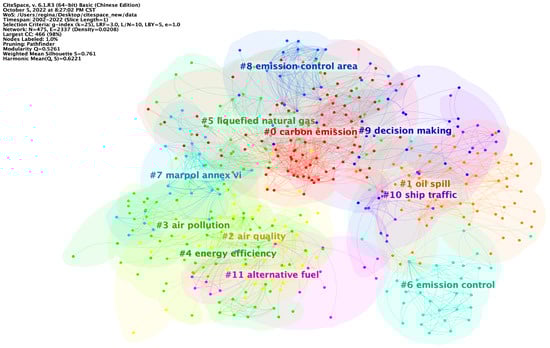
Figure 1.
Hot research topics on shipping pollution issues. Note: Keywords are unified into lowercase letters during graph analysis in the CiteSpace software. The term “marpol annex vi” here refers to “MARPOL Annex VI”.
Based on this result and inspired by the study of previous scholars [17], we reclassified these research hotspots with the labels of four guiding factors, which are “Regulation enforcement”, “Technical needs”, “Benefit incentives”, and “Information analysis” (Table 2).
Table 2.
Guiding factors of research on shipping pollution.
“Regulation enforcement” refers to articles that primarily focus on specific anti-pollution policies or regulations, exploring how the policies control shipping pollution. For example, studies have examined different enforcement regulations in the emission control area for the discharge of pollutants from ships [18,19,20] and compared and analyzed their implementation effects [12,15]. In July 2023, the IMO further revised its GHG strategy. Ref. [21] evaluated the recently revised GHG strategy of the IMO for maritime decarbonization and recommended the use of Life Cycle Assessment (LCA) Guidelines to support GHG strategies for achieving decarbonization targets.
The “Technical needs” category pertains to research on the technological upgrading of ship components to comply with explicit regulations in anti-pollution policies or the restriction of pollution index. As an alternative to switching to compliant fuels, marine companies have chosen to consider switching to clean fuel or installing scrubbers. The changes in pollution emissions brought about by this technological update have attracted a lot of attention [22,23]. Ref. [24] evaluated the performance of electronically controlled diesel engines under the newly introduced Energy Efficiency Existing Ship Index (EEXI) and Carbon Intensity Indicator (CII) regulations and found that their efficiency at low loads and overall flexibility can reduce emissions while decreasing OPEX, thereby promoting their adoption.
“Benefit incentives” pertain to how shipping companies can maximize benefits while complying with regulations. Scholars have analyzed the driving factors of interest, such as route optimization, slow steaming, and the use of clean energy, to save costs and bring greater economic benefits [25,26,27]. For example, [28] developed a multinominal logit model to identify the key determinants influencing shipowners’ choice of emissions solutions, which could guide shipowners in investing in greener vessels. The authors of [29] proposed an integer programming model based on the Marine Emissions Trading Scheme (METS), incorporating variables such as bunker price and the auction and purchase prices of carbon to provide relevant carbon reduction recommendations for container shipping companies and policy makers.
The “Information analysis” category involves analyzing pollution data to guide the reduction in ship pollution emissions and improve ship operational efficiency. For instance, [30] estimated the emission intensity of different pollutants from different ship types and identified the most effective shipping speed with the lowest pollutant emission rate. With the introduction of the “IMO 2020” regulations [31], stricter sulfur emission requirements have attracted scholars’ attention to investigate the impact of these regulations. Ref. [32] used the climate change metric to predict and compare the impact of sulfur emissions on carbon dioxide emissions before and after the sulfur regulations and concluded that the implementation of this provision can effectively reduce sulfur emissions, but there are also certain hidden dangers, that is, increased carbon dioxide emissions.
All the four types of studies above explored the results of the implementation of shipping pollution policies, while very few studies have assessed the effectiveness of policy implementation. It is crucial to assess the effectiveness of policy implementation to guide future policy formulation. Given that the MARPOL Convention is the only comprehensive policy treaty in the shipping industry pertaining to pollution, a systematic and comprehensive comparative study of its various annexes is imperative. This study employs the empirical method to evaluate the effectiveness of each annex so as to propose more targeted suggestions and guidelines for the practice of the shipping industry.
3. MARPOL Convention: A Systematic Policy Review
3.1. Policy Introduction
The MARPOL Convention is a major international convention dealing with the prevention of pollution of the marine environment caused by ships. Initially adopted on 2 November 1973, the convention underwent further development with the establishment of the MARPOL Protocol in 1978. The merged instrument of the parent convention and the protocol entered into force on 2 October 1983. Subsequently, Annex VI was added to the convention in 1997, which entered into force on 19 May 2005. Over the years, a large number of amendments have been made to the MARPOL Convention to ensure its relevance and effectiveness.
The MARPOL Convention addresses various forms of marine pollution resulting from shipping activities, including oil spills, transport of toxic liquids and other harmful substances, sewage, garbage, and air pollution. These different pollution issues have been addressed in separate annexes of the convention:
- Annex I: Regulations for the Prevention of Pollution by Oil (entered into force 2 October 1983);
- Annex II: Regulations for the Control of Pollution by Noxious Liquid Substances in Bulk (entered into force 2 October 1983);
- Annex III: Prevention of Pollution by Harmful Substances Carried by Sea in Packaged Form (entered into force 1 July 1992);
- Annex IV: Prevention of Pollution by Sewage from Ships (entered into force 27 September 2003);
- Annex V: Prevention of Pollution by Garbage from Ships (entered into force 31 December 1988);
- Annex VI: Prevention of Air Pollution from Ships (entered into force 19 May 2005).
3.2. Policy Comparison
In line with the policy design elements mentioned by [33], this study presents a preliminary comparison of the MARPOL Convention’s various annexes and summarizes their essential information in Table 3.
Table 3.
Comparison of basic information among the annexes.
3.2.1. Objective of the Annexes
Annex I mainly addresses issues related to oil pollution, which can impact the growth and reproduction of aquatic life. This annex sets out requirements for oil emissions and distinguishes between oil emission requirements for tankers and other vessels. The most stringent requirement prohibits all tanker oil emissions in or near special areas, except after using clean energy or tankers with scrubbers. In addition to the direct control of the oil emissions, this annex requires ship operators to provide information such as an Oil Record Book [34] and a Shipboard Oil Pollution Emergency Plan (SOPEP) to monitor their oil emissions.
Annex II addresses noxious liquid substances and categorizes them into three categories, with different emission restrictions imposed on each. Vessels authorized to carry a certain category of substances must have a Procedures and Arrangements Manual (P&A Manual) approved by the relevant authority on board to provide audit information. The special area mentioned in Annex II is the Antarctic area, where the release of noxious liquid substances is strictly prohibited.
Similarly, Annex III establishes regulations to prevent pollution by hazardous substances in packaging. The rules for the discharge of these harmful substances are straightforward: “Jettisoning of harmful substances carried in packaged form shall be prohibited, except where necessary for the purpose of securing the safety of the ship or saving life at sea”. Therefore, there is no special area under the provisions of this annex. However, the implementation of Annex III initially faced challenges due to the lack of a definitive definition for hazardous substances in packaged form. This issue has been rectified by amending the International Maritime Dangerous Goods (IMDG) Code to include marine pollutants. The introduction of this annex has promoted a more comprehensive definition and specification of hazardous substances in IMO.
Annex IV addresses raw sewage pollution and requires ships to have approved sewage treatment plants in operation or use approved systems to discharge comminuted and disinfected sewage. It also requires ship operators to provide an International Sewage Pollution Prevention Certificate issued by the national shipping administration to ships under their jurisdiction. In an amendment to Annex IV, the Baltic Sea was made a special area and new emission requirements for passenger ships within the area were added.
Annex V aims to eliminate and reduce garbage dumping by ships and bans the discharge of plastics into the sea. It sets out different emission limits for eight designated special areas. Governments are responsible for ensuring that reception facilities are available at ports and terminals to collect ship-generated garbage. Annex V also emphasizes the importance of shipboard waste management, so the Garbage Record Book (GRB) and Record of Garbage Discharges are required during the voyage of the vessel.
As the issue of global warming intensified, the IMO attached particular importance to the issue of air pollution and Annex VI was developed and continuously revised. In response to greenhouse gas emissions, the IMO proposed the “Initial IMO GHG Strategy”, a top-level strategy that has played a crucial role in guiding the revision of Annex VI. Annex VI mainly formulates regulations on the emission of various polluting gases through mandatory emission requirements, technical measures requirements (e.g., EEDI/EEXI/EEOI/IEEC/CII), and economic management measures requirements (e.g., SEEMP/MBMs). The annex designates four special areas.
3.2.2. Comparison of Common Features of the Annexes
In addition to the differences in theme and content of the above different annexes, this study also compares some of the common features of the annexes, including the existence of special areas, progress of national accession, revision intensity, proportion of European countries included, and intervention type.
Table 4 summarizes the number of special areas in each annex. Annex I has the most special areas, while Annex III does not set up special areas due to its comprehensive prohibition on hazardous material contamination in the form of packaging; i.e., it does not discriminate in all regions. Both Annex II and Annex IV have only one special area. The special areas set up in Annex V are similar to those in Annex I, with over half of them being the same. Annex VI sets up different Emission Control Areas (ECAs) according to different polluting gases.
Table 4.
Comparison of special areas under the annexes.
A detailed comparison on the various common features of the annexes is illustrated in Table 5. The progress of national accession compares the time lag between the signing and the formal entry into force of the contract, which is named as the “buffer level”. In this study, a buffer level of less than 100 days indicates a short-term period, while a buffer level greater than or equal to 100 days but less than 1000 days denotes a medium-term period. A buffer level of 1000 days or more indicates a long-term period. Because there are a lot of amendment issues in each annex, we calculated the mean of the buffer levels in each annex in Table 5. The results indicate that Annex IV experiences the longest buffer level, suggesting that a significant number of countries have experienced a relatively lengthy transition period before fully implementing the regulations. Conversely, the proportion of medium- and short-term buffer levels under Annex VI has reached 95%, indicating a relatively fast policy-promotion process within this annex.
Table 5.
Comparison of common features of the annexes.
“Revision intensity” is another key indicator for measuring policy or regulation effectiveness. We used the frequency of revisions between the first revision and the latest revision dates of each annex and the year of difference between the two as reference values and defined their ratio as “revision intensity”. According to Table 5, Annex VI exhibits the highest revision intensity (1.40), indicating that it receives the most revisions. Despite being implemented later than the other annexes, Annex VI has undergone more amendments. In contrast, Annex III has the lowest revision intensity, which can be attributed to its complete prohibition status.
Additionally, Annex VI covers a higher proportion of European countries, explaining the greater emphasis on addressing air pollution issues. Regarding the types of policy interventions, all six annexes have both similarities and differences. With the exception of Annex III and Annex VI, the other four annexes primarily focus on setting discharge limitations, providing supervisory information, establishing special areas, and requiring reception facilities. Annex III, on the other hand, completely prohibits the treatment of hazardous material pollution through packaging and does not provide as detailed intervention methods as the other annexes. Compared with the other annexes, Annex VI stands out with the most targeted and comprehensive interventions, including regulatory, technical, economic, and managerial measures.
4. Evaluation of the Phased Implementation of Policies
4.1. Differences-in-Differences Model
The differences-in-differences (DID) model is a widely used empirical method for policy evaluation across various fields. Its primary objective is to measure the effect of existing policies. Compared to other methods, the DID model can provide a more direct assessment of policy effectiveness while simultaneously avoiding endogeneity problems arising from policies as explanatory variables. The model is effective in controlling interaction effects between the predictor and explanatory variables. While traditional DID is mainly applied to policies with the same implementation period across sections, this study employs a time-varying DID method to address the difference in policy adoption time.
As the MARPOL Convention is the only international agreement that addresses shipping emissions, this study used the carbon emission data resulting from ship operations to evaluate the effectiveness of its policies. This study aimed to analyze how carbon dioxide emissions in different countries were affected by the MARPOL policies between 1971 and 2021. The study classified its analysis according to the different annexes of the MARPOL Convention, treating accepted countries as the experimental group and non-accepted countries as the control group. The data sample is divided into four sets, the experimental and control groups before and after accepting the annex policy. The specific time-varying DID model is expressed as follows:
where represents the amount of carbon dioxide emitted by a country i during year t. is 1 for countries accepting the MARPOL Convention Annex at year t, and 0 is for those not accepting the annex at year t. Xit represents the control variables that affect carbon emissions. and represent the country-fixed effects and year-fixed effects, respectively. Lastly, is the residual term. After estimation of the coefficients, the study compares the policy impact coefficients of different annexes to determine the policy orientation favorable to reducing carbon emissions.
4.2. Data Sources and Variable Description
The data used in this study are mainly from three sources: the IMO, Clarksons’ Shipping Intelligence Network (SIN), and International Energy Agency (IEA). IMO provides a global data platform that contains information on the ratification of the IMO convention, which is pertinent to the crucial variable of policy implementation timing. The shipping information from SIN was used as control variables in the research model, including ship deadweight, trade volume, and proportion of flag-of-convenience ships. Data on shipping carbon emissions were obtained from IEA. The timeframe for this study spans 51 years (1971–2021) and covers 160 countries that are members of the MARPOL protocol. The specific variables are described below. It is worth noting that all the variables are annual data for each country, and the subscript indices for country i and year t are omitted for ease of reference.
Carbon dioxide emissions (CO2) refer to the annual carbon dioxide emissions caused by the operation of ships in each country.
GDP (lgdp) represents the logarithm of the GDP of each respective country and indicates the economic situation of each country. When the total economic volume is larger, the GDP is higher, and the energy consumption at this time is larger, which may lead to larger CO2 emissions.
Trade volume (ltrade) is the logarithmic sum of imports and exports and is also considered one of the control variables affecting carbon emissions, given the role of international trade as a major contributor to environmental challenges.
Ship deadweight (ldwt) signifies each country’s operating volume of ships. To guarantee consistency in units, the variable is expressed as a logarithmic result.
The proportion of flag-of-convenience ships (focratio) measures each country’s foreign-flagged vessel ratio to total ships. Sailing vessels under a flag of convenience is a growing business practice adopted by shipping companies, as it allows ships to operate under less stringent regulations.
Table 6 displays the descriptive statistics of the variables mentioned above and policy effect variables as dummy variables for all the annexes under the MARPOL Convention. The policy implementation variable treati = 1 (i = I, II, III, IV, V, VI) was assigned to countries implementing Annex I/II/III/IV/V/VI policies, with a value of 0 assigned for those that did not implement them. A dummy variable yeart = 0 was specified before implementing the policy and assigned a value of 1 after implementing the policy. The final policy effect variable obtained for different annexes is didit = treati×yeart. In particular, because Annex I and II were implemented at the same time, their policy effects are regarded as the same variable in the model, namely didi_ii.
Table 6.
Descriptive statistics of the variables.
4.3. Benchmark Results and Discussion
Before proceeding with the DID model, Table 7 presents the bivariate correlation matrix of the variables. It suggests that the DID variables and other policy variables have a significant relationship with the dependent variable. This provides a preliminary support for the effect between them.
Table 7.
Bivariate correlation matrix.
To ensure the overall reliability and accuracy of the model, a sensitivity analysis was conducted using the stepwise regression method. Table 8 reports the results of five models, all of which incorporate the country- and year-fixed effects. All the F- and p-Values suggest that the models are statistically significant. A comparison of the models reveals that the gradual inclusion of the DID variables does not impact the coefficients of all other variables, while the R-squared keeps increasing, suggesting the significant explanatory power of the DID variables. This further confirms that the model constructed in this study is robust and stable. Notably, because some of the independent variables are highly related, VIF indicators were calculated for each model. As shown in Table 8, the maximum VIFs for each model are less than 10, indicating no concerns regarding multicollinearity issues in the models. Thus, to assess the impact of different annexes on ship pollution emissions in a comparable context, Model (5) was chosen for discussion.
Table 8.
Benchmark results for the difference-in-differences regression analysis.
Table 8 reports the regression results of the DID model evaluating the impact of policies across each annex of the MARPOL Convention on carbon emissions. As can be seen from the table, the coefficients of didiii, didv, and didivi are all statistically significant, signifying that the acceptance of MARPOL Annexes III, V, and VI has an impact on carbon emissions. However, the coefficient of the dummy variable didv representing Annex V is positive. This shows that the implementation of Annex V does not promote the reduction in carbon emissions but aggravates the generation of carbon emissions. Conversely, the coefficients for Annexes III and VI are negative, indicating that accepting policies under these annexes has led to a reduction in CO2 emissions. This further demonstrates the effectiveness of the policies implemented under these two annexes.
The coefficient for Annex III is larger than that of Annex VI. Considering the previous analysis of Annex III, its effectiveness may be closely related to the complete prohibition of its own regulations. The estimated coefficient for the dummy variable didvi representing policies under Annex VI is −2.438, and it is statistically significant at the 5% significance level. Annex VI of the MARPOL Convention aims to limit pollution emissions through multiple dimensions. Unlike other annexes, Annex VI not only sets direct numerical restrictions on pollutant discharge but also includes technical requirements for ship equipment, which addresses the problem of pollution discharge from the root. In addition, Annex VI also attempts to implement certain economic or managerial regulations, imposing implicit restrictions on ship emission behavior during operation. The regression result concerning the policy effect variables of Annex VI shows that it is relatively effective to implement emission control policies that are highly targeted and that consider both direct and indirect controls.
5. Discussion and Policy Recommendations
5.1. MARPOL Annex VI
This empirical result demonstrates the effectiveness of Annex VI of the MARPOL Convention in controlling ship pollution emissions. To further explore the reasons for the effectiveness of this annex, we conducted a more detailed analysis and summary of Annex VI.
Annex VI of the MARPOL Convention is the main international treaty addressing air pollution prevention requirements from ships. The regulation of pollution has been carried out through several amendment meetings since its implementation on 19 May 2005. During ship operation, there are three main ways of polluting the atmospheric environment, namely (1) dust or chemical vapors generated when transporting cargo; (2) exhaust gas pollution generated when burning fuel; and (3) technical or accidental leakage. Among these, the exhaust gas pollution emitted by ships has the most serious impact on the atmospheric environment and causes severe harm to humans and animals.
Annex VI has formulated different restrictions, such as limiting the amount of emission, setting standards for fuel oil used by ships, and establishing emission control areas. In order to actively respond to the problem of global warming and achieve green and low-carbon development, the entire international community is committed to promoting carbon peaking and carbon neutrality [6]. Although the proportion of CO2 in the combustion exhaust gas of ships is not the highest, compared with other types of transportation, the CO2 emissions of ships cannot be ignored. As a result, the IMO passed a new regulation in MARPOL Annex VI in June 2021 by introducing a Carbon Intensity Indicator (CII) rating scheme to regulate and control the carbon emissions from shipping.
Given the close relationship between fuel consumption and shipping volumes, improving fuel efficiency becomes crucial when shipping volumes cannot be controlled. In addition to direct restrictions on pollutant emissions, Annex VI also incorporates technical indicators related to ship fuel efficiency to promote better emission behavior, such as EEOI, EEDI, and EEXI. The Energy Efficiency Operational Index (EEOI) aims to measure the operational efficiency of all new and existing ships by allowing efficiency comparisons between similar ships on similar routes, prompting operators to take further efficiency measures. The Energy Efficiency Design Index (EEDI) aims to enable ship designers and builders to design and build future ships for maximum fuel efficiency, thereby reducing polluting gas emissions. The Energy Efficiency Existing Ship Index (EEXI) is similar to EEDI in that it measures the same, but EEDI applies to new buildings while EEXI applies to existing ships. The division of these indicators is based on existing ships and new buildings, considering the current situation as well as the future. It can be seen that when formulating regulations, Annex VI largely considers the long-term application of policies.
In addition, at the economic and managerial levels, Annex VI also carries out some indirect regulations on the emission of gas pollution, such as the introduction of the Ship Energy Efficiency Management Plan (SEEMP) and MBMs. At the heart of the SEEMP is the formulation and effective implementation of ship-specific energy efficiency measures. Because each shipping company and ship have their own unique operating characteristics, it is important to conduct scientific evaluations and continuous improvements to ensure the effectiveness and feasibility of energy efficiency measures. The implementation of this plan highlights the contingency of Annex VI in addressing the issue of pollution emissions.
To summarize, Annex VI of the MARPOL Convention primarily focuses on addressing air pollution from ships. It formulates regulations through three levels: Emission Limits, Technical Indicators, and Management Specifications, as shown in Table 9. These three levels, from mandatory emission numerical regulations to management planning methods based on corporate social responsibility, are the embodiment of the transition from tightening to elastic policies and regulations. A policy of combining elasticity and tightness can not only solve the main problems, but also provide more possibilities for better and improved solutions. Therefore, Annex VI stands out among all the annexes as the most targeted and comprehensive solution to ship air emission reduction.
Table 9.
Policies and regulations of MARPOL Annex VI.
5.2. Recommendations for Future Policies of Maritime Transportation
Examining the effectiveness of a policy serves two important purposes: evaluating the current implementation of the policy and providing guidance for future policy formulation, with the ultimate goal of promoting sustainable development in the shipping industry. Compared with other Annexes of the MARPOL Convention (excluding the particularity of Annex III), Annex VI demonstrates the effectiveness of its policy implementation through both quantitative indicators and specific content. Based on the above discussion of policy effectiveness, this study provides a certain reference direction for the formulation of future shipping policies.
First and foremost, the formulation of policies and regulations needs to be highly targeted. In the formulation of standards that can directly regulate behavior, policy makers should ensure the accuracy of regulations to guarantee effective policy implementation, as exemplified by Annex VI. In situations where specific standards are not feasible, policy formulation should avoid generalization as much as possible in order to align policies with desired outcomes. For instance, Annex VI sets strict emission standards for various polluting gases, with emission limits depending on the ship’s location within different sea areas. In areas prone to air pollution, the emission standards are even more stringent. The establishment of ECAs in Annex VI exemplifies its highly targeted approach in addressing air pollution concerns in specific areas. Similarly, the “2020 Global Sulphur Cap” introduced in recent years also clearly specifies different requirements for different areas. Therefore, policy formulation requires collaboration among relevant departments to ensure their implementation, taking into account the enforceability of the maritime authorities in the formulation of maritime transport policies.
Secondly, policies and regulations should be comprehensive by including multi-dimensional measures; either direct control means or indirect promotion methods should be included. Policy makers can adopt different dimensions or levels as a starting point and look at issues from different perspectives, which could promote policy integrity. For example, Annex VI of the MARPOL Convention is formulated from different perspectives, such as mandatory regulations, technical requirements, and market-based instruments. Furthermore, specific regulations should be aligned with an overarching goal to ensure consistency and create a leading effect. The IMO’s “Initial GHG Strategy” provides a clear vision and targets on air pollution from ships and guides the development of policies and regulations in Annex VI. All these guarantee the enforcement of Annex VI and its effectiveness in turn.
Thirdly, contingency is also one of the characteristics of an effective policy. Contingency allows for the flexibility of adapting to the same regulations for different objects, and is usually reflected in some indirect promotion measures. Moderate easing policies can promote the behavioral norms among regulated entities. In the shipping industry, when formulating some indirect regulations, the enforced (i.e., shipowners) can be given a certain maneuvering space, so that they can regulate their behavior more scientifically and reasonably according to their own ship conditions. The SEEMP, MBMs, and other management specifications implemented in Annex VI of the MARPOL Convention grant shipping companies the freedom to implement emission policies and regulations. Different requirements for new and existing ships, as well as variations in requirements based on ship type and age, also allow policy implementers to adapt their behavior according to their specific circumstances, such as the different requirements for new and existing ships of EEDI and EEXI. Similarly, the specified requirements of EEOI for different ships with different types and ages are also different. This freedom shows that policy makers play a significant role in facilitating regulatory implementation, so as to facilitate the final completion of regulatory implementation.
Lastly, a proactive policy is more effective when implemented. This initiative can be reflected in both policy makers and policy implementers. From the perspective of policy makers, they should actively participate in the formulation and revision of regulations, promptly abolish outdated regulations, and improve defective regulations in a timely manner. This can be reflected by the frequent revisions of Annex VI (see Table 5), whose revision intensity is the highest, almost two to three times that of the other four. The effective implementation of the policy is also inseparable from the good cooperation of those who accept the regulations. From the perspective of ship operators, their active behavior is an important reflection of whether they can cooperate with the implementation of the policy. Therefore, policy formulation should include incentives aimed at stimulating the initiative of shipping companies. Shipping companies primarily pursue benefits, and the market represents their greatest source of profit. Hence, policy makers can collaborate with industry departments to provide market preferences to shipping companies actively implementing emission reduction policies, encouraging more companies to join the efforts of reducing emissions.
6. Conclusions
The increasingly severe global environmental problems have made emission reduction in the shipping industry a crucial issue of international concern. In recent years, research on pollution reduction in the shipping industry has increased in response to the advocacy of the concept of green shipping and sustainability. The MARPOL Convention, developed by the IMO, is the main international maritime convention aimed at preventing pollution from ships. While previous research has mainly focused on individual annexes or regulations within the MARPOL Convention, this study takes a more comprehensive approach by considering the policy effects of all the annexes of the MARPOL Convention.
By comprehensively reviewing and discussing the six annexes of the MARPOL Convention, this study compares the similarities and differences of the regulations implemented by different annexes with certain quantitative indicators. It then adopted the empirical method of time-varying DID to explore the policy effectiveness of the six annexes. The empirical results align with the results of the review and discussion. They show that Annex III is the most effective, and this stems from the peculiarities of its policy, namely a complete ban on emissions. Annex VI is also confirmed to be effective, which proves that a highly targeted and multi-layered regulatory system is conducive to improving the effectiveness of the policy as a whole. Based on the above results, this study analyzes and summarizes the characteristics of Annex VI in detail and recommends that effective maritime policies should be targeted, comprehensive, contingency-based, and proactive.
The empirical study on the comparative analysis of carbon emissions in the shipping industry before and after the implementation of various annex policies of the MARPOL Convention is the result of converting actual shipping industry emissions data into an evaluation of policy effectiveness through econometric models. In addition, this study also combines the empirical results with the obtained policy review results and comprehensively discusses effective policy directions for promoting emission reduction in the shipping industry through a combination of quantitative and qualitative analyses, which could provide data support and an empirical basis for implementing existing and future emission reduction policies, as well as provide assistance for devising efficient policies in the future.
The emerging environmental challenges have made reducing emissions imperative. To develop effective policies on shipping emissions, it is essential to consider and analyze the existing policies. Through an evaluation of the effectiveness of each annex policy under the MARPOL Convention, this study discusses the policy orientation of promoting shipping emission reduction, which contributes to providing guidance for relevant policy makers and practitioners, as well as arousing awareness of emission reductions in the shipping industry to promote the early achievement of shipping emission reduction targets. Nevertheless, because shipping emission reduction policies are continuously being revised and updated and given that the shipping market is ever-changing, there are certain limitations to this study. Firstly, it primarily focuses on policy variables and lacks the inclusion of other relevant variables that could have efficiently evaluated policy effectiveness. Therefore, future research can include more variables with different dimensions for a comprehensive analysis, such as bunker price volatility and the nature of market and policy implementation entities of different countries. Secondly, this study employs the carbon emissions of each country as the research variable in the DID model, which may be influenced by various factors as a macro-level indicator. To conduct a more specific and targeted evaluation of the effectiveness of each policy, it is recommended that future research could distinguish shipping emissions based on different emission types.
Author Contributions
Conceptualization, L.F.; Methodology, H.Y.; Software, H.Y.; Validation, H.Y. and X.Z.; Formal analysis, H.Y.; Investigation, L.F. and X.Z.; Resources, X.Z.; Data curation, H.Y.; Writing—original draft, X.Z.; Writing—review and editing, L.F.; Project administration, L.F. All authors have read and agreed to the published version of the manuscript.
Funding
Chinese Ministry of Education, Humanities and Social Sciences (Grant Number 21YJA630013).
Institutional Review Board Statement
Not applicable.
Informed Consent Statement
Not applicable.
Data Availability Statement
Data are contained within the article.
Conflicts of Interest
The authors declare no conflict of interest.
References
- UNCTAD. Review of Maritime Transport (United Nations Publication). 2023. Available online: https://unctad.org/publication/review-maritime-transport-2023 (accessed on 3 November 2023).
- Cullinane, K.; Cullinane, S. Atmospheric Emissions from Shipping: The Need for Regulation and Approaches to Compliance. Transp. Rev. 2013, 33, 377–401. [Google Scholar] [CrossRef]
- Gren, I.-M.; Brutemark, A.; Jägerbrand, A.K.; Svedén, J.B. Costs of air pollutants from shipping: A meta-regression analysis. Transp. Rev. 2020, 40, 411–428. [Google Scholar] [CrossRef]
- Stevens, L.; Sys, C.; Vanelslander, T.; van Hassel, E. Is new emission legislation stimulating the implementation of sustainable and energy-efficient maritime technologies? Res. Transp. Bus. Manag. 2015, 17, 14–25. [Google Scholar] [CrossRef]
- Winnes, H.; Styhre, L.; Fridell, E. Reducing GHG emissions from ships in port areas. Res. Transp. Bus. Manag. 2015, 17, 73–82. [Google Scholar] [CrossRef]
- Wang, Y.; Guo, C.-H.; Chen, X.-J.; Jia, L.-Q.; Guo, X.-N.; Chen, R.-S.; Zhang, M.-S.; Chen, Z.-Y.; Wang, H.-D. Carbon peak and carbon neutrality in China: Goals, implementation path and prospects. China Geol. 2021, 4, 720–746. [Google Scholar] [CrossRef]
- Hjelle, H.M. Short Sea Shipping’s Green Label at Risk. Transp. Rev. 2010, 30, 617–640. [Google Scholar] [CrossRef]
- IMO. Adoption of the initial IMO straregy on reduction of GHG emissions from ships and existing IMO activity related to reducing GHG emissions in the shipping sector. In Proceedings of the Marine Environment Protection Committee (MEPC), 72nd Session, London, UK, 9–13 April 2018. [Google Scholar]
- IMO. 2023 IMO Strategy on Reduction of GHG Emissions from Ships; IMO: London, UK, 2023. [Google Scholar]
- IMO. International Convention for the Prevention of Pollution from Ships (MARPOL); IMO: London, UK, 1973. [Google Scholar]
- Tranfield, D.; Denyer, D.; Smart, P. Towards a methodology for developing evidence-informed management knowledge by means of systematic review. Br. J. Manag. 2003, 14, 207–222. [Google Scholar] [CrossRef]
- Bouman, E.A.; Lindstad, E.; Rialland, A.I.; Strømman, A.H. State-of-the-art technologies, measures, and potential for reducing GHG emissions from shipping—A review. Transp. Res. Part D Transp. Environ. 2017, 52, 408–421. [Google Scholar] [CrossRef]
- Davarzani, H.; Fahimnia, B.; Bell, M.; Sarkis, J. Greening ports and maritime logistics: A review. Transp. Res. Part D Transp. Environ. 2016, 48, 473–487. [Google Scholar] [CrossRef]
- Gonzalez Aregall, M.; Bergqvist, R.; Monios, J. A global review of the hinterland dimension of green port strategies. Transp. Res. Part D Transp. Environ. 2018, 59, 23–34. [Google Scholar] [CrossRef]
- Gössling, S.; Meyer-Habighorst, C.; Humpe, A. A global review of marine air pollution policies, their scope and effectiveness. Ocean. Coast. Manag. 2021, 212, 105824. [Google Scholar] [CrossRef]
- Tichavska, M.; Tovar, B. External costs from vessel emissions at port: A review of the methodological and empirical state of the art. Transp. Rev. 2017, 37, 383–402. [Google Scholar] [CrossRef]
- Woo, J.-K.; Moon, D.S.; Lam, J.S.L. The impact of environmental policy on ports and the associated economic opportunities. Transp. Res. Part A Policy Pract. 2018, 110, 234–242. [Google Scholar] [CrossRef]
- Han, B.; Pan, X.; Zhou, Y. Government Subsidies and Revenue Sharing Decisions for Port and Shipping Service Supply Chain in Emission Control Areas. J. Adv. Transp. 2020, 2020, 8892781. [Google Scholar] [CrossRef]
- Qin, Z.; Yin, J.; Cao, Z. Evaluation of effects of ship emissions control areas: Case study of Shanghai Port in China. Transp. Res. Rec. 2017, 2611, 50–55. [Google Scholar] [CrossRef]
- Svindland, M. The environmental effects of emission control area regulations on short sea shipping in Northern Europe: The case of container feeder vessels. Transp. Res. Part D Transp. Environ. 2018, 61, 423–430. [Google Scholar] [CrossRef]
- Bilgili, L.; Ölçer, A.I. IMO 2023 strategy—Where are we and what’s next? Marine Policy 2024, 160, 105953. [Google Scholar] [CrossRef]
- Lunde Hermansson, A.; Hassellöv, I.-M.; Moldanová, J.; Ytreberg, E. Comparing emissions of polyaromatic hydrocarbons and metals from marine fuels and scrubbers. Transp. Res. Part D Transp. Environ. 2021, 97, 102912. [Google Scholar] [CrossRef]
- Xu, H.; Yang, D. LNG-fuelled container ship sailing on the Arctic Sea: Economic and emission assessment. Transp. Res. Part D Transp. Environ. 2020, 87, 102556. [Google Scholar] [CrossRef]
- Polemis, D.; Boviatsis, M.; Chatzinikolaou, S. Assessing the Sustainability of the Most Prominent Type of Marine Diesel Engines under the Implementation of the EEXI and CII Regulations. Clean Technol. 2023, 5, 1044–1066. [Google Scholar] [CrossRef]
- Cariou, P.; Cheaitou, A.; Larbi, R.; Hamdan, S. Liner shipping network design with emission control areas: A genetic algorithm-based approach. Transp. Res. Part D Transp. Environ. 2018, 63, 604–621. [Google Scholar] [CrossRef]
- Sheng, D.; Meng, Q.; Li, Z.-C. Optimal vessel speed and fleet size for industrial shipping services under the emission control area regulation. Transp. Res. Part C Emerg. Technol. 2019, 105, 37–53. [Google Scholar] [CrossRef]
- Zhuge, D.; Wang, S.; Wang, D.Z.W. A joint liner ship path, speed and deployment problem under emission reduction measures. Transp. Res. Part B Methodol. 2021, 144, 155–173. [Google Scholar] [CrossRef]
- Zhang, X.; Bao, Z.; Ge, Y.-E. Investigating the determinants of shipowners’ emission abatement solutions for newbuilding vessels. Transp. Res. Part D Transp. Environ. 2021, 99, 102989. [Google Scholar] [CrossRef]
- Huang, D.; Wang, Y.; Yin, C. Selection of CO2 Emission Reduction Measures Affecting the Maximum Annual Income of a Container Ship. J. Mar. Sci. Eng. 2023, 11, 534. [Google Scholar] [CrossRef]
- Shu, Y.; Hu, A.; Zheng, Y.; Gan, L.; Xiao, G.; Zhou, C.; Song, L. Evaluation of ship emission intensity and the inaccuracy of exhaust emission estimation model. Ocean. Eng. 2023, 287, 115723. [Google Scholar] [CrossRef]
- IMO. Implementation of Sulphur 2020 Limit—Carriage Ban Adopted; IMO: London, UK, 2018. [Google Scholar]
- Kontovas, C.A. Integration of air quality and climate change policies in shipping: The case of sulphur emissions regulation. Mar. Policy 2020, 113, 103815. [Google Scholar] [CrossRef]
- Birkland, T.A. An Introduction to the Policy Process: Theories, Concepts, and Models of Public Policy Making; Routledge: London, UK, 2015. [Google Scholar]
- Winebrake, J.J.; Corbett, J.J.; Umar, F.; Yuska, D. Pollution Tradeoffs for Conventional and Natural Gas-Based Marine Fuels. Sustainability 2019, 11, 2235. [Google Scholar] [CrossRef]

Disclaimer/Publisher’s Note: The statements, opinions and data contained in all publications are solely those of the individual author(s) and contributor(s) and not of MDPI and/or the editor(s). MDPI and/or the editor(s) disclaim responsibility for any injury to people or property resulting from any ideas, methods, instructions or products referred to in the content. |
© 2024 by the authors. Licensee MDPI, Basel, Switzerland. This article is an open access article distributed under the terms and conditions of the Creative Commons Attribution (CC BY) license (https://creativecommons.org/licenses/by/4.0/).