


Abstract
In China, the annual generation of construction and demolition waste (CDW) has been steadily increasing, accompanied by a generally low recycling rate. To promote sustainable development, there is an urgent need to enhance the recycling of CDW. This paper aims to investigate the determinants of construction stakeholders’ intention to use CDW recycling products in China. The stimulus–organism–response (S-O-R) model, integrating the technological–organizational–environmental (TOE) framework, personal perceptions, personal traits, and the intention to use, was chosen as our theoretical model. Through an analysis of 272 valid questionnaires, the partial least squares structural equation modeling (PLS-SEM) was utilized to evaluate the model and test the proposed hypotheses. The results indicated that personal traits are the most influential factor shaping construction stakeholders’ intention to use, followed by personal perceptions, while external stimuli exert no direct significant impact on the intention to use. Nevertheless, personal traits and personal perceptions play a significant mediating role in the relationship between external stimuli and the intention to use, forming a noteworthy serial chain mediation. The research findings imply that in China, bolstering personal traits plays a critical role in guiding and promoting the intention to use CDW recycling products.
1. Introduction
At present, China is still in a stage characterized by the accelerated development of urbanization, and various wastes are produced at different construction stages, starting from site preparation to the completion of the building [1]. According to statistics, the quantity of construction and demolition waste (CDW) generated in 2020 was up to 3039 million tons [2], accounting for about 30~40% of the total municipal solid waste [3], and it is estimated that the amount of CDW may exceed 4000 million tons by 2026 [2]. Construction activities consume 25% of the globe’s virgin wood and 40% of the world’s raw stone, gravel, and sand every year [4]. In addition to resource depletion, CDW has a significant impact on land degradation, global warming, and ozone depletion [5]. The disposal of CDW into landfills results in a loss of resources, deteriorates the integrity of soil, and pollutes water, directly affecting the surrounding towns, thereby slowing down the sustainable development of cities and communities [6].
When effectively managed, CDW can serve as a valuable resource. Approximately 80% of CDW possesses significant recycling value [6]. CDW has the potential to be repurposed into various products, including bricks, mortar, aggregate, and lightweight wallboard [7], suitable for applications in housing construction, municipal public engineering, and more. Nevertheless, the global recycling rate of CDW remains below 30%, with China’s rate standing at a mere 5% [8].
One of the factors contributing to the low recycling rate of CDW is the belief among individuals that CDW recycling products are deemed “unsafe”, “unreliable”, and even “harmful” [9]. The implicit association test has been employed to validate the existence of deeply ingrained negative stereotypes associated with CDW recycling products [10]. Human factors have recently emerged as a focal point in the realm of CDW management, as stakeholders’ attitudes, intentions, and behaviors significantly impact CDW management practices [11]. Additionally, external factors such as economic viability and governmental supervision [12], as well as the value attributed to CDW recycling products [13], play a significant role in CDW management.
This paper aims to investigate the determinants of construction stakeholders’ intention to use CDW recycling products in China, so as to develop the CDW industry and enhance the recycling rate of CDW. The important role of stakeholders in achieving circular economy transition has been demonstrated in fields such as waste management [14], energy transition [15], and stormwater governance [16]. This study selected key construction stakeholders associated with construction units, design units, and client units.
2. Literature Review
2.1. Research on the Intention to Use CDW Recycling Products
Behavioral intention is a precursor to actual behavior [17]. Previous studies have found a positive relationship between behavioral intention and actual behavior in the construction sector [18]. The theory of planned behavior (TPB) is widely used in the study of behavioral intention in relation to CDW recycling products. In the TPB model, attitude, subjective norms, and perceived behavioral control are antecedents of behavioral intention. However, Jain et al. showed that subjective norms were not found to be positively related to recycling behavioral intention [19]. Personal traits may account for this disparity among different individuals. Additionally, Ding et al. developed a comprehensive model that merged the theory of planned behavior (TPB) and the norm activation model (NAM). Their study illustrated that while subjective norms may not directly impact CDW recycling intentions, they played a significant role in reinforcing personal norms and perceived behavioral control [2]. Moreover, personal norms emerged as the primary determinant in bolstering CDW recycling intentions, with perceived behavioral control following closely behind [2].
There is a positive association between regulatory pressure and the behavioral intention of construction professionals towards CDW recycling [12,19]. Furthermore, constructors with elevated environmental awareness or a clear understanding of environmental issues linked to CDW are more inclined to engage in CDW recycling [19,20]. Among the factors influencing stakeholders’ purchase intentions, perceived value plays a crucial role, with environmental value exhibiting the strongest correlation, followed by social and economic values [13].
2.2. Theory of Stimulus–Organism–Response (S-O-R)
Our research framework was founded upon Mehrabian and Russell’s (1974) S-O-R model, a sociopsychological theory specifically tailored for application in green consumption research. The S-O-R model states that a certain external stimulus influences individuals’ perceptions and attitudes, shaping their intentions and behaviors [21]. The stimulus variable (S) is the external influencing factor. The organism (O) refers to the internal states (i.e., perceptions or feelings) of a person between the stimulus and the resultant intentions or behaviors [22]. The response (R) refers to the end consequences or acts, which include psychological reactions such as attitudes and/or behavioral intentions [22]. The S-O-R model, as an explanatory model of consumer behavior, systematically describes the dynamic process from the time a consumer receives information about a stimulus to the time the stimulus influences his/her internal psychological activity and, subsequently, his/her behavioral response.
Many published papers that have investigated consumer purchase behavior within the S-O-R model framework have primarily explored the cognitive process of how external stimuli influence individual behavior, particularly from the perspective of purchase intention [23]. The S-O-R model has previously been applied to explain the antecedents of a range of consumers’ pro-environmental activities, notably energy saving [24], sustainable purchase intention [22], and pro-environmental intention [25]. However, the number of related studies remains limited. CDW recycling products, with their features of energy conservation, emission reduction, and recycling, fall within the realm of green consumption.
2.3. Research Gap and Innovation
From the above literature review, it can be identified that there is a research gap concerning construction stakeholders’ intention to use CDW recycling products, and no model or theory has been applied to reveal the relationship between internal and external factors and the mediating effects of internal factors between external factors and intention. The objective of this study is to investigate the determinants of construction stakeholders’ intention to use CDW recycling products based on the S-O-R model. Moreover, the innovative aspect of this study is that it integrates the TOE framework, personal perceptions (perceived usefulness and perceived ease of use), and personal traits (personal innovation and environmental concern) into the S-O-R model.
3. Research Methods
3.1. The Theoretical Model
3.1.1. TOE Framework as Stimulus
The TOE framework examines the factors affecting the corporate adoption of innovations from technological, organizational, and environmental aspects. In this paper, stimuli (S) are categorized into technological stimuli (S1), organizational stimuli (S2), and environmental stimuli (S3). Among these, technological stimuli (S1) include product competitiveness (PC) and enterprise competitiveness (EC) to highlight the relative advantages of CDW recycling products and enterprises. Organizational stimuli (S2) include organization support (OS) and organization compatibility (OC) to reflect the degree of organization support for CDW recycling, as well as the compatibility of organizational management systems and development strategies. Environmental stimuli (S3) include industry environment (IE) and information validity (IAD), capturing the current level of publicity, promotion, and support from various stakeholders such as the government, relevant departments, and industry associations, along with the ease of access to such information.
3.1.2. Personal Perceptions and Personal Traits as Organism
In this paper, personal perceptions (O1) are based on the Technology Acceptance Model (TAM), consisting of two major factors: perceived usefulness (PU) and perceived ease of use (PEOU). PU refers to the extent to which users perceive that the use of a particular information technology can enhance their job performance, while PEOU refers to the degree to which users perceive the ease of using a particular information technology [26]. They are influenced by external variables such as user characteristics, policy influences, and organizational structure, which, in turn, indirectly impact behaviors and attitudes [27].
Two factors, personal innovation (PI) and environmental concern (ECO) are incorporated into personal traits (O2). PI stimulates consumer curiosity, making it easier for them to embrace new technologies, thereby influencing consumers’ intention to use CDW recycling products. Li’s study on drivers’ acceptance of a vehicle road collaboration system demonstrated that PI positively influences the intention to use [28]. Paul et al. defined ECO as the extent to which individuals are conscious of environmentally related issues, support endeavors to address them, or express an intention to personally contribute to resolving these problems [29]. Studies have suggested that a heightened ECO can positively impact behavioral intention [30]. Individuals with a higher degree of ECO are more willing to respond to environmental problems and actively participate in environmental protection efforts [31].
3.1.3. Intention to Use as Response
Scholars have endorsed and confirmed that intention to buy can be regarded as the subjective tendency of consumers to choose a specific product and that intention to buy can serve as an important indicator for predicting consumers’ purchasing behavior [32]. Therefore, in the context of this paper, the intention to use refers to the subjective tendency of construction stakeholders to be receptive to CDW recycling products.
The theoretical model was established as shown in Figure 1.
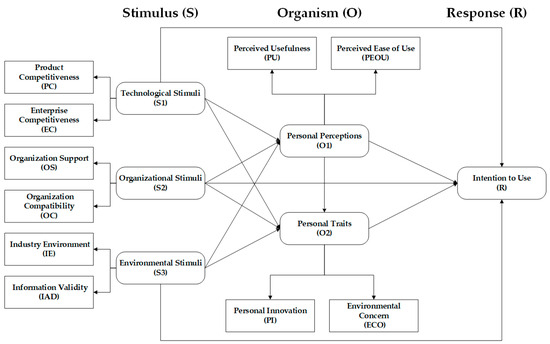
Figure 1.
The theoretical model.
Based on the theoretical model, eighteen hypotheses can be proposed, as shown in Table 1.

Table 1.
Hypotheses in the theoretical model.
3.2. Questionnaire Design
The questionnaire was segmented into three parts. The Section 1 was a scale to investigate construction stakeholders’ intention to use CDW recycling products. It consisted of 40 items designed to measure product competitiveness (PC), enterprise competitiveness (EC), organization support (OS), organization compatibility (OC), industry environment (IE), information validity (IAD), perceived ease of use (PEOU), perceived usefulness (PU), personal innovation (PI), environmental concern (ECO), and intention to use (R), as shown in Table 2. The scales used for this paper were developed by moderately adjusting the wording of established scales from existing relevant studies. This process involved amalgamating insights from preliminary field interviews and considering the present context of CDW recycling product usage in China. The Section 2 of the questionnaire was designed to gather information about the interviewees’ backgrounds, including details such as their gender, years of professional experience, and the type of company they work for. The Section 3 was crafted with two open-ended questions, prompting interviewees to share insights on perceived barriers to the adoption of CDW recycling products and offer suggestions for promotional strategies. The non-open-ended items were rated on a five-point Likert scale, with 1 being “not accepted” and with 5 being “accepted”.
Table 2.
Reliability and convergent validity of constructs.
3.3. Data Collection
This paper focused on client units, design units, construction units, and other entities associated with the construction industry. The research was mainly conducted in two main stages: pre-survey and formal research. During the pre-survey stage, industry experts and scholars were first invited to review the questionnaire content. The questionnaire underwent refinement, incorporating suggestions from these experts, and the semantics were enhanced accordingly. Subsequently, a small-scale questionnaire was administered to target individuals who will not participate in the formal survey. Based on the pre-survey results and feedback from interviewees, further refinements were made to the questionnaire, leading to the final version of the formal survey. In the formal research stage, the questionnaire was published on the Internet and randomly distributed to the target individuals via WeChat, QQ, and email. This approach followed a snowball sampling strategy, as recommended by Sekaran and Bougie [33] and Wu [12], encouraging interviewees to invite their colleagues to take part in the questionnaire survey [34]. Ultimately, a total of 310 questionnaires were collected, of which 272 were valid, with an effective recovery rate of 87.7%.
3.4. Partial Least Squares Structural Equation Modeling
Structural equation modeling belongs to multivariate statistics, which integrates two statistical methods, factor analysis and path analysis, and can analyze both the observed and latent variables included in the model [35]. In the structural equation model, latent variables, also called constructs, are abstract and indirectly measured by three or more observed variables [36], whereas observed variables, also called manifest variables, are evaluated by the measurement items in the questionnaire [37]. In this paper, the organization support (OS), the environmental concern (ECO), the intention to use (R), and other variables are all latent variables. Furthermore, technological stimuli (S1), organizational stimuli (S2), environmental stimuli (S3), personal perceptions (O1), and personal traits (O2) all have multiple dimensions, so they are second-order latent variables. PLS-SEM is a flexible method of structural equation modeling that can be applied in a wide range of situations and whose requirements for sample size [38] and distribution [39] are less restrictive than other modeling approaches. Barclay et al. suggest using a minimum sample size of ten times the maximum number of paths aiming at any construct in the measurement model and structural model [40]. It is also true that PLS-SEM has been shown to yield high levels of statistical power in composite model populations [41]. According to existing research, higher-order constructs can be assessed well with PLS-SEM [42], and mediation effects can be better analyzed with PLS-SEM [43]. The model of intention to use CDW recycling products constructed in this study includes the analysis of mediating effects and is a second-order structural model. Consequently, this paper used the PLS-SEM to analyze the data and test the model.
We adopted a two-step approach in this study. First, we tested the internal consistency, convergent validity, and discriminant validity of the measurement model. Then, given the results of the first stage, hypothesis testing of the structural model was performed.
4. Data Analysis and Results
4.1. Descriptive Statistics
Frequency analysis was conducted on 272 valid questionnaires using SPSSPRO statistical analysis modeling platform, and the results are shown in Table 3 below. For example, the majority of the interviewees had no more than 5 years of work experience, as reported by 89 individuals, accounting for 32.72% of the total sample. Another 83 individuals had more than 16 years of work experience, accounting for 30.51% of participants. The number of individuals with 11–15 years of work experience was 51, accounting for 18.75% of the sample, while the number of individuals with 6–10 years of work experience was 49, accounting for 18.01% of the sample.
Table 3.
Demographic characteristics of the sample.
4.2. Measurement Model
In this paper, we used SmartPLS 4 software to execute the PLS-SEM algorithm and analyzed the reliability and validity of the measurement model of the intention to use CDW recycling products. The measurement model includes not only a one-dimensional structure but also a reflective second-order construct. As suggested by Sarstedt, a disjointed two-stage approach of the sequential latent variable score method was employed to evaluate the measurement models [42]. In Stage I, we computed item loadings, Cronbach’s α, composite reliability (CR) values, and average variance extracted (AVE) values to assess the reliability and convergence validity of the unidimensional constructs and the dimensions of the second-order constructs. In Stage II, the latent variable scores of the dimensions obtained in Stage I were deployed as indicators/inputs for their corresponding second-order constructs.
4.2.1. Reliability
Reliability reflects the stability and consistency of measurement results. Cronbach’s α and CR can be used as indicators to judge the reliability of measurement models [44]. Cronbach’s α is seen as a conservative measure of internal consistency reliability and assumes that each item is equally reliable; in contrast, CR considers the different outer loadings of the items. Moreover, values for Cronbach’s α and CR should be greater than 0.7. As shown in Table 2, Cronbach’s α for each latent variable ranged from 0.782 to 0.955, all exceeding the threshold condition of 0.7. Moreover, the CR values ranged from 0.873 to 0.971, all surpassing the threshold condition of 0.7. These indicated that the measurement model passed the reliability test and the scale had acceptable internal reliability.
4.2.2. Validity
Validity reflects the effectiveness and accuracy of a measurement model. Validity consists of convergent validity and discriminant validity. According to Hair et al., convergent validity is connected to construct validity; tests using the same or a similar construct should have a strong correlation [45]. In this study, the factor loadings and average variance extracted (AVE) were used to evaluate and report the convergent validity. To ensure convergent validity, the item PI4 was excluded from the model because of its low loadings. The loadings of the reflective indicators attained in SEM should be greater than 0.700 [45]. As shown in Table 2, its factor loadings met all the index requirements. The algorithm requires that AVE values have a value of 0.500 or above, explaining at least 50% of the variance. The results of the measurement model showed that the AVE values were all higher than the threshold condition of 0.5. The minimum was the AVE value of PU at 0.689, and the maximum was the AVE value of IAD at 0.917.
Furthermore, the degree to which a concept differs empirically from other constructs is referred to as discriminant validity [46]. To ensure adequate discriminant validity, three key criteria proposed by Leguina [47] were applied. They are the cross-loading matrix, the Fornell–Larcker criterion, and the Heterotrait–Monotrait (HTMT) ratios. The cross-loading matrix required the outer loading of each latent unobserved variable to exceed the cross-loading (with other measurements) to guarantee discriminant validity. According to the Fornell–Larcker criterion, the square root of the AVE values for each construct are all greater than their largest correlations with other constructs. The Fornell–Larcker criterion was satisfied, as shown in Table 4. For the HTMT ratios, a threshold value of less than 0.85 is recommended [48], while Hair et al. suggested a limit of less than 1 [49]. As stated by Leguina, the HTMT values should be under 0.90 [47]. As shown in Table 5, HTMT ratios adhered to the cut-off level provided by Leguina and Hair. Thus, we assumed that discriminant validity was established.
Table 4.
Discriminant validity: Fornell–Larcker criterion.
Table 5.
Discriminant validity: Heterotrait–Monotrait (HTMT) ratios.
In summary, the previous results confirmed and supported the scale’s reliability, convergent, and discriminant validity, as approved by this study’s measurement model. Accordingly, we moved forward with the structural model to test the study hypotheses.
4.3. Structural Model and Hypotheses Testing
A structural equation investigation was employed to test the study’s proposed hypotheses. Specifically, the main aim was to examine the model’s ability to explain and predict the variation in the endogenous variables caused by the exogenous variable. PLS-SEM does not generate model fit statistics, but it does use the coefficient of determination (R2) in the dependent constructs to assess the explanatory power of a structural model [50]. The R2 indicates the percentage of exogenous variables that may be able to predict the endogenous variables [46]. R2 values can describe the level of predictive accuracy [51]: values of 0.25 and less are weak, values between 0.25 and 0.75 are moderate, and values exceeding 0.75 are strong [52]. According to the results shown in Table 6, our model could explain 57.2% of the variance in personal perceptions (O1), 61.0% of the variance in personal traits (O2), and 75.9% of the variance in intention to use (R). This meant that the model had moderate accuracy in predicting the variables of personal perceptions (O1) and personal traits (O2) and high accuracy in predicting the intention to use CDW recycling products. To test the hypotheses, bootstrapping was run in PLS-SEM.
Table 6.
Results of R2.
4.3.1. Direct Effects Testing
As shown in Table 7, technological stimuli (S1) had no significant direct effect on the intention to use (R) (β = 0.056, t = 1.086, p > 0.05, LLCI = −0.033, ULCI = 0.169), supporting H1a. Organizational stimuli (S2) also had no significant direct effect on the intention to use (R) (β = 0.115, t = 1.637, p > 0.05, LLCI = −0.027, ULCI = 0.247), supporting H1b. Similarly, environmental stimuli (S3) had no significant direct effect on the intention to use (R) (β = 0.027, t = 0.697, p > 0.05, LLCI = −0.100, ULCI = 0.165); thus, H1c was supported. Upon further observation, it was evident that personal perceptions (O1) had a significant and positive influence on the intention to use (R) (β = 0.150, t = 2.378, p < 0.05, LLCI = 0.011, ULCI = 0.258), which meant that a one-unit changes in personal perceptions (O1) could bring a 15% significant and positive variation in the intention to use (R). Additionally, t-statistics was above the threshold, and there was no zero between LLCI and ULCI, so H5 was accepted and substantiated. Furthermore, personal traits (O2) also had a significant positive impact on the intention to use (R) (β = 0.617, t = 10.374, p < 0.05, LLCI = 0.492, ULCI = 0.726), indicating that every time personal traits (O2) change by one unit, the intention to use (R) would have a 61.7% probability of changing accordingly. Changes had occurred to support H6.
Table 7.
Results of structural model.
4.3.2. Mediation Effects Testing
The mediating effect can be confirmed through bootstrapping. The analysis results showed that personal perceptions (O1) played a mediating role between technological stimuli (S1) and the intention to use (R) (β = 0.042, t = 2.085, p < 0.05, LLCI = 0.003, ULCI = 0.081). In addition, the VAF value was 21.65% > 20%, so H2a was acceptable. Personal perceptions (O1) had a significant impact on the relationship between environmental stimuli (S3) and the intention to use (R) (β = 0.074, t = 2.221, p < 0.05, LLCI = 0.006, ULCI = 0.135); the VAF was 28.24%, meaning that environmental stimuli (S3) indirectly affected the intention to use (R) through personal perceptions (O1), establishing H2c. For the relationship between organizational stimuli (S2) and the intention to use (R), personal perceptions (O1) had no significant impact (β = 0.007, t = 0.535, p > 0.05, LLCI = −0.020, ULCI = 0.036). On the contrary, personal traits (O2) had a significant impact (β =0.219, t = 4.208, p < 0.05, LLCI = 0.126, ULCI = 0.331), and the VAF value was 61.69%, indicating that personal traits (O2) played a positive mediating role between organizational stimuli (S2) and the intention to use (R), so H2b was not supported but H3b was supported. However, between personal traits (O2) and technological stimuli (S1) and the intention to use (R) (β = 0.022, t = 0.401, p > 0.05, LLCI = −0.082, ULCI = 0.131) and between environmental stimuli (S3) and the intention to use (R) (β = 0.029, t = 0.556, p > 0.05, LLCI = −0.073, ULCI = 0.133), there was no significant mediating effect, and both H3a and H3c were rejected.
Additionally, the research results demonstrated a significant correlation between personal perceptions (O1) and the impact of technological stimuli (S1) on personal traits (O2) (β = 0.121, t = 3.070, p < 0.05, LLCI = 0.042, ULCI = 0.196). A VAF value of 77.07%, suggested that technological stimuli (S1) indirectly influence personal traits (O2) through personal perceptions (O1). Thus, H8a was supported and confirmed. Furthermore, in the relationship between environmental stimuli (S3) and personal traits (O2), personal perceptions (O1) played a significant mediating role (β = 0.214, t = 3.120, p < 0.05, LLCI = 0.076, ULCI = 0.335). The VAF value was 81.99% more than 80%, indicating that personal perceptions (O1) not only affected environmental stimuli (S3) but that there was also a significant and strong intermediary effect between personal traits (O2), so H8c was deemed completely accepted. However, personal perceptions (O1) did not significantly mediate the relationship between organizational stimuli (S2) and personal traits (O2) (β = 0.021, t = 0.580, p > 0.05, LLCI = −0.055, ULCI = 0.088); thus, H8b was not supported.
Moreover, personal traits (O2) had a significant mediating effect in the relationship between personal perceptions (O1) and intention to use (R) (β = 0.267, t = 3.318, p < 0.05, LLCI = 0.093, ULCI = 0.403). The VAF value was 64.03%, so H7 was also established.
4.3.3. Serial Chain Mediation Effects Testing
The findings further confirmed that personal perceptions (O1) and personal traits (O2) mediated the crosstalk between technological stimuli (S1) and the intention to use (R), and environmental stimuli (S3) and the intention to use (R), respectively. The result (β = 0.075, t = 2.946, p < 0.05, LLCI = 0.025, ULCI = 0.124) with a VAF value of 38.66% was for technological stimuli (S1) and the intention to use (R). In addition, the result (β = 0.132, t = 2.836, p < 0.05, LLCI = 0.041, ULCI = 0.220) with a VAF value of 50.38% was for environmental stimuli (S3) and the intention to use (R). They were significant in terms of both personal perceptions (O1) and personal traits (O2). Therefore, we accepted both H4a and H4c. However, personal perceptions (O1) and personal traits (O2) had no significant serial mediating effect between organizational stimuli (S2) and the intention to use (R) (β = 0.013, t = 0.570, p > 0.05, LLCI = −0.034, ULCI = 0.056), so H4b was not accepted.
The results of the measurement model and the structural model are summarized in Figure 2.
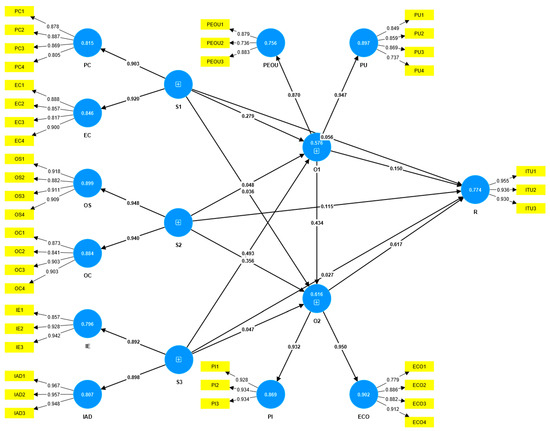
Figure 2.
Measurement model and structural model.
5. Discussion
5.1. Discussion of the Results
Based on the direct effects observed, H1a, H1b, and H1c were acceptable, indicating that there was no significant impact on the construction stakeholders’ intention to use CDW recycling products with technical stimuli, organizational stimuli, and environmental stimuli. Speculatively, the reason for this phenomenon may be rooted in the individual differences of construction stakeholders’ views toward CDW recycling products themselves. Unlike other green products, CDW recycling products are distinctive, being formed through the reuse or recycling of CDW. They are often perceived as “unsafe”, “unreliable”, or even “harmful” [9]. Moreover, Ding’s implicit association test confirmed the existence of negative and deeply ingrained stereotypes regarding CDW recycling products within the public [10], influencing their intention to use such products.
Furthermore, the results indicated that the personal perceptions and personal traits of construction stakeholders had a significant positive influence on the intention to use CDW recycling products, supporting H5 and H6. This is consistent with the results of previous studies [27,28,31,53,54,55], reinforcing the notion that personal perceptions and personal traits serve as direct predictors influencing intention [53,56,57]. When individuals perceive greater utility and ease of use in CDW recycling products, their inclination to use them is heightened. Notably, Massoro et al. highlighted that individuals with high levels of innovativeness exhibited a greater propensity to utilize open-source journals in libraries [58]. Simultaneously, other studies have demonstrated that individuals exhibiting a heightened environmental concern are more inclined to address environmental issues and actively engage in environmental protection measures [31]. In this regard, reorientating the personal perceptions of construction stakeholders towards CDW recycling products and fostering the promotion of personal innovation and environmental concern among them will be important ways to facilitate the promotion of the use of CDW recycling products.
The analysis of the mediating effect of personal perceptions revealed that personal perceptions significantly mediated the relationship between technological stimuli and the intention to use, as well as between environmental stimuli and the intention to use. Previous research has demonstrated that perceived usefulness and perceived ease of use are shaped by external factors such as user characteristics, policy influences, and organizational structure, subsequently influencing behavioral attitudes [27]. However, no significant mediating effect was observed between organizational stimuli and the intention to use. Consequently, H2a and H2c were supported, while H2b was not. This discrepancy might be attributed to the initial development stage of the CDW recycling industry [59]. High input costs led to elevated prices of CDW recycling products, and as a result, organizations and enterprises affiliated with construction stakeholders refrained from purchasing and using these products, leading to a weak influence on individual perceptions.
The link between organizational stimuli and the intention to use was found to be mediated by personal traits, whereas the connections between technological stimuli and the intention to use, as well as between environmental stimuli and the intention to use, remained unaffected by personal traits as a mediator. Consequently, we accepted H3b and rejected H3a and H3c. This may be attributed to the enduring impact of the enterprise’s management system and cultural environment on construction stakeholders. When an enterprise fosters innovation and environmental concern, implementing a reward system for innovative and environmentally friendly behavior or integrating these aspects into the employee assessment system, its personnel tend to exhibit high levels of innovation and environmental concern. While technological and environmental stimuli may not directly influence personal traits, personal perceptions can mediate these effects, as well as the relationship between environmental stimuli and personal traits. Thus, we accepted both H8a and H8b. This suggested that there was a significant positive impact of personal perceptions on personal traits, which is consistent with the theory of the TAM model [27]. However, in the case of the relationship between organizational stimuli and personal traits, personal perceptions did not serve as a mediating factor. This is primarily because organizational stimuli did not exert a significant impact on personal perceptions, leading to the rejection of H8b. At the same time, this study demonstrated that personal perceptions indirectly affect the intention to use CDW recycling products through personal traits. This comprehensive exploration illuminated the psychological processes underlying construction stakeholders’ intention to use CDW recycling products in response to external stimuli. It also validated that the S-O-R model effectively elucidated the mechanism of influence between stimuli and individual behavioral intention [60].
5.2. Theoretical Implications
This study is the first to apply the S-O-R theoretical model, which integrates the TOE framework theory and the perceived usefulness and perceived ease of use of the TAM model, as well as personal innovation and environmental concern, to explain construction stakeholders’ intention to use CDW recycling products. Based on the results of the PLS-SEM analysis, it was observed that the theoretical model exhibited satisfactory reliability, validity, and enhanced predictive capabilities. The outcomes of the direct and mediated effects underscored that the S-O-R model, in contrast to the TPB model, combined individual differences with external factors. It offered a more comprehensive and accurate analysis, elucidating the mechanism of influence between stimuli and individual’s behavioral intention. Moreover, the significance of the mediating effects was affirmed across various relationships, with exceptions noted between technological stimuli and personal traits, organizational stimuli and personal perceptions, and environmental stimuli and personal traits. Consequently, this study provides support for the application and development of the S-O-R theoretical model to a certain extent. In addition, this study provides a useful model to explain construction stakeholders’ intention to use CDW recycling products and explore the corresponding determinants.
5.3. Practical Implications
Firstly, personal perceptions can positively affect the intention of construction stakeholders to adopt CDW recycling products, and these personal perceptions played a significant mediating role in the relationship between external stimuli and the intention to use such products. Currently, given the early stage of CDW recycling utilization, the substantial costs associated with the utilization of recycled CDW products, and the generally elevated prices of CDW recycling products, many organizations and enterprises have not yet engaged with or incorporated CDW recycling products into their operations. This lack of direct interaction has resulted in insufficient support for CDW recycling products and a lack of strategic market positioning in their favor. Consequently, the personal perceptions of CDW recycling products among construction stakeholders at the organizational level have yet to be enhanced. To address this, collaboration between universities, research institutes, and CDW recycling enterprises is essential to advance CDW recycling technology and propose viable, refined management methods aimed at reducing the costs associated with CDW recycling. This, in turn, could contribute to lowering the overall price of CDW recycling products. Additionally, relevant government departments should regulate CDW treatment fees, transportation fees, site occupation fees, etc., based on the local circumstances, indirectly reducing the cost. Simultaneously, these departments should implement measures such as tax reductions and subsidies for CDW recycling enterprises, along with subsidies and incentives for purchasers of CDW recycling products. These strategic actions could effectively lead to a direct reduction in the price of CDW recycling products.
Secondly, personal traits were identified as the most crucial factor influencing the intention of construction stakeholders to adopt CDW recycling products, and they can be positively altered by fostering personal innovation and heightening environmental concern. To promote personal innovation, organizations and enterprises can regularly conduct diverse activities, such as training sessions and innovation competitions, and integrate innovation metrics into their internal employee evaluation systems to reward innovative behaviors. The government and the relevant departments within should actively promote innovation by organizing events like innovative technology exchange meetings in collaboration with enterprises and research institutes and introducing supportive policies. Simultaneously, it is the responsibility of the government and the relevant departments within to bring advanced technology to the public, enabling them to experience the advantages of innovation and, consequently, indirectly stimulating market demand for innovation. Regarding the reinforcement of environmental concern, the government and the relevant departments within should utilize various communication tools, including Internet media and seminars, to propagate information to construction stakeholders about the critical role of CDW recycling utilization in environmental protection and resource conservation. This publicity should cover not only the positive environmental impacts of using CDW recycling products but also the adverse environmental consequences of neglecting them to create an awareness of the environmental crisis and to strengthen their concern for the environment.
6. Conclusions
This study incorporated the TOE framework, perceived usefulness and perceived ease of use, and personal innovation and environmental concern into the S-O-R model to explore the determinants influencing construction stakeholders’ intention to use CDW recycling products. Based on the questionnaire data, the theoretical model was evaluated and analyzed using the PLS-SEM approach. The results showed that (1) the constructed S-O-R model had good reliability and validity, as well as a strong predictive ability, which confirmed the applicability of the constructed S-O-R model in the study of construction stakeholders’ intention to use CDW recycling products. (2) Personal traits were the most influential factor shaping construction stakeholders’ intention to use, followed by personal perceptions, while external stimuli did not exert a direct significant impact on the intention to use. Nevertheless, personal traits and personal perceptions played a significant mediating role in the relationship between external stimuli and the intention to use, forming a noteworthy serial chain mediation. (3) In China, a key pathway to promote the recycling of CDW and increase the recycling rate of CDW is to significantly enhance the personal traits of construction stakeholders.
Of course, the S-O-R model constructed in this study still needs to be improved. The model used in this study did not consider factors that have a negative impact on the intention to use CDW recycling products, such as perceived risk, which could be added to the model in future research to expand on the analysis presented herein. In addition, although intention to use is considered to be a key predictor of usage behavior, it still cannot fully represent usage behavior, and the usage behavior of CDW recycling products among construction stakeholders should be studied in depth in the future.
Author Contributions
Conceptualization, X.H. and X.W.; methodology, X.H.; data curation, Z.D. and X.W.; software, X.H.; analysis and discussion, X.H., Q.C. and J.Z.; writing—original draft, X.H.; writing—review and editing, Z.D., Z.W. and X.W.; funding acquisition, Z.D. All authors have read and agreed to the published version of the manuscript.
Funding
This research was conducted with the support of the National Nature Science Foundation of China (Grant No. 71974132; 72371171) and the Shenzhen Natural Science Fund (the Stable Support Plan Program No. 20220810160221001).
Institutional Review Board Statement
Not applicable.
Informed Consent Statement
Informed consent was obtained from all subjects involved in the study.
Data Availability Statement
The data presented in this study are available upon request from the corresponding author. The data are not publicly available due to privacy reasons.
Conflicts of Interest
Jiasheng Zhang was employed by the company CCFED the Fifth Construction & Engineering. Co., Ltd. The remaining authors declare that the research was conducted in the absence of any commercial or financial relationships that could be construed as a potential conflict of interest.
References
- Gupta, S.; Jha, K.N.; Vyas, G. Construction and demolition waste causative factors in building projects: Survey of the Indian construction industry experiences. Int. J. Constr. Manag. 2024, 24, 432–442. [Google Scholar] [CrossRef]
- Ding, Z.K.; Wen, X.P.; Zuo, J.; Chen, Y.Y. Determinants of contractor’s construction and demolition waste recycling intention in China: Integrating theory of planned behavior and norm activation model. Waste Manag. 2023, 161, 213–224. [Google Scholar] [CrossRef] [PubMed]
- Huang, B.J.; Wang, X.Y.; Kua, H.W.; Geng, Y.; Bleischwitz, R.; Ren, J.Z. Construction and demolition waste management in China through the 3R principle. Resour. Conserv. Recycl. 2018, 129, 36–44. [Google Scholar] [CrossRef]
- Peng, W.; Pheng, L.S. Managing the Embodied Carbon of Precast Concrete Columns. J. Mater. Civ. Eng. 2011, 23, 1192–1199. [Google Scholar] [CrossRef]
- Coelho, A.; de Brito, J. Influence of construction and demolition waste management on the environmental impact of buildings. Waste Manag. 2012, 32, 532–541. [Google Scholar] [CrossRef] [PubMed]
- Véliz, K.D.; Ramírez-Rodríguez, G.; Ossio, F. Willingness to pay for construction and demolition waste from buildings in Chile. Waste Manag. 2022, 137, 222–230. [Google Scholar] [CrossRef]
- Santos, S.; da Silva, P.R.; de Brito, J. Self-compacting concrete with recycled aggregates—A literature review. J. Build. Eng. 2019, 22, 349–371. [Google Scholar] [CrossRef]
- Hu, Q.; Su, P.; Xiong, F. Dynamic game strategies for construction and demolition waste recycling with learning and reference effects. Environ. Impact Assess. Rev. 2021, 89, 106592. [Google Scholar] [CrossRef]
- Cao, Y.; Wang, S.; Wang, Y.; Zhu, Z.; Wang, S.; Cao, Y. Current situation and future development trend of comprehensive utilization of construction waste in China. China Build. Mater. 2021, 9, 118–121. [Google Scholar] [CrossRef]
- Ding, Z.K.; Zhang, Z.Y.; Chen, W.L.; Chen, J.Y. Investigating the implicit stereotypes of recycled construction and demolition waste products with an fNIRS-enabled single category implicit association test. J. Clean. Prod. 2023, 382, 135233. [Google Scholar] [CrossRef]
- Yu, B.; Wang, J.Y.; Liao, Y.; Wu, H.Y.; Wong, A.B. Determinants Affecting Purchase Willingness of Contractors towards Construction and Demolition Waste Recycling Products: An Empirical Study in Shenzhen, China. Int. J. Environ. Res. Public Health 2021, 18, 4412. [Google Scholar] [CrossRef]
- Wu, Z.Z.; Yu, A.T.W.; Shen, L.Y. Investigating the determinants of contractor’s construction and demolition waste management behavior in Mainland China. Waste Manag. 2017, 60, 290–300. [Google Scholar] [CrossRef]
- Ding, Z.K.; Nie, W.Q.; Wu, H.Y. Investigating the connection between stakeholders’ purchase intention and perceived value of construction and demolition waste recycled products. Environ. Dev. Sustain. 2022, 24, 9285–9303. [Google Scholar] [CrossRef]
- Falcone, P.M.; De Rosa, S.P. Use of fuzzy cognitive maps to develop policy strategies for the optimization of municipal waste management: A case study of the land of fires (Italy). Land Use Policy 2020, 96, 104680. [Google Scholar] [CrossRef]
- Falcone, P.M.; Imbert, E.; Sica, E.; Morone, P. Towards a bioenergy transition in Italy? Exploring regional stakeholder perspectives towards the Gela and Porto Marghera biorefineries. Energy Res. Soc. Sci. 2021, 80, 102238. [Google Scholar] [CrossRef]
- Patra, D.; Chanse, V.; Rockler, A.; Wilson, S.; Montas, H.; Shirmohammadi, A.; Leisnham, P.T. Towards attaining green sustainability goals of cities through social transitions: Comparing stakeholders’ knowledge and perceptions between two Chesapeake Bay watersheds, USA. Sustain. Cities Soc. 2021, 75, 103318. [Google Scholar] [CrossRef]
- Ajzen, I. From Intentions to Actions: A Theory of Planned Behavior. In Action Control: From Cognition to Behavior; Kuhl, J., Beckmann, J., Eds.; Springer: Berlin/Heidelberg, Germany, 1985; pp. 11–39. [Google Scholar]
- Begum, R.A.; Siwar, C.; Pereira, J.J.; Jaafar, A.H. Attitude and behavioral factors in waste management in the construction industry of Malaysia. Resour. Conserv. Recycl. 2009, 53, 321–328. [Google Scholar] [CrossRef]
- Jain, S.; Singhal, S.; Jain, N.K.; Bhaskar, K. Construction and demolition waste recycling: Investigating the role of theory of planned behavior, institutional pressures and environmental consciousness. J. Clean. Prod. 2020, 263, 121405. [Google Scholar] [CrossRef]
- Manowong, E. Investigating factors influencing construction waste management efforts in developing countries: An experience from Thailand. Waste Manag. Res. 2012, 30, 56–71. [Google Scholar] [CrossRef]
- Sohaib, M.; Wang, Y.; Iqbal, K.; Han, H. Nature-based solutions, mental health, well-being, price fairness, attitude, loyalty, and evangelism for green brands in the hotel context. Int. J. Hosp. Manag. 2022, 101, 103126. [Google Scholar] [CrossRef]
- Xu, G.W.; Wang, S.Y.; Li, J.; Zhao, D.T. Moving towards sustainable purchase behavior: Examining the determinants of consumers’ intentions to adopt electric vehicles. Environ. Sci. Pollut. Res. 2020, 27, 22535–22546. [Google Scholar] [CrossRef]
- Keller, K.L. Brand Equity Management in a Multichannel, Multimedia Retail Environment. J. Interact. Mark. 2010, 24, 58–70. [Google Scholar] [CrossRef]
- Tang, Z.Y.; Warkentin, M.; Wu, L. Understanding employees’ energy saving behavior from the perspective of stimulus-organism-responses. Resour. Conserv. Recycl. 2019, 140, 216–223. [Google Scholar] [CrossRef]
- Kwon, J.; Boger, C.A. Influence of brand experience on customer inspiration and pro-environmental intention. Curr. Issues Tour. 2021, 24, 1154–1168. [Google Scholar] [CrossRef]
- Venkatesh, V.; Morris, M.G.; Davis, G.B.; Davis, F.D. User acceptance of information technology: Toward a unified view. MIS Q. 2003, 27, 425–478. [Google Scholar] [CrossRef]
- Yuan, S. The Unified Technology Acceptance Model Based on Task-Technology Fit Theory. Ph.D. Thesis, Zhejiang University, Hangzhou, China, 2010. [Google Scholar]
- Zhenlong, L.; Guanyang, X.; Jia, L.; Xiaohua, Z.; Jingsi, Z. Driver’s Acceptance of Cooperative Vehicle Infrastructure System Based on Extended TAM. China J. Highw. Transp. 2021, 34, 188–200. [Google Scholar] [CrossRef]
- Paul, J.; Modi, A.; Patel, J. Predicting green product consumption using theory of planned behavior and reasoned action. J. Retail. Consum. Serv. 2016, 29, 123–134. [Google Scholar] [CrossRef]
- Nordlund, A.M.; Garvill, J. Value structures behind proenvironmental behavior. Environ. Behav. 2002, 34, 740–756. [Google Scholar] [CrossRef]
- McDonald, S.; Oates, C.J.; Thyne, M.; Timmis, A.J.; Carlile, C. Flying in the face of environmental concern: Why green consumers continue to fly. J. Mark. Manag. 2015, 31, 1503–1528. [Google Scholar] [CrossRef]
- Mullet, G.M.; Karson, M.J. Analysis of purchase intent scales weighted by probability of actual purchase. J. Mark. Res. 1985, 22, 93–96. [Google Scholar] [CrossRef]
- Sekaran, U.; Bougie, R. Research Methods for Business: A Skill Building Approach; John Wiley & Sons: Hoboken, NJ, USA, 2016. [Google Scholar]
- Sambasivan, M.; Soon, Y.W. Causes and effects of delays in Malaysian construction industry. Int. J. Proj. Manag. 2007, 25, 517–526. [Google Scholar] [CrossRef]
- Yang, W.; Zhonglin, W.; Wei, L.; Jie, F. Methodological research and model development on structural equation models in China’s mainland from 2001 to 2020. Adv. Psychol. Sci. 2022, 30, 1715–1733. [Google Scholar]
- Marsh, H.W.; Hau, K.-T.; Balla, J.R.; Grayson, D. Is More Ever Too Much? The Number of Indicators per Factor in Confirmatory Factor Analysis. Multivar. Behav. Res. 1998, 33, 181–220. [Google Scholar] [CrossRef] [PubMed]
- Hair, J.F.; Gabriel, M.; Patel, V. AMOS covariance-based structural equation modeling (CB-SEM): Guidelines on its application as a marketing research tool. Braz. J. Mark. 2014, 13. [Google Scholar]
- Haenlein, M.; Kaplan, A.M. A beginner’s guide to partial least squares analysis. Underst. Stat. 2004, 3, 283–297. [Google Scholar] [CrossRef]
- Chin, W.W. The partial least squares approach to structural equation modeling. Mod. Methods Bus. Res. 1998, 295, 295–336. [Google Scholar]
- Hair, J.F.; Sarstedt, M.; Ringle, C.M.; Mena, J.A. An assessment of the use of partial least squares structural equation modeling in marketing research. J. Acad. Mark. Sci. 2012, 40, 414–433. [Google Scholar] [CrossRef]
- Hair, J.F.; Hult, G.T.M.; Ringle, C.M.; Sarstedt, M.; Thiele, K.O. Mirror, mirror on the wall: A comparative evaluation of composite-based structural equation modeling methods. J. Acad. Mark. Sci. 2017, 45, 616–632. [Google Scholar] [CrossRef]
- Sarstedt, M.; Hair, J.F., Jr.; Cheah, J.-H.; Becker, J.-M.; Ringle, C.M. How to specify, estimate, and validate higher-order constructs in PLS-SEM. Australas. Mark. J. 2019, 27, 197–211. [Google Scholar] [CrossRef]
- Nitzl, C.; Roldan, J.L.; Cepeda, G. Mediation analysis in partial least squares path modeling Helping researchers discuss more sophisticated models. Ind. Manag. Data Syst. 2016, 116, 1849–1864. [Google Scholar] [CrossRef]
- Hair, J.F.; Howard, M.C.; Nitzl, C. Assessing measurement model quality in PLS-SEM using confirmatory composite analysis. J. Bus. Res. 2020, 109, 101–110. [Google Scholar] [CrossRef]
- Hair, J.F.; Risher, J.J.; Sarstedt, M.; Ringle, C.M. When to use and how to report the results of PLS-SEM. Eur. Bus. Rev. 2019, 31, 2–24. [Google Scholar] [CrossRef]
- Alyoussef, I.Y.; Omer, O.M.A. Investigating Student Satisfaction and Adoption of Technology-Enhanced Learning to Improve Educational Outcomes in Saudi Higher Education. Sustainability 2023, 15, 14617. [Google Scholar] [CrossRef]
- Leguina, A. A primer on partial least squares structural equation modeling (PLS-SEM). Int. J. Res. Method Educ. 2015, 38, 220–221. [Google Scholar] [CrossRef]
- Henseler, J.; Ringle, C.M.; Sarstedt, M. A new criterion for assessing discriminant validity in variance-based structural equation modeling. J. Acad. Mark. Sci. 2015, 43, 115–135. [Google Scholar] [CrossRef]
- Hair, J.F., Jr.; Matthews, L.M.; Matthews, R.L.; Sarstedt, M. PLS-SEM or CB-SEM: Updated guidelines on which method to use. Int. J. Multivar. Data Anal. 2017, 1, 107–123. [Google Scholar] [CrossRef]
- Deng, L.Q.; Turner, D.E.; Gehling, R.; Prince, B. User experience, satisfaction, and continual usage intention of IT. European J. Inf. Syst. 2010, 19, 60–75. [Google Scholar] [CrossRef]
- Li, Y.; Li, D.; Liu, Y.; Shou, Y. Digitalization for supply chain resilience and robustness: The roles of collaboration and formal contracts. Front. Eng. Manag. 2023, 10, 5–19. [Google Scholar] [CrossRef]
- Hair, J.F.; Ringle, C.M.; Sarstedt, M. PLS-SEM: Indeed a silver bullet. J. Mark. Theory Pract. 2011, 19, 139–152. [Google Scholar] [CrossRef]
- Rogers, E.M.; Singhal, A.; Quinlan, M.M. Diffusion of innovations. In An Integrated Approach to Communication Theory and Research; Routledge: Abingdon, UK, 2014; pp. 432–448. [Google Scholar]
- Mostafa, M.M. Shades of green: A psychographic segmentation of the green consumer in Kuwait using self-organizing maps. Expert Syst. Appl. 2009, 36, 11030–11038. [Google Scholar] [CrossRef]
- Suki, N.M. Consumer environmental concern and green product purchase in Malaysia: Structural effects of consumption values. J. Clean. Prod. 2016, 132, 204–214. [Google Scholar] [CrossRef]
- Flynn, L.R.; Goldsmith, R.E. A Validation of the Goldsmith and Hofacker Innovativeness Scale. Educ. Psychol. Meas. 1993, 53, 1105–1116. [Google Scholar] [CrossRef]
- Zhang, D. Research on Consumers’ Consumption Behavior of Green Products from the Perspective of Environmental concern. Price Theory Pract. 2021, 9, 197–200. [Google Scholar] [CrossRef]
- Massoro, Z.Z.; Adewale, N.T. Influence of attitude, subjective norms and personal innovativeness on intention to use open access journals: A case of agricultural research institutes. Libr. Philos. Pract. 2019, 1–13. [Google Scholar]
- Yuan, H.; Song, X.; Liu, J. Interpretive Structural Modeling for Investigating Factors and Their Relationships Influencing On-Site Sorting of Construction Waste. J. Green Build. 2023, 18, 1–20. [Google Scholar] [CrossRef]
- Wang, J. Research on Formation Mechanism and Evaluation of Consumers’ Perceived Online Review Helpfulness Based on SOR Theory. Ph.D. Thesis, Harbin University of Science and Technology, Harbin, China, 2020. [Google Scholar]
Disclaimer/Publisher’s Note: The statements, opinions and data contained in all publications are solely those of the individual author(s) and contributor(s) and not of MDPI and/or the editor(s). MDPI and/or the editor(s) disclaim responsibility for any injury to people or property resulting from any ideas, methods, instructions or products referred to in the content. |
© 2024 by the authors. Licensee MDPI, Basel, Switzerland. This article is an open access article distributed under the terms and conditions of the Creative Commons Attribution (CC BY) license (https://creativecommons.org/licenses/by/4.0/).