Abstract
The compost-bedded pack (CBP) system offers a sustainable solution for dairy farms by enhancing cow welfare and health while promoting environmental sustainability and improving manure management for agricultural reuse. This study aimed to evaluate the reduction in manure treatment required for agricultural use by analyzing manure excretion patterns in lactating cows. We compared seven Holstein and six Holstein × Gyr cows, divided into two CBP groups, and monitored their feces and urine behaviors over a 48 h period. Manure excretion was recorded across four farm areas: (1) feeding area, (2) resting area (composted bed), (3) path to the milking parlor, and (4) milking parlor. Both breeds predominantly excreted feces (45.03%) and urine (54.18%) in the resting area, which facilitated composting directly in the bedding. This resulted in a significant reduction in nitrogen requiring treatment, averaging 76.8–85.3 g per cow per day, accounting for 44–49% of total nitrogen excretion. The CBP system demonstrated its effectiveness in reducing environmental impact by minimizing nitrogen loss through volatilization and leaching, while also enhancing nutrient recycle in agriculture. These findings emphasize the CBP system’s role in foresting sustainable dairy farming and environmentally friendly agricultural practices.
1. Introduction
Dairy farm management systems vary widely, including pasture-based, free stall, and compost-bedded pack (CBP) systems. One of the central challenges in all these systems is the effective management of bovine manure, a byproduct that requires careful treatment before being used in agriculture. Efficient manure management is essential for environmental sustainability, as improper handling can lead to nutrient runoff, greenhouse gas emissions, and the loss of valuable organic matter. The manure produced by lactating cows ranges from 50 to 70 kg per day [1,2], depending on the level of production and cow weight, which have a greater potential to affect the environment.
Among the dairy cows’ systems, the CBP system stands out as a sustainable alternative. It offers a solution for manure issues by reducing the need for extensive treatment and allows for direct reuse of manure in farming, minimizing the processing required before agricultural application [1]. This approach aligns with the sustainability principles of “reduce, reuse, and recycle” by facilitating the recycling and repurposing of bedding materials in agricultural use, which in turn improves soil structure and bioactivity [3].
The selection of bedding materials, such as sawdust and wood shavings, plays a crucial role in the effectiveness of CBP systems. These materials promote aerobic activity and facilitate the compost maturation process [4,5,6], contributing organic matter to the soil [7] and improving its quality compared to conventional waste composts [8]. This dual benefit of composting and soil enhancement highlights the environmental advantages of CBP systems.
In addition to environmental benefits, often termed “free-walk housing”, CBP systems are believed to improve animal welfare. Unlike traditional free stall systems, where cows spend time standing on concrete surfaces, CBP systems provide softer bedding that promotes healthier hooves and reduces hoof wear [8,9,10,11]. This, in combination with the freedom to move and increased comfort, enhances overall animal well-being and allows for more natural behaviors [12].
Several studies have highlighted the benefits of CBP systems, particularly in terms of animal comfort and welfare [9], as well as that these systems also encourage natural behaviors [8] and promote better hygiene [9] among dairy cows. There remains a gap in the literature regarding how these systems influence manure excretion patterns and the subsequent need for manure treatment. While previous studies focused on health improvements, notably through reduced incidence of udders and hoof problems [13,14], no studies have yet explored the excretion behaviors of cows within CBP systems and their impact on manure treatment requirements and the nitrogen captured by composting. Understanding these factors is crucial for determining the full potential of CBP systems in reducing environmental impacts and improving sustainability in dairy farms.
Thus, the present study aims to analyze the manure excretion patterns of dairy cows in a CBP system and quantify the reduction in the volume of manure requiring treatment, as well as quantify the nitrogen captured by the system for composting. We hypothesized that the CBP system captures over 40% of both the total manure and nitrogen produced by lactating Holstein and Holstein × Gyr cows, with both breeds demonstrating similar manure excretion patterns.
2. Materials and Methods
The experiment was conducted at the Dairy Research Facility of the Animal Science Department, Universidade Federal de Viçosa, in Viçosa, Minas Gerais, Brazil. All experimental procedures were approved by the Committee of Animal Use Ethics at the Department of Animal Science, Universidade Federal de Viçosa, under protocol number 35/2024.
A power analysis was performed using the function “pwr.t.test” from “pwr” package in R software version 2024.04.02 [15] to determine the appropriate sample size. The analysis targeted a statistical power greater than 0.80, with a significance level of 0.05. A coefficient of variation of 15% was used as the basis for the calculation of Cohen’s d, resulting in 1.333, ensuring that the sample size was sufficient to detect meaningful differences with adequate precision.
2.1. Animals and Behavior
The experiment involved thirteen dairy cows: six Holsteins with an average weight of 675 ± 10.8 kg and 230 ± 22.2 days in milk, and seven 5/8 Holstein × Gyr crossbreeds averaging 623 ± 11.7 kg and 188 ± 23.9 days in milk. All cows were in their second lactation, had been examined by a veterinarian, were clinically healthy, and were pregnant at an average of 156 ± 67.4 days.
The cows were fed a total mixed ration (TMR) ad libitum twice daily, after the morning and evening milking sessions. The diet was balanced according to NASEM [2] guidelines and consisted of corn silage, grass hay, soybean meal, corn meal, urea, whole cottonseed, and mineral supplements (Table 1). The cows were adapted to the diet for two weeks before the trial began, during which they were kept together to allow for social adjustment. The estimated dry matter intake (DMI) was 22.3 kg, with a crude protein content of 16.4%. Intake as a percentage of body weight was 3.30% for the Holsteins and 3.58% for the Holstein × Gyr crossbreeds.
Table 1.
Ingredients and chemical composition of the experimental diet.
2.2. Housing and Cooling
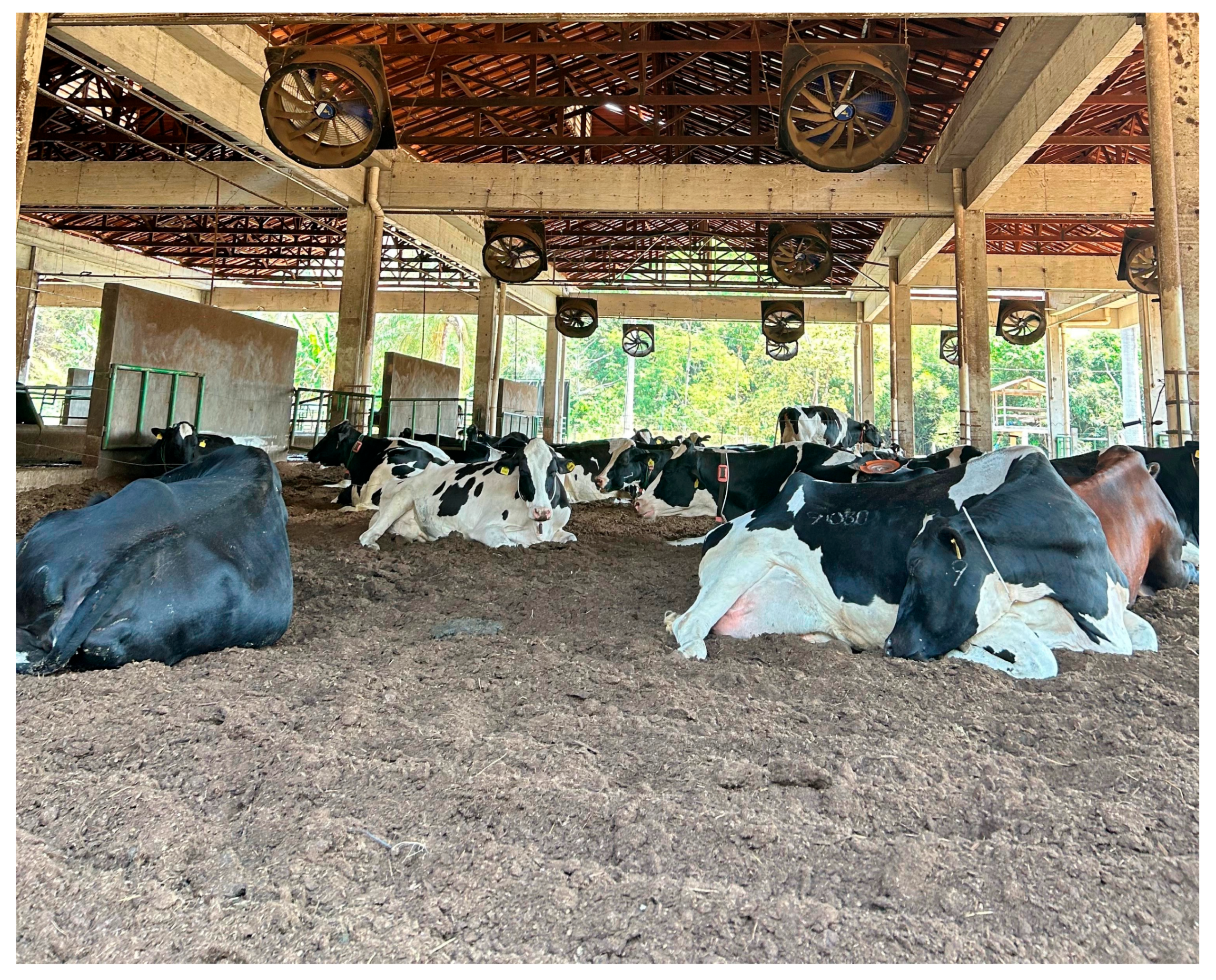
Cows were housed in a CBP with sawdust as the carbon source (Figure 1). This sawdust is a byproduct derived from pine wood shavings measuring 3–5 cm in size. The two pens, separated by breed were provided with a bedding area of 158 m2. Holsteins were allocated 26.3 m2 per cow, while Holstein × Gyr cows had 22.6 m2 per cow. This space exceeds the typical range of 10 to 12 m2 per cow recommended for dairy cows in Brazil and facilitated system observation.
Figure 1.
Experimental compost-bedded pack (CBP) system featuring bedding composed of a mixture of sawdust and manure. The CBP is equipped with fans positioned to enhance air circulation and promote optimal composting conditions.
The feeding area provided 35.6 m2 of free space, with each cow having access to more than 1.4 m of trough feeding space. Four fans (Magnum, GEA Brasil, Campinas, Brazil) were installed in the bedding area to aid in drying the compost and cooling the cows. The bedded pack was stirred twice daily while the cows were in the milking parlor to maintain its quality and effectiveness.
Cows were milked three times daily at 600 h, 1330 h, and 2000 h. Before each milking session, cows were cooled using cycles of 1 min of sprinkling with a disc nozzle, followed by 5 min of ventilation with fans (Magnum, GEA Farm Technologies, Bönen, Germany). During the experiment, the ambient temperature ranged from 15.8 to 28.3 °C, while the temperature humidity index (THI) ranged from 60 and 77. These values were recorded by the meteorological station of the Universidade Federal de Viçosa, located 1.5 km from the CBP where the trial took place. THI values exceeded 68 half the time, indicating conditions of heat stress [2].
2.3. Trial Evaluations
Before the trial began, cows were marked for easy identification using Celo Check marker paint (Weizur do Brazil, Brazil). Holsteins were numbered from 1 to 6, and Holstein × Gyr crossbreeds from 1 to 7.
The trial lasted 48 h, during which the location, urination, and defecation of each one of the thirteen animals was continuously monitored by trained observers across four designated areas: (1) feeding area (35.64 m2), (2) resting place (composted bed, 158 m2), (3) path to milking (272.57 m2), and (4) milking parlors (9.92 m2). Four observers recorded the specific locations of feces and urine disposal continuously from 0800 h on day one until 48 h later. The frequency of urination and defecation for each cow in each area was tallied at the end of each day.
On the second day, milk yield for each cow was measured during all three milking sessions using a DemaTron 70 control unit (GEA Group Aktiengesellschaft, Düsseldorf, Germany). A 350 mL milk sample was also collected using the VESTA Sampling System (GEA Group Aktiengesellschaft, Düsseldorf, Germany) and analyzed for composition with the Lactoscan SP Ultrasonic Milk Analyzer (Milkotronic Ltd.a, Nova Zagora, Bulgaria). Milk yield was adjusted to energy-corrected milk (ECM), based on fat and crude protein, according to Reincke et al., 2018 [16]:
0.25 × kg Milk + 12.2 × kg Fat + 7.7 × kg Crude Protein
2.4. N Excretion Calculations
Nitrogen (N) excretion was calculated based on N and DMI using equations from NASEM [2]:
urine N excretion based on N intake (Equation 14-5, NASEM, 2021, [2]).
fecal N excretion (Equation 14-6; NASEM, 2021, [2]), based on dry matter intake in kg per day.
Urine N (g/d) = 12.0 (±5.8) + 0.333 (±0.011) N intake (g/d)
Fecal N (g/d) = −18.5 (± 3.59) + 10.1 (± 0.169) dry matter intake (kg/d)
Additionally, we calculated total manure N excretion using a formula that incorporates diet, intake, and the yield and composition of milk: (Equation 14-4; NASEM, 2021, [2]).
Manure N (g/d) = (DMI × Diet crude protein)/0.625 − (Milk × Milk crude protein)/0.638 − 5
2.5. Statistical Analysis
Data analysis was performed using R software [15], with specific packages employed for various statistical tests. Values such as body weight, days in milk, milk yield, energy-corrected milk, and milk composition were analyzed using a linear mixed-effects model (lme) with the “lme4” package. In these models, breed was treated as a fixed effect, while individual cows were included as random effects to account for repeated measures. The models were checked for normality of residuals and homoscedasticity using diagnostic plots. Outliers were identified and removed using a threshold of 1.5 times the interquartile range. Additionally, confidence intervals were calculated for each effect, and effect sizes were derived using standardized coefficients (Cohen’s d). Comprehensive p-values were reported for all analyses.
For behavioral data related to excretion, normality and homoscedasticity assumptions were similarly verified, and outliers were excluded based on the same threshold of 1.5 times the interquartile range. Excretion behavior was analyzed by comparing the frequency of manure disposal between breeds using analysis of variance (ANOVA), implemented with the “aov” function in R. Data regarding the quantity of manure deposited in specific areas of the farm were compared using two-sample t-tests, with significance considered at p ≤ 0.05 and trends reported for 0.05 < p ≤ 0.10. Where appropriate, Tukey’s post-hoc test was used to adjust for multiple comparisons.
Nitrogen excretion via feces, urine, and total manure was also analyzed using ANOVA to compare across breeds and days of collection. Interaction effects between breed and day of collection were included to assess whether differences in excretion patterns emerged over time. Mean comparisons were performed using the “emmeans” package, with significance set at p ≤ 0.05, and effect sizes were calculated for the main effects. Results are presented as mean ± standard error (M ± SE) throughout the text.
In all analyses, comprehensive p-values, effect sizes, and 95% confidence intervals were reported to ensure transparency and validate the results. The assumptions of each statistical test were rigorously checked to ensure model reliability and robustness.
3. Results
Holstein cows demonstrated a similar milk yield compared to crossbred Holstein × Gyr cows (29.5 ± 1.61 vs. 26.0 ± 1.74 kg/d; Table 2). Both groups had comparable levels of total fat content and percentage of fat, as well as total protein.
Table 2.
Mean (±SE) milk yield and composition of Holstein and crossbred Holstein Gyr.
3.1. Manure Excretion Locations
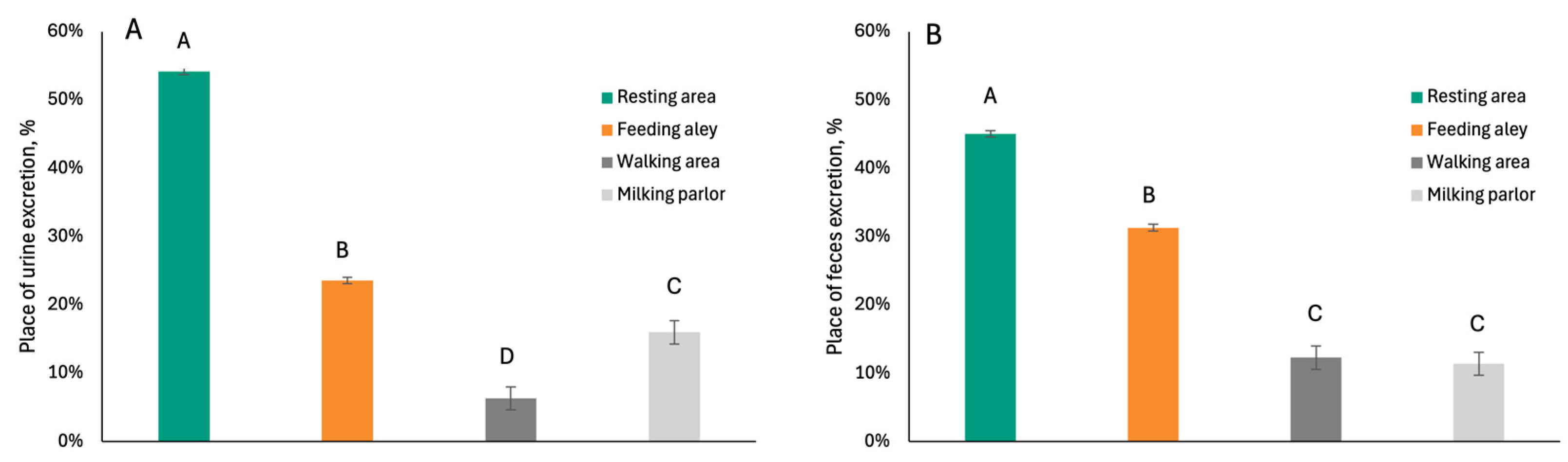
Both feces and urine excretion were primarily concentrated in the resting area. For feces, 45.03% was excreted in the resting area, followed by 31.29% in the feeding alley. Feces excretion in the walking area and milking parlor was similar (12.28% vs. 11.39%; p = 0.5248).
Urine excretion patterns were also concentrated in the resting area (54.18%; Figure 2, which was significantly more than in other areas (p < 0.001). These findings highlight the significance of the resting area as a critical zone for composting manure, where it can be reused as bedding material for the animals.
Figure 2.
Mean (±SE) distribution of urine (A) and feces (B) excretion across different locations: resting area, feeding alley, walking area, and milking parlor. Means within different letters are significantly different (p ≤ 0.05).
3.2. Behavior Patterns of Manure Excretion by Breed
Both Holstein and Holstein × Gyr breeds exhibited similar patterns of manure excretion across all areas within the CBP system. Feces excretion in the resting area, feeding alley, walking area, and milking parlor showed no significant breed differences (p > 0.05; Table 3). Urine excretion followed a similar trend, with both breeds excreting urine predominantly in the resting area and no differences between breeds. These results suggest that breed does not significantly influence manure deposition behaviors when cows are housed in a CBP system.
Table 3.
Mean (±SE) comparative analysis of feces and urine excretion between lactating Holstein and Holstein × Gyr cows.
3.3. Reduction in N Excretion That Requires Treatment
Based on the milk yield and composition data for both breeds evaluated, Holstein and Holstein × Gyr cows exhibited comparable daily nitrogen (N) manure excretion rates (p = 0.2428; Table 4). Holstein cows excreted 435 ± 7.8 g of N daily, while the crossbred cows excreted 449 ± 8.42 g of N daily. However, both breeds demonstrated a significant reduction in the nitrogen excreted that requires treatment due to the high concentration of excreta deposited in the resting area (p = 0.4699). Holstein cows reduced 46.5% in feces that directly impact the environment or require treatment, which equates to 49.0 g/d of N per cow. In contrast, in crossbred Holstein × Gyr cows, 43.4% of their feces were deposited in the resting area of the CBP, resulting in a reduction of 47.8 g/d of N that would otherwise need treatment. Both breeds exhibited similar rates of N excretion in the resting area (p = 0.868) according to feces estimates.
Table 4.
Mean (±SE) estimated daily nitrogen excretion and treatment-required nitrogen per cow for lactating Holstein and Holstein × Gyr cows.
Urine excretion in the resting area was similarly reduced (p = 0.1005) for both breeds, equating to 27.7 g/d less N per Holstein cow and 37.5 g/d for crossbred Holstein × Gyr cows. This reduction may positively impact the environment and lessen the need for further processing. In total, feces and urine excreted in the resting area account for 76.8 g/d of N for Holstein cows and 85.3 g/d for Holstein × Gyr cows, eliminating the necessity for treatment on dairy farms. This represents 44.1% of the total daily nitrogen excreted by Holstein cows and 49.0% for Holstein × Gyr cows, which is deposited directly for composting in the resting area of the CBP system. Overall, this indicates a reduction of 46.5 ± 3.34% of nitrogen, which is deposited in the resting area for composting.
4. Discussion
This study aimed to compare the manure excretion patterns of Holstein and Holstein × Gyr cows under identical conditions in a compost-bedded pack system (CBP). The results show that milk yield and composition were similar between the two breeds. These findings align with earlier studies that evaluated Holstein cows under tropical conditions [17], and some research that reports higher fat and total solids in crossbred, while protein levels were comparable across breeds [18,19,20].
Manure deposition patterns in both Holstein and Holstein × Gyr were concentrated in the resting area, supporting previous findings on the CBP’s effectiveness in managing waste. Both breeds demonstrated similar manure excretion behaviors, predominantly in the resting area, which facilitated the composting process. This concentration of waste helps significantly reduce the environmental burden by decreasing the amount of manure requiring treatment [21]. Our findings indicate a 44–49% reduction in nitrogen requiring treatment, which is slightly lower than the 75% reduction reported by some studies based on farmers’ estimates [14,22]. The slight discrepancy could be attributed to the different methods used in previous studies, such as farmer estimates and calculus based on daily intake and observation. Further studies are needed to standardize nitrogen reduction rates across various production systems to provide a more comprehensive comparison.
The composting of manure within the CBP bedding not only stabilizes nutrients but also supports more sustainable agricultural practices [23]. Furthermore, our study highlights the effectiveness of the CBP system in reducing manure treatment needs, especially when comparing excretion patterns in specific areas of the barn. While producers typically estimate that 20 to 25% of the manure is deposited in the feed alley [24], our findings indicate that 23.56% of urine and 31.29% of feces were deposited in this area. This reinforces the CBP’s efficiency in managing waste on dairy farms. Additionally, N from feces excreted in the resting area is composted on the cows’ bed and reused in agriculture without further treatment, further enhancing sustainability.
Previous studies have focused on differing feeding patterns between Holstein and Holstein × Gyr heifers in pasture conditions, showing minimal differences in performance [25,26]. Crossbreeds with Zebu have also demonstrated greater thermotolerance than purebred Holsteins under tropical conditions [27]. However, limited data exist on the performance of those breeds when housed in confined systems during lactation. Our study fills this gap by demonstrating that both Holstein and Holstein × Gyr lactating cows exhibited similar manure excretion patterns when housed in a CBP system. The majority of excreta was deposited in the resting area, facilitating its incorporation into the bedding for subsequent composting. This behavior leads to a consistent reduction in the volume of manure requiring treatment across both breeds.
The reduction in N directly entering the soil—between 44 and 49%—equates to 76.8 to 85.3 g of N per cow per day, which could otherwise promote soil leaching. Manure is often applied to fields without proper treatment, and at inappropriate times, increasing the risk of nitrogen loss [23]. The composting significantly reduces N loss through ammonia volatilization and leaching when compared to chemical fertilizers in agricultural uses [28,29]. To achieve these benefits, cattle manure requires a minimum of 80 days of composting to reduce phytotoxicity, improve nutrient stability [30], and minimize the presence and spread of antibiotic-resistant bacteria [31] in the field. These composting practices are in line with the CBP system’s removal and management of composted bedding once annually [4].
Addressing N management in agricultural practices is critical due to its potential for soil contamination. While the total N content in cattle manure is generally lower than in swine manure, composted cattle manure contains higher levels of total N compared to non-composted manure [32]. The CBP system, as used for lactating cows, effectively reduces the amount of N entering the soil or requiring treatment for agricultural applications. This reduction helps prevent soil leaching and minimizes N loss through volatilization, making CBP a sustainable system for dairy farms.
Moreover, the use of composted cattle manure can significantly reduce the need for chemical fertilizers, improve corn grain yields, provide a more consistent nitrate supply, and reduce N losses in the field, promoting more sustainable agricultural practices [33]. Additionally, incorporating composted manure as an organic nutrient source can lower the costs associated with soil management [34], further emphasizing the environmental and economic benefits of using composted manure in farming systems.
The compost-bedded-pack (CBP) system is recognized for its environmental benefits, particularly its ability to reduce the volume of manure requiring treatment and limit direct manure deposition into the soil. By promoting efficient composting, the CBP system enhances nutrient retention, improves soil health, and decreases reliance on chemical fertilizers, thereby supporting more sustainable agricultural practices.
While this study provides valuable insights into manure excretion patterns and nitrogen reduction in Holstein and Holstein × Gyr cows within CBP system, several limitations must be acknowledged. The small sample size limits the generalizability of the findings, and observational biases may have influenced the accuracy of the data collection. Future research should address these limitations by using larger sample sizes, automated monitoring methods, and stricter control of environmental conditions to confirm and expand upon these results. Additionally, future studies could explore seasonal variations in manure excretion patterns and their effects on CBP system efficiency. Investigating how different seasons impact cows’ behavior, manure deposition, and the composting process could lead valuable insights for optimizing CBP management throughout the year. Despite these constraints, this study offers meaningful contributions to sustainable manure management in dairy farming.
5. Conclusions
In our study, both Holstein and Holstein × Gyr cows exhibited similar excretion patterns when housed in a CBP system, with most of their waste deposited in the resting area. This behavior facilitated composting, leading to a substantial reduction in the amount of manure requiring treatment—45.03% for feces and 54.18% for urine. The concentration of waste in the CBP bedding allowed for enhanced nitrogen (N) retention at 46.5% and reduction in N loss through volatilization or leaching, which can otherwise occur when untreated manure is applied directly to fields.
These findings underscore the CBP system’s effectiveness in managing manure while minimizing its environmental impact. By decreasing nitrogen emissions and incorporating organic matter back into the soil, the CBP system not only reduces the overall volume of farm waste but also contributes to healthier soil and improved biosecurity. The system offers a sustainable solution for dairy farming, fostering better waste management practices and environmental stewardship.
Author Contributions
Conceptualization, K.R.O. and M.S.R.; methodology, K.R.O., M.S.R. and P.P.R.; formal analysis, K.R.O. and A.L.S.; investigation, K.R.O., M.S.R., L.H.R.S. and P.T.R.S., writing—original draft preparation, K.R.O.; writing—review and editing, P.P.R.; supervision, P.P.R. and A.L.S.; project administration, P.P.R.; funding acquisition, P.P.R. All authors have read and agreed to the published version of the manuscript.
Funding
This research was funded by CAPES PROEX (88887.844747/2023-00) and CNPq (141066/2022-9).
Institutional Review Board Statement
The animal study protocol was approved by the Committee of Animal Use Ethics Committee of the Department of Animal Science of the Universidade Federal de Viçosa, Minas Gerais, Brazil (protocol 35/2024).
Informed Consent Statement
Not applicable.
Data Availability Statement
Data are contained within the article.
Acknowledgments
We are grateful to the Dairy Research Facility of the Animal Science Department of Universidade Federal de Viçosa, Associação Brasileira de Criadores de Girolando, the donators of Holstein × Gyr animals for research use, and the research collaborators Bernardo Magalhães, Carina Bittencourt, João Vitor C. Rodrigues, and Thais A.S. Silva.
Conflicts of Interest
The authors declare no conflicts of interest. The funders had no role in the design of the study; in the collection, analyses, or interpretation of data; in the writing of the manuscript; or in the decision to publish the results.
References
- Damasceno, F.A.; Monge, J.L.; Nascimento, J.A.C.; Andrade, R.R.; Barbari, M.; Saraz, J.A.O.; Ferraz, G.A.S. Estimate of manure present in compost dairy barn systems for sizing of manure storage. Agron. Res. 2020, 18, 1213–1219. [Google Scholar] [CrossRef]
- NASEM. Nutrient Requirements of Dairy Cattle, 8th ed.; National Academies Press: Washington, DC, USA, 2021. [Google Scholar]
- Kuipers, A.; Galama, P.; Leso, L.; Bruegemann, K.; Klopčič, M. A Composting Bedding System for Animals as a Contribution to the Circular Economy. Processes 2022, 10, 518. [Google Scholar] [CrossRef]
- Barberg, A.E.; Endres, M.I.; Salfer, J.A.; Reneau, J.K. Performance and welfare of dairy cows in an alternative housing system in Minnesota. J. Dairy Sci. 2007, 90, 1575–1583. [Google Scholar] [CrossRef] [PubMed]
- Janni, K.A.; Endres, M.I.; Reneau, J.K.; Schoper, W.W. Compost dairy barn layout and management recommendations. Appl. Eng. Agric. 2007, 23, 97–102. [Google Scholar] [CrossRef]
- Llonch, L.; Castillejos, L.; Mainau, E.; Manteca, X.; Ferret, A. Effect of forest biomass as bedding material on compost-bedded pack performance, microbial content, and behavior of nonlactating dairy cows. J. Dairy Sci. 2020, 103, 10676–10688. [Google Scholar] [CrossRef]
- Llonch, L.; Gordo, C.; López, M.; Castillejos, L.; Ferret, A.; Balanyà, T. Agronomic Characteristics of the Compost-Bedded Pack Made with Forest Biomass or Sawdust. Processes 2021, 9, 546. [Google Scholar] [CrossRef]
- Leso, L.; Barbari, M.; Lopes, M.; Damasceno, F.; Galama, P.; Taraba, J.; Kuipers, A. Invited review: Compost-bedded pack barns for dairy cows. J. Dairy Sci. 2019, 103, 1072–1099. [Google Scholar] [CrossRef]
- Galama, P.J.; Bokma, S.; van Dooren, H.J.; Ouweltjes, W.; Smits, M.; Driehuis, F. Prospects for Bedded Pack Barns for Dairy Cattle; Wageningen UR Livestock Research: Lelystad, The Netherlands, 2011. [Google Scholar]
- Bewley, J.M.; Robertson, L.M.; Eckelkamp, E.A. A 100-year review: Lactating dairy cattle housing management. J. Dairy Sci. 2017, 100, 10418–10431. [Google Scholar] [CrossRef]
- Bran, J.A.; Costa, J.H.C.; von Keyserlingk, M.A.G.; Hötzel, M.J. Factors associated with lameness prevalence in lactating cows housed in freestall and compost-bedded pack dairy farms in southern Brazil. Prev. Vet. Med. 2019, 172, 104773. [Google Scholar] [CrossRef]
- Pilatti, J.A.; Vieira, F.C.M.; Rankrape, F.; Vismara, E.S. Diurnal behaviors and herd characteristics of dairy cows housed in a compost-bedded pack barn system under hot and humid conditions. Animal 2018, 13, 399–406. [Google Scholar] [CrossRef]
- Black, R.A.; Taraba, J.L.; Day, G.B.; Damasceno, F.A.; Bewley, J.M. Compost bedded pack dairy barn management, performance, and producer satisfaction. J. Dairy Sci. 2013, 96, 8060–8074. [Google Scholar] [CrossRef] [PubMed]
- Eckelkamp, E.A.; Taraba, J.L.; Akers, K.A.; Harmon, R.J.; Bewley, J.M. Understanding compost bedded pack barns: Interactions among environmental factors, bedding characteristics, and udder health. Livestock Sci. 2016, 190, 35–42. [Google Scholar] [CrossRef]
- R Core Team. R: A Language and Environment for Statistical Computing; R Foundation for Statistical Computing: Vienna, Austria, 2021; Available online: https://www.R-project.org/ (accessed on 22 August 2024).
- Reincke, K.; Saha, A.; Wyrzykowski, L. The Global Dairy World 2017/18: Results of the IFCN Dairy Report 2018. IFCN Dairy Research Network: Kiel, Germany, 2018. Available online: https://ifcndairy.org/wp-content/uploads/2018/10/Dairy-Report-Article-2018.pdf (accessed on 19 July 2024).
- Oliveira, A.S. Meta-analysis of feeding trials to estimate energy requirements of dairy cows under tropical condition. Anim. Feed. Sci. Technol. 2015, 15, 30045–30046. [Google Scholar] [CrossRef]
- Nóbrega, D.B.; Langoni, H. Breed and season influence on milk quality parameters and in mastitis occurrence. Pesq. Vet. Bras. 2011, 31, 1045–1052. [Google Scholar] [CrossRef]
- Houaga, I.; Muigai, A.W.T.; Ng’ang’a, F.M.; Ibeagha-Awemu, E.M.; Kyallo, M.; Yassao, I.A.K.; Stomeo, F. Milk fatty acid variability and association with polymorphisms in SCD1 and DGAT1 genes in White Fulani and Borgou cattle breeds. Mol. Biol. Rep. 2018, 45, 1849–1862. [Google Scholar] [CrossRef]
- Roessler, R.; Mpouam, S.E.; Schlecht, E. Genetic and nongenetic factors affecting on-farm performance of peri-urban dairy cattle in west Africa. J. Dairy Sci. 2019, 102, 2353–2364. [Google Scholar] [CrossRef]
- Hao, X.; Larney, F.J. Greenhouse gas emissions during co-composting of cattle feedlot manure with construction and demolition (C&D) waste. Front. Eviron. Sci. Eng. 2017, 11, 15. [Google Scholar] [CrossRef]
- Caldato, E.M.R.; Caldato, A.; Marcondes, M.I.; Rotta, P.P. Manual Técnico de Construção E Manejo de Compost Barn Para Vacas Leiteiras. Master’s Thesis, Universidade Federal de Viçosa, Pró- Reitoria de Extensão e Cultura, Divisão de Extensão, Viçosa, Brazil, 2020. [Google Scholar]
- Lazcano, C.; Gómez-Brandón, M.; Domínguez, J. Comparison of the effectiveness of composting and vermicomposting for the biological stabilization of cattle manure. Chemosphere. 2008, 72, 1013–1019. [Google Scholar] [CrossRef]
- Barberg, A.E.; Endres, M.I.; Janni, K.A. Compost dairy barns in Minnesota: A descriptive study. Appl. Eng. Agric. 2007, 23, 231–238. [Google Scholar] [CrossRef]
- Quirino, D.F.; Marcondes, M.I.; Rennó, L.N.; Correa, L.N.; Morais, V.C.L.; Cunha, C.S.; Silva, T.D.A.; da Silva, A.L.; Miller-Cushon, A.L.; Rotta, P.P. Intake, performance, and feeding behavior of Holstein and Holstein x Gyr heifers grazing intensive managed tropical grasses during the rainy season. Animal. 2022, 16, 100613. [Google Scholar] [CrossRef]
- Abreu, M.; Cunha, C.; Costa, J.; Miller-Cushon, E.; Rotta, P.; Machado, A.; Morais, V.; Marcondes, M. Performance and Feeding Behavior of Holstein and Holstein × Gyr Crossbred Heifers Grazing Temperate Forages. Trop. Anim. Health Prod. 2022, 54, 100. [Google Scholar] [CrossRef] [PubMed]
- Costa, A.N.L.; Feitosa, J.V.; Montezuma, P.A., Jr.; Souza, P.T.; Araújo, A.A. Rectal temperatures, respiratory rates, production, and reproduction performances of crossbred Girolando cows under heat stress in northeastern Brazil. Int. J. Biometeorol. 2015, 59, 1647–1653. [Google Scholar] [CrossRef] [PubMed]
- Jia, X.; Yang, Q.; Dong, S.T.; Zhang, J.W.; Zhao, B.; Liu, P. Using manure for improving nitrogen fertilization and maize yield. Exp. Agric. 2021, 56, 901–914. [Google Scholar] [CrossRef]
- Prados, L.F.; Chizzotti, F.H.M.; Cardoso, A.S.; Ruggieri, A.C.; Chizzotti, M.L.; Bretas, I.L.; Silva, B.C.; Rotta, P.P.; Silva, L.F.C.; Valadares Filho, S.C. Prediction of nitrogen and phosphorus excretion for beef cattle. In Nutrient Requirements of Zebu and Crossbred Cattle—BR-CORTE, 4th ed.; Valadares Filho, S.C., Saraiva, D.T., Benedeti, P.B., Silva, F.A.S., Chizzotti, M.L., Eds.; Suprema: Visconde de Rio Branco, Brazil, 2023; pp. 321–338. [Google Scholar] [CrossRef]
- Gómez-Brandón, M.; Lazcano, C.; Domínguez, J. The evaluation of stability and maturity during the composting of cattle manure. Chemosphere 2008, 70, 436–444. [Google Scholar] [CrossRef] [PubMed]
- Gou, M.; Hu, H.W.; Zhang, Y.J.; Wang, J.T.; Hayden, H.; Tang, Y.Q.; He, J.Z. Aerobic composting reduces antibiotic resistance genes in cattle manure and the resistome dissemination in agricultural soils. Sci. Total Environ. 2018, 612, 1300–1310. [Google Scholar] [CrossRef]
- Liu, S.; Wang, J.; Pu, S.; Blagodatskaya, E.; Kuzyakov, Y.; Razavi, B.S. Impact of manure on soil biochemical properties: A global synthesis. Sci. Total Environ. 2020, 745, 141003. [Google Scholar] [CrossRef]
- Zhang, L.; Li, L.; Sha, G.; Liu, C.; Wang, Z.; Wang, L. Aerobic composting as an effective cow manure management strategy for reducing the dissemination of antibiotic resistance genes: An integrated meta-omics study. J. Hazard. Mater. 2020, 386, 121895. [Google Scholar] [CrossRef]
- Zafari, A.; Kianmehr, M.H. Management and Reduction of Chemical Nitrogen Consumption in Agriculture. Am. J. Plant Sci. 2012, 3, 1827–1834. [Google Scholar] [CrossRef]
Disclaimer/Publisher’s Note: The statements, opinions and data contained in all publications are solely those of the individual author(s) and contributor(s) and not of MDPI and/or the editor(s). MDPI and/or the editor(s) disclaim responsibility for any injury to people or property resulting from any ideas, methods, instructions or products referred to in the content. |
© 2024 by the authors. Licensee MDPI, Basel, Switzerland. This article is an open access article distributed under the terms and conditions of the Creative Commons Attribution (CC BY) license (https://creativecommons.org/licenses/by/4.0/).