Methodological and Practical Basis for the Formation of a Matrix of Attractiveness of Tourist Sites and Its Role in the Process of Implementing Educational Tourism in the Education System of Higher Education Students


Abstract
1. Introduction
- Conducting a cluster analysis, the purpose of which is to group the regions of the Republic of Kazakhstan in the context of parameters characterizing the development of educational tourism in the country;
- Identification of criteria and sub-criteria for assessing the attractiveness of tourist facilities from the position of development and adaptation of the basic principles of educational tourism;
- Definition of groups of objects in the context of the regions of the Republic of Kazakhstan, for which an expert assessment will be made in the framework of the selected criteria;
- Defining the role of the matrix in the process of implementation of educational tourism in the educational environment within the framework of student-centered learning in Kazakhstan;
- Development of the SMART audio guide “Tourist objects of Karaganda city” (preparation of the route thread, description of the objects of the show and tell, calculation of the length) and uploading it in three languages (Kazakh, Russian, and English) on the platform is.Travel for further free use by all educational institutions of the region.
- What parameters characterizing the development of educational tourism can be used for cluster analysis and to influence the results of grouping the regions of Kazakhstan? (RQ1).
- What criteria and sub-criteria can include the matrix of assessment of tourist objects of the region from the position of educational tourism development? (RQ2).
- How can the obtained assessments presented in the matrix be used in the construction of route threads and the creation of SMART audio guides? (RQ3).
2. Literature Review
2.1. Features of Educational Tourism Development in the Conditions of Globalization, Digital Transformation of Educational Institutions, as Well as Within the Framework of Implementation of the Main Principles of Student-Centered Learning
2.2. The Role of Universities in the Development of Educational Tourism
2.3. Digitalization and Smartification of Educational Tourism
2.4. Specifics of Educational Tourism Potential Assessment: Main Approaches and Methods
3. Methodology
- Grouping the regions of the Republic of Kazakhstan by the level of educational tourism development based on hierarchical cluster analysis in the context of the selected statistical parameters;
- Formation of the criterion base (allocation of groups of criteria and sub-criteria in each group) and the matrix of assessment of tourist objects of the region from the position of educational tourism development; their testing on the example of tourist objects in the context of the regions of the Republic of Kazakhstan, previously assessed based on statistical criteria;
- Development of a SMART audio guide “Tourist objects of Karaganda city” as a conceptual complementary component of the system of implementation of educational tourism in the learning environment of higher school students.
3.1. Main Stages of Cluster Analysis of Regions from the Position of Educational Tourism Development
3.2. Formation of Groups of Criteria and Sub-Criteria for Evaluation of Tourist Objects of the Regions, as well as a Matrix from the Position of Their Attractiveness for the Development of Educational Tourism
3.3. Development of SMART Audio Guide as a Conceptual Complementary Component of the System of Implementation of Educational Tourism in the Learning Environment of Higher Education Students
- Defining the topics: relevant, interesting and useful for the educational process within the framework of implementation of the main provisions of the concept of student-centered learning, including those focused on taking into account the research interests of students;
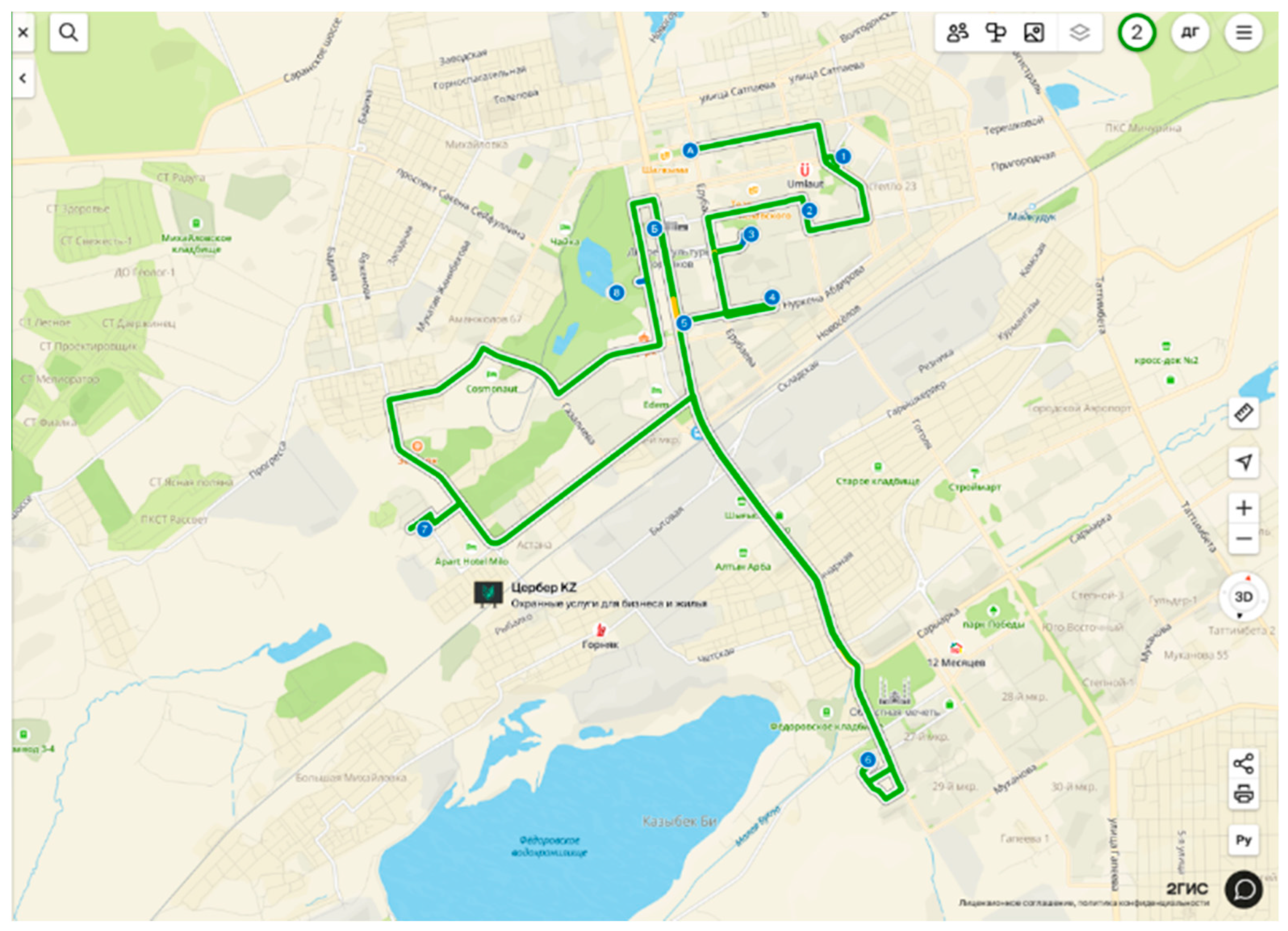
- Development of the excursion plan with the definition of the objects of demonstration and their distribution on the map (preliminary routing);
- Defining the type of the route and calculating its length;
- Formation of the description of each object in 3 languages: Kazakh, Russian, and English; the choice of these three languages is conditioned by the fact that students’ education in the region’s universities is conducted in 2 languages (Kazakh, Russian), and also there are specialties where training is conducted within the framework of polylingual education, i.e., in 3 languages (for example, the specialty “Tourism” (bachelor’s degree) on the basis of the Karaganda Buketov University); therefore, for convenience and maximum coverage of listeners, development of language competences of students it was accepted;
- Creation of an actual pool of photographic materials of the objects (by members of the research team using professional photographic equipment);
- Recording audio tracks in 3 languages for each object;
- Uploading the audio guide to the izi.Travel platform;
- Preparation of QR codes for quick access to the audio guide;
- Dissemination of information about the audio guide by publishing information in social networks, on the official website of the University, etc.
4. Results
4.1. RQ1: What Parameters Characterizing the Development of Educational Tourism Can Be Used for Cluster Analysis, as Well as Influence the Results of Grouping the Regions of Kazakhstan?
4.2. RQ2: What Criteria and Sub-Criteria Can the Matrix of Assessment of Tourist Objects of the Region from the Position of Educational Tourism Development Include?
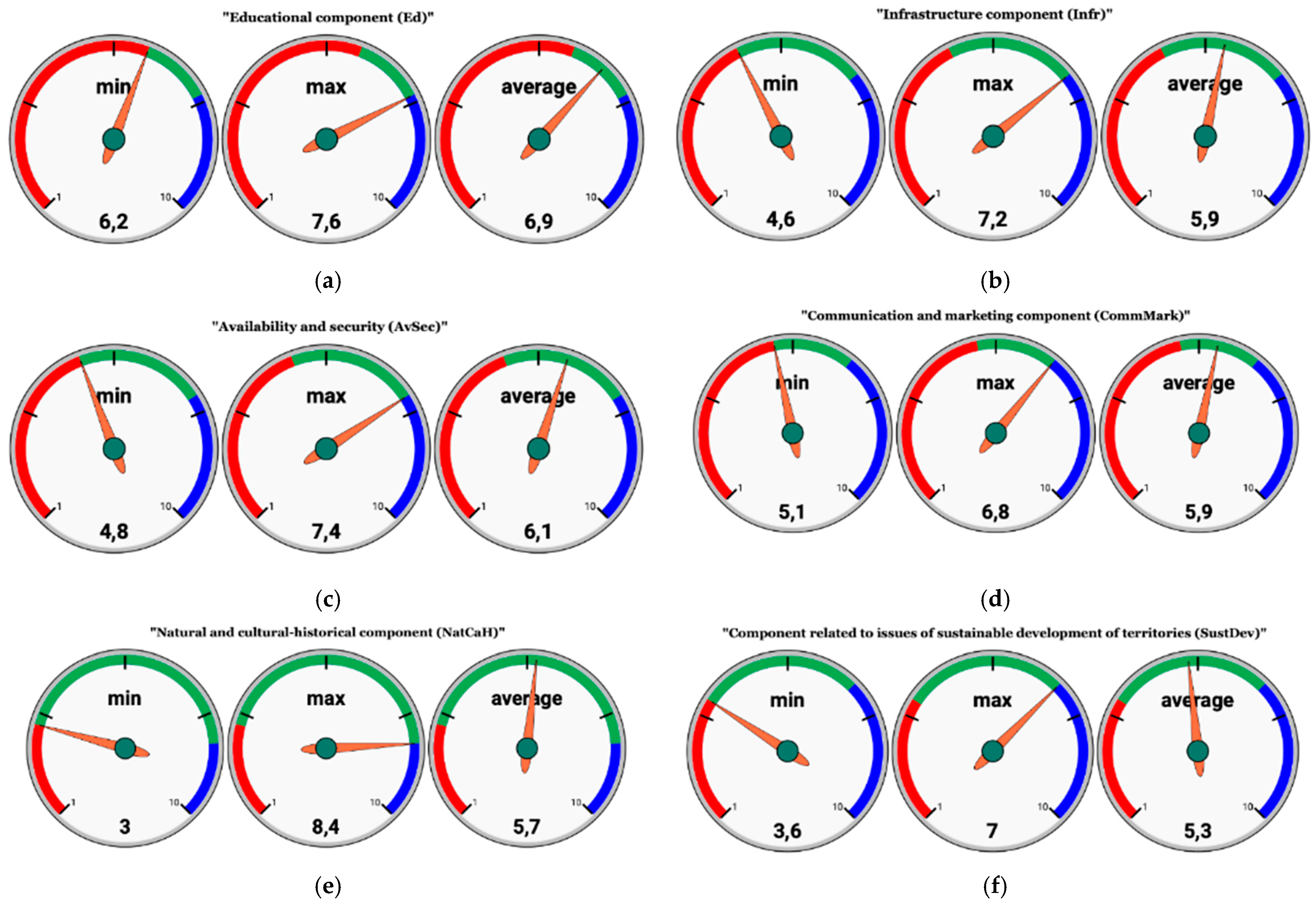
- Educational component (Ed)—0.25;
- Infrastructural component (Infr)—0.2;
- Accessibility and security (AvSec)—0.1;
- Communication and marketing component (CommMark)—0.1;
- Natural and cultural–historical component (NatCaH)—0.25;
- Component related to sustainable development of territories (SustDev)—0.1.
4.3. RQ3: How the Scores Obtained, as Presented in the Matrix, Can Be Used in the Construction of Route Threads and the Creation of SMART Audio Guides?
5. Discussion
6. Conclusions
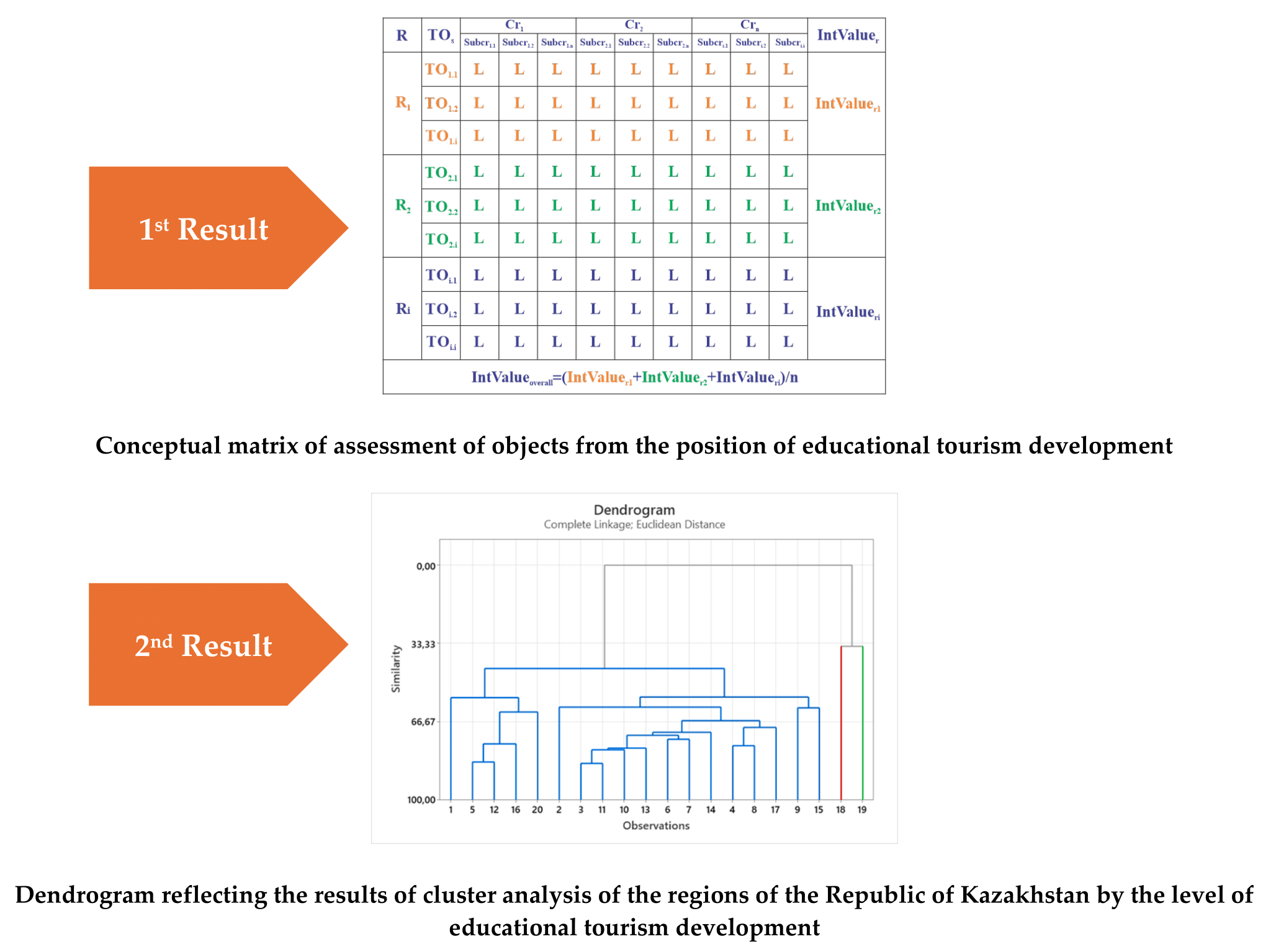
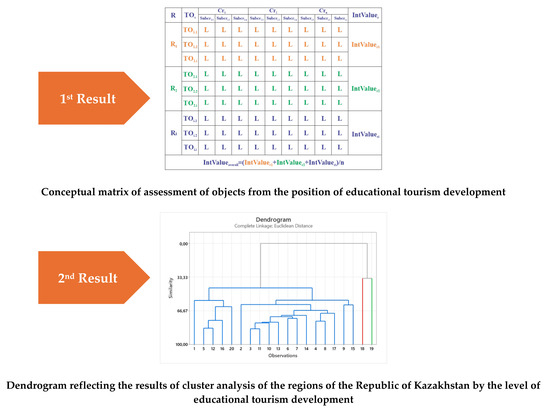
- On the basis of cluster analysis, three clusters were obtained (the first (blue) uniting 18 regions: Abay, Akmola, Aktobe, Almaty, Atyrau, West Kazakhstan, Zhambyl, Zhetisu, Karaganda, Kostanay, Kyzylorda, Mangistau, Pavlodar, North Kazakhstan, Turkestan, Ulytau, East Kazakhstan regions and the city of Shymkent; the second (red), represented by the city of Astana, the third (green)—the city of Almaty), which can be useful for the development of republican and regional programs. The second (red) is represented by the city of Astana and the third (green) by the city of Almaty, which can be useful in the development of national and regional programs for the development of educational tourism, as well as in the implementation of the main provisions of student-centered learning by educational institutions;
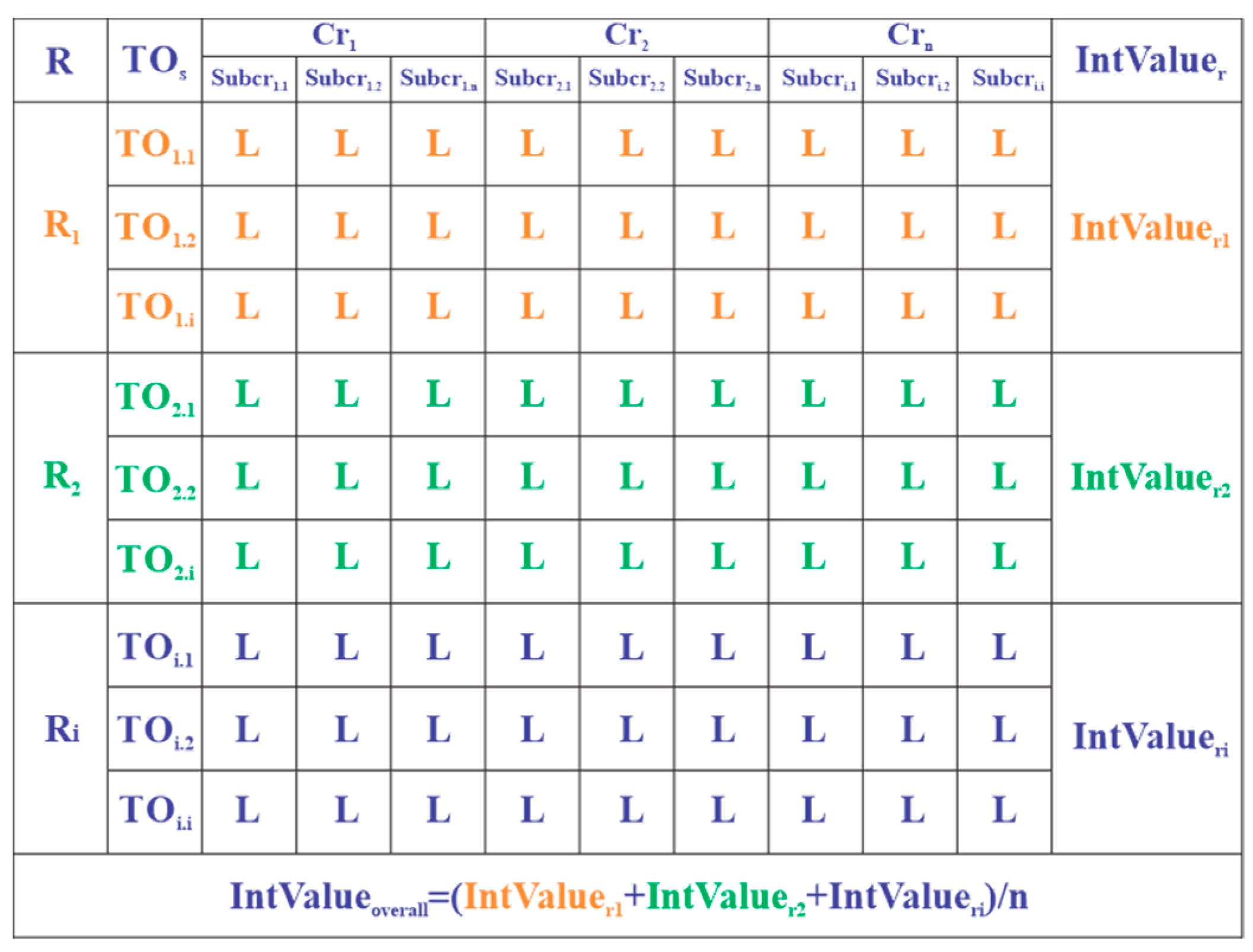
- In total, 6 groups of criteria and 53 sub-criteria of the matrix of evaluation of tourist objects of the region from the position of development of educational tourism, which were tested for the evaluation of 50 tourist objects of five regions of Kazakhstan: Northern, Southern, Western, Eastern and Central;
- On the basis of the conducted assessment, the SMART audio guide “Tourist objects of Karaganda city” was developed, which will find its wide application among educational institutions of the region, as well as among domestic and foreign tourists and excursionists; this audio guide is a kind of example of implementation of educational tourism in the system of education of higher school students, as it will be applied in the training of specialists of specialties “Tourism”, “Restaurant and hotel business”, “Marketing and SMM”, “Logistics”.
- Government agencies can use them in developing regional and national tourism development programs (including roadmaps) with the identification of groups of regions (based on the results of cluster analysis) that are the most promising for the development of the tourism industry and individual types of tourism, including educational tourism, interest in which can be generated in the process of student-centered learning;
- The formed criteria base for assessing the attractiveness of objects from the standpoint of educational tourism will allow key actors in the tourism market to form competitive educational tourism products for both the domestic and international markets, thereby popularizing domestic tourist destinations and creating a favorable tourist image of the country, since Kazakhstan has a high tourism and recreational potential; in addition, the presented assessment methodology will enable foreign researchers to conduct an effective analysis of the level of attractiveness of tourist sites in their country, supplementing it with new parameters, or removing those that are not significant in a specific assessment context;
- The developed attractiveness matrix will also allow the selection of those tourist sites that may be interesting from the perspective of educational tourism development and include them in the development of smart audio guides with subsequent posting on various platforms (for example, on izi.Travel, YouTravel.Me, GetYourGuide, etc.) for free use; the article shows an example of developing an audio guide in the industrial city of Central Kazakhstan—Karaganda, where it is trendy among schoolchildren, students, and postgraduate students, as it allows developing critical thinking skills, independent research, skills in working with modern information and communication technologies, as well as communication skills.
Author Contributions
Funding
Institutional Review Board Statement
Informed Consent Statement
Data Availability Statement
Conflicts of Interest
Appendix A

| Region/Area | Block 1—Set of Indicators Characterizing the Level of Education Development in the Republic of Kazakhstan: CED_1–CED_10 | |||||||||
|---|---|---|---|---|---|---|---|---|---|---|
| 1.1 Number of Organizations of Higher and/or Postgraduate Education, Units (CED_1) | 1.2 Number of Students in Organizations of Higher and (or) Postgraduate Education, People (CED_2) | 1.3 Share of Foreign Students in Organizations of Higher and/or Postgraduate Education, % (CED_3) | 1.4 Number of Master’s Students, Persons (CED_4) | 1.5 Residency Trainees, Persons (CED_5) | 1.6 Number of Doctoral Students, Persons (CED_6) | 1.7 Number of Teaching Staff by Degree and Title in Organizations of Higher and (or) Postgraduate Education (Candidates of Sciences, Doctors of Sciences), Persons (CED_7) | 1.8 Material and Technical Base in Organizations of Higher and (or) Postgraduate Education: Number of Computers Used in the Educational Process, Units (CED_8) | 1.9 Indicators of Financial and Economic Activity of Educational Organizations: Transfers Received for Capital Expenditures, Thousand Tenge (CED_9) | 1.10. Volume of Services Provided by Educational Organizations, Thousand Tenge (CED_10) | |
| Abay region | 3 | 18,316 | 6.4 | 1467 | 635 | 140 | 402 | 2965 | 1,331,617 | - |
| Akmola region | 4 | 10,908 | 3.0 | 525 | - | 30 | 255 | 1258 | 713,204 | 541,601 |
| Aktobe region | 6 | 22,774 | 3.0 | 943 | 602 | 84 | 445 | 4298 | 2,935,377 | 1,742,715 |
| Almaty region | 1 | 7303 | 0.5 | 544 | - | 68 | 44 | 600 | 795,173 | 1,740,279 |
| Atyrau region | 3 | 10,117 | 1.8 | 414 | - | 6 | 135 | 894 | 1,195,384 | 10,665,169 |
| West Kazakhstan region | 4 | 25,427 | 0.5 | 681 | - | 12 | 430 | 2332 | 733,130 | 3,085,844 |
| Zhambyl region | 2 | 19,632 | 3.3 | 1120 | - | 38 | 354 | 607 | 2,181,064 | 354,705 |
| Zhetisu region | 1 | 4400 | 0.4 | 391 | - | 54 | 99 | 1100 | 2,651,498 | - |
| Karaganda region | 8 | 38,079 | 4.8 | 1486 | 737 | 390 | 1029 | 8197 | 4,179,960 | 3,875,187 |
| Kostanai region | 6 | 17,143 | 1.3 | 433 | - | 76 | 364 | 3336 | 1,913,852 | 967,176 |
| Kyzylorda region | 3 | 14,276 | 0.2 | 775 | - | 38 | 313 | 1782 | 293,638 | 571,561 |
| Mangistau region | 1 | 6744 | 7.0 | 432 | - | 21 | 82 | 1133 | 165,693 | 1,363,893 |
| Pavlodar region | 4 | 14,586 | 1.8 | 1062 | - | 95 | 387 | 1294 | 1,122,805 | 964,758 |
| North Kazakhstan region | 2 | 6549 | 5.8 | 221 | - | 18 | 119 | 2201 | 379,078 | 459,021 |
| Turkestan region | 3 | 10,042 | 9.0 | 374 | 157 | 57 | 339 | 1507 | 7,488,325 | 415,418 |
| Ulytau region | 1 | 1310 | 0.1 | 16 | - | - | 24 | 324 | 1302,072 | - |
| East Kazakhstan region | 3 | 15,051 | 1.0 | 1279 | - | 120 | 280 | 1633 | 1,085,847 | 1,496,345 |
| Astana city | 14 | 67,211 | 2.9 | 6479 | 1468 | 1787 | 1777 | 13,991 | 36,436,181 | 28,118,137 |
| Almaty city | 39 | 177,568 | 4.5 | 11,973 | 2221 | 2857 | 4938 | 26,182 | 2,832,149 | 18,823,574 |
| Shymkent city | 8 | 90,801 | 5.7 | 4945 | 335 | 265 | 1296 | 6487 | 12,091,862 | 2,703,687 |
| Block 2—Set of Indicators Characterizing Cultural Development of the Regions of the Republic of Kazakhstan: CDC_1–CDC_46 | ||||||||||||||||||||||||||||||||||||
| Region/Area | Block 2—Set of Indicators Characterizing Cultural Development of the Regions of the Republic of Kazakhstan: CDC_1–CDC_11 | |||||||||||||||||||||||||||||||||||
| 2.1 Number of libraries, units (CDC_1) | 2.2 Number of cultural events held in the library, units (CDC_2) | 2.3 Number of visits to cultural events in the library, units (CDC_3) | 2.4 Number of historical museums (CDC_4) | 2.5 Number of local history museums (CDC_5) | 2.6 Number of memorial museums (CDC_6) | 2.7 Number of science museums (CDC_7) | 2.8 Number of art museums (CDC_8) | 2.9 Number of protected museums (CDC_9) | 2.10 Number of museums of other type (CDC_10) | 2.11. Number of visitors to museums, thousand people (CDC_11) | ||||||||||||||||||||||||||
| Abay region | 137 | 4787 | 200,093 | 1 | 5 | 1 | - | 1 | 1 | - | 229.4 | |||||||||||||||||||||||||
| Akmola region | 343 | 21,043 | 1,120,929 | - | 10 | 2 | 1 | - | - | 3 | 214.5 | |||||||||||||||||||||||||
| Aktobe region | 236 | 10,526 | 348,862 | 2 | 12 | 6 | - | - | - | - | 321.3 | |||||||||||||||||||||||||
| Almaty region | 143 | 13,179 | 602,006 | 2 | 1 | 6 | - | - | 2 | 5 | 93.6 | |||||||||||||||||||||||||
| Atyrau region | 139 | 8160 | 203,093 | 1 | 10 | - | - | - | 1 | - | 73.4 | |||||||||||||||||||||||||
| West Kazakhstan region | 360 | 13,394 | 276,225 | 3 | 9 | 5 | 1 | 1 | 1 | - | 101.0 | |||||||||||||||||||||||||
| Zhambyl region | 275 | 13,467 | 326,483 | 3 | 8 | 5 | - | - | 1 | - | 167.6 | |||||||||||||||||||||||||
| Zhetisu region | 147 | 17,299 | 216,008 | 4 | 1 | 4 | - | 1 | - | 3 | 50.8 | |||||||||||||||||||||||||
| Karaganda region | 255 | 26,590 | 225,844 | 3 | 11 | 1 | - | 1 | - | - | 420.9 | |||||||||||||||||||||||||
| Kostanai region | 340 | 15,278 | 269,563 | 2 | 4 | 3 | - | - | - | - | 353.6 | |||||||||||||||||||||||||
| Kyzylorda region | 209 | 9725 | 233,965 | 2 | 8 | 4 | - | - | - | - | 138.2 | |||||||||||||||||||||||||
| Mangistau region | 69 | 3785 | 302,382 | - | 5 | 2 | - | - | - | - | 83.7 | |||||||||||||||||||||||||
| Pavlodar region | 229 | 10,589 | 220,043 | - | 5 | 4 | - | 1 | - | 2 | 345.5 | |||||||||||||||||||||||||
| North Kazakhstan region | 318 | 17,382 | 432,290 | 2 | 4 | 5 | - | 1 | 1 | - | 142.2 | |||||||||||||||||||||||||
| Turkestan region | 398 | 13,687 | 276,878 | 4 | 12 | 5 | - | 1 | 3 | 2 | 1285.8 | |||||||||||||||||||||||||
| Ulytau region | 55 | 1527 | 45,015 | 3 | 2 | - | - | - | 1 | - | 141.5 | |||||||||||||||||||||||||
| East Kazakhstan region | 170 | 15,042 | 447,463 | 2 | 4 | - | - | 1 | 2 | - | 575.1 | |||||||||||||||||||||||||
| Astana city | 23 | 4088 | 206,445 | 2 | - | 4 | - | - | 1 | - | 890.4 | |||||||||||||||||||||||||
| Almaty city | 34 | 46,357 | 320,614 | 7 | - | 6 | 1 | 2 | - | 4 | 571.5 | |||||||||||||||||||||||||
| Shymkent city | 44 | 1840 | 351,677 | 4 | 1 | - | - | - | - | - | 55.9 | |||||||||||||||||||||||||
| Region/Area | Block 2—Set of Indicators Characterizing Cultural Development of the Regions of the Republic of Kazakhstan: CDC_12–CDC_23 | |||||||||||||||||||||||||||||||||||
| 2.12. Number of exhibits of the main collection in museums, units (CDC_12) | 2.13. Number of exhibitions held by museums abroad (CDC_13) | 2.14. Number of exhibitions held in museums (CDC_14) | 2.15. Number of theatres, units (CDC_15) | 2.16. Number of opera and ballet theatres, units (CDC_16) | 2.17. Number of drama theatres, units (CDC_17) | 2.18. Number of musical comedy theatres, units (CDC_18) | 2.19. Number of theatres for young spectators and puppets (CDC_19) | 2.20. Number of events held by theatres, units (CDC_20) | 2.21. Number of spectators at events held by theatres, persons (CDC_21) | 2.22. Number of new productions in the reporting year, units (CDC_22) | 2.23. Number of performances (theatre repertoire) in the reporting year, units (CDC_23) | |||||||||||||||||||||||||
| Abay region | 130,326 | - | 140 | 1 | - | 1 | - | - | 438 | 104,696 | 15 | 76 | ||||||||||||||||||||||||
| Akmola region | 131,658 | - | 307 | 2 | - | 2 | - | - | 770 | 99,351 | 22 | 83 | ||||||||||||||||||||||||
| Aktobe region | 97,258 | - | 688 | 2 | - | 1 | - | 1 | 812 | 138,264 | 12 | 86 | ||||||||||||||||||||||||
| Almaty region | 19,056 | 2 | 201 | 2 | - | - | - | 2 | 88 | 1280 | x | 31 | ||||||||||||||||||||||||
| Atyrau region | 86,321 | - | 120 | 1 | - | 1 | - | - | 127 | 32,069 | 4 | 50 | ||||||||||||||||||||||||
| West Kazakhstan region | 101,861 | - | 203 | 2 | - | 2 | - | - | 417 | 74,901 | 9 | 113 | ||||||||||||||||||||||||
| Zhambyl region | 119,346 | - | 350 | 2 | - | 2 | - | - | 543 | 79,580 | 12 | 73 | ||||||||||||||||||||||||
| Zhetisu region | 25,405 | - | 191 | - | - | x | - | - | 104 | 24,912 | x | x | ||||||||||||||||||||||||
| Karaganda region | 232,574 | - | 567 | 4 | - | 2 | 1 | 1 | 1643 | 275,997 | 30 | 243 | ||||||||||||||||||||||||
| Kostanai region | 210,154 | 2 | 555 | 4 | - | 2 | - | 2 | 1055 | 112,152 | 22 | 132 | ||||||||||||||||||||||||
| Kyzylorda region | 95,228 | - | 471 | 1 | - | 1 | - | - | 276 | 73,324 | 4 | 34 | ||||||||||||||||||||||||
| Mangistau region | 49,022 | 1 | 62 | 2 | - | 1 | - | 1 | 428 | 65,950 | 11 | 82 | ||||||||||||||||||||||||
| Pavlodar region | 173,483 | 1 | 445 | 3 | - | 2 | - | - | 412 | 91,700 | 12 | 87 | ||||||||||||||||||||||||
| North Kazakhstan region | 171,244 | 2 | 180 | 3 | - | 2 | - | 1 | 517 | 50,754 | 16 | 73 | ||||||||||||||||||||||||
| Turkestan region | 144,912 | 4 | 489 | 3 | - | 3 | - | - | 387 | 54,343 | 17 | 69 | ||||||||||||||||||||||||
| Ulytau region | 73,813 | - | 138 | - | - | - | - | - | 305 | 46,785 | x | x | ||||||||||||||||||||||||
| East Kazakhstan region | 253,932 | 2 | 445 | 1 | - | 1 | - | - | 344 | 74,934 | 11 | 66 | ||||||||||||||||||||||||
| Astana city | 136,445 | - | 165 | 9 | 2 | 3 | - | 2 | 2307 | 520,781 | 33 | 257 | ||||||||||||||||||||||||
| Almaty city | 369,481 | 5 | 198 | 24 | 1 | 9 | 2 | 6 | 3992 | 766,901 | 67 | 446 | ||||||||||||||||||||||||
| Shymkent city | 27,739 | - | 45 | 6 | 1 | 3 | 1 | 1 | 1563 | 282,879 | 28 | 206 | ||||||||||||||||||||||||
| Region/Area | Block 2—Set of Indicators Characterizing Cultural Development of the Regions of the Republic of Kazakhstan: CDC_24–CDC_35 | |||||||||||||||||||||||||||||||||||
| 2.24. Number of circuses, units (CDC_24) | 2.25. Number of events held in circuses, total, units (CDC_25) | 2.26. Number of spectators in circuses, persons (CDC_26) | 2.27. Number of cultural and leisure organizations, units (CDC_27) | 2.28. Number of cultural centers (palaces), units (CDC_28) | 2.29. Number of clubs, units (CDC_29) | 2.30. Number of Folk-Art Centers, units (CDC_30) | 2.31. Number of other cultural and leisure organizations, units (CDC_31) | 2.32. Number of seats in auditoriums of cultural and leisure organizations, units (CDC_32) | 2.33. Number of cultural events held, units (CDC_33) | 2.34. Number of spectators at the events held, persons (CDC_34) | 2.35. Number of concert organizations, units (CDC_35) | |||||||||||||||||||||||||
| Abay region | - | - | - | 124 | 31 | 93 | - | - | 18,652 | 6020 | 841,489 | 1 | ||||||||||||||||||||||||
| Akmola region | - | - | - | 260 | 111 | 146 | - | 2 | 41,777 | 32,173 | 3,944,301 | 1 | ||||||||||||||||||||||||
| Aktobe region | - | - | - | 202 | 55 | 145 | 1 | 1 | 34,736 | 12,617 | 1,989,532 | 1 | ||||||||||||||||||||||||
| Almaty region | - | - | - | 119 | 81 | 38 | - | - | 25,145 | 9724 | 1,237,112 | 2 | ||||||||||||||||||||||||
| Atyrau region | - | - | - | 82 | 52 | 29 | 1 | - | 14,612 | 5557 | 1,216,955 | 2 | ||||||||||||||||||||||||
| West Kazakhstan region | - | - | - | 270 | 125 | 140 | 1 | 4 | 40,882 | 14,362 | 2,144,159 | 3 | ||||||||||||||||||||||||
| Zhambyl region | - | - | - | 03 | 72 | 124 | 5 | 2 | 34,632 | 8456 | 1,024,129 | 2 | ||||||||||||||||||||||||
| Zhetisu region | - | - | - | 134 | 96 | 35 | 3 | - | 30,487 | 14,343 | 1,158,632 | 2 | ||||||||||||||||||||||||
| Karaganda region | - | - | - | 242 | 70 | 132 | - | 40 | 34,935 | 18,334 | 1,879,691 | 1 | ||||||||||||||||||||||||
| Kostanai region | - | - | - | 30 | 107 | 120 | - | 2 | 26,735 | 18,270 | 2,772,779 | 1 | ||||||||||||||||||||||||
| Kyzylorda region | - | - | - | 174 | 55 | 115 | 1 | 3 | 28,830 | 7707 | 1,037,744 | 1 | ||||||||||||||||||||||||
| Mangistau region | - | - | - | 43 | 29 | 13 | 1 | - | 9305 | 2321 | 1,135,935 | 1 | ||||||||||||||||||||||||
| Pavlodar region | - | - | - | 267 | 119 | 132 | 3 | 13 | 38,246 | 14,773 | 2,242,617 | 1 | ||||||||||||||||||||||||
| North Kazakhstan region | - | - | - | 238 | 83 | 97 | 2 | 56 | 34,117 | 14,977 | 869,553 | 1 | ||||||||||||||||||||||||
| Turkestan region | - | - | - | 255 | 112 | 143 | - | - | 47,540 | 10,396 | 1,357,314 | 1 | ||||||||||||||||||||||||
| Ulytau region | - | - | - | 42 | 9 | 30 | 1 | 2 | 6946 | 2434 | 462,460 | 1 | ||||||||||||||||||||||||
| East Kazakhstan region | - | - | - | 172 | 51 | 115 | - | 6 | 27,084 | 12,729 | 1,937,201 | 1 | ||||||||||||||||||||||||
| Astana city | 1 | 73 | 100,254 | 1 | 1 | - | - | - | 2579 | 394 | 214,159 | 6 | ||||||||||||||||||||||||
| Almaty city | 1 | 119 | 161,150 | 1 | 1 | - | - | - | 150 | 63 | 1800 | 13 | ||||||||||||||||||||||||
| Shymkent city | 1 | 68 | 48,899 | 10 | 5 | 5 | - | - | 1665 | 344 | 312,848 | 1 | ||||||||||||||||||||||||
| Region/Area | Block 2—Set of Indicators Characterizing Cultural Development of the Regions of the Republic of Kazakhstan: CDC_36–CDC_46 | |||||||||||||||||||||||||||||||||||
| 2.36. Number of events organized by concert organizations, units (CDC_36) | 2.37. Number of spectators at events organized by concert organizations, units (CDC_37) | 2.38. Number of parks, units (CDC_38) | 2.39. Number of cinematographic organizations engaged in film exhibition, units (CDC_39) | 2.40. Number of cinema screens in cinemas, units (CDC_40) | 2.41. Number of seats in cinema halls, units (CDC_41) | 2.42. Number of zoos, units (CDC_42) | 2.43. Total area of zoos, ha (CDC_43) | 2.44. Number of visitors to zoos, persons (CDC_44) | 2.45. Number of conducted excursions in zoos, units (CDC_45) | 2.46. Number of organised exhibitions in zoos. Units (CDC_46) | ||||||||||||||||||||||||||
| Abay region | 82 | 22,009 | 7 | 4 | 7 | 970 | 1 | 98.7 | 7070 | 8044 | 10 | |||||||||||||||||||||||||
| Akmola region | 230 | 36,081 | 4 | 4 | 5 | 780 | - | - | - | - | - | |||||||||||||||||||||||||
| Aktobe region | 342 | 227,100 | 12 | 3 | 8 | 1378 | - | - | - | - | - | |||||||||||||||||||||||||
| Almaty region | 187 | 80,870 | 16 | 3 | 10 | 1390 | - | - | - | - | - | |||||||||||||||||||||||||
| Atyrau region | 200 | 48,155 | 13 | 8 | 7 | 785 | - | - | - | - | - | |||||||||||||||||||||||||
| West Kazakhstan region | 213 | 94,975 | 10 | 11 | 14 | 1809 | - | - | - | - | - | |||||||||||||||||||||||||
| Zhambyl region | 284 | 42,250 | 14 | 15 | 20 | 3887 | - | - | - | - | - | |||||||||||||||||||||||||
| Zhetisu region | 200 | 56,200 | 2 | 2 | 7 | 801 | - | - | - | - | - | |||||||||||||||||||||||||
| Karaganda region | 972 | 139,453 | 18 | 5 | 14 | 2314 | 1 | 43.5 | 134,508 | 177 | 1 | |||||||||||||||||||||||||
| Kostanai region | 215 | 174,500 | 10 | 3 | 12 | 1405 | - | - | - | - | - | |||||||||||||||||||||||||
| Kyzylorda region | 324 | 62,953 | 1 | 2 | 11 | 1290 | - | - | - | - | - | |||||||||||||||||||||||||
| Mangistau region | 270 | 53,000 | 9 | 7 | 16 | 1866 | - | - | - | - | ||||||||||||||||||||||||||
| Pavlodar region | 236 | 90,565 | - | 5 | 16 | 2428 | - | - | - | - | - | |||||||||||||||||||||||||
| North Kazakhstan region | 194 | 60,589 | 4 | 7 | 13 | 1803 | 1 | - | 5000 | - | - | |||||||||||||||||||||||||
| Turkestan region | 214 | 8022 | 6 | 6 | 11 | 1440 | - | - | - | - | - | |||||||||||||||||||||||||
| Ulytau region | 176 | 41,524 | 27 | x | x | x | - | - | - | - | - | |||||||||||||||||||||||||
| East Kazakhstan region | 143 | 174,000 | 3 | 3 | 18 | 2676 | 2 | 3.7 | 94,186 | 1500 | 3 | |||||||||||||||||||||||||
| Astana city | 911 | 733,153 | 6 | 8 | 63 | 8405 | - | - | - | - | - | |||||||||||||||||||||||||
| Almaty city | 840 | 725,370 | 22 | 20 | 135 | 16,871 | 3 | 21.2 | 968,933 | 206 | - | |||||||||||||||||||||||||
| Shymkent city | 202 | 50,500 | 21 | 6 | 30 | 3345 | 1 | 30.1 | 343,024 | 130 | 6 | |||||||||||||||||||||||||
| Region/Area | Block 3—Indicators Characterizing the Development of the Tourism Industry by Regions of the Republic of Kazakhstan: TDC_1–TDC_3 | ||
|---|---|---|---|
| 3.1 Number of Accommodations * (TDC_1) | 3.2 Number of Rooms in Accommodation * (TDC_2) | 3.3 One-Time Capacity (Beds) of Accommodation (TDC_3) | |
| Abay region | 325 | 6675 | 17,379 |
| Akmola region | 339 | 5584 | 14,577 |
| Aktobe region | 100 | 2205 | 5751 |
| Almaty region | 261 | 5234 | 15,375 |
| Atyrau region | 128 | 4051 | 6700 |
| West Kazakhstan region | 92 | 2430 | 4812 |
| Zhambyl region | 225 | 2625 | 7048 |
| Zhetisu region | 311 | 6013 | 16,189 |
| Karaganda region | 245 | 4425 | 12,248 |
| Kostanai region | 132 | 2111 | 5579 |
| Kyzylorda region | 150 | 1769 | 4195 |
| Mangistau region | 101 | 4066 | 8148 |
| Pavlodar region | 124 | 3114 | 8402 |
| North Kazakhstan region | 123 | 1998 | 6231 |
| Turkestan region | 220 | 3100 | 9123 |
| Ulytau region | 25 | 276 | 489 |
| East Kazakhstan region | 334 | 5704 | 20,058 |
| Astana city | 257 | 9439 | 17,581 |
| Almaty city | 354 | 11,388 | 21,813 |
| Shymkent city | 146 | 3305 | 6058 |
References
- Educational Tourism Market Size, Share & Growth Report 2030. Available online: https://www.grandviewresearch.com/industry-analysis/educational-tourism-market-report (accessed on 13 June 2024).
- Educational Tourism Market Size & Share—Industry Growth|2031. Available online: https://www.skyquestt.com/report/educational-tourism-market# (accessed on 13 June 2024).
- Husin, A.; Maharani, S.D.; Raharjo, M.; Yosef, Y.; Sumarni, S.; Handrianto, C. Prospects for Implementation of Green Campus in Education and Research Pillars at Edupark Fkip Unsri Become Edutourism. Int. J. Prof. Bus. Rev. 2023, 8, e01597. [Google Scholar] [CrossRef]
- Carrera, C.A.B.; Sarmiento, C.d.R.J.; del Valle, N.M.R.; Aguilar, J.M. Turismo Educativo, Creación e Implementación de un Modelo Educomunicacional. Caso: Cuarto Grado de Educación Básica, Unidad Educativa Particular la Asunción. Universidad-Verdad 2023, 1, 142–155. [Google Scholar] [CrossRef]
- Kurniawan, A. Tourism-based Cultural Education. J. Tour. Creativity 2023, 7, 1–7. [Google Scholar] [CrossRef]
- Aleksіeіenko-Lemovska, L. Organization Principles of Tourist Activities in Education Institutions: Active Approach. Sci. J. Pol. Univ. 2022, 52, 14–20. [Google Scholar] [CrossRef]
- Kravchenko, T.; Danylko, V. Сharacteristics of socialization of ilder adolescents in the process of tourist activities. Sci. J. Natl. Pedagog. Dragomanov Univ. Ser. 15 Sci. Pedagog. Probl. Phys. Cult. (Phys. Cult. Sports) 2023, 3, 206–211. [Google Scholar] [CrossRef]
- Yen, T.-F.; Zhang, Q.; Zhang, Y. The Nature of Educational Tourism: The Aspects of Means-end Chain Approach. Asian J. Educ. Soc. Stud. 2021, 17, 1–16. [Google Scholar] [CrossRef]
- Gabdrakhmanova, G.F. The University and City Images for Migration of Nonresident Students: A Regional Case. Vysshee Obraz. Ross. High. Educ. Russ. 2023, 32, 116–138. [Google Scholar] [CrossRef]
- Pinto, M.J.A.; Moscardi, E.H.; Gomes, E.L.; Nakatani, M.S.M. The Touristudent. J. Int. Stud. 2021, 11, 60–80. [Google Scholar] [CrossRef]
- Suciu, M.-C.; Savastano, M.; Stativă, G.-A.; Gorelova, I. Educational Tourism and Local Development. Cactus 2022, 4, 18–26. [Google Scholar] [CrossRef]
- Franco, N.T.; Sánchez, J.E.O.; López, E.R. Educational tourism. J. Adm. Sci. 2022, 4, 26–31. [Google Scholar] [CrossRef]
- Priyanto, Y.A.U.; Andrianto, T. Long-term Impacts of Tourism Student Exchange Program. J. Tour. Sustain. 2022, 2, 11–18. [Google Scholar] [CrossRef]
- Hu, C.; Cheng, W. The Mission and Development Path of Online Education in Post-pandemic Era. In Proceedings of the 5th International Conference on Big Data and Education, Shanghai, China, 26–28 February 2022; pp. 133–140. [Google Scholar]
- Renz, A.; Hilbig, R. Digital Transformation of Educational Institutions Accelerated by COVID-19: A Digital Dynamic Capabilities Approach. In Beyond the Pandemic? Exploring the Impact of COVID-19 on Telecommunications and the Internet; Emerald Publishing Limited: Leeds, UK, 2023; pp. 103–119. [Google Scholar] [CrossRef]
- Shamsabadi, A.; Pashaei, A.; Rahmani, N.; Mahmoodabadi, A.D.; Norouzi, S.; Bahador, F.; SeyedAlinaghi, S.; Dadras, O.; Qaderi, K.; Mehraeen, E. Social Media Application in Education During the COVID-19 Pandemic; Pros and Cons: A Systematic Review. J. Iran. Med. Counc. 2023, 6, 389–400. [Google Scholar] [CrossRef]
- Zheng, Y. Impact of American Education System under the COVID-19 Pandemic Period. Lect. Notes Educ. Psychol. Public Media 2023, 7, 97–103. [Google Scholar] [CrossRef]
- Hariprasad, S.; Varghese, B. The Emerging Role of Innovative Teaching Practices in Tourism Education in the Post-COVID-19 Era; IGI Global: Hershey, PA, USA, 2023; pp. 286–299. [Google Scholar] [CrossRef]
- Zuccoli, A.; Korstanje, M.E. PANCOE: A Fresh Alternative to Post-COVID-19 Challenges in Education: The Case of Tourism Education. In Moving Higher Education Beyond COVID-19: Innovative and Technology-Enhanced Approaches to Teaching and Learning; Emerald Publishing Limited: Leeds, UK, 2023; pp. 53–63. [Google Scholar] [CrossRef]
- Mamrayeva, D.; Tashenova, L. Scientometric analysis of smart tourism using CiteSpace. Econ. Ann. 2022, 195, 13–25. [Google Scholar] [CrossRef]
- Tashenova, L.; Mamrayeva, D.; Borbasova, Z. Expert assessment and consumer preferences for the implementation of educational tourism in the learning system of universities students: The experience of Kazakhstan. Econ. Ann. 2023, 202, 108–126. [Google Scholar] [CrossRef]
- Bayanbayeva, A.; Makhmadinov, D.; Myrzatayev, N.; Niyetalina, G.; Narbayeva, G.; Suleimenova, S.; Altynbassov, B. The Transformational Role of Entrepreneurial Universities in Fostering Tourism Sector of Kazakhstan: Legal Documentary Analysis. J. Environ. Manag. Tour. 2023, 14, 2046–2055. [Google Scholar] [CrossRef]
- Dzhyndzhoian, V.; Botvinov, R.; Horb, K. The Role of State Institutions in the Promotion and Development of Educational Tourism in Ukraine. Sci. Opin. Econ. Manag. 2023, 1, 156–161. [Google Scholar] [CrossRef]
- Tomasi, S.; Paviotti, G.; Cavicchi, A. Educational Tourism and Local Development: The Role of Universities. Sustainability 2020, 12, 6766. [Google Scholar] [CrossRef]
- Räikkönen, J.; Rouhiainen, H.; Grénman, M.; Sääksjärvi, I.E. Advancing environmental sustainability through nature-based science tourism: The potential of universities. Matkailututkimus 2019, 15, 67–87. [Google Scholar] [CrossRef]
- Rinaldi, C.; Cavicchi, A.; Robinson, R.N.S. University contributions to co-creating sustainable tourism destinations. J. Sustain. Tour. 2022, 30, 2144–2166. [Google Scholar] [CrossRef]
- Barrientos-Báez, A.; Parra-López, E.; Martínez-González, J.A. Inclusivity in Higher Tourism Studies; IGI Global: Hershey, PA, USA, 2021; pp. 300–312. [Google Scholar] [CrossRef]
- Huang, L. Research on Mixed Education Teaching Reform in the Era of Internet plus. J. Theory Pract. Soc. Sci. 2024, 4, 1–6. [Google Scholar] [CrossRef] [PubMed]
- Iranmanesh, A.; Mousavi, S.A. Insights from the relationship between urban form, social media, and edu-tourism. Curr. Issues Tour. 2023, 26, 2559–2574. [Google Scholar] [CrossRef]
- Irfan, A.; Rasli, A.; Sami, A.; Liaquat, H. Role of Social Media in Promoting Education Tourism. Adv. Sci. Lett. 2017, 23, 8728–8731. [Google Scholar] [CrossRef]
- Balula, A.; Moreira, G.; Moreira, A.; Kastenholz, E.; Eusébio, C.; Breda, Z. Digital Transformation in Tourism Education. Tour. South. East. Eur. 2019, 5, 61–72. [Google Scholar] [CrossRef]
- Çınar, K. The Digital Revolution: Impact on Tourism Education. J. Tour. Gastron. Stud. 2020, 8, 2417–2443. [Google Scholar] [CrossRef]
- Gössling, S. Tourism, technology and ICT: A critical review of affordances and concessions. J. Sustain. Tour. 2021, 29, 733–750. [Google Scholar] [CrossRef]
- Indahyani, T.; Dewanti, N.R.; Meliana, S. Implementation of Digital Transformation in Design Education Learning to Support the Sustainability of Tourism Area. In Proceedings of the 2023 IEEE 9th International Conference on Computing, Engineering and Design (ICCED), Kuala Lumpur, Malaysia, 7–8 November 2023; pp. 1–6. [Google Scholar]
- Morellato, M. Digital Competence in Tourism Education: Cooperative-experiential Learning. J. Teach. Travel Tour. 2014, 14, 184–209. [Google Scholar] [CrossRef]
- Kumar, P.; Dubey, S.; Sahu, A.K. A Review on Smart and Intelligent Techniques for Digital Tourism. Int. J. Sci. Res. Comput. Sci. Eng. Inf. Technol. 2022, 8, 617–624. [Google Scholar] [CrossRef]
- Binytska, K. Features of Digitalization in the Process of Professional Training of Specialists in the Tourism Industry. Contin. Prof. Educ. Theory Pract. 2023, 75, 53–60. [Google Scholar] [CrossRef]
- Kallou, S.; Kikilia, A. A transformative educational framework in tourism higher education through digital technologies during the COVID-19 pandemic. Adv. Mob. Learn. Educ. Res. 2021, 1, 37–47. [Google Scholar] [CrossRef]
- Adiati, G. Digital Literacy in Post-Pandemic Project Based Learning at Sekolah Kembang Jakarta. WACANA J. Ilm. Ilmu Komun. 2023, 22, 1–10. [Google Scholar] [CrossRef]
- Jeon, J.Y.; Kim, J.M. Factors Affecting Digital Literacy of Specialized Vocational High School Students. Korean Soc. Study Vocat. Educ. 2023, 42, 53–72. [Google Scholar] [CrossRef]
- Sarva, E.; Lāma, G.; Oļesika, A.; Daniela, L.; Rubene, Z. Development of Education Field Student Digital Competences—Student and Stakeholders’ Perspective. Sustainability 2023, 15, 9895. [Google Scholar] [CrossRef]
- Sofian, S.R.A.; Subchan, W.; Yushardi, Y. Digital Literacy of Junior High School Students in Jember as an Indicator of Readiness in Facing the Society 5.0 Era in Science Learning. J. Penelit. Pendidik. IPA 2023, 9, 4078–4083. [Google Scholar] [CrossRef]
- Çilkin, R.E.; Toksöz, D. Reflections of Technological Developments on Tourist Guidance: Mobile Tourist Guide Applications. J. Tour. Gastron. Stud. 2024, 12, 445–455. [Google Scholar] [CrossRef]
- Lili, D.; Youlan, L. Research on Intelligent Tourism System of 5A-Level Tourist Attractions Based on Computer Big Data. In Proceedings of the 2022 IEEE Conference on Telecommunications, Optics and Computer Science (TOCS), Dalian, China, 11–12 December 2022; pp. 962–965. [Google Scholar]
- Mahajan, A.; Maidullah, S.; Hossain, M.R. Experience Toward Smart Tour Guide Apps in Travelling; IGI Global: Hershey, PA, USA, 2022; pp. 255–273. [Google Scholar] [CrossRef]
- Hale, B.W. Understanding potential impacts from university-led educational travel. Int. J. Sustain. High. Educ. 2019, 20, 245–263. [Google Scholar] [CrossRef]
- McGladdery, C.A.; Lubbe, B.A. Rethinking educational tourism: Proposing a new model and future directions. Tour. Rev. 2017, 72, 319–329. [Google Scholar] [CrossRef]
- Attaalla, F.A.H. Educational Tourism as a Tool to Increase the Competitiveness of Education in Egypt: A Critical Study. Int. J. Tour. Hosp. Rev. 2020, 7, 58–65. [Google Scholar] [CrossRef]
- Hussein, S.H.; Kusairi, S.; Ismail, F. Modelling the demand for educational tourism: Do dynamic effect, university quality and competitor countries play a role? J. Tour. Futur. 2022. ahead-of-print. [Google Scholar] [CrossRef]
- Drebot, O.; Babikova, K.; Oliinyk, H. Fundamentals of development of tourist and recreational potential of regions. Balanced Nat. Using 2022, 1, 5–11. [Google Scholar] [CrossRef]
- Ivlieva, O.V.; Shmytkova, A.V.; Sukhov, R.I.; Kushnir, K.V.; Grigorenko, T.N. Assessing the tourist and recreational potential in the South of Russia. E3S Web Conf. 2020, 208, 05013. [Google Scholar] [CrossRef]
- Luo, Y.; Chen, Y.; Zheng, W. A Literature Review on Evaluating Tourism Destinations. In Proceedings of the ISME 2016—Information Science and Management Engineering IV, Wuhan, China, 29–30 December 2016; pp. 329–334. [Google Scholar] [CrossRef]
- Mamraeva, D.G.; Tashenova, L.V. Methodological Tools for Assessing the Region’s Tourist and Recreation Potentia. Econ. Reg. 2020, 16, 127–140. [Google Scholar] [CrossRef] [PubMed]
- Nenasheva, G.; Kozyreva, Y. Assessment of area tourist-recreational potential with honey palinological research. Ukr. J. Ecol. 2020, 10, 225–229. [Google Scholar] [CrossRef] [PubMed]
- Tanina, A.; Tashenova, L.; Konyshev, Y.; Mamrayeva, D.; Rodionov, D. The Tourist and Recreational Potential of Cross-Border Regions of Russia and Kazakhstan during the COVID-19 Pandemic: Estimation of the Current State and Possible Risks. Economies 2022, 10, 201. [Google Scholar] [CrossRef]
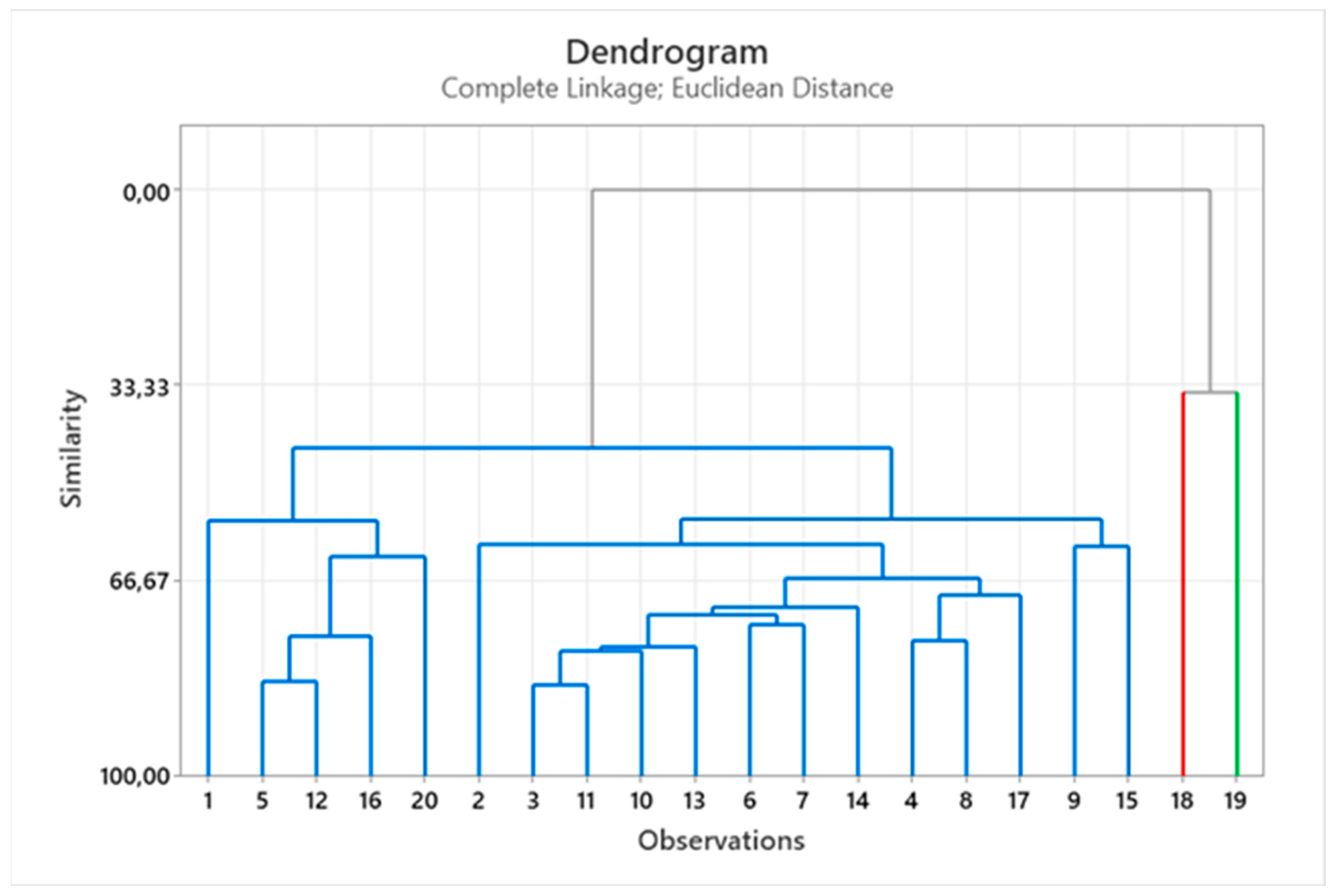
| Step | Number of Clusters | Similarity Level | Distance Level | Clusters Joined | New Cluster | Number of Observations in New Cluster | |
|---|---|---|---|---|---|---|---|
| 1 | 19 | 84.6003 | 3.6097 | 3 | 11 | 3 | 2 |
| 2 | 18 | 84.0194 | 3.7458 | 5 | 12 | 5 | 2 |
| 3 | 17 | 78.8109 | 4.9667 | 3 | 10 | 3 | 3 |
| 4 | 16 | 78.0722 | 5.1398 | 3 | 13 | 3 | 4 |
| 5 | 15 | 77.0363 | 5.3826 | 4 | 8 | 4 | 2 |
| 6 | 14 | 76.2691 | 5.5625 | 5 | 16 | 5 | 3 |
| 7 | 13 | 74.3014 | 6.0237 | 6 | 7 | 6 | 2 |
| 8 | 12 | 72.6454 | 6.4118 | 3 | 6 | 3 | 6 |
| 9 | 11 | 71.3441 | 6.7169 | 3 | 14 | 3 | 7 |
| 10 | 10 | 69.2052 | 7.2182 | 4 | 17 | 4 | 3 |
| 11 | 9 | 66.3804 | 7.8803 | 3 | 4 | 3 | 10 |
| 12 | 8 | 62.6563 | 8.7533 | 5 | 20 | 5 | 4 |
| 13 | 7 | 60.9275 | 9.1585 | 9 | 15 | 9 | 2 |
| 14 | 6 | 60.5736 | 9.2414 | 2 | 3 | 2 | 11 |
| 15 | 5 | 56.5326 | 10.1886 | 1 | 5 | 1 | 5 |
| 16 | 4 | 56.2840 | 10.2469 | 2 | 9 | 2 | 13 |
| 17 | 3 | 44.1492 | 13.0913 | 1 | 2 | 1 | 18 |
| 18 | 2 | 34.6271 | 15.3232 | 18 | 19 | 18 | 2 |
| 19 | 1 | 0.0000 | 23.4397 | 1 | 18 | 1 | 20 |
| № of Cluster | Number of Observations | Within Cluster Sum of Squares | Average Distance from Centroid | Maximum Distance from Centroid |
|---|---|---|---|---|
| Cluster1 | 18 | 557.841 | 5.37772 | 8.50822 |
| Cluster2 | 1 | 0.000 | 0.00000 | 0.00000 |
| Cluster3 | 1 | 0.000 | 0.00000 | 0.00000 |
| Clusters | Cluster 1 | Cluster 2 | Cluster 3 |
|---|---|---|---|
| Cluster1 | 0.0000 | 12.7070 | 21.2419 |
| Cluster2 | 12.7070 | 0.0000 | 15.3232 |
| Cluster3 | 21.2419 | 15.3232 | 0.0000 |
| Evaluation Criteria and Sub-Criteria |
|---|
| 1. Educational component (Ed) |
|
|
|
|
|
|
|
|
| 2. Infrastructure component (Infr) |
|
|
|
|
|
|
|
| 3. Accessibility and security (AvSec) |
|
|
|
|
|
|
|
|
|
|
|
|
| 4. Communication and marketing component (CommMark) |
|
|
|
|
|
|
|
| 5. Natural and cultural–historical component (NatCaH) |
|
|
|
|
|
|
|
|
|
|
|
| 6. Component related to sustainable territorial development issues (SustDev) |
|
|
|
|
|
|
|
|
| № | Tourist Sites and Their Brief Description |
|---|---|
| Central Kazakhstan | |
| 1 | Karkaraly State National Nature Park—organized in 1998; belongs to the second category of specially protected natural territories with the status of nature conservation and scientific institution of Republican significance. It has 5 relatively isolated mountain groups: Buguly, Shankoza, Matena, Airtau and Kent. The territory of the park is inhabited by the mountain sheep—argali, listed in the Red Book; there are also 46 species of mammals, 234 species of birds, 6 species of reptiles, 2 species of amphibians and 15 species of fish. |
| 2 | The Spassk Memorial Complex is a burial place for victims of political repressions during the years of totalitarianism, as well as prisoners of war and internees of the Second World War. It is a historical monument |
| 3 | The Central Park of Culture and Recreation of Karaganda is one of the largest parks in Kazakhstan; it hosts events, sports competitions, etc.; it is a popular recreation place for local residents and guests of the city. |
| 4 | The Karlag Museum is a museum commemorating the victims of political repression. |
| 5 | Mausoleum of Zhoshy Khan (Djuchi Khan) is an architectural monument of the 14th century; located 50 km from the city of Zhezkazgan on the bank of the Kengir River. |
| 6 | Ereimentau (“small mountains”) is a mountain range interesting for the study of geology and natural landscapes by researchers and students. It is part of the ancient Timan-Altaic mountain system. |
| 7 | Botanical Garden of Karaganda—founded in 1940 to conduct research work on breeding and selection of promising plant species for arid regions. |
| 8 | Balkhash Lake—a semi-freshwater lake; one of the largest inland drainless reservoirs on Earth. |
| 9 | Bektauata mountain massif—located at an altitude of 600 to 1214 metres above sea level. Weathering processes destroyed granites, as a result of which, the mountains took the most unusual shapes, receiving the following names: “Mushroom”, “Chest”, “Turtle”, “Three-toothed”. |
| 10 | Karaganda Zoo is one of the oldest in Kazakhstan; it was founded in 1938; it contains more than 1000 animals, 70% of which are listed in the Red Book. |
| South Kazakhstan | |
| 1 | The Mausoleum of Khoja Ahmed Yassawi in the city of Turkestan (formerly Yassy)—built between 1389 and 1405 by order of Tamerlane. It was erected in honor of the great thinker and poet Ahmed Yassawi. The mausoleum, mosque, khanaka, administrative and economic premises are located on the territory of the complex. The mausoleum is a masterpiece of architecture and an outstanding monument of medieval architecture. |
| 2 | The ancient city of Otrar (formerly Farab, named in honor of the great thinker, philosopher and mathematician Abu-Nasr Al-Farabi) is one of the most ancient cities of Central Asia. In 1219 Otrar fell under the onslaught of Genghis Khan’s army. It was the center of trade and the crossing of caravan routes. It is located 57 km from the city of Turkestan. It is an open-air archaeological museum and is protected by the state. |
| 3 | “Kolsai Lakes” State National Nature Park—includes a cascade of lakes: Upper, Mynzholki and Lower. They are characterized by clear fresh water; they are located in a gorge. The flora of the NPP includes more than 200 species of vertebrate animals and 700 species of plants, among which Kungai wattle, Adonis golden, Adonis Tianshan, orange jaundice, Shrenka spruce are included in the Red Book of Kazakhstan. Lake Kaindy is one of the natural wonders of Southern Kazakhstan, a member of the Kolsai group of lakes. Its uniqueness lies in the fact that the trunks of spruce trees rise right in the middle of the reservoir. |
| 4 | The Charyn Canyon is a landmark located 200 km from the city of Almaty. The canyon stretches for 154 km along the Charyn River. It is a natural monument made of sedimentary rocks, which are about 12 million years old. |
| 5 | Aksu-Zhabagli State Nature Reserve—the flora of which includes 1737 species; mammals are represented by 52 species. In 2015, it was included in the list of UNESCO World Heritage Sites in Kazakhstan as a biosphere reserve. |
| 6 | The Medeu High Altitude Ice Rink is the world’s largest high-altitude complex (1700 m above sea level) designed for winter sports; it has the world’s largest artificial ice field. It also hosts a variety of events, international song contests and sports competitions. It is a monument of town-planning and architecture of the Republican significance. |
| 7 | Shymkent State Zoological Park—contains more than 2800 animals, including 43 species listed in the Red Book of Kazakhstan; opened in 1980. |
| 8 | Aisha-bibi Mausoleum is an architectural monument of X–XII centuries. According to legend, Aisha-bibi was the beloved of Karakhan, who built a mausoleum in her honor. |
| 9 | Mausoleum of Arystan-Baba—a structure erected in honor of the religious figure of the 12th century—Arystan-Baba, who, according to historians, was also the teacher and spiritual adviser of Khoja Ahmed Yasawi. The mausoleum is an architectural monument. |
| 10 | Tamgaly-Tas—petroglyphs and ancient rock paintings located in a tract near the Ili River 120 km north of Almaty. |
| North Kazakhstan | |
| 1 | Saryarka—Steppes and lakes of Northern Kazakhstan. It is a UNESCO WORLD HERITAGE SITE; Korgalzhyn and Naurzum reserves are located here. It includes two groups of lakes with fresh and salt water, which support populations of globally threatened species, including Siberian Crane, Pink Flamingo, Gyrfalcon, White-tailed Eagle, Savka, Dalmatian Pelican and others. |
| 2 | National-cultural complex “Ethnoaul” is a tourist object created for EXPO-2017 in Kazakhstan with the purpose of acquainting visitors with the culture and life of the Kazakh people. It includes 30 yurts and various small architectural forms. |
| 3 | Archaeological monument “Bekteniz”—consists of 10 burial mounds of the Bronze Age. Bronze mirrors, women’s jewellery and many others were found here. |
| 4 | Lake Imantau—located 90 km from the city of Kokshetau; it is notable for its beautiful nature, as it is adjoined by rocks, birch, coniferous, aspen forests, medicinal herbs; there is an island on the lake. |
| 5 | The memorial complex of Karasai and Agyntai batyrs—opened in 1999 and is dedicated to the development of the tradition of ancient Turkic stakes of kagans, as well as to the memory of great batyrs. |
| 6 | Astrophysical Research Centre, Astrophysical Observatory—is located based on Kozybayev University, equipped with projection equipment of Leariving Technologies, USA. This is one of the biggest telescopes in the country, allowing to solve modern scientific problems. |
| 7 | “Botai” settlement is an Eneolithic monument located on the bank of the Iman-Burluk River. 158 dwellings were found on the territory of the settlement during archaeological excavations under the direction of Professor V. Seibert. |
| 8 | Museum complex “Abylai Khan’s Residence”—founded in 2007; a historical museum. It is also a monument of town-planning and architecture of republican importance. The museum complex is dedicated to the life and activity of Abylai Khan. |
| 9 | State National Natural Park “Burabai”—tourist and recreational resort of Kazakhstan, founded in 1910; there are 14 large and many small lakes; Burabai fauna includes about 300 species of vertebrates, flora—about 800 species of forest, meadow, saline plants. |
| 10 | Botanical garden of Petropavlovsk is one of the oldest in Kazakhstan; it includes a greenhouse, winter garden, squares, mini-dendrarium, pond for waterfowl, vivarium, zoological corner, aviaries with exotic species of birds, aquatic with exotic species of fish. |
| West Kazakhstan | |
| 1 | Ustyurt Plateau—the landscapes of the plateau have a unique beauty, as this area used to be under water and then transformed into an upland. It has sheer walls reaching up to 400 m in height in some places. In 2018, the Ustyurt mouflon (or Ustyurt ram), thought to be extinct, was discovered here. |
| 2 | The underground mosque of Shopan-Ata is one of the oldest monuments of architecture of X–XIX centuries, which has a necropolis and an underground mosque. Since 1982 it has been a monument of history and culture of republican significance. Here is the burial place of one of the disciples of Khoja Ahmed Yassaui—Shopan-Ata—a great Sufi philosopher and mystic. |
| 3 | The underground mosque of Beket-Ata—cut out in a rock massif; this object is a spiritual and historical relic of Kazakhstan, where Beket-Ata (Pir-Beket)—a famous religious figure, educator and batyr spent a certain period of time. |
| 4 | The city of “Kyzyl-Kala” is an archeological monument of X–XIII centuries, located in Mangistau district of Mangistau region. This city is a part of a large trade and crafts city that emerged on the caravan route of the northern branch of the Great Silk Road. In 2012, the site was included in the UNESCO World Heritage Tentative List. |
| 5 | Ak-Zhaiyk Biosphere Reserve is a natural complex of the Ural River delta. There are 292 bird species registered here, among which there are some rare species: dalmatian pelican, little cormorant, Egyptian heron, little white heron, yellow heron and many others. The theriofauna is represented by 48 species of mammals, which is more than 25% of the entire mammal fauna of Kazakhstan. |
| 6 | Bozzhyra tract is one of the largest sights of Mangistau; the tract appeared at the bottom of the ancient ocean of Tethys. It represents majestic light beige rocks. |
| 7 | Kyzylkup tract is a mountain made of colored marine sediments; the tract is 10 km long. One of the key sights is Bokty Mountain, depicted on the 1000 tenge note. |
| 8 | House-museum of Y.I. Pugachev—located in the city of Uralsk; dedicated to the memory of Yemelyan Pugachev. Since 1991 it has been a branch of the West Kazakhstan Regional Museum of History and Local Lore. Every year in spring the museum hosts a folklore and music festival “Larks”. |
| 9 | Historical complex “Bokey Ordasy”—a historical and museum complex, where the objects of the era of reign of Zhangir Khan have been preserved. |
| 10 | Valley of stone balls in Mangystau (Torysh) is one of the visiting cards of Mangystau; here, on the territory of the valley, scattered more than a thousand stone balls (in diameter from 1 to 3 m), which have a natural geological origin. |
| East Kazakhstan | |
| 1 | Rakhmanovskie Klyuchi—therapeutic springs flowing into Rakhmanovskoe Lake. The springs were discovered in 1769. The water temperature is from +32 to +42 degrees Celsius. The highest mosque in the country is also located here. |
| 2 | Katon-Karagai State National Natural Park—was established in 2001 to preserve and restore the unique natural complexes of Southern Altai. Many tourist routes have been created and operate on its territory, among them: the scientific-cognitive trail “Rakhmanovskie Klyuchi”, the excursion trail (route) “Altai Trails”, the tourist and excursion route “Ozerny” and many others. |
| 3 | East Kazakhstan regional architectural-ethnographic and natural-landscape museum-reserve—consists of 3 key buildings—administrative building and directly 2 buildings of the museum-reserve, which, in turn, are also historical and architectural monuments. It is a unique natural, cultural and architectural object. |
| 4 | The State Historical-Cultural and Literary-Memorial Reserve-Museum of Abai “Zhidebai-Borili”—was founded in 1940, has 21 thousand exhibits, 16 thousand publications, includes a library, head museum, house-museum of Abai, house-museum of M. Auezov, house-museum of Sh. Abenov, house-museum of A. Naimanbayev and house-museum of K. Orazalin. |
| 5 | Old Austrian road—was built in 1914–1916; a historical monument of the East Kazakhstan region. |
| 6 | Mount Belukha—a mountain in East Kazakhstan, whose peaks are covered with snow and ice; the summit is a snow-white peak 4506 m high. It is very popular among mountaineers. |
| 7 | Lake Alakol is a bitter-salt lake in Kazakhstan, which is famous for its healing properties. Beach tourism is actively developing here. |
| 8 | Berel barrows—a complex of burial mounds dating back to the V–IV centuries BC. It consists of more than 100 burial mounds. The State Historical and Cultural Museum-Reserve “Berel” was established in 2008. |
| 9 | Bukhtarma Reservoir is a reservoir formed by a dam on the Irtysh River, the largest in Kazakhstan. It is a popular holiday destination for local and foreign tourists. |
| 10 | Podbelkov Lake is a unique natural object, famous for its high radon content, which got into the reservoir from an abandoned adit. It is located at an altitude of 1906.5 m above sea level. |
| Tourist Object | Ed | Infr | AvSec | CommMark | NatCaH | SustDev | Average | Integral Indicator |
|---|---|---|---|---|---|---|---|---|
| Central Kazakhstan | ||||||||
| 1 | 7.9 | 5.7 | 5.9 | 6.9 | 6.8 | 4.6 | 6.3 | 6.3 |
| 2 | 7.6 | 5.7 | 6.2 | 5.9 | 6.7 | 4.6 | 6.1 | |
| 3 | 6.3 | 5.7 | 6.3 | 5.7 | 6.9 | 4.6 | 5.9 | |
| 4 | 8.5 | 5.7 | 7.1 | 6.3 | 7.1 | 4.6 | 6.5 | |
| 5 | 7.5 | 5.7 | 5.8 | 6.0 | 6.9 | 4.6 | 6.1 | |
| 6 | 6.5 | 5.7 | 5.4 | 4.7 | 6.7 | 4.6 | 5.6 | |
| 7 | 6.8 | 5.7 | 6.2 | 5.7 | 6.5 | 4.6 | 5.9 | |
| 8 | 7.3 | 5.7 | 5.8 | 6.3 | 6.5 | 4.6 | 6.0 | |
| 9 | 7.6 | 5.7 | 5.4 | 6.1 | 6.5 | 4.6 | 6.0 | |
| 10 | 6.4 | 5.7 | 6.5 | 6.0 | 6.8 | 4.6 | 6.0 | |
| Average values by parameter groups | 7.2 | 5.7 | 6.1 | 6.0 | 6.7 | 4.6 | - | |
| South Kazakhstan | ||||||||
| 1 | 9.0 | 7.6 | 7.3 | 7.7 | 8.3 | 6.0 | 7.6 | 7.53 |
| 2 | 8.8 | 7.6 | 6.8 | 7.0 | 7.9 | 6.0 | 7.3 | |
| 3 | 8.0 | 7.6 | 6.1 | 7.3 | 7.8 | 6.0 | 7.1 | |
| 4 | 8.1 | 7.6 | 5.8 | 7.6 | 7.8 | 6.0 | 7.2 | |
| 5 | 8.1 | 7.6 | 6.1 | 6.7 | 8.0 | 6.0 | 7.1 | |
| 6 | 8.0 | 7.6 | 7.3 | 7.7 | 8.0 | 6.0 | 7.4 | |
| 7 | 7.1 | 7.6 | 6.8 | 6.7 | 8.0 | 6.0 | 7.0 | |
| 8 | 8.1 | 7.6 | 6.4 | 7.1 | 7.9 | 6.0 | 7.2 | |
| 9 | 8.3 | 7.6 | 6.3 | 7.1 | 8.0 | 6.0 | 7.2 | |
| 10 | 8.8 | 7.6 | 5.8 | 7.3 | 7.8 | 6.0 | 7.2 | |
| Average values by parameter groups | 8.2 | 7.6 | 6.5 | 7.2 | 8.0 | 6.0 | - | |
| North Kazakhstan | ||||||||
| 1 | 6.5 | 6.6 | 5.9 | 6.0 | 6.7 | 4.9 | 6.1 | 6.65 |
| 2 | 7.0 | 6.6 | 7.5 | 5.7 | 6.9 | 4.9 | 6.4 | |
| 3 | 7.0 | 6.6 | 5.9 | 5.7 | 6.8 | 4.9 | 6.1 | |
| 4 | 6.8 | 6.6 | 6.1 | 5.1 | 6.7 | 4.9 | 6.0 | |
| 5 | 7.5 | 6.6 | 6.8 | 6.3 | 6.9 | 4.9 | 6.5 | |
| 6 | 7.4 | 6.6 | 7.2 | 6.9 | 7.0 | 4.9 | 6.6 | |
| 7 | 7.6 | 6.6 | 6.1 | 6.7 | 6.7 | 4.9 | 6.4 | |
| 8 | 8.5 | 6.6 | 7.3 | 7.0 | 7.0 | 4.9 | 6.9 | |
| 9 | 8.6 | 6.6 | 6.9 | 6.7 | 6.8 | 4.9 | 6.8 | |
| 10 | 7.0 | 6.6 | 6.9 | 6.3 | 6.7 | 4.9 | 6.4 | |
| Average values by parameter groups | 7.4 | 6.6 | 6.7 | 6.2 | 6.8 | 4.9 | - | |
| West Kazakhstan | ||||||||
| 1 | 6.6 | 5.6 | 5.3 | 5.3 | 6.2 | 4.6 | 5.6 | 6.04 |
| 2 | 6.9 | 5.6 | 5.9 | 5.7 | 6.4 | 4.6 | 5.8 | |
| 3 | 7.1 | 5.6 | 5.9 | 5.7 | 6.4 | 4.6 | 5.9 | |
| 4 | 6.5 | 5.6 | 5.8 | 5.3 | 6.4 | 4.6 | 5.7 | |
| 5 | 6.1 | 5.6 | 5.9 | 5.3 | 6.4 | 4.6 | 5.6 | |
| 6 | 7.1 | 5.6 | 5.6 | 5.9 | 6.3 | 4.6 | 5.8 | |
| 7 | 6.9 | 5.6 | 5.5 | 5.4 | 6.3 | 4.6 | 5.7 | |
| 8 | 7.3 | 5.6 | 6.7 | 6.3 | 6.5 | 4.6 | 6.1 | |
| 9 | 7.4 | 5.6 | 6.6 | 6.3 | 6.3 | 4.6 | 6.1 | |
| 10 | 7.0 | 5.6 | 5.6 | 6.0 | 6.3 | 4.6 | 5.8 | |
| Average values by parameter groups | 6.9 | 5.6 | 5.9 | 5.7 | 6.3 | 4.6 | - | |
| East Kazakhstan | ||||||||
| 1 | 6.1 | 5.4 | 6.2 | 5.9 | 6.4 | 4.5 | 5.7 | 5.94 |
| 2 | 6.8 | 5.4 | 6.3 | 5.9 | 6.4 | 4.5 | 5.9 | |
| 3 | 6.1 | 5.4 | 6.4 | 5.7 | 6.5 | 4.5 | 5.8 | |
| 4 | 7.1 | 5.4 | 6.8 | 6.3 | 6.5 | 4.5 | 6.1 | |
| 5 | 6.0 | 5.4 | 5.2 | 4.9 | 6.3 | 4.5 | 5.4 | |
| 6 | 6.5 | 5.4 | 5.9 | 6.4 | 6.5 | 4.5 | 5.9 | |
| 7 | 6.4 | 5.4 | 5.8 | 6.9 | 6.3 | 4.5 | 5.9 | |
| 8 | 6.9 | 5.4 | 5.6 | 6.3 | 6.5 | 4.5 | 5.9 | |
| 9 | 6.3 | 5.4 | 5.7 | 6.1 | 6.3 | 4.5 | 5.7 | |
| 10 | 6.3 | 5.4 | 5.6 | 5.6 | 6.3 | 4.5 | 5.6 | |
| Average values by parameter groups | 6.4 | 5.4 | 6.0 | 6.0 | 6.4 | 4.5 | - | |
| № | Tourist Attraction | Rank | Number of Points Received |
|---|---|---|---|
| Central Kazakhstan | |||
| 1 | Karlag Museum | 1 | 6.5 |
| 2 | Karkaraly State National Nature Park | 2 | 6.3 |
| 3 | Spassk memorial complex | 3 | 6.1 |
| South Kazakhstan | |||
| 1 | Mausoleum of Khoja Ahmed Yasawi in the city of Turkestan (formerly Yassy) | 1 | 7.6 |
| 2 | Medeu high-mountain skating rink | 2 | 7.4 |
| 3 | The ancient city of Otrar (formerly Farab, named in honor of the great thinker, philosopher and mathematician Abu-Nasr Al-Farabi) | 3 | 7.3 |
| North Kazakhstan | |||
| 1 | “Abylai Khan Residence” Museum Complex | 1 | 6.9 |
| 2 | State National Natural Park “Burabai” | 2 | 6.8 |
| 3 | Astrophysical Research Centre, Astrophysical Observatory | 3 | 6.6 |
| West Kazakhstan | |||
| 1 | House-museum of Y.I. Pugachev | 1 | 6.1 |
| 2 | Historical complex “Bokey Ordasy” | 1 | 6.1 |
| 3 | Beket-Ata Underground Mosque | 2 | 5.9 |
| 4 | Shopan-Ata underground mosque | 3 | 5.8 |
| 5 | Bozzhyra tract | 3 | 5.8 |
| East Kazakhstan | |||
| 1 | State Historical-Cultural and Literary-Memorial Reserve-Museum of Abai “Zhidebai-Borili” | 1 | 6.1 |
| 2 | Katon-Karagai State National Nature Park | 2 | 5.9 |
| 3 | Mount Belukha | 2 | 5.9 |
| 4 | Lake Alakol | 2 | 5.9 |
| 5 | Berel barrows | 2 | 5.9 |
| 6 | East Kazakhstan regional architectural-ethnographic and natural landscape museum-reserve | 3 | 5.8 |
| Object’s Type | Brief Description of the Object |
|---|---|
| Cosmonautics Monument | It was opened in 2011 in honor of the 20th anniversary of Independence and the 50th anniversary of the first human space flight. It consists of 2 components: a figure of an astronaut and a spire, 36 m high. |
| Abylkas Saginov Karaganda Technical University | One of the largest technical universities of the country and the region; it was founded in 1953 as Karaganda Mining Institute. In 2023 the university celebrated its 70th anniversary. Today, the university provides training for bachelors, masters, PhD doctors. |
| Karaganda Medical University | The University was founded in 1950. The history of the formation of the national school of medicine originates here. Today the University provides multi-level training: bachelor’s, master’s, residency, doctoral and additional education. |
| Eternal Flame Memorial Ensemble of Military Glory | The memorial was opened in 1975 in memory of the Victory of the Soviet people in World War II. |
| Monument “Where-Where? In Karaganda!” | This winged phrase became a kind of symbol of the city of miners. The monument is a pole with signs “Moscow”, “Astana” and “Karaganda”, and there are 2 figures of men. One asks the question, “Where am I?” and the other answers: “In Karaganda!”. |
| Monument to Nurken Abdirov | On the street of the same name, opposite the sports palace, which bears his name, there is a monument to the Hero of the Soviet Union—Nurken Abdirov. The monument to the hero was opened on 30 October 1958. |
| Karaganda Buketov University | Karaganda Buketov University was founded in 1938 as a Teachers’ Institute; in 1952 it was transformed into a Pedagogical Institute, and in 1972 Karaganda State University was opened. In 1992 the University was named after the famous scientist Evney Arsytanovich Buketov. By the Decree of the Government of the Republic of Kazakhstan in 5 April 2024, the status of a research university was granted. It is among the top five leaders of national education according to the national accreditation agencies. Today, the university trains bachelors, masters, PhDs in more than 130 educational programs in the following areas. |
| Karaganda University of Kazpotrebsoyuz | In 1966 the Karaganda Cooperative Institute of the USSR Centrosoyuz was founded, in 1991 the Institute was transformed into the Kazakh Institute of Consumer Cooperation, in 1997—Karaganda Economic University of Kazpotrebsoyuz, and in 2021—into Karaganda University of Kazpotrebsoyuz. It is one of the best universities of economic profile in the country. |
| Central Park of Culture and Recreation of Karaganda | One of the largest parks in Kazakhstan. It is a favorite place of recreation for the population of Karaganda city. In the center of the park zone, there is a lake, around which a green massif is laid. There is also a boat station, amusement rides, cafes, restaurants, a stage for holding events, and other park infrastructure facilities. |
| Monument “Miners’ Glory” | The monument was opened on 6 November 1974. The figures of the monument—miners—are made of bronze. |
Disclaimer/Publisher’s Note: The statements, opinions and data contained in all publications are solely those of the individual author(s) and contributor(s) and not of MDPI and/or the editor(s). MDPI and/or the editor(s) disclaim responsibility for any injury to people or property resulting from any ideas, methods, instructions or products referred to in the content. |
© 2024 by the authors. Licensee MDPI, Basel, Switzerland. This article is an open access article distributed under the terms and conditions of the Creative Commons Attribution (CC BY) license (https://creativecommons.org/licenses/by/4.0/).
Share and Cite
Mamrayeva, D.G.; Tashenova, L.V. Methodological and Practical Basis for the Formation of a Matrix of Attractiveness of Tourist Sites and Its Role in the Process of Implementing Educational Tourism in the Education System of Higher Education Students. Sustainability 2024, 16, 8868. https://doi.org/10.3390/su16208868
Mamrayeva DG, Tashenova LV. Methodological and Practical Basis for the Formation of a Matrix of Attractiveness of Tourist Sites and Its Role in the Process of Implementing Educational Tourism in the Education System of Higher Education Students. Sustainability. 2024; 16(20):8868. https://doi.org/10.3390/su16208868
Chicago/Turabian StyleMamrayeva, Dinara Gabitovna, and Larissa Vladimirovna Tashenova. 2024. "Methodological and Practical Basis for the Formation of a Matrix of Attractiveness of Tourist Sites and Its Role in the Process of Implementing Educational Tourism in the Education System of Higher Education Students" Sustainability 16, no. 20: 8868. https://doi.org/10.3390/su16208868
APA StyleMamrayeva, D. G., & Tashenova, L. V. (2024). Methodological and Practical Basis for the Formation of a Matrix of Attractiveness of Tourist Sites and Its Role in the Process of Implementing Educational Tourism in the Education System of Higher Education Students. Sustainability, 16(20), 8868. https://doi.org/10.3390/su16208868