


Abstract
Employing Grey Relation Analysis (GRA) and Leximetrics, this study conducts a comparative analysis of sustainable food governance performance in the Organization of Islamic Cooperation countries (OIC). It assesses the alignment of their food security policies with sustainable development principles. Addressing a gap in the existing literature, the study aims to assess two separate components of food security governance, i.e., policy formulation and policy implementation. This is achieved by focusing on critical intrinsic factors like sustainable agriculture, sufficiency, resilience, and inclusivity, and sustainable finance which are often overlooked in policy formulation and evaluation. The findings reveal inadequate incorporation of sustainable finance, sustainable agriculture, circular food systems, and effective governance principles. Several countries lack concise policies (e.g., Iran, Turkmenistan, Suriname), relying on fragmented approaches, while others adopt regional food security strategies with observed differences in food governance versus policy alignment performance. The study enhances our understanding of food security governance and policy formulation and implementation, offering insights for advancing sustainability in the food security policies of the OIC.
1. Introduction
Achieving food security is not only vital for human survival, but it also impacts sustainable development by reducing poverty, improving health, fostering trade, and promoting economic growth. The FAO (2014) [1] defines food security as the universal access to adequate and safe food. This aligns with the UN (1987) [2] definition of sustainable development: namely, meeting present needs without compromising on those of future generations. The global food system contributes to environmental problems, causing significant biodiversity loss and carbon dioxide emissions, ranking second after the energy sector. Animal agriculture contributes to emissions through methane release from digestion and nitrous oxide from waste, while emissions from the food chain lead to air pollution-related mortality and food output losses. Air pollutants including particulate matter, non-methane volatile organic compounds (NMVOCs), sulfur dioxide, carbon monoxide, and total nitrogen are released by food systems responsible for negative environmental impacts and agricultural losses. Food chain emissions have steadily increased over the past 50 years, with significant contributions to various pollutants. Land use, change, and agricultural activities account for most greenhouse gas emissions, highlighting the importance of addressing emissions from the global food system [3,4,5].
Both food security and sustainable development exhibit intricate and multifaceted operational structures [6]. Here, the concept of food security includes accessibility, availability, consumption, and stability on domestic, regional, and global levels [7]. The aggregate impact of these components is difficult to assess. Indeed, the Sustainable Development Goals (SDGs) framework with 17 interconnected goals, and further subcomponents and targets, is a daunting multidimensional set of objectives. Thus, measuring both food security and sustainable development involves multidimensional metrics encompassing numerous indicators [8].
The COVID-19 pandemic negatively impacted both food security and sustainable development. The rapid spread of COVID-19 triggered global health, economic, and humanitarian crises, hindering progress towards SDGs. The pandemic exacerbated inequality, driving poverty levels upward after decades of relative stability, leading to reduced food affordability and heightened global food insecurity. Severe food insecurity affected 928 million people in 2020, up by 148 million from the previous year, challenging the Zero Hunger target. Hunger rates surged by 118 million individuals, while water shortages hindered essential preventive measures. COVID-19′s adverse effects, including malnutrition and heightened poverty, directly affected general health and well-being. The pandemic’s complex implications for both food security and sustainable development are increasingly evident as its various components are continuously examined [9,10,11,12,13].
Given the intricate interplay between food security and sustainable development, it is imperative that the operationalization and execution of food security policies are harmonized with sustainable development imperatives. This study is a comparative appraisal of food security policy enactment and its alignment with sustainable development objectives across member states of the Organization of Islamic Cooperation (OIC), despite the multifaceted paradigms within the OIC. Along with the comparative study, a rigorous and methodologically consistent econometric approach is used to scrutinize the congruence of food security policies with the overarching goals of sustainable development.
To address the econometric research gap, the study employed the innovative Grey Relational Analysis (GRA) framework for a comprehensive assessment of food security performance of OIC member countries. GRA, renowned for its capacity to handle multidimensional complexities, facilitates the ranking of solutions across various criteria. This method proved invaluable in resolving intricate challenges arising from complex interrelationships among factors and variables. For example, through the integration of performance attributes for each alternative, GRA effectively streamlines multifaceted issues into singular, informative values.
Further, the study introduces a novel application of Leximetrics analysis to evaluate and rank the strengths and weaknesses of OIC food security policies in alignment with sustainable development objectives. This approach represents a pioneering effort to quantitatively assess policy coherence and effectiveness within this critical domain.
The approach is a rigorous evaluation of OIC sustainable food policies, food security policies and governance that employs a robust empirical analysis to illuminate the existing disparities between policy formulation and actual implementation. By employing a holistic framework for excellence in food security endeavors worldwide, the study lays the foundation for future investigations into refining the paradigms governing the execution of food security policies.
Figure 1 illustrates the study’s thought arrangement, with the introduction emphasizing research problem and objectives, the literature review, and methodology employing Grey Relational and Leximetric analyses for OIC food governance and food security policies. The empirical findings are interpreted, and the study’s inferences and policy implications are discussed.
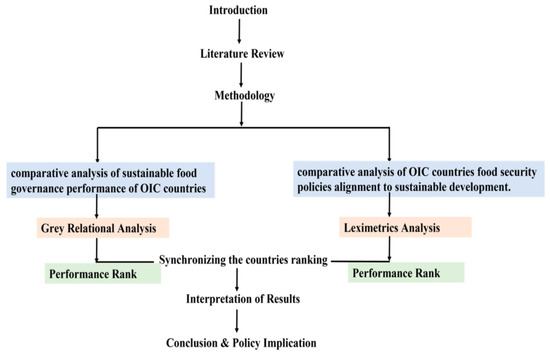
Figure 1.
Organization of the study.
2. Materials and Methods
2.1. Literature Review
Food security is the state in which all people, always, have easy access to an adequate supply of food that is affordable, nourishing, and fulfills their unique dietary needs and preferences to live a healthy, productive life [14]. Berry et al. (2015) [15] ascertained that effective and efficient reorientation of food security policy formulation, implementation and enforcement to sustainable development is crucial for achieving food security. El Bilali (2019) [16] asserted that food security policies that integrate sustainability into every facet are necessary for an optimal, robust, and long-lasting sustainable food system. However, it has been envisaged that some food security policies undermine the sustainability of food systems, resulting in detrimental consequences on society and the environment, and are core causes of food system underperformance [17,18]. Food insecurity has also been seen to have direct relationship with poverty [19], hunger [20], energy [20], climate [21], water [22], health [23], war [24], and technology [19]. Further, it is generally accepted that food insecurity is primarily caused by wars and conflicts around the globe [25,26].
Given the location of this study, it is pertinent to note that wars and conflicts exert profound and multifaceted impacts on food systems and food supply chains. War damages infrastructure, destroys irrigation systems, and disrupts supply. War impairs consumers’ food access by eroding purchasing power and limiting food availability [23,26]. Consequently, food prices surge both locally and globally, adversely affecting overall food stability. Moreover, international food aid encounters hurdles in addressing escalating food needs during war [27]. Abay et al. (2023) [28] asserted that ongoing conflicts pose substantial risks in exacerbating the prevailing circumstances, leading to elevated food prices, acute scarcities, and the emergence of a worldwide food crisis. For example, the Russia–Ukraine conflict has disrupted the cultivation and output of vital food crops, notably wheat, corn, and barley, in addition to fertilizer production. Nations heavily reliant on food imports from both Ukraine and Russia face imminent food scarcity. Moreover, the escalating prices of food and energy are having a ripple effect on other countries [28,29]. In the same vein, studies also show how food security relies on water availability and access. Diminished water resources reduce crop yields, affecting food availability for both local and global markets. Post-water economics encompasses the efficient allocation of water resources for irrigation and other agricultural needs [29]. Sutcliffe et al. (2021) [30] show that water scarcity can lead to increased production costs and reduced supply, causing food prices to rise. This, in turn, affects consumers’ purchasing power and access to affordable and nutritious food. The global food supply chain relies on water-intensive agriculture. Therefore, effective water management practices are crucial to sustaining food production and addressing food security concerns.
After completing a thorough synthesis of a wide field of 224 primary investigations and a meta-analysis of the higher quality 82 studies, Rosa (2022) [31] demonstrated that most policies and treaties in the world have generally failed to have the expected advantages. Policies fail because of unrealistic expectations, implementing them in decentralized governance frameworks, insufficient collaborative policymaking, and the ebb and flow of the politics involved [32,33,34,35]. From a review of 66 papers that included 73 analyses of individual or combined policies, Bizikova et al. (2020) [36] show that agricultural interventions can have favorable effects on SDG 2.1 and food security. Fifty-two per cent employed a direct food security indicator to assess the effects on food security, whereas the other studies made use of a proxy indicator. Among the 73 evaluations, 49 (67%) had favorable benefits on food security, 17 (23%) had no noticeable effects, and 7 (10%) had adverse consequences. They concluded that there is an emphasis in the literature that the best food security policies imbibe sustainability and promote sustainable development.
Numerous studies perceive the Global Food Security Index (GFSI) as a robust indicator of national food security, confirming its use as an estimate of the performance of food governance, using food availability, affordability, usage, safety, quality, nutritional challenges, and sustainability indicators [37,38,39,40,41]. Other studies have recommended a revision of the GFSI to make it more efficient and robust [42,43,44]. In the same vein, some studies have conducted assessments of national food security performances using the GFSI and indicators of sustainability [41,43,45,46], economic development [47,48,49], governance [38,50,51], and food sovereignty variables like inclusivity [52,53,54], resiliency [55,56,57,58], sufficiency, local production, collective action [59,60], sustainable finance (access to funds, diversified financial products, and financial literacy) [61,62,63,64] and food literacy [65].
In summary, although most studies emphasize that food security policies should contain sustainability, assessments of the alignment of food security policies with sustainability are lacking. The study here aims to fill this gap by conducting a critical in-depth comparative analysis of sustainable food security policies of OIC countries for a more robust and informed analysis. A further aim is to provide an independent comparative analysis of OIC sustainable food governance performance to investigate policy implementation. Using the Grey Relation Analysis (GRA) for the analysis of sustainable food governance performance of OIC countries, Leximetrics analysis is used to investigate the alignment of OIC food security policies with sustainable development principles. Thus, Leximetric analysis is used to assess the effectiveness of the OIC efforts to create food security policies, and GRA analyses their sustainable food policy implementation.
Table 1 below provides a comprehensive synthesis of the extant body of literature encompassing antecedent investigations dedicated to the evaluation and harmonization of policies pertaining to Agriculture and Food security within the broader framework of sustainability.

Table 1.
Literature summary of assessment and alignment of Agricultural and food security Policies to Sustainability.
2.2. Grey Relational Analysis (GRA)
Multi-criteria decision-making (MCDM) is a valuable tool for tackling intricate issues and enhancing decision-making by considering various criteria, encompassing both quantitative and qualitative factors. This approach has been extensively employed in research [74,75]. Singh et al. (2022) [75] highlighted that MCDM comprehensively examines all available options to derive an optimal simplified solution. Different MCDM methods exist, each with distinct applications and variations based on criteria such as data aggregation, algorithm complexity, uncertainty handling, and criteria weighting. Grey Relation Analysis (GRA) is a variant of MCDM, and is particularly suited for revealing intricate quantitative and qualitative connections among variables when data are limited [76,77]. Basel et al. (2021) [78] emphasized that GRA consolidates multifaceted performance factors into a single value, facilitating precise ranking of alternatives within a best-choice hierarchy.
GRA has been used extensively to investigate critical relationships along the paradigms of food security [41,79,80,81,82,83] sustainability and sustainable development [84,85,86,87,88], SDGs [89], and governance [76,90,91,92]. In Yao’s (2023) [93] study, the correlation between corporate social responsibility (CSR) regulation and the evolution of sustainable corporate law frameworks was examined. Employing the TOPSIS-GRA methodology, the grey relational analysis demonstrated an accuracy exceeding 80%. The empirical findings underscore the pivotal role of CSR in influencing enterprise growth and sustainability, advocating proactive social responsibility engagement for enduring sustainable development. Sun et al. (2019) [94] assessed six key indicators, encompassing reductions in pollutants (total nitrogen, TN; total phosphorous, TP; ammonium-nitrogen, NH4+-N; and chemical oxygen demand, COD), as well as the associated construction and operational expenditures. They conducted this evaluation within the framework of four systematic approaches that strategically integrated the reuse of treated wastewater (TWR) and nutrients (NR) pertaining to three primary ANPSP sources: crop farming, livestock, and aquaculture. The analytical hierarchy process (AHP) was employed in conjunction with grey relational analysis (GRA). These findings offer crucial insights for devising effective pollution mitigation systems, specifically tailored for multi-source ANPSP regions, thereby advancing environmental preservation and sustainable agriculture.
Agyemang et al. (2022) [95] explored the dynamics of assessing socially sustainable supply chain criteria (SSCC) within the developing world’s agricultural sector, with a focus on the West African cashew industry. They employed the best–worst method and Grey Relational Analysis (GRA) to evaluate seven sustainability criteria, seven ISO 26000 Core issues [96], and characteristics of fifteen managers across fifteen cashew manufacturing firms. The utilization of GRA provided a comprehensive evaluation, shedding light on their impact on SSSC performance. Alternatively, Banaeian et al. (2015) [97] devised a practical approach for green supplier selection within the food industry, employing TOPSIS and Fuzzy Grey Relational Analysis. The study evaluated 24 criteria grouped into four categories, involving two suppliers. The results highlighted the efficacy of employing fuzzy and grey relational analysis in group decision-making for superior green supplier selection, facilitating the establishment of a systematic ranking and selection process based on specific criteria.
2.2.1. Steps in Grey Relational Analysis
- Normalization (Data Pre-processing): To enable a more structured comparison in subsequent analysis, the data to be utilized in GRA are normalized by converting the initial sequence into a decimal sequence within 0.00 and 1.00.
- a
- The original data sequence can be normalized if it follows the “Higher-the-better” pattern as thus:
- b
- The original data sequence can be normalized if it follows the “Lower-the-better” pattern as thus:
- 2.
- Deviation Sequence: The deviation sequence calculates how far the values from comparable sequences are from the values from the reference sequences.
The identification coefficient . The default value generally adopted is .
- 3.
- Grey Relational Coefficient: The Grey relationship coefficient computation reflects the variations between the actual and hypothetical normalized experimental outcomes, and can be computed as thus:
- 4.
- Grey Relational Grade: denotes the average of the grey relational coefficients.
This study then performed the accurate ranking of the computed Grey Relational Grades in the hierarchy of the best choices.
The Assumption of Equal Weighting
In our analysis, we chose to treat all criteria as equally important. This deliberate decision serves multiple strategic purposes:
- I.
- Transparency and Ease of Exploration: Equal weighting allows for a straightforward and transparent exploration of the data. It simplifies the analysis process, making it more accessible to both researchers and stakeholders interested in understanding the methodology.
- II.
- Assessment of Complex Criteria Impact: By affording equal importance to all criteria, we enable a comprehensive assessment of how each complex criterion contributes to the results. This approach facilitates a nuanced understanding of the data’s intricate dynamics.
- III.
- Prevention of Dominance: Equal weighting ensures that no single dimension or criterion dominates the analysis. This is particularly crucial when comparing entities (e.g., countries) with varying levels of performance and competencies across different dimensions.
However, to enhance the rigor and accuracy of our analysis, we complemented this assumption with a Principal Components Analysis (PCA) to compute variable weightings. This data-driven approach objectively assesses the relative importance of each variable, and reassuringly, the PCA-computed weightings align closely with our initial assumption of equal weightings. This convergence lends robustness to our methodology and reinforces the impartiality of the analytical framework.
2.2.2. Justification for Using the Grey Relational Analysis (GRA)
This study is to assess and grade the collective performance of OIC countries within the domains of Sustainability, Food Security, Governance, and Economy. These multifaceted phenomena, each characterized by complex structures, pose a challenge when seeking a holistic evaluation metric for comparative analyses in the realm of sustainable food security across OIC nations. Consequently, the nuanced interactions and dynamics at the convergence of Sustainability, Food Security, Governance, and Economy within this context remain relatively uncharted territory. The intricacies of analyzing and contrasting sustainable food security strategies on a global scale demand a thorough and systematic comparative examination of national performance. To that end, our study adopts the pioneering Grey Relational Analysis (GRA) framework, renowned for its adeptness in navigating the multifaceted intricacies of complex systems. GRA’s capacity to facilitate performance assessment across diverse criteria positions it as an invaluable tool in unraveling the intricate tapestry of food security performance among OIC member states. Additionally, another benefit of GRA is its capacity to analyze the main correlation factors in a system with missing or unreliable data using a relatively modest amount of data.
2.3. Leximetrics Analysis
This study also assesses the impact and alignment of food security policies in OIC states with sustainable development, employing the Leximetrics method for statistical legal analysis. Leximetrics, utilized extensively, assigns numerical scores to legislative forms to evaluate their strengths and weaknesses [98,99,100]. This approach, as described by El-Halaby et al. (2021) [101], involves three stages: variable identification, binary coding of OIC food security policies using assessment criteria, and determining index values by summing scores. Identified variables encompass sufficiency, resilience, inclusivity, partnership, circular systems, security literacy, sustainable agriculture, nutrition, and finance. The index results gauge the cumulative effects of OIC food security policies on sustainable development across recognized benchmarks. Using Leximetrics to analyze recent food security policies in 41 OIC countries provided insights into sustainable development efforts.
2.3.1. Justifications for Using Leximetrics Method
For a robust quantitative assessment capable of measuring and comparing textual data, Leximetrics emerges as a highly apt instrument, as it empowers the quantitative evaluation and comparison of textual content. Thus, it is an effective tool for gauging the presence and degree of sustainability-related components within food policy documents. Importantly, Leximetrics introduces an objective dimension where bias and subjectivity are often present in sustainability assessments. Adhering to standardized criteria and algorithms ensures uniformity and replicability in sustainability analyses across diverse documents and contexts, even those replete with numerous references to sustainability considerations.
Table 2 details the process of coding decisions. The table serves as a comprehensive reference point. To shed more light on our variable selection and coding process, we established a rigorous criterion: if specific keywords or components of each adopted variable manifested within the context of policy enactments, policy interventions, or any other form of policy formulation within the Food Security policies documents of OIC countries (as accessible through FAOLEX and WFP Food Security country profiles), then the country received a score of 1. Conversely, if such keywords or components were absent, a score of 0 was assigned. This ensures transparency and objectivity in the variable selection and coding process. It leverages the presence or absence of well-defined criteria, rooted in actual policy documents, to yield quantifiable and replicable results. Aligning the methodology with concrete textual evidence bolsters the rigor and reliability of analysis while maintaining clarity and transparency.
Table 2.
Sustainable Food Governance Indicator Performance (Criteria).
Table 2 shows the indicators employed for the assessment of the performance of sustainable food governance within the context of the selected member countries of the OIC.
Table 3 highlights the variables and their corresponding coding utilized in the assessment of the alignment of Food Security policies among member countries of the OIC with the SDGs.
Table 3.
Variables for evaluating OIC Food Security policies alignment to the SDGs.
2.3.2. Data Source
The food security policies, strategies, and guides of OIC countries are obtained from the FAO’s FAOLEX database [132] and the World Food Program (WFP) Countries Food security Strategic Plans database [133].
2.4. Definition of Variables
Table 4 below defines the variables components adopted by this study to investigate the OIC sustainable food governance using the Grey Relational Analysis.
Table 4.
Gray Relational Analysis—Sustainable Food Governance components.
3. Results
3.1. Grey Relational Analysis
3.1.1. Comparative Analysis of Sustainable Food Governance Performance of OIC Countries
Table 5 gives the performance scores of the OIC countries across the variables listed above X1 to X15 in year 2022. These variables are duly explained in Table 3 and will be used to conduct the comparative analysis of sustainable food security governance using the Grey Relational Analysis. The computation of the Normalized Data, Deviation Sequence and the Grey Relational Coefficients can be accessed with this Link (https://docs.google.com/document/d/1PGu3q2jUNirkNA8GEpAk8GId0w9u4DfZ/edit accessed on 2 September 2023). The process of computing these metrics is duly explained in Section 2.2.1 “Steps in Grey Relational Analysis”.
Table 5.
Effective Sustainable Food Security Policy components.
Table 6 presents the indicators that reflects the performance of OIC member countries in 2022. These metrics are obtained from secondary data sources.
Table 6.
OIC country performances metrics for year 2022 obtained from secondary data sources.
where,
| Identifier | Variables |
| X1 | Global Food Security Index |
| X2 | Food Affordability |
| X3 | Food Availability |
| X4 | Food Stability |
| X5 | Food Sustainability and Adaptation |
| X6 | Human Development Index |
| X7 | Control of Corruption |
| X8 | Government Effectiveness |
| X9 | Regulatory Quality |
| X10 | Rule of Law |
| X11 | Voice and Accountability |
| X12 | Political Stability and Absence of Violence/Terrorism |
| X13 | UN SDG Index |
| X14 | ESG Risk Score |
| X15 | Nutritional Challenges |
3.1.2. Grey Relational Grade and Ranking
With the assumption of equal weight, the Grey Relational Grade of the OIC Grey Relational Coefficient performance, the grades and rankings are computed.
Table 7 provides a ranking of countries based on their Grey Relational Grade, signifying their performance relative to sustainable food governance. The United Arab Emirates (UAE) leads the list with a score of 0.902, followed by Qatar at 0.820, and Malaysia at 0.727. Conversely, Yemen, Chad and Sudan occupy the lower positions with scores of 0.356, 0.386, and 0.388, respectively. The ranking offers a comparative perspective on country performance on sustainable food governance, highlighting the UAE as the top-performing country and underscoring Yemen’s and Sudan’s relatively lower scores.
Table 7.
OIC Grey Relational Grades and Ranking.
3.2. Leximetrics Analysis
Comparative analysis of OIC food security policies alignment to sustainable development.
Table 8 gives the Leximetrical extracted data from the latest OIC food security strategy documents, with respect to the variables X1–X27 identified above. If the above variables are present in the context of policy enactment and interventions, or as a description of previously implemented policies, 1, is recorded, and 0, otherwise.
Table 8.
Leximetric analysis results of OIC food security policies.
4. Discussion
4.1. Comparative Analysis of Sustainable Food Security Governance-OIC
Regarding Food Security and Availability, which encompasses metrics such as the Global Food Security Index (X1), Food Affordability (X2), Food Availability (X3), and Food Stability (X4), countries such as Qatar, Bahrain, Oman, and the UAE consistently exhibit strong performance, signifying a heightened level of food security and availability in these regions.
In terms of Sustainability and Human Development, which are gauged by indicators including Food Sustainability and Adaptation (X5), Human Development Index (X6), and ESG Risk Score (X14), Bahrain and the UAE demonstrate notable proficiency, indicating a pronounced emphasis on sustainability and human development.
In the realm of Governance and Political Stability, assessed through metrics like Control of Corruption (X7), Government Effectiveness (X8), and Political Stability (X12), Qatar and the UAE exhibit robust governance and political stability.
Nutritional Challenges and ESG Risk, encompassing Nutritional Challenges (X15) and ESG Risk Score (X14), highlight challenges related to nutrition and environmental, social, and governance risks. Several countries, including Yemen and Sudan, face significant challenges in these dimensions. There are regional clusters of countries with similar performances. For example, Gulf Cooperation Council (GCC) states—Bahrain, Qatar, Kuwait, Oman, Saudi Arabia, and the UAE—often appear among the top performers, reflecting their shared socio-economic characteristics and governance systems.
Nations with higher Human Development Index (HDI) tend to perform well in multiple dimensions, including sustainability and governance. This indicates a positive correlation between human development and sustainable governance. Countries like Yemen and Sudan face challenges across various indicators, including high environmental, social, and governance risks, as well as nutritional challenges. This pattern may be attributed to ongoing conflicts and political instability in these regions.
4.2. Comparative Analysis of OIC Food Security Policies Alignment to Sustainable Development-OIC
On average, OIC countries demonstrate notable positive performance in formulating food security policies encompassing attributes such as ‘efficiency’, ‘stability’, ‘safety’, ‘affordability’, ‘resilience’, ‘human development’, and ‘sustainability’, as shown in Table 7. Conversely, attributes like ‘peace’, ‘recycling’, ‘circularity’, ‘financial literacy’, and ‘diversification of financial products’ exhibit lower average scores, suggesting a potential need for heightened attention and enhancement across the dataset’s countries.
Those nations performing well in ‘efficiency’ typically demonstrate high performance in ‘safety’ and ‘affordability’, indicating interrelatedness among these factors. Gender-related metrics (‘Gender’ and ‘Inequality’) exhibit moderate average scores, indicating further scope for advancing gender equality, while income inequality demands significant attention. Metrics associated with financial literacy (‘Financial literacy’ and ‘Diversified financial products’) display lower average scores, highlighting the potential necessity for enhanced financial education and diversification of financial services.
On average, sustainable finance (access to finance, diversified financing, and financial literacy), sustainable agriculture, circular food systems (storage and recycling) and peace are not properly incorporated in OIC national food security policies. In addition, on average, the key words that denote effective governance like accountability, transparency, and rule of law (supervision) are not adequately incorporated into OIC food security governance.
The involvement of international organizations in assisting some countries to draft strategic food security initiatives could significantly help in the alignment of food security policies with sustainable development in policy documents.
4.3. Synchronized Results of Grey Relational and Leximetrics Ranking
Table 9 gives the ranking of the OIC countries in accordance with their performance in how their approach to both food governance and food security policies aligns with sustainable development.
Table 9.
Comparative Performance Ranking of OIC Countries—Food governance and Food security policy.
The performance matrix below, as computed by this study, is highlighted in Table 10. Based on how well they compare in terms of sustainable food governance and how well their food security policies are in line with sustainable development, the OIC countries are divided into different categories.
Table 10.
Categories of Sustainable Development Performance of Food Governance and Food Security Policies.
There is considerable divergence in rankings between the two metrics. While some countries perform well in Sustainable Food Security Governance, they may not necessarily excel in Sustainable Food Security Policy, and vice versa. This suggests a distinction between the governance structures in place and the policies implemented. The top-ranked states in Sustainable Food Security Governance, such as the UAE, Qatar, Bahrain, Kazakhstan, and Malaysia, appear to prioritize governance practices that support sustainable food security. These states clearly have robust regulatory frameworks and institutions to manage food security. Countries like Bangladesh, Turkey, and Jordan excel in Sustainable Food Security Policy. This indicates a focus on implementing policies and strategies that align with sustainable development goals related to food security.
The rankings suggest that different countries employ varied approaches to address food security challenges. Some prioritize governance structures and institutions, while others emphasize policy implementation and alignment with sustainability objectives. The rankings also reflect the national development context. More developed nations tend to perform better in governance-related metrics, while emerging economies may excel in policy implementation but face governance challenges. Countries ranking lower in both metrics may face challenges in both governance and policy aspects of food security. These rankings can serve as a starting point for identifying areas where improvements are needed and opportunities for targeted interventions. Some countries demonstrate balanced rankings in both metrics, suggesting a holistic approach to addressing food security challenges. These nations may serve as models for comprehensive food security strategies.
States with a higher score in the “Peace” variable tend to have better political stability. For example, countries like Chad, Sudan, and Yemen, which have lower peace and lower political stability scores, need to make provisions for the enactment and implementation of food security policies. On average, countries with higher scores in “storage”, “recycling”, “circular”, “food waste”, and “food loss” perform better in global food security indices.
4.4. Empirical Results and the Literature
In summary, the literature emphasizes:
- the importance of incorporating sustainability considerations into food security policies.The empirical results reinforce this idea by highlighting countries like Qatar, Bahrain, and the UAE, that demonstrate proficiency in sustainability and human development, suggesting that these nations are prioritizing sustainable practices.
- that food security policies should align with sustainability principles.The empirical analysis reveals that OIC countries, on average, perform well in formulating food security policies that incorporate attributes like efficiency, stability, and resilience; although sustainability-related metrics (e.g., recycling and circularity) have lower scores.
- the importance of assessing the alignment of food security policies with sustainability aspects.The empirical results highlight that, on average, OIC countries do not adequately incorporate sustainable finance, sustainable agriculture, circular food systems, and peace into their food security policies.
- the need for comprehensive and sustainable food security strategies.The empirical analysis shows that some OIC countries excel in both governance and policy aspects of food security, suggesting a holistic approach to addressing food security challenges.
- the challenges of policy implementation and governance in achieving food security.The empirical results align with this by showing that some countries excel in governance but may not necessarily perform well in policy implementation, and vice versa.
- peace is a crucial factor in ensuring food security.The empirical results indicate that countries with higher peace scores tend to have better political stability, reinforcing the idea that peace is essential for food security.
- the role of water resources in food security.The empirical results suggest that countries scoring higher in “storage”, “recycling”, and “circular” (related to efficient resource use, water resources inclusive) perform better in global food.
5. Conclusions
On average, sustainable finance (access to finance, diversified financing, and financial literacy), sustainable agriculture, circular food systems (storage and recycling) and peace are not properly incorporated in OIC food security policies. In the formulation of some OIC food security policies framework, there is an emphasis on sustainability and diversified instruments (Note: Sustainable financial instruments include green bonds, social bonds, sustainability-linked loans, and impact investments, channeling capital towards environmentally and socially responsible projects while generating returns) of sustainable finance, however, the implementation is not effective. Furthermore, across OIC nations, the development of food security policies often lacks thorough incorporation of fundamental pillars: accountability, transparency, and rule of law (supervision). These pivotal aspects constitute the essence of effective food governance, illuminating the incongruence between robust policy construction and suboptimal execution evident in certain nations. The involvement of international organizations in assisting some states to draft strategic food security initiatives could help in the alignment of such national food security policies with sustainable development.
Some OIC countries (e.g., Iran, Turkmenistan, Suriname) did not document a wholesome food security policy or strategy, but rather enacted numerous segmented policies on different areas relating to agriculture, fisheries, oil, food, and nutrition. Further, some states (Burkina Faso, Cameroon, Niger, Nigeria, and Sudan) performed exceptionally well in food security policy formulation and in alignment with the SDGs but are characterized by low or medium performance in the implementation of food governance: while others (Senegal, Tajikistan, and Egypt) maintain an average performance in both food governance and food security policy alignment to sustainable development.
The UN World Food Program, FAO, and other supra-national institutions have joint Food Security related projects with some countries. These programs facilitate excellent performance in policy formulation and alignment with the SDGs, but more research is needed to investigate the main reasons why these Food Security policies are not properly implemented.
Furthermore, the literature emphasizes the critical role of water resources, peace, and the alignment of food security policies with sustainability principles. These themes align with the empirical results, highlighting the interplay between resource management, political stability, and policy coherence in ensuring food security.
In summary, the empirical analysis corroborates assertions in the literature that sustainable food security hinges on inclusive policies, holistic governance, and the alignment of strategies with sustainability goals. By identifying specific areas of focus and divergence among OIC countries, this research contributes to a more informed and nuanced approach to addressing global food security challenges. The study provides a comprehensive evaluation and grading of OIC country performance in Sustainability, Food Security, Governance, and Economy. It offers a comparative analysis of sustainable food security policy formulation and implementation among OIC countries, assessing alignment with sustainable development across multifaceted and exacting domains.
Future research should delve into the intricate dynamics of sustainable finance, recycling, food waste, food loss, storage, circularity, self-sufficiency, and local production within sustainable food security governance and the alignment of food security policies to sustainable development in the OIC. Understanding the nuanced relationships, or lack thereof, among these variables is essential for crafting comprehensive and effective policies. Additionally, investigating the obscure facets of these elements (such as the limited incorporation of peace and sustainable finance) can uncover hidden challenges and opportunities for enhancing food security initiatives and achieving greater synergy with sustainable development objectives, thus contributing to more resilient and sustainable food systems.
5.1. Limitation of the Research
In our Leximetrics analysis, we specifically focused on instances where sustainability-related terms were employed in the context of policy formulation, intervention, and past policy implementation. However, we encountered challenges, such as synonym usage (e.g., ‘food loss’ referred to as ‘post-harvest loss’) and instances where countries enacted relevant laws without explicit mention of these terms.
5.2. Reservation
The empirical analysis exclusively encompasses food security policies of specific OIC countries accessible through FAOLEX and the World Food Program (WFP) databases as of August 2023. Consequently, any discussions and conclusions drawn from the Leximetrics analysis are contingent upon the data available from the adopted databases. It is acknowledged that there may exist additional food security policy documents for these countries on alternative websites or databases.
Author Contributions
Conceptualization, D.A.; Validation, R.J. and D.A.; Formal analysis, D.A. and A.A.; Writing—original draft, D.A. and A.A.; Writing—review & editing, D.A. and R.J.; Project administration, D.A.; Funding acquisition, R.J. All authors have read and agreed to the published version of the manuscript.
Funding
Research was funded by QATAR NATIONAL RESEARCH FUND & MINISTRY OF MUNICIPALITY, Qatar, grant number MME01-0919-190041.
Institutional Review Board Statement
Not applicable.
Informed Consent Statement
Not applicable.
Data Availability Statement
Data can be obtained from databases stipulated in the paper.
Acknowledgments
The open access publication of this article was funded by the Qatar National Library.
Conflicts of Interest
The authors declare no conflict of interest.
References
- Practical, G. An Introduction to the Basic Concepts of Food Security; FAO: Rome, Italy, 2008. [Google Scholar]
- Imperatives, S. Report of the World Commission on Environment and Development: Our common future. Accessed Feb. 1987, 10, 1–300. [Google Scholar]
- Crippa, M.; Solazzo, E.; Guizzardi, D.; Monforti-Ferrario, F.; Tubiello, F.N.; Leip, A. Food systems are responsible for a third of global anthropogenic GHG emissions. Nat. Food 2021, 2, 198–209. [Google Scholar] [CrossRef] [PubMed]
- Environmental Protection Agency. Ireland’s GAir Pollutant Emissions 1990–2030; Environmental Protection Agency: Washington, DC, USA, 2021. [Google Scholar]
- Crippa, M.; Solazzo, E.; Guizzardi, D.; Van Dingenen, R.; Leip, A. Air pollutant emissions from global food systems are responsible for environmental impacts, crop losses and mortality. Nat. Food 2022, 3, 942–956. [Google Scholar] [CrossRef] [PubMed]
- Andrianarison, F. Unravelling the Linkage between Food Security, Poverty Reduction, and Education for Sustainable Development. J. Dev. Stud. 2022, 58, 2198–2221. [Google Scholar] [CrossRef]
- Matemilola, S.; Alabi, H.A. Food Security. In Encyclopedia of Sustainable Management; Elsevier: Amsterdam, The Netherlands, 2020; pp. 1–5. [Google Scholar]
- Miola, A.; Schiltz, F. Measuring sustainable development goals performance: How to monitor policy action in the 2030 Agenda implementation? Ecol. Econ. 2019, 164, 106373. [Google Scholar] [CrossRef]
- Dauderstädt, M. International inequality and the COVID-19 pandemic. Intereconomics 2022, 57, 40–46. [Google Scholar] [CrossRef] [PubMed]
- Emadi, M.H.; Rahmanian, M. Commentary on challenges to taking a food systems approach within the food and agriculture organization (FAO). In Food Security and Land Use Change under Conditions of Climatic Variability: A Multidimensional Perspective; Springer: Cham, Switzerland, 2020; pp. 19–31. [Google Scholar]
- Thompson, J.; Scoones, I. Addressing the dynamics of agri-food systems: An emerging agenda for social science research. Environ. Sci. Policy 2009, 12, 386–397. [Google Scholar] [CrossRef]
- World Health Organization. The State of Food Security and Nutrition in the World 2021: Transforming Food Systems for Food Security, Improved Nutrition and Affordable Healthy Diets for All; Food & Agriculture Organization: Rome, Italy, 2021; Volume 2021. [Google Scholar]
- Ceccarelli, T.; Chauhan, A.; Rambaldi, G.; Kumar, I.; Cappello, C.; Janssen, S.J.C.; McCampbell, M.D. Leveraging Automation and Digitalization for Precision Agriculture: Evidence from the Case Studies: Background Paper for the State of Food and Agriculture 2022; Food and Agriculture Organization of the United Nations: Rome, Italy, 2022. [Google Scholar]
- Fanzo, J. Healthy and sustainable diets and food systems: The key to achieving Sustainable Development Goal 2? Food Ethics 2019, 4, 159–174. [Google Scholar] [CrossRef]
- Berry, E.M.; Dernini, S.; Burlingame, B.; Meybeck, A.; Conforti, P. Food security and sustainability: Can one exist without the other? Public Health Nutr. 2015, 18, 2293–2302. [Google Scholar] [CrossRef]
- El Bilali, H.; Callenius, C.; Strassner, C.; Probst, L. Food and nutrition security and sustainability transitions in food systems. Food Energy Secur. 2019, 8, e00154. [Google Scholar] [CrossRef]
- Ingram, J.; Ericksen, P.; Liverman, D. Part II: Main Messages. In Food Security and Global Environmental Change; Routledge: London, UK, 2012; pp. 144–145. [Google Scholar]
- Clapp, J.; Moseley, W.G.; Burlingame, B.; Termine, P. Viewpoint: The case for a six-dimensional food security framework. Food Policy 2022, 106, 102164. [Google Scholar] [CrossRef]
- UNICEF. The State of Food Security and Nutrition in the World 2020; FAO: Rome, Italy, 2020. [Google Scholar]
- Cansino-Loeza, B.; del Carmen Munguía-López, A.; Ponce-Ortega, J.M. A water-energy-food security nexus framework based on optimal resource allocation. Environ. Sci. Policy 2022, 133, 1–16. [Google Scholar] [CrossRef]
- Caputo, S.; Schoen, V.; Specht, K.; Grard, B.; Blythe, C.; Cohen, N.; Fox-Kämper, R.; Hawes, J.; Newell, J.; Poniży, L. Applying the food-energy-water nexus approach to urban agriculture: From FEW to FEWP (Food-Energy-Water-People). Urban For. Urban Green. 2021, 58, 126934. [Google Scholar] [CrossRef]
- World Health Organization. Action Framework for Developing and Implementing Public Food Procurement and Service Policies for a Healthy Diet; World Health Organization: Geneva, Switzerland, 2021. [Google Scholar]
- Kemmerling, B.; Schetter, C.; Wirkus, L. The logics of war and food (in) security. Glob. Food Secur. 2022, 33, 100634. [Google Scholar] [CrossRef]
- Galanakis, C.M.; Rizou, M.; Aldawoud, T.M.S.; Ucak, I.; Rowan, N.J. Innovations and technology disruptions in the food sector within the COVID-19 pandemic and post-lockdown era. Trends Food Sci. Technol. 2021, 110, 193–200. [Google Scholar] [CrossRef] [PubMed]
- Berkhout, P.; Bergevoet, R.; van Berkum, S. A Brief Analysis of the Impact of the War in Ukraine on Food Security (No. 2022-033); Wageningen Economic Research: Wageningen, The Netherlands, 2022. [Google Scholar]
- Behnassi, M.; El Haiba, M. Implications of the Russia–Ukraine war for global food security. Nat. Hum. Behav. 2022, 6, 754–755. [Google Scholar] [CrossRef]
- Mottaleb, K.A.; Kruseman, G.; Snapp, S. Potential impacts of Ukraine-Russia armed conflict on global wheat food security: A quantitative exploration. Glob. Food Secur. 2022, 35, 100659. [Google Scholar] [CrossRef]
- Abay, K.A.; Breisinger, C.; Glauber, J.; Kurdi, S.; Laborde, D.; Siddig, K. The Russia-Ukraine war: Implications for global and regional food security and potential policy responses. Glob. Food Secur. 2023, 36, 100675. [Google Scholar] [CrossRef]
- Christoforidou, M.; Borghuis, G.; Seijger, C.; van Halsema, G.E.; Hellegers, P. Food security under water scarcity: A comparative analysis of Egypt and Jordan. Food Secur. 2023, 15, 171–185. [Google Scholar] [CrossRef] [PubMed]
- Sutcliffe, C.; Knox, J.; Hess, T. Managing irrigation under pressure: How supply chain demands and environmental objectives drive imbalance in agricultural resilience to water shortages. Agric. Water Manag. 2021, 243, 106484. [Google Scholar] [CrossRef]
- Rosa, L. Adapting agriculture to climate change via sustainable irrigation: Biophysical potentials and feedbacks. Environ. Res. Lett. 2022, 17, 063008. [Google Scholar] [CrossRef]
- Furton, G.; Martin, A. Beyond market failure and government failure. Public Choice 2019, 178, 197–216. [Google Scholar] [CrossRef]
- Hudson, B.; Hunter, D.; Peckham, S. Policy failure and the policy-implementation gap: Can policy support programs help? Policy Des. Pract. 2019, 2, 1–14. [Google Scholar] [CrossRef]
- Lin, B.C.-A. Institutional failure and sustainability policy. J. Econ. Issues 2021, 55, 454–460. [Google Scholar] [CrossRef]
- Ramia, G.; Perrone, L. Crisis management, policy reform, and institutions: The social policy response to COVID-19 in Australia. Soc. Policy Soc. 2023, 22, 562–576. [Google Scholar] [CrossRef]
- Bizikova, L.; Jungcurt, S.; McDougal, K.; Tyler, S. How can agricultural interventions enhance contribution to food security and SDG 2.1? Glob. Food Secur. 2020, 26, 100450. [Google Scholar] [CrossRef]
- Izraelov, M.; Silber, J. An assessment of the global food security index. Food Secur. 2019, 11, 1135–1152. [Google Scholar] [CrossRef]
- Allee, A.; Lynd, L.R.; Vaze, V. Cross-national analysis of food security drivers: Comparing results based on the Food Insecurity Experience Scale and Global Food Security Index. Food Secur. 2021, 13, 1245–1261. [Google Scholar] [CrossRef]
- Downs, S.M.; Ahmed, S.; Warne, T.; Fanzo, J.; Loucks, K. The global food environment transition based on the socio-demographic index. Glob. Food Secur. 2022, 33, 100632. [Google Scholar] [CrossRef]
- Saboori, B.; Radmehr, R.; Zhang, Y.Y.; Zekri, S. A new face of food security: A global perspective of the COVID-19 pandemic. Prog. Disaster Sci. 2022, 16, 100252. [Google Scholar] [CrossRef] [PubMed]
- Özkaya, G.; Özkaya, G.U. Evaluation of Global Food Security Index Indicators with 2020 COVID19 Period Data and Country Comparisons. Bitlis Eren Üniversitesi Fen Bilim. Derg. 2022, 11, 249–268. [Google Scholar] [CrossRef]
- Maricic, M.; Bulajic, M.; Dobrota, M.; Jeremic, V. Redesigning the global food security index: A multivariate composite I-distance indicator approach. Int. J. Food Agric. Econ. 2016, 4, 69–86. [Google Scholar]
- Chen, P.-C.; Yu, M.-M.; Shih, J.-C.; Chang, C.-C.; Hsu, S.-H. A reassessment of the Global Food Security Index by using a hierarchical data envelopment analysis approach. Eur. J. Oper. Res. 2019, 272, 687–698. [Google Scholar] [CrossRef]
- van Dijk, M.; Morley, T.; Rau, M.L.; Saghai, Y. A meta-analysis of projected global food demand and population at risk of hunger for the period 2010–2050. Nat. Food 2021, 2, 494–501. [Google Scholar] [CrossRef] [PubMed]
- Toumi, L. Sustainable food security in Morocco: Challenges & opportunities. Agrofor 2016, 1, 30–40. [Google Scholar] [CrossRef][Green Version]
- Singh, A.K. Influence of climate and non-climatic factors on global food security index: A cross-sectional country-wise analysis. Soc. J. 2018, 1, 22–35. [Google Scholar]
- Kozyr, N.S.; Petrovskaya, N.E.; Zazimko, V.L. Modern approaches assessing global competitiveness. Eur. Res. Stud. 2018, 21, 1034–1041. [Google Scholar]
- Świetlik, K. Economic growth versus the issue of food security in selected regions and countries worldwide. Probl. Agric. Econ. 2018, 3, 127–149. [Google Scholar]
- Alleway, H.K.; Jones, A.R.; Theuerkauf, S.J.; Jones, R.C. A global and regional view of the opportunity for climate-smart mariculture. Philos. Trans. R. Soc. B Biol. Sci. 2022, 377, 20210128. [Google Scholar] [CrossRef] [PubMed]
- Lezzaik, K.; Milewski, A.; Mullen, J. The groundwater risk index: Development and application in the Middle East and North Africa region. Sci. Total. Environ. 2018, 628–629, 1149–1164. [Google Scholar] [CrossRef]
- Verbruggen, P.; Havinga, T. Transnational Business Governance Interactions in Food Safety Regulation: Exploring the Promises and Risks of Enrolment; Wood, S., Schmidt, R., Meidinger, E., Eberlein, B., Abbott, K.W., Eds.; Edward Elgar Publishing: Cheltenham, UK, 2018; pp. 28–51. [Google Scholar]
- Candler, T.P.; Costa, S.; Heys, M.; Costello, A.; Viner, R. G324 Prevalence of thinness in adolescent girls in low and middle-income countries and associations with national wealth, food security, gender inequity and income inequality: A cross-sectional study. Arch. Dis. Child. 2016, 101, A188. [Google Scholar] [CrossRef]
- Debebe, S.; Zekarias, E.H. Analysis of poverty, income inequality and their effects on food insecurity in southern Ethiopia. Agric. Food Secur. 2020, 9, 16. [Google Scholar] [CrossRef]
- Haini, H.; Musa, S.F.P.D.; Loon, P.W.; Basir, K.H. Does unemployment affect the relationship between income inequality and food security? Int. J. Sociol. Soc. Policy 2023, 43, 48–66. [Google Scholar] [CrossRef]
- Fan, S.; Teng, P.; Chew, P.; Smith, G.; Copeland, L. Food system resilience and COVID-19—Lessons from the Asian experience. Glob. Food Secur. 2021, 28, 100501. [Google Scholar] [CrossRef] [PubMed]
- Odhiambo, V.O.; Hendriks, S.L.; Mutsvangwa-Sammie, E.P. The effect of an objective weighting of the global food security index’s natural resources and resilience component on country scores and ranking. Food Secur. 2021, 13, 1343–1357. [Google Scholar] [CrossRef]
- Picchioni, F.; Goulao, L.F.; Roberfroid, D. The impact of COVID-19 on diet quality, food security and nutrition in low- and middle-income countries: A systematic review of the evidence. Clin. Nutr. 2022, 41, 2955–2964. [Google Scholar] [CrossRef] [PubMed]
- Muzata, B. South Africa’s Global Food Security Index Score Remains Resilient. Dairy Mail. 2022, 29, 65–67. [Google Scholar]
- Lele, U.; Baldwin, B.C.; Goswami, S. Changing global governance context for food security and nutrition. In Food for All: International Organizations and the Transformation of Agriculture; Oxford University Press: Oxford, UK, 2021; pp. 284–336. [Google Scholar]
- Mayastuti, A.; Jamin, M.; Purwadi, H. Building a food sovereign society through indigenous forest establishment policy. In Proceedings of the 9th International Conference on Sustainable Agriculture and Environment, Online, 24–25 August 2022; IOP Publishing: Bristol, UK, 2022; Volume 1114, p. 012064. [Google Scholar]
- Lu, S.; Lu, W.; Xu, M.; Taghizadeh-Hesary, F.; Tang, Y. Water-energy-food security under green finance constraints in Southwest China. Energy Econ. 2023, 118, 106478. [Google Scholar] [CrossRef]
- Raimi, L.; Olowo, R.; Shokunbi, M. A comparative discourse of sustainable finance options for agribusiness transformation in Nigeria and Brunei: Implications for entrepreneurship and enterprise development. World J. Sci. Technol. Sustain. Dev. 2021, 18, 325–350. [Google Scholar] [CrossRef]
- Rahaman, M.A.; Rahman, M.M. Climate justice and food security: Experience from climate finance in Bangladesh. In Environmental Policy: An Economic Perspective; Wiley: Hoboken, NJ, USA, 2020; pp. 249–268. [Google Scholar]
- Lipper, L.; Thornton, P.; Campbell, B.M.; Baedeker, T.; Braimoh, A.; Bwalya, M.; Caron, P.; Cattaneo, A.; Garrity, D.; Henry, K.; et al. Climate-smart agriculture for food security. Nat. Clim. Chang. 2014, 4, 1068–1072. [Google Scholar] [CrossRef]
- Morgan, M.; Arrowood, J.; Farris, A.; Griffin, J. Assessing food security through cooking and food literacy among students enrolled in a basic food science lab at Appalachian State University. J. Am. Coll. Health 2023, 71, 30–35. [Google Scholar] [CrossRef]
- Qureshi, M.R.N.M.; Almuflih, A.S.; Sharma, J.; Tyagi, M.; Singh, S.; Almakayeel, N. Assessment of the climate-smart agriculture interventions towards the avenues of sustainable production–consumption. Sustainability 2022, 14, 8410. [Google Scholar] [CrossRef]
- Ali, E.B.; Agyekum, E.B.; Adadi, P. Agriculture for sustainable development: A SWOT-AHP assessment of Ghana’s planting for food and jobs initiative. Sustainability 2021, 13, 628. [Google Scholar] [CrossRef]
- Rao, C.S.; Kareemulla, K.; Krishnan, P.; Murthy, G.R.K.; Ramesh, P.; Ananthan, P.; Joshi, P. Agro-ecosystem based sustainability indicators for climate resilient agriculture in India: A conceptual framework. Ecol. Indic. 2019, 105, 621–633. [Google Scholar] [CrossRef]
- Rossi, L.; Ferrari, M.; Ghiselli, A. The Alignment of Recommendations of Dietary Guidelines with Sustainability Aspects: Lessons Learned from Italy’s Example and Proposals for Future Development. Nutrients 2023, 15, 542. [Google Scholar] [CrossRef]
- Armendáriz, V.; Armenia, S.; Atzori, A.S. Systemic analysis of food supply and distribution systems in city-region systems—An examination of FAO’s policy guidelines to-wards sustainable agri-food systems. Agriculture 2016, 6, 65. [Google Scholar] [CrossRef]
- Reeve, E.; Ravuvu, A.; Farmery, A.; Mauli, S.; Wilson, D.; Johnson, E.; Thow, A.-M. Strengthening food systems governance to achieve multiple objectives: A comparative instrumentation analysis of food systems policies in Vanuatu and the Solomon Islands. Sustainability 2022, 14, 6139. [Google Scholar] [CrossRef]
- Anderson, C.R.; Bruil, J.; Chappell, M.J.; Kiss, C.; Pimbert, M.P. From transition to domains of transformation: Getting to sustainable and just food systems through agroecology. Sustainability 2019, 11, 5272. [Google Scholar] [CrossRef]
- Ben Hassen, T.; El Bilali, H. Impacts of the Russia-Ukraine war on global food security: Towards more sustainable and resilient food systems? Foods 2022, 11, 2301. [Google Scholar] [CrossRef]
- Cicciù, B.; Schramm, F.; Schramm, V.B. Multi-criteria decision making/aid methods for assessing agricultural sustainability: A literature review. Environ. Sci. Policy 2022, 138, 85–96. [Google Scholar] [CrossRef]
- Singh, S.; Upadhyay, S.P.; Powar, S. Developing an integrated social, economic, environmental, and technical analysis model for sustainable development using hybrid multi-criteria decision making methods. Appl. Energy 2022, 308, 118235. [Google Scholar] [CrossRef]
- Koçak, D.; Özer, M.A. Comparing the quality of governance across the European Union member countries: A grey relational analysis approach. Policy Stud. 2022, 43, 1135–1155. [Google Scholar] [CrossRef]
- Zineb, A.; Zineb, F.; Ismael, E.O.; Ikram, M. Effects of COVID-19 on population, economic growth, logistics performance, and quality management in africa: Grey relational analysis. Int. J. Grey Syst. 2022, 2, 18–33. [Google Scholar] [CrossRef]
- Basel, S.; Gopakumar, K.U.; Rao, R.P. Classification of countries based on development indices by using K-means and grey relational analysis. GeoJournal 2021, 87, 3915–3933. [Google Scholar] [CrossRef]
- Singh, R.K.; Joshi, P.K.; Sinha, V.S.P.; Kumar, M. Indicator based assessment of food security in SAARC nations under the influence of climate change scenarios. Future Foods 2022, 5, 100122. [Google Scholar] [CrossRef]
- Lin, X.; Cui, S.; Han, Y.; Geng, Z.; Zhong, Y. An improved ISM method based on GRA for hierarchical analyzing the influencing factors of food safety. Food Control. 2019, 99, 48–56. [Google Scholar] [CrossRef]
- Ge, Y.; Chen, W.; Zhang, Y. Evaluation Model of Grain System Based on AAQN Index System. In Proceedings of the 2021 International Conference on Computer, Remote Sensing and Aerospace (CRSA 2021), Tokyo, Japan, 23–25 July 2021; IOP Publishing: Bristol, UK, 2021; Volume 2006, p. 012024. [Google Scholar] [CrossRef]
- Ivanova, M. Evaluation of Risks to Russian food supply chains during the COVID-19. Manag. Sci. Bus. Decis. 2022, 2, 40–47. [Google Scholar] [CrossRef]
- Muhirwa, F.; Shen, L.; Elshkaki, A.; Zhong, S.; Hu, S.; Hirwa, H.; Chiaka, J.C.; Umarishavu, F.; Mulinga, N. Ecological balance emerges in implementing the water-energy-food security nexus in well-developed countries in Africa. Sci. Total. Environ. 2022, 833, 154999. [Google Scholar] [CrossRef] [PubMed]
- Koçak, D. Green growth dynamics in OECD countries: An application of grey relational analysis. Grey Syst. Theory Appl. 2020, 10, 545–563. [Google Scholar] [CrossRef]
- Niazi, A.A.K.; Qazi, T.F.; Basit, A.; Shaukat, M.Z. Evaluation of climate of selected sixty-six countries using grey relational analysis: Focus on Pakistan. J. Bus. Soc. Rev. Emerg. Econ. 2021, 7, 95–106. [Google Scholar] [CrossRef]
- Abid, N.; Ceci, F.; Ikram, M. Green growth and sustainable development: Dynamic linkage between technological innovation, ISO 14001, and environmental challenges. Environ. Sci. Pollut. Res. 2022, 29, 25428–25447. [Google Scholar] [CrossRef] [PubMed]
- Peng, Z.; He, L.; Xie, Y.; Song, W.; Liu, J.; Ming, X.; Goh, M. A Pythagorean fuzzy ANP-QFD-Grey relational analysis approach to prioritize design requirements of sustainable supply chain. J. Intell. Fuzzy Syst. 2022, 42, 3893–3907. [Google Scholar] [CrossRef]
- Rehman, E.; Rehman, S. Modeling the nexus between carbon emissions, urbanization, population growth, energy consumption, and economic development in Asia: Evidence from grey relational analysis. Energy Rep. 2022, 8, 5430–5442. [Google Scholar] [CrossRef]
- Sarria, C.R.A.; Pastor, C.V. Assessment of the Sustainability Social Dimension in Machining Through Grey Relational Analysis. In Proceedings of the 2018 IEEE International Conference on Engineering, Technology and Innovation (ICE/ITMC), Stuttgart, Germany, 17–20 June 2018; IEEE: New York, NY, USA, 2018; pp. 1–8. [Google Scholar]
- Zhou, W.; Chen, L.; Feng, L. Effectiveness evaluation on third-party governance model for environmental pollution in China. Environ. Sci. Pollut. Res. 2019, 26, 17305–17320. [Google Scholar] [CrossRef] [PubMed]
- Jankovic-Milic, V.; Džunić, M. Measuring Governance: The Application of Grey Relational Analysis on World Governance Indicators. In Open Government: Concepts, Methodologies, Tools, and Applications; IGI Global: Hershey, PA, USA, 2020; pp. 675–699. [Google Scholar]
- Petrović-Ranđelović, M.; Jovanović, S.; Radukić, S. Which Dimensions of Institutional Quality Matter More in Attracting Fdi Flows: Grey Relational Analysis. TEME 2022, XLVI, 195–214. [Google Scholar] [CrossRef]
- Yao, S. Corporate Social Responsibility Regulatory System Based on Sustainable Corporation Law Pathway. Sustainability 2023, 15, 1638. [Google Scholar] [CrossRef]
- Sun, X.; Hu, Z.; Li, M.; Liu, L.; Xie, Z.; Li, S.; Wang, G.; Liu, F. Optimization of pollutant reduction system for controlling agricultural non-point-source pollution based on grey relational analysis combined with analytic hierarchy process. J. Environ. Manag. 2019, 243, 370–380. [Google Scholar] [CrossRef]
- Agyemang, M.; Kusi-Sarpong, S.; Agyemang, J.; Jia, F.; Adzanyo, M. Determining and evaluating socially sustainable supply chain criteria in agri-sector of developing countries: Insights from West Africa cashew industry. Prod. Plan. Control. 2022, 33, 1115–1133. [Google Scholar] [CrossRef]
- Pojasek, R.B. ISO 26000 guidance on social responsibility. Environ. Qual. Manag. 2011, 20, 85–93. [Google Scholar] [CrossRef]
- Banaeian, N.; Mobli, H.; Nielsen, I.E.; Omid, M. A methodology for green supplier selection in food industries. In Technology Management for Sustainable Production and Logistics; Springer: Berlin/Heidelberg, Germany, 2015; pp. 3–23. [Google Scholar]
- AlQassar, A.B.; Ahmed, H. Regulatory regimes for Sharīʿah governance: A framework of assessment and analysis. J. Bank. Regul. 2021, 23, 139–154. [Google Scholar] [CrossRef]
- Mückenberger, U.; Dingeldey, I. Introduction: Worldwide patterns of legal segmentation in employment law. Int. Labour Rev. 2022, 161, 511–534. [Google Scholar] [CrossRef]
- Kingston, S.; Wang, Z.; Alblas, E.; Callaghan, M.; Foulon, J.; Lima, V.; Murphy, G. The democratisation of European nature governance 1992–2015: Introducing the comparative nature governance index. Int. Environ. Agreem. Politics Law Econ. 2022, 22, 27–48. [Google Scholar] [CrossRef]
- El-Halaby, S.; Aboul-Dahab, S.; Bin Qoud, N. A systematic literature review on AAOIFI standards. J. Financ. Rep. Account. 2021, 19, 133–183. [Google Scholar] [CrossRef]
- Khan, N.; Ray, R.L.; Kassem, H.S.; Hussain, S.; Zhang, S.; Khayyam, M.; Ihtisham, M.; Asongu, S.A. Potential role of technology innovation in transformation of sustainable food systems: A review. Agriculture 2021, 11, 984. [Google Scholar] [CrossRef]
- Herrero, M.; Thornton, P.K.; Mason-D’Croz, D.; Palmer, J.; Benton, T.G.; Bodirsky, B.L.; Bogard, J.R.; Hall, A.; Lee, B.; Nyborg, K.; et al. Innovation can accelerate the transition towards a sustainable food system. Nat. Food 2020, 1, 266–272. [Google Scholar] [CrossRef]
- García-Díez, J.; Gonçalves, C.; Grispoldi, L.; Cenci-Goga, B.; Saraiva, C. Determining Food Stability to Achieve Food Security. Sustainability 2021, 13, 7222. [Google Scholar] [CrossRef]
- Mouléry, M.; Sanz Sanz, E.; Debolini, M.; Napoléone, C.; Josselin, D.; Mabire, L.; Vicente-Vicente, J.L. Self-Sufficiency Assessment: Defining the Foodshed Spatial Signature of Supply Chains for Beef in Avignon, France. Agriculture 2022, 12, 419. [Google Scholar] [CrossRef]
- Granstedt, A.; Thomsson, O. Sustainable agriculture and self-sufficiency in Sweden—Calculation of climate impact and acreage need based on ecological recy-cling agriculture farms. Sustainability 2022, 14, 5834. [Google Scholar] [CrossRef]
- Kumareswaran, K.; Jayasinghe, G.Y. Systematic review on ensuring the global food security and COVID-19 pandemic resilient food systems: Towards accomplishing sustainable development goals targets. Discov. Sustain. 2022, 3, 29. [Google Scholar] [CrossRef]
- Lawrence, M.A.; Baker, P.I.; Pulker, C.E.; Pollard, C.M. Sustainable, resilient food systems for healthy diets: The transformation agenda. Public Health Nutr. 2019, 22, 2916–2920. [Google Scholar] [CrossRef]
- Ansah, I.G.K.; Gardebroek, C.; Ihle, R. Resilience and household food security: A review of concepts, methodological approaches and empirical evidence. Food Secur. 2019, 11, 1187–1203. [Google Scholar] [CrossRef]
- Bers, C.V.; Pahl-Wostl, C.; Eakin, H.; Ericksen, P.J.; Lenaerts, L.; Förch, W.; Korhonen-Kurki, K.; Methner, N.; Jones, L.; Vasileiou, I.; et al. Transformation in Governance towards Resilient Food Systems. CCAFS Working Paper. 2016. Available online: https://cgspace.cgiar.org/handle/10568/78293 (accessed on 2 September 2023).
- Shilomboleni, H. COVID-19 and food security in Africa: Building more resilient food systems. AAS Open Res. 2020, 3, 27. [Google Scholar] [CrossRef] [PubMed]
- Klassen, S.; Murphy, S. Equity as both a means and an end: Lessons for resilient food systems from COVID-19. World Dev. 2020, 136, 105104. [Google Scholar] [CrossRef] [PubMed]
- Botreau, H.; Cohen, M.J. Gender inequality and food insecurity: A dozen years after the food price crisis, rural women still bear the brunt of poverty and hunger. In Advances in Food Security and Sustainability; Elsevier: Amsterdam, The Netherlands, 2020; Volume 5, pp. 53–117. [Google Scholar]
- Collins, A.M. Empowerment, rights, and global food governance: Gender in the UN Committee for World Food Security. Globalizations 2022, 19, 220–237. [Google Scholar] [CrossRef]
- Chegini, K.R.; Pakravan-Charvadeh, M.R.; Rahimian, M.; Gholamrezaie, S. Is there a linkage between household welfare and income inequality, and food security to achieve sustainable development goals? J. Clean. Prod. 2021, 326, 129390. [Google Scholar] [CrossRef]
- Anggraeni, E.W.; Handayati, Y.; Novani, S. Improving Local Food Systems through the Coordination of Agriculture Supply Chain Actors. Sustainability 2022, 14, 3281. [Google Scholar] [CrossRef]
- Holleman, C.; Jackson, J.; Sánchez, M.V.; Vos, R. Sowing the Seeds of Peace for Food Security. Disentangling the Nexus between Conflict, Food Security and Peace (No. 2143-2019-4789). 2017. Available online: https://ideas.repec.org/p/ags/faoets/296657.html (accessed on 2 September 2023).
- Mehrabi, S.; Perez-Mesa, J.C.; Giagnocavo, C. The role of consumer-citizens and connectedness to nature in the sustainable transition to agroecological food systems: The medi-ation of innovative business models and a multi-level perspective. Agriculture 2022, 12, 203. [Google Scholar] [CrossRef]
- Dou, Z.; Toth, J.D.; Westendorf, M.L. Food waste for livestock feeding: Feasibility, safety, and sustainability implications. Glob. Food Secur. 2018, 17, 154–161. [Google Scholar] [CrossRef]
- Valverde, J.-M.; Avilés-Palacios, C. Circular economy as a catalyst for progress towards the Sustainable Development Goals: A positive relationship between two self-sufficient variables. Sustainability 2021, 13, 12652. [Google Scholar] [CrossRef]
- De Boni, A.; Ottomano Palmisano, G.; De Angelis, M.; Minervini, F. Challenges for a Sustainable Food Supply Chain: A Review on Food Losses and Waste. Sustainability 2022, 14, 16764. [Google Scholar] [CrossRef]
- Abiad, M.G.; Meho, L.I. Food loss and food waste research in the Arab world: A systematic review. Food Secur. 2018, 10, 311–322. [Google Scholar] [CrossRef]
- Irani, Z.; Sharif, A.M.; Lee, H.; Aktas, E.; Topaloğlu, Z.; van’t Wout, T.; Huda, S. Managing food security through food waste and loss: Small data to big data. Comput. Oper. Res. 2018, 98, 367–383. [Google Scholar] [CrossRef]
- Caro, D.; Sporchia, F.; Antonelli, M.; Galli, A. Beyond the IPCC for Food: An Overarching Framework for Food Systems Sustainability Assessment. Sustainability 2023, 15, 14107. [Google Scholar] [CrossRef]
- Munesue, Y.; Masui, T.; Fushima, T. The effects of reducing food losses and food waste on global food insecurity, natural resources, and greenhouse gas emissions. Environ. Econ. Policy Stud. 2015, 17, 43–77. [Google Scholar] [CrossRef]
- Roy, S.; Zacharakis, J. Preliminary Analysis: Is there enough definitional clarity of food literacy for food security? In Proceedings of the Adult Education Research Conference, Norman, OK, USA, 9–11 June 2022. [Google Scholar]
- Teng, C.-C.; Chih, C. Sustainable food literacy: A measure to promote sustainable diet practices. Sustain. Prod. Consum. 2022, 30, 776–786. [Google Scholar] [CrossRef]
- Farooq, M.; Rehman, A.; Pisante, M. Sustainable agriculture and food security. In Innovations in Sustainable Agriculture; Springer: Cham, Switzerland, 2019; pp. 3–24. [Google Scholar] [CrossRef]
- Rehman, A.; Farooq, M.; Lee, D.-J.; Siddique, K.H.M. Sustainable agricultural practices for food security and ecosystem services. Environ. Sci. Pollut. Res. 2022, 29, 84076–84095. [Google Scholar] [CrossRef] [PubMed]
- Yunita, P. Cash waqf linked sukuk (CWLS) model: For Indonesia sustainable food security. Al-Awqaf J. Wakaf Dan Ekon. Islam 2020, 13, 59–72. [Google Scholar] [CrossRef]
- Arshad, A. Impact of financial inclusion on food security: Evidence from developing countries. Int. J. Soc. Econ. 2022, 49, 336–355. [Google Scholar] [CrossRef]
- FAOLEX. Food and Agriculture Organization of the United Nations. Available online: https://www.fao.org/faolex/country-profiles/en/ (accessed on 31 July 2023).
- WFP. World Food Program Countries Food Security Policies Profile. Available online: https://www.wfp.org/publications (accessed on 31 July 2023).
- Global Food Security Index. The Economists Impact. Available online: https://impact.economist.com/sustainability/project/food-security-index/explore-countries (accessed on 31 July 2023).
- Sachs, J.D.; Lafortune, G.; Fuller, G.; Drumm, E. Implementing the SDG Stimulus. Sustainable Development Report 2023; SDSN: Paris, France; Dublin University Press: Dublin, Ireland, 2023. [Google Scholar]
- CountryRisk.io. Assessing Country Risk, Simplified. Available online: https://www.countryrisk.io/ (accessed on 31 July 2023).
Disclaimer/Publisher’s Note: The statements, opinions and data contained in all publications are solely those of the individual author(s) and contributor(s) and not of MDPI and/or the editor(s). MDPI and/or the editor(s) disclaim responsibility for any injury to people or property resulting from any ideas, methods, instructions or products referred to in the content. |
© 2023 by the authors. Licensee MDPI, Basel, Switzerland. This article is an open access article distributed under the terms and conditions of the Creative Commons Attribution (CC BY) license (https://creativecommons.org/licenses/by/4.0/).