


Abstract
COVID-19 has affected travel and will undoubtedly impact how people view travel and future intentions to travel as we adjust to life moving forward. Understanding how people arrive at these travel intentions will be paramount for managers and planners in determining how best to reactively and proactively plan for tourism, especially considering perceived risk and uncertainty related to COVID-19. By extending the theory of planned behavior, this study aims to examine the relationship between perceived risk, perceived uncertainty, subjective norms, attitudes about future travel, and perceived behavioral control in explaining individuals’ intentions to travel in the near future. This study employed a quantitative research method, and data were gathered using an online questionnaire distributed through Qualtrics from a sample of 541 potential travelers (representing residents of 46 US states) from 23 June 2020 to 1 July 2020. Of the eight hypotheses tested, four were supported. Surprisingly, neither perceived risk nor uncertainty were significant within the model. Subjective norms significantly predicted both attitudes about traveling and perceived behavioral control. Subjective norms and perceived behavioral control, in turn, explained a moderate degree of variation in individuals’ intentions to travel. Study implications, limitations, and future research suggestions are offered. One of the main managerial implications includes the need for destinations to be proactive and focus on intentional planning for sustainable tourism.
1. Introduction
Back in 2010, the World Travel & Tourism Council (WTTC) estimated that tourism growth would be positive, contributing to USD 11.15 trillion in earnings, supporting in excess of 330 million jobs. However, these tourism-related figures have been sharply decreased due to the COVID-19 pandemic that began at the close of 2019. Unfortunately, in September of 2020, the WTCC shared a scenario indicating that 121 million tourism jobs and USD 3.4 trillion in tourism earnings could melt away as an adverse impact of COVID-19. Furthermore, in 2020, the United Nations World Tourism Organization (UNWTO) announced that international tourist arrivals had dropped 70% compared to the first eight months of last year’s records. In April of 2020, Longwoods International reported from the fifth wave of their traveler sentiment study related to the impacts of COVID-19 that approximately half of the participants (48%) had cancelled a trip, 43% decided to decrease their travel plans due to COVID-19, and the majority of them claimed that COVID-19 adversely influenced their decision making about travel [1]. These results reflect tourism’s sensitivity to global pandemics and indicate how individuals’ risk perception and uncertainty may play out regarding travel behavior.
In a report from 25 August 2023, the World Health Organization ([2], p. 1) affirms that «COVID-19 remains a major threat» as the number of reported cases for the last 28-day period (24 July to 20 August 2023) increased globally by 63% to 1.5 million new COVID-19 cases compared to the previous 28 days. In the analyzed period, 2000 COVID-19 deaths were registered.
Keeping in mind that tourism generally depends on the number of arrivals and is influenced by individuals’ reactions [3], several tourism scholars have emphasized the influential risk of catching COVID-19 on individuals’ decisions to select particular destinations, intentions to travel, and, ultimately, their travel behavior [1,3,4,5]. That said, however, a limited number of studies [4,5,6,7] (see Kock et al. [4]; Sánchez-Cañizares et al. [5]; Bae and Chang [7]) have focused on perceived risk and individuals’ intention to travel in light of COVID-19 and established travel restrictions. As such, the need exists to undertake research that assesses potential travelers’ intentions to once again engage in tourism, considering the role risk and uncertainty play in such intentions and just how ready individuals are to travel (considering various time horizons). Determining perceived risk and uncertainty are significant determinants in facilitating tourism policy and management decisions, even after the pandemic is controlled [8].
Utilizing a survey of potential US travelers, the main aim of this study is to extend the theory of planned behavior (TPB) model by including perceived risk and perceived uncertainty associated with COVID-19 and determine how the two constructs influence individuals’ attitudes to travel within the US in the near future, and, ultimately, how TPB factors (attitudes about future travel, subjective norms, and perceived behavioral control) may influence individuals’ intention to travel within the US in the near future. More specifically, this study aims to examine the relationship between perceived risk, perceived uncertainty, subjective norms, attitudes about future travel, and perceived behavioral control in explaining individuals’ intentions to travel in the near future. The “near future” is operationalized by considering five time horizons: 30 days, three months, six months, nine months, and one year or more.
In terms of the novelty of the present research in relation to the existing literature, to the best of our knowledge, this is the first study to examine the salient factors behind travel decision making (i.e., individuals’ intention to travel) during an unprecedented time involving COVID-19 using a modified theory of planned behavior model. Needless to say, tourism theory and practice are likely to continually change and adapt as we navigate travel life through the lens of the “new norm”.
The following section discusses the relevant literature and provides hypotheses relating to the study’s aims. The methods of testing these hypotheses are outlined, followed by the presentation of the results. The discussion, implications of the findings, limitations, and future research conclude the paper.
2. Literature Review
2.1. The COVID-19 Pandemic and Its Impact on Tourism
The global pandemic of COVID-19 hit the hotel and airline industries especially hard, along with the other tourism sectors. Prominent airlines such as Virgin, Flybe, Trans States Airlines, and Compass Airlines have experienced significant financial distress, leading to their collapse. In parallel, the tourism and hospitality industries were grappling with severe financial challenges due to an almost complete decline in demand, which severely affected businesses and employment losses [9,10,11,12,13]. For example, as a result of decreased demand for lodging during the pandemic, by the end of January 2020, China had experienced a 71% decline in hotel occupancy relative to the same time in 2019 [10]. In the United States, most tourism and outdoor recreation sectors suffered a downturn at the outset of COVID-19 and witnessed a decline in employment, with 5,512,000 people experiencing job losses. Tourism businesses suffered a staggering loss of more than USD 500 billion in revenue during the year 2020 [14,15].
Infectious diseases have impacted the travel industry and its affiliated supply chain in the past two decades. Infectious diseases threaten human health and communities’ social and economic well-being [16]. While travel is uncertain during an infectious disease outbreak, an outbreak’s economic consequence can devastate the destination’s economy [17,18].
In 2003, the outbreak of severe acute respiratory syndrome (SARS) spread across 29 countries and three regions, resulting in a total of 8422 reported cases and 916 deaths. Among the most affected areas were Hong Kong, Taiwan, China, and Singapore [19]. This outbreak had a profound impact on Hong Kong’s tourism industry. As noted by Siu and Wong (2004) [18], during the latter half of March 2003, there was a significant decline of 10.4% in visitor arrivals compared to the previous year. Moreover, the total number of incoming visitors to Hong Kong plummeted by 63% between March and April 2003. China’s net loss impact was estimated to be approximately USD 16.8 billion by the end of 2003. According to Henderson (2004) [17], for Singapore, tourist arrivals declined almost immediately in mid-March, and figures were 61.6% lower than the previous year in April, representing a contraction of 70.7% in May.
The health and economic impact of SARS was not only limited to Asia. In early 2014, the Ebola pandemic impacted the health and economy of West Africa. According to the Global Alert and Response (GAR), the origin of the 2014 Ebola virus outbreak was traced back to the Meliandou village of Guinea in December 2013 [19]. The collective repercussions of the Ebola crisis on Liberia, Guinea, and Sierra Leone were evaluated at approximately USD 2.8 billion, with Guinea accounting for USD 600 million, Liberia for USD 300 million, and Sierra Leone for USD 1.9 billion [20]. In 2012, the Middle East respiratory syndrome coronavirus (MERS-CoV) appeared in the Middle East and three years later showed up in Korea. Consequently, infectious diseases have substantially decreased the economies of host communities and countries over the past 20 years.
Finally, COVID-19 also adversely influenced the tourism sector in traditional destinations such as Greece, Turkey, Portugal, and Spain [21,22]. For instance, Moreno-Luna et al. [21] investigated the impact of the COVID-19 pandemic on different regions and their economies, focusing on tourism. The study in Spain analyzes the relationship between the tourism sector and the pandemic outbreak.
As a methodology, they utilized a comparative analysis approach. The aim was to analyze various Spanish regions representing the existing administrative divisions in Spain. This objective guided the data’s organization and presentation, which is reflected through tables, illustrative graphs, and maps. The authors propose a set of policy recommendations to enhance the tourism industry’s resilience, including implementing health and safety protocols, promoting domestic tourism, and financial support for affected businesses. These considerations should be integrated into marketing and communication strategies. Despite the negative effects, the research suggests that domestic tourism within Spain has started to recover, offering a potential opportunity for regions. The study emphasizes the importance of accommodation types in this recovery process and provides insights for tourism recovery efforts.
Furthermore, Meramveliotakis and Manioudis [22] discussed the challenges of the common belief that small businesses are the backbone of the economy and argues that Greek economic policy contradicts this notion. The authors aim to empirically validate a policy paradox in Greece concerning small businesses during COVID-19. Despite the vital importance of small businesses to the Greek economy, the limited financial support they receive implies a policy paradox. In other words, the crisis has created a political and economic environment where policies lead to the destruction of the weakest and least efficient sections of capital (i.e., small firms) during the COVID-19 pandemic.
2.2. Perceived Risk and Uncertainty Concerning Travel
Perceived risk is a barrier that makes consumers hesitate to make purchase decisions [23]. Risk researchers assert that people delay travel consumption to avoid risk [24]. Similarly, Sirakaya and Woodside [25] claim that the travel decision making process is risky and uncertain. Perceived risk is the subjective expectation of a potential negative consequence associated with a decision, whereas a degree of probability can be attached to each possible outcome [26].
Risk refers to action with implications but known probabilities [25]. Sönmez and Graefe [27] revealed that perceptions of risk or safety concerns are extremely influential in the decision making process of tourists since they can strongly influence an individual in selecting a destination. Consequently, tourists will consider the perceived risks of a destination before deciding to visit [28]. Examples of events that influence tourist travel intention include Avian flu, SARS, tsunamis, and earthquakes, and the results show lower perceived risk positively influences the intention to travel to the destination of interest [7,29]. Similarly, Hem, Iversen, and Nysveen’s [30] research shows that tourists are more inclined to skip visiting places if they perceive risk.
Bouzon and Devillard [31] assert that uncertainty is the impossibility of describing events that have not yet occurred or are inaccessible to measurement. Williams and Balaz [32] define uncertainty as actions with many possible outcomes, whereas the probabilities are unknown. It is a circumstance where anything (both known and unknown) can happen [33]. Research (e.g., [34,35]) provides evidence that consumers will spend less money when there is uncertainty. According to Ghosh [36], rational customers who delay purchases to safeguard themselves during uncertain times are the main cause of the drop in economic activity.
2.3. Theory of Planned Behavior and Work Surrounding Tourism
The theory of planned behavior (TPB) proposes a direct connection between behavioral intention and actual behavior [37,38]. According to TPB, psychological (attitudes) and social (subject norms) factors along with perceived behavioral control affect individuals’ decisions to act [39,40]. Attitude denotes an individual’s positive or negative sentiment towards a specific action and has been extensively used as a variable in consumer behavior to forecast consumer choices [41]. Subjective norms refer to how an individual perceives society’s impact on their decision to participate in an activity, measuring the importance attributed to a reference group’s endorsements and the willingness to conform to the shared beliefs, attitudes, and choices of these groups, such as preferences for holidays [42]. Perceived behavior control is an individual’s self-assessment of their ability to autonomously choose to undertake or avoid a specific action [43]. It relates to an individual’s perceived ease of performing a behavior [44].
Several studies have used the TPB model to explain tourists’ intention, many of which were most recently published [7,39,45,46,47,48,49,50,51,52,53]. For example, Lee and Jan [48] used TPB factors to determine tourists’ ecotourism behavioral intention and found that all factors significantly explained intention. Santos et al. [53] used TPB to assess attitudes as a predictor of environmental behavior in sustainable events. Furthermore, Hsieh et al. [29], Hsu and Huang [52], Park et al. [50], Cao et al. (2020) [45], Sánchez-Cañizares et al. [5], Chen and Tung [46], and Seow et al. [51] used the TPB and found that all three TPB constructs had a substantial impact on visitors’ behavioral intentions. However, some researchers found that two of the three TPB factors were significant predictors of tourists’ intentions. While Meng et al. [49] and Eom and Han [47] explained tourist intentions with subjective norms and attitudes, Quintal et al. [26] and Lam and Hsu [44] explained with subjective norms and perceived behavioral control. Furthermore, Zhang, Moyle, and Jin [54] found that only subjective norms significantly predicted visitors’ pro-environmental behavioral intentions. The TPB model has been extended in tandem with other factors. Those extra factors that have been used in addition to TPB factors (i.e., attitudes, perceived behavioral control, and subjective norms) either directly or indirectly determined tourists’ intentions. For instance, some of the variables that have been added in recent tourism studies include perceived risk [29], distance desire [45], travel constraints and destination image [50], positive and negative anticipated emotions [54], emotional solidarity [55], awareness [56], and destination attachment [47].
3. Methodology
3.1. Hypotheses Development
Specific research has shown that heightened perceived risks of infectious diseases within destinations have significantly affected attitudes and perceived behavioral control (PBC) [5,7,29]. For instance, Bae and Chang [7] found that, the more risk perception (cognitive/affective) increases, the more positive attitudes towards “untact” (i.e., avoiding unnecessary contact) tourism behavior result. Similarly, Sánchez-Cañizares et al. [5] found that individuals’ perceived risk due to COVİD-19 was negatively related to attitudes and PBC. Furthermore, Hsieh et al. [29] showed that perceived risk negatively impacts attitudes in their TPB model. Finally, Quintal et al. [26] found that perceived risk and uncertainty significantly and negatively influenced attitudes as perceived uncertainty was also a negative predictor of perceived behavioral control. In light of these extant findings [5,7,26,29], it is deduced that, as individuals’ perceived risk and uncertainty increase due to COVID-19, their attitudes regarding travel within the US in the near future will tend to decrease. Consequently, we hypothesize that
H1.
Perceived risk associated with COVID-19 while travelling will be negatively related to individuals’ attitudes regarding travel within the US in the near future.
H2.
Perceived uncertainty associated with COVID-19 while travelling will be negatively related to individuals’ attitudes regarding travel within the US in the near future.
H3.
Perceived uncertainty associated with COVID-19 while travelling will be negatively related to individuals’ perceived behavioral control concerning travel.
In TPB models, subjective norms generally serve as one of, if not the best, predictor of behavioral intentions [26,44,46,50,54]. However, only a few works have sought to examine the relationship between such TPB factors [26,47]. For example, Quintal et al. [26] found that subjective norms significantly and positively influenced both attitudes and PBC. Similarly, Eom and Han [47] showed a significantly strong positive relationship between subjective norms and attitudes.
These relations can be more obvious amid COVID-19 due to individuals experiencing social pressure (i.e., wearing masks, social distancing, hand-washing, coughing into arm, avoiding crowded areas, or even refraining from traveling outside one’s usual environment) that may influence their attitudes as well as perceived behavioral control. Given this [26,47], we hypothesize the following relationships:
H4.
Subjective norms concerning travel will be positively related to individuals’ attitudes regarding travel within the US in the near future.
H5.
Subjective norms concerning travel will be positively related to individuals’ perceived behavioral control regarding travel.
B factors (i.e., attitudes, subjective norms, and perceived behavioral control) have been shown to be significant predictors of individuals’ behavioral intention [5,7,39,45,47,48,49,50,51,52,53,54]. For example, the TPB model has been used to determine individuals’ decision making, including an intention to engage in “untact” travel [7], willingness to pay more for additional safety measures while traveling during COVID-19 [5], experience [47], general travel [29,45,50], ecotourism [48], continued volunteer tourism activities [49], pro-environmental behaviors [51], and medical tourism [49]. Thus, the current study advances the notion that significant and positive relationships will exist between TPB factors and behavioral intentions (i.e., individuals’ intentions to travel within the near future). In light of these extant findings [5,7,39,45,54], it is hypothesized that
H6.
Attitudes regarding travel within the US will be positively related to individuals’ intentions to travel within the near future.
H7.
Subjective norms concerning travel will be positively related to individuals’ intentions to travel within the near future.
H8.
Perceived behavioral control concerning travel will be positively related to individuals’ intentions to travel within the near future.
3.2. Sampling and Data Collection
Data were collected from an online survey in collaboration with Qualtrics, using an online questionnaire between 23 June 2020 and 1 July 2020. By the end of this period of data collection, 30 June 2020, 2.61 million Americans had been infected with COVID-19 and some 128,250 had died [57]. The survey was launched approximately three months after the fourth US Presidential Proclamation, which restricted US travel of foreign nationals. Online surveys are now more common in social science research given their ability to produce reliable data [56,58]. According to Heen, Lieberman, and Miethe [59], online platforms provide an extremely efficient and inexpensive method for collecting national survey data. When collaborating with Qualtrics, researchers can target participants based on demographics and specific interests. Specifically, panel individuals over the age of 18 were sent an email requesting that they participate in the study. They were surveyed for their past travel experiences (prior to COVID-19 pandemic) and future travel motivations during the pandemic. In total, 541 potential US travelers completed the questionnaire. According to Bryman and Cramer [60], a sufficient sample size will be obtained by multiplying the number of statements used in the scale by five or ten. Therefore, the total number of items in the survey created to test our research model is 25, and at least 25 × 10 = 250 questionnaires was determined as the minimum acceptable sample size for the universe of the research. Therefore, it can be stated that these 541 questionnaires collected from US travelers are sufficient to represent the universe [60].
3.3. Measures
All items within each of the six constructs in the model are built on measures from earlier studies. Perceived risk and its four items were adapted from the work of Quintal et al. [26] to measure the probability that travelling within the next six months would lead individuals to contract, spread, be hospitalized, and be around others with COVID-19. These four items were measured on a 5-point Likert scale (1 = highly improbable and 5 = highly probable). Perceived uncertainty (four items) was also adapted from the work of Quintal et al. [26] to gauge the uncertainty of the same four items used to measure risk. These items were measured on a 5-point Likert scale (1 = not at all certain and 5 = very certain).
Attitudes regarding travelling within the US in the near future were measured using five items adapted from Bagozzi, Dholakia, and Basuroy [61] and Quintal et al. [26]. These items were presented on a 5-point Likert scale (1 = strongly disagree and 5 = strongly agree) and included adjectives describing the idea of imminent travel, such as good, right, wise, necessary, and beneficial. Two other staple measures of the theory of planned behavior concern subjective norms and perceived behavioral control. The former was measured using three items adapted from Hsu and Huang [52] and Quintal et al. [26]; the latter was measured using five items adapted from Park and Hsieh [50]. Both presented on a 5-point Likert scale (1 = strongly disagree and 5 = strongly agree).
The ultimate dependent variable in the model, intentions to travel within the US, was measured using four items adapted from Hsu and Huang [52], Lam and Hsu [44], and Quintal et al. [26]. The items were presented on a 5-point Likert Scale (1 = 30 days; 2 = three months; 3 = six months; 4 = nine months; and 5 = one year or more) with the root, “I [intend to, plan to, want to, and probably will] travel within the U.S. within the next…”.
3.4. Data Analysis
Data analysis was conducted using both IBM SPSS v.25 and Amos v.25. IBM SPSS v.25 was used for univariate analysis, identifying potential outliers by considering z-scores from standardized data, and for multivariate data screening using Mahalanobis’s Distance [62]. Descriptive analysis was applied to depict participant characteristics across various demographic measures. Before assessing individual hypotheses in the model, Amos was used to examine skewness and kurtosis, which revealed no significant concerns regarding data distribution.
Subsequently, a two-step analytical approach following Anderson and Gerbing [63] was employed. The first step involved establishing a measurement model through confirmatory factor analysis (CFA), allowing the evaluation of psychometric properties for each scale and its corresponding items. Afterward, structural equation modeling (SEM) was utilized to evaluate the eight proposed hypotheses in the model. Throughout these processes, Amos was employed for CFA and SEM to assess psychometric properties of each scale, absolute fit indices, hypothesized relationships within the model, as well as the distinct variance in attitudes towards traveling in the US, perceived behavioral control, and intentions to travel.
4. Findings
4.1. Participant Profile
Numerous conclusions about the sample composition are possible based on Table 1. A slight majority (54.2%) of participants indicated that they were women. In the way of age, the median age falls within the 30–39 category. The current annual household income was also somewhat evenly distributed across the sample (i.e., the median score was USD 25,000–49,999). Most individuals had completed high school, some college, or an associate’s degree (70.8%). Slightly over half were married or partnered (50.8%), and most (73.6%) were considered White in racial group. A preponderance (63.8%) of individuals indicated that they did not have children under 18 living at home. Regarding the region where participants were from (based on US Census Bureau designations), nearly half (46.2%) of the sample was from the South, followed by 20.3% from the Northeast, 17.0% from the Midwest, and 16.1% from the West. Slightly less than half (46.6%) said they had taken an overnight trip or vacation for leisure in the US during the last 18 months. Of these individuals, the average number of trips or vacations taken during that period was 4.17.

Table 1.
Participants’ socio-demographic profile.
4.2. Measurement Model and Psychometrics
As we collected data from a single source, we took steps to investigate the potential presence of common method bias (CMB) to ensure the integrity of our data [64,65]. To accomplish this, we performed a Harman’s one-factor test, where all 25 items spanning the six constructs in our model were subjected to an unrotated exploratory factor analysis [66]. The results showed that no single factor accounted for more than 34% of the variance among the variables, indicating the absence of CMB in our measurements. Additionally, we examined skewness and kurtosis values to assess data normality. The output from Amos indicated skewness coefficients below 1.0 and kurtosis coefficients below 2.0 for all items. This study’s skewness and kurtosis results fulfilled the threshold for proving a normal univariate distribution. As supported by the works of Ribeiro, Pinto, Silva, and Woosnam (2018) [67] and West, Finch, and Curran [68], these values suggest the normality required for maximum likelihood estimation in structural equation modeling (SEM) and confirm the appropriateness of our survey data collected.
Before delving into exploring the potential influence of perceived risk and uncertainty on attitudes towards traveling, subjective norms, perceived behavioral control, and ultimately travel intentions within the structural model, a measurement model was formulated through confirmatory factor analysis (CFA) using IBM Amos, v.25. The use of covariance-based structural equation modeling (CB-SEM) for evaluating both CFA and structural relationships is justified by the data’s normality and the sample size sufficient for SEM analysis [69]. Establishing this measurement model, which examines the underlying factor structure of construct items, is a prerequisite for evaluating the latent measure’s structural paths [70]. Given that prior research has shown each of the six model constructs to be unidimensional, each construct was included in subsequent models using Amos, along with the addition of cross-loadings and error covariances. Table 2 showcases consistent factor structures (indicating unidimensionality) in line with previous findings in the tourism literature.
Table 2.
Normality analysis and measurement model results.
No items were eliminated from the final CFA or the structural model as we did not observe problematic cross-loadings [60], elevated error covariances [71], or low average variance extracted (AVE) scores [72] (refer to Table 2). All six constructs within the model exhibited robust composite reliabilities (ranging from 0.84 to 0.94) and adequate average variances extracted (AVE) (ranging from 0.52 to 0.81). As suggested by Hu and Bentler [73], composite reliabilities should exceed 0.70, while Hair et al. [72] recommend AVE estimates greater than 0.50.
Aside from evaluating the reliability of the six constructs, we also assessed their construct validity, encompassing both discriminant and convergent validity. Discriminant validity was scrutinized through two methods. Initially, we applied the criterion that the square root of the average variance extracted (AVE) for each factor should surpass the inter-factor correlations, aligning with the approach proposed by Fornell and Larcker [74]. As illustrated in Table 3, this criterion was satisfied across all cases. Furthermore, we confirmed convergent validity through the presence of statistically significant t-values connected to each factor loading, alongside AVE values exceeding 0.50, in line with the guidelines of Hair et al. [72]. VIF values of 5 or above suggest a potential collinearity concern [72]. All VIF values (maximum VIF: 2.820) in the inner model were less than 5 (Table 2), indicating that the study had no collinearity issue [72]. According to Table 2, the correlation values in the study were below (r < 0.85) and in the expected direction.
Table 3.
Discriminant validity analysis from CFA.
Fit indices for the measurement model were all acceptable. In other words, incremental model fit indices (i.e., TLI, IFI, and CFI) were near 0.95 as the absolute model fit index (i.e., RMSEA) under consideration was below 0.08 [65,66]. More specifically, the CFA revealed a measurement model of χ2(257) = 866.23, p < 0.001, TLI = 0.94, IFI = 0.95, CFI = 0.95, and RMSEA = 0.06 (see Table 4). Twenty-three of the twenty-five items demonstrated standardized factor loadings in excess of 0.70, which Tabachnick and Fidell [62] claim is good. The other two items had acceptable loadings above 0.50 [70].
Table 4.
Fit indices of models.
4.3. Structural Path Model to Examine Hypothesized Relationships
Having established the measurement model, we proceeded to evaluate a structural path model to investigate the eight hypotheses depicted in Figure 1. Similar to the measurement model, the results indicated an excellent fit of the structural model to the data: χ2(261) = 939.19, p < 0.001, TLI = 0.93, IFI = 0.94, CFI = 0.94, and RMSEA = 0.07 (Table 4). Table 5 and Figure 2 provide SEM results. In assessing the particular paths between perceived risk and attitudes regarding traveling within the US in the near future (β = −0.07, p > 0.05) and perceived uncertainty and attitudes regarding traveling within the US in the near future (β = 0.01, p > 0.05), neither were significant. As such, H1 and H2 were not supported. H3 was also not supported, revealed by perceived uncertainty not significantly explaining perceived behavioral control (β = −0.07, p > 0.05). Subjective norms, however, significantly explained attitudes regarding traveling in the US in the near future (β = 0.83, p < 0.001) and perceived behavioral control (β = 0.48, p < 0.001)—demonstrating support for H4 and H5. Although attitudes regarding traveling in the US in the near future did not significantly predict intentions to travel in the near future (β = 0.07, p > 0.05), both subjective norms and perceived behavioral control did explain the ultimate outcome variable (β = 0.40, p < 0.001; β = 0.19, p < 0.001). As such, H6 was not supported; H7 and H8 were supported. Considering the variance explained throughout the model, subjective norms explained 71% of the variance in attitudes about traveling within the US in the near future as well as 24% of the variance in perceived behavioral control. Further, 33% of the variations in individuals’ intentions to travel are explained by the variations in subjective norms and perceived behavioral control (R2 = 0.33). As shown in Table 5 and Figure 2, four of the eight model hypotheses were supported.
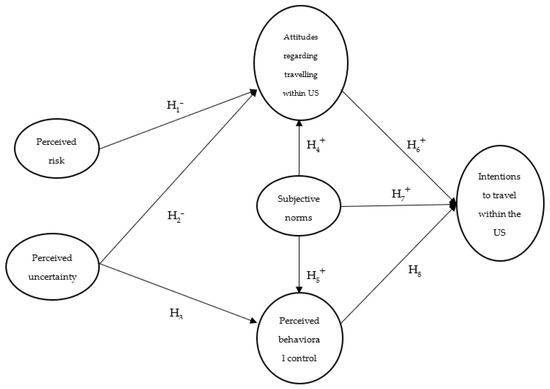
Figure 1.
Conceptual model.
Table 5.
Hypothesized results.
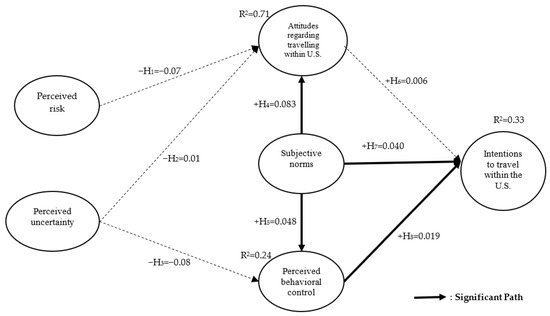
Figure 2.
Structural model results.
5. Discussion
This study incorporated individuals’ perceived risk and uncertainty with traveling amidst the COVID-19 pandemic to an amended theory of planned behavior model. In so doing, potential US travelers served as the study sample to determine how construct antecedents could explain individuals’ intentions to travel again, considering one of five time horizons (i.e., 30 days, three months, six months, nine months, and one year or more). Although this work is one of the first few to examine the model constructs as highlighted in Figure 1—and the insight will most certainly be helpful to managers—the findings were somewhat mixed relative to the eight hypotheses formulated. This is largely due to the inability of perceived risk or perceived uncertainty to serve as significant model predictors. Despite the hypothesized relationship between perceived risk and attitudes about traveling in the near future being negative (consistent with the work of Hsieh et al. [29], Quintal et al. [26], and Sánchez-Cañizares et al. [5]), it was not significant. Furthermore, similar to Quintal et al. [26], neither attitudes about traveling nor perceived behavioral control was significantly explained by perceived uncertainty. This reveals to us that, based on our model, these attitudes about traveling in the near future are potentially forged by factors external to the person, such as norms.
These subjective norms served to be a significant antecedent within the model, influencing attitudes about traveling in the near future and perceived behavioral control, as Quintal et al. [26] also discovered. Eom and Han [47] also found a significant link between subjective norms and attitudes, which is consistent with our findings. Most likely, subjective norms served as the best predictor in the model because social norms took on a heightened role as individuals felt greater pressure to act according to health standards, restrictions, and suggestions [74]. Given that many states had implemented travel restrictions, this most certainly factored into individuals’ attitudes to travel and their perceived control to travel in the first place. This was precisely why we utilized a national study, to reflect as many states and their potentially disparate travel restrictions when our study commenced.
Within the travel and tourism literature, many have employed theory of planned behavior models to explain individuals’ intentions to act, while fewer studies have found that only two of three TPB constructs (i.e., attitudes, subjective norms, and perceived behavioral control) significantly explained behavioral intentions [26,44,47,49]; however, a great majority of studies [5,7,29,39,45,46,48,50,51,52] have demonstrated that all three TPB constructs were significant in predicting behavioral intentions.
However, our study’s results align with the minority [26,44] in that only two of the three constructs (i.e., SN and PBC) were significant predictors of behavioral intentions. Quintal et al. [26] revealed the same significant antecedents in a similar study incorporating perceived risk and uncertainty. Eom and Han [47] indicated different findings in that attitudes and subjective norms were salient antecedents in explaining behavioral intentions. The results of this study indicate that residents’ perceived behavioral control (i.e., self-perception and determination) and subjective norms (i.e., social pressure from those most important to participants, such as friends and family members) strengthened individuals’ behavioral intention to travel within the near future [29,45,50]. Although only half of the hypotheses in the model were supported, a preponderance of those that were significant belonged to constructs within the traditional TPB framework. Consequently, a range of theoretical and practical implications emerges, necessitating attention to guide both academic research and management decisions concerning individuals’ travel intentions in the post-COVID-19 era.
6. Implications
Based on extant research findings (namely the work of Quintal et al., 2010 [26]), one would have expected perceived risk and perceived uncertainty to play a significant role in explaining individuals’ intentions to travel in the near future, but neither did. This leads us to consider one of two things. First, attitudes about traveling in the near future may be explained by some deeply held values or beliefs that we did consider or measure within our model. Had we employed a model more focused on the theory of reasoned action [75], we would have accounted for behavioral beliefs.
Second, perceived risk and perceived uncertainty (even during the pandemic) ultimately do not strongly impact individuals’ intentions to travel. This may not come as a total surprise because the US leads all countries (at the time of data collection with no other country as a close second) in the number of COVID-19 cases and deaths, and traveling indicates another form of behavior added to a list of those undertaken among individuals (e.g., shopping, eating at restaurants, visiting local parks, attending sporting events, gathering for worship, etc.). Although some restrictions have been put in place across the 50 US states, many individuals disregard the risk and uncertainty of potentially contracting and sharing COVID-19 with others [76]. Some of this may come from relaxed restrictions or people’s ignorance of their consequences. It should be noted that the current paper reflects the first wave (of at least three throughout 12 months), so we will keep a close eye on the role that perceived risk and perceived uncertainty play in explaining travel intentions.
Relationships between the main theory of planned behavior constructs contributed most in explaining intentions to travel in the future. Despite more than thirty years of support for the relationship between behavioral attitude and intention to behavior, our work did not reveal such a significant relationship. In looking at the only other work that incorporates perceived risk and uncertainty in explaining individuals’ intentions to travel, Quintal et al. [26], however, also demonstrated a weak relationship between such attitudes and behavioral intention, revealing significance in one of three scenarios. Perhaps our findings are a result of measuring attitudes using a Likert scale of agreement as opposed to extant work (see Bagozzi et al., 2003) [61] that has utilized a semantic differential scale. We opted for the former to present each of the antecedent constructs (i.e., attitudes, subjective norms, and perceived behavioral control) using the same scale.
This work also has implications for practice. Table 2 shows that the mean response to all travel intention items fell below 3.0 (M = 2.58), indicating that participants intend to travel within 6–9 months (from when these data were collected in July 2020). Although the ability to travel during such a time horizon will be contingent upon travel restrictions enacted and enforced by sending and receiving countries, such timing will allow for destinations to plan most appropriately for imminent travel at the beginning of 2021 and beyond [7]. What this also does is ‘buy more time’ for the transportation, lodging, and dining sectors to appropriately plan for effective safety, cleaning, and spacing of common areas [77]. Additionally, these sectors can also determine the most effective means by which to stagger their offerings, whether that be seats in planes, rooms available for purchasing, or chairs at tables; balancing health and safety with revenue will have to be the ‘new norm’ by which providers operate [78].
Furthermore, there is no better time to embrace forms of travel that are more sustainable in nature than now [79]. The worry of embracing sustainable tourism at the cost of sacrificing higher volumes of mass tourism is all but gone. Instead, a focus of how travel can be more sustainable moving forward is front-and-center [80]. The adage ‘some is better than none’ should be a mantra that all destinations embrace to allow a return to tourism earnings coupled with championing the other two legs of the proverbial triple-bottom-line stool [81]. Now, of course, what this looks like will be drastically different to each destination, but one thing is certain, the time for proactive, intentional planning for sustainable tourism is now if not too late. The disruption of the tourism industry due to the pandemic, especially in 2020 and 2021, could have been a good opportunity to rethink and reframe the tourism industry and put it on the right track to sustainability. There are studies that report that the pandemic has been a catalyst for the sustainable digital transformation in the hospitality industry [82]. Other studies suggest that it would be the right time for the accommodation industry to implement internal corporate social responsibility based on providing health, safety, compensation, benefits, training and development, well-being, and work–life equilibrium to their employees [83,84]. However, as of mid-2023, there is strong evidence that continued tourism growth contradicts industry narratives of progressively and successfully engaging with sustainable practices and climate change mitigation [85].
Our work also speaks to the value of social norms and perceived behavioral control. Indirectly, influencing aspects such as public service announcements through traditional media outlets (i.e., radio, television, and web) along with ever-evolving social media outlets have arguably positively impacted individuals’ intentions to travel [86]. In essence, individuals have been socially impacted not to travel so hastily. This needs to continue so that individuals are positively influenced to travel when the time is right for society and necessary measures are put in place to protect others.
7. Limitations and Future Research
The research delineated in this paper is subject to numerous limitations. First, this study used an online survey for data collection, and the self-selection process of joining Qualtrics and participating in online surveys raises concerns about the representativeness of a sample. In addition, older individuals who have lower incomes or reside in remote areas might not be adequately represented in this survey [87].
Third, the quality of the collected data is subject to potential bias. Participants received monetary compensation, raising concerns about the presence of professional survey takers who might inaccurately present themselves while participating in the study [88] and/or not provide thoughtful responses. Future studies should employ multiple methods of data collection to overcome this limitation. A combination of internet-based and on-site questionnaires should be employed. Fourth, it is somewhat surprising that neither perceived risk nor uncertainty were significant predictors in the model. As Bae and Chang [7] suggested, both social costs of traveling and motivations of traveling may help shed light on travel intentions. Because we treated travel intentions generically, we did not consider particular forms of travel. Future research should examine travel intentions by measuring intentions of engaging in certain behaviors focusing on care for queue management at attractions, transportation modifications, and lodging alterations.
Lastly, attitudes are not fixed and can frequently change due to various factors. Future research related to the relationship between the constructs of the theory of planned behavior, individuals’ intentions to travel, and actual travel behavior (within the framework of COVID-19) should encompass longitudinal data collected, shedding light on how attitudes might evolve.
8. Conclusions
By extending the theory of planned behavior, this study examined the relationship between perceived risk, perceived uncertainty, subjective norms, attitudes about future travel, and perceived behavioral control in explaining individuals’ intentions to travel in the near future. This study employed a quantitative research method and data were gathered using an online questionnaire distributed through Qualtrics from a sample of 541 potential travelers (representing residents of 46 US states) from 23 June 2020 through 1 July 2020. Out of the eight hypotheses, only four were supported. Neither perceived risk nor uncertainty were significant within the model. Subjective norms significantly predicted both attitudes about traveling and perceived behavioral control. Subjective norms and perceived behavioral control explained moderate variation in individuals’ intentions to travel. As we reflect on the evolving landscape shaped by the COVID-19 pandemic, it is evident that travel intentions and actual travel behavior have been permanently altered, influenced by the progression of the pandemic. This research contributes to understanding this dynamic context, incorporating insights from the latest literature and developments up to 2023.
Author Contributions
Conceptualization, E.E., K.M.W., J.S., A.U. and J.A.C.S.; methodology, E.E., K.M.W., J.S. and A.U.; software, E.E., J.A.C.S., A.U. and E.S.; validation, E.E., K.M.W., J.S. and A.U.; formal analysis, E.E., K.M.W., J.S., A.U., J.A.C.S. and E.S.; investigation, E.E., K.M.W., J.S., A.U. and J.A.C.S.; resources, E.E., K.M.W., J.S., A.U., J.A.C.S. and E.S.; data curation, E.E., K.M.W., J.S. and E.S.; writing—original draft preparation, E.E., K.M.W., J.S. and J.A.C.S.; visualization, E.E., K.M.W., J.S. and J.A.C.S.; writing—review and editing, E.E., K.M.W., J.S., A.U. and J.A.C.S.; supervision, E.E, K.M.W., J.S., J.A.C.S. and E.S. All authors have read and agreed to the published version of the manuscript.
Funding
This paper is financed by FCT—Foundation for Science and Technology through project UIDB/04020/2020.
Institutional Review Board Statement
Not applicable.
Informed Consent Statement
Not applicable.
Data Availability Statement
Data are contained within the article.
Conflicts of Interest
The authors declare no conflict of interest.
References
- Shin, H.; Kang, J. Reducing perceived health risk to attract hotel customers in the COVID-19 pandemic era: Focused on technology innovation for social distancing and cleanliness. Int. J. Hosp. Manag. 2020, 91, 102664. [Google Scholar] [CrossRef]
- World Heath Organization. COVID-19 Weekly Epidemiological Update—Edition 157 Published 25 August 2023. Available online: https://www.who.int/publications/m/item/weekly-epidemiological-update-on-covid-19---30-august-2023 (accessed on 30 August 2023).
- Li, Z.; Zhang, S.; Liu, X.; Kozak, M.; Wen, J. Seeing the invisible hand: Underlying effects of COVID-19 on tourists’ behavioral patterns. J. Destin. Mark. Manag. 2020, 18, 100502. [Google Scholar] [CrossRef]
- Kock, F.; Nørfelt, A.; Josiassen, A.; Assaf, A.G.; Tsionas, M.G. Understanding the COVID-19 tourist psyche: The Evolutionary Tourism Paradigm. Ann. Tour. Res. 2020, 85, 103053. [Google Scholar] [CrossRef]
- Sánchez-Cañizares, S.M.; Cabeza-Ramírez, L.J.; Muñoz-Fernández, G.; Fuentes-García, F.J. Impact of the perceived risk from COVİD-19 on intention to travel. Curr. Issues Tour. 2020, 24, 970–984. [Google Scholar] [CrossRef]
- Li, C.; Huang, X. How Does COVID-19 Risk Perception Affect Wellness Tourist Intention: Findings on Chinese Generation Z. Sustainability 2023, 15, 141. [Google Scholar] [CrossRef]
- Bae, S.Y.; Chang, P.J. The effect of coronavirus disease-19 (COVID-19) risk perception on behavioural intention towards ‘untact’tourism in South Korea during the first wave of the pandemic (March 2020). Curr. Issues Tour. 2020, 24, 1017–1035. [Google Scholar] [CrossRef]
- Zhang, S.; Sun, T.; Lu, Y. The COVID-19 pandemic and tourists’ risk perceptions: Tourism policies’ mediating role in sustainable and resilient recovery in the New Normal. Sustainability 2023, 15, 1323. [Google Scholar] [CrossRef]
- Tsionas, M.G. COVID-19 and gradual adjustment in the tourism, hospitality, and related industries. Tour. Econ. 2020, 27, 1828–1832. [Google Scholar] [CrossRef]
- Yang, Y.; Zhang, H.; Chen, X. Coronavirus pandemic and tourism: Dynamic stochastic general equilibrium modeling of infectious disease outbreak. Ann. Tour. Res. 2020, 83, 102913. [Google Scholar] [CrossRef] [PubMed]
- Lee, T.H.; Jan, F.H. How Does Personality Affect COVID-19 Pandemic Travel Risk Perceptions and Behaviors? Evidence from Segment Analysis in Taiwan. Sustainability 2023, 15, 655. [Google Scholar] [CrossRef]
- Wu, C.K.; Ho, M.T.; Le, T.K.T.; Nguyen, M.U. The COVID-19 Pandemic and Factors Influencing the Destination Choice of International Visitors to Vietnam. Sustainability 2023, 15, 396. [Google Scholar] [CrossRef]
- Unguren, E.; Arslam, S. How does COVID-19 fear affect job insecurity and stress for hospitality employees? A moderated mediation model for age and financial status. Tour. Manag. Stud. 2022, 18, 7–20. [Google Scholar] [CrossRef]
- Statista. Employment Loss in the Travel and Tourism Industry Due to the Coronavirus (COVID-19) Pandemic in Selected Countries Worldwide in 2020 and 2021. 2022. Available online: https://www.statista.com/statistics/1107475/coronavirus-travel-tourism-employment-loss/ (accessed on 15 October 2023).
- Yang, E.; Smith, J.W. The spatial and temporal resilience of the tourism and outdoor recreation industries in the United States throughout the COVID-19 pandemic. Tour. Manag. 2023, 95, 104661. [Google Scholar] [CrossRef]
- Batrancea, L. Stock Market Reactions to COVİD-19: The Case Of Nyse. Ann. Econ. Ser. 2020, 6, 17–23. [Google Scholar]
- Henderson, J.C. Managing a health-related crisis: SARS in Singapore. J. Vacat. Mark. 2004, 10, 67–77. [Google Scholar] [CrossRef]
- Siu, A.; Wong, Y.R. Economic impact of SARS: The case of Hong Kong. Asian Econ. Pap. 2004, 3, 62–83. [Google Scholar] [CrossRef]
- Sifolo, N.; Sifolo, P.P.S. The tourism inconvenience of the Ebola epidemic: Lessons for the South African tourism sector. Afr. J. Hosp. Tour. Leis. 2015, 4, 1–11. [Google Scholar]
- World Bank. 2016. Available online: https://www.worldbank.org/en/topic/macroeconomics/publication/2014-2015-west-africa-ebola-crisis-impact-update (accessed on 15 August 2022).
- Moreno-Luna, L.; Robina-Ramírez, R.; Sánchez, M.S.O.; Castro-Serrano, J. Tourism and sustainability in times of COVID-19: The case of Spain. Int. J. Environ. Res. Public Health 2021, 18, 1859. [Google Scholar] [CrossRef]
- Meramveliotakis, G.; Manioudis, M. Sustainable development, COVID-19 and small business in Greece: Small is not beautiful. Adm. Sci. 2021, 11, 90. [Google Scholar] [CrossRef]
- Park, S.; Tussyadiah, I.P.; Zhang, Y. Assessment of perceived risk in mobile travel booking. In Information and Communication Technologies in Tourism 2016; Springer: Berlin/Heidelberg, Germany, 2016; pp. 467–480. [Google Scholar]
- Wen, Z.; Huimin, G.; Kavanaugh, R.R. The impacts of SARS on the consumer behaviour of Chinese domestic tourists. Curr. Issues Tour. 2005, 8, 22–38. [Google Scholar] [CrossRef]
- Sirakaya, E.; Woodside, A.G. Building and testing theories of decision making by travellers. Tour. Manag. 2005, 26, 815–832. [Google Scholar] [CrossRef]
- Quintal, V.A.; Lee, J.A.; Soutar, G.N. Risk, uncertainty and the theory of planned behavior: A tourism example. Tour. Manag. 2010, 31, 797–805. [Google Scholar] [CrossRef]
- Sönmez, S.F.; Graefe, A.R. Influence of terrorism risk on foreign tourism decisions. Ann. Tour. Res. 1998, 25, 112–144. [Google Scholar] [CrossRef]
- Ugurlu, K.; Akay, B.; Demirel, S. The effect of COVID-19 on operating costs: The perspective of hotel managers in Antalya, Turkey. Tour. Manag. Stud. 2022, 18, 17–27. [Google Scholar] [CrossRef]
- Hsieh, C.M.; Park, S.H.; McNally, R. Application of the extended theory of planned behavior to intention to travel to Japan among Taiwanese youth: Investigating the moderating effect of past visit experience. J. Travel Tour. Mark. 2016, 33, 717–729. [Google Scholar] [CrossRef]
- Hem, L.E.; Iversen, N.M.; Nysveen, H. Effects of ad photos portraying risky vacation situations on intention to visit a tourist destination: Moderating effects of age, gender, and nationality. J. Travel Tour. Mark. 2003, 13, 1–26. [Google Scholar] [CrossRef]
- Bouzon, A.; Devillard, J. The management of uncertainty in tourism: Strategic paradoxes and communication. Tourismos 2011, 6, 53–68. [Google Scholar]
- Williams, A.M.; Baláž, V. Tourism risk and uncertainty: Theoretical reflections. J. Travel Res. 2015, 54, 271–287. [Google Scholar] [CrossRef]
- Hofstede, G. Culture’s Consequences: Comparing Values, Behaviors, İnstitutions, and Organizations across Nations, 2nd ed.; Sage: Thousand Oaks, CA, USA, 2001. [Google Scholar]
- Bertola, G.; Guiso, L.; Pistaferri, L. Uncertainty and consumer durables adjustment. Rev. Econ. Stud. 2005, 72, 973–1007. [Google Scholar] [CrossRef]
- Romer, P.M. Endogenous technological change. J. Polit. Econ. 1990, 98 Pt 2, S71–S102. [Google Scholar] [CrossRef]
- Ghosh, S. Uncertainty, economic growth its impact on tourism, some country experiences. Asia Pac. J. Tour. Res. 2019, 24, 83–107. [Google Scholar] [CrossRef]
- Ajzen, I. From intentions to actions: A theory of planned behavior. In Action Control; Kuhl, J., Beckmann, J., Eds.; SSSP Springer Series in Social Psychology; Springer: Berlin/Heidelberg, Germany, 1985. [Google Scholar]
- Ajzen, I. The theory of planned behavior. Organ. Behav. Hum. Dec. 1991, 50, 179–211. [Google Scholar] [CrossRef]
- Han, H.; Kim, Y. An investigation of green hotel customers’ decision formation: Developing an extended model of the theory of planned behavior. Int. J. Hosp. Manag. 2010, 29, 659–668. [Google Scholar] [CrossRef]
- Soliman, M. Extending the theory of planned behavior to predict tourism destination revisit intention. Int. J. Hosp. Tour. Adm. 2019, 22, 524–549. [Google Scholar] [CrossRef]
- Um, S.; Crompton, J.L. Attitude determinants in tourism destination choice. Ann. Tour. Res. 1990, 17, 432–448. [Google Scholar] [CrossRef]
- Moutinho, L. Consumer behaviour in tourism. Eur. J. Mark. 1987, 21, 5–44. [Google Scholar] [CrossRef]
- Bianchi, C.; Milberg, S.; Cúneo, A. Understanding travelers’ intentions to visit a short versus long-haul emerging vacation destination: The case of Chile. Tour. Manag. 2017, 59, 312–324. [Google Scholar] [CrossRef]
- Lam, T.; Hsu, C. Predicting behavioral intention of choosing a travel destination. Tour. Manag. 2006, 27, 589–599. [Google Scholar] [CrossRef]
- Cao, J.; Zhang, J.; Wang, C.; Hu, H.; Yu, P. How far Is the ideal destination? Distance desire, ways to explore the antinomy of distance effects in tourist destination choice. J. Travel Res. 2020, 59, 614–630. [Google Scholar]
- Chen, M.F.; Tung, P.J. Developing an extended theory of planned behavior model to predict consumers’ intention to visit green hotels. Int. J. Hosp. Manag. 2014, 36, 221–230. [Google Scholar] [CrossRef]
- Eom, T.; Han, H. Community-based tourism (TourDure) experience program: A theoretical approach. J. Travel Tour. Mark. 2019, 36, 956–968. [Google Scholar] [CrossRef]
- Lee, T.H.; Jan, F.H. Ecotourism behavior of nature-based tourists: An integrative framework. J. Travel Res. 2018, 57, 792–810. [Google Scholar] [CrossRef]
- Meng, B.; Ryu, H.B.; Chua, B.L.; Han, H. Predictors of intention for continuing volunteer tourism activities among young tourists. Asia Pac. J. Tour. Res. 2020, 25, 261–273. [Google Scholar] [CrossRef]
- Park, S.H.; Hsieh, C.; Lee, C. Examining Chinese college students’ intention to travel to Japan using the extended theory of planned behavior: Testing destination image and the mediating role of travel constraints. J. Travel Tour. Mark. 2016, 34, 113–131. [Google Scholar] [CrossRef]
- Seow, A.N.; Choong, Y.O.; Moorthy, K.; Choong, C.K. Predicting medical tourism behavioural intention using social cognition models. Tour. Rev. 2020, 76, 374–391. [Google Scholar] [CrossRef]
- Hsu, C.H.C.; Huang, S. An extension of the theory of planned behavior model for tourists. J. Hosp. Tour. Res. 2012, 36, 390–417. [Google Scholar] [CrossRef]
- Santos, J.A.C. The sustainable transformation of business events: Sociodemographic variables as determinants of attitudes towards sustainable academic conferences. Int. J. Event Festiv. Manag. 2023, 14, 1–22. [Google Scholar] [CrossRef]
- Zhang, Y.; Moyle, B.D.; Jin, X. Fostering visitors’ pro-environmental behaviour in an urban park. Asia Pac. J. Tour. Res. 2018, 23, 691–702. [Google Scholar] [CrossRef]
- Erul, E.; Woosnam, K.M. Explaining residents’ behavioral support for tourism through two theoretical frameworks. J. Travel Res. 2022, 61, 362–377. [Google Scholar] [CrossRef]
- Erul, E.; Woosnam, K.M.; Denley, T.J. Modelling residents’ perspectives of tourism opposition in US counties with the highest historical numbers of reported COVID-19 cases. Sustainability 2022, 14, 16382. [Google Scholar] [CrossRef]
- Mathieu, E.; Ritchie, H.; Rodés-Guirao, L.; Appel, C.; Giattino, C.; Hasell, J.; Macdonald, B.; Dattani, S.; Beltekian, D.; Ortiz-Ospina, E.; et al. Coronavirus Pandemic (COVID-19). OurWorldInData.org. Available online: https://ourworldindata.org/coronavirus (accessed on 24 October 2023).
- Kees, J.; Berry, C.; Burton, S.; Sheehan, K. An analysis of data quality: Professional panels, student subject pools, and Amazon’s Mechanical Turk. J. Advert. 2017, 46, 141–155. [Google Scholar] [CrossRef]
- Heen, M.; Lieberman, J.D.; Miethe, T.D. A comparisonof different online sampling approaches for generating national samples. Cent. Crime Justice Policy 2014, 1, 1–8. [Google Scholar]
- Bryman, A.; Cramer, D. Quantitative Data Analysis with SPSS Release 10 for Windows; Routledge: London, UK, 2001. [Google Scholar]
- Bagozzi, R.P.; Dholakia, U.M.; Basuroy, S. How effortful decisions get enacted: The motivating role of decision processes, desires, and anticipated emotions. J. Behav. Decis. Mak. 2003, 16, 273–295. [Google Scholar] [CrossRef]
- Tabachnick, B.G.; Fidell, F.S. Using Multivariate Statistics, 7th ed.; Pearson: Boston, MA, USA, 2019. [Google Scholar]
- Anderson, J.C.; Gerbing, D.W. Structural equation modeling in practice: A review and recommended two-step approach. Psychol. Bull. 1988, 103, 411–423. [Google Scholar] [CrossRef]
- Jordan, P.J.; Troth, A.C. Common method bias in applied settings: The dilemma of researching in organizations. Aust. J. Manag. 2020, 45, 3–14. [Google Scholar] [CrossRef]
- Spector, P.E. Method variance in organizational research: Truth or urban legend? Organ. Res. Methods 2006, 9, 221–232. [Google Scholar] [CrossRef]
- Podsakoff, P.M.; MacKenzie, S.B.; Lee, J.-Y.; Podsakoff, N.P. Common method biases in behavioral research: A critical review of the literature and recommended remedies. J. Appl. Psychol. 2003, 88, 879–903. [Google Scholar] [CrossRef]
- Ribeiro, M.A.; Pinto, P.; Silva, J.A.; Woosnam, K.M. Examining the predictive validity of SUS-TAS with maximum parsimony in developing island countries. J. Sustain. Tour. 2018, 26, 379–398. [Google Scholar] [CrossRef]
- West, S.G.; Finch, J.F.; Curran, P.J. Structural equation models with nonnormal variables: Problems and remedies. In Structural Equation Modeling: Concepts, Issues, and Applications; Hoyle, R.H., Ed.; Sage Publications, Inc.: Thousand Oaks, CA, USA, 1995; pp. 56–75. [Google Scholar]
- Hair, J.F.; Hult, G.T.M.; Ringle, C.M.; Sarstedt, M.; Thiele, K.O. Mirror, mirror on the wall: A comparative evaluation of composite-based structural equation modeling methods. J. Acad. Mark. Sci. 2017, 45, 616–632. [Google Scholar] [CrossRef]
- Kline, R.B. Principles and Practice of Structural Equation Modeling; Guilford Publications: New York, NY, USA, 2015. [Google Scholar]
- Byrne, B.M. Structural Equation Modeling with AMOS: Basic Concepts, Applications, and Programming, 3rd ed.; Routledge: New York, NY, USA, 2016. [Google Scholar]
- Hair, J.F.J.; Black, W.C.; Babin, B.J.; Anderson, R.E. Multivariate Data Analysis, 7th ed.; Prentice Hall: Hoboken, NJ, USA, 2018. [Google Scholar]
- Hu, L.T.; Bentler, P.M. Cutoff criteria for fit indexes in covariance structure analysis: Conventional criteria versus new alternatives. Struct. Equ. Model. 1999, 6, 1–55. [Google Scholar] [CrossRef]
- Fornell, C.; Larcker, D.F. Evaluating structural equation models with unobservable variables and measurement error. J. Mark. Res. 1981, 18, 39–50. [Google Scholar] [CrossRef]
- Fishbein, M.; Ajzen, I. Belief, Attitude, Intention, and Behavior: An Introduction to Theory and Research; Addison-Wesley: Reading, MA, USA, 1975. [Google Scholar]
- Van Bavel, J.J.; Baicker, K.; Boggio, P.S.; Capraro, V.; Cichocka, A.; Cikara, M.; Drury, J. Using social and behavioural science to support COVID-19 pandemic response. Nat. Hum. Behav. 2020, 4, 460–471. [Google Scholar] [CrossRef]
- Kaushal, V.; Srivastava, S. Hospitality and tourism industry amid COVID-19 pandemic: Perspectives on challenges and learnings from India. Int. J. Hosp. Manag. 2020, 92, 102707. [Google Scholar] [CrossRef] [PubMed]
- Romagosa, F. The COVID-19 crisis: Opportunities for sustainable and proximity tourism. Tour. Geogr. 2020, 22, 690–694. [Google Scholar] [CrossRef]
- Higgins-Desbiolles, F. The “war over tourism”: Challenges to sustainable tourism in the tourism academy after COVID-19. J. Sustain. Tour. 2020, 29, 551–569. [Google Scholar] [CrossRef]
- Gössling, S.; Scott, D.; Hall, C.M. Pandemics, tourism and global change: A rapid assessment of COVID-19. J. Sustain. Tour. 2020, 29, 1–22. [Google Scholar] [CrossRef]
- Brouder, P.; Teoh, S.; Salazar, N.B.; Mostafanezhad, M.; Pung, J.M.; Lapointe, D.; Higgins-Desbiolles, F.; Haywood, M.; Hall, C.M.; Clausen, H.B. Reflections and discussions: Tourism matters in the new normal post COVID-19. Tour. Geogr. 2020, 22, 735–746. [Google Scholar] [CrossRef]
- António, N.; Rita, P. COVID 19: The catalyst for digital transformation in the hospitality industry? Tour. Manag. Stud. 2021, 17, 41–46. [Google Scholar] [CrossRef]
- Abdelazimahmed, T.; Kassemo, A.; Alajloni, A.; Alomran, A.; Ragab, A.; Shaker, E. Effect of internal corporate social responsibility activities on tourism and hospitality employees’ normative commitment during COVID-19. Tour. Manag. Stud. 2022, 18, 21–35. [Google Scholar] [CrossRef]
- Al-Ababneh, M.M.; Al-Shakhsheer, F.J.; Habiballah, M.A.; Al-Badarneh, M.B. Assessing the impact of the COVID-19 pandemic on tourism workers’ health and well-being in Jordan. Tour. Manag. Stud. 2022, 18, 19–38. [Google Scholar] [CrossRef]
- Gössling, S.; Humpre, H.; Ya-Yen, S. On track to net-zero? Large tourism enterprises and climate change. Tour. Manag. 2024, 100, 104842. [Google Scholar] [CrossRef]
- Neuburger, L.; Egger, R. Travel risk perception and travel behaviour during the COVID-19 pandemic 2020: A case study of the DACH region. Curr. Issues Tour. 2020, 24, 1003–1016. [Google Scholar] [CrossRef]
- Smith, S.M.; Roster, C.A.; Golden, L.L.; Albaum, G.S. A multi-group analysis of online survey respondent data quality: Comparing a regular USA consumer panel to MTurk samples. J. Bus. Res. 2016, 69, 3139–3148. [Google Scholar] [CrossRef]
- Chambers, S.; Nimon, K. Conducting survey research using MTurk. In Innovative Techniques, Trends, and Analysis for Optimized Research Methods; Wang, V.C.X., Reio, T.G., Jr., Eds.; IGI Global: Hershey, PA, USA, 2018; pp. 258–288. [Google Scholar]
Disclaimer/Publisher’s Note: The statements, opinions and data contained in all publications are solely those of the individual author(s) and contributor(s) and not of MDPI and/or the editor(s). MDPI and/or the editor(s) disclaim responsibility for any injury to people or property resulting from any ideas, methods, instructions or products referred to in the content. |
© 2023 by the authors. Licensee MDPI, Basel, Switzerland. This article is an open access article distributed under the terms and conditions of the Creative Commons Attribution (CC BY) license (https://creativecommons.org/licenses/by/4.0/).