


Abstract
While global attention to zero-energy building (ZEB) has surged as a sustainable countermeasure to high-energy consumption, a congruent expansion in research remains conspicuously absent. Addressing this lacuna, our study harnesses public research and development grant data to decipher evolving trajectories within ZEB research. Distinctively departing from conventional methodologies, we employ state-of-the-art natural language processing (NLP) artificial intelligence models to meticulously analyze grant textual content pertinent to ZEB. Our findings illuminate an expansive spectrum of ZEB-related research, with a pronounced focus on the holistic continuum of energy supply, demand, distribution, and actualization within architectural confines. Theoretically, this work delineates key avenues ripe for future empirical exploration, fostering a robust academic foundation for subsequent ZEB inquiries. Practically, the insights derived bear significant implications for practitioners, informing optimal implementation strategies, and offering policymakers coherent roadmaps for sustainable urban development. Collectively, this study affords a panoramic perspective on contemporary ZEB research contours, enhancing both scholarly comprehension and practical enactment in this pivotal domain.
1. Introduction
As global efforts to address climate change and pursue sustainable development intensify, zero-energy building (ZEB) is increasingly considered a viable solution for reducing carbon dioxide (CO2) emissions and minimizing energy consumption within the building, construction, and architecture sector [1,2]. In many developed countries, the building sector accounts for 30% to 40% of total energy consumption and a sizable proportion of greenhouse gas emissions [3,4,5,6,7,8,9,10]. Consequently, ZEB has become a promising alternative many countries have actively pursued through technology and policy initiatives to improve building energy efficiency [1,11]. Similarly, the building sector accounts for over a quarter of Korea’s total energy consumption. Recognizing the need to address climate change, reduce energy demand, and decrease greenhouse gas emissions, the Korean government has prioritized promoting ZEB to foster new industries and technological advancements [12,13].
In conceptual terms, ZEB refers to a building that significantly enhances energy efficiency by incorporating renewable energy sources and minimizing energy losses [6]. In practice, however, ZEB is a complex concept with definitions that vary depending on the emphasis on specific aspects of building management technology. Moreover, the notion of a zero-energy state and how to measure the energy balance of a building remain ambiguous, with no clear consensus [1,11,14,15]. Consequently, a comprehensive understanding of the technical elements and research related to ZEB is still needed [14].
However, this does not imply a lack of research aimed at clarifying the definition of ZEB and calculating and evaluating various related parameters. For instance, Marszal et al. [1] reviewed multiple research papers on ZEB, presented definitions of ZEB and energy calculation methodologies, and elaborated on ZEB-related parameters. Marique and Reiter [15] proposed a framework for exploring the feasibility of ZEB at the neighborhood/community scale from a more realistic perspective. Moreover, Wells et al. [16] introduced the concept of ZEB in the context of Australia, reviewed existing ZEB models, and identified potential avenues for ZEB research through case studies and a literature review.
The mentioned studies provide a comprehensive overview of the research trends related to ZEB and offer insight for future research through a qualitative approach. However, scientometric analysis is also advantageous as a quantitative tool to identify the entire knowledge structure of research on ZEB. The science mapping method, a technique for visualizing bibliographic data, can validate trends and changes in research diachronically and synchronically and provide information on core research topics, researchers, research institutes, and cooperative networks more easily for collaborative research on specific topics [17,18,19,20,21]. Numerous studies have recently used scientometric analysis in architecture and construction (e.g., [22,23,24,25]).
Tashiro et al. [14] conducted a study that employed a scientometric approach to ZEB. In this study, scientometric analysis was conducted to analyze the knowledge structure of net-zero-energy building (NZEB). However, the query set to collect paper data included keywords related to indirect component technology comprising NZEB and technology related to NZEB. Thus, the study adopted a scientific approach to the technology related to NZEB in a wider area targeting numerous articles rather than specifically analyzing research on NZEB. Moreover, in the broader category, most studies have primarily been conducted on green building or building information modeling [26,27,28,29].
Recent studies have also used bibliometric or scientometric methods to analyze the trend of research on ZEB by collecting and analyzing scientific articles [30,31,32,33,34,35]. Through bibliometric analysis, Wang et al. [30] and Agbodjan et al. [31] identified influential organizations, leading experts, major research directions, collaboration networks, thematic trends, and challenges of nearly ZEB and ZEB, respectively. Similarly, Omrany et al. [34] used bibliometric analysis techniques to provide a comprehensive overview of three decades of research developments in NZEB, identifying influential researchers, sources, countries, and the main thematic research focus areas and hot topics in the field. Furthermore, Wei et al. [35] created knowledge maps of authors, institutions, and keywords in ZEB research using CiteSpace software(5.8.R3 SE 64-bit). The study found that research on ZEB has significantly advanced since 2000, with most papers published in the areas of energy fuels, construction building technology, civil engineering, and green sustainable science technology. The results revealed that the field has consolidated around three major themes and is expanding with emerging themes, providing valuable information for researchers interested in ZEB.
One attribute of scientific studies related to ZEB is that they typically only analyze data from published papers. However, according to Rotolo et al. [30], scientometrics for scientific papers is a retrospective analysis, which means a time lag exists between the observation (collection) of the data and when the technology is implemented. Therefore, this type of analysis is best suited for researching a particular technology’s past and present status, growth, and novelty. Different datasets are required to validate the future orientation or potential of emerging technology. Funding and research and development (R&D) grant-related data have been identified as promising sources to supplement the retrospective perspective of scientometric analysis [30].
This study aims to conduct a comprehensive trend analysis of ZEB research using R&D grant data invested in R&D projects in major countries rather than scientific publication data. The aim is to observe technological opportunities for future-oriented directions of ZEB-related R&D, summarize the latest status of global ZEB R&D, identify the knowledge structure, and seek future research directions. Specifically, this study adopted a methodology of analyzing R&D grant document data and extracting topics through natural language processing (NLP) based on artificial intelligence (AI) models instead of the traditional methodology of bibliometrics or scientometrics. The decision to employ AI-driven NLP techniques in lieu of conventional scientometric analysis stems from several considerations. Firstly, a plethora of studies have already employed scientometric or bibliometric methodologies to probe into ZEB-related research and development trends [29,30,31]. Adopting a similar approach would, thus, dilute the novelty of this investigation. Secondly, recent advancements in NLP, particularly methodologies harnessing architectures like BERT and Transformer, have demonstrated remarkable efficacy. Consequently, this study posits that leveraging these cutting-edge AI methodologies for analyzing ZEB-related R&D trends can yield more granular and empirically robust insights.
The research questions accordingly are as follows:
- (1)
- How does the trend analysis of ZEB research using R&D grant data differ from those derived from scientific publication data?
- (2)
- What technological opportunities can be observed for the future-oriented directions of ZEB-related R&D using grant data from major countries?
- (3)
- What is the current status of global ZEB R&D based on the analysis of R&D grant data?
- (4)
- How does the knowledge structure of ZEB research manifest when evaluated through R&D grant data?
- (5)
- Which future research directions emerge when R&D grant data for ZEB is analyzed through NLP based on AI models?
From these research questions, the research objectives presented in this paper are as follows:
- (1)
- To conduct a comprehensive trend analysis of ZEB research using R&D grant data from major countries.
- (2)
- To contrast the insights derived from R&D grant data with those typically obtained from scientific publication data.
- (3)
- To pinpoint technological opportunities that elucidate future-oriented directions in ZEB-related R&D.
- (4)
- To encapsulate the present status of global ZEB R&D by examining invested grant data.
- (5)
- To identify and map out the knowledge structure within the ZEB research domain.
- (6)
- To leverage an innovative methodology employing NLP based on AI models for analyzing R&D grant document data, moving away from conventional bibliometric or scientometric methods.
2. Materials and Methods
2.1. Data Collection and Preprocessing
This section outlines the steps for obtaining R&D grant datasets related to ZEB. The task involved creating a query set that includes the concepts of ZEB and NZEB. The R&D grant data related to ZEB were restricted to projects from 2000 to 2022. Data collection post-2000 was strategically chosen to discern shifts in R&D trends encompassing early ZEB-related research up to contemporary advancements. This decision was made in light of the fact that the Kyoto Protocol, an important international treaty aimed at mitigating global warming, was adopted in 1997.
The database used to collect ZEB-related R&D grant data is Dimensions.ai, an integrated research information system provided by Digital Science (https://www.dimensions.ai, accessed on 24 July 2023). This system was chosen due to its ability to organize and provide considerable global R&D grant data systematically. The research category feature offered by Dimensions.ai was used to narrow down data collection to research fields relevant to ZEB to reduce noise in the collected data. During the data collection process, the Australian and New Zealand Standard Research Classification 2020 (ANZSRC 2020) was used to limit research areas based on research field codes. The ANZSRC 2020 is a commonly used statistical classification system for measuring and analyzing R&D activities in Australia and New Zealand. The query set and parameters presented below were used to extract only ZEB-related data from the R&D grant data provided by Dimensions.ai. The asterisk indicates a fuzzy search. A total of 3456 documents were retrieved.
- The data date range was 2000 to 2022.
- Only documents of the grant type were used.
- Research fields (ANZSRC 2020) included engineering (40), built environment and design (33), building (3302), architecture (3301), civil engineering (4004), and environmental sciences (41).
- Duplicated data were removed based on the Grant ID.
- The query set is as follows:
- ((net OR nearly) AND (zero) AND (energy OR carbon OR emission) AND (build* OR hous* OR construction OR home*)) OR ((zero) AND (energy OR carbon OR emission) AND (build* OR hous* OR construction OR home*)) OR ((energy) AND (plus OR ultralow OR ultra-low) AND (build* OR hous* OR construction OR home*)).
Figure 1 displays the number of R&D grants associated with ZEB from 2000 to 2022. As illustrated in Figure 1, grants related to ZEB have exhibited an overall increasing trend throughout the period. Notably, R&D grants related to ZEB demonstrated a substantial surge from 2019 to 2020.
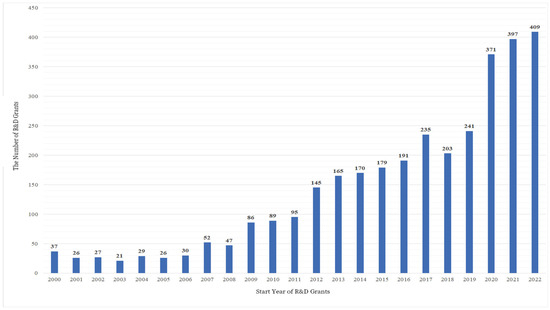
Figure 1.
Trend in the number of research and development (R&D) grants by start year, 2000–2022.
2.2. Data Analysis
Many studies previously conducted employed scientometrics to identify the domain of scientific knowledge using quantitative analysis methodologies, such as coauthorship, cocitation, keyword co-occurrence, and cluster analysis, facilitating the exploration of hidden implications and the identification of innovative research areas [35,36,37,38]. However, to identify more practical research fields and content related to ZEB, this study employs an AI-based clustering analysis after conducting NLP on the unstructured ZEB-related R&D grant data, specifically the titles and abstracts.
2.2.1. Document Embedding
The initial step in analyzing R&D grants related to ZEB is converting each document into numerical data, called embedding in NLP. In recent years, pretrained language models have become commonplace in the embedding process, and this study employs the widely used bidirectional encoder representations from transformers (BERT) model [39]. As BERT produces distinct embeddings based on word context, it is a suitable embedding method for comprehending ZEB-related research content. Moreover, many pretrained models are available as open sources, making them readily accessible for analysis. Numerous techniques can generate BERT embeddings with text data. This study employs Python and the sentence-transformers package to generate BERT embeddings for ZEB-related R&D grant documents. The sentence-transformers package is acknowledged for producing high-quality document-level embeddings [40,41], making it a suitable tool for this research. This study converts the documents into 512-dimensional numerical data via the BERT embedding.
2.2.2. Dimension Reduction and Document Clustering
A clustering analysis process is necessary to group documents sharing similar topics into clusters. However, numerous clustering algorithms struggle to manage high dimensions effectively, making it imperative to reduce the dimension of embedding beforehand.
Of the various dimensionality reduction algorithms available, uniform manifold approximation and projection (UMAP) [42] is recognized for its efficacy in preserving a significant proportion of high-dimensional local structures in low dimensionality. This study employs the UMAP algorithm for dimensionality reduction by installing the umap-learn package from Python. Through the UMAP algorithm, we reduced the dimension size to five while maintaining the local neighborhood size at 15. If the dimension is excessively low, pertinent information may be lost, whereas if the dimension is overly high, the clustering result may be suboptimal. Thus, we adopted the parameters suggested by the umap-learn package.
After reducing the document embedding dimension to five, we used the hierarchical density-based spatial clustering of applications with the noise (HDBSCAN) algorithm to cluster documents [43,44]. The HDBSCAN is a density-based clustering algorithm that synergizes well with UMAP because UMAP significantly preserves local structures, even in a low-dimensional space [45]. Moreover, HDBSCAN is advantageous because it does not compel data points to belong to clusters, as it considers some data points to be outliers [46]. We installed the hdbscan package of Python to employ this algorithm, as with the previous algorithms.
This process allows similar documents to be grouped to form clusters. Furthermore, reducing the dimension size to two enables the visualization of the cluster analysis result on a two-dimensional plane, while unclustered outliers can be visualized separately. In cases where the number of analyzed clusters is large, the clusters may not be accurately represented on a plane. Nonetheless, reducing the dimensionality to two can still reveal local structures in most cases.
2.2.3. Topic Modeling
This study applied the BERTopic algorithm to identify topics within clusters. The BERTopic technique extracts topics from text embeddings using a language model, such as BERT [47]. The process was implemented by installing the BERTopic package in Python, which is modular and uses a series of steps to create a topic model.
Steps 1 to 3 are identical to the document clustering process described earlier, except that, in topic modeling, the process is performed within the clusters generated in the previous step. In Step 4, to generate topics without assuming any expected structure of the clusters, BERTopic employs a bag-of-words approach by counting the frequency of each word in each cluster. After generating the word frequency representations in Step 4, Step 5 uses class-based term frequency–inverse document frequency (c-TF-IDF) to determine how one cluster differs from another. For instance, it calculates the importance of words within clusters and identifies which words are common in Cluster 1 but not in other clusters. The following equation can be used to calculate c-TF-IDF:
The process of collecting and analyzing ZEB-related R&D grant data in this study is illustrated in Figure 2.
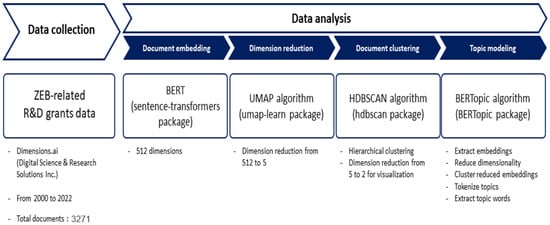
Figure 2.
Artificial intelligence-based process of collecting and analyzing related research and development grant data related to zero-energy building.
3. Results
3.1. Descriptive Analysis
This section presents the results of a descriptive statistical analysis of the R&D grant data related to ZEB collected from Dimensions.ai. Between 2000 and 2022, the United Kingdom (UK) funded the most ZEB-related R&D grants, with 719 grants being funded, followed by the United States (US), Canada, Belgium, and China funding 714, 474, 384, and 265 grants, respectively. Most of the grants funded in Belgium account for numerous projects funded by the European Commission (EC) because Belgium is the seat of the EC (Table 1).

Table 1.
Top 10 funder countries for research and development (R&D) grants related to zero-energy building.
In terms of funding institutions, the Natural Sciences and Engineering Research Council in Canada provided the most funding with 431 cases, followed by Innovate UK in the UK with 413 cases, the EC in Belgium with 312 cases, the Engineering and Physical Sciences Research Council in the UK with 225 cases, and the National Natural Science Foundation of China in China with 194 cases (Table 2).
Table 2.
Top 10 funder and funder countries for research and development (R&D) grants related to zero-energy building.
Table 3 summarizes the average funding for ZEB-related R&D grants during the study period. The investment amounts were converted into US dollars from each country’s respective currency. However, the average funding in Belgium includes grants funded by the EC; thus, it is not a good representation of the funding in Belgium alone. Japan is the top country for funding, followed by Belgium, New Zealand, the UK, and Czechia regarding the average investment for ZEB-related R&D grants. Although New Zealand and Czechia did not rank high in the number of R&D grants, the funding per grant is high given their high average investments.
Table 3.
Top 10 funder countries and average funding amount in US dollars for research and development (R&D) grants related to zero-energy building.
3.2. Document Clustering Results
Following the data analysis method, we embedded the text using BERT with the title and abstract of the R&D grants related to ZEB, reduced the dimensionality using the UMAP algorithm, and performed clustering using the HDBSCAN algorithm. Consequently, the documents were grouped into 25 clusters.
Figure 3 presents the results of the document embedding and clustering, reduced to two dimensions. The shaded areas correspond to outliers that did not form clusters. After dimensionality reduction from 512 to five dimensions using the UMAP algorithm, it was possible to identify the clustered structure of similar documents, even when the dimension size was reduced to two for visualization. The size of each cluster is listed in Table 4.
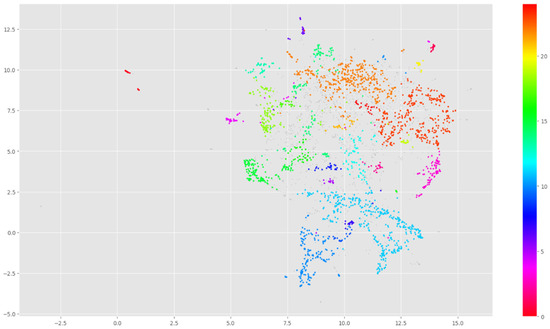
Figure 3.
Results of document embedding and clustering for research and development (R&D) grants related to zero-energy building.
Table 4.
Sizes of 25 clusters from documents on research and development (R&D) grants related to zero-energy building.
3.3. Results of Topic Modeling and Content Analysis by Clusters
As mentioned, topic modeling was performed for each cluster using the BERTopic algorithm. The number of topic groups extracted per cluster varied depending on cluster size. Figure 4 presents the results of topic modeling for the 25 clusters.
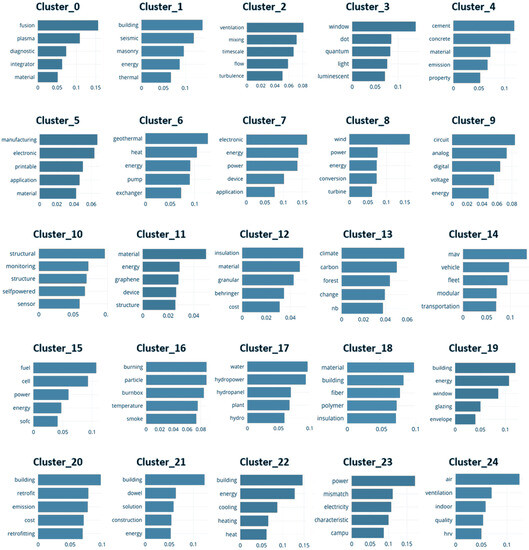
Figure 4.
Results of topic modeling by clusters.
The topics by cluster are the representative research content on ZEB-related R&D gathered in each cluster. This study examined the actual R&D grant content for each cluster by identifying the research content centered on the cluster topic. The results of identifying the research content for each cluster are presented in Table 5.
Table 5.
Topics in 25 clusters and titles of major research and development (R&D) grants related to zero-energy building (ZEB).
For example, the present thesis posits that the R&D grants attributed to Cluster 0 are primarily dedicated to conducting R&D endeavors on advanced nuclear technology. Moreover, these grants emphasize advancing the development of sustainable ZEB by incorporating innovative nuclear reactor designs, advanced fuel assemblies, and state-of-the-art diagnostic and monitoring tools.
The R&D grants belonging to Cluster 1 focus on developing advanced materials, innovative structural systems, and seismic design methods for enhancing the seismic safety and energy efficiency of buildings. These research studies aim to optimize the thermal and acoustic performances of masonry housing and develop sustainable and low-risk structural buildings using high-strength materials, timber composites, and energy-dissipating elements. These studies also investigate the response characteristics of super-high-rise structures under long-term ground motion and establish damping control mechanisms to improve their seismic performance.
The field of studies in Cluster 2 focuses on the dynamics and transport of fluids in complex systems, including developing advanced numerical methods and models for simulating turbulent flows and investigating the influence of numerous factors, such as rough surfaces, pressure gradients, and interfacial area concentration on the behavior of fluids. This work encompasses research areas, such as aerodynamics, hydrodynamics, and atmospheric physics, and applications in energy, urban air quality, and material science. Table 6 similarly summarizes the research areas and content of the 25 clusters. In this study, we organized clusters derived from a comprehensive analysis of R&D grants. Utilizing the BERTopic model, a state-of-the-art topic modeling technique, we extracted key thematic elements to inform the titles of each cluster. These titles were formulated based on keyword prominence and their relevance to the overarching themes of the respective R&D grants.
Table 6.
Topics for 25 clusters and the titles of major research and development (R&D) grants related to zero-energy building (ZEB).
4. Discussion
The clustering results highlight the diverse range of ZEB research, covering a spectrum from advanced nuclear technology to fluid dynamics in complex systems. Document categorization into 25 distinct groups signifies the breadth of subjects under the purview of ZEB research. Cluster 0 points to a nascent inclination towards harnessing advanced nuclear technology for sustainable ZEB outcomes. The focus on innovative reactor designs and advanced diagnostic tools alludes to a potential pivot towards nuclear energy as a sustainable solution for zero-energy buildings. This warrants an in-depth exploration of its feasibility, associated ramifications, and public perception. Cluster 1 accentuates the relevance of innovations in material science and the imperative of seismic safety in ZEB. Given the mounting concerns over environmental calamities, there is an increased emphasis on seismic design techniques and ensuring the resilience of towering structures. It is essential to evaluate how such advancements might redefine the established architectural and engineering paradigms in ZEB. The attention to fluid dynamics, as highlighted in Cluster 2, is of particular interest. When explored in the context of aerodynamics and atmospheric physics, fluid dynamics can profoundly impact building design, ventilation strategies, and energy conservation approaches. Delving into the interplay between these elements and ZEB design promises fresh perspectives.
The employment of AI tools, like BERT and UMAP, facilitates a nuanced exploration of ZEB-focused R&D trends. Yet, it remains critical to reflect on potential biases, ascertain the results’ reliability, and acknowledge the limitations of this AI-driven approach. The ungrouped outliers could represent untapped knowledge, potentially pointing to emerging or niche research areas on the verge of broader recognition. An in-depth analysis of these outliers could delineate emerging directions in ZEB research. Using AI to investigate prospective research trends in ZEB has demarcated clear clusters echoing the field’s multifaceted nature. Each cluster epitomizes a distinct aspect of ZEB, shedding light on the intricate avenues of sustainable building design research. Nevertheless, while these clusters serve as a valuable guide to current ZEB research, inherent limitations and potential areas of deeper inquiry emerge.
Despite BERT’s proven effectiveness in text embedding, biases innate to its pre-trained model can creep in. Moreover, while UMAP is proficient at dimensionality reduction, its sensitivity to hyperparameters might skew the clustering outcome. Furthermore, HDBSCAN’s capability in capturing diverse density clusters might occasionally miss more diffuse ones, categorizing certain research areas as outliers.
The study’s focus on only the titles and abstracts of R&D grants may inadvertently neglect subtle nuances or emergent themes present in the full text. Additionally, as this study provides a snapshot of ZEB trends, it may not trace the entire thematic evolution, especially emerging or waning research facets. Outliers, which do not neatly fit into the predefined 25 clusters, could be hinting at avant-garde, cross-disciplinary, or specialized research trajectories. An exhaustive qualitative probe into these outliers might unearth pioneering ZEB research directions.
Undertaking a time-based examination of the R&D grants might illuminate the temporal evolution of ZEB research. Such an inquiry can chronicle the birth, growth, and possible waning of distinct research themes, furnishing a fluid overview. Subsequent studies stand to gain from extending their scope to the full text of R&D grants, thereby ensuring a more holistic grasp of the research nuances. Complementing this with external datasets, like citation networks or patent databases, would bestow a comprehensive perspective on the ZEB research’s impact and innovative pathways.
5. Conclusions
Energy consumption in the building and construction sectors remains a salient challenge across many nations. Amid the global agreement to transition from fossil fuels to renewable energies, Zero-Energy Building (ZEB) stands out as a viable alternative, garnering extensive research attention [1,2]. This research introduced an AI-driven methodology to examine ZEB-centric R&D grants, aiming to decipher future trajectories and enrich our understanding of the discipline.
Diverging from conventional scientific analyses that primarily focus on academic articles, our study prioritized R&D projects to illuminate the prospective avenues of ZEB research. Despite inherent challenges in analyzing all ZEB-related R&D undertakings due to data accessibility constraints, such a methodological choice is pivotal. These projects often epitomize national R&D agendas, overseen by governmental or public entities. Our analysis emphasized concerted efforts to amplify ZEB efficiency, elevate photovoltaic performance, and blueprint smart cities integrating ZEB with transportation and avant-garde technologies, such as ICT and sensors. These insights resonate with Rotolo et al. [36], underscoring the relevance of R&D funding data in spotlighting imminent research directions. The value proposition of our study lies in its novel methodology to envisage the ZEB research horizon. By leveraging R&D project data, we offer a holistic vantage point and insights distinct from those gleaned through traditional article analyses. Moreover, this endeavor affirms the potency of AI techniques as instrumental scientific apparatuses, thereby extending the frontiers of such inquiries.
Our findings can serve both theoretical and applied facets, assisting entities in strategizing R&D initiatives, budget allocations, and outcome evaluations. Furthermore, this work provides a scaffold for assessing the contemporary status and prognosticating ZEB research’s forthcoming trends. Nonetheless, certain limitations persist, such as potential miscategorization of R&D grants or human biases affecting thematic assessments. Pioneering language models, exemplified by OpenAI’s ChatGPT or Google’s Bard, could proffer resolutions in future research endeavors.
There exists an imperative for subsequent studies to explore the intrinsic attributes and the juxtaposition of R&D grant data with scientific publications. Such endeavors would accentuate the significance of R&D grant data, augmenting its analytical utility, and paving the way for diverse AI-driven scientometric evaluations. Our AI-enhanced assessment underscored the multifaceted nature of ZEB research, spanning domains from nuclear technology to material science. The emphasis on fields such as advanced nuclear technology heralds potential paradigm shifts in ZEB’s energy and sustainability blueprints, signaling a renaissance in sustainable architectural design.
Based on the derived clusters, it is prudent for stakeholders to channel investments into emergent domains, such as cutting-edge materials, seismic safety paradigms, and novel nuclear innovations, as these could dictate ZEB’s future trajectory. This work epitomizes AI’s prowess in sifting through and categorizing intricate research vectors, suggesting that embracing such tools can refine the granularity and scope of scientific evaluations, thereby equipping stakeholders with actionable insights. Given the fluidity of ZEB research, a periodic reassessment of these trends becomes indispensable. A steadfast monitoring regimen, buttressed by state-of-the-art methodologies, is quintessential to ensure alignment with evolving technological advances and societal imperatives. A meticulous exploration of anomalies or outliers could also proffer a visionary perspective on the research frontier of ZEB.
By comprehensively mapping the ZEB terrain through AI, this study offers indispensable insights for a broad audience, ranging from researchers and policymakers to industry frontrunners. The ever-evolving tapestry of ZEB research necessitates sustained scrutiny and recalibration to propel sustainable and trailblazing architectural innovations.
Author Contributions
Methodology, Y.B.; Software, B.J.; Formal analysis, B.J.; Investigation, B.J.; Visualization, B.J.; Supervision, Y.B. All authors have read and agreed to the published version of the manuscript.
Funding
This research was supported by “Regional Innovation Strategy (RIS)” through the National Research Foundation of Korea (NRF) funded by the Ministry of Education (MOE)(2021RIS-002).
Institutional Review Board Statement
Not applicable.
Informed Consent Statement
Not applicable.
Data Availability Statement
Restrictions apply to the availability of these data. Data was obtained from Digital Science & Research Solutions Inc. and are available at https://app.dimensions.ai/discover/publication with the permission of Digital Science & Research Solutions Inc.
Conflicts of Interest
The authors declare no conflict of interest.
References
- Marszal, A.J.; Heiselberg, P.; Bourrelle, J.S.; Musall, E.; Voss, K.; Sartori, I.; Napolitano, A. Zero Energy Building—A review of definitions and calculation methodologies. Energ. Build. 2011, 43, 971–979. [Google Scholar] [CrossRef]
- Luo, T.; Tan, Y.; Langston, C.; Xue, X. Mapping the knowledge roadmap of low carbon building: A scientometric analysis. Energ. Build. 2019, 194, 163–176. [Google Scholar] [CrossRef]
- Sieminski, A. International Energy Outlook, EIA (Energy Information Administration). In Proceedings of the Deloitte Oil and Gas Conference, Houston, TX, USA, 18 November 2014; Energy Information Administration (EIA), U.S. Department of Energy (DOE): Washington, DC, USA, 2014. [Google Scholar]
- Berardi, U. Moving to Sustainable Buildings: Paths to Adopt Green Innovations in Developed Countries; Walter de Gruyter: Berlin, Germany, 2013. [Google Scholar]
- Fanney, A.H.; Payne, V.; Ullah, T.; Ng, L.; Boyd, M.; Omar, F.; David, M.; Skye, H.; Dougherty, B.; Polidoro, B.; et al. Net-zero and beyond! Design and performance of NIST’s net-zero energy residential test facility. Energ. Build. 2015, 101, 95–109. [Google Scholar] [CrossRef]
- Torcellini, P.; Pless, S.; Deru, M.; Crawley, D. Zero Energy Buildings: A Critical Look at the Definition (No. NREL/CP-550-39833); National Renewable Energy Labaratory: Golden, CO, USA, 2006. [Google Scholar]
- Deng, S.; Wang, R.Z.; Dai, Y.J. How to evaluate performance of net zero energy building—A literature research. Energy 2014, 71, 1–16. [Google Scholar] [CrossRef]
- European Commission. Technical Guidance, Financing the Energy Renovation of Buildings with Cohesion Policy Funding; European Commission, Directorate-General for Energy: Brussels, Belgium, 2014. [Google Scholar]
- UNEP. Buildings and Climate Change, Summary for Decision-Makers; United Nation Environment Programme: Nairobi, Kenya, 2009. [Google Scholar]
- IEA. Modernising Building Energy Codes to Secure our Global Energy Future; International Energy Agency: Paris, France, 2013. [Google Scholar]
- IPEEC. Zero Energy Building Definitions and Policy Activity: And International Review; International Partnership for Energy Efficiency Cooperation, IPEEC Building Energy Efficiency Taskgroup: Paris, France, 2018. [Google Scholar]
- Sung, U.J. A Review of Domestic Zero Energy Building Technology and Prospect. Rev. Archit. Build. Sci. 2017, 61, 13–16. [Google Scholar]
- Ministry of Land, Infrastructure, and Transport of Korea. Page of Architecture Policy, Section of Activation of Zero-Energy buildings. Available online: http://www.molit.go.kr/USR/WPGE0201/m_36421/DTL.jsp (accessed on 8 July 2019).
- Tashiro, A.; Tashiro, H.; Iwami, S.; Sakata, I. Bibliometric analysis of Net Zero Energy Buildings. In 2013 Proceedings of PICMET’13: Technology Management in the IT-Driven Services (PICMET); IEEE: Piscataway, NJ, USA, 2013; pp. 2628–2636. [Google Scholar]
- Marique, A.F.; Reiter, S. A simplified framework to assess the feasibility of zero-energy at the neighbourhood/community scale. Energ. Build. 2014, 82, 114–122. [Google Scholar] [CrossRef]
- Wells, L.; Rismanchi, B.; Aye, L. A review of Net Zero Energy Buildings with reflections on the Australian context. Energ. Build. 2018, 158, 616–628. [Google Scholar] [CrossRef]
- Hood, W.; Wilson, C. The literature of bibliometrics, scientometrics, and informetrics. Scientometrics 2001, 52, 291–314. [Google Scholar] [CrossRef]
- Su, H.N.; Lee, P.C. Mapping knowledge structure by keyword co-occurrence: A first look at journal papers in Technology Foresight. Scientometrics 2010, 85, 65–79. [Google Scholar] [CrossRef]
- Cobo, M.J.; López-Herrera, A.G.; Herrera-Viedma, E.; Herrera, F. Science mapping software tools: Review, analysis, and cooperative study among tools. J. Am. Soc. Inf. Sci. Tec. 2011, 62, 1382–1402. [Google Scholar] [CrossRef]
- Chen, C. Science mapping: A systematic review of the literature. J. Data Inf. Sci. 2017, 2, 1–40. [Google Scholar] [CrossRef]
- Ivancheva, L. Scientometrics today: A methodological overview. Collnet J. Scientometr. Inf. Manag. 2008, 2, 47–56. [Google Scholar] [CrossRef]
- Ganbat, T.; Chong, H.Y.; Liao, P.C.; Wu, Y.D. A bibliometric review on risk management and building information modeling for international construction. Adv. Civ. Eng. 2018, 2018, 13. [Google Scholar] [CrossRef]
- Li, Y.; Lu, Y.; Taylor, J.E.; Han, Y. Bibliographic and comparative analyses to explore emerging classic texts in megaproject management. Int. J. Proj. Manag. 2018, 36, 342–361. [Google Scholar] [CrossRef]
- Li, X.; Wu, P.; Shen, G.Q.; Wang, X.; Teng, Y. Mapping the knowledge domains of Building Information Modeling (BIM): A bibliometric approach. Automat. Constr. 2017, 84, 195–206. [Google Scholar] [CrossRef]
- Xue, X.; Wang, L.; Yang, R.J. Exploring the science of resilience: Critical review and bibliometric analysis. Nat. Hazards 2018, 90, 477–510. [Google Scholar] [CrossRef]
- He, Q.; Wang, G.; Luo, L.; Shi, Q.; Xie, J.; Meng, X. Mapping the managerial areas of Building Information Modeling (BIM) using scientometric analysis. Int. J. Proj. Manag. 2017, 35, 670–685. [Google Scholar] [CrossRef]
- Zhao, X. A scientometric review of global BIM research: Analysis and visualization. Automat. Constr. 2017, 80, 37–47. [Google Scholar] [CrossRef]
- Zhao, X.; Zuo, J.; Wu, G.; Huang, C. A bibliometric review of green building research 2000–2016. Archit. Sci. Rev. 2019, 62, 74–88. [Google Scholar] [CrossRef]
- Darko, A.; Chan, A.P.; Huo, X.; Owusu-Manu, D.G. A scientometric analysis and visualization of global green building research. Build. Environ. 2019, 149, 501–511. [Google Scholar] [CrossRef]
- Wang, M.; Liu, X.; Fu, H.; Chen, B. Scientometric of nearly zero energy building research: A systematic review from the perspective of co-citation analysis. J. Therm. Sci. 2019, 28, 1104–1114. [Google Scholar] [CrossRef]
- Agbodjan, Y.S.; Wang, J.; Cui, Y.; Liu, Z.; Luo, Z. Bibliometric analysis of zero energy building research, challenges and solutions. Sol. Energy 2022, 244, 414–433. [Google Scholar] [CrossRef]
- Bringas, E.N.; Godawatte, G.A.G.R. Shedding light on the efforts into the rehabilitation of a major culprit of carbon emissions: A scientometric analysis of net-zero in the built environment sector. Energ. Build. 2022, 266, 112119. [Google Scholar] [CrossRef]
- Manzoor, B.; Othman, I.; Sadowska, B.; Sarosiek, W. Zero-energy buildings and energy efficiency towards sustainability: A bibliometric review and a case study. Appl. Sci. 2022, 12, 2136. [Google Scholar] [CrossRef]
- Omrany, H.; Chang, R.; Soebarto, V.; Zhang, Y.; Ghaffarianhoseini, A.; Zuo, J. A bibliometric review of net zero energy building research 1995–2022. Energ. Build. 2022, 262, 111996. [Google Scholar] [CrossRef]
- Wei, J.; Li, J.; Zhao, J.; Wang, X. Hot topics and trends in zero-energy building research—A bibliometrical analysis based on CiteSpace. Buildings 2023, 13, 479. [Google Scholar] [CrossRef]
- Rotolo, D.; Hicks, D.; Martin, B.R. What is an emerging technology? Res. Policy 2015, 44, 1827–1843. [Google Scholar] [CrossRef]
- Hjørland, B.; Albrechtsen, H. Toward a new horizon in information science: Domain-analysis. J. Am. Soc. Infrom. Sci. 1995, 46, 400–425. [Google Scholar] [CrossRef]
- Song, J.; Zhang, H.; Dong, W. A review of emerging trends in global PPP research: Analysis and visualization. Scientometrics 2016, 107, 1111–1147. [Google Scholar] [CrossRef]
- Devlin, J.; Chang, M.W.; Lee, K.; Toutanova, K. Bert: Pre-training of deep bidirectional transformers for language understanding. arXiv 2018, arXiv:1810.04805. [Google Scholar]
- Koroteev, M.V. BERT: A review of applications in natural language processing and understanding. arXiv 2021, arXiv:2103.11943. [Google Scholar]
- Tesfagergish, S.G.; Kapočiūtė-Dzikienė, J.; Damaševičius, R. Zero-shot emotion detection for semi-supervised sentiment analysis using sentence transformers and ensemble learning. Appl. Sci. 2022, 12, 8662. [Google Scholar] [CrossRef]
- McInnes, L.; Healy, J.; Melville, J. UMAP: Uniform manifold approximation and projection for dimension reduction. arXiv 2018, arXiv:1802.03426. [Google Scholar]
- Campello, R.J.; Moulavi, D.; Sander, J. Density-based Clustering Based on Hierarchical Density Estimates. In Advances in Knowledge Discovery and Data Mining, Proceedings of the Pacific-Asia Conference on Knowledge Discovery and Data Mining, Gold Coast, Australia, 14–17 April 2013; Pei, J., Tseng, V.S., Cao, L., Motoda, H., Xu, G., Eds.; Springer: Berlin, Germany, 2013; pp. 160–172. [Google Scholar]
- Campello, R.J.; Moulavi, D.; Zimek, A.; Sander, J. Hierarchical density estimates for data clustering, visualization, and outlier detection. ACM Trans. Knowl. Discov. Data 2015, 10, 1–51. [Google Scholar] [CrossRef]
- Blanco-Portals, J.; Peiró, F.; Estradé, S. Strategies for EELS data analysis. Introducing UMAP and HDBSCAN for dimensionality reduction and clustering. Microsc. Microanal. 2022, 28, 109–122. [Google Scholar] [CrossRef]
- Stewart, G.; Al-Khassaweneh, M. An implementation of the HDBSCAN* clustering algorithm. Appl. Sci. 2022, 12, 2405. [Google Scholar] [CrossRef]
- Grootendorst, M. BERTopic: Neural topic modeling with a class-based TF-IDF procedure. arXiv 2022, arXiv:2203.05794. [Google Scholar]
Disclaimer/Publisher’s Note: The statements, opinions and data contained in all publications are solely those of the individual author(s) and contributor(s) and not of MDPI and/or the editor(s). MDPI and/or the editor(s) disclaim responsibility for any injury to people or property resulting from any ideas, methods, instructions or products referred to in the content. |
© 2023 by the authors. Licensee MDPI, Basel, Switzerland. This article is an open access article distributed under the terms and conditions of the Creative Commons Attribution (CC BY) license (https://creativecommons.org/licenses/by/4.0/).