


Abstract
The use of environmentally friendly deep eutectic solvents (DES) in green synthesis of different types of nanoparticles has garnered increasing interest in recent years. The application of these materials in water treatment, mainly by adsorption or degradation, is emerging as a sustainable alternative to conventional methodologies. However, the information about the green synthesis of nanoparticles (NPs) using DES is dispersed in the literature. This review is focused on compiling and systematizing information regarding DES-mediated NP synthesis, the application of these NPs in water treatment, and future perspectives of these technologies. DES represent an excellent alternative to traditional solvents in NP synthesis due to their low toxicity, low cost, and being environmentally friendly. The possible NP surface functionalization with DES is also attractive as it plays a pivotal role in processes related to water treatment. Modification and synthesis of carbon nanotubes, graphene oxides, magnetic iron oxides, among others, for the adsorption and degradation of organic dyes, pharmaceuticals, metal ions, herbicides, pesticides, and other water contaminants found in recent literature are presented in this work. Finally, the possibility to control NP size and shape can be helpful in the design of new materials for a specific application.
1. Introduction
Water consumption for industrial activities triggers the depletion of hydric resources, especially when wastewater is not properly treated before discharging it to water bodies. In this context, many pollutants, such as acid and alkaline compounds, organic and inorganic species, oil and fats, suspended solids, explosives, flammables, volatiles, corrosive materials, and many others, can be found in waste water [1]. All these substances are considered toxic pollutants and therefore must be removed or degraded. Conventional waste water treatment technologies comprise different stages (i.e., primary, secondary, and tertiary), including different operations. For instance, larger solids such as sediments or grit are physically separated in the primary stages. Then, these primary effluents may undergo biological treatment (e.g., anaerobic digestion) to eliminate organics and other nutrients, representing one of the secondary treatment technologies. If toxic species persist, a tertiary reduction is required (e.g., via coagulation and flocculation processes) [2].
Nevertheless, other non-traditional processes have also been developed to degrade specific pollutants. Nanoparticle-assisted waste water treatment falls within these novel strategies [3,4,5,6]. Adsorption experiments have been carried out using nanoparticles (NPs) as adsorbents to replace common adsorbents such as activated carbon. Some disadvantages were identified when using activated carbon, such as slow adsorption kinetics, expensive operation, and problems related to regeneration [7]. In nanoparticles, various oxides (e.g., TiO2, Al2O3, ZnO, NiO, ZrO2, etc.) are prepared from precursors that undergo hydrolysis/alcoholysis reactions; from these, precipitate is formed, which is finally calcinated. Both physical and chemical methods have been used to produce metallic nanoparticles [8,9,10]. The most popular chemical methods include polyol, microemulsions, thermal decomposition, sol-gel, and electrochemical synthesis [11]. The sol-gel method involves using a colloidal solution (sol) that evolves into a gel-like network, including both a liquid and a solid phase. For TiO2 NPs production, for instance, a sol-gel method is employed. A metal alkoxide (e.g., titanium isopropoxide) is dissolved in isopropanol, under stirring, until a homogeneous sol is obtained. Later, this sol must be aged under ambient conditions so that a gel is formed and then air-dried to remove the solvent. Finally, the dry gel is calcinated at 700 °C to form a nanocrystalline powder [4].
In terms of waste water treatment, nanotechnology is also applied through so-called advanced oxidation processes (AOPs). Nanoparticles’ size and shape-dependent properties make them attractive in light-induced chemical reactions due to their optical properties in an extensive spectral range (λ = 300–900 nm) [12,13]. AOPs are based on generating potent oxidizing agents such as hydroxyl radicals (·OH) capable of decomposing different pollutants, even to mineralization. These radicals are formed by photo-induced species (i.e., the electron-hole pairs) in the reaction medium when the semiconductor is irradiated. Several approaches have been studied to form these oxidizing species, including ozone-based methodologies, ultrasound treatment, photo-catalysis, Fenton and photo-Fenton, etc. [14,15].
In this sense, TiO2-based photo-catalysis is one of the most investigated techniques because the material is relatively cheap, abundant, non-toxic, insoluble in water, and resistant to most chemicals [16]. It implies the generation of hydroxyl radicals via UV light absorption by a semiconductor material (mainly anatase-based TiO2 nanoparticles), showing an appropriate band gap to form the aforementioned ·OH in an aqueous medium [16]. In terms of real applications, taking advantage of the UV radiation derived from solar light can be one of the main reasons for the photocatalytic treatment of certain pollutants. A vast number of pollutants have been treated using this route: dyes from textile industry [17], cyanide in mining effluents [18], phenol in seawater [19], etc. Due to its versatility, photo-catalysis is currently applied for waste water treatment and gaseous pollutants, as indicated in [20], for NOX removal.
Even though the photocatalytic activity of semiconductor NPs has been widely demonstrated, many drawbacks are associated with this technology application at an industrial scale. First, the semiconductor’s crystalline phase plays a key role in the way ·OH radicals are generated. For instance, Hwang et al. [21] indicated that for TiO2, anatase works better during photocatalytic mineralization of non-adsorbing organic pollutants than rutile. It therefore limits NP synthesis towards a suitable crystalline phase. On the other hand, NPs must be separated from effluent after treatment, adding extra filtration costs. This problem has been addressed by providing different support materials showing larger particle sizes, such as activated carbon [22], a polymer matrix [23], or converted biomass-based supports such as biochar [24] or hydrochar [25]. Moreover, the other significant problem herein is that electron-hole pairs can be recombined, limiting ·OH production. Semiconductor doping by metal or non-metal species has been applied, and later found unfavorable due to the high temperatures needed (e.g., 400–850 °C), among other issues that make doping difficult for industrial applications [26]. On the other hand, another strategy is gaining interest to enhance photocatalytic activity of semiconductors by lowering the electron-hole pair recombination, which lies in the addition of deep eutectic solvents (DES) during NP synthesis.
DES have emerged as possible solvents for green synthesis with many studies and applications, primarily since 2001, when the first paper by Abbott et al. [27] was published, highlighting this type of solvent. Since then, approximately 7700 journal articles and 914 patents have been published mentioning DES (see Figure 1). The two most explored applications of these solvents, over the years, are focused on synthetic media and metal processing; however, recently, new applications have been discussed [28,29,30]. Based on their physical properties, DES are related to the well-known ionic liquids (ILs), and the differences between these two liquids have also been widely discussed in the literature [31]. DES usually comprise hydrogen bond acceptors (nonsymmetrical ions) and hydrogen bond donors (HBD) or metal salts. Depending on the chemical characteristics of these two components, they are classified as type I, II, III, or IV. The common component of type I to III is the presence of a Cat+X-, being Cat+, a cation formed mainly by quaternary ammonium ions, and X-, a Lewis base (commonly, a halide anion). The other component gives the difference in these types of DES; whereas for type I, anhydrous metal chloride is employed, for type II, hydrated metal halides are used. For type III, an organic molecule containing polar functional groups with high electronegative atoms (acting as HBD), such as oxygen and nitrogen, is employed; the most common functional groups considered here are alcohols, carboxylic acids, and amides. In these systems, the most used Cat+X- is choline chloride acting as a hydrogen bond acceptor (HBA) due to the free electron pair available in the OH group. Type IV DES can be formed from the combination of some transition metal salts, which can be used as HBA, with some organic molecules, mainly amides and alcohols [31]. A DES in the liquid phase is obtained by preparing the mixture in a well-defined molar proportion (at the eutectic point). For example, a DES from the choline chloride and urea mixture, is formed at a recommended molar ratio of 1:2 (choline chloride: urea) [31].
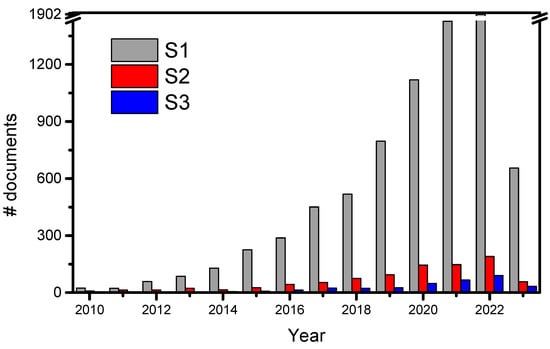
Figure 1.
Published papers and patents according to the search: S1: “Nanoparticles”, S2: “deep eutectic solvents”, and S3: “deep eutectic solvents” AND “nanoparticles”. Data source: Scopus.
Since 2011, the so-called natural deep eutectic solvents (NADES) have been prepared using organic compounds essentially found in natural sources. Choline bitartrate, betaine, proline, and choline acetate (HBAs), combined with citric acid, lactic acid, ethylene glycol, glycerol, clavulanic acid, imidazole, L-lactic acid, malic acid, or glycolic acid (HBDs) are usually obtained. These NADES can be included in the described DES type III classification [32].
DES have gained attention from the research community given their potential use as solvents with more attractive chemical properties than traditional alternatives, highlighting low vapor pressure, non-flammability, and the possibility of being liquid in a wide range of temperatures. DES are also considered to be easy to recycle compared with other solvents (such as ionic liquids). For example, they have been used to extract polysaccharides up until six experimental runs. In recent years, magnetic deep eutectic solvent preparation has been reported, using the magnetic properties for easy separation from the reaction media [31]. The possibility of preparing DES with non-toxic HBDs and HBAs is also attractive for the environmentally friendly applications of these solvents.
Based on the available information in the literature, the present review aims to provide comprehensive details about the use of Deep Eutectic Solvents (DES) for synthesizing nanoparticles and their application in water treatment processes, with a primary focus on contaminant absorption and/or degradation. This emerging technology appears to be promising and attractive due to its potential for green processes that involve the use of non-toxic and environmentally friendly reactants.
2. DES in Nanoparticles Synthesis
During the last decade, the application of DES in various synthetic fields has emerged, including nanoparticle synthesis. The use of DES in the initial stage of NP synthesis (see Figure 2) offers several advantages over traditional methods, such as co-precipitation [33,34], sol-gel [11], solvothermal methods [35], green synthesis, and photochemical synthesis [36]. The well-known low toxicity, wide range of operation temperatures, and DES high thermal stability of the DES are taken into account when selecting the appropriate route for NP synthesis [37].
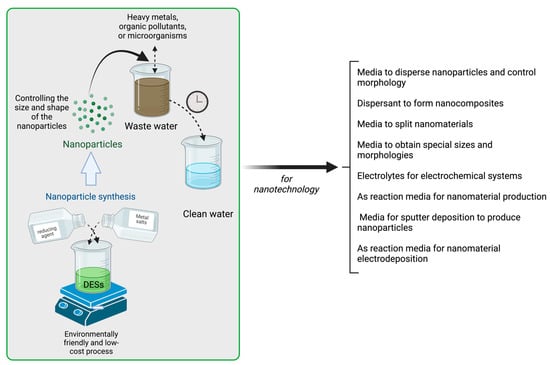
Figure 2.
General procedure for NP synthesis in the presence of DES and their possible applications in nanotechnology.
In NP synthesis, DES are used to replace traditional, most commonly used solvents [38,39,40], resulting in important advantages that can be listed as follows:
- DES are low in cost and easy to produce.
- Functionalizing nanoparticles with DES is an efficient and environmentally friendly method for the surface and properties modification of the material. By using a DES, it is possible to attach various functional groups to the NP´s surface. Functionalization can change the nanoparticle’s surface reactivity or add functionality for further processing or characterization.
- DES are effective in the removal of surface contaminants from NPs.
- DES help to stabilize NPs and keep them from clumping together.
DES have been used in the synthesis of various types of nanoparticles, including gold [41], silver [42], copper [43], iron oxide [44], and zinc oxide [45]. Depending on the synthesis method used, the nanoparticle properties are controlled. For example, Adhikari et al. [42] used choline chloride-glycerol DES to synthesize silver nanoparticles; for the synthesis, the authors employed microwave radiation for chemical reduction by using oleylamine as capping agent and reducing agent at the same time. The formation of the nanoparticles was extremely fast at only 30 s at 100 °C. As a result, the study reported that the DES-based method resulted in smaller, more uniform nanoparticles than traditional methods. In general terms, the synthesis of nanoparticles using DES involves the reduction of metal ions in the presence of a reducing agent [46]; the DES is the solvent used to dissolve the metal precursor, and the reducing agent is added to the solution. The reduction process is initiated by heating the solution, and the resulting nanoparticles are collected by centrifugation, filtration, or other separation techniques.
The nanoparticles synthesized and mediated by using DES are characterized by their size, shape, and chemical composition. Various techniques, such as transmission electron microscopy (TEM), X-ray diffraction (XRD), dynamic light scattering (DLS), Fourier transform infrared spectroscopy (FTIR), and UV-visible spectroscopy have been used to determine size, morphology, crystallinity, optical properties, and to obtain information about NP surface functionalization [38,47]. These techniques are essential in understanding the properties of the synthesized NPs, which determine their suitability for various applications.
One of the most promising applications of nanoparticles synthesized using DES is in water treatment [38,48]. NPs from iron oxide, titanium dioxide, and silver have removed pollutants such as heavy metals, organic compounds, and bacteria from water [49]. The unique properties of nanoparticles, such as their high surface area and reactivity, make them highly effective in removing or degrading pollutants from water. The main advantage of the DES in preparing nanoparticles is based on their large variety of chemical donors to obtain suspensions of metal nanoparticles [37]. For example, Mehrabi et al. (2020) used a mixture of quaternary ammonium with a compound containing carboxylic acid groups to synthesize magnetic nanoparticles onto graphene oxide, which were used to remove lead (II) and methylene blue from water [50]. The study reported that NPs showed high efficiency for removing pollutants and had low toxicity, making them a promising candidate for water treatment. Consequently, the application of nanoparticles synthesized using DES in water treatment is a promising area of research that can potentially address the global water contamination crisis.
3. Application of DES NPs in Waste Water Treatment
As described in Section 2, DES has been used in several applications in nanotechnology. They help to obtain well-defined materials for biomedicine, metallurgy, electrodeposition, separations, and gas capture, among others. However, just in the last few years, attention has been directed towards materials for waste water treatment. The literature describes the preparation and modification of nanoparticle systems for water treatment in which DES are used as raw materials, reducing agents, stabilizers, and surface modifiers. They are usually applied as adsorbents and photo-degradation catalysts of organic dyes, pharmaceuticals, metal ions, herbicides, pesticides, and other water contaminants. Methods of synthesis using DES that compete with their counterparts obtained by conventional methods, classified according to the type of nanomaterial, will be described in the following sections.
3.1. DES-Modified Carbon Nanotubes for Waste Water Treatment
Among other nanomaterials, CNTs have garnered particular attention in waste water treatment, mainly for the adsorption of different contaminants. Several methods for surface functionalization of carbon nanotubes with DES are described in the literature, which result in enhancing adsorption capabilities of the materials compared to those synthesized with conventional methods (please see Table 1 for a summary of publications dealing with DES and CNTs). Figure 3 shows a schematic representation of the most common methods for carbon nanotube functionalization. In summary, two ways are usually applied: (i) direct functionalization of pristine carbon nanotubes (P-CNTs), and (ii) DES functionalization after activation methods (i.e., oxidation and acidification).
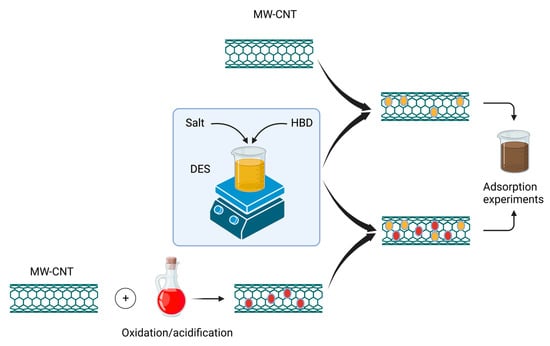
Figure 3.
Schematic representation of MW-CNT-DES functionalization steps, according to several authors.
For instance, AlOmar et al. [51] compared both functionalization methods on commercial multi-wall carbon nanotubes (MWCNTs). A mixture of three different salts and glycerol was used. For the second route, KMNO4 and HNO3 were used via ultrasonication and refluxing for oxidation and acidification of P-CNTs, respectively. Characterization showed efficient treatment and functionalization of CNTs. Figure 4 (above) shows the XRD patterns of pristine (P) and modified (K: KMNO4 oxidation, B: BTBC-glycol, M: MTPB-glycol) -CNTs. P-CNTs show typical peaks at 2θ 26° and 42°, which correspond to the hexagonal graphite structure and the concentric cylinder structure. Those peaks are reduced after oxidation with KMNO4, which destroys the hexagonal graphite structure of CNTs by wrapping them. DES functionalization further increased the wrapping around the CNTs’ edges. Moreover, Figure 4 (below) shows the presence of MNO2 embedded inside the CNT structure. Similarly, the same research group synthesized six different DES systems based on choline chloride and six hydrogen bond donors (glycerol, ethylene glycol, triethylene glycol, diethylene glycol, urea, and maleic acid) for comparison [52].
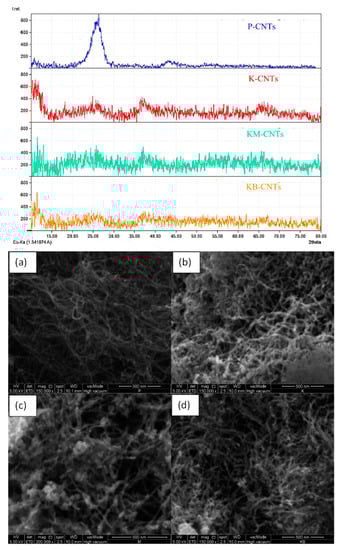
Figure 4.
(above) XRD patterns for P-CNTs, K-CNTs, KM-CNTs and KB-CNTs, and (below) FESEM image for (a) P-CNTs, (b) K-CNTs, (c) KM-CNTs, and (d) KB-CNTs [51]. Reproduced with permission from ELSEVIER.
According to several authors, DES functionalization adds more oxygen-containing groups (e.g., hydroxyl, carboxyl, and carbonyl groups), enhancing CNTs’ dispersion, purity, and the absolute value of zeta potential and specific surface area, without changing their structure [53,54]. In all contributions, functionalized P-CNTs showed an enhanced adsorption capacity of contaminants such as organic dyes (methyl orange (MO) [53], Eosin Y [55]), phenolic compounds [54], and metal ions (mercury [56], arsenic [51], lead [52], and nickel [57]).
Furthermore, Ibrahim et al. [53] demonstrated a superior adsorption capacity of methyl orange via a choline chloride-ethylene glycol-CNTs (P-ChCl-CNTs) treated material compared to its pristine (P-CNTs) version and other adsorbents published in the literature (P-CNTs = 110.45 mg g−1, P-ChCl-CNTs = 310.2 mg g−1, MWCNTs produced by chemical vapor deposition = 35–64.7 mg g−1 [58], mesoporous carbon = 294.1 mg g−1 [59], nanoparticles of copper oxide = 121.5 mg g−1 [60], among others). The same group applied a feedforward backpropagation neural network technique to predict the adsorption of 2,4 dichlorophenol (2,4-DCP) via DES-functionalized multi-wall CNTs. The impact of operational parameters such as pH, adsorbent dosage, and contact time was optimized to identify a material with a maximum adsorption capacity of 390.35 mg g−1 [54]. For a detailed list of examples, please refer to Table 1.

Table 1.
DES-functionalized carbon nanotubes for adsorption of contaminants.
Table 1.
DES-functionalized carbon nanotubes for adsorption of contaminants.
| DES Type | Molar Ratio | Nanomaterial | Functionalization/Solvent Methods | Remarks and Details | Application | Ref. | |
|---|---|---|---|---|---|---|---|
| Salt | HBD | (Salt:HBD) | |||||
| ChCl | EG | 1:2 | CNTs | Sonication with DES Oxidation with KMnO4 + sonication with DES | Significant purification of CNTs. Addition of more oxygen-containing groups Increment of the surface area | Novel adsorbents for methyl orange removal Optimal conditions: pH = 2.0, adsorbent dosage > 10 mg, contact time > 60 min. | [53] |
| N,N-diethylethanolammonium chloride | EG | 1:3 | |||||
| Tetra-n-butyl ammonium bromide (TBAB) | Glycerol | 1:4 | MWCNT | Oxidation with KMnO4 + sonication with DES | High adsorption efficiency | Highly efficient adsorbent for nickel removal 115.8 mg g−1 and 93% of adsorption capacity and maximum removal percentage, respectively. | [57] |
| ChCl | EG | 1:2 | CNTs | Acidification with H2SO4 + mixed with DES | Functionalization without CNT structure damage | Adsorbent for 2,4-DCP from water Maximum adsorption capacity 390.35 mg g−1 A neuronal network model was applied to predict 2,4-DCP adsorption | [54] |
| Methyl-triphenylphosphonium bromide (MTPB) | Glycerol | 1:3 | CNTs | Oxidation with KMnO4 + Sonication with DES Acidification with HNO3 + sonication with DES | Significant surface area increment | Novel adsorbents for As3+ Maximum adsorption capacity 23.4 mg g−1 for KMNO4 and MTPB DES-functionalized CNTs | [51] |
| Benzyltriphenylphosphonium chloride (BTPC) | 1:16 | ||||||
| ChCl | Glycerol | 1:2 | CNTs | Oxidation with KMnO4 + sonication with DESAcidification with HNO3/H2SO4 + sonication with DES | Uptake capacities were optimized by RSM-CCD experimental design | Novel adsorbent for Pb(II) removal Optimum conditions: pH = 5, dosage = 5 mg, contact time = 15 min Maximum adsorption capacity of 288.4 mg g−1 | [52] |
| Ethylene glycol | 1:2 | ||||||
| Triethylene glycol | 1:3 | ||||||
| Diethylene glycol | 1:3 | ||||||
| Urea | 1:2 | ||||||
| Maleonic acid | 1:1 | ||||||
| Tetra-n-butyl ammonium bromide (TBAB) | Glycerol | 1:1–1:10 | CNTs | Oxidation with KMnO4 + Sonication with DESAcidification with HNO3+ Sonication with DES | Significantly increase in CNT surface area from 123 to 204 m2 g−1 Presence of new functional groups | Novel adsorbents for Hg2+ removal Maximum adsorption capacity 177.76 mg g−1 Optimal removal conditions: pH = 6.4, adsorbent dosage = 6.0 mg, contact time = 45 min | [56] |
| Cetyltrimethylammonium bromide | Glycerol | 1:2 | CNT/ZnCo2O4 | DES functionalization | The material can be reused up to 5 times with little or no destruction | Eosin dye adsorption in an aqueous medium Adsorption was favored between pH range 2–7 | [55] |
3.2. DES-Modified Graphene Oxide for Waste Water Treatment
The application of graphene oxide nanomaterials (GON) has also been studied involving DES in recent years (please see Table 2 for a summary of publications dealing with DES and GON). Different from their application in CNT functionalization, DES can be used as coupling and surface functionalization agents for GON. As coupling agents, ChCl-based DES have been used to add magnetic nanoparticles onto graphene oxide layers, providing synergistically enhanced adsorption for removal of lead (II), methylene blue (MB) [50], and mercury [61] from waste water. Chen et al. [61], prepared magnetic composites from GO following the synthesis method shown in Figure 5 (left). This study confirmed the influence of DES on the homogeneity and size distribution of iron oxide NPs over the GO surface (see Figure 5 (right)). Figure 5a shows GO as a thin layer structure, while Figure 5b depicts the Fe3O4 (M) loaded on the GO surface and modified with 3-(Trimethoxysilyl)-Propyl Methacrylate (γ-MPS) in Figure 5c. Figure 5d shows that M-GO-γ-MPS was surrounded by a gray and semitransparent liquid, possibly due to the surrounding DES layer.
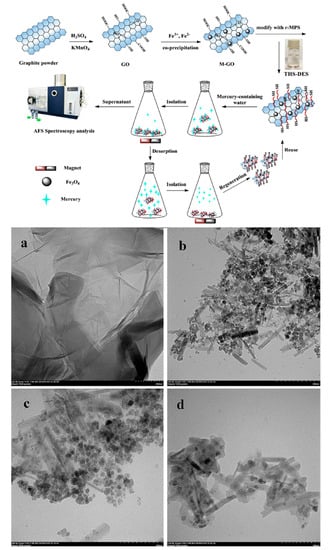
Figure 5.
(above Synthesis of THS-DES@M-GO and the removal of Hg+. (below) TEM images of GO (a), MGO (b), M-GO-γ-MPS (c) and THS-DES@M-GO (d) [61]. Reproduced with permission from ELSEVIER.
On the other hand, GO nanosheets have also been doped with ZnO and Ni3V2O8 for the photocatalytic degradation of cefixime trihydrate (CFX) [62], and anionic (MB, MO) and cationic dyes (crystal violet (CV)) [63], respectively. For instance, the optimal CFX photo-degradation efficiency reached 86% with a catalyst dose of 0.532 g L−1, an initial CFX concentration of 20.13 mg L−1, and a pH of 4.03, under UVA irradiation. Authors discussed the possible mechanism of photo-degradation, where the electron-hole pair determines the activity of the catalyst, which seemed to be increased by the presence of DES during synthesis. On the other hand, the efficiency of the N-doped Ni3V2O8 reduced graphene oxide hybrid was higher under visible light irradiation than UV light, with degradation values of 94.6 and 96.7% for MO and CV, respectively.
Table 2.
DES used as a coupling agent in synthesizing graphene oxide nanomaterials for adsorption or degradation of contaminants.
Table 2.
DES used as a coupling agent in synthesizing graphene oxide nanomaterials for adsorption or degradation of contaminants.
| DES Type | Molar Ratio | Nanomaterial | Functionalization/Solvent Methods | Remarks and Details | Application | Ref. | |
|---|---|---|---|---|---|---|---|
| Salt | HBD | (Salt:HBD) | |||||
| ChCl | Urea | 1:2 | Fe3O4, graphene oxide nanosheets | DES as coupling agent for GO-Fe3O4 nanohybrids (GO to Fe3O4 mass ratios of 1:1, 1:2, 1:5) | Successful coupling of GO and Fe3O4 NPs | Used for the removal of organic dyes and lead (II) Complete removal of 25 mg L−1 of MB within 5 min Lead (II): maximum adsorption capacity of 120.5 mg g−1 | [50] |
| ChCl | Oxalic acid | 1:2 | Ni3V2O8, N-doped reduced graphene oxide | DES as a coupling agent | Improved structural and morphological characteristics. Enhanced activity for H2 evolution and dye degradation Increased band gap and conductivity | The efficiency of degradation under Vis was higher than under UV irradiation (94.6 and 96.7% removal capacity for MO and CV, respectively) | [63] |
| ChCl | Itaconic acid/3-mercaptopropionic acid | 2:1:1 | Magnetic graphene nanoparticles | THS-DES@M-GO functionalization | Addition of -SH groups Composites have good stability and are easily regenerated | Better removal of Hg2+ than not functionalized particlesMaximum adsorption capacity of 215.1 mg g−1 | [61] |
| ChCl | Ethylene glycol | 1:2 | GO nanosheets, ZnO | All materials mixed | Efficient photocatalyst under UVA irradiation | Cefixime trihydrate degradation (86.2% removal at 4.03 pH) | [62] |
3.3. DES for Iron Oxide Nanoparticles for Waste Water Treatment
DES have also been used as ionothermal solvents and functionalization agents to synthesize magnetic iron oxide NPs. Various target pollutants for adsorption and degradation (pharmaceuticals [64,65], pesticides [66,67], organic dyes [68,69,70,71], heavy metal ions [72], etc.) are found in the literature (please see Table 3 for a summary of studies concerning DES and iron oxide nanoparticles). For example, Wei et al. [64] used seven DES based on quaternary ammonium salts and lactic acid or glycolic acid to synthesize magnetic metal-organic framework composites for the adsorption of pharmaceuticals and personal care products (see synthesis, adsorption, desorption and reuse experiments scheme in Figure 6). According to the authors, the proper use of DES can produce adsorbents with selective adsorption ability for target analytes. Husin et al. [65] showed that the presence of ChCl-BuIM during nanohybrid formation resulted in a strong generation of stable complexes through π−π interactions and hydrogen bonding between the composite materials and naproxen from waste waters. Baghaei et al. used DES to functionalize pre-synthesized cobalt ferrite nanoparticles in a different approach. These nano-adsorbents were applied for the determination of heavy metal ions (e.g., Zn(II), Ni(II), Cu(II), Pb(II), and Hg(II)) in water and fruit juice samples.
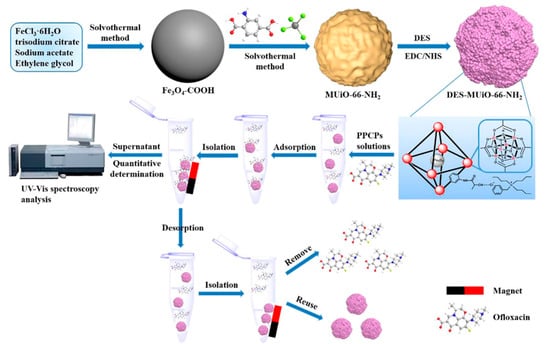
Figure 6.
Schematic representation of synthesis of magnetic (Fe3O4) metal-organic framework (MUiO-66-NH2) composites and the selective adsorption of pharmaceuticals and personal care products (PPCPs) [64]. Reproduced with permission from ELSEVIER.
Moreover, DES have also been used for the ionothermal synthesis of Fe3O4 metal NPs. These materials worked as Fenton-like catalysts for the degradation of Rhodamine B, showing higher adsorption capacities than undoped materials [69,70]. Magnetic monoliths composed of polyacrylamide-ϒ-Fe2O3 nanoparticles have successfully adsorbed an organic dye such as MB, reaching maximum adsorption capacity as high as 350 mg g−1 [71].
Table 3.
Magnetic iron oxide nanoparticles and DES for adsorption and degradation of contaminants.
Table 3.
Magnetic iron oxide nanoparticles and DES for adsorption and degradation of contaminants.
| DES Type | Molar Ratio | Nanomaterial | Functionalization/Solvent Methods | Remarks and Details | Application | Ref. | |
|---|---|---|---|---|---|---|---|
| Salt | HBD | (Salt:HBD) | |||||
| Tetraethylammonium chloride (TEAC) | Lactic acid | 1:2 | Magnetic (Fe3O4) metal-organic framework (MUiO-66-NH2) composites | Previous EDC/NHS chemistry treatment then stirred with DES | Good adsorption capacity, prominent anti-interference ability and outstanding renewability and re-usability DES-MUiO-66-NH2 adsorbed pharmaceuticals and personal care products (PPCPs) through electrostatic interaction, chelation, hydrophobic interaction, π-π stacking, and hydrogen bonding. | Used in the adsorption of PPCPs PPCP: solutions of mefenamic acid, ibuprofen, indomethacin and diclofenac | [64] |
| Tetrabutylammonium chloride (TBAC) | 1:2 | ||||||
| Benzyltributylammonium chloride (BTBAC) | 1:2 | ||||||
| Benzyl tributyl ammonium bromide (BTBAB) | 1:2 | ||||||
| Dodecyltributylammonium chloride (DTBAC) | 1:2 | ||||||
| Tetrabutylammonium chloride (TBAC) | Glycolic acid | 1:2 | |||||
| Benzyltributylammonium chloride (BTBAC) | 1:2 | ||||||
| ChCl | BuIM | 1:1 | Fe3O4@MIP | DES as co-monomer for template pre-polymerization | The presence of ChCl-BuIM resulted in the strong formation of stable complexes through the π−π interaction and hydrogen bonding between adsorbents and adsorbatesMultilayer adsorption occurred | Used as adsorbent for naproxen They could be applied to imprint other non-steroidal anti-inflammatory drugs | [65] |
| ChCl | p-aminophenol | 1:2 | Cobalt ferrite nanoparticles | Pre-treated of NPs with sodium dodecyl + DES sonication | DES had two important roles; as a coating for the nanoparticles and as a complexing agent | Used as nano-sorbent for the extraction of Zn(II), Ni(II), Cu(II), Pb(II), and Hg(II) | [72] |
| ChCl | Citric acid | 2:1 | Iron oxide NPs | DES as a non-toxic solvent for NP synthesis | Superparamagnetic Fe3O4 nanocubes DES played a crucial role in the control of size and morphology | Used for photo-degradation of Rhodamine B 94% dye degradation in 180 min under UV irradiation Stable up to five successive cycles | [68] |
| ChCl | Urea | 1:2 | Cu-Fe3O4 metal NPs | DES as a non-toxic solvent for NP synthesis | Evidence of substitution of Fe2+ with Cu2+ at octahedral sites Cu2+ ions enhance the regeneration of Fenton active species Fe2+ by reduction of Fe3+ Higher peroxidase-like activity | Exemplary degradation of Rhodamine B Faster decomposition compared to undoped materials (0.584 vs. 0.153 h−1, respectively) Enhanced H2O2-activation at pH = 7 and 25 °C | [69] |
| ChCl | Urea | 1:2 | Fe3O4 magnetic NPs | Oxidative precipitation + ionothermal synthesis | Magnetic NPs as efficient and stable catalysts | A Fenton-like catalyst for Rhodamine B degradation First order rate constant 0.0376 min−1) >98% degradation efficiency of Rhodamine B in 2 h | [70] |
| d-l-menthol | Pyruvic acid | 1:2 | Magnetic monoliths composed of polyacrylamide-ϒ– Fe2O3 NPs | Green internal phase for the formulation of high internal phase formulations | Allowed formulation of stable emulsions used as templates in the fabrication of polyacrylamide macroporous materials | Used for methylene blue adsorption Maximum adsorption capacity reported (>350 mg g−1) Reusable materials for more than 6 adsorption-desorption cycles | [71] |
| Acetic acid | 1:1 | ||||||
| Lactic acid | 1:2 | ||||||
| Lauric acid | 2:1 | ||||||
| Dimethyl ammonium chloride | 4-chlorophenol | 1:5 | Fe3O4@PDA | DES functionalization | This method has low limit of detection (LOD), good repeatability, high pre-concentration factor, and extraction recoveries | For detecting sulfonylurea herbicides in water samples | [66] |
| Menthol | Acrylic acid | 2:1 | Magnetic poly (AA-menthol DES) hydrogel | DES used as a functional monomer | Hydrogels with large specific surface area and enhanced selectivity Its use can be considered a green extraction technique The average enrichment factor (58) indicates the effectiveness of the hydrogel for extracting the analytes. Low LODs and a relatively wide linear range show the sensitivity of this method | Use for pesticides extraction, such as including lindane, alachlor, aldrin, bromophos methyl, heptachlor epoxide, α-endosulfan, hexaconazole, dieldrin, endrin, β- endosulfan, diazinon, endosulfan sulfate, bromopropylate, fenpropathrin, tetradifon, and fenvalerate | [67] |
| ChCl | Urea | 1:2 | Spherical Fe3O4 magnetic NPs | DES for co-precipitation | Spherical Fe3O4 magnetic NPs (Fe3O4-DES) with an average particle size of ca. 10.5 nm | Compared to Fe3O4 made in water, Fe3O4-DES nanoparticles show significantly improved adsorption capacity of Cu2þ after surface modification with EDTA (28.0 vs. 21.0 mg/ gFe3O4) and are easy to be recovered by an external magnet | [73] |
| ChCl | Sucrose | 2:1 | Iron nanoparticles (Fe NPs) | DES as a stabilizing and capping agent | Synthesis of amorphous Fe NPsusing cane sugar-based DES as a bio-reductant and a capping agent by a one-pot co-precipitation method | The nanocatalyst displays excellent dye degradation efficiency (96.06%) within 30 min | [74] |
3.4. Miscellaneous Materials
Finally, Table 4 shows various types of DES used in synthesis and functionalization of different nanomaterials (e.g., chitosan NPs [75], TiO2, SiO2 NPs [76,77], nickel nanorods [78], and many others) for environmental applications. The contaminants treated include a range of dyes, pharmaceuticals, and other pollutants. For example, malachite green dye [75], Congo red [77], flumequine [79], methyl orange, indigo carmine [80], sulfamethoxazole [81], among others, were removed from aqueous solutions using various types of DES- functionalized nanomaterials. Levofloxacin-imprinted nanoparticles were used to remove levofloxacin, while mesoporous α-MnO2 adsorbs Congo red. Nitrogen-doped ceria nanoparticles [82] were used to degrade sulfamethoxazole through photo-catalysis, and ultrathin double-layered Mg-Al hydroxide was used to remove borate [80]. Furthermore, through photo-Fenton degradation, a metal–DES system was used to degrade organic pollutants such as Rhodamine B and methylene blue [83].
Table 4.
Miscellaneous materials and DES for adsorption and degradation of contaminants.
The common properties among the examples include successful modification with thermal stability, improved adsorption site morphology, good selectivity to anionic dyes, highly stable and crystalline mesoporous structures, and small size with uniform surface due to the presence of DES, for improved contaminant removal. Additionally, materials such as polyimide membranes embedded with DES@SiO2, silica-modified particles, and wood with selective removal of lignin and hemicellulose using DES showed improved mechanical properties, porosity, and hydrophilicity [76]. The materials also demonstrated high photocatalytic efficiency, high flux, and rejection for cationic dyes. In some cases, materials such as nickel NPs and DES-LIN showed good re-usability for water decontamination.
4. Future Perspectives
The use of environmentally friendly solvents, such as deep eutectic solvents (DES), in synthesizing different types of nanoparticles has gained significant attention from the research community in recent years. DES are attractive due to their vast chemical diversity, minimum toxicity, low cost, and sustainable properties, making them a promising alternative to conventional solvents. Furthermore, DES can be easily synthesized from natural and renewable resources, adding to their eco-friendly appeal.
One of the significant advantages of synthesizing nanoparticles mediated by DES is the possibility for greater control of particle size and shape. This control can be crucial in designing materials with specific properties for selected applications. DES can also act as stabilizers during the synthesis process, improving the overall quality of the nanoparticles. The application of DES-mediated nanoparticles in water treatment has also been of increasing interest. Surface modification of nanoparticles with DES can enhance their adsorption capacity, allowing for more effective removal of contaminants from polluted water. Moreover, the use of DES in the degradation of pollutants through catalytic reactions has shown great potential for sustainable water treatment technologies.
Despite the advantages of using DES in synthesizing and applying nanoparticles for water treatment, information on this topic is still dispersed throughout the literature. Consequently, comprehensive reviews such as this one are crucial for consolidating information and advancing research in the field. Looking forward, the potential of DES-mediated nanoparticles in water treatment is vast. Further research is needed to optimize synthesis and application of these nanoparticles for more efficient and sustainable water treatment technologies. Additionally, the functionalization of nanoparticles with DES can lead to novel materials with unique properties and applications beyond water treatment, but some challenges remain such as thermal instability and high viscosity. Another important challenge is related to costs; despite being considered low cost, DES may imply higher initial investments in large scale process, and additional costs associated with re-using the solvent. However, as more technologies surrounding DES are implemented, larger industrial development may be boosted, which could potentially help lower the costs in the long term. It was summarized all these features and future perspectives for DES and nanoparticles in Figure 7.
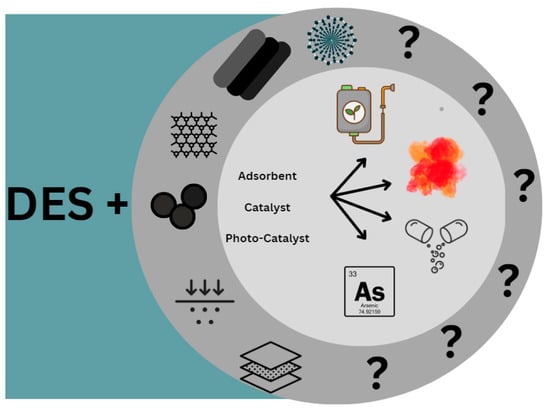
Figure 7.
Future perspectives for DES and nanoparticles in water treatment.
In conclusion, with further research and development, for extending the scope to more nanoparticle systems and better controlling NPs’ properties, the potential industrial applications of DES-mediated nanoparticles are eminent and promising. They would represent a valuable contribution to the development of sustainable technologies, including, water treatment.
Author Contributions
Conceptualization, S.P. and J.R.M.; data curation, S.P. and J.R.M.; writing—original draft preparation, S.P., J.R.M., H.A.M., F.A. and J.A.-B.; writing—review and editing, S.P., J.R.M., H.A.M., F.A. and J.A.-B. All authors have read and agreed to the published version of the manuscript.
Funding
This research received no funding.
Institutional Review Board Statement
Not applicable.
Informed Consent Statement
Not applicable.
Data Availability Statement
Not applicable.
Acknowledgments
The authors are grateful to the USFQ Collaboration and POLI grants 2022–2023 for the financial support of this research.
Conflicts of Interest
The authors declare no conflict of interest.
References
- Yavuz, Y.; Ögütveren, B. Treatment of Industrial Estate Wastewater by the Application of Electrocoagulation Process Using Iron Electrodes. J. Environ. Manage. 2018, 207, 151–158. [Google Scholar] [CrossRef] [PubMed]
- Gupta, S.; Mittal, Y.; Panja, R.; Prajapati, K.B.; Yadav, A.K. Conventional Wastewater Treatment Technologies. Curr. Dev. Biotechnol. Bioeng. Strateg. Perspect. Solid Waste Wastewater Manag. 2021, 47–75. [Google Scholar] [CrossRef]
- Zamora-Ledezma, C.; Negrete-Bolagay, D.; Figueroa, F.; Zamora-Ledezma, E.; Ni, M.; Alexis, F.; Guerrero, V.H. Heavy Metal Water Pollution: A Fresh Look about Hazards, Novel and Conventional Remediation Methods. Environ. Technol. Innov. 2021, 22, 101504. [Google Scholar] [CrossRef]
- Guerra, F.D.; Attia, M.F.; Whitehead, D.C.; Alexis, F. Nanotechnology for Environmental Remediation: Materials and Applications. Molecules 2018, 23, 1760. [Google Scholar] [CrossRef] [PubMed]
- Gnanamoorthy, G.; Ali, H.; Yadav, V.K.; Ali, D.; Kumar, G.; Narayanan, V. New Development and Photocatalytic Performance and Antimicrobial Activity of α-NH4(VO2)(HPO4) Nanosheets. Spectrochim. Acta Part A Mol. Biomol. Spectrosc. 2022, 276, 121250. [Google Scholar] [CrossRef] [PubMed]
- Gnanamoorthy, G.; Yadav, V.K.; Ali, D.; Ramar, K.; Kumar, G.; Narayanan, V. New Designing (NH4)2SiP4O13 Nanowires and Effective Photocatalytic Degradation of Malachite Green and Antimicrobial Properties. Chem. Phys. Lett. 2022, 803, 139817. [Google Scholar] [CrossRef]
- Monsef Khoshhesab, Z.; Souhani, S. Adsorptive Removal of Reactive Dyes from Aqueous Solutions Using Zinc Oxide Nanoparticles. J. Chin. Chem. Soc. 2018, 65, 1482–1490. [Google Scholar] [CrossRef]
- Jamkhande, P.G.; Ghule, N.W.; Bamer, A.H.; Kalaskar, M.G. Metal Nanoparticles Synthesis: An Overview on Methods of Preparation, Advantages and Disadvantages, and Applications. J. Drug Deliv. Sci. Technol. 2019, 53, 101174. [Google Scholar] [CrossRef]
- Mittal, A.K.; Chisti, Y.; Banerjee, U.C. Synthesis of Metallic Nanoparticles Using Plant Extracts. Biotechnol. Adv. 2013, 31, 346–356. [Google Scholar] [CrossRef]
- Panigrahi, S.; Kundu, S.; Ghosh, S.K.; Nath, S.; Pal, T. General Method of Synthesis for Metal Nanoparticles. J. Nanopart. Res. 2004, 6, 411–414. [Google Scholar] [CrossRef]
- Tomé, L.C.; Mecerreyes, D. Emerging Ionic Soft Materials Based on Deep Eutectic Solvents. J. Phys. Chem. B 2020, 124, 8465–8478. [Google Scholar] [CrossRef] [PubMed]
- Kamat, P.V.; Meisel, D. Nanoparticles in Advanced Oxidation Processes. Curr. Opin. Colloid Interface Sci. 2002, 7, 282–287. [Google Scholar] [CrossRef]
- Bethi, B.; Sonawane, S.H.; Bhanvase, B.A.; Gumfekar, S.P. Nanomaterials-Based Advanced Oxidation Processes for Wastewater Treatment: A Review. Chem. Eng. Process.—Process Intensif. 2016, 109, 178–189. [Google Scholar] [CrossRef]
- Chan, S.H.S.; Wu, T.Y.; Juan, J.C.; Teh, C.Y. Recent Developments of Metal Oxide Semiconductors as Photocatalysts in Advanced Oxidation Processes (AOPs) for Treatment of Dye Waste-Water. J. Chem. Technol. Biotechnol. 2011, 86, 1130–1158. [Google Scholar] [CrossRef]
- Bokare, A.D.; Choi, W. Review of Iron-Free Fenton-like Systems for Activating H2O2 in Advanced Oxidation Processes. J. Hazard. Mater. 2014, 275, 121–135. [Google Scholar] [CrossRef]
- Miklos, D.B.; Remy, C.; Jekel, M.; Linden, K.G.; Drewes, J.E.; Hübner, U. Evaluation of Advanced Oxidation Processes for Water and Wastewater Treatment—A Critical Review. Water Res. 2018, 139, 118–131. [Google Scholar] [CrossRef] [PubMed]
- Jiang, P.; Ren, D.; He, D.; Fu, W.; Wang, J.; Gu, M. An Easily Sedimentable and Effective TiO2 Photocatalyst for Removal of Dyes in Water. Sep. Purif. Technol. 2014, 122, 128–132. [Google Scholar] [CrossRef]
- Pan, Y.; Zhang, Y.; Huang, Y.; Jia, Y.; Chen, L. Enhanced Photocatalytic Oxidation Degradability for Real Cyanide Wastewater by Designing Photocatalyst GO/TiO2/ZSM-5: Performance and Mechanism Research. Chem. Eng. J. 2022, 428, 131257. [Google Scholar] [CrossRef]
- Asencios, Y.J.O.; Lourenço, V.S.; Carvalho, W.A. Removal of Phenol in Seawater by Heterogeneous Photocatalysis Using Activated Carbon Materials Modified with TiO2. Catal. Today 2022, 388–389, 247–258. [Google Scholar] [CrossRef]
- Si, H.; Zhou, M.; Fang, Y.; He, J.; Yang, L.; Wang, F. Photocatalytic Concrete for NOx Degradation: Influence Factors and Durability. Constr. Build. Mater. 2021, 298, 123835. [Google Scholar] [CrossRef]
- Hwang, J.Y.; Moon, G.H.; Kim, B.; Tachikawa, T.; Majima, T.; Hong, S.; Cho, K.; Kim, W.; Choi, W. Crystal Phase-Dependent Generation of Mobile OH Radicals on TiO2: Revisiting the Photocatalytic Oxidation Mechanism of Anatase and Rutile. Appl. Catal. B Environ. 2021, 286, 119905. [Google Scholar] [CrossRef]
- Conde-Rivera, L.R.; Suarez-Escobar, A.F.; Marin-Perez, J.J.; Junco-Rodriguez, M.J.; Lopez-Suarez, F.E. TiO2 Supported on Activated Carbon from Tire Waste for Ibuprofen Removal. Mater. Lett. 2021, 291, 129590. [Google Scholar] [CrossRef]
- Wang, L.; Ali, J.; Zhang, C.; Mailhot, G.; Pan, G. Simultaneously Enhanced Photocatalytic and Antibacterial Activities of TiO2/Ag Composite Nanofibers for Wastewater Purification. J. Environ. Chem. Eng. 2020, 8, 102104. [Google Scholar] [CrossRef]
- Abodif, A.M.; Abodif, A.M.; Meng, L.; Ma, S.; Ahmed, A.S.A.; Belvett, N.; Wei, Z.Z.; Ning, D. Mechanisms and Models of Adsorption: TiO2-Supported Biochar for Removal of 3,4-Dimethylaniline. ACS Omega 2020, 5, 13630–13640. [Google Scholar] [CrossRef] [PubMed]
- Xu, N.; Cheng, X.; Zhou, K.; Xu, X.; Li, Z.; Chen, J.; Wang, D.; Li, D. Facilitated Transport of Titanium Dioxide Nanoparticles via Hydrochars in the Presence of Ammonium in Saturated Sands: Effects of PH, Ionic Strength, and Ionic Composition. Sci. Total Environ. 2018, 612, 1348–1357. [Google Scholar] [CrossRef] [PubMed]
- Dong, H.; Zeng, G.; Tang, L.; Fan, C.; Zhang, C.; He, X.; He, Y. An Overview on Limitations of TiO2-Based Particles for Photocatalytic Degradation of Organic Pollutants and the Corresponding Countermeasures. Water Res. 2015, 79, 128–146. [Google Scholar] [CrossRef] [PubMed]
- Abbott, A.P.; Capper, G.; Davies, D.L.; Rasheed, R.K.; Tambyrajah, V. Novel Solvent Properties of Choline Chloride/Urea Mixtures. Chem. Commun. 2003, 39, 70–71. [Google Scholar] [CrossRef]
- Del Monte, F.; Carriazo, D.; Serrano, M.C.; Gutiérrez, M.C.; Ferrer, M.L. Deep Eutectic Solvents in Polymerizations: A Greener Alternative to Conventional Syntheses. ChemSusChem 2014, 7, 999–1009. [Google Scholar] [CrossRef]
- Cooper, E.R.; Andrews, C.D.; Wheatley, P.S.; Webb, P.B.; Wormald, P.; Morris, R.E. Ionic Liquids and Eutectic Mixtures as Solvent and Template in Synthesis of Zeolite Analogues. Nature 2004, 430, 1012–1016. [Google Scholar] [CrossRef]
- Smith, E.L.; Abbott, A.P.; Ryder, K.S. Deep Eutectic Solvents (DESs) and Their Applications. Chem. Rev. 2014, 114, 11060–11082. [Google Scholar] [CrossRef]
- Hansen, B.B.; Spittle, S.; Chen, B.; Poe, D.; Zhang, Y.; Klein, J.M.; Horton, A.; Adhikari, L.; Zelovich, T.; Doherty, B.W.; et al. Deep Eutectic Solvents: A Review of Fundamentals and Applications. Chem. Rev. 2021, 121, 1232–1285. [Google Scholar] [CrossRef]
- Liu, Y.; Friesen, J.B.; McAlpine, J.B.; Lankin, D.C.; Chen, S.N.; Pauli, G.F. Natural Deep Eutectic Solvents: Properties, Applications, and Perspectives. J. Nat. Prod. 2018, 81, 679–690. [Google Scholar] [CrossRef]
- Carrera, S.A.; Villarreal, J.S.; Acosta, P.I.; Noboa, J.F.; Gallo-Cordova, A.; Mora, J.R. Designing an Efficient and Recoverable Magnetic Nanocatalyst Based on Ca, Fe and Pectin for Biodiesel Production. Fuel 2022, 310, 122456. [Google Scholar] [CrossRef]
- Gangotena, P.A.; Ponce, S.; Gallo-Córdova, Á.; Streitwieser, D.A.; Mora, J.R. Highly Active MgP Catalyst for Biodiesel Production and Polyethylene Terephthalate Depolymerization. ChemistrySelect 2022, 7, e202103765. [Google Scholar] [CrossRef]
- Munoz, M.; Ponce, S.; Zhang, G.R.; Etzold, B.J.M. Size-Controlled PtNi Nanoparticles as Highly Efficient Catalyst for Hydrodechlorination Reactions. Appl. Catal. B Environ. 2016, 192, 1–7. [Google Scholar] [CrossRef]
- Ponce, S.; Hernandez, M.; Vizuete, K.; Streitwieser, D.A.; Debut, A. Fast Synthesis of Silver Colloids with a Low-Cost 3D Printed Photo-Reactor. Colloid Interface Sci. Commun. 2021, 43, 100457. [Google Scholar] [CrossRef]
- Lee, J.S. Deep Eutectic Solvents as Versatile Media for the Synthesis of Noble Metal Nanomaterials. Nanotechnol. Rev. 2017, 6, 271–278. [Google Scholar] [CrossRef]
- Tomé, L.I.N.; Baião, V.; da Silva, W.; Brett, C.M.A. Deep Eutectic Solvents for the Production and Application of New Materials. Appl. Mater. Today 2018, 10, 30–50. [Google Scholar] [CrossRef]
- Abo-Hamad, A.; Hayyan, M.; AlSaadi, M.A.H.; Hashim, M.A. Potential Applications of Deep Eutectic Solvents in Nanotechnology. Chem. Eng. J. 2015, 273, 551–567. [Google Scholar] [CrossRef]
- Karimi, M.; Hesaraki, S.; Alizadeh, M.; Kazemzadeh, A. One-Pot and Sustainable Synthesis of Nanocrystalline Hydroxyapatite Powders Using Deep Eutectic Solvents. Mater. Lett. 2016, 175, 89–92. [Google Scholar] [CrossRef]
- Liao, H.G.; Jiang, Y.X.; Zhou, Z.Y.; Chen, S.P.; Sun, S.G. Shape-Controlled Synthesis of Gold Nanoparticles in Deep Eutectic Solvents for Studies of Structure–Functionality Relationships in Electrocatalysis. Angew. Chem. Int. Ed. 2008, 47, 9100–9103. [Google Scholar] [CrossRef] [PubMed]
- Adhikari, L.; Larm, N.E.; Bhawawet, N.; Baker, G.A. Rapid Microwave-Assisted Synthesis of Silver Nanoparticles in a Halide-Free Deep Eutectic Solvent. ACS Sustain. Chem. Eng. 2018, 6, 5725–5731. [Google Scholar] [CrossRef]
- Zhang, Q.B.; Hua, Y.X. Electrochemical Synthesis of Copper Nanoparticles Using Cuprous Oxide as a Precursor in Choline Chloride–Urea Deep Eutectic Solvent: Nucleation and Growth Mechanism. Phys. Chem. Chem. Phys. 2014, 16, 27088–27095. [Google Scholar] [CrossRef] [PubMed]
- Jia, H.; Sun, J.; Dong, M.; Dong, H.; Zhang, H.; Xie, X. Deep Eutectic Solvent Electrolysis for Preparing Water-Soluble Magnetic Iron Oxide Nanoparticles. Nanoscale 2021, 13, 19004–19011. [Google Scholar] [CrossRef] [PubMed]
- Gontrani, L.; Donia, D.T.; Maria Bauer, E.; Tagliatesta, P.; Carbone, M. Novel Synthesis of Zinc Oxide Nanoparticles from Type IV Deep Eutectic Solvents. Inorg. Chim. Acta 2023, 545, 121268. [Google Scholar] [CrossRef]
- Mahmoud, M.A. Simultaneous Reduction of Metal Ions by Multiple Reducing Agents Initiates the Asymmetric Growth of Metallic Nanocrystals. Cryst. Growth Des. 2015, 15, 4279–4286. [Google Scholar] [CrossRef]
- Huang, Y.; Shen, F.; La, J.; Luo, G.; Lai, J.; Liu, C.; Chu, G. Synthesis and Characterization of CuCl Nanoparticles in Deep Eutectic Solvents. Part. Sci. Technol. 2013, 31, 81–84. [Google Scholar] [CrossRef]
- Aruchamy, K.; Maalige, R.N.; Halanur, M.M.; Mahto, A.; Nagaraj, R.; Kalpana, D.; Ghosh, D.; Mondal, D.; Nataraj, S.K. Ultrafast Synthesis of Exfoliated Manganese Oxides in Deep Eutectic Solvents for Water Purification and Energy Storage. Chem. Eng. J. 2020, 379, 122327. [Google Scholar] [CrossRef]
- Anjum, M.; Miandad, R.; Waqas, M.; Gehany, F.; Barakat, M.A. Remediation of Wastewater Using Various Nano-Materials. Arab. J. Chem. 2019, 12, 4897–4919. [Google Scholar] [CrossRef]
- Mehrabi, N.; Haq, U.F.A.; Reza, M.T.; Aich, N. Application of Deep Eutectic Solvent for Conjugation of Magnetic Nanoparticles onto Graphene Oxide for Lead(II) and Methylene Blue Removal. J. Environ. Chem. Eng. 2020, 8, 104222. [Google Scholar] [CrossRef]
- AlOmar, M.K.; Alsaadi, M.A.; Hayyan, M.; Akib, S.; Hashim, M.A. Functionalization of CNTs Surface with Phosphonuim Based Deep Eutectic Solvents for Arsenic Removal from Water. Appl. Surf. Sci. 2016, 389, 216–226. [Google Scholar] [CrossRef]
- AlOmar, M.K.; Alsaadi, M.A.; Hayyan, M.; Akib, S.; Ibrahim, R.K.; Hashim, M.A. Lead Removal from Water by Choline Chloride Based Deep Eutectic Solvents Functionalized Carbon Nanotubes. J. Mol. Liq. 2016, 222, 883–894. [Google Scholar] [CrossRef]
- Ibrahim, R.K.; El-Shafie, A.; Hin, L.S.; Mohd, N.S.B.; Aljumaily, M.M.; Ibraim, S.; AlSaadi, M.A. A Clean Approach for Functionalized Carbon Nanotubes by Deep Eutectic Solvents and Their Performance in the Adsorption of Methyl Orange from Aqueous Solution. J. Environ. Manage. 2019, 235, 521–534. [Google Scholar] [CrossRef]
- Ibrahim, R.K.; Fiyadh, S.S.; AlSaadi, M.A.; Hin, L.S.; Mohd, N.S.; Ibrahim, S.; Afan, H.A.; Fai, C.M.; Ahmed, A.N.; Elshafie, A. Feedforward Artificial Neural Network-Based Model for Predicting the Removal of Phenolic Compounds from Water by Using Deep Eutectic Solvent-Functionalized CNTs. Molecules 2020, 25, 1511. [Google Scholar] [CrossRef] [PubMed]
- Lawal, I.A.; Dolla, T.H.; Pruessner, K.; Ndungu, P. Synthesis and Characterization of Deep Eutectic Solvent Functionalized CNT/ZnCo2O4 Nanostructure: Kinetics, Isotherm and Regenerative Studies on Eosin Y Adsorption. J. Environ. Chem. Eng. 2019, 7, 102877. [Google Scholar] [CrossRef]
- AlOmar, M.K.; Alsaadi, M.A.; Jassam, T.M.; Akib, S.; Ali Hashim, M. Novel Deep Eutectic Solvent-Functionalized Carbon Nanotubes Adsorbent for Mercury Removal from Water. J. Colloid Interface Sci. 2017, 497, 413–421. [Google Scholar] [CrossRef] [PubMed]
- Rahmati, N.; Rahimnejad, M.; Pourali, M.; Muallah, S.K. Effective Removal of Nickel Ions from Aqueous Solution Using Multi-Wall Carbon Nanotube Functionalized by Glycerol-Based Deep Eutectic Solvent. Colloid Interface Sci. Commun. 2021, 40, 100347. [Google Scholar] [CrossRef]
- Yao, Y.; Bing, H.; Feifei, X.; Xiaofeng, C. Equilibrium and Kinetic Studies of Methyl Orange Adsorption on Multiwalled Carbon Nanotubes. Chem. Eng. J. 2011, 170, 82–89. [Google Scholar] [CrossRef]
- Mohammadi, N.; Khani, H.; Gupta, V.K.; Amereh, E.; Agarwal, S. Adsorption Process of Methyl Orange Dye onto Mesoporous Carbon Material–Kinetic and Thermodynamic Studies. J. Colloid Interface Sci. 2011, 362, 457–462. [Google Scholar] [CrossRef]
- Darwish, A.A.A.; Rashad, M.; AL-Aoh, H.A. Methyl Orange Adsorption Comparison on Nanoparticles: Isotherm, Kinetics, and Thermodynamic Studies. Dye. Pigment. 2019, 160, 563–571. [Google Scholar] [CrossRef]
- Chen, J.; Wang, Y.; Wei, X.; Xu, P.; Xu, W.; Ni, R.; Meng, J. Magnetic Solid-Phase Extraction for the Removal of Mercury from Water with Ternary Hydrosulphonyl-Based Deep Eutectic Solvent Modified Magnetic Graphene Oxide. Talanta 2018, 188, 454–462. [Google Scholar] [CrossRef] [PubMed]
- Ciğeroğlu, Z.; Şahin, S.; Kazan, E.S. One-Pot Green Preparation of Deep Eutectic Solvent-Assisted ZnO/GO Nanocomposite for Cefixime Trihydrate Photocatalytic Degradation under UV-A Irradiation. Biomass Convers. Biorefinery 2022, 12, 73–86. [Google Scholar] [CrossRef]
- Alharthi, F.A.; Ababtain, A.S.; Aldubeikl, H.K.; Alanazi, H.S.; Hasan, I. Deep Eutectic Solvent-Mediated Synthesis of Ni3V2O8/N-Doped RGO for Visible-Light-Driven H2 Evolution and Simultaneous Degradation of Dyes. Inorganics 2023, 11, 67. [Google Scholar] [CrossRef]
- Wei, X.; Wang, Y.; Chen, J.; Xu, F.; Liu, Z.; He, X.; Li, H.; Zhou, Y. Adsorption of Pharmaceuticals and Personal Care Products by Deep Eutectic Solvents-Regulated Magnetic Metal-Organic Framework Adsorbents: Performance and Mechanism. Chem. Eng. J. 2020, 392, 124808. [Google Scholar] [CrossRef]
- Husin, N.A.; Muhamad, M.; Yahaya, N.; Miskam, M.; Kamal, N.N.S.N.K.; Asman, S.; Raoov, M.; Zain, N.N.M. Application of a New Choline-Imidazole Based Deep Eutectic Solvents in Hybrid Magnetic Molecularly Imprinted Polymer for Efficient and Selective Removal of Naproxen from Aqueous Samples. Mater. Chem. Phys. 2021, 261, 124228. [Google Scholar] [CrossRef]
- Wang, D.D.; Zhao, Y.; Ouyang, M.N.; Guo, H.M.; Yang, Z.H. Magnetic Polydopamine Modified with Deep Eutectic Solvent for the Magnetic Solid-Phase Extraction of Sulfonylurea Herbicides in Water Samples. J. Chromatogr. A 2019, 1601, 53–59. [Google Scholar] [CrossRef]
- Jamshidi, F.; Nouri, N.; Sereshti, H.; Shojaee Aliabadi, M.H. Synthesis of Magnetic Poly (Acrylic Acid-Menthol Deep Eutectic Solvent) Hydrogel: Application for Extraction of Pesticides. J. Mol. Liq. 2020, 318, 114073. [Google Scholar] [CrossRef]
- Sakthi Sri, S.P.; Taj, J.; George, M. Facile Synthesis of Magnetite Nanocubes Using Deep Eutectic Solvent: An Insight to Anticancer and Photo-Fenton Efficacy. Surf. Interfaces 2020, 20, 100609. [Google Scholar] [CrossRef]
- Huang, X.; Xu, C.; Ma, J.; Chen, F. Ionothermal Synthesis of Cu-Doped Fe3O4 Magnetic Nanoparticles with Enhanced Peroxidase-like Activity for Organic Wastewater Treatment. Adv. Powder Technol. 2018, 29, 796–803. [Google Scholar] [CrossRef]
- Chen, F.; Xie, S.; Huang, X.; Qiu, X. Ionothermal Synthesis of Fe3O4 Magnetic Nanoparticles as Efficient Heterogeneous Fenton-like Catalysts for Degradation of Organic Pollutants with H2O2. J. Hazard. Mater. 2017, 322, 152–162. [Google Scholar] [CrossRef]
- Vallejo-Macías, M.T.; Recio-Colmenares, C.L.; Pelayo-Vázquez, J.B.; Gómez-Salazar, S.; Carvajal-Ramos, F.; Soltero-Martínez, J.F.; Vázquez-Lepe, M.; Mota-Morales, J.D.; Pérez-García, M.G. Macroporous Polyacrylamide γ-Fe2O3 Nanoparticle Composites as Methylene Blue Dye Adsorbents. ACS Appl. Nano Mater. 2020, 3, 5794–5806. [Google Scholar] [CrossRef]
- Ali Mohammadzadeh Baghaei, P.; Afshar Mogaddam, M.R.; Farajzadeh, M.A.; Mohebbi, A.; Sorouraddin, S.M. Application of Deep Eutectic Solvent Functionalized Cobalt Ferrite Nanoparticles in Dispersive Micro Solid Phase Extraction of Some Heavy Metals from Aqueous Samples Prior to ICP-OES. J. Food Compos. Anal. 2023, 117, 105125. [Google Scholar] [CrossRef]
- Chen, F.; Xie, S.; Zhang, J.; Liu, R. Synthesis of Spherical Fe3O4 Magnetic Nanoparticles by Co-Precipitation in Choline Chloride/Urea Deep Eutectic Solvent. Mater. Lett. 2013, 112, 177–179. [Google Scholar] [CrossRef]
- Swathi Pon Sakthi Sri, V.; Manikandan, A.; Mathankumar, M.; Tamizhselvi, R.; George, M.; Murugaiah, K.; Kashmery, H.A.; Al-Zahrani, S.A.; Puttegowda, M.; Khan, A.; et al. Unveiling the Photosensitive and Magnetic Properties of Amorphous Iron Nanoparticles with Its Application towards Decontamination of Water and Cancer Treatment. J. Mater. Res. Technol. 2021, 15, 99–118. [Google Scholar] [CrossRef]
- Sadiq, A.C.; Olasupo, A.; Rahim, N.Y.; Ngah, W.S.W.; Suah, F.B.M. Comparative Removal of Malachite Green Dye from Aqueous Solution Using Deep Eutectic Solvents Modified Magnetic Chitosan Nanoparticles and Modified Protonated Chitosan Beads. J. Environ. Chem. Eng. 2021, 9, 106281. [Google Scholar] [CrossRef]
- Ali, J.K.; Chabib, C.M.; Abi Jaoude, M.; Alhseinat, E.; Teotia, S.; Patole, S.; Hussain Anjum, D.; Qattan, I. Enhanced Removal of Aqueous Phenol with Polyimide Ultrafiltration Membranes Embedded with Deep Eutectic Solvent-Coated Nanosilica. Chem. Eng. J. 2021, 408, 128017. [Google Scholar] [CrossRef]
- Shi, R.; Zhang, B.; Chen, W.; Lan, X.; Yang, Y.; Mu, T. Deep Eutectic Solvent-Assisted Synthesis of Porous Ni2CO3(OH)2/SiO2 Nanosheets for Ultra-Efficient Removal of Anionic Dyes from Water. J. Colloid Interface Sci. 2021, 604, 635–642. [Google Scholar] [CrossRef] [PubMed]
- Hou, Y.; Li, R.; Liang, J. Superhydrophilic Nickel-Coated Meshes with Controllable Pore Size Prepared by Electrodeposition from Deep Eutectic Solvent for Efficient Oil/Water Separation. Sep. Purif. Technol. 2018, 192, 21–29. [Google Scholar] [CrossRef]
- Iqbal, J.; Shah, N.S.; Sayed, M.; Muhammad, N.; Saif-ur-Rehman; Khan, J.A.; Khan, Z.U.H.; Howari, F.M.; Nazzal, Y.; Xavier, C.; et al. Deep Eutectic Solvent-Mediated Synthesis of Ceria Nanoparticles with the Enhanced Yield for Photocatalytic Degradation of Flumequine under UV-C. J. Water Process Eng. 2020, 33, 101012. [Google Scholar] [CrossRef]
- Li, N.; Chang, Z.; Dang, H.; Zhan, Y.; Lou, J.; Wang, S.; Attique, S.; Li, W.; Zhou, H.; Sun, C. Deep Eutectic Solvents Assisted Synthesis of MgAl Layered Double Hydroxide with Enhanced Adsorption toward Anionic Dyes. Colloids Surf. A Physicochem. Eng. Asp. 2020, 591, 124507. [Google Scholar] [CrossRef]
- Li, X.; Row, K.H. Preparation of Levofloxacin-Imprinted Nanoparticles Using Designed Deep Eutectic Solvents for the Selective Removal of Levofloxacin Pollutants from Environmental Waste Water. Analyst 2020, 145, 2958–2965. [Google Scholar] [CrossRef] [PubMed]
- Iqbal, J.; Shah, N.S.; Sayed, M.; Ali Khan, J.; Muhammad, N.; Khan, Z.U.H.; Saif-ur-Rehman; Naseem, M.; Howari, F.M.; Nazzal, Y.; et al. Synthesis of Nitrogen-Doped Ceria Nanoparticles in Deep Eutectic Solvent for the Degradation of Sulfamethaxazole under Solar Irradiation and Additional Antibacterial Activities. Chem. Eng. J. 2020, 394, 124869. [Google Scholar] [CrossRef]
- Wang, N.; Xu, Q.; Yu, J.; Jia, S.; Zhai, L.; Yang, T.; Yang, C.; Zheng, B.; Xiong, W.W. Using Transition Metal-Based Deep Eutectic Solvents to Synthesize Transition Metal-Doped Carbon Nitrides for Photo-Fenton Degradation of Organic Dyes and Antibiotics. Appl. Surf. Sci. 2022, 597, 153718. [Google Scholar] [CrossRef]
- Anicai, L.; Petica, A.; Patroi, D.; Marinescu, V.; Prioteasa, P.; Costovici, S. Electrochemical Synthesis of Nanosized TiO2 Nanopowder Involving Choline Chloride Based Ionic Liquids. Mater. Sci. Eng. B 2015, 199, 87–95. [Google Scholar] [CrossRef]
- Sun, X.; Yu, Q.; Yang, H.; Wang, X.; Yang, Z.; Li, Y.; Wang, C. Life Cycle Assessment Instructed Preparation of Wood-Based Filtration Device with Efficient Water Purification and Oil Reclamation by Deep Eutectic Solvent. J. Environ. Chem. Eng. 2022, 10, 108446. [Google Scholar] [CrossRef]
- Kuttiani Ali, J.; Abi Jaoude, M.; Alhseinat, E. Polyimide Ultrafiltration Membrane Embedded with Reline-Functionalized Nanosilica for the Remediation of Pharmaceuticals in Water. Sep. Purif. Technol. 2021, 266, 118585. [Google Scholar] [CrossRef]
- Lai, X.; Luo, G. Synthesis of Mesoporous α-MnO2 in Manganese(II)-Based Deep Eutectic Solvent and Their Application in the Absorption of Congo Red. Sep. Sci. Technol. 2019, 54, 1269–1277. [Google Scholar] [CrossRef]
- Bide, Y.; Shokrollahzadeh, S. Toward Tailoring of a New Draw Solute for Forward Osmosis Process: Branched Poly (Deep Eutectic Solvent)-Decorated Magnetic Nanoparticles. J. Mol. Liq. 2020, 320, 114409. [Google Scholar] [CrossRef]
- Gao, Z.; Xie, S.; Zhang, B.; Qiu, X.; Chen, F. Ultrathin Mg-Al Layered Double Hydroxide Prepared by Ionothermal Synthesis in a Deep Eutectic Solvent for Highly Effective Boron Removal. Chem. Eng. J. 2017, 319, 108–118. [Google Scholar] [CrossRef]
Disclaimer/Publisher’s Note: The statements, opinions and data contained in all publications are solely those of the individual author(s) and contributor(s) and not of MDPI and/or the editor(s). MDPI and/or the editor(s) disclaim responsibility for any injury to people or property resulting from any ideas, methods, instructions or products referred to in the content. |
© 2023 by the authors. Licensee MDPI, Basel, Switzerland. This article is an open access article distributed under the terms and conditions of the Creative Commons Attribution (CC BY) license (https://creativecommons.org/licenses/by/4.0/).