


Abstract
In order to solve the social stability risk problem of the adjusting goods vehicle calculation method (AGVCM) in the cancellation of toll stations at expressway provincial boundaries, a social stability risk evaluation model was proposed. Firstly, based on the possible time stages of the AGVCM, we built the social stability risk evaluation index system of the AGVCM including 4 levels, 3 grades, and 60 indicators. Secondly, we used the semantic information of cloud model to transform qualitative description and quantitative evaluation, calculated the risk level for social stability risk evaluation of AGVCM according to an integrated cloud algorithm, and proposed an optimal combination weighting—cloud model for the social stability risk evaluation of AGVCM. Finally, the feasibility of the evaluation model is verified by a case study in Yunnan province in China. The results showed that the cloud model’s numerical characteristic of social stability risk evaluation of AGVCM in Yunnan based on the optimal combination weighting—cloud model is (0.28, 0.073, 0.0008), implying the risk level is “small” and the conclusion is basically consistent with current standards. The model contains rich process information, which is helpful to better effectively eliminate the subjectivity and arbitrariness in the evaluation process of identifying the key factors affecting the project risk level.
1. Introduction
On 16 May 2019, the General Office of the State Council of the People’s Republic of China issued an implementation plan for deepening reforms of the toll road system to cancel the provincial toll station of expressways in China. It puts forward the requirements for adjusting the charging mode of freight car tolls and revising the standards of the classification of vehicle types for toll roads and unified tolling in China according to vehicle (axle) types. On 31 May 2019, the Ministry of Transport of the People’s Republic of China issued a classification of toll road vehicles standard. According to the document, the provinces have been carrying out the cancellation of adjusting goods vehicle calculation method (AGVCM) at toll stations on the interprovincial expressways among provinces [1]. According to the statistics of China Statistical Yearbook 2019 regarding expressway vehicle ownership, until the end of 2018, the number of China’s cargo vehicle ownership was 135.82 million, tonnage was 128.7297 million tons, and employees exceeded 21 million people. Therefore, AGVCM involves a wide range of complex procedures and many uncertainties, which may easily affect the relevant interest groups and lead to social stability problems if not handled properly. Therefore, it is of great significance to scientifically analyze the risk factors that may be caused by AGVCM and evaluate the risk level of each relevant group in order to promote the implementation of AGVCM in an efficient, orderly and stable manner.
Since the adoption of the National Environmental Policy Act in 1969 [2], many foreign scholars have conducted research on the definition of risk [3,4,5], research frameworks [6], and evaluation methods [7,8,9], and the issue of social stability risk in the transport sector has also gradually gained attention. Ghosh used principal component analysis to analyze the key risk factors for the Thailand Metro project [10]. Wei Chen studied the social stability risk assessment of rail transit construction projects from the subjective and objective perspectives [11]. Zou Yuhui and Liu Xiaohui studied the risk identification and risk estimation of social stability risk analysis, taking Taiyuan Rail Transit Line 2. and Zhengzhou Rail Transit Line 1 as examples, respectively [12,13]. Du Zhe studied the identification and evaluation methods of risk factors involved in the social stability risk assessment of rail transit [14]. Taking the characteristics of highway projects as a starting point, Hu Liang constructed a social stability risk evaluation index system and conducted a risk evaluation study using AHP [15]. Dong Zhi studied the social stability risk of highway projects based on the entropy weight extension matter–element model on the basis of constructing a social stability risk assessment index system combined with the characteristics of highway projects at various stages of construction [16]. Liu Shuai used the AHP method to evaluate the social stability risk of taxi reservation in the Wulingyuan district of Zhangjiajie [17]. Li Jun used the single-factor risk assessment method to study the impact of airport construction on social stability risk [18]. Li Fei studied the social stability risks of the project, taking into account the characteristics of an integrated passenger hub station [19]. Because the social stability risk assessment of major administrative decision-making has long been operated in a non-rule-of-law manner, Lin studied the social stability evaluation system for major administrative decisions [20]. Hong studied the social stability risk factors of large industrial construction projects under the concept of interactive fairness about land acquisition and demolition [21]. Wang, Jiang and Liu studied the problems and countermeasures of social stability risk assessment in China [22,23,24]. According to the characteristics of floods, Xu studied the topology map for the evolution of flood social stability risk based on the investigation conducted on the flood that occurred in Hunan Province in August 2013 [25]. In addition, some scholars had studied the social stability risk assessment of large industrial construction projects, housing demolition, river comprehensive improvement projects, rural land integrated consolidation, land-integrated renovation projects and so on [26,27,28,29]. In summary, social stability risk assessment in the field of transportation has achieved some results, but few studies focus on the social stability risk assessment of AGVCM. The social stability risk assessment of AGVCM involves a number of relevant groups, and the evaluation index systems of highway construction projects, rail transit and integrated hub stations have large differences. Most of the existing studies use qualitative or quantitative methods, such as the expert decision-making and hierarchical analysis methods, ignoring the fuzzy randomness of the human factor involved in the adjusting goods vehicle calculation method, which leads to a discrepancy between the assessment results and the objective results.
On the basis of analyzing the social stability risk factors of the adjusting goods vehicle calculation method, this study establishes an AGVCM social stability risk evaluation index system, proposing AGVCM social stability risk optimal combination weighting—cloud model evaluation modeling, and then regards the social stability risk evaluation project of adjusting goods vehicle in Yunnan Province as an example to carry out empirical analysis, in order to provide a theoretical basis for the social stability risk evaluation of adjusting goods vehicles.
2. AGVCM Social Stability Risk Evaluation Index System
2.1. AGVCM Social Stability Risk Factor Identification
The social stability risk factors of AGVCM refer to the collection of potential social instability factors caused by the correlation and coupling between interest-related groups and various uncertain factors in the process of project promotion. These risk factors are associated with a wide range of subjects, and most of them are related to the interests of the people. Incomplete identification, improper preventive measures or unscientific treatment can easily lead to social contradictions and social instability. AGVCM social stability risk factor identification is the basis for constructing a risk assessment index system and carrying out the assessment. According to the project stage (decision-making, preparation, implementation, operation), this study identifies the project from four aspects: legitimacy, rationality, feasibility and controllability.
- (1)
- Project legitimacy: This refers to whether the implementation of the project meets the requirements of laws and regulations in the decision-making and preparation stage of the AGVCM project. It mainly includes four factors, namely whether the implementation of the adjusting goods vehicle calculation method is consistent with the relevant existing laws, regulations, norms and national policies, whether it is consistent with the national economic and social development plans and industrial policies of the national regions, whether the approval is carried out in accordance with the responsibilities and authority of the departments, and whether the decision-making process and procedures are in line with regulation.
- (2)
- Project rationality: This refers to whether the implementation of the AGVCM project meets the requirements of scientific development law in the implementation and operation stage. It mainly includes four factors: the impact of project implementation on economic development, the impact on industry development, the impact on employment, and the impact on regional basic living prices.
- (3)
- Project Feasibility: This refers to the implementation and operation stage of the AGVCM project, and whether the implementation of the project is supported by sound schemes and measures. It mainly includes five factors, namely, energy consumption, air pollutant emission, noise and vibration, regional traffic and mass travel.
- (4)
- Project Controllability: This refers to the ability to control mass incidents and social negative public opinion after the implementation of the AGVCM project. It mainly includes four factors, namely the influence of the legitimate rights and interests of stakeholders, stakeholders’ attitudes, public opinion risk and risk prevention.
2.2. AGVCM Social Stability Risk Evaluation Index System
This study combines the entire process risk identification of an AGVCM project and develops the AGVCM social stability risk evaluation index system according to the interaction of risk factors. The indexing system is divided into four layers, and the goal layer is the social stability risk of AGVCM. The first grade indexes layer contains four indicators, namely, project legitimacy, project rationality, project feasibility and project controllability. The second-grade index layer contains 17 indicators, including regulatory policy coherence, national economy and industrial policy coherence, and approval process. The third-grade index layer contains 39 indicators, which are the subdivided indicators of the second-grade index layer, as shown in Table 1.

Table 1.
AGVCM social stability risk evaluation index system.
3. AGVCM Social Stability Risk Optimal Combination Weighting—Cloud Model Evaluation Modeling
The AGVCM social stability risk evaluation is mainly to quantify the impact or loss of project implementation on social stability before the occurrence of risk events. On the basis of risk investigation, this study intends to determine the weight of each index by using the combination weighting method combined with the opinions of planning, design, construction, environmental assessment, government and other participants (hereinafter referred to as “participants”) to reduce the randomness of evaluation. At the same time, in order to solve the uncertainty conversion between qualitative and quantitative indicators in the evaluation index system, the cloud model is used to judge the social stability risk level of AGVCM.
3.1. AGVCM Social Stability Risk Evaluation Index Optimal Combination Weighting Calculation
After the AGVCM social stability risk evaluation index system has been established, the indicators are assigned different weight values. When assigning weights to individual indicators, the participants combine the weight set level to divide each indicator for scoring. As the results are subjective, this paper uses the combined weighting method to calculate the weights.
3.1.1. Subjective Weight Set
In this study, AHP [30,31] is used to calculate the subjective weight of the AGVCM social stability risk evaluation index. The calculation steps are as follows:
- Index normalization processing
Let A = (aij)n×n be the pairwise judgment matrix of the lower index to the upper index, then we have
In the formula, aij represents the comparison result of the importance of i index and j index, is the normalized value of aij.
- 2.
- Subjective weight calculation
Let Ws be a subjective weight set, then:
Ws = {ws1, ws2,…, wsn}
In the formula .
- 3.
- Consistency test calculation
Let CR be the consistency ratio, then
In the formula, is the maximum number of characteristic tests. , RI is a random consistency index value. When CR < 0.1, the consistency of the judgment matrix is within an acceptable range, that is, the comparison results are correct, otherwise the judgment matrix needs to be corrected.
3.1.2. Objective Weight Set
This study uses the EWM to calculate the objective weight of the AGVCM social stability risk index, which is calculated as follows:
- Index standardization
Set xik as the evaluation score of the k-participant for the i-level index, the standardized process of the index score is:
In the formula, xik as the evaluation score of the k-participant for the i-level index, i = 1, 2,..., P, P is the number of the third-level indicators of the evaluation index system. k = 1, 2,..., K, K is the number of evaluators. xmax, xmin are the maximum and minimum values of the importance evaluation of the same indicator by the participants.
- 2.
- Index entropy calculation
Combining Equation (4), the entropy value of the AGVCM social stability risk index is:
- 3.
- Index entropy weight calculation
Let W0 be the set of objective weights, then the AGVCM social stability risk index entropy weight W0 is
W0 = {w01, w02,…, w0n}
In the formula , and .
3.1.3. Optimal Combination Weighting Set
In order to fully express the subjectivity and objectivity of the evaluators in the weight set, this paper uses the combination weighting method to calculate the index weight. Let wi be the value of the combined assignment weight for the i index, then
wi = awsi + bw0i
In the formula, a and b are the optimization factors for the subjective and objective weights, respectively.
Assuming that the minimum deviation between the combined weighting weight and each subjective weight and objective weight is set as the objective, the following planning model is established:
Combining Equation (8), the model can be deformed to:
From Equations (10) and (11), it is easy to conclude that the optimal solution of the planning model is:
Based on the above analysis, W is set as the optimal combination weighting weight set, and then:
W = 0.5Ws + 0.5W0
3.2. AGVCM Social Stability Risk Evaluation Index Cloud
The numerical characteristics of the cloud are characterized by three values of expectation, entropy and super-entropy, reflecting the quantitative nature of the qualitative description. This study omits the computational rules of the cloud model and the cloud parameter calculation process and focuses on the associated evaluation cloud generation [32]. Combined with the actual situation of AGVCM project, this paper divides the evaluation results of social stability risk indicators into five language values [32], and sets the evaluation cloud as V, where V = {significant, large, general, small, tiny}.
The corresponding cloud parameters are calculated by the reverse cloud generator method and described by the normal cloud. The corresponding cloud number characteristics are significant (1, 0.061, 0.003), large (0.76, 0.061, 0.004), general (0.51, 0.061, 0.004), small (0.29, 0.061, 0.004) and tiny (0.001, 0.061, 0.002). AGVCM social stability risk evaluation index cloud is shown in Figure 1:
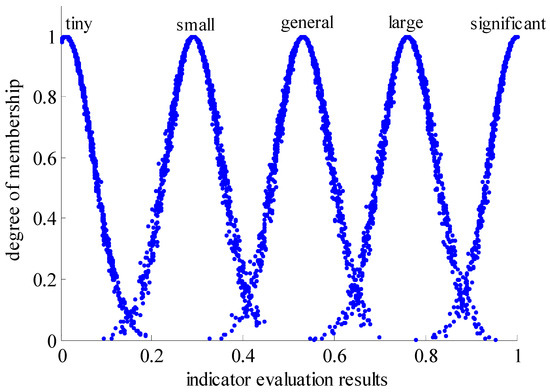
Figure 1.
AGVCM social stability risk evaluation index cloud.
3.3. AGVCM Social Stability Risk Evaluation Comprehensive Cloud
Combined with the 2.2 index cloud language value level, the participants are invited to grade the index system. On the basis of obtaining the evaluation results, the cloud digital characteristics of each index T = U (Ex, En, He) are calculated by using the comprehensive cloud algorithm for the same type of cloud, and then
In the formula, i is the number of commentator, (Exji, Enji, Heji) is the cloud characteristic value of the jth indicator in a layer after qualitative judgment by the ith commentator, (Exi, Eni, Hei) is the cloud characteristic value of the jth indicator in a layer. Combined with Equation (13) and Equation (14), we can obtain the cloud digital characteristics of the upper layer index. The formula is as follows:
In the formula, (Ex, En, He) is the cloud characteristic value of the upper indicator in that layer. Thus, the digital features of AGVCM social stability risk evaluation comprehensive cloud modeling can be calculated.
4. Example Application Analysis
This study takes Yunnan’s AGVCM social stability risk evaluation project as an example, and invites commentators to evaluate the social stability risk of adjusting goods vehicle according to the evaluation index system and evaluation criteria established in this study.
4.1. Determining the Assignment of Optimal Combination Weighting
According to the 2.1.1 and 2.1.2 model, this paper uses the analytic hierarchy process and entropy weight method to calculate the subjective weight and objective weight, combined with Formula (13), using the optimal combination weighting method to calculate the combination weighting, as shown in Table 2.
Table 2.
Social stability risk evaluation index weight of AGVCM.
4.2. AGVCM Social Stability Risk Evaluation Comprehensive
In this study, five experts were invited to score the indicators of the evaluation index system, and the evaluation results are shown in Table 3.
Table 3.
Social stability risk evaluation index weight of AGVCM.
According to the comprehensive cloud algorithm in Equation (14), the qualitative description of index in Table 3 is transformed into the quantitative evaluation of cloud of digital characteristics, and the cloud model’s digital characteristics corresponding to the three-level index are obtained. Therefore, according to the Equation (15), the cloud model’s digital characteristics corresponding to the secondary index can be obtained. In this way, the numerical characteristics of the cloud model for each level of indicators in the AGVCM social stability risk evaluation index system can be obtained, as shown in Table 4, the evaluation cloud of first grade indexes as shown in Figure 2.
Table 4.
Cloud model numerical characteristic of index system.
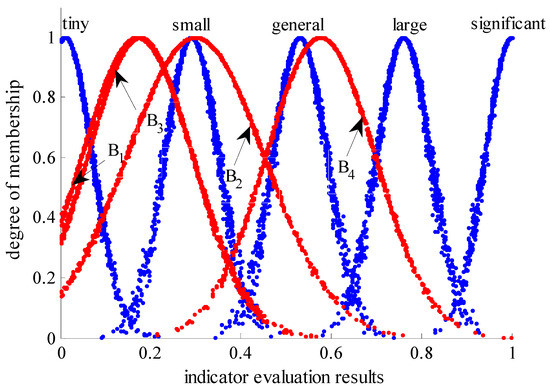
Figure 2.
Evaluation cloud of first grade indexes. B1–B4 in Table 1.
According to Table 4 and Equation (15), the numerical characteristics of the evaluation cloud model for the target layer of AGVCM social stability risk evaluation can be obtained as (0.28, 0.073, 0.0008), and the evaluation result cloud diagram is shown in Figure 3.
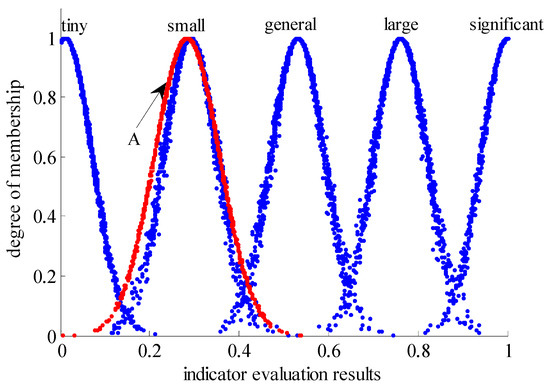
Figure 3.
Evaluation cloud of first grade indexes. A in Table 1.
As can be seen from Figure 3, the evaluation results are located between “tiny” and “small”, and tend to “small” cloud range, belonging to “small”. Therefore, this project’s risk level is “small”.
4.3. Comparison Results
In order to verify the reliability of the evaluation of the AGVCM social stability risk optimal combination weighting—cloud model, this paper relies on the interim measures for social stability risk assessment of major fixed asset investment projects (hereinafter referred to as the Measures) of the National Development and Reform Commission to evaluate the social stability risk evaluation index system and weights of the AGVCM, and the comparison results are shown in Table 5.
Table 5.
Cloud model numerical characteristic of index system.
Table 5 shows: (1) The risk assessment results of the optimal combination weighting—cloud model are basically consistent with the evaluation results of t Measures, which proves the validity and reliability of the model. (2) The assessment risk level of some aspects is higher than the assessment in Measures, indicating that the model is helpful in better identifying the key factors affecting the project risk level, t, so as to formulate targeted prevention and mitigation of Measures.
5. Conclusions
- (1)
- The AGVCM social stability risk evaluation index system, which consists of 4 levels, 3 grades and 60 indexes, was systematically constructed by identifying risks in 4 aspects: legality, reasonableness, feasibility and controllability, according to the time stage of risk occurrence.
- (2)
- The proposed AGVCM social stability risk optimal combination weighting—cloud model establishes an optimal combination weighting model with the objective of minimizing the deviation of the combination weighting from the weighting of the hierarchical analysis method and the entropy weighting method, respectively, and uses the optimal combination weighting to comprehensively characteries the subjective and objective attitudes of the participants. The model also uses the semantic information of the cloud model to qualitatively describe and quantitatively evaluate the indexes, and accurately calculates the risk level of AGVCM evaluation based on the integrated cloud algorithm, effectively eliminating subjectivity and arbitrariness in the evaluation process.
- (3)
- Taking the AGVCM project in Yunnan Province as an example, the AGVCM social stability risk evaluation was calculated to be “less” based on the combination weights of the indexes and the numerical characteristics of the cloud model. Comparing the evaluation results with those of Measures, the simulation results show that the findings of the optimal combination weighting—cloud model basically match those of Measures, verifying the validity and reliability of the model and algorithm. The evaluation results of the optimal combination weighting—cloud model contain rich process information, which is helpful for the evaluation results of the model and better identification of the key factors affecting the risk level of the project. It shows that the evaluation is more intuitive, scientific and effective than the evaluation results of Measures.
- (4)
- The evaluation method proposed in this study has certain reference value for AGVCM social stability risk identification and evaluation, and can be applied to the social stability risk evaluation of similar major projects, but the evaluation index system will be different due to the influence of factors such as geography, policy and implementation conditions, etc. Later, we will focus on the classification and accuracy of the evaluation model based on the factors we have found.
Author Contributions
Conceptualization, P.C. and H.Y.; methodology, P.C.; validation, L.L., D.W. and J.L.; writing—original draft preparation, P.C., C.W. and P.W.; writing—review and editing, P.C. and D.D. All authors have read and agreed to the published version of the manuscript.
Funding
This research was funded by Xingdian Talents Support Program, grant number YNWR-QNBJ-2020-035, and also funded by Special Postdoctoral Science Fund Project for basic research and frontier exploration of Chongqing Science and Technology Bureau, grant number cstc2021jcyj-bsh0210.
Data Availability Statement
The data presented in this study are available on request from the corresponding author.
Conflicts of Interest
The authors declare no conflict of interest.
References
- Liu, Y. An analysis of the socio-economic impact brought by the abolition of provincial highway toll stations. Transp. Inform. Indus 2020, 6, 32–33. [Google Scholar]
- Momtaz, S. Institutionalizing social impact assessment in Bangladesh resource management: Limitations and opportunities. Environ. Impact. Assess. 2005, 25, 33–45. [Google Scholar] [CrossRef]
- Aven, T.; Renn, O. On risk defined as an event where the outcome is uncertain. J. Risk Res. 2009, 12, 1–11. [Google Scholar] [CrossRef]
- Faber, M.H.; Stewart, M.G. Risk assessment for civil engineering facilities: Critical overview and discussion. Reliab. Eng. Sys. Safe. 2003, 80, 173–184. [Google Scholar] [CrossRef]
- Cao, F.; Shao, D.K.; Li, H.L.; Peng, Z.C.; Xue, L. The Evaluation Framework and Methodology of the Governance System of Social Stability of China: A Perspective from “Environment-Behavior” of the Social Ecological System. Comp. Eco. Soci. Sys. 2014, 36, 184–200. [Google Scholar]
- Holzmann, R.; Jørgensen, S. Social Risk Management: A New Conceptual Framework for Social Protection, and Beyond. Int. Tax. Pub. Fin. 2001, 8, 529–556. [Google Scholar] [CrossRef]
- Croson, R.; Donohue, K.; Katok, E.; Sterman, J. Order stability in supply chains: Coordination risk and the role of coordination stock. Prod. Oper. Manag. 2014, 23, 176–196. [Google Scholar] [CrossRef]
- Acemoglu, D.; Ozdaglar, A.; Tahbaz-Salehi, A. Systemic risk and stability in financial networks. Am. Econ. Rev. 2015, 105, 564–608. [Google Scholar] [CrossRef]
- Shan, W.; Liu, H.; Pan, Y.; Tong, H. Evaluation of Social Risk Using Structural Equation Model. Ibusiness 2010, 2, 188–192. [Google Scholar] [CrossRef][Green Version]
- Ghosh, S.; Jintanapakanont, J. Identifying and assessing the critical risk factors in an underground rail project in Thailand: A factor analysis approach. Int. J. Proj. Manag. 2004, 22, 633–643. [Google Scholar] [CrossRef]
- Wei, C.; Yu, S. Perspective on social stability risk assessment for major projects—The social stability risk assessment for rail transit projects. J. SH. Ship & Shiping. Res. Instit. 2013, 36, 8–11. [Google Scholar]
- Zou, Y.-H. Risk analysis of social stability of urban rail transit. Rail. Stan. Des. 2015, 59, 127–131. [Google Scholar]
- Liu, X.-H.; Wang, Z.-N. Urban rail transit stability risk assessment. Constr. Technol. 2017, 46, 1480–1482. [Google Scholar]
- Du, Z.; Guo, J.; Wu, S. Social stability risk assessment on urban rail transit project. Urb. Rap. Ra. Trans. 2015, 28, 136–139. [Google Scholar]
- Hong, L.; Hong, J.-Y. Discussion on the analysis methods of social stability risk for highway project. Highway 2014, 59, 43–48. [Google Scholar]
- Dong, Z.; Wang, H.; Dong, X.-L.; Liu, S. Evaluation method for highway project social stability risk based on entropy weight extension matter-element model. C. J. Hig. Transp. 2018, 31, 191–198. [Google Scholar]
- Liu, S.; Wang, J.; Liu, Y.-D. Social stability risk assessment of online taxi reservation based on AHP—Taking taxi reservation in Wulingyuan district of Zhangjiajie as an example. Hig. Auto. Appli. 2019, 2, 15–19. [Google Scholar]
- Li, J. Research on Social Stability risk assessment method of airport construction project. Tech. Outl. 2014, 13, 154–156. [Google Scholar]
- Li, F.; Liu, L.-N. Analysis of social stability risk in a domestic comprehensive passenger hub station. Constr. Des. Proj. 2015, 5, 170–174. [Google Scholar]
- Lin, H.-C. Criticism and reconstruction of social stability evaluation system for major administrative decisions. Adm. Law Review. 2018, 3, 75–87. [Google Scholar]
- Hong, K.-R.; Huang, Q.-B. Analysis on social stability risk factors of large industrial construction projects under the concept of interactive fairnessabout land acquisition and demolition. Syst. Eng. 2018, 35, 154–158. [Google Scholar]
- Wang, X.-M.; Li, M.-R. Research on the problems and countermeasures of social stability risk assessment in China. In Proceedings of the International Conference on Social Science & Contemporary Humanity Development, Wuhan, China, 15–17 July 2016; pp. 7–11. [Google Scholar]
- Jiang, J.-J. The social stability risk assessment mechanism in China: The status quo, challenges and countermeasures. J. Shanghai Adm. Inst. 2014, 15, 90–96. [Google Scholar]
- Liu, Z.-T.; Li, W.-J. National risk management structural framework in perspective of China social stability risk assessment. In Proceedings of the 2013 IEEE International Conference on Grey Systems and Intelligent Services (GSIS), Macao, China, 15–17 November 2013; pp. 330–334. [Google Scholar]
- Xu, X.H.; Wang, C.H.; Cai, C.G.; Xue, M. Evolution and coping research for flood disaster social stability risk based on the complex network. Nat. Hazards 2015, 77, 1491–1500. [Google Scholar] [CrossRef]
- Yang, F.-Y. The study of social work in the social stability risk assessment mechanism—For example of housing demolition. J. Soc. Work. 2013, 3, 29–36. [Google Scholar]
- Zhou, H. Preliminary study on social stability risk assessment of Fuping Shichuan river comprehensive improvement project. Urban. Land Use 2021, 9, 17–22. [Google Scholar] [CrossRef]
- Wu, X.T.; Li, Y.; Zheng, H.W.; Wen, B.; Liu, Y.Z. Social risk assessment of rural land integrated consolidation—A case study at Jiangning district of Nanjiang City. Bull. Soil Water Conserv. 2015, 35, 245–250. [Google Scholar]
- Zhou, H.; Xu, Y. Preliminary study on social stability risk assessment of land integrated renovation project: A case study of shichuan river project in fuping. IOP Conf. Ser. Earth Environ. Sci. 2021, 781, 022058. [Google Scholar] [CrossRef]
- Saaty, T.L. The modern science of multicriteria decision making and its practical applications: The AHP/ANP approach. Oper. Res. 2013, 61, 1101–1118. [Google Scholar] [CrossRef]
- Saaty, T.; Kułakowski, K. Axioms of the analytic hierarchy process (ahp) and its generalization to dependence and feedback: The analytic network process (ANP). arXiv 2016, arXiv:1605.05777. [Google Scholar]
- Chong, P.-Y.; Shuai, B. Evaluating of coming hazardous materials transportation network node risk under terrorist attack. J. Safe. Sci. J. 2012, 22, 104–109. [Google Scholar]
Publisher’s Note: MDPI stays neutral with regard to jurisdictional claims in published maps and institutional affiliations. |
© 2022 by the authors. Licensee MDPI, Basel, Switzerland. This article is an open access article distributed under the terms and conditions of the Creative Commons Attribution (CC BY) license (https://creativecommons.org/licenses/by/4.0/).