


Abstract
Energy-consuming countries are affected by obstructions in supplies or conflicts that may occur along the energy transit path. Hence, the presence of a global logistics hub for energy acting as a connecting bridge between energy-supplying and energy-consuming countries can overcome such troubles, support the sustainable flow of energy, and achieve the overall operational efficiency of the energy supply chain. However, establishing a global energy hub is a complicated issue, especially in the absence of a clear approach for this. Through conducting a systematic literature review on 36 papers over the past two decades, we identified the key determinants for each player in the energy supply chain and proposed a leading and integrated conceptual framework for establishing and operating a global logistics energy hub, with a particular focus on oil and gas. This article contributes to knowledge by providing a comprehensive review targeting energy hubs from a logistics perspective, as previous studies have addressed energy hubs from other perspectives such as political, legal, and security perspectives, while the logistics perspective has not been tackled comprehensively. Moreover, the suggested framework can be then used by further researchers to develop the performance of energy hubs. Practically, this framework can be employed to identify the requirements for a country to become a global energy hub.
1. Introduction
Energy is an indispensable resource in our life [1]. Despite the high levels of energy production in recent years, world energy consumption has also witnessed a significant increase [2]. This continuous growth in global energy consumption presents an important challenge in the energy supply chain, where the larger portion of oil and gas reserves resides and are controlled by a limited number of countries. This forms a vulnerable energy supply chain that is expected to reach its limit within the foreseeable future [3]. Murele and Zulkafli [4] state that although fossil fuels play a vital role in the current global energy portfolio, their limited availability and links to geopolitical uncertainties pose a threat to global energy supply security. Hence, with the continuous demand for energy at an affordable price and reliable supply, energy supply chains are critical assets for our societies, in which any disruption could have tremendous social and economic impacts on countries [5]. Therefore, issues of uncertainty in the energy supply chain and its security have become a widely used trend in global energy policies [6]. This implies that countries should harness all available resources and capabilities efficiently in order to achieve a well-structured energy supply chain that is characterized by a secured supply pathway [4].
In general, when the supply from the local energy resources is limited, the needs are delivered from the external energy-rich suppliers or countries [7]. Consequently, as global energy consumption continues to rise and competition over access to resources increases [8], energy-supplying countries and transit routes play a continuously increasing role in the development of the energy markets and covering the increase in energy demand [9]. This means that the consuming or destination country is likely to be affected, in the case of any conflict occurring, by the path of the energy in transit from the supplier to the consuming country [10]. For this reason, there is an urgent need to manage limited fossil energy sources through national and international energy policies [1]. The presence of energy hubs could represent one of the key opportunities to overcome such troubles [8].
The energy hub can act as a connecting bridge between energy-supplying countries and energy-consuming ones [11], where the energy hub country takes the right to purchase energy within its borders and then re-export it to other customers [12]. The energy hub country can achieve several incentives such as ensuring the security of its energy supplies through enjoying the offtake rights for transit countries, gaining financial benefits, and increasing its regional strategic advantage and geopolitical influence [13]. Nevertheless, becoming an energy hub is a more complex system than being an energy transit corridor [14]. This is because an energy transit or corridor is a country that basically provides transit services for energy resources and in return charges certain transit fees, yet it does not participate in the decisions regarding delivery conditions or demand provisions [15]. In contrast, an energy hub country comprises the control mechanism of energy distribution and provides the exportation or sale options in addition to domestic needs [14]. Thus, the transformation into an energy hub country takes time and needs a lot of requirements such as political will, international cooperation, comprehensive infrastructure, extensive investments, a well-developed financial and legal environment, long-term energy policies, and logistics facilities [12,16].
The development of an energy hub is highly associated with providing a wide range of international logistics services, and, therefore, it must be equipped with the necessary infrastructure and facilities to carry out these services and functions [17]. Such facilities will support the supply chain functions as well as the efficient operation of the entire supply chain [18].
Logistics is a constituting part of the supply chain that deals with the management of materials and goods in an efficient way [19]. According to Lukashevich [20], logistics includes complex, versatile, and various types of activity. The main task of logistics is to provide a set of interrelated functions for the formation, management, and optimization of materials flow from the point of origin and the point of consumption in order to meet customers’ requirements. Hence, applying the logistics practices and initiatives can help in managing the energy flows from energy supplying countries to consuming countries. In which the presence of global logistics hubs (GLH) in energy can support the sustainable flow of energy between the supplying and consuming countries and achieve the overall operational efficiency of the energy supply chain [18].
Nevertheless, after reviewing the relevant literature, we noted that some studies such as those by Zhang, et.al [21]; Shahparvari, Nasirian [22]; Maharjan and Hanaoka [23]; Essaadi, Grabot [24]; Maharjan and Hanaoka [25] addressed the key elements and challenges for establishing permanent and temporary logistic hubs, in addition to developing various models for selecting the optimal location of logistic hubs with the application on different sectors, e.g., sea and air ports, passenger and container terminals and freight. While other literature such as that of Kemoklidze [26], Yilmaz-Bozkus [12], Ersen and Celikpala [13], Stratakis and Pelagidis [27], and Akhbari [28] mainly focused on the role and importance of energy hubs and analyzed the endeavors of some countries to transform into a regional or global energy hub or corridor from several points of view, i.e., political, legal, and security. Consequently, there are no previous studies tackling establishing energy hubs from a logistics perspective or their requirements. Therefore, this paper addresses the energy hub logistics requirements through the following elements: mapping the energy supply chain and identify the key players in it, detecting the essential determinants of each player, and specifying the relationships between these players. The ultimate goal of this study was to develop a comprehensive conceptual framework that considers the main determinants for establishing and operating a global logistics energy hub (GLEH), with particular respect to oil and gas.
The rest of the paper is organized as follows: Section 2 gives a thorough explanation of the methodology used. In Section 3, the energy supply chain and the content analysis of the selected works are discussed. The proposed conceptual framework extracted from the literature analysis is presented in Section 4, while Section 5 provides the conclusion and the suggested areas for further research.
2. Materials and Methods
This paper relies on a systematic review of the best resources available in the literature in a systematic, transparent, and reproducible manner [29]. To conduct the review, this research followed a rigorous systematic protocol proposed by Moher, Liberati [30] and obeyed the preferred reporting items for systematic reviews and meta-analyses (PRISMA, 2020). Moreover, the research presents a flow diagram for depicting the identification, screening, and exclusion procedures of papers. This protocol has been used and recommended by many researchers such as [31,32,33]. Thus, the authors kept track of the following steps [30]:
2.1. Formulation of Researchable Questions
In this step, the authors should select and identify answerable research question(s). Accordingly, this paper aimed to address the following questions:
- RQ1.
- Who are the key players in the energy supply chain?
- RQ2.
- What is the relationship between the key players in the energy supply chain?
- RQ3.
- What are the main determinants to establish and operate a global logistics hub for energy?
2.2. Disclosure of Studies
Research methods, investigated databases, and keywords must be specified in this step. Thus, the authors selected two prominent electronic databases: Web of Science (WOS) and Scopus, in order to reduce the risk of losing publications and to include as much published work in the research area as possible. Then, online research in all fields (title, abstract, topic, keywords, and full-text) in both databases was run separately in March 2021. The search strategy also included English language research papers published in journals only and within all available time span [34,35].
The search string for Web of Science was:
ALL FIELDS: (“logistics hub” OR “logistics energy hub”) OR ALL FIELDS: (“energy hub” OR “energy corridor” OR “energy transit”) AND ALL FIELDS: (oil) AND ALL FIELDS: (gas) AND LANGUAGE: (English) AND DOCUMENT TYPES: (ARTICLE OR REVIEW). Timespan: All years, and the search string for Scopus was:
(TITLE-ABS-KEY (“logistics hub” OR “logistics energy hub”) OR TITLE-ABS-KEY (“energy hub” OR “energy corridor” OR “energy transit”) AND TITLE-ABS-KEY (oil) AND TITLE-ABS-KEY (gas)) AND DOCTYPE (ar OR re) AND (LIMIT-TO (LANGUAGE, “English”)). Timespan: All years.
The initial results of the identification phase revealed a total of 149 records (101 records for WOS and 48 records for Scopus) including the article or review documents only and all subject areas of the database.
2.3. Evaluation of the Quality of the Studies
An indispensable stage in the review process is to separate good research from poor-quality research through a set of quality criteria. The findings should be based on better-qualified research to the greatest extent possible. In this step, a screening use of the reference manager software “EndNote” was made to remove duplicates and facilitate the screening process. Post removal of duplicates, the list generated 118 papers, which were further screened to pick the most relevant studies [32,36,37]. The 118 records were screened again based on analysis of the titles, abstracts, and full-text [38]. Every document was independently evaluated, and irretrievable papers were excluded, and the remaining 49 papers proceeded to the eligibility analysis [33]. This step was performed using Rayyan (http://rayyan.qcri.org), a free web and mobile app that helps speed up the initial screening of abstracts and titles using a semi-automated process while incorporating a high level of usability [39].
Once the records were screened, we tested the papers for their eligibility by focusing on the largest and highest quality studies. Hence, the authors have developed exclusion criteria to assess the eligibility of papers [34,40]. The research focused on publications starting from 2000 in order to ensure that only recent works were considered, especially since this is a topic with practical implications. Additionally, to guarantee the quality of the available full text for the papers used in the review, the authors focused only on articles and reviews published in journals. Moreover, we excluded the studies that are not relevant to the questions and objectives of this research to make sure that reviewed papers are within the scope of this research such as the papers in fields of the sea and airports logistics hubs; energy hubs in power, heating, and electricity plants; and renewable energy resources. Table 1 below summarizes the exclusion reasons during the different stages of research, identification, and eligibility, where 28 papers of 49 met the criteria to be included in the review.

Table 1.
Exclusion criteria.
To ensure completeness, additional studies were identified using other methods, e.g., searching websites and reviewing bibliographies within the first round of articles and categorize additional relevant literature, as well as identifying an additional 41 studies. After implementing the same criteria of exclusion and filtration used above, only 8 papers remained [32,41].
2.4. Formulating the Synthesis
The researcher, in this step, presents the interpretation methods and synthesis of outcomes. Thereby, a final sample of 36 studies remained to be included in this synthesis. Figure 1 shows the PRISMA flow diagram depicting the identification, screening, and exclusion procedures of this study based on PRISMA guidelines by Moher, Liberati [30]. In addition, Table 2 provides a summary for the final synthesis of studies related to the areas of energy hubs, logistics hubs, and the energy supply chain, which were relied upon in implementing this study.
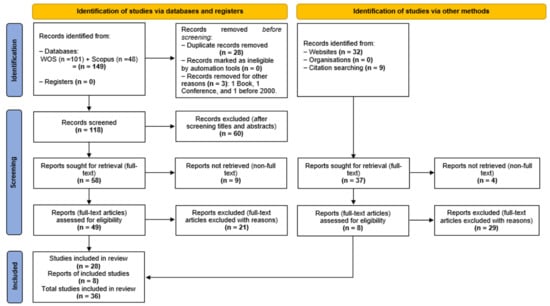
Figure 1.
Flow of information through the different phases of the systematic review. Source: Adapted by the authors.
Table 2.
Summary of the reviewed literature. Source: Developed by the authors.
3. Results and Discussion
Based on the indicated methodology in the previous section and following the review of the detected 36 papers, the authors classified the studies into three groups according to the theme of the study. The first group contained energy relations and policies including energy cooperation, diplomacy, geopolitics, domestic, and international policies. The second category addressed energy security, which contained the security of energy supply, infrastructure, and pipelines, while the last group dealt with the regulatory and logistical aspects and the legal regime. Considering this classification, 19 studies (53%) of the studies reviewed belong to the first category. The remaining 17 papers are distributed as follows: nine papers (25%) in the second group and eight papers (22%) for the third group, as shown in Figure 2. This grouping helped to understand the nature and features of logistics energy hubs in order to develop the proposed conceptual framework.
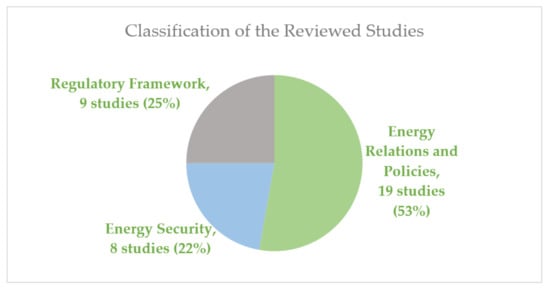
Figure 2.
Analysis of the literature by study category. Source: Developed by the authors.
Although the search horizon starts in 2000, no articles were included in the period 2000–2002, and the first article considered in this research was in 2003 by Ozturk and Hepbasli [42], who analyzed the status of natural gas in Turkey as a candidate to be an energy corridor. After this study, literature production remained moderate and reached its peak in 2010 and 2016. Figure 3 shows the evolution of papers reviewed since 2000.
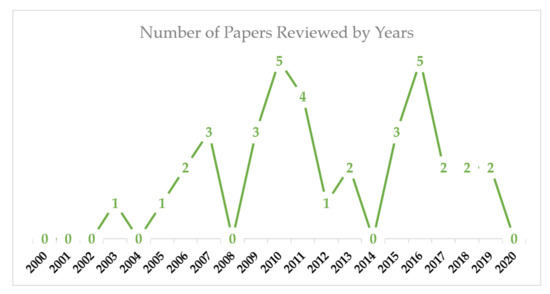
Figure 3.
The trend of studies reviewed by year (until the end of 2020). Source: Developed by the authors.
In the following subsections, the energy supply chain will be mapped out and the main determinants and relationships between the key players in the energy supply chain will be discussed in order to propose a framework for establishing and operating a GLH of energy.
3.1. Energy Supply Chain
According to the literature review of studies by authors such as Le Coq and Paltseva [10], Bilgin [15], Babali [49], Doulah and Shafee [60], Ersen and Celikpala [13], Yilmaz-Bozkus [12], we can conclude that the energy supply chain is mainly formed by three players as follows:
- Supplying country. An energy-producing country or region, where rich energy resources and reserves prevail.
- Consuming country. A country or region that does not have enough domestic energy resources to meet the demand for energy, and therefore it imports energy needs.
- Transit/corridor country. An energy transit state is a third country, where pipelines are laid to link an energy-producing country with an energy-consuming one. Agreements are concluded between the energy-producing country and the transit state by which allows the transit country to gather transit gains for permitting oil and gas to be transported across its territory. However, transit can happen between two countries only if the pipeline starts from country A and enter country B and then return to country A.
On the other hand, the energy supplying or transit country can turn into an energy hub country. An energy hub country refers to a state where a country buys energy within its borders and then re-exports it to other countries. It is not easy for a country to be transformed into an energy hub, and it is a more complicated system than being an energy transit country. Figure 4 shows the main three players involved in the energy supply chain and how the hub country can participate in this chain.
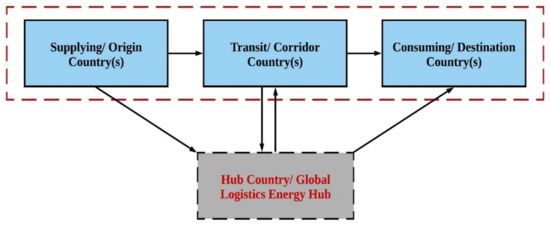
Figure 4.
Key players in the energy supply chain. Source: Developed by authors.
The literature review revealed that the majority of research conducted to analyze energy transport and its transit routes in the area of energy supply chain focused on regions that hold great reserves of oil and gas resources: the Middle East, Central Asia, the Caucasus, the Caspian Basin, the Eastern Mediterranean, and Russia. However, this does not necessarily mean that these regions or countries are the only players in the energy supply chain.
The review also showed that Turkey dominates the major part in terms of research on its possibility of becoming a transit or an energy hub country, with 19 papers (52.77%). Nevertheless, we do not have a clear framework that can be used to convert a country to becoming an energy hub. Hence, the second contribution of this paper comes to build an integrated conceptual framework that a state can use to become a global energy hub country from a logistical perspective. In Figure 5, an analysis for the studies reviewed based on the geographical coverage is shown.
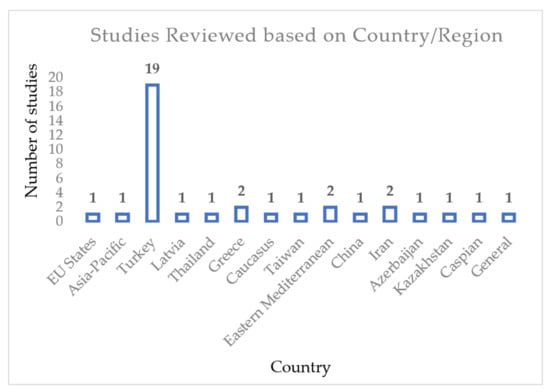
Figure 5.
Analysis of the studies reviewed on a geographical basis. Source: Developed by authors.
3.2. Determinants of Each Player
3.2.1. Supplying/Origin Country(s)
The future production and export of oil and natural gas mainly depends on several determinants such as availability of energy resources and reserves, production capacities or rates, the technology used for production [7,62,64], and production and transport costs [46]. Additionally, increasing revenues and profits from oil and gas exports are a serious concern for the energy-producing countries [64].
3.2.2. Consuming/Destination Country(s)
Reducing the level of dependence on imported energy sources is a major concern facing energy-consuming countries [13,46]. This energy dependency escalates when the energy-consuming country faces an energy supply vulnerability due to increased energy demand, supply disruptions, price hikes, or limited transportation options [9,48,51]. Thus, the energy-consuming countries strive to reduce their energy dependence and vulnerability by decreasing their energy import levels [8] and change consumption patterns through several factors such as developing and implementing energy conservation and efficiency measures [48,56], increasing the utilization of domestic renewable energy sources [11], and diversity of the country’s energy mix [10].
3.2.3. Transit/Corridor Country(s)
For a transit or corridor country, there are two elements that can be considered in this respect. The benefits and gains that a transit country can achieve in return for allowing the use of its territory, in which an energy transit country can gain several political and economic benefits. This includes access to the oil or natural gas for domestic needs at a discounted rate, collecting transit fees, and some influence in the region [8,14,56]. Modernizing and developing energy transportation systems, facilities, and capacity is another important issue for transit countries in order to increase the amount of energy that is transported through their borders [8,43,62].
3.2.4. Hub Country/Global Logistics Energy Hub
Since this research mainly focused on the hub country and the determinants of establishing and operating a GLEH, this section will discuss it in detail below. Figure 6 summarizes the main determinants related to each player in the energy supply chain.
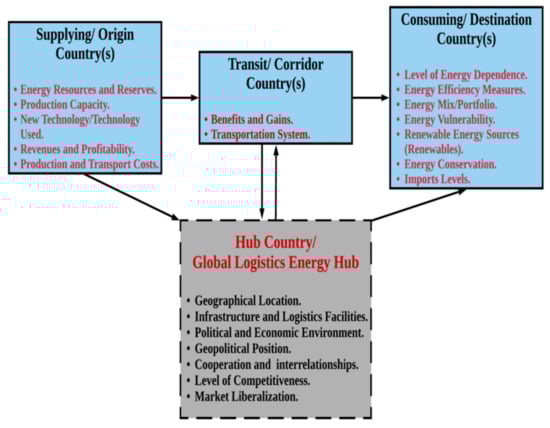
Figure 6.
Main variables for each player in the energy supply chain. Source: Developed by the authors.
3.3. Relationships between the Hub Country and Other Players
3.3.1. Relationship between the Supplying Country and the Hub Country
A shared concern for both supplying and hub states is the diverse consumption of export markets as a way to increase revenues from their oil and gas exports. Moreover, they search together for alternative transportation means to diversify the transit routes or countries linking them [60,64].
3.3.2. Relationship between the Consuming Country and the Hub Country
There are many common interests between the consuming country and the hub. Coskun and Carlson [8]; Doukas, Karakosta [9]; and Doulah and Shafee [60] highlighted the importance of increasing the availability and access to energy resources and assessed the risk of low energy availability for energy-consuming and hub countries. While Le Coq and Paltseva [10], Iseri [58], and Ersen and Celikpala [13] emphasized that both consuming and hub countries have the same concern about obtaining energy sources at affordable or reasonable prices as well as avoiding any fluctuations or chronically unstable high prices. Additionally, the diversification of energy supply routes and sources is a crucial issue for the consuming and hub countries [9,10,59]. Based on Le Coq and Paltseva [10], the security and safety of energy supply are among the main objectives for energy-importing and hub countries. A number of studies have addressed the energy supply security such as those by Eris [48], Iseri [58], and Gokırmak [11]. As diversification of transit routes is a worry shared between the supply and hub nations, the same concern exists between the hub and the consuming countries [64]. One of the most serious factors for both consuming and hub states is the development of a more reliable and sustainable energy supply system. Various scholars have used the concept of energy reliability within a country or a region [9,11,55,58].
3.3.3. Relationship between the Transit Country and the Hub Country
Other academics such as Doulah and Shafee [60] and Raimbekov, Syzdykbayeva [62] reported that it is important for the hub and transit countries to reconsider and harmonize their national legislative system and regulations in order to give the right of transit to other countries, especially in the case of oil and gas transit. Without such legal adaptations, the countries cannot obtain international commitment to give transit permission. They should also ensure transparency and control of transit tariffs and the taxation system in accordance with the international conventions and treaties. An abridgment of the relationships between the major three players (supplying, consuming, and transit countries) and the hub country is shown in Figure 7.
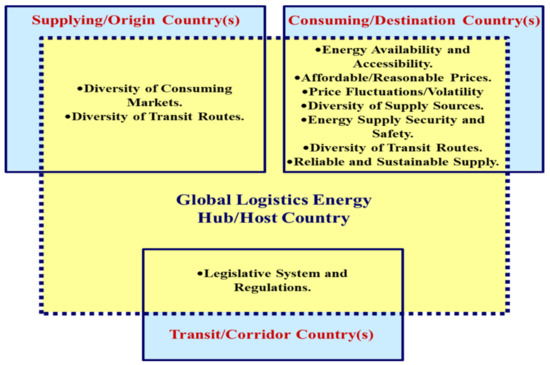
Figure 7.
The relationship between the key players in the global logistics energy hub. Source: Developed by the authors.
3.4. Ecosystem
The term “ecosystem” in this study refers to the overall framework that governs and surrounds all four players, and it consists of three different levels.
In the first level, the four players are wrapped by three elements, namely, long-term agreements, investments and physical infrastructure, and domestic consumption level. As pointed out by Ibrayeva, Tashtemkhanova [64], exporting and promoting energy cooperation among the partners require some factors such as significant sources of investment and financing, extensive infrastructure, and long-term agreements. Consequently, according to Coskun and Carlson [8], Stegen [56], and Yilmaz-Bozkus [12], the development and modernization of future and existing infrastructure projects for energy production and transportation requires large national and foreign investments and can take years to implement. Whereas, researchers such as Eris [48], Babali [49], and Mustafayev [61] see that long-term agreements and contracts provide all sides with the planning security they need, securing their energy supplies for several decades and guaranteeing the returns on their investments. Therefore, the long-term nature of the agreements is critical to remunerate the costs and investments over the longest possible period. Other authors claim that nothing can be done without considering and minimizing the level of internal consumption [42,43], through which the production, transit, and hub countries need to save sufficient energy for the export markets after meeting their domestic demand [56,64]. As for importing counties, they must exploit all domestic energy sources in order to lower their domestic consumption and reduce their dependency on imported energy sources and import bills [8,11].
The second level comprises the stakeholders involved in the energy sector. Mustafayev [61] determined that the key stakeholders in the international energy system are governments and regulators of all participants, national and international investors, financiers and lenders, energy companies, pipeline owners and operators, international bodies and organizations as the OPEC, and other interest holders. The author also stressed the necessity of balancing the different and sometimes conflicting objectives between all these players.
The last level is the highest level in the ecosystem, which organizes all participants including the first and second levels. Eris [48], Seljom and Rosenberg [7], and Mustafayev [61] argued that many other considerations may affect the orientations of parties in the global energy equation due to the uncertainty associated with the energy market, specifically at the supply and investment sides. In addition, environmental preservation issues along with technical and economic aspects play a key role in the considerations of energy projects and the contracting parties. Doulah and Shafee [60] investigated the implications of the Energy Charter Treaty, the international treaty for promoting energy cooperation and security for oil and gas transit and emphasized the importance of adapting countries’ national laws to it. Iseri [58] added that the participants in the global energy system should take into account the international energy order/market and be aware of the transformations and changes in that order. Moreover, Mustafayev [61] and Doulah and Shafee [60] believe that lack of a transparent and secure legislative framework, which protects the rights of all partners and clearly determines the conditions and regulations, makes cooperation and investment in energy projects in the long term not impossible but certainly difficult. After all, Gromule and Yatskiv [44] and Trappey, Lin [6] claim that an information-sharing mechanism between all actors is required in order to ensure information transparency and improve energy supply chain linkage. Figure 8 demonstrates the three levels of the ecosystem in this study.
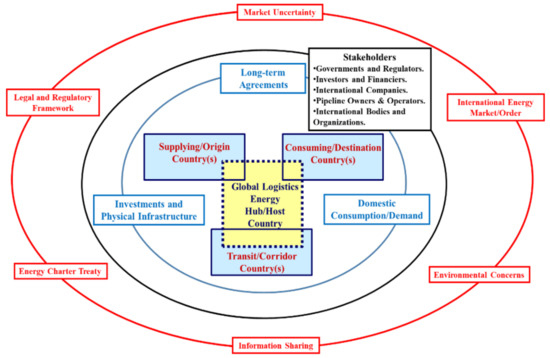
Figure 8.
The ecosystem and its relation with the global logistics energy hub players. Source: Developed by the authors.
4. The Proposed Conceptual Framework for a Global Logistics Energy Hub
This particular portion of the paper focuses on the hub country as a focal partner in the global energy supply chain. This helps further explain the proposal of a conceptual framework that supports countries aiming to become a global energy hub from a logistical point of view. The authors have identified a set of fundamental determinants for creating and operating a GLEH based on a review of relevant previous literature as presented in Figure 9 and is discussed as follows:
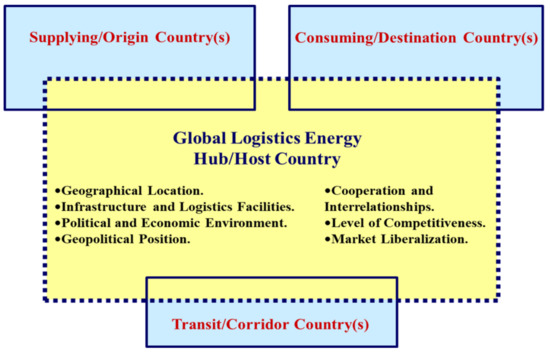
Figure 9.
The main logistical determinants for the establishment and operation of a GLEH. Source: Developed by the authors.
4.1. Geographical Location
The geographical location of a country is usually viewed as a distinct advantage in the energy game [13] and a critical factor for developing and effectively operating a GLH [44,47]. The geostrategic location of a country, i.e., close to oil and gas reservoirs [12], located at the crossroads of major transport routes [62] and pipelines [58], or through controlling major international waterways [12] and chokepoints [51] between oil and gas producing regions and importing countries, can make it a crucial link in the energy supply chain worldwide [43].
Several researchers have focused on measuring and comparing the geographical locations of countries or facilities, whether using quantitative or qualitative indicators or both. Previous studies of GLHs have generally selected several candidate locations in specific regions and assessed their preference depending on the location’s ranking order and criteria [66]. Gromule and Yatskiv [44] designed and assessed the location selection of a logistics hub for a passenger terminal using a simulation model developed by the VISSIM package. Lee, Huang [47] evaluated the competitive position of locations to develop a GLH using a quantified SWOT analytical method that integrates the fuzzy theory and Analytic Hierarchy Process (AHP) method. Wanitwattanakosol, Holimchayachotikul [50] proposed a two-phase quantitative framework for the selection of the efficient freight logistics hub through multiple regression, a genetic algorithm, and fuzzy AHP simulation. Other authors such as Kilic [43], Misiągiewicz [53], Cevikoz [59], and Yilmaz-Bozkus [12] analyzed the importance of geographical location of the candidate countries in becoming a global energy hub through a qualitative approach.
4.2. Infrastructure and Logistics Facilities
For a country to be a GLEH, it depends on the state of energy infrastructure and logistics facilities to store and transport oil and gas, which requires substantial investments [12,55]. Bilgin [15], Iseri [58], and Firat [63] identified that the necessary facilities and infrastructure of energy include pipelines, tankers and trains, platforms and refineries, compressor stations, liquefaction plants, storage units, petrochemical factories, terminals, and ports, etc. It is noteworthy that natural gas is more of an infrastructure issue than oil, and it requires more groundwork as it is much harder to transport [8]. Additionally, Yilmaz-Bozkus [12] noted that such logistics facilities generate a lot of financial profit and create more job opportunities. Iseri [58] and Mustafayev [61] highlighted that the security and preventive measures of these infrastructures, facilities, and the entire supply chain are of paramount importance for continuous energy flow. Another concern was raised by Bilgin [15], Raimbekov, Syzdykbayeva [62], and Yilmaz-Bozkus [12] concerning the level of development and capacities of such facilities in order to balance and regulate the flow of oil and gas from suppliers to markets and emerge as a genuine energy hub. Moreover, the GLEH requires extended and integrated logistics services and operations [6] for the successful and smooth operation of the pipelines and facilities that run in various directions [13,51].
Firat [63] provided a descriptive analysis of the importance of material infrastructures for energy as a model for economic integration, rather than political forms of integration, by exploring several energy-transport infrastructure projects, which are imagined to connect Eurasia to Europe via Turkey. Batten [57] and Cevikoz [59] analyzed the use of energy infrastructure and pipelines as a geopolitical force and a tool for changing the energy equation and diversifying energy supplies. Whereas, Bilgin [15], Winrow [55], Akyener and Apaydin [14], and Yilmaz-Bozkus [12] discussed the role of investment and developing energy projects and facilities with extensive capacities in supporting the transformation of a country into an energy hub or center. Iseri [58] argued that it is vital for a state to keep the security of its energy infrastructure and address the threats it might face on its way to becoming an energy hub. Lee, Huang [47] used the facilities of reprocessing, ports and warehouses as key indicators to measure and compare the efficiency of the GLHs. Trappey, Lin [6] derived a field-tested method for implement integrated industrial logistics hubs to improve the efficiency of manufacturers’ global operations. Accordingly, to develop a successful GLEH, there has to be an assessment of the energy infrastructure and logistics facilities which can be measured by quantitative and qualitative indicators: infrastructure projects and logistics facilities, levels of development and capacities, the intensity of use, the volume of investments, quality of logistic services and operations rendered, degree of security, and management efficiency [62].
4.3. Political and Economic Environment
The political and economic stability of a country or region is crucially important for the development and transportation of oil and gas resources [54]. Mustafayev [61] also indicated that cross-border oil and gas projects cannot be implemented without strong political support from the producer and transit states. As the continuity of energy supply may be affected by the political and economic situation of the producing or transit (hub) countries which may lead to supply disruption [10] or push-up prices [48]. These elements are essential to attract foreign energy investors and guarantee their investments that could be endangered by economic and political instability [52].
Le Coq and Paltseva [10] considered the political situation in the supplying and transit countries and the economic impact of supply disruption as main factors in their index designed to evaluate the short-term risks associated with the external supply of energy. Another approach proposed by Doukas, Flamos [51], who developed a web tool for measuring and quantification of energy supply risks of oil and gas corridors, includes the social, economic, and political risk dimensions of energy security.
4.4. Geopolitical Position
Declining energy production and increasing competition over energy resources have made energy one of the basic issues in the geopolitical considerations of international actors through emphasizing the ownership of energy resources and control of the trade routes that bring those resources to consumers [8]. As Ersen and Celikpala [13] expressed that just as there is military geopolitics, diplomatic geopolitics, and economic geopolitics, there is also energy geopolitics. Based on Coskun and Carlson [8], the geopolitical term covers the relationship between the conduct of foreign policy, political power and the physical environment. Doulah and Shafee [60] added that transit requires strong political relations and agreement between countries. Hence, a hub country should be careful to build up political support from its neighbors [54], use foreign policy that maintains a careful balance in its relations with neighbors [13], and emerge as a balancing actor trying to find solutions through mediation and facilitation in many foreign policy issues [49]. Changing national and foreign policies, joining regional and international institutions and blocs, high-level political dialogue, mutual official visits and memoranda of understanding/agreements, and agreed maritime boundary delineations could form new prospects for the geopolitical position of the hub country that exists in energy [49,54,59]. This would give the country the opportunity to expand its importance in energy geopolitics and contribute to its regional and global power [12].
Babali [49] studied Turkish foreign policy in regional energy equations and its integration with all neighbors and partners through energy. Coskun and Carlson [8] analyzed Turkey’s energy geopolitics within the new global energy geopolitics and its position as an energy hub from a geopolitical approach. Akhbari [28] investigated, through a library research method, the role of energy resources and the geopolitical position of Iran to pump money into the country whether by selling or transmitting energy and hence evolving the country’s economy and engagement with other countries. Using the traditional geopolitical approach, Ersen and Celikpala [13] elaborated the influence of regional and global political, economic, and military conflicts in the development of energy transportation routes in Eurasia in terms of oil and natural gas pipelines, evaluated Turkish role in the changing energy geopolitics of Eurasia, and determined the ways in which these geopolitical factors strengthen or weaken Turkey’s objective of becoming a regional energy hub.
4.5. Cooperation and Interrelationships
The transit issue is not only limited to the transit or hub country, but also requires the cooperation of departure and destination countries for the complete fulfillment of the transit [60], as the objective of any convergent corridor is to develop cooperation in the trade and economy of countries [28]. Moreover, international law and institutions encourage international reconciliation and cooperation among states. Moreover, energy interdependence generates incentives for further cooperation and increases trust among states, which in turn facilitates the resolution of conflicts [12]. Thus, a hub country has to strive to head toward a paradigm shift with neighboring producing, transit, and consumer states based on deepening relations and establishing cooperation–integration schemes, particularly in the field of energy. Such cooperation can be through the investment in energy infrastructure projects or joint ventures while maximizing mutual interests for partners [49]. Ozturk and Hepbasli [42] stated that creating a balanced international cooperation environment is a significant factor for acquiring more reliable energy supply policies. Cevikoz [59] has also argued that the normalization of bilateral and multilateral relations between transit county and other countries opens up a new outlook in its aspire to become an energy hub. In short, engaging in energy projects and activities and establishing common foreign trade policies are among the typical strategies for building effective and efficient relations and cooperation [42].
4.6. Level of Competitiveness
Indeed, the competition over energy is not only in energy producing and supplying but also in energy transportation means and routes [48]. This increasing competition in the energy market imposes the importance of adopting an international competitive advantage through establishing international logistics hubs, expanding the infrastructure and capacities [6], securing a reliable supply [49], cutting costs, and utilizing recent technology developments, etc. [7]. Yilmaz-Bozkus [12] further explained that an energy hub country has to diversify its long-term supply deals and routes to augment competitive supplies in the market. These competitive advantage initiatives could therefore attract customers [64].
According to Lee, Huang [47], to develop a successful GLH and confront increasing competition, it is imperative to understand the competitive position among market players to gain competitive advantages, where the authors utilized a quantified SWOT method to assess the competitive position of given GLH. Trappey, Lin [6] used the competitive advantage of the logistics hub as an indicator in deriving their industrial logistics hub models. Yilmaz-Bozkus [12] reviewed the role of competition in making Turkey a possible energy hub.
4.7. Market Liberalization
To become a more effective key transit country and energy hub, the host country needs to adapt its laws and launch energy market liberalization programs based on free-market principles and the liberalization of the economic regulations such as financial system and pricing policies in order to create an investor-friendly business environment [46,49,59]. Gokırmak [11] claims that increasing private sector involvement is a very important action to create competition and sustainable growth rates in the energy market. Another procedure to reform the country’s energy sector is to establish an energy stock exchange to participate in foreign energy stock exchanges and to increase liquidity, efficiency, and transparency in the energy market. Yilmaz-Bozkus [12] added that limited roles and non-intervention of governments are among the key issues in market liberalization, where market mechanisms and liberal regulations are enough to make markets work. Hence, an energy hub necessitates a liberalized and a deregulated market where suppliers and customers are free to conduct their operations in an open, transparent, and well-regulated competitive market [12,55].
Winrow [55], Gokırmak [11], and Yilmaz-Bozkus [12] have analyzed the importance of the liberalization of the energy sector and the major mechanisms that governments could adopt in order to create a competitive, free, and transparent energy market in the context of Turkish ambitions to become an energy hub. Table 3 provides a summary of the above factors that are necessary for the establishment and operation of GLEH.
Table 3.
The factors of the establishment and operation of GLEH. Source: Developed by the authors.
The entire proposed conceptual framework is shown in Figure 10. The framework consists of the major three players in the energy supply chain and the relationship or common factors between them and the hub country, and then the three-tiered surrounding ecosystem.
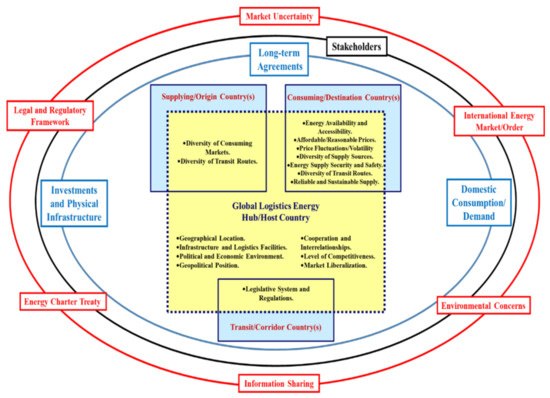
Figure 10.
The proposed conceptual framework for establishing and operating a GLEH. Source: Developed by the authors.
5. Conclusions
Continuous growth in global energy consumption raises an important challenge in the global energy supply chain. The consuming country is likely to be affected in case of any disruption occurs on the path of the energy in transit from the supplier to the consuming country. Therefore, countries seek to harness all available resources and capabilities to achieve a well-structured energy supply chain that is characterized by a secured supply pathway.
The paper conducted a systematic literature review focused on studying the energy supply chain and energy and logistics hubs to propose a framework for creating and operating a GLEH. This GLEH can act as a link between energy-supplying and energy-consuming countries, which will help in managing and organizing effectively energy flows. A major part of the paper has been allocated to analyze the relevant previous literature, where this analysis enabled the authors to understand the nature global energy supply chain and the features of logistics energy hubs. The authors classified the 36 selected studies according to the scope of each study into three groups: energy relations and policies, energy security, and regulatory frameworks. According to this classification, the first category involved 19 studies: 9 papers for the second category, and the remaining 8 papers went to the third category. The classification of previous studies confirmed that no previous studies focused on the logistics aspect for establishing energy hubs.
The literature review demonstrated that the most of research conducted to analyze energy transit routes concentrated on regions with great reserves of oil and natural gas resources such as the Middle East, Central Asia, the Caucasus, and the Caspian Basin. Additionally, the review also showed that the Turkish endeavors dominate the major part in terms of research its possibility of becoming a transit or an energy hub country with 19 papers of the reviewed papers. Despite this, there is still no research providing a framework that can be used to turn a country into a global energy hub. Hence, this paper conducted a comprehensive review targeting the energy hub logistics requirements, as previous studies have addressed energy hubs from other perspectives such as political, legal, and security perspectives, while the logistics perspective has not been tackled comprehensively in order to develop an integrated conceptual framework that considers the main determinants for establishing and operating a GLEH.
The proposed conceptual framework is a unique, comprehensive, and integrated framework, and it takes into account all logistics aspects that may affect the success of the GLEH. Additionally, the framework suggested in this paper addressed establishing and operating GLEH from the strategic level; thus, further research can be carried out to implement and build upon this framework to disaggregate the technical aspects. In addition, the framework opens the gate for further research to improve the performance of energy hubs and the efficiency of the energy supply chain. In practice, the framework can help countries interested in transforming into GLEH. Lastly, the suggested conceptual framework needs to be empirically validated in order to prove this framework as an accepted and validated model.
Author Contributions
Conceptualization, M.A.H. and S.E.; methodology, M.A.H., S.E. and M.S.; software, M.A.H.; validation, M.A.H., S.E. and M.S.; formal analysis, M.A.H., S.E. and M.S.; investigation, M.A.H.; resources, M.A.H.; data curation, M.A.H., S.E. and M.S.; writing—original draft preparation, M.A.H.; writing—review and editing, S.E. and M.S.; visualization, M.A.H., S.E. and M.S.; supervision, S.E. and M.S.; project administration, S.E. and M.S. All authors have read and agreed to the published version of the manuscript.
Funding
This research received no external funding.
Institutional Review Board Statement
Not applicable.
Informed Consent Statement
Not applicable.
Data Availability Statement
Data is contained within the article.
Conflicts of Interest
The authors declare no conflict of interest.
References
- Kilic, A.M. Major Utilization of Natural Gas in Turkey. Energy Explor. Exploit. 2005, 23, 125–140. [Google Scholar] [CrossRef]
- Marchi, B.; Zanoni, S. Supply Chain Management for Improved Energy Efficiency: Review and Opportunities. Energies 2017, 10, 1618. [Google Scholar] [CrossRef]
- Vlachos, D.; Iakovou, E.; Karagiannidis, A.; Toka, A. A Strategic Supply Chain Management Model for Waste Biomass Networks. In Proceedings of the 3rd International Conference on Manufacturing Engineering (ICMEN), Chalkidiki, Greece, 1–3 October 2008. [Google Scholar]
- Murele, O.C.; Zulkafli, N.I.; Kopanos, G.; Hart, P.; Hanak, D.P. Integrating Biomass into Energy Supply Chain Networks. J. Clean. Prod. 2020, 248, 119246. [Google Scholar] [CrossRef]
- Urciuoli, L.; Mohanty, S.; Hintsa, J.; Boekesteijn, E.G. The Resilience of Energy Supply Chains: A Multiple Case Study Approach on Oil and Gas Supply Chains to Europe. Supply Chain. Manag. Int. J. 2014, 19, 46–63. [Google Scholar] [CrossRef]
- Trappey, C.; Lin, G.Y.; Trappey, A.J.; Liu, C.; Lee, W. Deriving Industrial Logistics Hub Reference Models for Manufacturing Based Economies. Expert Syst. Appl. 2011, 38, 1223–1232. [Google Scholar] [CrossRef]
- Seljom, P.; Rosenberg, E. A Study of Oil and Natural Gas Resources and Production. Int. J. Energy Sect. Manag. 2011, 5, 101–124. [Google Scholar] [CrossRef]
- Coskun, B.B.; Carlson, R. New Energy Geopolitics: Why does Turkey Matter? Insight Turk. 2010, 12, 205–220. [Google Scholar]
- Doukas, H.; Karakosta, C.; Flamos, A.; Flouri, M. Graph Theory-Based Approach for Energy Corridors Network to Greece. Int. J. Energy Sect. Manag. 2011, 5, 60–80. [Google Scholar] [CrossRef]
- Le Coq, C.; Paltseva, E. Measuring the Security of External Energy Supply in the European Union. Energy Policy 2009, 37, 4474–4481. [Google Scholar] [CrossRef]
- Gokırmak, H. The Energy Policies for a Sustainable Economic Growth in Turkey. Int. J. Energy Econ. Policy 2017, 7, 55–61. [Google Scholar]
- Yilmaz-Bozkus, R. Analysis of Turkey’s Role as a Possible Energy Hub. Geojournal 2019, 84, 1353–1364. [Google Scholar] [CrossRef]
- Ersen, E.; Celikpala, M. Turkey and the Changing Energy Geopolitics of Eurasia. Energy Policy 2019, 128, 584–592. [Google Scholar] [CrossRef]
- Akyener, O.; Apaydin, M. Comments on the Role of Turkey as an Energy Center. Energy Policy Turk. 2016, 1, 32–41. [Google Scholar]
- Bilgin, M. Turkey’s Energy Strategy: What Difference Does It Make to Become an Energy Transit Corridor, Hub or Center? Rev. UNISCI 2010, 23, 113–128. [Google Scholar]
- Altundeğer, N. Altundeğer, N. A Dream Coming True? Turkey Becoming an Energy Hub. In International Academic Conference Proceedings; The West East Institute: Prague, Czech Republic, 2015. [Google Scholar]
- Vieira, C.L.d.S.; Catapan, A.; Luna, M. An Updated Perspective on the Concept of Logistics Hubs. 2016. Available online: https://www.pomsmeetings.org/ConfProceedings/065/Full%20Papers/Final%20Full%20Papers/065-0083.pdf (accessed on 15 September 2021).
- Lu, H.; Zhao, X.; Cook, D. A Model of Integrated Regional Logistics Hub Insupply Chain. Enterp. Inf. Syst. 2018, 12, 1308–1335. [Google Scholar] [CrossRef]
- Anca, V. Logistics and Supply Chain Management: An Overview. Stud. Bus. Econ. 2019, 14, 209–215. [Google Scholar] [CrossRef]
- Lukashevich, V. Global Logistics: Definition of Main Concepts and Essences. Technol. Audit. Prod. Reserves 2017, 3, 43–48. [Google Scholar] [CrossRef][Green Version]
- Zhang, X.; Lu, J.; Peng, Y. Hybrid MCDM Model for Location of Logistics Hub: A Case in China under the Belt and Road Initiative. IEEE Access 2021, 9, 41227–41245. [Google Scholar] [CrossRef]
- Shahparvari, S.; Nasirian, A.; Mohammadi, A.; Noori, S.; Chhetri, P. A GIS-LP Integrated Approach for the Logistics Hub Location Problem. Comput. Ind. Eng. 2020, 146, 106488. [Google Scholar] [CrossRef]
- Maharjan, R.; Hanaoka, S. A Credibility-Based Multi-Objective Temporary Logistics Hub Location-Allocation Model for Relief Supply and Distribution under Uncertainty. Socio-Econ. Plan. Sci. 2020, 70, 100727. [Google Scholar] [CrossRef]
- Essaadi, I.; Grabot, B.; Féniès, P. Location of Global Logistic Hubs within Africa Based on a Fuzzy Multi-Criteria Approach. Comput. Ind. Eng. 2019, 132, 1–22. [Google Scholar] [CrossRef]
- Maharjan, R.; Hanaoka, S. Fuzzy Multi-Attribute Group Decision Making to Identify the Order of Establishing Temporary Logistics Hubs during Disaster Response. J. Humanit. Logist. Supply Chain. Manag. 2019, 9, 2–21. [Google Scholar] [CrossRef]
- Kemoklidze, N. China’s Belt and Road Initiative: Opportunities and Challenges for Georgia. Lex Portus 2021, 7, 64. [Google Scholar] [CrossRef]
- Stratakis, A.M.; Pelagidis, T. The South-East Energy Corridor Connecting Greece and Cyprus. How Feasible, How Viable? East. Mediterr. Geopolit. Rev. 2018, 3, 16–33. [Google Scholar]
- Akhbari, M. The Role of Fossil Fuels (Oil and Gas) in the World Geopolitics of Energy (Case Study: Iran 2000–2015). Geopolit. Q. 2018, 13, 76–91. [Google Scholar]
- Klewitz, J.; Hansen, E.G. Sustainability-Oriented Innovation of SMEs: A Systematic Review. J. Clean. Prod. 2013, 65, 1–19. [Google Scholar] [CrossRef]
- Moher, D.; Liberati, A.; Tetzlaff, J.; Altman, D.G.; The PRISMA Group. Preferred Reporting Items for Systematic Reviews and Meta-Analyses: The PRISMA Statement. BMJ 2009, 6, e1000097. [Google Scholar]
- Gülpınar, Ö.; Güçlü, A.G. How to Write a Review Article? Turk. J. Urol. 2013, 39, 44–48. [Google Scholar] [CrossRef]
- Barlow, P.; McKee, M.; Basu, S.; Stuckler, D. The Health Impact of Trade and Investment Agreements: A Quantitative Systematic Review and Network Co-Citation Analysis. Glob. Health 2017, 13, 13. [Google Scholar] [CrossRef]
- Marcolino, M.S.; Oliveira, J.A.Q.; D’Agostino, M.; Ribeiro, A.L.; Alkmim, M.B.M.; Novillo-Ortiz, D. The Impact of mHealth Interventions: Systematic Review of Systematic Reviews. JMIR mHealth uHealth 2018, 6, e23. [Google Scholar] [CrossRef]
- Barlow, P.; McKee, M.; Reeves, A.; Galea, G.; Stuckler, D. Time-Discounting and Tobacco Smoking: A Systematic Review and Network Analysis. Int. J. Epidemiol. 2017, 46, 860–869. [Google Scholar] [CrossRef]
- Braun, R.; Catalani, C.; Wimbush, J.; Israelski, D. Community Health Workers and Mobile Technology: A Systematic Review of the Literature. PLoS ONE 2013, 8, e65772. [Google Scholar] [CrossRef] [PubMed]
- Castaneda, D.I.; Manrique, L.F.; Cuellar, S. Is Organizational Learning Being Absorbed by Knowledge Management? A Systematic Review. J. Knowl. Manag. 2018, 22, 299–325. [Google Scholar] [CrossRef]
- Elgazzar, S.; Tipi, N.; Jones, G. Key Characteristics for Designing a Supply Chain Performance Measurement System. Int. J. Product. Perform. Manag. 2019, 68, 296–318. [Google Scholar] [CrossRef]
- Pham, D.D.T.; Paillé, P.; Halilem, N. Systematic Review on Environmental Innovativeness: A Knowledge-Based Resource View. J. Clean. Prod. 2019, 211, 1088–1099. [Google Scholar] [CrossRef]
- Ouzzani, M.; Hammady, H.; Fedorowicz, Z.; Elmagarmid, A. Rayyan-A Web and Mobile App for Systematic Reviews. Syst. Rev. 2016, 5, 1–10. [Google Scholar] [CrossRef]
- Bastas, A.; Liyanage, K. Sustainable Supply Chain Quality Management: A Systematic Review. J. Clean. Prod. 2018, 181, 726–744. [Google Scholar] [CrossRef]
- Liberati, A.; Altman, D.G.; Tetzlaff, J.; Murlow, C.; Gøtzsche, P.C.; Ioannidis, J.P.A.; Clarke, M.; Devereaux, P.J.; Kleijnen, J.; Moher, D. The PRISMA Statement for Reporting Systematic Reviews and Meta-Analyses of Studies That Evaluate Health Care Interventions: Explanation and Elaboration. J. Clin. Epidemiol. 2009, 62, 1–34. [Google Scholar] [CrossRef] [PubMed]
- Ozturk, H.K.; Hepbasli, A. The Place of Natural Gas in Turkey’s Energy Sources and Future Perspectives. Energy Sources 2003, 25, 293–307. [Google Scholar] [CrossRef]
- Kilic, A.M. Turkey’s Natural Gas Necessity, Consumption and Future Perspectives. Energy Policy 2006, 34, 1928–1934. [Google Scholar] [CrossRef]
- Gromule, V.; Yatskiv, I. Coach Terminal as Important Element of Transport Infrastructure. Transport 2007, 22, 200–206. [Google Scholar] [CrossRef][Green Version]
- Jensen, D.N. Turkey’s Energy Ambitions Clash with Russian Succession Politics. Turk. Policy Q. 2007, 6, 35–45. [Google Scholar]
- Bilgin, M. New Prospects in the Political Economy of Inner-Caspian Hydrocarbons and Western Energy Corridor through Turkey. Energy Policy 2007, 35, 6383–6394. [Google Scholar] [CrossRef]
- Lee, K.L.; Huang, W.C.; Teng, J.Y. Locating the Competitive Relation of Global Logistics Hub Using Quantitative Swot Analytical Method. Qual. Quant. 2009, 43, 87–107. [Google Scholar] [CrossRef]
- Eris, O.U. The European Union’s Energy Security within the Framework of Turkish Membership. J. Interdiscip. Econ. 2009, 20, 283–313. [Google Scholar] [CrossRef]
- Babali, T. Regional Energy Equations and Turkish Foreign Policy: The Middle East and the CIS. Insight Turk. 2010, 12, 147–168. [Google Scholar]
- Wanitwattanakosol, J.; Holimchayachotikul, P.; Nimsrikul, P.; Sopadang, A. Performance Improvement of Freight Logistics Hub Selection in Thailand by Coordinated Simulation and AHP. Ind. Eng. Manag. Syst. 2010, 9, 88–96. [Google Scholar] [CrossRef]
- Doukas, H.; Flamos, A.; Karakosta, C.; Flouri, M.; Psarras, J. Web Tool for the Quantification of Oil and Gas Corridors’ Socio-Economic Risks the Case of Greece. Int. J. Energy Sect. Manag. 2010, 4, 213–235. [Google Scholar] [CrossRef]
- Kakachia, K.K. Challenges to the South Caucasus Regional Security Aftermath of Russian-Georgian Conflict: Hegemonic Stability or New Partnership? J. Eurasian Stud. 2011, 2, 15–20. [Google Scholar] [CrossRef]
- Misiągiewicz, J. Turkey as an Energy Hub in the Mediterranean Region. Spectr. J. Glob. Stud. 2012, 4, 107–126. [Google Scholar]
- Tagliapietra, S. Towards a New Eastern Mediterranean Energy Corridor? Natural Gas Developments between Market Opportunities and Geopolitical Risks. SSRN Electron. J. 2013, 12, 1–34. [Google Scholar] [CrossRef]
- Winrow, G.M. The Southern Gas Corridor and Turkey’s Role as an Energy Transit State and Energy Hub. Insight Turk. 2013, 15, 145–163. [Google Scholar]
- Stegen, K.S. Understanding China’s Global Energy Strategy. Int. J. Emerg. Mark. 2015, 10, 194–208. [Google Scholar] [CrossRef]
- Batten, T. Turkey as an Energy Hub for the Southern Gas Corridor. SEER J. Labour Soc. Aff. East. Eur. 2015, 17, 193–205. [Google Scholar] [CrossRef]
- Iseri, E. Addressing Pipeline Security Regime of the Prospective Regional Energy Hub Turkey. Secur. J. 2015, 28, 1–15. [Google Scholar] [CrossRef]
- Cevikoz, U. Could Turkey Become a New Energy Trade Hub in South East Europe? Turk. Policy Q. 2016, 15, 67–76. [Google Scholar]
- Doulah, A.; Shafee, M. Study of the Legal Regime of Oil and Gas Transit in Energy Charter Treaty and Law of Iran. J. Politics Law 2016, 9, 194–208. [Google Scholar] [CrossRef][Green Version]
- Mustafayev, N. The Southern Gas Corridor: Legal and Regulatory Developments in Major Gas Transit Pipeline Projects. J. World Energy Law Bus. 2016, 9, 370–387. [Google Scholar] [CrossRef]
- Raimbekov, Z.; Syzdykbayeva, B.; Zhenskhan, D.; Bayneeva, P.; Amirbekuly, Y. Study of the State of Logistics in Kazakhstan: Prospects for Development and Deployment of Transport and Logistics Centres. Transp. Probl. 2016, 11, 57–71. [Google Scholar] [CrossRef][Green Version]
- Firat, B. The Most Eastern of the West, the Most Western of the East: Energy-Transport Infrastructures and Regional Politics of the Periphery in Turkey. Econ. Anthropol. 2016, 3, 81–93. [Google Scholar] [CrossRef]
- Ibrayeva, A.; Tashtemkhanova, R.; Ospanova, A.; Somzhurek, B.; Azmukhanova, A. Energy Export Potential in the Caspian Region and Its Impact on EU Energy Security. Period. Polytech. Soc. Manag. Sci. 2017, 25, 127–140. [Google Scholar] [CrossRef]
- Ibrayeva, A. Importance of the Caspian Countries for the European Union Energy Security. Int. J. Energy Econ. Policy 2018, 8, 150–159. [Google Scholar]
- Lee, K.L. Analyzing the Competitive Relations among the Location in the Asia-Pacific Region for Developing the Re-Export Type of Global Logistics Hub. J. Mar. Sci. Technol.-Taiwan 2007, 15, 187–200. [Google Scholar]
Publisher’s Note: MDPI stays neutral with regard to jurisdictional claims in published maps and institutional affiliations. |
© 2021 by the authors. Licensee MDPI, Basel, Switzerland. This article is an open access article distributed under the terms and conditions of the Creative Commons Attribution (CC BY) license (https://creativecommons.org/licenses/by/4.0/).