


Abstract
The adoption of Industry 4.0 technologies has become particularly important nowadays for companies in order to optimize their production processes and organizational structures. However, companies sometimes find it difficult to develop a strategic plan that innovates their current business model and develops an Industry 4.0 vision. To overcome the growing uncertainty and dissatisfaction in implementing Industry 4.0, new methods and tools that specifically address dedicated companies’ areas, such as logistics, supply chain management, and manufacturing processes, were developed to provide guidance and support to align companies’ business strategies and operations. In particular, this paper develops and presents the application of a maturity model for Logistics 4.0, focusing on the specific applications of Industry 4.0 in the area of logistics. To do so, extant maturity models, linked to the context of Industry 4.0 implementation in logistics processes, were examined in the main scientific research. Afterward, two companies have been investigated through a survey, built around three fundamental macro-aspects, named (i) the propensity of the company towards Industry 4.0 and Logistics 4.0, (ii) the current use of technologies in the logistics process, and (iii) the investments’ level towards Industry 4.0 technologies for a Logistics 4.0 transition. By doing so, a maturity model for Logistics 4.0 emerged as the main result of our research, able to identify the level of maturity of companies in implementing the Industry 4.0 technologies in their logistics processes. Moreover, the model highlighted the strengths and weaknesses of the two investigated companies with respect to the transition towards Logistics 4.0. On the basis of the obtained results, a roadmap for enhancing the digitalization of logistics processes, according to the principles of the fourth industrial revolution, was finally proposed.
1. Introduction
In a context where the wider of the supply chain is increasing, in terms of scope and interconnection, the margins for improvement that can be capitalized today are not only referring to the optimization of the efficiency within the business logistics process, but they are strongly addressed to the improvement of the synergies among the actors involved in the overall logistics process. Consistently with this issue, in past years, the logistics processes were receiving pressure to increase levels of sustainability, in environmental terms, which helps to meet the overall sustainability challenges, such as minimizing greenhouse gas emissions. According to the theoretical definition, the sustainability concept in a company is related to three important pillars, namely, environmental, social, and economic [1]. At the intersection of these three pillars lie organizational activities that have a positive effect on the environment and result both in long-term benefits and in an increased competitive ability. According to Strandhagen et al. [1], the sustainability development can be considered a crosscutting capability for individual companies, since it requires the entire company to change its way of thinking. Accordingly, sustainability is becoming an important element of business models that radically changes the way companies operate. Currently, there is an increasing attention toward the management of social and environmental impacts in business, which makes the integration with environmental, economic, and social issues an obvious choice to ensure the company’s long-term stability and development. In addition, at a more operational level, it can be very important for companies to redesign their logistics processes in order to achieve specific sustainability targets [2]. On this point, Industry 4.0 technologies can effectively help to achieve the desired sustainability targets in the logistics processes, also contributing to the improvement of the overall performances of companies [3]. Industry 4.0 introduced different technological paradigms such as big data, the Internet of Things (IoT), and the smart factory; each of them has a positive effect on the performances of companies. Therefore, the integration of Industry 4.0 concepts can increase the volume of business and solve various issues, such as the plants’ obsolescence. Although the adoption of the new Industry 4.0 technologies can represent a difficult task for companies, recent studies have demonstrated the scalability of the Industry 4.0 technologies [4], and many experts are claiming that, in this revolution, there is the ability to provide a fundamental contribution to the sustainability of businesses. The term “Logistics 4.0” is focused on the specific applications of Industry 4.0 in the area of logistics. Consistently with existing scientific definitions, Logistics 4.0 represents the logistical system that enables the sustainable satisfaction of individualized customer demands without increasing costs [5]. Logistics 4.0 changes the existing solutions already adopted in traditional logistics, and introduces new enabling technologies, such as the cyber–physical systems (CPSs), which allow us to realize the networking and automation of storage system transportation, and decentralized software control [2,3,5,6]. In other cases, the support of the Internet of Things (IoT) technology allows linking physical objects to enable real-time data visualization in order to automate the logistics flows [7,8,9] under either an uncertain or a given demand [10], and when considering different kind of materials [11]. Again, the implementation of big data [12] in logistics and supply chain operations [13] contributes to “improving the visibility, flexibility, and integration of global supply chains and logistics processes, effectively managing demand volatility, and handling cost fluctuations” [14]. The adoption of green solutions allows for improving the environmental performances and can open up new market segments that were previously unexplored. Indeed, according to Garcia-Muiña et al. [15], there is a new share of the market characterized by consumers that require detailed knowledge and information about the environmental costs of what they consume and use. Accordingly, they can enable the product’s success, one that includes both the attributes of quality and design, as well as of sustainability. On this direction, the attention to the consumers, to the distance travelled, and to the means of transport adopted, is integrated with the assessments of flows of energy, resources, and materials needed to manufacture, transport, and use products. The objective is to reduce their impact on the external environment, making them sustainable also from an economic, social point of view. These drivers form a dynamic and challenging environment for companies, and especially in manufacturing industries, they can be addressed with Industry 4.0.
If, on the one hand, Logistics 4.0 represents an important innovation, since it is related to a range of problems and issues that affect the sustainability performance of companies, on the other hand, many companies are uncertain, both about the financial effort required for implementing the related technologies, and about the corresponding impact on their business strategies [16]. Accordingly, national plans were designed and prepared by world governments with the aim to guide and facilitate the transition of companies towards Industry 4.0 [17]. The next steps consist of assessing whether companies are ready to enter the Industry 4.0 or not, depending on their ability to grasp the overall idea of Industry 4.0 and to change their business model accordingly.
However, although companies can relate their as-is positioning to their current business strategy, they sometimes find it difficult to identify a strategic plan that innovates their current business model and develops an Industry 4.0 vision [18]. In particular, companies sometimes fail to recognize concrete fields of action, programs, and projects for an Industry 4.0 implementation. In most cases based on the pursuit of three different goals, a paradigmatic one, a technological one, and one related to sustainability due to the integration of humans and the industrial systems [2]. To overcome the growing uncertainty and dissatisfaction of companies in implementing Industry 4.0, new methods and tools were developed to provide guidance and support to align companies’ business strategies and operations [19]. This notwithstanding, much more theoretical and empirical effort is needed to develop and propose methods and tools that specifically address dedicated companies’ areas for Industry 4.0 implementation, such as logistics, supply chain management, manufacturing processes, etc. [20,21,22].
Starting from this premise, the paper focuses its attention on the companies’ area of logistics with the main objective to propose a model able to guide companies to assess their maturity level of Industry 4.0 implementation in logistics processes. In particular, this paper seeks to discuss the opportunities of Industry 4.0 in the context of logistics, since relevant implications are expected in this field [23]. For instance, scholars argue that “logistics can be seen as a network where all processes can communicate with each other, as well as with humans for enhancing their analytical potentialities throughout the supply chain” [24]. Accordingly, logistics processes represent a fertile ground to experiment Industry 4.0, given also the fact that proper paths for implementing Industry 4.0 solutions in logistics processes are still unexplored [25,26]. By doing so, the paper proposes a maturity model for Logistics 4.0, which is still missing in the extant literature. By assessing their maturity level of Industry 4.0 implementation in logistics processes, companies will be in a better position to plan the next steps towards the fourth industrial revolution.
The paper is structured as follows. Section 2 summarizes the background of extant research in the intersection between Industry 4.0 and Logistics 4.0 and proposes, from a theoretical point of view, a maturity model for Logistics 4.0. Section 3 highlights the rationale of the methodology used to address the empirical analysis, whereas Section 4 tests the model on two manufacturing companies engaged in a digital transformation of their logistics processes. Finally, Section 5 points out some concluding remarks and a roadmap for future research.
2. Theoretical Background
2.1. Defining a Maturity Model
The term “maturity” refers to a “state of being complete, perfect, or ready” [27]. A maturity model is a tool that is used to measure, compare, describe, or determine a path or roadmap [28]. A maturity model is a structured set of elements that describes an evolutionary path of improvement from immature processes to mature, effective, and qualitatively better processes. Maturity can be captured qualitatively or quantitatively in a discrete or continuous manner [29]. Thus, maturity models are adopted to assess the state of a company, or a production organization, in accordance with one of the states indicated by such models in order to obtain useful information regarding the point of departure for the improvement of extant organizations’ processes. They can be also used to compare different organizations [30,31].
From a historical perspective, Stewhart (1924) began working on process improvement with his principles of statistical quality control. These principles were then refined by others, including Humphrey (1978), who extended them and developed software by elaborating on these principles. Humphrey brought this maturity framework to the Software Engineering Institute (SEI) in 1986, added the concept of maturity levels, and developed the foundation for its current use throughout the software industry. Then, Humphrey provided a description of the basic principles on which many of the so-named capability maturity models (CMMs) are based. These principles have been adopted by the SEI into a maturity framework that establishes project management and engineering foundation for quantitative control of the software process, which is the basis for continuous process improvement [32].
The CMMs have spread enormously and proved their validity in various application fields, not exclusively related to the software industry, but also risk management, resource management, project management, etc. This led to the creation of the capability maturity model integration (CMMI), which was born as a general model for several fields of application. The CMMI is a process based on behavioral models that support the organizations to streamline process improvement and encourage efficient behaviors to decrease risks in product and service development [33]. In many cases, the CMMI can be considered like a ‘constellation’ of best practices that can be used by organizations, which also belong to different areas of activity. CMMI provides two different types of methodological approaches, classified as ‘continuous’ and ‘at levels’.
The ‘continuous’ CMMI allows for identifying a process area of a company and to improve one or more part of the same process. This type of approach adopts the capability levels to characterize the improvement related to a single process area. The continuous approach provides maximum flexibility, since it leads to improving the performance of a single process or on multiple areas asymptotically aligned with the business objectives pursued. The ‘at levels’ CMMI adopts predefined packets of multiple process areas to define an improvement path. Each improvement path is characterized by maturity levels, each level provides a set of well-defined process areas. The approach, therefore, offers a structured and systematic path to reach a certain level of maturity. The achievement of a level ensures the necessary maturity for moving to the next level. The maturity levels are as follows:
- Level 1—Initial:Processes are characterized by a lack of rules and in some cases, they are developed in a "chaotic" way. Only a few processes are well defined, and the success of the projects depends on individual initiative.
- Level 2—Managed:The main processes are generally well defined, to control their cost, time, and functions. Process results are reproducible.
- Level 3—Defined:The software process, both in terms of organizational and production, is documented and standardized. All software development and maintenance projects are managed by company procedures and standards.
- Level 4—Quantitatively Managed:Detailed measures are collected and analyzed for each software process. Both the processes and products are studied and controlled.
- Level 5—Optimizing:The results of the measurements and the use of innovative ideas and technologies allow for the continuous improvement of processes.
2.2. Towards Maturity Levels for Logistics 4.0 Based on Industry 4.0 Maturity Levels
The North Rhine-Westphalia (NRW) model defines five Industry 4.0 maturity levels that represent the transition from largely analog to networked, automated production. The highest maturity level represents an automatic exchange with businesses throughout the value chain [34].
The first level is the unconnected analog production. In the second level, digital data processing is introduced, which in the third level turns into automatic data collection in most of the dedicated programs. The fourth level defines a high level of networking of individual processes through a software solution that performs automated data analysis and enables the easy exchange of data from other programs. The fifth level describes completely networked production. The software used can identify real relationships in production independently [34].
Starting from this reference model, the authors identified individual logistics systems. In other words, logistics can be considered as a system that can be further divided into individual subsystems that are interdependent in certain scopes but interconnected. These individual subsystems are:
- Purchase logistics.
- Production logistics.
- Distribution logistics.
- After-sales logistics.
Summary tables (Table 1, Table 2, Table 3 and Table 4) are therefore provided since different maturity levels have been defined for each subsystem.

Table 1.
Maturity levels in Purchase logistics.
Table 2.
Maturity levels in Production logistics.
Table 3.
Maturity levels in Distribution logistics.
Table 4.
Maturity levels in After-sales logistics.
Dividing logistics into subsystems was fundamental for us in order to figure out the several articulations of the maturity levels of the logistics processes and to allow building a solid base on which starting to design an effective maturity model for Logistics 4.0.
2.3. A Maturity Model for Logistics 4.0
The proposed model was designed to offer measures that can be translated into a set of guidelines or recommended solutions towards Logistics 4.0. We started from the logistics definition given by the Council of Supply Chain Management Professionals (CSCMP), which defines logistics as “…that part of Supply Chain Management that plans, implements, and controls the efficient, effective forward and reverse flow and storage of goods, services and related information between the point of origin and the point of consumption in order to meet customers’ requirements”. This definition underlines the need – in a logistics process – of managing the whole set of material and information flows. Accordingly, we identified three main dimensions according to which testing the maturity level of a company for Logistics 4.0. Each dimension is characterized by dedicated evaluation areas (as shown in Table 5).
Table 5.
Logistics 4.0 dimensions and areas of evaluation [35].
The above three dimensions can be used to assess the maturity and awareness of Industry 4.0 solutions for a Logistics 4.0 transition.
Therefore, building on the literature review about the concept of ‘maturity levels’ of Section 2.1 and Section 2.2, we advanced five maturity levels for evaluating the maturity of companies in each of the three Logistics 4.0 dimensions. The maturity levels are five: the first level identifies the absence of any Logistics 4.0 capability and the fifth level identifies the full implementation and integration of Logistics 4.0 solutions. The five maturity levels are:
- Ignoring
- Defining
- Adopting
- Managing
- Integrated
Figure 1 shows the five levels of maturity combined with the three Logistics 4.0 dimensions already shown in Table 5.
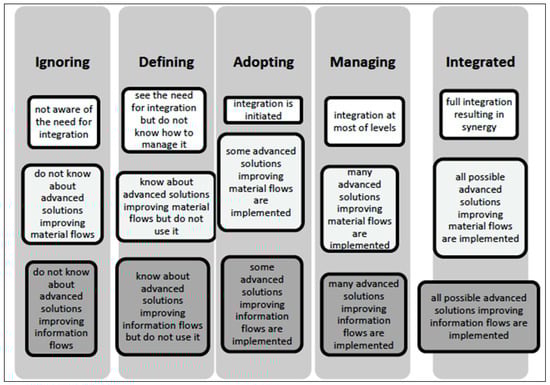
Figure 1.
A maturity model for Logistics 4.0 [36].
3. Materials and Methods
3.1. Sampled Firms
Two leading companies operating in the European and international markets, located in the Wielkopolska region (in Poland), and engaged in a digital transformation in logistics, are considered. The identification of the companies has followed theoretical and convenience sampling criteria [37], Hence, these cases have been selected because they have implemented Industry 4.0 technologies to support their logistics processes. With this regard, these investigated companies offered a useful empirical base to achieve the main objective of proposing a model able to guide companies to assess their maturity level of Industry 4.0 implementation in logistics processes.
The first company is a leader in the Logistics, Transport, and Storage sector, with a turnover of more than €50 million and with more than 250 employees. The headquarter is located in Poznań. In addition, the company has around 10 branches throughout Poland and provides over 80,000 active facilities, operating in the national and international markets. For over 30 years, the company deals with improving its customers’ storage, goods transportation area, and production space through the optimal selection of modern warehouse and warehouse equipment. Storage systems, forklifts, metal furniture, hoisting equipment, loading, and packaging systems are just a small part of the wide range of its offer.
The second analyzed company is an automotive production company operating in European and international markets for over 70 years. The production capacity of the factory reaches approximately 100,000 cars per year. The company has four production plants: two plants in Poznań/Swarzędz, one plant in Wrzesnia, and the components plant (foundry) situated in Poznań. The company has also invested in technologically advanced facilities including body shop, paint shop, assembly hall, and suppliers’ park, as well as a special vehicle body plant and a pilot manufacturing plant. The company is also bringing two major areas into the cloud: first, the networked vehicle and digital services and, now, its production and logistics. The purpose of this company is to continue operating in the field of Industry 4.0.
3.2. Data Collection
The first phase of this analysis consisted of drafting a questionnaire in English titled “Logistics 4.0”. The survey, composed of 15 questions, was based on pen-and-paper personal interviews (PAPI) to collect general information, such as the name of the company, the company’s turnover, the industrial sector, and the average number of employees. The questions were mainly related to the following three fundamental macro-aspects:
- The propensity of the company towards Industry 4.0 and Logistics 4.0, i.e., knowledge, perception, and dynamic development of the company concerning the general issues addressed, such as Industry 4.0 and Logistics 4.0.
- The current use of technologies in the logistics process, i.e., resource management system and smart infrastructures and devices in use throughout the entire logistics process.
- The investments’ level towards Industry 4.0 technologies for a Logistics 4.0 transition, i.e., knowledge, competitive position, and investments undertaken by the company into the Industry 4.0 technologies for a Logistics 4.0 transition, such as IoT, big data, Artificial Intelligence, etc., assessing obstacles and advantages.
The results collected by the two surveys allowed the achievement of the predesigned objective, namely the evaluation of the level of maturity of the analyzed companies for Logistics 4.0.
3.3. Testing the Maturity Model
The methodology and the evaluation process adequately considered are described below. First, we took into account the maturity levels defined in Figure 1. The first level (i.e., “ignoring”) describes a total lack of competencies, knowledge, and adoption of the elements generally adopted by Industry 4.0 and Logistics 4.0, on the contrary, the fifth level (i.e., “integrated”) indicates a full integration and complete digitization of the analyzed company. At this point, in order to evaluate the digital readiness of the companies, it was necessary to define the analytical dimensions.
Starting from the three Logistics 4.0 dimensions pointed out in Table 5, the questions included in the survey were coherently grouped within two macro-dimensions: (a) management and (b) flow of material and information. Then, for each macro-dimension, the other seven sub-dimensions were identified. Again, for each sub-dimension one or more items/questions were considered (Table 6).
Table 6.
Macro-dimensions, sub-dimensions, and items/questions of the maturity model.
On the basis of existing research in the intersection between Logistics 4.0 and Industry 4.0, we assumed that not all items/questions have the same impact in order to evaluate the “maturity” of a company in terms of Logistics 4.0. Consistently with this consideration, the practical importance of each maturity item was rated on a Likert-scale reaching from “not important” (rating = 1) to “very important” (rating = 4). The technique adopted for the model implementation is based on the analytic hierarchy process (AHP). In Table 7, are shown the weights assigned to each item/question.
Table 7.
Maturity items weights.
Again, four different answers in accordance to Likert-scale (including the values from 1 to 4) were identified for each question. For example, for the question shown in Figure 2, the following values have been assigned: (a) not inhibiting = 4; (b) not very inhibiting = 3; (c) enough inhibiting = 2; (d) very inhibiting = 1.
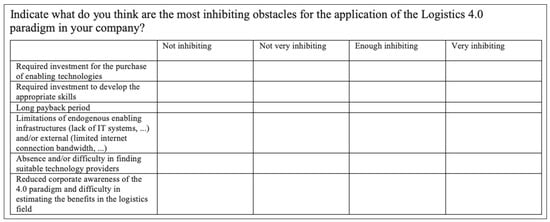
Figure 2.
Example of a question of the questionnaire.
The last step of the evaluation consisted of the overall estimation of the weighted average of all maturity items/questions in accordance with Equation (1):
where: M = maturity, D = dimension, I = item, g = weighting factor, n = number of maturity item.
The maturity level (MD) of each dimension results from calculating the weighted average of all maturity items (MDIi) within its related dimension [19]. Therefore, a numerical interval was assigned to each maturity level, in accordance to the following criteria:
- Ignoring → 1
- Defining → (1;2]
- Adopting → (2;3]
- Managing → (3;4]
- Integrated → 4
Based on the MD value obtained for each dimension it is possible to develop a maturity report, which can be easily shown by a radar chart.
4. Findings
4.1. Analysis of the 1st Company
The macro-dimension, namely “Management”, which is characterized by three other sub-dimensions: (i) Knowledge, (ii) Strategy and Leadership (S&L), and (iii) Employees, is considered. For each sub-dimension the questions and the corresponding scores are shown (Table 8, Table 9 and Table 10).
Table 8.
Scores obtained in the sub-dimension “Knowledge”.
Table 9.
Scores obtained in the sub-dimension “Strategy and Leadership (S&L)”.
Table 10.
Scores obtained in the sub-dimension “Employees”.
Once the weighted average has been calculated for each sub-dimension, it can assign each of them to a specific level of maturity, in accordance with the maturity levels defined in Figure 1 (i.e., Ignoring, Defining, Adopting, Managing, and Integrated). Therefore, it follows that the maximum level of maturity belongs to “Knowledge” with a score of 4 and falls within the “Integrated” level, followed by “Strategy and Leadership (S&L)” and “Employees” with a score of 3, which corresponds to the level “Adopting”. Figure 3 depicts the results obtained by a radar chart.
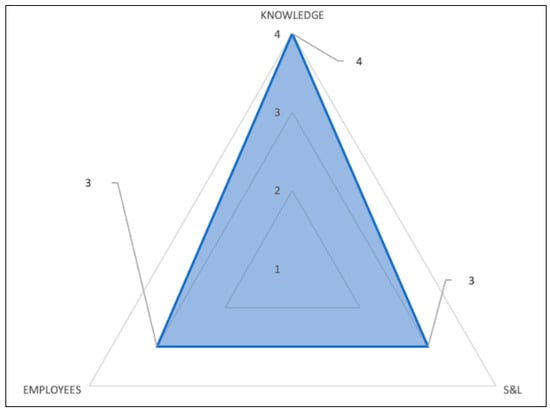
Figure 3.
Radar chart visualizing Logistics 4.0 maturity in “Management” macro-dimension.
The second macro-dimension “Flow of material and information” is divided into four sub-dimensions, namely (i) “IT Systems”, (ii) “Smart Products”, (iii) “Smart Warehouses”, and (iv) “Technologies”. The results of the survey conducted are shown below (Table 11, Table 12, Table 13 and Table 14).
Table 11.
Scores obtained in the sub-dimension “IT Systems”.
Table 12.
Scores obtained in the sub-dimension “Smart Products”.
Table 13.
Scores obtained in the sub-dimension “Smart Warehouses”.
Table 14.
Scores obtained in the sub-dimension “Technologies”.
The graphical representation of the results obtained also of the second dimension “Flow of material and information” is shown in Figure 4.
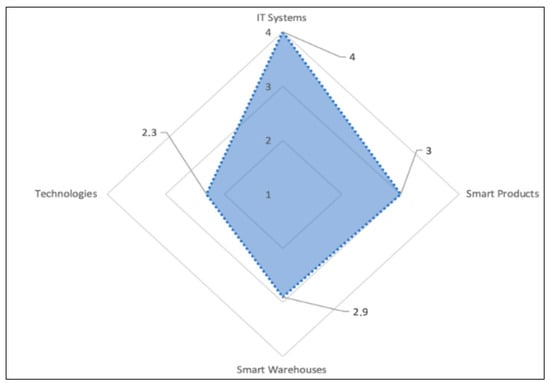
Figure 4.
Radar chart visualizing Logistics 4.0 maturity in “Flow of material and information” macro-dimension.
It is possible observe that a maximum level of maturity is reached and belongs to the “IT Systems” sub-dimension with a score of 4 and therefore falls within the “Integrated” level, followed by “Smart Products”, “Smart Warehouses”, and “Technologies” with a score of 3, 2.9, and 2.3 respectively and all three coincide with the “Adopting” level. Once the analysis has been completed, the results achieved have been summarized in Table 15 and represented by radar chart, showed in Figure 5. As explained above, the company under investigation is a leading company in its sector and is already equipped with a “smart” organization model, therefore the results obtained were rather expected.
Table 15.
Weighted average and Maturity Level in all seven dimensions.
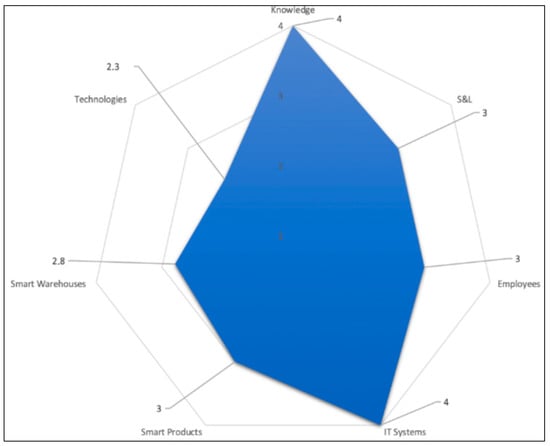
Figure 5.
Radar chart visualizing Logistics 4.0 maturity in all the seven dimensions.
As declared by the same company, technical and scenario interventions are already in progress or are about to be carried out in order to implement new technologies and facilitate the achievement of objectives such as improvement in terms of productivity and growth in the rate of innovation. Where the company excels are the dimensions “Knowledge” and “IT Systems”, this means that it has a clear and precise idea and knowledge of what is happening and what the change entails in terms of company downsizing.
The maturity model showed that the infrastructure currently present in the company allowed the ability to capture in real-time, automatically, and with extreme precision, the movements of all the objects present in the plant, to provide localization information to the control, monitoring, and digital documentation systems. The areas in which integration is least felt within the company are evaluated with the “Adopting” level, in these cases, the innovation process has certainly begun, and it proceeds quickly to the next step. The enabling technologies of Industry 4.0 for a Logistics 4.0 transition are seen by the company mostly as an obstacle in terms of the investments necessary for their adoption, with an average score of 3.4 out of 4, but their relevance and potentials are perfectly understood. In particular, the company is well aware of being able to improve the level of service offered to the customer, succeeding in reducing the lead time of the entire process (average of 3.7 out of 4) and increasing the punctuality of deliveries (average of 3.8 out of 4). Picking errors are reduced, which in the logistic sphere implies multiplication of corrective operations with the related costs, can cause inventory inconsistencies and stock breaks with negative consequences upstream and downstream of the process. To remedy this, vertical automatic warehouses or horizontal automatic warehouses are required.
Concerning technologies like collaborative robots, automated guided vehicles (AGV) as well as big data, the maturity model shows that these technologies are already implemented in the reference company’s context. Under this perspective, there is an unavoidable need to rethink and adapt the protection and skills of workers concerning these new technologies and work environments.
4.2. Analysis of the 2nd Company
The maturity model, already adopted to analyze the first company, is replicated for the second company evaluation. Table 16 shows the corresponding scores and weighted averages of the “Management” dimension, while Table 17 shows the scores for the second dimension “Flow of material and information”.
Table 16.
Scores obtained in “Management” macro-dimension.
Table 17.
Scores obtained in “Flow of material and information” macro-dimension.
In this case, the maximum level of maturity belongs to “Knowledge” and “IT Systems” with a score for both of 4 and they fall within the “Integrated” level, followed by “Strategy and Leadership (S&L)” with a score of 3.7, “Smart Products” and “Smart Warehouses” have the same score 3.3, “Technologies” with a score of 3.1 out of 4 and all fall within the “Managing” level. Only “Employees” with a score of 3 corresponds to the level “Adopting”. Results have been summarized in Table 18 and represented by the radar chart in Figure 6.
Table 18.
Weighted average and Maturity Level in all seven dimensions.
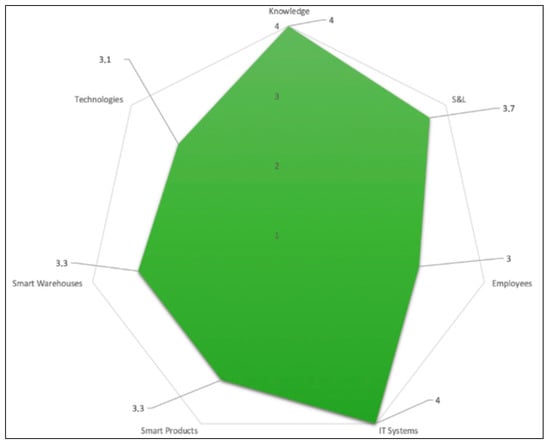
Figure 6.
Radar chart visualizing Logistics 4.0 maturity in all the seven dimensions.
5. Discussions and Conclusions
The goal of this paper was to apply a maturity model for Logistics 4.0 and test its feasibility on the real case study of two companies. To reach this objective, we reviewed the existing research in the intersection between Logistics 4.0 and Industry 4.0 to explore the maturity models dealing with the implementation of Industry 4.0 solutions in logistics processes. Then, two manufacturing companies operating in Poland were identified as study cases to evaluate their level of maturity in terms of Logistics 4.0. Therefore, the results highlight the strengths and weaknesses of the two companies with respect to the transition towards Logistics 4.0.
Although the sample size of the companies analyzed is very small and, therefore, it does not allow us to identify the results at concept-level, the testing of the model on these two real companies case studies showed its capacity to adapt to different scenarios. In addition, the anatomy of the analyzed companies, characterized by a very different core business, allowed us to evaluate the flexibility of the model. In both cases, the model allowed us to identify the level of maturity of companies in accordance with Logistics 4.0.
Even if the conducted tests are not enough to allow a complete validation of the model, they have however shown the effectiveness of the model in the industrial context. Consistently with this consideration, our research represents only the first step to enhance the transition towards Industry 4.0 in companies’ logistics processes. Accordingly, it provides to companies’ decision-makers, a user-friendly tool for a quick evaluation of the maturity level of the company in terms of Logistics 4.0.
From a theoretical perspective, mostly in light of the emerging results, this work can be considered as one of the first attempts to dig into the ways of transitioning towards Logistics 4.0 by proposing an ad-hoc maturity model for evaluating the implementation of Industry 4.0 in logistics processes. From a managerial perspective, the paper advances the proposed maturity model as a tool that, especially for logistics companies, can be applied to assess their readiness level to the fourth industrial revolution.
Several reflections can additionally be done according to this research. First, Industry 4.0 represents a necessary path that companies should consider if they intend to survive in rapidly and constantly evolving markets. Rohrbeck and Schwarz (2013) have already observed that ignoring changes in a globalized world often results in losing opportunities or failing to respond to threats [38]. Initiating and successfully completing the processes of innovation and digital transformation from the perspective of Industry 4.0 requires, in addition to investments in hardware and software technologies, an internal cultural change and consequently a well-defined company roadmap. Second, the digital transition pushed by Industry 4.0 not only challenges companies’ capacity to innovate, but also requires new strategies, organizational and operational models, as well as organization-wide changes in physical infrastructure, manufacturing operations, technologies, human resources, and managerial practices [39]. Hence, this represents a profound change, a transformation towards digital requires a thorough understanding of current state of transition of a company, hence suggesting subsequent actions, such as the development of new methods and tools to face the transition.
Again, although new methods and tools were developed to provide guidance and support to align companies’ business strategies and operations [19,40], much more theoretical and empirical effort is further needed to develop and propose methods and tools that specifically address dedicated companies’ areas for Industry 4.0 implementation, such as logistics, supply chain management, manufacturing processes, etc. [41]. Accordingly, although we just started from logistics processes, there is surely a space for future research both in other companies’ functions and sectors of activity. Finally, we hope through this work, being preliminary in nature, to provide an effective reference model for scholars and practitioners operating in the fields of Industry 4.0 and Logistics 4.0.
Author Contributions
Conceptualization, F.F. and J.O.-S.; methodology, J.O.-S.; writing—original draft preparation, A.U.; writing—review and editing, F.F. and A.U.; visualization, L.R., All authors have read and agreed to the published version of the manuscript.
Funding
This research received no external funding.
Conflicts of Interest
The authors declare no conflict of interest.
References
- Strandhagen, J.O.; Vallandingham, L.R.; Fragapane, G.; Strandhagen, J.W.; Stangeland, A.B.H.; Sharma, N. Logistics 4.0 and emerging sustainable business models. Adv. Manuf. 2017, 5, 359. [Google Scholar] [CrossRef]
- Winkelhaus, S.; Grosse, E.H. Logistics 4.0: a systematic review towards a new logistics system. Int. J. Prod. Res. 2019. [Google Scholar] [CrossRef]
- Carli, R.; Dotoli, M.; Pellegrino, R.; Ranieri, L. Using multi-objective optimization for the integrated energy efficiency improvement of a smart city public buildings’ portfolio. In Proceedings of the 2015 IEEE International Conference on Automation Science and Engineering (CASE), Gothenburg, Sweden, 24–28 August 2015; pp. 21–26. [Google Scholar]
- Haseeb, M.; Hussain, H.I.; Ślusarczyk, B.; Jermsittiparsert, K. Industry 4.0: A solution towards technology challenges of sustainable business performance. Soc. Sci. 2019, 8, 154. [Google Scholar] [CrossRef]
- Carli, R.; Dotoli, M.; Epicoco, N.; Angelico, B.; Vinciullo, A. Automated evaluation of urban traffic congestion using bus as a probe. In Proceedings of the 2015 IEEE International Conference on Automation Science and Engineering (CASE), Gothenburg, Sweden, 24–28 August 2015; pp. 967–972. [Google Scholar]
- Rosa, P.; Sassanelli, C.; Urbinati, A.; Chiaroni, D.; Terzi, S. Assessing relations between Circular Economy and Industry 4.0: A systematic literature review. Int. J. Prod. Res. 2019. [Google Scholar] [CrossRef]
- Ardito, L.; D’Adda, D.; Messeni Petruzzelli, A. Mapping innovation dynamics in the Internet of Things domain: Evidence from patent analysis. Technol. Forecast. Soc. Chang. 2018, 136, 317–330. [Google Scholar] [CrossRef]
- Zhong, R.Y.; Xu, X.; Klotz, E.; Newman, S.T. Intelligent Manufacturing in the Context of Industry 4.0: A Review. Engineering 2017, 3, 616–630. [Google Scholar] [CrossRef]
- Urbinati, A.; Chiaroni, D.; Chiesa, V.; Frattini, F. The role of digital technologies in open innovation processes: An exploratory multiple case study analysis. R D Manag. 2018. [Google Scholar] [CrossRef]
- Digiesi, S.; Mossa, G.; Mummolo, G. A sustainable order quantity model under uncertain product demand. Ifac Proc. Vol. 2013, 46, 664–669. [Google Scholar] [CrossRef]
- Digiesi, S.; Mossa, G.; Rubino, S. A sustainable EOQ model for repairable spare parts under uncertain demand. Ima. J. Manag. Math. 2015, 26, 185–203. [Google Scholar] [CrossRef]
- Urbinati, A.; Bogers, M.; Chiesa, V.; Frattini, F. Creating and capturing value from Big Data: A multiple-case study analysis of provider companies. Technovation 2019, 84, 21–36. [Google Scholar] [CrossRef]
- Digiesi, S.; Mossa, G.; Mummolo, G. Supply lead time uncertainty in a sustainable order quantity inventory model. Manag. Prod. Eng. Rev. 2013, 4, 15–27. [Google Scholar] [CrossRef]
- Wang, G.; Gunasekaran, A.; Ngai, E.W.T.; Papadopoulos, T. Big data analytics in logistics and supply chain management: Certain investigations for research and applications. Int. J. Prod. Econ. 2016, 176, 98–110. [Google Scholar] [CrossRef]
- Garcia-Muiña, F.E.; González-Sánchez, R.; Ferrari, A.M.; Volpi, L.; Pini, M.; Siligardi, C.; Settembre-Blundo, D. Identifying the equilibrium point between sustainability goals and circular economy practices in an Industry 4.0 manufacturing context using eco-design. Soc. Sci. 2019, 8, 241. [Google Scholar]
- Nagy, J.; Oláh, J.; Erdei, E.; Máté, D.; Popp, J. The role and impact of industry 4.0 and the internet of things on the business strategy of the value chain-the case of Hungary. Sustainability 2018, 10, 3491. [Google Scholar] [CrossRef]
- Alcácer, V.; Cruz-Machado, V. Scanning the Industry 4.0: A Literature Review on Technologies for Manufacturing Systems. Eng. Sci. Technol. Int. J. 2019, 22, 899–919. [Google Scholar]
- Burmeister, C.; Luettgens, D.; Piller, F.T. Business Model Innovation for Industrie 4.0: Why the ‘Industrial Internet’ Mandates a New Perspective. SSRN Electron. J. 2015. [Google Scholar] [CrossRef]
- Schumacher, A.; Erol, S.; Sihn, W. A Maturity Model for Assessing Industry 4.0 Readiness and Maturity of Manufacturing Enterprises. Procedia CIRP 2016, 52, 161–166. [Google Scholar] [CrossRef]
- Ardito, L.; Petruzzelli, A.M.; Panniello, U.; Garavelli, A.C. Towards Industry 4.0. Bus. Process Manag. J. 2019, 25, 323–346. [Google Scholar] [CrossRef]
- Uva, A.E.; Fiorentino, M.; Gattullo, M.; Colaprico, M.; De Ruvo, M.F.; Marino, F.; Trotta, G.F.; Manghisi, V.M.; Boccaccio, A.; Bevilacqua, V.; et al. Design of a projective AR workbench for manual working stations. In Lecture Notes in Computer Science (Including Subseries Lecture Notes in Artificial Intelligence and Lecture Notes in Bioinformatics); Springer: Berlin, Germany, 2016. [Google Scholar]
- Boccaccio, A.; Cascella, G.L.; Fiorentino, M.; Gattullo, M.; Manghisi, V.M.; Monno, G.; Uva, A.E. Exploiting augmented reality to display technical information on industry 4.0 P&ID. In Lecture Notes in Mechanical Engineering; Springer: Cartagena, Spain, 2019. [Google Scholar]
- Bauernhansl, B.; Ten Hompel, T.; Vogel-Heuser, M. Industrie 4.0 in Produktion, Automatisierung und Logistik; Springer: Wiesbaden, Germany, 2014. [Google Scholar]
- Barreto, L.; Amaral, A.; Pereira, T. Industry 4.0 implications in logistics: an overview. Procedia Manuf. 2017, 13, 1245–1252. [Google Scholar]
- Hofmann, E.; Rüsch, M. Industry 4.0 and the current status as well as future prospects on logistics. Comput. Ind. 2017, 89, 23–34. [Google Scholar] [CrossRef]
- Stahl, B.C.; Obach, M.; Yaghmaei, E.; Ikonen, V.; Chatfield, K.; Brem, A. The responsible research and innovation (RRI) maturity model: Linking theory and practice. Sustainability 2017, 9, 1036. [Google Scholar] [CrossRef]
- Wibowo, M.A.; Waluyo, R. Knowledge management maturity in construction companies. Procedia Eng. 2015, 125, 85–94. [Google Scholar] [CrossRef]
- Proença, D.; Borbinha, J. Maturity Models for Information Systems—A State of the Art. Procedia Comput. Sci. 2016, 100, 1042–1049. [Google Scholar] [CrossRef]
- Kohlegger, M.; Maier, R.; Thalmann, S. Understanding maturity models results of a structured content analysis. In Proceedings of the I-KNOW 2009—9th International Conference on Knowledge Management and Knowledge Technologies and Proceedings of I-SEMANTICS 2009—5th International Conference on Semantic Systems, Graz, Austria, 2–4 September 2009; pp. 51–61. [Google Scholar]
- Röglinger, M.; Pöppelbuß, J.; Becker, J. Maturity models in business process management. Bus. Process Manag. J. 2012, 18, 328–346. [Google Scholar] [CrossRef]
- Zhang, J.; Li, H.; Wang, S.H.M. Analysis and potential application of the maturity of growth management in the developing construction industry of a Province of China: A case study. Sustainability 2017, 9, 143. [Google Scholar] [CrossRef]
- Paulk, M.C. A History of the Capability Maturity Model for Software. Softw. Qual. Profile 2009, 12, 5–19. [Google Scholar]
- Dennis, A.; Aaron, C.; Richard, T. CMMI® Distilled: A Practical Introduction to Integrated Process Improvement, 3rd ed.; Addison-Wesley: Boston, MA, USA, 2008. [Google Scholar]
- Sternad, M.; Lerher, T.; Gajsek, B. Maturity Levels for Logistics 4.0 based on Nrw’s Industry 4.0 Maturity Model. Bus. Logist. Mod. Manag. 2018, 18, 695–708. [Google Scholar]
- Oleśków-Szłapka, J.; Stachowiak, A. The framework of logistics 4.0 maturity model. In Advances in Intelligent Systems and Computing; Springer: Wrocław, Poland, 2019. [Google Scholar]
- Batz, A.; Oleśków-Szłapka, J.; Stachowiak, A.; Pawłowski, G.; Maruszewska, K. Identification of Logistics 4.0 Maturity Levels in Polish Companies—Framework of the Model and Preliminary Research. In Sustainable Logistics and Production in Industry 4.0; Grzybowska, R., Awasthi, K., Sawhney, A., Eds.; Springer: Cham, Switzerland, 2020; pp. 161–175. [Google Scholar]
- Voss, C.; Tsikriktsis, N.; Frohlich, M. Supply chain risks: a review and typology. Int. J. Oper. Prod. Manag. 2002, 22, 195–219. [Google Scholar] [CrossRef]
- Rohrbeck, R.; Schwarz, J.O. The value contribution of strategic foresight: Insights from an empirical study of large European companies. Technol. Forecast. Soc. Chang. 2013, 80, 1593–1606. [Google Scholar] [CrossRef]
- Gilchrist, A. Introducing Industry 4.0. In Industry 4.0; Apress: Berkeley, CA, USA, 2016; pp. 195–215. [Google Scholar]
- Neto, G.O.; Tucci, H.; Pinto, L.; Costa, I.; Leite, R. Economic and Environmental Advantages of Rubber Recycling. In Proceedings of the IFIP International Conference on Advances in Production Management Systems (APMS), Iguassu Falls, Brazil, 3–7 September 2016; pp. 818–824. [Google Scholar]
- Tjahjono, B.; Esplugues, C.; Ares, E.; Pelaez, G. What does Industry 4.0 mean to Supply Chain? Procedia Manuf. 2017, 13, 1175–1182. [Google Scholar] [CrossRef]
© 2019 by the authors. Licensee MDPI, Basel, Switzerland. This article is an open access article distributed under the terms and conditions of the Creative Commons Attribution (CC BY) license (http://creativecommons.org/licenses/by/4.0/).