


Abstract
The past decade has seen a surge in the use of city branding, which is used to attract specific target groups of investors, high-tech green firms and talented workforce and reflects a desired shift from old, polluting manufacturing industries to new, clean service industries. Previous studies in the Chinese mega-city regions Pearl River Delta, Yangtze River Delta and Jing-Jin-Ji (region around Beijing and Tianjin) have shown that branding practices of primarily service and innovation oriented cities are largely in line with existing industrial profiles while those which are predominantly manufacturing oriented wish to present themselves as more service and innovation driven. In this contribution, city branding practices are studied in China’s three Northeastern provinces Heilongjiang, Jilin and Liaoning which face structural decline because of the presence of many outdated resource-based and heavy industries. The gap between existing profile and branding choices appears not systematic as in China’s leading economic regions. Northeastern cities focus more on combining primary, secondary and tertiary industrial patterns than on displacing manufacturing with services. The tertiary sector in these provinces is more administrative and public sector oriented and generates lower value added; it is therefore not significantly more attractive than the primary and secondary ones.
1. Introduction
The past decade has seen a dramatic surge in the use of city branding practices by local governments around the world. In the drive to attract investors, businesses, talented workforce and profusely spending visitors they go to great lengths to convey positive self-images to the outside world and hope to obtain a variety of economic returns in exchange. Chinese cities are no exception to this rule. Some put themselves on display as global cities [1], others organize significant international events to get into the spotlights, such as sports events and large-scale exhibitions [2], while nearly all significant cities and even a great many districts build copious planning exhibition halls to share their urban development achievements with the broader community [3]. Few if any visitors have doubts on the speed and perseverance with which their infrastructure and urban development projects have progressed over the past thirty years or so.
Given China’s continued aspirations to record annual economic growth of over 6.5% and combine this with an improvement in its environmental performance, ‘ecological modernization’ appears by far to be the most attractive course of future economic development [4,5,6]. Ecological modernization is generally defined as continued economic growth with reduced harmful environmental emissions and/or reduced consumption of natural resources by making a transition from a manufacturing and physical production oriented to a knowledge-driven and service oriented economy. This industrial transformation is not an automatic transition; it goes hand in hand with intense rivalry among municipalities and districts in attracting green, clean, innovative and high-tech service industries within their borders. A key tool municipalities use to boost their attractiveness is city branding [7]. City branding refers to the application of self-profiling and ‘imagineering’ practices by cities to enhance their positive visibility and loyalty among stakeholders relevant to their economic success [8,9]. They do this by highlighting their attractive features, cloaking themselves in and associating themselves with fashionable terminology and using images and logos to be remembered. They have also stepped up their use of a great variety of attractive city labels, such as eco cities, low carbon cities, smart cities, knowledge cities, resilient cities and many more [10]. Each of these concepts reflect a desired shift in the direction of ecological modernization where social, economic and ecological gains are presumed to come nicely together. Earlier studies in the application of city branding among cities in the face of ecological modernization focused on polycentric regions such as Rhine-Ruhr in Germany and Randstad in The Netherlands [11] and the three Chinese Mega-City Regions Pearl River Delta, Yangtze River Delta and Jin-Jin-Ji [12,13,14]. From these studies, it appeared that city branding practices were quite commonly used but that cities with a strong tradition in manufacturing and heavy industry were reluctant to present themselves as such and preferred to dress up as service or innovation cities even if this seemed barely realistic in the eyes of their stakeholders. A negative interpretation would lead observers to believe that city branding was all in all an activity in green-washing rather than true industrial transformation. Cities where the service and knowledge industries had already become dominant in recent years proved decidedly happier with their profile and their branding was more in line with geographic and industrial realities.
Since these previous studies focused on centrally located and economically leading regions, knowledge of city branding practices in underprivileged areas where cities dominated by heavy industry, agriculture and resource extraction is scant. The aim of this contribution is to examine what the city branding patterns in these lesser developed regions in China looks like. More specifically, we ask ourselves what city branding strategies are deployed by cities in the North-East of China the attractiveness of which to investors, high-tech forms and talented workforce is low and which face economic and population decline and struggle to maintain their natural resources and environmental quality. How do these city branding practices match their geographic and economic profiles and what are the policy ramifications of these choices?
To answer the above questions, the remainder of this article will proceed as follows. Section 2 will present define and operationalize the concept city branding as it is used here. It will (1) offer a set of leading definitions and conceptualizations as they exist in the literature and (2) clarify the methodological approach to city branding practices in China’s Northeast. Section 3 provides a general geographic, demographic and economic description of China’s Northeastern region and shows the challenges it is facing. Section 4 and Section 5 provide an overview of and analyze how a selection of 34 cities in the provinces of Heilongjiang, Jilin and Liaoning brand themselves. More specifically, these refer to their use of (1) city brand identities: positive self-descriptions containing their essential features and (2) city labels: attractive terminology by which local governments convey an appealing green and/or high-tech impression of their own cities. We also examine to what extent these brand identities match the industrial and geographic features of the cities involved. Section 4 does this for the city brand identities, Section 5 for their use of city labels related to ecological modernization. Section 6 wraps up this article with conclusions, compares the findings here with those of the previous studies and sketches a future research agenda.
2. City Branding: Theory and Methodology
At face value, city branding shows resemblance to city marketing, a term that was much en vogue in the 1980s and 1990s. However, closer inspection shows that marketing essentially refers to a heightened sense of awareness of target group wishes in the short and medium term, while branding is more strategic and long-term oriented and has a strong aspect of loyalty to it [15]. Vanolo has defined city branding as a complete set of activities aimed at establishing and maintaining a positive city image and conveying this information to different target groups via materials and events at various scales [16]; all of this to gain competitive advantages over other cities. In other words, while city marketing can for instance support Harbin in knowing more about its various stakeholders in and around the city and act on this knowledge, city branding can help it in letting these stakeholders know more good things [16] about Harbin which can translate into a long-term commitment to engage in and collaborate with it. Dinnie emphasizes other aspects in his definition; he sees a city brand as a unique, multi-dimensional blend of elements, which provides the city with culturally grounded differentiation and relevance for its target audiences [17]. Most authors in the field are in agreement that place branding, of which city branding is a specific subset, is more complex in nature than product branding, because cities are truly multi-dimensional entities evoking a great variety of impressions and associations depending on people among whom and circumstances under which they are evoked [18]. One general message addressed at different groups of stakeholders with potentially conflicting interests and expectations can lead to trouble, making it necessary to convey partially different (but not contradictory) messages to those various target groups [19,20,21]. City branding has more in common with the corporate branding that large companies and holdings with many different product lines engage in. This hints at the importance of distinguishing target groups and/or stakeholders and addressing them in different ways; at their turn, they hopefully reflect the brand message in the same way in their own communication, a sign that they support it and act in accordance with it.
The city brand dimension of particular relevance here is that of urban and industrial greening and transformation, the stakeholders for which are investors, corporations, talented workforce and real or potential residents of the city. A salient feature appearing in the literature on city branding relevant to urban transformation towards ecological modernization is the tension between a city’s current social, economic and geographic features (its existing profile) and its self-image based on high-brow future ambitions (its desired brand). Generally speaking, cities have (1) a historically based cultural, social and economic legacy which colors them, (2) a present social and economic profile with a specific composition of the population and collection of dominant industries and (3) a set of policy ambitions and chosen policy measures for the future. If present situation and future ambitions deviate from each other too strongly without stakeholders being able to grasp how this gap can be closed, credibility of a brand suffers from this (perceived) inconsistency [16,22]. On the other hand, if the realization of future ambitions can be seen as a continuation and enhancement of an evolving developmental path spiced up with a peculiar historical and cultural background the brand will appear both attractive and credible. Therefore, local governments able to align current profile with future wishes, following up with concomitant implementation and convincing relevant stakeholders to echo their brand in ways consistent with their own are likely to bridge the gap between existing profile and desired brand and realize their long-term goals for urban transformation.
In this study, the focus is specifically on economic city branding, which takes place in the context of urban and industrial development policy and is reflected in development plans. This is different from what is often understood as city branding as a targeted process in which labels, slogans and logos are established which are subsequently broadly advertised across the media [23]. We utilize an analytical framework on urban developmental pathways that explicitly relates to urban and industrial profiles cities have and examine how their existing geographic profiles compare with their desired brands and pathways [9,13]. The alignment of past traditions, status quo and future ambitions is examined by comparing city branding practices adopted by cities with their urban and industrial developmental pathways. In the analytical framework we adopt, a city’s branding practice constitutes the dependent variable and a city’s geographic position (regional, national and international importance) and stage of urban economic development (primary, secondary or tertiary industries dominant in their production) is the independent variable. Depending on their score for the independent variable ‘geographic position’, we surmise that cities will respond differently to the challenges of ecological modernization, reflected in the score on their dependent variable ‘branding practice’. Table 1 below, adopted from [14] where this approach was first introduced, shows the different possible pathways that follow from various geographic positions.

Table 1.
Urban developmental pathways (adopted from de Jong et al. 2018).
A total of five possible pathways can be distinguished (see de Jong et al. 2018) [14] of which only three appear in China’s Northeast:
Pathway 1: Cities retain substantial agricultural or resource extraction activity and, consequently, benefit from significant open and green space within their large territory. At the same time, they have a weak basis in knowledge development. They, therefore, can be expected to choose to attract ‘clean’ low-tech industries, such as eco-tourism, while also inevitably remaining open to accommodating manufacturing industries so as to complement economic activity where green industries do not generate sufficient employment. We would expect their brand identities to reflect these characteristics. Predicted city labels are eco city, tourism city, modern agricultural city and livable/green city, because these are all within the range of developmental options available to pathway 1 cities.
Pathway 2: Cities are of regional or national importance. In terms of economic activity, material processing and manufacturing dominate, although cities seek to shift to more advanced, less carbon-intensive industries. They may be incentivized to do so through relevant national policy initiatives, which becomes reflected in their city branding identities. Corresponding city labels in line with their developmental possibilities are advanced manufacturing city, low carbon city and smart city.
Pathway 4: Cities herein are of regional or national importance. A majority of the population work in trade and service industries; and cities aim to consolidate their position as service industry hubs by offering attractive space and facilities for knowledge-intensive production coupled with cultural facilities. Cities on this pathway 4 can, given their range of developmental options, be expected to deploy a relatively generic brand identity centered on their service industry aspirations, with typical city labels likely to include service city, innovation city, livable/green city and tourism city.
We argue that cities with credible city branding strategies show awareness of the pathway they are on and reflect this in their use of brand identities and labels. In order to examine the branding practices of cities in China’s deprived Northeastern corner, a number of methodological and operational choices have been made.
- Since the number of cities in the three provinces Heilongjiang, Jilin and Liaoning is manageable, we selected all 34 cities. For each city, branding practices were mapped at two levels. We examined both (1) the city brand identity, which can be seen as a city’s general self-image in which it includes its essential features and (2) its use of city-labels in connection with urban ecological modernization. This selection of city labels finds its origin in earlier work [10,24] where various different city labels were identified but then adapted to terminology as it prevails in the Chinese policy context [13,14]. These labels are sustainable city, smart city, innovation city, resilient city, tourism city, eco city, low carbon city, livable city, advanced manufacturing city, service city and modern agricultural city. There is evidence that some of these city labels, such as the sustainable city and the smart city should in fact be conceptualized in multi-dimensional ways [25,26]. In order to cover the variety of interpretations under each city label, we considered these various dimensions or aspects as variations under one theme, the general city label. When relevant similar terms related to but slightly deviating from the city labels were found, these were subsumed as variants under the most suitable city label.
- For the data collection regarding the dependent variable ‘branding practices’, local plans offered the most reliable documents to establish city branding choices. Interviews with policy makers would have evoked mostly subjective signals depending on the responding official, investment figures in projects or programs say little about branding and government websites may be neither complete nor easy to compare with one another. There were three credible plans that could act as sources for data collection: Social and Economic Five Year Plans (FYPs), Urban Master Plans (UMPs) and Land Use Plans (LUPs). The 13th FYPs and the most recent UMPs proved to be of unqualified significance for the topic at hand [12,13]. Since LUPs turned out to be too operational to serve for branding purposes, these were excluded. To establish a city’s brand identity, the introduction, conclusions and summary of the selected plans were scanned for the most suitable phrases and descriptions. To find the most popular city label for each city, a total frequency count was made of all city labels throughout the selected plans to identify the ranks of the most popular ones in each city.
- For the data collection regarding the independent variable urban economic development stage, a selection of relevant statistical data was collected: (1) land area; (2) permanent population; (3) three dominant industries; (4) GDP per capita of the permanent population; ratio of primary/secondary/tertiary sector as (5) percentage of GDP and (6) percentage of working population. While land area, permanent population and GDP per capita provided relevant background information, the value for urban developmental stage was determined primarily based on the ratio primary/secondary/tertiary sector as percentage of the working population. However, where the gap between two sectors was narrow, the ratio primary/secondary/tertiary sector as percentage of GDP and dominant industries were used for a nuanced picture. If the indicators pointed in different directions, we chose as the value for this independent variable a combination of two stages. For instance, in the case of Suihua, only 4.94% of the working population works in the primary sector but nearly 40% of GDP is generated there and wholesale and retail represent the dominant industries in terms of workforce. This led us to characterize Suihua as a city in both urban stages 4 and 1 (4/1). See Table 2. The data collection procedure on which this contribution is based on a methodology initially developed in earlier work [12,13] and fully elaborated in [14].
Table 2. Key geographic and economic data and developmental pathways of HLJ Province (2015).
3. A Brief Profile of China’s Deprived Northeastern Region
The Northeastern provinces in China (the ‘Northeast’) have the disposal of rich natural resources and have played an important role in China’s national economic development. After the foundation of new China, the Northeast enjoyed full support from the central government under the planned economy. Among the 156 priority construction projects of the whole country, the northeast accounted for 52 [27]. Before 1990s, the Northeast were a relatively developed region in China and its most important industrial base. However, compared with the rest of the country, in the past 15 years, the Northeast’s economic development has markedly lagged behind. GDP and industrial added value as a proportion of the national total score dropped by nearly 15% and 20% from the beginning of Reform and Opening Up period to less than 10% now. In October 2003, the Central Committee of the Communist Party of China and the State Council issued several notices on the strategy of revitalizing the old industrial bases in the Northeast and clarified the guiding ideology, principles, tasks and policy measures for the implementation of the revitalization strategy. The implementation of the revitalization strategy seemed to generate a positive effect, because as can be seen in Figure 1, the GDP in the Northeast climbed more rapidly than the national average from 2003 to 2013. Since then, however, the roles have been reversed again.
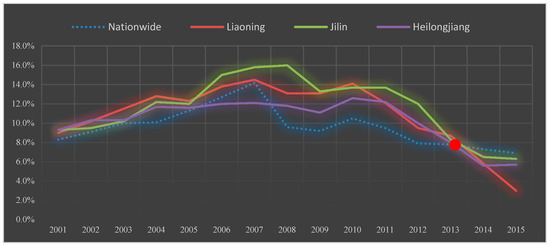
Figure 1.
GDP growth rate of the three provinces compared to the national level.
The Northeast includes the provinces Heilongjiang, Jilin and Liaoning. See Figure 2. Below, short profiles are given of each province and its key cities.
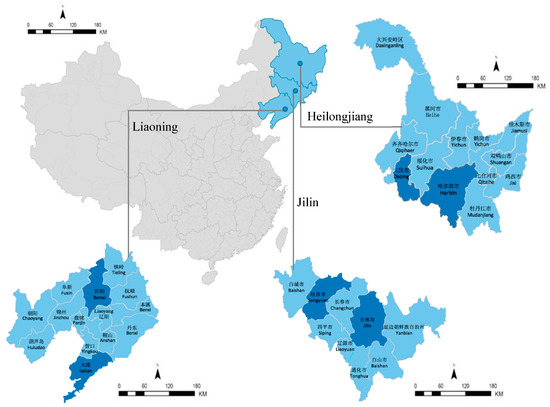
Figure 2.
The location of Liaoning, Jilin and Heilongjiang Provinces and their cities.
3.1. Liaoning Province
Liaoning is the only coastal province in the Northern China. Among the three Northeastern provinces, it covers the smallest land area (148,000 km2) and has a population of 43.778 million. Its GDP in 2016 was 2866.90 billion RMB, almost the sum of Jilin and Heilongjiang together. Liaoning is one of the important old industrial bases in China. Equipment manufacturing industry and raw material industry are relatively developed [28,29]. It includes 14 cities: Shenyang, Dalian, Anshan, Fushun, Benxi, Panjin, Huludao, Dandong, Jinzhou, Yingkou, Fuxin, Liaoyang, Tieling and Chaoyang. Shenyang and Dalian are vice provincial level cities.
Shenyang is an important advanced equipment manufacturing base and national historical city in the Northeast [30]. Since as far back as the New China (PRC) was founded, Shenyang had been regarded as one of the key areas for national economic development and focused on the development of heavy industry [31]. After decades of development, its industrial legacy includes the auto, pharmaceutical, chemical, aeronautical and metallurgy industries. Dalian is Liaoning province’s second city. Petrochemical industry is one of its pillar industries. Its industrial added value accounts for about a quarter of its total industrial added value and contributed substantially to Dalian’s economic and social development [32].
Most of other cities in the region have manufacturing as their dominant industry. For instance, Anshan, is famous for its iron and steel industry, Panjin because of its oil and petrochemical industry, while Yingkou is the first open port in the modern history of the Northeast. Many of the smaller cities realized a substantial share of their economic growth by the rise of the real estate industry (Table 3).
Table 3.
Key geographic and economic data and developmental pathways of Liaoning Province (2015).
3.2. Jilin Province
Jilin province is both an important industrial base and strong in agriculture. The manufacturing industry is well developed and its pillar industries include auto, petrochemical, processing of agricultural products and commercial satellite production [33,34]. Jilin covers a total area of 187,400 m2, with a population of 27.533 million and its GDP amounted to 1406.31 billion in 2015. Jilin province has jurisdiction over Changchun (vice provincial city and provincial capital), Jilin city (2nd city in size and former capital), Siping, Songyuan, Baicheng, Liaoyuan, Tonghua, Baishan and Yanbian Korean Autonomous prefecture.
Changchun was the earliest auto industry and film production base in the New China. Unlike other cities in Jilin province, the tertiary sector in Songyuan is well developed [35]. Other cities, such as Siping and Baicheng, conversely have more people working in the primary industry (Table 4). Baicheng is known as a large commodity grain base city at the national level. Yanbian has the largest contingent of ethnic Koreans and is one of the major timber producing areas in China. It is the only autonomous prefecture in the Northeast, enjoying strong self-governance. Therefore, its statistic data cannot be found in the yearbook. This explains why data on its ‘1/2/3 as working population’ is missing in Table 4. Other small cities in Jilin province have undergone economic restructuring based on removing traditional, resource consuming industries and realizing advanced and high-tech industries. However, manufacturing continues to be the lion’s share in their economic structures.
Table 4.
Key geographic and economic data and developmental pathways of Jilin Province (2015).
3.3. Heilongjiang Province (HLJ)
Heilongjiang is another base for heavy industry in China but it also has substantial shares in its agricultural production and resource extraction. High-end manufacturing, aerospace, machinery, petroleum, coal, wood, agriculture and animal husbandry are its key industries [36,37,38,39]. The region’s total land area covers 473,000 km2 and it has a population around 40 million. According to the Heilongjiang provincial statistic report, in 2016 Heilongjiang realized a GDP of 1538.61 billion RMB [40]. There are 12 prefecture level cities in Heilongjiang, including Harbin, Qiqihar, Jixi, Hegang, Shuangyashan, Daqing, Yichun, Jiamusi, Mudanjiang, Heihe, Qitaihe and Suihua.
Harbin is a provincial capital city, also the Northeast’s third largest city in terms of household population. Initially, Harbin’s economic structure consisted mainly of light industry such as food and textile but after the establishment of the New China (1994), it became a heavy industrial base [41]. Another big city, Daqing, also known as oil city, counts petroleum and petrifaction among its pillar industries [42]. It ranks first in per capita GDP in Heilongjiang province (see Table 2).
Compared to Liaoning and Jilin province, agriculture in Heilongjiang accounts for a higher portion of its economic activity. Yichun has the largest Korean pine virgin forest in the world; Heihe is an important commodity grain base and green food production area in China; Suihua and Hegang, located in the Songnen and Sanjiang plains, also have a high percentage in the primary sector (see Table 2).
The above descriptions and tables of the three Northeastern provinces, a few conclusions can be drawn on the independent variable ‘geographic position’ of their cities.
- Only two cities in Heilongjiang are unambiguously on pathway 1 (Yichun and Heihe), while two more have important features of pathway 1 (Hegang and Suihua).
- A great number of cities are on pathway 2, especially the less central and populous ones.
- A great number of cities are on pathway 4, especially the centrally located, most populous and economically vital ones. However, not in all cases does being on pathway 4 imply higher levels of prosperity. This depends strongly on which industries are represented in the tertiary sector. If public management, security and social organization are the dominant industries as in various cities in Heilongjiang, these tend to have low value added. This picture matches earlier findings for cities in Hebei province, showing similar evidence that the tertiary sector consisted of less economically advantageous economic activities [14]. If tertiary sector activity is mostly in trade, logistics and commerce or high-tech innovation, as in parts of Jiangsu and Zhejiang, it generates far higher levels of GDP per capita.
- There are also many cities with characteristics of both pathway 2 and 4.
4. City Brand Identities in China’s Northeastern Region
After mapping the geographic positions of the cities in the North-East and thus establishing the developmental pathways they are on, we now look at the dependent variable: their city branding practices. In this section, the city brand identities will be examined. In the three tables below (Table 5 for Liaoning, Table 6 for Jilin and Table 7 for Heilongjiang), we show city, pathway following geographic position (derived from Table 2, Table 3 and Table 4), brand identity description as found in Five Year Plan or Urban Master Plan and desired pathway, i.e., pathway as implied by the expressed city brand identity. Concordance of actual pathway and desired pathway implies that city branding occurs in line with geographic profile and is thus ‘on path’, while divergence between the former and the latter implies a city’s wish to be or become different from what it is now (‘off-path’).
Table 5.
Developmental pathways and brand identities for cities in Liaoning.
Table 6.
Developmental pathways and brand identities for cities in Jilin.
Table 7.
Developmental pathways and brand identities for cities in Heilongjiang.
While some brand identities such as those for Panjin, Yingkou, Liaoyang and Chaoyang are very specific and colorful, what generally stands out in Liaoning is that there is no significant desire among cities to shift from manufacturing to services as such. Most cities brand themselves in line with their geographic profile and to the extent that there is divergence between actual and desired pathway, changes are not away from industry and agriculture towards services but towards an integration of pathways 2 and 4 or 1, 2 and 4 at the same time and to become eco-friendly. Some cities stay on pathway 4, some stay on pathway 2 but most in fact wish to have features of two or three different pathways at the same time.
The table for the cities in Jilin demonstrates the same trends as the one for Liaoning: cities do not systematically deviate from their actual pathway but yearn for diversification in their economic activity and often for the integration of manufacturing with services and the rural with the urban leading to a higher and more ecological quality of life. Baishan and Yanbian, for instance, both have manufacturing and services features but in their branding, pay ample attention to integrating the rural and the urban and attractiveness as a tourist resort.
Heilongjiang clearly shows the most diverse picture with cities appearing in all different possible pathways and combinations thereof. This is already true for the actual pathways but even more distinctly so for the desired pathways where obviously combinations of pathways 1, 2 and 4 appear frequently. Here perhaps even more the coupling of various industrial sectors and rural and urban integration stand at the forefront of proclaimed future development en repositioning.
5. City Labels in China’s Northeastern Region
In Section 4 we compared developmental pathways according geographic position with desired pathways as expressed in city brand identities. This was the first indicator for city branding practices; in this section we use city labels as a second indicator. In Table 8, Table 9 and Table 10, we do this by presenting city, pathway following geographic position (derived from Table 2, Table 3 and Table 4), most frequent city label in the 13th FYP, most frequent city label in the most recent UMP, overall dominant city label and desired pathway, i.e., pathway as implied by the most frequently used city label. Concordance of actual and desired pathway implies that city branding occurs in line with the geographic situation and is thus ‘on path’, while divergence between the former and the latter implies that wish to be or become different from what they are now (‘off-path’).
Table 8.
Developmental pathways and brand labels for cities in Liaoning.
Table 9.
Developmental pathways and brand labels for cities in Jilin.
Table 10.
Developmental pathways and brand labels for cities in Heilongjiang.
In the above table on Liaoning’s cities, we again observe that the gap between actual pathways and desired pathways is limited. Cities on pathway 2 overwhelmingly claim to be and/or become advanced manufacturing and/or low carbon cities, with some attention also paid to innovation and service, while those on pathway 4 do the exact opposite. Mixed cities with pathway 2 and 4 also exist. A special category found in China’s Northeast but not in any previous studies is that of the ‘administrative progress city’. Administrative progress reflects a change in the government’s administrative system to make the economy more efficient, including SOE reform, opening up urban governance and administrative reform. Administrative progress is of critical importance for cities to revitalize their economy. This label cannot be unambiguously connected with any particular pathway but presumably reflects the desire to modernize public services which especially in this part of China are still provided by public-owned enterprises which have a reputation of being inefficient and lacking in innovativeness and customer-friendliness.
Findings for the smaller number of cities in Jilin are not markedly different from those in Liaoning. We see a broad convergence between actual and desired pathways, no specific preference to evolve a more service-oriented profile per se and in Changchun and Tonghua the appearance of the administrative progress city. The ‘administrative progress city’ represents a unique brand label of cities in the northeast. Service, smart and low carbon cities are the most popular city labels, presumably to deal with pressing environmental problems. It is intriguing to see that both Baishan and Yanbian are located near famous Changbai Mountain. However, while Yanbian focuses much of its branding on it, Baishan pays more attention to low carbon and services, with tourism city appearing just twice.
The table presenting the findings for cities in Heilongjiang clearly demonstrates that the share of tourism and agriculturally oriented cities is higher than in Liaoning and Jilin. This explains the higher incidence of terms such as eco city, modern agricultural city and tourism city. Nonetheless, the broad picture, again, is that cities choose brand label which are largely ‘on path’ albeit that they often strive for industrial diversification and integration of rural and urban too thus aiming to build bridges between the various industries. Finally, it appears that none of them wish to be on pathway 1 alone: a match with 2 or 4 is always made.
6. Conclusions
Amidst rising levels of material wealth and falling levels of environmental health in China, national and local governments and other stakeholders pay ample attention to the quality of urban development. In order to attract investors, industry respectful of the natural ecology and talented labor, all to deal with the challenges of ecological modernization, improving the image of the city is a crucial task. While cities in the more prosperous parts of China and especially the globalized ones such as Beijing, Tianjin, Shanghai, Hangzhou, Shenzhen, Guangzhou and Hong Kong have set successful examples in city branding, many lesser ones are struggling with their industrial transformation. What do relatively deprived resource-based and heavily industrialized cities with low economic growth figures do? In this paper, we selected all 34 cities in three Northeastern provinces of the country, examined what regional and industrial profiles they had, how they branded themselves and to what extent profile and branding were in line with each other. We used the theoretical and methodological framework on ecological modernization related developmental pathways as developed in [14].
For city branding to be credible and successful, it is imperative that stakeholders relevant to its implementation support it and communicate the same message to the outside world. The evidence in this contribution shows that the provinces of Liaoning, Jilin and Heilongjiang have many cities dominated by heavy manufacturing (pathway 2) or public-sector dominated services (a low value-added edition of pathway 4), while a few have most people working in agriculture (pathway 1) or combinations of 2 and 4. Most cities choose to brand themselves in line with the actual developmental pathways they are on and can thus be called “on-path.” Some of them do this in quite well-reflected and sophisticated ways, such as Liaoyang in Liaoning province, which leans on but further elaborates its manufacturing profile by fleshing out its brand identity to one evolving into a comprehensive smart city with all this entails. The choice for city labels in conformity with this (smart city, advanced manufacturing city, low carbon city) also reflect this tendency. Other examples include Baishan and Yanbian in Jilin province, which seek various ways to combine their attractive location for tourism with manufacturing functions and Heihe and Suihua in Heilongjiang which strive to combine their resource-based and agricultural origins with a complete portfolio in which elements of the primary, secondary and tertiary sectors are combined and integrated. On the other hand, cities with less convincing brand identities are characterized by the adoption of vague and politically correct phrases that offer little developmental direction, such as Anshan in Liaoning province which says it will ‘adhere to the principle of scientific development, build an environment-friendly city; adhere to the principle of intensive conservation; build a resource-saving city; adhere to the principle of multi regulatory cohesion, build a comprehensive central city; adhere to the principle of fairness and harmony and build a harmonious livable city’ (see Table 5). Such sentences reveal a desire to follow general policy clauses promoted by the central government rather than internalized ideas on self-initiated future development. Although the outcome that branding in line with on-path industrial development may seem insignificant at first, it actually diverges from findings in China’s more economically developed Mega City Regions. There many industrial cities chose to brand themselves as service- and innovation oriented, although they were actually also dominated by manufacturing industries [14]. Their branding was therefore off-path and reflected their wish to rid themselves of their industrial image. The fact that this did not happen can be explained by two factors: (1) the types of tertiary industries in Liaoning, Jilin and Heilongjiang, like in Hebei province, are mostly state-owned and/or low-tech and have low value added; (2) cities often mix in features of various other pathways when branding themselves: this implies that cities aim to carry out industrial transformation through diversification, sometimes expanding their tourism, culture and service industries but often in combination with upgrading their manufacturing industries on which they still heavily rely. This explains why eco, low carbon, advanced manufacturing and smart are quite popular as city labels, especially in the cities where heavy industry dominates. Interestingly, the Northeastern cities on pathway 1, all located in Heilongjiang province, choose not to give up their focus on agriculture and/or forestry but rather aim to modernize their profile by combining it with industries on pathways 2, 4 or both (1/2,1/4,1/2/4), expressing a strong drive to realize urban-rural integration.
From a credibility viewpoint, branding in line with an existing geographic profile and developmental pathway while including new features pointing to future ambitions is a wise choice. It connects past, present and future and therefore builds on the old to develop the new. Whether this reflects an intentional tendency to professional branding or rather translates national policy wishes in municipal plan documents is an important topic for future study. Earlier work on the Pearl River Delta revealed that the influence of Multi-Level Governance on local branding strategies is significant [13]. Evidence in this study also reveals the existence of a city label not previously found elsewhere: the ‘administrative progress city’. This is a unique label that cannot be unambiguously connected with any particular pathway reflective of the desire to modernize public services provided by public-owned enterprises.
More in-depth qualitative analysis is due to explore the environmental impact of the branding practices, i.e., to test whether the chosen cities labels are implemented in accordance with the claims and how various stakeholders experience and act on them. As usual the proof of the pudding is in the eating.
Acknowledgments
This research has been kindly supported by The Netherlands Organization for Scientific Research (NWO) with project number 467-14-153, the Deutsche Forschungsgemeinschaft (DFG) [grant number SP 1545/1-1], The National Natural Science Foundation of China (NSFC) [grant number 71461137005] and Dutch Academy of Sciences (KNAW) [grant number 530-6CD108]. The National Natural Science Foundation of China (NSFC) (grant number 71774042; 71532004); the authors are also indebted to TU-Delft’s Initiative for Mobility and Infrastructures (DIMI). The Key Program, National Science Foundation of China (Grant No. 71532004) will cover the costs for publishing in open access.
Author Contributions
Meiling Han and Martin de Jong jointly wrote the article, with Meiling Han focusing more on the empirical sections and Martin de Jong more on the theoretical and methodological parts. Meiling Han, Zhuqing Cui and Limin Xu collected and analyzed the data; Haiyan Lu and Baiqing Sun contributed to the data analysis and text-editing. Martin de Jong and Baiqing Sun share academic responsibility for the research program in which this paper is embedded.
Conflicts of Interest
The authors declare no conflict of interest.
References
- Wu, F.; Phelps, N.A. From suburbia to post-suburbia in China? Aspects of the transformation of the Beijing and Shanghai global city regions. Built Environ. 2008, 34, 464–481. [Google Scholar] [CrossRef]
- Zhang, L.; Zhao, S.X. City branding and the Olympic effect: A case study of Beijing. Cities 2009, 26, 245–254. [Google Scholar] [CrossRef]
- Fan, P. Producing and consuming urban planning exhibition halls in contemporary China. Urban Stud. 2015, 52, 2890–2905. [Google Scholar] [CrossRef]
- Hajer, M.A. The Politics of Environmental Discourse: Ecological Modernization and the Policy Process; Clarendon Press: Oxford, UK, 1995. [Google Scholar]
- Mol, A.P.; Sonnenfeld, D.A.; Spaargaren, G. The Ecological Modernisation Reader: Environmental Reform in Theory and Practice; Routledge: London, UK; New York, NY, USA, 2009. [Google Scholar]
- Bayulken, B.; Huisingh, D. A literature review of historical trends and emerging theoretical approaches for developing sustainable cities (part 1). J. Clean. Prod. 2015, 109, 11–24. [Google Scholar] [CrossRef]
- Joss, S. Eco-cities: The mainstreaming of urban sustainability–key characteristics and driving factors. Int. J. Sustain. Dev. Plan. 2011, 6, 268–285. [Google Scholar] [CrossRef]
- Anholt, S. Competitive identity: The new brand management for nations, cities and regions. J. Brand Manag. 2007, 14, 474–475. [Google Scholar]
- Anttiroiko, A.-V. City brands in the Mediatised world: Economic profiles of Nordic capitals aggregated from city rankings. Scand. J. Public Adm. 2016, 20, 97–118. [Google Scholar]
- De Jong, M.; Joss, S.; Schraven, D.; Zhan, C.; Weijnen, M. Sustainable–smart–resilient–low carbon–eco–knowledge cities; making sense of a multitude of concepts promoting sustainable urbanization. J. Clean. Prod. 2015, 109, 25–38. [Google Scholar] [CrossRef]
- Goess, S.; de Jong, M.; Meijers, E. City branding in polycentric urban regions: Identification, profiling and transformation in the Randstad and Rhine-Ruhr. Eur. Plan. Stud. 2016, 24, 2036–2056. [Google Scholar] [CrossRef]
- De Jong, M.; Chen, Y.; Zhao, M.; Lu, H. Urban transformation and city branding in the Greater Pearl River Delta. In Sustainable Cities in Asia; Caprotti, F., Yu, L., Eds.; Routledge: Abingdon, UK, 2017; pp. 282–297. [Google Scholar]
- Lu, H.; de Jong, M.; Chen, Y. Economic city branding in China: The multi-level governance of municipal self-promotion in the Greater Pearl River Delta. Sustainability 2017, 9, 496. [Google Scholar] [CrossRef]
- De Jong, M.; Chen, Y.; Joss, S.; Lu, H.; Zhao, M.; Yang, Q.; Zhang, C. Explaining city branding practices in China’s three mega-city regions: The role of ecological modernization. J. Clean. Prod. 2017. under review. [Google Scholar]
- Baker, B. Destination Branding for Small Cities; the Essentials for Successful Place-Branding, 2nd ed.; Creative Leap Books: New York, NY, USA, 2012. [Google Scholar]
- Vanolo, A. The image of the creative city: Some reflections on urban branding in Turin. Cities 2008, 25, 370–382. [Google Scholar] [CrossRef]
- Dinnie, K. City Branding: Theory and Cases; Palgrave Macmillan: Basingstoke, UK, 2011. [Google Scholar]
- Braun, E.; Eshuis, J.; Klijn, E.-H. The effectiveness of place brand communication. Cities 2014, 41, 64–70. [Google Scholar] [CrossRef]
- Kavaratzis, M.; Kalandides, A. Rethinking the place brand: The interactive formation of place brands and the role of participatory place branding. Environ. Plan. A 2015, 47, 1368–1382. [Google Scholar] [CrossRef]
- Merrilees, B.; Miller, D.; Herington, C. Multiple stakeholders and multiple city brand meanings. Eur. J. Mark. 2012, 46, 1032–1047. [Google Scholar] [CrossRef]
- Henninger, C.E.; Foster, C.; Alevizou, P.J.; Frohlich, C. Stakeholder engagement in the city branding process. Place Brand. Public Dipl. 2016, 12, 285–298. [Google Scholar] [CrossRef]
- Kavaratzis, M. City marketing: The past, the present and some unresolved issues. Geogr. Compass 2007, 1, 695–712. [Google Scholar] [CrossRef]
- Björner, E. Imagineering Chinese mega-cities in the age of globalization. In Branding Chinese Mega-Cities: Policies, Practices and Positioning; Berg, P.O., Björner, E., Eds.; Edward Elgar Publishing: Cheltenham, UK, 2014; pp. 106–120. [Google Scholar]
- Fu, Y.; Zhang, X. Trajectory of urban sustainability concepts: A 35-year bibliometric analysis. Cities 2017, 60, 113–123. [Google Scholar] [CrossRef]
- Lu, D.; Tian, Y.; Liu, V.Y.; Zhang, Y. The performance of the smart cities in China—A comparative study by means of self-organizing maps and social networks analysis. Sustainability 2015, 7, 7604–7621. [Google Scholar] [CrossRef]
- Bifulco, F.; Tregua, M.; Amitrano, C.C.; D’Auria, A. ICT and sustainability in smart cities management. Int. J. Public Sect. Manag. 2016, 29, 132–147. [Google Scholar] [CrossRef]
- Pingyu, Z. Urbanization progress, problem and policy in northeast china since 2003. Bull. Chin. Acad. Sci. 2013, 1, 006. [Google Scholar]
- Liang, Q.; Liu, J. Research on the development of equipment manufacturing in Liaoning. Financ. Econ. Res. 2013, 5, 40–44. [Google Scholar]
- Li, J.; Zhang, Y.; Shao, S.; Zhang, S.; Ma, S. Application of cleaner production in a Chinese magnesia refractory material plant. J. Clean. Prod. 2016, 113, 1015–1023. [Google Scholar] [CrossRef]
- Cui, W.; Zhang, Y.; Li, J. Comparative study on innovation ability of Shenyang and Dalian equipment manufacturing industry. Financ. Econ. Res. 2009, 4, 122–128. [Google Scholar]
- Wang, H. The review and foresight of the construction of the old industrial base in Shenyang. Macroecon. Res. 2002, 7, 18–21. [Google Scholar]
- Dalian Statistical Information Net: Reducing Consumption and Optimizing the Development of Dalian Petrochemical Industry. Available online: http://www.stats.dl.gov.cn/index.php?m=content&c=index&a=show&catid=48&id=11229 (accessed on 10 November 2017).
- Xinhua Net Jilin: The Layout of “Satellite+” and Lift up the Banner of Jilin Aerospace Industry. Available online: http://www.jl.xinhuanet.com/2012jlpd/2016-05/03/c_1118785851.htm (accessed on 15 November 2017).
- Li, Y.; Liu, J. Research on the development trend of pillar industries in Jilin Province. Ind. Sci. Technol. Forum 2013, 12, 40. [Google Scholar] [CrossRef]
- Jilin Government: Songyuan 2016 National Economic and Social Development Statistical Bulletin. Available online: http://www.jl.gov.cn/sj/sjcx/nbcx/gdzs/201705/t20170509_2489637.html (accessed on 18 November 2017).
- Sun, W. Research on the development strategy of equipment manufacturing industry in Heilongjiang province. Bus. Res. 2004, 23, 69–72. [Google Scholar]
- Shen, X.; Liu, L.; Huang, Z. Investigation and analysis of agricultural cold chain logistics and its development strategy in Heilongjiang province. Asian Agric. Res. 2013, 5, 80. [Google Scholar]
- Zhang, Y.; Sun, Y.; Qin, J. Sustainable development of coal cities in Heilongjiang province based on AHP method. Int. J. Min. Sci. Technol. 2012, 22, 133–137. [Google Scholar] [CrossRef]
- Qin, J.; Yu, D.; Sun, J. The coordinated economic development of regional ecological research of heilongjiang based on automatic control. Ecol. Econ. 2010, 4, 015. [Google Scholar]
- Heilongjiang Bureau of Statistics: Heilongjiang 2016 National Economic and Social Development Statistical Bulletin. Available online: http://www.hlj.stats.gov.cn/tjgb/shgb/201705/t20170527_58845.htm (accessed on 19 November 2017).
- Zhang, W.; Xu, R.; Guo, Y. Discussion on the development of new ecological industry in the old industrial base in Harbin. Acad. Exch. 2005, 6, 103–106. [Google Scholar]
- Zou, C.; Tao, S.; Yang, Z.; Hou, L.; Yuan, X.; Zhu, R.; Jia, J.; Wu, S.; Gong, Y.; Gao, X. Development of petroleum geology in China: Discussion on continuous petroleum accumulation. J. Earth Sci. 2013, 24, 796–803. [Google Scholar] [CrossRef]
© 2018 by the authors. Licensee MDPI, Basel, Switzerland. This article is an open access article distributed under the terms and conditions of the Creative Commons Attribution (CC BY) license (http://creativecommons.org/licenses/by/4.0/).