


Abstract
Background/Objectives: Workplace violence (WV) against healthcare workers (HCWs) is a major hazard all over the world. Prevention requires a reliable risk assessment. The rate of HCWs reporting a violent event varies considerably across multi-year retrospective studies compared to periodic surveys. We conducted a rapid observational study to demonstrate that data collection methods are more important than socio-cultural and healthcare organizational differences in determining the frequency of reported violence. Methods: In June 2025, in a cross-sectional observational comparison, we examined a total of 236 nurses divided into three groups: the first two were recruited online from Brescia (Italy) and Trollhättan (Sweden), while the third group was composed of Latium (Italy) nurses participating in a sleep health promotion program who answered the same questions on WV online. All the workers reported the frequency of violent incidents experienced in the previous 12 months using the Violent Incident Form (VIF), occupational stress using the Effort/Reward Imbalance questionnaire (ERI), and work ability via the Work Ability Score (WAS). Results: In the three samples, WV was correlated positively with stress and inversely with work ability (p < 0.01), while no significant difference was found between Italian and Swedish nurses in relation to the spot surveys. The nurses questioned directly about WV were significantly younger and reported significantly higher rates of physical aggression (28% vs. 5%, p < 0.001) and all forms of violence (73% vs. 20%, p < 0.001) than those questioned indirectly during the census of all the HCWs. In a multivariate linear regression model, the WV experienced and poor work ability were highly significant predictors of work-related stress (p < 0.001). Nurses who had experienced WV in the previous year had an increased odds ratio (OR = 8.94; Confidence Interval 95% = 4.43; 18.01) of reporting a state of distress. Conclusions: Experience has shown that specific questioning about violence—the commonest method used—encourages respondents to report violent events and may induce overreporting. This method also tends to involve younger workers who are more exposed to WV. On the other hand, prospective studies based on official reports may be influenced by underreporting. Monitoring WV during health promotion interventions included in occupational health surveillance could minimize both phenomena. Systematic studies and meta-analyses which rely mainly on “ad hoc” studies may be biased.
1. Introduction
Although workplace violence (WV) has only recently entered the age-old history of occupational medicine (the first scientific articles reporting damage to workers date back only to the late 1980s [1,2,3], and in most countries employers are still not required to prevent this occupational risk [4], it has rapidly achieved a role of vital importance in healthcare. This has occurred not only because healthcare workers (HCWs) are the most frequently affected by assaults [5], but also because the risk is pervasive, recurrent and difficult to predict [6]. WV can have serious effects on workers’ physical [7] and mental health [8,9,10]. Furthermore, it reduces job satisfaction [11,12] and work engagement [13,14], stimulates turnover intention [15,16,17] and impacts on productivity [18,19], thus compromising interpersonal relationships with patients and the quality of care [20,21,22].
The main aspects of the phenomenon are known to us from a copious series of cross-sectional and retrospective studies. WV is associated with distress [23,24], fatigue [25], sleep problems [26,27,28,29], eating disorders [30] and burnout [31,32,33,34,35]. Serious physical assaults may lead to the death of HCWs [36,37,38]. Repeated and persistent non-physical violence can also be seriously harmful and lead to workers abandoning the profession [39] or, in extreme cases, suicidal ideation and suicide [40,41,42]. Younger and more inexperienced HCWs suffer the most severe effects [43,44,45]. No professional sector is immune to violence [46,47,48,49,50,51,52,53], although certain departments, such as psychiatric services and emergency rooms, are more exposed [54,55,56,57]. WV does not have a clear gender prevalence [58], although males tend to be more exposed than women to physical violence in Eastern countries [59,60,61,62,63] and in Italy [64]. On the other hand, women often report higher rates of harassment than males [63].
Longitudinal studies have shown that the relationship between violence and stress is reciprocal. Workers exposed to violence experience distress and reduced social support, favoring exposure to violence in subsequent years [65,66]. The relationship between WV and work ability is also circular. Indeed, prolonged exposure to violence damages relational skills and worsens caregiving, thereby reducing the work ability of HCWs [67]. It has also been observed that HCWs with poor work ability, namely older or disabled persons who experience significant difficulty in carrying out their professional duties, are more exposed to violence than their healthier colleagues [68].
This consolidated evidence might lead us to believe we have a perfect understanding of the phenomenon and are therefore able to prevent it. Unfortunately, this is not entirely true. Studies on WV are subject to severe methodological problems which, if not structured correctly, profoundly distort the results. The first problem is the definition of violence. Although authoritative international bodies have proposed valid definitions (Table S1), the fact remains that workers do not share a univocal definition of what type of act, behavior, or situation constitutes an episode of violence. This is especially true for verbal violence, where the same phrase can be interpreted as harassing or even threatening by one individual, but of no relevance by another [69]. This different perception is of the utmost importance in medicine because it is quite clear that only those who perceive a certain situation as violent can then feel distressed due to it. For this reason, WV investigations are asked to provide a precise operational definition of what the researcher means by violence and to accompany retrospective reporting of violent behavior with a measurement of personal perception of stress at the time of the response, so as to ascertain whether the reported event is important for the worker’s equilibrium.
A second significant issue is the choice of method used to measure exposure to violence. To assess the risk of violence, healthcare organizations mainly use multi-year retrospective analyses of official reports submitted by workers. This rather slow method is complemented in the literature by cross-sectional surveys, which, in much shorter timeframes, reach large numbers of HCWs. These two methods provide profoundly different results for the prevalence of workers reporting WV, thus preventing us from accurately assessing the phenomenon. This unsatisfactory situation is evident when comparing studies conducted in the same country.
In Italy, the retrospective studies conducted in large healthcare organizations (all with emergency and psychiatric services) indicate that over a period of 12 months approximately two out of a thousand workers risk being victims of physical assault, and approximately one or two out of a hundred may be subjected to some form of WV (Table 1).

Table 1.
Percentage of Italian workers who have experienced workplace violence (WV) in the previous 12 months according to multi-year retrospective studies.
In the same country, cross-sectional studies obtained prevalence rates that were more than an order of magnitude higher than retrospective ones. In surveys reserved for workers employed in a single company, between 6% and 12% reported having experienced physical violence in the previous year, while in online studies with self-selection of respondents from the general population of HCWs, the prevalence of physical violence rose to over 30%. The annual prevalence of all forms of WV is reported by one-third to 88% of respondents, with rates approaching 100% in psychiatric and emergency services (Table 2).
Table 2.
Percentage of Italian workers who have experienced workplace violence (WV) in the previous 12 months according to spot cross-sectional studies.
Since all the studies were conducted in the same period and refer to national health service facilities in the same country, the different rates are clearly not an authentic expression of different levels of risk. We believe that underreporting significantly affects the results of retrospective studies, while spot studies suffer from overreporting. Furthermore, in our opinion only by interviewing all workers during workplace health surveillance examinations is it possible to identify which violent incidents have affected workers’ well-being. On the contrary, we believe that the general characteristics of WV cannot be modified by the survey method and that the latter only impacts the measurement of prevalence.
Having observed methodological gaps in assessing the prevalence of workers exposed to WV, we designed a study to compare different methods in online surveys. Workers may be explicitly asked to report their experiences of violence, or this topic may be included in a broader health promotion context. They may be completely unknown to the interviewer, or the interviewer may be the doctor supervising them and to whom they could/should report the consequences of the violence they have experienced. Furthermore, since cultural context may influence the perception of an event as violent, it is necessary to compare different national contexts.
In this study, without changing the characteristics of the phenomenon, we aimed to demonstrate how sample selection and the form of presentation can influence the prevalence of WV. To this end, we selected several questions that contain an operational definition of violence experienced in the previous 12 months and administered them to two self-selected online samples in Italy and Sweden. The operational definition of WV was necessary in order to control variability in the individual concept of violence. A Northern European country whose history, traditions, and healthcare organization differed considerably from Italy was chosen to highlight the sociocultural differences that could influence the study outcome. We compared the responses of the samples with those of a numerically equivalent group of nurses selected through a census of participants in a sleep health promotion project during their annual health surveillance in Latium (Italy).
The hypotheses underlying our investigation were the following:
- WV is positively associated with occupational stress;
- WV is inversely associated with work ability;
- Stress is inversely associated with work ability;
- Self-selected samples explicitly questioned about WV report higher rates of violence than those declared by all workers undergoing health surveillance.
Confirmation of the first three hypotheses, which were consistent with the literature, would demonstrate the validity of the epidemiological design. The fourth hypothesis was completely new and sought to investigate the reasons for bias related to the survey method. In brief, our thesis was that the three samples would retain the same characteristics (association of WV with stress and disability) but would yield a different prevalence.
An assessment of the true number of workers experiencing WV is essential in order to provide appropriate counseling measures for victims, plan and develop adequate action to combat violence, and monitor the effectiveness of such intervention over time.
2. Materials and Methods
2.1. Population and Design of the Study
In Italy and in European countries, workers who are exposed to occupational risks undergo health surveillance. Besides regular medical examination and tests aimed at preventing occupational diseases, this includes the development of health promotion programs. These programs, which our university organizes every year with different health objectives, include screening through questionnaires on the basis of which workers identified as possible cases are invited to undergo further tests and treatment on the national health service. Although participation in health promotion programs is voluntary, worker participation is always very high, exceeding 85% [97]. The 2025 program focused on sleep problems. Some of the questions addressed WV, occupational stress, and work ability.
The methodology used in promotional campaigns for occupational risk prevention was studied by third-year students of the Nursing Sciences degree program at the Catholic University of Brescia, where the first author teaches. One of the students, who is among the authors of this article (S.F.), presented his nursing degree thesis on the relationship between work-related violence, stress and work ability among hospital nurses in Brescia and those at the Trollhättan hospital where he had completed an internship. To carry out this project, he singled out the questions on violence, stress, and work ability from the module used for health promotion in Latium, Italy and administered these questions to hospital nurses from Brescia (Italy) and Trollhättan (Sweden). Nurses were invited by their respective health departments to participate and completed the questionnaire anonymously by clicking a link or using the QR code provided on the invitation. Data was collected using the SurveyMonkey© platform, the same one used by the Latium workers monitored by the first author. The survey, which was conducted in June 2025, was terminated when in accordance with a previously calculated sample size, enough responses had been received. In this way, two samples were obtained, each composed of 75 nurses. In the same month, 86 nurses in Latium who were participating in a health promotion intervention on sleep that included questions on WV, formed the 3rd group. The study was therefore observational and cross-sectional with two groups of 75 and one of 86.
2.2. Questionnaire
Experience of WV was measured using the first questions of the Violent Incident Form (VIF), an instrument created by Arnetz [98] to describe the type and consequences of violent episodes. Four items concerned physical violence, threats, harassment, and stalking. For example, “In the past 12 months, have you experienced a physical assault while at work?” Each question included a succinct explanation. Physical assault refers to an attack, which may involve may not involve the use of weapons and can potentially result in physical harm. A threat means the intention to inflict physical harm. Harassment refers to any bothersome or unwelcome behavior (including words, attitudes, and actions) that contributes to a hostile work environment. Stalking is defined as a pattern of behavior involving persistent requests, messages, phone calls, and other forms of unwanted contact that elicit feelings of annoyance, concern, or fear. The fifth question sought to determine the principal perpetrator of violence.
The short Italian [99] and English version [100] of the Effort/Reward Imbalance (ERI) questionnaire [101] was utilized to assess work-related stress. Effort was assessed through three questions, each with a score ranging from 1 to 4, yielding a total range of 3 to 12. In contrast, reward was evaluated using seven questions, with scores ranging from 7 to 28. Stress represented the proportional relationship between effort and reward (effort/reward imbalance, ERI). ERI values higher than 1.0 indicate a state of distress. The reliability of effort, measured by three items, was 0.770 (0.794 in group 1; 0.680 in group 2; 0.790 in group 3), while the reliability of reward was 0.752 (0.805 in group 1; 0.711 in group 2; 0.784 in group 3).
Work ability was measured using the Italian [102] and English version of the Work Ability Score (WAS), which is the first question of the Work Ability Inventory (WAI) [103]. This one-item measure is expressed as a value ranging from 0 to 10 and has convergent validity with the total WAI score [104].
Overall, the questionnaire administered to nurses on violence/stress/work ability, both in the Italian and English versions was composed of 19 questions and took approximately 2 min to answer. We decided to use the original English version of the questionnaires instead of the Swedish translation because of the excellent level of knowledge of this language among Swedish nurses. The sleep health questionnaire used in Latium included a larger number of questions and took an average of 14 min to answer.
2.3. Ethics
The study protocol of the health promotion campaign “Sleep Health 2025”, containing the questions on violence, stress and work ability, was conducted in accordance with the Declaration of Helsinki and approved by the Territorial Ethics Committee 4 of Latium, Italy on 29 January 2025 (ID 5/2025). The research was then approved by the Committee for Good Research Practice and Ethics, University West, Trollhättan, Sweden on 16 May 2025 (ID F 2025/150). The workers signed an informed consent form and authorized the anonymous use of the data in their personal health document, also for scientific purposes. The research was not funded. The collected data are stored in a public repository and are freely accessible.
2.4. Statistics
To estimate the minimum sample size of Swedish and Lombardy nurses to be contacted, we considered the rate of physical assault measured during health surveillance of the nurses in Latium. We based the sample size calculation on physical violence (“an attack that… has the potential to result in physical harm”) because this type of violence is more universally recognizable than other forms of violence (threats, harassment) which depend on the victim’s perception and sensitivity. In this cohort, which has been continuously monitored for over 20 years [105], 5.0% of workers who were examined in the first quarter of 2025 reported having experienced at least one physical assault in the previous 12 months. The formula we have adopted for determining sample size was the following:
where we set the margin of error (ε) at 5%, the population proportion (p) at 5%, the confidence level score (z) at 95%. Consequently, using an automatic calculation system (Calculator.net©) [106], we ascertained that a minimum of 73 observations were needed to obtain a confidence level of 95%. We therefore stopped collecting online questionnaires from Brescia and Trollhättan as soon as 75 valid responses had been received. However, since health surveillance in Latium is a survey of all workers, we selected the nurses who agreed to participate in the same month as the other samples, thus obtaining 86 observations. Given the brevity of the questionnaire, we eliminated cases who responded to fewer than 18 of the 19 questions. After collecting responses online, we discovered that three Italian nurses and one Swedish nurse had provided only personal data without answering the questionnaires. These individuals were excluded from the study.
N = z2 × p (1 − p)/ε2
The collected variables were analyzed using the Kolmogorov–Smirnov and Shapiro–Wilk tests to determine whether the distribution was parametric or nonparametric. The sample size indicated that parametric methods were applicable despite the ordinal nature of the variables. Consequently, we examined the relationship between the variables by computing both Pearson’s r and Spearman’s rho.
An evaluation of the prevalence of disorders was integrated with that of the degree of uncertainty in prevalence (95% Confidence Interval, 95%CI) calculated by means of the Clopper–Pearson exact binomial test. Categorical data were compared using Pearson’s chi-square and Fisher’s exact test. Means were compared using ANOVA and post hoc Bonferroni comparisons. The correlation between variables was tested using Pearson’s r and Spearman’s rho. The relationship between violence and work ability on the perceived stress score was assessed using simple linear regression. A multivariate logistic regression model was used to calculate the risk of reporting a state of distress (defined as ERI > 1), by entering gender, age, WAS and WV as predictors.
Prior to examining the interactions among the variables through multiple linear regression, we ensured that these variables were not excessively correlated, as such relationships could compromise the integrity of the regression models. We calculated the variance inflation factor (VIF) to assess the interrelationship among predictor variables in a regression model. As in all cross-sectional studies, the regression equations do not imply a judgment about the causality of events.
All tests were performed using the 30.0 version of the IBM/SPSS statistical package (IBM Corp.: Armonk, NY, USA).
3. Results
Of the two hundred and thirty-six (236) nurses who took part in this survey, most were female (190, 80.5%). No gender differences were observed between the three groups (Table 3). The ages of the nurses from Brescia and Trollhättan who spontaneously responded to our invitation to participate, were very similar. Both groups were much younger than the nurses from Latium who had been contacted online during the workplace health surveillance (Table 4). The average age difference was more than ten years (p < 0.001).
Table 3.
Distribution of groups by gender.
Table 4.
Comparison of groups by age.
A comparison of the violence nurses reported experiencing in the previous 12 months failed to highlight any difference between Brescia and Trollhättan. In contrast, the workers in Latium, who answered questions about violence during the sleep health promotion program, reported significantly lower rates of violence (p < 0.001) for all types of WV except stalking (Table 5).
Table 5.
Workplace Violence (WV) reported.
In the two groups questioned directly about WV, physical violence was reported by 42 of the 150 respondents, corresponding to a 0.280 rate with a 95% confidence interval (95%CI) between 0.210 and 0.359. In the Latium sample, physical violence affected 0.047 (95%CI 0.013; 0.115) of the 86 participants. Similarly, in the two self-selected Italian and Swedish groups, the rate of threats was 0.360 (95%CI 0.283; 0.442), and that of harassment 0.560 (CI 95% 0.477; 0.641). In the Latium sample, 0.047 (CI 95% 0.013; 0.115) had experienced threats and 0.174 (CI 95% 0.101; 0.271) had undergone harassment. The overall rate of violence, according to the self-selected samples, was 0.727 (95%CI 0.648; 0.796), while it was 0.198 (95%CI 0.120; 0.298) among nurses under surveillance.
The levels of work-related stress and work ability reported by the two self-selected samples were very similar, while those reported by the nurses interviewed in Latium were much lower. Nurses from Brescia and Trollhättan reported levels of effort, reward, and work ability that did not differ significantly. The average level of perceived occupational stress was slightly higher among nurses from Brescia than among those from Trollhättan. In both samples, most workers reported a level of stress much higher than the theoretical level of equivalence between effort expended at work and rewards obtained. In Brescia, 82.7% of nurses were distressed, whereas the percentage of nurses in a state of distress in Trollhättan was 74.7%. In contrast, in Latium, a sample of nurses drawn from the entire population and interviewed in the same month of June, mostly reported acceptable levels of stress; only 16.7% reported excessive stress levels (Table 6). Overall, therefore, there were no significant differences between the Italian and Swedish samples recruited through a direct online survey on violence, while the picture drawn from the workers routinely interviewed during health surveillance indicated lower levels of violence, stress and inability.
Table 6.
Comparison of stress and work ability.
In the 236 observations, males reported significantly greater exposure to threats than females (males 41.3%, females 20.5%, p = 0.003), but no significant gender differences were observed for physical violence (males 19.6%, females 19.5%, p = 0.989), harassment (males 43.5%, females 41.6%, p = 0.815), or for all forms of violence (males 65.2%, females 50.5%, p = 0.073).
The mean age of those who reported physical assaults was significantly younger than that of the other participants (35.41 ± 10.45 vs. 42.59 ± 12.15, p < 0.001). Similarly, those who had experienced threats (36.5 ± 10.55 vs. 42.87 ± 12.26, p < 0.001), those who had experienced harassment (37.93 ± 11.37 vs. 43.55 ± 12.28, p < 0.001) and all forms of violence (37.31 ± 11.26 vs. 45.65 ± 11.76, p < 0.001) had a lower average age than others. No age difference was observed among those who reported stalking (42.50 ± 12.27, p = 0.681).
Overall, the level of violence experienced was positively correlated with work-related stress and negatively correlated with work ability. Stress was also negatively correlated with work ability (Table 7). The bivariate correlation between these three variables is expressed in Figure 1.
Table 7.
Bivariate correlations between workplace violence (WV), stress ERI), and work ability (WAS). Spearman’s rho values (upper triangle) and Pearson’s r (lower triangle).
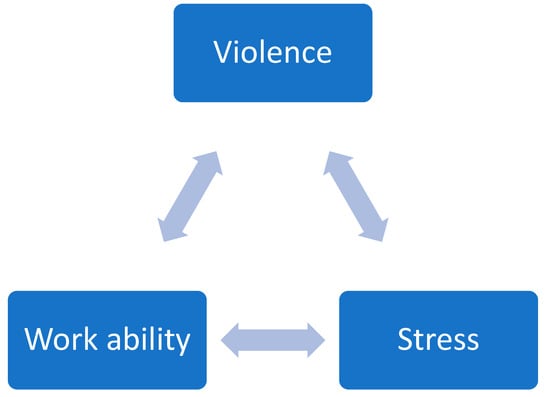
Figure 1.
Relationship between workplace violence, work ability, and work stress.
After checking for multicollinearity among the variables of interest, we assessed the association between WV, stress, and work ability. In a multivariate regression model adjusted for age and gender, with stress (ERI) as the dependent variable, violence experienced and poor work ability were found to be significant predictors of perceived stress level. The model explains over a third of the individual variation in perception of work-related stress (adjusted R2 = 0.382) (Table 8).
Table 8.
Relationship between workplace violence (WV), work ability (WAS), and work-related stress. Multivariate linear regression model.
We then evaluated the impact that WV has on the perception of stress. Using a logistic regression model adjusted for age and gender, with distress (ERI > 1.0) as the dependent variable, violence experienced and poor work ability were found to be significant predictors of the state of distress. Workers who had experienced some form of violence in the previous year had an almost nine-fold increased risk (OR = 8.94) of being distressed at work. Work ability was a protective factor. The model explained about half of the individual variance in distress (Nagelkerke R2 = 0.446) (Table 9).
Table 9.
Logistic regression. Relationship between workplace violence, work ability, and distress.
4. Discussion
This study confirmed that WV is a significant problem for nurses in both Italy and Sweden. All our a priori hypotheses were confirmed. In all surveyed samples, WV was positively correlated with occupational stress and negatively correlated with work ability, as is extensively demonstrated in the literature [107,108,109]. Stress and work ability were inversely correlated. The three samples confirmed the bivariate relationships between WV, stress and work ability described in the literature. In the multivariate regression model, occupational stress showed higher values in nurses experiencing violence and insufficient work ability. In the logistic regression model, violence was associated with an 8.9 times higher risk of distress. The correspondence of our findings with the literature indirectly confirmed the validity of the responses given by nurses in the three surveys and demonstrated that the respondents had directly experienced the effects of WV. In agreement with the literature, the frequency of violent behavior failed to show a clear gender differentiation. Our study also confirmed the greater frequency of violent behavior against younger workers. This is observed in the literature and probably linked to being assigned tasks for which they are not yet fully trained [43,68]. The greater propensity of young people to participate in online surveys may be one reason why spot surveys obtain higher prevalence rates of WV than studies conducted on the whole population. The inability to verify the claims of online studies that are not followed up by medical examination may be another factor in inappropriate reporting.
Given the literature, our results were to be expected. The fourth hypothesis, namely that the degree of reported violence depends on the way the request is made, requires discussion. Our study has shown that the responses of the nurses from Brescia and Trollhättan were very similar, despite the considerable differences in the Italian and Swedish healthcare systems: the former is characterized by major inter-regional disparities, the latter by difficulties of access in rural areas, although the main difference is between the Italian socio-cultural structure that is closely linked to the family and the Swedish system that tends to separate work from private life. On the other hand, there was a significant difference in all parameters between the nurses in Brescia and Latium, all of whom belonged to the same healthcare system. Our hypothesis is that such a marked difference between data from two groups of Italian nurses can be explained only by the different way of presenting identical questions. The literature consistently indicates that WV episodes are severely underreported by workers, and this is certainly true for retrospective studies based on official reports. Cross-sectional studies, however, may be exposed to the risk of overreporting. We designed this study to demonstrate how these phenomena—under- and over-reporting—are closely linked to the methods used to administer questions and select the sample.
4.1. Causes of Under- or Over-Reporting
Studies on this topic generally conclude that violent incidents are severely underreported by HCWs [110]. There are numerous explanations for underreporting [111]. The most common is that HCWs view aggression by patients with cognitive impairment as part of their job [112,113,114,115] and are reluctant to report the patient’s behavior, partly because they are caught in an ethical conflict between providing help and correcting the patient’s behavior. HCWs who often rely on their professional ability to predict and prevent violence and believe that the occurrence of an assault is to some extent linked to their own behavior [116]. Qualitative studies have provided a list of other causal factors, broadly classified into organizational challenges, cultural and social barriers, and personal and emotional barriers [117], ranging from fear of retaliation [118] to the belief that reporting is futile because no one takes action to punish the perpetrators or change the conditions that foster violence [119,120,121,122]. Due to this complex set of factors, experience has shown that only major events involving a prognosis lasting several days are reported to the insurance company. A larger number of incidents are generally reported to colleagues, mainly so that they can implement precautionary measures, but no formal report is made to the health authorities. Consequently, many cases are unreported. This is a well-known phenomenon [69,123,124], and many measures have been proposed to reduce its extent [125,126,127].
On the contrary, the opposite phenomenon, overreporting, also occurs in the workplace [128]. Investigations specifically aimed at revealing the existence of WV and its consequences inevitably encourage workers to report events that occurred in the past. Legitimate concerns for their safety and the hope that better organizational procedures and measures can control the phenomenon induce the social desirability of a positive response from HCWs and can lead to bias whereby remote incidents can be mistakenly placed in a more recent time. Estimates of the frequency of violent events may therefore vary, depending on the method used to assess them. This could have an important impact on prevention measures, because understanding the risk is the first step in managing it.
Let us therefore consider the data available concerning the frequency of WV against HCWs, first of all in Italy, and then examine a summary of studies from other countries, paying attention to the methods of collection.
4.2. Retrospective Studies
Retrospective studies are conducted by collecting all complaints filed by workers seeking recognition of sick days following assaults, together with official reports forwarded to company services, such as Clinical Risk Management or the Prevention and Protection Service.
The retrospective analyses reported in Table 1 indicate that with prevalence rates ranging from 0.18% to 0.25% HCWs are exposed to physical violence, while with rates from 0.93% to 1.92% they are exposed to all forms of WV. Three recent studies were conducted in health companies situated close to the one we observed [72,73,77]. In each of these studies, assuming that each worker had been assaulted only once in the observation period, it was possible to calculate on the basis of the cases reported and the total number of employees in the company the percentage of workers assaulted annually. Given that differences in the way hospitals record incidents can influence the final result [129], we can see that these types of studies produced annual rates of physical violence of approximately 0.2 percent, and of just over 1% for all types of assault, which is equivalent to saying that physical assaults affected only one worker in 500, and that 99 out of 100 had no problems with harassment or incivility from patients, visitors, and colleagues—clearly, a situation too good to be true. Similar results have been obtained by other Italian hospitals that have adopted this method [70,74,76]. Retrospective surveys over several years lead to prevalence rates of WV against HCWs of around 1% per year also in other countries, such as Türkiye [121]. All these studies indicate that retrospective analyses of official reports fail to include all the incidents since they intercept only the most serious ones and those that the worker deems appropriate to report. Some healthcare organizations have implemented organizational and training measures to reduce underreporting from HCWs, thereby achieving a moderate increase in rates. For example, the University Hospitals of Turin (Italy) calculated a WV rate of 1.92% annually between 2015 and 2017 [71], and the University of Insubria (Varese, Italy) recorded a 2.08% annual rate of workers experiencing WV [75].
4.3. Cross-Sectional Studies
Cross-sectional studies reported in Table 2 are more numerous than multi-year retrospective studies and reveal widely varying results: exposure to physical violence ranges from 6.1% to 46.6%, while exposure to various forms of violence is between 29.6% and 96.0%.
In many studies, social media have been used to request participation. For example, in an online survey conducted between May 2018 and March 2020, La Torre et al. found 10% of HCWs reported experiencing physical violence in the previous 12 months, and 47.1% reported verbal aggression [64]. Other online studies have published percentages ranging from 29.6% to 57.1% [83,88,89]. HCWs who respond to social media are generally younger than the population of nurses working in the NHS. In May 2021, in a cohort of HCWs mainly composed of young nurses recruited through an online web-based survey, Ielapi et al. estimated a 32.0% rate of physical violence, a 64.0% rate of psychological aggression, and an 88.2% rate of verbal aggression [84]. In cases where studies involving a large number of participants were conducted in a single hospital, the rates tended to be lower than those in which the sample was selected through social media; however, also in single hospital studies, the percentage of HCWs reporting WV in the previous year ranged from 36.1% [85], 40.2% [79] 43% [80], 45% [82], 46.5% [87], 48.6% [81], to 49.4% [78]. High rates of WV are also reported by students, who are definitely less exposed than workers. For example, 35.1% of nursing students in Milan reported having been assaulted [86]. Even higher rates of aggression were obtained from sectoral studies in psychiatric or emergency departments: the percentages of emergency room workers who reported experiencing assaults in the previous year ranged from 71.1% to 96% [91,92,93,94,96], while the rates reported in psychiatric services were between 27.2% and 91.5% [90,95].
4.4. Systematic and Meta-Analytic Studies
The differences in prevalence rates between retrospective and follow-up studies can largely be explained by the way in which the information was collected. The ‘one-off’ investigations that explicitly declare the aim of recording violence against workers encourage the latter to report all incidents of assault, including minor ones, thus determining a social desirability bias [130]. The worker will be motivated to report an event that may have happened some time before the previous 12 months, thus causing a chronological recall bias [131]. Moreover, when samples are self-selected, workers who have undergone violence will be especially motivated to respond, while those who have not experienced violence will avoid responding and this may cause a self-selection bias [132]. In online studies, respondents may differ from non-responders in age and electronic literacy. Both factors are related to WV exposure, and this may induce a selection bias [133]. Furthermore, given that different research groups obtain responses from social media, it is also possible that the same person responds to multiple surveys, reporting the same experience several times over. The cumulative effect of these methodological problems means that there may be significant overreporting in ad hoc cross-sectional studies.
Spot cross-sectional studies are much more common than prospective longitudinal studies or multi-year retrospective surveys. Systematic reviews with meta-analyses rely mainly on one-off studies that consequently yield higher rates than those obtained from formal reports. The risk of selection bias is enhanced in umbrella reviews which repeatedly take into consideration the same original studies recorded by different systematic analyses, thus causing exponential overreporting. This is clear in the systematic studies currently available. Only a few systematic studies note that there is wide heterogeneity across the study methodology, definitions and rates and therefore avoid obtaining meta-analytic data [134]. Most of the others take account of the studies together regardless of method, thus leading to a potential systematic bias in meta-analysis.
A systematic analysis that included studies conducted before the COVID-19 pandemic and encompassed 253 studies involving more than 331,000 individuals, indicated that 61.9% (95%CI 56.1% to 67.6%) of workers had reported exposure to some form of WV in the previous year, with 24.4% (95%CI 22.4% to 26.4%) experiencing physical violence and 42.5% encountering non-physical violence. Verbal abuse, occurring in over two-thirds of cases, constituted the predominant type of non-physical violence. This was followed by threats in one-third of cases and sexual harassment in 12.4% of cases [135]. Another meta-analytic study led to a 19.33% (95CI 16.49% to 22.53%) estimated rate of physical violence [136]. Notably, substantial variations were observed across different countries, working hours, and workplaces. In China, the estimated prevalence of physical violence was 13.7% (95%CI 12.2% to 15.1%), while that of all forms of WV was 62.4% (95%CI 59.4% to 65.5%) [137]. A nationwide study involving over 100.000 Chinese nurses found WV rates of 30.3%, in addition to a strong association with mental health problems [10]. A meta-analysis of studies on home care nurses indicated that they had an annual rate of 0.135 for physical violence and 0.515 for verbal violence [49]. As regards doctors, 69% (95%CI 58% to 78%) had been subjected to WV [138]. In 2019, in Iranian emergency services, Sahebi et al. estimated a 36.39% (95%CI 27.29% to 45.50%) rate of physical assaults and a 73.13% (95%CI 68.64% to 77.62%) rate of verbal violence [139]. Research on WV increased during and after the pandemic. Based on over 44,000 observations, Matta et al. estimated that the prevalence rate of HCWs experiencing WV during the pandemic was 51% [58]. During the initial phase of the pandemic, there was a significant reduction in violent incidents [105]. This was followed, however, by an increase from mid-pandemic to late pandemic, and then a gradual return to pre-pandemic levels [140,141]. After the pandemic, the pooled rate of physical violence against HCWs was estimated to be 17% (95%CI: 6% to 28%) [142]; 17% (95%CI 14% to 21%) [143]; 23% (95%CI 14% to 34%) [144]. The proportion of HCWs who had received threats in the previous year was estimated to be 30% (95%CI 11% to 52%) [144]. The annual rate of all forms of violence has been estimated at 72% among Chinese nurses [145], at 35% (95%CI: 29% to 42%) among US nurses [146], and between 45.6% and 90% in studies published between 2013 and 2023 [147]. In the emergency department, verbal abuse was estimated at 77% [148], and in psychiatric nurses at 78% (95%CI 65% to 88%) [149]. According to an umbrella review of meta-analyses, the average rate of physical violence against HCWs is 20.8% for physical violence and 66.8% for verbal violence [150]. Another umbrella review reported an overall violence rate among HCWs as high as 78.9% [151].
4.5. Studies Conducted Through Health Surveillance
In our study, nurses from Brescia and Trollhättan reported experiencing very high rates of physical aggression (28%), threats (36%), harassment (56%), and all forms of violence (73%) in the previous year. These values can be placed at the upper end of the values estimated by meta-analyses and umbrella reviews. In contrast, in the Latium sample, 4.7% of the nurses were affected by physical violence, 4.7% reported threats and 17.4% experienced harassment, with an overall rate of 19.8% of nurses reporting some form of WV in the previous year. These latter values were below the levels estimated by meta-analyses. They were, however, in line with annual WV rates assessed in the same health company over the previous 20 years [105]. The percentages of nurses experiencing WV in the previous 12 months differed significantly from those for all forms of WV except stalking that has different causes [152]. These results can be explained by the method used. In the Latium census of all workers undergoing health surveillance, WV was included in the multipurpose questionnaire. Therefore, even those who had not experienced assault in the previous year participated in this survey because the focus of the questionnaire was on sleep problems, not workplace violence. Workers were free to join the online questionnaire, but experience shows that participation in health promotion projects is very high, so the survey took on the character of a census. Moreover, contact with the occupational physician after completing the questionnaire made it possible to clarify the characteristics of the violent incidents, assess their severity, and plan any necessary counseling, prevention, and control measures. The regular annual medical examinations also enabled nurses to be very precise about the timing of the assaults and prevent them from reporting remote events since those incidents and their consequences had already been noted in their personal health records. Consequently, data collection during health surveillance eliminates not only the overreporting bias of cross-sectional surveys but also most of the underreporting inherent in official records and appears to be the most accurate method [153].
Confirmation of this hypothesis is given by the only Italian study conducted on workers undergoing health surveillance in a university hospital in Sicily in 2023. The latter reported a 2.51% rate of physical assaults and a rate of all forms of WV of 26.8% [154]. During health surveillance, workers report incidents of violence they deem significant, regardless of whether they have been officially reported or not, but correctly overlook minor problems that have had no impact on their physical and mental well-being. Experience shows that underreporting can also occur during health surveillance, either because the worker believes that assault by a patient with cognitive impairment should not be reported, or because they are afraid to disclose assaults suffered by colleagues and superiors. However, the occupational physician’s attention to the issue of WV can educate workers to report and prevent under- and over-reporting.
4.6. Perspectives
In conclusion, we can state that the marked difference in rates of nurses experiencing violence in different healthcare settings was due to the different methods used to select the samples and administer the questions. Although the items were the same for all respondents, in the Brescia and Trollhättan samples, the topic of “violence” was explicit. By requesting an online response and terminating the survey after the first 75 responses, we wanted to increase the possibility of bias. The respondents were younger and therefore more exposed to violence than their older colleagues. Most of the self-selected nurses had recently experienced violent incidents they wished to report. Apart from differences in the prevalence of nurses reporting WV, the three samples showed the same relationship between violence, work ability, and stress. The nurses from Brescia and Trollhättan who reported higher rates of VW showed higher levels of stress and lower work ability than the nurses from Latium who underwent health surveillance in the same month of June.
To the best of our knowledge, this study is the only one that has assessed WV experience in different countries using the same questions but different sampling and survey presentation methods. Besides confirming the importance of WV for perceived stress and work ability and thereby corroborating the need for intervention to prevent WV and mitigate its effects [155,156,157], this study highlights serious bias in meta-analysis and umbrella review studies that do not differentiate between multi-year retrospective analyses and spot cross-sectional studies. This study empirically confirms theoretical expectations that emerged from the analysis of the marked difference between retrospective and spot studies and from related synthetic analyses.
We believe this study could have important implications for the health surveillance of HCWs and the prevention of WV. First, it demonstrates that systematic reviews and meta-analyses cannot be automatically assumed to be effective WV risk assessments, as unfortunately occurs with many methods adopted by healthcare organizations [158]. WV risk assessment could be much more accurate if the information were collected by occupational physicians during the health surveillance of workers. Our study demonstrated that responses on violence, stress, and workability can be collected in a few minutes and do not represent an excessive burden for either occupational health services or workers. If these questions are included in a program to improve worker well-being related, for example, to investigations on sleep, diet, or physical activity, it is possible to avoid the social desirability of negative responses, typical of spot WV surveys. Furthermore, the worker undergoing a medical examination will be able to discuss with the occupational physician the issue of any violence he/she has experienced, obtain the necessary counseling and contribute to the activation of prevention measures for the benefit of all workers. The data collected systematically during health surveillance can effectively monitor WV and verify whether the preventive interventions that have been implemented are effective in responding to environmental pressures [55,105,153].
4.7. Limitations
Our study has these strengths, but also many weaknesses. First, it is important to consider that the purpose of the study was not to describe in detail the violence experienced by nurses in different European countries, but to demonstrate, through a rapid cross-sectional comparison of three samples, the impact that the choice of method has on the results. The limited observation period and the barely sufficient sample dimensions reduced the stability of the results, although the limited dimensions of the sample were chosen specifically to enhance the effect of self-selection and highlight the difference between sampling methods. Across the three samples, WV maintained the same correlation with stress and workability, demonstrating that the observations were sufficiently stable. Despite the numerous cultural and healthcare system differences, the disparity between the self-selected Italian and Swedish samples supported our belief that the way questions are asked and respondents are invited is crucial to the results.
The cross-sectional nature of observations prevented us from interpreting the causality of the associations observed, which could only be explained on the basis of previous longitudinal studies. Of the three samples, only the one collected from Latium during health surveillance enabled the occupational physician to verify the occurrence of the reported WV episodes, whereas no objective verification could be made for the violence reported anonymously online.
In Italy and other countries where employers are required by law to assess the risk of WV, the difficulty encountered by managers in monitoring violence has often led them to use non-validated algorithms fueled by extemporaneous observations and supported by meta-analysis studies or umbrella reviews [158]. We believe that entrusting the monitoring of WV to the health surveillance service would be the most rational, economical and effective solution to this problem as it would lead to early identification of high-risk conditions and subsequent appropriate intervention.
5. Conclusions
A comparison of countries has shown that violence is widespread and exhibits similar characteristics across different work environments. The inexplicable difference in WV rates measured within the same country demonstrates that data collection methods directly influence results. This experimental study suggests that an assessment of violence experienced by workers can be efficiently conducted by surveying all workers during health surveillance. If workers are asked to report incidents experienced in the previous year during a broad online medical interview, we can be sure that they will only report the incidents they consider truly important for their well-being. This will enable us to comprehend the true impact that WV has on health and allow us to allocate preventive resources more effectively. Moreover, periodic health surveillance can enable us to monitor the incidence of WV over time and assess the causality of its effects.
We are confident that other workplace health and safety sectors can apply our study method that requires minimal time commitment for workers but provides reliable data for occupational medicine and prevention services. The problem of violence in healthcare settings is too serious to base prevention efforts on literature rather than on an effective assessment of the actual situation and a discussion of possible solutions with those involved.
Supplementary Materials
The following supporting information can be downloaded at: https://www.mdpi.com/article/10.3390/nursrep16010007/s1, Table S1: Definitions of workplace violence.
Author Contributions
Conceptualization, N.M.; methodology, N.M.; investigation, N.M., M.O.-T., and S.F.; data curation, N.M.; writing—original draft preparation, N.M.; writing—review and editing, N.M. and L.I. All authors have read and agreed to the published version of the manuscript.
Funding
This research received no external funding.
Institutional Review Board Statement
The study was conducted in accordance with the Declaration of Helsinki, and approved by the Territorial Ethics Committee 4 of Latium, Rome, Italy on 29 January 2025 (ID 5/2025), and by the Committee for Good Research Practice and Ethics, University West, Trollhättan, Sweden on 16 May 2025 (ID F 2025/150).
Informed Consent Statement
Informed consent was obtained from all subjects involved in the study.
Data Availability Statement
Data were deposited on Zenodo DOI 10.5281/zenodo.17100742. (Available from 11 September 2025).
Public Involvement Statement
No public involvement in any aspect of this research.
Guidelines and Standards Statement
This manuscript was drafted against the STROBE checklist for cross-sectional observational studies, available at: https://www.equator-network.org/reporting-guidelines/strobe/ accessed on 18 May 2025.
Use of Artificial Intelligence
AI or AI-assisted tools were not used in drafting any aspect of this manuscript.
Acknowledgments
We thank the workers who participated in the research.
Conflicts of Interest
The authors declare no conflicts of interest.
Abbreviations
The following abbreviations are used in this manuscript:
| CI95% | Confidence Interval 95% |
| ERI | Effort/Reward Imbalance |
| HCWs | Healthcare workers |
| VIF | Violent Incident Form |
| WAI | Work Ability Inventory |
| WAS | Work Ability Score |
| WV | Workplace violence |
References
- Leppänen, R.A.; Olkinuora, M.A. Psychological stress experienced by health care personnel. Scand. J. Work Environ. Health 1987, 13, 1–8. [Google Scholar] [CrossRef]
- Goerth, C.R. Violence in the workplace emerges as growing health and safety problem. Occup. Health Saf. 1988, 57, 53. [Google Scholar]
- White, S.G.; Hatcher, C. Violence and trauma response. Occup. Med. 1988, 3, 677–694. 24. [Google Scholar]
- Chirico, F.; Heponiemi, T.; Pavlova, M.; Zaffina, S.; Magnavita, N. Psychosocial Risk Prevention in a Global Occupational Health Perspective. A Descriptive Analysis. Int. J. Environ. Res. Public Health 2019, 16, 2470. [Google Scholar] [CrossRef]
- Gash, V.; Blom, N. Workplace violence and fear of violence: An assessment of prevalence across industrial sectors and its mental health effects. Scand. J. Work Environ. Health 2025, 51, 4230. [Google Scholar] [CrossRef] [PubMed]
- Airaksinen, J.; Pentti, J.; Seppälä, P.; Virtanen, M.; Ropponen, A.; Elovainio, M.; Kivimäki, M.; Ervasti, J. Prediction of violence or threat of violence among employees in social work, healthcare and education: The Finnish Public Sector cohort study. BMJ Open 2023, 13, e075489. [Google Scholar] [CrossRef]
- Xu, T.; Magnusson Hanson, L.L.; Lange, T.; Starkopf, L.; Westerlund, H.; Madsen, I.E.H.; Rugulies, R.; Pentti, J.; Stenholm, S.; Vahtera, J.; et al. Workplace bullying and workplace violence as risk factors for cardiovascular disease: A multi-cohort study. Eur. Heart J. 2019, 40, 1124–1134. [Google Scholar] [CrossRef] [PubMed]
- Rudkjoebing, L.A.; Bungum, A.B.; Flachs, E.M.; Eller, N.H.; Borritz, M.; Aust, B.; Rugulies, R.; Rod, N.H.; Biering, K.; Bonde, J.P. Work-related exposure to violence or threats and risk of mental disorders and symptoms: A systematic review and meta-analysis. Scand. J. Work Environ. Health 2020, 46, 339–349. [Google Scholar] [CrossRef] [PubMed]
- Flores-Cohaila, J.A.; Miranda-Chavez, B.; Copaja-Corzo, C. The causal effect of workplace violence on mental health and work-related outcomes: A cross-sectional study using propensity score matching. PLoS ONE 2025, 20, e0321845. [Google Scholar] [CrossRef] [PubMed]
- Yu, Q.; Huang, C.; Tian, Y.; Li, X.; Yang, J.; Ning, M.; Chen, Z.; Liu, Y.; Li, Y. Relationships between workplace violence, psychological symptoms, and adverse events: A nationwide cohort study of Chinese nurses. J. Affect. Disord. 2025, 385, 119418. [Google Scholar] [CrossRef]
- Duan, X.; Ni, X.; Shi, L.; Zhang, L.; Ye, Y.; Mu, H.; Li, Z.; Liu, X.; Fan, L.; Wang, Y. The impact of workplace violence on job satisfaction, job burnout, and turnover intention: The mediating role of social support. Health Qual. Life Outcomes 2019, 17, 93. [Google Scholar] [CrossRef] [PubMed]
- Luo, Y.; Zhang, M.; Yu, S.; Guan, X.; Zhong, T.; Wu, Q.; Li, Y. The impact of psychological violence in the workplace on turnover intention of clinical nurses: The mediating role of job satisfaction. BMC Nurs. 2024, 23, 844. [Google Scholar] [CrossRef]
- Cao, Y.; Gao, L.; Fan, L.; Zhang, Z.; Liu, X.; Jiao, M.; Li, Y.; Zhang, S. Effects of verbal violence on job satisfaction, work engagement and the mediating role of emotional exhaustion among healthcare workers: A cross-sectional survey conducted in Chinese tertiary public hospitals. BMJ Open 2023, 13, e065918. [Google Scholar] [CrossRef]
- Chipps, E.; Weaver, S.H.; Wood, T.; Sinnott, L.T.; McCarthy, K. The Impact of Patient Assaults and Aggressive Behaviors on Nursing Personnel’s Stress, Well-being, and Intention to Leave Post-COVID-19 Pandemic. J. Nurs. Adm. 2024, 54, 479–487. [Google Scholar] [CrossRef] [PubMed]
- Liang, L.; Wang, Z.; Hu, Y.; Yuan, T.; Fei, J.; Mei, S. Does workplace violence affect healthcare workers’ turnover intention? Jpn. J. Nurs. Sci. 2023, 20, e12543. [Google Scholar] [CrossRef]
- Hämmig, O. Quitting one’s job or leaving one’s profession: Unexplored consequences of workplace violence and discrimination against health professionals. BMC Health Serv. Res. 2023, 23, 1251. [Google Scholar] [CrossRef]
- Pien, L.C.; Cheng, Y.; Lee, F.C.; Cheng, W.J. The effect of multiple types of workplace violence on burnout risk, sleep quality, and leaving intention among nurses. Ann. Work Expo. Health 2024, 68, 678–687. [Google Scholar] [CrossRef]
- Amberson, T.; Quarry, C. Understanding Traumatic Stress in Emergency Nurses: A Systematic Review. J. Adv. Nurs. 2025, 81, 6261–6280. [Google Scholar] [CrossRef] [PubMed]
- Isara, A.R.; Wudiri, Z.W.; Agbo, H.A.; Lar, L.A.; Aigbokhaode, A.Q.; Awunor, N.S.; For Association of Public Health Physicians of Nigeria. Assessment of the Prevalence and Patterns of Violence against Healthcare Workers in Nigeria: A Multicentre Study. Niger. Postgrad. Med. J. 2024, 31, 299–310. [Google Scholar] [CrossRef]
- Pariona-Cabrera, P.; Bartram, T.; Cavanagh, J.; Halvorsen, B.; Shao, B.; Yang, F. The effects of workplace violence on the job stress of health care workers: Buffering effects of wellbeing HRM practices. Int. J. Hum. Resour. Manag. 2024, 35, 1654–1680. [Google Scholar] [CrossRef]
- Machul, M.; Krasucka, K.N.; Pelc, D.; Dziurka, M. Impact of Workplace Bullying on Nursing Care Quality: A Comprehensive Review. Med. Sci. Monit. 2024, 30, e944815. [Google Scholar] [CrossRef]
- Fujii, C.; Iwasa, Y. Implications of Nursing Peer Violence on Patient Safety: An Integrative Review. Int. Nurs. Rev. 2025, 72, e70042. [Google Scholar] [CrossRef]
- Kumar, R.P.; Verghese, W.; Hegde, D.; Rasquinha, S.L.; Rao, R.M.; Kumar, A. Workplace violence in the healthcare setting and its psychological impact on healthcare workers. Ind. Psychiatry J. 2025, 34, 45–52. [Google Scholar] [CrossRef]
- Lin, M.W.; Wong, S.W.; Cheng, Y. Psychosocial Work Conditions, Mental Distress, Burnout, and Hypnotic Use Among Healthcare and Social Workers: A Comparative Analysis with General Employees. J. Occup. Environ. Med. 2025, 67, e379–e385. [Google Scholar] [CrossRef] [PubMed]
- Wang, B.; Yang, W.; Wang, Y.; Chen, X.; Liu, D.; Yin, B.; Bao, H.; Wang, D.; He, S. Current situation and related factors of fatigue among doctors and nurses in tertiary general hospitals in Northeast China. Sci. Rep. 2025, 15, 9548. [Google Scholar] [CrossRef]
- Pien, L.C.; Wang, C.H.; Cheng, W.J.; Lin, Y.H.; Chou, K.R.; Hsu, C.Y. The Relationship Between Resilience and Mental Health Status Among Nurses With Workplace Violence Experiences: A Cross-Sectional Study. Int. J. Ment. Health Nurs. 2025, 34, e13497. [Google Scholar] [CrossRef] [PubMed]
- Magnavita, N.; Di Stasio, E.; Capitanelli, I.; Lops, E.A.; Chirico, F.; Garbarino, S. Sleep Problems and Workplace Violence: A Systematic Review and Meta-Analysis. Front. Neurosci. 2019, 13, 997. [Google Scholar] [CrossRef]
- Magnavita, N.; Mele, L.; Meraglia, I.; Merella, M.; Vacca, M.E.; Cerrina, A.; Gabriele, M.; Labella, M.; Soro, M.T.; Ursino, S.; et al. The Impact of Workplace Violence on Headache and Sleep Problems in Nurses. Int. J. Environ. Res. Public Health 2022, 19, 13423. [Google Scholar] [CrossRef]
- Zheng, Y.; Li, X.; Sun, Y.; Mao, C.; Huang, J.; Li, J.; Zhang, G.; Wei, N.; Wang, X.; Teng, Y. Association between workplace violence from patients and the mental health status of healthcare workers in Zhuhai China: A cross-sectional study. Front. Public Health 2025, 12, 1441389. [Google Scholar] [CrossRef]
- Magnavita, N.; Isolani, L. Violence in Healthcare Workers Is Associated with Disordered Eating. Int. J. Environ. Res. Public Health 2025, 22, 1221. [Google Scholar] [CrossRef] [PubMed]
- Chang, Y.P.; Lee, D.C.; Lee, Y.H.; Chiu, M.H. Nurses’ perceived health and occupational burnout: A focus on sleep quality, workplace violence, and organizational culture. Int. Nurs. Rev. 2024, 71, 912–923. [Google Scholar] [CrossRef] [PubMed]
- Membrive-Jiménez, M.J.; Gómez-Urquiza, J.L.; Suleiman-Martos, N.; Velando-Soriano, A.; Ariza, T.; De la Fuente-Solana, E.I.; Cañadas-De la Fuente, G.A. Relation between Burnout and Sleep Problems in Nurses: A Systematic Review with Meta-Analysis. Healthcare 2022, 10, 954. [Google Scholar] [CrossRef]
- Kobayashi, Y.; Oe, M.; Ishida, T.; Matsuoka, M.; Chiba, H.; Uchimura, N. Workplace Violence and Its Effects on Burnout and Secondary Traumatic Stress among Mental Healthcare Nurses in Japan. Int. J. Environ. Res. Public Health 2020, 17, 2747. [Google Scholar] [CrossRef] [PubMed]
- Zhao, X.; Zhang, Z.; Chen, Z.; Tian, Y.; Chen, H.; Zhou, J. Mediating role of depression between workplace violence and job burnout among healthcare workers. Zhong Nan Da Xue Xue Bao Yi Xue Ban 2023, 48, 903–908, (In English and Chinese). [Google Scholar] [CrossRef]
- Chen, Z.; Peng, K.; Liu, X.; Yang, J.; Long, L.; Liu, Y.; Li, Y.; Tian, Y. Association between high burn-out and workplace violence among healthcare workers in China: A WeChat-based survey. BMJ Open 2022, 12, e064729. [Google Scholar] [CrossRef]
- Ma, J.; Chen, X.; Zheng, Q.; Zhang, Y.; Ming, Z.; Wang, D.; Wu, H.; Ye, H.; Zhou, X.; Xu, Y.; et al. Serious Workplace Violence Against Healthcare Providers in China Between 2004 and 2018. Front. Public Health 2021, 8, 574765. [Google Scholar] [CrossRef]
- Lorettu, L.; Nivoli, A.M.A.; Daga, I.; Milia, P.; Depalmas, C.; Nivoli, G.; Bellizzi, S. Six things to know about the homicides of doctors: A review of 30 years from Italy. BMC Public Health 2021, 21, 1318. [Google Scholar] [CrossRef] [PubMed]
- Jia, C.; Han, Y.; Lu, W.; Li, R.; Liu, W.; Jiang, J. Prevalence, characteristics, and consequences of verbal and physical violence against healthcare staff in Chinese hospitals during 2010–2020. J Occup Health 2022, 64, e12341. [Google Scholar] [CrossRef]
- Yun, J.Y.; Myung, S.J.; Kim, K.S. Associations among the workplace violence, burnout, depressive symptoms, suicidality, and turnover intention in training physicians: A network analysis of nationwide survey. Sci. Rep. 2023, 13, 16804. [Google Scholar] [CrossRef]
- Magnusson Hanson, L.L.; Pentti, J.; Nordentoft, M.; Xu, T.; Rugulies, R.; Madsen, I.E.H.; Conway, P.M.; Westerlund, H.; Vahtera, J.; Ervasti, J.; et al. Association of workplace violence and bullying with later suicide risk: A multicohort study and meta-analysis of published data. Lancet Public Health 2023, 8, e494–e503, Erratum in Lancet Public Health 2023, 8, e755. https://doi.org/10.1016/S2468-2667(23)00225-6. [Google Scholar] [CrossRef]
- Ayala-Burboa, M.O.; García-Flores, R.; Sotelo-Quiñonez, T.I.; Acosta-Quiroz, C.O. Violencia laboral como predictor de ideación suicida en médicos internos de pregrado [Workplace violence as a predictor of suicidal ideation in undergraduate internal physicians]. Rev. Med. Inst. Mex. Seguro Soc. 2024, 62, e6277. (In Spanish) [Google Scholar] [CrossRef] [PubMed]
- Chan, C.C.; Faherty, C.; Rahman, N.; Murrough, J.W.; Benn, E.K.T.; Clark, U.; Mohamed, N.; DePierro, J.M.; Ripp, J.A.; Peccoralo, L.A. Suicidal ideation among non-physician hospital system staff: Prevalence and workplace correlates. J. Affect. Disord. 2024, 362, 638–644. [Google Scholar] [CrossRef] [PubMed]
- Magnavita, N.; Heponiemi, T. Workplace violence against nursing students and nurses. An Italian experience. J. Nurs. Scholarsh. 2011, 43, 203–210. [Google Scholar] [CrossRef] [PubMed]
- Rauscher, K.; Casteel, C.; Davis, J.; Myers, D.; Peek-Asa, C. Prevalence of workplace violence against young workers in the United States. Am. J. Ind. Med. 2023, 66, 462–471. [Google Scholar] [CrossRef]
- Berlanda, S.; Pedrazza, M.; Fraizzoli, M.; de Cordova, F. Addressing Risks of Violence against Healthcare Staff in Emergency Departments: The Effects of Job Satisfaction and Attachment Style. BioMed Res. Int. 2019, 2019, 5430870. [Google Scholar] [CrossRef]
- Acquadro Maran, D.; Varetto, A.; Zedda, M.; Magnavita, N. Violence toward Hospital Staff and Volunteers: A survey of an Italian sample. J. Aggress. Maltreatment Trauma 2017, 26, 76–95. [Google Scholar] [CrossRef]
- Magnavita, N.; Fileni, A.; Pescarini, L.; Magnavita, G. Violence against radiologists. I: Prevalence and preventive measures. Radiol. Med. 2012, 117, 1019–1033. [Google Scholar] [CrossRef]
- Tian, K.; Xiao, X.; Zeng, R.; Xia, W.; Feng, J.; Gan, Y.; Zhou, Y. Prevalence of workplace violence against general practitioners: A systematic review and meta-analysis. Int. J. Health Plan. Manag. 2022, 37, 1238–1251. [Google Scholar] [CrossRef]
- Byon, H.D.; Lee, M.; Choi, M.; Sagherian, K.; Crandall, M.; Lipscomb, J. Prevalence of type II workplace violence among home healthcare workers: A meta-analysis. Am. J. Ind. Med. 2020, 63, 442–455. [Google Scholar] [CrossRef] [PubMed]
- Conti, A.; Scacchi, A.; Clari, M.; Scattaglia, M.; Dimonte, V.; Gianino, M.M. Prevalence of Violence Perpetrated by Healthcare Workers in Long-Term Care: A Systematic Review and Meta-Analysis. Int. J. Environ. Res. Public Health 2022, 19, 2357. [Google Scholar] [CrossRef]
- Binmadi, N.O.; Alblowi, J.A. Prevalence and policy of occupational violence against oral healthcare workers: Systematic review and meta-analysis. BMC Oral. Health 2019, 19, 279. [Google Scholar] [CrossRef]
- Hallett, N.; Gayton, A.; Dickenson, R.; Franckel, M.; Dickens, G.L. Student nurses’ experiences of workplace violence: A mixed methods systematic review and meta-analysis. Nurse Educ. Today 2023, 128, 105845. [Google Scholar] [CrossRef]
- Lu, X.; Hou, C.; Bai, D.; Yang, J.; He, J.; Gong, X.; Cai, M.; Wang, W.; Gao, J. Prevalence, associated factors, and nursing practice-related outcomes of workplace violence towards nursing students in clinical practice: A systematic review and meta-analysis. Nurse Educ. Today 2024, 133, 106074. [Google Scholar] [CrossRef]
- Berger, S.; Grzonka, P.; Frei, A.I.; Hunziker, S.; Baumann, S.M.; Amacher, S.A.; Gebhard, C.E.; Sutter, R. Violence against healthcare professionals in intensive care units: A systematic review and meta-analysis of frequency, risk factors, interventions, and preventive measures. Crit. Care 2024, 28, 61. [Google Scholar] [CrossRef]
- Magnavita, N.; Heponiemi, T. Violence towards health care workers in a Public Health Care Facility in Italy: A repeated cross-sectional study. BMC Health Serv. Res. 2012, 12, 108. [Google Scholar] [CrossRef]
- Doehring, M.C.; Curtice, H.; Hunter, B.R.; Oaxaca, D.M.; Satorius, A.; Reed, K.; Beckman, A.; Vaughn, T.; Palmer, M. Exploring verbal and physical workplace violence in a large, urban emergency department. Am. J. Emerg. Med. 2023, 67, 1–4. [Google Scholar] [CrossRef] [PubMed]
- Azami, M.; Moslemirad, M.; YektaKooshali, M.H.; Rahmati, S.; Soleymani, A.; Bigdeli Shamloo, M.B.; Esmaeilpour-Bandboni, M.; Khataee, M.; Khorshidi, A.; Otaghi, M. Workplace Violence Against Iranian Nurses: A Sys-tematic Review and Meta-Analysis. Violence Vict. 2018, 33, 1148–1175. [Google Scholar] [CrossRef] [PubMed]
- Matta, M.G.; Gupta, S.; Alfonso, J.M.; Carrero, M.C.; Agahari, I.; Sabouret, P.; Gulati, M.; Baranchuk, A.; Garcia-Zamora, S. Prevalence and patterns of gender disparity in workplace violence among healthcare workers during the COVID-19 pandemic: A systematic review and meta-analysis. Public Health 2024, 235, 76–83. [Google Scholar] [CrossRef]
- Sun, L.; Zhang, W.; Cao, A. Associations between work-related variables and workplace violence among Chinese medical staff: A comparison between physical and verbal violence. Front. Public Health 2023, 10, 1043023. [Google Scholar] [CrossRef] [PubMed]
- Han, X.; Jiang, F.; Shen, L.; Liu, Y.; Liu, T.; Liu, H.; Wang, P.; Yang, Z.; Tang, Y.L.; Zhu, J. Workplace Violence, Workforce Stability, and Well-being in China’s Psychiatric Hospitals. Am. J. Prev. Med. 2022, 62, e265–e273. [Google Scholar] [CrossRef] [PubMed]
- Vu, L.G.; Nguyen Hoang, L.; Le Vu Ngoc, M.; Nguyen Si Anh, H.; Nathan, N.; Trong Dam, V.A.; Vu, T.M.T.; Latkin, C.A.; Ho, C.S.H.; Ho, R.C.M. Professional Preparedness Implications of Workplace Violence against Medical Students in Hospitals: A Cross-Sectional Study. INQUIRY 2023, 60, 469580231179894. [Google Scholar] [CrossRef]
- Taherzadeh Chenani, K.; Jahangiri, M.; Madadizadeh, F.; Sadat Anoosheh, V. Factors associated with occurrence of workplace violence against healthcare workers during the COVID-19 pandemic: A meta-analysis. Int. J. Occup. Saf. Ergon. 2024, 30, 1115–1123. [Google Scholar] [CrossRef]
- Rehan, S.T.; Shan, M.; Shuja, S.H.; Khan, Z.; Hussain, H.U.; Ochani, R.K.; Shaikh, A.; Ratnani, I.; Nashwan, A.J.; Surani, S. Workplace violence against healthcare workers in Pakistan; call for action, if not now, then when? A systematic review. Glob. Health Action 2023, 16, 2273623. [Google Scholar] [CrossRef] [PubMed]
- La Torre, G.; Firenze, A.; Di Gioia, L.P.; Perri, G.; Soncin, M.; Cremonesi, D.; De Camillis, N.; Guidolin, S.; Evangelista, G.; Marte, M.; et al. Workplace violence among healthcare workers, a multicenter study in Italy. Public Health 2022, 208, 9–13. [Google Scholar] [CrossRef] [PubMed]
- Magnavita, N. The exploding spark. Workplace violence in an infectious disease hospital—A longitudinal study. BioMed Res. Int. 2013, 2013, 316358. [Google Scholar] [CrossRef]
- Magnavita, N. Workplace violence and occupational stress in health care workers: A chicken and egg situation—Results of a 6-year follow-up study. J. Nurs. Sch. 2014, 46, 366–376. [Google Scholar] [CrossRef]
- Magnavita, N.; Heponiemi, T.; Chirico, F. Workplace Violence Is Associated with Impaired Work Functioning in Nurses: An Italian Cross-Sectional Study. J. Nurs. Sch. 2020, 52, 281–291. [Google Scholar] [CrossRef]
- Magnavita, N.; Meraglia, I. Poor Work Ability Is Associated with Workplace Violence in Nurses: A Two-Wave Panel Data Analysis. Int. J. Environ. Res. Public Health 2024, 21, 1118. [Google Scholar] [CrossRef]
- Morphet, J.; Griffiths, D.; Innes, K. The trouble with reporting and utilization of workplace violence data in health care. J. Nurs. Manag. 2019, 27, 592–598. [Google Scholar] [CrossRef] [PubMed]
- Sossai, D.; Molina, F.S.; Amore, M.; Ferrandes, G.; Sarcletti, E.; Biffa, G.; Accorsi, S.; Belvederi Murri, M.; Tomellini, M.J.; Copello, F. Analisi degli episodi di violenza in in grande ospedale italiano [Analysis of incidents of violence in a large Italian hospital]. Med. Lav. 2017, 108, 6005. (In Italian) [Google Scholar] [CrossRef]
- Viottini, E.; Politano, G.; Fornero, G.; Pavanelli, P.L.; Borelli, P.; Bonaudo, M.; Gianino, M.M. Determinants of aggression against all health care workers in a large-sized university hospital. BMC Health Serv. Res. 2020, 20, 215. [Google Scholar] [CrossRef]
- Sacco, A. Physical violence against healthcare workers employed at a local health unit in the Lazio Region, Italy: A cross-sectional study. [Il fenomeno delle aggressioni a danno degli operatori sanitari: Risultati di uno studio “cross-sectional” effettuato in una Azienda Sanitaria Locale della Regione Lazio]. G. Ital. Psicol. Med. Lav. 2022, 2, 50–56. (In Italian) [Google Scholar] [CrossRef]
- Di Prinzio, R.R.; Bondanini, G.; De Falco, F.; Vinci, M.R.; Camisa, V.; Santoro, A.; De Santis, M.; Raponi, M.; Dalmasso, G.; Zaffina, S. The Management of Workplace Violence against Healthcare Workers: A Multidisciplinary Team for Total Worker Health® Approach in a Hospital. Int. J. Environ. Res. Public Health 2022, 20, 196. [Google Scholar] [CrossRef]
- Mele, F.; Buongiorno, L.; Montalbò, D.; Ferorelli, D.; Solarino, B.; Zotti, F.; Carabellese, F.F.; Catanesi, R.; Bertolino, A.; Dell’Erba, A.; et al. Reporting Incidents in the Psychiatric Intensive Care Unit: A Retrospective Study in an Italian University Hospital. J. Nerv. Ment. Dis. 2022, 210, 622–628. [Google Scholar] [CrossRef]
- Veronesi, G.; Ferrario, M.M.; Giusti, E.M.; Borchini, R.; Cimmino, L.; Ghelli, M.; Banfi, A.; Luoni, A.; Persechino, B.; Di Tecco, C.; et al. Systematic Violence Monitoring to Reduce Underreporting and to Better Inform Workplace Violence Prevention Among Health Care Workers: Before-and-After Prospective Study. JMIR Public Health Surveill. 2023, 9, e47377. [Google Scholar] [CrossRef] [PubMed]
- Terranova, C.; Cestonaro, C.; Ferrari, F.; Fava, L.; Cinquetti, A.; Aprile, A. Behind the white coat: Unraveling the patterns of workplace violence in an Italian healthcare setting—An epidemiological exploration. PLoS ONE 2025, 20, e0324545. [Google Scholar] [CrossRef]
- Bianco, L.; Oliva, S.; Grassi, F.; Arena, J.F.; Aromatario, M.; Ferracuti, S.; Abate, S.; Napoli, C.; Del Casale, A. Violence Against Healthcare Workers in a University Hospital of Central Italy: How Risk Management Interventions Can Help Change a Trend. Healthcare 2025, 13, 409. [Google Scholar] [CrossRef]
- Zampieron, A.; Galeazzo, M.; Turra, S.; Buja, A. Perceived aggression towards nurses: Study in two Italian health institutions. J. Clin. Nurs. 2010, 19, 329–341, Erratum in J. Clin. Nurs. 2010, 20, 1796. [Google Scholar] [CrossRef] [PubMed]
- Terzoni, S.; Ferrara, P.; Cornelli, R.; Ricci, C.; Oggioni, C.; Destrebecq, A. Violence and unsafety in a major Italian hospital: Experience and perceptions of health care workers. Med. Lav. 2015, 106, 403–411. [Google Scholar] [PubMed]
- Luciani, M.; Spedale, V.; Romanenghi, M.; Villa, C.E.; Ausili, D.; Di Mauro, S. Violence towards nurses and factors affecting violence in hospital settings: An Italian cross-sectional study. Med. Lav. 2016, 107, 191–204. (In Italian) [Google Scholar]
- Guglielmetti, C.; Gilardi, S.; Licata, M.; De Luca, G. The healthcare operators’ experience with aggressive patients and their visitors: A cross-sectional study in four clinical departments. Med. Lav. 2016, 107, 223–234. (In Italian) [Google Scholar]
- Ferri, P.; Silvestri, M.; Artoni, C.; Di Lorenzo, R. Workplace violence in different settings and among various health professionals in an Italian general hospital: A cross-sectional study. Psychol. Res. Behav. Manag. 2016, 9, 263–275. [Google Scholar] [CrossRef]
- Firenze, A.; Santangelo, O.E.; Gianfredi, V.; Alagna, E.; Cedrone, F.; Provenzano, S.; La Torre, G. Violence on doctors. An observational study in Northern Italy. Med. Lav. 2020, 111, 46–53. [Google Scholar] [CrossRef]
- Ielapi, N.; Andreucci, M.; Bracale, U.M.; Costa, D.; Bevacqua, E.; Giannotta, N.; Mellace, S.; Buffone, G.; Cerabona, V.; Arturi, F.; et al. Workplace Violence towards Healthcare Workers: An Italian Cross-Sectional Survey. Nurs. Rep. 2021, 11, 758–764. [Google Scholar] [CrossRef]
- Converso, D.; Sottimano, I.; Balducci, C. Violence exposure and burnout in healthcare sector: Mediating role of work ability. Med. Lav. 2021, 112, 58–67. [Google Scholar] [CrossRef] [PubMed]
- Ferrara, P.; Terzoni, S.; Destrebecq, A.; Ruta, F.; Sala, E.; Formenti, P.; Maugeri, M. Violence and unsafety in Italian hospitals: Experience and perceptions of nursing students. Work 2022, 73, 211–217. [Google Scholar] [CrossRef] [PubMed]
- Brunelli, L.; Scarpis, E.; Lo Presti, T.; Fiorillo, F.; Campanella, F.; Zuliani, P.; Farneti, F.; Croci, E.; Pellizzari, B.; Cocconi, R.; et al. Health professionals who have worked in COVID-19 immunization centers suffer the effects of violence. Front. Public Health 2023, 11, 1264301. [Google Scholar] [CrossRef] [PubMed]
- Bagnasco, A.; Catania, G.; Pagnucci, N.; Alvaro, R.; Cicolini, G.; Dal Molin, A.; Lancia, L.; Lusignani, M.; Mecugni, D.; Motta, P.C.; et al. Protective and risk factors of workplace violence against nurses: A cross-sectional study. J. Clin. Nurs. 2024, 33, 4748–4758. [Google Scholar] [CrossRef]
- Stufano, A.; De Maria, L.; Delvecchio, G.; Sifanno, G.; Maffione, G.; Giannelli, G.; Schino, V.; Ravallese, R.; Caputi, A.; Sivo, D.; et al. Gender Disparities in Workplace Violence Among Italian Healthcare Workers: A Cross-Sectional Study. Med. Lav. 2025, 116, 16795. [Google Scholar] [CrossRef]
- Palumbo, C.; Di Sciascio, G.; Di Staso, S.; Carabellese, F.; Valerio, A.; Catanesi, R. Evaluation of safety at work in a psychiatric setting: The “Workplace Safety Assessment”. Med. Lav. 2016, 107, 284–292. [Google Scholar]
- Ramacciati, N.; Gili, A.; Mezzetti, A.; Ceccagnoli, A.; Addey, B.; Rasero, L. Violence towards Emergency Nurses: The 2016 Italian National Survey—A cross-sectional study. J. Nurs. Manag. 2019, 27, 792–805. [Google Scholar] [CrossRef]
- Cannavò, M.; La Torre, F.; Sestili, C.; La Torre, G.; Fioravanti, M. Work Related Violence As a Predictor of Stress and Correlated Disorders in Emergency Department Healthcare Professionals. Clin. Ther. 2019, 170, e110–e123. [Google Scholar] [CrossRef]
- Gravante, F.; Lombardi, A.; Cecere, L.; Russo, G.; De Rosa, F.; Gagliardi, A.M.; Gili, A.; Ramacciati, N. Gli infermieri di pronto soccorso e la violenza sul luogo di lavoro: Un’indagine trasversale nel contesto campano [Emergency nurses and workplace violence: A cross-sectional study in Campania, South Italy]. Prof. Inferm. 2020, 73, 89–97. (In Italian) [Google Scholar]
- Ferri, P.; Stifani, S.; Accoto, A.; Bonetti, L.; Rubbi, I.; Di Lorenzo, R. Violence Against Nurses in the Triage Area: A Mixed-Methods Study. J. Emerg. Nurs. 2020, 46, 384–397. [Google Scholar] [CrossRef]
- Bizzarri, J.V.; Piacentino, D.; Kotzalidis, G.D.; Moser, S.; Cappelletti, S.; Weissenberger, G.; Pompili, M.; Conca, A. Aggression and Violence Toward Healthcare Workers in a Psychiatric Service in Italy: A Retrospective Questionnaire-Based Survey. J. Nerv. Ment. Dis. 2020, 208, 299–305, Erratum in J. Nerv. Ment. Dis. 2020, 208, 636. https://doi.org/10.1097/NMD.0000000000001201. [Google Scholar] [CrossRef] [PubMed]
- Zaboli, A.; Sibilio, S.; Magnarelli, G.; Mian, M.; Brigo, F.; Turcato, G. Nurses in the eye of the storm: A study of violence against healthcare personnel working in the emergency department. Emerg. Med. J. 2024, 41, 501–502. [Google Scholar] [CrossRef]
- Magnavita, N. Workplace Health Promotion Embedded in Medical Surveillance: The Italian Way to Total Worker Health Program. Int. J. Environ. Res. Public Health 2023, 20, 3659. [Google Scholar] [CrossRef]
- Arnetz, J.E. The Violent Incident Form (VIF): A practical instrument for the registration of violent incidents in the healthcare workplace. Work Stress 1998, 12, 17–28. [Google Scholar] [CrossRef]
- Magnavita, N. Two tools for health surveillance of job stress: The Karasek Job Content Questionnaire and the Siegrist Effort Reward Imbalance Questionnaire. G. Ital. Med. Lav. Ergon. 2007, 29, 667–670. [Google Scholar] [PubMed]
- Magnavita, N.; Garbarino, S.; Siegrist, J. The use of parsimonious questionnaires in occupational health surveillance. Psychometric properties of the short Italian version of the Effort/Reward Imbalance questionnaire. TSWJ Sci. World J. 2012, 2012, 372852. [Google Scholar] [CrossRef] [PubMed]
- Siegrist, J. Adverse health effects of high-effort/low-reward conditions. J. Occup. Health Psychol. 1996, 1, 27–41. [Google Scholar] [CrossRef] [PubMed]
- Converso, D.; Sottimano, I.; Garzaro, G.; Guidetti, G.; Pira, E.; Viotti, S. Contribution to validation of the Italian version of work ability personal radar. Med. Lav. 2022, 113, e2022051. [Google Scholar] [CrossRef]
- Tuomi, K.; Ilmarinen, J.; Jahkola, A.; Katajarinne, L.; Tulkki, A. Work Ability Index, 2nd ed.; Finnish Institute of Occupational Health: Helsinki, Finland, 1998. [Google Scholar]
- El Fassi, M.; Bocquet, V.; Majery, N.; Lair, M.L.; Couffignal, S.; Mairiaux, P. Work ability assessment in a worker population: Comparison and determinants of Work Ability Index and Work Ability score. BMC Public Health 2013, 13, 305. [Google Scholar] [CrossRef]
- Magnavita, N.; Meraglia, I.; Viti, G.; Gasbarri, M. Tracking Workplace Violence over 20 Years. Int. J. Environ. Res. Public Health 2024, 21, 1438. [Google Scholar] [CrossRef]
- Calculator.Net. Sample Size Calculator. Available online: https://www.calculator.net/sample-size-calculator.html (accessed on 29 September 2025).
- Sun, X.; Qiao, M.; Deng, J.; Zhang, J.; Pan, J.; Zhang, X.; Liu, D. Mediating Effect of Work Stress on the Associations Between Psychological Job Demands, Social Approval, and Workplace Violence Among Health Care Workers in Sichuan Province of China. Front. Public Health 2021, 9, 743626. [Google Scholar] [CrossRef]
- Jiménez, R.E.; Bachelet, V.C.; Gomolán, P.; Lefio, L.Á.; Goyenechea, M. Violence and burnout in health care emergency workers in Santiago, Chile: A survey-based cross-sectional study. Int. Emerg. Nurs. 2019, 47, 100792. [Google Scholar] [CrossRef]
- Aunger, J.A.; Abrams, R.; Westbrook, J.I.; Wright, J.M.; Pearson, M.; Jones, A.; Mannion, R.; Maben, J. Why do acute healthcare staff behave unprofessionally towards each other and how can these behaviours be reduced? A realist review. Health Soc. Care Deliv. Res. 2024, 12, 1–195. [Google Scholar] [CrossRef]
- Martínez Gandolfi, M.A.; Rodríguez Mir, J. Agresiones hacia el personal sanitario en España: Violencias invisibilizadas, silencios inaceptables [Violence against healthcare workers in Spain: Invisible violence, unacceptable silences]. Med. de Fam. SEMERGEN 2024, 50, 102319. (In Spanish) [Google Scholar] [CrossRef]
- Zhao, Z.; Gao, Y.; Liang, X.; Pang, L.; Wang, L.; Shi, Z. Rationale for Nurse Underreporting of Workplace Violence: A Qualitative Systematic Review. ANS Adv. Nurs. Sci. 2025, 48, E59–E78. [Google Scholar] [CrossRef] [PubMed]
- Trossman, S. Not ‘part of the job’. Nurses seek an end to workplace violence. Am. Nurse 2010, 42, 1–6. [Google Scholar] [PubMed]
- Wax, J.R.; Pinette, M.G.; Cartin, A. Workplace Violence in Health Care-It’s Not “Part of the Job”. Obstet. Gynecol. Surv. 2016, 71, 427–434. [Google Scholar] [CrossRef]
- Sauer, P.A. Workplace Violence: Not Part of the Job. West. J. Nurs. Res. 2017, 39, 1531–1532. [Google Scholar] [CrossRef]
- Sibbald, B. Workplace violence is not part of a doctor’s job. CMAJ 2017, 189, E184. [Google Scholar] [CrossRef]
- Sjöberg, F.; Salzmann-Erikson, M.; Åkerman, E.; Joelsson-Alm, E.; Schandl, A. The paradox of work-place violence in the intensive care unit: A focus group study. Crit. Care 2024, 28, 232. [Google Scholar] [CrossRef]
- Xu, D.; Zhou, J.; Yang, M.; Yang, L.; Li, Q.; Zeng, Y. Barriers and facilitators to reporting workplace violence among healthcare workers: A mixed-methods systematic review. Nurs. Outlook 2025, 73, 102443. [Google Scholar] [CrossRef] [PubMed]
- Hamdan, M.; Erdem, R.; Toraman, A.; Ceylan, H.; Rashed, A.; Jawabreh, B. Dimensions of violence against healthcare workers in emergency departments: A cross-sectional comparative study. BMC Public Health 2025, 25, 1370. [Google Scholar] [CrossRef] [PubMed]
- Li, P.; Xing, K.; Qiao, H.; Fang, H.; Ma, H.; Jiao, M.; Hao, Y.; Li, Y.; Liang, L.; Gao, L.; et al. Psychological violence against general practitioners and nurses in Chinese township hospitals: Incidence and implications. Health Qual. Life Outcomes 2018, 16, 117. [Google Scholar] [CrossRef] [PubMed]
- Yang, S.Z.; Wu, D.; Wang, N.; Hesketh, T.; Sun, K.S.; Li, L.; Zhou, X.Y.; Yang, S.Z.; Wu, D.; Wang, N.; et al. Workplace violence and its aftermath in China’s health sector: Implications from a cross-sectional survey across three tiers of the health system. BMJ Open 2019, 9, e031513. [Google Scholar] [CrossRef]
- Sari, H.; Yildiz, İ.; Çağla Baloğlu, S.; Özel, M.; Tekalp, R. The frequency of workplace violence against healthcare workers and affecting factors. PLoS ONE 2023, 18, e0289363. [Google Scholar] [CrossRef]
- Schøsler, B.; Bang, F.S.; Mikkelsen, S. The extent of physical and psychological workplace violence experienced by prehospital personnel in Denmark: A survey. Scand. J. Trauma Resusc. Emerg. Med. 2024, 32, 136. [Google Scholar] [CrossRef]
- Christensen, S.S.; Wilson, B.L. Why nurses do not report patient aggression: A review and appraisal of the literature. J. Nurs. Manag. 2022, 30, 1759–1767. [Google Scholar] [CrossRef] [PubMed]
- Tyler, V.; Aggar, C.; Grace, S.; Doran, F. Nurses and midwives reporting of workplace violence and aggression: An integrative review. Contemp. Nurse 2022, 58, 113–124. [Google Scholar] [CrossRef]
- Gillespie, G.L.; Leming-Lee, T. Chart It to Stop It: Failure Modes and Effect Analysis for the Reporting of Workplace Aggression. Nurs. Clin. N. Am. 2019, 54, 21–32. [Google Scholar] [CrossRef]
- Dunseth-Rosenbaum, T.; Krueger, K.; Spradlin, E.; Hoffbauer, C.; Loper, P. Workplace Violence in the Hospital: Strategies for Meaningful Change. J. Emerg. Nurs. 2023, 49, 345–351. [Google Scholar] [CrossRef]
- Scallan, R.M.; Speciale, A.; Kasen, K.E.M.; Martin, D.; Byon, H.D.; Quatrara, B.A. A Quality Improvement Project to Enhance Emergency Nurse Workplace Violence Reporting. J. Emerg. Nurs. 2024, 50, 591–600. [Google Scholar] [CrossRef]
- Paulin, J.; Lahti, M.; Riihimäki, H.; Hänninen, J.; Vesanen, T.; Koivisto, M.; Peltonen, L.M. The rate and predictors of violence against EMS personnel. BMC Emerg. Med. 2024, 24, 200. [Google Scholar] [CrossRef]
- Odes, R.; Chapman, S.; Ackerman, S.; Harrison, R.; Hong, O. Differences in Hospitals’ Workplace Violence Incident Reporting Practices: A Mixed Methods Study. Policy Polit. Nurs. Pract. 2022, 23, 98–108. [Google Scholar] [CrossRef]
- Visschers, J.; Jaspaert, E.; Vervaeke, G. Social Desirability in Intimate Partner Violence and Relationship Satisfaction Reports: An Exploratory Analysis. J. Interpers. Violence 2017, 32, 1401–1420. [Google Scholar] [CrossRef]
- Nørregaard Rasmussen, C.D.; Holtermann, A.; Jørgensen, M.B. Recall Bias in Low Back Pain Among Workers: Effects of Recall Period and Individual and Work-Related Factors. Spine 2018, 43, E727–E733. [Google Scholar] [CrossRef] [PubMed]
- Waltermaurer, E.M.; Ortega, C.A.; McNutt, L.A. Issues in estimating the prevalence of intimate partner violence: Assessing the impact of abuse status on participation bias. J. Interpers. Violence 2003, 18, 959–974. [Google Scholar] [CrossRef] [PubMed]
- O’Doherty, L.; Hegarty, K.; Ramsay, J.; Davidson, L.L.; Feder, G.; Taft, A. Screening women for intimate partner violence in healthcare settings. Cochrane Database Syst. Rev. 2015, 2015, CD007007. [Google Scholar] [CrossRef] [PubMed]
- Nikathil, S.; Olaussen, A.; Gocentas, R.A.; Symons, E.; Mitra, B. Review article: Workplace violence in the emergency department: A systematic review and meta analysis. Emerg. Med. Australas. 2017, 29, 265–275. [Google Scholar] [CrossRef]
- Liu, J.; Gan, Y.; Jiang, H.; Li, L.; Dwyer, R.; Lu, K.; Yan, S.; Sampson, O.; Xu, H.; Wang, C.; et al. Prevalence of workplace violence against healthcare workers: A systematic review and meta-analysis. Occup. Environ. Med. 2019, 76, 927–937. [Google Scholar] [CrossRef]
- Li, Y.L.; Li, R.Q.; Qiu, D.; Xiao, S.Y. Prevalence of Workplace Physical Violence against Health Care Professionals by Patients and Visitors: A Systematic Review and Meta-Analysis. Int. J. Environ. Res. Public Health 2020, 17, 299. [Google Scholar] [CrossRef]
- Lu, L.; Dong, M.; Wang, S.B.; Zhang, L.; Ng, C.H.; Ungvari, G.S.; Li, J.; Xiang, Y.T. Prevalence of Workplace Violence Against Health-Care Professionals in China: A Comprehensive Meta-Analysis of Observational Surveys. Trauma Violence Abus. 2020, 21, 498–509. [Google Scholar] [CrossRef]
- Nowrouzi-Kia, B.; Chai, E.; Usuba, K.; Nowrouzi-Kia, B.; Casole, J. Prevalence of Type II and Type III Workplace Violence against Physicians: A Systematic Review and Meta-analysis. Int. J. Occup. Environ. Med. 2019, 10, 99–110. [Google Scholar] [CrossRef]
- Sahebi, A.; Jahangiri, K.; Sohrabizadeh, S.; Golitaleb, M. Prevalence of Workplace Violence Types against Personnel of Emergency Medical Services in Iran: A Systematic Review and Meta-Analysis. Iran. J. Psychiatry 2019, 14, 325–334. [Google Scholar] [CrossRef]
- Zhang, S.; Zhao, Z.; Zhang, H.; Zhu, Y.; Xi, Z.; Xiang, K. Workplace violence against healthcare workers during the COVID-19 pandemic: A systematic review and meta-analysis. Environ. Sci. Pollut. Res. Int. 2023, 30, 74838–74852. [Google Scholar] [CrossRef] [PubMed]
- Hadavi, M.; Ghomian, Z.; Mohammadi, F.; Sahebi, A. Workplace violence against health care workers during the COVID-19 Pandemic: A systematic review and meta-analysis. J. Safety Res. 2023, 85, 1–7. [Google Scholar] [CrossRef] [PubMed]
- Ramzi, Z.S.; Fatah, P.W.; Dalvandi, A. Prevalence of Workplace Violence Against Healthcare Workers During the COVID-19 Pandemic: A Systematic Review and Meta-Analysis. Front. Psychol. 2022, 13, 896156. [Google Scholar] [CrossRef]
- Önal, Ö.; Evcil, F.Y.; Batmaz, K.; Çoban, B.; Doğan, E. Systematic review and meta-analysis of verbal and physical violence against healthcare workers in the Eastern Mediterranean Region. East. Mediterr. Health J. 2023, 29, 819–830. [Google Scholar] [CrossRef]
- Varghese, A.; Joseph, J.; Vijay, V.R.; Khakha, D.C.; Dhandapani, M.; Gigini, G.; Kaimal, R. Prevalence and determinants of workplace violence among nurses in the South-East Asian and Western Pacific Regions: A systematic review and meta-analysis. J. Clin. Nurs. 2022, 31, 798–819. [Google Scholar] [CrossRef]
- Liu, X.; Yang, H.; Hu, Y.; Zhou, Y.; Wang, J.; Dong, L.; Zhang, M.; Liang, T. Incidence of workplace violence against nurses among Chinese hospitals: A meta-analysis. J. Nurs. Manag. 2022, 30, 1490e501. [Google Scholar] [CrossRef]
- McLaughlin, L.; Khemthong, U. The Prevalence of Type II Workplace Violence in US Nurses 2000 to 2022: A Meta-Analysis. West. J. Nurs. Res. 2024, 46, 248–255. [Google Scholar] [CrossRef] [PubMed]
- Yusoff, H.M.; Ahmad, H.; Ismail, H.; Reffin, N.; Chan, D.; Kusnin, F.; Bahari, N.; Baharudin, H.; Aris, A.; Shen, H.Z.; et al. Contemporary evidence of workplace violence against the primary healthcare workforce worldwide: A systematic review. Hum. Resour. Health 2023, 21, 82. [Google Scholar] [CrossRef]
- Aljohani, B.; Burkholder, J.; Tran, Q.K.; Chen, C.; Beisenova, K.; Pourmand, A. Workplace violence in the emergency department: A systematic review and meta-analysis. Public Health 2021, 196, 186–197. [Google Scholar] [CrossRef] [PubMed]
- Li, L.; Zhang, Q.; Yang, H.; Undergraduate, S.L. Incidence and related influencing factors of workplace violence among psychiatric nurses in China: A systematic review and Meta-analysis. Arch. Psychiatr. Nurs. 2022, 40, 68–76. [Google Scholar] [CrossRef] [PubMed]
- Sahebi, A.; Golitaleb, M.; Moayedi, S.; Torres, M.; Sheikhbardsiri, H. Prevalence of workplace violence against health care workers in hospital and pre-hospital settings: An umbrella review of meta-analyses. Front. Public Health 2022, 10, 895818. [Google Scholar] [CrossRef]
- Rossi, M.F.; Beccia, F.; Cittadini, F.; Amantea, C.; Aulino, G.; Santoro, P.E.; Borrelli, I.; Oliva, A.; Ricciardi, W.; Moscato, U.; et al. Workplace violence against healthcare workers: An umbrella review of systematic reviews and me-ta-analyses. Public Health 2023, 221, 50–59. [Google Scholar] [CrossRef]
- Acquadro Maran, D.; Varetto, A.; Zedda, M.; Franscini, M. Health Care Professionals as Victims of Stalking: Characteristics of the Stalking Campaign, Consequences, and Motivation in Italy. J. Interpers. Violence 2017, 32, 2605–2625. [Google Scholar] [CrossRef]
- Magnavita, N.; Meraglia, I.; Viti, G.; Gasbarri, M. Measuring the Risk of Violence Through Health Surveillance. Int. J. Environ. Res. Public Health 2024, 21, 1708. [Google Scholar] [CrossRef] [PubMed]
- Vitale, E.; Vella, F.; Matera, S.; Mazzeo, S.; Farrauto, C.; Filetti, V.; Rapisarda, V.; Farruggio, G.; Vitale, N.M.; Uccelli, E.; et al. Violence and harassment against healthcare workers: A psychological-clinical perspective on a survey in a Policlinic Hospital. Front. Public Health 2025, 13, 1607011. [Google Scholar] [CrossRef] [PubMed]
- Geoffrion, S.; Hills, D.J.; Ross, H.M.; Pich, J.; Hill, A.T.; Dalsbø, T.K.; Riahi, S.; Martínez-Jarreta, B.; Guay, S. Education and training for preventing and minimizing workplace aggression directed toward healthcare workers. Cochrane Database Syst. Rev. 2020, 9, CD011860. [Google Scholar] [CrossRef] [PubMed]
- Spelten, E.; Thomas, B.; O’Meara, P.F.; Maguire, B.J.; FitzGerald, D.; Begg, S.J. Organisational interventions for preventing and minimising aggression directed towards healthcare workers by patients and patient advocates. Cochrane Database Syst. Rev. 2020, 4, CD012662. [Google Scholar] [CrossRef]
- López-Ros, P.; López-López, R.; Pina, D.; Puente-López, E. User violence prevention and intervention measures to minimize and prevent aggression towards health care workers: A systematic review. Heliyon 2023, 9, e19495. [Google Scholar] [CrossRef]
- Magnavita, N.; Larese Filon, F.; Giorgi, G.; Meraglia, I.; Chirico, F. Assessing Workplace Violence: Methodological Considerations. Med. Lav. 2024, 115, e2024003. [Google Scholar] [CrossRef]
Disclaimer/Publisher’s Note: The statements, opinions and data contained in all publications are solely those of the individual author(s) and contributor(s) and not of MDPI and/or the editor(s). MDPI and/or the editor(s) disclaim responsibility for any injury to people or property resulting from any ideas, methods, instructions or products referred to in the content. |
© 2025 by the authors. Licensee MDPI, Basel, Switzerland. This article is an open access article distributed under the terms and conditions of the Creative Commons Attribution (CC BY) license.