
Article

Physiological and Molecular Responses of Sensitive, Moderate, and Tolerant Sugarcane Cultivars to Drought Stress


by
Risky Mulana Anur
1,
Muslimah Arniyanti
2,
Intan Ria Neliana
3,
Bambang Sugiharto
4,*,
Wahyu Indra Duwi Fanata
1,
Tri Handoyo
5 and
Parawita Dewanti
5,*
1
Doctoral Program in Agricultural Sciences, Faculty of Agriculture, University of Jember, Jl. Kalimantan No. 37, Kampus Tegalboto, Jember 68121, Indonesia
2
Postgraduate Program in Biotechnology, University of Jember, Jl. Kalimantan No. 37, Kampus Tegalboto, Jember 68121, Indonesia
3
Department of Agricultural Product Technology, Faculty of Agricultural Technology, University of Jember, Jl. Kalimantan No. 37, Kampus Tegalboto, Jember 68121, Indonesia
4
Laboratory of Molecular Biology and Biotechnology, Center for Development of Advanced Science and Technology (CDAST), University of Jember, Jl. Kalimantan No. 37, Kampus Tegalboto, Jember 68121, Indonesia
5
Department of Agronomy, Faculty of Agriculture, University of Jember, Jl. Kalimantan No. 37, Kampus Tegalboto, Jember 68121, Indonesia
*
Authors to whom correspondence should be addressed.
Int. J. Plant Biol. 2026, 17(8), 62; https://doi.org/10.3390/ijpb17080062
Submission received: 19 May 2026 / Revised: 1 July 2026 / Accepted: 22 July 2026 / Published: 24 July 2026
(This article belongs to the Topic New Insights into Plant Biotic and Abiotic Stress)

Abstract

Water deficit is one of the most critical factors for determining the growth and yield of sugarcane. Understanding the physiological and molecular mechanisms of sugarcane responses is essential for developing resilient cultivars. In this study, three sugarcane cultivars, NX04 (sensitive), BL (moderate), and NXI-4T (tolerant), were grown in a greenhouse for 2 months and then subjected to drought stress for 8 days after planting. Morphological variation showed that the tolerant sugarcane cultivar exhibits a longer root system and delays leaf chlorosis and rolling. Malondialdehyde (MDA) content was increased in the sensitive and moderate cultivars, although it slightly increased in the tolerant cultivars at 8 days after drought stress. The increase was accompanied by increases in proline content and in gene expression of the catalase (Cat) and ascorbate peroxidase (Apx) across all cultivars, which protect cells from oxidative damage. Interestingly, the expression of the photosynthetic Pepc (phosphoenolpyruvate carboxylase) and Sps (sucrose-phosphate synthase) genes was significantly decreased, whereas SPS activity increased under drought stress. This implies that the SPS protein may be regulated through post-translational modification. The expression of transcription factors (TFs) of NAC, rather than DREB, was significantly upregulated in the tolerant cultivar under 8 days of drought stress, in line with the delay of chlorosis.

1. Introduction

Sugarcane is a major crop for producing sugar in Indonesia, planted mainly on Java and Sumatra. The sugarcane industry not only provides a sugar supply but also ensures energy security by producing bioethanol from molasses and bagasse, as well as organic fertilizers [1]. However, sugarcane production is consistently insufficient to meet the national domestic demand. Climate change has been considered to result in lower sugarcane production. The global rise in temperature has exacerbated water stress, leading to reduced sugarcane production [2,3]. In addition, competition between sugarcane and other food crops for water and land often results in sugarcane losing out [4]. The shift from irrigated systems to marginal land with limited water supply has a significant impact on sugarcane production.
Water is essential for plant growth, and water scarcity affects the vegetative growth of sugarcane. Drought conditions significantly affect leaf area, leaf rolling, and stomatal closure, leading to a substantial 60–80% reduction in sugarcane yield [5,6]. In addition, plant roots play important roles in water absorption, and drought-tolerant sugarcane has been reported to have a longer root system [6,7]. Application of plant growth-promoting rhizobacteria has also been reported to enhance water absorption and mitigate drought stress in sugarcane [8]. Understanding the impact of water stress on the physiological and molecular characteristics of susceptible, moderate, and tolerant sugarcane cultivars is crucial for developing a breeding strategy.
Drought stress induces various changes in physiological processes, including increases in reactive oxygen species (ROS) and damage to lipids, proteins, and DNA, leading to decreased growth and yield in plants. To mitigate the damage, plants activate enzymatic and non-enzymatic scavenging systems. Superoxide dismutase (SOD), catalase (CAT), peroxidase (POD), and ascorbate peroxidase (APX) are mainly enzymatic scavenging systems. The activity of APX and CAT was higher in the drought-tolerant sugarcane [9]. Similar results were observed, with the expression of APX and CAT genes upregulated in response to biotic stress in sugarcane [10]. The contents of non-enzymatic scavengers, such as small metabolites, proline, sugar alcohols, and glycine betaine, were accumulated to protect cells under drought stress [11,12,13]. Several studies have reported that overproduction of small metabolites helps plants acclimate to drought stress [12], including sugarcane [7].
Sugarcane is a C4 plant that operates a unique CO2 concentration mechanism through the operation of phosphoenolpyruvate carboxylase (PEPC). The PEPC acts as the initial carbon-assimilating enzyme with a high affinity for CO2, enabling efficient carbon fixation under reduced water supply. The PEPC, pyruvate orthophosphate dikinase (PPDK), and sucrose-phosphate synthase (SPS) were reported to undergo post-translational modification (PTM) and increase their activities in response to drought stress [14,15]. Furthermore, nitrate reductase (NR), a key enzyme in nitrogen assimilation, was also regulated by drought stress in a PTM-dependent manner [16]. Whether the limited water supply affects the activity of photosynthetic enzymes in sugarcane remains unclear and warrants further investigation.
Plants have developed various survival mechanisms to adapt to drought conditions, one of which is the enhancement of drought-tolerant genes. The drought-inducible gene has been identified in sugarcane and is involved in drought adaptation [7]. Furthermore, gene expression efficiency is influenced by transcription factors (TFs) that respond to environmental stimuli. TFs are proteins that bind to DNA promoter sequences and either promote or block gene expression. Several TFs are involved in the regulation of stress-responsive gene expression, and among them are DREBs (dehydration-responsive element-binding proteins), NAC, bZIP (basic leucine zipper proteins), MYB, and WRKY [17,18]. DREBs are family members of AP2/ERF TFs that play a crucial role in drought stress responses [19,20]. DREB expression was found to be upregulated under drought, salt, and cold conditions in sugarcane [13,21]. Moreover, overexpression of the DREB gene significantly confers drought tolerance in transgenic plants [22], including transgenic Nicotiana benthamiana [23] and sugarcane [24,25]. The NAC is involved in growth, development, and drought stress responses in plants [26,27], and NAC expression has been reported to modulate sugar metabolism in sugarcane [25] and peach ripening [28]. The bZIP is also known to regulate plant growth and plays an important role in responses to abiotic stress. The overexpression of bZIP increased sucrose content in tobacco leaves [29] and enhanced drought tolerance in transgenic tobacco [30]. MYB is another TF in plants that plays a role in the adaptive response to drought stress. MYB has been reported to be involved in responding to drought-induced leaf senescence in sugarcane [31] and in synthesising signalling-related substances to regulate drought stress [25]. The overexpression of the honeysuckle MYB increases flavonoid biosynthesis gene and drought resistance in transgenic Arabidopsis thaliana [32]. Numerous studies on the role of TFs as key regulators of drought stress have been reported; however, studies on sensitive, moderate, and tolerant sugarcane cultivars under water stress remain limited.
To gain more understanding of how sugarcane responds to drought stress at physiological and molecular levels, three sugarcane cultivars for sensitive (NX-04), moderate (BL), and drought-tolerant (NXI-4T) were subjected to water deficit regimes in greenhouse conditions. The sugarcane cultivars were classified as sensitive, moderately tolerant, and drought-tolerant, respectively, according to the Indonesian Ministry of Agriculture decrees. Furthermore, the transgenic sugarcane cultivar NXI-4T was developed by inserting the betA gene, which encodes choline dehydrogenase (CDH) [7]. Drought stress was induced by withholding water for 8 days. The morphological, physiological, and molecular responses were observed at 0 (before), 4, and 8 days after dehydration. The results indicate that the tolerant sugarcane cultivar exhibited longer root length, delayed chlorosis, increased antioxidant activity, and highly upregulated NAC expression. The physiological and molecular analysis underlying drought tolerance in a sugarcane cultivar may be useful for the sugarcane breeding program.

2. Materials and Methods

2.1. Plant Material and Growth Conditions

Sugarcane bud chips of three sugarcane cultivars, sensitive (NX04), moderate (BL), and tolerant (NXI-4T) to drought stress, provided by the Sugarcane Research Centre, PT. Perkebunan Nusantara I in Indonesia were used as plant material. All sugarcane cultivars are commercially available, and the classification was based on the Indonesian Ministry of Agriculture decrees. Furthermore, NXI-4T is a drought-tolerant transgenic sugarcane overexpressing the betA gene, which encodes choline dehydrogenase from the bacterium Rhizobium meliloti with a higher glycine betaine content [7]. The sugarcane bud chips were germinated for 2 weeks, then transplanted into pots containing sandy soil media (10 kg per pot). The sugarcane cultivars were grown in a greenhouse for 2 months, supplied with water daily and with NPK fertilizer twice. The sugarcane cultivars were subjected to drought stress by water withholding for 8 days. Rolling leaf symptoms were observed, and soil and leaf samples were collected before, 4, and 8 days after drought stress for analysis. Fresh weight was determined using the whole plant upon completion of the treatments. The remaining soil was loosened by rinsing with water, and the roots and shoot parts were measured separately. For physiological and molecular analysis, the youngest fully expanded sugarcane leaves were harvested at the indicated time and plunged into liquid nitrogen. The experiment was conducted using a completely randomized factorial design consisting of three treatments in three replicates.

2.2. Soil and Leaf Water Contents Analysis

Soil samples were collected from the root zone at the indicated times and then heated at 105 °C to a constant dry weight. Soil water content (SWC) was determined using the equation: (wet weight − dry weight)/(wet weight) × 100. Leaf water content expressed as Relative Water Content (RCW) was measured in the youngest fully expanded leaves as previously described [8]. The RCW was determined by the equation: (fresh weight − dry weight)/(turgid weight − dry weight) × 100.

2.3. Measurement of Metabolite Contents

The metabolites of glucose, sucrose, and proline were extracted from the frozen sugarcane leaves using a mixture of methanol:chloroform:water (12:5:3, v/v/v) as previously described [33]. Glucose content was measured spectrophotometrically using the DNS (dinitrosalicylic acid) assay at 540 nm [34]. The glucose content was calculated by comparison of the glucose standard curve. Sucrose content was determined using the resorcinol sulfuric acid method as previously described [35]. The proline content was measured with the ninhydrin-based colourimetric assay as described by Abraham et al. (2010) [36].
The malondialdehyde (MDA) measurement was conducted by grinding the frozen sugarcane leaf (1 g) in 0.1% trichloroacetic acid (TCA), as described in the previous method [8]. The MDA was measured using a spectrophotometer at 532–660 nm. The MDA content was determined by comparison with the standard curve and calculated using the method described by Buqori et al. (2025) [8].

2.4. Chlorophyll Contents and Enzyme Activity Measurement

Total chlorophyll was measured by extracting frozen sugarcane leaves (0.1 g) with 5 mL of 95% ethanol, then centrifuged at 10,000× g at 4 °C for 10 min. Total chlorophyll in the supernatant was then determined using a spectrophotometer at 645 and 663 nm, according to the previously described equation [10].
Activity of phosphoenolpyruvate carboxylase (PEPC) and sucrose-phosphate synthase (SPS) was determined by grinding 1 g frozen sugarcane leaves in liquid nitrogen, followed by extraction in a buffer containing 50 mM MOPS, 10 mM MgCl2, 1 mM EDTA, 2.5 mM DTT, and 10% PVP. After centrifugation at 12,000× g and 4 °C for 5 min, the supernatant was desalted using Sephadex G-25 resin (Sigma-Aldrich, Missouri, USA) and stored at −80 °C for analysis of enzyme activity. PEPC activity was assayed with the buffer containing 50 mM Tris-HCl, pH 8.0, 5 mM MgCl2, 50 mM NaHCO3, 2 mM dithiothreitol, 0.4 mM NADH, and 5 units of malate dehydrogenase (MDH). The reaction was initiated by adding 50 µL of desalted crude extract protein and 1 mM phosphoenolpyruvate (PEP). The decrease in NADH level was monitored at 340 nm using a spectrophotometer, and 1 unit of PEPC activity is defined as the oxidation of 1 µM NADH per min per mg of total protein.
The SPS activity was determined by measuring the formation of sucrose-6-phosphate [37]. The reaction mixture contained 30 mM MOPS-NaOH (pH 7.5), 10 mM MgCl2, 15 mM UDP-glucose, 10 mM fructose-6-phosphate (F6P), 10 mM glucose-6-phosphate (G6P), and 30 µL of desalted leaf extract. The reaction was performed at 30 °C for 10 min, then terminated by adding 70 µL of 1 M NaOH, and incubated at 95 °C for 10 min. After chilling on ice, 0.25 mL resorcinol (1%) and 0.75 mL 30% HCl were added, and the mixture was incubated at 80 °C for 8 min to develop colour, then measured at 520 nm using a spectrophotometer. The SPS activity in the leaf was calculated as the quantity of sucrose produced per minute per mg protein at 30 °C.

2.5. RNA Extraction and Gene Expression Analysis

Total RNA was extracted from 0.5 g of frozen sugarcane leaves using an RNA isolation kit (Tiangen, Beijing, China) according to the manufacturer’s instructions. The RNA was used as a template for first-stranded cDNA synthesis using reverse transcriptase (RT) and oligo-dT primer (Roche, Basel, Switzerland). Quantitative real-time PCR (RT-qPCR) was conducted using the cDNA to determine the expression of Pepc, Sps, and TFs (DREB2, MYB-R2R3, NAC23, bZIP1). The reaction mixture (25 µL) contained 12.5 µL of 2× SYBR Green master mix (Thunder-birdTM SYBR qPCR Mix, Toyobo, Tokyo, Japan), 0.5 µmol/L of primers, 50 ng cDNA, and nuclease-free water. The specific primers listed in Table 1 were used to detect the corresponding gene expression. The RT-qPCR program was conducted as previously described [10], with annealing temperatures adjusted to primer-dependent values (Table 1).

2.6. Statistical Analysis

Experimental data were analyzed using standard one-way ANOVA followed by Tukey’s honestly significant difference test at a significance level of p ≤ 0.05.

3. Results

3.1. Water Content and Morphological Variation Under Drought Stress

In this study, three sugarcane cultivars categorized as sensitive (NX-04), moderate (BL), and tolerant (NXI-4T) to drought stress were grown in pots in a greenhouse, and drought stress was applied after 60 days. The soil water content (SWC) was sharply depleted during the first 4 days and remained continuously reduced for 8 days of water stress relative to before water stress initiation (Figure 1a). The SWC fell below the soil field capacity (15%) in 4 and 8 days and appeared slightly higher in the tolerant cultivar. In line with the SWC, the measurement of relative water content (RWC) showed a smaller decline in the tolerant cultivars than in the sensitive cultivar (Figure 1b).
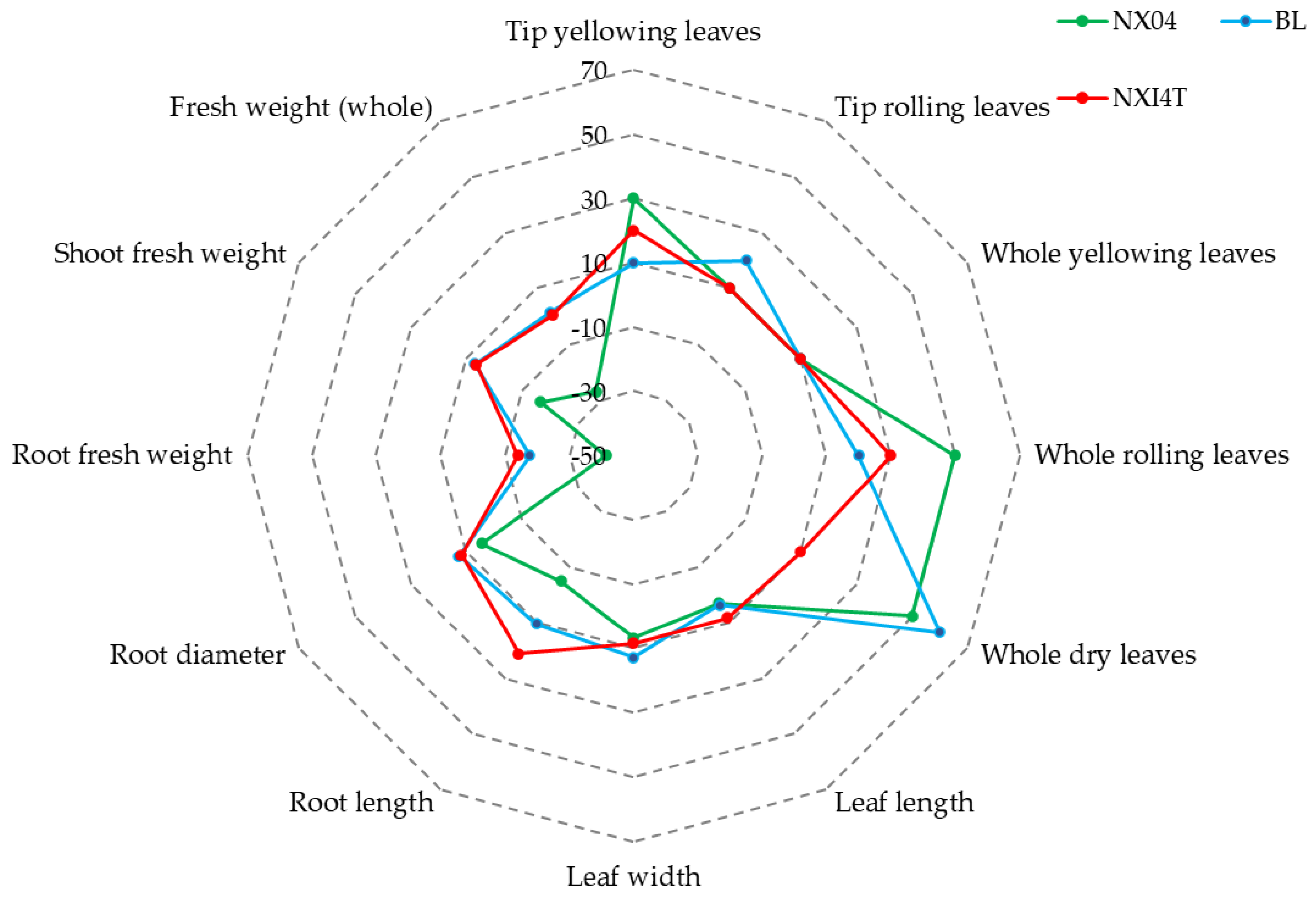
To assess morphological variation, leaf number, yellowing, rolling leaf symptoms, and fresh weight of the sugarcane were recorded under drought stress, and the parameters were plotted in Figure 2. Fresh weight and leaf number did not differ between the sugarcane cultivars during 8 days of drought stress. This indicates that sugarcane growth was unaffected during the 8-day stress period. Fresh weight is widely used to quantify morphological and biomass changes in plants under drought stress. This measurement was conducted to assess the ability of plants to maintain an appropriate water status for growth and survival under drought conditions. However, rolling leaf symptoms and yellowing (chlorosis) leaves were observed more quickly in the sensitive and moderate genotypes than in the drought-tolerant NXI-4T. On the other hand, root length and root diameter were greater in the tolerant cultivars. These results indicated that the NXI-4T cultivar is a drought-tolerant sugarcane with key characteristics: a deep, extensive root system and delayed yellowing and leaf rolling [40].

3.2. Physiological Response of Sugarcane Cultivars Under Drought Stress

Drought stress induced a rapid accumulation of ROS, such as H2O2 (Table 2), which is reactive and can oxidize multiple cellular components, resulting in increased cell damage. Measurement of MDA (malondialdehyde) content showed an increase in sensitive and moderate sugarcane cultivars at 4 days and remained at high levels at 8 days after drought stress (Table 2). This increase was greater in sensitive compared to moderate sugarcane cultivars. However, the content was slightly increased 8 days after drought stress in the tolerant cultivar. The MDA serves as a marker of oxidative stress and cellular damage linked to drought stress.
To overcome damage caused by drought stress, plants activate antioxidant scavenging systems. Proline and sugar are well-known as non-enzymatic antioxidant systems. Proline contents significantly increased in 4 and 8 days after drought stress (Table 2). Glucose accumulation increased concomitantly, whereas sucrose accumulation was only significantly increased at 8 days of water stress in the tolerant sugarcane cultivar of NXI-4T. The increase in sucrose is suggested to contribute to osmoregulation and provide energy for survival under severe stress in the tolerant plants [41].
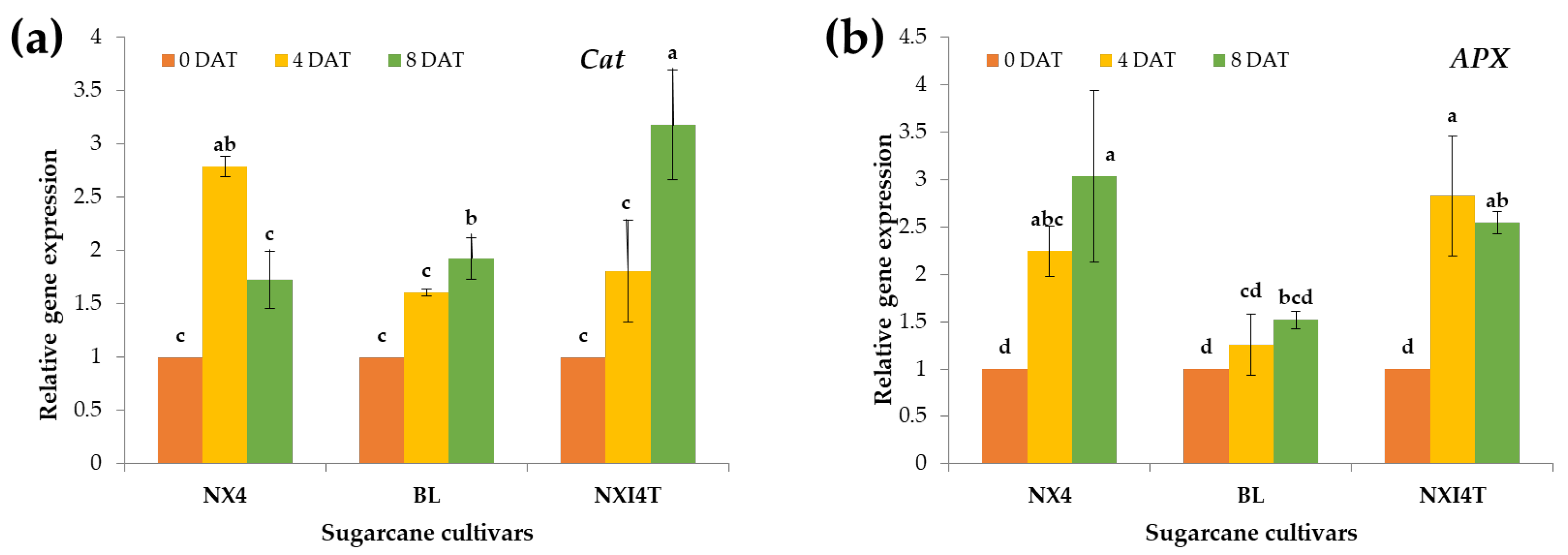
Plants induce antioxidant enzyme activity to detoxify ROS accumulation during water stress. The increase in ROS induces molecular responses that are key determinants of plant tolerance to drought stress. The expression of the gene for catalase (Cat) and ascorbate peroxidase (Apx) was significantly upregulated during drought stress (Figure 3a,b). The induction of Cat and Apx expression was dominantly higher in tolerant sugarcane cultivars, which increased by 2.5–3-fold.
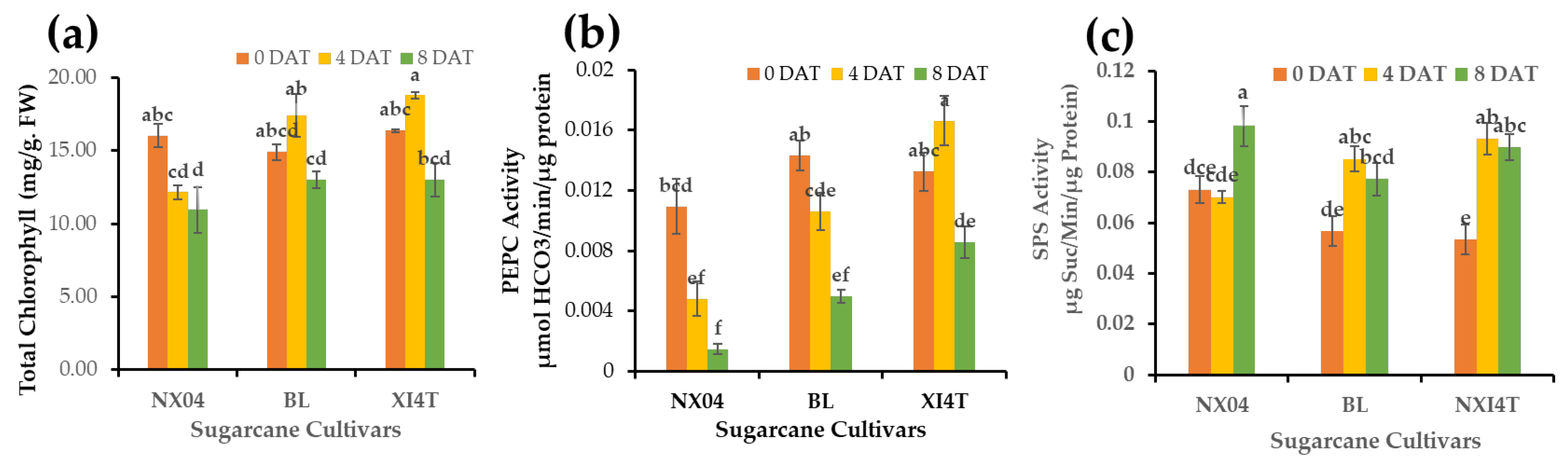
Drought stress severely restricts plant growth by reducing water uptake, leading to wilting, leaf rolling, and senescence. To observe the effect of drought stress on photosynthesis, chlorophyll content in sugarcane cultivars was assessed under drought stress. The results showed a decrease in chlorophyll content in sensitive sugarcane cultivars at 4 and 8 days of water stress (Figure 4a). However, the contents were transiently increased in moderate- and tolerant-sugarcane cultivars at 4 days, then decreased after 8 days of drought stress. The increase in chlorophyll content may help provide energy for photosynthetic carbon assimilation.
Plants employ regulatory mechanisms to mitigate abiotic stress, including post-translational modifications (PTMs) of proteins. This mechanism is directed to maintain metabolic processes to sustain growth and development. Measurement of PEPC activity, as the primary carbon assimilating enzyme, showed a decrease in activity in all sugarcane cultivars during water stress, except an increase at 4 days of water stress in tolerant cultivars (Figure 4b). However, SPS activity was induced under water stress in the moderate- and tolerant cultivars (Figure 4c). The increases in SPS activity were consistent with the increase in sucrose content detected in the sugarcane cultivars (Table 2) and with previous reports [7]. Although the increase in SPS activity has not been confirmed by further analysis, the PTM of the SPS protein is a crucial regulatory mechanism that allows plants to rapidly adjust to drought stress [42].

3.3. Expression of Photosynthetic Genes and Transcription Factors During Drought Stress

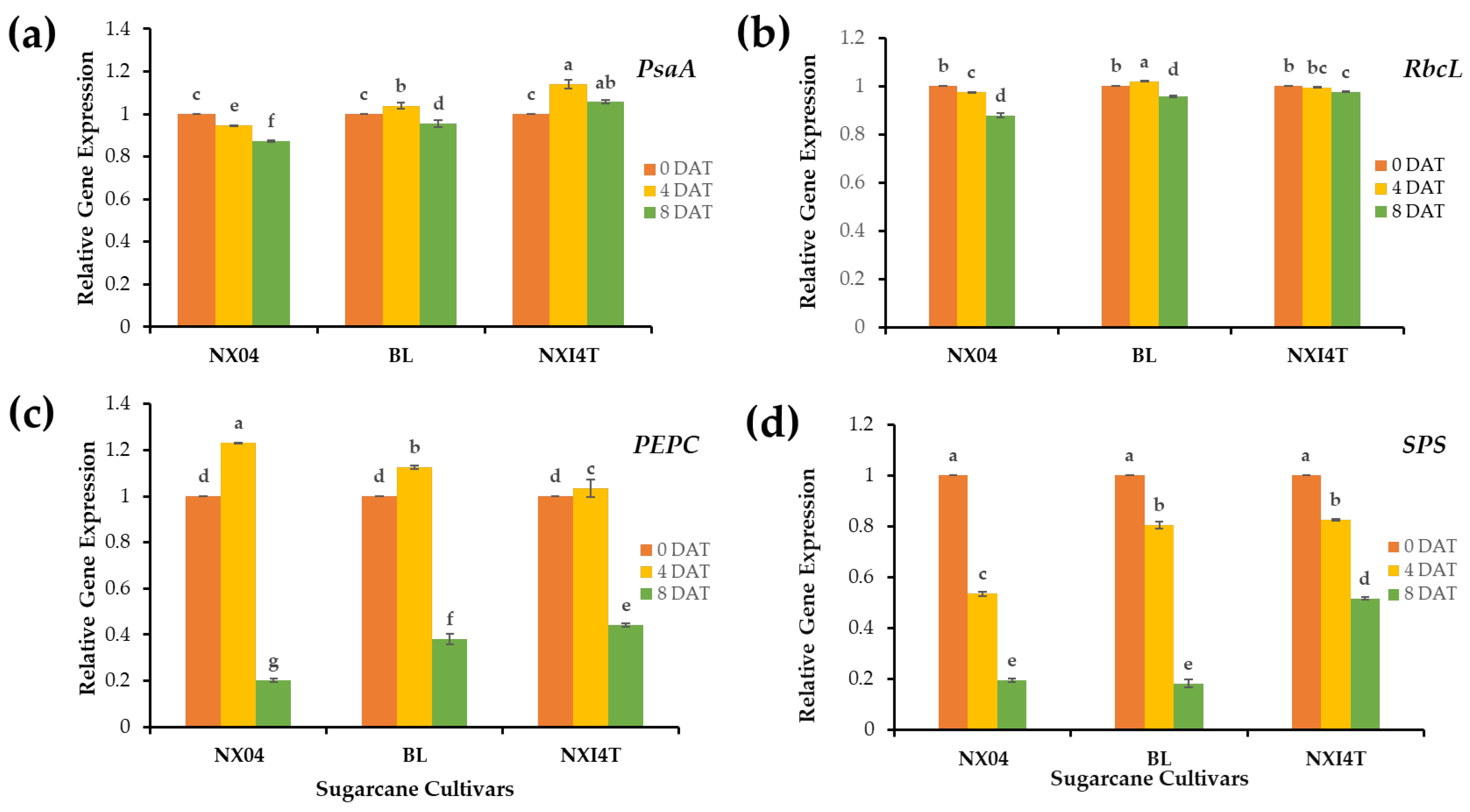
Photosynthesis is one of the main plant processes that impacts plant growth and yield. The susceptibility of photosynthesis to drought stress is primarily due to stomatal closure, which reduces CO2 assimilation. Quantification of gene expression by RT-qPCR revealed that expression of PsaA and RbcL genes, which are localised in the chloroplast, was not affected by drought stress for 8 days in moderate and tolerant sugarcane cultivars, while the expression was slightly decreased in sensitive sugarcane cultivars (Figure 5a,b). However, the Pepc and Sps, which are nuclear genes, were downregulated during 8 days of drought stress in all sugarcane cultivars. These downregulations were inconsistent with the enzyme activity presented in Figure 4b,c.
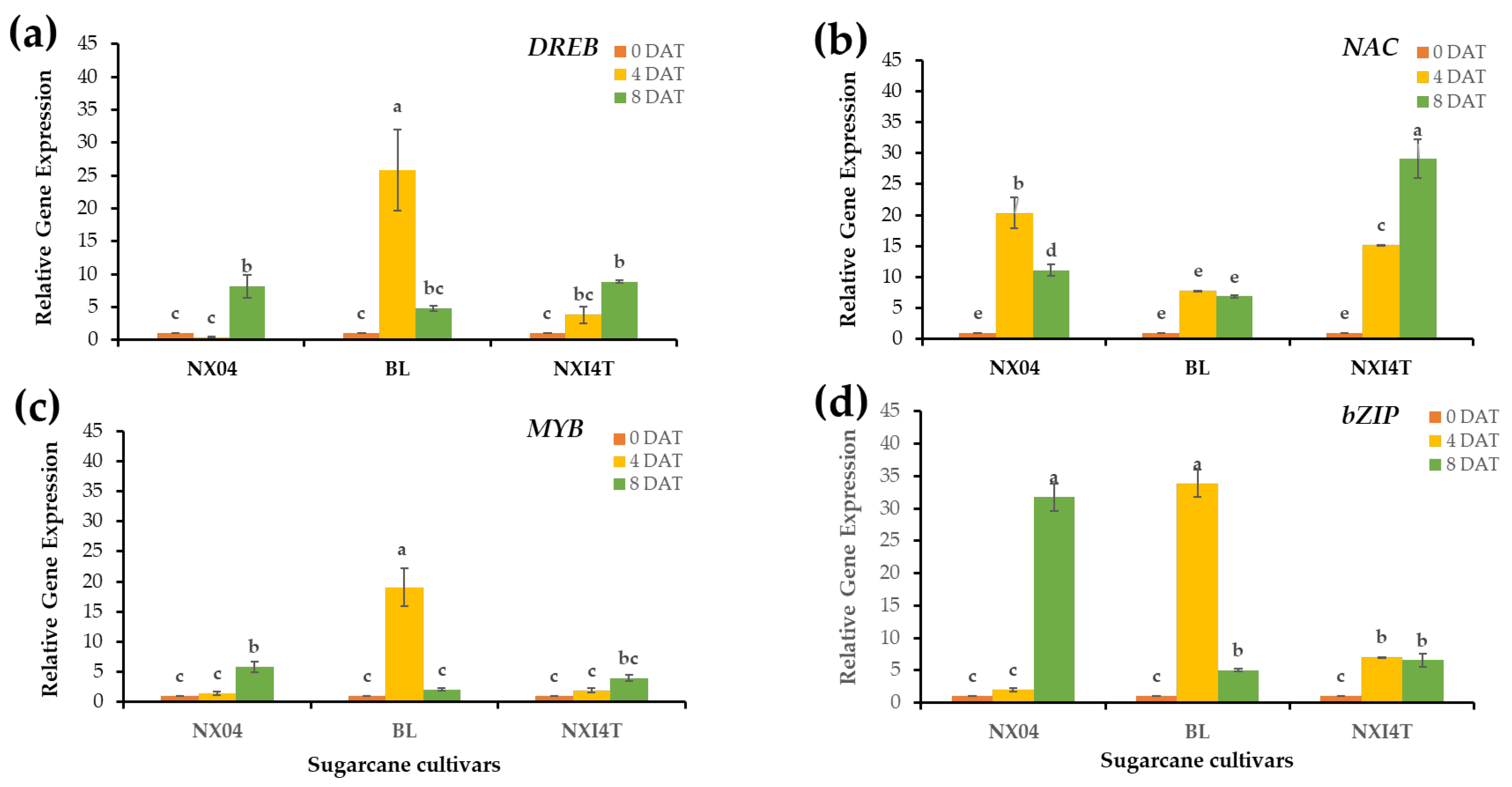
Transcription factors (TFs) are critical regulators of gene expression, playing key roles in various biological processes, including abiotic stress responses in plants. Key TFs, including DREB, NAC, bZIP, and MYB, have been involved in drought responses and regulate downstream stress-responsive genes. Analysis of RT-qPCR showed that expression of DREB, a TF responsible for drought and salt tolerance, was significantly upregulated at 4 days and declined at 8 days of water stress in moderate cultivars (Figure 6a). A similar response was observed in MYB gene expression, which was induced at 4 days of water stress. Although MYB gene expression was also significantly increased at 4 days in the moderate cultivar, the increase was lower than that of DREB expression. However, bZIP expression was highly upregulated in sensitive and moderate sugarcane cultivars, but not in the tolerant cultivar NXI-4T (Figure 6d). This discrepancy indicates that bZIP is involved in many biological processes and plays an important role in biotic and abiotic stresses [43]. Interestingly, among the TFs, NAC expression was significantly upregulated at 4 and 8 days of water stress in moderate- and tolerant cultivars (Figure 6b), whereas it was decreased at 8 days in the sensitive cultivar. The enhanced NAC expression was found in the transgenic sugarcane and did not come from a native cultivar trait, since the NAC expression was enhanced more in the transgenic drought-tolerant compared to non-transgenic sugarcane. The NAC TFs act as critical regulators of leaf senescence, functioning as both positive and negative regulators [44], and may play a key role in sugarcane tolerance to abiotic stress [27].

4. Discussion

The growth response of plant cultivars to water stress is critically dependent on their sensitivity to drought stress. Different genotypes possess distinct morphological and physiological mechanisms for adapting to water shortages. Observation of morphological variation showed that root length was longer in moderate- and tolerant-sugarcane cultivars than in sensitive ones (Figure 2). Under water stress, tolerant plants maximize water uptake by increasing root length and depth, allowing them to access deeper soil moisture layers [45]. In addition, yellowing leaves (chlorosis) as a symptom of senescence and rolling leaves were remarkably delayed in tolerant cultivars. The rolling leaf is a typical response to water deficit, and tolerant plants show the rolling leaf later and remain green [46]. Measurements of soil water content (SWC) and relative water content (RCW) showed that SWC and RCW rapidly decreased in the sensitive cultivars (Figure 1a,b). These morphological changes and retardation of water content indicate that NXI-4T is a tolerant cultivar to water stress.
Drought stress promotes excessive ROS generation, leading to the accumulation of malondialdehyde (MDA), which disrupts cell membrane integrity and ultimately triggers cell death. Drought stress significantly increased MDA content in the sensitive sugarcane cultivar but not in the tolerant cultivars (Table 2). To overcome cellular damage, plants operate a highly organized antioxidant defense system to maintain normal cellular function. The proline content, as a nonenzymatic antioxidant, increased sharply, almost 10-fold, in all sugarcane cultivars. However, sucrose content was significantly accumulated in tolerant sugarcane cultivars. Interestingly, the glucose content increased in 4 days and remained elevated for 8 days of water scarcity. Glucose plays a significant role as an osmoprotectant, signaling molecule, and energy source during drought in plants [47,48,49]. In addition, plants also operate an enzymatic antioxidant defense system that directly converts harmful ROS into harmless substances. Catalase (Cat) and ascorbate peroxidase (Apx) expression increased under drought stress in sugarcane [50,51]. Similarly, expression of the Cat and Apx genes was significantly enhanced in all sugarcane cultivars under drought stress, and the Cat expression was pronouncedly increased at 8 days of water withholding in tolerant sugarcane cultivars (Figure 3).
Water stress reduced the photosynthesis rate and affected plant growth by lowering chlorophyll content and the expression of photosynthetic genes [52]. The chlorophyll content was significantly reduced in the drought-sensitive cultivar, whereas in the moderate and tolerant cultivars, the reduction was observed only at 8 days of water stress (Figure 4a). Chlorophyll pigmentation was reported to increase under mild stress and decrease under severe water stress in water-tolerant blue honeysuckle [53]. Maintaining chlorophyll levels plays an important role in serving energy and adaptive mechanisms under drought stress in the tolerant cultivar. Measurement of PEPC and SPS activities, the main carbon-assimilation enzymes, showed an increase under drought stress in the tolerant cultivar (Figure 4b,c). However, the expression of the corresponding genes Pepc and Sps was reduced under drought stress in all sugarcane cultivars (Figure 5d,c). These results suggested that the enzymes may be regulated through post-translational modifications (PTMs) under drought stress, although extensive work is required. The PTM is prominent in plant proteins involved in photosynthetic carbon assimilation and in responses to environmental changes [54].
One of the fundamental steps in enhancing drought stress resilience in plants is understanding the roles of TFs, which regulate gene expression. Examination of TFs in sugarcane indicated that TFs such as DREB, NAC, and ABRE-binding factor showed high expression during drought stress [55]. Detection of TF expression using RT-qPCR revealed that NAC and DREB were significantly upregulated in tolerant cultivars, with increases of more than 5-fold. However, bZIP and MYB expression were pronounced in sensitive and moderate cultivars at 4 and 8 days of water stress (Figure 6). These results indicate that NAC plays an important role in drought tolerance in sugarcane. NAC is one of the largest families of TFs in plants and is involved in various stress responses. Overexpression of the NAC gene has been reported to improve drought and salt tolerance in rice [56] and transgenic cotton [57]. In addition, the expression of sugarcane NACs is involved in senescence-associated functions [26,44], positively as accelerators [58] and negatively as delayers [59]. Morphological variation in sugarcane cultivars showed that leaf senescence was delayed in the tolerant cultivars under drought stress (Figure 2). This suggests that NAC is a TF responsible for drought stress and delay of senescence in sugarcane.
The DREB transcription factor plays a pivotal role in regulating drought responses in plants [23,25]. However, DREB expression was lower than that of the NAC under drought stress in sugarcane (Figure 6a,b). Analysis of the DREB protein domain identified a transcriptional activation domain within the amino acid sequence, and engineering of these residues resulted in significant drought stress tolerance [60]. This may suggest that DREB expression was not activated under normal growth conditions in sugarcane. Recently, genome editing in plants, especially using CRISPR-Cas9, has acted as a precise molecular tool to engineer targeted DNA for the rapid development of plants with higher drought tolerance. Engineering the transcriptional activation domain of DREB will be an important target for achieving drought-resistant sugarcane in the future molecular breeding program.

5. Conclusions

The physiological and molecular responses of sensitive (NX04), moderate (BL), and tolerant (NXI4T) sugarcane cultivars to drought stress were examined under greenhouse conditions. The morphological variation showed that the tolerant sugarcane cultivar exhibits a longer root system and delays leaf chlorosis and rolling compared to the sensitive cultivars. The MDA content increased significantly, accompanied by an increase in the antioxidant system that protects the cell from oxidative damage. The SPS was increased under drought stress in the tolerant cultivars, although the expression of the corresponding gene was decreased. Among the TFs, NAC expression increased markedly, consistent with the delayed onset of chlorosis, suggesting that NACs play an important role in drought stress in sugarcane.

Author Contributions

Conceptualization, B.S. and P.D.; methodology, R.M.A. and B.S.; software, R.M.A. and I.R.N.; validation, P.D. and W.I.D.F.; formal analysis, R.M.A., M.A. and I.R.N.; investigation, R.M.A., M.A. and I.R.N.; software and statistics, R.M.A., M.A. and I.R.N.; resources, B.S. and P.D.; data curation, R.M.A., I.R.N. and B.S.; writing—original draft preparation, B.S., I.R.N. and R.M.A.; writing—review and editing, B.S. and I.R.N.; visualization, R.M.A. and M.A.; supervision, B.S., W.I.D.F., T.H. and P.D.; project administration, I.R.N. and T.H.; funding acquisition, B.S., T.H. and P.D. All authors have read and agreed to the published version of the manuscript.

Funding

This research was supported by a grant from the University of Jember, Indonesia (grant number 2839/UN25.3.1/LT/2025), and by Indonesian eRISPRO LPDP (grant number PRJ-4/LPDP/LPDP.4/2023—4818/UN25.3.1/LT/2023).

Data Availability Statement

No new data were created or analyzed in this study. Data sharing is not applicable to this article.

Acknowledgments

The authors would like to thank Purnama Okviandari and Retnosari Apriasti for their help.

Conflicts of Interest

The authors declare no conflicts of interest.

References

  1. O’Hara, I.M.; Mundree, S.G. (Eds.) Sugarcane-Based Biofuels and Bioproducts, 1st ed.; Wiley: Hoboken, NJ, USA, 2016. [Google Scholar] [CrossRef] [Scilit]
  2. Srivastava, A.K. Sugarcane Production: Impact of Climate Change and Its Mitigation. Biodiversitas J. Biol. Divers. 2012, 13, 214–227. [Google Scholar] [CrossRef] [Scilit]
  3. Linnenluecke, M.K.; Nucifora, N.; Thompson, N. Implications of Climate Change for the Sugarcane Industry. WIREs Clim. Change 2018, 9, e498. [Google Scholar] [CrossRef] [Scilit]
  4. Wijaya, E.F.; Irham; Sugiyarto. Measuring the Competitiveness of Sugarcane Farming: A Case Study in Magetan Regency, East Java, Indonesia. J. Agribus. Manag. Dev. 2021, 2, 33–41. [Google Scholar]
  5. Jangpromma, N.; Thammasirirak, S.; Prasit, J.; Patcharin, S. Effects of Drought and Recovery from Drought Stress on above Ground and Root Growth, and Water Use Efficiency in Sugarcane (Saccharum officinarum L.). Aust. J. Crop Sci. 2012, 6, 1298–1304. [Google Scholar]
  6. Wirojsirasak, W.; Songsri, P.; Jongrungklang, N.; Tangphatsornruang, S.; Klomsa-ard, P.; Ukoskit, K. Determination of Morpho-Physiological Traits for Assessing Drought Tolerance in Sugarcane. Plants 2024, 13, 1072. [Google Scholar] [CrossRef] [Scilit] [PubMed]
  7. Sugiharto, B. Biotechnology of Drought-Tolerant Sugarcane. In Sugarcane—Technology and Research; Oliveira, A.B.D., Ed.; InTech: Houston, TX, USA, 2018. [Google Scholar] [CrossRef] [Scilit]
  8. Buqori, D.M.A.I.; Sugiharto, B.; Suherman; Siswoyo, T.A.; Hariyono, K. Mitigating Drought Stress by Application of Drought-Tolerant Bacillus spp. Enhanced Root Architecture, Growth, Antioxidant and Photosynthetic Genes Expression in Sugarcane. Sci. Rep. 2025, 15, 5259. [Google Scholar] [CrossRef] [Scilit] [PubMed]
  9. Cia, M.C.; Guimarães, A.C.R.; Medici, L.O.; Chabregas, S.M.; Azevedo, R.A. Antioxidant Responses to Water Deficit by Drought-tolerant and -sensitive Sugarcane Varieties. Ann. Appl. Biol. 2012, 161, 313–324. [Google Scholar] [CrossRef] [Scilit]
  10. Neliana, I.R.; Soleha, W.; Suherman; Darsono, N.; Harmoko, R.; Sawitri, W.D.; Sugiharto, B. Alteration of Photosynthetic and Antioxidant Gene Expression in Sugarcane Infected by Multiple Mosaic Viruses. Int. J. Plant Biol. 2024, 15, 757–768. [Google Scholar] [CrossRef] [Scilit]
  11. Wani, S.H.; Singh, N.B.; Haribhushan, A.; Mir, J.I. Compatible Solute Engineering in Plants for Abiotic Stress Tolerance—Role of Glycine Betaine. Curr. Genom. 2013, 14, 157–165. [Google Scholar] [CrossRef] [Scilit] [PubMed]
  12. Ferreira, T.H.S.; Tsunada, M.S.; Bassi, D.; Araújo, P.; Mattiello, L.; Guidelli, G.V.; Righetto, G.L.; Gonçalves, V.R.; Lakshmanan, P.; Menossi, M. Sugarcane Water Stress Tolerance Mechanisms and Its Implications on Developing Biotechnology Solutions. Front. Plant Sci. 2017, 8, 1077. [Google Scholar] [CrossRef] [Scilit] [PubMed]
  13. Li, Z.; Wang, G.; Liu, X.; Wang, Z.; Zhang, M.; Zhang, J. Genome-Wide Identification and Expression Profiling of DREB Genes in Saccharum Spontaneum. BMC Genom. 2021, 22, 456. [Google Scholar] [CrossRef] [Scilit] [PubMed]
  14. Du, Y.; Zhao, Q.; Chen, L.; Yao, X.; Zhang, H.; Wu, J.; Xie, F. Effect of Drought Stress during Soybean R2–R6 Growth Stages on Sucrose Metabolism in Leaf and Seed. Int. J. Mol. Sci. 2020, 21, 618. [Google Scholar] [CrossRef] [Scilit] [PubMed]
  15. Wang, X.; Liu, H.; Zhang, D.; Zou, D.; Wang, J.; Zheng, H.; Jia, Y.; Qu, Z.; Sun, B.; Zhao, H. Photosynthetic Carbon Fixation and Sucrose Metabolism Supplemented by Weighted Gene Co-Expression Network Analysis in Response to Water Stress in Rice with Overlapping Growth Stages. Front. Plant Sci. 2022, 13, 864605. [Google Scholar] [CrossRef] [Scilit] [PubMed]
  16. Tang, X.; Peng, Y.; Li, Z.; Guo, H.; Xia, X.; Li, B.; Yin, W. The Regulation of Nitrate Reductases in Response to Abiotic Stress in Arabidopsis. Int. J. Mol. Sci. 2022, 23, 1202. [Google Scholar] [CrossRef] [Scilit] [PubMed]
  17. Hoang, X.L.T.; Nhi, D.N.H.; Thu, N.B.A.; Thao, N.P.; Tran, L.-S.P. Transcription Factors and Their Roles in Signal Transduction in Plants under Abiotic Stresses. Curr. Genom. 2017, 18, 483–497. [Google Scholar] [CrossRef] [Scilit] [PubMed]
  18. Hussain, Q.; Asim, M.; Zhang, R.; Khan, R.; Farooq, S.; Wu, J. Transcription Factors Interact with ABA through Gene Expression and Signaling Pathways to Mitigate Drought and Salinity Stress. Biomolecules 2021, 11, 1159. [Google Scholar] [CrossRef] [Scilit] [PubMed]
  19. Liu, Q.; Kasuga, M.; Sakuma, Y.; Abe, H.; Miura, S.; Yamaguchi-Shinozaki, K.; Shinozaki, K. Two Transcription Factors, DREB1 and DREB2, with an EREBP/AP2 DNA Binding Domain Separate Two Cellular Signal Transduction Pathways in Drought- and Low-Temperature-Responsive Gene Expression, Respectively, in Arabidopsis. Plant Cell 1998, 10, 1391–1406. [Google Scholar] [CrossRef] [Scilit] [PubMed]
  20. Li, P.; Chai, Z.; Lin, P.; Huang, C.; Huang, G.; Xu, L.; Deng, Z.; Zhang, M.; Zhang, Y.; Zhao, X. Genome-Wide Identification and Expression Analysis of AP2/ERF Transcription Factors in Sugarcane (Saccharum spontaneum L.). BMC Genom. 2020, 21, 685. [Google Scholar] [CrossRef] [Scilit] [PubMed]
  21. Chanprame, S.; Promkhlibnil, T.; Suwanno, S.; Laksana, C. Isolation, Characterization and Expression of Transcription Factor ScDREB2 from Wild, Commercial and Interspecific Hybrid Sugarcane in Salinity Condition. J. Plant Biotechnol. 2019, 46, 97–105. [Google Scholar] [CrossRef] [Scilit]
  22. Kudo, M.; Kidokoro, S.; Yoshida, T.; Mizoi, J.; Todaka, D.; Fernie, A.R.; Shinozaki, K.; Yamaguchi-Shinozaki, K. Double Overexpression of DREB and PIF Transcription Factors Improves Drought Stress Tolerance and Cell Elongation in Transgenic Plants. Plant Biotechnol. J. 2017, 15, 458–471. [Google Scholar] [CrossRef] [Scilit] [PubMed]
  23. Chen, Y.; Li, Z.; Sun, T.; Wang, D.; Wang, Z.; Zhang, C.; Que, Y.; Guo, J.; Xu, L.; Su, Y. Sugarcane ScDREB2B-1 Confers Drought Stress Tolerance in Transgenic Nicotiana Benthamiana by Regulating the ABA Signal, ROS Level and Stress-Related Gene Expression. Int. J. Mol. Sci. 2022, 23, 9557. [Google Scholar] [CrossRef] [Scilit] [PubMed]
  24. Xiao, S.; Wu, Y.; Xu, S.; Jiang, H.; Hu, Q.; Yao, W.; Zhang, M. Field Evaluation of TaDREB2B-Ectopic Expression Sugarcane (Saccharum spp. Hybrid) for Drought Tolerance. Front. Plant Sci. 2022, 13, 963377. [Google Scholar] [CrossRef] [Scilit] [PubMed]
  25. Wang, M.; Luo, Y.; Li, A.; Chen, Z.; Qin, C.; Liao, F.; Zhang, B.; Zhang, Y.; Lakshmanan, P.; Pan, Y.; et al. Generation of Transgenic Sugarcane with Enhanced Drought Tolerance and Increased Sucrose Content via Overexpression of the AtDreb1Asc Gene. Plant Cell Environ. 2025, 48, 7961–7964. [Google Scholar] [CrossRef] [Scilit] [PubMed]
  26. Carrillo-Bermejo, E.A.; Gamboa-Tuz, S.D.; Pereira-Santana, A.; Keb-Llanes, M.A.; Castaño, E.; Figueroa-Yañez, L.J.; Rodriguez-Zapata, L.C. The SoNAP Gene from Sugarcane (Saccharum officinarum) Encodes a Senescence-Associated NAC Transcription Factor Involved in Response to Osmotic and Salt Stress. J. Plant Res. 2020, 133, 897–909. [Google Scholar] [CrossRef] [Scilit] [PubMed]
  27. Shen, Q.; Qian, Z.; Wang, T.; Zhao, X.; Gu, S.; Rao, X.; Lyu, S.; Zhang, R.; He, L.; Li, F. Genome-Wide Identification and Expression Analysis of the NAC Transcription Factor Family in Saccharum Spontaneum under Different Stresses. Plant Signal. Behav. 2022, 17, 2088665. [Google Scholar] [CrossRef] [Scilit] [PubMed]
  28. Dai, J.; Xu, Z.; Fang, Z.; Han, Q.; Shi, P.; Zhu, J.; Cao, L.; Liu, H.; Hu, Y.; Zhao, C. NAC Transcription Factor PpNAP4 Modulates Sucrose Accumulation by Activating the Expression of PpSUS1 and PpSPS2 during Peach Ripening. Hortic. Plant J. 2025, 12, 1318–1330. [Google Scholar] [CrossRef] [Scilit]
  29. Zhao, C.; Nong, W.; Qian, Z.; Ding, Q.; Wang, Y.; He, L.; Li, F. Identification and Characterization of the Efbzip Gene Family in Erianthus Fulvus and Exploration of Functional Genes Involved in Sucrose Metabolism. Genes 2025, 16, 1434. [Google Scholar] [CrossRef] [Scilit] [PubMed]
  30. Huang, L.-T.; Liu, C.-Y.; Li, L.; Han, X.-S.; Chen, H.-W.; Jiao, C.-H.; Sha, A.-H. Genome-Wide Identification of bZIP Transcription Factors in Faba Bean Based on Transcriptome Analysis and Investigation of Their Function in Drought Response. Plants 2023, 12, 3041. [Google Scholar] [CrossRef] [Scilit] [PubMed]
  31. Guo, J.; Ling, H.; Ma, J.; Chen, Y.; Su, Y.; Lin, Q.; Gao, S.; Wang, H.; Que, Y.; Xu, L. A Sugarcane R2R3-MYB Transcription Factor Gene Is Alternatively Spliced during Drought Stress. Sci. Rep. 2017, 7, 41922. [Google Scholar] [CrossRef] [Scilit] [PubMed]
  32. Tang, Z.; Wang, J.; Li, R.; Tang, Y.; Zhang, Y.; Pu, G. Expression Analysis and Functional Study of Honeysuckle MYB Transcription Factors under Drought Stress. Sci. Rep. 2025, 15, 14843. [Google Scholar] [CrossRef] [Scilit] [PubMed]
  33. Anur, R.M.; Mufithah, N.; Sawitri, W.D.; Sakakibara, H.; Sugiharto, B. Overexpression of Sucrose Phosphate Synthase Enhanced Sucrose Content and Biomass Production in Transgenic Sugarcane. Plants 2020, 9, 200. [Google Scholar] [CrossRef] [Scilit] [PubMed]
  34. Wood, I.P.; Elliston, A.; Ryden, P.; Bancroft, I.; Roberts, I.N.; Waldron, K.W. Rapid Quantification of Reducing Sugars in Biomass Hydrolysates: Improving the Speed and Precision of the Dinitrosalicylic Acid Assay. Biomass Bioenergy 2012, 44, 117–121. [Google Scholar] [CrossRef] [Scilit]
  35. Monsigny, M.; Petit, C.; Roche, A.-C. Colorimetric Determination of Neutral Sugars by a Resorcinol Sulfuric Acid Micromethod. Anal. Biochem. 1988, 175, 525–530. [Google Scholar] [CrossRef] [Scilit] [PubMed]
  36. Ábrahám, E.; Hourton-Cabassa, C.; Erdei, L.; Szabados, L. Methods for Determination of Proline in Plants. In Plant Stress Tolerance: Methods in Molecular Biology; Sunkar, R., Ed.; Humana Press: Totowa, NJ, USA, 2010; Volume 639, pp. 317–331. [Google Scholar] [CrossRef] [Scilit] [PubMed]
  37. Sawitri, W.D.; Narita, H.; Ishizaka-Ikeda, E.; Sugiharto, B.; Hase, T.; Nakagawa, A. Purification and Characterization of Recombinant Sugarcane Sucrose Phosphate Synthase Expressed in E. Coli and Insect Sf9 Cells: An Importance of the N-Terminal Domain for an Allosteric Regulatory Property. J. Biochem. 2016, 159, 599–607. [Google Scholar] [CrossRef] [Scilit] [PubMed]
  38. Manimekalai, R.; Narayanan, J.; Ranjini, R.; Gokul, M.; Selvi, A.; Kumar, P.; Gomathi, R. Hydrogen Peroxide-Induced Oxidative Stress in Sugarcane and Response Expression Pattern of Stress-Responsive Genes Through Quantitative RT-PCR. Sugar Tech 2018, 20, 681–691. [Google Scholar] [CrossRef] [Scilit]
  39. Liu, F.; Huang, N.; Wang, L.; Ling, H.; Sun, T.; Ahmad, W.; Muhammad, K.; Guo, J.; Xu, L.; Gao, S.; et al. A Novel L-Ascorbate Peroxidase 6 Gene, ScAPX6, Plays an Important Role in the Regulation of Response to Biotic and Abiotic Stresses in Sugarcane. Front. Plant Sci. 2018, 8, 2262. [Google Scholar] [CrossRef] [Scilit] [PubMed]
  40. Chandarak, N.; Wang, X.; Liu, S.; Xiong, D. Does Leaf Rolling Serve as a Phenotype Index for Drought Tolerance in Grasses? A Review. Plant Ecophysiol. 2025, 1, 3. [Google Scholar] [CrossRef] [Scilit]
  41. Ennajeh, M.; Ehwald, R.; Kühn, C. Role of Sucrose and Phloem–Xylem Interaction in Recovery of Water Status and Hydraulic Dehydration Impacts in Tobacco Plants (Nicotiana tabacum). Acta Physiol. Plant. 2022, 44, 56. [Google Scholar] [CrossRef] [Scilit]
  42. Bagnato, L.; Tosato, E.; Gurrieri, L.; Trost, P.; Forlani, G.; Sparla, F. Arabidopsis Thaliana Sucrose Phosphate Synthase A2 Affects Carbon Partitioning and Drought Response. Biology 2023, 12, 685. [Google Scholar] [CrossRef] [Scilit] [PubMed]
  43. Liu, H.; Tang, X.; Zhang, N.; Li, S.; Si, H. Role of bZIP Transcription Factors in Plant Salt Stress. Int. J. Mol. Sci. 2023, 24, 7893. [Google Scholar] [CrossRef] [Scilit] [PubMed]
  44. Li, S.; Li, S.; Tan, S.; Liu, Z.; Li, Z. Transcription Factors-Regulated Leaf Senescence in Major Crops: Insights, Applications, and Challenges. Curr. Plant Biol. 2024, 40, 100428. [Google Scholar] [CrossRef] [Scilit]
  45. Kou, X.; Han, W.; Kang, J. Responses of Root System Architecture to Water Stress at Multiple Levels: A Meta-Analysis of Trials under Controlled Conditions. Front. Plant Sci. 2022, 13, 1085409. [Google Scholar] [CrossRef] [Scilit] [PubMed]
  46. Kadioglu, A.; Terzi, R.; Saruhan, N.; Saglam, A. Current Advances in the Investigation of Leaf Rolling Caused by Biotic and Abiotic Stress Factors. Plant Sci. 2012, 182, 42–48. [Google Scholar] [CrossRef] [Scilit] [PubMed]
  47. Yu, J.; Zhang, R.; Li, X.; Dong, D.; Wang, S. Sugar Metabolism and Transport in Response to Drought–Rehydration in Poa Pratensis. Agronomy 2025, 15, 320. [Google Scholar] [CrossRef] [Scilit]
  48. Amoah, J.N.; Adu-Gyamfi, M.O. Effect of Drought Acclimation on Sugar Metabolism in Millet. Protoplasma 2025, 262, 35–49. [Google Scholar] [CrossRef] [Scilit] [PubMed]
  49. Wu, Q.; Chen, Y.; Zou, W.; Pan, Y.-B.; Lin, P.; Xu, L.; Grisham, M.P.; Ding, Q.; Su, Y.; Que, Y. Genome-Wide Characterization of Sugarcane Catalase Gene Family Identifies a ScCAT1 Gene Associated Disease Resistance. Int. J. Biol. Macromol. 2023, 232, 123398. [Google Scholar] [CrossRef] [Scilit] [PubMed]
  50. Boaretto, L.F.; Carvalho, G.; Borgo, L.; Creste, S.; Landell, M.G.A.; Mazzafera, P.; Azevedo, R.A. Water Stress Reveals Differential Antioxidant Responses of Tolerant and Non-Tolerant Sugarcane Genotypes. Plant Physiol. Biochem. 2014, 74, 165–175. [Google Scholar] [CrossRef] [Scilit] [PubMed]
  51. Dos Santos, C.M.; De Almeida Silva, M.; Lima, G.P.P.; De Almeida Prado Bortolheiro, F.P.; Brunelli, M.C.; De Holanda, L.A.; Oliver, R. Physiological Changes Associated with Antioxidant Enzymes in Response to Sugarcane Tolerance to Water Deficit and Rehydration. Sugar Tech 2015, 17, 291–304. [Google Scholar] [CrossRef] [Scilit]
  52. Hu, F.; Zhang, Y.; Guo, J. Effects of Drought Stress on Photosynthetic Physiological Characteristics, Leaf Microstructure, and Related Gene Expression of Yellow Horn. Plant Signal. Behav. 2023, 18, 2215025. [Google Scholar] [CrossRef] [Scilit] [PubMed]
  53. Yan, W.; Lu, Y.; Guo, L.; Liu, Y.; Li, M.; Zhang, B.; Zhang, B.; Zhang, L.; Qin, D.; Huo, J. Effects of Drought Stress on Pho-tosynthesis and Chlorophyll Fluorescence in Blue Honeysuckle. Plants 2024, 13, 2115. [Google Scholar] [CrossRef] [Scilit] [PubMed]
  54. Balparda, M.; Bouzid, M.; Martinez, M.D.P.; Zheng, K.; Schwarzländer, M.; Maurino, V.G. Regulation of Plant Carbon Assimilation Metabolism by Post-translational Modifications. Plant J. 2023, 114, 1059–1079. [Google Scholar] [CrossRef] [Scilit] [PubMed]
  55. Devi, K.; Prathima, P.T.; Gomathi, R.; Manimekalai, R.; Lakshmi, K.; Selvi, A. Gene Expression Profiling in Sugarcane Genotypes During Drought Stress and Rehydration. Sugar Tech 2019, 21, 717–733. [Google Scholar] [CrossRef] [Scilit]
  56. Zheng, X.; Chen, B.; Lu, G.; Han, B. Overexpression of a NAC Transcription Factor Enhances Rice Drought and Salt Tolerance. Biochem. Biophys. Res. Commun. 2009, 379, 985–989. [Google Scholar] [CrossRef] [Scilit] [PubMed]
  57. Liu, G.; Li, X.; Jin, S.; Liu, X.; Zhu, L.; Nie, Y.; Zhang, X. Overexpression of Rice NAC Gene SNAC1 Improves Drought and Salt Tolerance by Enhancing Root Development and Reducing Transpiration Rate in Transgenic Cotton. PLoS ONE 2014, 9, e86895. [Google Scholar] [CrossRef] [Scilit] [PubMed]
  58. Sun, L.; Xu, H.; Song, J.; Yang, X.; Wang, X.; Liu, H.; Pang, M.; Hu, Y.; Yang, Q.; Ning, X.; et al. OsNAC103, a NAC Transcription Factor, Positively Regulates Leaf Senescence and Plant Architecture in Rice. Rice 2024, 17, 15. [Google Scholar] [CrossRef] [Scilit] [PubMed]
  59. Kan, C.; Zhang, Y.; Wang, H.-L.; Shen, Y.; Xia, X.; Guo, H.; Li, Z. Transcription Factor NAC075 Delays Leaf Senescence by Deterring Reactive Oxygen Species Accumulation in Arabidopsis. Front. Plant Sci. 2021, 12, 634040. [Google Scholar] [CrossRef] [Scilit] [PubMed]
  60. Sakuma, Y.; Maruyama, K.; Osakabe, Y.; Qin, F.; Seki, M.; Shinozaki, K.; Yamaguchi-Shinozaki, K. Functional Analysis of an Arabidopsis Transcription Factor, DREB2A, Involved in Drought-Responsive Gene Expression. Plant Cell 2006, 18, 1292–1309. [Google Scholar] [CrossRef] [Scilit] [PubMed]
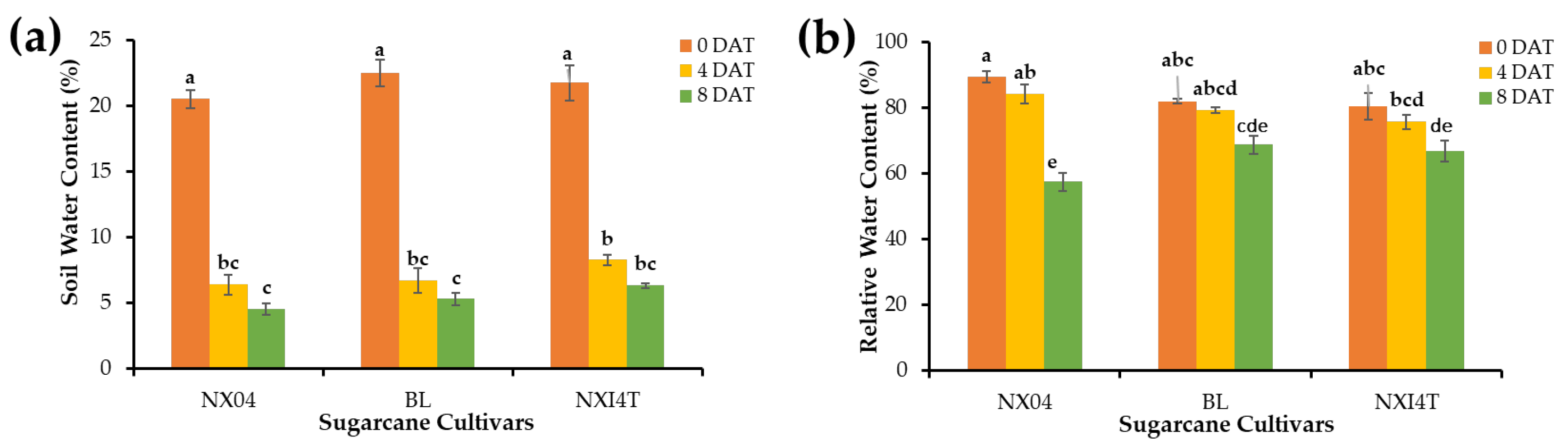
Figure 1. Soil water content (SWC) and relative water content (RWC) in sugarcane cultivars during drought stress. The SWC (a) and RWC (b) were measured at 0, 4, and 8 days of drought stress. NX04, BL, and NXI4T represent sensitive, moderate, and tolerant sugarcane cultivars, respectively. Values are means ± SD of three biological replicates, and different lowercase letters indicate significant differences (p ≤ 0.05).
Ijpb 17 00062 g001
Figure 2. Radar plot showing the morphological variation in sugarcane cultivars at 8 days after drought stress. Values indicate the percentage of trait values under drought conditions relative to those at 0 days (before water withholding). Green, blue, and red colours are sensitive (NX04), moderate (BL), and tolerant (NXI4T) sugarcane cultivars, respectively.
Ijpb 17 00062 g002
Figure 3. Enhancement of Cat (a) and Apx (b) gene expression in the leaves of sugarcane cultivars at 0, 4, and 8 days after drought stress. Orange, yellow, and green colours represent NX04 (sensitive), BL (moderate), and NXI4T (tolerant) sugarcane cultivars. Actin was used as the reference gene. Relative expression was determined by setting the baseline (day 0) to one unit. Values are means ± SD of three biological replicates, and different lowercase letters indicate significant differences (p ≤ 0.05).
Ijpb 17 00062 g003
Figure 4. Change in chlorophyll content (a), activity of phosphoenolpyruvate carboxylase (PEPC) (b) and sucrose-phosphate synthase (SPS) (c) in response to drought stress in leaves of sugarcane cultivars. Orange, yellow, and green colours represent NX04 (sensitive), BL (moderate), and NXI4T (tolerant) sugarcane cultivars. Values are means ± SD for three independent biological samples, and different lowercase letters indicate significant differences (p ≤ 0.05).
Ijpb 17 00062 g004
Figure 5. Expression of photosynthetic genes in response to drought stress in leaves of sugarcane cultivars. The expressions of PsaA (a), RbcL (b), Pepc (c), and Sps (d) were determined in the leaves at 0, 4, and 8 days after drought stress. Orange, yellow, and green colours represent NX04 (sensitive), BL (moderate), and NXI4T (tolerant) sugarcane cultivars. Actin was used as the reference gene. Relative expression was determined by setting the baseline (day 0) to one unit. Values are means ± SD of three biological replicates, and different lowercase letters indicate significant differences (p ≤ 0.05).
Ijpb 17 00062 g005
Figure 6. Expression of transcription factors (TFs) in response to drought stress in leaves of sugarcane cultivars. The expressions of DREB (a), NAC (b), MYB (c), and bZIP (d) were determined in the leaves at 0, 4, and 8 days after drought stress. Orange, yellow, and green colours represent NX04 (sensitive), BL (moderate), and NXI4T (tolerant) sugarcane cultivars. Actin was used as the reference gene. Relative expression was determined by setting the baseline (day 0) to one unit. Values are means ± SD of three biological replicates, and different lowercase letters indicate significant differences (p ≤ 0.05).
Ijpb 17 00062 g006
Table 1. Nucleotide sequences of primers used in this study. The nucleotide sequences of the primer pairs were designed using primer design software (NCBI and PerlPrimer 1.1.21).
PrimersNucleotide Sequence (5′-3′)Amplicon Length (bp)Annealing
Temperature
References
MYB-R2R3F: CTACTGGAGAACACACATGAGG
R: CGCAGCTACCATTGTGAGTGTC
14955This study
NAC23F: CTCGTCTTCTACGCCGGCAA
R: CCCGCCCTTCTTGTTGTAGAT
15055This study
DREB2F: CTGAGAACGTCAACTGCGTG
R: CCTTTGCCGCCTCATCGTAT
18955This study
bZIP1F: GCGAAAGAAGGCATACATCCA
R: TGTTGTGCTCCTCCAACCAG
15055This study
ActinF: TCCAGCGGATATTCGGTATG
R: AGCATAAGGCTAGGTGATGT
14355This study
CatF: GCTCAGTTCGACAGGGAACG
R: CACGTGGATCCCTCAAGGTC
20855[38]
ApxF: GATTTGATTGCCGTGGCTG
R: TCTTCAGGAAGTTTGCCAGTTG
13455[39]
PsaAF: AGGGGCTTATACCCTCAG
R: GGATTAGGTGCCTAACGGAC
12152This study
RbcLF: CTACACCCCGGAGTACGAAA
R: GGGCTCGATGTGATAGCATCG
19560This study
PepcF: TGGGTGGTGACCGTGATGG
R: GCAGCGCCACATAGAGAGC
12960[10]
SpsF: GGGTCTCCATAGGACCATTA
R: GGGGTGTTATTGTGTGAGTA
11055[10]
Table 2. Content of metabolites in leaves of sugarcane cultivars during days 0, 4, and 8 of drought stress. NX04, BL, and NXI4T represent sensitive, moderate, and tolerant sugarcane cultivars, respectively. Different lowercase letters within rows indicate significant differences between treatments (p < 0.05).
MetabolitesSugarcane
Cultivars
Treatment of Drought Stress
0 Days4 Days8 Days
H2O2
(µmol/g FW)
NX042.77 ± 0.06 bc4.37 ± 0.28 a4.88 ± 0.11 a
BL2.58 ± 0.19 c3.53 ± 0.21 abc4.13 ± 0.22 ab
NXI4T2.27 ± 0.02 c3.59 ± 0.36 abc3.87 ± 0.21 ab
MDA
(µmol/g FW)
NX043.81 ± 0.39 c8.15 ± 0.49 ab8.82 ± 0.40 a
BL5.95 ± 0.40 abc7.38 ± 0.41 ab7.38 ± 0.52 ab
NXI4T5.97 ± 0.50 abc5.32 ± 0.42 bc6.62 ± 0.34 abc
Proline
(mg/g FW)
NX040.14 ± 0.01 e1.01 ± 0.11 c2.12 ± 0.08 b
BL0.27 ± 0.08 d0.66 ± 0.14 d2.16 ± 0.07 b
NXI4T0.25 ± 0.04 d0.80 ± 0.04 c2.68 ± 0.13 a
Sucrose
(mg/g FW)
NX045.56 ± 0.32 ab5.36 ± 0.02 ab3.28 ± 0.33 d
BL5.78 ± 0.32 ab6.17 ± 0.43 a5.81 ± 0.70 ab
NXI4T3.50 ± 0.10 cd4.14 ± 0.53 bc5.24 ± 0.03 ab
Glucose
(mg/g FW)
NX040.28 ± 0.01 c0.61 ± 0.08 b0.68 ± 0.02 b
BL0.82 ± 0.08 ab0.88 ± 0.07 ab1.07 ± 0.08 a
NXI4T0.28 ± 0.01 c0.69 ± 0.11 b0.74 ± 0.07 b
Disclaimer/Publisher’s Note: The statements, opinions and data contained in all publications are solely those of the individual author(s) and contributor(s) and not of MDPI and/or the editor(s). MDPI and/or the editor(s) disclaim responsibility for any injury to people or property resulting from any ideas, methods, instructions or products referred to in the content.