


Enhancing Grid Stability Through Physics-Informed Machine Learning Integrated-Model Predictive Control for Electric Vehicle Disturbance Management



Abstract
1. Introduction
- Development of a dynamic disturbance model using a PIML approach, which accurately emulates the stochastic behavior of EV plug-in and plug-out events and their impact on the power grid.
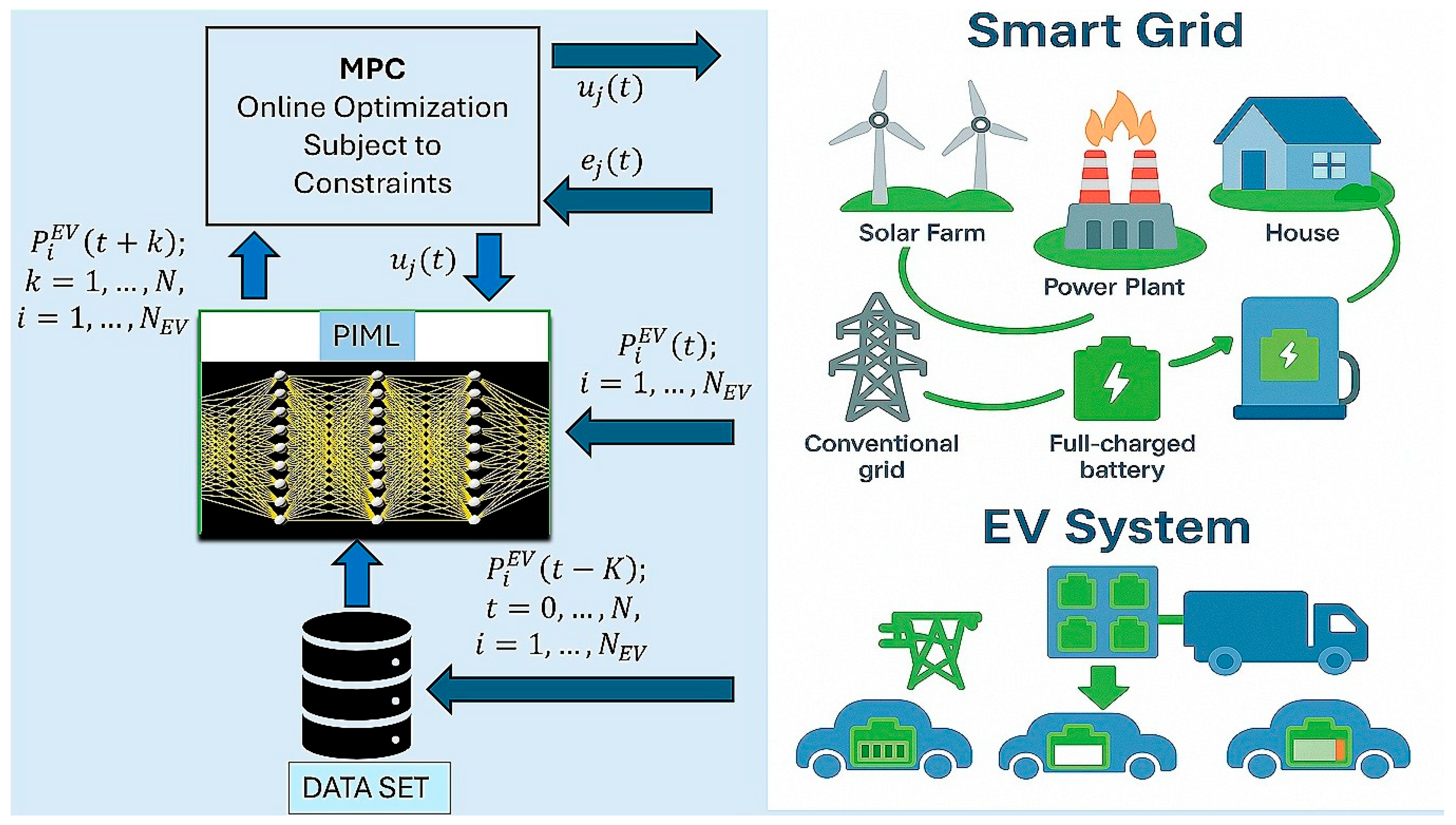
- Design of an advanced MPC framework that incorporates PIML-based disturbance predictions for the real-time estimation and compensation of uncertainties, enhancing the robustness of the underlying prediction model.
- Rigorous mathematical stability analysis of the proposed PIML-MPC control law, comprising two parts: (i) convergence guarantees PIML model training and (ii) closed-loop stability of the MPC formulation using Lyapunov-based techniques.
- Comprehensive performance evaluation of the proposed control strategy on the IEEE 39-bus system under diverse G2V and V2G scenarios, demonstrating significant improvements in grid stability metrics.
2. Mathematical Modeling of the Power System
2.1. Power Generator Dynamics
2.2. Voltage Dynamics
2.3. State-Space Formulation of Power System Dynamics
3. Event-Driven EV Disturbances for Plug-In and Plug-Out Events
3.1. Statistical Modeling of EV Disturbance Event
3.2. Disturbance Dynamics
3.3. Higher-Order Moment Analysis of Disturbance Dynamics
4. Physics-Informed Machine Learning (PIML) Model Design
4.1. PIML Model Formulation
4.2. Physics-Informed Loss Function
4.3. Training Algorithm for PIML
| Algorithm 1: Enhanced PIML Neural Network Training for Disturbance Prediction |
| Input: Training data , physical dynamic function , collocation points , hyperparameters: initial learning rate , regulation parameter , batch size (), number of epochs , decay rate . Output: Training neural network parameters . 1. Initialize: Set neural network weights , where . Initialize learning rate . 2. For epoch = 1 to : 2.1. Sample minibatch: Randomly select minibatch of size . 2.2. Predict Disturbance: For each , compute: . 2.3. Compute Physical Residual: For each collocation point , evaluate: ; . 2.4. Evaluate Loss: Compute the minibatch loss: . 2.5. Update parameters: Compute the gradient using automatic differentiation and update: 2.6. Adjust Learning Rate: Update . 3. Return: . End. |
4.4. Convergence Analysis
5. Physics-Informed Machine Learning Model Predictive Control Design with Disturbance Prediction
5.1. System Dynamics and PIML Integration
5.2. Nonlinear MPC Formulation
| Algorithm 2: PIML-Enhanced Nonlinear MPC |
| Input: Initial state , prediction horizon N, PIML model weighting matrices , constraint sets , sampling time . For each time set: 1. Measure State: Obtained current state . 2. Disturbance Prediction: Compute for 3. Solve Optimization: Solve the online nonlinear optimal control problem in (31): subject to dynamics and constraints: 4. Apply Control: Apply first control input . 5. Update: Set and return to step 1. End. |
5.3. Stability Analysis
- 1.
- Recursive feasibility: Suppose the optimization is feasible at time-step , the optimization solution yields the following optimal control sequence, , and state trajectory, . At time , construct a candidate control sequence:where is the terminal control (using the LQR control law). The corresponding trajectory satisfies the dynamics and constraints since , and is control invariant according to Assumption 4. Thus, is feasible and ensures recursive feasibility.
- 2.
- Cost decrease: Compute the MPC optimization cost at in (29):where .Using Assumption 5:This satisfies the Lyapunov cost-decreasing property, i.e., :
- 3.
- Convergence: Since and , is non-increasing and bounded below, ; thus, , which provides asymptotic stability.□
5.4. Computational Complexity of the PIML NMPC Algorithm
6. Performance Evaluation
6.1. Simulation Setup
6.2. Results and Analysis
6.2.1. PIML Prediction Results
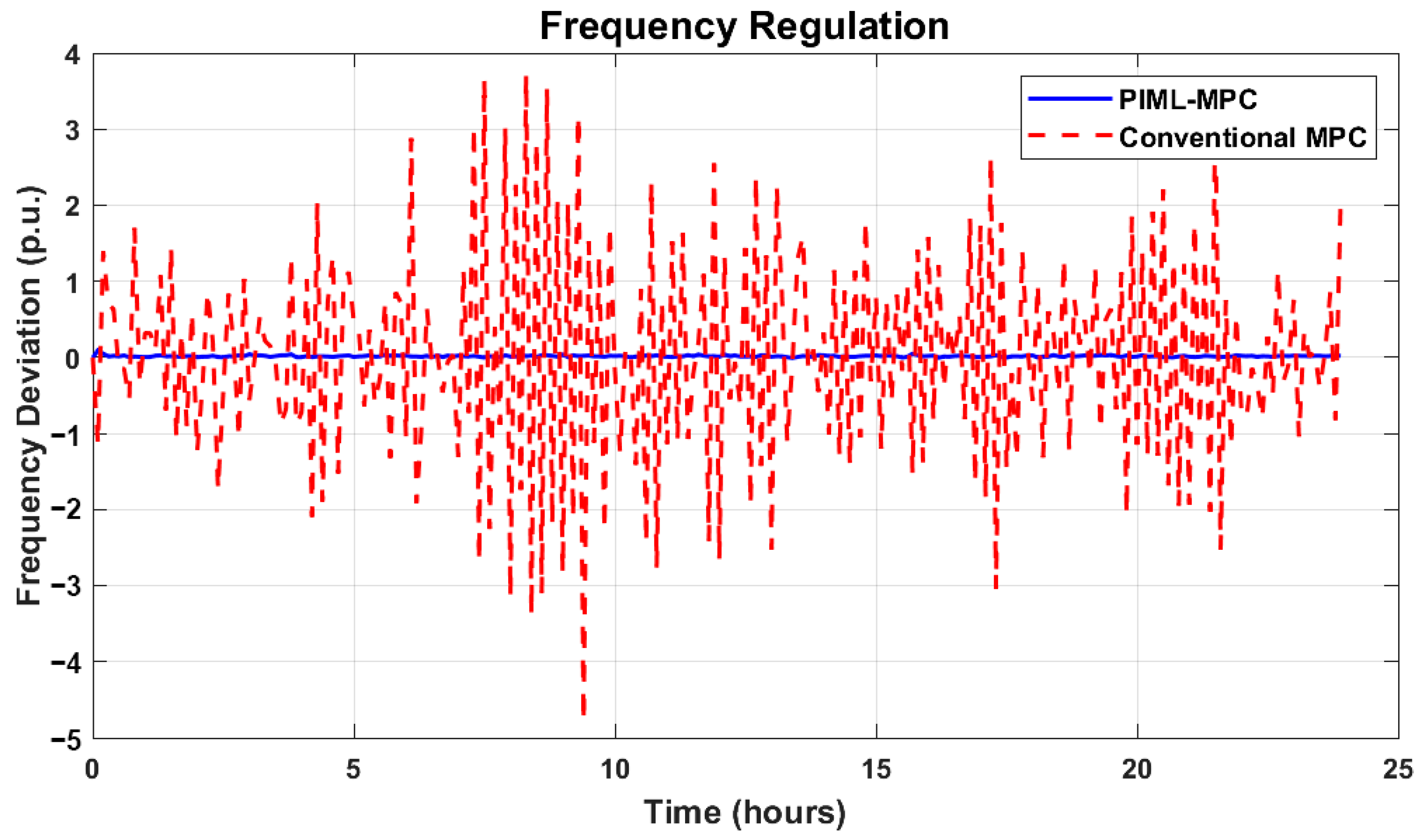
6.2.2. Frequency Regulation
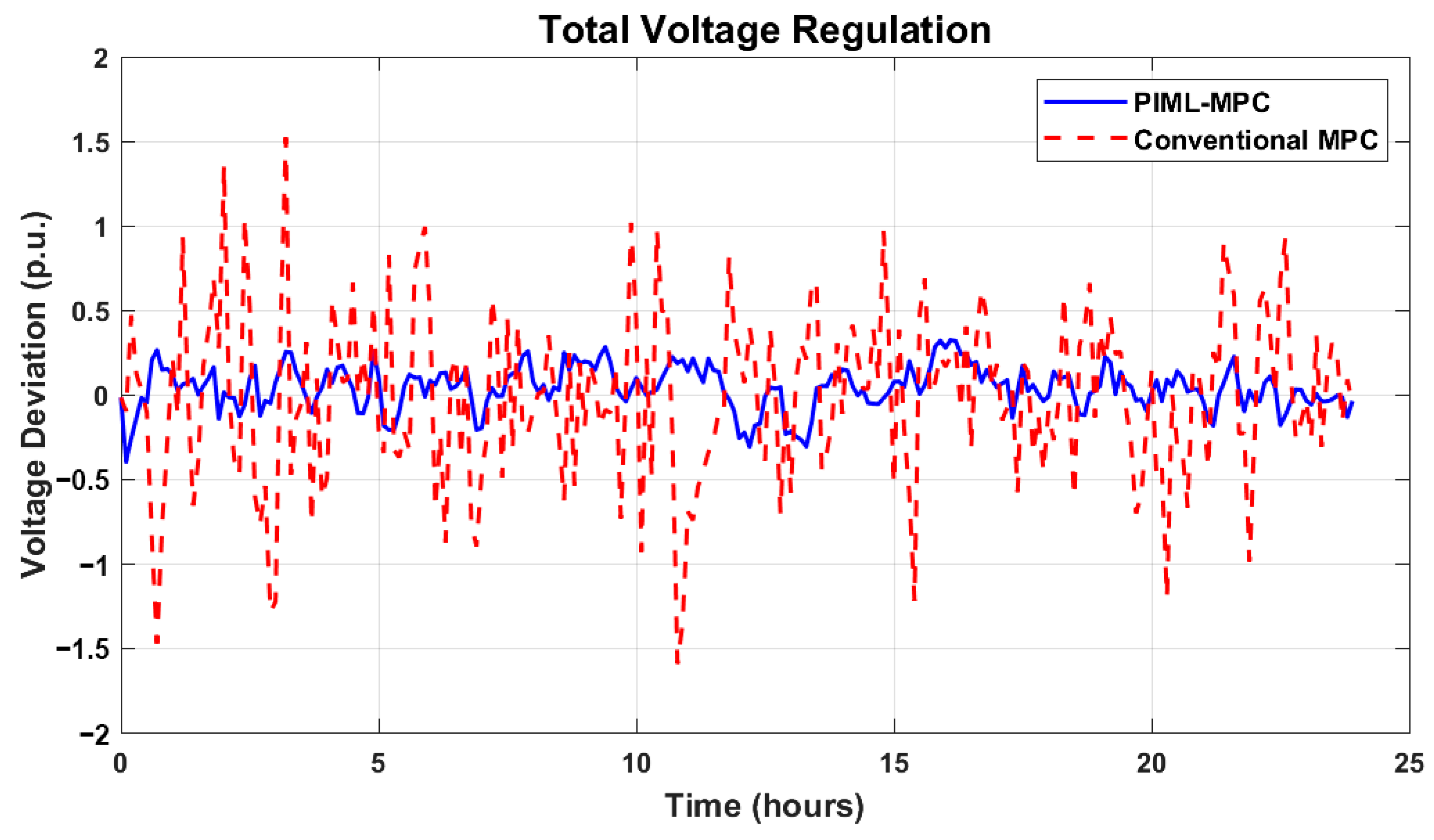
6.2.3. Voltage Regulation
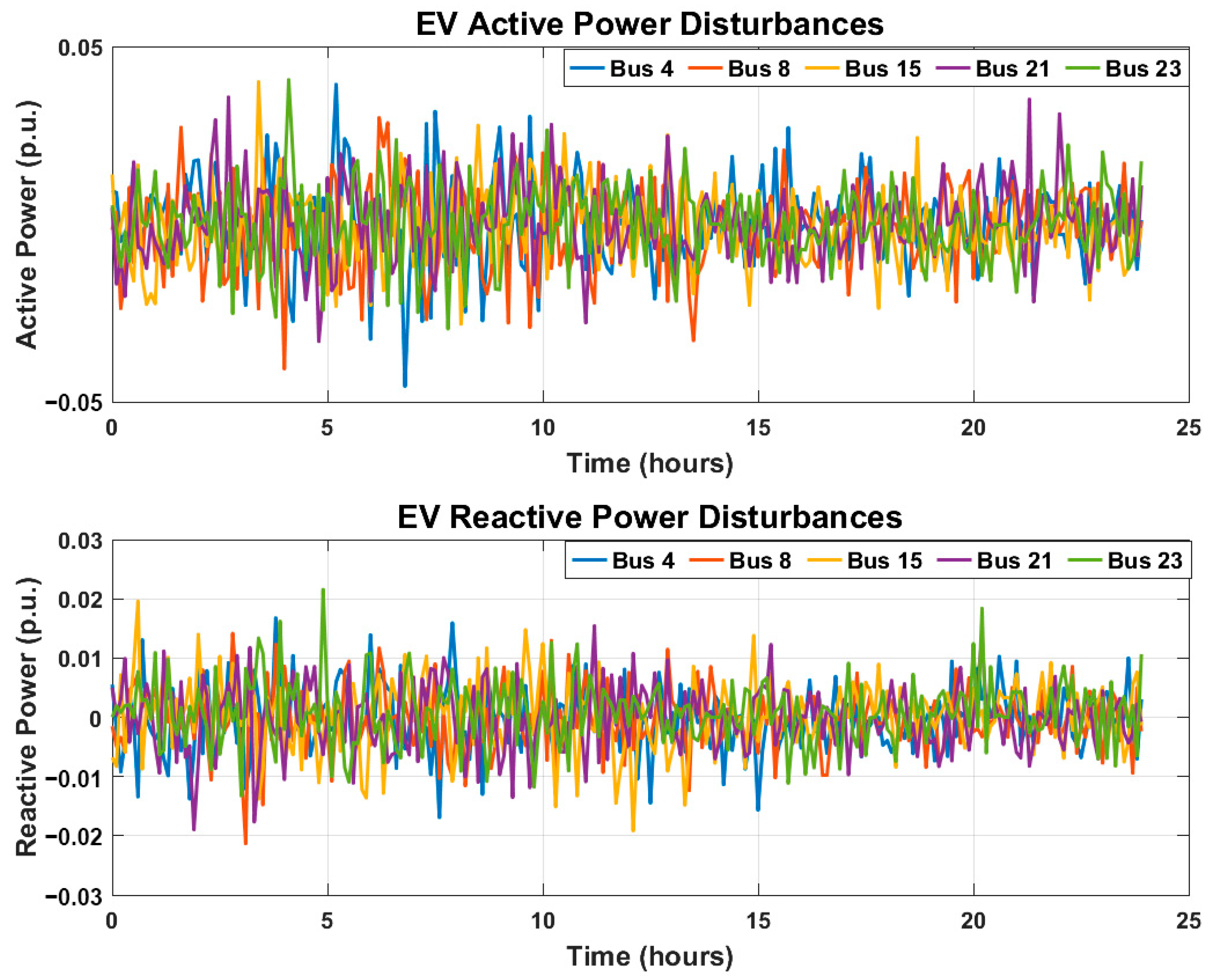
6.2.4. Disturbance Characteristics
6.2.5. Comparison with Recent Validated Systems and MPC Methods
6.2.6. Performance Under Increasing Disturbance Levels
6.2.7. Generalization and Scalability to Larger Systems
6.3. Discussion
7. Conclusions and Future Work
Author Contributions
Funding
Data Availability Statement
Conflicts of Interest
References
- Chen, L.; Ma, R. Clean energy synergy with electric vehicles: Insights into carbon footprint. Energy Strategy Rev. 2024, 53, 101394. [Google Scholar] [CrossRef] [Scilit]
- Micari, S.; Napoli, G. Electric Vehicles for a flexible energy system: Challenges and opportunities. Energies 2024, 17, 5614. [Google Scholar] [CrossRef] [Scilit]
- Chiranjivi, M.; Suresh, K.; Siddartha, M. Navigating the Present and Future Dynamics of Electric Vehicle Fast Charging and its Impact on Grid. CVR J. Sci. Technol. 2024, 26, 68–75. [Google Scholar] [CrossRef] [Scilit]
- Yang, Y.; Wang, W.; Qin, J.; Wang, M.; Ma, Q.; Zhong, Y. Review of vehicle to grid integration to support power grid security. Energy Rep. 2024, 12, 2786–2800. [Google Scholar] [CrossRef] [Scilit]
- Kazemtarghi, A.; Dey, S.; Mallik, A. Optimal utilization of bidirectional EVs for grid frequency support in power systems. IEEE Trans. Power Deliv. 2022, 38, 998–1010. [Google Scholar] [CrossRef] [Scilit]
- Begum, B.; Jena, N.K.; Sahu, B.K.; Bajaj, M.; Blazek, V.; Prokop, L. Frequency stability improvement in EV-integrated power systems using optimized fuzzy-sliding mode control and real-time validation. Sci. Rep. 2025, 15, 5782. [Google Scholar] [CrossRef] [Scilit]
- Kumar, A.; Sharma, D.; Pal, M. Physics-Informed Neural Network-Based Control for Grid-Forming Converter’s Stability Under Overload Conditions. arXiv 2025, arXiv:2503.21529. [Google Scholar]
- Hua, Y.; Wang, S.; Wang, Y.; Zhang, L.; Liu, W. Optimal dispatching of regional power grid considering vehicle network interaction. PLoS ONE 2024, 19, e0297855. [Google Scholar] [CrossRef] [Scilit]
- Fan, P.; Song, K.; Yang, J.; Wen, Y.; Xie, L.; Li, Y.; Kamel, S. A frequency cooperative control strategy for multimicrogrids with EVs based on improved evolutionary-deep reinforcement learning. Int. J. Electr. Power Energy Syst. 2024, 159, 109991. [Google Scholar] [CrossRef] [Scilit]
- Liu, D.; Zeng, P.; Cui, S.; Song, C. Deep reinforcement learning for charging scheduling of electric vehicles considering distribution network voltage stability. Sensors 2023, 23, 1618. [Google Scholar] [CrossRef] [Scilit]
- Lenka, R.K.; Panda, A.K.; Senapati, L. Grid integrated multifunctional EV charging infrastructure with improved power quality. J. Energy Storage 2024, 76, 109637. [Google Scholar] [CrossRef] [Scilit]
- Dhumane, R.A.; Nikam, T.D.; Hajare, R.N.; Pardeshi, D.B.; William, P. Sustainable and Intelligent Control Strategies for Electric Vehicle Systems. In Proceedings of the 2023 2nd International Conference on Edge Computing and Applications (ICECAA), Namakkal, India, 19–21 July 2023. [Google Scholar] [CrossRef] [Scilit]
- Alyami, S. Ensuring Sustainable Grid Stability through Effective EV Charging Management: A Time and Energy-Based Approach. Sustainability 2024, 16, 6149. [Google Scholar] [CrossRef] [Scilit]
- He, C.; Zhang, Z. An efficient hierarchical electric vehicle charging control strategy. Int. J. Robust Nonlinear Control, 2023; early view. [CrossRef] [Scilit]
- Zafar, S.; Blavette, A.; Camilleri, G.; Ahmed, H.B.; Agbodjan, J.-J.P. Decentralized optimal management of a large-scale EV fleet: Optimality and computational complexity comparison between an adaptive MAS and MILP. Int. J. Electr. Power Energy Syst. 2023, 147, 108861. [Google Scholar] [CrossRef] [Scilit]
- Aljohani, T.; Mohamed, M.A.; Mohammed, O. Tri-level hierarchical coordinated control of large-scale EVs charging based on multi-layer optimization framework. Electr. Power Syst. Res. 2024, 226, 109923. [Google Scholar] [CrossRef] [Scilit]
- Wei, Y.; Zhu, Y.; Qin, Y.; Li, Y.; Wang, H.; Han, X.; Lu, L.; Ouyang, M. A Hierarchical Framework for Vehicle-to-Grid (V2G) Distributed Control Combining Peer-to-peer Blockchain with Systemic Scheduling. In Proceedings of the 2023 13th International Conference on Power and Energy Systems (ICPES), Chengdu, China, 8–10 December 2023. [Google Scholar] [CrossRef] [Scilit]
- Kuang, H.; Qu, H.; Deng, K.; Li, J. A physics-informed graph learning approach for citywide electric vehicle charging demand prediction and pricing. Appl. Energy 2024, 363, 123059. [Google Scholar] [CrossRef] [Scilit]
- Mehmood, F.; Khan, B.; Ali, S.M.; Rossiter, J.A. Distributed MPC for economic dispatch and intermittence control of renewable based autonomous microgrid. Electr. Power Syst. Res. 2021, 195, 107131. [Google Scholar] [CrossRef] [Scilit]
- Mehmood, F.; Khan, B.; Ali, S.M.; Rossiter, J.A. Distributed model predictive based secondary control for economic production and frequency regulation of MG. IET Control Theory Appl. 2019, 13, 2948–2958. [Google Scholar] [CrossRef] [Scilit]
- Minchala-Ávila, C.; Arévalo, P.; Ochoa-Correa, D. A Systematic Review of Model Predictive Control for Robust and Efficient Energy Management in Electric Vehicle Integration and V2G Applications. Modelling 2025, 6, 20. [Google Scholar] [CrossRef] [Scilit]
- European Network of Transmission System Operators for Electricity (ENTSOE). Rate of Change of Frequency (RoCoF) Withstand Capability, ENTSO-E Guidance Document for National Implementation for Network Codes on Grid Connection; European Network of Transmission System Operators for Electricity: Brussels, Belgium, 2018. [Google Scholar]

| Parameter | Description | Value | Adjustment |
|---|---|---|---|
| Regularization parameter for physics-informed loss (24) | 0.5 | Tuned via grid search over [0.1, 0.5, 1.0] to prioritize physical consistency | |
| Hidden Layer Neurons | Number of neurons in PIML neural network hidden layer | 64 | Fixed after testing [32, 64, 128] for prediction accuracy |
| Learning Rate | Initial learning rate for PIML training (Section 4.3) | 0.001 | Decayed by 0.95 every 50 epochs to ensure convergence |
| Epochs | Number of training epochs for PIML model | 500 | Fixed to balance training time and prediction MAE (0.002 p.u., Section 6.2.1) |
| Batch Size | Batch size for PIML training | 32 | Fixed for computational efficiency |
| MPC prediction horizon (29) | 10 | Adjusted from 5 to 10 to improve disturbance rejection during peak events | |
| State weighting matrix in MPC cost function (29) | Diagonal, [1, 1, 0.5] | Increased voltage weight from 0.3 to 0.5 to reduce voltage RMSE (Section 6.2.3) | |
| Control weighting matrix in MPC cost function (29) | Diagonal, [0.1, 0.1] | Fixed to balance control effort and stability | |
| Terminal cost matrix in MPC cost function (29) | Diagonal, [2, 2, 1] | Adjusted to ensure Lyapunov stability (Section 5.3) |
| Performance Metric | PIML-MPC | Conventional MPC | t-Test (p-Value) |
|---|---|---|---|
| RMSE Frequency Deviations () | 0.0112 ± 0.0035 | 0.4672 ± 0.0641 | 0.0001 |
| MAE Frequency Deviations () | 0.0238 ± 0.0074 | 1.1698 ± 0.1564 | 0.0001 |
| MD Frequency Deviations () | 0.2785 ± 0.1973 | 4.9719 ± 0.6736 | - |
| RMSE Voltage Deviation (V) | 0.4006 ± 0.2165 | 0.4932 ± 0.0070 | 0.3888 |
| MAE Voltage Deviation (V) | 1.9853 ± 1.0710 | 1.5096 ± 0.0444 | 0.3765 |
| MD Voltage Deviation (V) | 2.6937 ± 1.2229 | 3.2151 ± 0.3625 | - |
| Computational Time (s) (Mean ± Std) | 219.71 ± 48.86 | 219.71 ± 48.86 | - |
Disclaimer/Publisher’s Note: The statements, opinions and data contained in all publications are solely those of the individual author(s) and contributor(s) and not of MDPI and/or the editor(s). MDPI and/or the editor(s) disclaim responsibility for any injury to people or property resulting from any ideas, methods, instructions or products referred to in the content. |
© 2025 by the authors. Published by MDPI on behalf of the World Electric Vehicle Association. Licensee MDPI, Basel, Switzerland. This article is an open access article distributed under the terms and conditions of the Creative Commons Attribution (CC BY) license (https://creativecommons.org/licenses/by/4.0/).
Share and Cite
Khan, B.; Ullah, Z.; Gruosso, G. Enhancing Grid Stability Through Physics-Informed Machine Learning Integrated-Model Predictive Control for Electric Vehicle Disturbance Management. World Electr. Veh. J. 2025, 16, 292. https://doi.org/10.3390/wevj16060292
Khan B, Ullah Z, Gruosso G. Enhancing Grid Stability Through Physics-Informed Machine Learning Integrated-Model Predictive Control for Electric Vehicle Disturbance Management. World Electric Vehicle Journal. 2025; 16(6):292. https://doi.org/10.3390/wevj16060292
Chicago/Turabian StyleKhan, Bilal, Zahid Ullah, and Giambattista Gruosso. 2025. "Enhancing Grid Stability Through Physics-Informed Machine Learning Integrated-Model Predictive Control for Electric Vehicle Disturbance Management" World Electric Vehicle Journal 16, no. 6: 292. https://doi.org/10.3390/wevj16060292
APA StyleKhan, B., Ullah, Z., & Gruosso, G. (2025). Enhancing Grid Stability Through Physics-Informed Machine Learning Integrated-Model Predictive Control for Electric Vehicle Disturbance Management. World Electric Vehicle Journal, 16(6), 292. https://doi.org/10.3390/wevj16060292

