
Consumers’ Purchase Intentions Towards New Energy Vehicles Based on the Theory of Planned Behaviour on Perceived Value: An Empirical Survey of China


Abstract
1. Introduction
2. Conceptual Framework and Hypotheses
2.1. Theoretical Foundation
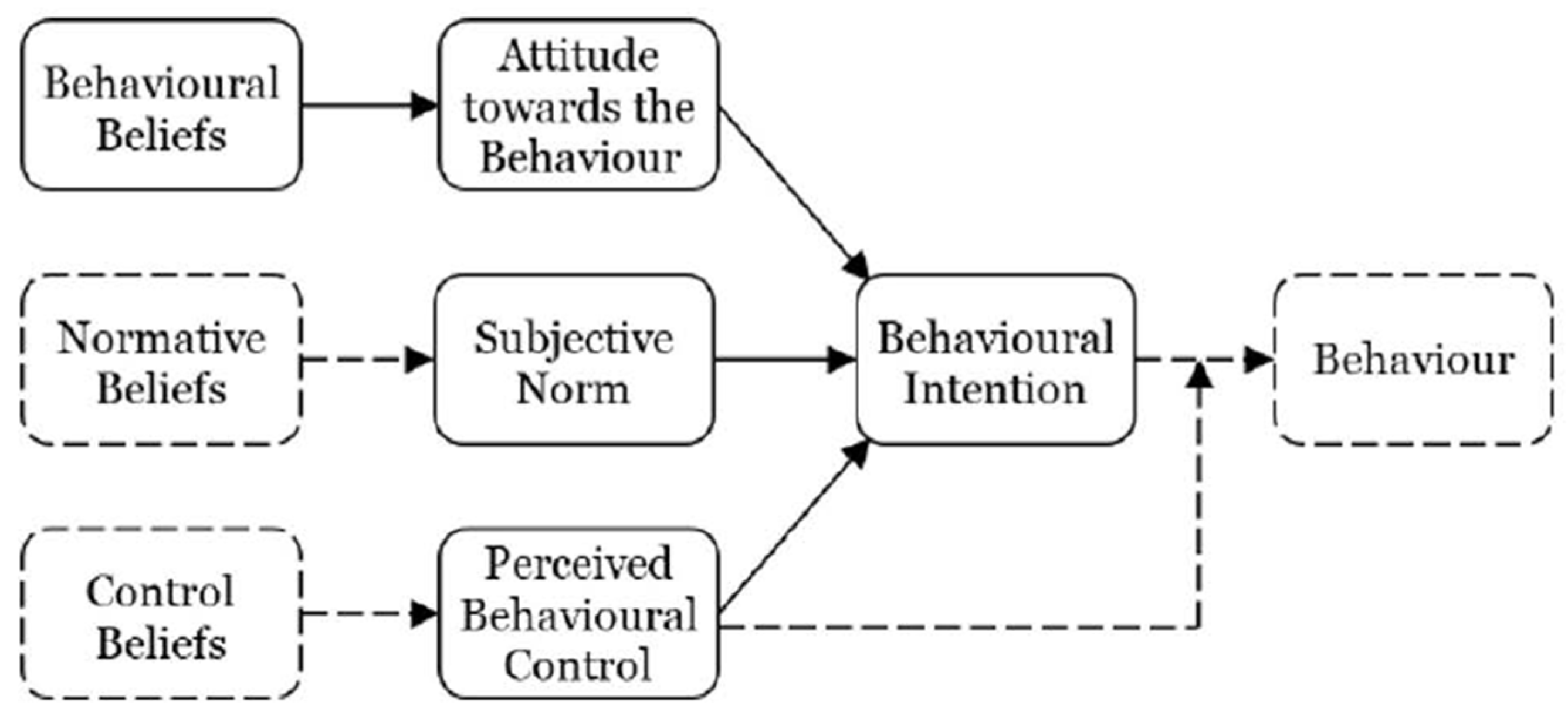
2.1.1. Theory of Planned Behaviour (TPB)
2.1.2. Theory of Perceived Value (TPV)
2.1.3. Theory of Perceived Risk (TPR)
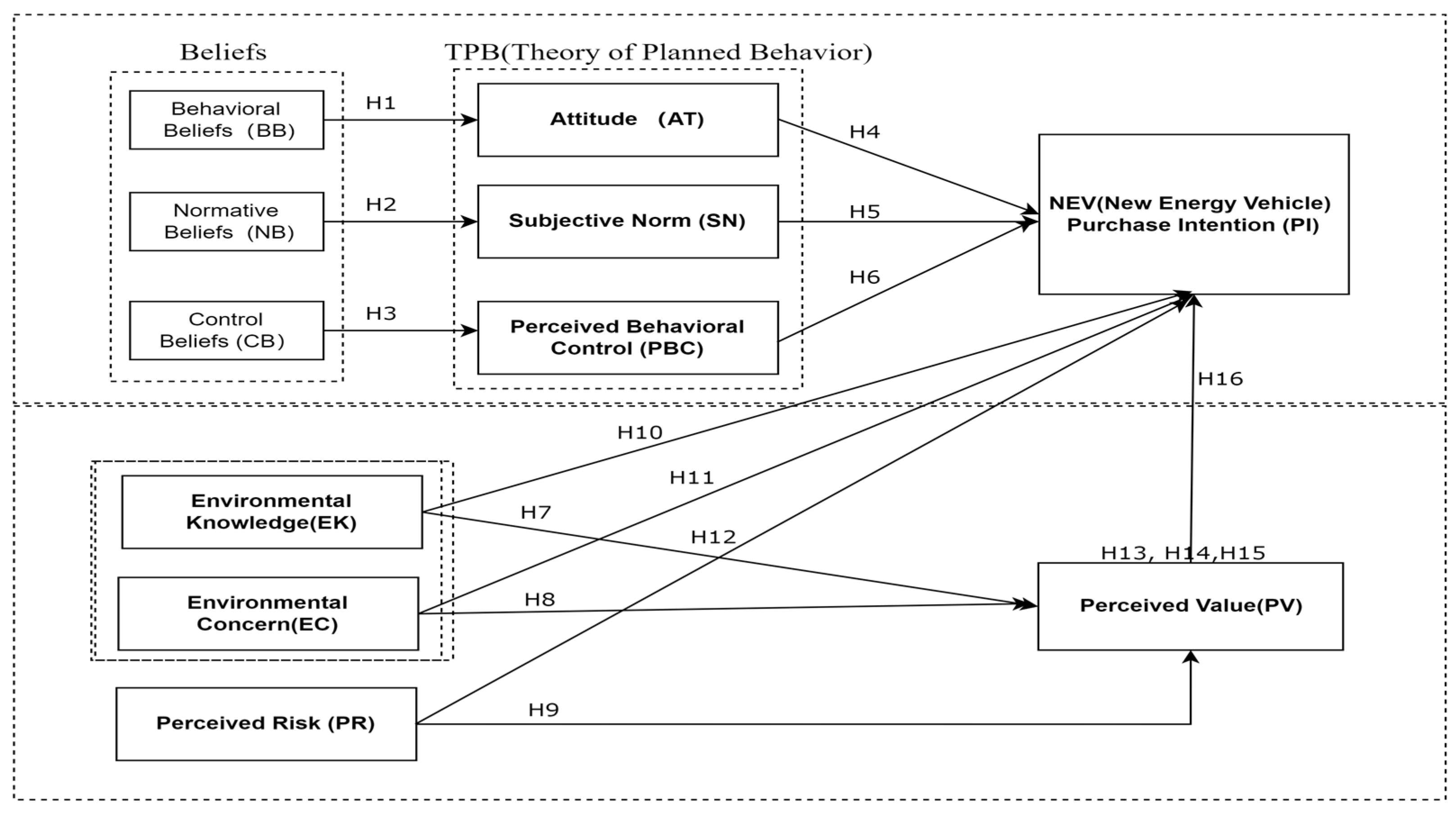
2.2. Hypothesis Development
2.2.1. Extending of the TPB and NEV Purchase Intentions
2.2.2. Environmental Knowledge and Concern and Perceived Value
2.2.3. Perceived Risk and Perceived Value
2.2.4. Environmental Knowledge and Concern and Purchase Intentions
2.2.5. Perceived Risk and Purchase Intention
2.2.6. Mediating Variables
2.2.7. Perceived Value and NEV Purchase Intentions
3. Methodology
3.1. Data Collection and Sample Design
3.2. Instrument Measures
3.3. Data Analysis and Planning
3.4. Statistical Test Procedure
4. Results
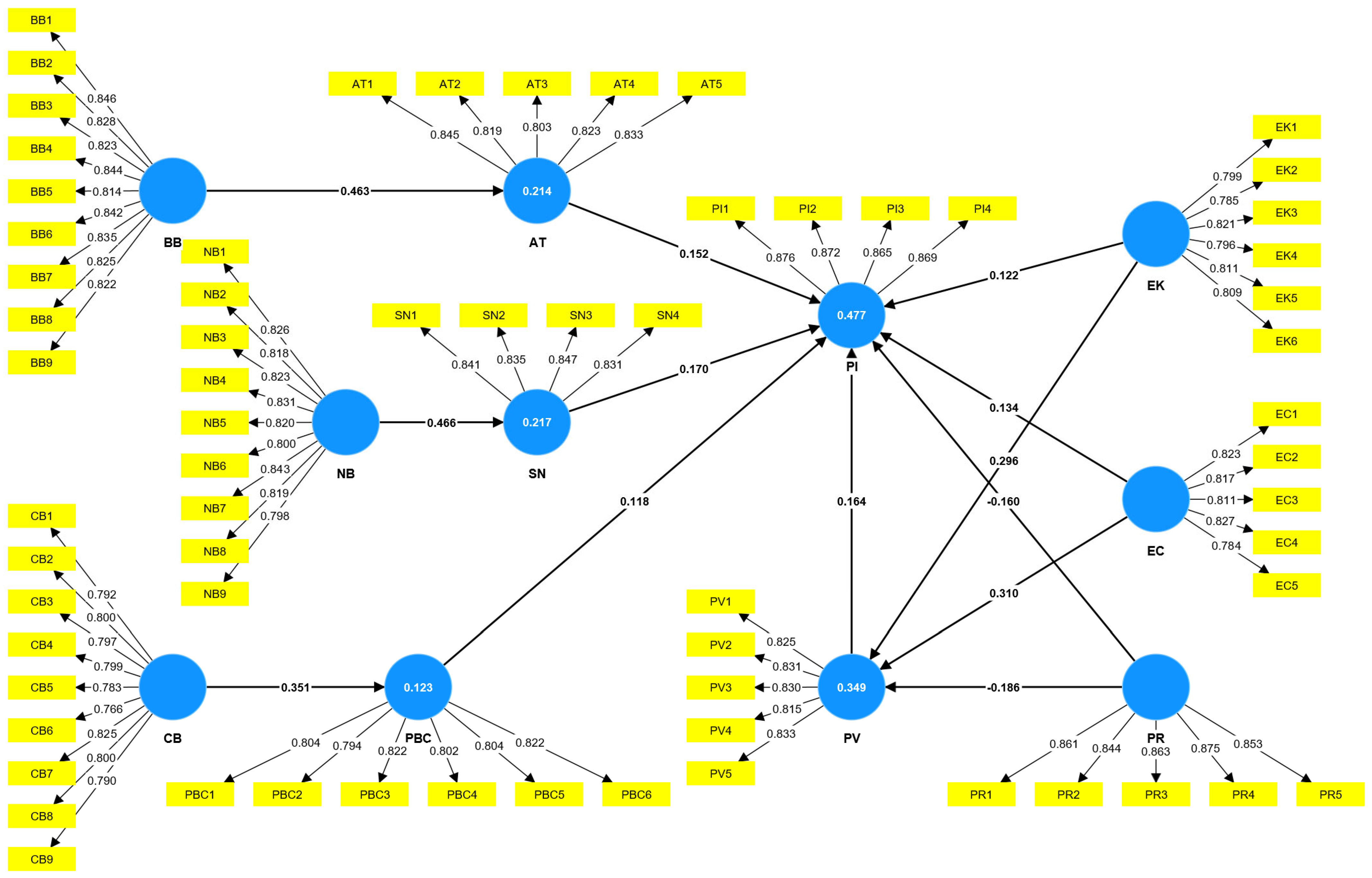
4.1. Measurement Model Assessment
Reliability and Validity of Measurement Instruments
4.2. Structural Model Assessment
4.2.1. Variance Inflation Factor (VIF)
4.2.2. Coefficient of Determination (R2)
4.2.3. The Effect Size f2
4.2.4. Predictive Relevance (Q2)
5. Discussions and Conclusions
5.1. Discussions
5.2. Contributions of This Study
5.3. Limitations of This Study
Author Contributions
Funding
Institutional Review Board Statement
Informed Consent Statement
Data Availability Statement
Acknowledgments
Conflicts of Interest
Abbreviations
| NEVs | New Energy Vehicles |
| TPB | Theory of Planned Behaviour |
| GEO | Global Environment Outlook |
| IBRD | International Bank for Reconstruction and Development |
| ICCT | International Council on Clean Transportation |
| IEA | International Energy Agency |
| OECD | Organisation for Economic Cooperation and Development |
| OICA | International Organization of Motor Vehicle Manufacturers |
| PCA | Paris Climate Agreement |
| TAM | Technology Acceptance Model |
| GHG | Global Greenhouse Gas |
References
- Sostar, M.; Ristanovic, V. Assessment of Influencing Factors on Consumer Behavior Using the AHP Model. Sustainability 2023, 15, 10341. [Google Scholar] [CrossRef]
- Zhuang, W.; Luo, X.; Riaz, M.U. On the Factors Influencing Green Purchase Intention: A Meta-Analysis Approach. Front. Psychol. 2021, 12, 644020. [Google Scholar] [CrossRef] [PubMed]
- Ansu-Mensah, P. Green product awareness effect on green purchase intentions of university students’: An emerging market’s perspective. Future Bus. J. 2021, 7, 48. [Google Scholar] [CrossRef]
- Škatarić, G.; Vlahović, B.; Užar, D.; Spalevic, V.; Novićević, R. The influence of green marketing on consumer environmental awareness. J. Agric. For. 2021, 67, 21–36. [Google Scholar] [CrossRef]
- Adam, D. How far will global population rise? Researchers can’t agree. Nature 2021, 597, 462–465. [Google Scholar] [CrossRef]
- Daszkiewicz, T. Food Production in the Context of Global Developmental Challenges. Agriculture 2022, 12, 832. [Google Scholar] [CrossRef]
- Sovacool, B.K.; Bergman, N.; Hopkins, D.; Jenkins, K.E.; Hielscher, S.; Goldthau, A.; Brossmann, B. Imagining sustainable energy and mobility transitions: Valence, temporality, and radicalism in 38 visions of a low-carbon future. Soc. Stud. Sci. 2020, 50, 642–679. [Google Scholar] [CrossRef]
- Gansser, O.A.; Reich, C.S. Influence of the New Ecological Paradigm (NEP) and environmental concerns on pro-environmental behavioral intention based on the Theory of Planned Behavior (TPB). J. Clean. Prod. 2023, 382, 134629. [Google Scholar] [CrossRef]
- Wang, Z.X.; Jantan, A.H.B.; Wu, R.X.; Gong, Y.; Cao, M.R.; Wong, P.P.W.; Wang, L. Exploring consumers’ intention toward domestic energy-saving vehicles: Some insights from China. Front. Psychol. 2022, 13, 927709. [Google Scholar] [CrossRef]
- Wang, H.; Gui, H.; Ren, C.; Liu, G. Factors Influencing Urban Residents’ Intention of Garbage Sorting in China: An Extended TPB by Integrating Expectancy Theory and Norm Activation Model. Sustainability 2021, 13, 12985. [Google Scholar] [CrossRef]
- Chen, Z.; Zhang, K.; Jia, S. Influence factors and risk analysis of new energy vehicles from the perspective of system. Environ. Sci. Pollut. Res. 2021, 28, 62891–62906. [Google Scholar] [CrossRef] [PubMed]
- Hu, H.; Dong, W.; Zhou, Q. A comparative study on the environmental and economic effects of a resource tax and carbon tax in China: Analysis based on the computable general equilibrium model. Energy Policy 2021, 156, 112460. [Google Scholar] [CrossRef]
- Sovacool, B.K.; Abrahamse, W.; Zhang, L.; Ren, J. Pleasure or profit? Surveying the purchasing intentions of potential electric vehicle adopters in China. Transp. Res. Part A Policy Pract. 2019, 124, 69–81. [Google Scholar] [CrossRef]
- Gallo, M.; Marinelli, M. Sustainable mobility: A review of possible actions and policies. Sustainability 2020, 12, 7499. [Google Scholar] [CrossRef]
- Alanazi, F.; Alenezi, M. Driving the future: Leveraging digital transformation for sustainable transportation. J. Infrastruct. Policy Dev. 2024, 8, 3085. [Google Scholar] [CrossRef]
- Shin, J.; Badgwell, T.A.; Liu, K.H.; Lee, J.H. Reinforcement Learning—Overview of recent progress and implications for process control. Comput. Chem. Eng. 2019, 127, 282–294. [Google Scholar] [CrossRef]
- Liu, Y.; Chen, L.; Huang, C. Study on the Carbon Emission Spillover Effects of Transportation under Technological Advancements. Sustainability 2022, 14, 10608. [Google Scholar] [CrossRef]
- The History of the Electric Car. Energy.gov. Available online: https://www.energy.gov/articles/history-electric-car (accessed on 20 December 2024).
- Kumaradeepan, V.; Azam, S.; Tham, J. Factors Influencing of Social Media on Consumer Perception and Purchase Intention Towards Brand Loyalty: A Conceptual Paper. Int. J. Prof. Bus. Rev. 2023, 8, e01571. [Google Scholar] [CrossRef]
- Tsou, C.T. Deciphering the accelerated expansion of China’s NEV sector post-2020: A cross-system analysis using multi-level perspective. Sci. Public Policy 2024, 52, 32–49. [Google Scholar] [CrossRef]
- Xie, R.; An, L.; Yasir, N. How Innovative Characteristics Influence Consumers’ Intention to Purchase Electric Vehicle: A Moderating Role of Lifestyle. Sustainability 2022, 14, 4467. [Google Scholar] [CrossRef]
- Alanazi, F. Development of Smart Mobility Infrastructure in Saudi Arabia: A Benchmarking Approach. Sustainability 2023, 15, 3158. [Google Scholar] [CrossRef]
- More Alarm Bells Sound on Slowing Demand for Electric Vehicles-Business Today. Available online: https://www.businesstoday.in/auto/story/more-alarm-bells-sound-on-slowing-demand-for-electric-vehicles-403290-2023-10-26 (accessed on 20 December 2024).
- Sauid, M.K.; Hasan, Z.; Sauid, Z. A Conceptual Paper on the Effects of Green Intellectual Capital on Business Sustainability. Inf. Manag. Bus. Rev. 2023, 15, 231–238. [Google Scholar] [CrossRef]
- Zahoor, A.; Yu, Y.; Zhang, H.; Nihed, B.; Afrane, S.; Peng, S.; Sápi, A.; Lin, C.J.; Mao, G. Can the new energy vehicles (NEVs) and power battery industry help China to meet the carbon neutrality goal before 2060? J. Environ. Manag. 2023, 336, 117663. [Google Scholar] [CrossRef] [PubMed]
- Immonen, A.; Kiljander, J.; Aro, M. Consumer viewpoint on a new kind of energy market. Electr. Power Syst. Res. 2020, 180, 106153. [Google Scholar] [CrossRef]
- Tjoe, T.; Samsul Bahri, R.; Alamsyah, D.; Ghofar, K.; Rohaeni, H. Perceived Value Mediation Model to Improve Customer Expectation and Loyalty. In Proceedings of the 2nd South American International Conference on Industrial Engineering and Operations Management, Sao Paulo, Brazil, 5–8 April 2021; pp. 1210–1215. [Google Scholar] [CrossRef]
- Wang, C.; Sinha, P.N.; Zhang, X.; Wang, S.; Lee, Y.K. The impact of NEV users’ perceived benefits on purchase intention. Travel Behav. Soc. 2024, 34, 100681. [Google Scholar] [CrossRef]
- Ajzen, I.; Driver, B.L. Prediction of leisure participation from behavioral, normative, and control beliefs: An application of the theory of planned behavior. Leis. Sci. 1991, 13, 185–204. [Google Scholar] [CrossRef]
- Sánchez-Fernández, R.; Iniesta-Bonillo, M.Á. The concept of perceived value: A systematic review of the research. Mark. Theory 2007, 7, 427–451. [Google Scholar] [CrossRef]
- Maccioni, L.; Borgianni, Y.; Basso, D. Value Perception of Green Products: An Exploratory Study Combining Conscious Answers and Unconscious Behavioral Aspects. Sustainability 2019, 11, 1226. [Google Scholar] [CrossRef]
- Cao, H.; Li, F.; Zhao, K.; Qian, C.; Xiang, T. From value perception to behavioural intention: Study of Chinese smallholders’ pro-environmental agricultural practices. J. Environ. Manag. 2022, 315, 115179. [Google Scholar] [CrossRef]
- Aufa, A.; Gunanto, E. The Influence of Perceived Risk and Loyalty on Purchase Intention of Fashion Products Based on the Theory of Perceived Risk. J. Ekon. Akunt. Dan Manaj. 2023, 22, 67. [Google Scholar] [CrossRef]
- Wang, Z.; Zhang, J.; Zhao, H. The Selection of Green Technology Innovations under Dual-Credit Policy. Sustainability 2020, 12, 6343. [Google Scholar] [CrossRef]
- Slovic, P. Perception of Risk. Science 1987, 236, 280–285. [Google Scholar] [CrossRef]
- Gunawardane, N.; Dk, T. The effect of perceived risk on the purchase intention of electric vehicles: An extension to the technology acceptance model. Int. J. Electr. Hybrid Veh. 2019, 11, 73. [Google Scholar] [CrossRef]
- Miller, M.C. The Role of Beliefs in Identifying Rising Powers. Chin. J. Int. Politics 2016, 9, 211–238. [Google Scholar] [CrossRef]
- Institute, Investments & Wealth. The Human Side of Decision Making: Thinking Things Through with Daniel Kahneman, PhD. J. Invest. Consult. 2012, 13, 5–14. Available online: https://ssrn.com/abstract=2144471 (accessed on 7 February 2025).
- Ajzen, I.; Fishbein, M. Understanding Attitudes and Predicting Social Behavior; Prentice-Hall: Saddle River, NJ, USA, 1980; Available online: https://api.semanticscholar.org/CorpusID:142061533 (accessed on 7 February 2025).
- Chaturvedi, P.; Kulshreshtha, K.; Tripathi, V.; Agnihotri, D. Exploring consumers’ motives for electric vehicle adoption: Bridging the attitude–behavior gap. Benchmarking Int. J. 2023, 30, 4174–4192. [Google Scholar] [CrossRef]
- Michie, S.; Johnston, M. Behavior Change Techniques. In Encyclopedia of Behavioral Medicine; Gellman, M.D., Turner, J.R., Eds.; Springer: New York, NY, USA, 2013; pp. 182–187. [Google Scholar] [CrossRef]
- Ajzen, I.; Gilbert Cote, N. Attitudes and the prediction of behavior. In Attitudes and Attitude Change; Psychology Press: East Sussex, UK, 2008; pp. 289–311. [Google Scholar]
- Social Perception|3|Social Psychology Through Experiment|Henri T. Available online: https://www.taylorfrancis.com/chapters/edit/10.4324/9781315727929-3/social-perception-henri-tajfel (accessed on 20 December 2024).
- Lefkowitz, J. The constancy of ethics amidst the changing world of work. Hum. Resour. Manag. Rev. 2006, 16, 245–268. [Google Scholar] [CrossRef]
- Kahneman, D.; Tversky, A. Variants of uncertainty. Cognition 1982, 11, 143–157. [Google Scholar] [CrossRef]
- Cheng, S.; Lam, T. The role of the customer–seller relationship in the intention of the customer to complain: A study of Chinese restaurateurs. Int. J. Hosp. Manag. 2008, 27, 552–562. [Google Scholar] [CrossRef]
- Wei, L.C. How Effectively Does Social Media Influence Malaysian Consumers to Purchase Electronic Vehicles (EVs) Using the Engel-Blackwell-Miniard Model (EBM). Ph.D. Thesis, Universiti Tunku Abdul Rahman (UTAR), Petaling Jaya, Malaysia, 2023. [Google Scholar]
- Souza, J.; Tondolo, V.; Sarquis, A.; Longaray, A.; Tondolo, R.; Costa, L. Effect of perceived value, risk, attitude and environmental consciousness on the purchase intention. Int. J. Bus. Environ. 2020, 11, 11–31. [Google Scholar] [CrossRef]
- Lin, B.; Shi, L. Identify and bridge the intention-behavior gap in new energy vehicles consumption: Based on a new measurement method. Sustain. Prod. Consum. 2022, 31, 432–447. [Google Scholar] [CrossRef]
- Xu, Y.; Du, J.; Khan, M.A.S.; Jin, S.; Altaf, M.; Anwar, F.; Sharif, I. Effects of Subjective Norms and Environmental Mechanism on Green Purchase Behavior: An Extended Model of Theory of Planned Behavior. Front. Environ. Sci. 2022, 10, 779629. [Google Scholar] [CrossRef]
- Zhao, J.; Su, Y.; Fang, M.; Su, M. Embracing new energy vehicles: An empirical examination of female consumer perspectives. J. Retail. Consum. Serv. 2024, 80, 103925. [Google Scholar] [CrossRef]
- Bredahl, L.; Grunert, K.G.; Fertin, C. Relating consumer perceptions of pork quality to physical product characteristics. Food Qual. Prefer. 1998, 9, 273–281. [Google Scholar] [CrossRef]
- Kian, T.P.; Chia, L.H. Consumer Purchase Intention for Organic Personal Care Product. GATR J. Manag. Mark. Rev. 2021, 6, 213–221. [Google Scholar] [CrossRef]
- Barbarossa, C.; De Pelsmacker, P. Positive and Negative Antecedents of Purchasing Eco-friendly Products: A Comparison Between Green and Non-green Consumers. J. Bus. Ethics 2016, 134, 229–247. [Google Scholar] [CrossRef]
- Jiménez-Parra, B.; Rubio, S.; Vicente-Molina, M.A. Key drivers in the behavior of potential consumers of remanufactured products: A study on laptops in Spain. J. Clean. Prod. 2014, 85, 488–496. [Google Scholar] [CrossRef]
- He, X.; Zhan, W. How to activate moral norm to adopt electric vehicles in China? An empirical study based on extended norm activation theory. J. Clean. Prod. 2018, 172, 3546–3556. [Google Scholar] [CrossRef]
- Stern, P.C. Toward a coherent theory of environmentally significant behavior. J. Soc. Issues 2000, 56, 407–424. [Google Scholar] [CrossRef]
- Liu, P.; Teng, M.; Han, C. How does environmental knowledge translate into pro-environmental behaviors?: The mediating role of environmental attitudes and behavioral intentions. Sci. Total Environ. 2020, 728, 138126. [Google Scholar] [CrossRef]
- Kang, W. Residence and Education Moderate the Longitudinal Association between Environmental Concern (EC) and Proenvironmental Behavior. Sustainability 2022, 14, 14716. [Google Scholar] [CrossRef]
- Qomariah, A.; Prabawani, B. The Effects of Environmental Knowledge, Environmental Concern, and Green Brand Image on Green Purchase Intention with Perceived Product Price and Quality as the Moderating Variable. IOP Conf. Ser. Earth Environ. Sci. 2020, 448, 012115. [Google Scholar] [CrossRef]
- Bocken, N.; Boons, F.; Baldassarre, B. Sustainable business model experimentation by understanding ecologies of business models. J. Clean. Prod. 2019, 208, 1498–1512. [Google Scholar] [CrossRef]
- Laukkanen, M.; Tura, N. The potential of sharing economy business models for sustainable value creation. J. Clean. Prod. 2020, 253, 120004. [Google Scholar] [CrossRef]
- Patala, S.; Jalkala, A.; Keränen, J.; Väisänen, S.; Tuominen, V.; Soukka, R. Sustainable value propositions: Framework and implications for technology suppliers. Ind. Mark. Manag. 2016, 59, 144–156. [Google Scholar] [CrossRef]
- McIlroy, R.C.; Baden, D.A.; Brown, J.; Gauthier, S.M.; Swierczynski, J.; Wilks, S.A. Clean vs green: The impact of reading short stories on sustainable and healthy cleaning behaviours. Discov. Sustain. 2024, 5, 356. [Google Scholar] [CrossRef]
- Sarkodie, S.A.; Strezov, V. Effect of foreign direct investments, economic development and energy consumption on greenhouse gas emissions in developing countries. Sci. Total Environ. 2019, 646, 862–871. [Google Scholar] [CrossRef]
- Al-Shetwi, A.Q. Sustainable development of renewable energy integrated power sector: Trends, environmental impacts, and recent challenges. Sci. Total Environ. 2022, 822, 153645. [Google Scholar] [CrossRef]
- Vidal, D.G.; Oliveira, G.M.; Pontes, M.; Maia, R.L.; Ferraz, M.P. The influence of social and economic environment on health. In One Health; Elsevier: Amsterdam, The Netherlands, 2022; pp. 205–229. [Google Scholar] [CrossRef]
- Grebitus, C.; Printezis, I.; Printezis, A. Relationship between Consumer Behavior and Success of Urban Agriculture. Ecol. Econ. 2017, 136, 189–200. [Google Scholar] [CrossRef]
- Miniero, G.; Codini, A.; Bonera, M.; Corvi, E.; Bertoli, G. Being green: From attitude to actual consumption. Int. J. Consum. Stud. 2014, 38, 521–528. [Google Scholar] [CrossRef]
- Mayer, F.S.; Frantz, C.M. The connectedness to nature scale: A measure of individuals’ feeling in community with nature. J. Environ. Psychol. 2004, 24, 503–515. [Google Scholar] [CrossRef]
- Nisbet, E.K.L.; Gick, M.L. Can health psychology help the planet? Applying theory and models of health behaviour to environmental actions. Can. Psychol. Psychol. Can. 2008, 49, 296–303. [Google Scholar] [CrossRef]
- D’Souza, C.; Wong, W.; Haber, N.E.; Brouwer, A.R.; Niininen, O. Online impulse purchases versus planned purchases and the role of visual attributes. J. Glob. Fash. Mark. 2024, 15, 504–522. [Google Scholar] [CrossRef]
- Nekmahmud, M.; Fekete-Farkas, M. Why Not Green Marketing? Determinates of Consumers’ Intention to Green Purchase Decision in a New Developing Nation. Sustainability 2020, 12, 7880. [Google Scholar] [CrossRef]
- Ahmad, M.; Ahmed, Z.; Alvarado, R.; Hussain, N.; Khan, S.A. Financial development, resource richness, eco-innovation, and sustainable development: Does geopolitical risk matter? J. Environ. Manag. 2024, 351, 119824. [Google Scholar] [CrossRef]
- Wang, B.; Wang, X.; Guo, D.; Zhang, B.; Wang, Z. Analysis of factors influencing residents’ habitual energy-saving behaviour based on NAM and TPB models: Egoism or altruism? Energy Policy 2018, 116, 68–77. [Google Scholar] [CrossRef]
- Loock, C.M.; Staake, T.; Thiesse, F. Motivating Energy-Efficient Behavior With Green Is: An Investigation of Goal Setting and the Role of Defaults. MIS Q. 2013, 37, 1313–1332. [Google Scholar] [CrossRef]
- Muraguri, E.K.; Jin, S.; Samake, A. Modeling the role of perceived green value and consumer innovativeness in green productsâ€TM consumption intention within the theory of planned behavior. Sustinere J. Environ. Sustain. 2020, 4, 94–116. [Google Scholar] [CrossRef]
- Zeithaml, V.A. Service Quality, Profitability, and the Economic Worth of Customers: What We Know and What We Need to Learn. J. Acad. Mark. Sci. 2000, 28, 67–85. [Google Scholar] [CrossRef]
- Wichmann, J.R.K.; Uppal, A.; Sharma, A.; Dekimpe, M.G. A global perspective on the marketing mix across time and space. Int J. Res. Mark. 2022, 39, 502–521. [Google Scholar] [CrossRef]
- Bukhari, S.A. Sample Size Determination Using Krejcie and Morgan Table; 2021. Available online: https://www.researchgate.net/publication/349118299_Sample_Size_Determination_Using_Krejcie_and_Morgan_Table (accessed on 7 February 2025).
- Ajzen, I. Perceived Behavioral Control, Self-Efficacy, Locus of Control, and the Theory of Planned Behavior. J. Appl. Soc. Psychol. 2002, 32, 665–683. [Google Scholar] [CrossRef]
- Hoque, M.Z.; Hossan, A. Understanding the Influence of Belief and Belief Revision on Consumers’ Purchase Intention of Liquid Milk. SAGE Open 2020, 10, 2158244020922972. [Google Scholar] [CrossRef]
- Yadav, R.; Pathak, G.S. Determinants of Consumers’ Green Purchase Behavior in a Developing Nation: Applying and Extending the Theory of Planned Behavior. Ecol. Econ. 2017, 134, 114–122. [Google Scholar] [CrossRef]
- Alcalde-Rabanal, J.; Nieto, C.; Carriedo, A.; Mena, C.; Barquera, S. Behavioral and normative beliefs that influence Mexican consumers to purchase packaged food in urban supermarkets. Salud Pública México 2022, 64, 280–289. [Google Scholar] [CrossRef]
- Hauslbauer, A.L.; Schade, J.; Drexler, C.E.; Petzoldt, T. Extending the theory of planned behavior to predict and nudge toward the subscription to a public transport ticket. Eur. Transp. Res. Rev. 2022, 14, 5. [Google Scholar] [CrossRef]
- Blue, C.L.; Marrero, D.G. Psychometric Properties of the Healthful Eating Belief Scales for Persons at Risk of Diabetes. J. Nutr. Educ. Behav. 2006, 38, 134–142. [Google Scholar] [CrossRef]
- Kamalanon, P.; Chen, J.S.; Le, T.T.Y. “Why Do We Buy Green Products?” An Extended Theory of the Planned Behavior Model for Green Product Purchase Behavior. Sustainability 2022, 14, 689. [Google Scholar] [CrossRef]
- Shalender, K.; Sharma, N. Using extended theory of planned behaviour (TPB) to predict adoption intention of electric vehicles in India. Environ. Dev. Sustain. 2021, 23, 665–681. [Google Scholar] [CrossRef]
- Rusyani, E.; Lavuri, R.; Gunardi, A. Purchasing Eco-Sustainable Products: Interrelationship between Environmental Knowledge, Environmental Concern, Green Attitude, and Perceived Behavior. Sustainability 2021, 13, 4601. [Google Scholar] [CrossRef]
- Tam, F.Y.; Lung, J.W.Y. Impact of COVID-19 and innovative ideas for a sustainable fashion supply chain in the future. Foresight 2023, 25, 225–248. [Google Scholar] [CrossRef]
- Kim, N.; Lee, K. Environmental Consciousness, Purchase Intention, and Actual Purchase Behavior of Eco-Friendly Products: The Moderating Impact of Situational Context. Int. J. Environ. Res. Public Health 2023, 20, 5312. [Google Scholar] [CrossRef] [PubMed]
- Zheng, S.; Liu, H.; Guan, W.; Yang, Y.; Li, J.; Fahad, S.; Li, B. Identifying Intention-Based Factors Influencing Consumers’ Willingness to Pay for Electric Vehicles: A Sustainable Consumption Paradigm. Sustainability 2022, 14, 16831. [Google Scholar] [CrossRef]
- Walsh, G.; Shiu, E.; Hassan, L.M. Replicating, validating, and reducing the length of the consumer perceived value scale. J. Bus. Res. 2014, 67, 260–267. [Google Scholar] [CrossRef]
- Hu, X.; Yusof, R.N.R.; Mansor, Z.D. Research on the influence of consumer Perceived Value on the purchase of new energy vehicles. Salud Cienc. Tecnol.-Ser. Conf. 2024, 3, 921. [Google Scholar] [CrossRef]
- Hermundsdottir, F.; Haneberg, D.H.; Aspelund, A. Analyzing the impact of COVID-19 on environmental innovations in manufacturing firms. Technol. Soc. 2022, 68, 101918. [Google Scholar] [CrossRef]
- Stewart, G.W. Collinearity and Least Squares Regression. Stat. Sci. 1987, 2, 68–84. [Google Scholar] [CrossRef]
- Chatfield, C. Model Uncertainty, Data Mining and Statistical Inference. J. R. Stat. Soc. Ser. A Stat. Soc. 1995, 158, 419–466. [Google Scholar] [CrossRef]
- Barclay, D.; Thompson, R.; Higgins, C. The Partial Least Squares (PLS) Approach to Causal Modeling: Personal Computer Use as an Illustration. Technol. Stud. 1995, 2, 284–324. [Google Scholar]
- Cohen, J. A Power Primer. Psychol. Bull. 1992, 112, 155–159. [Google Scholar] [CrossRef]
- Sarstedt, M.; Ringle, C.; Hair, J. Partial Least Squares Structural Equation Modeling. In Handbook of Market Research; Springer: Berlin/Heidelberg, Germany, 2021; pp. 1–47. [Google Scholar] [CrossRef]



| No. | Vehicle Type | Definition/Description |
|---|---|---|
| 1 | Battery Electric Vehicles (BEVs) | Only rechargeable batteries are used to power these fully electric automobiles. They do not have an internal combustion engine and emit no pollution from their tailpipes. They only use electricity that has been stored for propulsion. |
| 2 | Hybrid Electric Vehicles (HEVs) | These vehicles use gasoline, internal combustion engines, electric motors, and batteries. The electric motor assists the engine, improving fuel efficiency. |
| 3 | Plug-In Hybrid Electric Vehicles (PHEVs) | Like HEVs, PHEVs have a bigger battery that connects to an outside power source. PHEVs use a finite all-electric range before switching to their internal combustion engine to increase the driving range. |
| 4 | Fuel Cell Electric Vehicles (FCEVs) | These vehicles use hydrogen as fuel, converting it into electricity through a fuel cell stack. They emit only water vapour and have longer ranges than battery electric vehicles but require access to hydrogen refuelling stations. |
| 5 | Extended-Range Electric Vehicles (EREVs) | These vehicles primarily run on electricity and use an internal combustion engine as a generator to charge the battery and extend the driving range. The engine does not directly power the wheels. |
| Time Phase | Representative Point of View | Author |
|---|---|---|
| Academics | The country initially perceived NEVs, including BEVs, PHEVs, and hydrogen-powered fuel cell electric vehicles [FCEVs]). | Sovacool et al., 2019 [13] |
| Industry | NEVs are used to designate automobiles that are wholly or predominantly powered by electric energy, which include plug-in electric vehicles, battery electric vehicles (BEVs), plug-in hybrid electric vehicles (PHEVs), and fuel cell electric vehicles (FCEV). | World Bank, 2011 |
| Scholar | Year | Key Insights | Market and Products |
|---|---|---|---|
| Maccioni L. et al. [31] | 2019 | Role of perceived value in sustainable products, focusing on environmental and social responsibility | Sustainable products market, green consumer goods market |
| Cao & Hui [32] | 2022 | Role of perceived value in cross-border e-commerce, especially the impact of cultural differences | Cross-border e-commerce market |
| Alanazi F [22] | 2023 | Perceived value in digital marketing, particularly the impact of social media platforms | Digital marketing, social media market |
| Alanazi, F., & Alenezi, M [15] | 2024 | Perceived value in digital products and services, including user experience, data privacy, security, and technological adaptability | Digital products and services market, including software, applications, and online services |
| Scholar | Year | Key Insights | Market and Products |
|---|---|---|---|
| Wang & Chen [28] | 2018 | Perceived risk in social media and online shopping | E-commerce and social media markets |
| Nisal &Thilina [36] | 2019 | Extension to the Technology Acceptance Model, consisting of five dimensions | Electric vehicle markets, performance risk, physical risk, financial risk, time risk, and psychological risk |
| Zhang & Zhao [34] | 2020 | Perceived risk in mobile payments and financial technology | Financial technology and mobile payment markets |
| Aufa, A.A., & Marsasi, E.G. [33] | 2022 | Social risk, performance risk, physical risk, financial risk, time risk, and psychological risk | Recycled products |
| Variable | Detailed Analysis | Hypothesis | References |
|---|---|---|---|
| Environmental Knowledge (EK) | Environmental knowledge refers to consumers’ awareness and understanding of environmental issues and the benefits of eco-friendly products. | H1: Higher environmental knowledge positively correlates with higher perceived value of NEVs. | Kang et al. [59] |
| Environmental Concern (EC) | Environmental concern refers to the degree of importance consumers place on environmental protection and sustainability. | H2: Greater environmental concern positively correlates with the higher perceived value of NEVs. | Qomariah et al. [60] |
| Combined Analysis and Summary | Both environmental knowledge and concern play crucial roles in shaping the perceived value of NEVs. Environmental knowledge provides a rational understanding of their practical benefits, while environmental concern adds an emotional and value-based dimension to this perception. | Bocken et al. [61] | |
| Variables | Description | Expected Sign |
|---|---|---|
| Region | Urban/rural | + |
| Gender | Female | + |
| Male | + | |
| Age | Respondent’s age | + |
| Income | Respondent’s monthly income (RMB) | + |
| Marital Status | Single | + |
| Education | Level of education: primary school, secondary school, diploma, undergraduate, and postgraduate | + |
| Occupation | Standard of living indicators | + |
| Attributes | Description | Expected Sign | Attributes |
|---|---|---|---|
| Range | Above/100 km/300 km/500 km | + | Range |
| Fast charging | 3 km/5 km/10 km | + | Fast charging |
| Owner car | none/one car/two cars | + | Owner car |
| Driving age | 1 year/3 years/more than 5 years | + | Driving age |
| Concerned environmental protection | No/Constant/Occasionally attention | + | Concerned environmental protection |
| Price | The purchase price for the vehicle will depend on the amount of tax or incentive. | + | Price |
| No. | Constructs | ITEMS Variable Scales | Reference | Criteria |
|---|---|---|---|---|
| Behavioural Belief Strength (BBS) Scale | ||||
| 1 | Behavioural Beliefs (BB) | I believe driving NEVs is a relaxing way of living. | Hoque & Hossan (2020) [82] | 0.787 |
| 2 | I believe driving NEVs is a convenient way of meeting daily recommended travel mode. | Hoque& Hossan (2020) [82] | 0.853 | |
| 3 | I can determine the differences between NEV products by test driving. | Hoque & Hossan (2020) [82] | 0.799 | |
| 4 | I believe buying NEVs would enable me to help save the environment. | Yadav (2017) [83] | 0.80 | |
| 5 | I believe buying NEVs would enable me to be a responsible citizen. | Yadav (2017) [83] | 0.79 | |
| 6 | I believe buying NEVs would enable me to stay in a clean and better environment. | Yadav (2017) [83] | 0.75 | |
| 7 | I believe buying NEVs would enable me to perform eco-friendly practices. | Yadav (2017) [83] | 0.78 | |
| 8 | In my opinion, NEVs are good-quality vehicles. | Alcalde-Rabanal et al. (2022) [84] | 0.76 | |
| 9 | In my opinion, My family/kids/husband like NEVs. | Alcalde-Rabanal et al. (2022) [84] | 0.79 | |
| Normative Belief Strength (NBS) Scale | ||||
| 10 | Normative Beliefs Strength (NB) | My family think I should drive NEVs. | Hoque & Hossan (2020) [82] | 0.723 |
| 11 | My friends and colleagues believe I should drive NEVs. | Hoque & Hossan (2020) [82] | 0.704 | |
| 12 | My co-worker believes I should drive NEVs. | Hoque & Hossan (2020) [82] | 0.647 | |
| 13 | My family thinks I should purchase NEV products in place of traditional fossil fuel-powered vehicle. | Bhutto et al. (2022) [85] | 0.981 | |
| 14 | My friend thinks I should purchase NEV products in place of traditional fossil fuel-powered vehicle. | Bhutto et al. (2022) [85] | 0.891 | |
| 15 | My family thinks I should purchase green products in place of conventional non-green products | Yadav (2017) [83] | 0.72 | |
| 16 | My friends think I should purchase green products instead of conventional non-green products. | Yadav (2017) [83] | 0.82 | |
| 17 | My colleagues think I should purchase green products instead of conventional non-green products. | Yadav (2017) [83] | 0.79 | |
| 18 | I value the opinions and feelings of my family and friends about my NEV consumption behaviour. | Bhutto et al. (2022) [85] | 0.915 | |
| Control Beliefs Strength (CBS) Scale | ||||
| 19 | Control Beliefs (CB) | I believe that while buying the NEVs, the location needs to be convenient. | Yadav (2017) [83] | 0.65 |
| 20 | I believe buying NEVs requires time and effort. | Yadav (2017) [83] | 0.76 | |
| 21 | I believe that I can plan to purchase NEVs ahead of time. | Blue & Marrero (2006) [86] | 0.757 | |
| 22 | In my opinion, my company/school/others that pay(s) for my expenses encourage(s) me to use NEVs | Yadav (2016) [83] | 0.76 | |
| 23 | My willingness to pay a premium for quality NEVs will encourage me to purchase them. | Hoque & Hossan (2020) [82] | 0.858 | |
| 24 | In my opinion, I am not able to choose NEVs when driving outside my home. | Blue & Marrero (2006) [86] | 0.84 | |
| 25 | I will find it hard to break my driving habits if I drive an NEV. | Blue & Marrero (2006) [86] | 0.84 | |
| 26 | I lack the confidence to drive NEVs. | Blue & Marrero (2006) [86] | 0.84 | |
| 27 | In my opinion, the cost of NEVs is not a problem for me. | Blue & Marrero (2006) [86] | 0.757 | |
| Attitude Scale | ||||
| 28 | Attitude (AT) | I like the idea of purchasing a NEV. | Kamalanon et al.(2022) [87] | 0.810 |
| 29 | I consider the adoption of NEVs favourable. | Shalender & Sharma (2021) [88] | 0.87 | |
| 30 | I consider the adoption of NEVs desirable. | Shalender & Sharma (2021) [88] | 0.87 | |
| 31 | Environmental protection is essential to me when I purchase NEVs. | Kamalanon et al. (2022) [87] | 0.757 | |
| 32 | I have a favourable attitude toward purchasing NEVs. | Kamalanon et al. (2022) [87] | 0.802 | |
| Subjective Norms Scale | ||||
| 33 | Subjective Norms (SN) | People will have a good impression of me if I purchase NEVs. | Kamalanon et al. (2022) [87] | 0.838 |
| 34 | While adopting a new vehicle, I consider the wishes of other people who are important to me. | Shalender, & Sharma (2021) [88] | 0.87 | |
| 35 | Most people who are important to me would expect that I should buy NEVs. | Kamalanon et al. (2022) [87] | 0.764 | |
| 36 | The people who influence my opinions prefer that I adopt the NEVs while adopting a vehicle in the future. | Shalender & Sharma (2021) [88] | 0.82 | |
| Perceived Behavioural Control Scale | ||||
| 37 | Perceived Behavioural Control (PBC) | I can find where to buy NEVs when I decide to adopt them. | Shalender & Sharma (2021) [88] | 0.85 |
| 38 | I can afford to buy NEV brands, even if they are slightly expensive. | Bhutto et al. (2022) [86] | 0.84 | |
| 39 | The price of NEVs is essential when I decide to adopt them. | Shalender & Sharma (2021) [88] | 0.84 | |
| 40 | The repair and maintenance of the NEVs are essential when I adopt them. | Shalender & Sharma (2021) [88] | 0.84 | |
| 41 | If NEVs are available in dealerships, I am sure that I will only buy NEV products and brands. | Bhutto et al. (2022) [86] | 0.775 | |
| 42 | Choosing whether to buy or not buy NEVs is solely my decision. | Bhutto et al. (2022) [86] | 0.889 | |
| Environmental Knowledge Scale | ||||
| 43 | Environmental Knowledge (EK) | I am very knowledgeable about environmental issues. | Kamalanon et al. (2022) [87] | 0.769 |
| 44 | NEVs are Eco friendly. | Rusyani (2021) [89] | 0.794 | |
| 45 | I know more about recycling than the average person. | Kamalanon et al. (2022) [87] | 0.069 | |
| 46 | I know how to select products and packages that reduce the amount of landfill waste. | Kamalanon et al. (2022) [87] | 0.069 | |
| 47 | I know that I buy products and packages that are environmentally safe. | Kamalanon et al. (2022) [87] | 0.069 | |
| 48 | I know I buy green products that can help protect the environment. | Okur et al. (2023) [90] | 0.780 | |
| Environmental Concern Scale | ||||
| 49 | Environmental Concern (EC) | I would describe myself as an environmentally responsible person. | Kamalanon et al. (2022) [87] | 0.731 |
| 50 | I want to buy an NEV due to the air pollution crisis. | Kim et al. (2023) [91] | 0.768 | |
| 51 | NEVs help build a sustainable environment. | Rusyani (2021) [89] | 0.726 | |
| 52 | NEVs minimise waste and recycle it. | Rusyani (2021) [89] | 0.764 | |
| 53 | The use of NEVs makes me feel happy. | Rusyani (2021) [89] | 0.757 | |
| Perceived Risk Scale | ||||
| 54 | Perceived Risk (PR) | In my opinion, the environmental crisis has become more severe in recent years. | Zheng et al. (2022) [92] | 0.752 |
| 55 | Buying NEVs may make me spend more money. | Walsh et al. (2014) [93] Hu et al. (2024) [94] | 0.804 | |
| 56 | The safety and reliability of NEVs may not be good enough. | Hu et al. (2024) [94] Hermundsdottir (2022) [95] | 0.821 | |
| 57 | I have concerns regarding the performance of NEVs as compared to traditional gasoline-powered vehicles. | Zheng et al. (2022) [92] | 0.807 | |
| 58 | I believe that using NEVs could involve considerable time losses considering their disadvantages (e.g., limited driving range and long charging times). | Zheng et al. (2022) [92] | 0.779 | |
| Perceived Value Scale | ||||
| 59 | Perceived Value (PV) | NEVs Offers value for money. | Walsh et al. (2014) [93] | 0.75 |
| 60 | NEVs have consistent quality. | Okur (2023) [90] | 0.733 | |
| 61 | NEVs Would improve the way I am perceived. | Walsh et al. (2014) [93] | 0.71 | |
| 2 | NEVs will help me feel acceptable. | Walsh et al. (2014) [93] | 0.72 | |
| 63 | NEVs are the ones that I would feel relaxed about using. | Okur (2023) [90] | 0.855 | |
| Purchase Intention Scale | ||||
| 64 | Purchase Intention | I intend to buy NEVs in the future. | Kim et al. (2023) [91] | 0.851 |
| 65 | My willingness to buy NEVs is high. | Kim et al. (2023) [91] | 0.816 | |
| 66 | I have a high chance of buying NEVs in the future. | Kim et al. (2023) [91] | 0.819 | |
| 67 | I will pay more for an NEV that has more environmental benefits. | Kim et al. (2023) [91] | 0.814 | |
| Criterion | CB-SEM | PLS-SEM | AMOS-SEM |
|---|---|---|---|
| Orientation | Parameter oriented | Prediction oriented | Parameter oriented |
| Approach | Covariance based | Variance based | Covariance based |
| Assumptions | Parametric | Nonparametric | Parametric |
| Latent Variable Scores | Indeterminate | Explicitly estimated | Indeterminate |
| Applicable to Formative or Reflective Model | Reflective indicators only | Formative or reflective model | Reflective indicators only |
| Implications | Optimal for parameter accuracy | Optimal for prediction accuracy | Optimal for parameter accuracy |
| Model Complexity | Slight to moderate (e.g., <100 indicators) | Large (e.g., 100 constructs, 1000 indicators) | Small to moderate |
| Sample Size | Minimum 200 to 800 cases | Minimum 30 to 100 cases | Medium to large sample sizes |
| Software | EQS, AMOS, LISREL, SEPATH | Smart PLS, PLS-GUI, PLS-GRAPH | AMOS |
| Research Goal | Theory testing, confirmation | Predicting-oriented, exploratory | Theory testing, confirmation |
| Data Distribution Requirements | Normal distribution required | No distributional assumptions | Normal distribution required |
| Use of Latent Variable Scores | Generally not used | Used in subsequent analyses | Generally not used |
| No. | Method | Application Scope | Characteristics |
|---|---|---|---|
| 1 | Histogram | Any sample size | Intuitive and easy-to-understand |
| 2 | Q-Q Plot | Any sample size | Intuitive and easy-to-understand |
| 3 | Shapiro–Wilk Test | Small samples (n < 50) | Precise, commonly used for small samples |
| 4 | Kolmogorov–Smirnov Test | Large samples | Suitable for large samples, conservative |
| 5 | Anderson-Darling Test | Large samples | Sensitive to tail differences |
| 6 | Lilliefors Test | Large samples, unknown mean and variance | Modified K-S test |
| 7 | Jarque–Bera Test | Large samples | Based on skewness and kurtosis, often used in economic data analysis |
| 8 | D’Agostino’s K-squared Test | Any sample size | Based on skewness and kurtosis, it is suitable for various data types |
| 9 | Cramér-von Mises Test | Large samples | Different measure of CDF, high sensitivity |
| 10 | Residual Analysis | Residuals in regression | Combines visual methods and statistical tests to assess the normality of residuals |
| No. | Research Aspect | Description | Methodology |
|---|---|---|---|
| 1 | Purpose | Test theories and hypotheses | SPSS 22.0 |
| 2 | Approach | Statistically measure and test | PLS-SEM |
| 3 | Data collection | Structured response | Quantitative Research |
| 4 | Research objectivity samples | The researcher distanced themselves from the observe | Online questionnaire |
| 5 | Samples | Large samples for generalisable results | Target Population: 517 consumers in first-tier cities in China |
| 6 | Most often used | Descriptive research | Non-Probability Sampling Procedures |
| No. | Demographic | Demographic Variable | N | % |
|---|---|---|---|---|
| 1 | Age | [18, 29] | 55 | 11.777 |
| (30, 40] | 130 | 27.837 | ||
| (41, 50] | 165 | 35.332 | ||
| (51, 60] | 117 | 25.054 | ||
| 2 | Gender | Male | 248 | 53.105 |
| Female | 219 | 46.895 | ||
| 3 | Education | High school and less | 154 | 32.976 |
| Degree | 196 | 41.97 | ||
| Master | 84 | 17.987 | ||
| PhD and above | 33 | 7.066 | ||
| 4 | Family Demography | 1~2 | 105 | 22.484 |
| 3~5 | 254 | 54.39 | ||
| 5 above | 108 | 23.126 | ||
| 5 | Marital | Single | 77 | 16.488 |
| Married | 158 | 33.833 | ||
| Divorced | 175 | 37.473 | ||
| Others | 57 | 12.206 | ||
| 6 | Occupation | Student | 4 | 0.857 |
| Enterprise employee | 214 | 45.824 | ||
| Enterprise manager | 23 | 4.925 | ||
| Government sector | 20 | 4.283 | ||
| Academician | 33 | 7.066 | ||
| CEO/COO | 5 | 1.071 | ||
| Top manager | 27 | 5.782 | ||
| Middle manager | 48 | 10.278 | ||
| Supervisor | 3 | 0.642 | ||
| Professional | 7 | 1.499 | ||
| Engineer | 78 | 16.702 | ||
| Other | 5 | 1.071 | ||
| 7 | Income | 3000 or less | 84 | 17.987 |
| (3000, 8000] | 105 | 22.484 | ||
| (8001, 15,000] | 154 | 32.976 | ||
| 15,000 or above | 82 | 17.559 | ||
| Unemployed or prefer not to say | 42 | 8.994 |
| Path | OS | SM | SD | t | p Values |
|---|---|---|---|---|---|
| AT1 <- AT | 0.85 | 0.84 | 0.01 | 60.40 | 0.00 |
| AT2 <- AT | 0.82 | 0.82 | 0.02 | 51.22 | 0.00 |
| AT3 <- AT | 0.80 | 0.80 | 0.02 | 43.74 | 0.00 |
| AT4 <- AT | 0.82 | 0.82 | 0.02 | 50.62 | 0.00 |
| AT5 <- AT | 0.83 | 0.83 | 0.01 | 57.95 | 0.00 |
| BB1 <- BB | 0.85 | 0.85 | 0.01 | 60.02 | 0.00 |
| BB2 <- BB | 0.83 | 0.83 | 0.02 | 54.45 | 0.00 |
| BB3 <- BB | 0.82 | 0.82 | 0.01 | 57.98 | 0.00 |
| BB4 <- BB | 0.84 | 0.84 | 0.01 | 62.75 | 0.00 |
| BB5 <- BB | 0.81 | 0.81 | 0.02 | 53.05 | 0.00 |
| BB6 <- BB | 0.84 | 0.84 | 0.01 | 61.35 | 0.00 |
| BB7 <- BB | 0.84 | 0.83 | 0.02 | 56.83 | 0.00 |
| BB8 <- BB | 0.83 | 0.82 | 0.02 | 52.54 | 0.00 |
| BB9 <- BB | 0.82 | 0.82 | 0.02 | 49.78 | 0.00 |
| CB1 <- CB | 0.79 | 0.79 | 0.02 | 48.93 | 0.00 |
| CB2 <- CB | 0.80 | 0.80 | 0.02 | 45.91 | 0.00 |
| CB3 <- CB | 0.80 | 0.80 | 0.02 | 44.56 | 0.00 |
| CB4 <- CB | 0.80 | 0.80 | 0.02 | 45.18 | 0.00 |
| CB5 <- CB | 0.78 | 0.78 | 0.02 | 43.77 | 0.00 |
| CB6 <- CB | 0.77 | 0.76 | 0.02 | 34.40 | 0.00 |
| CB7 <- CB | 0.83 | 0.82 | 0.02 | 55.44 | 0.00 |
| CB8 <- CB | 0.80 | 0.80 | 0.02 | 43.13 | 0.00 |
| CB9 <- CB | 0.79 | 0.79 | 0.02 | 41.96 | 0.00 |
| EC1 <- EC | 0.82 | 0.82 | 0.02 | 47.78 | 0.00 |
| EC2 <- EC | 0.82 | 0.82 | 0.02 | 46.95 | 0.00 |
| EC3 <- EC | 0.81 | 0.81 | 0.02 | 43.47 | 0.00 |
| EC4 <- EC | 0.83 | 0.83 | 0.02 | 47.98 | 0.00 |
| EC5 <- EC | 0.78 | 0.78 | 0.02 | 36.39 | 0.00 |
| EK1 <- EK | 0.80 | 0.80 | 0.02 | 44.95 | 0.00 |
| EK2 <- EK | 0.79 | 0.78 | 0.02 | 37.38 | 0.00 |
| EK3 <- EK | 0.82 | 0.82 | 0.02 | 51.28 | 0.00 |
| EK4 <- EK | 0.80 | 0.80 | 0.02 | 45.07 | 0.00 |
| EK5 <- EK | 0.81 | 0.81 | 0.02 | 50.92 | 0.00 |
| EK6 <- EK | 0.81 | 0.81 | 0.02 | 47.08 | 0.00 |
| NB1 <- NB | 0.83 | 0.83 | 0.02 | 55.67 | 0.00 |
| NB2 <- NB | 0.82 | 0.82 | 0.02 | 54.47 | 0.00 |
| NB3 <- NB | 0.82 | 0.82 | 0.01 | 58.14 | 0.00 |
| NB4 <- NB | 0.83 | 0.83 | 0.02 | 52.69 | 0.00 |
| NB5 <- NB | 0.82 | 0.82 | 0.01 | 58.25 | 0.00 |
| NB6 <- NB | 0.80 | 0.80 | 0.02 | 47.03 | 0.00 |
| NB7 <- NB | 0.84 | 0.84 | 0.01 | 64.22 | 0.00 |
| NB8 <- NB | 0.82 | 0.82 | 0.02 | 55.88 | 0.00 |
| NB9 <- NB | 0.80 | 0.80 | 0.02 | 47.10 | 0.00 |
| PBC1 <- PBC | 0.80 | 0.80 | 0.02 | 40.10 | 0.00 |
| PBC2 <- PBC | 0.79 | 0.79 | 0.02 | 43.21 | 0.00 |
| PBC3 <- PBC | 0.82 | 0.82 | 0.02 | 51.12 | 0.00 |
| PBC4 <- PBC | 0.80 | 0.80 | 0.02 | 46.30 | 0.00 |
| PBC5 <- PBC | 0.80 | 0.80 | 0.02 | 43.43 | 0.00 |
| PBC6 <- PBC | 0.82 | 0.82 | 0.02 | 48.45 | 0.00 |
| PI1 <- PI | 0.88 | 0.88 | 0.01 | 74.38 | 0.00 |
| PI2 <- PI | 0.87 | 0.87 | 0.01 | 81.64 | 0.00 |
| PI3 <- PI | 0.87 | 0.86 | 0.01 | 65.93 | 0.00 |
| PI4 <- PI | 0.87 | 0.87 | 0.01 | 73.95 | 0.00 |
| PR1 <- PR | 0.86 | 0.86 | 0.02 | 51.22 | 0.00 |
| PR2 <- PR | 0.84 | 0.84 | 0.02 | 45.10 | 0.00 |
| PR3 <- PR | 0.86 | 0.86 | 0.02 | 50.78 | 0.00 |
| PR4 <- PR | 0.88 | 0.88 | 0.01 | 68.80 | 0.00 |
| PR5 <- PR | 0.85 | 0.85 | 0.02 | 56.20 | 0.00 |
| PV1 <- PV | 0.83 | 0.82 | 0.03 | 31.47 | 0.00 |
| PV2 <- PV | 0.83 | 0.83 | 0.02 | 43.10 | 0.00 |
| PV3 <- PV | 0.83 | 0.83 | 0.02 | 38.52 | 0.00 |
| PV4 <- PV | 0.82 | 0.82 | 0.02 | 37.40 | 0.00 |
| PV5 <- PV | 0.83 | 0.83 | 0.02 | 45.32 | 0.00 |
| SN1 <- SN | 0.84 | 0.84 | 0.02 | 57.54 | 0.00 |
| SN2 <- SN | 0.84 | 0.83 | 0.02 | 49.97 | 0.00 |
| SN3 <- SN | 0.85 | 0.85 | 0.01 | 60.25 | 0.00 |
| SN4 <- SN | 0.83 | 0.83 | 0.02 | 48.91 | 0.00 |
| Cronbach’s Alpha | |
|---|---|
| AT | 0.882 |
| BB | 0.944 |
| CB | 0.927 |
| EC | 0.871 |
| EK | 0.89 |
| NB | 0.939 |
| PBC | 0.894 |
| PI | 0.893 |
| PR | 0.911 |
| PV | 0.884 |
| SN | 0.859 |
| Composite Reliability (rho c) | |
|---|---|
| AT | 0.914 |
| BB | 0.953 |
| CB | 0.939 |
| EC | 0.907 |
| EK | 0.916 |
| NB | 0.949 |
| PBC | 0.919 |
| PI | 0.926 |
| PR | 0.934 |
| PV | 0.915 |
| SN | 0.904 |
| Variance Inflation Factor (VIF) | |
|---|---|
| AT -> PI | 1.565 |
| BB -> AT | 1 |
| CB -> PBC | 1 |
| EC -> PI | 1.589 |
| EC -> PV | 1.185 |
| EK -> PI | 1.47 |
| EK -> PV | 1.222 |
| NB -> SN | 1 |
| PBC -> PI | 1.419 |
| PR -> PI | 1.234 |
| PR -> PV | 1.131 |
| R-Square | R-Square Adjusted | |
|---|---|---|
| AT | 0.214 | 0.212 |
| PBC | 0.123 | 0.121 |
| PI | 0.477 | 0.469 |
| PV | 0.349 | 0.345 |
| SN | 0.217 | 0.215 |
| AT | PBC | PI | PV | SN | |
|---|---|---|---|---|---|
| AT | 0.028 (s) | ||||
| BB | 0.272 (m) | ||||
| CB | 0.141 (s) | ||||
| EC | 0.022 (s) | 0.125 (s) | |||
| EK | 0.019 (s) | 0.111 (s) | |||
| NB | 0.277 (m) | ||||
| PBC | 0.019 (s) | ||||
| PI | |||||
| PR | 0.039 (s) | 0.047 (s) | |||
| PV | 0.033 (s) | ||||
| SN | 0.037 (s) |
| Construct Cross-Validated Redundancy | Construct Cross-Validated Communality | |
|---|---|---|
| AT | 0.143 | 0.515 |
| PBC | 0.079 | 0.509 |
| PI | 0.355 | 0.581 |
| PV | 0.236 | 0.519 |
| SN | 0.150 | 0.495 |
| Path | OS | SM | SD | Value | p Value | 95%CI | Result |
|---|---|---|---|---|---|---|---|
| PR -> PV -> PI | −0.031 | −0.031 | 0.012 | 2.511 | 0.012 | [−0.059, −0.011] | Accepted |
| EC -> PV -> PI | 0.051 | 0.051 | 0.018 | 2.808 | 0.005 | [0.019,0.091] | Accepted |
| EK -> PV -> PI | 0.049 | 0.048 | 0.017 | 2.879 | 0.004 | [0.019,0.087] | Accepted |
Disclaimer/Publisher’s Note: The statements, opinions and data contained in all publications are solely those of the individual author(s) and contributor(s) and not of MDPI and/or the editor(s). MDPI and/or the editor(s) disclaim responsibility for any injury to people or property resulting from any ideas, methods, instructions or products referred to in the content. |
© 2025 by the authors. Published by MDPI on behalf of the World Electric Vehicle Association. Licensee MDPI, Basel, Switzerland. This article is an open access article distributed under the terms and conditions of the Creative Commons Attribution (CC BY) license (https://creativecommons.org/licenses/by/4.0/).
Share and Cite
Hu, X.; Yusof, R.N.R.; Mansor, Z.D. Consumers’ Purchase Intentions Towards New Energy Vehicles Based on the Theory of Planned Behaviour on Perceived Value: An Empirical Survey of China. World Electr. Veh. J. 2025, 16, 120. https://doi.org/10.3390/wevj16030120
Hu X, Yusof RNR, Mansor ZD. Consumers’ Purchase Intentions Towards New Energy Vehicles Based on the Theory of Planned Behaviour on Perceived Value: An Empirical Survey of China. World Electric Vehicle Journal. 2025; 16(3):120. https://doi.org/10.3390/wevj16030120
Chicago/Turabian StyleHu, Xiaofang, Raja Nerina Raja Yusof, and Zuraina Dato Mansor. 2025. "Consumers’ Purchase Intentions Towards New Energy Vehicles Based on the Theory of Planned Behaviour on Perceived Value: An Empirical Survey of China" World Electric Vehicle Journal 16, no. 3: 120. https://doi.org/10.3390/wevj16030120
APA StyleHu, X., Yusof, R. N. R., & Mansor, Z. D. (2025). Consumers’ Purchase Intentions Towards New Energy Vehicles Based on the Theory of Planned Behaviour on Perceived Value: An Empirical Survey of China. World Electric Vehicle Journal, 16(3), 120. https://doi.org/10.3390/wevj16030120