


Abstract
Forests is a Swiss open access journal in the field of forestry and forest ecology founded in 2010. Currently, the journal celebrates its 10th anniversary. Therefore, the purpose of this research for the special issue A Decade of Forests Open Access Publishing is to present a whole bibliometric overview of the journal and highlight the state of the art of forestry as an interdisciplinary knowledge area. A bibliometric analysis of 2094 articles, reviews, editorials and corrections was conducted using two different scientific information platforms which publish indexes in online databases: Web of Science (WoS) and Scopus. The most influential countries and their relationship with funding institutions, the most leading and outstanding authors and the most significant articles published in Forests have been analyzed. A complete keyword concurrence network with a graphical visualization and a cluster analysis are adopted for identifying the main trends and opening issues to address in the coming decade, such as genetic diversity, forest productivity, resistance or resilience. This article has identified climate change, remote sensing, biomass and forest management as the main trends in forestry research during the last ten years.
1. Introduction
Since it is very common to organize a special issue when a scientific journal celebrates an anniversary, an interesting study that it is usually included in this number is a bibliometric overview of the journal in itself [1,2,3,4,5]. Forests, founded in 2010, is a prestigious international scientific journal that since 2014 publishes monthly online and has the purpose of publishing works on any field of Forest Engineering and Ecology. Over the years, the journal has experienced great recognition among professionals in this discipline, especially since its inclusion in the databases of the Web of Science (WoS) and, specifically since its incorporation in 2013 in the Journal Citation Reports (JCR) of the Science Citation Index Expanded (SCIE), reaching a first Impact Factor of 1.094. By doing so, Forests entered the ranking in the category “Forestry” placed at 25 out of 60 (Quartile 2), the highest-ranked open access journal in this field. In 2014 it started to be published monthly and since 2017 the Editor-in-Chief is Professor Dr. Timothy A. Martin.
As with other disciplines, the category Forestry Engineering has numerous journals but if only the journals included in the Forestry thematic category of the JCR are taken into account, the journals with the highest visibility and excellence in this discipline are located in the position between 62 in 2012 and 66 in 2017—with an Impact Factor of 1.951—and, throughout this period, Forests journal has always occupied the highest privileged positions (Quartiles 1 and 2).
The scientific journal is the place where scientific work finds its publication and publicity, becoming a fundamental intermediary between the producer group and consumers, the scientific community and society. This gives it an important role in the future of science as it reveals the methods used. Thus, it can be argued that the level and situation of a journal determine, to a large extent, the success of the scientific community whom it represents, due to a greater dissemination and recognition that their works may have. Those who do research try to publish in the best journals of their specialty, not only to obtain the greatest possible visibility of their work, but also because they give them a greater prestige. Even more, at times it is also a fundamental factor in the promotion and recognition of researchers’ professional and social scale, and also considering the allocation of economic resources destined for science. Hence, the importance of publishing the results of the works carried out in high indexed journals, within the area where the research activity is carried out. In addition, when these scientific journals are available in open access, the availability and dissemination of research results are maximized, since it extends the free availability of scientific literature on the Internet.
The bibliometric method constitutes an indirect approach that infers the academic quality itself from the quantification of that academic output and publications. It can be considered highly mathematically and statistically reliable or be rendered understandable and transparent for non-mathematicians in its basic features [6].
Currently, it can be admitted that only the scientific activity product is made when authors communicate their contribution in a publication with dissemination possibilities, within the reach of the entire scientific community. Therefore, the publication is, strictly speaking, the final product of the investigation.
Considering citations as the fundamental indicator to measure the impact of a work, Citation Index has obviously become one of the driving forces of current international research activity [7,8,9]. Another important parameter used to compare journals as a quality indicator in order to measure and rank international research journals is the well-known Impact Factor created by Eugene Garfield in 1955 [7]. The value refers to statistics calculated and published by Clarivate Analytics as JCR. Calculation of an Impact Factor requires the total number of citations to the articles (the numerator) and the total number of articles published (the denominator) within specific time periods.
For this reason, the use of bibliometrics—a research area of library and information sciences that studies bibliographic material using quantitative methods [10,11] and bibliometric indicators—has been extended in recent years in order to analyze the situation of a country’s research, its evolution over time and its position in the international context. Most bibliometric studies analyze specific disciplines, yet it has been lately used to present the basic structure of a specific journal in order to provide a complete bibliometric overview throughout several years [12,13].
Therefore, the main objective of this work is to offer a bibliometric analysis during the first decade of the open access journal Forests, initially published quarterly by the Editor-in-Chief Professor Dr. Eric J. Jokela.
2. Materials and Methods
In order to reflect on the past decade’s progress in research on forests and forestry, to study the evolution and growing influence of Forests journal in academic literature, and to show emerging issues, a bibliometric analysis was carried on. This bibliometric study is a research area of library and information sciences that studies bibliographic material using quantitative methods [14]. The applied methodology in this research work is shown in Figure 1 and follows the resulting structure. The first step was to define the search criteria and subsequently, the databases were selected. The research criteria are then merged and refined. The results were fully exported and finally the analysis of the information and discussion were done.
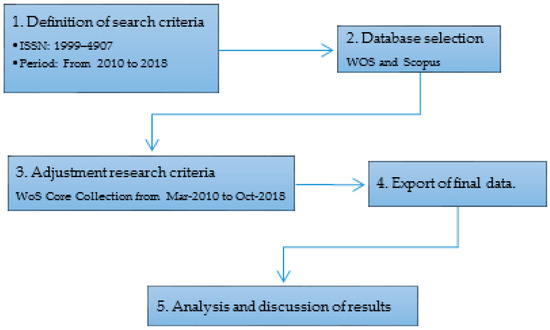
Figure 1.
Methodology steps of the bibliometric analysis developed for Forests.
Thus, the term selected for searching Forests was the International Standard Serial Number (ISSN) of the journal, used uniquely to identify a serial publication and the research scope focused on by articles published during the period 2010–2018. The following step was to identify the journal from robust and reliable databases. The publication of indexes in WoS core collection and Scopus online databases [15,16] was considered. Despite the limitations of using those databases, WoS and Scopus provided enough information for the purpose of this research since both are multidisciplinary databases, which mainly record scientific articles, reviews, and books, but also other documents such as meetings, editorials or letters. Although there is a close correlation between several bibliometric indicators and the databases [17], WoS and Scopus were considered the best options due to their quality, the possibility to search and filter information using several bibliographic parameters and their ability to provide easy access to the full texts of the journal Forests.
The preliminary results in the databases of this research identified 2095 documents, which include the results analyzed according to the search criteria defined for this research. After checking that all the information and results belonged to Forests journal, the results were exported with all available information in “.txt” format, which were used later for the bibliometric analysis.
For the articles, reviews, editorials, and corrections identified according to the criteria described above, the following elements were considered: number of annual publications, keywords, types of documents, funding agencies, countries, institutions, authors and knowledge areas. Bibliometric analyses are mainly based on two criteria: the number of publications and citations. The scientific publication, as an indicator of research output [18], measures productivity, and citations arising from them serve as a proxy of their scientific impact and influence [19].
Different bibliometric indicators were also used in this study to characterize the scientific output. These include: (1) The impact of papers, indicated by the number of references received from other subsequent publications (number of citations). (2) Frequency, as measured by the Hirsch index (h-index), which combines publications and citations in the same result considering the number of articles published and the citations to them in a balanced way, and thus is useful to make comparisons between scientists [20,21]. (3) The Impact Factor of Forests in JCR and the Scimago Journal Rank (SJR) Impact Factor of journal. Other indicators of a specific variable were studied such as publications and citations per keywords or authors co-authoring.
To analyze the results in depth, the article develops a graphical mapping of the bibliographic material applied to authors’ keywords using the VOSviewer software. The steps in the development of the bibliometric analysis are shown in Figure 1 below:
3. Results and Discussion
The results obtained from the introduction of the ISSN of Forests in the WoS and Scopus databases are presented below. They have been analyzed from different perspectives: countries of origin of the articles, most influential authors, most prominent institutions, evolution of the number of articles published and citations and author keywords trends.
3.1. Most Influential Countries
It is very remarkable that the journal Forests has published articles from the five continents during these ten years, with a total of 105 countries spread all over the world. In Figure 2, a density map of the geographical distribution of citations of articles is shown.
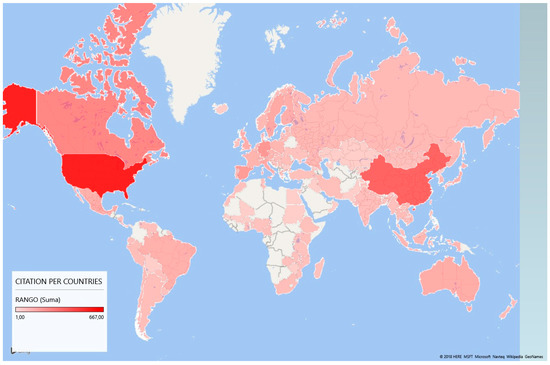
Figure 2.
Global distribution of citations of Forests articles.
The United States of America leads the ranking (Table 1) of the most influential countries in Forests due to the volume of publications (667 articles). China (387 articles), Canada (235), Germany (167) and Spain (150) complete the top five of the most relevant countries according to the volume of publications. A broad representation of European and Asian countries appears also in the top 20.

Table 1.
Ranking of countries based on the number of articles and citations in Forests.
Regarding the h-index, the United States of America (21) leads the ranking as well, followed by Italy (16), Germany (15), China (14), Canada (14), and the United Kingdom (13). It is also remarkable the case of Indonesia (12) in this regard. Finally, considering the average of citations per article, the ranking is slightly altered, led by Indonesia (11.15) and France (10.24). In the case of Indonesia, this is mainly due to three articles with a large number of citations: Corbera et al. (2011) [22] (55 citations); Locatelli et al. (2011) [23] (48); and Pacheco et al. (2011) [24] (44). Regarding France, there are also some articles with many citations, such as: Lisein et al. (2013) [25] (104 citations); Kolstrom et al. (2011) [26] (89); and Eysn et al. (2015) [27] (50). A second group of countries is composed by Sweden (8.82), Finland (7.88), United Kingdom (7.59), and Brazil (7.04).
The two articles with the highest number of citations are: Thomas and Martin (2012) (119 citations) [28], both from Canada; and White et al. (2013) (107 citations) [29], published by five Canadian authors and a Finnish author.
3.2. Evolution of the Number of Publications and Keywords Per Year
Forests has published many articles over the past 10 years; the annual evolution of the number of publications is shown in Figure 3. During the initial years, the journal was publishing less than a hundred articles per year, but after 2014 there was a huge increase in the number of papers published, although having a 57% rejection rate.
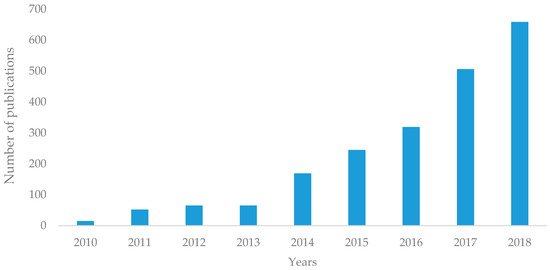
Figure 3.
Annual evolution of publications in Forests.
The historical development of publishing is shown in Table 2. The first publication in 2010 was an editorial: Forests: An International and Multidisciplinary Scientific Open Access Journal [30], an intention statement for the incoming future years. The first article was A Methodology for Modelling Canopy Structure: An Exploratory Analysis in the Tall Wet Eucalypt Forest of Southern Tasmania [31], an innovative research that incorporated a three-dimensional canopy model for predicting forest canopy structures.
Table 2.
Articles in Forests and the Impact Factor per year.
During the last five years, the growth of publications was high, from 169 articles in 2014 to 659 in October of 2018, representing a continuous growth of nearly 50%.
The most cited article of Forests in this first decade of the journal was published in 2012 by Sean C. Thomas and Adam T. Martin [32]. This article suggests that information on wood carbon content from a wider range of species is needed to inform forest carbon accounting in a number of forest types. The paper has more than 100 citations and it is one of the most influential research articles in Forests journal. The paper includes as keywords the following concepts: carbon; forest; tree; volatile carbon; wood chemistry; carbon accounting; tropical forest; temperate forest; subtropical forest and boreal forest.
Two other papers that have over 100 citations each were both published in 2013. The first one is a review: The Utility of Image-Based Point Clouds for Forest Inventory: A Comparison with Airborne Laser Scanning [29], related with forest inventory and Light Detection and Ranging (LiDAR), with 107 citations. The second one is an article entitled A Photogrammetric Workflow for the Creation of a Forest Canopy Height Model from Small Unmanned Aerial System Imagery [25], also dealing with LiDAR, and it has scored 104 citations so far. The complete selection of top citation papers is shown in Table 3.
Table 3.
Most cited articles per year in Forests.
An analysis of the authors’ keywords per year shows significant changes in the core research. Therefore, Table 4 shows the frequency of the concept repetition of the top five keywords per year. From 2015 until now, the most important keyword has been Climate change, with 121 occurrences. Other significant keywords are: Forest management; Reducing Emissions from Deforestation and Forest Degradation (REDD); Remote sensing and forest inventory.
Table 4.
Frequency of leading keywords per year in Forests.
The evolution of a keywords network map using VOSviewer software [37] is shown in Figure 4. Maps based on bibliographic data from WoS have been created for each year, choosing the co-occurrence of author keywords. The minimum number of occurrences of a keyword has been established as one, so the 9144 keywords have been taken into account for a more complete analysis. VOSviewer software divides data into clusters by the number of items belonging to that cluster in the area of the point.
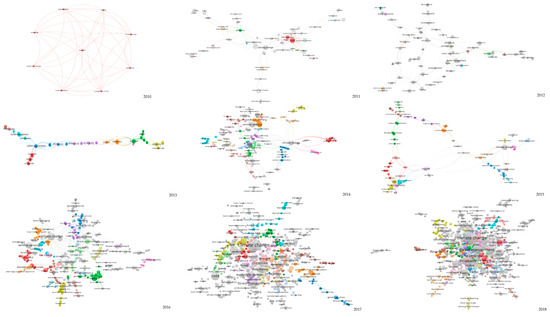
Figure 4.
Cluster analysis map showing evolution of keywords network in Forests (2010–2018).
3.3. Most Influential Funding Institutions
Various public and private entities have promoted or supported research on various subjects of interest in the journal Forests. Table 5 shows specifically the 20 organizations which have helped to promote scientific investigation and to disseminate knowledge, mainly by means of the publication of research articles in Forests journal.
Table 5.
Top 20 most active funding sponsors of research published in Forests.
The National Natural Science Foundation of China (NSFC) leads the ranking, with a total of 182 articles supported by it. NSFC is an institution directly under the jurisdiction of the State Council, tasked with the administration of the National Natural Science Fund from the Central Government, and in accordance with the Government’s strategies and plans for the development of science and technology. The NSFC is responsible for directing, coordinating and making an effective use of the national natural science fund to support basic research.
Regarding countries, China leads the ranking with six organizations supporting research in Forests. In addition to the aforementioned NSFC, there are other entities, such as the National Key Research and Development Program of China which aims to streamline numerous state-funded scientific and technological programs, and focuses on research in different fields (e.g., agriculture, energy, the environment and health) and that has produced a total of 41 articles published in Forests journal. Other major funding organizations in China include: the Fundamental Research Funds for the Central Universities from the Ministry of Education of China with 22 articles published in total; the Priority Academic Program Development of Jiangsu Higher Education Institutions (15 articles); China Scholarship Council (11 articles); and the National Basic Research Program of China (10 articles). This means that 72% of the total publications of Chinese authors in Forests have been promoted by these organizations.
Sweden is the second country in number of organizations supporting research and publications in Forests. Its major funding organizations include: Umea University (16 articles); Forestry Research Institute of Sweden (16 articles); Swedish University of Agricultural Sciences (15 articles); Swedish Forestry Industry (13 articles); The Foundation for Strategic Environmental Research—MISTRA (12 articles); and Future Forests (11 articles), a multi-disciplinary forest research program driven by the Swedish University of Agricultural Sciences, Umea University and the Forestry Research Institute of Sweden. Thus, 89.2% of articles published in Forests by Swedish scholars was supported by these entities.
Three organizations from the United States of America appear on the list: The National Science Foundation (NSF) (49 articles), an independent federal agency created to promote the progress of science and support basic research and people to create knowledge that transforms the future; the National Institute of Food and Agriculture (NIFA)—USDA (United States Department of Agriculture) (27 articles), which provides leadership and funding for programs that advance agriculture-related sciences; and Forest Service—USDA (27 articles), the largest forest research organization in the world, whose objective is to sustain the health, diversity, and productivity of the nation’s forests and grasslands.
Other entities that have a key role in the promotion of research and publications in Forests journal are: The European Union (EU) (46 articles), whose aims in this area are to co-ordinate and stimulate research. The independent European Research Council allocates EU funds to European or national research projects; The German Research Foundation—in German known as the DFG—(36 articles). This German research funding organization includes about 100 research universities and other research institutions; The Natural Sciences and Engineering Research Council of Canada (NSERC) (24 articles), which supports university students in their advanced studies, promotes and supports discovery research, and fosters innovation by encouraging Canadian companies to participate and invest in postsecondary research projects; The Academy of Finland (18 articles) is a governmental funding body for scientific research in Finland; and lastly, the Spanish Ministry of Economy and Competitiveness (17 articles).
3.4. Most Relevant Authors and Cited References
To determine the characteristics of authorship in the works, it is convenient to know both the total number of authors who have published the works, as well as the amount of works published by each author and the distribution of the number of authors per work. In the past, Crump [38] indicated that the lone signer was a species facing extinction. The increase of the number of authors per work, both nationally and internationally, is a well-established fact [39,40].
Some authors can be highlighted for having a great production (Table 6): Camarero J.J. with 16 articles (Instituto Pirenaico de Ecología (IPE)—Consejo Superior de Investigaciones Científicas (CSIC)); Vastaranta, M. (University of Helsinki), Holopainen, M. (University of Helsinki), Bergeron, Y. (Université du Québec à Montréal) and Pretzsch, H. (Technische Universität München) with 13 works each; and Hyypaa, J. (Finnish Geodetic Institute), Li, Y. (Beijing Forestry University) and Son, Y. (Korea University) with 12 works each.
Table 6.
Top 20 most relevant authors in Forests.
3.5. Main Areas of Knowledge
By identifying the main areas of knowledge in which the articles have been published in Forests during the last ten years, the current context and trends are known, as well as the emerging topics for the academy. As many of the topics related to Forests are transversal, they are a wide variety of areas of knowledge dealing with this subject. In addition, there are many articles that can be part of more than one area of knowledge.
The two areas of knowledge which are clearly the most prolific (see Figure 5) are: Forestry (2094 articles, which means all papers except for one) and Plant Sciences (2043 articles). The third most important area in number of publications is Environmental Sciences Ecology (1065 articles). Other prominent areas are: Biodiversity Conservation (651 articles), Meteorology Atmospheric Sciences (541), Agriculture (477), Science Technology (318), and Business Economics (303).
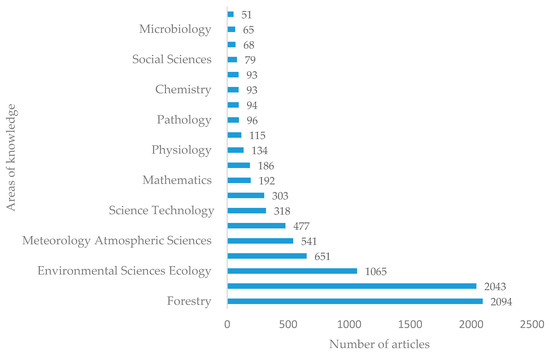
Figure 5.
Number of articles in Forests, categorized by areas of knowledge (WoS).
According to the h-index, the most relevant areas of knowledge in WoS are (see Table 7): Forestry (31), Plant Sciences (27), Environmental Sciences Ecology (23), Science Technology (23), Meteorology Atmospheric Sciences (22), and Business Economics (19).
Table 7.
Main areas of knowledge (WoS).
Figure 6 shows a map based on WoS data on co-occurrence on the authors’ keywords from the last ten years by using a fractional counting method. The minimum of occurrences of a keyword was established at seven of the 7082 keywords found. This map is useful in order to know the research trends in Forests journal and shows the main interactions between the most frequent terms in this research and the existing clusters, highlighting the term climate change as the central figure. On the network analysis the keywords build clusters and the size of the circle is determined by the weight of the item. The higher the weight of an item, the larger the circle of the item. Lines between items represents links, and the distance between two keywords indicates the relatedness of the keywords in terms of co-occurrence links.
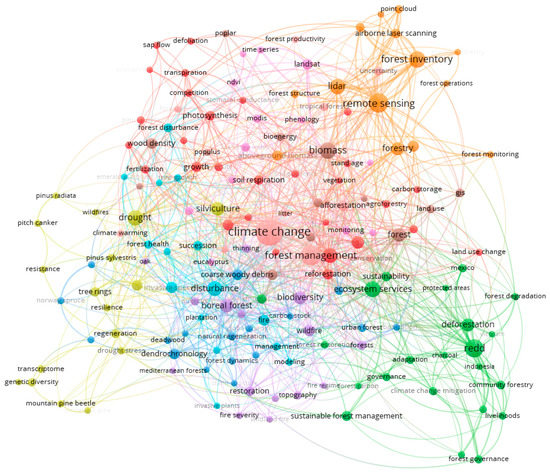
Figure 6.
Cluster analysis map of keywords in Forests.
Therefore, ten clusters were identified in total. Below the most prominent topics in each of the clusters are presented:
Cluster 1 (shown in red and with 29 items): Carbon, growth, photosynthesis, reforestation and soil respiration are the most relevant topics of this cluster. Thus, there are works related to forest as a key player within the global carbon cycle and reforestation as an important climate change mitigation mechanism. Some articles focus on the human footprint in the carbon cycle; identifying potentially suitable areas for reforestation to assess the carbon sequestration potential in some regions; understanding the spatial and seasonal variations in leaf physiology for accurately modelling the carbon uptake, and growth of entire canopies and stands; contrasting responses of total soil respiration and its three components, soil respiration derived from plant roots, root-free soil and the litter layer; or spatial and seasonal variations of standardized photosynthetic parameters under different environmental conditions.
Cluster 2 (colored green and with 22 items): this includes REDD, ecosystem services, deforestation, and sustainability. In a second level another topic was highlighted: sustainable forest management. Finally, in a third level, some territories were also identified: Mexico, Indonesia, Vietnam and South America. The main topic of the cluster is the United Nations’ program: Reducing Emissions from Deforestation and forest Degradation (REDD). Some articles also focus on REDD+, which extends REDD by Sustainable Forest Management, Conservation of Forests and Enhancement of carbon sinks. Research related to different subjects are found: to analyze the extent to which REDD+ projects are delivering on the promise of co-benefits and the elusive ”triple-win” for climate, biodiversity, and local communities; investigating about how REDD+ is performing in communities; conceptualizing the REDD+ policy framework as the world’s largest experiment in payments for ecosystem services; assessing ecosystem services; species mixing regulation with respect to forest ecosystem service provision; comparison of ecosystem services from mixed and monospecific forests; implications of deforestation research for policies to promote REDD. Finally, research in different geographical contexts (e.g., Mexico, Indonesia, Vietnam, or South America) is also carried out.
Cluster 3 (in dark blue and with 17 items): this includes topics on coarse woody debris, dendrochronology and urban forest. Some other relevant issues are dead wood, carbon stock, urbanization, agroforestry, competition, transpiration, etc. Coarse woody debris plays an important role in supporting biodiversity and assisting ecological processes. Some works analyze it as an important component of temperate stream and forest ecosystems. There are also studies about its variability due to human accessibility to forest. Dendrochronology is another important subject of this cluster, and due to its diverse applications, it may be related to many knowledge areas. Averaging tree-ring measurements from multiple individuals is one of the most common procedures in dendrochronology; also, combining genomics and dendrochronology to explore the relationship between individual genetic diversity and tree growth at mountains. Urban forest is another outstanding topic of this cluster. Different researches about this topic may be found in this cluster: Urban park systems to support sustainability; understanding key biophysical links between urban forests and ecosystem services; analyzing benefits that urban trees can provide to the urban environment and well-being of people; how to most effectively manage urban forests to provide these benefits; promoting and preserving biodiversity in the urban forest, as a significant valuable component of the urban environment. Finally, articles about re-evaluation of forest biomass carbon stocks provide relevant information for negotiations on climate change regarding forest conservation, management, and restoration.
Cluster 4 (in light green and with 17 items): drought and silviculture are the main topics, followed by tree rings and regeneration. Research related to this cluster is mainly focused on issues such as: Differences in the response to acute drought; drought sensitiveness on forest growth; regeneration silviculture of different species of trees; forest silviculture; silviculture and ecology; soils in relation to silviculture.
Cluster 5 (colored purple and including 15 items): includes boreal forest, biodiversity, and wildfire; at a second stage: forests, restoration, or quercus. Some important subjects studied in this cluster are: maintaining and restoring biodiversity in boreal forests by developing natural disturbance regimes; assessment and monitoring protocols to guarantee the maintenance of biodiversity in certified forests; how forest densification, wildfires, and disease can reduce the growth and survival of hardwood trees; possible wildfire management practices for facilitating the restoration of trees; model to select and temporally allocate resources for fighting forest fires; using wildfire observations for systematic fire simulator development; temporal patterns of wildfire activity in areas of contrasting human influence in boreal forest; analysis of naturally dynamic boreal forest landscapes.
Cluster 6 (in light blue and with 15 items): includes disturbance, invasive species, fire, and succession. Other important topics in the cluster are: forest disturbance, and forest health. Some of the subjects analyzed in this cluster are: the key role of disturbance in shaping forest composition and diversity; interactive effects of human and natural disturbance; analyzing the effect of disturbance on different species; the impact of invasive plants on species spread and implications for further integration of forest-management practices; an integer linear programming model to select and temporally allocate resources for fighting forest fires; determination of patterns of forest succession over different periods of time.
Cluster 7 (in orange and with 14 items): includes remote sensing, forest inventory, LiDAR, and forestry. Another important topic is aboveground biomass. In recent years, several remote sensing-based methods have been used in research. LiDAR is a detection system that works on the principle of radar but uses light from a laser. Some of the researches are: remote sensing techniques for estimating forest canopy cover; remote sensing-based methods for mapping burn severity in order to understand, quantify and monitor forest fire severity and its impacts on ecosystems; spatial variation in canopy structure across forest landscapes by using a portable canopy LiDAR system; estimating forest canopy cover using random forest; evaluating the effects and uncertainties of different tree species employing forest inventory data.
Cluster 8 (in brown and with 13 items): includes biomass and forest, followed by other topics, such as wood density or bioenergy. Researchers focused on: forest biomass as a valuable renewable energy feedstock; studies to optimize decision-making about suitable locations for biomass energy plants intending to use forest residues; estimation of forest above-ground biomass by geographically weighted regression and machine learning with sentinel imagery; increasing knowledge about forest biomass accumulation and to provide a set of tools for aboveground biomass estimation.
Cluster 9 (shaded in pink and with 13 items): Landsat and Moderate resolution Imaging Spectroradiometer (MODIS) are the most relevant topic of this cluster. Landsat (a series of artificial satellites that monitor the earth’s resources by photographing the surface at different wavelengths), and MODIS are used in many works for evaluating different issues, such as: A method for integrating MODIS and Landsat data for systematic monitoring of forest cover and change; phenology-based method for mapping tropical evergreen forests by integrating of MODIS and Landsat imagery; the potential of multisource remote sensing for mapping the biomass of a degraded forest; evaluation of the potential of optical (Landsat, MODIS) and radar remote sensing sources in modelling and mapping forest aboveground biomass; Landsat time series data used to characterize forest degradation.
Cluster 10 (colored salmon and with 12 items): includes climate change and forest management. These are the most relevant topics, not only of this cluster, but of the set of topics analysed. Among the numerous works focused on these two concepts, the following can be mentioned: Mitigation of climate change; the potential distribution of tree species in different periods of time under a climate change scenario; forest management for climate change; understanding perceptions and attitudes of forest managers toward climate change and climate adaptive forest management practices; motivations, actions, and potential barriers to action of forest managers toward climate adaptive forest management practices.
To analyze the evolution of the most frequent terms used by the researchers in the journal Forests, a trend map is made, using a fractional counting method, attending to the WoS database and based on bibliographic data on co-occurrence on the authors’ keywords (Figure 7). This map is based on the average of publications per year and uses different colors to highlight the most employed authors’ keywords in each of them. The most recent keywords are marked in yellow, so the most important trends can be easily identified.
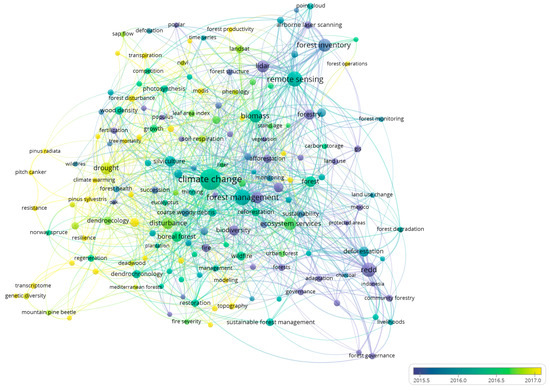
Figure 7.
Map based on co-occurrence on the author keywords, and evolution in recent years.
Currently, some emergent topics are identified in Forests and this research is mainly focused on: Forest operations, forest productivity, forest disturbance, genetic diversity, transcriptome, pitch canker, Pinus radiata, resistance, resilience, transpiration, topography and MODIS.
4. Conclusions
Forests journal is 10 years old and has a strong influence in its research field. In order to celebrate this anniversary, this bibliometric study shows the past decade’s progress in research on forest and forestry, leading trends and challenges to face. The research has identified countries, authors and institutions involved with topics related to forest knowledge areas.
The results indicate that the United States of America, China and Canada are the most active countries in Forests. The journal has reached up to 105 countries, making Forests a global journal in scope. Contributions and citations are strongly increasing year by year, especially since 2014. The National Natural Science Foundation of China (NSFC) has an important role in funding works and leads the ranking of funding institutions, and other six Chinese organizations are also supporting investigations published in Forests. The keywords and expressions “Climate Change”, “Forest Management” and “Reducing Emissions from Deforestation and forest Degradation (REDD)” are the most frequently used terms but also are the main focus of interest and driving force. The influence of Forests on worldwide research is more than evident and a proof of this is the evolution of its Impact Factor on both JCR and SJR, reaching its highest index in 2017.
Emergent topics in forests and research are dedicated to genetics, resistance or resilience, transversal concepts by nature which indicate a more complex scenario for the next incoming decade. Thus, interdisciplinary research groups will be necessary in line with the aim and scope of Forests: From forest ecology and management to forest ecophysiology, from urban forestry to human dimensions and everything in between. An exciting time is therefore coming for Forests journal, open to a wide spectrum of topics, in which experts and researchers from very different disciplines will be able to collaborate and to broaden horizons.
This work is not exempt from certain limitations, some of which could be the basis for future research. First, the bibliometric analysis could be also developed by using other quantitative or qualitative tools (e.g., Google Scholar or meta-analysis), that may provide some differences, mainly regarding citations. In addition, because the databases are not updated immediately after the publication of an article, there may be slight variations in the number of articles gathered in both WoS and Scopus databases.
Author Contributions
J.U.-T., J.L.R.-R.; J.H.-O. and J.d.P.V. have contributed in the same way to the writing of this manuscript, and all the authors have read and approved the final manuscript.
Funding
This research received no external funding.
Conflicts of Interest
The authors declare no conflict of interest.
References
- Tang, M.; Liao, H.; Wan, Z.; Herrera-Viedma, E.; Rosen, M.A. Ten Years of Sustainability (2009 to 2018): A Bibliometric Overview. Sustainability 2018, 10, 1655. [Google Scholar] [CrossRef]
- Kokol, P.; Vošner, H.B.; Železnik, D. Clinical simulation in nursing: A bibliometric analysis after its tenth anniversary. Clin. Simul. Nurs. 2017, 13, 161–167. [Google Scholar] [CrossRef]
- Gaviria-Marin, M.; Merigo, J.M.; Popa, S. Twenty years of the Journal of Knowledge Management: A bibliometric analysis. J. Knowl. Manag. 2018, 22, 1655–1687. [Google Scholar] [CrossRef]
- Cunill, O.M.; Salvá, A.S.; Gonzalez, L.O.; Mulet-Forteza, C. Thirty-fifth anniversary of the International Journal of Hospitality Management: A bibliometric overview. Int. J. Hosp. Manag. 2019, 78, 89–101. [Google Scholar] [CrossRef]
- Martínez-López, F.J.; Merigó, J.M.; Valenzuela-Fernández, L.; Nicolás, C. Fifty years of the European journal of Marketing: A bibliometric analysis. Eur. J. Market. 2018, 52, 439–468. [Google Scholar] [CrossRef]
- Ball, R. An Introduction to Bibliometrics: New Development and Trends; Chandos Publishing: Cambridge, MA, USA, 2018; pp. 15–53. [Google Scholar]
- Garfield, E. Citation Index for Science. A New Dimension in Documentation through Association of Ideas. Science 1955, 122, 108–111. [Google Scholar] [CrossRef]
- Garfield, E. ‘Science Citation Index’—A New Dimension in Indexing. Science 1964, 144, 649–654. [Google Scholar] [CrossRef]
- Garfield, E. Citation analysis as a tool in journal evaluation. Science 1972, 178, 471–479. [Google Scholar] [CrossRef]
- Broadus, R.N. Towards a definition of Bibliometrics. Scientometrics 1987, 12, 373–379. [Google Scholar] [CrossRef]
- Van Raan, A. Advanced bibliometric method as quantitative core of peer review based evaluation and foresight exercises. Scientometrics 2005, 36, 397–420. [Google Scholar] [CrossRef]
- Xie, Y.; Ji, L.; Zhang, B.; Huang, G. Evolution of the Scientific Literature on Input–Output Analysis: A Bibliometric Analysis of 1990–2017. Sustainability 2018, 10, 3135. [Google Scholar] [CrossRef]
- Niu, J.; Tang, W.; Xu, F.; Zhou, X.; Song, Y. Global Research on Artificial Intelligence from 1990–2014: Spatially-Explicit Bibliometric Analysis. ISPRS Int. J. Geo-Inf. 2016, 5, 66. [Google Scholar] [CrossRef]
- Pritchard, A. Statistical bibliography or bibliometrics? J. Doc. 1969, 25, 348–349. [Google Scholar]
- Web of Science. Available online: https://login.webofknoledge.com (accessed on 1 December 2018).
- Scopus. Available online: https://www.scopus.com/ (accessed on 1 December 2018).
- Salvador-Oliván, J.A.; Agustín-Lacruz, C. Correlación entre indicadores bibliométricos en revistas de Web of Science y Scopus. Revista General de Información y Documentación 2015, 25, 341–359. [Google Scholar] [CrossRef]
- Moed, H.F. Citation Analysis in Research Evaluation. In Proceedings of the ISSI 2005: 10th International Conference of the International Society for Scientometrics and Informetrics, Stockholm, Sweden, 24–28 July 2005; pp. 437–444. [Google Scholar]
- Svensson, G. SSCI and its Impact Factors: A prisioner’s dilemma? Eur. J. Market. 2010, 44, 22–33. [Google Scholar] [CrossRef]
- Hirsch, J.E. An index to quantify an individual’s scientific research output. Proc. Natl. Acad. Sci. USA 2005, 102, 16569–16572. [Google Scholar] [CrossRef] [PubMed]
- Hirsch, J.E.; Buela-Casal, G. The meaning of h-index. Int. J. Clin. Health Psychol. 2014, 14, 161–164. [Google Scholar] [CrossRef]
- Corbera, E.; Estrada, M.; May, P.; Navarro, G.; Pacheco, P. Rights to Land, Forests and Carbon in REDD plus: Insights from Mexico, Brazil and Costa Rica. Forests 2011, 2, 301–342. [Google Scholar] [CrossRef]
- Locatelli, B.; Evans, V.; Wardell, A.; Andrade, A.; Vignola, R. Forests and Climate Change in Latin America: Linking Adaptation and Mitigation. Forests 2011, 2, 431–450. [Google Scholar] [CrossRef]
- Pacheco, P.; Aguilar-Støen, M.; Borner, J.; Etter, A.; Putzel, L.; Diaz, M.D.V. Landscape Transformation in Tropical Latin America: Assessing Trends and Policy Implications for REDD. Forests 2011, 2, 1–29. [Google Scholar] [CrossRef]
- Lisein, J.; Pierrot-Deseilligny, M.; Bonnet, S.; Lejeune, P. A Photogrammetric Workflow for the Creation of a Forest Canopy Height Model from Small Unmanned Aerial System Imagery. Forests 2013, 4, 922–944. [Google Scholar] [CrossRef]
- Kolstrom, M.; Lindner, M.; Vilen, T.; Maroschek, M.; Seidl, R.; Lexer, M.J.; Netherer, S.; Kremer, A.; Delzon, S.; Barbati, A.; et al. Reviewing the Science and Implementation of Climate Change Adaptation Measures in European Forestry. Forests 2011, 2, 961–982. [Google Scholar] [CrossRef]
- Eysn, L.; Hollaus, M.; Lindberg, E.; Berger, F.; Monnet, J.M.; Dalponte, M.; Kobal, M.; Pellegrini, M.; Lingua, E.; Mongus, D.; et al. A Benchmark of Lidar-Based Single Tree Detection Methods Using Heterogeneous Forest Data from the Alpine Space. Forests 2015, 6, 1721–1747. [Google Scholar] [CrossRef]
- Thomas, S.C.; Martin, A.R. Carbon Content of Tree Tissues: A Synthesis. Forests 2012, 3, 332–352. [Google Scholar] [CrossRef]
- White, J.C.; Wulder, M.A.; Vastaranta, M.; Coops, N.C.; Pitt, D.; Woods, M. The Utility of Image-Based Point Clouds for Forest Inventory: A Comparison with Airborne Laser Scanning. Forests 2013, 4, 518–536. [Google Scholar] [CrossRef]
- Jokela, E.J. Forests: An International and Multi-disciplinary Scientific Open Access Journal. Forests 2010, 1, 1–3. [Google Scholar] [CrossRef]
- Scanlan, I.; McElhinny, C.; Turner, P. A Methodology for Modelling Canopy Structure: An Exploratory Analysis in the Tall Wet Eucalypt Forests of Southern Tasmania. Forests 2010, 1, 4–24. [Google Scholar] [CrossRef]
- Pirotti, F. Assessing a Template Matching Approach for Tree Height and Position Extraction from Lidar-Derived Canopy Height Models of Pinus Pinaster Stands. Forests 2010, 1, 194–208. [Google Scholar] [CrossRef]
- Paneque-Gálvez, J.; McCall, M.K.; Napoletano, B.M.; Wich, S.A.; Koh, L.P. Small Drones for Community-Based Forest Monitoring: An Assessment of Their Feasibility and Potential in Tropical Areas. Forests 2014, 5, 1481–1507. [Google Scholar] [CrossRef]
- Wallace, L.; Lucieer, A.; Malenovský, Z.; Turner, D.; Vopěnka, P. Assessment of Forest Structure Using Two UAV Techniques: A Comparison of Airborne Laser Scanning and Structure from Motion (SfM) Point Clouds. Forests 2016, 7, 62. [Google Scholar] [CrossRef]
- Cohen, W.B.; Healey, S.P.; Yang, Z.; Stehman, S.V.; Brewer, C.K.; Brooks, E.B.; Gorelick, N.; Huang, C.; Hughes, M.J.; Kennedy, R.E.; et al. How Similar Are Forest Disturbance Maps Derived from Different Landsat Time Series Algorithms? Forests 2017, 8, 98. [Google Scholar] [CrossRef]
- Palos-Sanchez, P.; Ramon Saura, J. The Effect of Internet Searches on Afforestation: The Case of a Green Search Engine. Forests 2018, 9, 51. [Google Scholar] [CrossRef]
- Van Eck, N.J.; Waltman, L. Software survey: VOSviewer, a computer program for bibliometric mapping. Scientometrics 2010, 84, 523–538. [Google Scholar] [CrossRef] [PubMed]
- Crump, A.J. They are not alone. Nature 1984, 309–310. [Google Scholar] [CrossRef]
- Yegros-Yegros, A.; Tur, E.M.; Amat, C.B. Número de autores y colaboración institucional en los artículos originales de investigación biomédica española. Evolución de los valores básicos de referencia en el período 1990–2009. Med. Clin. Barc. 2012, 138, 165–170. [Google Scholar] [CrossRef] [PubMed]
- Wutchy, S.; Jones, B.F.; Uzzi, B. The increasing dominance of teams in production of knowledge. Science 2007, 18, 1036–1039. [Google Scholar] [CrossRef]
© 2019 by the authors. Licensee MDPI, Basel, Switzerland. This article is an open access article distributed under the terms and conditions of the Creative Commons Attribution (CC BY) license (http://creativecommons.org/licenses/by/4.0/).