You are currently viewing a new version of our website. To view the old version click .
Algorithms
  • Article
  • Open Access

18 January 2013

Energy Efficient Routing in Wireless Sensor Networks Through Balanced Clustering

,
,
and
1
Department of Informatics, University of Piraeus, 80, Karaoli & Dimitriou Street, GR-185-34 Piraeus, Greece
2
Department of Electronics, Technological Educational Institute (TEI) of Athens, Agiou Spiridonos, GR-12210 Egaleo, Athens, Greece
*
Author to whom correspondence should be addressed.
This article belongs to the Special Issue Sensor Network

Abstract

The wide utilization of Wireless Sensor Networks (WSNs) is obstructed by the severely limited energy constraints of the individual sensor nodes. This is the reason why a large part of the research in WSNs focuses on the development of energy efficient routing protocols. In this paper, a new protocol called Equalized Cluster Head Election Routing Protocol (ECHERP), which pursues energy conservation through balanced clustering, is proposed. ECHERP models the network as a linear system and, using the Gaussian elimination algorithm, calculates the combinations of nodes that can be chosen as cluster heads in order to extend the network lifetime. The performance evaluation of ECHERP is carried out through simulation tests, which evince the effectiveness of this protocol in terms of network energy efficiency when compared against other well-known protocols.

1. Introduction

Recent technological advances have enabled the inexpensive mass production of sensor nodes, which, despite their relatively small size, have particularly advanced sensing, processing and communication capabilities. A WSN consists of spatially distributed sensor nodes, which are interconnected without the use of any wires [1,2]. In a WSN, sensor nodes sense the environment and use their communication components in order to transmit the sensed data over wireless channels to other nodes and to a designated sink point, referred to as the Base Station (BS). BS collects the data transmitted to it in order to act either as a supervisory control processor or as an access point for a human interface or even as a gateway to other networks [3,4]. Through the collaborative use of a large number of sensor nodes, a WSN is able to perform concurrent data acquisition of existing conditions at various points of interest located over wide areas. Nowadays, WSNs, due to the numerous benefits that their utilization offers, support an ever growing variety of applications, including agriculture, traffic control, environment and habitat monitoring, object tracking, fire detection, surveillance and reconnaissance, home automation, biomedical applications, inventory control, machine failure diagnosis and energy management [5,6,7].
However, despite the advantages that the utilization of a WSN offers, their use is severely limited by the energy constraints posed by the sensors. The energy expenditure of the sensor nodes occurs during the wireless communication, the environment sensing and the data processing. Therefore, most of the routing protocols in WSNs aim mainly at the attainment of power conservation. Since most of the routing protocols developed for wired networks pursue the attainment of high Quality of Service (QoS), they are practically improper for application in WSNs. For these reasons, many protocols have been proposed for data routing in sensor networks [4,8,9,10].
Most of the protocols use clusters in order to provide energy efficiency and to extend the network lifetime. Each cluster first elects a node as the cluster head (CH), and then, the nodes in every cluster send their data to their own cluster head. The cluster head sends its data to the base station. This data transfer can be performed in two alternative ways. Either directly, in the case in which the cluster head is located close to the base station, or via intermediate cluster heads. In this paper, a novel energy efficient protocol, named ECHERP, is proposed. ECHERP, contrary to other existing cluster-based protocols that select a random node or the node with the higher energy at a particular time instance as the new cluster head, considers the current and the estimated future residual energy of the nodes, along with the number of rounds that can be cluster heads, in order to maximize the network lifetime. The network is modeled as a linear system, and the Gaussian elimination algorithm is used in order to calculate the combinations of nodes that can be chosen as cluster heads. The proposed protocol allows new nodes to be added to the system and automatically adjusts its behavior based on the dying nodes and the signal-to-noise interference. In addition, node mobility is also handled.
This paper is organized as follows. In Section 2, related work in energy efficient protocols is presented. In Section 3, the proposed protocol that models the network as a linear system using Gaussian elimination, in order to select the cluster head that minimizes the energy consumption in the cluster, is described. In Section 4, the performance of the proposed protocol is evaluated. In Section 5, conclusions are drawn.

3. The Proposed Protocol for Energy Efficient Routing in WSNs

In this section, a novel energy efficient routing protocol, named ECHERP, is presented. ECHERP selects cluster heads in the network using a model, as most of the previously proposed protocols. However, the main difference with other protocols is that this one uses a more efficient mechanism to select a node as the cluster head. This is performed by considering the current and the estimated future residual energy of the nodes, along with the number of rounds that they can be cluster heads, in order to maximize the network lifetime. ECHERP models the network and the energy spent by the nodes as a linear system and, using the Gaussian elimination algorithm, selects the cluster heads of the network. In Subsection 3.1, the energy model adopted in ECHERP is presented, while in Subsection 3.2, the routing model of ECHERP is described.

3.1. Description of the Adopted Energy Model

Currently, there is a great deal of research in the area of low-energy radios. Different assumptions about the radio characteristics, including energy dissipation in the transmit and receive modes, affect the performance of different protocols.
In this work, the energy model adopted is as follows: the radio dissipates 50 nJ/bit (Eelec) to run the transmitter or receiver circuitry and 100 pJ/bit/m2 (Eamp) for the transmit amplifier [11]. The energy that a node dissipates for the radio transmission ETx(k, d) of a message of k bits over a distance d is due to running both the transmitter circuitry ETx-elec(k) and the transmitter amplifier ETX-amp(k, d) and is expressed by the following:
E Tx ( k , d ) = E T X-elec ( k ) + E Tx-amp ( k , d ) = E elec k + E amp k d 2
where Eelec is the transmitter circuitry dissipation per bit—equal to the corresponding receiver circuitry dissipation per bit—and Eamp is the transmit amplifier dissipation per bit per square meter. Moreover, by using multi-hop routing, ETx(k, d) is reduced when compared to that in single-hop routing. Similarly, the energy dissipated by a node for the reception ERx(k) of a message of k bits is due to running the receiver circuitry ERx-elec(k) and is expressed by the following equation:
E Rx ( k ) = E R X-elec ( k ) = E elec k

3.2. Description of the Proposed Routing Model

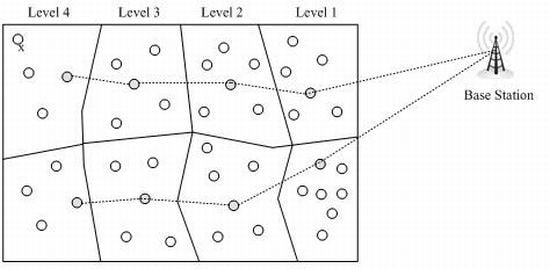
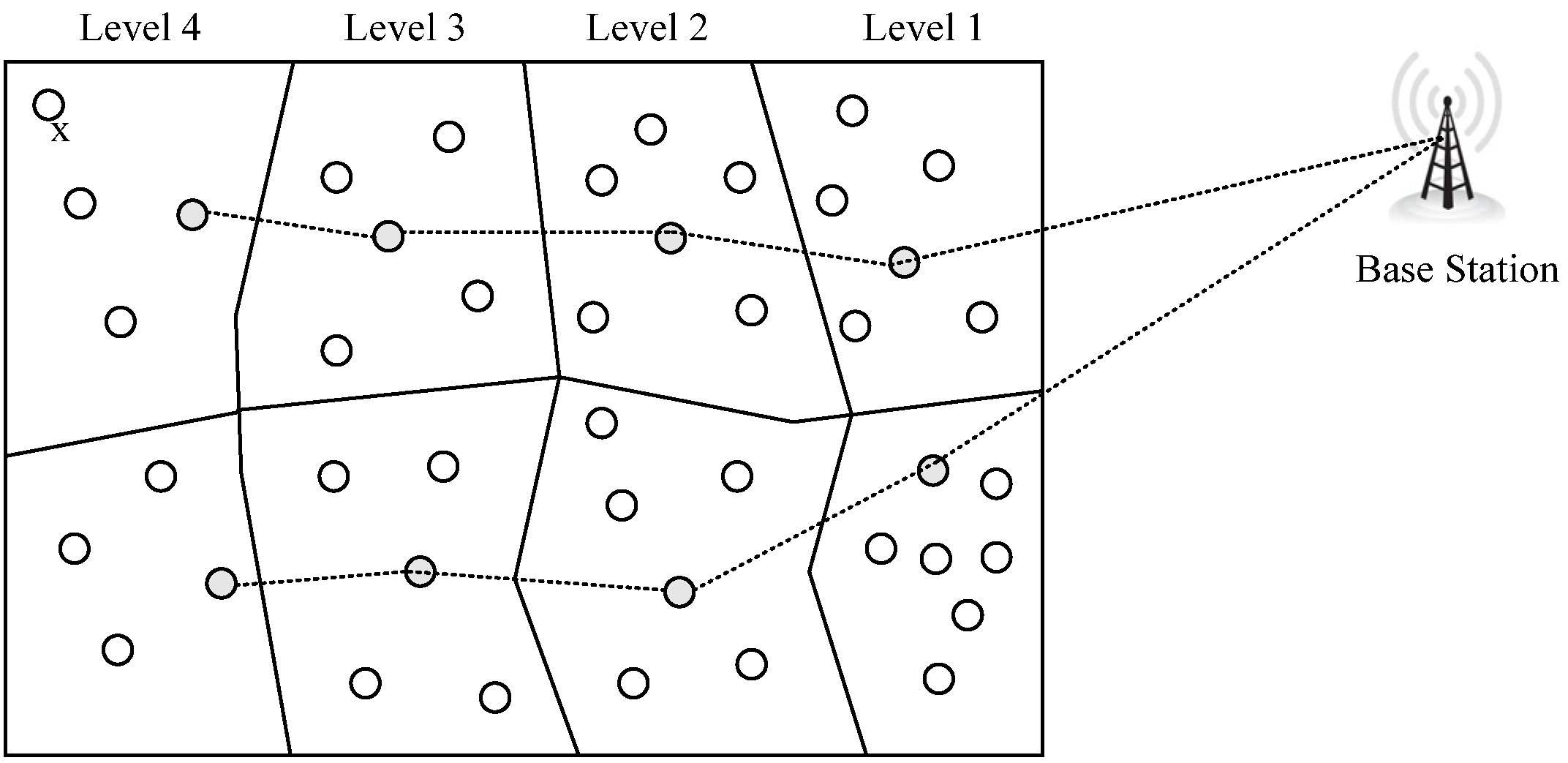
In ECHERP, the BS is assumed to have unlimited energy residues and communication power. It is also assumed that the BS is located at a fixed position, either inside or away from the sensor field. The longer the distance between the BS and the center of the sensor field, the higher the energy expenditure for every node transmitting to the BS. All the network nodes, which are assumed to be located within the sensor field, are dynamically grouped into clusters. One of the nodes within every cluster is elected to be the cluster head of this cluster. Therefore, the number of cluster heads is equal to the number of clusters. The cluster heads, which are located close enough to the network base station, are referred to as the first level cluster heads. These cluster heads are capable of direct transmission to the base station with reasonable energy expenditure. The cluster heads that are located at more distant positions from the base station are considered as second-, third-, etc. level cluster heads. These cluster heads transmit data to the upper level cluster heads. Moreover, in order to achieve balanced energy consumption and extend the network’s lifetime, the election of the cluster heads is performed in turns.
The main characteristic of ECHERP is the head selection process. In this protocol, in order to elect a cluster head, the routing information and the energy spent in the network are formulated as a linear system, the solution of which is computed using the Gaussian elimination algorithm. Therefore, cluster heads are elected as the nodes that minimize the total energy consumption in the cluster.
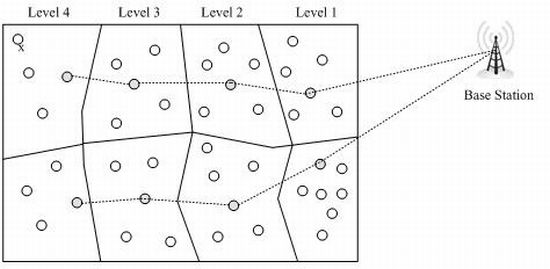
In most of the protocols proposed so far, the node with the highest residual energy in a cluster is elected as the cluster head. This selection may lead to inefficiencies, as can be seen by the following example. Let us assume that node x in Figure 1 has higher residual energy than the other nodes belonging to the same cluster. Then, this node is elected as the new cluster head. However, this forces the rest of the nodes to send data in the opposite direction to the base station, resulting in higher energy consumption.
Figure 1. The network model adopted.
Obviously, this is not an energy efficient process, and it can be avoided by selecting cluster heads in a more energy efficient manner. This is pursued by the proposed protocol.
The steps in order to setup clusters and then to elect cluster heads are the following:
  • The BS creates a Time Division Multiple Access (TDMA) schedule and requests the nodes to advertise themselves, a process similar to that of other protocols.
  • Each node broadcasts a message to advertise its energy level and location to its neighbors. Based on this exchanged information, each node sets up a neighbor information table that records the energy level and the positions of its neighbors and sends this table along with its corresponding information to its neighbors. This step is repeated until the information of all the nodes in the network is sent to the BS, allowing the BS to have a global knowledge of the network. At this step, all the nodes are cluster head candidates, and each node has a unique ID that is also included in the exchanged table.
  • As soon as the node advertisement is completed, the BS runs the Gaussian elimination algorithm and computes the number of rounds at which every node can be a cluster head, trying to maximize the network lifetime. In the first step of the cluster head selection, the BS chooses the nodes closest to itself to be the high level cluster heads. Moreover, some of the nodes from which the BS has not received any direct advertisement message are considered to be low level cluster heads. The overall number of nodes, which are assigned to be cluster heads, is 5% of the total number of the nodes in the network, as this can be helpful in achieving good performance in a homogeneous network with various parameter settings [11]. Other percentages can also be used.
  • The BS broadcasts the unique IDs of the newly selected cluster heads, and their cluster members and the nodes use this information to form and enter a cluster. Therefore, each node has the knowledge of the number of times that it can be a cluster head and the number of times that it cannot. The BS runs the Gaussian elimination algorithm and computes the appropriate number of rounds that the nodes can be cluster heads and sends this information to the nodes.
  • The lower level cluster heads do not transmit directly to the BS. They use the upper level cluster heads as intermediate repeaters of their data to the BS.
  • Each cluster head creates a TDMA schedule and broadcasts this schedule to the nodes in its cluster, in order to inform each node of the timeslot that it can transmit. Moreover, the radio component of each node is allowed to be turned off at all time periods, except during its transmission time. Therefore, the energy dissipation of every individual sensor is considerably reduced.
  • Then, the data transmission starts. The nodes, based on the allocated transmission time, send the data concerning the sensed events to their cluster head. The transmission power of every node is adjusted to the minimum necessary to reach its next hop neighbor. In this way, both the interference with other transmissions and the energy dissipation are reduced.
  • Every lower level cluster head aggregates the data and then transmits the compressed data to the upper lever cluster heads until the data reaches the base station. A round of data transmission has been completed, and the protocol continues from step 4 for the next round.
  • In case that there is a change in the network topology, due to either a change in a node position or in the total dissipation of a node residual energy, the BS uses again the Gaussian elimination algorithm to determine the appropriate cluster head election
  • The execution of the protocol is terminated as soon as all the nodes in the network run out of energy.
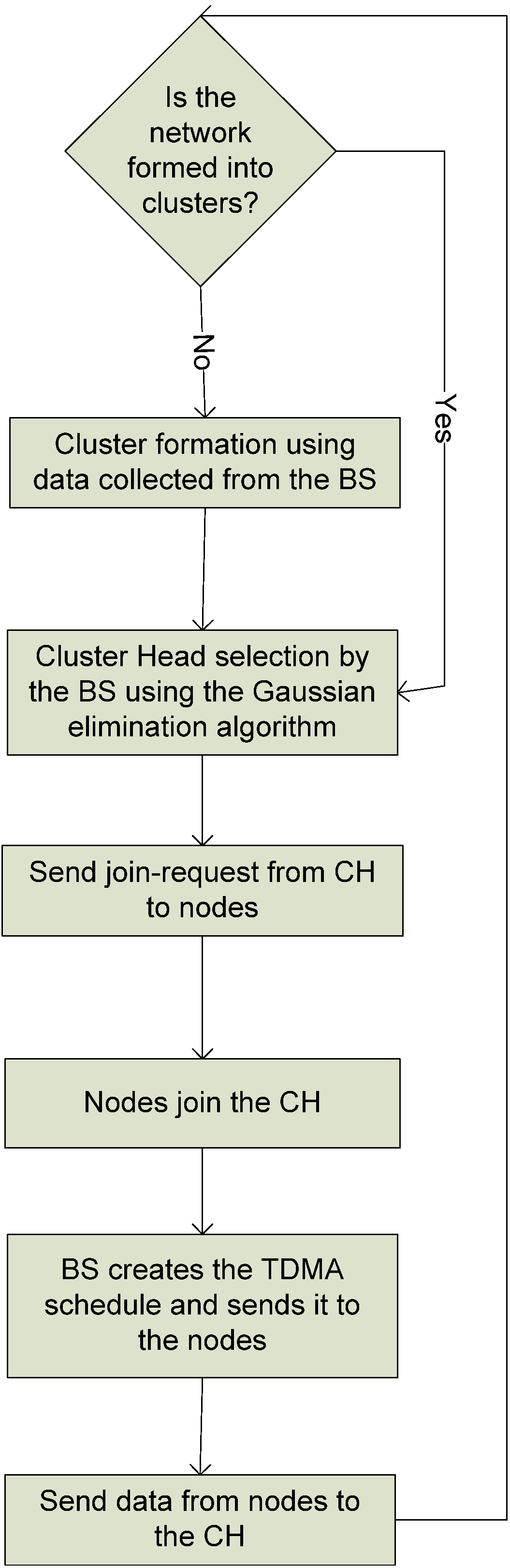
The flow chart of ECHERP is shown in Figure 2.
Figure 2. Cluster formation and data sending in ECHERP.
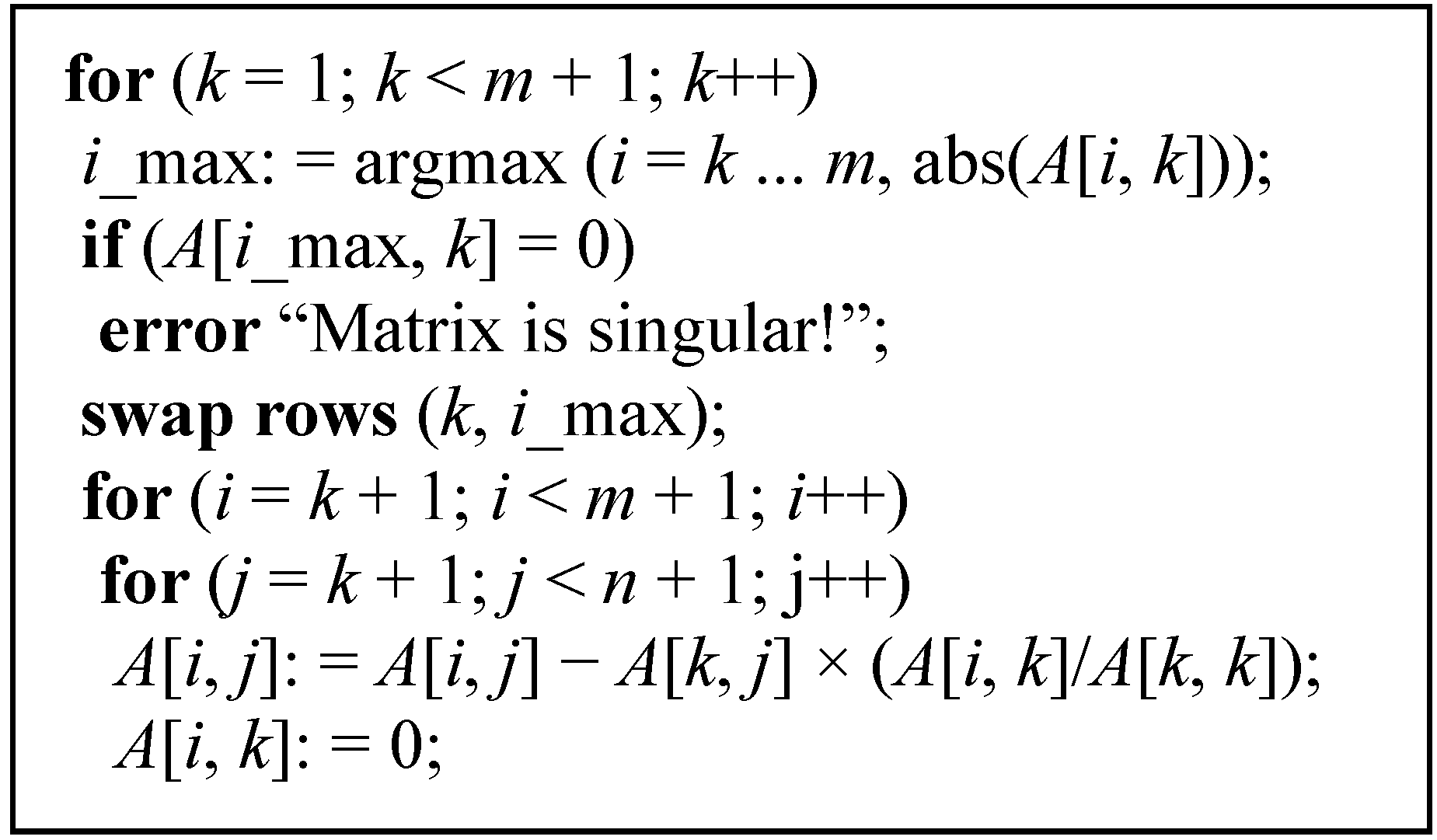
The Gaussian elimination algorithm as used in the proposed protocol is presented in Figure 3.
Figure 3. The pseudo-code of the Gaussian elimination algorithm used in ECHERP.
The proposed protocol performs clustering only once, at the initial stage. Hence, the protocol can avoid the time and energy consumed for re-clustering. The energy spent by the nodes in the network is modeled as a linear system, and the BS uses the Gaussian elimination algorithm in order to compute the energy consumpted by a node if it becomes a cluster head at the very next round by taking into consideration all possible combinations. Therefore, a combination that minimizes the overall energy consumption and prolongs the network is selected.
The process of Gaussian elimination is accomplished in two phases. During the first phase, by using the forward elimination technique, the rank of the system, which represents the energy spent, is reduced. This is accomplished through the use of elementary row operations. In the second phase, the back substitution technique is used in order to find the solution of the system above.
The energy consumption of a cluster head is based on the data reception of the messages sent to it by the cluster nodes and the data transmission of the messages sent from the cluster head to the upper level cluster heads or to the base station. The energy consumption of a cluster node is based on the data transmission of the messages sent to the cluster head.
Let us assume that a cluster consists of k nodes; matrix A represent the energy consumption of every node in the cluster and k the number of nodes in a cluster. aij Denotes the energy consumed by node i if node j is the cluster head. Additionally, bi denotes the residual energy of node i, while xi expresses the times that node i can become a cluster head. In this way, matrices B and X are formed, so that A·X = B, as shown in Equation 3.
[ a 11 a 12 a 13 a 14 a 1 k a 21 a 22 a 23 a 24 a 2 k a 31 a 32 a 33 a 34 a 3 k a 41 a 42 a 43 a 44 a 4 k a k 1 a k 2 a k 3 a k 4 a k k ] [ x 1 x 2 x 3 x 4 x k ] = [ b 1 b 2 b 3 b 4 b k ]

4. Performance Evaluation of ECHERP

In order to evaluate the performance of ECHERP simulations, over 50 different 100 m × 100 m network topologies were performed. The network architecture considered is the following:
  • A fixed base station is located away from the sensor field.
  • The sensor nodes are energy constrained with uniform initial energy allocation.
  • Each node senses the environment at a fixed rate and always has data to send to the base station (data are sent if an event occurs).
  • The sensor nodes are assumed to be immobile. However, the protocol can also support node mobility.
  • The network is homogeneous, and all the nodes are equivalent, i.e., they have the same computing and communication capacity.
  • The network is location unaware, i.e., the physical location of nodes is not known in advance.
  • The transmitter can adjust its amplifier power based on the transmission distance.
The aforementioned network architecture is typical of numerous applications of hierarchical WSNs, such as in environment and habitat monitoring, surveillance and reconnaissance, home automation, biomedical applications, object tracking, traffic control, fire detection, inventory control, agriculture, machine failure diagnosis and energy management [10].
In a real application of the proposed protocol, it may be used in a fire monitoring system in a set of buildings where the sensors in each building are grouped in the same cluster that send the data to the cluster of the next building.
The simulation was performed by developing a customized software environment based on Java programming language. In all the simulation scenarios examined, 500 homogeneous nodes with an initial energy of 2 J were randomly scattered within a 100 × 100 m2 sensor field. The base station was positioned at point (0, 150), so it is at least 100 m away from the closest node, and the packets sent were 500 bytes. The energy consumption due to communication is calculated using the first order energy model described in the previous subsection. We assume that each sensor node is immobile and generates one data packet per round to be transmitted to the BS. The sensor nodes were grouped into clusters consisting of cluster heads that send data to upper level cluster heads in order to finally reach the BS.
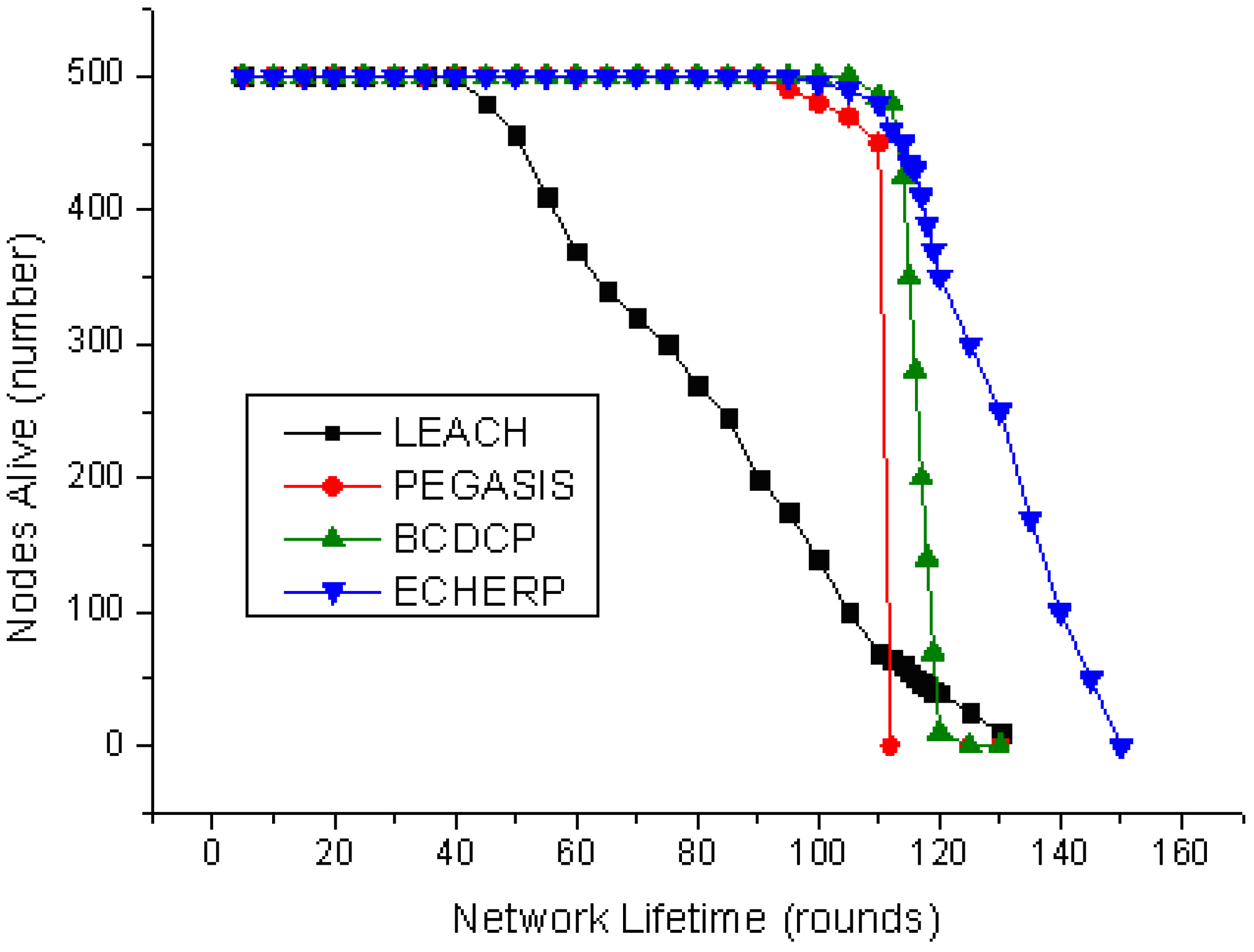
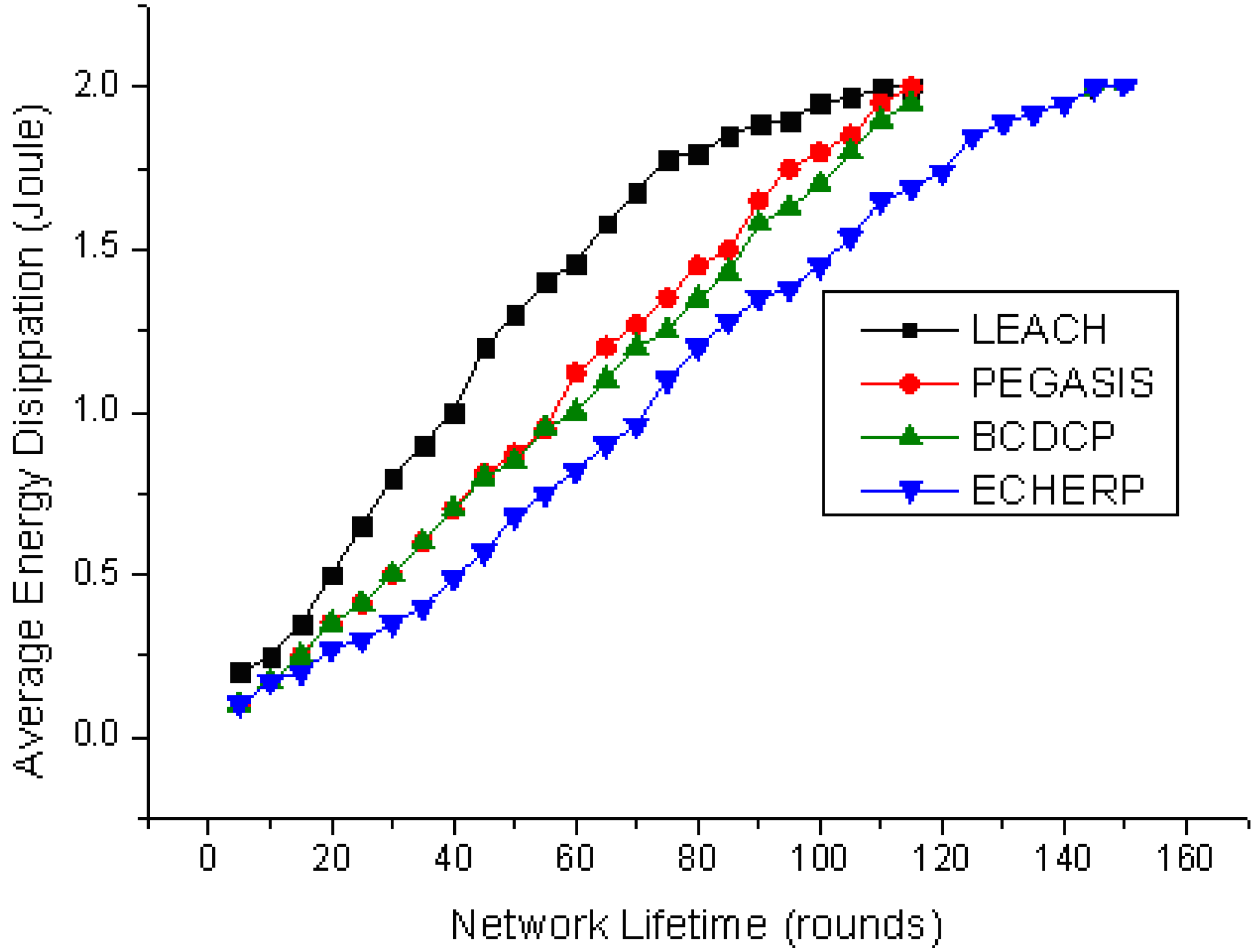
Figure 4 and Figure 5 show the average energy dissipation and the number of nodes that remain alive when LEACH, PEGASIS, BCDCP and ECHERP are applied. The Node Ratio (Nr), as explained in (4) is equal to 1. As these figures depict, the performance of ECHERP is considerably better than LEACH, PEGASIS and BCDCP. More precisely, in the case of LEACH, PEGASIS and BCDCP, all the network nodes are depleted by the end of the 110th, 115th and 120th round, respectively. On the other hand, when ECHERP is applied, the last remaining node is depleted in the 145th round.
Figure 4. Average energy dissipation versus the network lifetime in rounds.
Figure 5. Number of nodes alive versus the network lifetime in rounds.
Additionally, the performance of ECHERP is evaluated as a function of the ratio of upper level and lower level nodes. More precisely, it is true that the upper level cluster heads not only transmit their own data to the base station, but they also forward the data of the lower level cluster heads destined to the base station. Therefore, they have higher average energy dissipation than the lower level nodes. In order to correlate the performance of ECHERP with the distribution of nodes in network topology, the node ratio Nr is defined as follows:
N r = n u n l
where Σnu is the number of nodes at the upper level and Σnl the number of nodes at the lower levels.
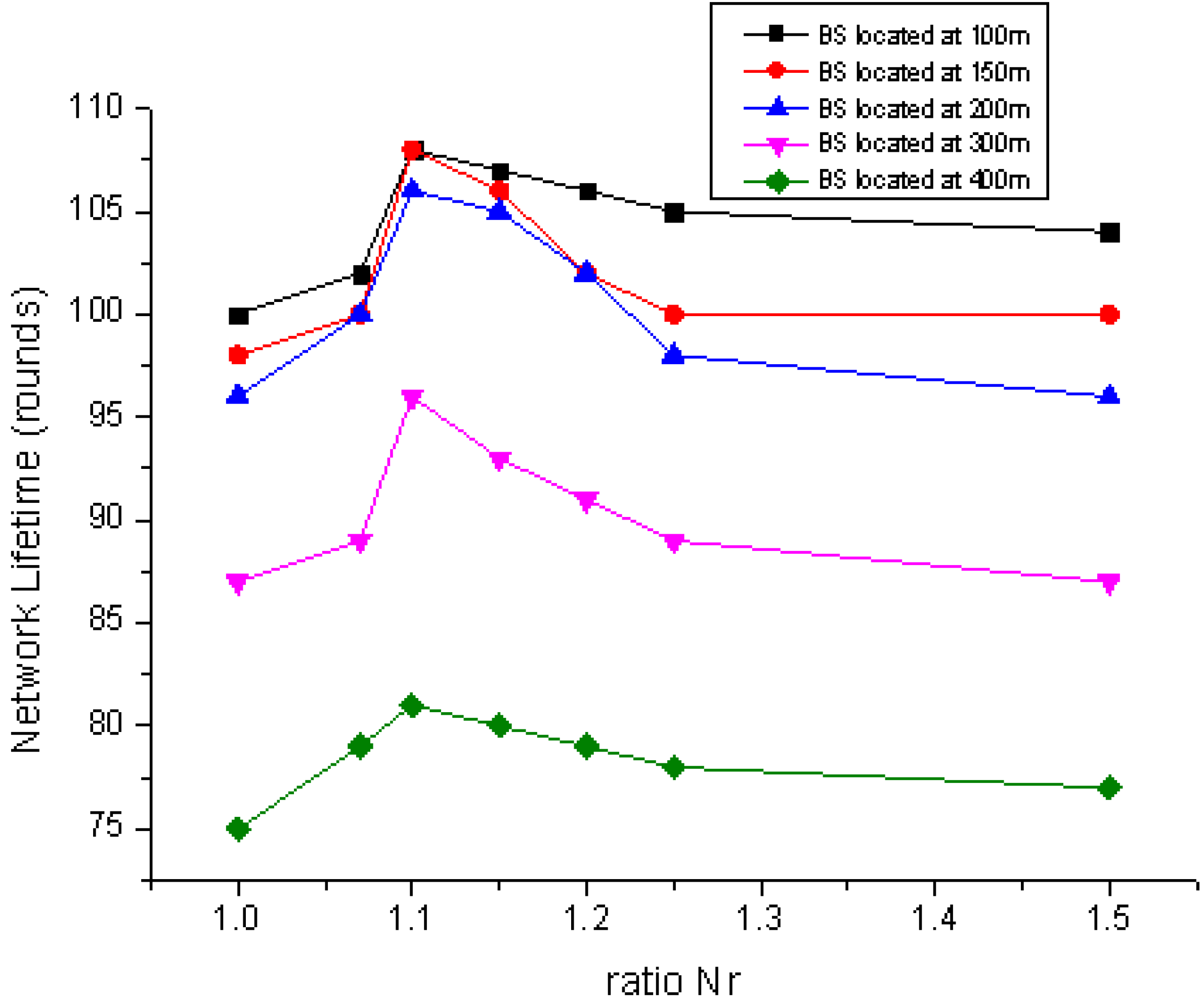
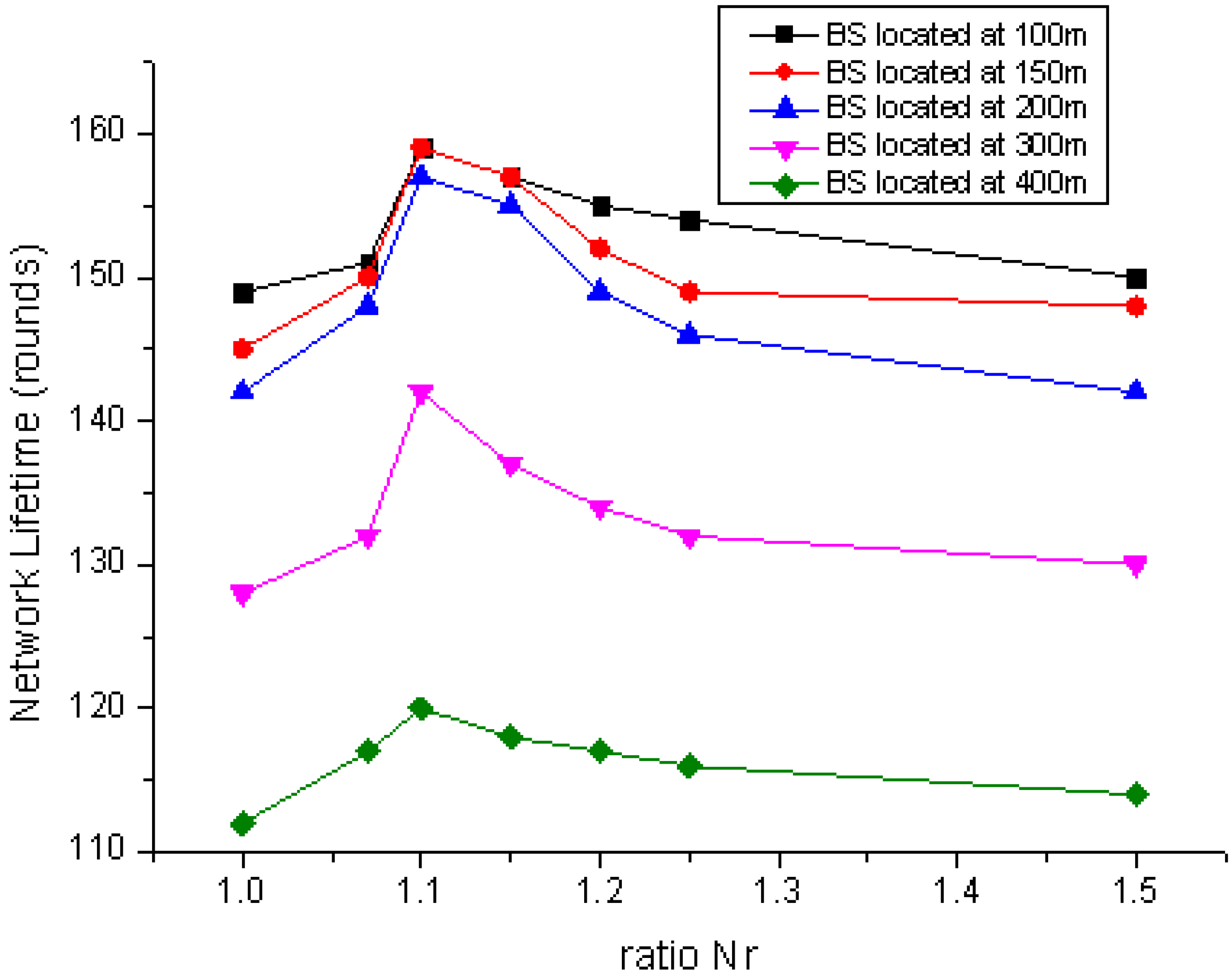
Simulation tests showed that the best energy efficiency is achieved when the BS is located 150 m away from the center of the network field and the number of upper level nodes is by 10% greater than the number of lower level nodes. This is graphically displayed in Figure 6 and Figure 7.
Figure 6. Last node depletion time in rounds versus Nr as base station (BS0 is located 100 m, 150 m, 200 m, 300 m and 400 m away from the center of the network field.
Figure 7. First node depletion time in rounds versus Nr as BS is located 100 m, 150 m, 200 m, 300 m and 400 m away from the center of the network field.
A more analytical description of the effects of the use of the two protocols in comparison may be derived by focusing on the first node depletion time, the last node depletion time and the average energy consumption. Table 1 summarizes the results, concerning these metrics which are illustrated in Figure 4 and Figure 5 in the case of uniform energy distribution.
Table 1. Comparison of ECHERP to LEACH, PEGASIS and BCDCP as a function of the distance of the base station from the center of the sensor field when the initial node energy is set to 2 J.
Distance between the Base Station and the Center of the WSN Field (m)First Node Depletion Time (%)Last Node Depletion Time (%)Mean Energy Consumption (%)Compared Protocol
150+98+7.5−25.05LEACH
150+5+30−19.12PEGASIS
150−10+16−17.25BCDCP
In Table 2 and Table 3, the simulation results, which are illustrated in Figure 6 and Figure 7, concerning the base station located at a distance of 150 m and 300 m from the center of the sensor field are presented. In both tables, it is shown that the proposed protocol has better performance when the node ratio Nr of the nodes of the upper level to nodes of the lower level is 1.1 for the network.
Table 2. Percentage of change in WSN performance by the use of ECHERP as a function of the node ratio Nr when the base station is located 150 m away the center of the sensor field.
Node Ratio Nr of Nodes on upper versus Nodes on Lower LevelFirst Node Depletion Time (%)Last Node Depletion Time (%)Mean Energy Consumption (%)
1---
1.07+2+3.5−2.5
1.1+10+10−5.7
1.15+8.2+8−4.5
1.2+4+4.8−3.2
1.25+2+2.7−2.1
1.5+2+2−1.9
Table 3. Percentage of change in WSN performance by the use of ECHERP over the Node Ratio r when the base station is located 300m away from the center of the sensor field.
Node ratio Nr of Nodes on Upper versus Nodes on Lower LevelFirst Node Depletion Time (%)Last Node Depletion Time (%)Mean Energy Consumption (%)
1---
1.07+2.1+3.1−2.2
1.1+10+10−5.7
1.15+6.8+7−3.5
1.2+4.9+4.6−3.2
1.25+2.1+3.1−2.5
1.5+0.1+1.5−1.5

5. Conclusions

In this paper, ECHERP, an energy efficient protocol for WSNs, was presented. ECHERP considers the current and the estimated future residual energy of the nodes, along with the number of rounds, that can be cluster heads in order to maximize the network lifetime. The protocol computes the energy consumed using the Gaussian elimination algorithm in order to minimize the overall network energy consumption at every single round. Therefore, it elects as a cluster head the node that minimizes the total energy consumption in the cluster and not the node with the higher energy left, as in many other protocols. ECHERP also adopts a multi-hop routing scheme to transfer fused data to the base station. Therefore, ECHERP achieves substantial energy efficiency, as shown through simulation tests, which indicates that ECHERP outperforms several previously proposed protocols, namely LEACH, PEGASIS and BCDCP. In future work, ECHERP can be further enhanced by taking into consideration metrics related to QoS and time constraints.

References

  1. Akyildiz, I.F.; Su, W.; Sankarasubramaniam, Y.; Cayirci, E. Wireless sensor networks: A survey. Comput. Netw. 2002, 38, 393–422. [Google Scholar] [CrossRef]
  2. Yick, J.; Mukherjee, B.; Ghosal, D. Wireless sensor network survey. Comput. Netw. 2008, 52, 2292–2330. [Google Scholar] [CrossRef]
  3. Kandris, D.; Tsioumas, P.; Tzes, A.; Nikolakopoulos, G.; Vergados, D. Power conservation through energy efficient routing in wireless sensor networks. Sensors 2009, 9, 7320–7342. [Google Scholar] [CrossRef] [PubMed]
  4. Jin, Z.; Ping, Y.; Wang, Z.; Ping, L.; Guang, L. A survey on position-based routing algorithms in wireless sensor networks. Algorithms 2009, 2, 158–182. [Google Scholar] [CrossRef]
  5. Liao, W.; Chang, K.; Kedia, S. An Object Tracking Scheme for Wireless Sensor Networks using Data Mining Mechanism. In Proceedings of the Network Operations and Management Symposium, Maui, HI, USA, 2012; pp. 526–529. [Green Version]
  6. Tubaishat, M.; Zhuang, P.; Qi, Q.; Shang, Y. Wireless sensor networks in intelligent transportation systems. Wirel. Commun. Mob. Comput. 2009, 9, 287–315. [Google Scholar] [CrossRef]
  7. Wood, A.; Stankovic, J.; Virone, G.; Selavo, L.; Zhimin, H.; Qiuhua, C.; Thao, D.; Yafeng, W.; Lei, F.; Stoleru, R. Context-Aware wireless sensor networks for assisted living and residential monitoring. Network 2008, 22, 26–33. [Google Scholar] [CrossRef]
  8. Alemdar, A.; Ibnkahla, M. Wireless Sensor Networks: Applications and Challenges. In Proceedings of the 9th International Symposium on Signal Processing and Its Applications, Sharjah, United Arab Emirates, 2007; pp. 1–7. [Green Version]
  9. Vidhyapriya, R.; Vanathi, P. Energy Aware Routing for Wireless Sensor Networks. In Proceedings of the International Conference on Signal Processing, Communications and Networking, Chennai, India, 2007; pp. 545–550. [Green Version]
  10. Nikoletseas, S.; Spirakis, P.G. Probabilistic Distributed Algorithms for Energy Efficient Routing and Tracking in Wireless Sensor Networks. Algorithms 2009, 2, 121–157. [Google Scholar] [CrossRef]
  11. Heinzelman, W.; Chandrakasan, A.; Balakrishnan, H. Energy-Efficient Communication Protocol for Wireless Microsensor Networks. In Proceedings of the 33rd Hawaii International Conference on System Sciences, Hawaii, HI, USA, 2000; pp. 1–10. [Green Version]
  12. Lindsey, S.; Raghavendra, C. PEGASIS: Power-Efficient GAthering in Sensor Information Systems. In Proceedings of the IEEE Aerospace Conference, Los Angeles, MT, USA, 2000; pp. 1125–1130. [Green Version]
  13. Jung, S.; Han, Y.; Chung, T. The Concentric Clustering Scheme for Efficient Energy Consumption in the PEGASIS. In Proceedings of the 9th International Conference on Advanced Communication Technology, Gangwon-Do, Korea, 2007; pp. 260–265. [Green Version]
  14. Manjeshwar, A.; Agrawal, D. Teen: A Routing Protocol for Enhanced Efficiency in Wireless Sensor Networks. In Proceedings of the 15th International Parallel and Distributed Processing Symposium (IPDPS’01) Workshops, San Francisco, CA, USA, 2001; pp. 2009–2015. [Green Version]
  15. Yang, Y.; Wu, H.; Chen, H. SHORT: Shortest Hop Routing Tree for Wireless Sensor Networks. In Proceedings of the IEEE International Conference on Communications, Istanbul, Turkey, 2006; pp. 3450–3454. [Green Version]
  16. Lotf, J.; Bonab, M.; Khorsandi, S. A Novel Cluster-based Routing Protocol with Extending Lifetime for Wireless Sensor Networks. In Proceedings of the 5th International Conference on Wireless and Optical Communications Networks, Surabaya, India, 2008; pp. 1–5. [Green Version]
  17. Allirani, A.; Suganthi, M. An Energy Efficient Cluster Formation Protocol with Low Latency In Wireless Sensor Networks. World Acad. Sci., Eng. Tech. 2009, 51, 1–7. [Google Scholar]
  18. Muruganathan, S.; Ma, D.; Bhasin, R.; Fapojuwo, A. A Centralized Energy-Efficient Routing Protocol for Wireless Sensor Networks. IEEE Radio Commun. 2005, 43, 8–13. [Google Scholar] [CrossRef]

Article Metrics

Citations

Article Access Statistics

Multiple requests from the same IP address are counted as one view.