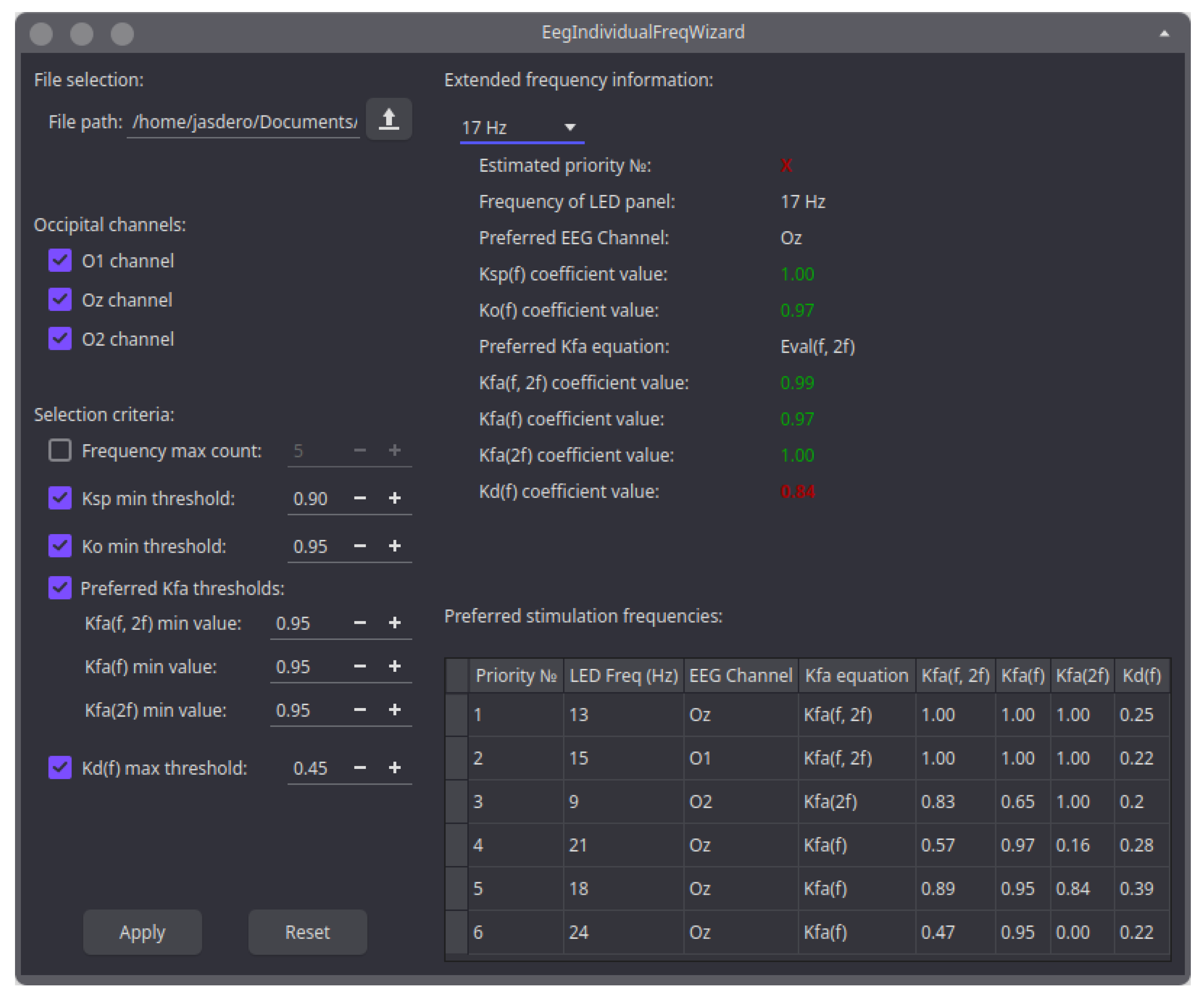



Automating Stimulation Frequency Selection for SSVEP-Based Brain-Computer Interfaces


Abstract
Share and Cite
Kozin, A.; Gerasimov, A.; Bakaev, M.; Pashkov, A.; Razumnikova, O. Automating Stimulation Frequency Selection for SSVEP-Based Brain-Computer Interfaces. Algorithms 2023, 16, 502. https://doi.org/10.3390/a16110502
Kozin A, Gerasimov A, Bakaev M, Pashkov A, Razumnikova O. Automating Stimulation Frequency Selection for SSVEP-Based Brain-Computer Interfaces. Algorithms. 2023; 16(11):502. https://doi.org/10.3390/a16110502
Chicago/Turabian StyleKozin, Alexey, Anton Gerasimov, Maxim Bakaev, Anton Pashkov, and Olga Razumnikova. 2023. "Automating Stimulation Frequency Selection for SSVEP-Based Brain-Computer Interfaces" Algorithms 16, no. 11: 502. https://doi.org/10.3390/a16110502
APA StyleKozin, A., Gerasimov, A., Bakaev, M., Pashkov, A., & Razumnikova, O. (2023). Automating Stimulation Frequency Selection for SSVEP-Based Brain-Computer Interfaces. Algorithms, 16(11), 502. https://doi.org/10.3390/a16110502