
Abstract
In order to better decompose the images and protect their edges, in this paper, we proposed a coupled variational system consisting of two steps. The first step, an improved weighted variational model is introduced to obtain the cartoon and texture. Using the obtained cartoon image, in the second step, a new vector function is obtained for describing the pseudo edge of the considered image by one Tikhonov regularization variational model. Because Tikhonov regularization model is equivalent to carrying out a Gaussian linear filtering, the obtained vector function is smoother. To solve the coupled system, we give the alternating direction method, primal-dual method and Gauss-Seidel iteration. Using the coupled system, we can not only separate out the cartoon and texture parts, but also extract the edge. Extensive numerical experiments are given to show the effectiveness of the proposed method compared with other variational methods.
1. Introduction
Image decomposition is an important research topic in the field of image processing. The purpose is to decompose a given image into the different parts. For example, for a noise-free image, we can split it into cartoon and texture; for a noisy smooth image, we can split it into cartoon and noise. The cartoon part (also called structure component) is ideally piecewise smooth parts corresponding to the main objects; the texture part usually refers to the fine scale details consisting of repetitive patterns presented in the original image.
Variational methods for image decomposition have become very popular in recent years. Their aims are to find the appropriate priors to describe the cartoon and texture components so that the two components have respective small norms in their corresponding functional spaces [1,2,3,4,5,6,7,8,9,10,11,12,13,14,15]. For example, a classical variational model was proposed by Rudin et al. [1]. The cartoon component belongs to the bounded variation space and the noise or small scale texture component is in . The model denoises well for the piecewise-constant images while preserving sharp edges. However, some details can be destroyed. Consequently, Meyer [2] introduced the dual spaces of bounded variation space to model the oscillating patterns and pointed out that the oscillating patterns should have small norm in these dual spaces. However, Meyer’s model can not directly give its numerical solutions. To solve the difficulty, the authors in [3,4,5,6] designed different approximation models. Other methods based on total variation (TV) can be seen in [7,8,9,10,11,12,13,14,15]. As is well known, TV regularization easily tends to make the staircase effect. To reduce the staircase effect, some higher-order and nonlocal variational models were discussed in [16,17,18,19,20,21] for image decomposition.
Different from the above approaches, Xu et al. [22] proposed a relative TV regularization model with the windowed TV norm. Based on sparse approximation theory, Starck et al. [23] and Cai et al. [24] designed two different dictionaries and tight frames for the cartoon and texture respectively. Based on the discriminative patch recurrence prior, Xu et al. [25] constructed an effective approach for cartoon-texture decomposition. Through the relative variation of gradient, Buades et al. [26] designed a fast filter method for cartoon-texture decomposition. By increasing the size of the parameter, multiscale methods for image decomposition were studied in [27,28,29,30]. Using the texture similarity, some low rank techniques for image decomposition were proposed in [31,32,33,34,35].
With the development of deep learning, some deep unfolding learning methods for image decomposition were studied in [36,37]. However, on the one hand, it is difficult to find the original cartoon and texture data for training, on the other hand, deep unfolding networks have to adopt the input and the output of each stage as an image, which inevitably results in feature-to-image information distortion [38]. So it is difficult for us to get good decomposition results based on deep learning method. In addition, [36,37] are based on model which is not suitable for image decomposition [2].
Recently, Surya Prasath et al. [39] introduced a coupled system for image restoration by combining a constrained partial differential equation (PDE) with weighted TV. Substituting the first equation of the coupled system in [39] by the weighted regularization model, Moreno et al. [40] proposed a new coupled system and gained some better image denoising and decomposition results. Because model is not suitable for additive Gaussian noise, a higher order variational system was proposed by Xu et al. [11]. Inspired by [11,39,40], in this paper, we give a new different coupled system which contains two variational minimal models. One is for cartoon-texture decomposition model which adopts norm to describe the oscillation part, the other is a Tikhonov regularization model for the smoothed vector field. These two models are intertwined, that is, the smooth vector field can affect the cartoon-texture decomposition result. In turn, the decomposed cartoon image can also affect the vector field result. Some numerical examples will be given to highlight the decomposition nature of the proposed model along with some comparison results.
2. Prior Work
To improve the denoising capability, Perona-Malik (PM) [41] discussed the following PDE of anisotropic diffusion
where , is a contrast parameter. Due to the impact of noise, the computation of gradient is not robust to outliers. Hence, with the aid of the Gaussian convolution, Catté et al. [42] introduced the modified model
where is the Gaussian kernel function and means convolution. Because Gaussian smoothing is equivalent to solving the heat diffusion equation, Surya Prasath et al. [39] used an auxiliary variable to split Equation (1) into the following PDEs system
where is a balancing parameter. Later, the authors in [40] used a weighted model to replace Equation (3) and considered the following coupled variational model
where is an adaptive parameters, is called the pseudo edge function.
Because Equation (5) is not suitable for Gaussian noise, and the solutions of Equations (4) and (6) are not the same as the form of Equation (2), Xu et al. [11] proposed the following high order coupled model
where are positive parameters, is the observed image.
3. The Proposed Model and Algorithm
3.1. The Proposed Model
Meyer [2] pointed out that the oscillatory components should use a weaker norm to describe, Equations (3), (5) and (7) are not suitable for image decomposition, and Meyer gave the following model
where represents the dual norms (see details in [2]).
Because Equation (9) is hard to compute its numerical solution, Vese and Osher [3] gave an approximation model of (9) as follows.
where are positive tuning parameters, represents the texture component and represents the cartoon component.
With the Hodge decomposition of in [4], then , where is a single-valued function and is a divergence-free vector field. Letting , we have by ignoring , where is the Laplace operator, its inverse operator. Setting then Equation (10) can be turned into the following model:
Combining Equations (11) and (8), we study the following coupled variational system for image decomposition:
where is defined as Equation (1), are the positive parameters, is an observed image, is the cartoon image, and is the texture image or noise. Similar to the definition of [11,39,40], the norm of is called the pseudo edge function.
The first term in (12) contains an edge indicator function and when , , it can preserve edges; when , then , it can remove some small details. The second term in (12) is the norm for describing the texture. The third term in (12) is a residual term. Compared with [11,39,40], mathematically, the proposed model is more suitable for image decomposition.
3.2. Algorithm
We now firstly give the detail algorithm for (12), which can be turned into the following two coupled problems:
For fixed, we solve
For fixed, we have
For (14), using the Legendre-Fenchel’s transformation, it becomes
where , .
Then (16) can be solved by the primal-dual method
where are the positive parameters.
Minimizing (15) with respect to results in the following Euler-Lagrange equation:
which can be solved by Gauss-Seidel iteration.
For (13), the corresponding Euler-Lagrange equation is
and we can solve it using the Gauss-Seidel iteration.
From the above derivation, we now summarize the detail algorithm for the coupled system as Algorithm 1:
| Algorithm 1 Given the initial value. |
| Step 1: Compute by (17), Step 2: Compute by (18), Step 3: Compute by (19), Until: A stopping criterion is satisfied; otherwise set and return to Step 1. |
4. Experimental Results and Discussion
In this section, we would like to show some numerical results for different methods. The best results are shown according to the stopping condition or the max iteration number.
4.1. The Parameters Selection Discussion
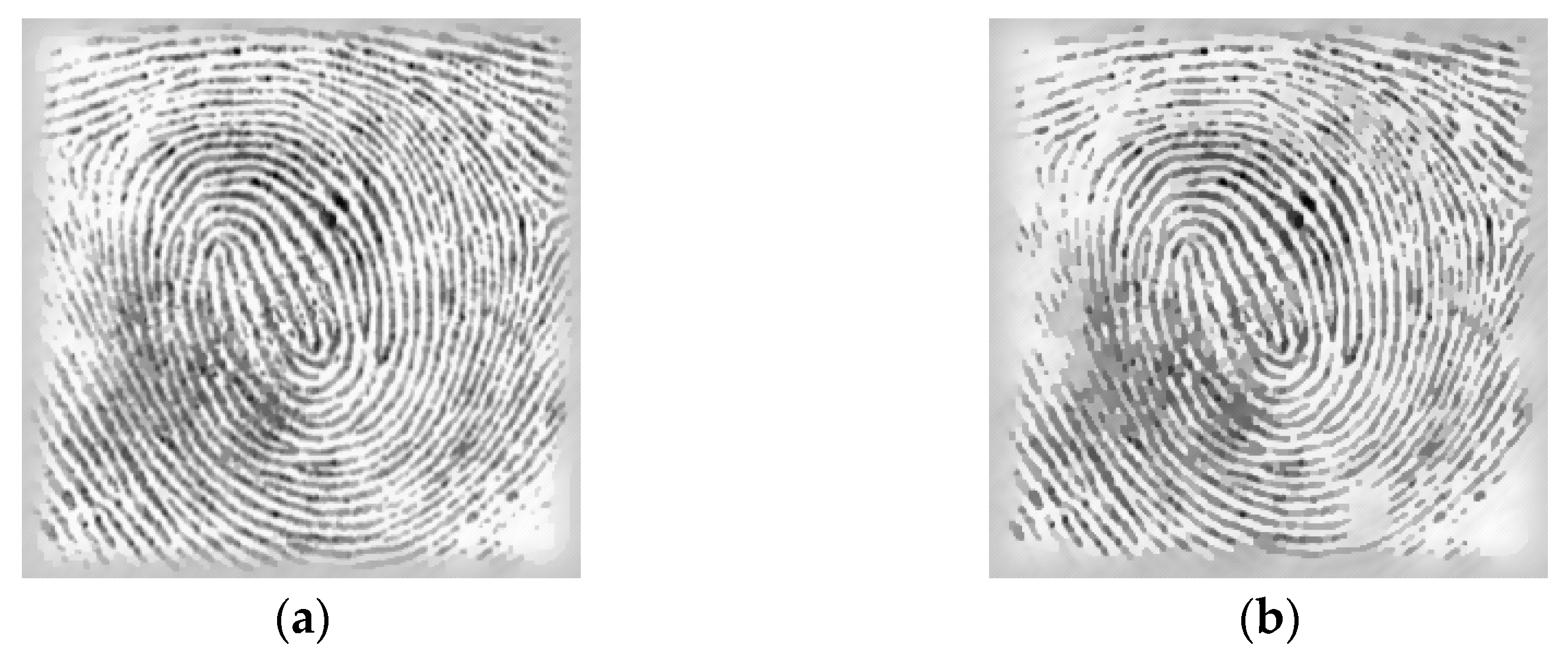
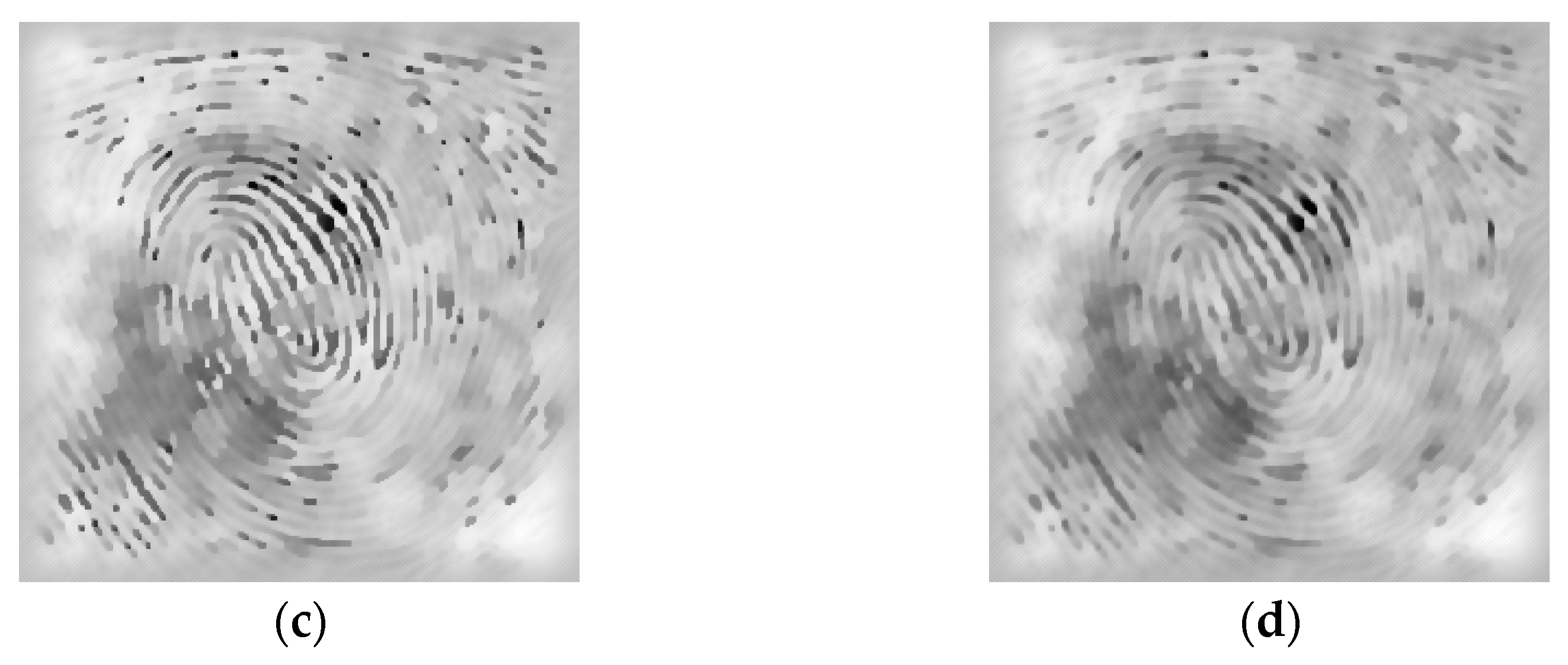
For proposed method, these parameters need to be given to run the algorithm. For , we find that when it is smaller, the cartoon image will become smoother. Once is determined, we fix and change the other parameters, we find that when and it is smaller and smaller, the cartoon image will become smoother and smoother. To see these experimental phenomena more clearly, we take the Finger image as an example and fix to change and obtain the flowing results in Figure 1.

Figure 1.
Results for different . (a) ; (b) ; (c) ; (d) .
For , if it is larger and larger, the pseudo edge image will get thicker and thicker, the cartoon becomes more and more blurred. In short, we choose in the following experiments, other parameters are adjusted according to different test images.
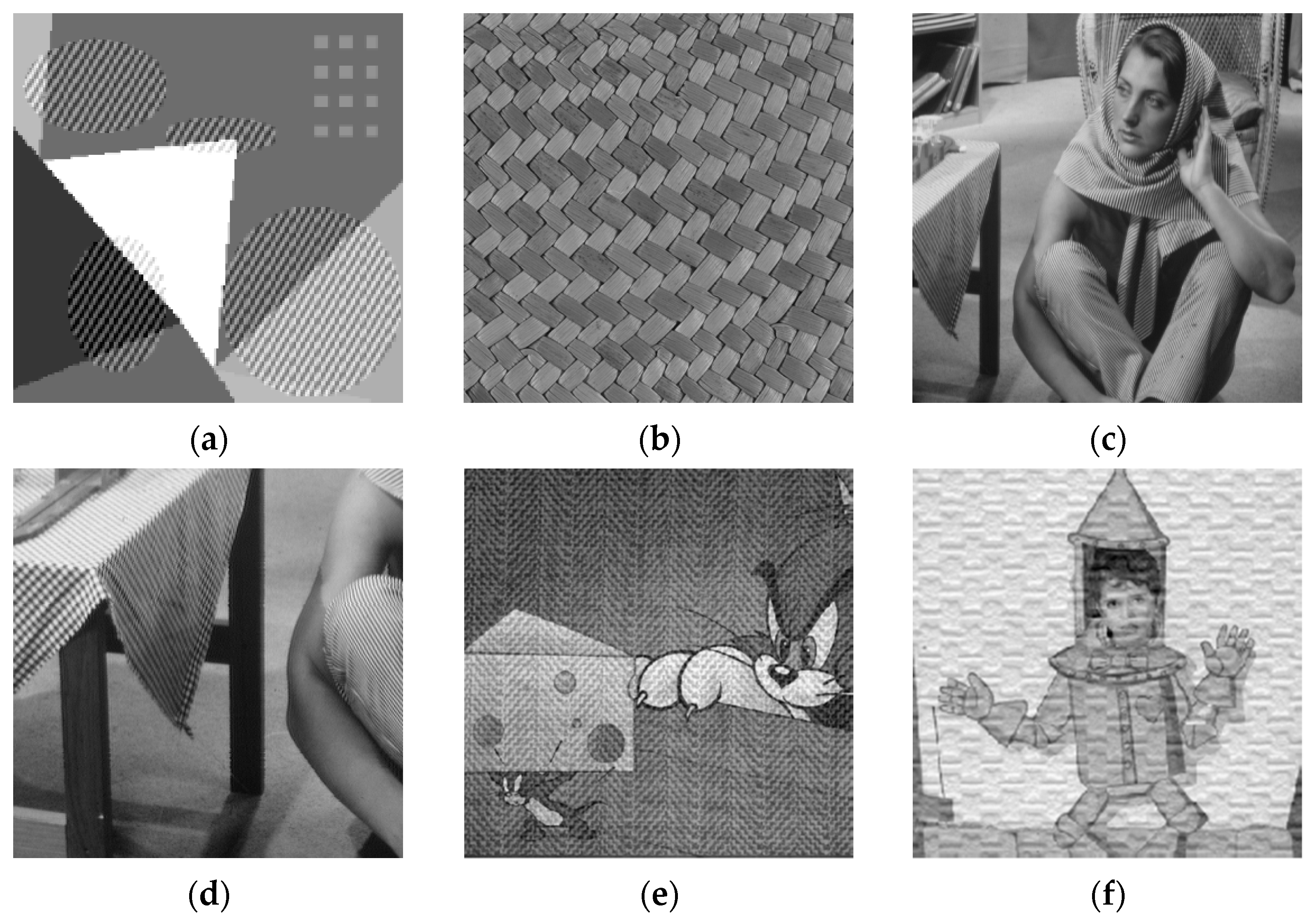
The test images are in Figure 2 and the stopping condition is or the maximum 400 iterations. The decomposition results are compared with them using [4,5,8,11,12,15,18,26,39,40], respectively.
Figure 2.
The test images. (a) Synthesis image; (b) Fabric image; (c) Barbara image; (d) Table image; (e) Tom image; (f) Boy image.
4.2. Image Decomposition Results Discussion
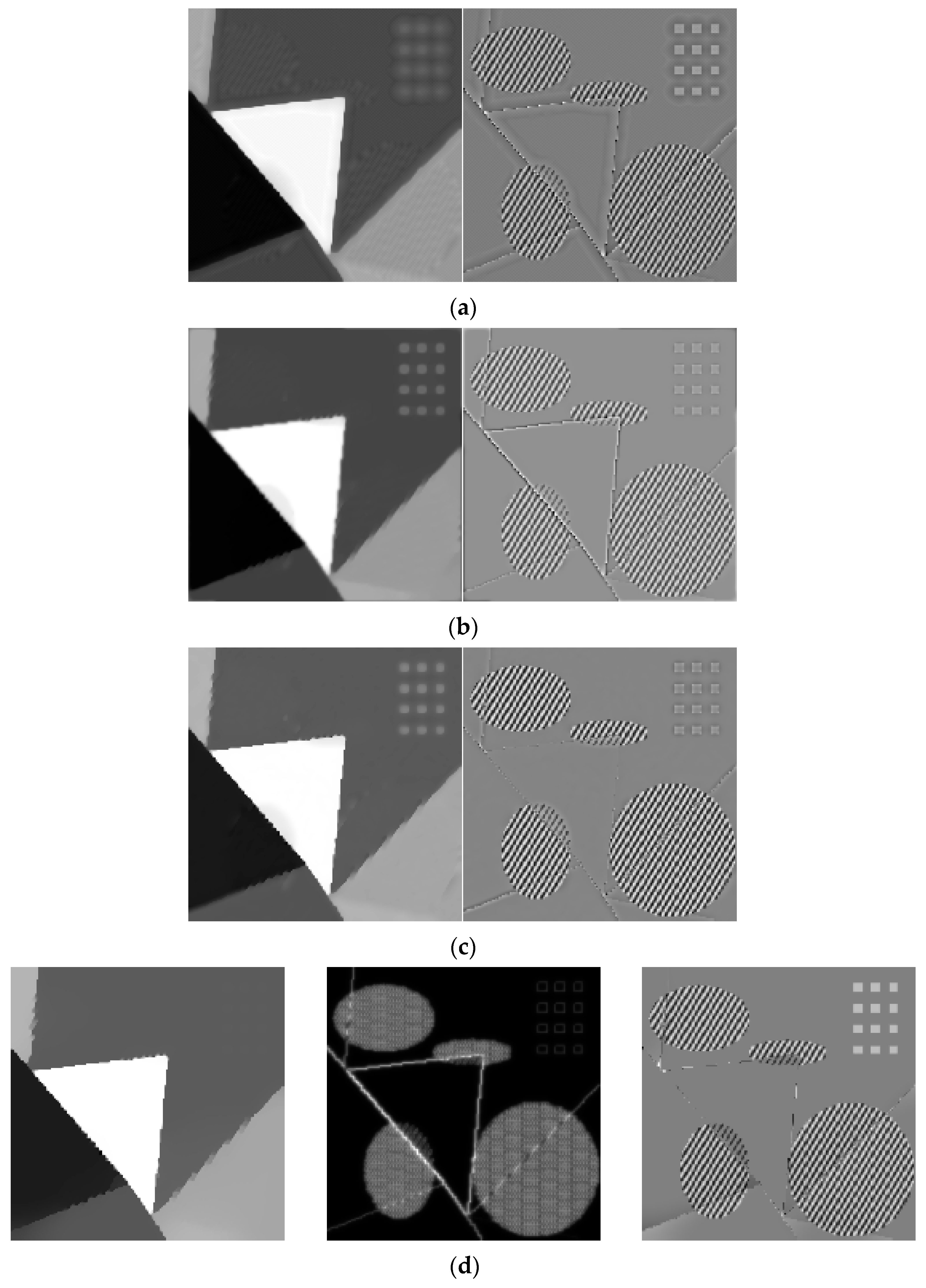
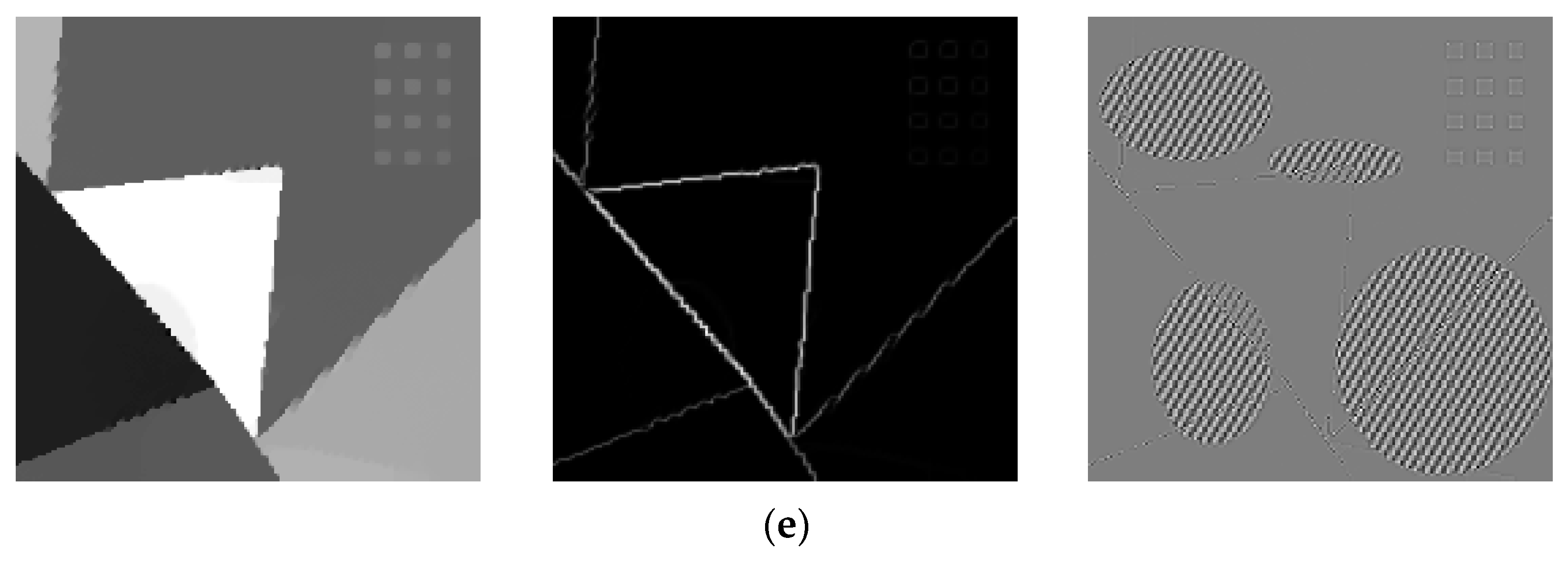
Figure 3 displays the decomposition results for Synthetic image. The parameters for the proposed model are . The parameters in [8] are taken . The parameters in [15] are . From Figure 3, we can see that the new model gains much better decomposition results and some edges are kept in the cartoon image. The other methods contain cartoon contours (edges) which were wrongly assigned to the texture component. For the pseudo edge function, we only give the results of [40] and ours, since other methods without it. From Figure 3d,e, we can see that the pseudo edge image appears many false edges in Figure 3d which are not consistent with the decomposed cartoon image (see some circular areas in Figure 3d), however the proposed method obtains the better results. In short, the proposed method is more effective than other four methods.

Figure 3.
The decomposition results using different algorithms. From left to right: (a) Cartoon and texture obtained by [4]. (b) Cartoon and texture obtained by [8]. (c) Cartoon and texture obtained by [18]. (d) Cartoon, the pseudo edge and texture obtained by [40]. (e) Cartoon, the pseudo edge and texture obtained by the proposed method.
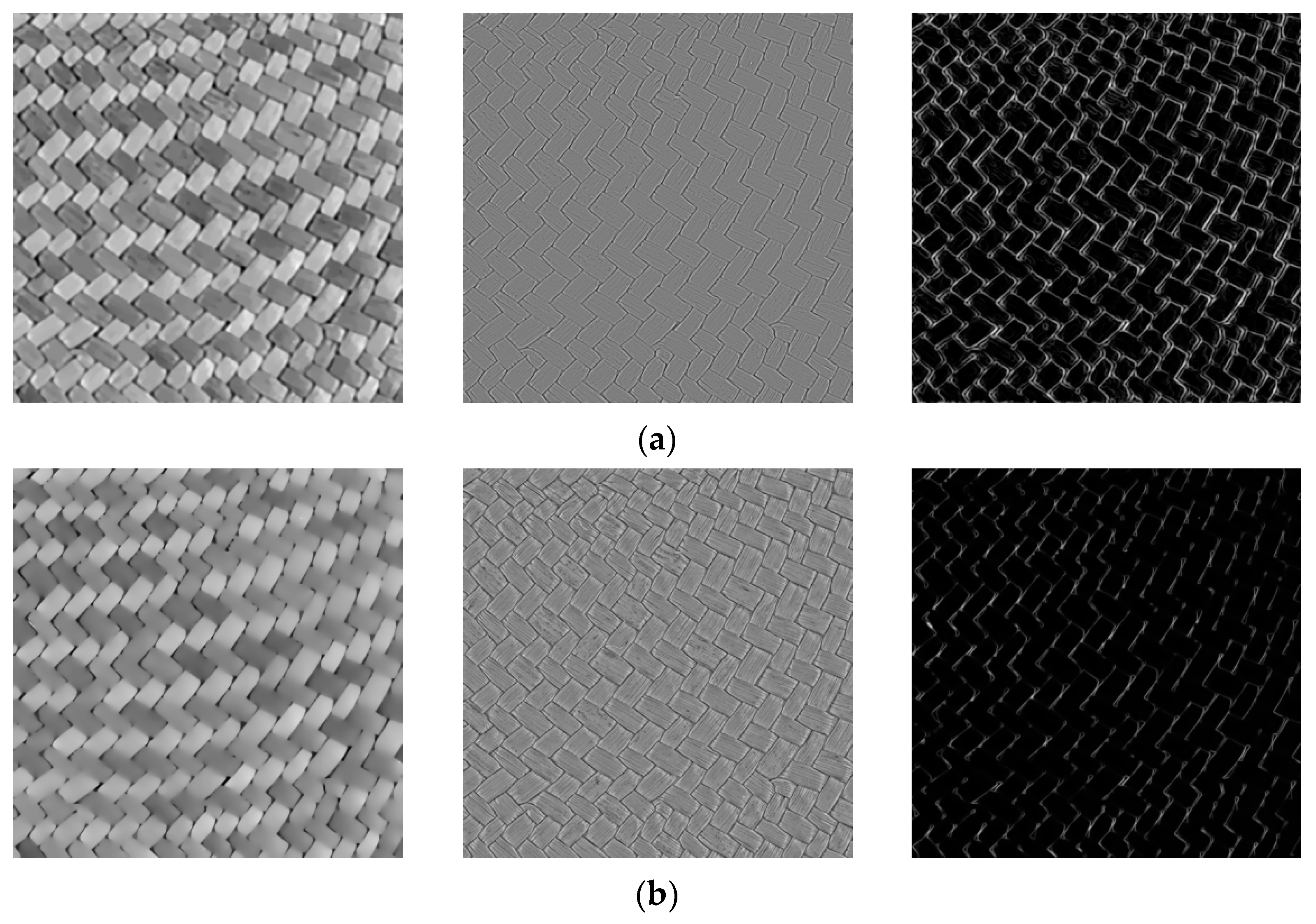
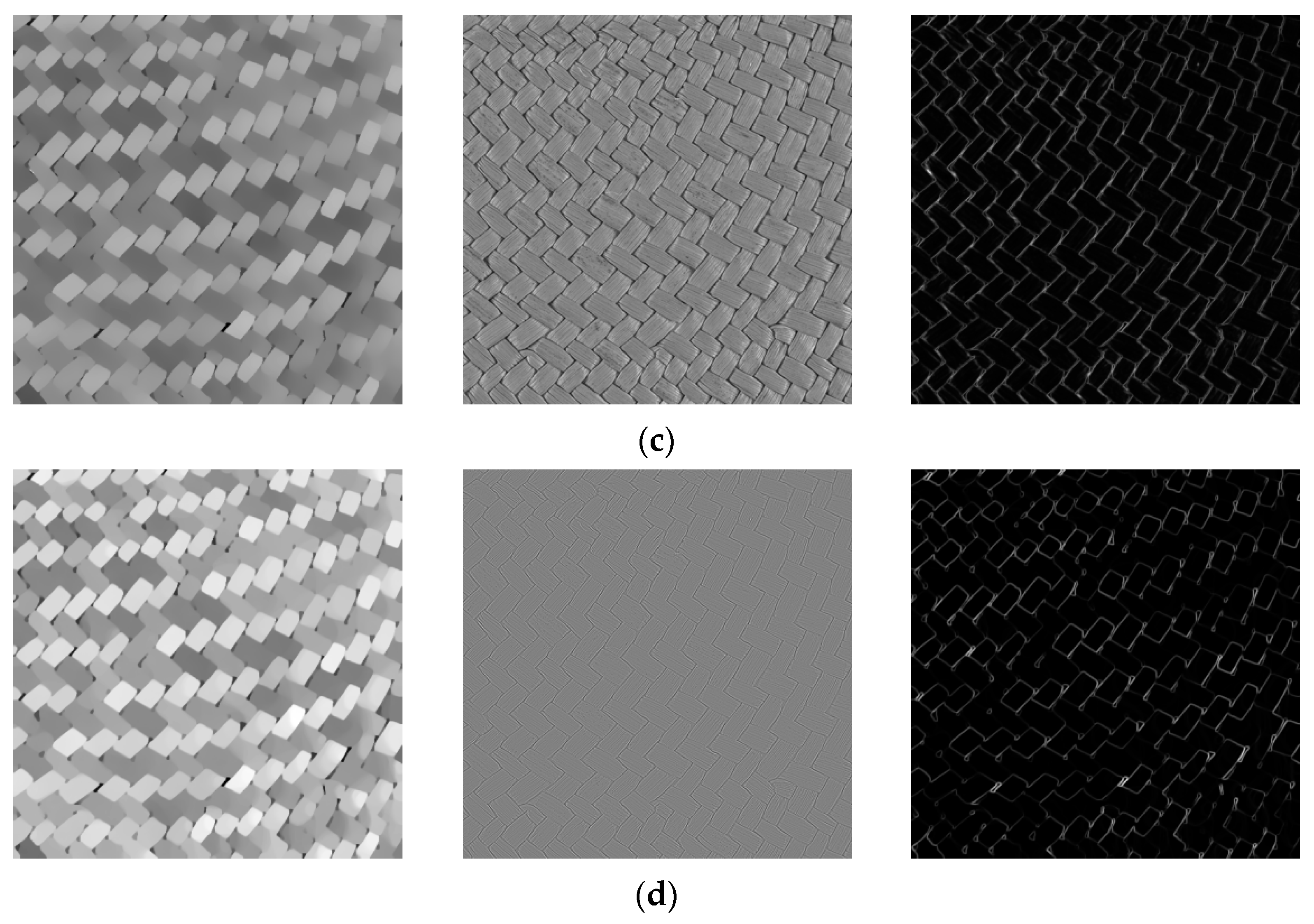
Figure 4 takes Fabric as the tested image, and the experimental parameters are taken respectively. Those parameters in [8] are manual mediated to achieve good results, which are selected . The parameters in [39] are . For the parameters in [40], are chosen. From Figure 4a–d, we can see that the texture images in Figure 4b,c contain more contours which should be retained in the cartoon image. However, these characteristics are not obvious in Figure 4a,b. In addition, from the perspective of vision, the separated cartoon by the proposed method is better than [8]. For the pseudo edge image in Figure 4, we can observe that the obtained pseudo edge using [40] doesn’t match the cartoon image.

Figure 4.
The decomposition results using different algorithms. From left to right: (a) Cartoon, texture and the module of gradient for the cartoon obtained by [8]. (b) Cartoon, texture and the pseudo edge obtained by [39]. (c) Cartoon, texture and the pseudo edge obtained by [40]. (d) Cartoon, texture and the pseudo edge obtained by the proposed method.
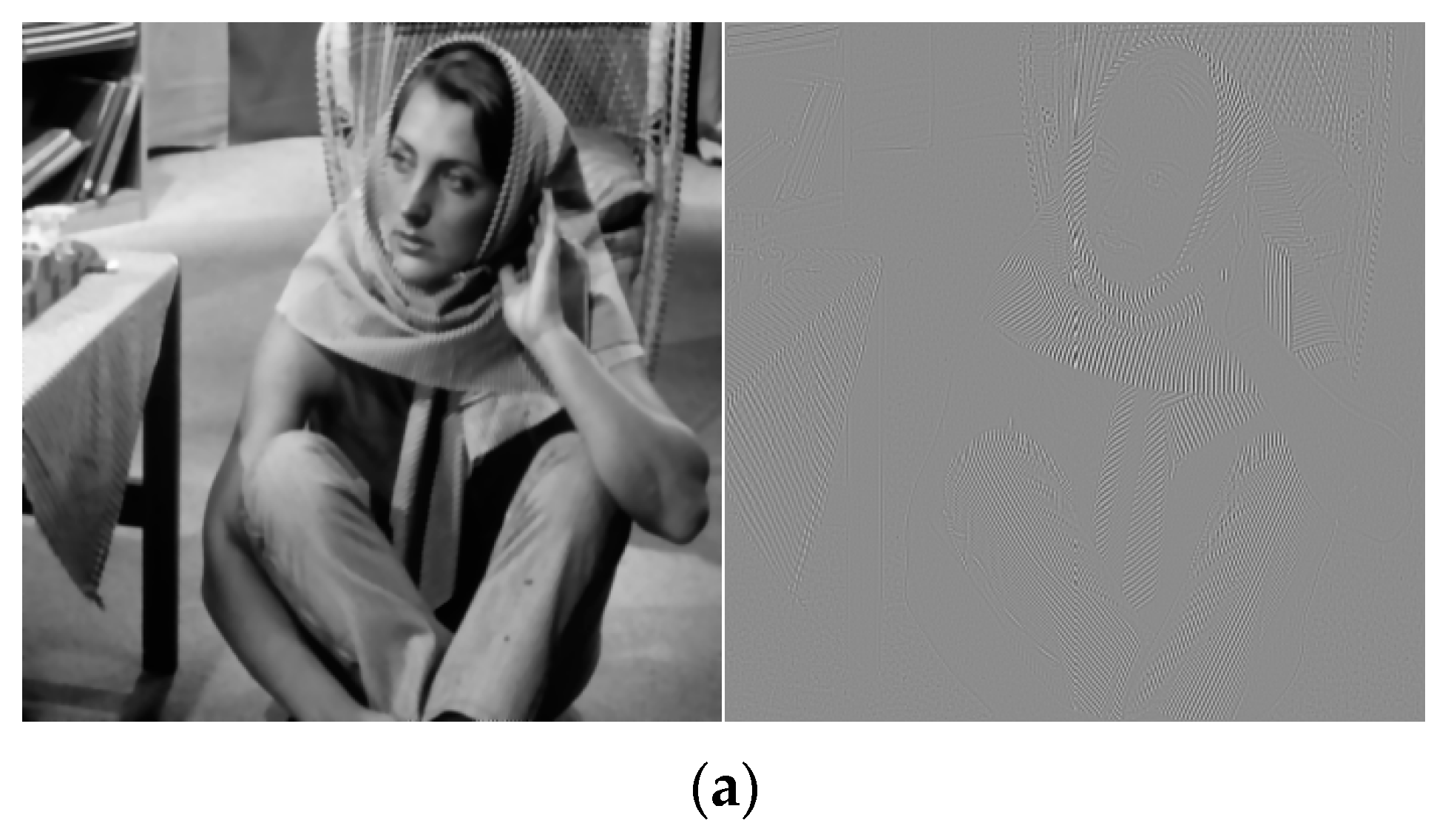
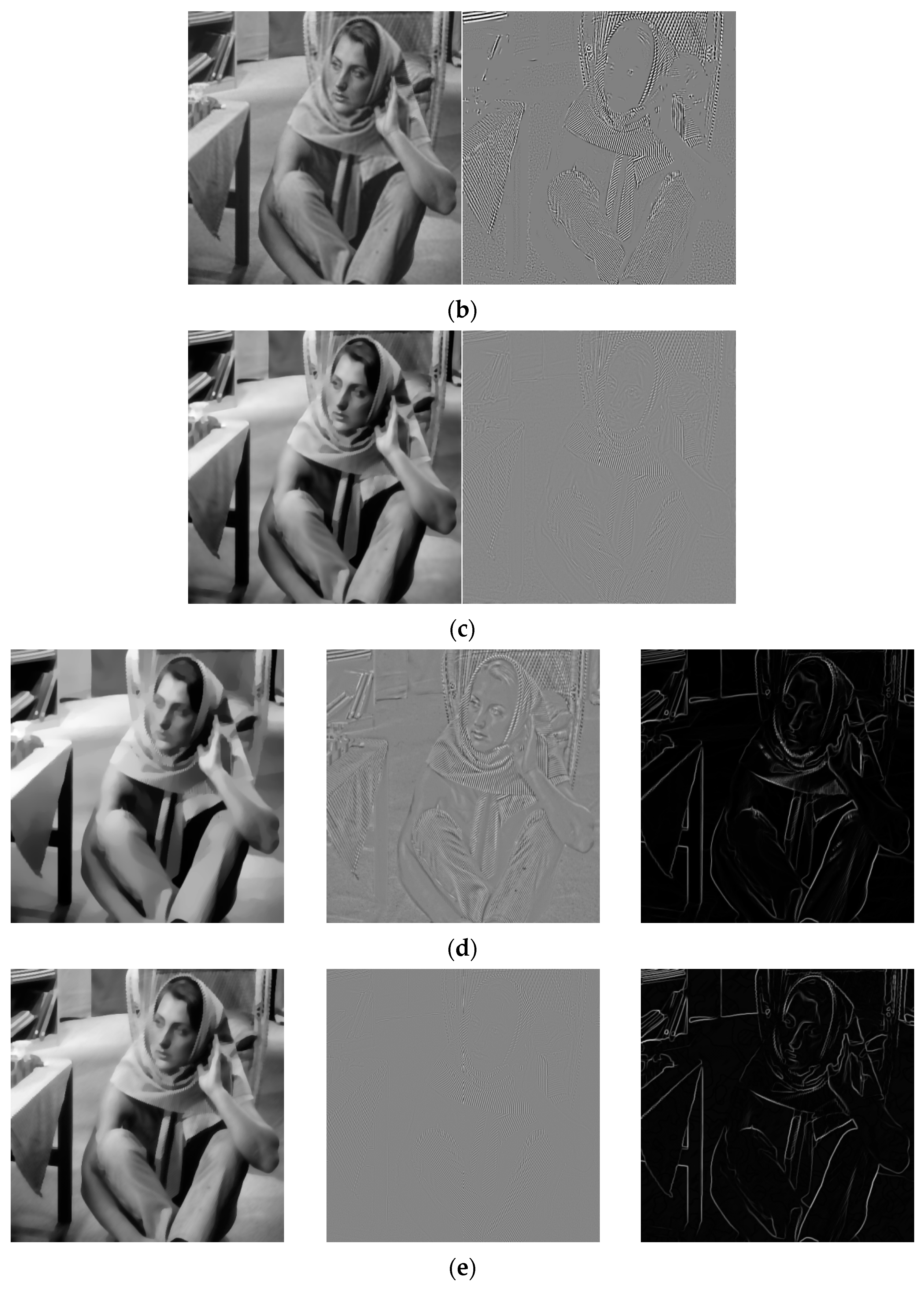
In Figure 5, we take Barbara image to test the different methods. The experimental parameters are . The parameters in [15,40] are and respectively. From the decomposed cartoon images, we can observe that the cartoon image in Figure 5a contains some textures which are not extracted in the upper right area; the cartoon image in Figure 5d is smoother than other cartoon images. For the decomposed texture images, we can observe that the texture in Figure 5b is enhanced, and the texture in Figure 5d contains more contour structure which should be in the cartoon. Relatively speaking, the proposed method achieves better results. For the pseudo edge images in Figure 5d,e, we can see that the pseudo edge image in Figure 5d is not consistent with the cartoon image in Figure 5d, which can be seen from the neckline area of the Barbara image, while the proposed method better consistent with its cartoon image which can be seen from the Figure 5e.

Figure 5.
The decomposition results using different algorithms. From left to right: (a) Cartoon and texture [5]. (b) Cartoon and texture obtained by [26]. (c) Cartoon and texture obtained by [15]. (d) Cartoon, texture and the pseudo edge obtained by [40]. (e) Cartoon, texture and the pseudo edge obtained by the proposed method.
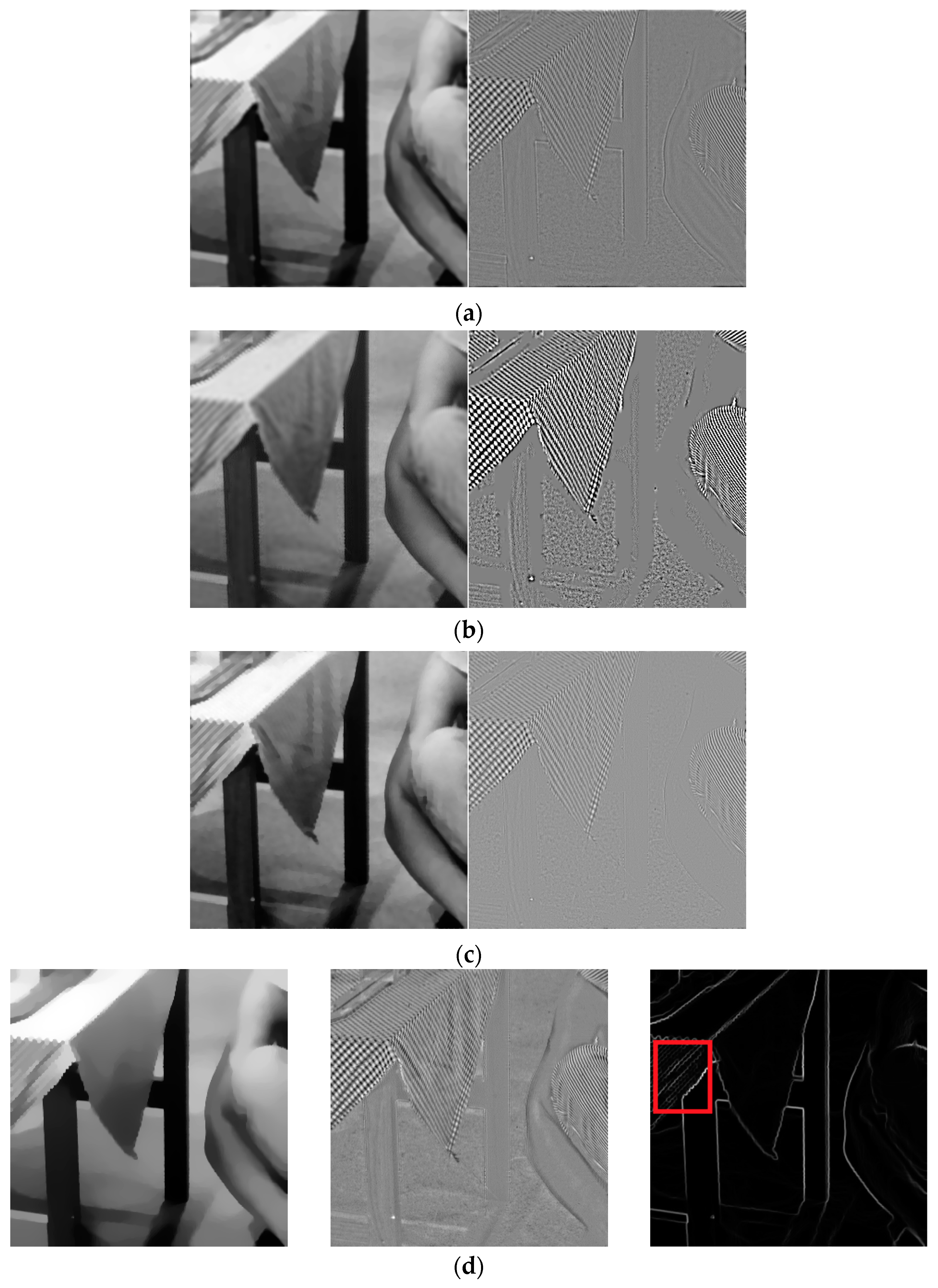
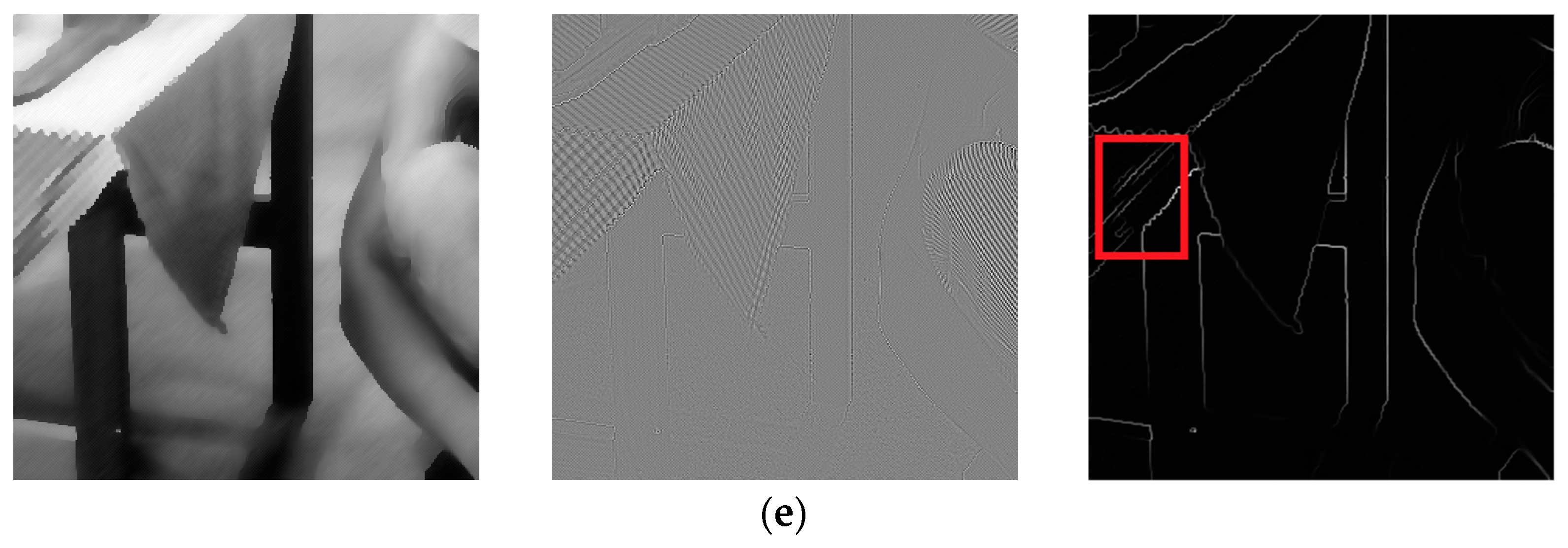
Figure 6 displays the decomposition results for Table image, which has a high presence of texture combined with cartoon parts. The parameters in [8,12] are chosen and respectively. The decomposition results in [26] can be run from the author’s homepage, the scale is chosen 3 to reach the best result in their homepage. The parameters are for the proposed method. Visually, the cartoon images in Figure 6a,b are more blurry; [26,40] smooth the non-textured part, such as the legs and the arm; the texture image in Figure 6c is relative good; for the pseudo edge images in Figure 6d,e, the new method obtain the better results which can be observed from the red rectangular area. In a word, the new model performs comparable results with the other methods.

Figure 6.
Table decomposition experiment. From left to right: (a) cartoon, texture with [8]; (b) cartoon, texture with [26]; (c) cartoon, texture with [12]; (d) cartoon, texture and the pseudo edge with [40]; (e) cartoon, texture and the pseudo edge obtained by the proposed method.
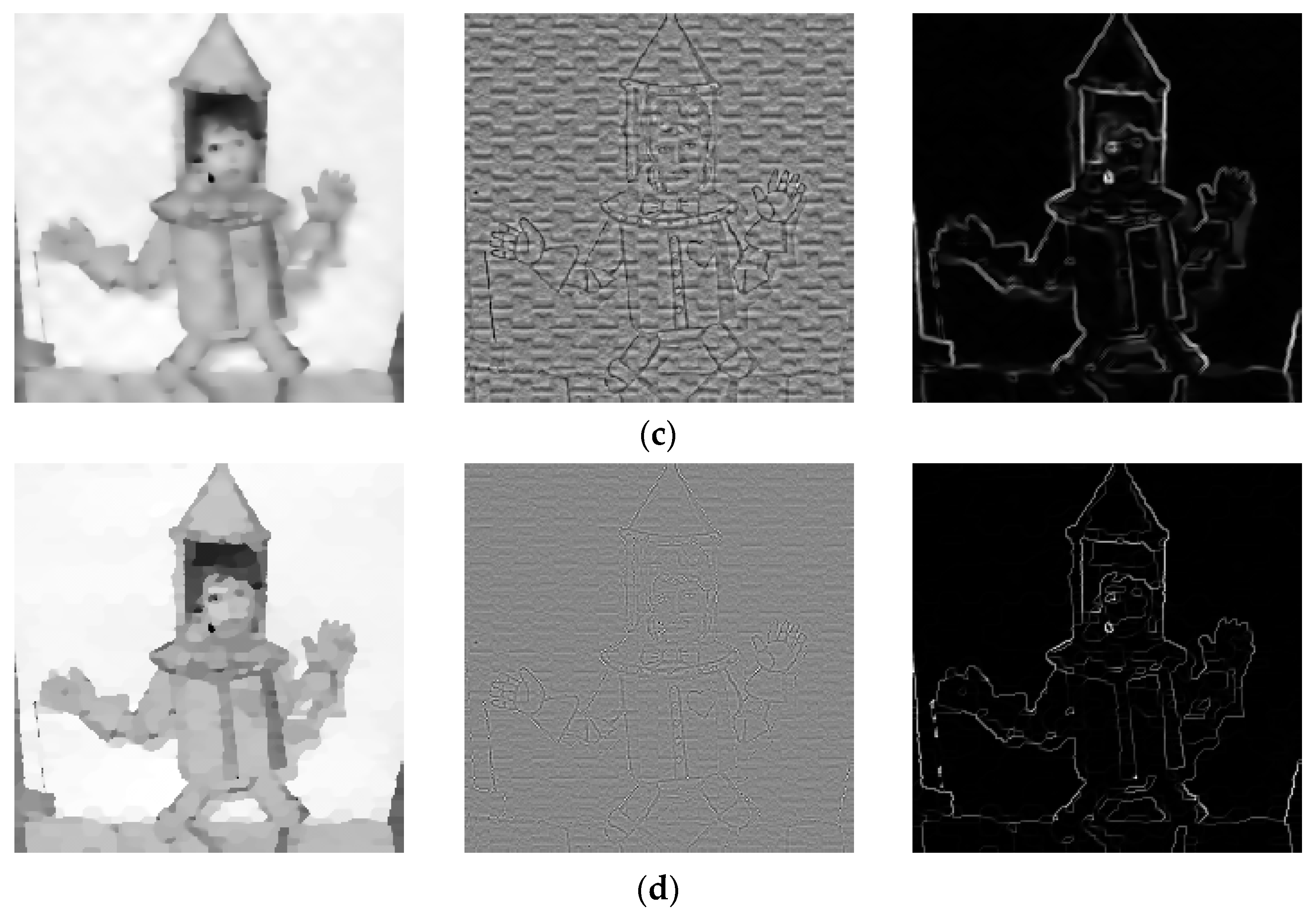
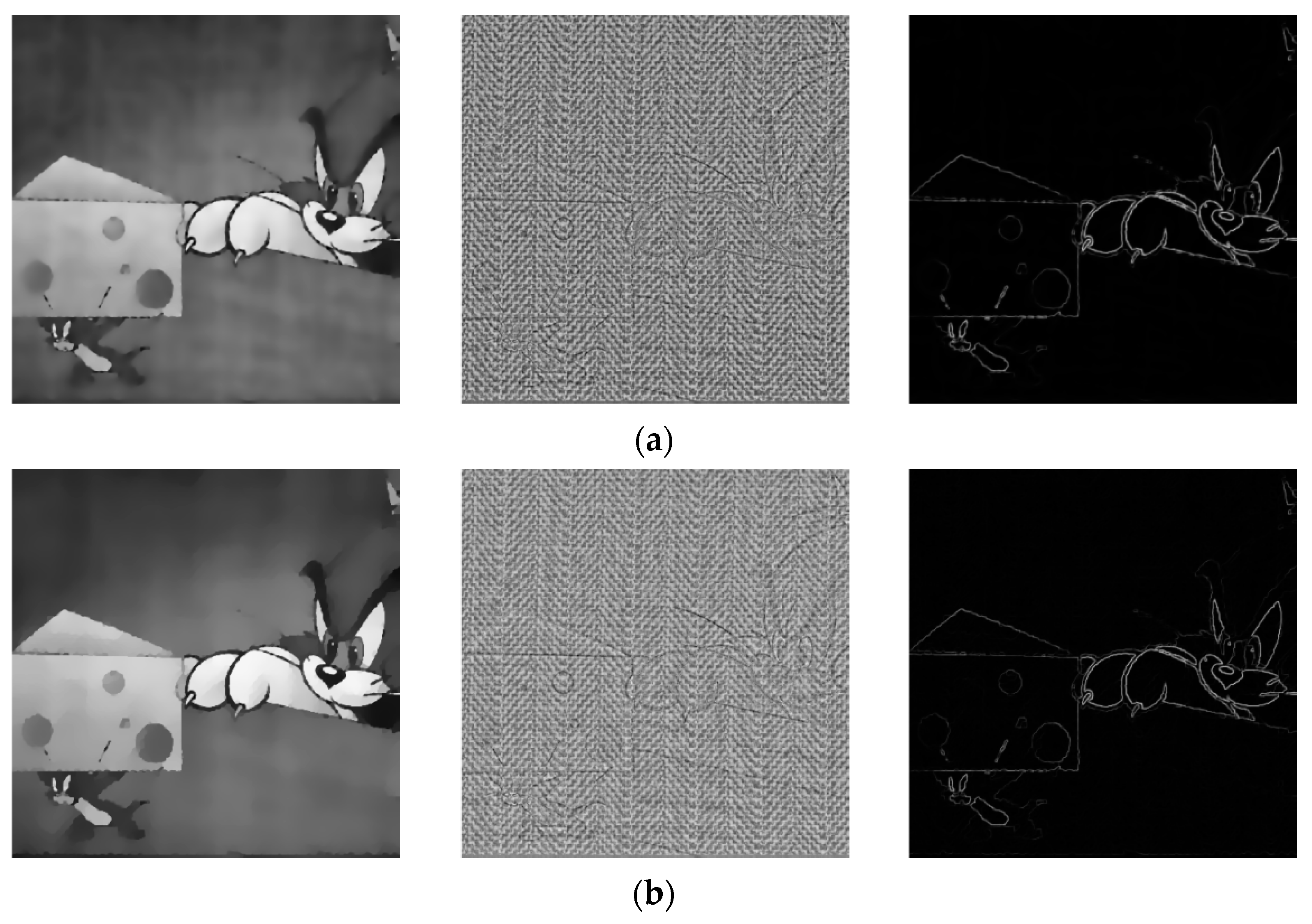
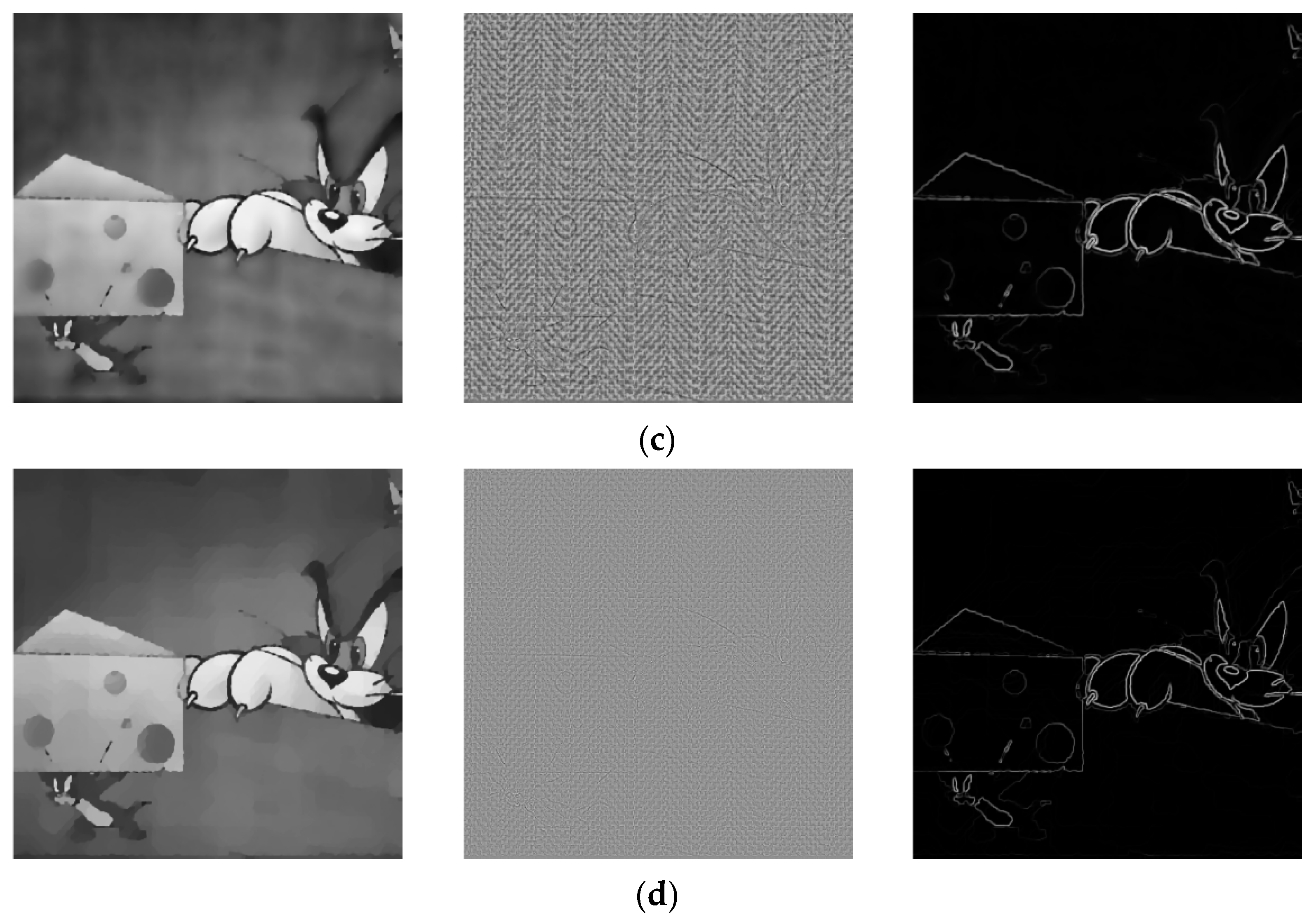
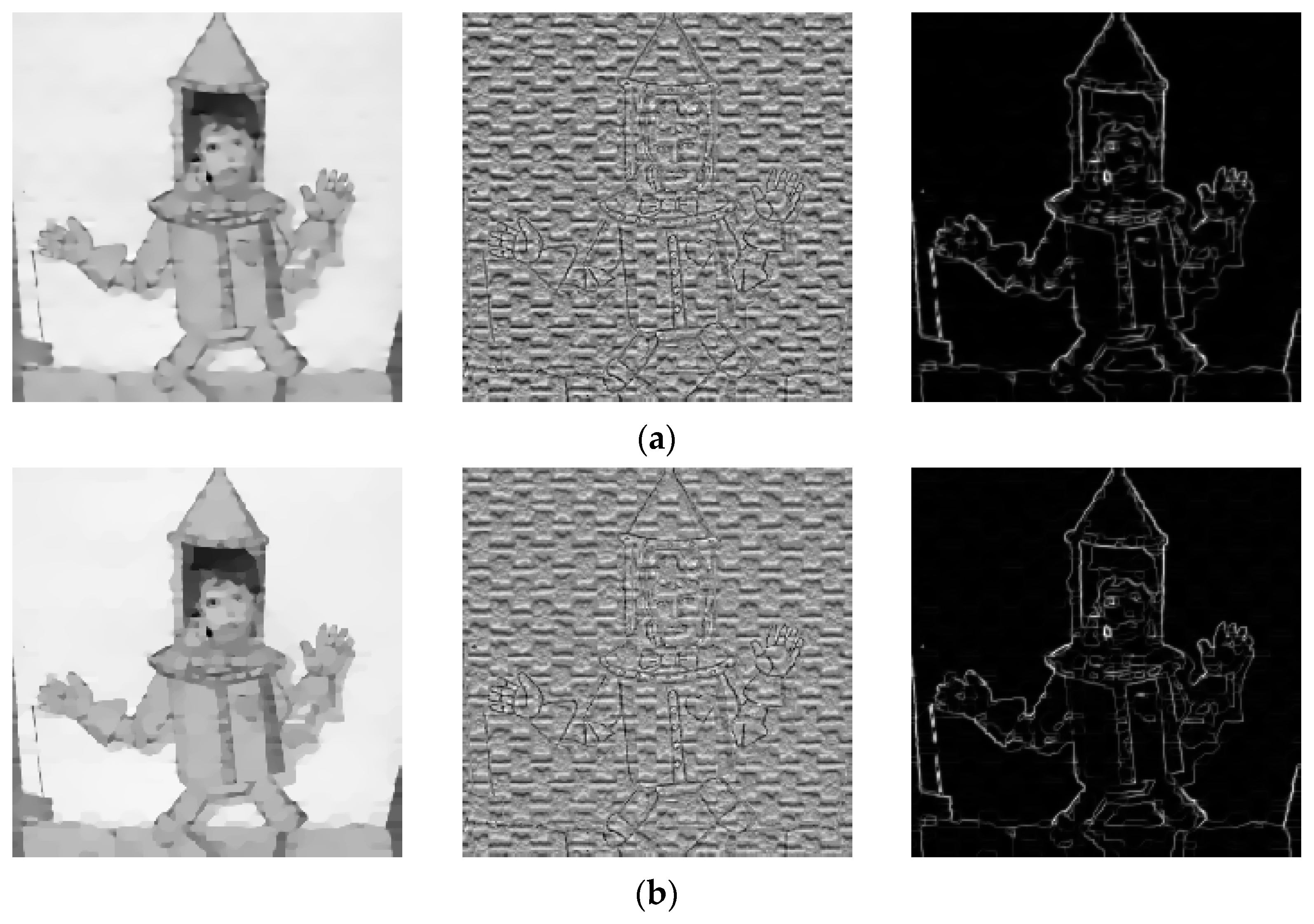
Figure 7 and Figure 8 are the experimental results for Tom and Boy images, respectively. The parameters are and for the proposed method, respectively. The parameters are chosen to get the better results in [11]. The parameters are and in [39], respectively. The parameters are in [40] and , respectively. Because [11,39] mainly studied image restoration, the residue denote the texture. Form Figure 7 and Figure 8, we can see that the cartoon images and the pseudo edges by three methods are similar visually and the texture images obtained by [11,39,40] contain obvious cartoon information, i.e., cartoon and texture are not completely separated. In comparison, the new method achieves better results.

Figure 7.
Tom decomposition experiment. From left to right: (a) cartoon, texture and the pseudo edge with [39]; (b) cartoon, texture and the pseudo edge with [40]; (c) cartoon, texture and the pseudo edge with [11]; (d) cartoon, texture and the pseudo edge obtained by the proposed method.

Figure 8.
Boy decomposition experiment. From left to right: (a) cartoon, texture and the pseudo edge with [39]; (b) cartoon, texture and the pseudo edge with [40]; (c) cartoon, texture and the pseudo edge with [11]; (d) cartoon, texture and the pseudo edge obtained by the proposed method.
5. Conclusions
In this paper, one coupled variational system for image decomposition is proposed. In this coupled system, the vector field, structure and texture images are interwove. We design the alternating direction method, primal-dual method and Gauss-Seidel iteration for the given system. Using the proposed method, we can not only separate out the cartoon and texture parts, but the pseudo edges are extracted. Numerical experiments show the effectiveness of the proposed method compared with other variational methods.
Author Contributions
Conceptualization, J.X., Y.G., Y.H. and L.H.; methodology, J.X. and Y.H.; software, J.X., Y.G. and Y.H.; validation, J.X., Y.G. and L.H.; formal analysis, J.X. and Y.G.; investigation, J.X., Y.G., Y.H. and L.H.; resources, J.X., Y.G. and L.H.; data curation, J.X. and Y.G.; writing—original draft preparation, J.X. and Y.H.; writing—review and editing, J.X., Y.G. and L.H.; visualization, J.X. and Y.H.; project administration, J.X.; funding acquisition, J.X. and L.H. All authors have read and agreed to the published version of the manuscript.
Funding
This research was funded by the National Natural Science Foundation of China (No. U1504603), Key Scientific Research Project of Colleges and Universities in Henan Province (No. 22A120006), Guangxi Natural Science Foundation under Grant (No. 2018GXNSFBA281086).
Institutional Review Board Statement
Not applicable.
Informed Consent Statement
Not applicable.
Data Availability Statement
The data and the code are available on demand.
Acknowledgments
We would like to thank all the reviewers for their helpful suggestions.
Conflicts of Interest
All authors declare no conflict of interest.
References
- Rudin, L.; Osher, S.; Fatemi, E. Nonlinear Total Variation based Noise Removal Algorithms. Phys. D Nonlinear Phenom. 1992, 60, 259–268. [Google Scholar] [CrossRef]
- Meyer, Y. Oscillating Patterns in Image Processing and Nonlinear Evolution Equations; The Fifteenth Dean Jacqueline B. Lewis Memorial Lectures, Vol. 22 of University Lecture Series; American Mathematical Society: Boston, MA, USA, 2001. [Google Scholar]
- Vese, L.; Osher, S. Modeling Textures with Total Variation Minimization and Oscillating Patterns in Image Processing. J. Sci. Comput. 2003, 19, 553–572. [Google Scholar] [CrossRef]
- Osher, S.; Sole, A.; Vese, L. Image Decomposition and Restoration Using Total Variation Minimization and the H−1 norm. Multiscale Modeling Simul. 2003, 1, 349–370. [Google Scholar] [CrossRef]
- Aujol, J.; Aubert, G.; Blanc-Feraud, L.; Chambolle, A. Image Decomposition into a Bounded Variation Component and an Oscillating Component. J. Math. Imaging Vis. 2005, 22, 71–88. [Google Scholar] [CrossRef]
- Aujol, J.; Chambolle, A. Dual Norms and Image Decomposition Models. Int. J. Comput. Vis. 2005, 63, 85–104. [Google Scholar] [CrossRef]
- Garnett, J.B.; Le, T.M.; Meyer, Y.; Vese, L.A. Image Decompositions Using Bounded Variation and Generalized Homogeneous Besov Spaces. Appl. Comput. Harmon. Anal. 2007, 23, 25–56. [Google Scholar] [CrossRef]
- Ng, M.; Yuan, X.; Zhang, W. Coupled Variational Image Decomposition and Restoration Model for Blurred Cartoon- plus-Texture Images with Missing Pixels. IEEE Trans. Image Process. 2013, 22, 2233–2246. [Google Scholar] [CrossRef]
- Wang, W.; Zhao, X.; Ng, M. A Cartoon-plus-Texture Image Decomposition Model for Blind Deconvolution. Multidimens. Syst. Signal Process. 2016, 27, 541–562. [Google Scholar] [CrossRef]
- Wu, X.; Zheng, J.; Wu, C.; Cai, Y. Variational Structure–Texture Image Decomposition on Manifolds. Signal Process. 2013, 93, 1773–1784. [Google Scholar] [CrossRef]
- Xu, J.; Hao, Y.; Li, M.; Zhang, X. A Novel Variational Model for Image Decomposition. Signal Image Video Process. 2019, 13, 967–974. [Google Scholar] [CrossRef]
- Xu, J.; Shang, W.; Hao, Y. A New Cartoon + Texture Image Decomposition Model Based on the Sobolev Space. Signal Image Video Process. 2022, 16, 1569–1576. [Google Scholar] [CrossRef]
- Song, J.; Cho, H.; Yoon, J.; Yoon, S.M. Structure Adaptive Total Variation Minimization-Based Image Decomposition. IEEE Trans. Circuits Syst. Video Technol. 2018, 28, 2164–2176. [Google Scholar] [CrossRef]
- Han, Y.; Xu, C.; Baciu, G.; Li, M. Lightness Biased Cartoon-and-Texture Decomposition for Textile Image Segmentation. Neurocomputing 2015, 168, 575–587. [Google Scholar] [CrossRef]
- Xu, J.; Hao, Y.; Zhang, X.; Zhang, J. A Cartoon + Texture Image Decomposition Variational Model Based on Preserving the Local Geometric Characteristics. IEEE Access 2020, 8, 46574–46584. [Google Scholar] [CrossRef]
- Chan, T.F.; Esedoglu, S.; Park, F.E. Image Decomposition Combining Staircase Reduction and Texture Extraction. J. Vis. Commun. Image Represent. 2007, 18, 464–486. [Google Scholar] [CrossRef]
- Hao, Y.; Xu, J.; Bai, J.; Han, Y. Image Decomposition Combining a Total Variational Filter and a Tikhonov Quadratic Filter. Multidimens. Syst. Signal Process. 2015, 26, 739–751. [Google Scholar] [CrossRef]
- Xu, J.; Feng, X.; Hao, Y.; Han, Y. Image Decomposition Using Adaptive Second-order Total Generalized Variation. Signal Image Video Process. 2014, 8, 39–47. [Google Scholar] [CrossRef]
- Tang, L.; Zhang, H.; He, C.; Fan, Z. Non-convex and Non-smooth Variational Decomposition for Image Restoration. Appl. Math. Model. 2019, 69, 355–377. [Google Scholar]
- Liu, X. A New TGV-Gabor Model for Cartoon-Texture Image Decomposition. IEEE Signal Process. Lett. 2018, 25, 1221–1225. [Google Scholar] [CrossRef]
- Jin, Y.; Jost, J.; Wang, G. A Nonlocal Version of the Osher-Solé-Vese Model. J. Math. Imaging Vis. 2011, 44, 99–113. [Google Scholar] [CrossRef]
- Xu, L.; Yan, Q.; Xia, Y.; Jia, J. Structure Extraction from Texture via Relative Total Variation. ACM Trans. Graph. 2012, 31, 439–445. [Google Scholar] [CrossRef]
- Starck, J.-L.; Elad, M.; Donoho, D. Image Decomposition via the Combination of Sparse Representations and a Variational Approach. IEEE Trans. Image Process. 2005, 14, 1570–1582. [Google Scholar] [CrossRef] [PubMed]
- Cai, J.; Chan, R.; Shen, Z. Simultaneous Cartoon and Texture Inpainting. Inverse Probl. Imaging 2010, 4, 379–395. [Google Scholar] [CrossRef]
- Xu, R.; Xu, Y.; Quan, Y. Structure-Texture Image Decomposition Using Discriminative Patch Recurrence. IEEE Trans. Image Process. 2021, 30, 1542–1555. [Google Scholar] [CrossRef]
- Buades, A.; Le, T.; Morel, J.; Vese, L. Fast Cartoon + Texture Image Filters. IEEE Trans. Image Process. 2010, 19, 1978–1986. [Google Scholar] [CrossRef]
- Tadmor, E.; Athavale, P. Multiscale Image Representation Using Integro-Differential Equations. Inverse Probl. Imaging 2009, 3, 693–710. [Google Scholar] [CrossRef]
- Tadmor, E.; Nezzar, S.; Vese, L. A Multiscale Image Representation Using Hierarchical (BV;L2) Decompositions. Multiscale Modeling Simul. 2003, 2, 554–579. [Google Scholar] [CrossRef]
- Tadmor, E.; Nezzar, S.; Vese, L. Multiscale Hierarchical Decomposition of Images with Applications to Deblurring, Denoising and Segmentation. Commun. Math. Sci. 2008, 6, 281–307. [Google Scholar]
- Tang, L.; He, C. Multiscale Texture Extraction with Hierarchical (BV,Gp,L2) Decomposition. J. Math. Imaging Vis. 2013, 45, 148–163. [Google Scholar] [CrossRef]
- Schaeer, H.; Osher, S. A Low Patch-Rank Interpretation of Texture. SIAM J. Imaging Sci. 2013, 6, 226–262. [Google Scholar] [CrossRef]
- Song, J.; Yoon, G.; Yoon, S. Monolithic Image Decomposition. Neurocomputing 2019, 366, 264–275. [Google Scholar] [CrossRef]
- Han, D.; Kong, W.; Zhang, W. A Partial Splitting Augmented Lagrangian Method for Low Patch-Rank Image Decomposition. J. Math. Imaging Vis. 2015, 51, 145–160. [Google Scholar] [CrossRef]
- Zhang, Z.; He, H. A Customized Low-Rank Prior Model for Structured Cartoon–Texture Image Decomposition. Signal Process. Image Commun. 2021, 96, 116308. [Google Scholar] [CrossRef]
- Ono, S.; Miyata, T.; Yamada, I. Cartoon-Texture Image Decomposition Using Blockwise Low-Rank Texture Characterization. IEEE Trans. Image Process. 2014, 23, 1128–1142. [Google Scholar] [CrossRef] [PubMed]
- Kim, Y.; Ham, B.; Do, M.; Sohn, K. Structure-Texture Image Decomposition Using Deep Variational Priors. IEEE Trans. Image Process. 2019, 28, 2692–2704. [Google Scholar] [CrossRef] [PubMed]
- Zhou, F.; Chen, Q.; Liu, B.; Qiu, G. Structure and Texture-Aware Image Decomposition via Training a Neural network. IEEE Trans. Image Process. 2020, 29, 3458–3473. [Google Scholar] [CrossRef] [PubMed]
- Mou, C.; Wang, Q.; Zhang, J. Deep Generalized Unfolding Network for Image Restoration. In Proceedings of the IEEE/CVF Conference on Computer Vision and Pattern Recognition, New Orleans, LA, USA, 19–24 June 2022; pp. 17399–17410. [Google Scholar]
- Prasath, V.; Vorotnikov, D. On A System of Adaptive Coupled PDEs for Image Restoration. J. Math. Imaging Vis. 2014, 48, 35–52. [Google Scholar] [CrossRef]
- Moreno, J.C.; Prasath, V.B.; Vorotnikov, D.; Proença, H.; Palaniappan, K. Adaptive Diffusion Constrained Total Variation Scheme with Application to ‘Cartoon + Texture + Edge’ Image Decomposition. arXiv 2015. [Google Scholar] [CrossRef]
- Perona, P.; Malik, J. Scale-Space and Edge Detection Using Anisotropic Diffusion. IEEE Trans. Pattern Anal. Mach. Intell. 1990, 12, 629–639. [Google Scholar] [CrossRef]
- Catte, V.; Lions, P.; Morel, J.; Coll, T. Image Selective Smoothing and Edge Detection by Nonlinear Diffusion. SIAM J. Numer. Anal. 1992, 29, 182–193. [Google Scholar] [CrossRef]
Publisher’s Note: MDPI stays neutral with regard to jurisdictional claims in published maps and institutional affiliations. |
© 2022 by the authors. Licensee MDPI, Basel, Switzerland. This article is an open access article distributed under the terms and conditions of the Creative Commons Attribution (CC BY) license (https://creativecommons.org/licenses/by/4.0/).