Material Extrusion Additive Manufacturing of Ceramics: A Review on Filament-Based Process



Abstract
1. Introduction
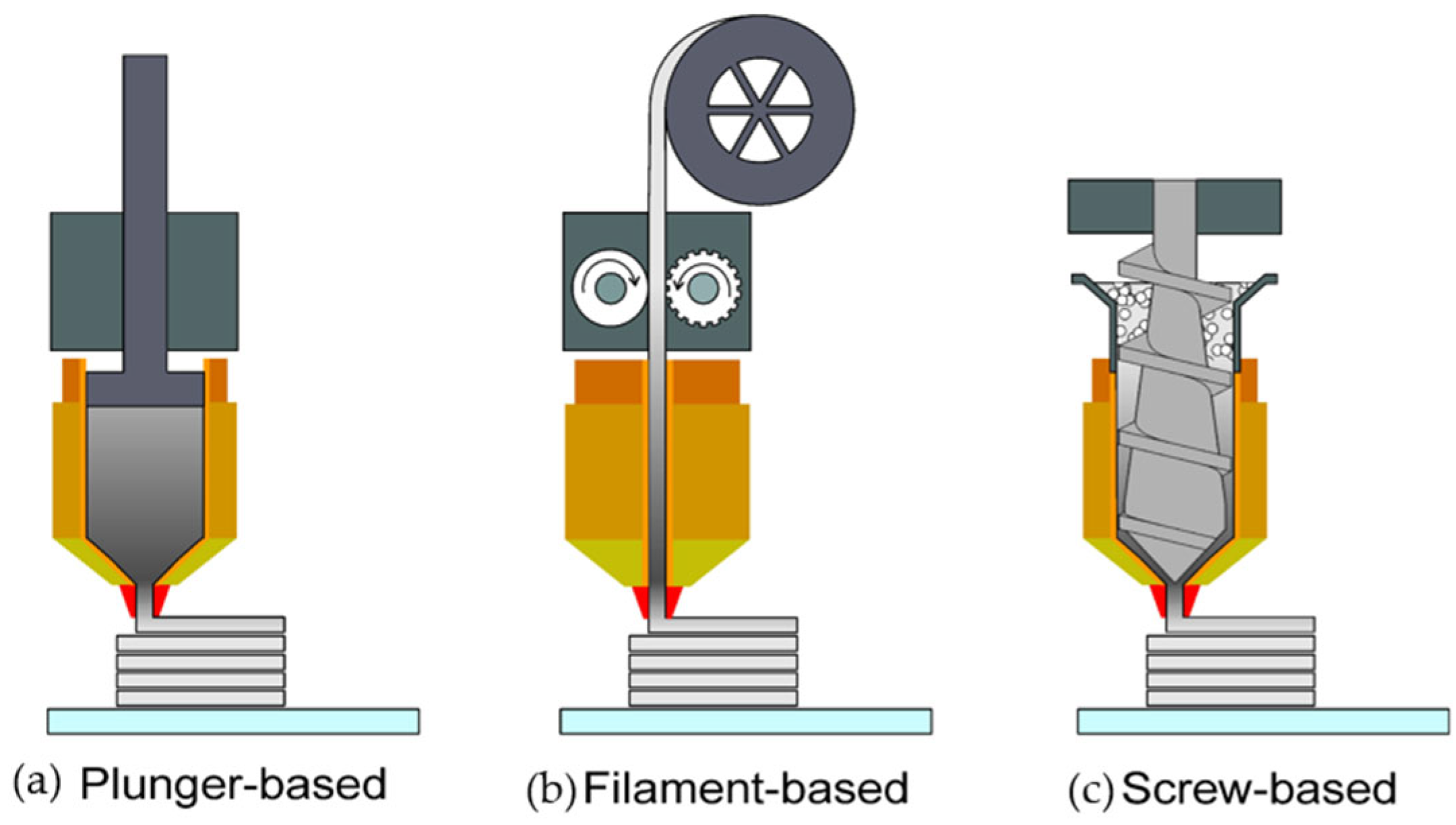
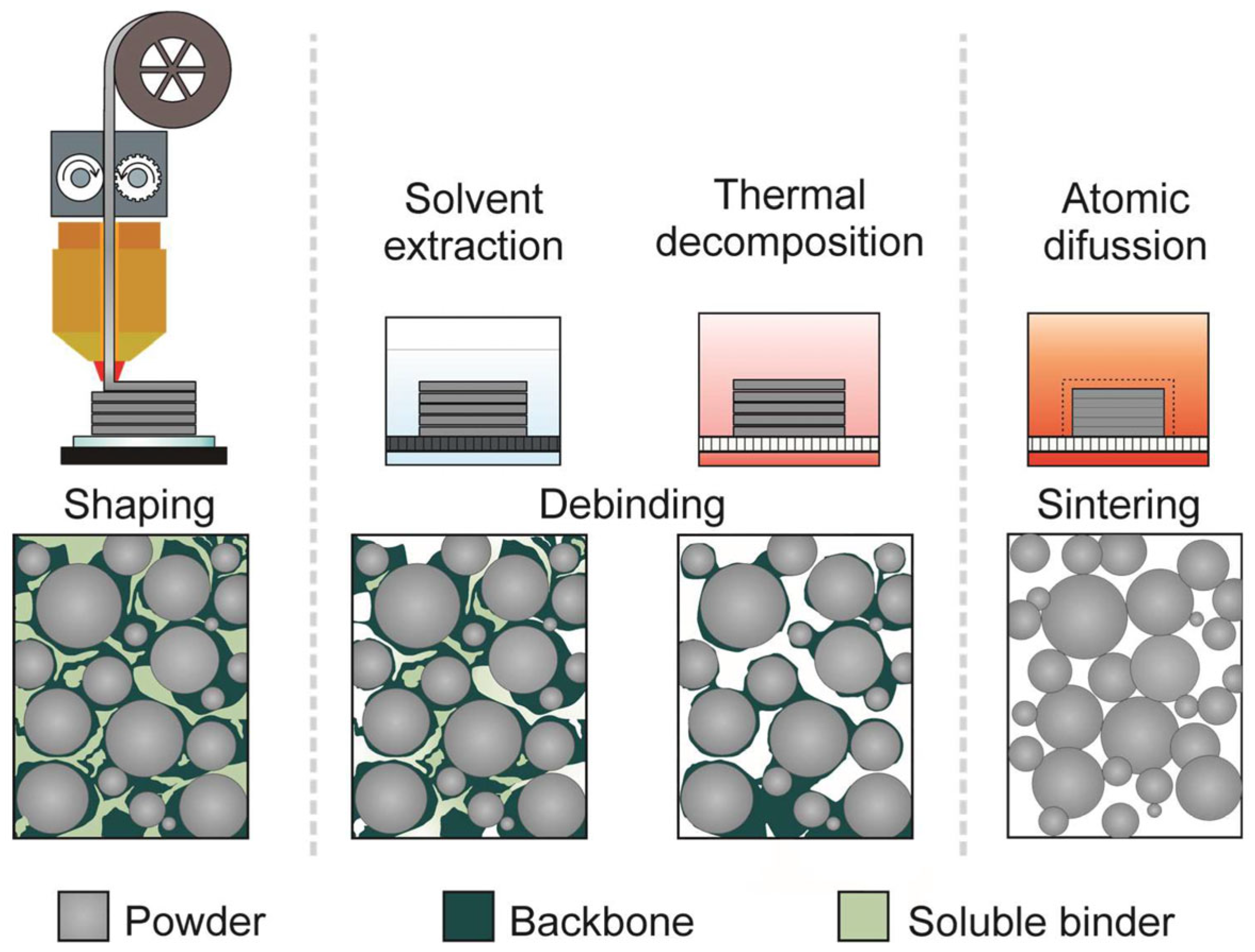
- -
- Primary binder: This polymer, usually a thermoplastic, is the predominant constituent and serves as its primary element. In the debinding stage, it is the initial component that undergoes removal. Typically, a substance with a low molecular weight is selected to maintain lower viscosity, thereby preventing interactions with the powder and heavier components. Polyoxymethylene (POM), polypropylene (PP), polyethylene-glycol (PEG), low-density polyethylene (LDPE), thermoplastic elastomer (TPE), steric acid (SA), wax paraffin (PW), and polyolefin-based binders are examples of commonly used binders [9,16,17,18,19].
- -
- Backbone (up to 50%): The second component remains unchanged throughout the debinding process. It contributes to the structural integrity of the portion after debinding. Thermal degradation of the backbone occurs either before or during the sintering process.
- -
- Additives (up to 10%): To facilitate the even dispersion of powder particles within the binder, various additives are employed, including dispersing agents, compatibilizers, plasticizers, waxes, and stabilizers. These additions help prevent the segregation and clumping of constituents.
2. Material Extrusion of Ceramics
2.1. Al2O3
- Material Selection: The study starts with selecting materials, including fillers, binders, and surfactants.
- Compounding and Rheological Characterization: After material selection, compounding and rheological characterization are carried out to ensure the materials’ proper mixture and flow properties.
- Filament Extrusion: The next step is filament extrusion, where the material mixture is formed into filaments suitable for 3D printing.
- Feedstock Printing: These filaments are then used as feedstock for 3D printing, where they are deposited layer by layer to create the desired ceramic structures.
- Thermal Post-Processing (Debinding and Sintering): After printing, thermal post-processing involves debinding to remove the binders and sintering to achieve the desired density.
2.2. ZrO2
2.3. Other Ceramic Materials
3. Ceramic Materials as Reinforcement for Composite Parts
- -
- Enhancing Mechanical Properties: The minimization of defects and improved bonding between fibers and matrices were critical topics. Understanding how fiber characteristics and content influence composite properties was crucial for successfully applying these materials.
- -
- Developing Novel AM Technologies: The current focus was primarily on short-fiber-reinforced ceramic matrix composites, but there was a shift toward continuous fiber reinforcement due to its superior properties.
- -
- Expanding Applications: To leverage FRCMCs in various applications, developing advanced materials suitable for AM was crucial. These materials will be integrated into structural design and simulation analyses to create customized functionalities, ultimately achieving the seamless integration of structure and function in FRCMCs.
4. Conclusions
Author Contributions
Funding
Institutional Review Board Statement
Informed Consent Statement
Data Availability Statement
Acknowledgments
Conflicts of Interest
References
- Spina, R. Performance Analysis of Colored PLA Products with a Fused Filament Fabrication Process. Polymers 2019, 11, 1984. [Google Scholar] [CrossRef] [Scilit] [PubMed]
- Bankapalli, N.K.; Gupta, V.; Saxena, P.; Bajpai, A.; Lahoda, C.; Polte, J. Filament Fabrication and Subsequent Additive Manufacturing, Debinding, and Sintering for Extrusion-Based Metal Additive Manufacturing and Their Applications: A Review. Compos. B Eng. 2023, 264, 110915. [Google Scholar] [CrossRef] [Scilit]
- Hafenecker, J.; Bartels, D.; Kuball, C.M.; Kreß, M.; Rothfelder, R.; Schmidt, M.; Merklein, M. Hybrid Process Chains Combining Metal Additive Manufacturing and Forming—A Review. CIRP J. Manuf. Sci. Technol. 2023, 46, 98–115. [Google Scholar] [CrossRef] [Scilit]
- García-Collado, A.; Blanco, J.M.; Gupta, M.K.; Dorado-Vicente, R. Advances in Polymers Based Multi-Material Additive-Manufacturing Techniques: State-of-Art Review on Properties and Applications. Addit. Manuf. 2022, 50, 102577. [Google Scholar] [CrossRef] [Scilit]
- Chen, Z.; Li, Z.; Li, J.; Liu, C.; Lao, C.; Fu, Y.; Liu, C.; Yang, L.; Wang, P.; Yi, H. 3D Printing of Ceramics: A Review. J. Eur. Ceram. Soc. 2019, 39, 661–687. [Google Scholar] [CrossRef] [Scilit]
- Altıparmak, S.C.; Yardley, V.A.; Shi, Z.; Lin, J. Extrusion-Based Additive Manufacturing Technologies: State of the Art and Future Perspectives. J. Manuf. Process 2022, 83, 607–636. [Google Scholar] [CrossRef] [Scilit]
- Ngo, T.D.; Kashani, A.; Imbalzano, G.; Nguyen, K.T.Q.; Hui, D. Additive Manufacturing (3D Printing): A Review of Materials, Methods, Applications, and Challenges. Compos. B Eng. 2018, 143, 172–196. [Google Scholar] [CrossRef] [Scilit]
- Lotfizarei, Z.; Mostafapour, A.; Barari, A.; Jalili, A.; Patterson, A.E. Overview of Debinding Methods for Parts Manufactured Using Powder Material Extrusion. Addit. Manuf. 2023, 61, 103335. [Google Scholar] [CrossRef] [Scilit]
- Abel, J.; Scheithauer, U.; Janics, T.; Hampel, S.; Cano, S.; Müller-Köhn, A.; Günther, A.; Kukla, C.; Moritz, T. Fused Filament Fabrication (FFF) of Metal-Ceramic Components. J. Vis. Exp. 2019, 143. [Google Scholar] [CrossRef] [Scilit]
- Park, S.; Fu, K. (Kelvin) Polymer-Based Filament Feedstock for Additive Manufacturing. Compos. Sci. Technol. 2021, 213, 108876. [Google Scholar] [CrossRef] [Scilit]
- Danforth, S.C. Fused Deposition of Ceramics: A New Technique for the Rapid Fabrication of Ceramic Components. Mater. Technol. 1995, 10, 144–146. [Google Scholar] [CrossRef] [Scilit]
- Özden, I.; Iveković, A.; Kocjan, A. Additive Manufacturing of Ceramics from Thermoplastic Feedstocks. Open Ceram. 2021, 6, 100129. [Google Scholar] [CrossRef] [Scilit]
- Wang, J.C.; Dommati, H.; Hsieh, S.J. Review of Additive Manufacturing Methods for High-Performance Ceramic Materials. Int. J. Adv. Manuf. Technol. 2019, 103, 2627–2647. [Google Scholar] [CrossRef] [Scilit]
- Gonzalez-Gutierrez, J.; Cano, S.; Schuschnigg, S.; Kukla, C.; Sapkota, J.; Holzer, C. Additive Manufacturing of Metallic and Ceramic Components by the Material Extrusion of Highly-Filled Polymers: A Review and Future Perspectives. Materials 2018, 11, 840. [Google Scholar] [CrossRef] [Scilit] [PubMed]
- González-Gutiérrez, J.; Stringari, G.B.; Emri, I. Powder Injection Molding of Metal and Ceramic Parts, Some Critical Issues for Injection Molding; Wang, J., Ed.; InTech: Houston, TX, USA, 2012; ISBN 978-953-51-0297-7. [Google Scholar]
- Wu, H.; Cheng, Y.L.; Liu, W.; He, R.; Zhou, M.; Wu, S.; Song, X.; Chen, Y. Effect of the Particle Size and the Debinding Process on the Density of Alumina Ceramics Fabricated by 3D Printing Based on Stereolithography. Ceram. Int. 2016, 42, 17290–17294. [Google Scholar] [CrossRef] [Scilit]
- Rane, K.; Farid, M.A.; Hassan, W.; Strano, M. Effect of Printing Parameters on Mechanical Properties of Extrusion-Based Additively Manufactured Ceramic Parts. Ceram. Int. 2021, 47, 12189–12198. [Google Scholar] [CrossRef] [Scilit]
- Travitzky, N.; Bonet, A.; Dermeik, B.; Fey, T.; Filbert-Demut, I.; Schlier, L.; Schlordt, T.; Greil, P. Additive Manufacturing of Ceramic-Based Materials. Adv. Eng. Mater. 2014, 16, 729–754. [Google Scholar] [CrossRef] [Scilit]
- Gorjan, L.; Galusca, C.; Sami, M.; Sebastian, T.; Clemens, F. Effect of Stearic Acid on Rheological Properties and Printability of Ethylene Vinyl Acetate Based Feedstocks for Fused Filament Fabrication of Alumina. Addit. Manuf. 2020, 36, 101391. [Google Scholar] [CrossRef] [Scilit]
- Hadian, A.; Morath, B.; Biedermann, M.; Meboldt, M.; Clemens, F. Selected Design Rules for Material Extrusion-Based Additive Manufacturing of Alumina Based Nozzles and Heat Exchangers Considering Limitations in Printing, Debinding, and Sintering. Addit. Manuf. 2023, 75, 103719. [Google Scholar] [CrossRef] [Scilit]
- Nötzel, D.; Hanemann, T. New Feedstock System for Fused Filament Fabrication of Sintered Alumina Parts. Materials 2020, 13, 4461. [Google Scholar] [CrossRef] [Scilit]
- Orlovská, M.; Chlup, Z.; Bača, Ľ.; Janek, M.; Kitzmantel, M. Fracture and Mechanical Properties of Lightweight Alumina Ceramics Prepared by Fused Filament Fabrication. J. Eur. Ceram. Soc. 2020, 40, 4837–4843. [Google Scholar] [CrossRef] [Scilit]
- Orlovská, M.; Hain, M.; Kitzmantel, M.; Veteška, P.; Hajdúchová, Z.; Janek, M.; Vozárová, M.; Bača, Ľ. Monitoring of Critical Processing Steps during the Production of High Dense 3D Alumina Parts Using Fused Filament Fabrication Technology. Addit. Manuf. 2021, 48, 102395. [Google Scholar] [CrossRef] [Scilit]
- Smirnov, A.; Seleznev, A.; Peretyagin, P.; Bentseva, E.; Pristinskiy, Y.; Kuznetsova, E.; Grigoriev, S. Rheological Characterization and Printability of Polylactide (PLA)-Alumina (Al2O3) Filaments for Fused Deposition Modeling (FDM). Materials 2022, 15, 8399. [Google Scholar] [CrossRef] [Scilit]
- Tosto, C.; Bragaglia, M.; Nanni, F.; Recca, G.; Cicala, G. Fused Filament Fabrication of Alumina/Polymer Filaments for Obtaining Ceramic Parts after Debinding and Sintering Processes. Materials 2022, 15, 7399. [Google Scholar] [CrossRef] [Scilit] [PubMed]
- Truxová, V.; Šafka, J.; Sobotka, J.; Macháček, J.; Ackermann, M. Alumina Manufactured by Fused Filament Fabrication: A Comprehensive Study of Mechanical Properties and Porosity. Polymers 2022, 14, 991. [Google Scholar] [CrossRef] [Scilit] [PubMed]
- Vozárová, M.; Neubauer, E.; Bača, Ľ.; Kitzmantel, M.; Feranc, J.; Trembošová, V.; Peciar, P.; Kritikos, M.; Orlovská, M.; Janek, M.; et al. Preparation of Fully Dense Boron Carbide Ceramics by Fused Filament Fabrication (FFF). J. Eur. Ceram. Soc. 2023, 43, 1751–1761. [Google Scholar] [CrossRef] [Scilit]
- Furong, N.; Xiaole, Y.; Yuanbing, L.; Jinyu, G.; Peng, l.; Zhipeng, X.; Xianfeng, Y. Fused deposition modeling of Si3N4 ceramics: A cost-effective 3D-printing route for dense and high performance non-oxide ceramic materials. J. Eur. Ceram. Soc. 2022, 42, 7369–7376. [Google Scholar] [CrossRef] [Scilit]
- Bhandari, S.; Maniere, C.; Sedona, F.; De Bona, E.; Sglavo, V.M.; Colombo, P.; Fambri, L.; Biesuz, M.; Franchin, G. Ultra-Rapid Debinding and Sintering of Additively Manufactured Ceramics by Ultrafast High-Temperature Sintering. J. Eur. Ceram. Soc. 2023, 44, 328–340. [Google Scholar] [CrossRef] [Scilit]
- Petit, C.; Meunier, C.; Manceaux, L.; Rivera, H.; Taxil, H. Fused Deposition Modeling and Microwave Sintering of 3Y-TZP Samples. Open Ceram. 2023, 15, 100378. [Google Scholar] [CrossRef] [Scilit]
- Cano, S.; Lube, T.; Huber, P.; Gallego, A.; Naranjo, J.A.; Berges, C.; Schuschnigg, S.; Herranz, G.; Kukla, C.; Holzer, C.; et al. Influence of the Infill Orientation on the Properties of Zirconia Parts Produced by Fused Filament Fabrication. Materials 2020, 13, 3158. [Google Scholar] [CrossRef] [Scilit]
- Clemens, F.; Sarraf, F.; Borzì, A.; Neels, A.; Hadian, A. Material Extrusion Additive Manufacturing of Advanced Ceramics: Towards the Production of Large Components. J. Eur. Ceram. Soc. 2023, 43, 2752–2760. [Google Scholar] [CrossRef] [Scilit]
- Guan, Z.; Yang, X.; Liu, P.; Xu, X.; Li, Y.; Yang, X. Additive Manufacturing of Zirconia Ceramic by Fused Filament Fabrication. Ceram. Int. 2023, 49, 27742–27749. [Google Scholar] [CrossRef] [Scilit]
- Hadian, A.; Koch, L.; Koberg, P.; Sarraf, F.; Liersch, A.; Sebastian, T.; Clemens, F. Material Extrusion Based Additive Manufacturing of Large Zirconia Structures Using Filaments with Ethylene Vinyl Acetate Based Binder Composition. Addit. Manuf. 2021, 47, 102227. [Google Scholar] [CrossRef] [Scilit]
- Hadian, A.; Fricke, M.; Liersch, A.; Clemens, F. Material Extrusion Additive Manufacturing of Zirconia Parts Using Powder Injection Molding Feedstock Compositions. Addit. Manuf. 2022, 57, 102966. [Google Scholar] [CrossRef] [Scilit]
- He, Q.; Jiang, J.; Yang, X.; Zhang, L.; Zhou, Z.; Zhong, Y.; Shen, Z. Additive Manufacturing of Dense Zirconia Ceramics by Fused Deposition Modeling via Screw Extrusion. J. Eur. Ceram. Soc. 2021, 41, 1033–1040. [Google Scholar] [CrossRef] [Scilit]
- Nötzel, D.; Eickhoff, R.; Pfeifer, C.; Hanemann, T. Printing of Zirconia Parts via Fused Filament Fabrication. Materials 2021, 14, 5467. [Google Scholar] [CrossRef] [Scilit] [PubMed]
- Spintzyk, S.; Geis-Gerstorfer, J.; Bourauel, C.; Keilig, L.; Lohbauer, U.; Brune, A.; Greuling, A.; Arnold, C.; Rues, S.; Adjiski, R.; et al. Biaxial Flexural Strength of Zirconia: A Round Robin Test with 12 Laboratories. Dent. Mater. 2021, 37, 284–295. [Google Scholar] [CrossRef] [Scilit]
- Dadkhah, M.; Tulliani, J.-M.; Saboori, A.; Iuliano, L. Additive Manufacturing of Ceramics: Advances, Challenges, and Outlook. J. Eur. Ceram. Soc. 2023, 43, 6635–6664. [Google Scholar] [CrossRef] [Scilit]
- Bai, J.; Sun, J.; Binner, J. Additive Manufacturing of Ceramics: Materials, Characterization and Applications. In Additive Manufacturing; Zhou, K., Ed.; Springer: Cham, Germany, 2023. [Google Scholar] [CrossRef] [Scilit]
- Datta, P.; Balla, V.K. Ceramics Processing by Additive Manufacturing. Trans. Indian. Natl. Acad. Eng. 2021, 6, 879–893. [Google Scholar] [CrossRef] [Scilit]
- Walton, R.L.; Kupp, E.R.; Messing, G.L. Additive manufacturing of textured ceramics: A review. J. Mater. Res. 2021, 36, 3591–3606. [Google Scholar] [CrossRef] [Scilit]
- Nötzel, D.; Hanemann, T.; Eickhoff, R. Charakterisierung Additiv Gefertigter Keramischer Bauteile via FFF-Verfahren. Keram. Z. 2019, 71, 56–61. [Google Scholar] [CrossRef] [Scilit]
- Rane, K.; Strano, M. A comprehensive review of extrusion-based additive manufacturing processes for rapid production of metallic and ceramic parts. Adv. Manuf. 2019, 7, 155–173. [Google Scholar] [CrossRef] [Scilit]
- Ramanath, H.S.; Chua, C.K.; Leong, K.F.; Shah, K.D. Melt Flow Behaviour of Poly-ε-Caprolactone in Fused Deposition Modelling. J. Mater. Sci. Mater. Med. 2008, 19, 2541–2550. [Google Scholar] [CrossRef] [Scilit]
- Turner, B.N.; Strong, R.; Gold, S.A. A Review of Melt Extrusion Additive Manufacturing Processes: I. Process Design and Modeling. Rapid Prototyp. J. 2014, 20, 192–204. [Google Scholar] [CrossRef] [Scilit]
- Tosoh Corporation. Advanced Ceramics: Zirconia Powders. Available online: https://www.Tosoh.Com/Ourproducts/Advanced-Materials/Zirconia-Powders (accessed on 3 April 2024).
- Nakai, H.; Inokoshi, M.; Nozaki, K.; Komatsu, K.; Kamijo, S.; Liu, H.; Shimizubata, M.; Minakuchi, S.; Van Meerbeek, B.; Vleugels, J.; et al. Additively Manufactured Zirconia for Dental Applications. Materials 2021, 14, 3694. [Google Scholar] [CrossRef] [Scilit] [PubMed]
- Nötzel, D.; Eickhoff, R.; Hanemann, T. Fused Filament Fabrication of Small Ceramic Components. Materials 2018, 11, 1463. [Google Scholar] [CrossRef] [Scilit]
- Ji, W.; Zhang, J.; Wang, W.; Fu, Z.; Todd, R.I. The Microstructural Origin of Rapid Densification in 3YSZ during Ultra-Fast Firing with or without an Electric Field. J. Eur. Ceram. Soc. 2020, 40, 5829–5836. [Google Scholar] [CrossRef] [Scilit]
- Ji, W.; Parker, B.; Falco, S.; Zhang, J.Y.; Fu, Z.Y.; Todd, R.I. Ultra-Fast Firing: Effect of Heating Rate on Sintering of 3YSZ, with and without an Electric Field. J. Eur. Ceram. Soc. 2017, 37, 2547–2551. [Google Scholar] [CrossRef] [Scilit]
- Wang, W.; Zhang, L.; Dong, X.; Wu, J.; Zhou, Q.; Li, S.; Shen, C.; Liu, W.; Wang, G.; He, R. Additive Manufacturing of Fiber Reinforced Ceramic Matrix Composites: Advances, Challenges, and Prospects. Ceram. Int. 2022, 48, 19542–19556. [Google Scholar] [CrossRef] [Scilit]
- Freudenberg, W.; Wich, F.; Langhof, N.; Schafföner, S. Additive Manufacturing of Carbon Fiber Reinforced Ceramic Matrix Composites Based on Fused Filament Fabrication. J. Eur. Ceram. Soc. 2022, 42, 1822–1828. [Google Scholar] [CrossRef] [Scilit]
- Zanjanijam, A.R.; Major, I.; Lyons, J.G.; Lafont, U.; Devine, D.M. Fused Filament Fabrication of PEEK: A Review of Process-Structure-Property Relationships. Polymers 2020, 12, 1665. [Google Scholar] [CrossRef] [Scilit] [PubMed]
- Morfini, L.; Guerra, M.G.; Lavecchia, F.; Spina, R.; Galantucci, L.M. Preliminary Test on the Effect of Direct Annealing on Additive Manufactured PEEK Bending Properties. Procedia CIRP 2023, 118, 705–710. [Google Scholar] [CrossRef] [Scilit]
- Petousis, M.; Vidakis, N.; Mountakis, N.; Moutsopoulou, A.; Papadakis, V.; Maravelakis, E. On the Substantial Mechanical Reinforcement of Polylactic Acid with Titanium Nitride Ceramic Nanofillers in Material Extrusion 3D Printing. Ceram. Int. 2023, 49, 16397–16411. [Google Scholar] [CrossRef] [Scilit]
- Petousis, M.; Michailidis, N.; Papadakis, V.M.; Korlos, A.; Mountakis, N.; Argyros, A.; Dimitriou, E.; Charou, C.; Moutsopoulou, A.; Vidakis, N. Optimizing the Rheological and Thermomechanical Response of Acrylonitrile Butadiene Styrene/Silicon Nitride Nanocomposites in Material Extrusion Additive Manufacturing. Nanomaterials 2023, 13, 1588. [Google Scholar] [CrossRef] [Scilit] [PubMed]
- Vidakis, N.; Moutsopoulou, A.; Petousis, M.; Michailidis, N.; Charou, C.; Papadakis, V.; Mountakis, N.; Dimitriou, E.; Argyros, A. Rheology and Thermomechanical Evaluation of Additively Manufactured Acrylonitrile Butadiene Styrene (ABS) with Optimized Tungsten Carbide (WC) Nano-Ceramic Content. Ceram. Int. 2023, 49, 34742–34756. [Google Scholar] [CrossRef] [Scilit]
- Rueda, M.M.; Auscher, M.; Fulchiron, R.; Périé, T.; Martin, G.; Sonntag, P.; Cassagnau, P. Rheology and Applications of Highly Filled Polymers: A Review of Current Understanding. Prog. Polym. Sci. 2017, 66, 22–53. [Google Scholar] [CrossRef] [Scilit]


| Material | Feedstock | Powder Particle Size d50 [μm] | Printing Parameters | Shrinkage (avg.) | References | |||||
|---|---|---|---|---|---|---|---|---|---|---|
| d [mm] | s [mm/s] | lh [mm] | Tp [°C] | Tb [°C] | ||||||
| Al2O3 |
| 0.5 | 0.6 | 10 | - | 30–170 | - | height 23% diameter 18% wall thickness 12% | Gorjan et al. [19] | |
| - | 0.4 | 20 | 0.20 | 180 | 50 | 22.40% | Hadian et al., 2023 [20] | ||
| 0.1 | 0.25 | 10 | 0.10 | 165 | 60 | 20.75% | Nötzel et al., 2020 [21] | ||
| 0.4–0.7 | 0.4 | 10–15 | 0.10 | 240 | 60 | 20% 19% | Orlovská et al., 2020 [22] Orlovská et al., 2021 [23] | ||
| 30 | 0.8 | - | 0.40 | 220 | 100 | Smirnov et al. [24] | |||
| <1.0 | 0.6 | 20 | 0.2 | 150 | 50 | 20.70% | Tosto et al. [25] | ||
| - | 30 | 0.20 | 150 | 25 | 22.50% | Truxová et al. [26] | ||||
| B4C |
| 3 | 0.4 | 10 | - | 210 | 50 | 19.41% | Vozárová et al. [27] | |
| Si3N4 |
| 0.69 | 0.4, 0.6, 0.8 | 25 | 0.10, 0.15, 0.20 | 170 | 80 | 24.20% | Furong et al. [28] | |
| ZrO2 |
| 0.3 | 0.4 | - | - | - | - | - | Bhandari et al. [29] | |
| 0.6 | - | 0.15 | 200 | - | 18% | Petit et al. [30] | ||||
| 0.09 | 0.6 | 12.5 | 0.15 | 255 | 100 | 20% | Cano et al. [31] | ||
| - | 0.6 | 30 | 0.2 | 145 180 | 45 40 | Only Fabru filament sintered 24% | Clemens et al. [32] | ||
| 0.5 | 0.6 | 12 | - | - | - | wt.% 78% 80% 82% | shrink. 29.7% 28.4% 26.7% | Guan et al. [33] | |
| ZrO2 |
| 0.6 | 0.8 | 8 | - | 180 | 60 | 23% | Hadian et al., 2021 [34] | |
| 0.6 | 0.8 | 25 | 0.40 | 180 | 40 | 21.5% | Hadian et al., 2022 [35] | ||
| 0.5 | 0.2–1.0 | 50–80 | 0.10 | 130–190 | - | 20% | He et al. [36] | ||
| 1.04 | 0.4 | 10 | 0.10 | 170 | 70 | 20.90% | Nötzel et al., 2021 [37] | ||
| ZrO2—17-4PH Multi-material |
| 0.50 | - | 10 | - | 220 | 20 | - | Abel et al. [9] | |
| Material | Mechanical Test | Flexural Strength σ [MPa] | Characteristic Flexural Strength σ0 [MPa] | Weibull Modulus m | References | ||
|---|---|---|---|---|---|---|---|
| Al2O3 | Biaxial flexural test | 145.5 | 3.0 | Gorjan et al. [19] | |||
| 3-point bending test | lh 0.3 mm lh 0.2 mm lh 0.1 mm | 200 260 300 | - | - | Orlovská et al., 2020 [22] | ||
| 3-point bending test | 232.6 | - | - | Tosto et al. [25] | |||
| 3-point bending test | Infill 80% Infill 90% Infill 100% | 316.12 327.24 331.61 | - | - | Truxová et al. [26] | ||
| Si3N4 | Biaxial flexural test | - | 824.74 | 7.0 | Furong et al. [28] | ||
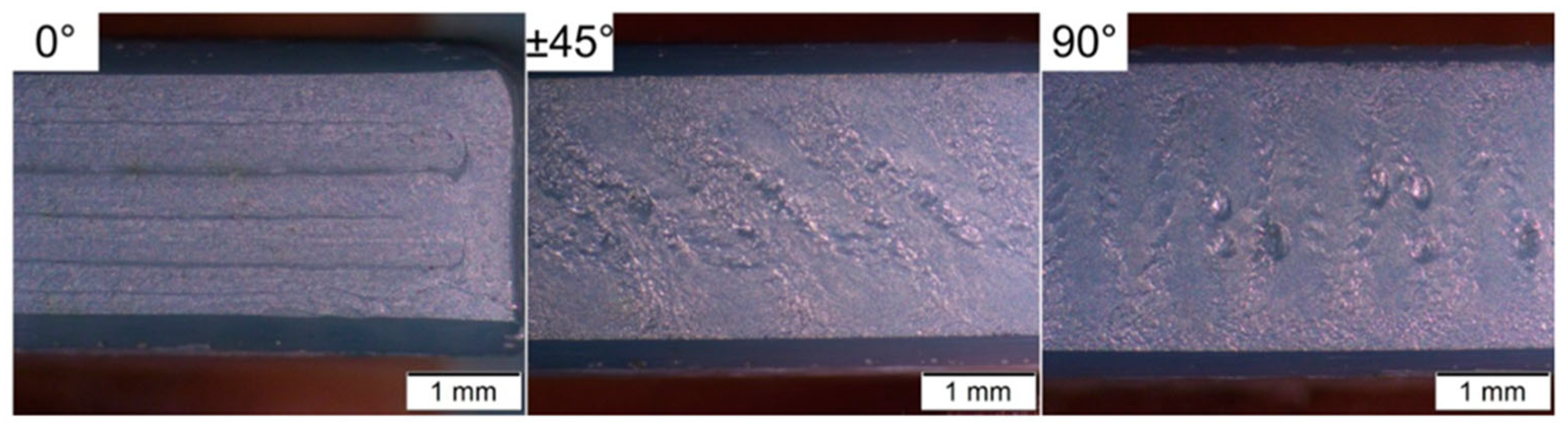
| ZrO2 | 3-point bending test | raster 0° raster +/− 45° raster 90° | 512 473 366 | 537 508 404 | 9.9 6.5 4.3 | Cano et al. [31] | |
| 3-point bending test | wt.% 78% wt.% 80% wt.% 82% | 206.3 311.1 492.8 | - | - | Guan et al. [33] | ||
| Biaxial flexural test | - | 91 | 5.7 | Hadian et al., 2021 [34] | |||
| Biaxial flexural test | - | feedstock filament | 203 531 | 4.3 3.5 | Hadian et al., 2022 [35] | ||
| 3-point bending test | 890 | - | - | He et al. [36] | |||
| ZrO2 5Y-PSZ (Ceramill ZOLID FX, Herrschaftswiesen, Austria) traditionally manufactured as a reference | Biaxial flexural test | - | as fired polished | 633.8 943.9 | 9.8 6.6 | Spintzyk et al. [38] | |
Disclaimer/Publisher’s Note: The statements, opinions and data contained in all publications are solely those of the individual author(s) and contributor(s) and not of MDPI and/or the editor(s). MDPI and/or the editor(s) disclaim responsibility for any injury to people or property resulting from any ideas, methods, instructions or products referred to in the content. |
© 2024 by the authors. Licensee MDPI, Basel, Switzerland. This article is an open access article distributed under the terms and conditions of the Creative Commons Attribution (CC BY) license (https://creativecommons.org/licenses/by/4.0/).
Share and Cite
Spina, R.; Morfini, L. Material Extrusion Additive Manufacturing of Ceramics: A Review on Filament-Based Process. Materials 2024, 17, 2779. https://doi.org/10.3390/ma17112779
Spina R, Morfini L. Material Extrusion Additive Manufacturing of Ceramics: A Review on Filament-Based Process. Materials. 2024; 17(11):2779. https://doi.org/10.3390/ma17112779
Chicago/Turabian StyleSpina, Roberto, and Luigi Morfini. 2024. "Material Extrusion Additive Manufacturing of Ceramics: A Review on Filament-Based Process" Materials 17, no. 11: 2779. https://doi.org/10.3390/ma17112779
APA StyleSpina, R., & Morfini, L. (2024). Material Extrusion Additive Manufacturing of Ceramics: A Review on Filament-Based Process. Materials, 17(11), 2779. https://doi.org/10.3390/ma17112779