Article

Shoulder Related Temperature Thresholds in FSSW of Aluminium Alloys

1
Institute for Sustainability and Innovation in Structural Engineering (ISISE), Department of Mechanical Engineering, University of Coimbra, 3030-788 Coimbra, Portugal
2
Centre for Mechanical Engineering, Materials and Processes (CEMMPRE), Department of Mechanical Engineering, University of Coimbra, 3030-788 Coimbra, Portugal
3
Instituto Superior de Engenharia de Lisboa (ISEL), Department of Mechanical Engineering, Polytechnic Institute of Lisbon, 1959-007 Lisbon, Portugal
*
Author to whom correspondence should be addressed.
Materials 2021, 14(16), 4375; https://doi.org/10.3390/ma14164375
Submission received: 2 July 2021 / Revised: 28 July 2021 / Accepted: 30 July 2021 / Published: 5 August 2021

Abstract

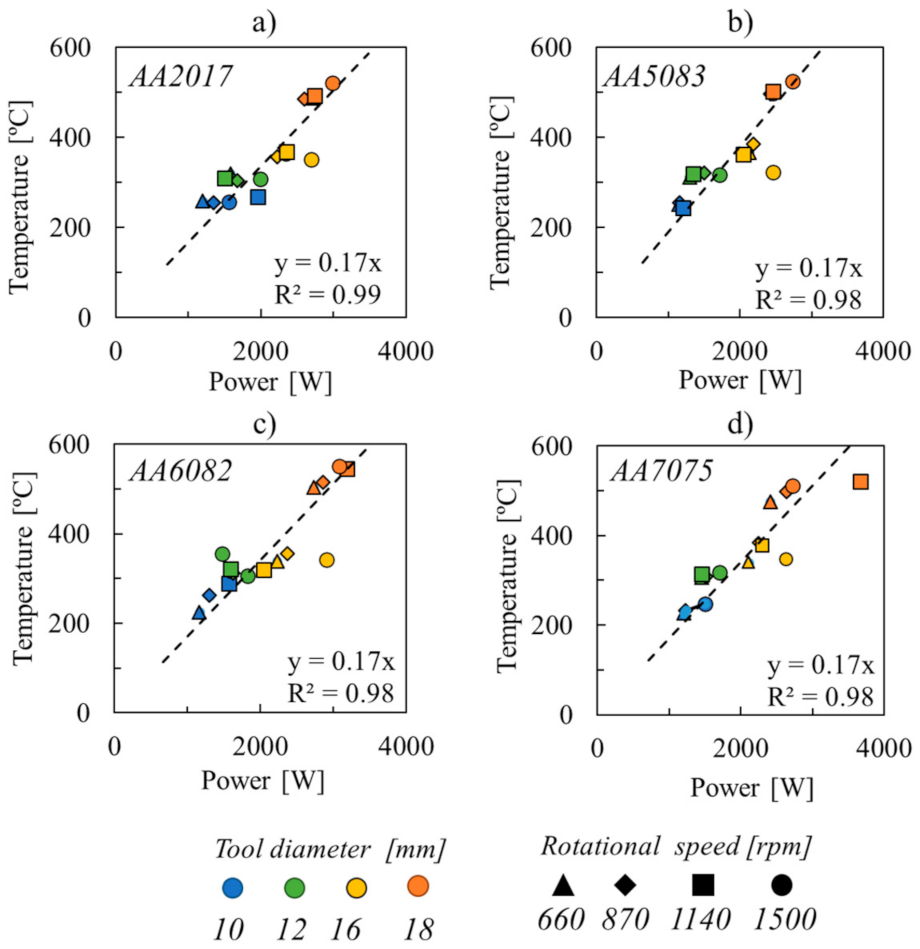
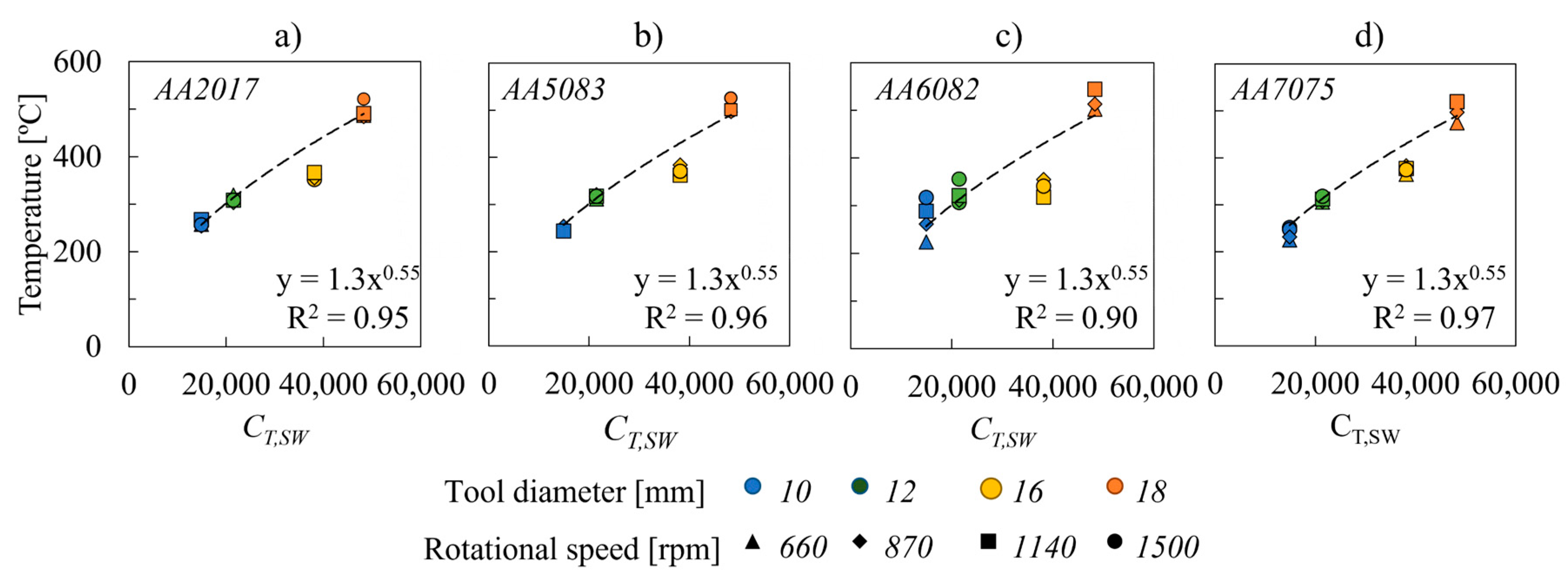
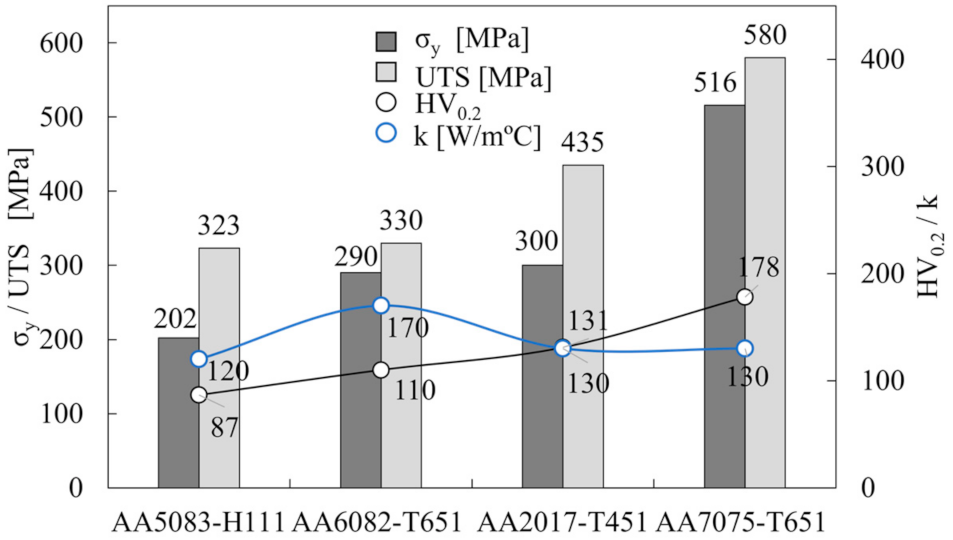
Friction Stir Spot Welding (FSSW) is assumed as an environment-friendly technique, suitable for the spot welding of several materials. Nevertheless, it is consensual that the temperature control during the process is not feasible, since the exact heat generation mechanisms are still unknown. In current work, the heat generation in FSSW of aluminium alloys, was assessed by producing bead-on-plate spot welds using pinless tools. Coated and uncoated tools, with varied diameters and rotational speeds, were tested. Heat treatable (AA2017, AA6082 and AA7075) and non-heat treatable (AA5083) aluminium alloys were welded to assess any possible influence of the base material properties on heat generation. A parametric analysis enabled to establish a relationship between the process parameters and the heat generation. It was found that for rotational speeds higher than 600 rpm, the main process parameter governing the heat generation is the tool diameter. For each tool diameter, a threshold in the welding temperature was identified, which is independent of the rotational speed and of the aluminium alloy being welded. It is demonstrated that, for aluminium alloys, the temperature in FSSW may be controlled using a suitable combination of rotational speed and tool dimensions. The temperature evolution with process parameters was modelled and the model predictions were found to fit satisfactorily the experimental results.
Keywords: aluminium alloys; temperature; FSSW aluminium alloys; temperature; FSSW