Article

A Power Coordinated Control Method for Islanded Microgrids Based on Impedance Identification
College of Automation and Electronic Engineering, Qingdao University of Science and Technology, Qingdao 266061, China
*
Authors to whom correspondence should be addressed.
Energies 2026, 19(3), 857; https://doi.org/10.3390/en19030857
Submission received: 26 December 2025 / Revised: 24 January 2026 / Accepted: 3 February 2026 / Published: 6 February 2026

Abstract

Droop control is an effective power regulation method for islanded microgrids to cope with fluctuations in renewable energy and loads. However, its power coordination performance is easily affected by the line impedance. When virtual impedance is introduced to enhance impedance matching, fixed values struggle to adapt flexibly to varying grid conditions. To address this specific limitation, this paper proposes a novel power coordination control strategy based on real-time line impedance identification. The method first analyzes the power distribution principle and equilibrium conditions under droop control. Crucially, it then establishes a dynamic virtual impedance regulation mechanism. By continuously identifying the actual line impedance, the proposed strategy dynamically adjusts the virtual impedance, thereby reshaping the inverter’s output impedance in real-time to match the grid conditions. This approach directly enhances the inverter’s adaptability to impedance variations, which is the core challenge in robust power coordination. Simulation results demonstrate that, compared to methods using fixed virtual impedance, the proposed strategy significantly improves power-sharing accuracy and system robustness under uncertainties such as fluctuating line impedance and load changes.

1. Introduction

As traditional fossil energy sources deplete, the rapid development of renewable energy has emerged as a key solution to address climate change and energy security challenges in the modern energy landscape [1]. Distributed Generation (DG) systems based on renewable energy have garnered widespread attention due to their environmental benefits, high efficiency, and operational flexibility [2,3]. To address the shortcomings of strong randomness, significant volatility, and intermittent randomness in DG, the concept of microgrids is proposed [4]. In the microgrids, different energy sources are integrated via inverters. The power coordination among multiple power sources is particularly critical for the stable operation of the system, which is achieved through the control of inverters [5]. Due to the lack of support from the main grid, power coordination control in the islanded operation deserves greater attention [6,7,8].
The droop control strategy is proposed for inverters to mimic the droop characteristics of synchronous generators and possess power-sharing capabilities [9]. Due to its advantages of simple implementation, no requirement for communication, and plug-and-play capability, it is widely used for power distribution among parallel-connected inverters. In the droop control method, the characteristics of the inverter output impedance and line impedance affect the accuracy of power sharing among parallel inverters in the system. Numerous studies have been conducted on this topic, yielding some notable research findings. In [10,11], a virtual active and reactive power decoupling method is proposed to achieve precise active power sharing based on the droop control scheme.
To address the challenge of uneven reactive power distribution in droop control—caused by inconsistent inverter output impedances resulting from hardware factors like filters and line impedances—an adaptive droop coefficient control method is proposed in [12]. Refs. [13,14,15] jointly explored adaptive virtual impedance control as a key solution to improve the accuracy and stability of power sharing in islanded microgrids. The research in [16,17,18] uses deep reinforcement learning to enhance traditional droop control strategies. On the basis of droop control, references [19,20] further introduce the rotor motion equation and damping characteristics of synchronous generators to compensate for the shortcomings of traditional droop control. At the same time, various intelligent algorithms have been widely explored in the field of power control optimization [17,21,22,23].
In islanded operation, the power distribution of low-voltage microgrids is constrained by the resistance–inductance characteristics of line impedances. In [24,25], the inverse droop control is investigated for the condition of line impedances exhibiting a high resistance–inductance ratio. In this method, the active power-amplitude and reactive power-frequency droop scheme is constructed. A model analysis of voltage source converter impedance is performed in [26,27], and the significance of line impedance for power distribution is highlighted. Two critical conditions are concluded for precise power distribution: the consistency of equivalent line impedance parameters and output voltage amplitude and phase for all inverters. However, in practical engineering, these two conditions are often difficult to satisfy simultaneously.
To address the uneven power distribution caused by line impedance mismatch, ref. [28] investigates the output voltage characteristics and power distribution mechanism. A voltage integration loop is designed to suppress excessive bus voltage deviation, thereby improving power distribution accuracy and the reliability of system operation. In [29], a virtual equivalent impedance control algorithm is developed to regulate load power distribution in multi-DG inverter systems using the equivalent resistance–inductance ratio. With this approach, the system stability and distribution accuracy are all improved. An improved droop control method based on adaptive virtual impedance is proposed in [30]. Through low-bandwidth communication, two variables representing the average distribution ratios of active and reactive power are introduced to enable online adjustment of the virtual impedance parameter for each DG.
Based on the aforementioned research, given the practical uncertainty of line impedances and their undeniable impact on power sharing, embedding tunable virtual impedance into droop control offers a straightforward solution to mitigate power sharing dilemmas in microgrids. Nevertheless, existing adaptive virtual impedance strategies mostly rely on fixed regulation rules or offline impedance calibration, lacking real-time coordination with actual grid impedance variations. Meanwhile, conventional impedance identification-based droop control methods tend to separate impedance detection from virtual impedance adjustment, leading to potential delays in dynamic response and compromised control robustness under complex operating conditions. To address these limitations and fill the research gap between the two types of strategies, this paper proposes a coordinated power control strategy integrating droop control with real-time grid impedance identification for low-voltage islanded microgrids. The work undertaken is as follows:
(1)
The power distribution principle of islanded microgrids with resistive-dominated line impedance under droop control is analyzed, and the influence of the line impedance is revealed.
(2)
Online grid impedance identification is integrated with adaptive virtual impedance adjustment, where fast response and high precision are achieved through current peak perturbation and DFT fundamental wave extraction techniques.
(3)
A virtual impedance adjustment mechanism based on power sharing errors is developed to dynamically modify the inverter output impedance, and the proportional power distribution under line impedance fluctuations can be ensured.
(4)
Comprehensive simulation validations are conducted covering multiple scenarios, and the performance of the proposed method in improving the power distribution capability of the microgrid is verified.
The rest of this paper is organized as follows. In Section 2, the power distribution principle of the islanded microgrid is analyzed. In Section 3, the improved droop control method with adaptive virtual impedance and the grid impedance identification method are proposed. Simulation results under different conditions are given in Section 4. Conclusions are finally drawn in Section 5.

2. Power Distribution Principle of Islanded Microgrid

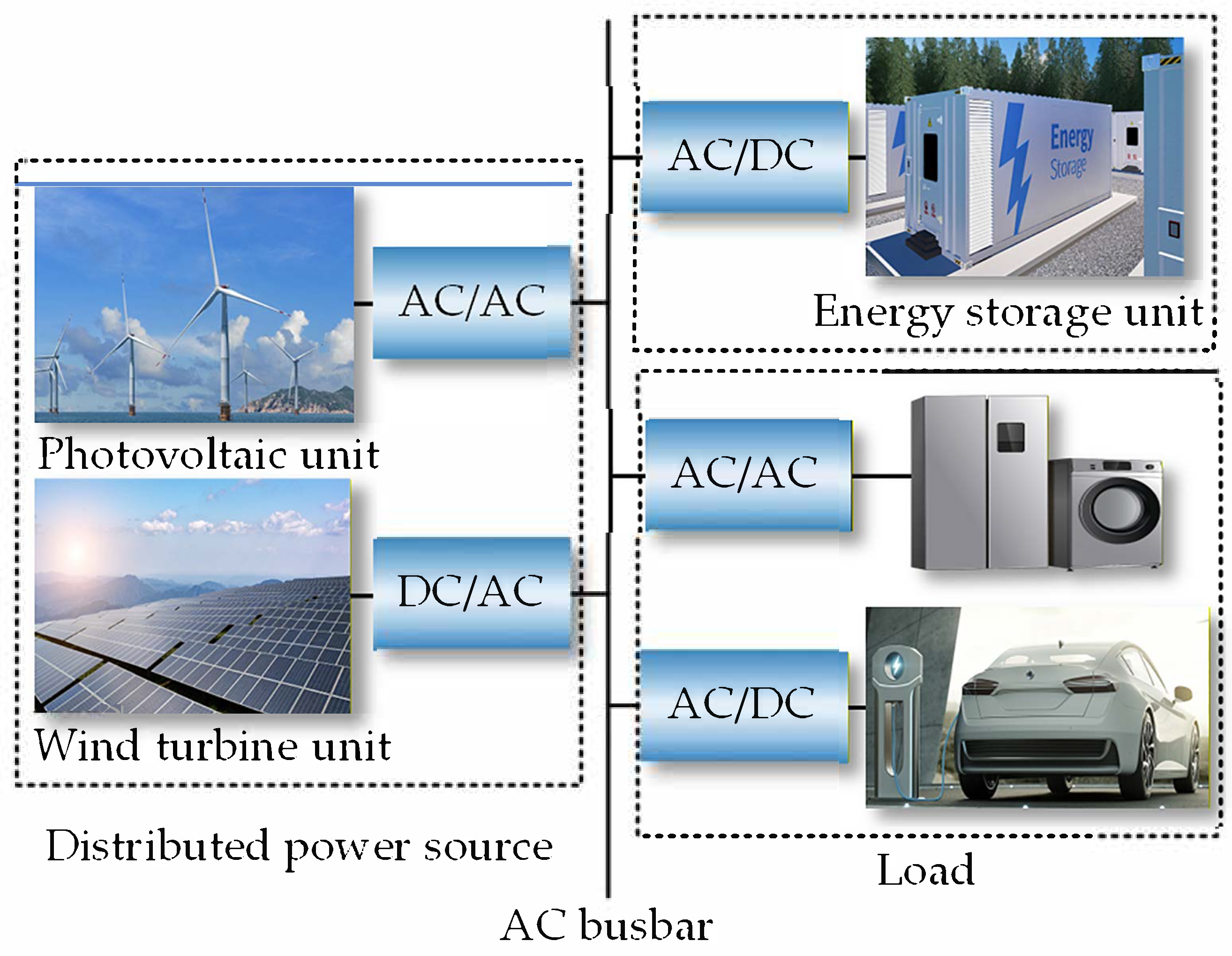
The typical structure of the islanded microgrid is illustrated in Figure 1. It comprises DGs, energy storage units, power converters, and loads. When operating in the islanded mode, DG units are responsible for supplying power to the load and providing voltage and frequency support to the system.

2.1. Droop Control

In the low-voltage microgrid, transmission lines are resistive-dominated [24]. To alleviate the coupling between active power and reactive power, droop control needs to be adopted. The control characteristics can be described as
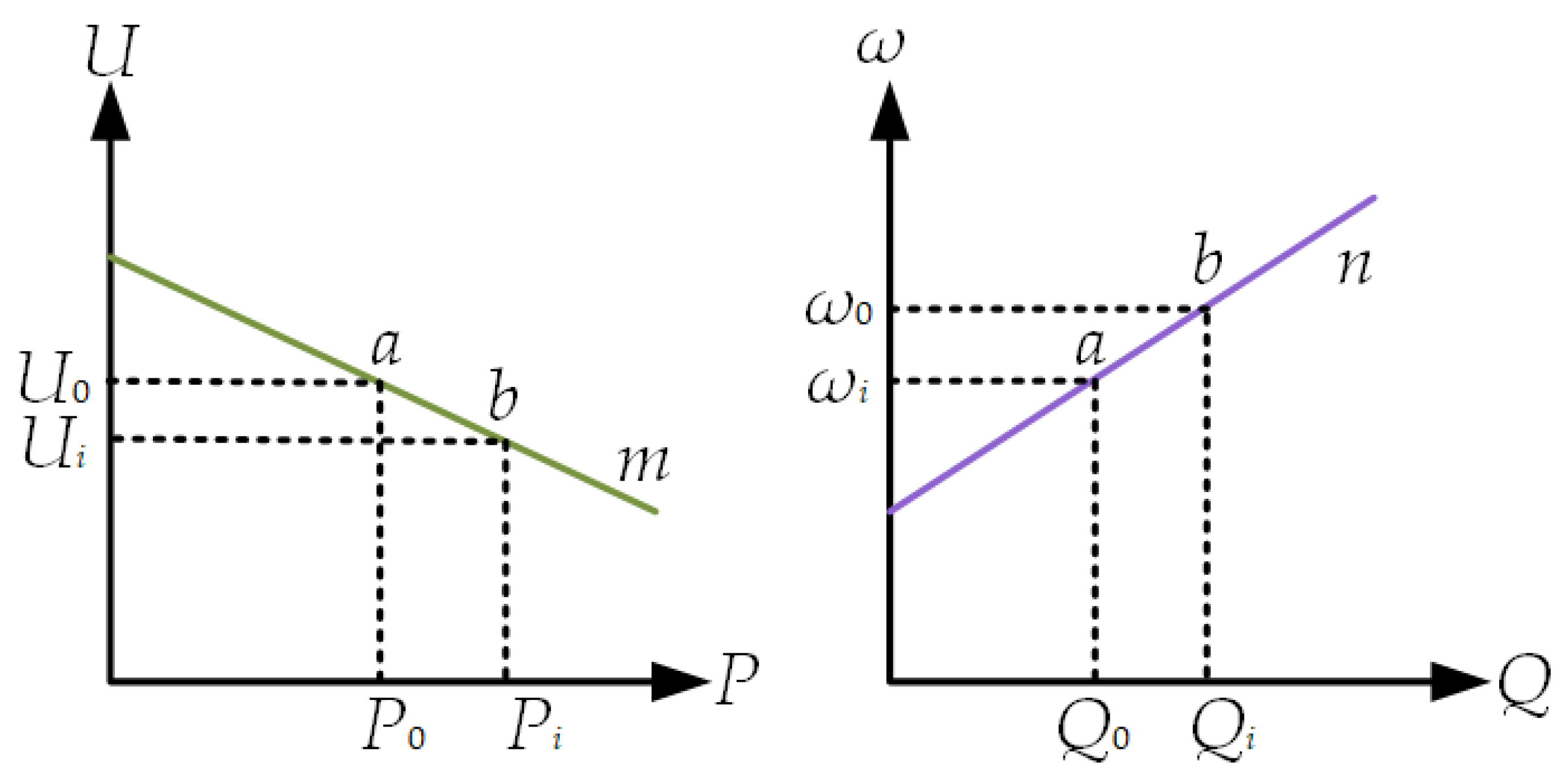
U = U 0 m ( P i P 0 ) ω = ω 0 + n ( Q i Q 0 )
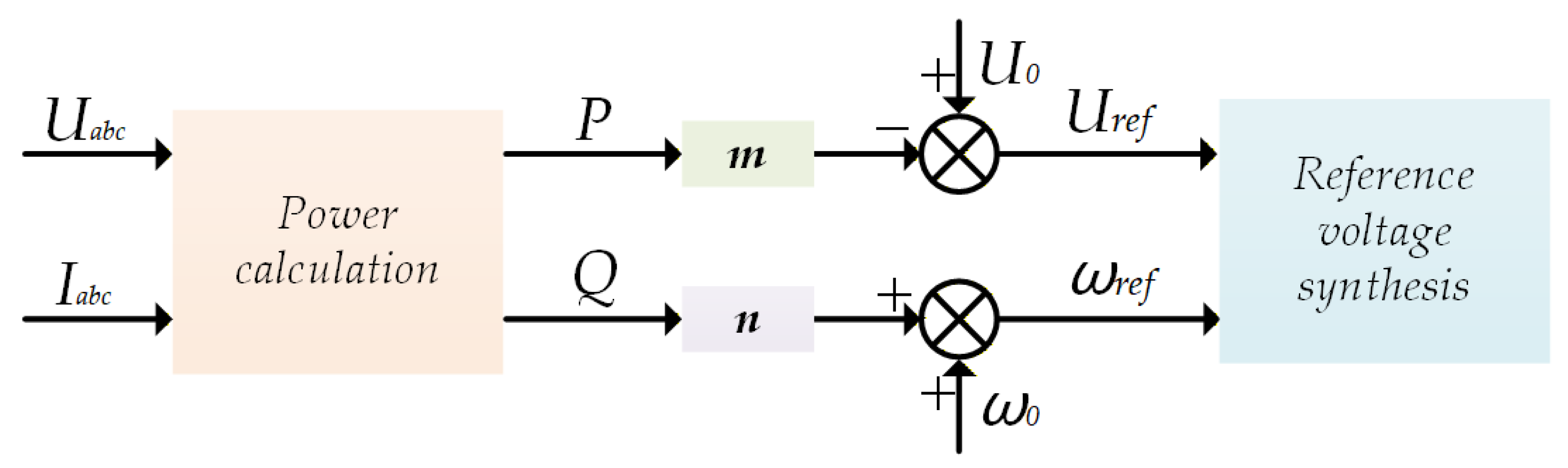
where ω is the frequency, U is the amplitude of the output voltage, and U0 and ω0 are their reference values. P and Q are the actual output active power and reactive power, respectively, and P0 and Q0 are their reference values. m and n are droop coefficients for the active power and reactive power, respectively. Based on (1), the block diagram of the droop control method can be depicted in Figure 2, and the regulation curves are shown in Figure 3.
It can be observed from the above equation that when the equivalent impedance of the inverter is resistive, the output active power depends on the difference between the output voltage amplitude of each DG unit and the voltage amplitude at the PCC, while the output reactive power depends on the phase angle difference between each DG unit and the PCC. This indicates that its control characteristics differ from the traditional principle [25].

2.2. Power Characteristic Analysis and Capacity-Based Distribution Conditions

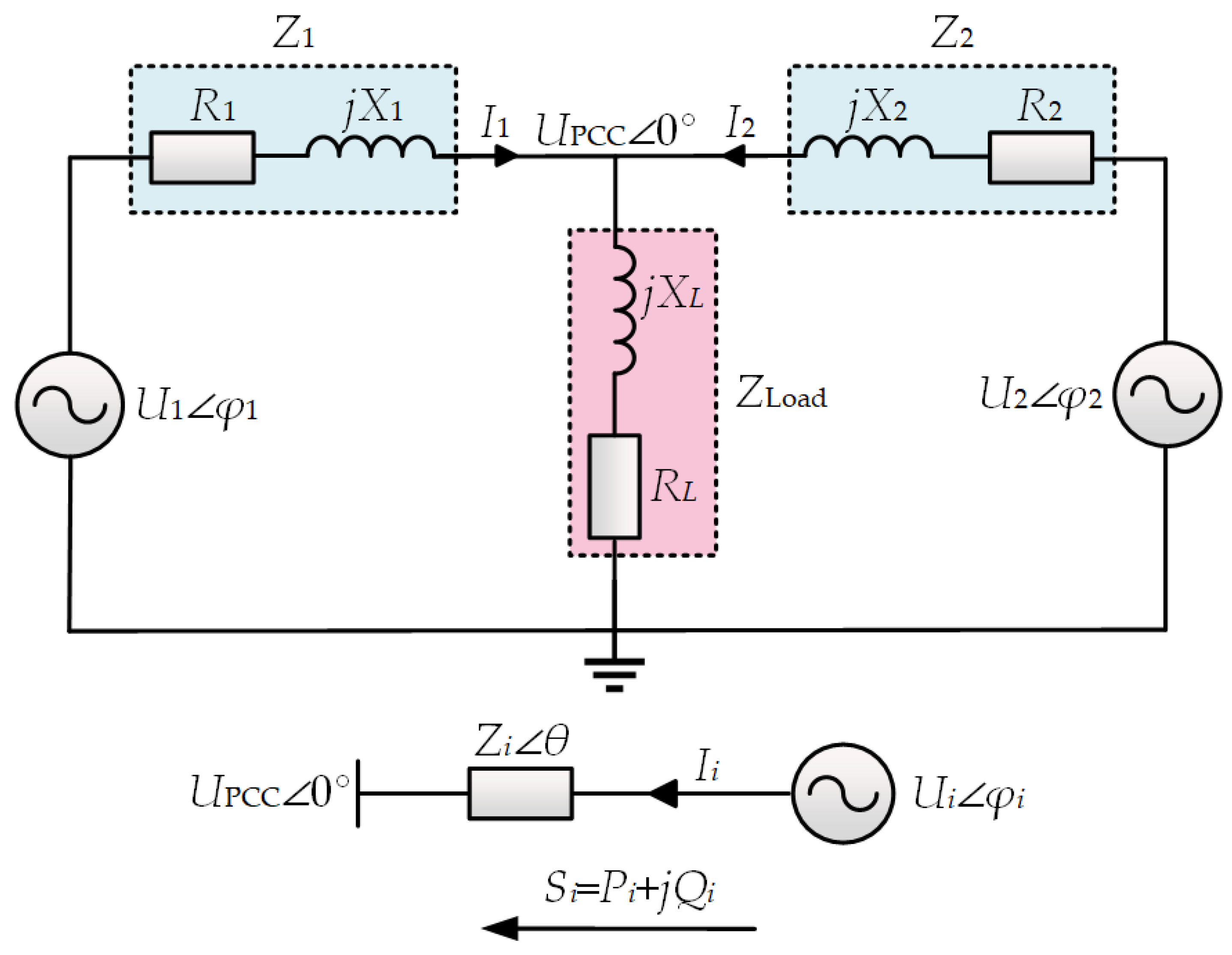
The equivalent circuit diagram of multiple inverters operating in parallel within an islanded microgrid is presented in Figure 4. Ui (i = 1,2) denotes the output voltage amplitude of the i-th inverter, φi represents the phase angle difference between the i-th inverter and the PCC voltage, and Ii indicates the output current of each inverter. Zi = Ri + jXi represents the equivalent line impedance from the i-th inverter to the PCC, where Ri is the resistive component and Xi is the inductive component. ZLoad = RL + jXL denotes the common load, where RL is the resistive component and XL is the inductive component. From Figure 4, the output power of each inverter can be derived as
P i = U i [ R i ( U i U PCC cos φ i ) + U PCC X i sin φ i ] R i 2 + X i 2
Q i = U i [ X i ( U i U PCC cos φ i ) U PCC R i sin φ i ] R i 2 + X i 2
In low-voltage microgrid, the line impedance is primarily resistive with negligible phase angles, approximately 0°. So sinφiφi, cosφi ≈ 1, and (2) and (3) can be simplified to
P i U PCC ( U i U PCC ) R i
Q i U PCC U i φ i R i
(1)
Distribution principle of reactive power
Based on (1) and (5), the Laplace transform of the reactive power under droop control can be derived as
Q i ( s ) = Q o i ( s ) ω o / n i 1 + s R i n i U PCC ( s ) U i
As can be seen from (6), the line impedance only affects the transient regulation process of reactive power and does not influence the final distribution result. The realization of reactive power distribution according to inverter capacity only requires that
Q o i : Q o j = S i : S j ,   n i : n j = S j : S i
where Si and Sj are the capacities of the i-th and j-th inverters.
(2)
Distribution principle of active power
Based on (1) and (2), the Laplace transform of the active power under droop control can be derived as
P i ( s ) = U o i U PCC ( s ) + m i P o i m i + R i U PCC
To achieve a proportional distribution of active power according to the inverter capacity, the following condition must be satisfied.
P o i : P o j = S i : S j ,   m i : m j = S j : S i ,   R i : R j = S j : S i
where S i and S j denote the capacities of the i-th and j-th inverters.

3. Coordinated Power Control Method Based on Impedance Identification

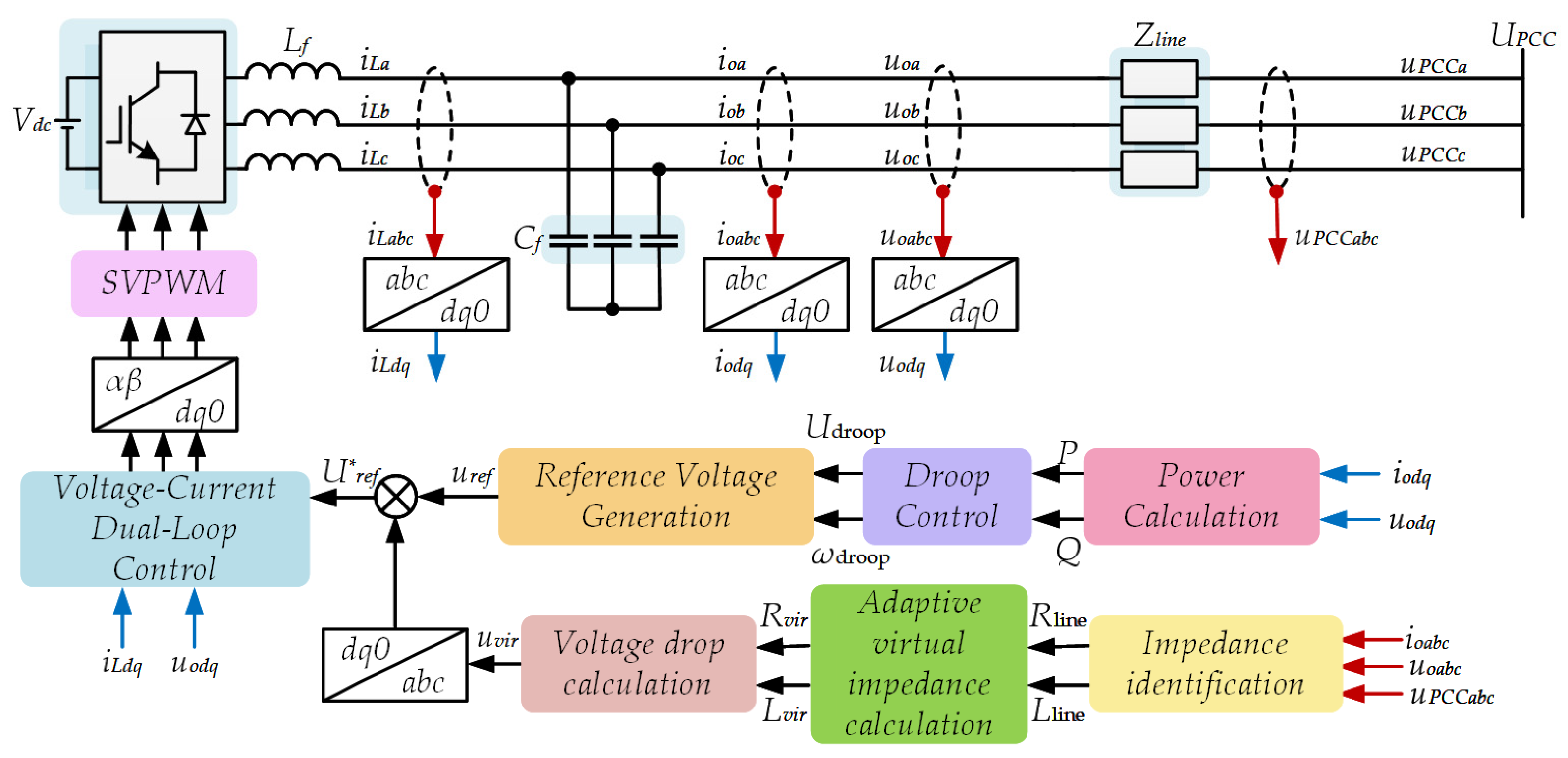
The proposed coordinated power control method for the islanded microgrid is shown in Figure 5, which is composed of a droop control loop and a virtual impedance control loop. Furthermore, an adaptive regulation strategy based on impedance identification is adopted in the virtual impedance control loop to enhance impedance matching.

3.1. Droop Control with Embedded Adaptive Virtual Impedance

Based on (1) and Figure 5, the droop control with embedded virtual impedance can be described as
U d r e f = U o d m ( P i P o ) U d v i r U q r e f = U o q m ( P i P o ) U q v i r ω = ω o + n ( Q i Q o ) ,   U dqref = U d r e f U q r e f T ,   U odq = U o d U o q T
where U*dqref is the reference voltage vector on the dq axis after virtual impedance adjustment and Uodq is the voltage reference vector of the dq axis in sag control. Uvirabc represents the compensation voltage generated by virtual impedance, which can be expressed as
U v i r = Z v i r i a b c ,   Z v i r a b c = R v i r 0 0 0 R v i r 0 0 0 R v i r T ,   i a b c = i a i b i c T
where Uvirdq is a pure resistive virtual impedance matrix. iabc is a three-phase current vector.
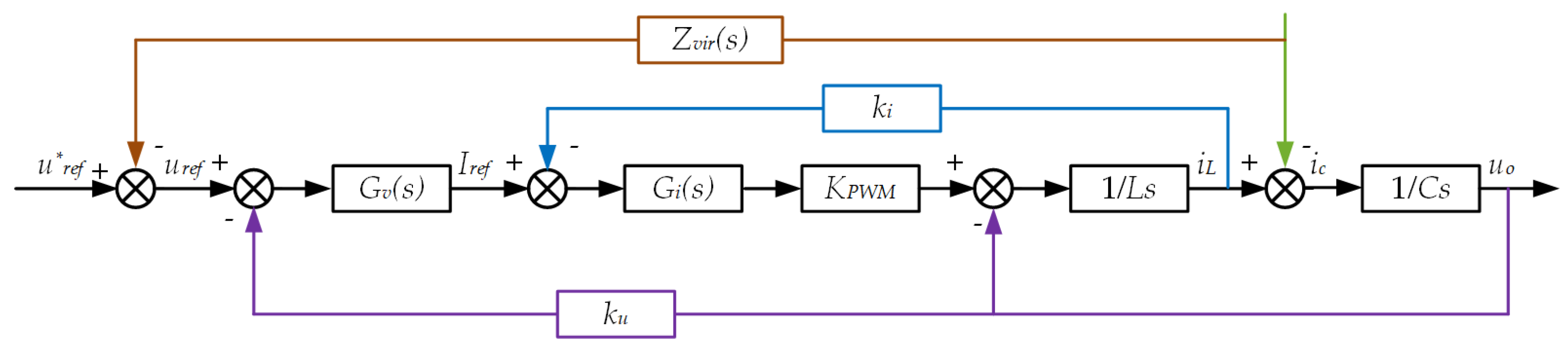
Based on (10) and (11), the block diagram of the proposed droop control with embedded adaptive virtual impedance can be drawn in Figure 6. As can be seen from Figure 6, a path from the output current to the voltage reference is constructed by the virtual impedance. Based on Figure 6, the output impedance of the inverter can be derived as
Z o ( s ) = L s + K PWM G i ( G v Z v i r + K i ) L C s 2 + K PWM G i C ( G v Z v i r + K i ) s + K PWM G i ( G v + 1 )
Based on (4) and (5), if the influence of the inverter output impedance is considered, and the output power of the inverter can be expressed as
P i U PCC ( U i U PCC ) Z i + Z o i
Q i U PCC U i φ i Z i + Z o i
Inspired by (12) to (14), the control strategy is determined to achieve power coordination and sharing by adjusting the virtual impedance value to shape the inverter output impedance. Virtual impedance control introduces a variable impedance link in the control loop to simulate a virtual impedance series connected with the physical output impedance. This enables the total equivalent output impedance of the inverter to be adjusted. The total equivalent output impedance of each inverter must satisfy the proportional relationship expressed in (9). According to the droop characteristic and the capacity ratio. The theoretical power value Pi,ref under the current working condition can be calculated as
P i , r e f = S i S total P total
Since the output impedance of the inverter directly affects its power sharing performance in microgrids, this paper proposes a virtual impedance regulation method based on power sharing error, as shown in (16). In (16), the power sharing error is defined as ΔPi = PiPi,ref, where Pi,ref represents the reference active power of the i-th inverter. Based on (16), if an inverter is detected to have an active power output exceeding its theoretical value calculated by capacity, its virtual resistance Zvir will be increased. According to (13), the active power output of the inverter will be reduced with the increase of Zvir, thereby bringing it closer to the proportional value. By assigning larger virtual impedances to inverters with smaller output impedances, the differences in equivalent impedances between inverters can be modified, allowing power distribution to become independent of unbalanced line parameters.
R v , i ( k + 1 ) = R v , i ( k ) + Δ R v , i ( Δ P i )
This study is based on the identification of line impedance parameters, identifying the line impedances Rline and Zline, and then calculating the appropriate virtual impedance value. Finally, the required virtual impedance voltage drop is added to the reference voltage of the voltage PI regulator. General virtual impedance control does not include line impedance observation, so when determining the virtual impedance, a larger value is usually set to offset the inconsistency of line impedance between inverters. However, a larger virtual impedance value can cause a drop in output voltage. The adaptive virtual impedance proposed in this article can obtain the impedance value of the line and set suitable values between different inverters. Compensate impedance values Rvir and Lvir. By adding different virtual impedances to different inverters, the obtained virtual impedances can achieve impedance matching while also taking into account lower output voltage drops. In addition, when the line impedance changes, the real-time calculation of the changed line impedance value can adaptively adjust the virtual impedance that needs to be added.

3.2. Impedance Identification Method

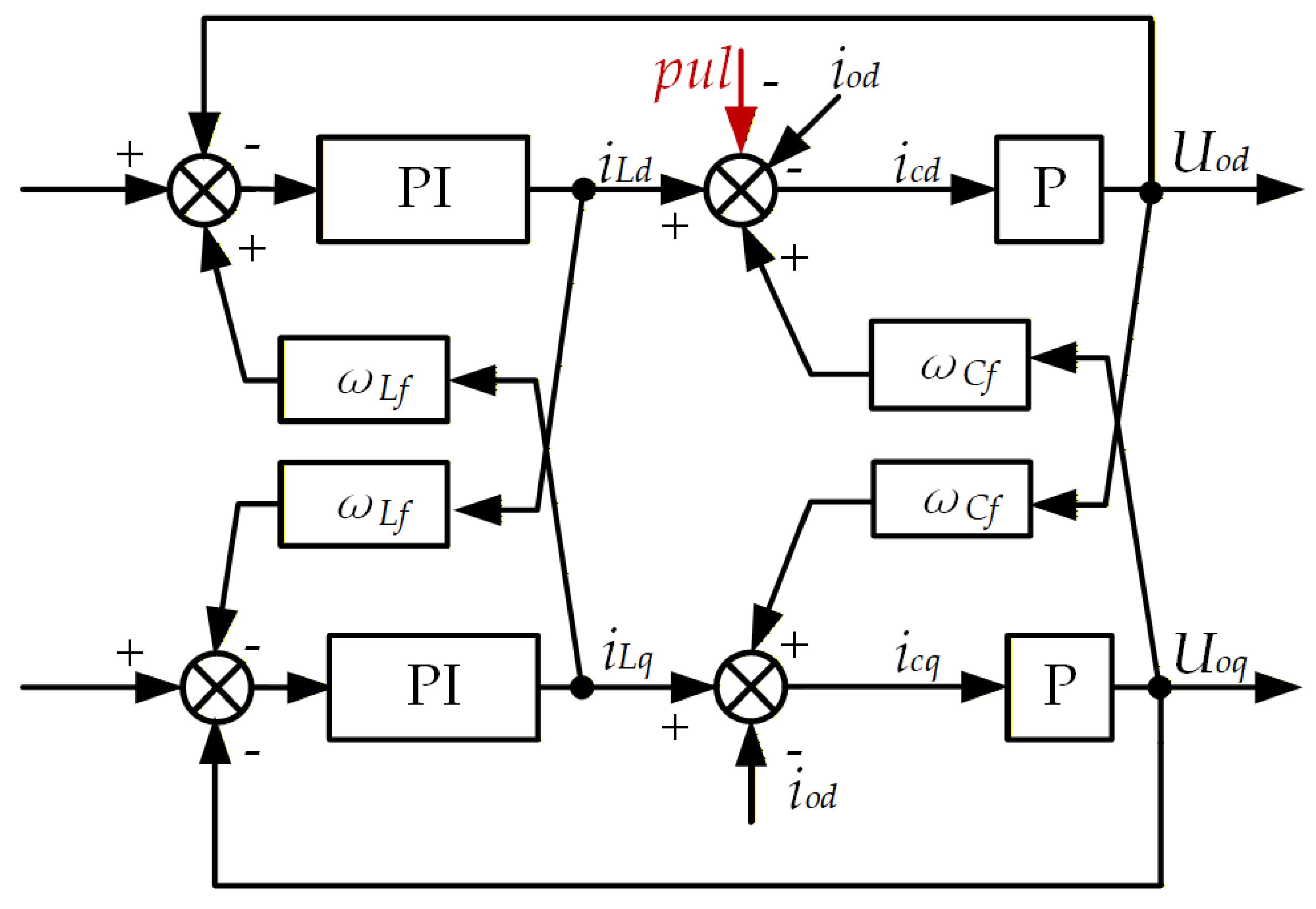
The block diagram of the voltage-current dual-loop controller is shown in Figure 7. To achieve the measurement of the line impedance, a disturbance signal marked as ‘pul’ is superimposed on the inner-loop current reference to make the inverter inject a disturbance current into the grid.
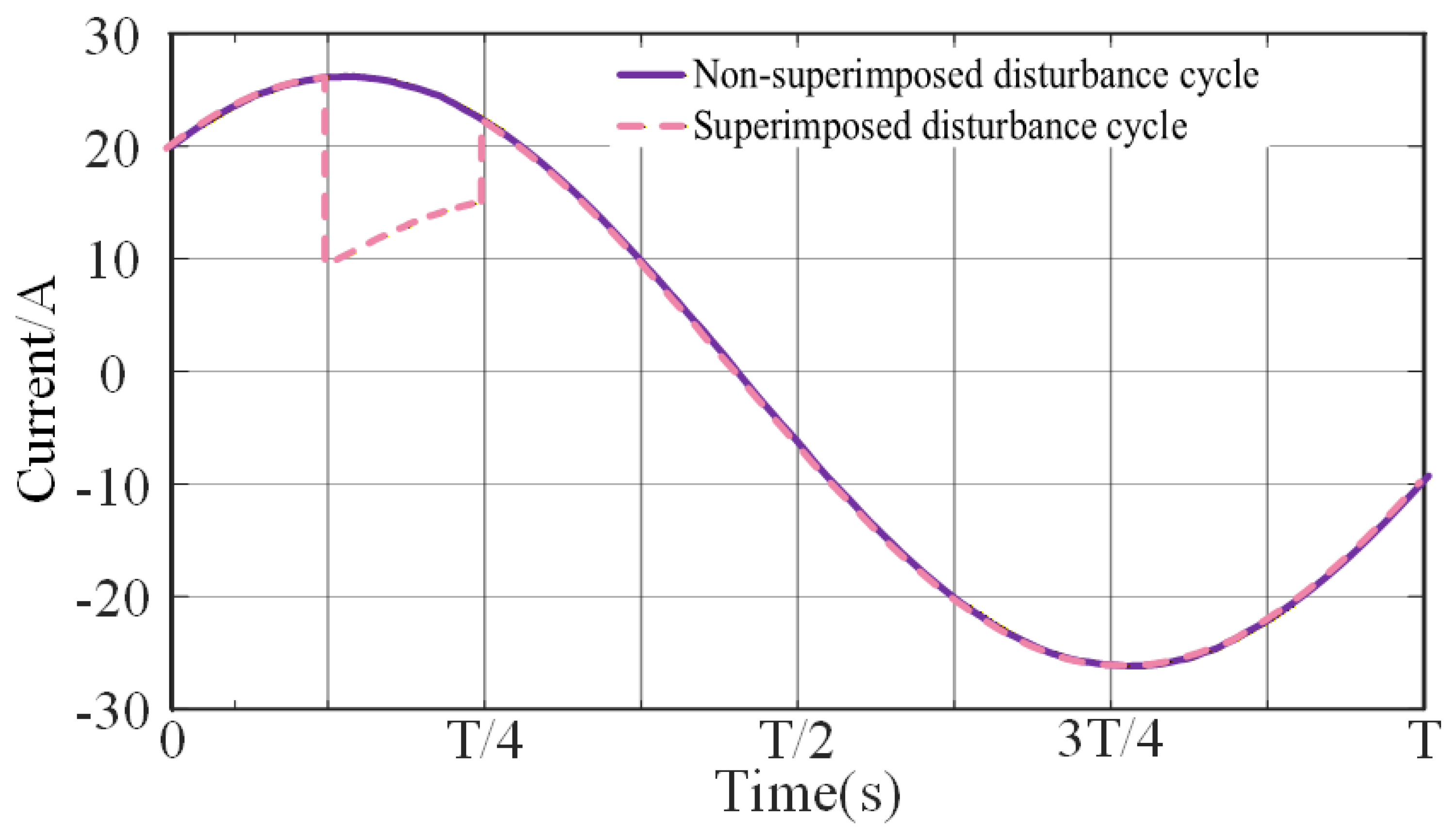
The proposed online impedance identification algorithm operates by injecting a controlled current disturbance and analyzing the system’s electrical response. The disturbance amplitude should be balanced between impedance identification accuracy and system impact. The process begins by monitoring the inverter’s output current. At the precise moment the current waveform reaches its peak, a negative rectangular disturbance pulse is injected. The amplitude of this pulse is set to 3/4 of the current reference signal, and it is removed once the resultant disturbance in the inverter output current itself reaches three-quarters of the amplitude. Following the injection, the inverter’s output voltage and current are sampled.
The analysis of impulse response relies on the assumption that the conditions remain constant between two consecutive fundamental periods. In order to isolate the disturbance response from the inherent harmonic background of the microgrid, the fundamental frequency component of subsequent periods is subtracted from the response signal of the disturbance period, as shown in Figure 8.
Δ x ( t ) = x n ( t ) x ( t )
where xn(t) represents the voltage or current signal during a pulse period disturbed by current, x(t) denotes the corresponding signal in the adjacent subsequent period, and ∆x(t) is the disturbance response in the voltage or current signal after subtracting these two signals to eliminate inherent harmonics. To obtain the frequency-domain components of the voltage and current can be derived with the Discrete Fourier Transform (DFT) as
X ( k ) = D F T [ x ( n ) ] = n = 0 N 1 x n e i θ e j 2 π kn N
Then the resulting frequency-domain sequences for the three-phase voltages and currents are subsequently decomposed into their positive- and negative-sequence components as
U p U n = 1 3 1 1 a a 2 a 2 a U a U b U c I p I n = 1 3 1 1 a a 2 a 2 a I a I b I c
where a = e j 2 π 3 is the 120-degree phase rotation factor; Ua, Ub, and Uc represent the frequency domain sequences of the three-phase voltages; Up and Un denote the frequency domain sequences of the positive and negative sequence voltages, respectively. Ia, Ib, and Ic are the frequency domain sequences of the three-phase currents, while Ip and In are the frequency domain sequences of the positive and negative sequence currents, respectively. Finally, the line impedance can be calculated from the ratio of the voltage response to the current response for each sequence as
Z p = U p I p Z n = U n I n
where Zp is positive sequence impedance and Zn is the negative sequence impedance. Finally the line impedance can be calculated as
R l i n e = Re Z p L l i n e = Im Z p
where Rline and Lline correspond to the resistance and inductance components of the measured line impedance, respectively.
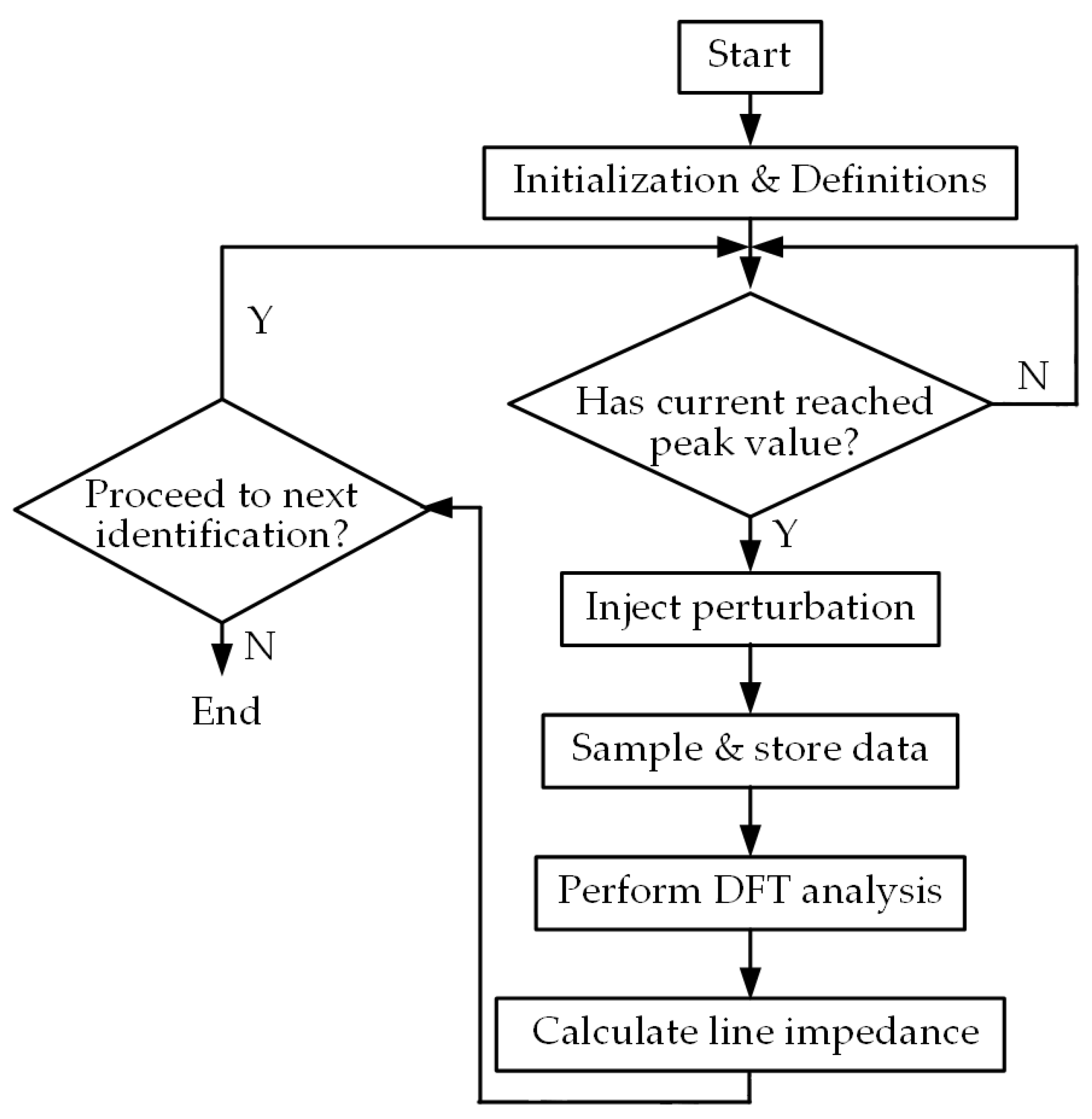
Based on the above analysis, the overall identification process of the line impedance is depicted in Figure 9. In Figure 9, the initialization section completes variable definition and system parameter setup, including configuration of sampling time and frequency. To minimize the impact on the normal operation of the inverter, the current disturbance is generated at the peak of the current through a peak detection unit. Then, the grid voltage and current during the disturbance are captured, and a Discrete Fourier Transform (DFT) is performed to extract their respective fundamental components. Finally, the line impedance can be calculated using the fundamental components of the voltage response and the current disturbance.

4. Verification Results

To validate the performance of the proposed power coordination control method, a microgrid system composed of two inverters is established in Simulink, with specific parameters provided in Table 1. Various conditions are set in the simulation to analyze the effectiveness and flexible adaptability of the proposed control method.

4.1. Power Distribution Performance of Inverters with the Same Capacity Under Line Impedance Fluctuation

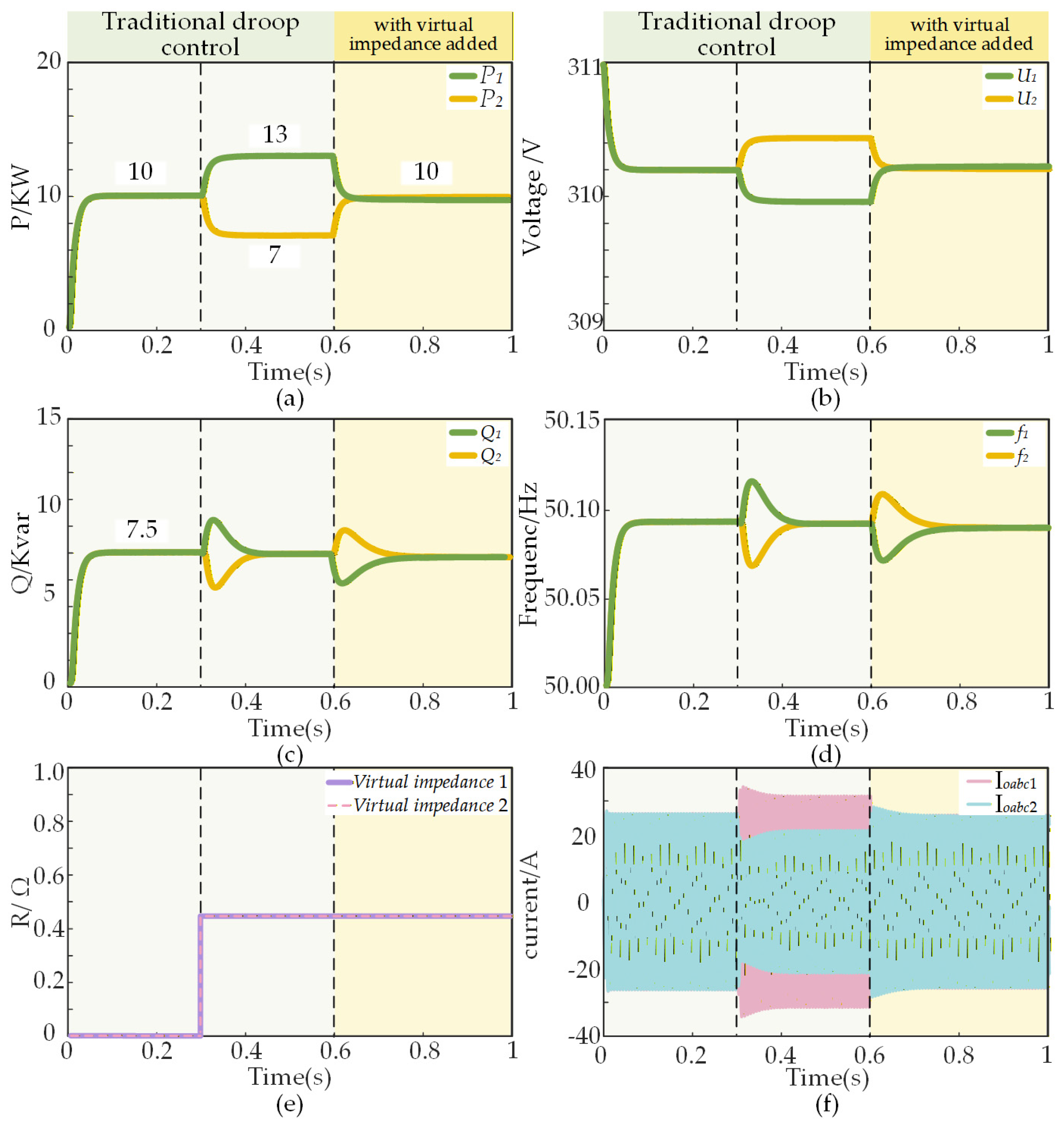
In this simulation, both inverters adopt the same parameters as listed in Table 1. To analyze the effectiveness of the proposed power coordination control method, a variation in line impedance is simulated during the process. The simulation waveforms are shown in Figure 10. As can be seen from Figure 10, initially, since the parameters of both inverters are identical and the matching relationships shown in (9) and (10) can both be satisfied, both inverters deliver equal power to the load. At 0.3 s, the line impedance of the second inverter is doubled, and it is observed that the power balance is immediately disrupted. Due to the increased line impedance, both the active and reactive power of the second inverter decreased, requiring the first inverter to deliver more power to the load to compensate for the change. To address the change in power, the droop control adjusts the output voltage and frequency of the inverters according to the relationship expressed in (1). Since the line impedance only affects the transient regulation of reactive power, as shown in (6), the frequency and reactive power of the two inverters become equal again after a brief adjustment. However, for the distribution of active power, as indicated in (8), it is difficult to restore the initial balanced state.
At 0.6 s, the line impedance identification and virtual impedance adaptive regulation algorithm are activated. The line impedance values are correctly identified, and under the effect of the adaptive adjustment strategy, the matching relationships shown in (9) and (10) are satisfied, and the output power of both inverters will be balanced again. The power coordination behavior of the two inverters during the aforementioned process can also be reflected in their output current waveforms. The aforementioned results demonstrate the effectiveness of the proposed power coordination control method. When the line impedance changes, the impedance value can be accurately identified, and the virtual impedance can be autonomously adjusted, thereby achieving dynamic power coordination between the two inverters.

4.2. Power Distribution Performance of Inverters with Different Capacities Under Line Impedance Fluctuation

In this simulation, a parallel system consisting of two inverters with a capacity ratio of 2:1 is established. The common load 1 is 30 + j15 Ω. To analyze the effectiveness of the proposed power coordination control method under mismatched parameters, variations in line impedance are introduced during the process.
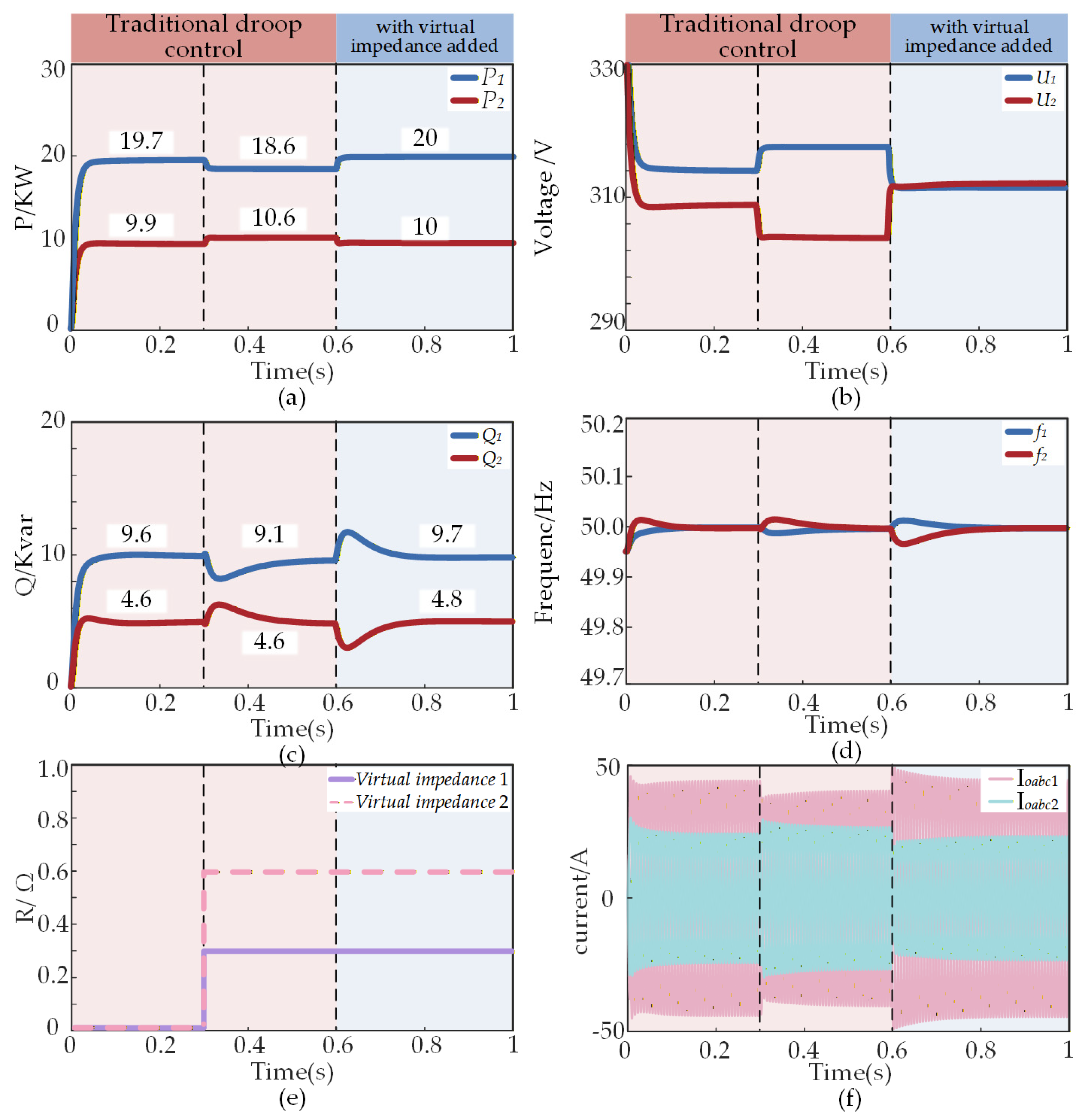
As observed in Figure 11, during the initial phase, the line impedance ratio of the two inverters is set to 1:2. By implementing the traditional droop control strategy, the inherent impedance difference precisely matched the inverter capacity ratio, partially satisfying the proportional power distribution matching relationships as expressed in (7) and (9). Consequently, both active and reactive powers of Inverter 1 and Inverter 2 achieved an approximate 2:1 distribution ratio.
At 0.3 s, the line impedance ratio changes to 1:1, at which point an immediate disruption in power distribution becomes evident. Since the line impedance ratio no longer satisfies the necessary condition for inverse proportional power sharing, the active power outputs of the two inverters deviate from the ideal proportion. Traditional droop control regulates output voltage and frequency to achieve the relationship described in Equation (1). However, as derived and analyzed for inverters with different capacities, when line impedances do not maintain an inverse relationship with capacity ratios, conventional droop control cannot sustain precise power distribution ratios, making it impossible to restore the ideal 2:1 sharing state.
At 0.6 s, the line impedance identification and virtual impedance adaptive adjustment algorithm are activated. The system successfully identifies the line impedance values and reconfigures the virtual impedance ratio through adaptive virtual impedance adjustment to satisfy the matching relationships under different capacities specified in Equations (7) and (9). Subsequently, the two inverters achieve precise power distribution according to the preset 2:1 capacity ratio. The output current waveforms in the figure clearly demonstrate the power coordination behavior during this process. These results fully validate the effectiveness of the proposed control strategy for inverters with different capacities. When line impedance changes occur, the system can accurately identify the impedance values and autonomously adjust the virtual impedance, thereby realizing dynamically precise power coordination that matches the rated capacities of the inverters.

4.3. Load Mutation Power Distribution Simulation Verification of Inverter with Different Capacities

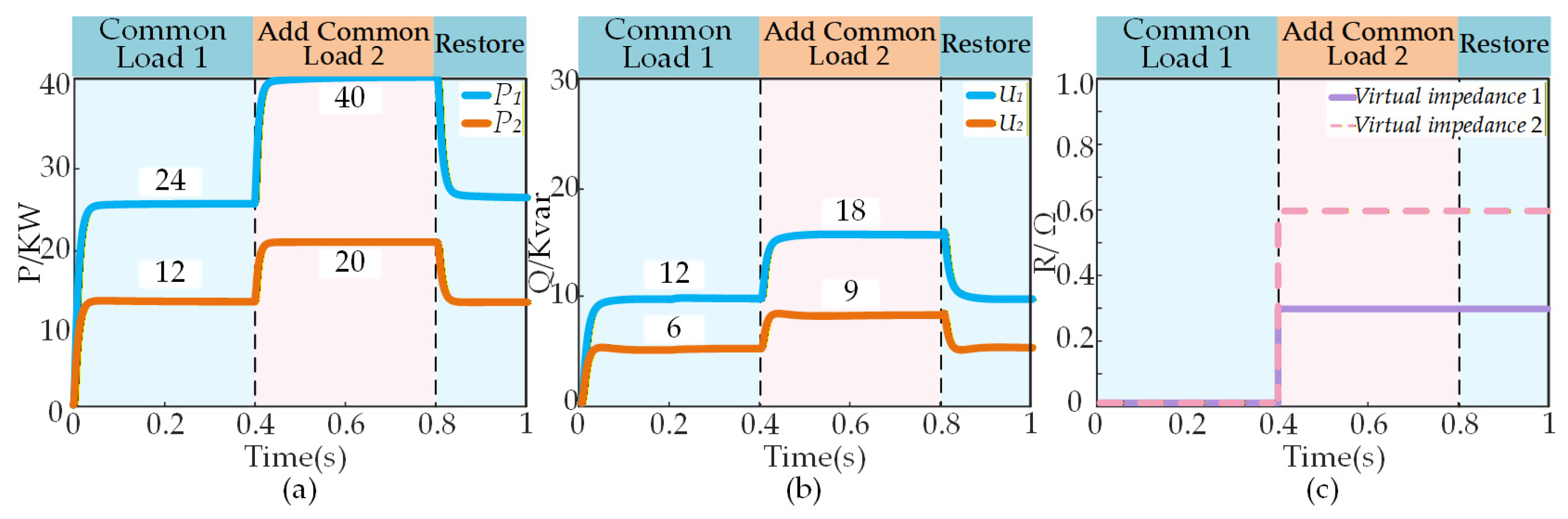
The load disturbance response performance of the proposed method is validated by changing the load, and the simulation waveforms are shown in Figure 12. At 0.4 s, the load is adjusted from 30 + j15 to 60 + j30, and both inverters respond rapidly by increasing their respective power output according to their capacities. The first inverter increases its output by 16 kW of active power and 8 kvar of reactive power, while the second inverter increases its output by 6 kW of active power and 3 kvar of reactive power. The increments in power output from the two inverters are consistent with their capacity ratio. At 0.8 s, the load is reduced to the initial value, and the output power of both inverters returns to their original values.
The above simulation results validate that with the proposed control strategy, the islanded microgrid can effectively achieve power coordination under different conditions and has strong robustness to both line and load disturbances.

5. Conclusions

This paper addresses the challenge of power sharing among parallel inverters in islanded microgrids, which is primarily caused by mismatched line impedance conditions. A power coordinated control method characterized by droop control embedded with adaptive virtual impedance is proposed. Through theoretical analysis and simulation validation, the following conclusions can be drawn:
(1)
Under the traditional droop control for the microgrid with resistive-dominated line impedances, the line impedance only affects the transient regulation process of reactive power and does not influence the final distribution result. But the balance of active power depends on the matching of line impedances and capacities between different inverters.
(2)
With accurate identification of line impedance and adaptive adjustment of virtual impedance in the proposed method, the inverter can flexibly adapt to changes in external line conditions by adjusting internal control parameters. And the power coordination control capability of the islanded microgrid under mismatched line impedance conditions can be effectively improved.
(3)
Simulation results show that the proposed method can coordinate the output of inverters according to their own capacity under the conditions of line impedance fluctuations, load abrupt changes and mild non-factors, so as to ensure the stable operation of the system, and has high identification accuracy and good dynamic response performance.
Despite these achievements, this study has the following limitations. Due to its focus on resistance dominated islanded power grids, this method did not take into account the inductance dominated situation of medium and high voltage microgrids. In the future, we will further enhance the anti-interference capability of microgrids by combining the methods proposed by the research institute with collaborative control of energy storage systems.

Author Contributions

Conceptualization, S.S. and Z.L.; methodology, S.S. and Z.L.; software, Y.W.; validation, Y.W., R.Y. and R.X.; formal analysis, Y.W.; investigation, Y.W.; resources, S.S.; data curation, Y.W.; writing—original draft preparation, Y.W.; writing—review and editing, Y.W.; visualization, Y.W.; supervision, S.S. and Z.L.; project administration, S.S.; funding acquisition, S.S. All authors have read and agreed to the published version of the manuscript.

Funding

This research was funded by Youth Science and Technology Innovation Support Program for Higher Education Institutions of Shandong Province, grant number 2024KJH134.

Data Availability Statement

The original contributions presented in this study are included in the article. Further inquiries can be directed to the corresponding authors.

Acknowledgments

The author assumes full responsibility for the final content and conclusions presented in this publication.

Conflicts of Interest

The authors declare no conflicts of interest. The funders had no role in the design of the study; in the collection, analyses, or interpretation of data; in the writing of the manuscript; or in the decision to publish the results.

Abbreviations

PCCPoint of Common Coupling
DGDistributed Generation
DFTDiscrete Fourier Transform

References

  1. Holttinen, H.; Kiviluoma, J.; Flynn, D.; Smith, J.C.; Orths, A.; Eriksen, P.B.; Cutululis, N.; Soder, L.; Korpas, M.; Estanqueiro, A.; et al. System Impact Studies for Near 100% Renewable Energy Systems Dominated by Inverter Based Variable Generation. IEEE Trans. Power Syst. 2020, 37, 3249–3258. [Google Scholar] [CrossRef]
  2. Li, Y.; Feng, B.; Wang, B.; Sun, S. Joint planning of distributed generations and energy storage in active distribution networks: A Bi-Level programming approach. Energy 2022, 245, 123226. [Google Scholar] [CrossRef]
  3. Zhang, C.; Guerrero, J.M.; Vasquez, J.C.; Coelho, E.A.A. Control architecture for parallel-connected inverters in uninterruptible power systems. IEEE Trans. Power Electron. 2016, 31, 5176–5188. [Google Scholar]
  4. Souza, M.E.T.; Carvalho, H.T.D.M.; Rodrigues, D.B.; Guimarães, É.C.; Coelho, E.A.A.; Freitas, L.C.G. Unified Control Strategy for Islanded, Seamless Transition, and Grid-Connected Operations of Inverter-Based Distributed Generation and Microgrids. IEEE Access 2025, 13, 202253–202274. [Google Scholar] [CrossRef]
  5. Kadhim, I.J.; Hasan, M.J. Enhancing power stability and efficiency with multilevel inverter technology based on renewable energy sources. Electr. Power Syst. Res. 2024, 231, 110290. [Google Scholar] [CrossRef]
  6. Miret, J.; Castilla, M.; Guzmán, R.; Borrell, A.; Velasco, M. Enhancing the Voltage-Support Capabilities of Grid-Feeding Inverters in an Islanded Microgrid Under a Short Circuit. IEEE Trans. Power Electron. 2025, 40, 18040–18053. [Google Scholar] [CrossRef]
  7. Ling, Y.; Li, Y.; Yang, Z.; Xiang, J. A Dispatchable Droop Control Method for Distributed Generators in Islanded AC Microgrids. IEEE Trans. Ind. Electron. 2020, 68, 8356–8366. [Google Scholar] [CrossRef]
  8. Liu, X.; Tang, J.; Zhou, Q.; Peng, J.; Huang, N. Coordinated Optimization Scheduling Method for Frequency and Voltage in Islanded Microgrids Considering Active Support of Energy Storage. Processes 2025, 13, 2146. [Google Scholar] [CrossRef]
  9. Liu, H.; Fang, T.; Lin, Z.; Wang, P.; Huang, X.; Li, Y. Droop Control Strategy Without Interconnection Lines for Input-Parallel Output-Series Grid-Connected Inverter System. IEEE Trans. Ind. Electron. 2024, 71, 15224–15228. [Google Scholar] [CrossRef]
  10. Wang, J.; Liu, Z.; Feng, K.; Liu, J. An Adaptive Droop and Feedforward Control Based Transient Power Sharing and Decoupling Method for Grid-Forming Inverters in Islanded Microgrids. IEEE Trans. Ind. Electron. 2024, 72, 4800–4810. [Google Scholar] [CrossRef]
  11. Campo-Ossa, D.D.; Sanabria-Torres, E.A.; Rodriguez-Martinez, O.F.; Vasquez-Plaza, J.D.; Rengifo, F.A. Rotated-Droop Control for Enhanced Stability and Power Decoupling in Microgrids With Complex Line Impedances. IEEE Access 2025, 13, 173614–173628. [Google Scholar] [CrossRef]
  12. Wang, R.; Sun, Q.; Hu, W.; Li, Y.; Ma, D.; Wang, P. SoC-Based Droop Coefficients Stability Region Analysis of the Battery for Stand-Alone Supply Systems With Constant Power Loads. IEEE Trans. Power Electron. 2021, 36, 7866–7879. [Google Scholar] [CrossRef]
  13. Zhang, Q.; Li, Y.; Ding, Z.; Xie, W.; Li, C. Self-Adaptive Secondary Frequency Regulation Strategy of Micro-Grid With Multiple Virtual Synchronous Generators. IEEE Trans. Ind. Appl. 2020, 56, 6007–6018. [Google Scholar] [CrossRef]
  14. Yang, H.; Sun, Z.; Wang, H.; Wang, Y.; Zhu, M.; Guo, L.; Zhou, G.; Lyu, H. Adaptive Virtual Impedance Droop Control of Parallel Inverters for Islanded Microgrids. Sensors 2025, 25, 5166. [Google Scholar] [CrossRef]
  15. Fan, B.; Li, Q.; Wang, W.; Yao, G.; Ma, H.; Zeng, X.; Guerrero, J.M. A Novel Droop Control Strategy of Reactive Power Sharing Based on Adaptive Virtual Impedance in Microgrids. IEEE Trans. Ind. Electron. 2021, 69, 11335–11347. [Google Scholar] [CrossRef]
  16. Khosravi, N.; Dowlatabadi, M.; Sabzevari, K. A hierarchical deep learning approach to optimizing voltage and frequency control in networked microgrid systems. Appl. Energy 2024, 377, 124313. [Google Scholar] [CrossRef]
  17. Babu, P.A.; Iqbal, J.L.M.; Priyanka, S.S.; Reddy, M.J.; Kumar, G.S.; Ayyasamy, R. Power Control and Optimization for Power Loss Reduction Using Deep Learning in Microgrid Systems. Electr. Power Compon. Syst. 2023, 52, 219–232. [Google Scholar] [CrossRef]
  18. Lai, H.; Xiong, K.; Zhang, Z.; Chen, Z. Droop control strategy for microgrid inverters: A deep reinforcement learning enhanced approach. Energy Rep. 2023, 9, 567–575. [Google Scholar] [CrossRef]
  19. Ke, S.; Yang, J.; Chen, L.; Fan, P.; Shi, X.; Li, G.; Wu, F. A Frequency Control Strategy for EV Stations Based on MPC-VSG in Islanded Microgrids. IEEE Trans. Ind. Inform. 2023, 20, 1819–1831. [Google Scholar] [CrossRef]
  20. Gurski, E.; Kuiava, R.; Damm, G. A Novel VSG Control Strategy with Droop Compensation for Improved Oscillation Damping and Guaranteed Steady-State Performance in Microgrids. IEEE Access 2025, 13, 170488–170503. [Google Scholar] [CrossRef]
  21. Naderi, E.; Mirzaei, L.; Pourakbari-Kasmaei, M.; Cerna, F.V.; Lehtonen, M. Optimization of active power dispatch considering unified power flow controller: Application of evolutionary algorithms in a fuzzy framework. Evol. Intell. 2023, 17, 1357–1387. [Google Scholar] [CrossRef]
  22. Tu, B.; Xu, X.; Gu, Y.; Deng, K.; Xu, Y.; Zhang, T.; Gao, X.; Wang, K.; Wei, Q. Improved Droop Control Strategy for Islanded Microgrids Based on the Adaptive Weight Particle Swarm Optimization Algorithm. Electronics 2025, 14, 893. [Google Scholar] [CrossRef]
  23. Xie, L.L.; Li, Y.; Fan, P.; Wan, L.; Zhang, K.; Yang, J. Research on load frequency control of multi-microgrids in an isolated system based on the multi-agent soft actor-critic algorithm. IET Renew. Power Gener. 2023, 18, 1230–1246. [Google Scholar] [CrossRef]
  24. Zhang, R.; Hredzak, B.; Chen, D. Bi-Level Control Structure with Accurate Real and Reactive Powers Sharing for Low Voltage Microgrids with Highly Resistive Line Impedances. In Proceedings of the 2020 IEEE 9th International Power Electronics and Motion Control Conference (IPEMC2020-ECCE Asia), Nanjing, China, 29 November–2 December 2020; pp. 1210–1215. [Google Scholar]
  25. Villa, A.; Belloni, F.; Chiumeo, R.; Gandolfi, C. Conventional and Reverse Droop Control in Islanded Microgrid: Simulation and Experimental Test. In Proceedings of the 2016 International Symposium on Power Electronics, Electrical Drives, Automation and Motion (SPEEDAM), Capri, Italy, 22–24 June 2016; pp. 288–294. [Google Scholar]
  26. Abouassy, A.M.; Alafnan, H.; Mansour, D.-E.A.; Albaker, A.; Megahed, T.F. An Improved Droop-Based Adaptive Virtual Impedance for Accurate Power Sharing Among Multiple DGs in Islanded Microgrid. IEEE Access 2025, 13, 108918–108933. [Google Scholar] [CrossRef]
  27. Chen, Z.; Pei, X.; Yang, M.; Peng, L.; Shi, P. A Novel Protection Scheme for Inverter- Interfaced Microgrid (IIM) Operated in Islanded Mode. IEEE Trans. Power Electron. 2017, 33, 7684–7697. [Google Scholar] [CrossRef]
  28. Zhai, M.-Y. Transmission Characteristics of Low-Voltage Distribution Networks in China Under the Smart Grids Environment. IEEE Trans. Power Deliv. 2010, 26, 173–180. [Google Scholar] [CrossRef]
  29. Ahmed, M.; Meegahapola, L.; Vahidnia, A.; Datta, M. Adaptive Virtual Impedance Controller for Parallel and Radial Microgrids with Varying X/R Ratios. IEEE Trans. Sustain. Energy 2021, 13, 830–843. [Google Scholar] [CrossRef]
  30. Abouassy, A.M.; Mansour, D.-E.A.; Asano, T.; Megahed, T.F. IoT-Based Microgrid Central Controller to Adaptively Tune Virtual Complex Impedance for Accurate Power Sharing. IEEE Internet Things J. 2025, 12, 35097–35110. [Google Scholar] [CrossRef]
Figure 1. Microgrid structure diagram.
Energies 19 00857 g001
Figure 2. Block diagram of droop control.
Energies 19 00857 g002
Figure 3. Droop control characteristic curve.
Energies 19 00857 g003
Figure 4. Equivalent circuit diagram of parallel inverter.
Energies 19 00857 g004
Figure 5. Improved droop control structure based on virtual impedance.
Energies 19 00857 g005
Figure 6. Control architecture with incorporated virtual impedance.
Energies 19 00857 g006
Figure 7. Control architecture for impedance identification.
Energies 19 00857 g007
Figure 8. Waveform of current disturbance injection effect using pulse response analysis method.
Energies 19 00857 g008
Figure 9. The process of online identification of line impedance.
Energies 19 00857 g009
Figure 10. Power distribution results of improved droop control inverters under line impedance fluctuation conditions. (a) Active power. (b) Output voltage. (c) Reactive power. (d) Output frequency. (e) Virtual impedance. (f) Output current of DG1 and DG2.
Energies 19 00857 g010
Figure 11. Improved droop control power distribution results for converters of different capacities under online impedance fluctuation conditions. (a) Active power. (b) Output voltage. (c) Reactive power. (d) Output frequency. (e) Virtual impedance. (f) Output current of DG1 and DG2.
Energies 19 00857 g011
Figure 12. Improved droop control power distribution results for converters of different capacities under load change. (a) Active power. (b) Reactive power. (c) Virtual impedance.
Energies 19 00857 g012
Table 1. Design of Simulation Parameters.
ParametersSymbolsValues
Frequencyf50 Hz
DC side voltageU800 V
AC side output preset voltage amplitude settingU311 V
Switching frequencyfo10 kHz
Filter inductanceLf4 mH
Filter capacitanceCf45 μF
Initial line impedanceZline0.3 + 0.1 × 10⁻³ Ω
Voltage outer loop proportional coefficientP10
Voltage inner loop integral coefficientI100
Current inner loop proportional coefficientP5
Traditional active droop coefficientKp8 × 10−5
Traditional reactive droop coefficientKq5 × 10−4
Public load 1Zload120 + j15 Ω
Public load 2Zload220 + j15 Ω
Disclaimer/Publisher’s Note: The statements, opinions and data contained in all publications are solely those of the individual author(s) and contributor(s) and not of MDPI and/or the editor(s). MDPI and/or the editor(s) disclaim responsibility for any injury to people or property resulting from any ideas, methods, instructions or products referred to in the content.