Article

Numerical Analysis of Heat Transfer Process and Mechanisms for High-Temperature Air Flowing Across Staggered Lined Fine Tubes


1
State Key Laboratory of Intelligent Construction and Healthy Operation and Maintenance of Deep Underground Engineering, College of Water Resource & Hydropower, Sichuan University, Chengdu 610065, China
2
Guangdong Provincial Key Laboratory of Deep Earth Sciences and Geothermal Energy Exploitation and Utilization, Institute of Deep Earth Sciences and Green Energy, College of Civil and Transportation Engineering, Shenzhen University, Shenzhen 518060, China
*
Author to whom correspondence should be addressed.
Energies 2026, 19(3), 796; https://doi.org/10.3390/en19030796
Submission received: 14 December 2025 / Revised: 26 January 2026 / Accepted: 31 January 2026 / Published: 3 February 2026
(This article belongs to the Special Issue Heat Transfer Performance and Influencing Factors of Waste Management)

Abstract

This study investigates the flow and heat transfer mechanisms of high-temperature air flowing across staggered lined fine tubes in a SABRE-type precooler. Large-Eddy Simulation (LES) was employed to model three-dimensional unsteady flow under constant-property and variable-property air models at inlet temperatures of 400–800 K. The results show that increasing temperature substantially enhances vorticity, turbulent kinetic energy, heat flux, and Nusselt number, while flow separation and pressure drop are intensified. However, when temperature-dependent air properties are incorporated, the wake width increases and the separated shear layers become thicker, while the turbulence/unsteadiness intensity decreases. Consequently, the near-wall shear is reduced and the heat transfer coefficients are lower. Compared with variable-property predictions, constant-property models overestimate the average Nusselt number by 20–40% and the local pressure drop by 40–65%, and they underestimate the air-side temperature drop along the tube rows. These findings demonstrate that real-gas effects significantly alter both aerodynamic resistance and thermal performance. Overall, accurate representation of temperature-dependent air properties is essential for the reliable design, evaluation, and optimization of micro-tube precoolers.

1. Introduction

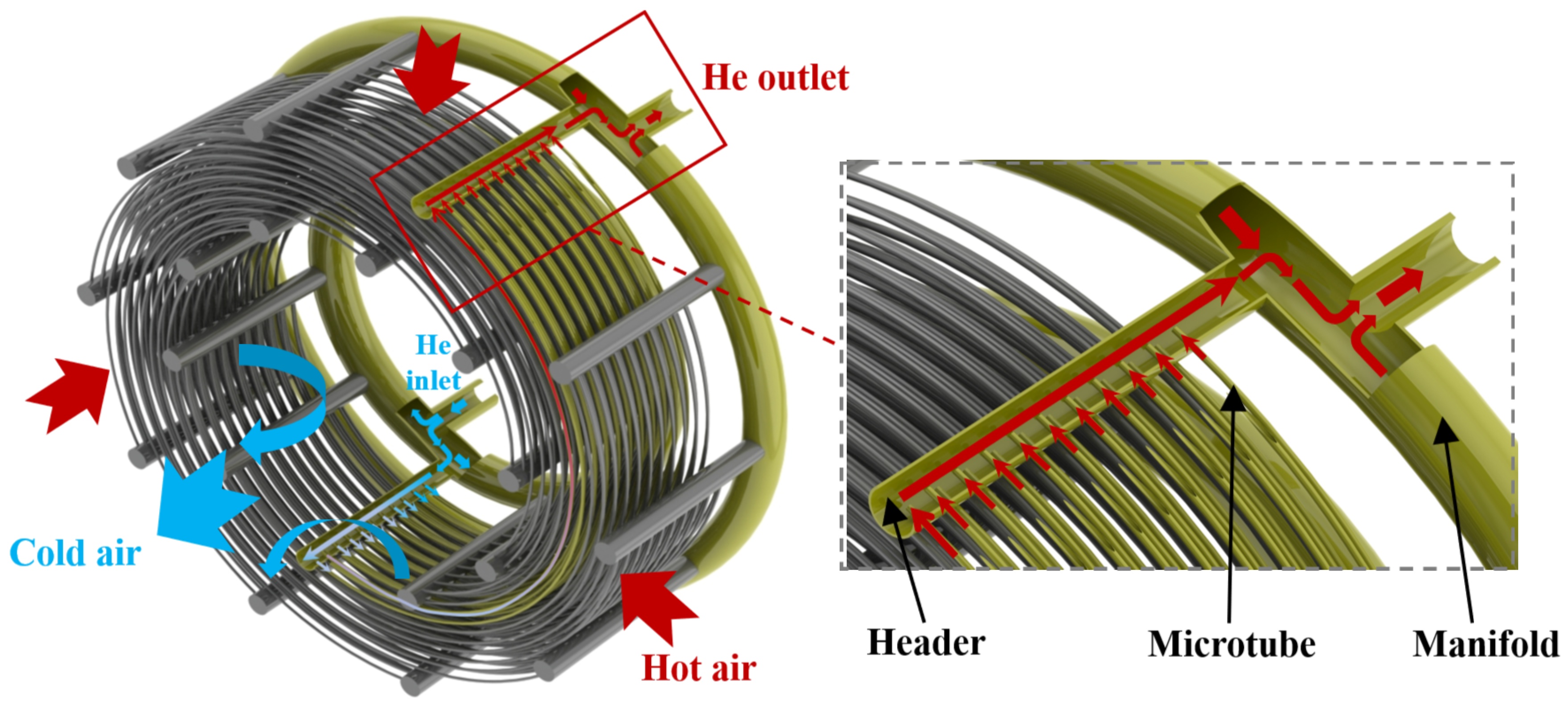
The SABRE (Synergetic Air-Breathing Rocket Engine) is the propulsion system designed for the single-stage orbiting SKYLON aircraft, developed by Reaction Engines Limited (REL) [1,2]. This engine adopts a closed-loop helium cycle and incorporates a precooler to transfer thermal energy from the high-temperature intake air to liquid hydrogen, effectively mitigating issues related to hydrogen embrittlement and thermal management [3,4]. A key component of this system is the precooler, which comprises approximately 300,000 microtubes with an outer diameter of 0.98 mm and a wall thickness of 40 μm [5,6]. The structure and operating principle of the precooler are illustrated in Figure 1. The header distributes helium, which subsequently moves from inside to outside while high-temperature incoming air travels in the opposite direction, creating a counter-flow heat exchange mechanism. This arrangement enables the precooler to rapidly cool the inlet airflow of 400 kg/s from over 1000 °C to −150 °C within 20 ms at Ma = 5.0, achieving a power-to-weight ratio of up to 667 kW/kg and substantially enhancing the engine’s overall thrust-to-weight ratio [7,8]. Consequently, the outstanding heat transfer capability of the precooler has been a subject of focus within the research community, leading to numerous studies on system performance evaluation [9,10,11], parameter optimization [12,13,14], numerical simulation [15,16], and experimental validation [17].
Since high-temperature air passes through an array of fine tubes in a staggered arrangement, the precooler experiences a more intense convective heat exchange process. The following features of such fine tubes are important: (1) their extremely small size, (2) their very large temperature differences between the gas and wall of the tube, and (3) their complicated airflow behavior under highly compact tube packing. Over the past few years, systematic studies have been carried out by researchers about the external flow and heat transfer properties of tubes of varied characteristic sizes. These studies help explain the underlying differences between fine tubes and conventional tubes and thus enhance our understanding of heat transfer in fine-tube configurations.
Bacellar et al. [18] examined the air-side heat transfer of staggered tube bundles whose diameter varied between 0.5 and 2.0 mm and concluded that smaller diameter tubes deliver significantly better heat transfer performance at the same inlet velocity. This finding is in line with that of Zhang et al. [19], who demonstrated that smaller diameter tubes, i.e., bigger curvature ratios of tubes tend to induce a boundary-layer separation, which helps to enhance heat transfer. Collectively, these studies indicate that changes in tube diameter can change significantly the flow structures in the exterior and, therefore, have a robust impact on the heat transfer behavior. In an attempt to further explain the effect of tube diameter on flow characteristic, Li et al. [20] conducted a comparative numerical examination of wake flow behind 1 mm and 22 mm diameter single tubes. A large, symmetric vortex was detected at Re = 500 behind the 22 mm tube which causes significant fluid perturbation and facilitates the exchange of heat in the wake. By contrast, only a small-scale vortex developed behind the 1 mm tube, resulting in weaker flow disturbance and thus a more limited degree of heat transfer enhancement. However, Qin et al. [21] reported contrasting results, finding that under identical Reynolds number conditions and with Ma < 0.1, the wake structures and dimensionless velocity field distributions were highly similar across tubes of different diameters. Additionally, Guan et al. [22] conducted a study on the heat transfer behavior of water flowing over micro-pillar structures inside a confined rectangular channel. Their results demonstrated that under a heat flux of 3 W/cm2, pronounced differences in vortex behavior were observed among micro-pillars with diameters of 300, 600, and 3000 μm. Larger-diameter cylinders, due to the increased flow path length and associated frictional resistance losses, promoted earlier flow separation and formed substantially longer recirculation zones, ultimately yielding stronger heat transfer capability.
On one hand, as discussed above, the external flow characteristics of micro-scale heat exchange tubes differ substantially from those of conventional tubes. Previous work by our research group has similarly shown that when air flows over a single micro-scale tube, high-frequency vortex shedding occurs, with the shedding frequency for a 1 mm tube being approximately an order of magnitude higher than that for a 3 mm tube [23]. On the other hand, much of the earlier research on tube-bundle heat exchangers has centered on conventional tube dimensions and relatively modest temperature differences, and thus has largely neglected the effects that temperature-dependent fluid properties may exert on the flow and heat transfer behavior [24,25]. In this paper, the present work uses numerical simulations to examine how high-temperature air flows and transfers heat across staggered fine tubes, accounting for both constant-property and temperature-dependent air models under various inlet temperatures. Based on these analyses, the variations in flow behavior and heat transfer performance among four tubes arranged along the flow direction are examined. The findings are expected to offer theoretical guidance for the design and optimization of precooler systems.

2. Numerical Methods

2.1. Geometric Model

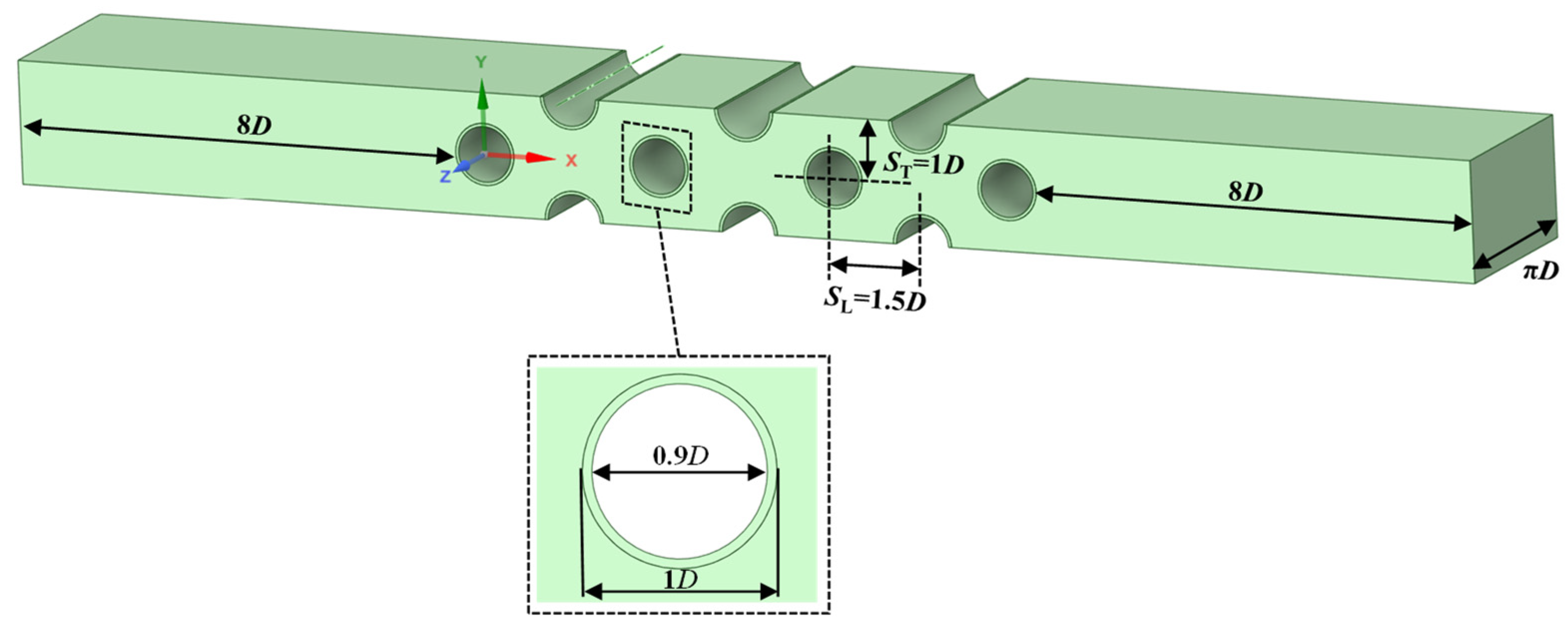
The computational model in this study is constructed with reference to the precooler design parameters reported by REL and domestic research institutions [26,27,28,29], as illustrated in Figure 2. The simulation domain consists of four full circular tubes and six half-circular tubes arranged across seven rows. The heat-exchange tubes have an outer diameter (D) and an inner diameter (d) of 1D and 0.9D, respectively. The tubes are configured in a staggered arrangement, with a transverse pitch (ST) of 2D and a longitudinal pitch (SL) of 1.5D. To minimize the effects of inlet flow development and potential backflow at the outlet, extension sections of length 8D are added upstream and downstream of the computational domain. In the spanwise (z) direction, the tube length is set to πD to adequately capture three-dimensional vortex structures and ensure complete development of the flow field [30,31].

2.2. Numerical Setup

All numerical simulations were performed using ANSYS Fluent 2023 R2. The fluid motion and heat transfer were governed by the conservation equations of mass, momentum, and energy, and the three-dimensional unsteady Navier–Stokes equations were solved with a pressure-based algorithm. Large Eddy Simulation (LES) was adopted because it is more capable than Reynolds-Averaged Navier–Stokes (RANS) models of resolving transient, highly unsteady vortex structures [32,33]. The Smagorinsky-Lilly model was employed to represent the subgrid-scale contribution of unresolved small-scale vortices to the resolved flow field. This selection was primarily based on its good robustness and computational stability in high-Reynolds-number turbulent flows. To account for strong temperature gradients and property variations caused by high inflow temperatures, the model implementation incorporates fluid properties (density, dynamic viscosity, thermal conductivity, etc.) that vary with local temperature, enabling the subgrid eddy viscosity coefficient to indirectly reflect the influence of the temperature field on subgrid stresses. Furthermore, the computational grid was sufficiently refined near the wall and in regions with significant temperature gradients (ensuring a dimensionless wall distance y+ < 1 for the first grid layer) to directly resolve more scales of the flow and heat transfer processes. This approach reduces reliance on the SGS model in critical areas, thereby ensuring computational accuracy. Pressure-velocity coupling was handled using the SIMPLE scheme. For spatial discretization, the bounded central differencing scheme was applied to the momentum equations, and a second-order upwind scheme was used for the energy equation, while the pressure field was discretized using a second-order formulation. Time advancement relied on a second-order implicit scheme.
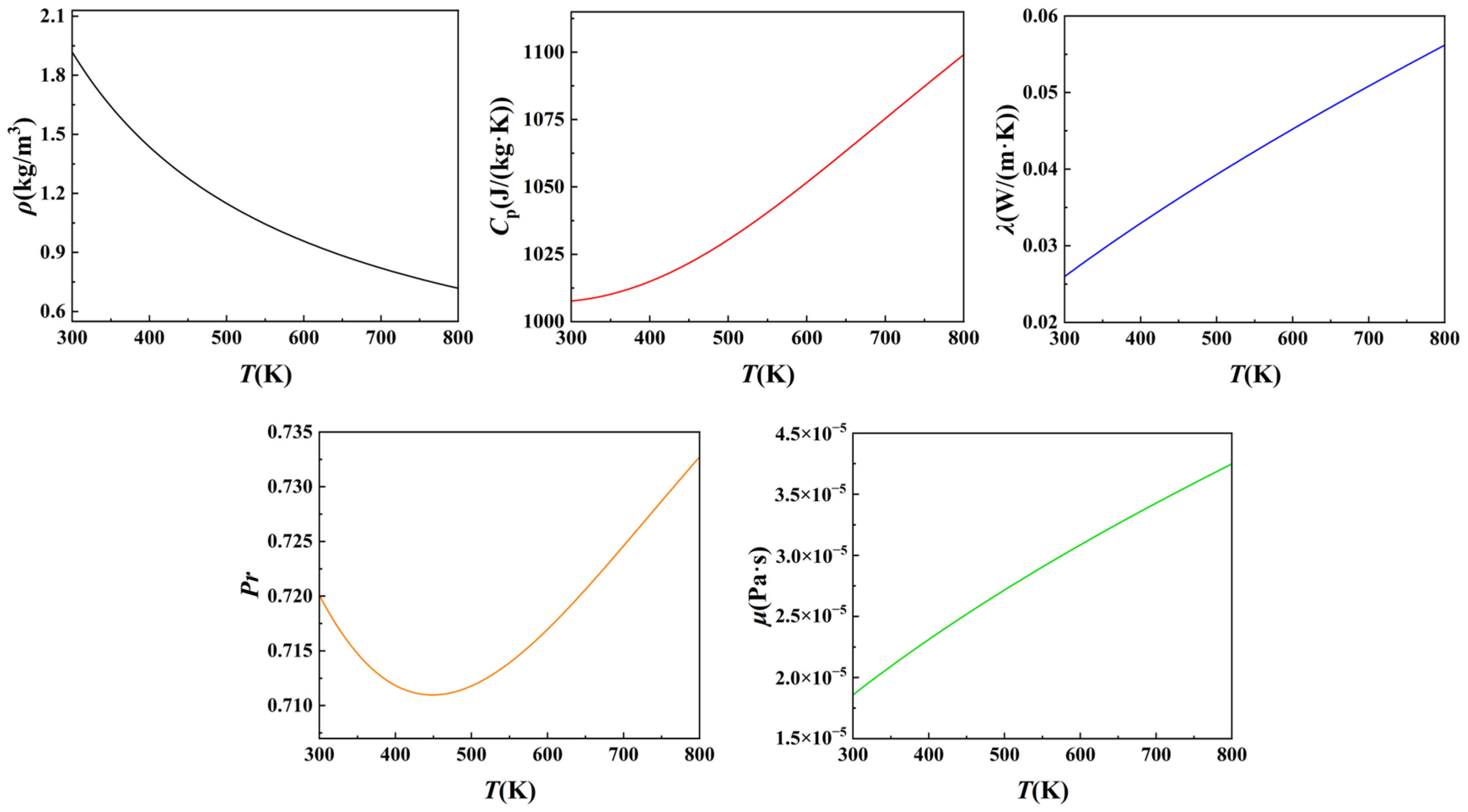
The main boundary conditions are shown in Figure 3. The flow inside the precooler is predominantly turbulent. For complex flow passages, turbulence may occur at relatively low Reynolds numbers (Re < 1000) [28]. Referring to the Reynolds number ranges adopted in previous studies (0 < Re ≤ 6000) [20,28,33], Re = 1000 is selected as the turbulent operating condition in the present study. A velocity inlet was prescribed at the upstream boundary, and the inlet velocity was adjusted in each case so that the Reynolds number remained fixed at 1000. The inlet air temperatures were set to 400, 600, and 800 K. To incorporate compressibility effects and temperature-dependent variations in thermophysical properties, air was treated as an ideal gas [34], with viscosity, thermal conductivity, and specific heat capacity evaluated from polynomial correlations fitted to REFPROP data from the National Institute of Standards and Technology (NIST). Figure 4 illustrates the temperature dependence of these properties at an air pressure of 0.165 MPa, corresponding to the precooler intake condition. A pressure outlet with a gauge pressure of 0 Pa was applied downstream. Symmetry conditions were imposed on the upper and lower boundaries in the y-direction, while periodic boundaries were used in the z-direction. The inner surface of each tube was kept at a constant temperature of 300 K, and the external tube wall was treated as a no-slip, coupled boundary. It should be noted that a constant wall temperature of 300 K is prescribed for the heat transfer tubes in this study. This treatment represents an idealized equivalent assumption, whose physical implication is that the coolant (helium) inside the tubes possesses sufficient, or effectively infinite, heat transfer capacity to maintain the wall temperature at a constant low level. The primary purpose of this simplification is to concentrate the computational resources and analytical focus on the complex flow and heat transfer mechanisms on the high-temperature air side, particularly the unique effects arising from the strong temperature dependence of air properties. By fixing the wall temperature, the air-side physical processes can be effectively isolated and highlighted, avoiding the interference introduced by the complex coupled heat transfer between the internal and external flows, and thereby enabling a clearer interpretation of the core mechanisms addressed in this study. Convergence criteria for the continuity, momentum, and energy equations were all set to 10−6. A fixed time step of Δt = 2.5 × 10⁻⁶ s was used in the unsteady numerical simulations. Under the most demanding condition considered in this study (800 K with variable properties), the dominant vortex shedding frequency was approximately 4.7 × 10⁴ Hz, corresponding to a characteristic shedding period of about 2.13 × 10⁻⁵ s. Thus, each shedding cycle was resolved by approximately 8–9 time steps, satisfying the Nyquist sampling criterion for resolving the dominant unsteady mode. The tube walls were assumed to be Inconel 718, and their thermal conductivity was calculated using Equation (1) [35]. The four complete tubes aligned in the streamwise direction are referred to as Tube 1 through Tube 4, and the subsequent analysis focuses exclusively on these tubes.
λ = 1.11 × 1 0 5 T t 2 0.001986 T t + 14.37
where Tt is the thermodynamic temperature of the tube.

2.3. Mesh Independence

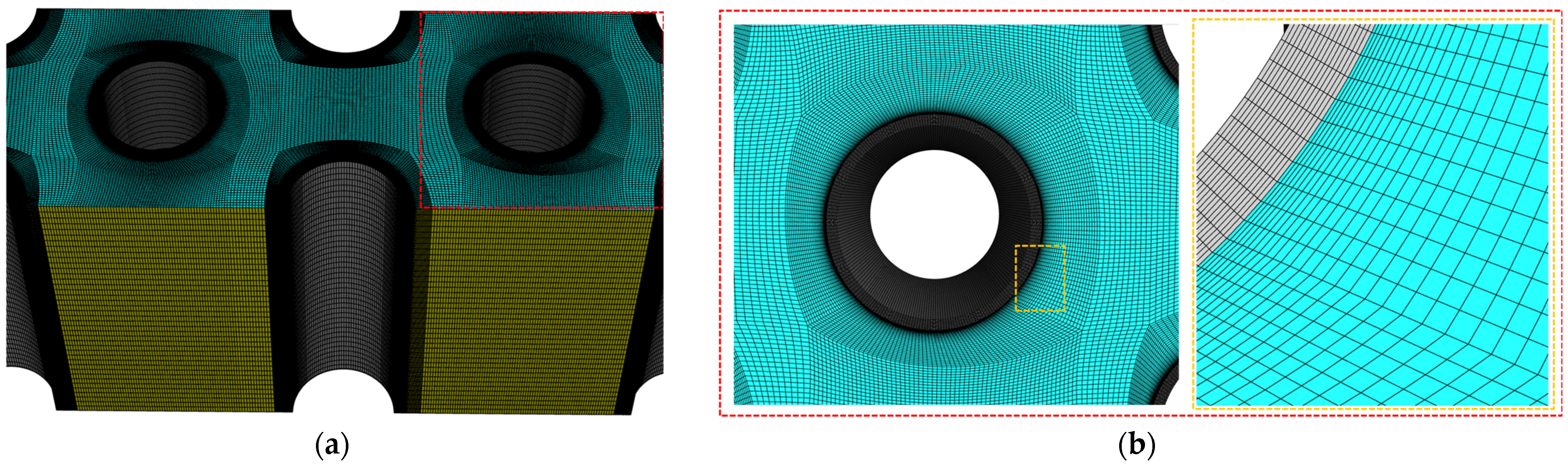
The entire computational domain was discretized using structured grids generated with ICEM CFD 2023 R2. An O-grid layout was generated around each tube, and the mesh was locally refined near the wall to resolve the boundary layer and capture flow separation. The first-layer cell height next to the tube surface was set to 2 μm, with a growth rate of 1.12. A total of 25 grid layers were distributed in the wall-normal direction, ensuring that the wall resolution satisfied the requirement of y+ < 1 along all tube surfaces. The computational mesh is shown in Figure 5.
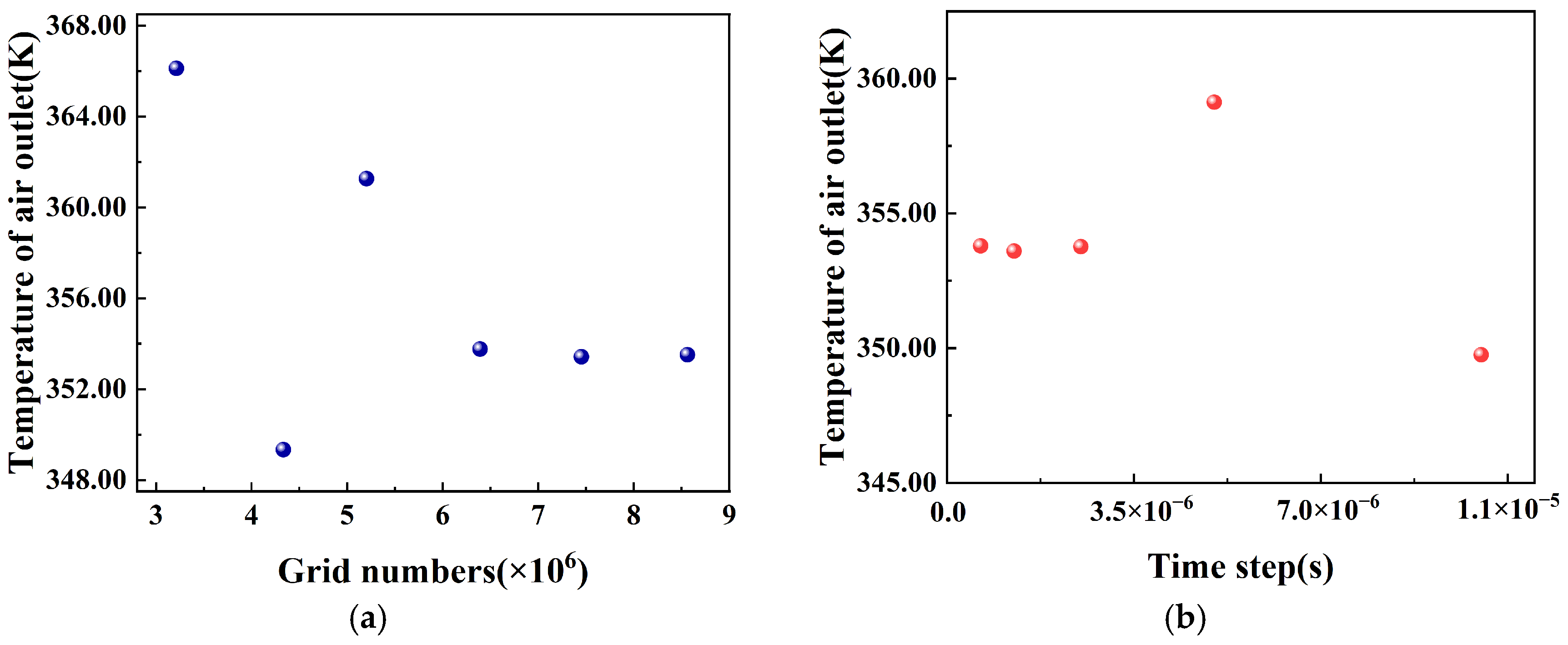
To evaluate mesh independence, six mesh configurations of different densities were created by varying the numbers of grid nodes in the circumferential, radial, and spanwise directions around each tube and its surrounding region. Figure 6a presents the outlet air temperature as a function of the total cell count for an inlet temperature of 400 K. When the overall number of cells exceeded 6.39 million, further refinement produced less than a 1% change in the outlet temperature, indicating that the solution had become effectively insensitive to the mesh resolution. Consequently, the mesh with 6.39 million cells was adopted for all simulations in our study. To further reduce numerical uncertainty, we additionally carried out simulations using multiple time-step sizes, and the outlet air temperature was also employed as the evaluation metric, as shown in Figure 6b. The results demonstrate that once the time step reaches 2.5 × 10⁻⁶ s, further reduction in the time step leads to only minor differences in the predicted outlet temperature (less than 0.5%). Therefore, a time step of 2.5 × 10⁻⁶ s was adopted in the present simulations as a good compromise between accuracy and computational cost.

2.4. Data Reduction

The Reynolds number (Re) is defined as:
R e = ρ u max D μ
where ρ and μ denote the air density and dynamic viscosity, respectively; umax is the average air velocity at the minimum cross section, given as:
u max = S T / D S T / D 1 u in
where uin is the inlet air velocity.
It should be noted that under high-temperature conditions, significant variations in air density and dynamic viscosity lead to corresponding changes in the local Reynolds number, even though the inlet Reynolds number is fixed at 1000. An evaluation based on the local temperature field indicates that the local Reynolds number varies within a range of approximately 8–15% relative to the inlet Reynolds number, solely due to property variations. This variation is an inherent physical consequence of high-temperature air flow and is insufficient to alter the overall flow scale or dominant flow structures. Therefore, comparisons between constant-property and variable-property cases remain physically consistent, with the observed differences primarily attributable to the effects of temperature-dependent air properties on local flow and heat transfer characteristics.
This study focuses on the local Nusselt number corresponding to each individual tube. The local Nusselt number (Nul) is given by:
N u l = h D λ = q T f T w × D λ
where h denotes the external convective heat transfer coefficient; λ is the thermal conductivity of air; q is the heat flux at the outer surface of tube; Tw represents the temperature of tube outer surface; Tf is the average air temperature, given as:
T f = T front + T back 2
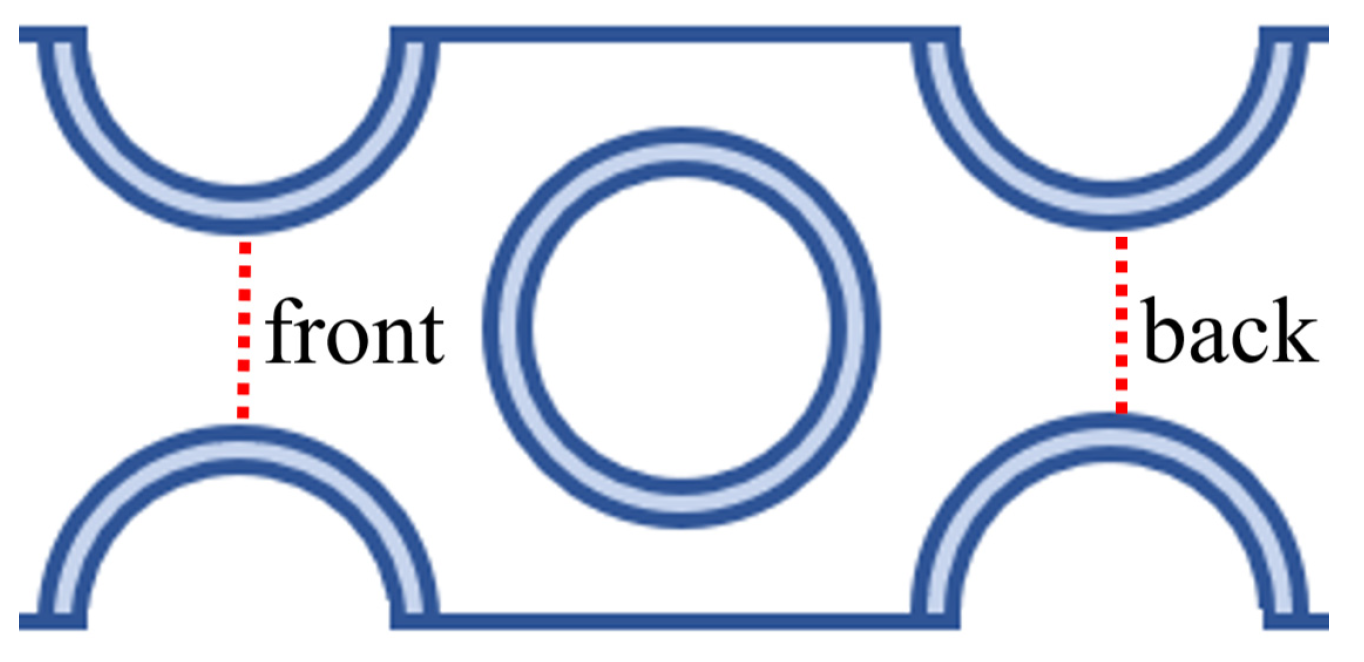
where Tfront and Tback represent the average temperatures at the frontal and rear cross-sections of tube, respectively. The positions of these two cross-sections are illustrated in Figure 7.
The local pressure drop (ΔPl) is given by:
Δ P l = P front P back
where Pfront and Pback represent the average pressures at the frontal and rear cross-sections of tube, respectively.
All time-averaged quantities presented in this paper, including the Nusselt number, local pressure drop, and surface friction coefficient, were obtained by performing time averaging on unsteady numerical simulation results after the flow reached a statistically steady state. The unsteady simulations employed a fixed time step of Δt = 2.5 × 10⁻⁶ s.
For each operating condition, the initial transient phase was first discarded, and a time interval during which the flow characteristics remained stable was selected for statistical averaging. As mentioned earlier, all operating conditions studied in this paper satisfy the Nyquist sampling theorem, thereby ensuring sufficient representativeness of the statistical results.
Statistical convergence was evaluated by progressively extending the averaging duration and monitoring the variations in the time-averaged Nusselt number, pressure drop, and friction coefficient. Convergence was considered achieved when the changes in these averaged quantities remained below 1% with further increases in the averaging duration. The same time-averaging strategy was applied to all operating conditions to ensure the reliability and comparability of results under different temperature and property conditions.

2.5. Validation of Numerical Model

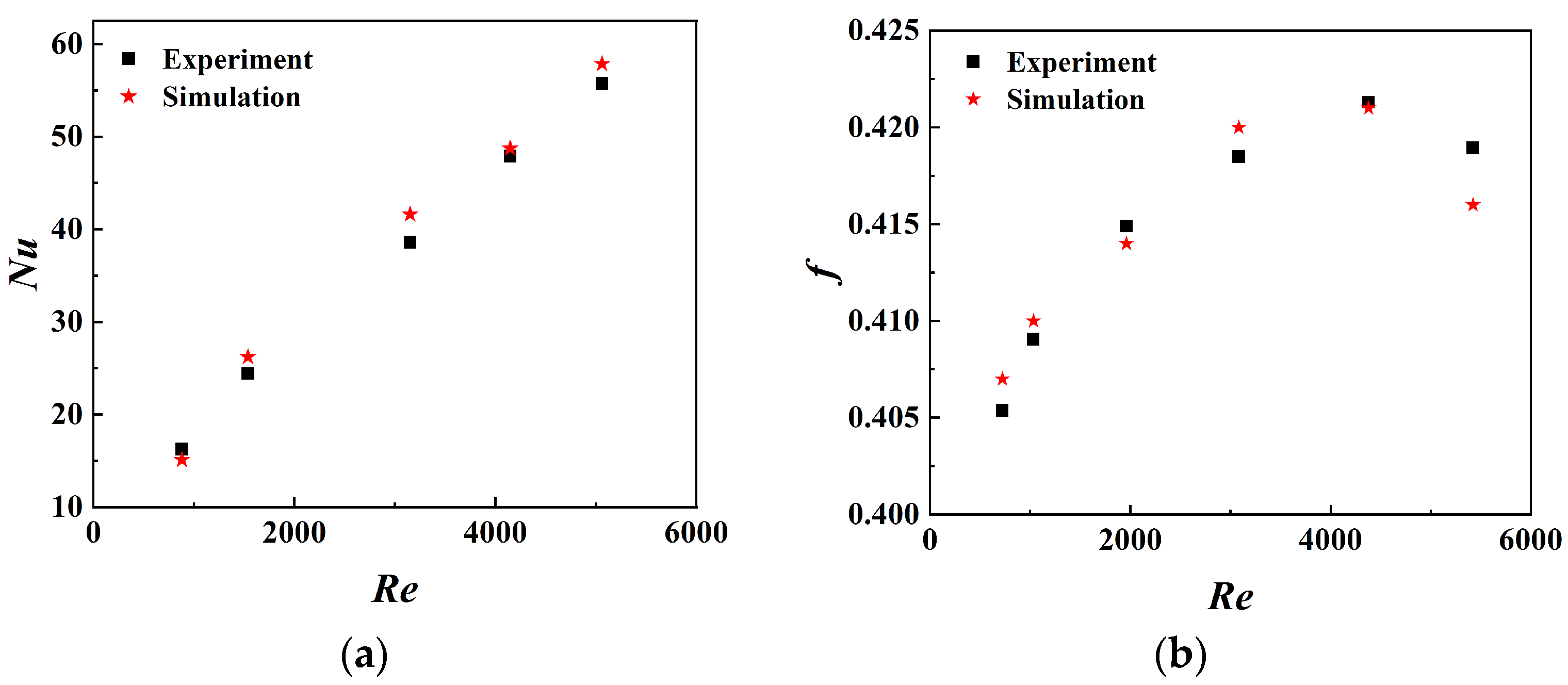
The numerical methodology was validated by comparing the present simulation results with the experimental measurements provided in Ref. [36]. Figure 8a and Figure 8b show the comparative results for the Nusselt number (Nu) and friction factor (f), respectively, where f is defined by Equation (7). The results derived from the simulated profile of Nu and f are consistent with the experiment data of the studied conditions. Both parameters have the mean relative error lower than 6% which is a high consistency between the two datasets. This rapport shows that the numerical model can be used to reliably model the necessary flow and heat transfer features in the scope of this study.
It should be noted that, for the condition of high-temperature air flow across micro-tubes, there is currently a lack of experimental or database results that can independently quantify the effects of temperature-dependent properties. The temperature-dependent thermophysical properties adopted in this study are all sourced from standard databases and have been validated in numerous studies on high-temperature gas flow and heat transfer. Based on this, the calculated Nusselt numbers, friction coefficients, and their development trends under variable-property conditions exhibit physical consistency, without unphysical oscillations or anomalies, indicating that the treatment of temperature-dependent properties in this work is physically reasonable. Furthermore, although the validation of the numerical model corresponds to a relatively moderate temperature range, the governing equations, turbulence modeling strategy, and wall treatment employed are not inherently dependent on a specific temperature level. Instead, they are grounded in the continuum assumption and the mechanisms of high-Reynolds-number shear-layer-dominated flow. When extrapolating the model to an inlet temperature as high as 800 K, this study enhances physical consistency by incorporating temperature-dependent air thermophysical properties (density, viscosity, specific heat, and thermal conductivity) to explicitly account for high-temperature effects.
f = 2 Δ P N L × ρ u max 2
where NL denotes the number of tube rows in the longitudinal direction.

3. Results

3.1. Flow Characteristics

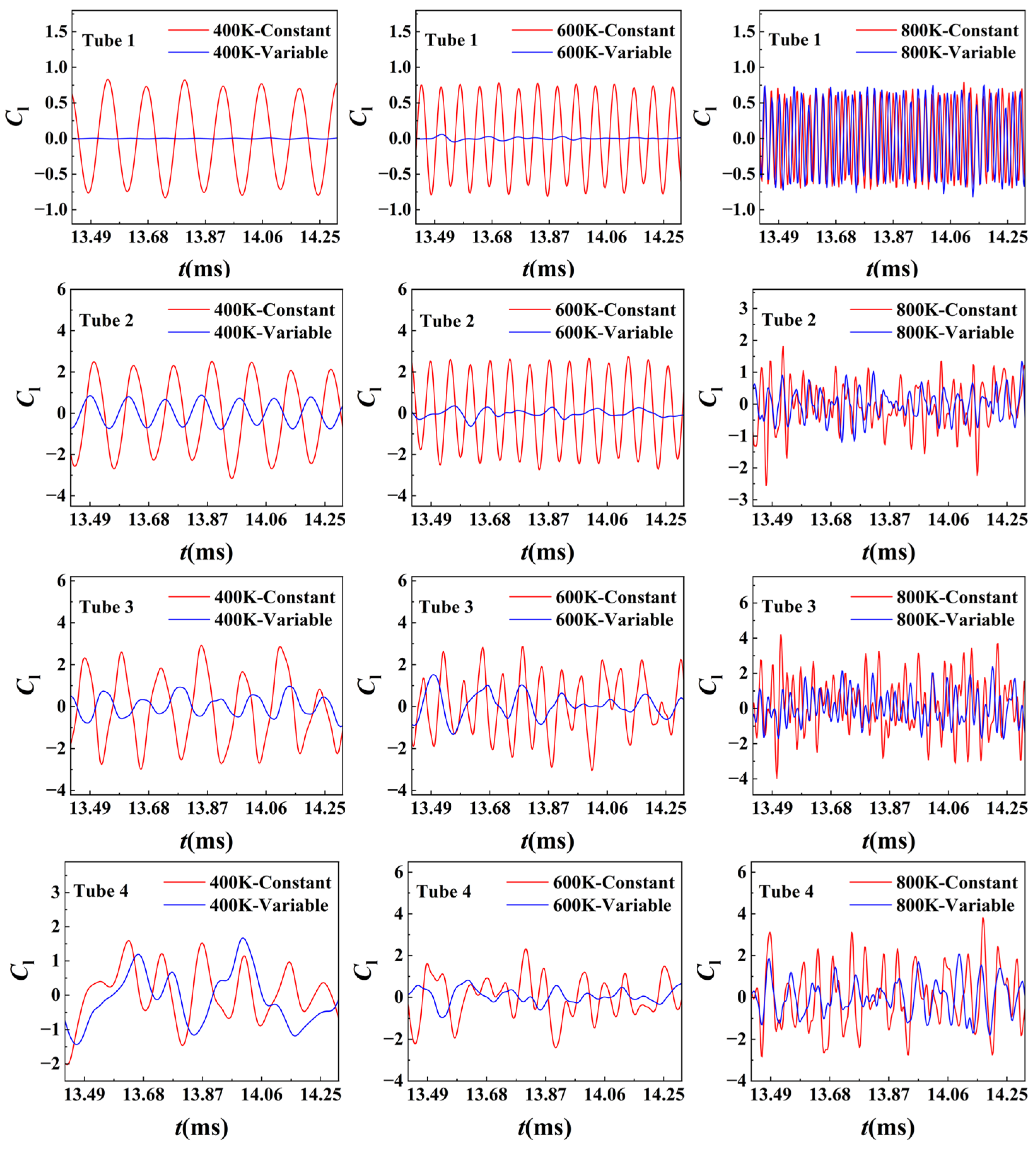
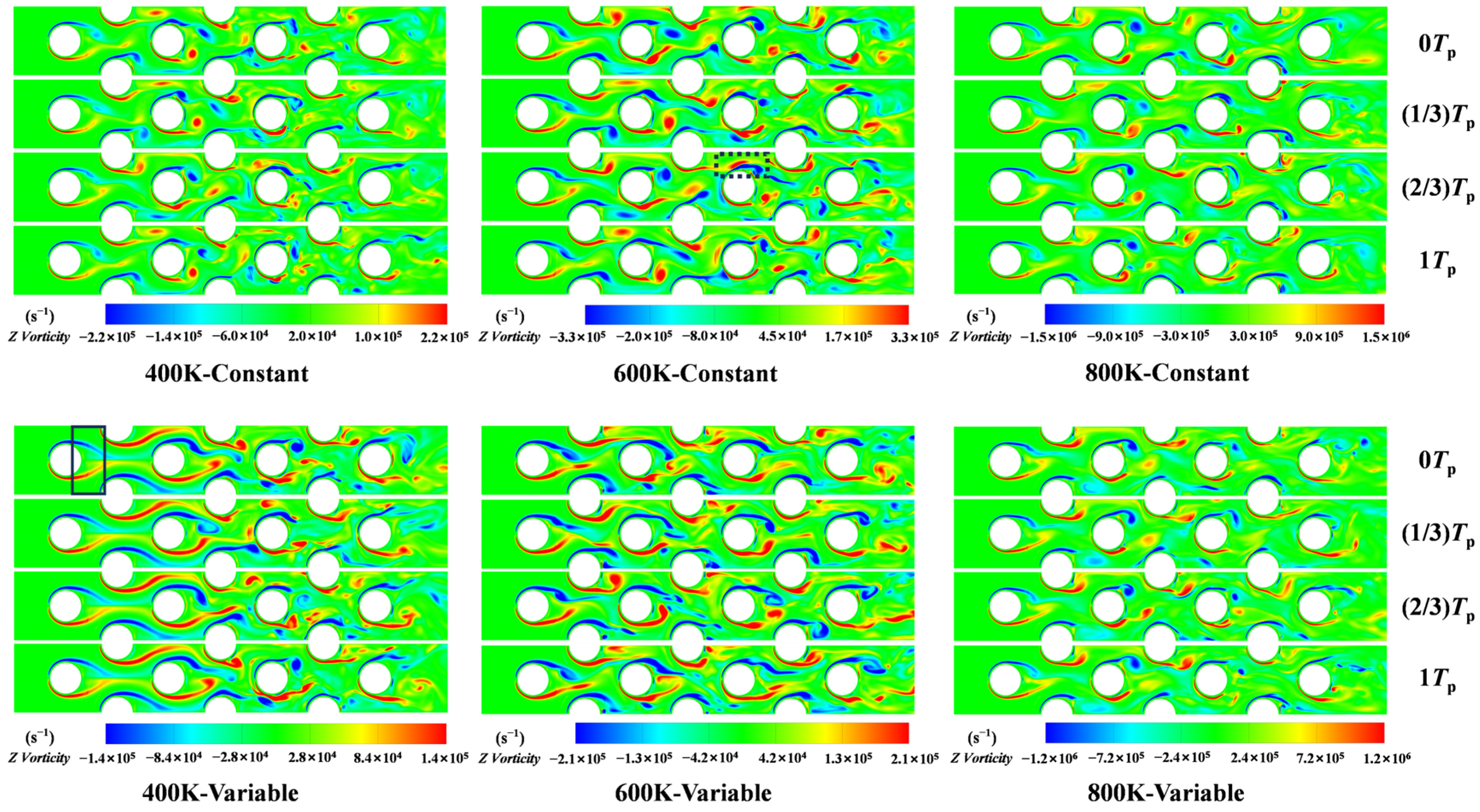
In order to have a better knowledge about the mechanisms of flow governing the crossflow of air between staggered fine tubes, the discussion commences with the unsteady wake movements in various temperature conditions and thermophysical-property model. As shown in Figure 9, the time traces of the lift coefficients reveal that both temperature and property variations have a clear impact on wake dynamics. At 400 K, Tube 1 in the constant-property case exhibits pronounced, periodic lift oscillations with relatively large amplitudes. In contrast, when variable properties are applied, the oscillations weaken notably and the lift signal becomes much smoother. These differences correspond directly to the vorticity structures illustrated in Figure 10, where the changes in shear-layer development and vortex shedding align with the observed lift-coefficient behavior. Under constant properties, the shear layer behind the tube undergoes strong roll-up and generates regular vortex shedding. In contrast, when variable properties are considered, the vorticity intensity weakens and the recirculation zone becomes more stable (highlighted by the black solid-line box in Figure 10), consistent with the nearly non-oscillatory lift response of Tube 1. As the inlet temperature increases to 600 K and 800 K, the oscillation frequency under constant properties rises, while the flow under variable properties gradually becomes more unstable. Nonetheless, the discrepancy between the two conditions diminishes with increasing temperature.
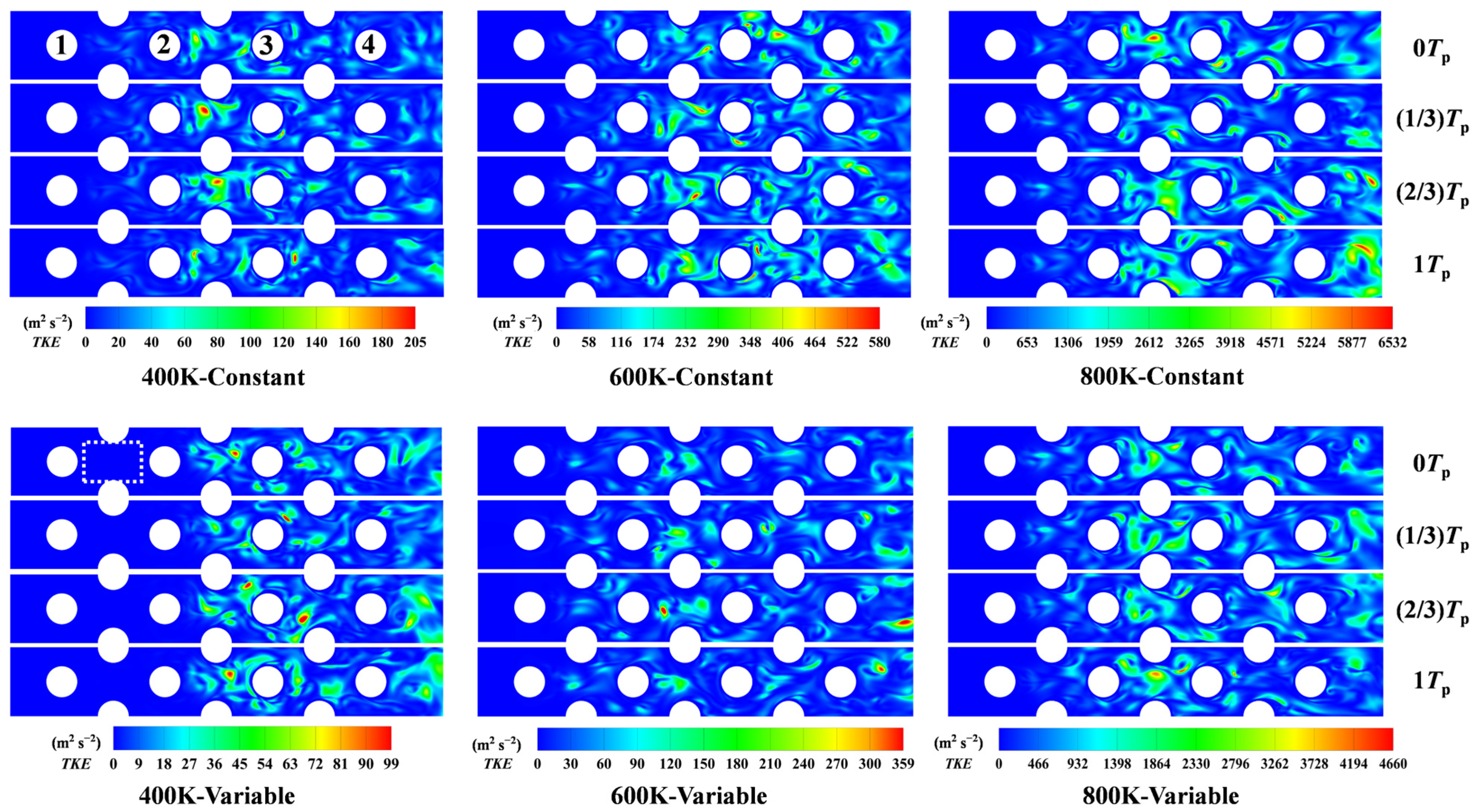
The turbulent kinetic energy (TKE) distribution shown in Figure 11 further demonstrates that under high-temperature conditions, the TKE around Tubes 2–4 increases markedly, which is fully consistent with the intensified lift oscillations observed in the lift-coefficient curves. In contrast, under variable-property conditions at 400 K, the TKE near Tube 1 is almost negligible (highlighted by the white dashed-line box in Figure 11), indicating that the incoming flow remains nearly laminar or only weakly turbulent. As a consequence, a stable Kármán vortex street does not form, and the lift acting on Tube 1 remains nearly constant in time. At this temperature, the overall TKE under variable-property conditions is noticeably lower than that predicted with constant properties, indicating weaker wake instability and correspondingly smaller lift fluctuations.
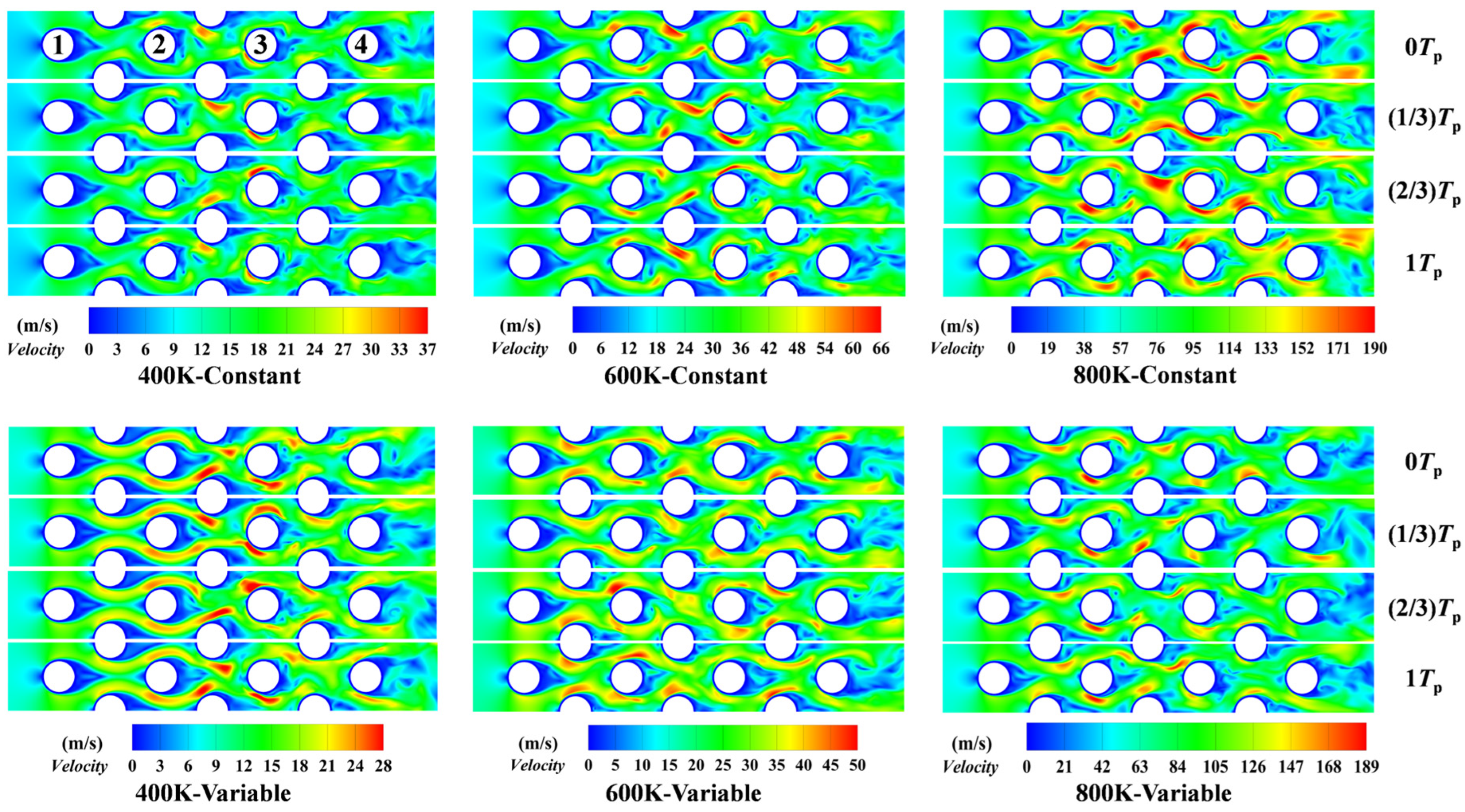
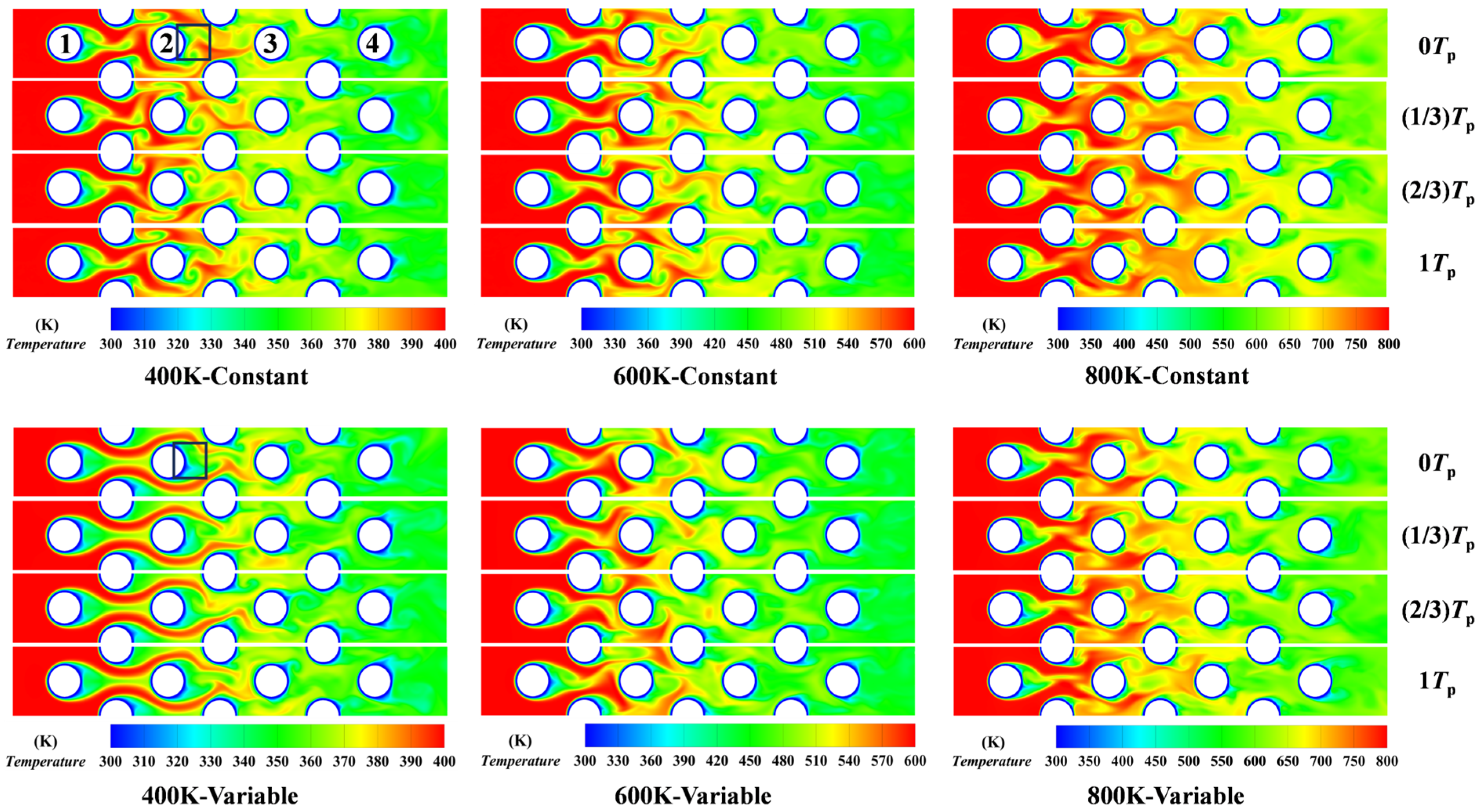
Additional insight into the governing flow mechanisms can be gained from the velocity and temperature fields shown in Figure 12 and Figure 13. Under high-temperature conditions, the increase in flow velocity may raise concerns about compressibility effects. Taking the 800 K variable-property case as an example, the inlet velocity is 52.2 m/s, and numerical results show that the local maximum velocity is approximately 190 m/s. Based on the estimated speed of sound for air at 800 K (approximately 560–570 m/s), the corresponding maximum local Mach number is about 0.33. This maximum Mach number occurs only in the locally accelerated region of the shear layer around the tube, while the vast majority of the computational domain exhibits Mach numbers below 0.3. According to classical compressible flow theory, compressibility effects in this Mach number range are generally weak, with their influence primarily manifested through temperature-dependent thermophysical property changes, rather than through pressure wave-dominated compression waves or shock structures. Therefore, within the parameter range covered in this study, it is reasonable to neglect the effects of high-Mach-number compressibility on the overall flow and heat transfer characteristics.
For the constant-property model, increasing the temperature accelerates the shear-layer roll-up process and strengthens wake unsteadiness, thereby increasing vorticity production and TKE and resulting in more pronounced lift oscillations. In contrast, when temperature-dependent properties are considered, the flow velocity at the same nominal temperature is reduced and the downstream wake becomes visibly broader (as marked by the black box in Figure 13). This broader wake weakens shear-layer roll-up and suppresses periodic vortex shedding, thereby decreasing lift variability. Overall, rising temperature promotes stronger wake unsteadiness, while neglecting the associated property variations leads to an overprediction of both vortex shedding intensity and lift-oscillation amplitude.
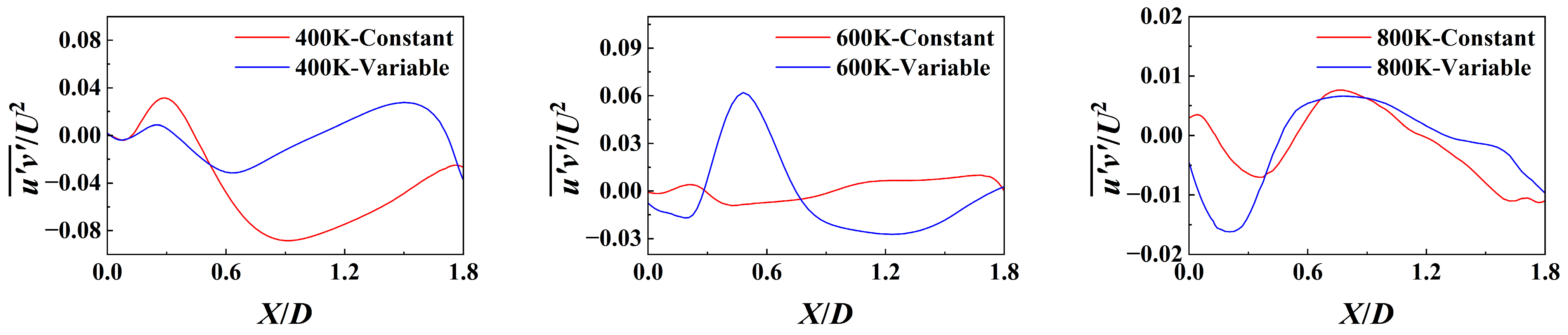
To analyze the wake turbulence behind the staggered fines tubes, the streamwise distribution of Reynolds stress was examined. The sampling line was located along the wake centerline downstream of the second tube row, starting 0.1 mm downstream of the second tube center and ending 0.1 mm upstream of the windward surface of the third tube, aligned with the main flow direction.
Figure 14 shows the streamwise Reynolds stress distributions at inlet temperatures of 400 K, 600 K, and 800 K. Non-monotonic variations are observed for all temperatures; however, the detailed behaviors differ significantly. At 400 K and 600 K, pronounced fluctuations persist throughout the sampling region, and clear differences are observed between the constant-property and variable-property cases. In contrast, at 800 K, the Reynolds stress profiles obtained using different property treatments are generally similar, exhibiting comparable streamwise variation patterns.
This difference is mainly associated with the magnitude of temperature variations in the wake region. At 400 K and 600 K, appreciable temperature gradients remain downstream of the second tube row, and the use of variable properties alters the local viscosity and momentum diffusion, leading to differences in the Reynolds stress distribution. At 800 K, the flow field is globally at a high temperature level, and the relative temperature variation in the wake is smaller, resulting in a weaker influence of property treatment on the Reynolds stress profiles.
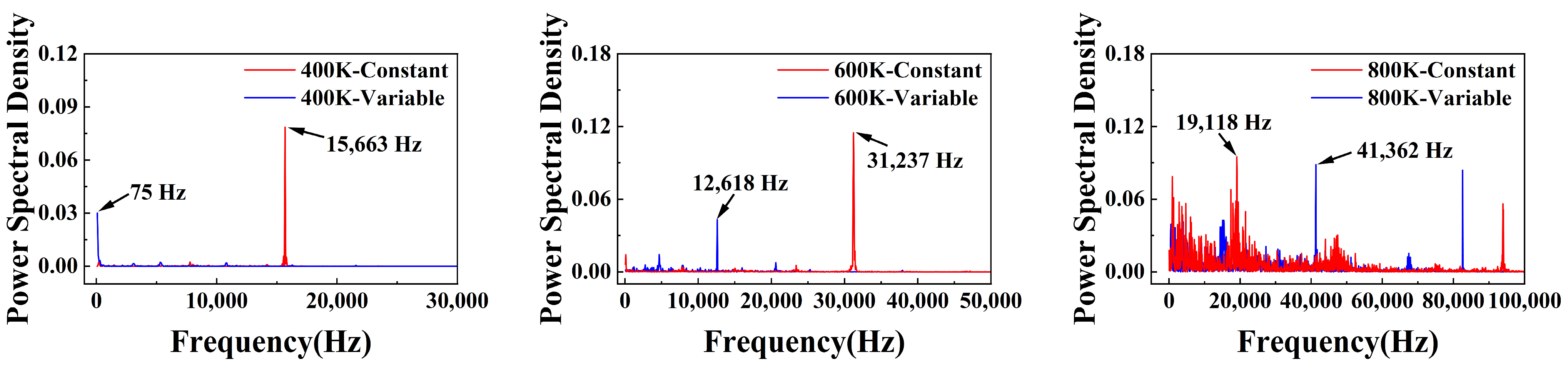
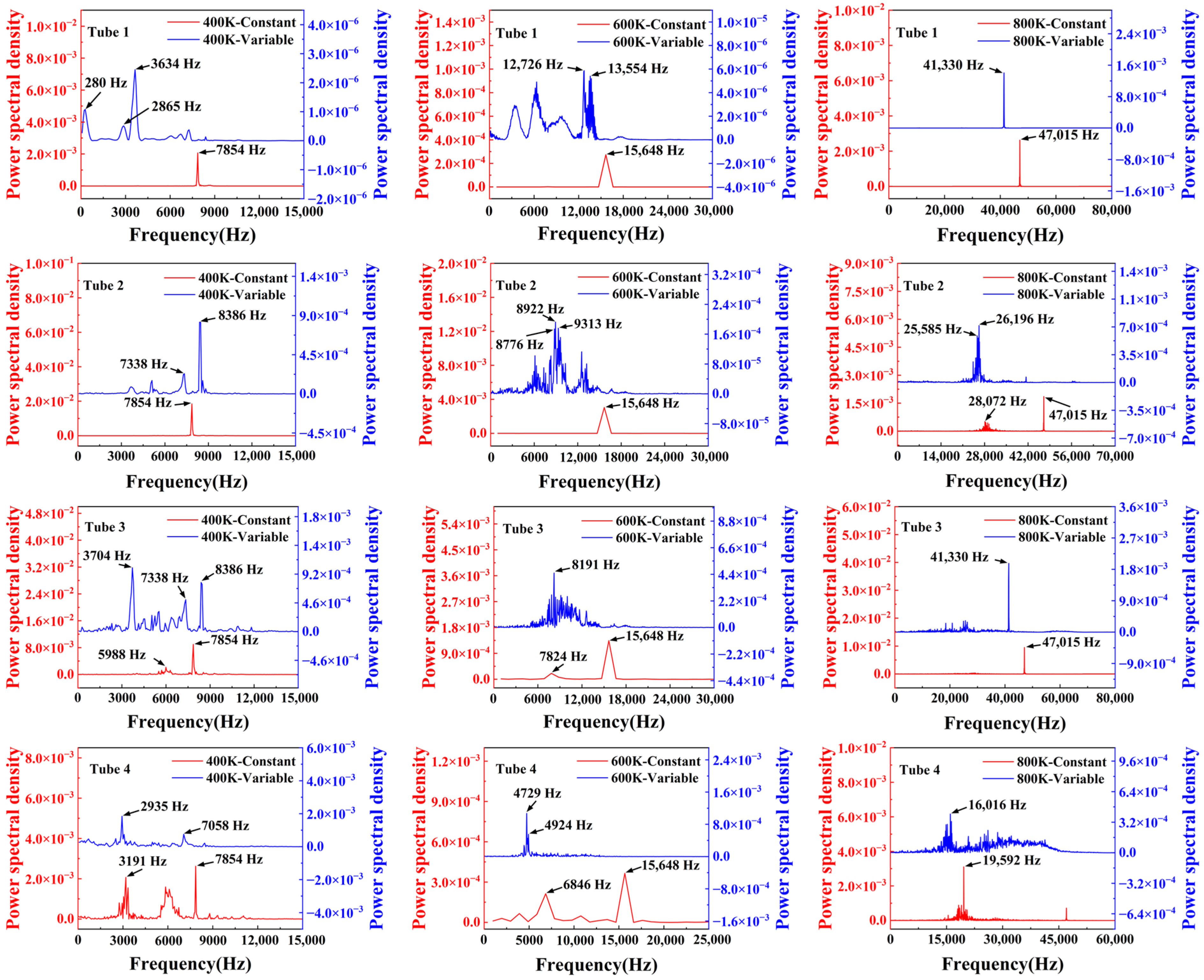
To quantitatively characterize wake unsteadiness in the fine tubes, a monitoring point was placed on the wake centerline 0.5 mm downstream of Tube 2, and the time history of the streamwise velocity was sampled to compute the corresponding power spectral density (PSD). This location lies in the near-wake region and can effectively capture vortex-shedding-induced velocity fluctuations while representing typical wake structures inside the bundle. In addition, to validate the wake dynamics from the perspective of global aerodynamic response, frequency-domain analyses were also conducted for the lift-coefficient time histories of all four tube rows. For both the monitoring-point velocity signal and the lift signals, the spectra were obtained using Fast Fourier Transform (FFT). A total sampling duration of approximately 3.0 × 10⁻³ s was used, covering about 140 complete shedding cycles, which ensures statistical convergence of the spectra and provides sufficient frequency resolution. Moreover, the Strouhal number estimated from the inlet velocity of 52.2 m/s and the tube outer diameter of 1 mm is approximately 0.9, consistent with the typical range St ≈ O(1) for shear-layer-dominated vortex shedding from circular cylinders at high Reynolds numbers. This agreement further confirms that the dominant spectral peaks are physically meaningful rather than numerical artifacts.
As shown in Figure 15, both inlet temperature and thermophysical property treatment significantly alter the dominant unsteady scales and the spectral energy distribution in the tube-bundle wake. Under the constant-property conditions, the PSD at the monitoring point exhibits sharp and highly concentrated dominant peaks at all three temperatures, indicating the presence of a strong single dominant periodic mode in the wake, i.e., the typical vortex-shedding frequency. The dominant frequency shifts noticeably to higher values as the inlet temperature increases: it is approximately 15,663 Hz at 400 K and rises to 31,237 Hz at 600 K, suggesting that elevated temperature intensifies shear-layer roll-up, accelerates the vortex-shedding process, and enhances wake unsteadiness. At 800 K under constant properties, the spectral energy distribution transitions from a “single-peak-dominated” pattern to a broader-band spectrum, with a dominant peak around 19,118 Hz. This reflects a more strongly nonlinear wake state at high temperature, where multi-scale disturbances are amplified and the energy is no longer concentrated at a single frequency.
In contrast, the variable-property cases generally show weaker dominant peaks and a more dispersed spectral distribution. This indicates that once temperature-dependent variations in viscosity, density, and other properties are taken into account, the periodic fluctuations in the wake become less concentrated and the dominant shedding mode is less pronounced than that predicted under constant properties. For example, at 400 K under variable properties, the dominant peak nearly vanishes and only a weak low-frequency peak around 75 Hz is observed, suggesting that periodic shedding is strongly weakened and the wake unsteadiness is substantially reduced. At 600 K under variable properties, a dominant peak appears at approximately 12,618 Hz, yet its magnitude remains much weaker than that of the constant-property case, indicating that unsteadiness begins to develop but the shedding process is still weak. When the temperature rises to 800 K under variable properties, a distinct high-frequency dominant peak emerges at about 41,362 Hz, indicating that high-temperature forcing enhances wake unsteadiness; however, the energy remains relatively broadband, implying a more complex shear-layer instability with pronounced multi-scale features. Overall, the monitoring-point PSD results demonstrate that increasing temperature elevates the characteristic wake frequency and strengthens unsteadiness, whereas neglecting property variations markedly amplifies the peak intensity and reinforces a “single-frequency-dominated” behavior, thereby tending to overestimate the periodicity and instability of vortex shedding in the wake.
Figure 16 presents the spectra of the lift coefficients for all four tubes, and the overall trends are consistent with those obtained from the monitoring-point PSD. Under constant-property conditions, higher dominant frequencies and more concentrated energy peaks are observed at all temperatures, whereas the variable-property cases exhibit lower dominant frequencies, weaker peaks, and more pronounced broadband distributions. Along the tube rows, downstream tubes are influenced by upstream vortex impingement and vortex merging, which may introduce secondary peaks in the constant-property spectra. In contrast, the spectra obtained under variable-property conditions tend to contain more scattered frequency components, indicating a less coherent wake governed by more intricate unsteady dynamics. These frequency-domain features are consistent with the flow-field contours: increasing temperature generally enhances vorticity and turbulent kinetic energy (TKE), promoting shear-layer instability and increasing the shedding frequency; when temperature-dependent properties are incorporated, the wake is weakened and both vorticity and TKE are reduced, suppressing shear-layer roll-up and the shedding process, which leads to reduced peak intensity and a more dispersed energy distribution. A particularly notable case occurs at 400 K under variable-property conditions, where some tube rows (e.g., Tube 1) exhibit almost no periodic shedding, and the resulting wake structures carry much lower frequencies and substantially weaker energy content than those predicted under constant properties. Overall, treating the fluid as having constant properties tends to overpredict both the shedding frequency and its associated spectral energy, whereas incorporating realistic temperature-dependent properties yields a wake that evolves toward a more complex multi-scale behavior with substantially reduced unsteady energy levels.
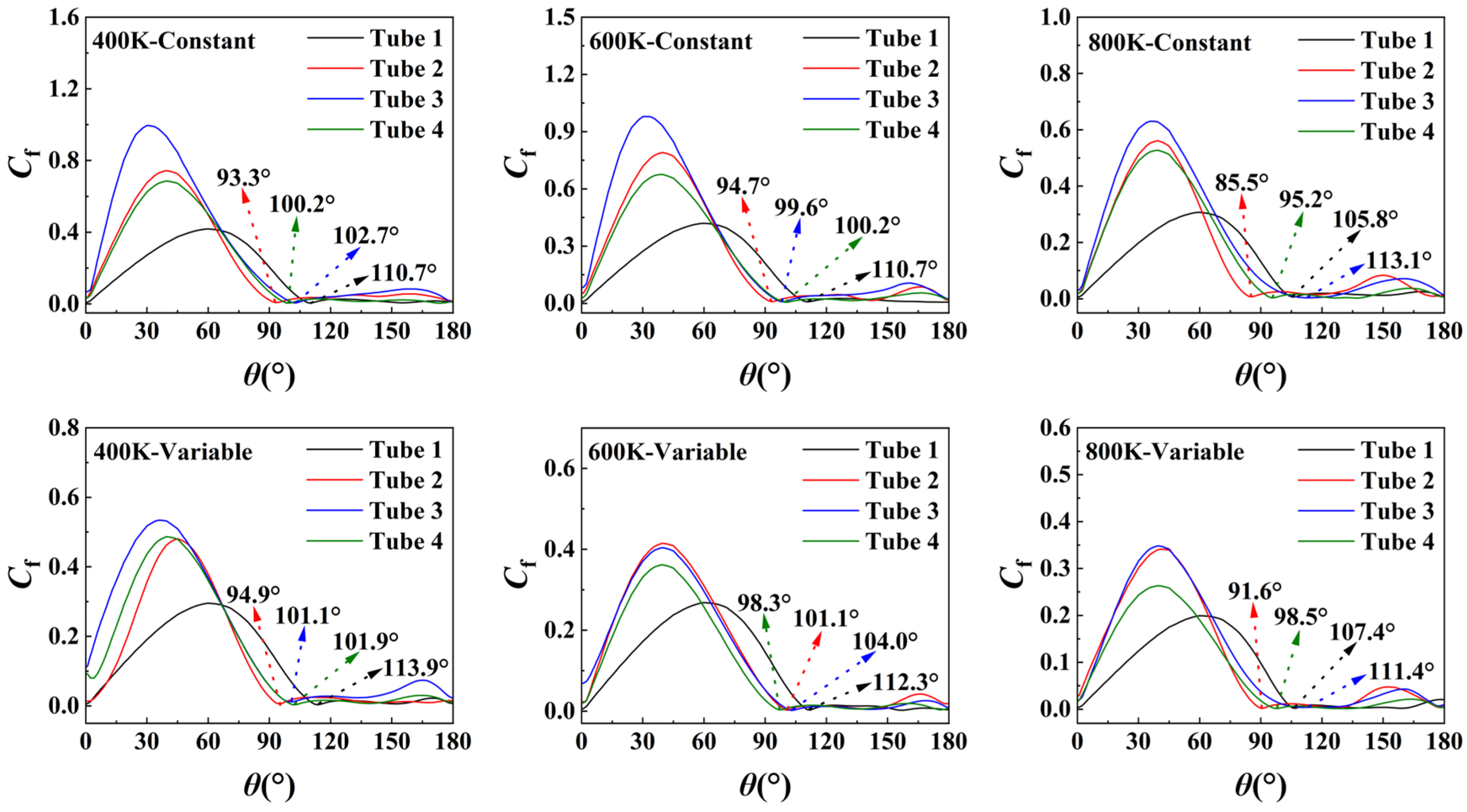
These unsteady wake characteristics also affect the near-wall flow around each tube, making it necessary to examine the circumferential distribution of the friction coefficient. As shown in Figure 17, all tubes exhibit a distinct peak on the windward side, and the magnitude follows the order Tube 3 > Tube 2 > Tube 4 > Tube 1. The hierarchy is also consistent with the flow field: the tubes in the middle-row face a more powerful near-wall shear since it is affected by both acceleration due to the mainstream and the vortex structures expelled by the upstream tubes. Tube 1 on the other hand is highly free of upstream disturbances and thus has the lowest shear. At 800 K, all tubes drop their values of friction and their points of separation shift upstream. This migration represents improved vorticity and TKE with elevated temperature, which enhance the loss of momentum in the boundary layer and enhance the separation of flows sooner.
Under variable-property conditions, the friction coefficients decrease further with increasing temperature, and the separation angles advance correspondingly. Combined with the contour results—showing a larger low-velocity wake region (a wider velocity-deficit zone) and reduced vorticity and TKE—it becomes evident that temperature-dependent properties decrease the local Reynolds number and thicken the boundary layer, thereby weakening near-wall shear and reducing the tendency for shear-layer reattachment. Moreover, at the same temperature, the constant-property cases consistently overestimate the friction coefficient, indicating that neglecting temperature-dependent property variations leads to an overprediction of near-wall shear.
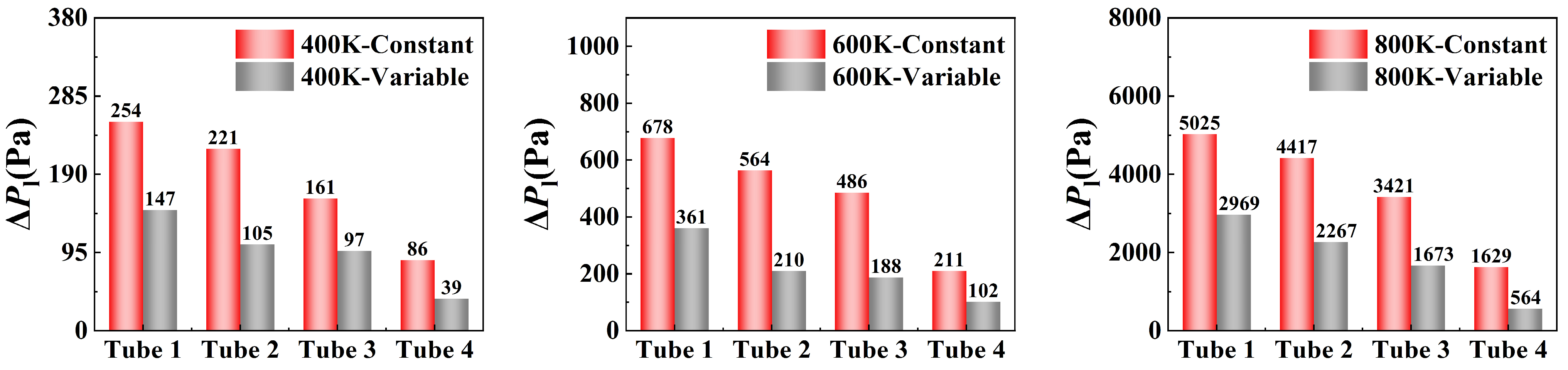
These near-wall shear characteristics further influence the overall flow resistance acting on the tubes, particularly the pressure distribution along the flow direction. Figure 18 illustrates the variations in pressure drop across the four tubes under different temperatures and fluid-property conditions. Under all operating conditions, the local pressure drop decreases markedly along the flow direction. For example, at 400 K under constant-property conditions, the pressure drop decreases from 254 Pa at Tube 1 to 86 Pa at Tube 4; under variable-property conditions, it decreases from 147 Pa to 39 Pa. This trend suggests that the momentum dissipation and wake weakening caused by the upstream tubes markedly reduce the aerodynamic loading on the downstream ones.
As temperature increases, the pressure drop across each tube rises steeply. For Tube 1, for instance, elevating the temperature from 400 K to 800 K causes the pressure drop to increase from 254 Pa to 5025 Pa under constant-property assumptions, and from 147 Pa to 2969 Pa under variable properties—both representing nearly a twentyfold growth. This substantial increase is consistent with the progressively stronger shear-layer roll-up and vortex shedding revealed in the vorticity fields, and also aligns with the velocity-field trend: higher temperature leads to a reduction in air density, which in turn produces a significant increase in flow velocity.
At the same temperature, the pressure drop under variable-property conditions is consistently much lower than that under constant-property conditions. For example, at 600 K, the pressure drops for the four tubes under constant properties are 678, 564, 486, and 211 Pa, respectively, whereas under variable properties they decrease to only 361, 210, 188, and 102 Pa. The contour plots show that under variable-property conditions, the low-velocity wake region expands and both vorticity magnitude and TKE are reduced. This effect is particularly pronounced for Tubes 1–2 at 400 K, where the TKE is close to zero. These observations indicate that real fluid property variations enhance viscous diffusion, weaken near-wall shear, and consequently reduce local flow resistance. Overall, treating the flow with constant properties leads to a systematic overprediction of the local pressure drop on each tube. When temperature-dependent variations in fluid properties are included, the flow resistance decreases notably, primarily because vortex shedding is weakened and the associated turbulent structures are substantially reduced. From a system design perspective, the overestimation of pressure drop under constant property assumptions implies an amplified prediction of the required pump or compressor power. Since the driving power is typically approximately proportional to the pressure loss, this deviation may lead to overly conservative component sizing, which is particularly pronounced in high-temperature air-breathing systems. Therefore, considering temperature-dependent property variations is crucial for obtaining more realistic and reliable engineering conclusions when evaluating aerodynamic losses and overall system efficiency.

3.2. Heat Transfer Characteristics

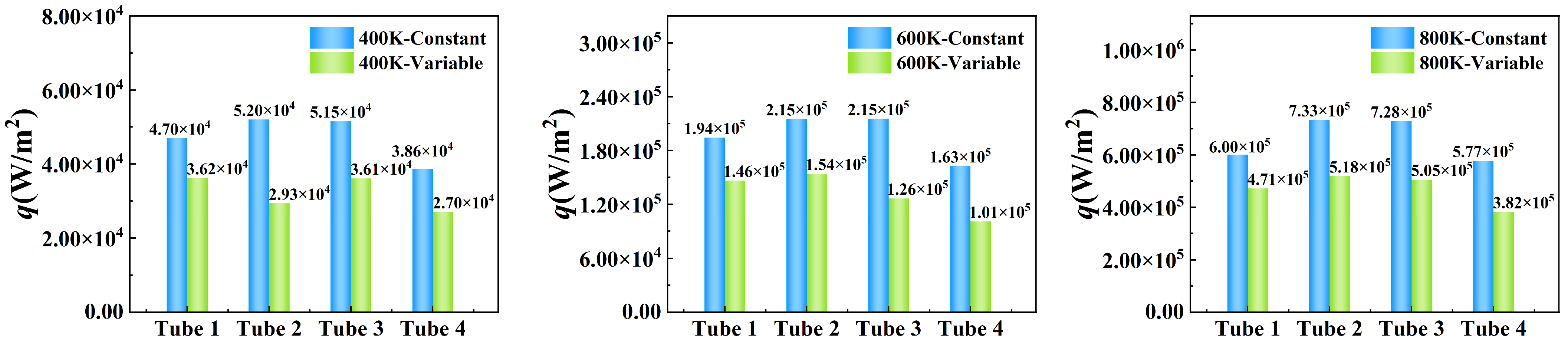
Since wake dynamics and near-wall shear play a central role in determining thermal transport, it is necessary to further examine the heat transfer behavior of the fine tubes. Figure 19 shows the average surface heat flux for each tube under different operating conditions, and the overall trends align well with the flow-field contours. Tubes 2 and 3 exhibit the highest heat-flux levels, which is consistent with the vorticity and TKE distributions indicating that the middle-row tubes experience the strongest shear layers and the most concentrated TKE. The vortices shed from upstream tubes repeatedly impinge on the downstream tubes, enhancing near-wall mixing and thereby steepening the local temperature gradient. For Tube 4, the temperature contours indicate a noticeably thicker near-wall thermal boundary layer on its lee side, which reduces the wall-normal temperature gradient and leads to the lowest heat flux. In addition, the incoming flow reaching Tube 4 has already been substantially cooled by the upstream rows, further weakening the local thermal driving force. Tube 1, unaffected by upstream vortex disturbances, relies mainly on the direct impingement of the incoming flow and therefore shows only a moderate level of heat transfer.
As the temperature increases from 400 K to 800 K, the heat flux of all tubes increases by several orders of magnitude. This rise is consistent with the stronger vorticity and higher TKE observed in the contour fields, as well as the thinner near-wall thermal boundary layers at elevated temperatures. The combined effects of intensified shear-layer instability and the larger temperature difference between the solid surface and the air substantially reinforce the heat-transfer process.
At the same temperature, the heat flux under variable-property conditions is noticeably lower than that under constant-property conditions (approximately 20–30% lower at 800 K). The contour analysis indicates that under variable-property conditions, the bulk flow velocity decreases, the recirculation region expands, and both the vorticity magnitude and TKE are reduced. These changes significantly reduce the near-wall velocity and temperature gradients. Consequently, assuming constant properties leads to an overestimation of the surface heat transfer capability.
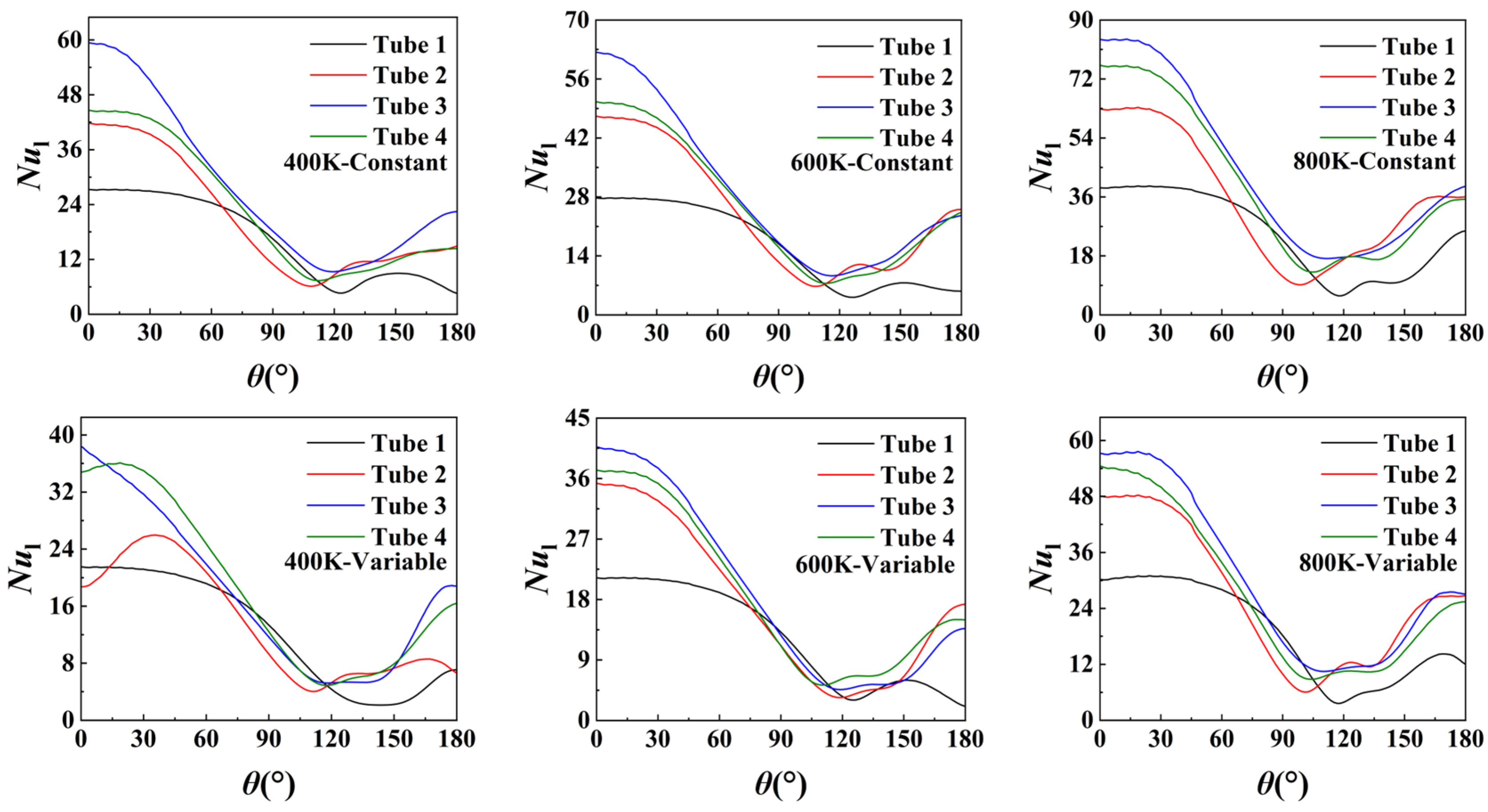
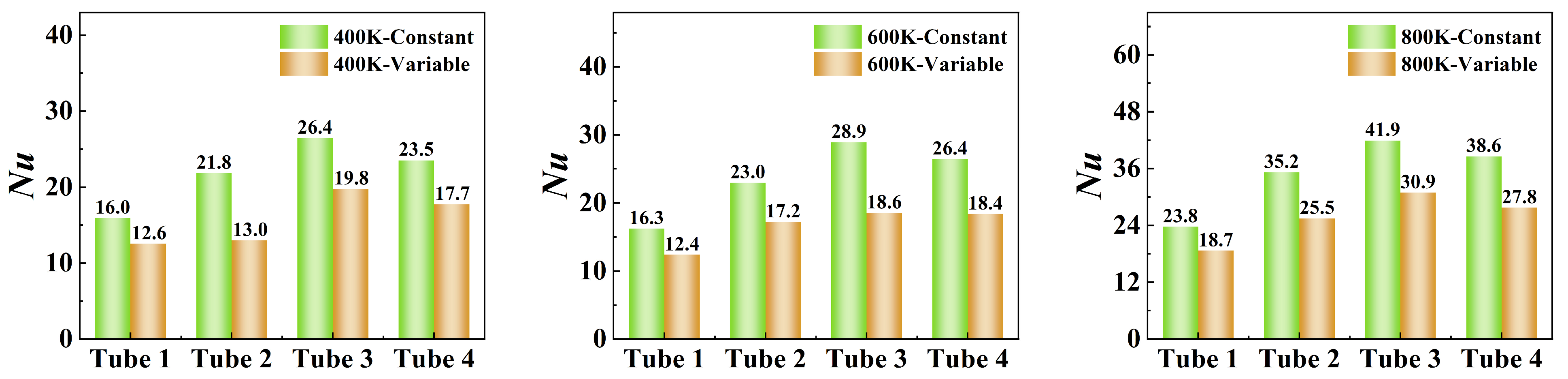
To further elucidate how heat transfer varies along the tube surface, the circumferential and average Nusselt numbers were analyzed. As shown in Figure 20 and Figure 21, the circumferential Nu distributions follow similar patterns under all operating conditions: Nu peaks on the windward side due to strong heat transfer in the stagnation region and a thin near-wall thermal boundary layer, then decreases rapidly after separation, forming a pronounced trough within the separated zone. A partial recovery occurs near the reattachment region, where shear-layer reattachment and enhanced mixing promote thermal-boundary-layer thinning.
More importantly, the row-wise variation in the average Nu can be explained by the evolution of wake–tube interactions. Tube 1 exhibits the lowest heat-transfer level because it encounters an undisturbed incoming flow with relatively weaker near-wall turbulence, leading to a more stable boundary layer and reduced wall-normal transport. In contrast, the middle-row tubes experience strong disturbances originating from upstream wakes. In particular, Tube 3 achieves the highest average Nu because it is subjected to (i) wake-induced flow acceleration and larger local velocity gradients on the windward side, which effectively increase the local Reynolds number and convective transport, and (ii) intense vortex impingement and elevated turbulence intensity in the near-wake, which disrupt the boundary layer and strengthen the near-wall velocity/temperature gradients. These effects also enhance the heat-transfer recovery in the reattachment region, thereby increasing the surface-averaged Nu. For the last-row tube (Tube 4), although upstream fluctuations still exist, part of the kinetic energy has already been dissipated and the approaching fluid has been pre-cooled by the upstream tubes, resulting in a reduced available temperature difference and a slightly lower average Nu than Tube 3, while remaining higher than the upstream tubes overall.
As the inlet temperature increases from 400 K to 800 K, the near-reattachment Nu is substantially enhanced, resulting in a significant increase in the average Nu. This enhancement is attributed to the increased thermal driving force together with stronger shear-layer instability and higher turbulence intensity at elevated temperatures, which promote wall-normal mixing and thermal-boundary-layer thinning.
Regarding variable-property effects, incorporating realistic temperature-dependent properties leads to lower circumferential Nu values over the entire surface compared with constant-property predictions, with the most pronounced reduction near the stagnation region and a weakened recovery in the reattachment zone. This reduction is mainly caused by temperature-dependent variations in viscosity and density, which decrease the effective local Reynolds number and thicken the boundary layer, leading to weaker near-wall velocity and temperature gradients. In addition, the reduced wake turbulence intensity under variable-property conditions diminishes the reattachment-related heat-transfer enhancement. Overall, constant-property assumptions tend to overpredict both the magnitude and the coherence of convective heat transfer in the fines tubes.
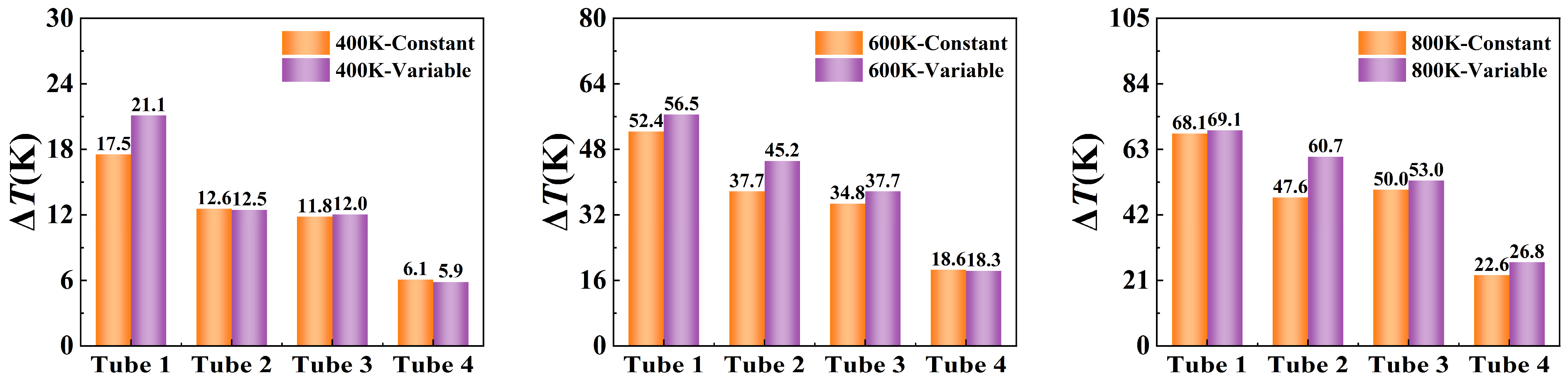
Beyond the surface heat transfer behavior, it is also necessary to examine how the air temperature evolves as it passes through the tube rows. Figure 22 shows the distribution of the local temperature drop across the four rows under different operating conditions. The temperature fields indicate that the air is gradually cooled as it moves around the tubes, and the magnitude of this temperature drop diminishes steadily in the downstream direction. This behavior can be attributed to the fact that Tube 1 encounters the largest initial temperature difference relative to the 300 K tube wall, providing the strongest thermal driving force for heat transfer. After successive heat exchange with the upstream tubes, the air temperature decreases, leading to a substantially reduced temperature difference when it reaches the downstream tubes. As a result, the temperature drops across Tubes 2 and 3 are smaller than that across Tube 1, while Tube 4 exhibits the smallest temperature drop.
As the inlet temperature increases from 400 K to 800 K, the temperature drop across all tube rows increases substantially. For example, the temperature drop of Tube 1 rises from approximately 17.5 K to nearly 68 K. This indicates that a higher incoming-flow temperature provides a stronger solid–air temperature difference as the driving force for heat transfer. Coupled with the enhanced TKE and intensified shear-layer disturbances at elevated temperatures, the sensible heat transfer from the air to the tube wall is significantly strengthened, thereby improving the overall cooling performance of the system.
At the same temperature, the temperature drop under variable-property conditions is generally greater than that under constant-property conditions, a trend particularly evident in the first three rows (e.g., at 600 K, the temperature drop of Tube 2 increases from 37.7 K to 45.18 K). The underlying mechanism is as follows: although variable properties reduce the local surface heat flux, the accompanying decrease in air density at higher temperatures lowers the mass flow rate. The velocity fields indicate that under variable-property conditions, the low-velocity wake (velocity-deficit) region expands and the bulk flow velocity decreases, leading to a reduced mass flow rate through the fine tubes. Because the reduction in mass flow rate outweighs the decrease in heat flux, the air undergoes a larger temperature drop per unit mass, thereby producing a larger overall temperature difference. (For the 600 K case, the outlet mass flow rate decreases from 9.6227 × 10⁻⁵ kg/s (constant properties) to 6.5960 × 10⁻⁵ kg/s (variable properties), i.e., a reduction of about 31.5%. Meanwhile, the mass-weighted outlet temperature decreases from 462.44 K to 447.20 K, corresponding to a larger temperature drop under variable properties (152.80 K vs. 137.56 K). Using Qair = |m|(ℎin − ℎout), we obtained Qair = 13.92 W for the constant-property case and 10.44 W for the variable-property case. Although the overall heat removal rate is lower under variable properties, the enthalpy drop per unit mass is larger (Δℎ = 158.25 kJ/kg vs. 144.66 kJ/kg) and the mass flow rate is significantly reduced, which together lead to a larger temperature decrease in the air). In summary, the cooling performance of air flowing over fine tubes is jointly governed by the local temperature driving force, the heat transfer capability of the upstream tube rows, and the flow parameters (including velocity, vorticity, and TKE). Additionally, constant-property assumptions tend to underestimate the air temperature drop, demonstrating that temperature-dependent property variations play a critical role in accurately predicting the cooling performance of fine tubes.
To assess how temperature-dependent property variations affect the flow and heat transfer behavior of air flowing across fine tubes, the average Nu and local pressure drop for both constant-property and variable-property models were compiled and compared for each tube, as summarized in Table 1. The findings indicate that the use of constant-property assumptions is always followed by an overestimation of both flow and heat transfer performance. The predicted Nu is, on average, approximately 20–40% greater than the variable-property calculation, and local pressure drop is also overestimated to even higher proportions, usually 40–65%. These inconsistencies underscore the fact that temperature-dependent variations in fluid properties should not be neglected since they may cause significant errors and especially when determining pressure drop. Generally, consideration of real-property effects is critical to the proper predictive character of the flow and heat transfer of high temperature air flowing over fine tubes. It is particularly important to this consideration when estimating the pressure drops, since the failure to consider property variations would greatly overestimate the flow resistance and may negatively affect the design and optimization of the engineering process of precoolers.

4. Discussion

Proper modeling of the thermophysical characteristics of air as a function of temperature is important to the technological prediction of the thermal-hydraulic characteristics of micro-scale precooler tubes. Neglecting real-gas effects leads to notable overestimations of both heat transfer capability and pressure losses, which may further resulting in oversized components, underestimated cooling demands, or insufficient performance margins in SABRE-type precooler designs. Thus, incorporating variable air properties is fundamental to the reliable design, assessment, and optimization of precooler systems. Current research still faces multiple limitations. Future work should address these existing shortcomings by conducting more systematic and in-depth studies to refine theoretical frameworks and guide engineering practices. Specifically, subsequent efforts could proceed from the following aspects:
(1)
The present study still has some limitations, such as the consideration of a single Reynolds number. Future work will systematically investigate a broader Reynolds number range, from low to high (e.g., Re = 300–3000 or wider), to establish generalized correlations applicable to full operating conditions and to provide more comprehensive data support for the optimal design of precoolers.
(2)
The present model has limitations regarding the extrapolation of the number of tube rows in the streamwise direction. Future work will systematically increase the number of tube rows to identify the critical condition required to achieve fully developed flow, thereby establishing more general design guidelines.
(3)
To facilitate an in-depth investigation of the air-side flow and heat transfer mechanisms in fine tubes, an idealized constant wall temperature boundary condition is adopted in the present study. Under this assumption, the conclusions are most directly applicable to operating conditions with strong cooling capacity on the cold side or well-controlled coolant temperatures. However, the actual operation of a SABRE precooler involves strongly coupled, transient heat transfer between the hot (air) and cold (helium) fluids, resulting in complex spatiotemporal variations in the wall temperature. Therefore, extending the air-side fundamental mechanisms revealed in this study to practical engineering scenarios with fully coupled hot–cold side interactions represents a critical step toward real-world applications. Future work will focus on developing fully coupled, transient numerical models that simultaneously account for the internal and external flows under prescribed inlet conditions (mass flow rate, pressure, and temperature), in order to systematically investigate the heat transfer characteristics and dynamic wall temperature evolution under dual-sided convective effects. This will help establish a comprehensive theoretical bridge from fundamental mechanisms to engineering design, providing a more solid basis for the refined design and dynamic control of precoolers.
(4)
This study primarily reveals the evolution of flow and heat transfer mechanisms under a limited number of tube rows. The current model has limitations regarding extrapolation to a greater number of tube rows along the flow direction. In future research, the number of tube rows will be systematically increased to determine the critical conditions for achieving fully developed flow, thereby establishing more universal design criteria.
(5)
It should be noted that the strong property variations at significantly elevated temperatures may enhance shear layer instability and affect local heat transfer and resistance distributions, aspects not directly covered by the existing validation data. Therefore, the results under high-temperature conditions in this study are more suitable for revealing trends and relative variations in flow and heat transfer rather than serving as absolute quantitative predictions. Further validation of the model’s applicability under extreme conditions through high-temperature experiments or higher-fidelity simulations remains necessary in future work.
(6)
The present results also show that high-frequency vortex shedding develops when air flows across staggered fine tubes. A promising direction for future research is to examine how these fine tubes respond to the disturbances generated by such high-frequency shedding. Insights from this investigation would help establish a more comprehensive theoretical basis for improving precooler design and guiding performance optimization.

5. Conclusions

This work numerically examined the flow and heat transfer behavior of high-temperature air passing over staggered fine tubes, considering both constant-property and temperature-dependent property models. The key findings can be summarized as follows:
(1)
The unsteady flow characteristics of fine tubes are highly sensitive to temperature. Rising inlet temperature significantly strengthens shear-layer instability, vortex shedding, and TKE, thereby enhancing heat transfer and increasing pressure drop. However, when temperature-dependent air properties are incorporated, the wake width increases and the separated shear layers become thicker, while the turbulence/unsteadiness intensity is reduced. As a result, vortex shedding becomes less periodic and less regular, the wake vortices are more scattered, and the near-wall shear is substantially weakened.
(2)
These flow modifications directly influence thermal performance. Middle-row tubes achieve the highest heat transfer due to strong vortex impingement. Higher inlet temperatures greatly increase Nu and heat flux.
(3)
Temperature drop through the tube rows decreases along the flow direction, yet increases markedly with inlet temperature. Under variable-property conditions, reduced density and mass flow rate yield a larger temperature drop per unit mass, despite lower surface heat flux. Constant-property models underestimate this cooling effect.
(4)
Overall, constant-property assumptions overpredict both heat transfer and flow resistance performance, with local pressure drop errors reaching 40–65% and Average Nu errors 20–40%.

Author Contributions

Conceptualization, L.S.; methodology, Q.Z.; software, Q.Z. and Y.F.; validation, C.Z. and J.Z.; formal analysis, X.X.; investigation, Q.Z. and Y.F.; resources, Y.F.; data curation, L.S.; M.D. and Z.M.; writing—original draft preparation, Q.Z.; writing—review and editing, L.S.; M.D. and Z.M.; visualization, Q.Z.; supervision, L.S.; project administration, L.S. All authors have read and agreed to the published version of the manuscript.

Funding

This research was funded by The National Science and Technology Major Project, 2025ZD1009905 and by The National Natural Science Foundation of China, 12075160, and by The National Key R&D Program of China, 2021YFB1507403, and by The Natural Science Foundation of Sichuan Province, 2025ZNSFSC0445, 2026NSFSC1345.

Data Availability Statement

The original contributions presented in this study are included in the article. Further inquiries can be directed to the corresponding author.

Acknowledgments

During the preparation of this manuscript/study, the authors used DeepSeek for the purposes of generating text. The authors have reviewed and edited the output and take full responsibility for the content of this publication.

Conflicts of Interest

The authors declare no conflicts of interest. The funders had no role in the design of the study.

Abbreviations

The following abbreviations are used in this manuscript:
LESLarge-Eddy Simulation
SABRESynergetic Air-Breathing Rocket Engine
RELReaction Engines Limited
RANSReynolds-Averaged Navier–Stokes
NISTNational Institute of Standards and Technology
TKETurbulent Kinetic Energy
FFTFast Fourier Transform

References

  1. Deng, F.; Tan, H.; Dong, H.; Fu, Q.; Chen, J. Progress on Key Technologies of Hypersonic Aerospace Plane with Pre-Cooled Combined Propulsion. J. Propuls. Technol. 2018, 39, 1. (In Chinese) [Google Scholar] [CrossRef]
  2. Wei, X.; Wang, Z.; Yu, X.; Zhao, M.; Feng, Y.; Xu, S.; Qin, J. Numerical Investigation on the Flow and Heat transfer Characteristics of Tube-Bundle Precooler Based on the Multi-Layer Grid Superposition Method. Therm. Sci. Eng. Prog. 2025, 67, 104090. [Google Scholar] [CrossRef]
  3. Ding, W.; Eri, Q.; Kong, B.; Wang, C. The Effect of Inlet Pressure Distortion on the Performance of an Axisymmetric Compact Tube Heat Exchanger with Radial Counter Flow Type for Hypersonic Pre-Cooled Aero-Engine. J. Mech. Sci. Technol. 2022, 36, 3181–3191. [Google Scholar] [CrossRef]
  4. Wang, C.; Eri, Q.; Wang, Y.; Ding, W. Flow and Heat Transfer Characteristics of Intake-Precooler System for Hypersonic PreCooled Aero-engine. Appl. Therm. Eng. 2023, 229, 120596. [Google Scholar] [CrossRef]
  5. Zhang, J. Research on the Flow and Heat Transfer Mechanism of Cryogenic Fluid in the Micro/Mini-Channel of Combined Cycle Engine Precooler. Ph.D. Thesis, National University of Defense Technology, Changsha, China, 2018. (In Chinese) [Google Scholar] [CrossRef]
  6. Wu, Y.; Xu, R.; Wang, C.; Jiang, P. Novel Three-Equation Porous Media Model for Prediction of Compact Heat Exchanger and Its Case Study for Microtube Bundle Precooler. Int. J. Heat Mass Tran. 2025, 248, 127177. [Google Scholar] [CrossRef]
  7. Li, W.; Zhang, L.; Shen, L.; Wang, C.; Qin, J. Overview of Precooled Turbine-Based Combined Cycle Engine and Its Key Technologies. Aeroengine 2024, 50, 16–29. (In Chinese) [Google Scholar] [CrossRef]
  8. Wei, X.; Jin, F.; Yao, Z.; Ji, H. Numerical Investigation on the Heat Transfer of Air/Helium Precooler for Air-Breathing Pre-Cooled Engine. Therm. Sci. 2024, 28, 913–927. [Google Scholar] [CrossRef]
  9. Lu, Y.; Jiang, S.; Che, Y.; Zhang, Z.; Wang, X. Coupling Characteristics of the Bowed Micro-Tubes for Precooled Heat Exchangers Under Different Inflow Speeds. Phys. Fluids 2025, 37, 075155. [Google Scholar] [CrossRef]
  10. Xie, P.; Liu, Y.; Yuan, W. An Investigation on Aerodynamic and Thermodynamic Characteristics of a Precooled Intake for the Supersonic Precooled Turbine Engine. Appl. Therm. Eng. 2025, 278, 127458. [Google Scholar] [CrossRef]
  11. Wang, Z.; Ma, T.; Wang, B.; Gu, M. Heat Exchange Micro-Tube Vibration Analysis and Reliability Evaluation Methods for Diaphragm Micro-channel Pre-coolers. China Mech. Eng. 2024, 35, 869–876. (In Chinese) [Google Scholar] [CrossRef]
  12. Wei, X.; Jin, F.; Ji, H.; Jin, Y. Thermodynamic Analysis of Key Parameters on the Performance of Air Breathing Pre-Cooled Engine. Appl. Therm. Eng. 2022, 201, 117733. [Google Scholar] [CrossRef]
  13. Li, N.; Yan, X.; Chen, X.; Zhou, X.; Su, W.; Duan, Z. Efficient Prediction of Heat Transfer Characteristics of Compact Heat Exchangers. J. Aerosp. Power. 2025, 40, 20230811. (In Chinese) [Google Scholar] [CrossRef]
  14. Ma, H.; Zhang, W.; Su, W.; An, H. Modal Decomposition and Rapid Prediction of Flow and Heat Transfer in Microtubes of Precooler. Acta Aerodyn. Sin. 2025, 43, 110–120. (In Chinese) [Google Scholar] [CrossRef]
  15. Ding, W.; Eri, Q.; Kong, B.; Zhang, Z. Numerical Investigation of a Compact Tube Heat Exchanger for Hypersonic Pre-Cooled Aero-Engine. Appl. Therm. Eng. 2020, 170, 114977. [Google Scholar] [CrossRef]
  16. Li, S.; Ma, T.L.; Liu, H.T.; Zhang, Z.G.; Xiang, Z.H.; Mo, Z.Y.; Sun, L.C. Numerical Analysis of Effects of Pre-Cooler Structure Parameter on Its Performance in SABRE. J. Propuls. Technol. 2022, 43, 257–264. (In Chinese) [Google Scholar] [CrossRef]
  17. Mi, Y.; Liu, M.; Wu, H.; Zhao, R.; Zhu, K. Experimental Study on Frost Formation on the Surface of Ultra-Low Temperature Circular Tubes Under Forced Convection Conditions. Int. J. Heat Mass Tran. 2025, 249, 127280. [Google Scholar] [CrossRef]
  18. Bacellar, D.; Aute, V.; Huang, Z.; Radermacher, R. Airside Friction and Heat Transfer Characteristics for Staggered Tube Bundle in Crossflow Configuration with Diameters from 0.5 mm to 2.0 mm. Int. J. Heat Mass Tran. 2016, 98, 448–454. [Google Scholar] [CrossRef]
  19. Zhang, J.; Li, G.; Nan, X.; Ma, Y.; Tang, G. Design and Flow Heat Transfer of Mini-Channel Helium Heat Exchanger in Combined Engine. J. Rocket. Propul. 2021, 47, 9–18. (In Chinese) [Google Scholar]
  20. Li, S.; Li, J.; Liu, Z. Simulation Study on Flow and Heat Transfer of Cross-Arrangement Tube Bundle. J. Therm. Sci. 2023, 32, 1435–1444. [Google Scholar] [CrossRef]
  21. Qin, Y.; Zhuang, L.; Liu, Q.; Liu, Z.; Wen, J. Numerical Investigation on Heat Transfer Characteristics of Staggered Tube Bundles in Cross Flow. J. Aerosp. Power. 2023, 38, 2718–2728. (In Chinese) [Google Scholar] [CrossRef]
  22. Guan, N.; Luan, T.; Liu, Z.G.; Zhang, C.W.; Jiang, G. Vortex Distribution and Mixed Convection of Liquid Flow Across Micro-Cylinders in a Rectangular Channel. Heat Mass Transfer. 2016, 52, 657–670. [Google Scholar] [CrossRef]
  23. Wei, M. Study on the Heat Transfer of High-Temperature Air Traversing Microtubule Bundles Flow Under Quenching Cold Conditions. Master’s Thesis, Sichuan University, Chengdu, China, 2024. (In Chinese) [Google Scholar]
  24. Su, L. Precooling Turbine Cooling Air for Aviation Engines. Master’s Thesis, Shenyang Aerospace University, Shenyang, China, 2018. (In Chinese) [Google Scholar]
  25. Gu, L.; Min, J.; Wu, X.; Yang, L. Airside Heat Transfer and Pressure Loss Characteristics of Bare and Finned Tube Heat Exchangers Used for Aero Engine Cooling Considering Variable Air Properties. Int. J. Heat Mass Tran. 2017, 108, 1839–1849. [Google Scholar] [CrossRef]
  26. Wei, X.; Jin, F.; Liu, T.; Ji, H. Numerical Study on Flow and Heat Transfer of Air Precooler in SABRE. J. Rocket. Propul. 2019, 45, 8–16. (In Chinese) [Google Scholar]
  27. Li, C.P.; Wang, Y.S.; Wang, H.J.; Wei, Y.Q. Numerical Analysis of Heat Transfer in Precooler for Hybrid Airbreathing Rocket Engines. J. Eng. Thermophys. 2017, 38, 811–816. (In Chinese) [Google Scholar]
  28. Li, G.; Ma, T.L.; Liu, H.T.; Zhang, Z.G.; Tang, J.G.; Sun, L.C. Evaluation and Analysis of Applicability of Zukauskas Correlation to Microtubular Pre-Cooler. J. Propuls. Technol. 2021, 42, 2754–2761. (In Chinese) [Google Scholar] [CrossRef]
  29. Linton, D.; Thornber, B. Direct Numerical Simulation of Transitional Flow in a Staggered Tube Bundle. Phys. Fluids 2016, 28, 024111. [Google Scholar] [CrossRef]
  30. Lei, C.; Cheng, L.; Kavanagh, K. Spanwise Length Effects on Three-Dimensional Modelling of Flow over a Circular Cylinder. Comput. Methods Appl. Mech. Eng. 2001, 190, 2909–2923. [Google Scholar] [CrossRef]
  31. Labbé, D.F.L.; Wilson, P.A. A Numerical Investigation of the Effects of the Spanwise Length on the 3-D Wake of a Circular Cylinder. J. Fluid. Struct. 2007, 23, 1168–1188. [Google Scholar] [CrossRef]
  32. Yao, L.; Fu, C.; Zhang, J.; Li, Z.; Zou, Z. Heat Transfer Performance of Pre-Cooler Under Unsteady Inflow Pressure Condition Using Dynamic Mode Decomposition Method. J. Aerosp. Power. 2020, 35, 2064–2077. (In Chinese) [Google Scholar] [CrossRef]
  33. Chen, Y.; Li, Z.; Zhang, J.; Zou, Z. Large Eddy Simulation on the Staggered Tube Bundle of the Compact Precooler. J. Aerosp. Power. 2021, 36, 701–712. (In Chinese) [Google Scholar] [CrossRef]
  34. Xie, J.; Li, S.; Yan, H.; Xie, G. Numerical Analysis on Thermal–Hydraulic Performances of Staggered Tube Bundles for an Aero-Engine Compact Precooler. J. Therm. Anal. Calorim. 2020, 141, 387–399. [Google Scholar] [CrossRef]
  35. Li, Y.; Jiang, S.; Chen, X.; Sun, F.; Wang, S.; Lu, Y. Study on the Effects of Structural Parameters of the Pre-Cooler on the Performance of Combined Power Generation Engines. Symmetry 2024, 16, 1471. [Google Scholar] [CrossRef]
  36. Wen, J.; Qin, Y.; Xu, G.; Liu, Z.; Dong, B.; Wu, S.; Zhuang, L. Experimental and Numerical Analysis of Airside Thermal-Hydraulic Characteristics of Small-Diameter Tube Bundle Under Compressible Flow Conditions. Int. Commun. Heat Mass 2025, 168, 109429. [Google Scholar] [CrossRef]
Figure 1. SABRE-type precooler.
Energies 19 00796 g001
Figure 2. Computational domain and geometric configuration of the staggered fine tubes.
Energies 19 00796 g002
Figure 3. Boundary conditions applied in the staggered fine tubes simulations.
Energies 19 00796 g003
Figure 4. Dependences of air physical properties on air temperature at 0.165 MPa air pressure.
Energies 19 00796 g004
Figure 5. Mesh generation: (a) meshing of the partial computational domain; (b) locally refined mesh.
Energies 19 00796 g005
Figure 6. Independence verification of outlet air temperature: (a) grid number; (b) time step.
Energies 19 00796 g006
Figure 7. The locations of the frontal and rear cross-sections of tube.
Energies 19 00796 g007
Figure 8. Comparisons of the numerical and experimental results [36]: (a) Nusselt number; (b) friction factor.
Energies 19 00796 g008
Figure 9. Time histories of lift coefficient for Tubes 1–4 under constant- and variable-property conditions at inlet temperatures of 400, 600, and 800 K.
Energies 19 00796 g009
Figure 10. Instantaneous spanwise vorticity contours of the staggered fine tubes under constant- and variable-property conditions at inlet temperatures of 400, 600, and 800 K.
Energies 19 00796 g010
Figure 11. Instantaneous TKE contours of the staggered fine tubes under constant- and variable-property conditions at inlet temperatures of 400, 600, and 800 K.
Energies 19 00796 g011
Figure 12. Instantaneous velocity contours of the staggered fine tubes under constant- and variable-property conditions at inlet temperatures of 400, 600, and 800 K.
Energies 19 00796 g012
Figure 13. Instantaneous temperature contours of the staggered fine tubes under constant- and variable-property conditions at inlet temperatures of 400, 600, and 800 K.
Energies 19 00796 g013
Figure 14. Streamwise distributions of normalized Reynolds shear stress along the wake centerline downstream of Tube 2 under constant- and variable-property conditions at 400–800 K.
Energies 19 00796 g014
Figure 15. PSD of the streamwise velocity at the monitoring point located 0.5 mm downstream of Tube 2 on the wake centerline under constant- and variable-property conditions at 400–800 K.
Energies 19 00796 g015
Figure 16. PSD of the lift coefficient for Tubes 1–4 under constant- and variable-property conditions at inlet temperatures of 400, 600, and 800 K.
Energies 19 00796 g016
Figure 17. Circumferential distributions of surface friction coefficient for Tubes 1–4 under constant- and variable-property conditions at inlet temperatures of 400, 600, and 800 K.
Energies 19 00796 g017
Figure 18. Local pressure drop across Tubes 1–4 under constant- and variable-property conditions at inlet temperatures of 400, 600, and 800 K.
Energies 19 00796 g018
Figure 19. Comparison of average surface heat flux for Tubes 1–4 under constant- and variable-property conditions at inlet temperatures of 400, 600, and 800 K.
Energies 19 00796 g019
Figure 20. Circumferential distributions of Nu for Tubes 1–4 under constant- and variable-property conditions at inlet temperatures of 400, 600, and 800 K.
Energies 19 00796 g020
Figure 21. Average Nusselt number of Tubes 1–4 under constant- and variable-property conditions at inlet temperatures of 400, 600, and 800 K.
Energies 19 00796 g021
Figure 22. Air temperature drop across Tubes 1–4 under constant- and variable-property conditions at inlet temperatures of 400, 600, and 800 K.
Energies 19 00796 g022
Table 1. Error in average Nu and local pressure drop under constant- and variable-property conditions.
Inlet Air TemperatureTube NumberAverage NuLocal Pressure Drop
400 K121.3%42.1%
240.5%52.5%
325.3%39.8%
424.6%54.7%
600 K123.9%46.8%
225.0%62.8%
335.8%61.3%
430.4%51.7%
800 K121.3%40.9%
227.5%48.7%
326.3%51.1%
428.0%65.4%
Disclaimer/Publisher’s Note: The statements, opinions and data contained in all publications are solely those of the individual author(s) and contributor(s) and not of MDPI and/or the editor(s). MDPI and/or the editor(s) disclaim responsibility for any injury to people or property resulting from any ideas, methods, instructions or products referred to in the content.