Advances in Sodium Ion Batteries Based on Mixed Electrolytes of ILs and Organic Solvents



Abstract
1. Introduction
2. Background and Theory
2.1. Electrolytes
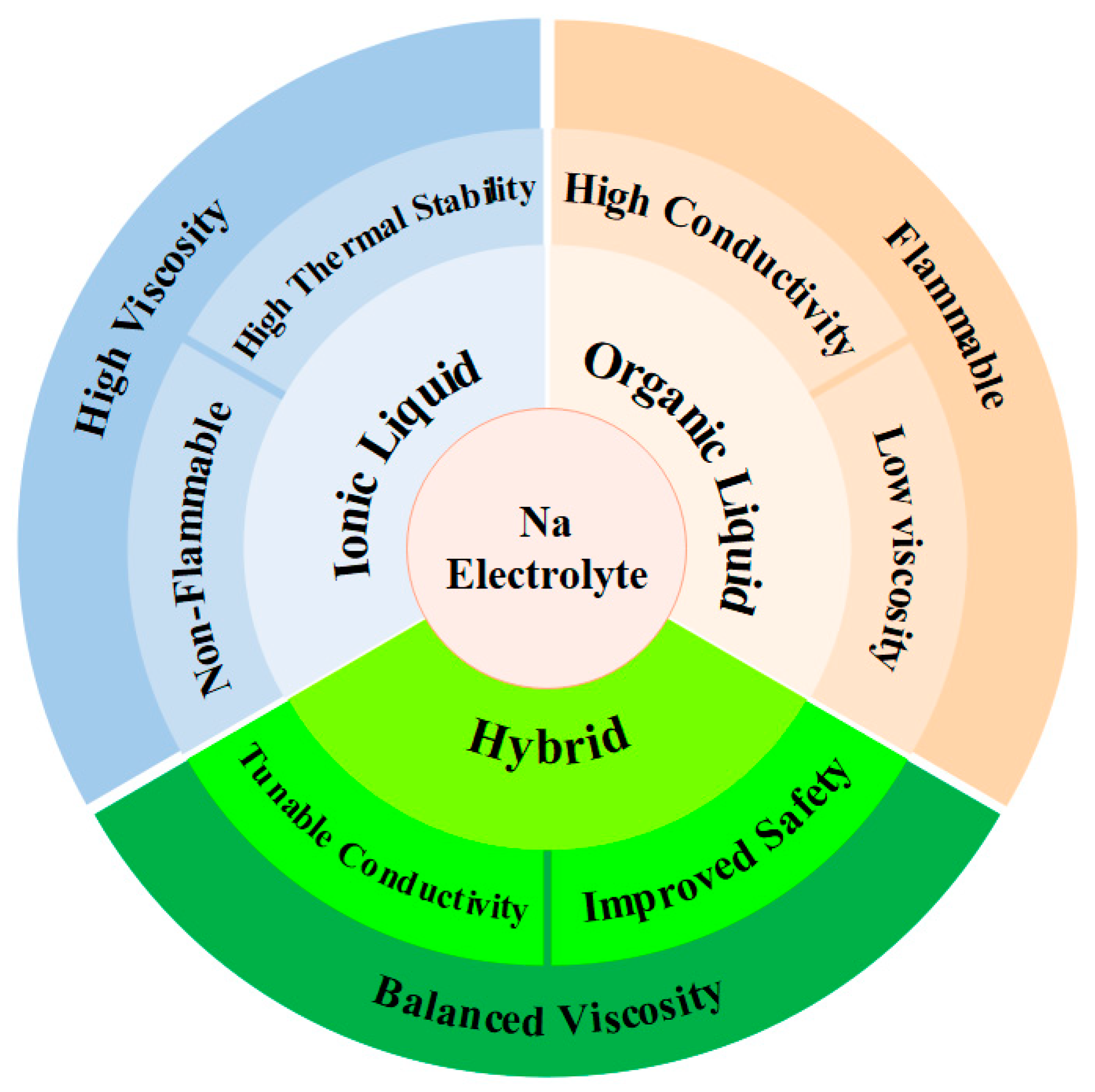
- Ionic conductivity, essential for the performance of SIBs. Faster ion transportation between the electrodes and higher power output could be reachable with higher ionic conductivity [14].
- The electrochemical window of the electrolyte in a rechargeable battery should be larger than the voltage ranges at which the cathode or anode are subjected to charge-transfer reactions, which can prevent unwanted reduction or oxidation reactions in the electrolyte [43].
- To minimize the short circuits and reduce energy losses within the battery, electrolytes should have high electronic resistance (i.e., low electronic conductivity) [44].
- Safe and stable electrolytes will mitigate risks of thermal runaway and fire [45].
2.1.1. Solid Electrolytes
2.1.2. Organic Liquid Electrolytes
2.1.3. IL Electrolytes
3. Synergistic Effects and Interfacial Stabilization Mechanisms
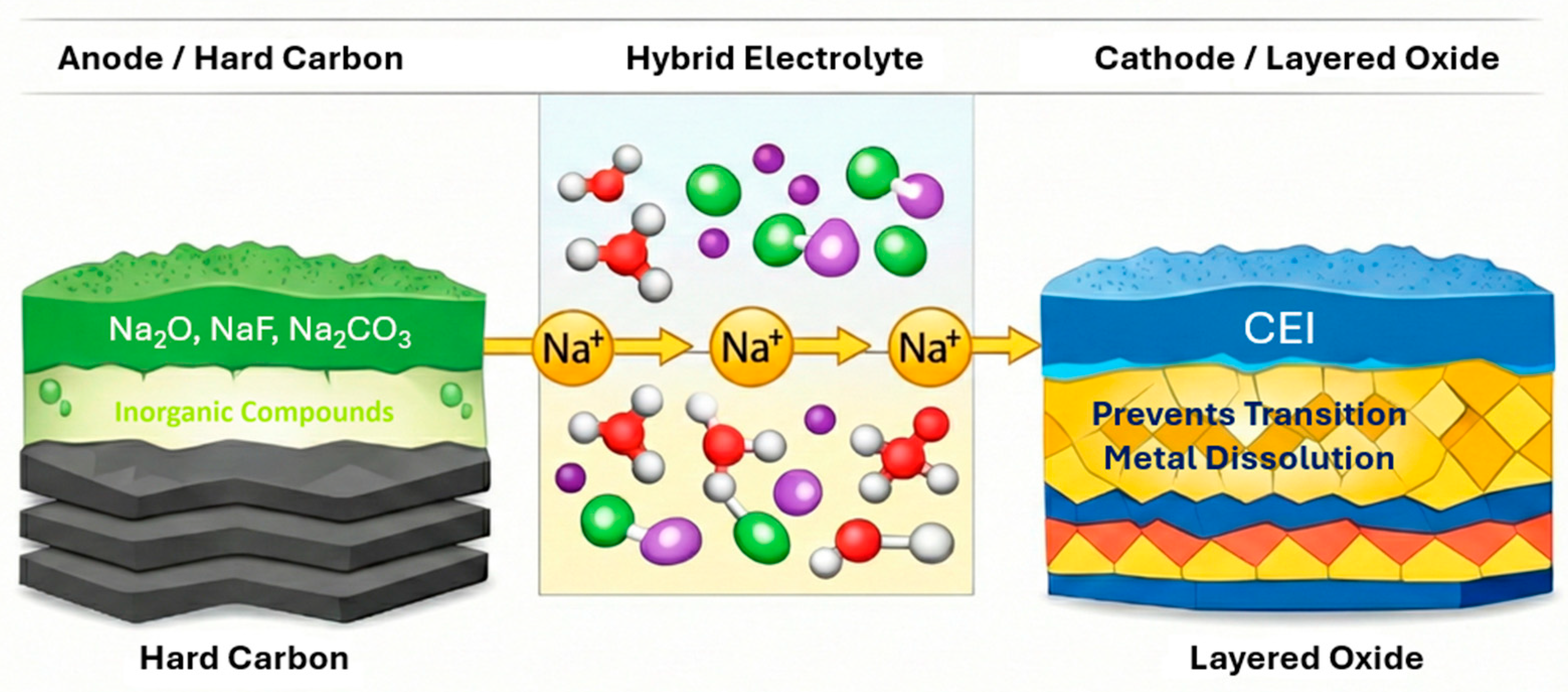
3.1. SEI on the Anode
3.2. CEI on the Cathode
3.3. Synergistic Effects on Thermal Stability
3.3.1. Reduction of Organic Solvent Volatility and Flammability
3.3.2. Formation of Thermally Stable Solvation Structures
3.3.3. Suppression of Side Reactions and SEI Stabilization
3.3.4. Dilution Effect and Heat Dissipation
3.3.5. Thermal Stability of Hybrid Electrolytes
4. Advanced Characterization and Computational Modeling for Deeper Analysis
4.1. Advanced Characterization Techniques for Mechanistic Understanding
4.1.1. Spectroscopic Probes of Solvation Structure and Interactions
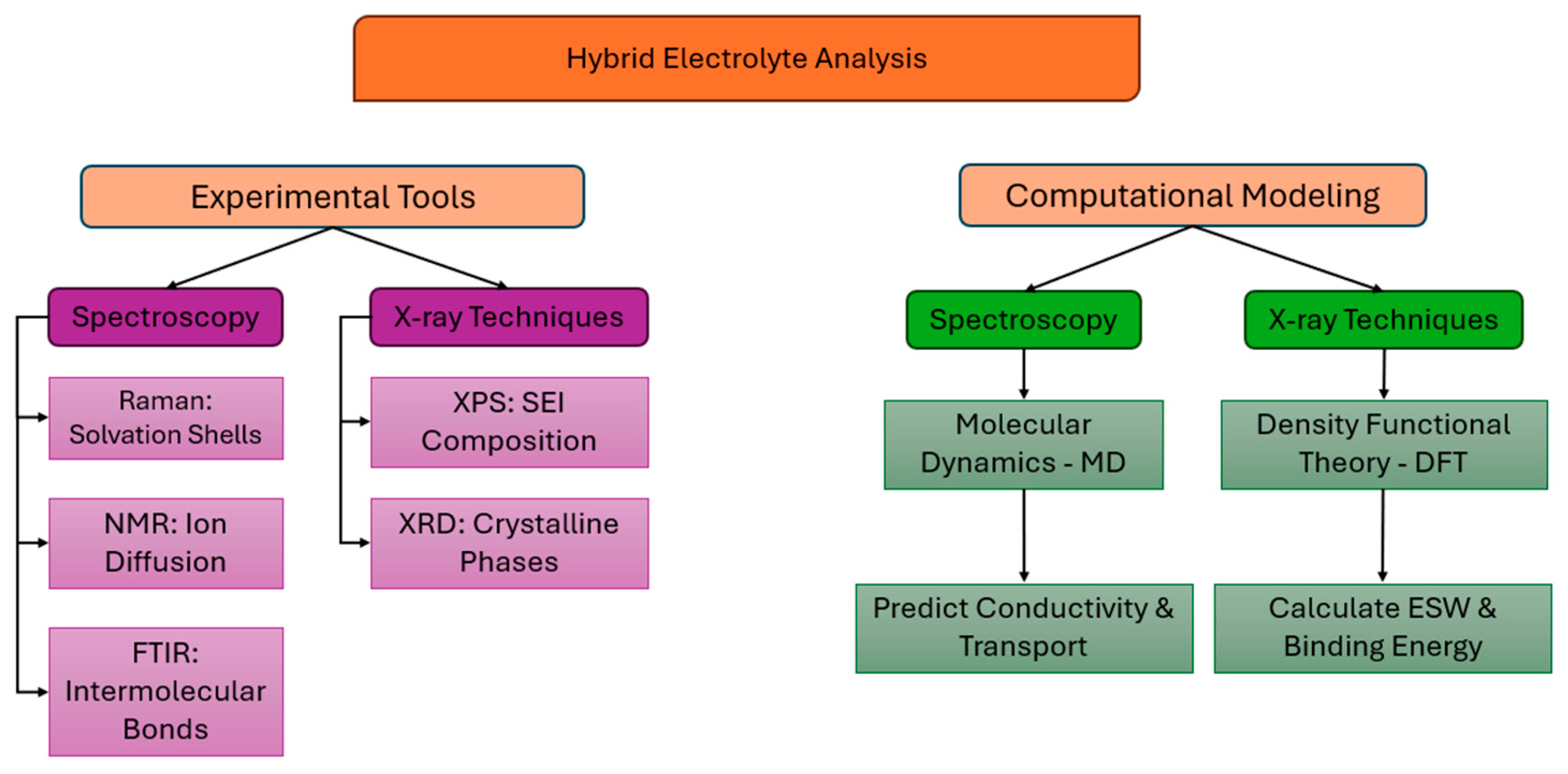
- Raman Spectroscopy: This technique is highly effective in probing the local solvation environment of Na+ ions and the interactions between ILs and organic solvents. By analyzing shifts in vibrational modes of solvent molecules and IL ions, researchers can identify the formation of stable solvation complexes, ion-pairing phenomena, and the degree of solvent coordination around Na+ ions. For instance, studies have used Raman spectroscopy to show that the presence of ILs can strengthen the coordination of organic solvent molecules (e.g., ethylene carbonate, EC) to Na+, leading to more robust solvation shells and contributing to enhanced thermal stability [14]. This provides direct evidence of the synergistic effects at a molecular level.
- Nuclear Magnetic Resonance (NMR) Spectroscopy: Solid-state and liquid-state NMR can provide detailed information on ion transport mechanisms, molecular dynamics, and the chemical environment of various species within the electrolyte. Diffusion coefficients of Na+ ions, IL ions, and solvent molecules can be measured, offering insights into the factors limiting ionic conductivity. Furthermore, changes in chemical shifts can indicate specific interactions between components, such as hydrogen bonding or preferential solvation. For example, 23Na NMR can directly probe the local environment of sodium ions, revealing how their coordination changes with varying IL and organic solvent ratios, and how this impacts ion mobility [106].
- Fourier Transform Infrared (FTIR) Spectroscopy: FTIR can complement Raman spectroscopy by identifying functional groups and their interactions. It is particularly useful for detecting hydrogen bonding and other intermolecular associations between ILs and organic solvents, which are critical for understanding the reduced volatility and enhanced thermal stability of hybrid systems.
4.1.2. X-Ray Techniques for Interfacial Analysis
- X-Ray Photoelectron Spectroscopy (XPS): XPS is widely used to analyze the chemical composition and electronic states of elements within the SEI layer. By examining the binding energies of core-level electrons, researchers can identify the various inorganic (e.g., NaF, Na2CO3) and organic (e.g., R-ONa, R-OCO2Na) components of the SEI. This helps in understanding how ILs influence the formation and stability of the SEI, leading to improved interfacial properties and reduced side reactions at elevated temperatures [107].
- Synchrotron-based X-Ray Absorption Spectroscopy (XAS) and X-Ray Diffraction (XRD): These techniques can provide insights into the atomic and electronic structure of electrolyte components and interfacial layers. XAS can reveal the local coordination environment of specific elements (e.g., Na, F), while XRD can identify crystalline phases within the SEI or bulk electrolyte. These techniques are particularly useful for understanding the long-term stability and degradation mechanisms of hybrid electrolytes.
4.2. Computational Modeling and Simulation for Predictive Design
4.2.1. MD Simulations
- Predict Ionic Conductivity: Calculate diffusion coefficients of ions and correlate them with experimental ionic conductivity values, identifying the rate-limiting steps in ion transport.
- Visualize Solvation Shells: Provide a detailed picture of how Na+ ions are solvated by both organic solvent molecules and IL ions, revealing the competition between different species for coordination. This can help explain the formation of thermally stable solvation structures [108].
- Analyze Intermolecular Interactions: Quantify the strength and nature of interactions (e.g., hydrogen bonding, electrostatic) between ILs and organic solvents, which directly relates to the reduced volatility and enhanced thermal stability.
4.2.2. DFT Calculations
- Calculate Binding Energies: Determine the strength of interactions between Na+ ions and various solvent/IL molecules, providing a theoretical basis for preferential solvation and solvation shell stability.
- Predict ESW: Calculate the theoretical oxidation and reduction potentials of electrolyte components, helping to design electrolytes with wider ESWs for higher voltage applications.
- Investigate SEI Formation Mechanisms: Model the initial decomposition reactions of electrolyte components on electrode surfaces, offering insights into the formation pathways and composition of the SEI layer [109].
5. Novel Strategies in Hybrid Electrolyte Design
5.1. Localized High-Concentration Electrolytes (LHCEs)
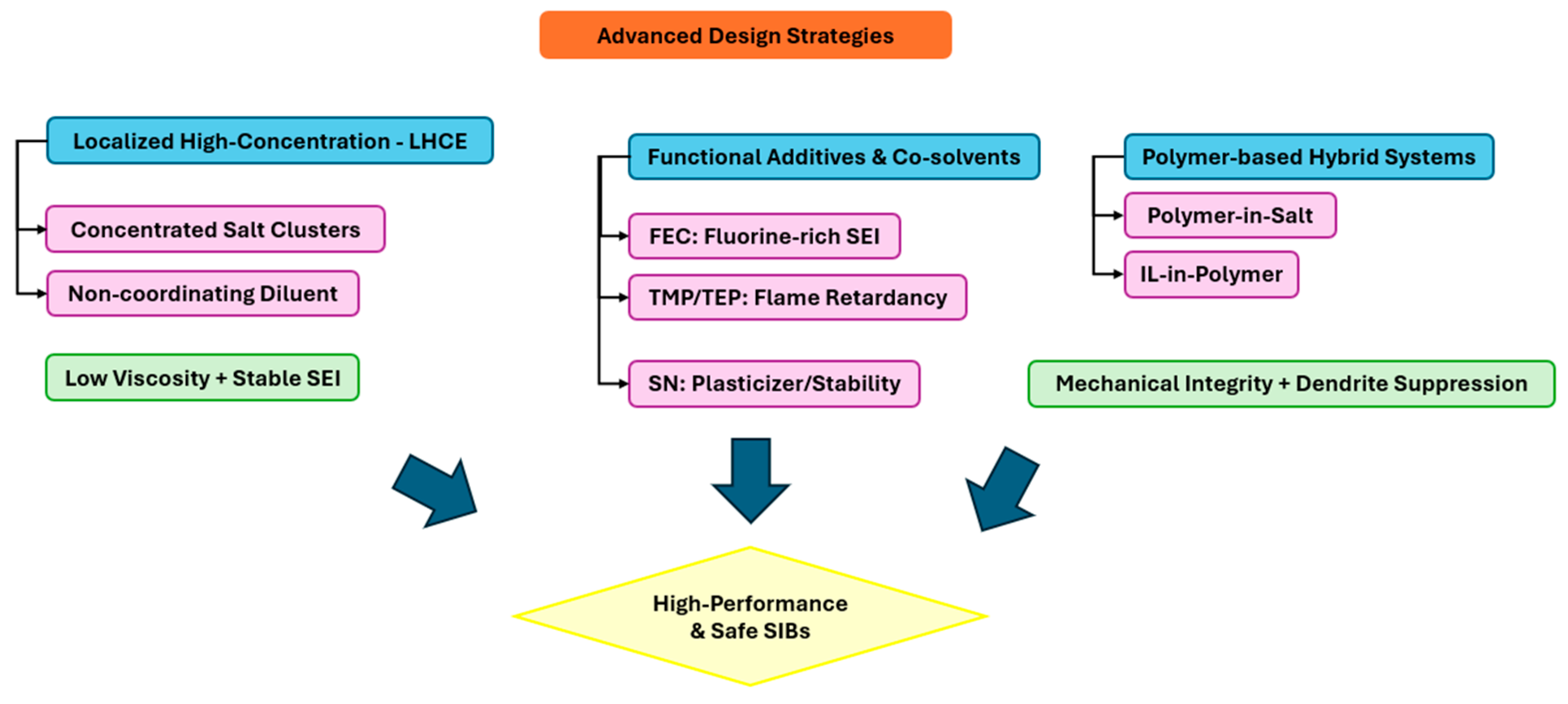
- Suppressing Side Reactions: The reduced free solvent content minimizes parasitic reactions with electrode surfaces.
- Enhancing SEI Stability: The unique solvation structure promotes the formation of a more robust and uniform SEI layer, which is critical for long-term cycling stability and dendrite suppression [110].
- Improving Thermal Stability: By reducing the amount of highly volatile free solvent, LHCEs inherently possess improved thermal stability compared to conventional dilute electrolytes.
5.2. Functional Additives and Co-Solvents
- Flame Retardants: Non-flammable additives can further enhance the safety of hybrid electrolytes, particularly those with higher organic solvent content. TMP and Triethyl Phosphate (TEP) are common organophosphorus compounds used as flame retardants. They can be incorporated into electrolytes to suppress combustion. For instance, studies have shown that adding TMP can make organic electrolytes non-flammable [21].
- SEI-Forming Additives: Specific additives can be designed to decompose preferentially on the electrode surface, forming a stable and protective SEI layer that prevents further electrolyte decomposition and dendrite growth. Fluoroethylene Carbonate (FEC) is one of the most widely used and effective SEI-forming additives for both lithium-ion and sodium-ion batteries. FEC decomposes to form a robust, fluorine-rich SEI layer that improves cycling stability and Coulombic efficiency [107].
- Redox Shuttles: These additives can improve overcharge protection by reversibly oxidizing and reducing at the electrodes, preventing thermal runaway. Trisaminocyclopropenium perchlorate (TAC.ClO4) is an organic salt that has been demonstrated as an effective redox shuttle for overcharge protection in Na-ion battery systems [111]. Benzophenone (BP) is more commonly studied in Li-ion batteries; the concept of using organic molecules with reversible redox potentials applies to SIBs as well [112].
- Plasticizers: For hybrid quasi-solid or solid electrolytes, plasticizers can improve ionic conductivity and flexibility at lower temperatures. EC/DMC are primary solvents that can also act as plasticizers in polymer-based electrolytes, improving chain mobility and ion transport [113]. Succinonitrile (SN) is an organic compound used in quasi-solid-state electrolytes due to its high dielectric constant and ability to dissolve salts, contributing to good ionic conductivity [114].
5.3. Polymer-in-Salt and IL-in-Polymer Electrolytes
- Improve Mechanical Stability: They suppress dendrite growth and improve overall battery safety by providing a more rigid electrolyte structure.
- Enhance Interfacial Contact: They ensure good contact with electrode materials, reducing interfacial resistance.
- Maintain Ionic Conductivity: They optimize the polymer and IL content to achieve a balance between mechanical stability and sufficient ionic conductivity, even at lower temperatures [115].
5.4. Conclusion on Novel Strategies and Deeper Analysis
6. Comparative Analysis
6.1. Physical Properties of Hybrid Electrolytes for SIBs
6.1.1. Viscosity and Density
6.1.2. Ionic Conductivity
6.1.3. The Significance of the Sodium-Ion Transference Number
6.1.4. Chemical Stability
6.1.5. Mathematical Correlations Between Ionic Conductivity, Viscosity, and Temperature
6.2. Electrochemical Tests
6.2.1. Cyclic Voltammetry
6.2.2. Galvanostatic Cycling with Potential Limitation (GCPL)
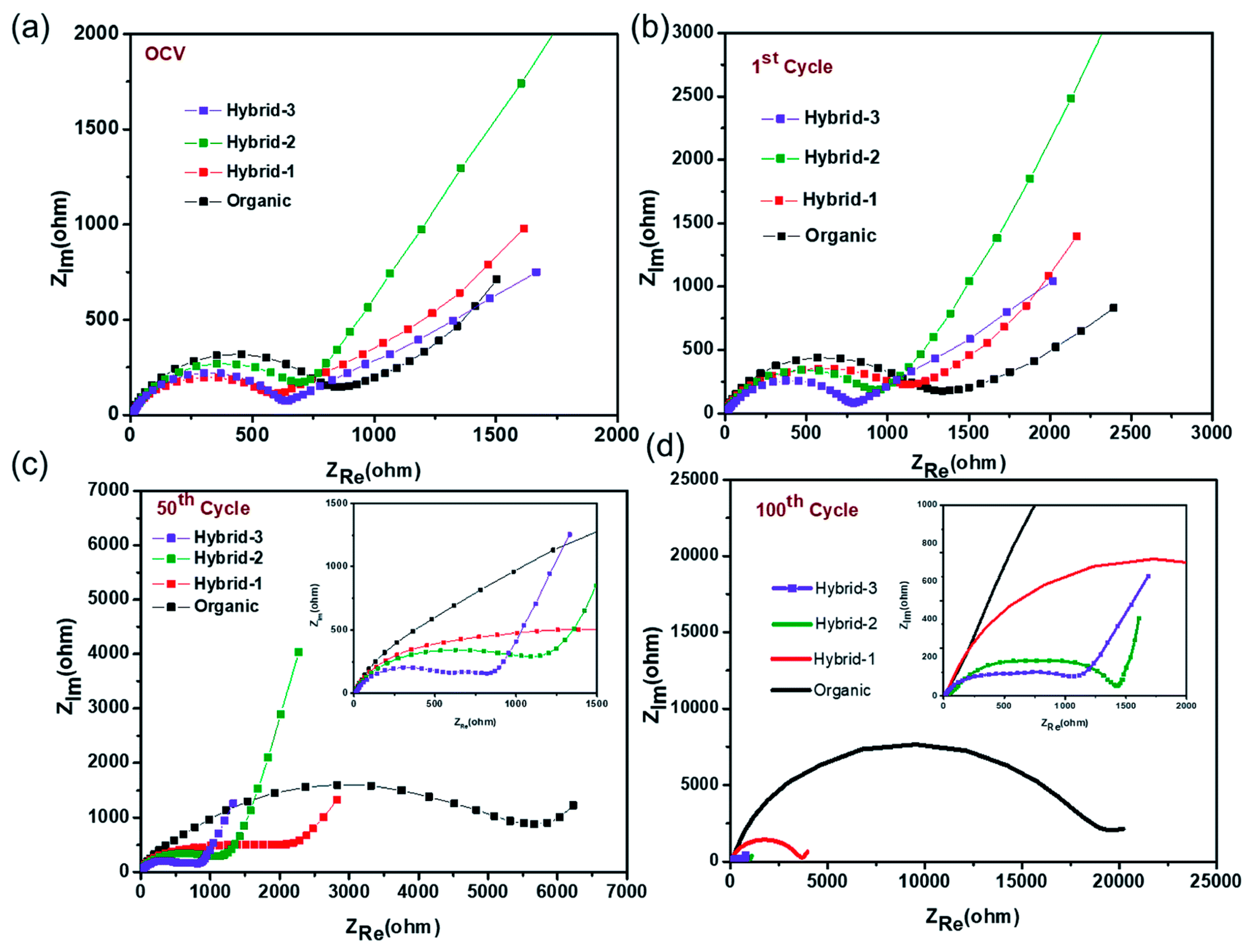
6.2.3. EIS
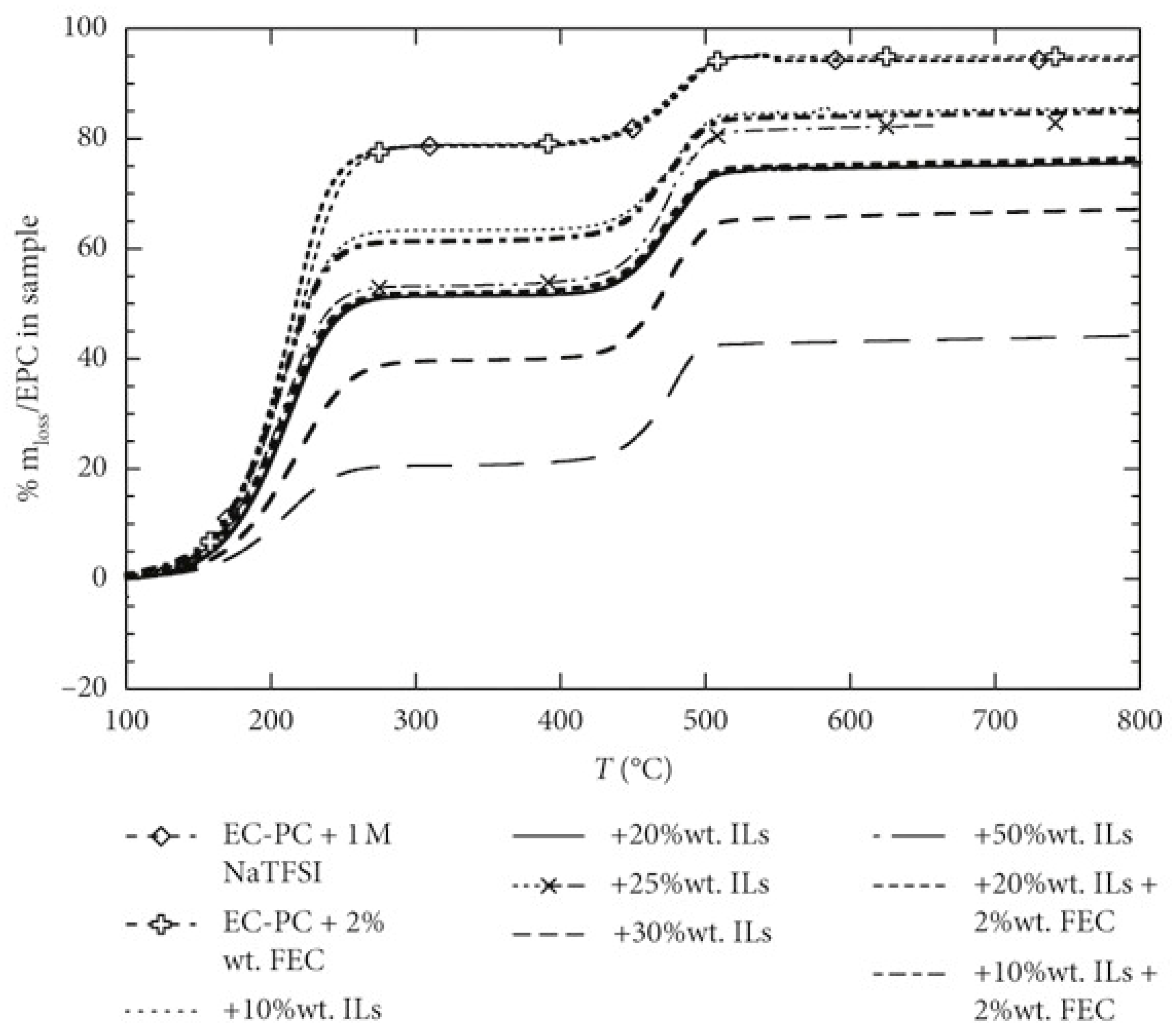
6.3. DSC–TGA
6.4. Safety Tests
7. Perspectives, Limitations, and Future Pathways
7.1. Opinions on the Current State of Hybrid Electrolytes
7.2. Key Challenges in Hybrid Electrolyte Development
7.2.1. Optimization of IL/Organic Solvent Ratio and Component Selection
7.2.2. Interfacial Stability and SEI Formation
7.2.3. Dendrite Formation and Suppression
7.2.4. Cost-Effectiveness and Scalability
7.2.5. Low-Temperature Performance
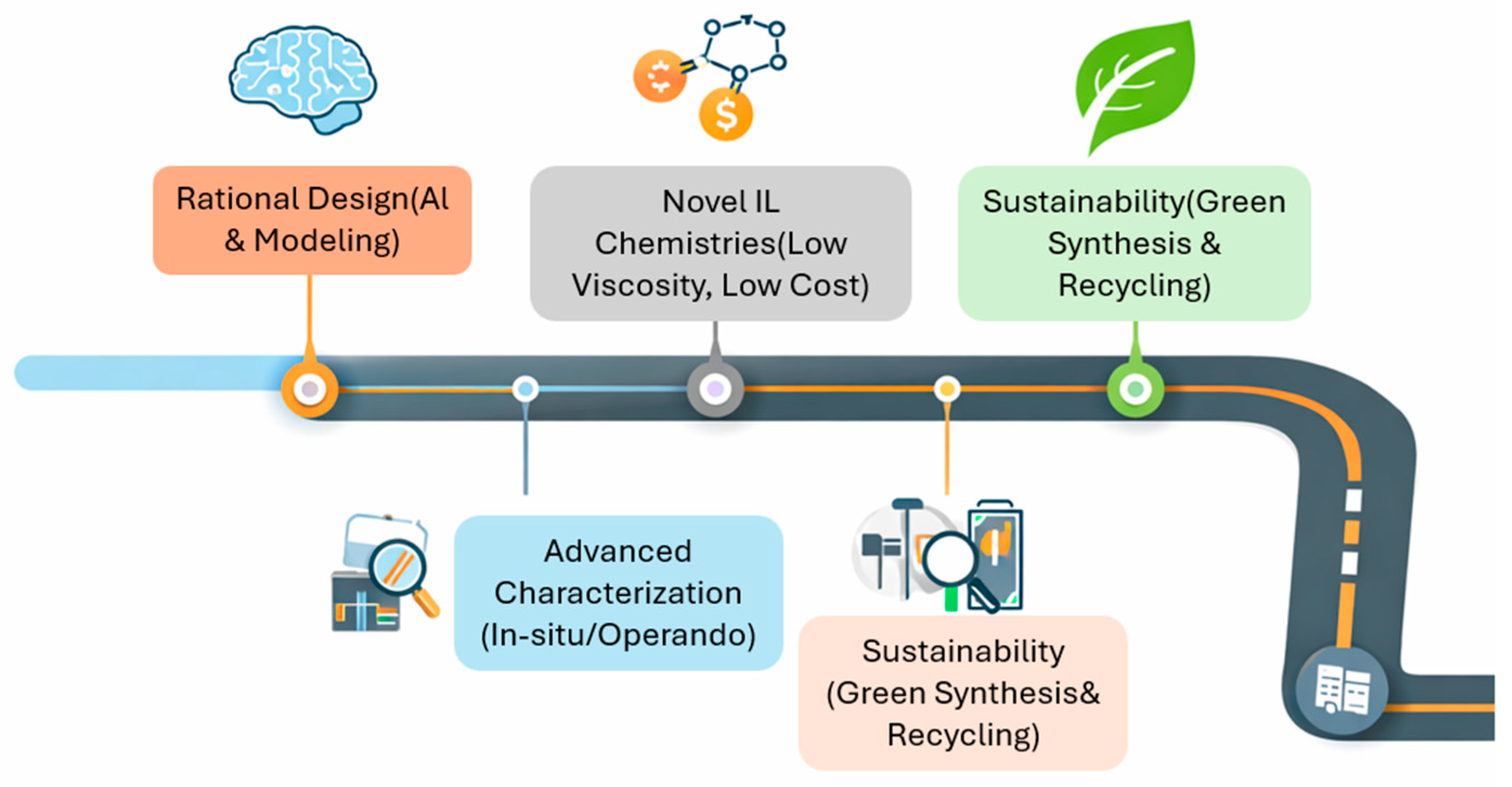
7.3. Future Research Directions and Outlook
7.3.1. Rational Design Through Advanced Modeling and AI
7.3.2. Development of Novel IL Chemistries and Functional Additives
7.3.3. In Situ and Operando Characterization
7.3.4. Sustainable and Environmentally Friendly Electrolytes
7.3.5. Integration with Advanced Electrode Materials
8. Conclusions
Funding
Data Availability Statement
Conflicts of Interest
Abbreviations
| SIB | Sodium-ion battery |
| IL | Ionic Liquids |
| SEI | Solid electrolyte interphase |
| CEI | Cathode electrolyte interphase |
| EC | Ethylene carbonate |
| PC | Propylene carbonate |
| DMC | Dimethyl carbonate |
| EMC | Ethyl methyl carbonate |
| DEC | Diethyl carbonate |
| VC | Vinylene carbonate |
| FEC | Fluoroethylene carbonate |
| THF | Tetrahydrofuran |
| DME | 1,2-Dimethoxyethane |
| SET | Self-extinguishing time |
| HC | Hard carbon |
| NMO | Sodium manganese oxide |
| RT | Room temperature |
| GBL | Gamma-butyrolactone |
| DMSO | Dimethyl sulfoxide |
| TMP | Trimethyl phosphate |
| TEP | Triethyl phosphate |
| HOMO | Highest occupied molecular orbital |
| LUMO | Lowest unoccupied molecular orbital |
| TGA | Thermogravimetric analysis |
| NCO | Sodium Chromite |
| ESW | Electrochemical stability window |
| XPS | X-ray photoelectron spectroscopy |
| NMR | Nuclear magnetic resonance |
| FTIR | Fourier-transform infrared spectroscopy |
| DFT | Density functional theory |
| MD | Molecular dynamics |
| DFOB | Difluoro(oxalate)borate |
| BOB | Bis(oxalate)borate |
| AI | Artificial Intelligence |
References
- Ibrahim, H.; Ilinca, A.; Perron, J. Energy Storage Systems—Characteristics and Comparisons. Renew. Sustain. Energy Rev. 2008, 12, 1221–1250. [Google Scholar] [CrossRef]
- Survey, G. Mineral Commodity Summaries: 2012; Government Printing Office: Washington, DC, USA, 2012. [Google Scholar]
- Perrin, M.; Saint-Drenan, Y.M.; Mattera, F.; Malbranche, P. Lead–Acid Batteries in Stationary Applications: Competitors and New Markets for Large Penetration of Renewable Energies. J. Power Sources 2005, 144, 402–410. [Google Scholar] [CrossRef]
- Kundu, D.; Talaie, E.; Duffort, V.; Nazar, L.F. The Emerging Chemistry of Sodium Ion Batteries for Electrochemical Energy Storage. Angew. Chem. Int. Ed. 2015, 54, 3431–3448. [Google Scholar] [CrossRef]
- Domingues, L.S.; De Melo, H.G.; Martins, V.L. Ionic Liquids as Potential Electrolytes for Sodium-Ion Batteries: An Overview. Phys. Chem. Chem. Phys. 2023, 25, 12650–12667. [Google Scholar] [CrossRef]
- Niu, H.; Wang, L.; Guan, P.; Zhang, N.; Yan, C.; Ding, M.; Guo, X.; Huang, T.; Hu, X. Recent Advances in Application of Ionic Liquids in Electrolyte of Lithium Ion Batteries. J. Energy Storage 2021, 40, 102659. [Google Scholar] [CrossRef]
- Ponrouch, A.; Marchante, E.; Courty, M.; Tarascon, J.-M.; Palacín, M.R. In Search of an Optimized Electrolyte for Na-Ion Batteries. Energy Environ. Sci. 2012, 5, 8572–8583. [Google Scholar] [CrossRef]
- Monti, D.; Ponrouch, A.; Palacín, M.R.; Johansson, P. Towards Safer Sodium-Ion Batteries via Organic Solvent/Ionic Liquid Based Hybrid Electrolytes. J. Power Sources 2016, 324, 712–721. [Google Scholar] [CrossRef]
- Manohar, C.V.; Kathribail, A.R.; Kar, M.; Forsyth, M.; MacFarlane, D.R.; Mitra, S. Stability Enhancing Ionic Liquid Hybrid Electrolyte for NVP@C Cathode Based Sodium Batteries. Sustain. Energy Fuels 2018, 2, 566–576. [Google Scholar] [CrossRef]
- Vo, T.D.; Nguyen, H.V.; Nguyen, Q.D.; Phung, Q.; Tran, V.M.; Le, P.L.M. Carbonate Solvents and Ionic Liquid Mixtures as an Electrolyte to Improve Cell Safety in Sodium-Ion Batteries. J. Chem. 2019, 2019, 7980204. [Google Scholar] [CrossRef]
- Hwang, J.; Yang, H.; Matsumoto, K.; Hagiwara, R. Benefits of the Mixtures of Ionic Liquid and Organic Electrolytes for Sodium-Ion Batteries. J. Electrochem. Soc. 2021, 168, 030508. [Google Scholar] [CrossRef]
- Quan, P.; Linh, L.T.M.; Tuyen, H.T.K.; Van Hoang, N.; Thanh, V.D.; Van Man, T.; Phung, L.M.L. Safe Sodium-Ion Battery Using Hybrid Electrolytes of Organic Solvent/Pyrrolidinium Ionic Liquid. Vietnam J. Chem. 2021, 59, 17–26. [Google Scholar] [CrossRef]
- Huang, L.; Makhlooghiazad, F.; O’Dell, L.A.; Howlett, P.C.; Forsyth, M. Investigating the Role of Mixed-Cation Ionic Liquid Electrolytes in Sodium Battery Efficiency and Stability. Mater. Adv. 2024, 5, 6899–6909. [Google Scholar] [CrossRef]
- Monti, D.; Jónsson, E.; Boschin, A.; Palacín, M.R.; Ponrouch, A.; Johansson, P. Towards Standard Electrolytes for Sodium-Ion Batteries: Physical Properties, Ion Solvation and Ion-Pairing in Alkyl Carbonate Solvents. Phys. Chem. Chem. Phys. 2020, 22, 22768–22777. [Google Scholar] [CrossRef]
- Hwang, J.-Y.; Myung, S.-T.; Sun, Y.-K. Sodium-Ion Batteries: Present and Future. Chem. Soc. Rev. 2017, 46, 3529–3614. [Google Scholar] [CrossRef]
- Zhao, L.; Zhang, T.; Li, W.; Li, T.; Zhang, L.; Zhang, X.; Wang, Z. Engineering of Sodium-Ion Batteries: Opportunities and Challenges. Engineering 2022, 24, 172–183. [Google Scholar] [CrossRef]
- Hou, Z.; Zhang, X.; Li, X.; Zhu, Y.; Liang, J.; Qian, Y. Surfactant Widens the Electrochemical Window of an Aqueous Electrolyte for Better Rechargeable Aqueous Sodium/Zinc Battery. J. Mater. Chem. A 2017, 5, 730–738. [Google Scholar] [CrossRef]
- Liang, Y.; Yao, Y. Designing Modern Aqueous Batteries. Nat. Rev. Mater. 2022, 8, 109–122. [Google Scholar] [CrossRef]
- Eshetu, G.G.; Elia, G.A.; Armand, M.; Forsyth, M.; Komaba, S.; Rojo, T.; Passerini, S. Electrolytes and Interphases in Sodium-Based Rechargeable Batteries: Recent Advances and Perspectives. Adv. Energy Mater. 2020, 10, 2000093. [Google Scholar] [CrossRef]
- Xu, Y.; Zhou, M.; Lei, Y. Organic Materials for Rechargeable Sodium-Ion Batteries. Mater. Today 2018, 21, 60–78. [Google Scholar] [CrossRef]
- Yu, Y.; Che, H.; Yang, X.; Deng, Y.; Li, L.; Ma, Z.-F. Non-Flammable Organic Electrolyte for Sodium-Ion Batteries. Electrochem. Commun. 2020, 110, 106635. [Google Scholar] [CrossRef]
- Xia, Q.; Zhao, X.G. Organic Liquid Electrolytes for Sodium-Ion Batteries. In Sodium-Ion Batteries; John Wiley & Sons, Ltd.: Hoboken, NJ, USA, 2022; pp. 339–382. [Google Scholar]
- Makhlooghiazad, F.; Pozo-Gonzalo, C.; Johansson, P.; Forsyth, M. Electrolytes for Sodium Batteries. In Na-Ion Batteries; John Wiley & Sons, Ltd.: Hoboken, NJ, USA, 2021; pp. 205–241. [Google Scholar]
- Lin, Y.; Huang, S.; Zhong, L.; Wang, S.; Han, D.; Ren, S.; Xiao, M.; Meng, Y. Organic Liquid Electrolytes in Li-S Batteries: Actualities and Perspectives. Energy Storage Mater. 2021, 34, 128–147. [Google Scholar] [CrossRef]
- Zhang, W.; Sun, H.; Sun, Z.; Liu, S.; Huang, W. Revealing Better Organic Sodium Battery Performance in Ionic Liquid Electrolytes. Inorg. Chem. Front. 2021, 8, 4751–4756. [Google Scholar] [CrossRef]
- Zhang, W.; Sun, H.; Hu, P.; Huang, W.; Zhang, Q. Double-effect of Highly Concentrated Acetonitrile-based Electrolyte in Organic Lithium-ion Battery. EcoMat 2021, 3, e12128. [Google Scholar] [CrossRef]
- Lu, Y.; Zhang, Q.; Li, L.; Niu, Z.; Chen, J. Design Strategies toward Enhancing the Performance of Organic Electrode Materials in Metal-Ion Batteries. Chem 2018, 4, 2786–2813. [Google Scholar] [CrossRef]
- Baumann, A.E.; Burns, D.A.; Liu, B.; Thoi, V.S. Metal-Organic Framework Functionalization and Design Strategies for Advanced Electrochemical Energy Storage Devices. Commun. Chem. 2019, 2, 86. [Google Scholar] [CrossRef]
- Shi, R.; Jiao, S.; Yue, Q.; Gu, G.; Zhang, K.; Zhao, Y. Challenges and Advances of Organic Electrode Materials for Sustainable Secondary Batteries. Exploration 2022, 2, 20220066. [Google Scholar] [CrossRef]
- Wu, Z.; Liu, Q.; Yang, P.; Chen, H.; Zhang, Q.; Li, S.; Tang, Y.; Zhang, S. Molecular and Morphological Engineering of Organic Electrode Materials for Electrochemical Energy Storage. Electrochem. Energy Rev. 2022, 5, 26. [Google Scholar] [CrossRef]
- Lei, Z.; Chen, B.; Koo, Y.-M.; MacFarlane, D.R. Introduction: Ionic Liquids. Chem. Rev. 2017, 117, 6633–6635. [Google Scholar] [CrossRef]
- Chen, R.; Bresser, D.; Saraf, M.; Gerlach, P.; Balducci, A.; Kunz, S.; Schröder, D.; Passerini, S.; Chen, J. A Comparative Review of Electrolytes for Organic-Material-Based Energy-Storage Devices Employing Solid Electrodes and Redox Fluids. ChemSusChem 2020, 13, 2205–2219. [Google Scholar] [CrossRef]
- Oyedotun, K.O.; Masikhwa, T.M.; Lindberg, S.; Matic, A.; Johansson, P.; Manyala, N. Comparison of Ionic Liquid Electrolyte to Aqueous Electrolytes on Carbon Nanofibres Supercapacitor Electrode Derived from Oxygen-Functionalized Graphene. Chem. Eng. J. 2019, 375, 121906. [Google Scholar] [CrossRef]
- Meng, T.; Young, K.-H.; Wong, D.; Nei, J. Ionic Liquid-Based Non-Aqueous Electrolytes for Nickel/Metal Hydride Batteries. Batteries 2017, 3, 4. [Google Scholar] [CrossRef]
- Mele, C.; Catalano, M.; Taurino, A.; Bozzini, B. Electrochemical Fabrication of Nanoporous Gold-Supported Manganese Oxide Nanowires Based on Electrodeposition from Eutectic Urea/Choline Chloride Ionic Liquid. Electrochim. Acta 2013, 87, 918–924. [Google Scholar] [CrossRef]
- Zhu, N.; Zhang, K.; Wu, F.; Bai, Y.; Wu, C. Ionic Liquid-Based Electrolytes for Aluminum/Magnesium/Sodium-Ion Batteries. Energy. Mater. Adv. 2021, 2021, 9204217. [Google Scholar] [CrossRef]
- Liu, H.; Yu, H. Ionic Liquids for Electrochemical Energy Storage Devices Applications. J. Mater. Sci. Technol. 2019, 35, 674–686. [Google Scholar] [CrossRef]
- Karuppasamy, K.; Theerthagiri, J.; Vikraman, D.; Yim, C.-J.; Hussain, S.; Sharma, R.; Maiyalagan, T.; Qin, J.; Kim, H.-S. Ionic Liquid-Based Electrolytes for Energy Storage Devices: A Brief Review on Their Limits and Applications. Polymers 2020, 12, 918. [Google Scholar] [CrossRef] [PubMed]
- Emanuele, E.; Li Bassi, A.; Macrelli, A.; Mele, C.; Strada, J.; Bozzini, B. Zinc Electrode Cycling in Deep Eutectic Solvent Electrolytes: An Electrochemical Study. Molecules 2023, 28, 957. [Google Scholar] [CrossRef]
- Monti, D.; Jónsson, E.; Palacín, M.R.; Johansson, P. Ionic Liquid Based Electrolytes for Sodium-Ion Batteries: Na+ Solvation and Ionic Conductivity. J. Power Sources 2014, 245, 630–636. [Google Scholar] [CrossRef]
- Park, J.; Ko, I.; Lee, J.; Park, S.; Kim, D.; Yu, S.; Sung, Y. Anionic Redox Reactions in Cathodes for Sodium-Ion Batteries. ChemElectroChem 2021, 8, 625–643. [Google Scholar] [CrossRef]
- Xu, L.; Li, Y.; Xiang, Y.; Li, C.; Zhu, H.; Li, C.; Zou, G.; Hou, H.; Ji, X. Bridging Structure and Performance: Decoding Sodium Storage in Hard Carbon Anodes. ACS Nano 2025, 19, 14627–14651. [Google Scholar] [CrossRef]
- Westman, K.; Dugas, R.; Jankowski, P.; Wieczorek, W.; Gachot, G.; Morcrette, M.; Irisarri, E.; Ponrouch, A.; Palacín, M.R.; Tarascon, J.-M.; et al. Diglyme Based Electrolytes for Sodium-Ion Batteries. ACS Appl. Energy Mater. 2018, 1, 2671–2680. [Google Scholar] [CrossRef]
- Takeno, M.; Fukutsuka, T.; Miyazaki, K.; Abe, T. Investigation of Electronic Resistance in Lithium-Ion Batteries by AC Impedance Spectroscopy. J. Electrochem. Soc. 2017, 164, A3862–A3867. [Google Scholar] [CrossRef]
- Gebert, F.; Knott, J.; Gorkin, R.; Chou, S.-L.; Dou, S.-X. Polymer Electrolytes for Sodium-Ion Batteries. Energy Storage Mater. 2021, 36, 10–30. [Google Scholar] [CrossRef]
- Wu, E.A.; Banerjee, S.; Tang, H.; Richardson, P.M.; Doux, J.-M.; Qi, J.; Zhu, Z.; Grenier, A.; Li, Y.; Zhao, E.; et al. A Stable Cathode-Solid Electrolyte Composite for High-Voltage, Long-Cycle-Life Solid-State Sodium-Ion Batteries. Nat. Commun. 2021, 12, 1256. [Google Scholar] [CrossRef]
- Wang, M.; Wang, Q.; Ding, X.; Wang, Y.; Xin, Y.; Singh, P.; Wu, F.; Gao, H. The Prospect and Challenges of Sodium-Ion Batteries for Low-Temperature Conditions. Interdiscip. Mater. 2022, 1, 373–395. [Google Scholar] [CrossRef]
- Ma, L.A.; Naylor, A.J.; Nyholm, L.; Younesi, R. Strategies for Mitigating Dissolution of Solid Electrolyte Interphases in Sodium-Ion Batteries. Angew. Chem. Int. Ed. 2021, 60, 4855–4863. [Google Scholar] [CrossRef] [PubMed]
- Maurya, D.K.; Dhanusuraman, R.; Guo, Z.; Angaiah, S. Composite Polymer Electrolytes: Progress, Challenges, and Future Outlook for Sodium-Ion Batteries. Adv. Compos. Hybrid Mater. 2022, 5, 2651–2674. [Google Scholar] [CrossRef]
- Zheng, J.; Li, W.; Liu, X.; Zhang, J.; Feng, X.; Chen, W. Progress in Gel Polymer Electrolytes for Sodium-Ion Batteries. Energy Environ. Mater. 2023, 6, e12422. [Google Scholar] [CrossRef]
- Kim, J.I.; Chung, K.Y.; Park, J.H. Design of a Porous Gel Polymer Electrolyte for Sodium Ion Batteries. J. Membr. Sci. 2018, 566, 122–128. [Google Scholar] [CrossRef]
- Kumar, D.; Hashmi, S.A. Ionic Liquid Based Sodium Ion Conducting Gel Polymer Electrolytes. Solid State Ion. 2010, 181, 416–423. [Google Scholar] [CrossRef]
- Gabryelczyk, A.; Smogór, H.; Swiderska-Mocek, A. Highly Conductive Gel Polymer Electrolytes for Sodium-Ion Batteries with Hard Carbon Anodes. Electrochim. Acta 2023, 439, 141645. [Google Scholar] [CrossRef]
- Deng, Z.; Mishra, T.P.; Mahayoni, E.; Ma, Q.; Tieu, A.J.K.; Guillon, O.; Chotard, J.-N.; Seznec, V.; Cheetham, A.K.; Masquelier, C.; et al. Fundamental Investigations on the Sodium-Ion Transport Properties of Mixed Polyanion Solid-State Battery Electrolytes. Nat. Commun. 2022, 13, 4470. [Google Scholar] [CrossRef]
- Song, S.; Duong, H.M.; Korsunsky, A.M.; Hu, N.; Lu, L. A Na+ Superionic Conductor for Room-Temperature Sodium Batteries. Sci. Rep. 2016, 6, 32330. [Google Scholar] [CrossRef]
- Yang, J.; Wan, H.-L.; Zhang, Z.-H.; Liu, G.-Z.; Xu, X.-X.; Hu, Y.-S.; Yao, X.-Y. NASICON-Structured Na3.1Zr1.95Mg0.05Si2PO12 Solid Electrolyte for Solid-State Sodium Batteries. Rare. Met. 2018, 37, 480–487. [Google Scholar] [CrossRef]
- An, S.; Lee, M.W.; Kim, N.Y.; Lee, C.; Al-Deyab, S.S.; James, S.C.; Yoon, S.S. Effect of Viscosity, Electrical Conductivity, and Surface Tension on Direct-Current-Pulsed Drop-on-Demand Electrohydrodynamic Printing Frequency. Appl. Phys. Lett. 2014, 105, 214102. [Google Scholar] [CrossRef]
- Tian, Z.; Zou, Y.; Liu, G.; Wang, Y.; Yin, J.; Ming, J.; Alshareef, H.N. Electrolyte Solvation Structure Design for Sodium Ion Batteries. Adv. Sci. 2022, 9, 2201207. [Google Scholar] [CrossRef] [PubMed]
- Xu, K. Nonaqueous Liquid Electrolytes for Lithium-Based Rechargeable Batteries. Chem. Rev. 2004, 104, 4303–4418. [Google Scholar] [CrossRef]
- Bommier, C.; Ji, X. Electrolytes, SEI Formation, and Binders: A Review of Nonelectrode Factors for Sodium-Ion Battery Anodes. Small 2018, 14, 1703576. [Google Scholar] [CrossRef]
- Ponrouch, A.; Monti, D.; Boschin, A.; Steen, B.; Johansson, P.; Palacín, M.R. Non-Aqueous Electrolytes for Sodium-Ion Batteries. J. Mater. Chem. A 2015, 3, 22–42. [Google Scholar] [CrossRef]
- Zeng, Z.; Jiang, X.; Li, R.; Yuan, D.; Ai, X.; Yang, H.; Cao, Y. A Safer Sodium-Ion Battery Based on Nonflammable Organic Phosphate Electrolyte. Adv. Sci. 2016, 3, 1600066. [Google Scholar] [CrossRef] [PubMed]
- Kajita, T.; Noji, T.; Imai, Y.; Kawamata, T.; Kato, M.; Koike, Y. Electrochemical Performance of Layered FeSe for Sodium Ion Batteries Using Ether-Based Solvents. J. Electrochem. Soc. 2018, 165, A3582. [Google Scholar] [CrossRef]
- Zhang, J.; Wang, D.-W.; Lv, W.; Zhang, S.; Liang, Q.; Zheng, D.; Kang, F.; Yang, Q.-H. Achieving Superb Sodium Storage Performance on Carbon Anodes through an Ether-Derived Solid Electrolyte Interphase. Energy Environ. Sci. 2017, 10, 370–376. [Google Scholar] [CrossRef]
- Li, K.; Zhang, J.; Lin, D.; Wang, D.-W.; Li, B.; Lv, W.; Sun, S.; He, Y.-B.; Kang, F.; Yang, Q.-H.; et al. Evolution of the Electrochemical Interface in Sodium Ion Batteries with Ether Electrolytes. Nat. Commun. 2019, 10, 725. [Google Scholar] [CrossRef]
- Carbone, L.; Munoz, S.; Gobet, M.; Devany, M.; Greenbaum, S.; Hassoun, J. Characteristics of Glyme Electrolytes for Sodium Battery: Nuclear Magnetic Resonance and Electrochemical Study. Electrochim. Acta 2017, 231, 223–229. [Google Scholar] [CrossRef]
- Tang, Z.; Wang, H.; Wu, P.-F.; Zhou, S.-Y.; Huang, Y.-C.; Zhang, R.; Sun, D.; Tang, Y.-G.; Wang, H.-Y. Electrode–Electrolyte Interfacial Chemistry Modulation for Ultra-High Rate Sodium-Ion Batteries. Angew. Chem. Int. Ed. 2022, 61, e202200475. [Google Scholar] [CrossRef] [PubMed]
- Perveen, T.; Siddiq, M.; Shahzad, N.; Ihsan, R.; Ahmad, A.; Shahzad, M.I. Prospects in Anode Materials for Sodium Ion Batteries—A Review. Renew. Sustain. Energy Rev. 2020, 119, 109549. [Google Scholar] [CrossRef]
- Rodriguez-Martinez, L.M.; Omar, N. Emerging Nanotechnologies in Rechargeable Energy Storage Systems; William Andrew: New York, NY, USA, 2017. [Google Scholar]
- Eshetu, G.G.; Grugeon, S.; Kim, H.; Jeong, S.; Wu, L.; Gachot, G.; Laruelle, S.; Armand, M.; Passerini, S. Comprehensive Insights into the Reactivity of Electrolytes Based on Sodium Ions. ChemSusChem 2016, 9, 462–471. [Google Scholar] [CrossRef]
- Zhu, Y.; Luo, X.; Zhi, H.; Liao, Y.; Xing, L.; Xu, M.; Liu, X.; Xu, K.; Li, W. Diethyl(Thiophen-2-Ylmethyl)Phosphonate: A Novel Multifunctional Electrolyte Additive for High Voltage Batteries. J. Mater. Chem. A 2018, 6, 10990–11004. [Google Scholar] [CrossRef]
- Krossing, I.; Raabe, I. Noncoordinating Anions—Fact or Fiction? A Survey of Likely Candidates. Angew. Chem. Int. Ed. 2004, 43, 2066–2090. [Google Scholar] [CrossRef] [PubMed]
- Bhide, A.; Hofmann, J.; Dürr, A.K.; Janek, J.; Adelhelm, P. Electrochemical Stability of Non-Aqueous Electrolytes for Sodium-Ion Batteries and Their Compatibility with Na0.7CoO2. Phys. Chem. Chem. Phys. 2014, 16, 1987–1998. [Google Scholar] [CrossRef]
- Wróbel, P.; Kubisiak, P.; Eilmes, A. NaFSI and NaTFSI Solutions in Ether Solvents from Monoglyme to Poly(Ethylene Oxide)—A Molecular Dynamics Study. J. Phys. Chem. B 2021, 125, 10293–10303. [Google Scholar] [CrossRef]
- Hallett, J.P.; Welton, T. Room-Temperature Ionic Liquids: Solvents for Synthesis and Catalysis. 2. Chem. Rev. 2011, 111, 3508–3576. [Google Scholar] [CrossRef]
- Nikiforidis, G.; Belhcen, A.; Anouti, M. A Highly Concentrated Vanadium Protic Ionic Liquid Electrolyte for the Vanadium Redox Flow Battery. J. Energy Chem. 2021, 57, 238–246. [Google Scholar] [CrossRef]
- Vázquez-Fernández, I.; Raghibi, M.; Bouzina, A.; Timperman, L.; Bigarré, J.; Anouti, M. Protic Ionic Liquids/Poly(Vinylidene Fluoride) Composite Membranes for Fuel Cell Application. J. Energy Chem. 2021, 53, 197–207. [Google Scholar] [CrossRef]
- Chiao, Y.-H.; Sengupta, A.; Chen, S.-T.; Huang, S.-H.; Hu, C.-C.; Hung, W.-S.; Chang, Y.; Qian, X.; Wickramasinghe, S.R.; Lee, K.-R.; et al. Zwitterion Augmented Polyamide Membrane for Improved Forward Osmosis Performance with Significant Antifouling Characteristics. Sep. Purif. Technol. 2019, 212, 316–325. [Google Scholar] [CrossRef]
- Schalenbach, M.; Durmus, Y.E.; Tempel, H.; Kungl, H.; Eichel, R.-A. Ion Transport and Limited Currents in Supporting Electrolytes and Ionic Liquids. Sci. Rep. 2022, 12, 6215. [Google Scholar] [CrossRef]
- Lee, B.; Paek, E.; Mitlin, D.; Lee, S.W. Sodium Metal Anodes: Emerging Solutions to Dendrite Growth. Chem. Rev. 2019, 119, 5416–5460. [Google Scholar] [CrossRef]
- Benchea, A.; Siu, B.; Soltani, M.; McCants, J.H.; Salter, E.A.; Wierzbicki, A.; West, K.N.; James, H.; Davis, J. An Evaluation of Anion Suitability for Use in Ionic Liquids with Long-Term, High-Temperature Thermal Stability. New J. Chem. 2017, 41, 7844–7848. [Google Scholar] [CrossRef]
- Huang, Y.; Zhao, L.; Li, L.; Xie, M.; Wu, F.; Chen, R. Electrolytes and Electrolyte/Electrode Interfaces in Sodium-Ion Batteries: From Scientific Research to Practical Application. Adv. Mater. 2019, 31, 1808393. [Google Scholar] [CrossRef]
- Fan, W.; Wang, A.; Cai, J.; Shi, L.; Wang, W.; Nan, J. Electrolyte Salts for Large-Scale Application of Sodium-Ion Batteries: NaPF6 and Emerging Alternatives. J. Power Sources 2025, 650, 237519. [Google Scholar] [CrossRef]
- Welch, J.; Mogensen, R.; Van Ekeren, W.; Eriksson, H.; Naylor, A.J.; Younesi, R. Optimization of Sodium Bis(Oxalato)Borate (NaBOB) in Triethyl Phosphate (TEP) by Electrolyte Additives. J. Electrochem. Soc. 2022, 169, 120523. [Google Scholar] [CrossRef]
- Chandrawanshi, S.; Deb, M.K.; Kurrey, R. A Comprehensive Review on Perchlorate Chemistry. J. Ravishankar Univ. Part B Sci. 2021, 30, 18–31. [Google Scholar] [CrossRef]
- Khazalpour, S.; Yarie, M.; Kianpour, E.; Amani, A.; Asadabadi, S.; Seyf, J.Y.; Rezaeivala, M.; Azizian, S.; Zolfigol, M.A. Applications of Phosphonium-Based Ionic Liquids in Chemical Processes. J. Iran. Chem. Soc. 2020, 17, 1775–1917. [Google Scholar] [CrossRef]
- Verevkin, S.P.; Zaitsau, D.H.; Yermalayeu, A.V.; Vostrikov, S.V. Ammonium-Based Ionic Liquids: Cross-Validation of Energetics Using Solution Calorimetry, Quartz Crystal Microbalance, Quantum Chemistry, and Structure–Property Relationships. J. Solution. Chem. 2023, 52, 1194–1208. [Google Scholar] [CrossRef]
- Welch, J.; Van Ekeren, W.W.A.; Mindemark, J.; Younesi, R. Effect of Additives on the High-Temperature Performance of a Sodium Bis(Oxalato)Borate in Triethyl Phosphate Electrolyte in Sodium-Ion Batteries. Commun. Chem. 2025, 8, 127. [Google Scholar] [CrossRef]
- Stigliano, P.; Ferrara, C.; Pianta, N.; Gentile, A.; Mezzomo, L.; Lorenzi, R.; Berbenni, V.; Ruffo, R.; Appetecchi, G.B.; Mustarelli, P. Physicochemical Properties of Pyr13TFSI-NaTFSI Electrolyte for Sodium Batteries. Electrochim. Acta 2022, 412, 140123. [Google Scholar] [CrossRef]
- Fischer, P.J.; Do, M.P.; Reich, R.M.; Nagasubramanian, A.; Srinivasan, M.; Kühn, F.E. Synthesis and Physicochemical Characterization of Room Temperature Ionic Liquids and Their Application in Sodium Ion Batteries. Phys. Chem. Chem. Phys. 2018, 20, 29412–29422. [Google Scholar] [CrossRef]
- Khajeh, A.; Rahman, M.H.; Liu, T.; Panwar, P.; Menezes, P.L.; Martini, A. Thermal Decomposition of Phosphonium Salicylate and Phosphonium Benzoate Ionic Liquids. J. Mol. Liq. 2022, 352, 118700. [Google Scholar] [CrossRef]
- Hilder, M.; Howlett, P.C.; Saurel, D.; Gonzalo, E.; Armand, M.; Rojo, T.; Macfarlane, D.R.; Forsyth, M. Small Quaternary Alkyl Phosphonium Bis(Fluorosulfonyl)Imide Ionic Liquid Electrolytes for Sodium-Ion Batteries with P2- and O3-Na2/3[Fe2/3Mn1/3]O2 Cathode Material. J. Power Sources 2017, 349, 45–51. [Google Scholar] [CrossRef]
- Heubach, M.-K.; Schuett, F.M.; Kibler, L.A.; Abdelrahman, A.; Jacob, T. Initial Stages of Sodium Deposition onto Au(111) from [MPPip][TFSI]: An In-Situ STM Study for Sodium-Ion Battery Electrolytes. ChemElectroChem 2022, 9, e202200722. [Google Scholar] [CrossRef]
- Montanino, M.; Carewska, M.; Alessandrini, F.; Passerini, S.; Appetecchi, G.B. The Role of the Cation Aliphatic Side Chain Length in Piperidinium Bis(Trifluoromethansulfonyl)Imide Ionic Liquids. Electrochim. Acta 2011, 57, 153–159. [Google Scholar] [CrossRef]
- Massaro, A.; Avila, J.; Goloviznina, K.; Rivalta, I.; Gerbaldi, C.; Pavone, M.; Gomes, M.F.C.; Padua, A.A.H. Sodium Diffusion in Ionic Liquid-Based Electrolytes for Na-Ion Batteries: The Effect of Polarizable Force Fields. Phys. Chem. Chem. Phys. 2020, 22, 20114–20122. [Google Scholar] [CrossRef]
- Zhang, J.; Ma, S.; Zhang, J.; Zhang, J.; Wang, X.; Wen, L.; Tang, G.; Hu, M.; Wang, E.; Chen, W. Critical Review on Cathode Electrolyte Interphase towards Stabilization for Sodium-Ion Batteries. Nano Energy 2024, 128, 109814. [Google Scholar] [CrossRef]
- Song, J.; Xiao, B.; Lin, Y.; Xu, K.; Li, X. Interphases in Sodium-Ion Batteries. Adv. Energy Mater. 2018, 8, 1703082. [Google Scholar] [CrossRef]
- Li, M.; Sun, C.; Zhang, R.; Qi, M.; Wu, Z.; Zhang, X.; Zhang, Y.; Yuan, J.; Zhang, N. Unveiling the Electrolyte and Solid Electrolyte Interphase in Sodium Ion Batteries: Mechanisms, Progress, and Perspectives. Adv. Mater. 2025, 37, e10882. [Google Scholar] [CrossRef]
- Du, L.; Xu, G.; Sun, C.; Zhang, Y.-H.; Zhang, H.; Dong, T.; Huang, L.; Ma, J.; Sun, F.; Li, C.; et al. Smart Gel Polymer Electrolytes Enlightening High Safety and Long Life Sodium Ion Batteries. Nat. Commun. 2025, 16, 2979. [Google Scholar] [CrossRef]
- Xia, Q.; Ko, C.-L.; Fan, Y.; Liu, H.; Lei, Y.; Xu, Z.; Shao, Z.; Gentle, I.; Knibbe, R. Interfacial Orbital Hybridization Derived Robust Cathode-Electrolyte Interphase Enables Exceptional Sodium-Ion Storage Performance. ACS Nano 2025, 19, 40902–40916. [Google Scholar] [CrossRef]
- Sirengo, K.; Babu, A.; Brennan, B.; Pillai, S.C. Ionic Liquid Electrolytes for Sodium-Ion Batteries to Control Thermal Runaway. J. Energy Chem. 2023, 81, 321–338. [Google Scholar] [CrossRef]
- Tian, X.; Yi, Y.; Fang, B.; Yang, P.; Wang, T.; Liu, P.; Qu, L.; Li, M.; Zhang, S. Design Strategies of Safe Electrolytes for Preventing Thermal Runaway in Lithium Ion Batteries. Chem. Mater. 2020, 32, 9821–9848. [Google Scholar] [CrossRef]
- Plylahan, N.; Kerner, M.; Lim, D.-H.; Matic, A.; Johansson, P. Ionic Liquid and Hybrid Ionic Liquid/Organic Electrolytes for High Temperature Lithium-Ion Battery Application. Electrochim. Acta 2016, 216, 24–34. [Google Scholar] [CrossRef]
- Nachaki, E.O.; Kuroda, D.G. Transitioning from Regular Electrolytes to Solvate Ionic Liquids to High-Concentration Electrolytes: Changes in Transport Properties and Ionic Speciation. J. Phys. Chem. C 2024, 128, 11522–11533. [Google Scholar] [CrossRef] [PubMed]
- Choi, J.; Shim, E.G.; Scrosati, B.; Kim, D.W. Mixed Electrolytes of Organic Solvents and Ionic Liquid for Rechargeable Lithium-Ion Batteries. Bull. Korean Chem. Soc. 2010, 31, 3190–3194. [Google Scholar] [CrossRef][Green Version]
- van Ekeren, W.W.A.; Pereira, A.M.; Albuquerque, M.; Costa, L.T.; Younesi, R. Nonflammable Ether and Phosphate-Based Liquid Electrolytes for Sodium-Ion Batteries. ACS Appl. Mater. Interfaces 2024, 16, 56355–56365. [Google Scholar] [CrossRef]
- Zhang, J.; Gai, J.; Song, K.; Chen, W. Advances in Electrode/Electrolyte Interphase for Sodium-Ion Batteries from Half Cells to Full Cells. Cell Rep. Phys. Sci. 2022, 3, 100868. [Google Scholar] [CrossRef]
- Chen, W.; Park, J.-S.; Kwon, C.; Plaza-Rivera, C.O.; Hsu, C.-W.; Phong, J.K.; Kilgallon, L.J.; Wang, D.; Dai, T.; Kim, S.Y.; et al. Hybrid Solvating Electrolytes for Practical Sodium-Metal Batteries. Joule 2025, 9, 101811. [Google Scholar] [CrossRef]
- Wang, Y.; Yu, B.; Xiao, J.; Zhou, L.; Chen, M. Application of First Principles Computations Based on Density Functional Theory (DFT) in Cathode Materials of Sodium-Ion Batteries. Batteries 2023, 9, 86. [Google Scholar] [CrossRef]
- Zheng, J.; Chen, S.; Zhao, W.; Song, J.; Engelhard, M.H.; Zhang, J.-G. Extremely Stable Sodium Metal Batteries Enabled by Localized High-Concentration Electrolytes. ACS Energy Lett. 2018, 3, 315–321. [Google Scholar] [CrossRef]
- Ji, W.; Huang, H.; Zhang, X.; Zheng, D.; Ding, T.; Lambert, T.H.; Qu, D. A Redox-Active Organic Salt for Safer Na-Ion Batteries. Nano Energy 2020, 72, 104705. [Google Scholar] [CrossRef]
- Lin, S.; Yang, Z.; Chen, J.; Qiao, Y.; Li, L.; Chou, S. Functional Electrolyte Additives for Sodium-Ion and Sodium-Metal Batteries: Progress and Perspectives. Adv. Funct. Mater. 2024, 34, 2400731. [Google Scholar] [CrossRef]
- de Araujo, C.M.B.; Pinto, A.; Fernandes, M.; de Zea Bermudez, V.; Gonçalves, R.; Silva, M.M. Influence of Sodium Bis(Fluorosulfonyl)Imide Concentration and Dimethyl Carbonate: Ethylene Carbonate Plasticizer on Methylcellulose-Based Polymer Electrolyte Films for Electrochemical Applications. J. Electroanal. Chem. 2025, 996, 119408. [Google Scholar] [CrossRef]
- Rasupillai Dharmaraj, V.; Sarkar, A.; Huang, J.-Y.; Huang, S.-C.; Kuo, C.-L.; Wu, C.-C.; Chang, W.-S.; Chen, H.-C.; Lin, Y.-P.; Kaun, C.-C.; et al. Superionic Quasi-Solid-State Electrolyte for Rechargeable Magnesium–Oxygen Batteries. ACS Mater. Lett. 2025, 7, 1440–1446. [Google Scholar] [CrossRef]
- Ahmad, F.; Shahzad, A.; Sarwar, S.; Inam, H.; Waqas, U.; Pakulski, D.; Bielejewski, M.; Atiq, S.; Amjad, S.; Irfan, M.; et al. Gel Polymer Electrolyte Composites in Sodium-Ion Batteries: Synthesis Methods, Electrolyte Formulations, and Performance Analysis. J. Power Sources 2024, 619, 235221. [Google Scholar] [CrossRef]
- Bozzini, B.; Gianoncelli, A.; Kaulich, B.; Mele, C.; Prasciolu, M.; Kiskinova, M. Electrodeposition of Manganese Oxide from Eutectic Urea/Choline Chloride Ionic Liquid: An in Situ Study Based on Soft X-Ray Spectromicroscopy and Visible Reflectivity. J. Power Sources 2012, 211, 71–76. [Google Scholar] [CrossRef]
- Yoon, H.; Best, A.S.; Forsyth, M.; MacFarlane, D.R.; Howlett, P.C. Physical Properties of High Li-Ion Content N-Propyl-N-Methylpyrrolidinium Bis(Fluorosulfonyl)Imide Based Ionic Liquid Electrolytes. Phys. Chem. Chem. Phys. 2015, 17, 4656–4663. [Google Scholar] [CrossRef]
- Noor, S.A.M.; Su, N.C.; Khoon, L.T.; Mohamed, N.S.; Ahmad, A.; Yahya, M.Z.A.; Zhu, H.; Forsyth, M.; MacFarlane, D.R. Properties of High Na-Ion Content N-Propyl-N-Methylpyrrolidinium Bis(Fluorosulfonyl)Imide-Ethylene Carbonate Electrolytes. Electrochim. Acta 2017, 247, 983–993. [Google Scholar] [CrossRef]
- Karahan Toprakci, H.A.; Toprakci, O. Recent Advances in New-Generation Electrolytes for Sodium-Ion Batteries. Energies 2023, 16, 3169. [Google Scholar] [CrossRef]
- Yang, P.; Wu, Z.; Liang, Y.; Chen, H.; Lin, C.; Qiu, J.; Meng, J.; He, Y.; Zhang, S. Engineering Ion Transport in All-Solid-State Sodium-Ion Batteries: Fundamentals, Strategies, and Perspectives. Prog. Mater. Sci. 2025, 154, 101503. [Google Scholar] [CrossRef]
- Makhlooghiazad, F.; Huang, L.; Byrne, N.; Howlett, P.C.; Forsyth, M. Ionic Liquids Electrolytes for High Performance Sodium Batteries—Chemistry, Composition, and Interfaces. Adv. Energy Mater. 2026, e06236. [Google Scholar] [CrossRef]
- Lehnert, L.; Nojabaee, M.; Latz, A.; Horstmann, B. Challenges in Measuring Transport Parameters of Carbonate-Based Electrolytes. ChemElectroChem 2024, 11, e202400056. [Google Scholar] [CrossRef]
- Angell, C.A. Formation of Glasses from Liquids and Biopolymers. Science 1995, 267, 1924–1935. [Google Scholar] [CrossRef]
- Matsumoto, K.; Okamoto, Y.; Nohira, T.; Hagiwara, R. Thermal and Transport Properties of Na[N(SO2F)2]–[N-Methyl-N-Propylpyrrolidinium][N(SO2F)2] Ionic Liquids for Na Secondary Batteries. J. Phys. Chem. C 2015, 119, 7648–7655. [Google Scholar] [CrossRef]
- Forsyth, M.; Yoon, H.; Chen, F.; Zhu, H.; MacFarlane, D.R.; Armand, M.; Howlett, P.C. Novel Na+ Ion Diffusion Mechanism in Mixed Organic–Inorganic Ionic Liquid Electrolyte Leading to High Na+ Transference Number and Stable, High Rate Electrochemical Cycling of Sodium Cells. J. Phys. Chem. C 2016, 120, 4276–4286. [Google Scholar] [CrossRef]
- Shkrob, I.A.; Marin, T.W.; Zhu, Y.; Abraham, D.P. Why Bis(Fluorosulfonyl)Imide Is a “Magic Anion” for Electrochemistry. J. Phys. Chem. C 2014, 118, 19661–19671. [Google Scholar] [CrossRef]
- Ponrouch, A.; Palacín, M.R. On the High and Low Temperature Performances of Na-Ion Battery Materials: Hard Carbon as a Case Study. Electrochem. Commun. 2015, 54, 51–54. [Google Scholar] [CrossRef]
- Komaba, S.; Murata, W.; Ishikawa, T.; Yabuuchi, N.; Ozeki, T.; Nakayama, T.; Ogata, A.; Gotoh, K.; Fujiwara, K. Electrochemical Na Insertion and Solid Electrolyte Interphase for Hard-Carbon Electrodes and Application to Na-Ion Batteries. Adv. Funct. Mater. 2011, 21, 3859–3867. [Google Scholar] [CrossRef]



| Electrolyte System | Ionic Conductivity (mS·cm−1) | Specific Capacity (mAh·g−1) | ESW (V vs. Na/Na+) | Key Innovation for SIBs | Ref |
|---|---|---|---|---|---|
| NaPF6 in EC:PC | 2.5–4.2 | Baseline for organic Na-ion electrolytes. | [7] | ||
| 0.8 m NaTFSI in EC0.45:PC0.45:Pyr13TFSI0.1 | 182 @ C/10 | First systematic study of hybrid IL/organic electrolytes. | [8] | ||
| 1 M NaFSI in EC:PC:C3mpyrTFSI 50:50 v/v | 3.2 | 115 @ 0.2 C | Identified optimal IL/organic ratio for high-rate SIBs. | [9] | |
| EC:PC + EMI-TFSI + FEC | 410 | 5.5 | Safe high-performance hybrid (high flash point). | [10] | |
| 1 M Na[FSA] + NaClO4 in PC:[C3C1pyrr][FSA] | Long-cycle-life full-cell operation (>700 cycles) with IL/organic mixture. | [11] | |||
| EC:PC + Py14TFSI | 15.1 to 11.6 (20% IL) | 0 to 6.1 | Mapped performance vs. IL fraction, showing safety gains (reduced flammability). | [12] | |
| Mixed-cation IL (P111i4 + C3mpyrFSI) | 4.4 @ 50 °C | Tuning properties (conductivity, stability) by mixing IL cations. | [13] |
| Anion | Thermal Stability | ESW (V) | Ionic Conductivity | Cost/ Availability | Key Advantage | Key Drawback | Ref. |
|---|---|---|---|---|---|---|---|
| DFOB− | High | Wide | Moderate | Moderate | SEI formation (low LUMO), high-T performance | Limited solubility, high cost | [83] |
| BOB− | High | Wide | Low | Moderate | SEI/CEI stabilization, halide-free | Low conductivity (high viscosity), limited solubility | [84] |
| TFSI− FSI− | High | Wide | High | Moderate | High stability, good conductivity, less corrosive | Synthesis complexity, potential environmental persistence | [36] |
| PF6− | Moderate | Wide | High | Low | High conductivity, low cost, common in commercial use | Hydrolytic instability (forms corrosive HF) | [36] |
| ClO4− | High | Narrow | Moderate | Low | High thermal stability | Strong oxidant, potential explosion risk, narrow ESW | [85] |
| Cl− | Low | Narrow | High | Very Low | High conductivity, low cost | Highly corrosive nature | [36] |
| Example Ion | Thermal Stability | ESW (V) | Ionic Conductivity | Cost/ Availability | Key Advantage | Key Drawback | Ref. |
|---|---|---|---|---|---|---|---|
| C3mpyr+ | Moderate | Very wide (~5 V) | High | Moderate | Excellent ESW high conductivity | Decomposes in highly anodic regions | [36] |
| EMI+ | Moderate | Narrow | Very High | Low | High ionic conductivity, good for low-viscosity mixtures | Lower cathodic stability, limiting ESW | [36] |
| P111i4+ | Very High | Very wide (~5.5–6 V) | Low | High | Excellent thermal and electrochemical stability | Low ionic conductivity (high viscosity) | [86] |
| Quaternary N+ | High | Wide (~5.0–5.2 V) | Low | Moderate | Good cathodic stability | Low ion mobility (large size) | [87] |
| Mechanism | Description | Impact on Safety |
|---|---|---|
| Volatility Suppression | ILs reduce the vapor pressure of organic solvents. | Higher flash point; reduced ignition risk. |
| Solvation Stabilization | Na+ solvent coordination is strengthened by IL presence. | Higher decomposition temperature. |
| Interfacial Robustness | Formation of inorganic-rich SEI/CEI layers. | Prevention of thermal runaway propagation. |
| Flame Retardancy | ILs do not support combustion. | Self-extinguishing behavior; reduced fire hazard. |
| Electrolyte | Composition | Ionic Conductivity | References |
|---|---|---|---|
| Organic | 1 M NaFSI in EC:PC (1:1) v/v | 5.5 mS·cm−1 | [9] |
| Hybrid-1 | 1 M NaFSI in (EC:PC):C3mpyrTFSI (75:25) v/v | 4.2 mS·cm−1 | [9] |
| Hybrid-2 | 1 M NaFSI in (EC:PC):C3mpyrTFSI (50:50) v/v | 3.2 mS·cm−1 | [9] |
| Hybrid-3 | 1 M NaFSI in (EC:PC):C3mpyrTFSI (25:75) v/v | 2.9 mS·cm−1 | [9] |
| Ref 1 | 1 M Na[FSA]-PC | 6.3 mS·cm−1 | [11] |
| Ref 2 | 1 M Na [ClO4 + FSA]-PC | 7 mS·cm−1 | [11] |
| ILOL 0 | 1 M Na[ClO4]-PC | 6.9 mS·cm−1 | [11] |
| ILOL 50 | 1 M Na [FSA]-[C3C1pyrr] [FSA] + 1 M Na [ClO4]-PC (5:5, v/v) | 9.7 mS·cm−1 | [11] |
| ILOL 80 | 1 M Na [FSA]-[C3C1pyrr] [FSA] + 1 M Na [ClO4]-PC (8:2, v/v) | 6.6 mS·cm−1 | [11] |
| ILOL 100 | 1 M Na[FSA]-[C3C1pyrr][FSA] | 5 mS·cm−1 | [11] |
| Electrolyte System | Composition Focus | Ionic Conductivity (mS·cm−1) | Stability Window (V vs. Na/Na+) | Capacity Metric (Cathode/Anode) | Key Performance Feature |
|---|---|---|---|---|---|
| Pyrrolidinium Hybrid | EC:PC + 20% Py14TFSI | 15.1 | 0–6.1 | - | Ultra-high conductivity matching aqueous systems; wide voltage window. |
| Pyrrolidinium Hybrid | EC:PC + 50% C3mpyrTFSI | 3.2 | ~5.2 | 115 mAh·g−1 (NVP@C) | Excellent capacity retention (95% after 100 cycles); stable CEI formation. |
| Imidazolium Hybrid | EC:PC + 20% EMIm-TFSI + FEC | - | ~5.5 | 410 mAh·g−1 (Anode) | High capacity enabled by FEC-derived SEI; improved safety over pure organic. |
| Standard Organic | NaPF6 in EC:PC | 6–12 | 2.5–4.2 | - | High conductivity but limited voltage and poor thermal safety. |
| Electrolyte System | IL Content (vol. %) | Flash Point (°C) | Thermal Stability Limit (TGA) | Flammability/SET |
|---|---|---|---|---|
| Standard Organic (EC:PC) | 0% | ~35 (mixture) | ~150 °C (evaporation) | Highly flammable |
| Low-Conc Hybrid | 10–20% | ~140 | >200 °C | Reduced flammability; measurable SET. |
| Balanced Hybrid | 40–50% | >160 | >250 °C | Self-extinguishing (SET ≈ 0 s); no sustained flame. |
| High-Conc Hybrid | >80% | None (Non-flammable) | >350 °C | Non-flammable; essentially zero vapor pressure. |
Disclaimer/Publisher’s Note: The statements, opinions and data contained in all publications are solely those of the individual author(s) and contributor(s) and not of MDPI and/or the editor(s). MDPI and/or the editor(s) disclaim responsibility for any injury to people or property resulting from any ideas, methods, instructions or products referred to in the content. |
© 2026 by the authors. Licensee MDPI, Basel, Switzerland. This article is an open access article distributed under the terms and conditions of the Creative Commons Attribution (CC BY) license.
Share and Cite
Ghiyami, S.; Mele, C. Advances in Sodium Ion Batteries Based on Mixed Electrolytes of ILs and Organic Solvents. Energies 2026, 19, 679. https://doi.org/10.3390/en19030679
Ghiyami S, Mele C. Advances in Sodium Ion Batteries Based on Mixed Electrolytes of ILs and Organic Solvents. Energies. 2026; 19(3):679. https://doi.org/10.3390/en19030679
Chicago/Turabian StyleGhiyami, Sajjad, and Claudio Mele. 2026. "Advances in Sodium Ion Batteries Based on Mixed Electrolytes of ILs and Organic Solvents" Energies 19, no. 3: 679. https://doi.org/10.3390/en19030679
APA StyleGhiyami, S., & Mele, C. (2026). Advances in Sodium Ion Batteries Based on Mixed Electrolytes of ILs and Organic Solvents. Energies, 19(3), 679. https://doi.org/10.3390/en19030679