Article

Optimizing the Trade-Off Among Comfort, Electricity Use, and Economic Benefits in Smart Buildings Within Renewable Electricity Communities

1
Department of Electrical and Electronic Engineering, University of Cagliari, Via Marengo 2, 09123 Cagliari, Italy
2
Department of Civil, Environmental and Architectural Engineering, University of Cagliari, Via Marengo 2, 09123 Cagliari, Italy
3
Sm@rtKNX S.r.l., 09045 Quartu S. Elena, Italy
*
Author to whom correspondence should be addressed.
Energies 2026, 19(2), 547; https://doi.org/10.3390/en19020547
Submission received: 18 November 2025 / Revised: 11 January 2026 / Accepted: 19 January 2026 / Published: 21 January 2026

Abstract

The integration of smart electricity management models in buildings is a key strategy for improving living comfort and optimizing energy efficiency. The incentive mechanisms introduced by the Italian regulatory framework for widespread self-consumption and energy communities encourage the deployment of smart management systems within Collective Self-Consumption Groups (CSGs) and Renewable Energy Communities (RECs). These mechanisms drive the search for solutions that combine occupant well-being with economic benefits, thereby fostering citizen participation in aggregation models that play a key role in the transition towards a progressively decarbonized electricity system. In this context, an optimization model for the management of residential heat pumps is proposed, aimed at identifying the best compromise between thermal comfort, electricity consumption, and economic benefits. The approach developed in the research encourages citizens to take an active role without the need for burdensome commitments and/or significant changes in their daily habits, in line with the importance that users themselves attribute to these aspects. To demonstrate the potential of the proposed approach, a case study was developed on a residential building located in Sardinia (Italy). The implementation of an optimization model aimed at simultaneously maximizing economic benefits and indoor thermal comfort is simulated. The model’s economic and energy performance is assessed and compared with the results obtained using different advanced heat pump control and management strategies.

1. Introduction

The electricity scenario of recent years has highlighted the urgency, driven by the rising cost of electricity and the push towards adopting models capable of counteracting the effects of climate change, to find innovative methods for electricity management that can be easily integrated into today’s urban context. At the same time, the latest geopolitical context and the evolution of the electricity market have called for a significant acceleration of the transition to clean electricity, which would reduce emissions while enhancing Europe’s electricity independence. In this context, the active participation of citizens in the electricity transition has been identified by the European Union as crucial to achieving the targets set for reducing greenhouse gas emissions by at least 55% by 2030 compared to 1990 levels, as part of the Fit for 55 package [1], and achieving climate neutrality by 2050 according to the European Climate Law [2].
The RED II Directive [3], as part of the broader Clean Electricity for All Europeans package [4], introduces electricity communities as a solution to promote active consumer participation in the electricity transition. These communities provide a model for aggregating electricity system users, from consumer to producers, enabling them to generate environmental, social, and economic benefits through the production, consumption and sharing of renewable electricity produced at the local level. The long-term benefits for community members are manifold and go far beyond individual financial aspects such as reduced electricity bills. These benefits impact at the community level and are linked to broader goals such as social and environmental regeneration and the revitalization of local economies through the creation of new jobs. The ability of communities to attract public and private sector investment is a key factor in accelerating the achievement of these goals. Aggregation models also provide citizens, businesses, and public bodies with a concrete means of accessing the electricity market, as established by the IEM Directive [5]. In Italy, before the current regulatory framework was established, a pilot phase was launched to explore the potential of electricity communities across the country. Article 42-bis of Legislative Decree 162/19 [6], known as the Milleproroghe Decree, introduced the first form of Renewable Electricity Communities (RECs). Participation was initially restricted to users connected to the same medium/low voltage secondary transformer substation, and each renewable generation plant was limited to a capacity of 200 kW. With Resolution 318/2020/R/eel of 4 August 2020 [7], issued by the Regulatory Authority for Electricity, Networks and Environment (ARERA), in implementation of the provisions of Article 42-bis of the Milleproroghe Decree, the Authority established new provisions regulating the economic aspects of electricity involved in collective self-consumption and electricity sharing within renewable electricity communities. Through this resolution, ARERA recognizes a ‘virtual’ regulatory model that allows RECs and Collective Self-Consumption Groups (CSGs) to enjoy benefits and incentives for the consumption of electricity produced on site. With Legislative Decree No. 199 of 2021 [8], the RED II Directive was implemented and the constraints previously defined for REC implementation by pilot phase were changed. Subsequently, with ARERA Resolution 727/2022/R/eel of 27 December 2022 [9], the Integrated Text on Widespread Self-Consumption TIAD (Testo Integrato Autoconsumo Diffuso) was approved, which regulates the modalities and economic regulation related to electricity subject to diffuse self-consumption and univocally defines all the various configurations of self-consumption recognized, while also simplifying the relative access procedures. The full transposition of the European directives and the finalization of the current Italian regulatory framework were completed with the Decree of the Minister of the Environment and Electricity Security MASE of 7 December 2023, no. 414 [10], commonly known as the CACER Decree, in force since 24 January 2024. This has identified, among the self-consumption models defined by the TIAD, three models that are granted access to the new incentive modalities: RECs, CSGs and remote renewable self-consumers. The remote renewable self-consumers model is not examined in detail in this study, as it diverges from the concept of community, which is a central focus of the work. The main incentive is recognized according to the share of electricity shared virtually between the members of the configuration. The term ‘virtually’ refers to the absence of physical connections for electricity sharing. The shared electricity is calculated as the minimum, on an hourly basis, between the self-consumed electricity virtually within the configuration and the renewable electricity produced and fed into the grid. RECs and CSGs share the goal of promoting the local deployment of renewable electricity plants through the coexistence and the collaboration of the roles of consumer, producer and prosumer, a figure that reconciles the dual role of producer and consumer. The main difference between these models lies in the geographical scope of their configurations. RECs generally cover a wider area, though still constrained to the same primary substation, with participants located in different buildings that may be several kilometers apart. This broader scope enables a more diverse integration of renewable electricity sources, including wind, solar, and hydropower. In contrast, CSGs are characterized by a perimeter typically limited to a single building, usually an apartment block, or at most to adjacent buildings. Due to the limited space available for installing renewable electricity plants, typically confined to the rooftop of the building, photovoltaic (PV) plants are the most common solution adopted in CSGs. Although this aspect may seem limiting, the presence of a significant number of buildings already equipped with PV systems can act as a catalyst for the implementation of self-consumption schemes. The heterogeneous composition of the REC and the geographical dispersion of its members pose significant challenges to the implementation and coordination of the technologies necessary for the efficient management of self-consumption. From this perspective, the model proposed by the CSG offers a less complicated path. Another advantage of CSGs is that, unlike RECs, which require the creation of a legal entity, CSGs associated with individual buildings are classified as ‘management entities’ under Italian law. This legal framework offers a significant opportunity to streamline bureaucratic procedures and reduce implementation time. Taking these preliminary considerations into account, the study found the possibility offered by the individual building to facilitate the integration of a consumer aggregation model in an urban context, as well as the simplification of management strategies, to be of particular interest. As a result, the work focus was primarily on the application to CSG. While the focus is placed on CSGs, the potential for future application to REC models remains a relevant avenue for further investigation.
The paper is organized as follows: Section 2 provides an overview of the Smart Building paradigm as a support element for self-consumption models and includes a review of the literature regarding the optimization of RECs. Section 3 illustrates the proposed management strategy and the mathematical formulation of the optimization model. The suitability of certain loads, such as HPs, for the optimization model is also assessed. Section 4 is dedicated to a detailed description of the case study and to the presentation and comparison of the results obtained, while Section 5 is devoted to the conclusions.

2. Literature Review on Smart-Buildings and REC Optimization

2.1. Smart Buildings for Energy Communities

The building sector is among the most electricity intensive and environmentally impactful, both globally and in Italy. According to the Circularity Gap Report 2024 [11], approximately 40% of global greenhouse gas emissions are attributable to the life cycle of buildings, encompassing the production of materials, the operational phase, and demolition. Furthermore, buildings account for about 40% of global electricity consumption, with a substantial share related to lighting, cooling, and heating activities. At the European level, the Council of the European Union reports that the building sector is responsible for approximately 36% of CO2 emissions and 40% of final electricity consumption [12], thus corroborating these figures. These data underscore the critical role that the building sector can play in achieving decarbonization goals. Indeed, reducing the environmental impact of the building sector and enhancing its overall environmental performance are central objectives in the pursuit of sustainable development [13]. Strategic interventions, such as electricity efficiency measures, integration of renewable electricity sources, and the deployment of intelligent electricity management systems, offer promising avenues to reduce emissions and electricity waste. Considering the potential for intervention in the building sector, it is essential to rethink the way buildings are designed and managed. In this scenario, the Smart Building (SB) concept offers a concrete response to the need for optimization of electricity consumption and its intelligent management.
A SB involves intelligent and automated management of services through the integration of advanced automation technologies, real-time monitoring and strategic load management, with the aim of optimizing electricity use and improving comfort and security, thereby enhancing the overall quality of life of its occupants. Although the concept of ‘smart’ and the characteristics of a SB have been widely explored in the literature, they have not yet been unambiguously defined. According to [14], the smartness of a building refers to the ability to use information and communication technologies to actively and efficiently respond to the needs of occupants and the grid, improving electricity efficiency and overall building performance. The main functions that a SB should provide have been classified in [15] into four macro-categories:
  • Climate Response: the buildings’ capability to adapt to external climatic conditions, both current and expected future conditions, in order to identify the best operating profile in terms of comfort and electricity consumption.
  • Grid Response: the buildings’ capability to respond dynamically to signals from the electricity grid, with the aim of optimizing electricity and economic efficiency on a district or urban scale, for example by reducing peak loads or scheduling consumption at times of higher availability and lower electricity costs.
  • User Response: the capability of a building to enable real-time interaction between users and technologies implemented.
  • Monitoring and Supervision: the capability to monitor the functioning of the building’s technical systems and user behavior in real time.
SBs are thus designed not only to adapt to external conditions and occupants’ needs, but also to be able to respond dynamically to the state of the electricity grid, potentially becoming active and flexible elements of the electricity system. To guarantee this performance, buildings are equipped with enabling technologies from a monitoring, control and communication perspective. In this sense, integrating the Internet of Things (IoT) into SBs is one of the most widely adopted and effective solutions for improving the electricity performance and sustainability of buildings using data-driven technologies, as reported in [16]. Thanks to the IoT, operating conditions can be monitored in real time, the operation of technical systems can be adapted to the actual needs of the occupants, electricity consumption can be optimized, and the desired control logic can be implemented, thus improving the building’s overall performance. In particular, there is great potential for the IoT to cognitively interconnect systems such as HVAC, lighting, fault detection and security systems [17,18]. Based on these premises, integrating SBs and the IoT into the emerging models of RECs and CSGs seems like a natural step.
The importance of integrating advanced technological solutions to effectively address the challenges posed by distributed self-consumption models is highlighted in [19,20]. The review highlights that, in order to fully exploit the potential of these models and tackle their main challenges, it is essential to adopt appropriate technological tools, including energy management systems (EMS), demand response strategies, infrastructures for monitoring, data analysis, and communication.

2.2. Literature Review on REC Optimization

Scientific research has shown interest in consumer aggregation models, recognizing them as a possible lever for promoting energy transition and improving the social and economic context at the local level, long before the concept of RECs was officially defined at the regulatory level. The potential of such models in promoting social commitment to the de-carbonization process, counteracting electricity poverty and fostering local electricity autonomy is widely documented in the literature [21], as well as the obstacles and enabling factors to facilitating its dissemination [22]. The positive results that have emerged from the first pilot projects [23] and the adoption of economic incentive mechanisms in national regulatory frameworks have contributed significantly to increasing interest among citizens and private investors. In this context, the focus of research has gradually shifted towards the development of operational strategies for intelligent electricity management within configurations. Electricity management in a multi-user context, such as that of CSGs and RECs, necessarily requires the integration of a significant technological infrastructure that supports real-time electricity monitoring, electricity flow control and bidirectional communication. More penetration of monitoring technologies and control systems allows for better coordination of participants’ actions within the same configuration. This coordination, depending on the management strategy implemented and the needs of the members, enables the intelligent use of the renewable electricity produced, with the objective of providing services to the grid or optimizing the economic incentive.
The economic incentive associated with shared electricity was introduced as a tool to promote active user participation in electricity aggregation models. Strategies aimed at benefits maximization can therefore boost the territorial spread of such models. Various approaches have been proposed in the literature to maximize the economic return or minimize the electricity costs incurred by users. Some studies have proposed optimization models that focus on the design phase of electricity communities, with the aim of maximizing economic benefits already at the initial configuration stage. For example, a combinatorial optimization method for participant selection and a multi-objective optimization of solar electricity allocation is presented in [24], while a mathematical model based on the best balance between the number of consumers and prosumers is illustrated in [25]. In [26], the design and optimal operation of a REC within the Italian regulatory framework are examined, considering the two possible distribution methods and the variations in installed renewable electricity capacity. These studies emphasize that careful planning is essential to ensure the full exploitation of the high potential of RECs. Other works, however, focused on operational management by formulating mathematical models and load control strategies for the optimization of the economic benefit. One example is the mixed-integer linear programming based optimal planning approach for the management of RECs with distributed PV and electricity storage systems proposed in [27], which examines its potential through a case study in Austria, confirming the international relevance of the topic. In [28], an algorithm based on a bilevel optimization approach is illustrated which, by exploiting Karush–Kuhn–Tucker conditions, converts low-level problems into high-level problem constraints to perform the optimal management of a REC, aimed at maximizing the economic incentive and minimizing the costs of individual members. In [29], a bi-objective approach is defined, which considers investment and operating costs and greenhouse gas emissions as targets to be minimized. Furthermore, the same article proposes two different demand-side management strategies. A further contribution can be found in [30], where a stochastic linear programming model is proposed to optimize electricity sharing in a condominium context. The model aims to maximize the return on shared electricity incentives in accordance with Italian regulations by optimizing the control of heat pumps (HPs) and storage systems. A similar approach has been explored from a more technological perspective in [31]. This paper is the first to explore the integration of the KNX standard and the CSG paradigm, with the aim of creating a potential infrastructure for managing HPs and maximizing shared electricity. In this work, the maximization of shared electricity is pursued by limiting the operation of HPs to a predetermined temperature range.
Current approaches to HP management in energy communities are rather rigid as they do not allow the indoor temperature range to adapt according to occupants’ perceived importance of thermal comfort. Allowing a certain degree of deviation from the setpoint could significantly improve the effectiveness of a HP management model. Furthermore, while many strategies in the literature focus on maximizing economic benefits, they often neglect the active role of community members by failing to prioritize user-driven decisions. This highlights a gap in the literature where user choices are not considered a central factor in the management of RECs. In light of these considerations, the present study aims to go beyond the mere maximization of shared energy, placing greater emphasis on community needs to promote adoption and active participation. In this context, given the potential of intelligent strategies as a lever to enhance the overall performance of an energy community, the paper proposes a HP-based air conditioning management model designed to identify the optimal trade-off between thermal comfort, electricity consumption, and economic benefits. In this way, the optimization model enables customization of trade-offs, giving end users a more active role in the decision-making process and increasing the system’s adaptability to individual preferences and different application contexts.
A comparison is then proposed between the results obtained, evaluated in terms of increased shared electricity, overall savings and thermal comfort level, considering on the one hand a model aimed at maximizing electricity sharing and, on the other, a model based on finding the best trade-off, applied to the case a CSG. The CSG under consideration is in a Smart Building, where the integration of the technological infrastructure and optimization model has been shown to generate tangible economic benefits without compromising the inhabitants’ comfort or quality of life. The authors of this article acknowledge that implementing and developing smart buildings provides an opportunity to encourage the adoption of collective self-consumption models and realize their full potential.

3. Electricity Management Strategy for Comfort-Economic Trade-Off

3.1. Load Management Towards the Best Trade-Off Research

In pursuing the best trade-off between economic benefit, electricity consumption and comfort, incentives for shared electricity represent a significant economic contribution: the greater the amount of electricity shared within a configuration, the higher the resulting economic benefit.
In principle, load management aimed at optimizing shared electricity and the associated economic benefits must be geared towards shifting consumption to the time window in which renewable energy is produced. Due to the variable and intermittent nature of renewable energy sources, it is not possible to temporally control when this energy, which is absolutely relevant in the calculation of shared electricity, is produced. Consequently, there is a need to act on the load and coordinate it according to production. A load management operation, in the context of a REC or CSG directly involving the end users participating in the configuration, must be designed with particular care in order to avoid the risk of disincentivizing their participation. Although they may bring benefits on other fronts, proposals perceived as penalizing or excessively intrusive may undermine user acceptance and participation, hampering participation and consequently the overall effectiveness of the configuration. Considering this, it is crucial to determine which load types are most suitable for management operations. In a residential context such as that typically associated with the establishment of a CSG, a variety of load types coexist. However, not all are suitable for coordinated control due to constraints related to load, time flexibility and user comfort.
The authors of this article identify three main criteria that a load should fulfill to be considered suitable for the subsequently proposed control operation:
  • The shift in time of its activity must not significantly influence the user’s habits, so that the user does not feel discouraged to accept non-manual control. According to the division made in [32] and the considerations above, it is necessary that these loads belong to the ‘physical loads’, such as lighting, space and water heating, which are less correlated with people’s habits than the so-called ‘behavioral loads’.
  • Its management must not lead to conditions of living discomfort for the occupants, making it complicated to maintain acceptable standards in terms of air quality, thermal comfort, lighting and acoustic environment.
  • It must be able to absorb a sufficiently large amount of electricity to actually affect the overall shared electricity. In fact, when it comes to defining a strategy to optimize economic benefits, being able to control a large proportion of the load is a crucial advantage. A more controllable load leads to higher potential economic returns and better overall demand management.
Furthermore, according to the classification proposed in [33], it is important that the load is “interruptible”, i.e., that it can be disconnected at any time without impairing its proper function. Loads such as dish washers and washing machines are examples of shiftable but “uninterruptible” loads.
Based on these considerations, the authors identify heating and cooling systems, particularly HPs, as a load type that is perfectly suited to being managed according to the requirements of trade-off optimization. In fact, HPs generally meet all the above criteria: they can be managed without affecting users’ habits, they can be controlled without compromising indoor comfort by exploiting the thermal inertia of rooms, and they are sufficiently electricity intensive. To corroborate this, a Ricerca sul Sistema Energetico (RSE) report of 2023 [34] reports that in Italy, 60% of the total electricity consumed in the residential sector is for air-conditioning, highlighting the high potential of electrification and the associated intelligent management. From this, it emerges how the management of air-conditioning-related demand through the control of HPs can have a significant impact, being particularly more effective than the management of other types of loads. Moreover, HPs distinguish themselves among the typical household loads due to their ability to seamlessly integrate with PV systems [35], electricity storage solutions [36], Demand Response programs [37] and home automation.

3.2. Thermal Comfort

Thermal comfort is a fundamental element in building design and in the optimized management of air conditioning systems, as it directly affects the well-being perceived by occupants and, consequently, the quality of life in residential contexts or work performance in environments such as offices. With a view to autonomous management of air conditioning in rooms, such as through the control of HPs, ensuring adequate thermal comfort conditions is not only an essential requirement for environmental quality, but also a strategic lever for promoting the spread of advanced electricity consumption management and control practices, especially in relation to a sensitive load such as that associated with air conditioning. In the context of SBs, maintaining adequate thermal comfort is essential, particularly when implementing air conditioning control strategies that aim to optimize shared electricity, in line with the REC paradigm.
Fanger’s model of thermal comfort, developed in the 1970s, remains the most widely recognized framework for assessing human thermal sensation. This model of thermal comfort was incorporated into the UNI EN ISO 7730:2006 [38] standard, which has been adopted throughout the broader ISO member countries. It is based on the heat balance of the human body and incorporates six primary variables: air temperature, mean radiant temperature, relative humidity, air velocity, clothing insulation, and metabolic rate. From this model, two indices are derived: the Predicted Mean Vote (PMV), which estimates the average thermal sensation of a large group of people on a seven-point scale (from −3 cold to +3 hot), and the Predicted Percentage of Dissatisfied (PPD), which quantifies the percentage of individuals likely to feel thermally uncomfortable. According to ISO 7730 and ASHRAE Standard 55 [39], acceptable comfort corresponds to PMV values between −0.5 and +0.5, with a PPD below 10%. These indices provide a quantitative basis for designing and evaluating indoor thermal environments and are particularly relevant in the context of dynamic thermal control and SB applications. However, for practical real-time applications and simplified control strategies in residential settings, indoor air temperature is often used as a proxy indicator. Although Fanger’s comfort model, as defined in UNI EN ISO 7730, depends on four variables—air temperature, mean radiant temperature, relative humidity, and air velocity—evaluated virtually in very small zones around an occupant exposed to such environmental conditions. In this work, a central position within the rooms is assumed. Air velocity and relative humidity are considered constant and within the median range corresponding to PPD ± 0.5, while the mean radiant temperature is assumed to coincide with the air temperature.
In this work, thermal comfort is explicitly linked to the relative importance users assign (weight assigned in optimization algorithm) to perceived discomfort. Essentially, a penalty coefficient γ is defined for thermal discomfort, interpreted as an economic weight in euros to be attributed to each degree of deviation that is maintained for one hour. This coefficient is therefore expressed in €/°C∙h. The choice of this coefficient can significantly influence the optimal behavior of the scheduling of the operation of the HPs, and consequently the indoor temperature. The internal temperature may deviate from the setpoint value to a greater or lesser extent: a high penalty coefficient favors comfort stability, while a low penalty coefficient allows for greater variations in favor of electricity savings and economic incentives. The choice of γ is therefore a key regulatory factor in the trade-off between economic performance and perceived comfort and can be adapted to different user preferences or regulatory scenarios. For this reason, different values of this coefficient will be tested. The results obtained will then be compared with those derived from an alternative model, in which thermal comfort is guaranteed by enforcing constant compliance with a predefined indoor temperature range.

3.3. Incentive for Electricity Shared

Monetizing shared electricity within the CSG for the benefit of its members plays a potentially fundamental role in incentivizing individual citizens to participate in aggregation models and, consequently, in the active process of electricity transition. In accordance with the Italian regulatory framework on collective self-consumption [10], two types of economic contribution are recognized for the configuration:
  • Valorization contribution, for each kWh of self-consumed electricity, through the return of the tariff components provided for by the TIAD.
  • Incentive contribution (premium tariff) granted based on the amount of shared electricity eligible for incentives under the CACER Decree.
The premium tariff, which determines the total amount of the recognized incentive, consists of a fixed and a variable component. The fixed component is recognized for a period of 20 years and is determined according to the size of the installation in terms of nominal power. The variable component, meanwhile, depends on the market price of electricity. Generally, the tariff increases as the size of the plant and the market price of electricity decrease. In addition, an increase in tariffs is recognized for PV plants located exclusively in central and northern Italy (+4 €/MWh for plants in central Italy and +10 €/MWh for plants in northern Italy). The table below summarizes the values assumed by the different elements of the premium tariff.
The recognized hourly tariff can be assessed rigorously using the following equation:
T I P , h   =   ( 1 F ) · { m i n   [ C A P ; T P b a s e + m a x   ( 0 , 180 P z ) ]   + F C z o n e }
where
  • F  represents a factor proportional to the non-repayable capital grant received, which varies linearly between 0 and 0.5. The non-repayable capital contribution, financed by the PNRR, is recognized for the establishment of CERs and CSGs in municipalities with less than fifty thousand inhabitants, in accordance with the new CACER 2025 Decree [40], and allows to cover a maximum of 40% of the investment cost.
  • C A P  indicates the maximum expected tariff, dependent on the power of the plant.
  • F C z o n e  corresponds to the geographical correction factor to be applied to the tariff to compensate for territorial differences related to PV production.
  • T P b a s e  represents the fixed part of the incentive, calculated in relation to the size of the plant.
  • P z  indicates the zonal market price, expressed in euros per megawatt hour (€/MWh).
The  T I P , h  tariff is expressed in €/MWh and refers to a single hour. Therefore, to calculate the recognized incentive contribution in euro, it is sufficient to multiply the  T I P , h  by the incentivized electricity shared in the relevant hour. The shared electricity, which is the subject to incentive, is calculated by the Gestore dei Servizi Energetici (GSE) according to the measurements taken through the 2G smart meters of the members of the configurations on the different Points of Delivery (PODs).
In order to assess the share of electricity subject to incentives, the GSE compares the hourly input of electricity produced by incentivized plants and injected into the grid with the hourly withdrawal of electricity by all members, effectively obtaining 24 ‘pairs’ of values per day. The hourly electricity shared is then established as the minimum for each value pair, as shown in the equation:
E s h , h   =   m i n E i , h ; E w , h
E i , h  and  E w , h  represent, respectively, the electricity injected into the grid by the incentivized plants of the configuration and the electricity withdrawn from the grid by the members for the given hour  h , both relevant for the calculation of the overall economic contribution. Therefore, the economic incentive recognized for the individual hour:
I s h , h = T I P , h · E s h , h
An evaluation of the daily incentive is then trivial:
I s h , d a y = h = 0 h = 23 I s h , h
Since the premium tariff is a function of the zonal market price trend through its variable component, a rigorous analysis would theoretically require consideration of a  T I P , h  value that varies over time. However, assuming this component remains constant, as does the premium tariff, does not introduce a significant margin of error overall. Referring to the zonal price trend in Sardinia in 2024, according to data reported [41] by the Gestore dei Mercati Energetici (GME), the average monthly zonal prices were always below €140/MWh during the year in question. This trend has also been observed up to June 2025, according to the document released by the GSE [42]. Therefore, the premium tariff was presumably set at its maximum value for most of the time. In fact, by assuming a fixed component of 80 €/MWh for p ≤ 200 kW (the band in which the majority of condominium plants fall), it is straightforward to calculate that the variable component is set at 40 €/MWh for any zonal price below 140 €/MWh, resulting in a tariff equal to the maximum value according to Table 1. Consequently, it can be considered reasonable to assume a constant tariff in the context of Sardinia.

3.4. Trade-Off Optimization

In principle, the load management strategy aimed at maximizing shared electricity presented in [31] and partly in [30] involves activating the air conditioning system by forcing the associated consumption to coincide with the time window of PV production. In this way, conceptually, it is possible to cool or heat the environment by virtually self-consuming a significant part of the electricity produced by the condominium PV system, even at times when the air conditioning system would otherwise typically be inactive. At night, in the absence of production, the temperature of the residential unit, previously brought to a predetermined optimal value, can remain within a satisfactory range in terms of living comfort for longer, exploiting the thermal inertia and insulating characteristics of the building, requiring limited intervention by the air conditioning system and thus compensating for electricity consumption during the day. The time shift in its operation is constrained by a temperature range to be respected, which has been defined as a fixed value around an ideal value, with the idea of ensuring a certain level of thermal comfort.
This article aims to continue this line of research, introducing a certain degree of freedom with regard to indoor temperature and, as discussed above, associating an arbitrary penalty coefficient γ with the level of discomfort. This flexibility enables increased user participation in CSG decision-making processes and gives greater importance to individual preferences. Furthermore, it enables the optimization problem to consider electricity consumption (related to the operation of HPs) and the associated economic impact. Taking these considerations into account, the aim of optimization is to identify the best compromise between three key factors:
  • The amount of electricity withdrawn from the grid.
  • The amount of shared electricity.
  • The level of indoor thermal comfort in residential units.
To ensure comparability between the three factors, the optimization model allocates a weighting coefficient to each one, thereby expressing all terms of the objective function in euros. In particular, the coefficients are, respectively, as follows:
  • C [€/kWh] represents the unit cost of electricity drawn from the grid.
  • TIP [€/kWh] represents the tariff recognized per unit of shared electricity.
  • γ [€/°C∙h] represents a penalty coefficient attributed to thermal discomfort, as previously explained.

3.5. Mathematical Formulation of the Optimization Problem

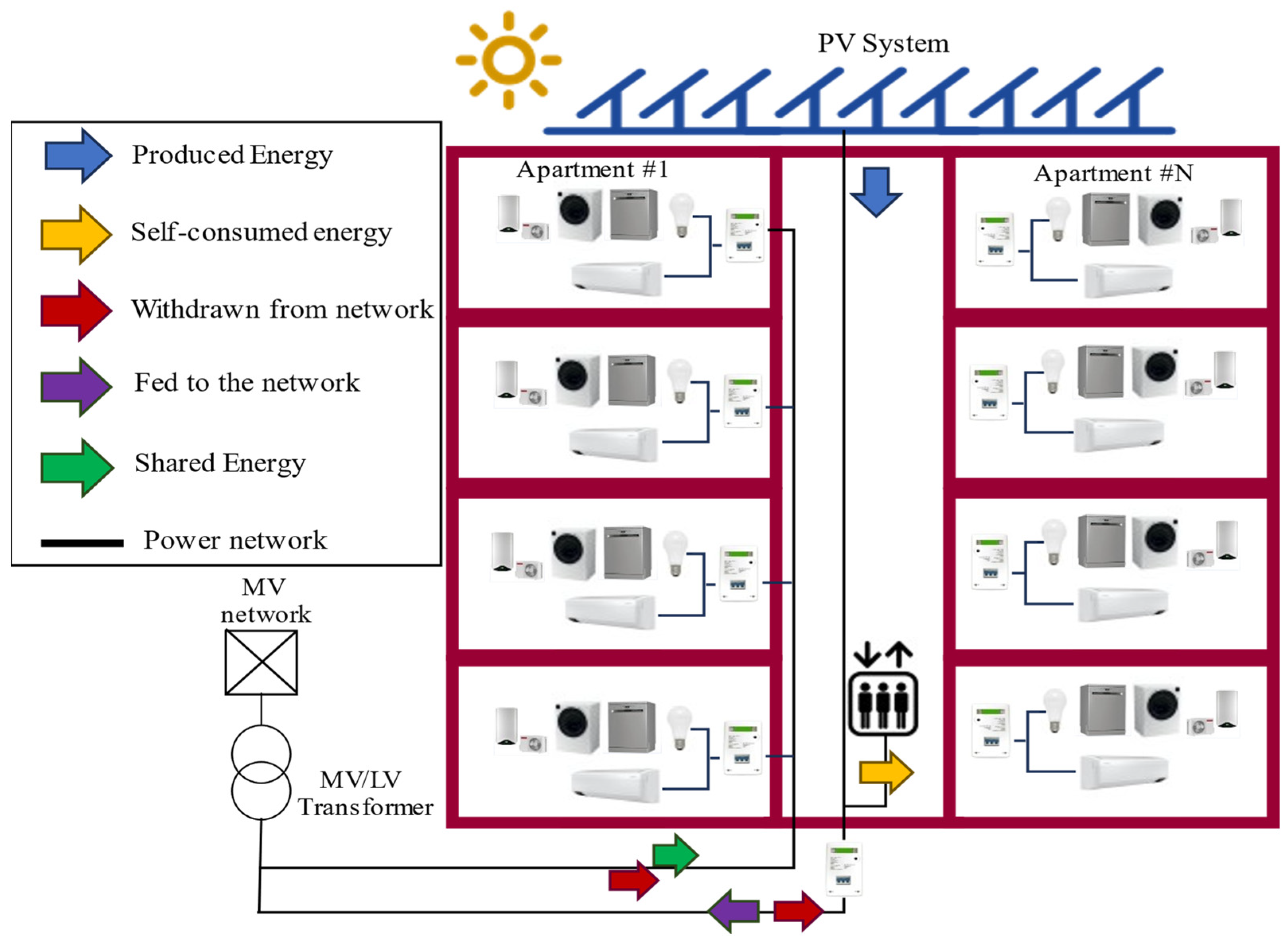
The optimization problem is presented below in its mathematical formulation according to the physical installation illustrated in Figure 1. In particular, it has been considered a condominium with a PV system installed on the roof, whose residential units are combined to form a CSG, in accordance with the Italian regulatory framework. The PV system is assumed to be designed to supply the common utilities of the condominium directly, such as the staircase lights and lift, while it is assumed that the individual flats play the role of consumers only, and therefore no electricity production is associated with them. In this scenario, the condominium as a whole effectively acts as a prosumer. Each residential unit is equipped with an air-conditioning system with HPs.
This paper has considered a generic number of N residential units, where i identifies the specific apartment, and k identifies the observed time window. Therefore:
  • T i n i , k  represents the detected indoor air temperature in residential unit i during the time window k.
  • T s e t k  represents the setpoint temperature during the time window k.
  • T o u t k  represents the outdoor temperature during the time window k.
  • P H P i , k  represents the power absorbed by the HPs of apartment i in time window k, while  P l o a d i , k  represents the power absorbed by non-controllable loads.
  • P P V k  represents the power produced by the PV system in the time-window k (as the system is not associated with any flat, it has no superscript i).
The internal temperature trend in residential units is estimated based on the simplified first-order thermal model:
d T i n d t =   1 τ   Q H P , M A X H u t T i n T o u t
where
  • τ  is the building’s thermal time constant.
  • Q H P , M A X  represents the maximum thermal power of the HP.
  • H  is global heat loss coefficient.
  • u t  is the control variable.
The control variable is binary for more traditional HPs in ON/OFF mode (0 = HP off, ±1 = HP on), while it can vary continuously between ±1 for inverter technologies. This enables the power modulation employed by the most modern technologies to be considered. The sign of the control variable defines the operating mode (heating or cooling).
By adapting the thermal model, it is possible to obtain
T i n i , k + 1 = T i n i , k + t τ Q H P , M A X i H u i , k T i n i , k T o u t k
where
  • t  coincides with the duration of the observation window k.
The electrical power absorbed by the HPs of the i-th residential unit in time window k  P H P i , k  depends on the thermal power  Q H P , M A X i · u i , k :
P H P i , k =   Q H P , M A X · i u i , k η H P i
A first constraint of the problem is introduced, according to which the management of HPs must not lead to an increase in the bill compared to a reference value, presumably associated with an ON/OFF type air conditioning system regulation. In fact, an increase in the bill, even if offset by an increase in the incentive, is a factor that can discourage consumer participation. It should be noted that participation in an aggregation model does not affect the rights of the end customer. Therefore, it is possible that contracts may differ from one another, even among end users from the same condominium.
It is then possible to define an expected bill  B i l l i , referring to a single day, and associated with the i-th residential unit through the equation:
B i l l i =   k = 1 k = 96 ( P H P i , k + P l o a d i , k ) t · P r i c e c o n t r a c t i , k
where  P r i c e c o n t r a c t i , k  is the price of electricity associated with the consumption of the i-th apartment in time window k, in accordance with its supply contract, and the sum is extended to 96 observation windows k, each with a duration of  t = 15   m i n , which coincides with the number of daily consumption recordings attainable with 2G smart meters. On this basis, the consumption curve for each individual POD is drawn up. That said, the constraint can be expressed by the equation:
B i l l d a y i B i l l b a s e i         , i , d a y
where  B i l l d a y i  denotes the expected daily bill, and  B i l l b a s e i  represents the reference daily bill. A second constraint must be imposed in relation to the contracted power established in the private agreement between the end user and the electricity supplier. To avoid inappropriate disconnections of the electricity supply, it is necessary that the total power absorbed by the user, which is influenced by the management of the HPs, does not exceed the maximum power specified in the contract.
Therefore, the third constraint is expressed as
P H P i , k + P l o a d i , k = P t o t i , k       , i   ,   k
P t o t i , k P C o n t r a c t i       , i   ,   k
where  P C o n t r a c t i  denotes the maximum power specified in the contract associated with the  i -th residential unit.
In accordance with the definition of shared electricity, it is possible to adapt general Equation (1) to the mathematical formalization of the optimization problem. For the h-th hour of the day, the electricity produced by the PV system can be defined as follows:
E P V h = t · k = h + 1 k = 4 h + 4 P P V k
The electricity physically self-consumed by condominium loads:
E P S C h = t · k = h + 1 k = 4 h + 4 P c o n d P S C k
where  P c o n d P S C k  is the physically self-consumed power in the k-th time window.
The electricity withdrawn from the grid by condominium loads:
E c o n d W h = t · k = h + 1 k = 4 h + 4 P c o n d W k
where  P c o n d W k  is the power absorbed from the grid by condominium loads.
The electricity withdrawn from the grid by the N residential units:
E t o t W h = t · i = 1 N k = h + 1 k = 4 h + 4 P t o t i , k
Then the electricity shared in the h-th hour:
E s h h = m i n ( E P V h E P S C h , E t o t W h + E c o n d W h )
Accordingly, the objective function to be minimized is defined as follows:
m i n J = m i n h = 0 23 C · E t o t W h T I P · E s h h + γ · i = 1 N m a x 0 ;   T i n i , h T t o l
where  T i n i , h  is expressed in °C∙h and represents the average deviation in hour h of the internal temperature from the setpoint:
T i n i , h = k = h + 1 k = 4 h + 4 T i n i , k T s e t k t
The term  T t o l    term represents the tolerated deviation within which the degree of thermal discomfort is considered zero.
Within the objective function (17), three economic terms can be identified:
  • C · E t o t W h , representing the cost of the energy consumed during hour h;
  • T I P · E s h h , representing the economic return from the shared electricity in hour h;
  • γ · i = 1 N m a x 0 ;   T i n i , h T t o l , representing an economic penalty for thermal discomfort, capturing the deviation of the indoor temperature from the overall setpoint across the N residential units during hour h, beyond an admissible tolerance.
In this context, the economic benefit is represented by the difference between the economic return from shared electricity and the cost of energy consumption.

4. Case Study and Results

To assess the potential application of the above-described strategy for managing HPs, a case study was developed. A condominium located in Sardinia was examined, consisting of 8 residential units and equipped with a PV system with a peak power of 18 kW installed on its roof. It is assumed that each residential unit is equipped with a 3 kW HP, characterized by a constant efficiency, with both COP and EER equal to 4.
In accordance with the developed mathematical formulation, the PV system is exclusively associated with the condominium POD. Therefore, the context under consideration is perfectly consistent with the provisions of the regulatory framework governing CSG. In the case study, in order to explore the potential of the proposed model and its limitations, three scenarios are examined:
  • Scenario 0 (baseline case): ON/OFF HP control (non-optimized control).
  • Scenario 1: HP control aimed at maximizing shared electricity, as proposed in [30] and in [31].
  • Scenario 2: HP control according to the trade-off optimization model discussed.
The analysis of the economic and energy results obtained in Scenarios 1 and 2 makes it possible to compare the shared-energy maximization model with the proposed trade-off optimization model.
The optimization problem was solved using the Excel Solver with the GRG Nonlinear algorithm and the Multistart option enabled. A convergence threshold of 0.01 was adopted, and the Multistart procedure was configured with a population size of 50.

4.1. Input Data

4.1.1. Outdoor Temperature Data and Photovoltaic Production

For simulation purposes, hourly outdoor temperature data were obtained from the PVGIS-SARAH3 database [43]. Specifically, the average daily temperature profiles for Selargius (Cagliari), were extracted for each month. This approach allowed the analysis to be extended and the results to be evaluated on an annual basis. The hourly data were then linearly interpolated to obtain representative monthly profiles with a 15 min temporal resolution. Consequently, the analysis was carried out on 12 outdoor temperature vectors (one for each month), each consisting of 96 values corresponding to the 15 min intervals of a typical day.
The PV production profiles were obtained starting from an actual 15 min resolution production profile recorded in July for an 18 kW PV system installed in Southern Sardinia. To derive 12 representative profiles (one for each month), the July profile was scaled according to the monthly production data extracted from the PVGIS-SARAH3 database. The final dataset therefore consists of 12 production vectors (one for each month), each containing 96 values corresponding to the 15 min intervals of a typical day.

4.1.2. Daily Electrical Load Profiles

Three distinct load profiles were hypothesized, which were then assigned to one or more housing units. These profiles reflect different daily routines and usage habits, which significantly affect the temporal distribution of electricity consumption throughout the day. The load profile can lead to significant variations in uncontrollable loads, with repercussions on the management of HPs based on constraints (9) and (11).
The three typical profiles hypothesized:
  • Family with two workers, no children.
  • Family with two workers, one child.
  • Family with two workers, three children.
The assumed load profiles were also associated with a specific power contract size, as reported in Table 2.
Annual electricity consumption was calculated by adding together twelve monthly load profiles, each of which was weighted according to the number of days in its respective month. Each profile was modeled as the sum of two components: an uncontrollable load component, which remained the same throughout the year and varied according to the three reference profiles; and a scenario-dependent component, which was associated with the operation of the HPs. The load profile of the HPs depends on the scenario considered and the month (which is associated with a different daily temperature trend).
The annual cost of the bill has been estimated based on monthly electricity consumption according to the values in Table 3 for the year 2024. These values are linked to the national average price of electricity for the typical residential consumer in Italy with a market contract whose electricity prices are adjusted to the Single National Price.
The possible contribution of condominium loads was considered negligible as they would be classified as uncontrollable and therefore not particularly relevant to the final assessment.
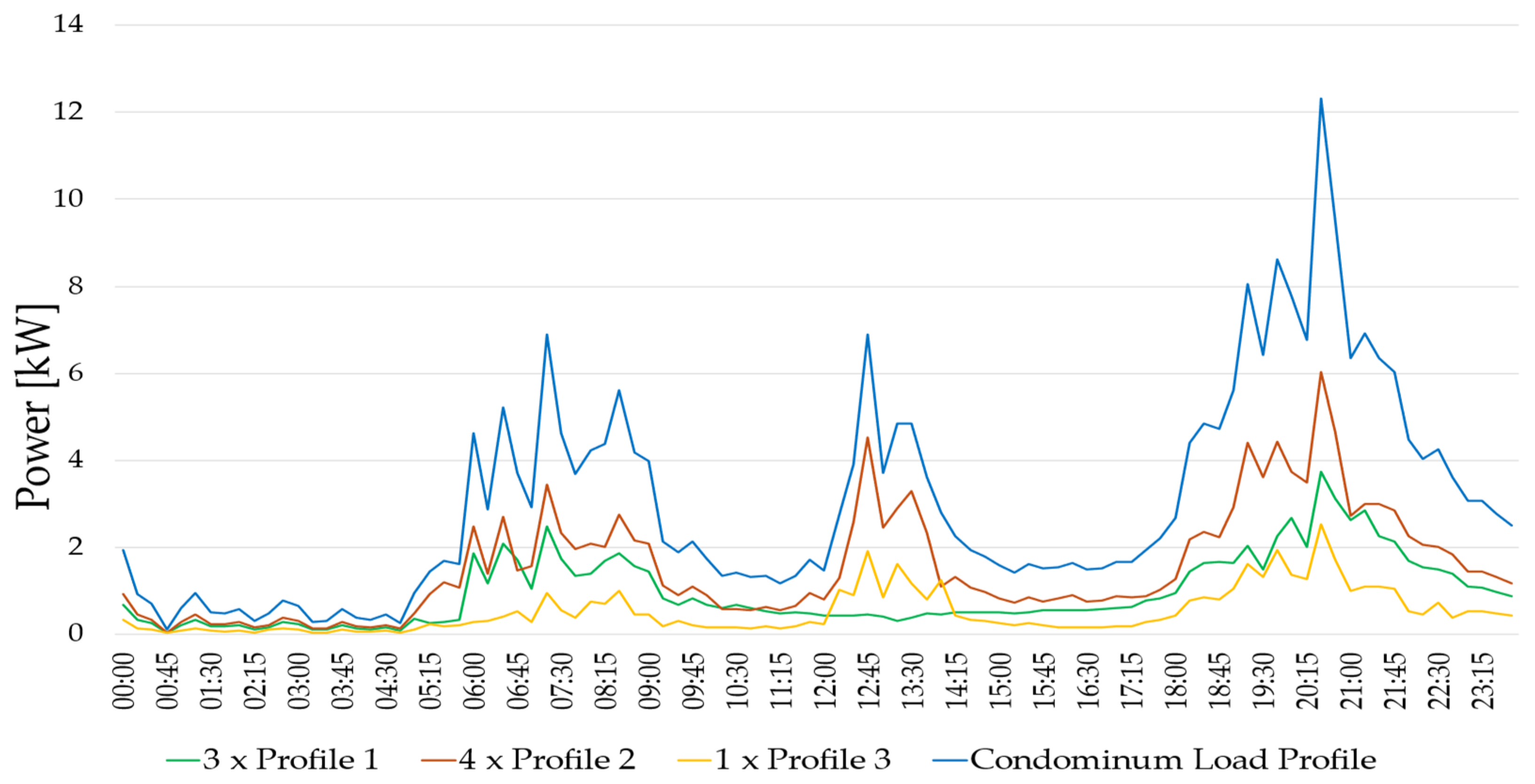
Aggregating the eight load profiles associated with the residential units provides an overall load profile for the examined condominium, as shown in Figure 2.

4.2. Thermal Modeling of the Building

In order to evaluate how the internal temperature of the building evolves in response to variations in the external temperature and the activity of the HPs, in accordance with the first-order model defined in (6), it is necessary to establish the building’s thermal time constant. The choice of thermal time constant is based on two complementary considerations. First, it can be derived from a simplified RC (resistance–capacitance) thermal model of a medium-inertia residential apartment. Assuming a thermal capacity  C 3.5 · 10 6   J / K   (e.g., for an 80 m2 apartment with 40–45 kJ/m2·K) and a global heat loss coefficient  H 1100   W / K , the resulting time constant is
τ = C H 3.4 10 6 J K 1100 W K 3.2   h
Second, an alternative estimate can be derived from the envelope’s thermal characteristics. Let us assume an opaque envelope with a steady-state transmittance  U = 0.34   W / m 2 K    and a periodic thermal transmittance  Y _ i e   <   0.1   W / m 2 K , typical of heavy constructions with good thermal inertia (in compliance with UNI EN ISO 13786:2018 [44] and UNI EN ISO 6946:2018 [45]). For a total dispersing surface of 120 m2 and a specific internal thermal capacity  c _ i   =   60   k J / m 2 K   (in line with ISO 52016-1 [46]), the time constant of the envelope becomes
C = 60000   J m 2 K     80   m 2 = 4.8 · 10 6   J / K  
H = 0.34   W m 2 K     120 m 2 = 40.8   W / K  
τ _ e n v e l o p e = C H 4.8 · 10 6 J K 40.8 W K 117.6   h
However, such long-time constants reflect the building’s envelope response, not the internal air dynamics. For control-oriented models (e.g., demand response strategies on HPs), the effective internal thermal response time must also consider the air-exchange rate, internal convection, and radiant exchange. Accordingly, ISO 52016-1 and practical simulation studies (e.g., [32,47]) support the use of a reduced effective time constant in the range of 2–5 h.
Therefore, a value of  τ   = 3.2   h  is adopted here to represent the internal air temperature response time, which governs the dynamics relevant to HP control and comfort preservation.

4.3. Scenarios Analyzed

4.3.1. Scenario 0

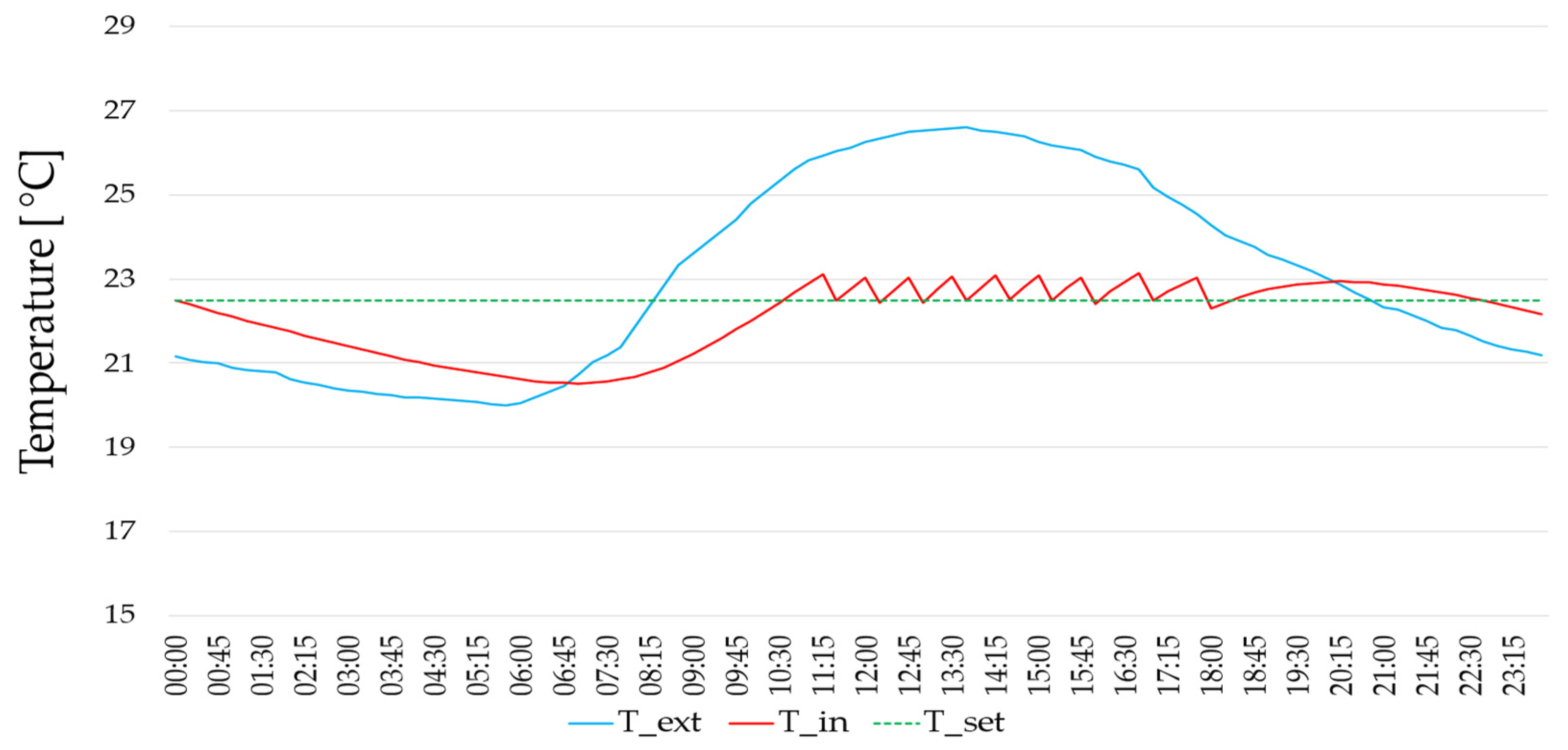
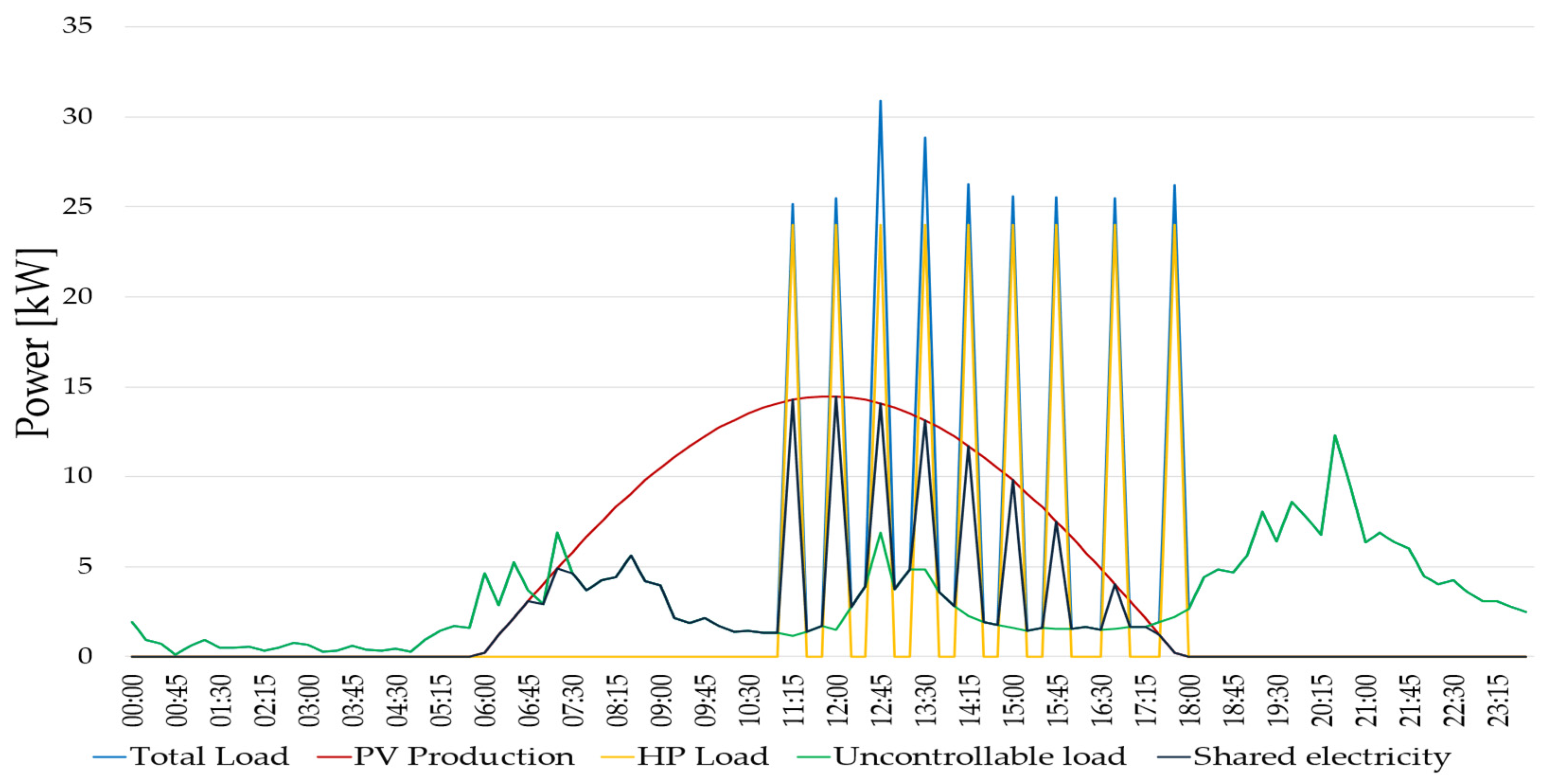
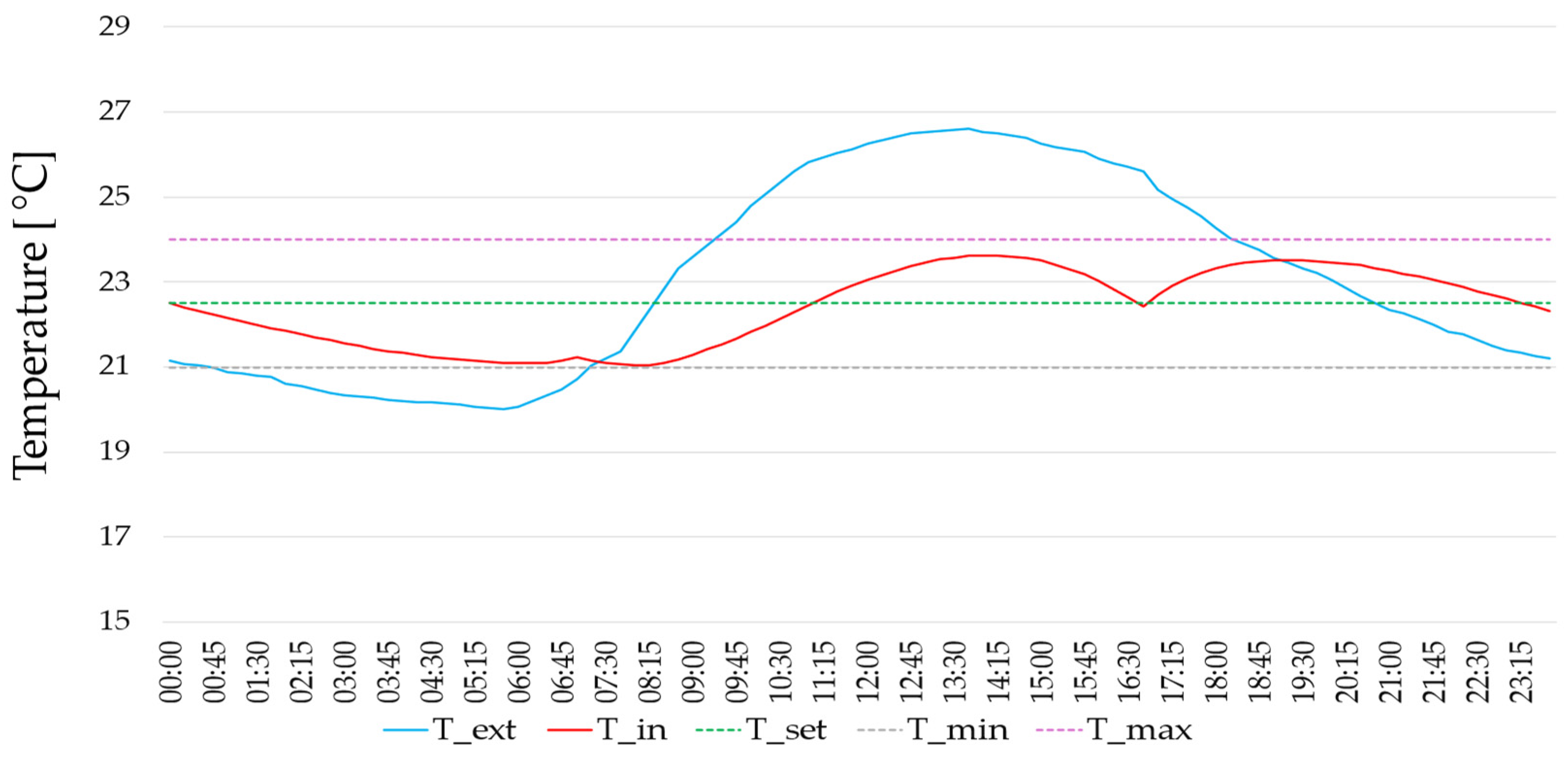
Scenario 0 was used as the baseline case for evaluating the results achieved in Scenarios 1 and 2. In this scenario, the HPs operate in ON/OFF mode. When the internal temperature of the residential unit deviates from the setpoint value by more than the predefined tolerance threshold, the system operates at nominal power until the desired conditions are restored. During hot months (June, July, August and September), the system operates in cooling mode only, while during cold months (November, December, January, February and March), the system operates in heating mode only. In April, May and October, based on the climate data collected, no air conditioning was considered in operation. This approach is consistent with what would realistically occur in a condominium located in Sardinia. To account for the different seasonal requirements, two setpoint values were adopted, with a tolerance of 0.5 °C. Specifically, the indoor temperature setpoint was set to 22.5 °C for the warmer months (June–September) and 19 °C for the colder months (November–March). Considering the typical climatic characteristics of Sardinia and the meteorological data provided by PVGIS, HPs’ consumption is significantly reduced in the months adjacent to the transitional periods. Consequently, these months yield only limited effects associated with the application of alternative management strategies in other simulation scenarios. Figure 3 shows the typical trends in outdoor (T_ext) and indoor (T_in) temperature in September.
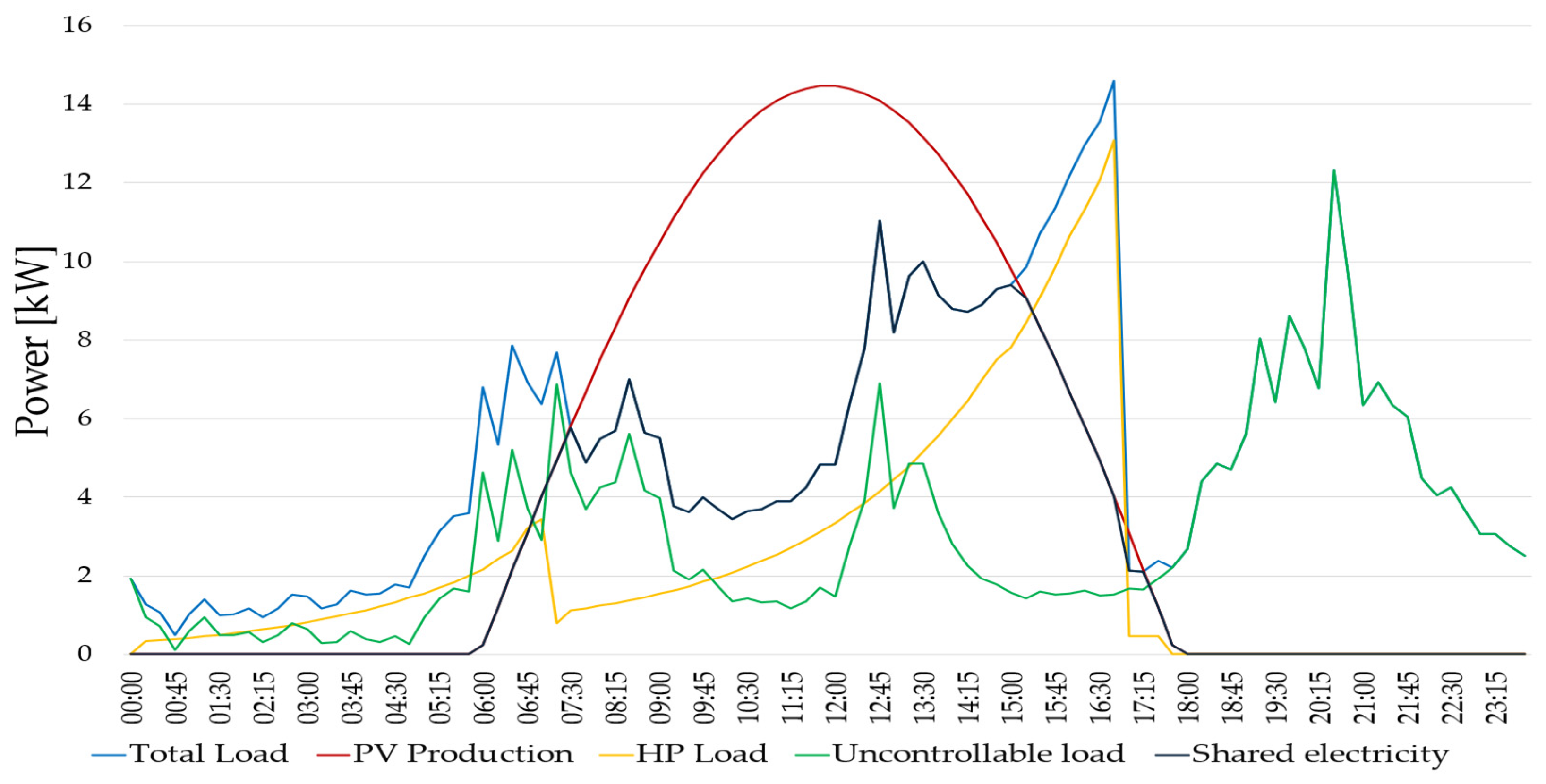
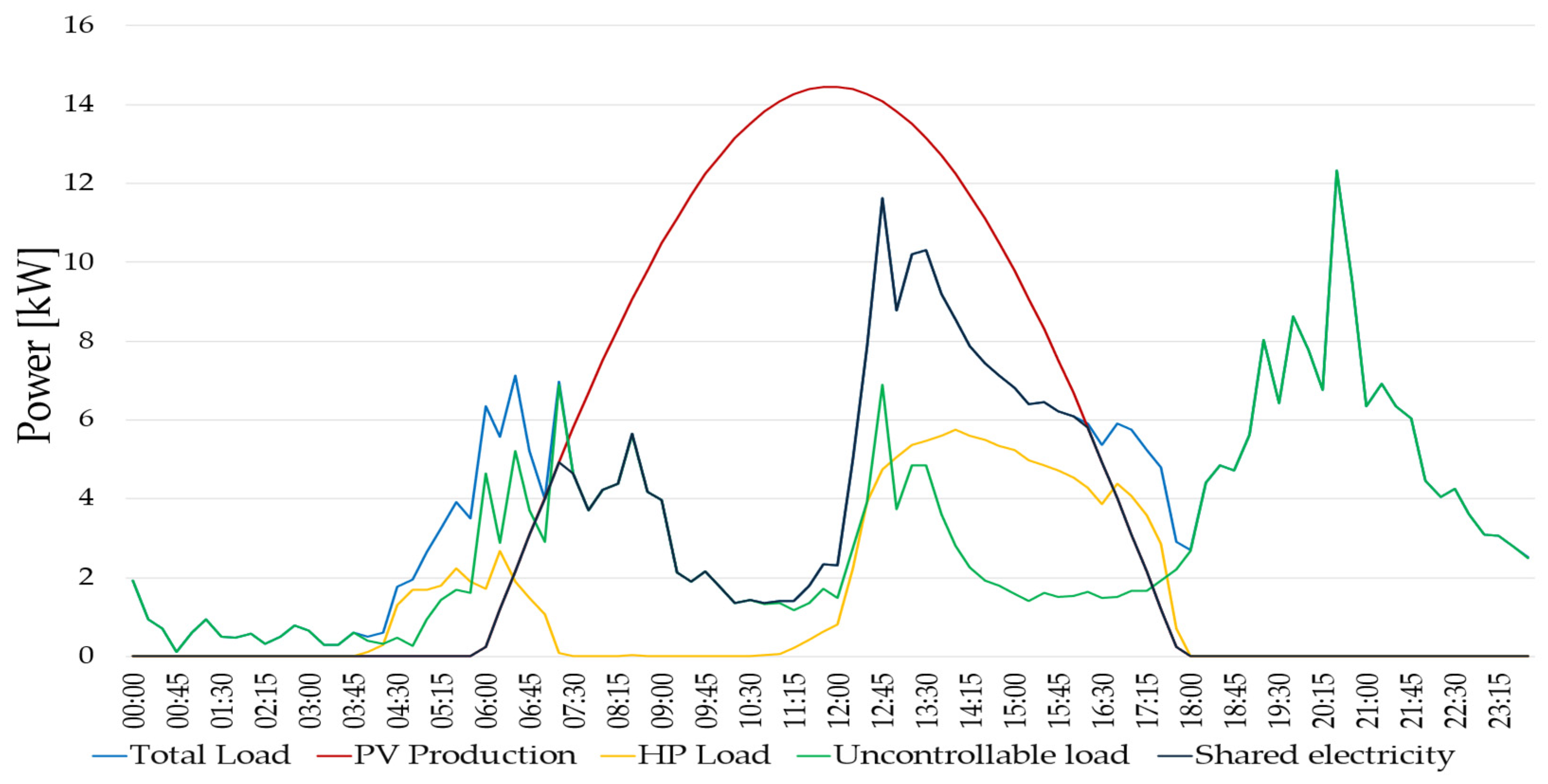
Figure 4, on the other hand, shows the HPs consumption in ON/OFF mode, the resulting total load profile (the sum of the uncontrollable load and the HPs demand) and the shared electricity profile. These two figures demonstrate that HPs activate at nominal power when the internal temperature exceeds the setpoint value by the specified tolerance. This type of operation is completely independent of PV production conditions.

4.3.2. Scenario 1

Scenario 1 adopts an HP control strategy aimed at maximizing shared electricity, while complying with specific constraints: maintaining a fixed temperature range, staying within the contractual power limit, and keeping the bill no higher than in Scenario 0. In this scenario, the operation of the HPs is therefore modulated to increase the alignment between their electricity consumption and PV production. In addition, unlike in Scenario 0, the operation of the HPs does not occur exclusively at nominal power, allowing for finer temperature regulation. The allowed temperature ranges are defined as ±1.5 °C relative to the setpoint values established for Scenario 0. Figure 5 shows the internal temperature trend for Scenario 1 in September, highlighting that it remains within the tolerance range defined around the setpoint value.
Figure 6 shows the consumption profile of the heat pumps, the total load profile, and the shared electricity. It illustrates how the units operate in cooling mode with modulated power to comply with the constraints imposed by the shared energy maximization model. Notably, around 06:45, the power absorbed by the HPs is reduced to prevent the internal temperature from dropping below the permitted minimum value.

4.3.3. Scenario 2

In Scenario 2, the HPs operate according to the optimization model presented in this paper. The HPs’ overall consumption and its distribution throughout the day vary to find the best trade-off between shared electricity, electricity consumption, and thermal comfort. The entire trade-off is particularly influenced by the choice of penalty coefficient γ attributed to thermal discomfort. As previously mentioned, this is an arbitrary parameter whose value can be chosen according to the importance attributed to thermal comfort. Considering this, the results of using two different values of this parameter are investigated, in order to evaluate the impact of the selected value of γ:
  • γ = 0.1 / ° C · h  (Scenario 2.1)
  • γ = 0.3 / ° C · h  (Scenario 2.2)
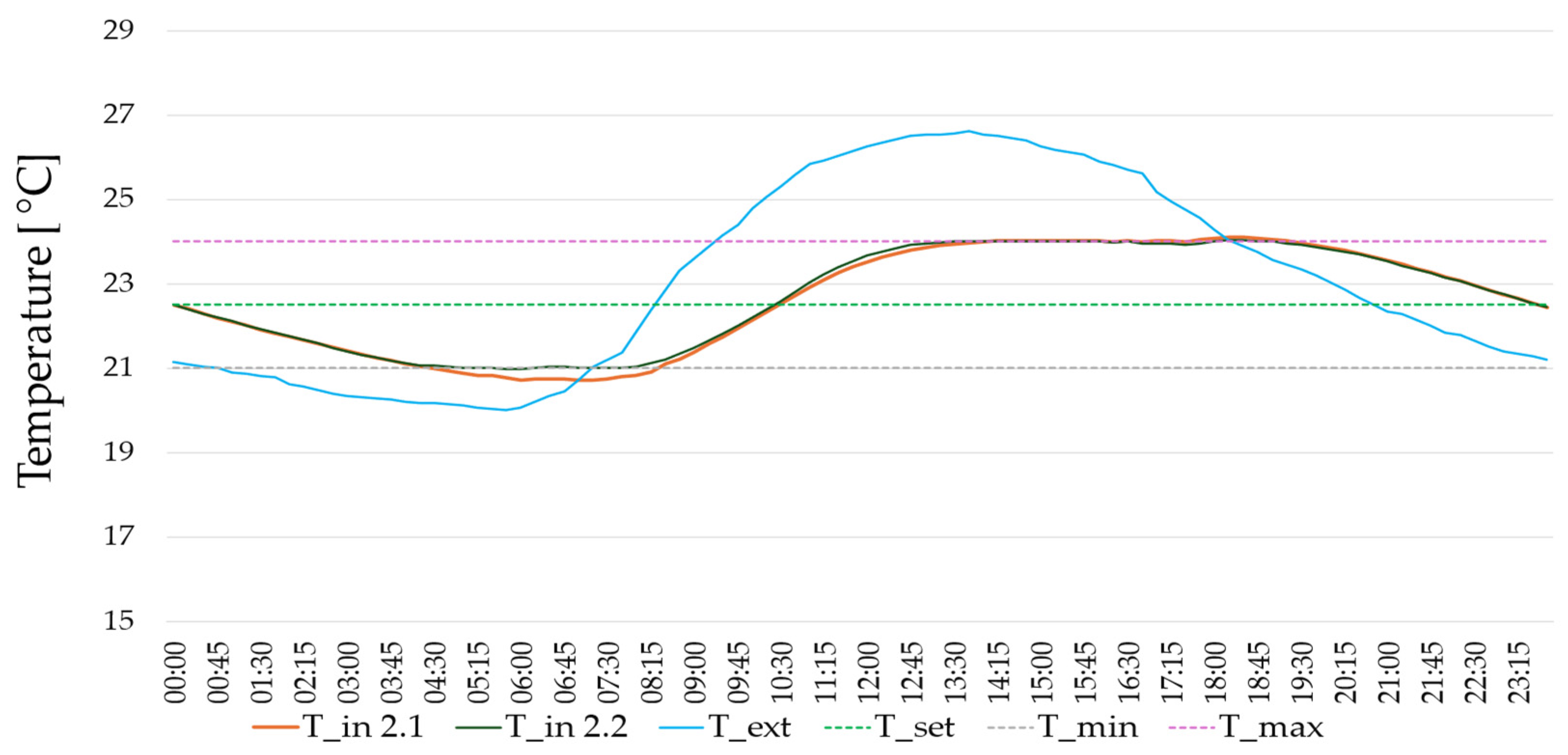
In essence, Scenario 2.1 is a trade-off situation in which maintaining thermal comfort is not prioritized, whereas Scenario 2.2 is a trade-off situation in which this aspect is given more importance. The tolerance was set to  T t o l = 1.5   ° C . Figure 7 shows the indoor temperature profiles for Scenarios 2.1 and 2.2 over the representative day in September.
As shown in Figure 7, the indoor temperature in Scenario 2.1 exceeds the tolerance band defined around the setpoint, whereas in Scenario 2.2, it remains substantially within it. This is similar to what was observed in Scenario 1 due to the operating constraints imposed. This behavior is consistent with the assignment of two distinct penalty coefficient  γ  values: a higher value in Scenario 2.2 and a lower value in Scenario 2.1.
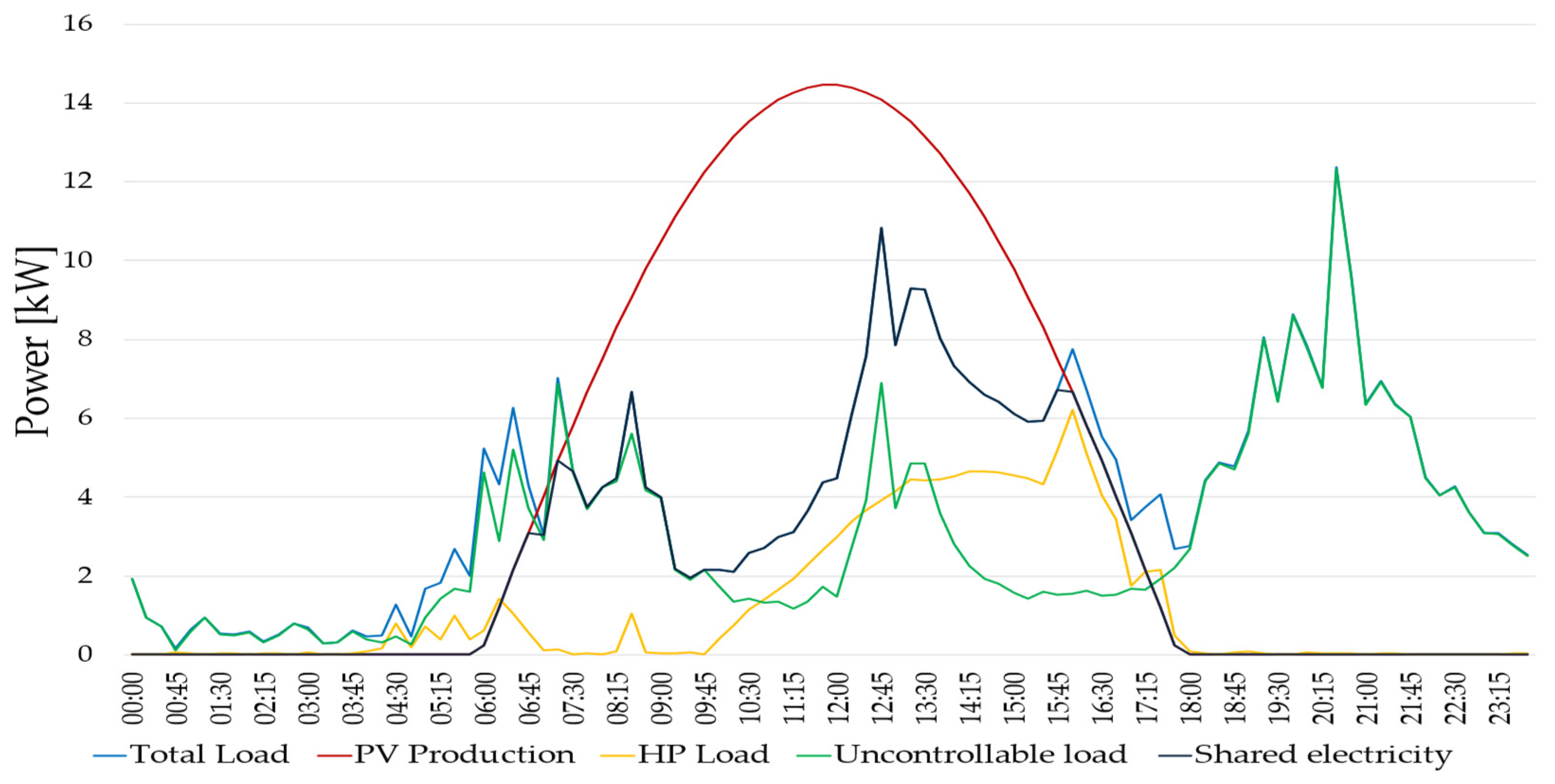
Figure 8 and Figure 9 show the load profiles for Scenarios 2.1 and 2.2 on a typical day in September, respectively. The different power modulations of the HPs can be observed, as well as the resulting total load profiles and the different shared energy profiles derived from them.

4.4. Monthly and Yearly Comparative Evaluation of Scenarios

In Table 4, a monthly comparison over a period of twelve months is reported to assess Scenarios 1 and 2 against Scenario 0 in terms of shared electricity, electricity consumption and thermal comfort. In particular, the daily comfort deviation shown corresponds to the maximum value observed across all residential units. In fact, due to different uncontrollable load profiles and contracted power, variations in indoor temperature trends may occur between residential units, consistent with the constraints of the management strategy.
The analysis of Scenario 1 shows that electricity consumption—and, consequently, electricity bills—are not significantly reduced. At the same time, in compliance with operational constraints, consumption does not increase in any month, which guarantees maintenance of the estimated bill in Scenario 0. Scenario 1 shows a larger monthly increase in shared electricity than Scenario 2 in almost all of the considered months, with the sole exception of January, when the maximum level of sharing permitted by photovoltaic production is reached. This value is the same for Scenarios 1 and 2.1.
In Scenario 2, the increase in shared electricity is reduced in favor of reducing electricity consumption. The balance between the two is influenced by the different weighting assigned to the two terms within the objective function, among other things. Therefore, the balance depends on the ratio between TIP, which remains constant throughout the year, and C, which varies from month to month. The greater the difference between C and TIP, the more likely it is that electricity savings will be favored in the same month. In Scenario 2.2, electricity consumption is reduced each month compared to Scenario 2.1. This is in line with the need to increase HPs activity to satisfy the new trade-off, which places greater emphasis on maintaining comfort.
Deviation from thermal comfort is defined as zero in Scenario 1, whereas it is more pronounced in Scenario 2.1 than in Scenario 2.2 due to the lesser importance given to maintaining comfortable conditions. This deviation is generally more evident in the colder months than in the warmer months, as more intensive operation of the HPs is required in these conditions to bring the temperature back to the setpoint value due to the greater temperature gradient between the indoor and outdoor environments. In Scenario 2.2, deviations from thermal comfort are practically zero in July, August and September.
Table 5 summarizes the monthly economic results, emphasizing the increase in shared electricity incentives and the potential savings from reduced electricity consumption. For each month, the net economic benefit is reported, defined as the sum of the savings from reduced electricity consumption and the increase in incentives for shared electricity with respect to Scenario 0. Scenario 1 shows that July and August offer the greatest economic benefits, due to the combination of high air conditioning demand and widespread photovoltaic production. In contrast, despite high demand for air conditioning in January, the economic benefits are more limited due to constraints resulting from reduced photovoltaic production.
The analysis also shows that Scenario 2 yields a substantially higher net economic benefit than Scenario 1. This is because, for the parameters adopted in the case study for defining the cost of electricity to the user, avoiding electricity consumption results in greater savings than using the same amount of electricity on a per kWh basis. Unlike in Scenario 1, the months with the greatest net economic benefit in Scenario 2 are the coldest ones. This is because more air conditioning is required during these months, offering a greater amount of electricity on which savings can be made. Furthermore, the reduction in consumption has a more significant impact on the net economic benefit since the cost associated with electricity consumption has a greater economic weight than the incentive for shared electricity. However, it should be noted that there is also a more pronounced daily deviation in thermal comfort in these months, as shown in Table 4.
Table 6 shows the annual comparison of shared and consumed electricity in the four analyzed scenarios, highlighting the deviations from Scenario 0 and the estimated net economic benefits.
Although Scenario 2.1 is associated with the greatest net economic benefit, it results in a greater deterioration in thermal comfort conditions than the other scenarios. Scenario 2.2 guarantees a significant net economic benefit, albeit less than that of Scenario 2.1, while maintaining thermal comfort more satisfactorily. Scenario 1, on the other hand, achieves a net economic benefit of €965, which is entirely due to maximizing shared electricity and is therefore limited.
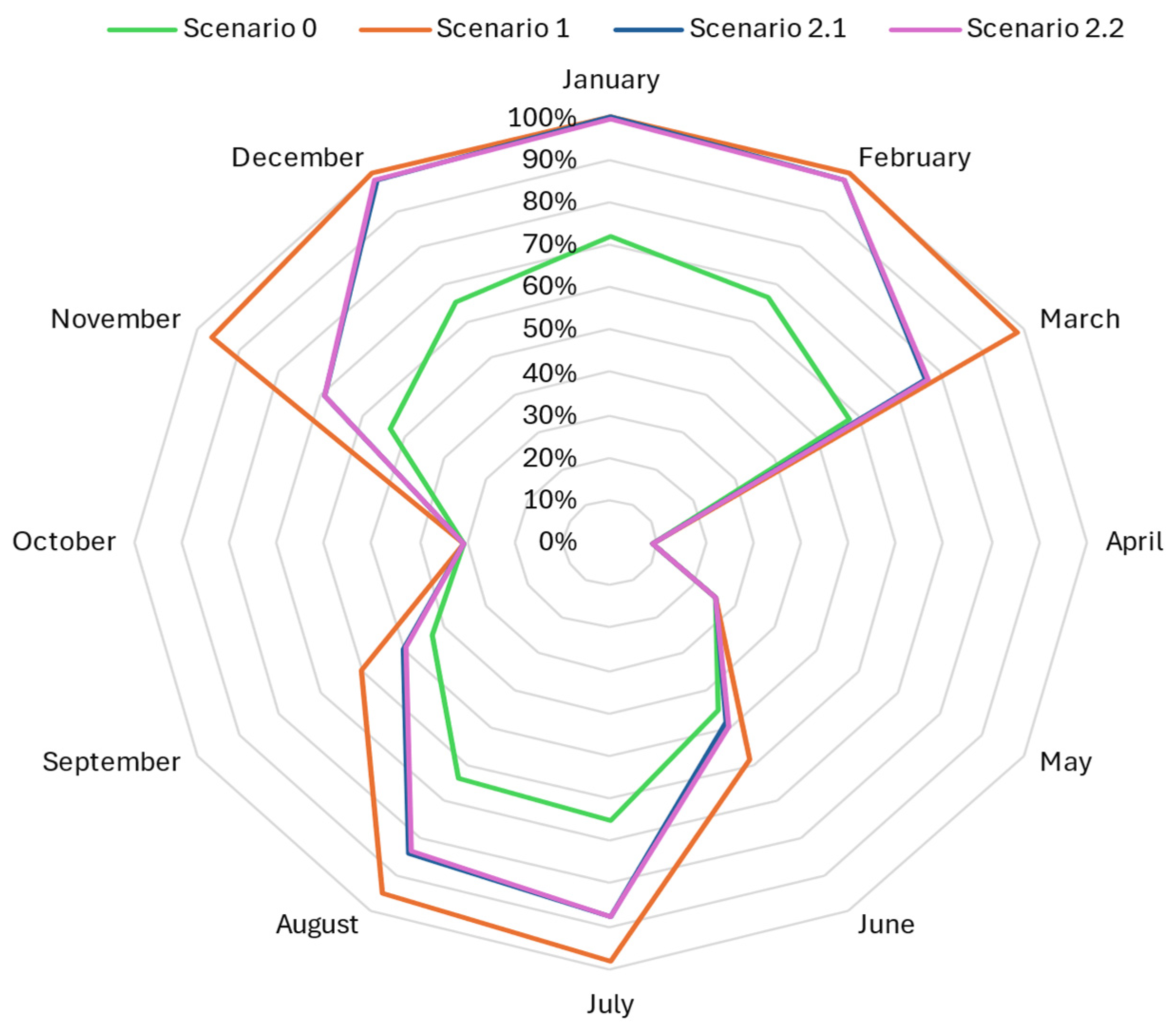
Figure 10 shows the trend in the ratio of electricity fed into the grid to electricity shared over a period of twelve months.
This performance indicator, which was formerly introduced in [48], provides information on the potential increase in the CSG’s electricity-sharing capacity. It is also a measure of the configuration’s economic efficiency in generating value through incentive mechanisms. Generally, the closer this ratio is to 100%, the more the CSG’s capacity to create economic value is exploited and the smaller the margin for improvement through load manipulation alone becomes. In Scenario 1, economic efficiency only deviates from values close to 100% during the transition months, which are characterized by reduced or absent air conditioning requirements. In Scenarios 2.1 and 2.2, however, economic efficiency remains almost identical throughout the year and is lower than in Scenario 1.

4.5. Scenarios Comparison Remarks

The results obtained were compared with those of two alternative scenarios: in the first (Scenario 0), HP management was carried out in ON/OFF mode, while in the second (Scenario 1), a strategy of maximizing shared electricity was adopted. Furthermore, to test the influence of the choice of discomfort penalty coefficient, two different values were assigned to define two sub-scenarios. The first (Scenario 2.1) gives limited importance to thermal comfort, while the second (Scenario 2.2) increases this importance.
The results show that the trade-off approach leads to an overall annual increase in shared electricity of 28.3% (Scenario 2.1) and 28.4% (Scenario 2.2) compared to Scenario 0, as well as electricity savings of 21.3% (Scenario 2.1) and 16.1% (Scenario 2.1). While the increase in shared electricity is smaller compared to Scenario 1 (+44.7%), the net economic benefit is significantly higher. The decision in Scenario 2 to prioritize electricity savings over increased shared electricity depended closely on the weighting assigned to the respective terms in the trade-off. Compared to Scenario 1, Scenario 2.1 shows an 11.2% reduction in revenue from electricity sharing (falling from €3141 to €2788) but allows for a significant 21.3% reduction in electricity consumption costs (falling from €19,597 to €15,420). This results in an increase in net annual economic benefit of around €3828.
Scenario 2.2, on the other hand, reduces revenue from shared energy by 11.3% (from €3141 to €2786) and electricity consumption costs by 16.1% (from €19,597 to €16,440). This results in an increase in net economic benefit of €2806.
Analyzing two different values of γ made it possible to assess this parameter’s influence within the trade-off. This highlighted that even slight deviations from thermal comfort can increase the potential economic benefits of achieving an optimal balance between shared electricity and electricity savings. This demonstrates the significant impact that user decisions have on such an optimization model. For this reason, the definition of this coefficient should rely on a careful assessment of the expected outcomes, as its value significantly impacts both economic performance and indoor thermal comfort. Accordingly, it can be established at the condominium level through a collective agreement, based on proposals supported by simulations or projections of the anticipated results.

5. Conclusions

Incentive schemes for shared electricity, such as those implemented within the Italian renewable electricity community framework, can play a fundamental role in promoting consumer aggregation models. These innovative regulations schemes are crucial for promoting electricity transition and improving environmental, economic and social conditions at a local level. Therefore, load management strategies aimed at optimizing electricity use can act as catalysts in encouraging participation. In this context, this paper proposes a model for optimizing the trade-off between comfort, electricity consumption and economic benefits within a condominium CSG scheme, based on the management of the air conditioning system and capable of adapting to the importance that users attach to maintaining thermal comfort in their apartments. The introduction of this flexibility allows for the development of a more versatile model, which departs from the simple maximization of shared electricity and allows for the exploration of more economically favorable solutions in line with user preferences.
The results of applying the trade-off model were compared with those of two reference scenarios: Scenario 0, which is the baseline with ON/OFF management of HPs; and Scenario 1, which is based on a shared energy maximization model. A sensitivity study was also conducted on the thermal discomfort penalty coefficient, generating Scenarios 2.1 and 2.2. Compared to Scenario 0, the model increased electricity sharing by 28.3% (Scenario 2.1) and 28.4% (Scenario 2.2), respectively, while reducing consumption by 21.3% and 16.1%. Compared to Scenario 1, the trade-off model, although it reduced revenues from energy sharing by 11.2% (Scenario 2.1) and 11.3% (Scenario 2.2), respectively, it has enabled a reduction in the costs associated with electricity consumption of 21.3% (Scenario 2.1) and 16.1% (Scenario 2.2), respectively, leading to a significant increase in net economic benefit. These results show that introducing a parameter in the optimization model that considers user preferences enables the identification of solutions that are more economically advantageous overall than solely maximizing shared energy. Furthermore, this approach enables the identification of scenarios that better align with users’ actual needs, effectively integrating energy efficiency with the satisfaction of individual preferences.
The variability of the results with respect to the discomfort penalty coefficient emphasizes the need for future studies to include a more detailed sensitivity analysis. Furthermore, accounting for the dynamism of economic parameters, such as the tariff for shared energy in relation to zonal prices, and the cost of energy drawn from the grid under different contract types could improve the representativeness of the model.

Author Contributions

Conceptualization, E.G., R.R. and F.M.; methodology, E.G.; software, F.M. and G.S.; validation, E.G. and R.R.; writing—original draft preparation, review and editing, E.G., R.R., G.S. and F.M.; supervision, E.G. All authors have read and agreed to the published version of the manuscript.

Funding

This research was supported by the Project Smart Communities for Resilient Electricity Transition—SCORET—National Research and Resilience Plan (NRRP) Mission 4 ‘Education and Research’—Component C2 Investment 1.1, ‘Fund for the National Research Program and Projects of Significant National Interest (PRIN)’. Project Code 2022YYMWTJ—CUP F53D23000760006. Directorial Decree no. 104 of 02.02.2022. Public Notice for the submission of Research Projects of Significant National Interest (PRIN) to be financed under the PNRR—PRIN 2022—European Union Funding—Next Generation EU. This work has also been partly financed by Project e.INS Ecosystem of Innovation for Next Generation Sardinia (e.INS)—National Research and Resilience Plan (NRRP)—Mission 4, Component 2, “From research to business”. Investment 1.5 “Creation and strengthening of Ecosystems of innovation and construction of Territorial R&D Leaders”. MUR ECS00000038—CUP F53C22000430001.

Data Availability Statement

The original contributions presented in this study are included in the article. Further inquiries can be directed to the corresponding author.

Conflicts of Interest

Gianmarco Sitzia is employed by the company Sm@rtKNX S.r.l. The remaining authors declare that the research was conducted in the absence of any commercial or financial relationships that could be construed as a potential conflict of interest.

Abbreviations

The following abbreviations are used in this manuscript:
CSGCollective Self-Consumption Group
RECRenewable Electricity Community
PVPhotovoltaic
HPHeat Pump
SBSmart Building
IoTInternet of Things
EMSElectricity Management System

References

  1. European Commission. Fit for 55 Package. Fit for 55: Delivering on the Proposals—European Commission. Available online: https://commission.europa.eu/topics/climate-action/delivering-european-green-deal/fit-55-delivering-proposals_en (accessed on 29 April 2025).
  2. European Commission. European Climate Law. Available online: https://climate.ec.europa.eu/eu-action/european-green-deal/european-climate-law_en (accessed on 29 April 2025).
  3. Directive (EU) 2018/2001 of the European Parliament and of the Council-of 11 December 2018-on the Promotion of the Use of Electricity from Renewable Sources (RED II Directive). Available online: https://eur-lex.europa.eu/legal-content/EN/TXT/PDF/?uri=CELEX:32018L2001&amp;from=EN (accessed on 29 April 2025).
  4. European Commission. Clean Electricity for All Europeans Package. Available online: https://ec.europa.eu/energy/topics/energy-strategy/clean-energy-all-europeans_enen (accessed on 29 April 2025).
  5. Directive (EU) 2019/944 of the European Parliament and of the Council of 5 June 2019 on Common Rules for the Internal Market for Electricity and Amending Directive. Available online: https://eur-lex.europa.eu/legal-content/EN/TXT/PDF/?uri=CELEX:32019L0944 (accessed on 29 April 2025).
  6. Italian Legislative Decree 162/19. Available online: https://www.gazzettaufficiale.it/eli/id/2019/12/31/19G00171/sg (accessed on 29 April 2025).
  7. ARERA, Italian Resolution 318/2020/R/EEL. Available online: https://www.arera.it/fileadmin/allegati/docs/20/318-20.pdf (accessed on 29 April 2025).
  8. Italian Legislative Decree 199/2021. Available online: https://www.gazzettaufficiale.it/atto/vediMenuHTML?atto.dataPubblicazioneGazzetta=2021-11-30&atto.codiceRedazionale=21G00214&tipoSerie=serie_generale&tipoVigenza=originario (accessed on 29 April 2025).
  9. ARERA Resolution 727/2022/R/eel of 27 December 2022. Available online: https://www.arera.it/fileadmin/allegati/docs/22/727-22.pdf (accessed on 29 April 2025).
  10. MASE Decree of 7 December 2023, no. 414. Decreto MASE n. 414 del 07/12/2023: È Entrato in Vigore il Decreto CER. Available online: https://www.e-cycle.it/ita/news/2705/Decreto-MASE-n-414-del-07-12-2023-e-entrato-in-vigore-il-Decreto-CER (accessed on 29 April 2025).
  11. Circle Economy Foundation. The Circularity Gap Report 2024: A Circular Economy to Live Within the Safe Limits of the Planet; Circle Economy Foundation: Amsterdam, The Netherlands, 2024; Available online: https://www.circularity-gap.world/2024 (accessed on 12 May 2025).
  12. European Commission. In Focus: Electricity Efficient Buildings. 2024. Available online: https://energy.ec.europa.eu/news/focus-energy-efficient-buildings-2024-04-16_en (accessed on 12 May 2025).
  13. Delavar, T.; Amiri, A.; Borgentorp, E.; Junnila, S. The Prioritization of Sustainability Features of Buildings from the Viewpoint of Experts. Buildings 2023, 13, 3021. [Google Scholar] [CrossRef]
  14. Zuhaib, S.; Schmatzberger, S.; Volt, J.; Tóth, Z.; Kranzl, L.; Maia, I.E.N.; Verheyen, J.; Borragán, G.; Monteiro, C.S.; Mateus, N.; et al. Next-generation electricity performance certificates: End-user needs and expectations. Electr. Policy 2022, 161, 112723. [Google Scholar] [CrossRef]
  15. Al Dakheel, J.; Del Pero, C.; Aste, N.; Leonforte, F. Smart Buildings Features and Key Performance Indicators: A Review. Sustain. Cities Soc. 2020, 61, 102328. [Google Scholar] [CrossRef]
  16. Billanes, J.D.; Ma, Z.G.; Jørgensen, B.N. Data-Driven Technologies for Electricity Optimization in Smart Buildings: A Scoping Review. Energies 2025, 18, 290. [Google Scholar] [CrossRef]
  17. Moudgil, V.; Hewage, K.; Hussain, S.A.; Sadiq, R. Integration of IoT in Building Electricity Infrastructure: A Critical Review on Challenges and Solutions. Renew. Sustain. Electricity Rev. 2023, 174, 113121. [Google Scholar] [CrossRef]
  18. Jia, M.; Komeily, A.; Wang, Y.; Srinivasan, R.S. Adopting Internet of Things for the Development of Smart Buildings: A Review of Enabling Technologies and Applications. Autom. Constr. 2019, 101, 111–126. [Google Scholar] [CrossRef]
  19. Ahmed, S.; Ali, A.; Ciocia, A.; D’Angola, A. Technological Elements behind the Renewable Electricity Community: Current Status, Existing Gap, Necessity, and Future Perspective—Overview. Energies 2024, 17, 3100. [Google Scholar] [CrossRef]
  20. Menniti, D.; Pinnarelli, A.; Sorrentino, N.; Vizza, P.; Barone, G.; Brusco, G.; Mendicino, S.; Mendicino, L.; Polizzi, G. Enabling Technologies for Electricity Communities: Some Experimental Use Cases. Energies 2022, 15, 6374. [Google Scholar] [CrossRef]
  21. Ahmed, S.; Ali, A.; D’Angola, A. A Review of Renewable Electricity Communities: Concepts, Scope, Progress, Challenges, and Recommendations. Sustainability 2024, 16, 1749. [Google Scholar] [CrossRef]
  22. Gjorgievski, V.; Cundeva, S.; Georghiou, G. Social arrangements, technical designs and impacts of electricity communities: A review. Renew. Electr. 2021, 169, 1138–1156. [Google Scholar] [CrossRef]
  23. Trevisan, R.; Ghiani, E.; Olivero, S.; Bailo, M. The Magliano Alpi Electricity Community: Analysis and Insights After Three-Years Operation. In Proceedings of the IEEE International Conference on Environment and Electrical Engineering and 2024 IEEE Industrial and Commercial Power Systems Europe (EEEIC/I&CPS Europe), Rome, Italy, 17–20 June 2024; pp. 1–6. [Google Scholar] [CrossRef]
  24. Lazzari, F.; Mor, G.; Cipriano, J.; Solsona, F.; Chemisana, D.; Guericke, D. Optimizing planning and operation of renewable energy communities with genetic algorithms. Appl. Electr. 2023, 338, 120906. [Google Scholar] [CrossRef]
  25. Sassone, A.; Ahmed, S.; D’Angola, A. A Profit Optimization Model for Renewable Electricity Communities Based on the Distribution of Participants. In Proceedings of the IEEE International Conference on Environment and Electrical Engineering and 2024 IEEE Industrial and Commercial Power Systems Europe (EEEIC/I&CPS Europe), Rome, Italy, 17–20 June 2024; pp. 1–6. [Google Scholar] [CrossRef]
  26. Cutore, E.; Volpe, R.; Sgroi, R.; Fichera, A. Electricity Management and Sustainability Assessment of Renewable Electricity Communities: The Italian Context. Electr. Convers. Manag. 2023, 278, 116713. [Google Scholar] [CrossRef]
  27. Cosic, A.; Stadler, M.; Mansoor, M.; Zellinger, M. Mixed-Integer Linear Programming-Based Optimization Strategies for Renewable Electricity Communities. Electricity 2021, 237, 121559. [Google Scholar] [CrossRef]
  28. Casella, V.; Ferro, G.; Parodi, L.; Robba, M. Electricity Community Optimal Management: A Bilevel Approach. In Proceedings of the IEEE 20th International Conference on Automation Science and Engineering (CASE), Bari, Italy, 28 August–1 September 2024; pp. 2720–2725. [Google Scholar] [CrossRef]
  29. Dal Cin, E.; Carraro, G.; Volpato, G.; Lazzaretto, A.; Danieli, P. A multi-criteria approach to optimize the design-operation of Electricity Communities considering economic-environmental objectives and demand side management. Electr. Convers. Manag. 2022, 263, 115677. [Google Scholar] [CrossRef]
  30. Di Somma, M.; Dolatabadi, M.; Burgio, A.; Siano, P.; Cimmino, D.; Bianco, N. Erratum to Optimizing Virtual Electricity Sharing in Renewable Electricity Communities of Residential Users for Incentives Maximization. Sustain. Electr. Grids Netw. 2024, 40, 101557. [Google Scholar] [CrossRef]
  31. Sitzia, G.; Roscia, M.C.; Valerii, M.; Ghiani, E. Integrating Electricity Communities and Digital Condominiums with KNX Technology. In Proceedings of the 2024 AEIT International Annual Conference (AEIT), Trento, Italy, 18–20 September 2024; pp. 1–6. [Google Scholar] [CrossRef]
  32. Yao, R.; Steemers, K. A Method of Formulating Electricity Load Profile for Domestic Buildings in the UK. Electr. Build. 2005, 37, 663–671. [Google Scholar] [CrossRef]
  33. Ayan, O.; Turkay, B. Domestic Electrical Load Management in Smart Grids and Classification of Residential Loads. In Proceedings of the 2018 5th International Conference on Electrical and Electronic Engineering (ICEEE), Istanbul, Turkey, 3–5 May 2018; pp. 279–283. [Google Scholar] [CrossRef]
  34. RSE—Ricerca sul Sistema Energetico. Analisi della Flessibilità di Impianti di Riscaldamento e Raffrescamento e Sviluppo di Metodologie per L’aggregazione e la Fornitura di Servizi da Parte di Risorse Distribuite Singole; RSE: Milano, Italy, 2024; Available online: https://www.rse-web.it/wp-content/uploads/2024/09/Analisi-della-flessibilita-di-impianti-di-riscaldamento-e-raffrescamento-e-sviluppo-di-metodologie-per-laggregazione-e-la-fornitura-di-servizi-da-parte-di-risorse-distribuite-singole.pdf (accessed on 12 May 2025).
  35. Schreurs, T.; Madani, H.; Zottl, A.; Sommerfeldt, N.; Zucker, G. Techno-Economic Analysis of Combined Heat Pump and Solar PV System for Multi-Family Houses: An Austrian Case Study. Electr. Strategy Rev. 2021, 36, 100666. [Google Scholar] [CrossRef]
  36. Rehman, M.A.; Borri, E.; Palomba, V.; Frazzica, A.; Brancato, V.; Botargues, T.; Cabeza, L.F. Analysis on Integration of Heat Pumps and Thermal Electricity Storage in Current Electricity System: From Research Outputs to Electricity Policies. J. Electr. Storage 2024, 97, 112795. [Google Scholar] [CrossRef]
  37. Honarmand, M.E.; Hosseinnezhad, V.; Hayes, B.; Shafie-Khah, M.; Siano, P. An Overview of Demand Response: From Its Origins to the Smart Electricity Community. IEEE Access 2021, 9, 96851–96876. [Google Scholar] [CrossRef]
  38. UNI EN ISO 7730:2006; Ergonomics of the Thermal Environment—Analytical Determination and Interpretation of Thermal Comfort Using Calculation of the PMV and PPD Indices and Local Thermal Comfort Criteria. Italian Organization for Standardization (UNI): Milan, Italy, 2006. Available online: https://store.uni.com/en/uni-en-iso-7730-2006 (accessed on 10 September 2025).
  39. ANSI/ASHRAE Standard 55-2023; Thermal Environmental Conditions for Human Occupancy. American Society of Heating, Refrigerating and Air-Conditioning Engineers: Atlanta, GA, USA, 2023. Available online: https://www.ashrae.org/technical-resources/bookstore/standard-55-thermal-environmental-conditions-for-human-occupancy (accessed on 10 September 2025).
  40. Ministry of the Environment and Electricity Security. Ministerial Decree of 8 May 2025, Amendment to the CACER Decree 2025, File 663. Available online: https://www.rinnovabili.it/wp-content/uploads/2025/05/DM-modifica-DM-CACER_2025.05.08-fasc-663_signed-1.pdf (accessed on 25 May 2025).
  41. Gestore dei Mercati Energetici. Prezzi Zonali—MGP Esiti Elettricità; GME: Roma, Italy, 2025; Available online: https://gme.mercatoelettrico.org/it-it/Home/Esiti/Elettricita/MGP/Esiti/PrezziZonali (accessed on 30 July 2025).
  42. Gestore dei Servizi Energetici (GSE). Prezzi Medi Mensili per Fascia Oraria e Zona—Ritiro Dedicato (RID), Anno 2025; GSE: Roma, Italy, 2025; Available online: https://www.gse.it/documenti_site/Documenti%20GSE/Servizi%20per%20te/RITIRO%20DEDICATO/Altri%20contenuti/Prezzi%20medi%20RID%202025.pdf (accessed on 30 July 2025).
  43. Joint Research Centre (JRC). Photovoltaic Geographical Information System (PVGIS). Available online: https://re.jrc.ec.europa.eu/pvg_tools/en/#TMY (accessed on 3 August 2025).
  44. UNI EN ISO 13786:2018; Thermal Performance of Building Components—Dynamic Thermal Characteristics—Calculation Methods. International Organization for Standardization: Geneva, Switzerland, 2018.
  45. UNI EN ISO 6946:2018; Building Components and Building Elements—Thermal Resistance and Thermal Transmittance—Calculation Method. International Organization for Standardization: Geneva, Switzerland, 2018.
  46. ISO 52016-1:2017; Electricity Performance of Buildings—Electricity Needs for Heating and Cooling, Internal Temperatures and Sensible and Latent Heat Loads—Part 1: Calculation Procedures. International Organization for Standardization: Geneva, Switzerland, 2017.
  47. Belloni, E.; Fioriti, D.; Poli, D. Optimal Design of Renewable Electricity Communities (RECs) in Italy: Influence of Composition, Market Signals, Buildings, Location, and Incentives. Electr. Power Syst. Res. 2024, 235, 110895. [Google Scholar] [CrossRef]
  48. Ghiani, E.; Trevisan, R.; Pilo, F. Performance Metrics for Renewable Electricity Communities. In Proceedings of the 2022 AEIT International Annual Conference (AEIT), Rome, Italy, 5–7 October 2022; pp. 1–6. [Google Scholar] [CrossRef]
Figure 1. Schematic representation of Collective Self-consumption Group.
Energies 19 00547 g001
Figure 2. Uncontrollable load profiles considered.
Energies 19 00547 g002
Figure 3. Indoor and outdoor temperature trends for Scenario 0 in September.
Energies 19 00547 g003
Figure 4. Electricity consumed and shared by the entire condominium for Scenario 0 in September.
Energies 19 00547 g004
Figure 5. Indoor and outdoor temperature trends for Scenario 1 in September.
Energies 19 00547 g005
Figure 6. Electricity consumed and shared by the entire condominium for Scenario 1 in September.
Energies 19 00547 g006
Figure 7. Indoor and outdoor temperature trends for Scenario 2.1 and 2.2 in September (profile 1).
Energies 19 00547 g007
Figure 8. Electricity consumed and shared by the entire condominium for Scenario 2.1 in September.
Energies 19 00547 g008
Figure 9. Electricity consumed and shared by the entire condominium for Scenario 2.2 in September.
Energies 19 00547 g009
Figure 10. Monthly trend of economic efficiency across the different scenarios.
Energies 19 00547 g010
Table 1. Premium tariff for calculating the incentive contribution.
Nominal Power (kW)Fixed Component
(€/MWh)
Variable Component
(€/MWh)
Maximum
Tariff
(€)
Geographical Correction Factor for PV Only (€/MWh)
SouthCentreNorth
p ≤ 200800 ÷ 40120+0+4+10
200 < p ≤ 600700 ÷ 40110
p > 600600 ÷ 40100
Table 2. Typical load profiles assumed, baseline case (Scenario 0).
Load ProfileResidential Units #Power Contract Size [kW]Yearly Consumption [kWh]Yearly Bill Cost [€]
134.510,6322335
244.511,3072478
31611,6912570
Table 3. Monthly average electricity cost 2024.
JanFebMarAprMayJanJulAugSepOctNovDec
Cost
[€/kWh]
0.180.170.170.210.210.260.260.340.340.240.240.21
Table 4. Monthly results of Scenario 1 and Scenario 2 relative to the baseline case (Scenario 0).
Month∆ Electricity Shared [kWh]∆ Electricity Consumption [kWh]Daily Comfort Deviation [°C∙h]
Scenario 1Scenario 2Scenario 1Scenario 2Scenario 1Scenario 2
γ = 0.1 γ = 0.3 γ = 0.1 γ = 0.3 γ = 0.1 γ = 0.3
Jan+671+671+6620−2787−194209.60.8
Feb+798+750+751−3−2441−174909.10.9
Mar+1268+564+5900−2933−196907.90.7
Apr---------
May---------
Jun+467+113+1440−797−51202.50.1
Jul+1329+903+9080−1518−141101.30
Aug+1216+795+7630−1562−142901.9<0.1
Sep+553+236+1990−749−62301.2<0.1
Oct---------
Nov+990+362+3610−2955−215508.70.5
Dec+785+744+7480−3152−209109.20.7
Table 5. Economic performance of Scenario 1 and Scenario 2 relative to the baseline case.
Month∆ Revenue for Electricity Shared [€]∆ Cost for Electricity Consumption [€]Net Economic Benefit [€]
Scenario 1Scenario 2Scenario 1Scenario 2Scenario 1Scenario 2
γ = 0.1 γ = 0.3 γ = 0.1 γ = 0.3 γ = 0.1 γ = 0.3
Jan+80.5+80.5+79.50−487.8−339.980.5568.3419.4
Feb+95.8+90+90.1−0.6−415−297.495.2505397.5
Mar+152.2+67.7+70.80−498.7−334.6152.2566.5405.4
Apr-- ------
May-- ------
Jun+56.1+13.6+17.30−207.2−132.956.1220.7150.2
Jul+159.5+108.3+1090−394.6−366.9159.5503475.9
Aug+146+95.4+91.50−531.2−485.7146626.6577.3
Sep+66.4+28.3+23.90−254.8−232.166.4283.2256
Oct-- ------
Nov+118.9+43.4+43.40−712.3−519.3118.9755.7562.7
Dec+94.3+89.3+89.90−674.6−447.494.3763.9537.3
Table 6. Comparative annual economic outcomes across Scenarios 0, 1 and 2.
ScenarioRevenue for
Electricity Shared [€]
∆ Revenue for
Electricity Shared [%]
Cost for Electricity Consumption [€]∆ Cost for Electricity Consumption [%]Net Economic
Benefit [€]
02171-19,597--
13141+44.7%19,5970965
2   ( γ = 0.1 ) 2788+28.4%15,420−21.3%4793
2   ( γ = 0.3 ) 2786+28.3%16,440−16.1%3771
Disclaimer/Publisher’s Note: The statements, opinions and data contained in all publications are solely those of the individual author(s) and contributor(s) and not of MDPI and/or the editor(s). MDPI and/or the editor(s) disclaim responsibility for any injury to people or property resulting from any ideas, methods, instructions or products referred to in the content.