Optimizing the Trade-Off Among Comfort, Electricity Use, and Economic Benefits in Smart Buildings Within Renewable Electricity Communities


Abstract
1. Introduction
2. Literature Review on Smart-Buildings and REC Optimization
2.1. Smart Buildings for Energy Communities
- Climate Response: the buildings’ capability to adapt to external climatic conditions, both current and expected future conditions, in order to identify the best operating profile in terms of comfort and electricity consumption.
- Grid Response: the buildings’ capability to respond dynamically to signals from the electricity grid, with the aim of optimizing electricity and economic efficiency on a district or urban scale, for example by reducing peak loads or scheduling consumption at times of higher availability and lower electricity costs.
- User Response: the capability of a building to enable real-time interaction between users and technologies implemented.
- Monitoring and Supervision: the capability to monitor the functioning of the building’s technical systems and user behavior in real time.
2.2. Literature Review on REC Optimization
3. Electricity Management Strategy for Comfort-Economic Trade-Off
3.1. Load Management Towards the Best Trade-Off Research
- The shift in time of its activity must not significantly influence the user’s habits, so that the user does not feel discouraged to accept non-manual control. According to the division made in [32] and the considerations above, it is necessary that these loads belong to the ‘physical loads’, such as lighting, space and water heating, which are less correlated with people’s habits than the so-called ‘behavioral loads’.
- Its management must not lead to conditions of living discomfort for the occupants, making it complicated to maintain acceptable standards in terms of air quality, thermal comfort, lighting and acoustic environment.
- It must be able to absorb a sufficiently large amount of electricity to actually affect the overall shared electricity. In fact, when it comes to defining a strategy to optimize economic benefits, being able to control a large proportion of the load is a crucial advantage. A more controllable load leads to higher potential economic returns and better overall demand management.
3.2. Thermal Comfort
3.3. Incentive for Electricity Shared
- Valorization contribution, for each kWh of self-consumed electricity, through the return of the tariff components provided for by the TIAD.
- Incentive contribution (premium tariff) granted based on the amount of shared electricity eligible for incentives under the CACER Decree.
- represents a factor proportional to the non-repayable capital grant received, which varies linearly between 0 and 0.5. The non-repayable capital contribution, financed by the PNRR, is recognized for the establishment of CERs and CSGs in municipalities with less than fifty thousand inhabitants, in accordance with the new CACER 2025 Decree [40], and allows to cover a maximum of 40% of the investment cost.
- indicates the maximum expected tariff, dependent on the power of the plant.
- corresponds to the geographical correction factor to be applied to the tariff to compensate for territorial differences related to PV production.
- represents the fixed part of the incentive, calculated in relation to the size of the plant.
- indicates the zonal market price, expressed in euros per megawatt hour (€/MWh).
3.4. Trade-Off Optimization
- The amount of electricity withdrawn from the grid.
- The amount of shared electricity.
- The level of indoor thermal comfort in residential units.
- C [€/kWh] represents the unit cost of electricity drawn from the grid.
- TIP [€/kWh] represents the tariff recognized per unit of shared electricity.
- γ [€/°C∙h] represents a penalty coefficient attributed to thermal discomfort, as previously explained.
3.5. Mathematical Formulation of the Optimization Problem
- represents the detected indoor air temperature in residential unit i during the time window k.
- represents the setpoint temperature during the time window k.
- represents the outdoor temperature during the time window k.
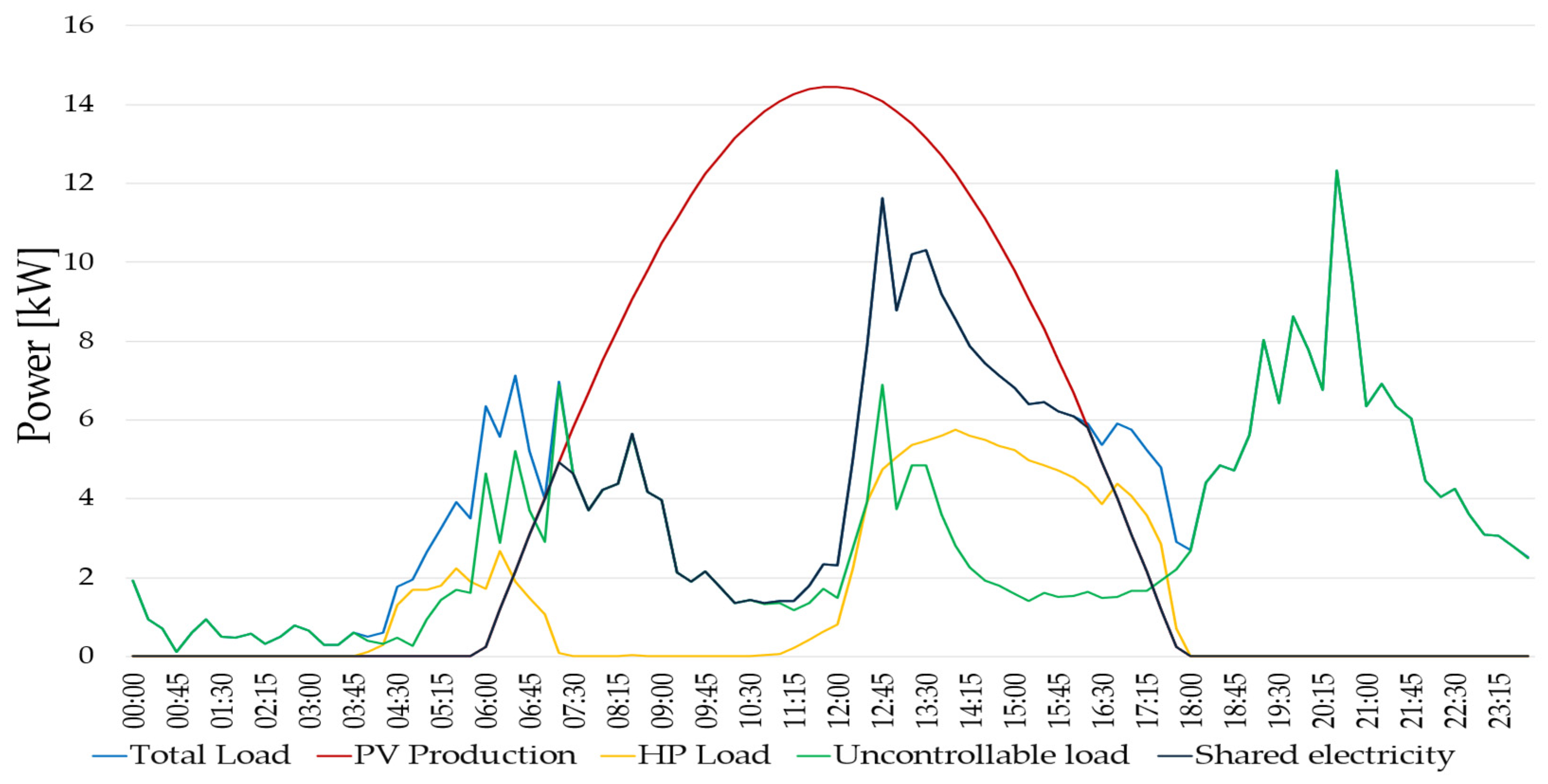
- represents the power absorbed by the HPs of apartment i in time window k, while represents the power absorbed by non-controllable loads.
- represents the power produced by the PV system in the time-window k (as the system is not associated with any flat, it has no superscript i).
- is the building’s thermal time constant.
- represents the maximum thermal power of the HP.
- is global heat loss coefficient.
- is the control variable.
- coincides with the duration of the observation window k.
- , representing the cost of the energy consumed during hour h;
- , representing the economic return from the shared electricity in hour h;
- , representing an economic penalty for thermal discomfort, capturing the deviation of the indoor temperature from the overall setpoint across the N residential units during hour h, beyond an admissible tolerance.
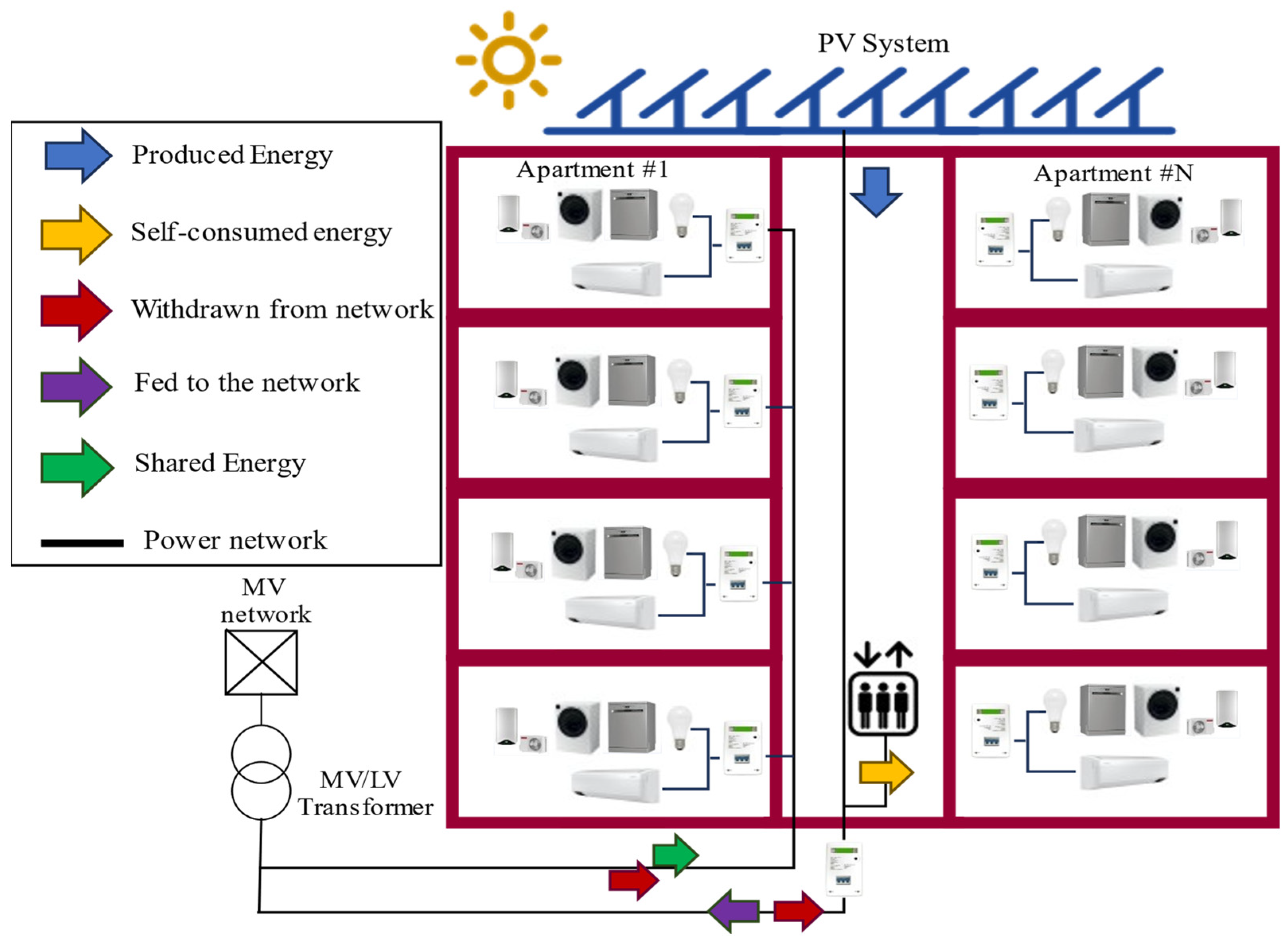
4. Case Study and Results
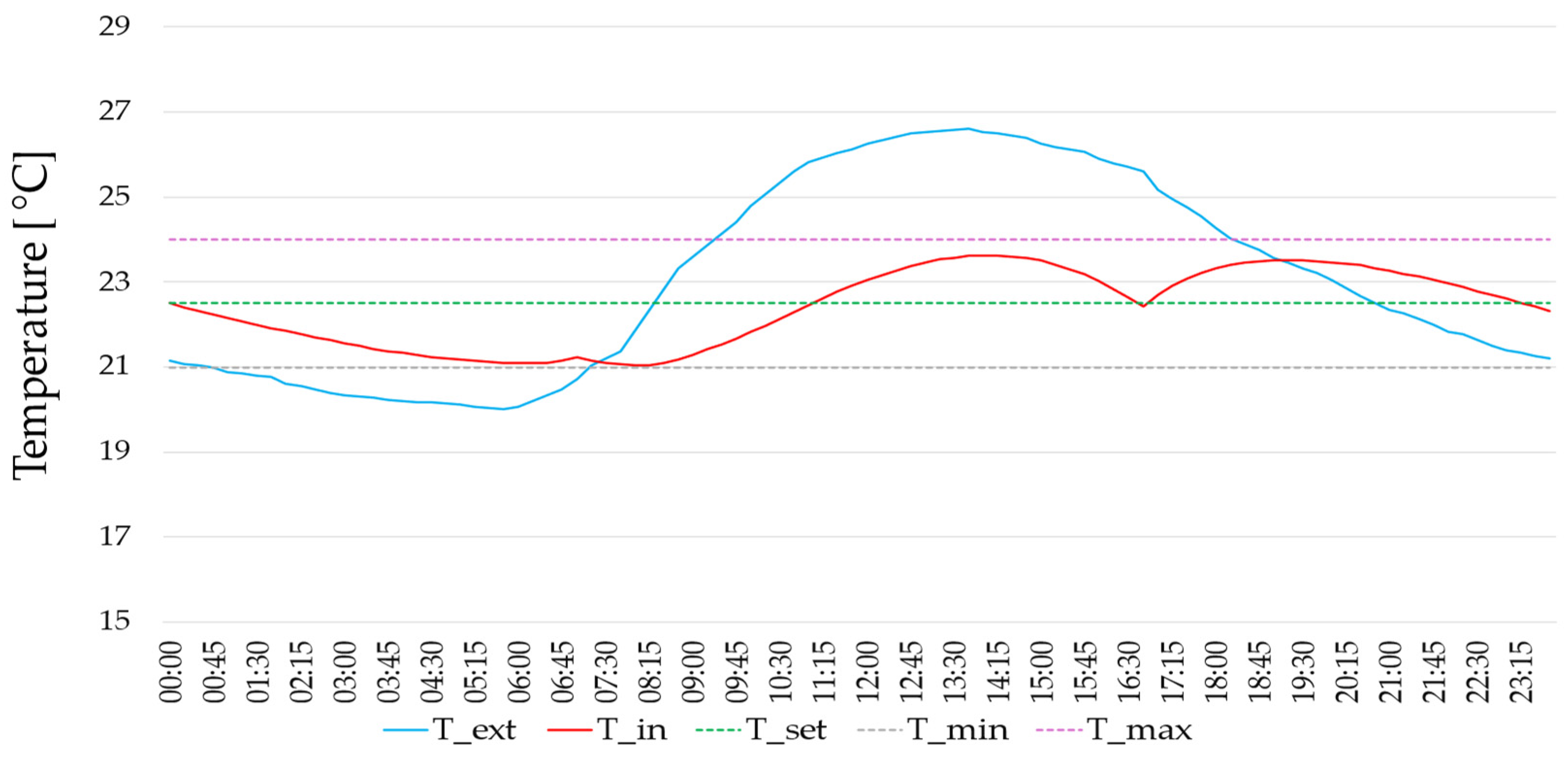
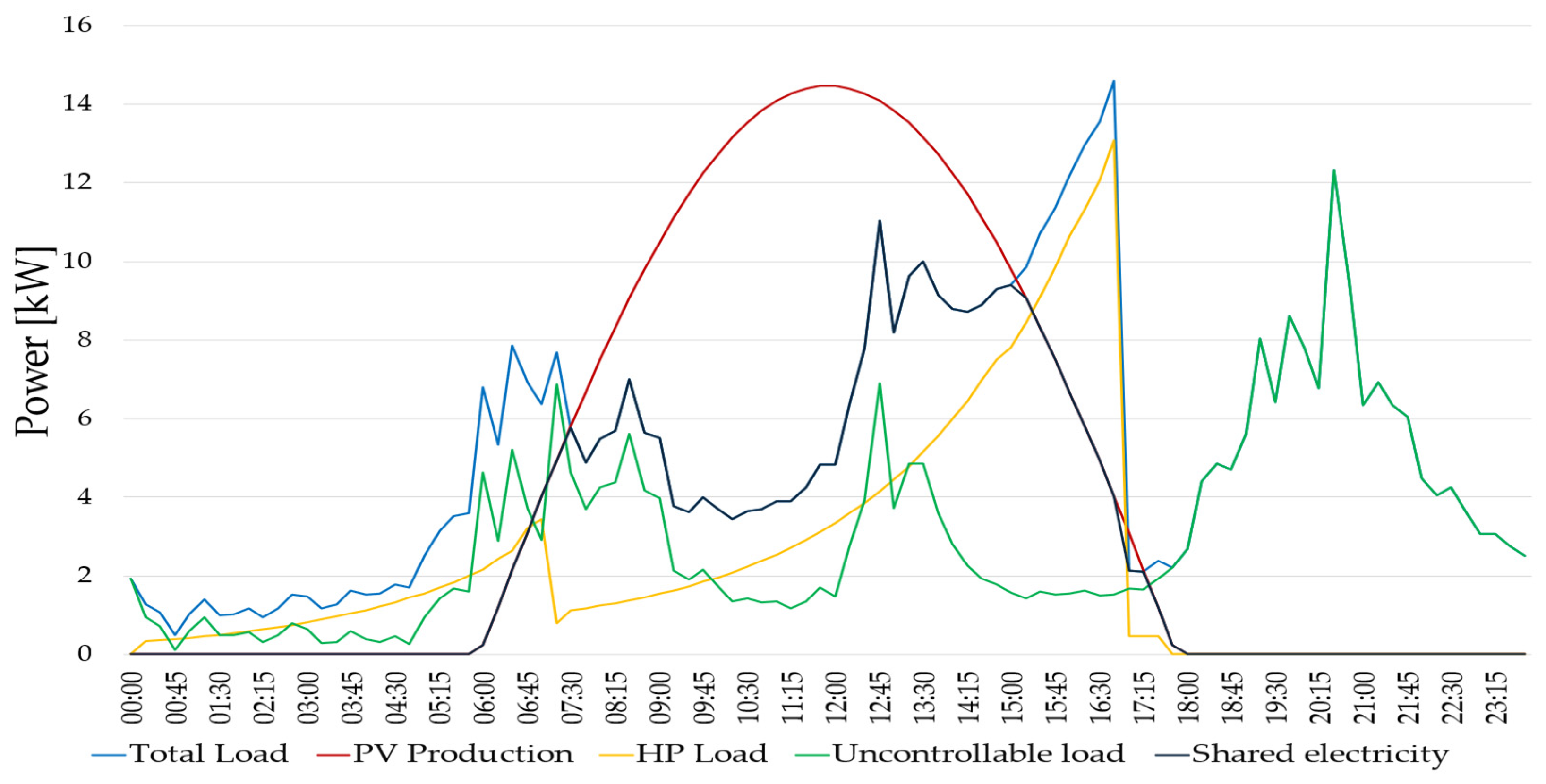
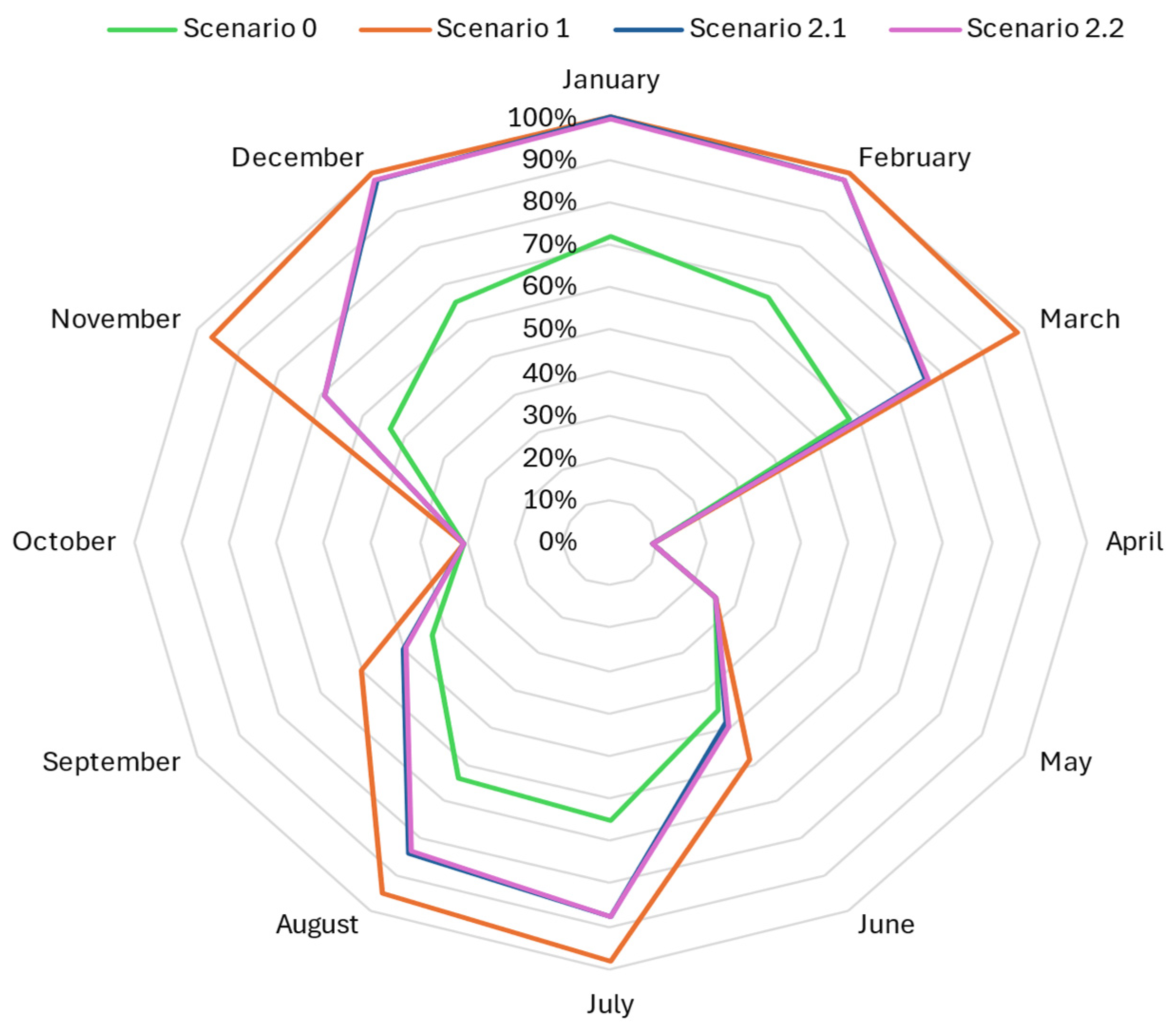
- Scenario 0 (baseline case): ON/OFF HP control (non-optimized control).
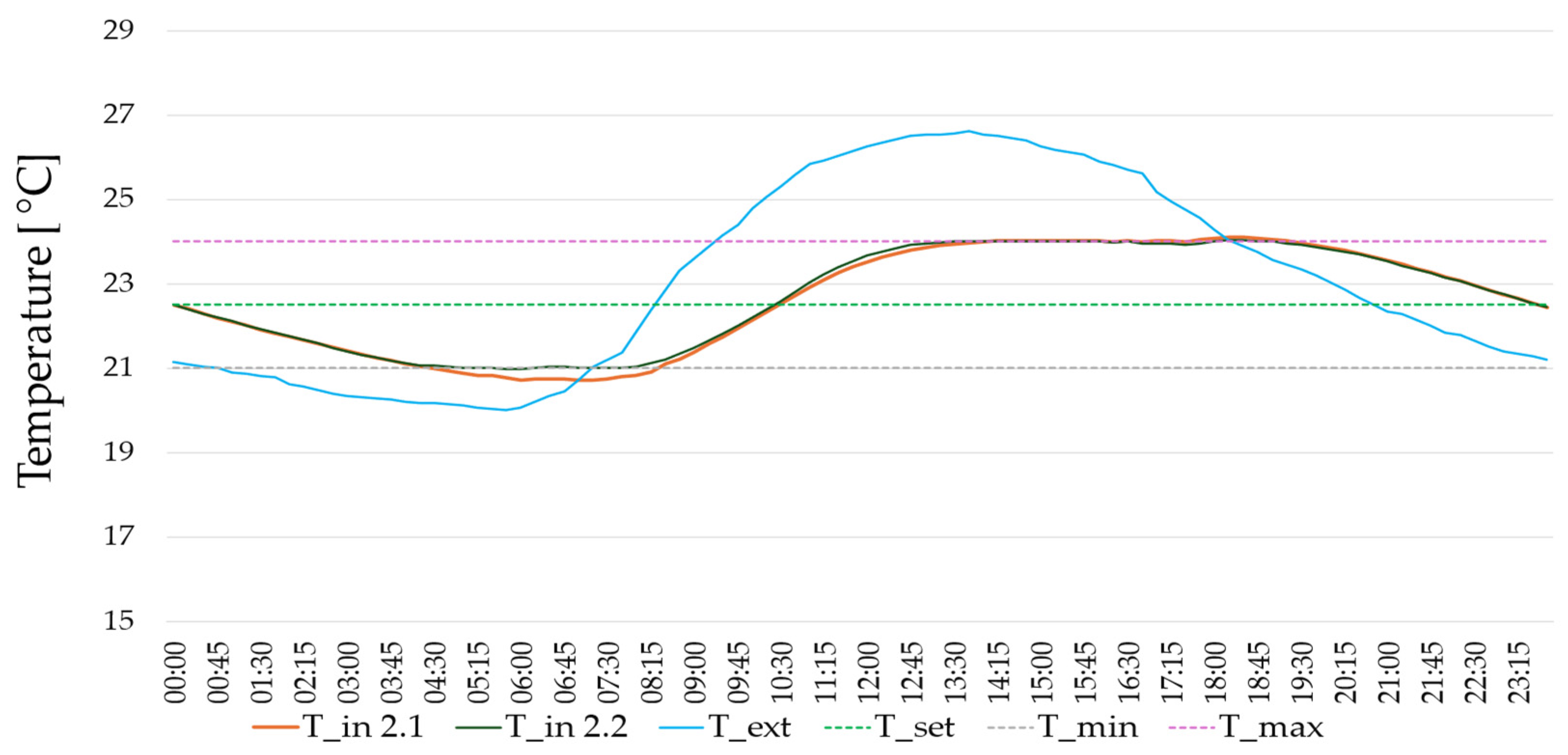
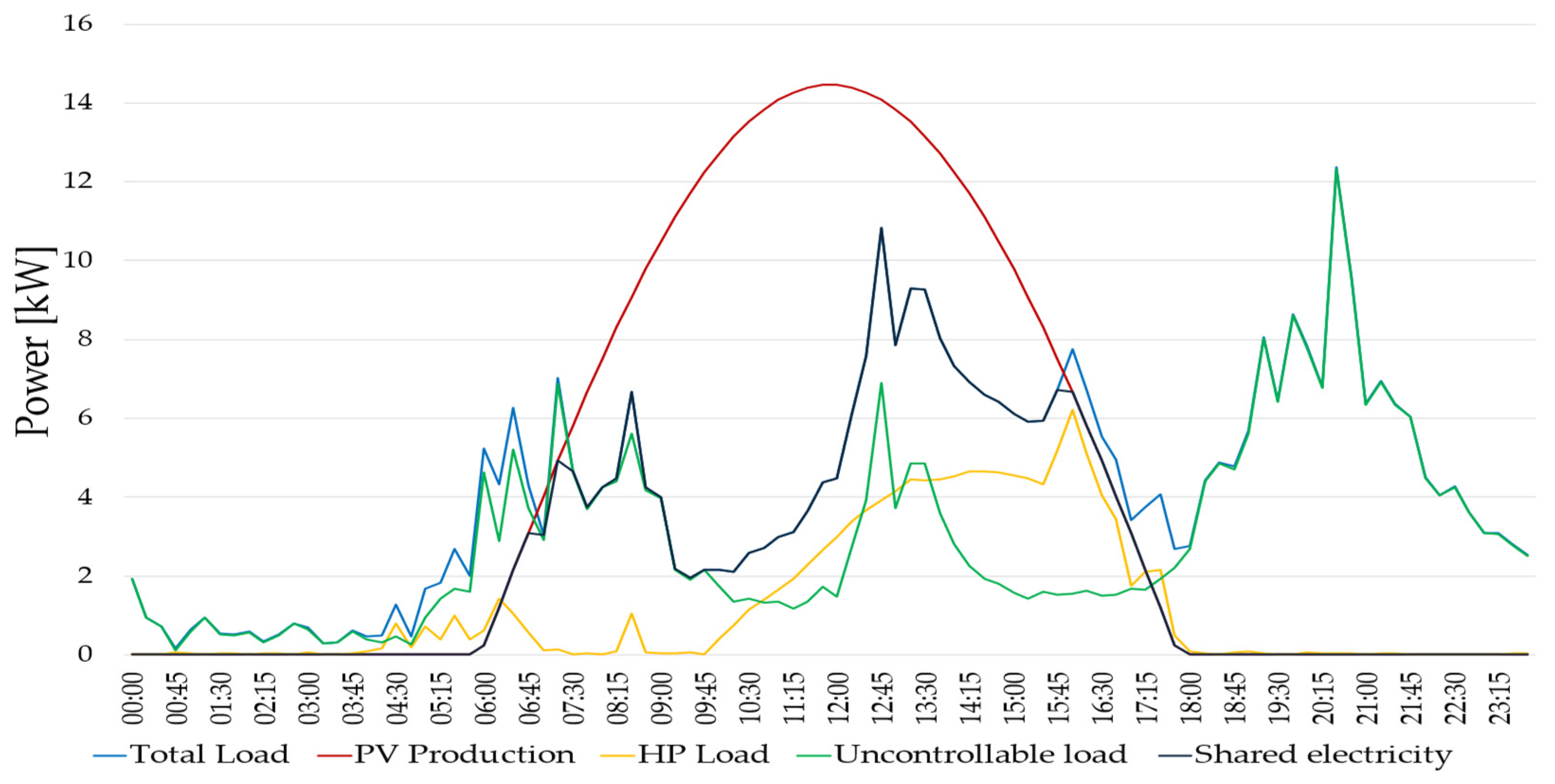
- Scenario 2: HP control according to the trade-off optimization model discussed.
4.1. Input Data
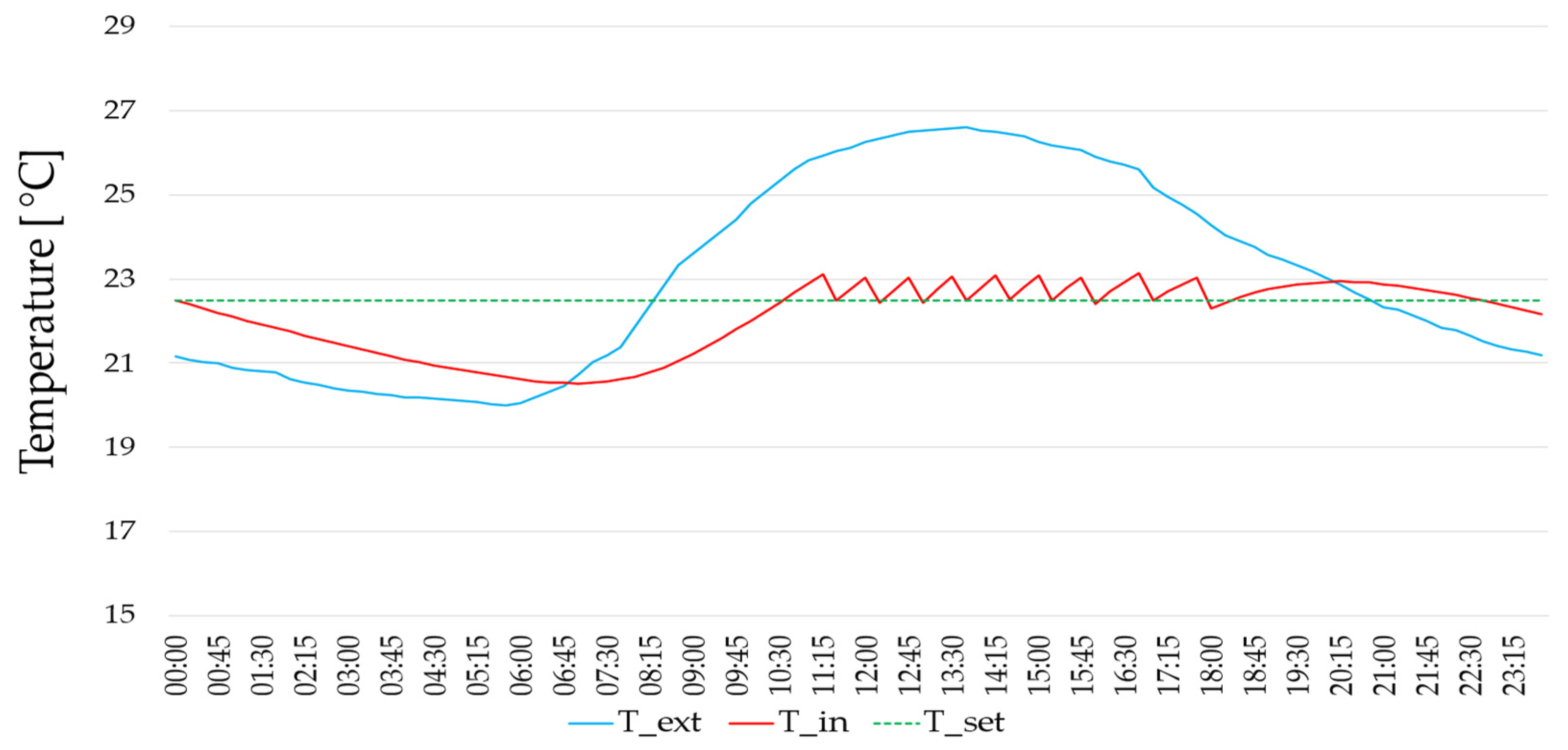
4.1.1. Outdoor Temperature Data and Photovoltaic Production
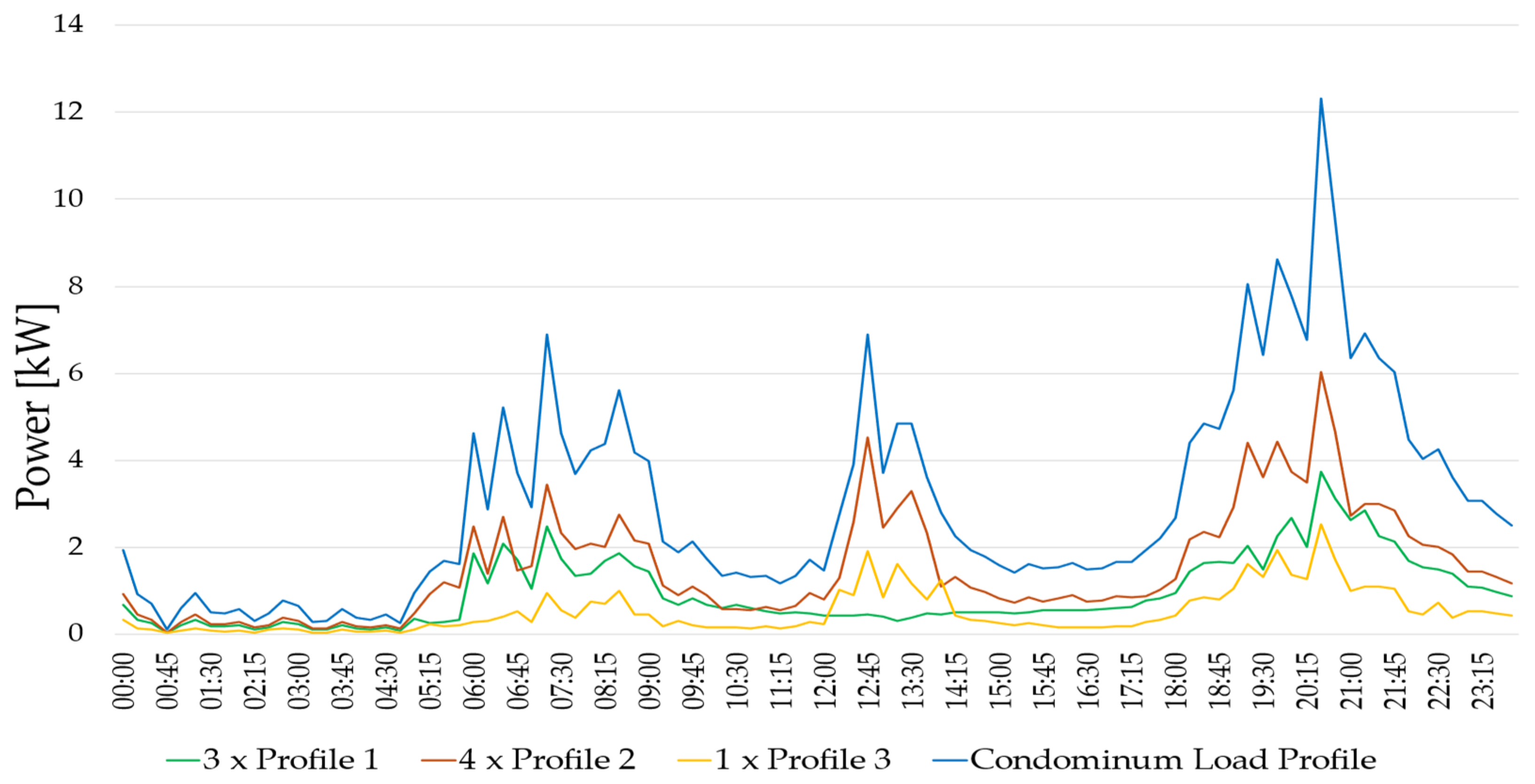
4.1.2. Daily Electrical Load Profiles
- Family with two workers, no children.
- Family with two workers, one child.
- Family with two workers, three children.
4.2. Thermal Modeling of the Building
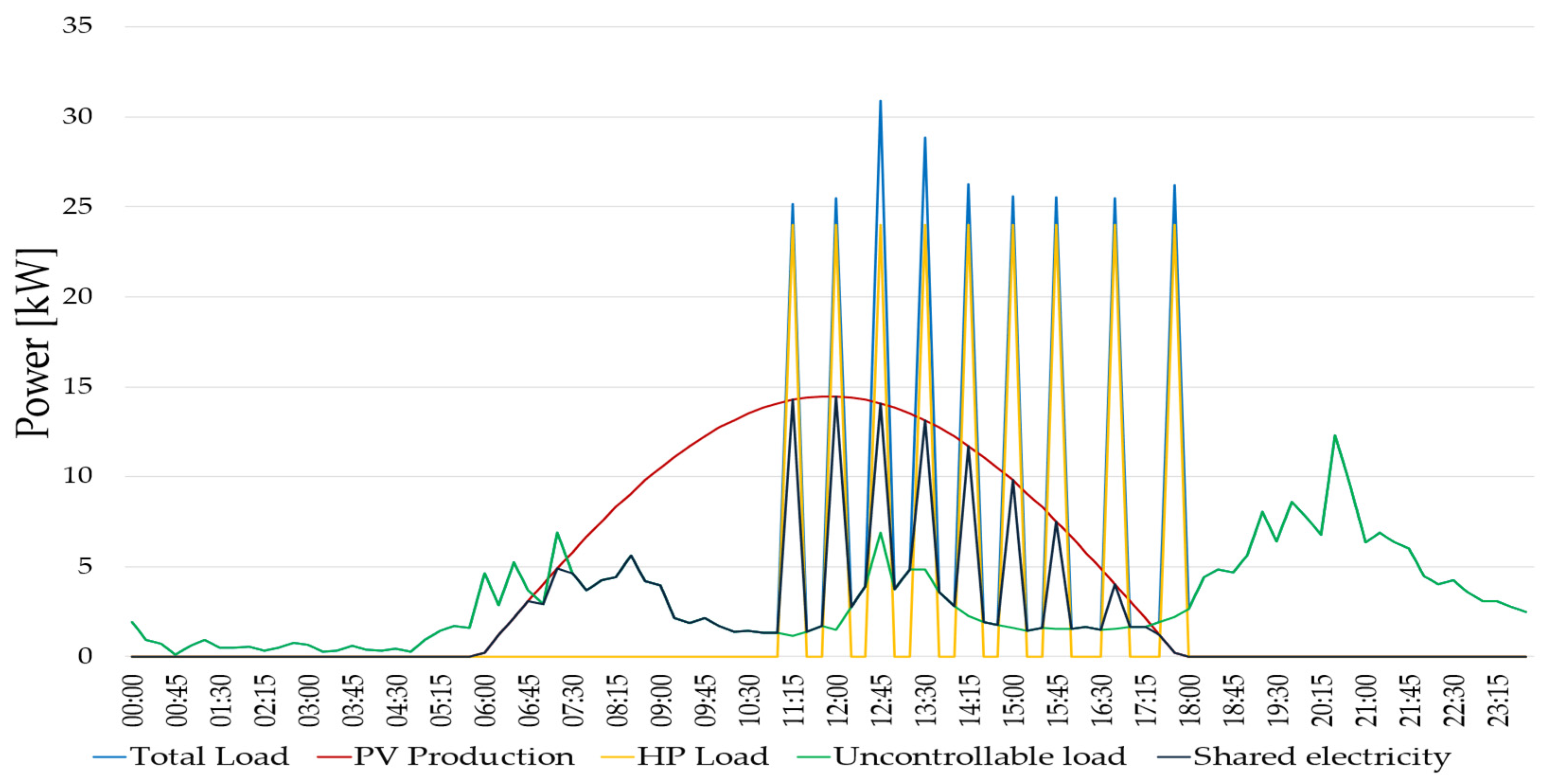
4.3. Scenarios Analyzed
4.3.1. Scenario 0
4.3.2. Scenario 1
4.3.3. Scenario 2
- (Scenario 2.1)
- (Scenario 2.2)
4.4. Monthly and Yearly Comparative Evaluation of Scenarios
4.5. Scenarios Comparison Remarks
5. Conclusions
Author Contributions
Funding
Data Availability Statement
Conflicts of Interest
Abbreviations
| CSG | Collective Self-Consumption Group |
| REC | Renewable Electricity Community |
| PV | Photovoltaic |
| HP | Heat Pump |
| SB | Smart Building |
| IoT | Internet of Things |
| EMS | Electricity Management System |
References
- European Commission. Fit for 55 Package. Fit for 55: Delivering on the Proposals—European Commission. Available online: https://commission.europa.eu/topics/climate-action/delivering-european-green-deal/fit-55-delivering-proposals_en (accessed on 29 April 2025).
- European Commission. European Climate Law. Available online: https://climate.ec.europa.eu/eu-action/european-green-deal/european-climate-law_en (accessed on 29 April 2025).
- Directive (EU) 2018/2001 of the European Parliament and of the Council-of 11 December 2018-on the Promotion of the Use of Electricity from Renewable Sources (RED II Directive). Available online: https://eur-lex.europa.eu/legal-content/EN/TXT/PDF/?uri=CELEX:32018L2001&from=EN (accessed on 29 April 2025).
- European Commission. Clean Electricity for All Europeans Package. Available online: https://ec.europa.eu/energy/topics/energy-strategy/clean-energy-all-europeans_enen (accessed on 29 April 2025).
- Directive (EU) 2019/944 of the European Parliament and of the Council of 5 June 2019 on Common Rules for the Internal Market for Electricity and Amending Directive. Available online: https://eur-lex.europa.eu/legal-content/EN/TXT/PDF/?uri=CELEX:32019L0944 (accessed on 29 April 2025).
- Italian Legislative Decree 162/19. Available online: https://www.gazzettaufficiale.it/eli/id/2019/12/31/19G00171/sg (accessed on 29 April 2025).
- ARERA, Italian Resolution 318/2020/R/EEL. Available online: https://www.arera.it/fileadmin/allegati/docs/20/318-20.pdf (accessed on 29 April 2025).
- Italian Legislative Decree 199/2021. Available online: https://www.gazzettaufficiale.it/atto/vediMenuHTML?atto.dataPubblicazioneGazzetta=2021-11-30&atto.codiceRedazionale=21G00214&tipoSerie=serie_generale&tipoVigenza=originario (accessed on 29 April 2025).
- ARERA Resolution 727/2022/R/eel of 27 December 2022. Available online: https://www.arera.it/fileadmin/allegati/docs/22/727-22.pdf (accessed on 29 April 2025).
- MASE Decree of 7 December 2023, no. 414. Decreto MASE n. 414 del 07/12/2023: È Entrato in Vigore il Decreto CER. Available online: https://www.e-cycle.it/ita/news/2705/Decreto-MASE-n-414-del-07-12-2023-e-entrato-in-vigore-il-Decreto-CER (accessed on 29 April 2025).
- Circle Economy Foundation. The Circularity Gap Report 2024: A Circular Economy to Live Within the Safe Limits of the Planet; Circle Economy Foundation: Amsterdam, The Netherlands, 2024; Available online: https://www.circularity-gap.world/2024 (accessed on 12 May 2025).
- European Commission. In Focus: Electricity Efficient Buildings. 2024. Available online: https://energy.ec.europa.eu/news/focus-energy-efficient-buildings-2024-04-16_en (accessed on 12 May 2025).
- Delavar, T.; Amiri, A.; Borgentorp, E.; Junnila, S. The Prioritization of Sustainability Features of Buildings from the Viewpoint of Experts. Buildings 2023, 13, 3021. [Google Scholar] [CrossRef]
- Zuhaib, S.; Schmatzberger, S.; Volt, J.; Tóth, Z.; Kranzl, L.; Maia, I.E.N.; Verheyen, J.; Borragán, G.; Monteiro, C.S.; Mateus, N.; et al. Next-generation electricity performance certificates: End-user needs and expectations. Electr. Policy 2022, 161, 112723. [Google Scholar] [CrossRef]
- Al Dakheel, J.; Del Pero, C.; Aste, N.; Leonforte, F. Smart Buildings Features and Key Performance Indicators: A Review. Sustain. Cities Soc. 2020, 61, 102328. [Google Scholar] [CrossRef]
- Billanes, J.D.; Ma, Z.G.; Jørgensen, B.N. Data-Driven Technologies for Electricity Optimization in Smart Buildings: A Scoping Review. Energies 2025, 18, 290. [Google Scholar] [CrossRef]
- Moudgil, V.; Hewage, K.; Hussain, S.A.; Sadiq, R. Integration of IoT in Building Electricity Infrastructure: A Critical Review on Challenges and Solutions. Renew. Sustain. Electricity Rev. 2023, 174, 113121. [Google Scholar] [CrossRef]
- Jia, M.; Komeily, A.; Wang, Y.; Srinivasan, R.S. Adopting Internet of Things for the Development of Smart Buildings: A Review of Enabling Technologies and Applications. Autom. Constr. 2019, 101, 111–126. [Google Scholar] [CrossRef]
- Ahmed, S.; Ali, A.; Ciocia, A.; D’Angola, A. Technological Elements behind the Renewable Electricity Community: Current Status, Existing Gap, Necessity, and Future Perspective—Overview. Energies 2024, 17, 3100. [Google Scholar] [CrossRef]
- Menniti, D.; Pinnarelli, A.; Sorrentino, N.; Vizza, P.; Barone, G.; Brusco, G.; Mendicino, S.; Mendicino, L.; Polizzi, G. Enabling Technologies for Electricity Communities: Some Experimental Use Cases. Energies 2022, 15, 6374. [Google Scholar] [CrossRef]
- Ahmed, S.; Ali, A.; D’Angola, A. A Review of Renewable Electricity Communities: Concepts, Scope, Progress, Challenges, and Recommendations. Sustainability 2024, 16, 1749. [Google Scholar] [CrossRef]
- Gjorgievski, V.; Cundeva, S.; Georghiou, G. Social arrangements, technical designs and impacts of electricity communities: A review. Renew. Electr. 2021, 169, 1138–1156. [Google Scholar] [CrossRef]
- Trevisan, R.; Ghiani, E.; Olivero, S.; Bailo, M. The Magliano Alpi Electricity Community: Analysis and Insights After Three-Years Operation. In Proceedings of the IEEE International Conference on Environment and Electrical Engineering and 2024 IEEE Industrial and Commercial Power Systems Europe (EEEIC/I&CPS Europe), Rome, Italy, 17–20 June 2024; pp. 1–6. [Google Scholar] [CrossRef]
- Lazzari, F.; Mor, G.; Cipriano, J.; Solsona, F.; Chemisana, D.; Guericke, D. Optimizing planning and operation of renewable energy communities with genetic algorithms. Appl. Electr. 2023, 338, 120906. [Google Scholar] [CrossRef]
- Sassone, A.; Ahmed, S.; D’Angola, A. A Profit Optimization Model for Renewable Electricity Communities Based on the Distribution of Participants. In Proceedings of the IEEE International Conference on Environment and Electrical Engineering and 2024 IEEE Industrial and Commercial Power Systems Europe (EEEIC/I&CPS Europe), Rome, Italy, 17–20 June 2024; pp. 1–6. [Google Scholar] [CrossRef]
- Cutore, E.; Volpe, R.; Sgroi, R.; Fichera, A. Electricity Management and Sustainability Assessment of Renewable Electricity Communities: The Italian Context. Electr. Convers. Manag. 2023, 278, 116713. [Google Scholar] [CrossRef]
- Cosic, A.; Stadler, M.; Mansoor, M.; Zellinger, M. Mixed-Integer Linear Programming-Based Optimization Strategies for Renewable Electricity Communities. Electricity 2021, 237, 121559. [Google Scholar] [CrossRef]
- Casella, V.; Ferro, G.; Parodi, L.; Robba, M. Electricity Community Optimal Management: A Bilevel Approach. In Proceedings of the IEEE 20th International Conference on Automation Science and Engineering (CASE), Bari, Italy, 28 August–1 September 2024; pp. 2720–2725. [Google Scholar] [CrossRef]
- Dal Cin, E.; Carraro, G.; Volpato, G.; Lazzaretto, A.; Danieli, P. A multi-criteria approach to optimize the design-operation of Electricity Communities considering economic-environmental objectives and demand side management. Electr. Convers. Manag. 2022, 263, 115677. [Google Scholar] [CrossRef]
- Di Somma, M.; Dolatabadi, M.; Burgio, A.; Siano, P.; Cimmino, D.; Bianco, N. Erratum to Optimizing Virtual Electricity Sharing in Renewable Electricity Communities of Residential Users for Incentives Maximization. Sustain. Electr. Grids Netw. 2024, 40, 101557. [Google Scholar] [CrossRef]
- Sitzia, G.; Roscia, M.C.; Valerii, M.; Ghiani, E. Integrating Electricity Communities and Digital Condominiums with KNX Technology. In Proceedings of the 2024 AEIT International Annual Conference (AEIT), Trento, Italy, 18–20 September 2024; pp. 1–6. [Google Scholar] [CrossRef]
- Yao, R.; Steemers, K. A Method of Formulating Electricity Load Profile for Domestic Buildings in the UK. Electr. Build. 2005, 37, 663–671. [Google Scholar] [CrossRef]
- Ayan, O.; Turkay, B. Domestic Electrical Load Management in Smart Grids and Classification of Residential Loads. In Proceedings of the 2018 5th International Conference on Electrical and Electronic Engineering (ICEEE), Istanbul, Turkey, 3–5 May 2018; pp. 279–283. [Google Scholar] [CrossRef]
- RSE—Ricerca sul Sistema Energetico. Analisi della Flessibilità di Impianti di Riscaldamento e Raffrescamento e Sviluppo di Metodologie per L’aggregazione e la Fornitura di Servizi da Parte di Risorse Distribuite Singole; RSE: Milano, Italy, 2024; Available online: https://www.rse-web.it/wp-content/uploads/2024/09/Analisi-della-flessibilita-di-impianti-di-riscaldamento-e-raffrescamento-e-sviluppo-di-metodologie-per-laggregazione-e-la-fornitura-di-servizi-da-parte-di-risorse-distribuite-singole.pdf (accessed on 12 May 2025).
- Schreurs, T.; Madani, H.; Zottl, A.; Sommerfeldt, N.; Zucker, G. Techno-Economic Analysis of Combined Heat Pump and Solar PV System for Multi-Family Houses: An Austrian Case Study. Electr. Strategy Rev. 2021, 36, 100666. [Google Scholar] [CrossRef]
- Rehman, M.A.; Borri, E.; Palomba, V.; Frazzica, A.; Brancato, V.; Botargues, T.; Cabeza, L.F. Analysis on Integration of Heat Pumps and Thermal Electricity Storage in Current Electricity System: From Research Outputs to Electricity Policies. J. Electr. Storage 2024, 97, 112795. [Google Scholar] [CrossRef]
- Honarmand, M.E.; Hosseinnezhad, V.; Hayes, B.; Shafie-Khah, M.; Siano, P. An Overview of Demand Response: From Its Origins to the Smart Electricity Community. IEEE Access 2021, 9, 96851–96876. [Google Scholar] [CrossRef]
- UNI EN ISO 7730:2006; Ergonomics of the Thermal Environment—Analytical Determination and Interpretation of Thermal Comfort Using Calculation of the PMV and PPD Indices and Local Thermal Comfort Criteria. Italian Organization for Standardization (UNI): Milan, Italy, 2006. Available online: https://store.uni.com/en/uni-en-iso-7730-2006 (accessed on 10 September 2025).
- ANSI/ASHRAE Standard 55-2023; Thermal Environmental Conditions for Human Occupancy. American Society of Heating, Refrigerating and Air-Conditioning Engineers: Atlanta, GA, USA, 2023. Available online: https://www.ashrae.org/technical-resources/bookstore/standard-55-thermal-environmental-conditions-for-human-occupancy (accessed on 10 September 2025).
- Ministry of the Environment and Electricity Security. Ministerial Decree of 8 May 2025, Amendment to the CACER Decree 2025, File 663. Available online: https://www.rinnovabili.it/wp-content/uploads/2025/05/DM-modifica-DM-CACER_2025.05.08-fasc-663_signed-1.pdf (accessed on 25 May 2025).
- Gestore dei Mercati Energetici. Prezzi Zonali—MGP Esiti Elettricità; GME: Roma, Italy, 2025; Available online: https://gme.mercatoelettrico.org/it-it/Home/Esiti/Elettricita/MGP/Esiti/PrezziZonali (accessed on 30 July 2025).
- Gestore dei Servizi Energetici (GSE). Prezzi Medi Mensili per Fascia Oraria e Zona—Ritiro Dedicato (RID), Anno 2025; GSE: Roma, Italy, 2025; Available online: https://www.gse.it/documenti_site/Documenti%20GSE/Servizi%20per%20te/RITIRO%20DEDICATO/Altri%20contenuti/Prezzi%20medi%20RID%202025.pdf (accessed on 30 July 2025).
- Joint Research Centre (JRC). Photovoltaic Geographical Information System (PVGIS). Available online: https://re.jrc.ec.europa.eu/pvg_tools/en/#TMY (accessed on 3 August 2025).
- UNI EN ISO 13786:2018; Thermal Performance of Building Components—Dynamic Thermal Characteristics—Calculation Methods. International Organization for Standardization: Geneva, Switzerland, 2018.
- UNI EN ISO 6946:2018; Building Components and Building Elements—Thermal Resistance and Thermal Transmittance—Calculation Method. International Organization for Standardization: Geneva, Switzerland, 2018.
- ISO 52016-1:2017; Electricity Performance of Buildings—Electricity Needs for Heating and Cooling, Internal Temperatures and Sensible and Latent Heat Loads—Part 1: Calculation Procedures. International Organization for Standardization: Geneva, Switzerland, 2017.
- Belloni, E.; Fioriti, D.; Poli, D. Optimal Design of Renewable Electricity Communities (RECs) in Italy: Influence of Composition, Market Signals, Buildings, Location, and Incentives. Electr. Power Syst. Res. 2024, 235, 110895. [Google Scholar] [CrossRef]
- Ghiani, E.; Trevisan, R.; Pilo, F. Performance Metrics for Renewable Electricity Communities. In Proceedings of the 2022 AEIT International Annual Conference (AEIT), Rome, Italy, 5–7 October 2022; pp. 1–6. [Google Scholar] [CrossRef]



| Nominal Power (kW) | Fixed Component (€/MWh) | Variable Component (€/MWh) | Maximum Tariff (€) | Geographical Correction Factor for PV Only (€/MWh) | ||
|---|---|---|---|---|---|---|
| South | Centre | North | ||||
| p ≤ 200 | 80 | 0 ÷ 40 | 120 | +0 | +4 | +10 |
| 200 < p ≤ 600 | 70 | 0 ÷ 40 | 110 | |||
| p > 600 | 60 | 0 ÷ 40 | 100 | |||
| Load Profile | Residential Units # | Power Contract Size [kW] | Yearly Consumption [kWh] | Yearly Bill Cost [€] |
|---|---|---|---|---|
| 1 | 3 | 4.5 | 10,632 | 2335 |
| 2 | 4 | 4.5 | 11,307 | 2478 |
| 3 | 1 | 6 | 11,691 | 2570 |
| Jan | Feb | Mar | Apr | May | Jan | Jul | Aug | Sep | Oct | Nov | Dec | |
|---|---|---|---|---|---|---|---|---|---|---|---|---|
| Cost [€/kWh] | 0.18 | 0.17 | 0.17 | 0.21 | 0.21 | 0.26 | 0.26 | 0.34 | 0.34 | 0.24 | 0.24 | 0.21 |
| Month | ∆ Electricity Shared [kWh] | ∆ Electricity Consumption [kWh] | Daily Comfort Deviation [°C∙h] | ||||||
|---|---|---|---|---|---|---|---|---|---|
| Scenario 1 | Scenario 2 | Scenario 1 | Scenario 2 | Scenario 1 | Scenario 2 | ||||
| Jan | +671 | +671 | +662 | 0 | −2787 | −1942 | 0 | 9.6 | 0.8 |
| Feb | +798 | +750 | +751 | −3 | −2441 | −1749 | 0 | 9.1 | 0.9 |
| Mar | +1268 | +564 | +590 | 0 | −2933 | −1969 | 0 | 7.9 | 0.7 |
| Apr | - | - | - | - | - | - | - | - | - |
| May | - | - | - | - | - | - | - | - | - |
| Jun | +467 | +113 | +144 | 0 | −797 | −512 | 0 | 2.5 | 0.1 |
| Jul | +1329 | +903 | +908 | 0 | −1518 | −1411 | 0 | 1.3 | 0 |
| Aug | +1216 | +795 | +763 | 0 | −1562 | −1429 | 0 | 1.9 | <0.1 |
| Sep | +553 | +236 | +199 | 0 | −749 | −623 | 0 | 1.2 | <0.1 |
| Oct | - | - | - | - | - | - | - | - | - |
| Nov | +990 | +362 | +361 | 0 | −2955 | −2155 | 0 | 8.7 | 0.5 |
| Dec | +785 | +744 | +748 | 0 | −3152 | −2091 | 0 | 9.2 | 0.7 |
| Month | ∆ Revenue for Electricity Shared [€] | ∆ Cost for Electricity Consumption [€] | Net Economic Benefit [€] | ||||||
|---|---|---|---|---|---|---|---|---|---|
| Scenario 1 | Scenario 2 | Scenario 1 | Scenario 2 | Scenario 1 | Scenario 2 | ||||
| Jan | +80.5 | +80.5 | +79.5 | 0 | −487.8 | −339.9 | 80.5 | 568.3 | 419.4 |
| Feb | +95.8 | +90 | +90.1 | −0.6 | −415 | −297.4 | 95.2 | 505 | 397.5 |
| Mar | +152.2 | +67.7 | +70.8 | 0 | −498.7 | −334.6 | 152.2 | 566.5 | 405.4 |
| Apr | - | - | - | - | - | - | - | - | |
| May | - | - | - | - | - | - | - | - | |
| Jun | +56.1 | +13.6 | +17.3 | 0 | −207.2 | −132.9 | 56.1 | 220.7 | 150.2 |
| Jul | +159.5 | +108.3 | +109 | 0 | −394.6 | −366.9 | 159.5 | 503 | 475.9 |
| Aug | +146 | +95.4 | +91.5 | 0 | −531.2 | −485.7 | 146 | 626.6 | 577.3 |
| Sep | +66.4 | +28.3 | +23.9 | 0 | −254.8 | −232.1 | 66.4 | 283.2 | 256 |
| Oct | - | - | - | - | - | - | - | - | |
| Nov | +118.9 | +43.4 | +43.4 | 0 | −712.3 | −519.3 | 118.9 | 755.7 | 562.7 |
| Dec | +94.3 | +89.3 | +89.9 | 0 | −674.6 | −447.4 | 94.3 | 763.9 | 537.3 |
| Scenario | Revenue for Electricity Shared [€] | ∆ Revenue for Electricity Shared [%] | Cost for Electricity Consumption [€] | ∆ Cost for Electricity Consumption [%] | Net Economic Benefit [€] |
|---|---|---|---|---|---|
| 0 | 2171 | - | 19,597 | - | - |
| 1 | 3141 | +44.7% | 19,597 | 0 | 965 |
| 2788 | +28.4% | 15,420 | −21.3% | 4793 | |
| 2786 | +28.3% | 16,440 | −16.1% | 3771 |
Disclaimer/Publisher’s Note: The statements, opinions and data contained in all publications are solely those of the individual author(s) and contributor(s) and not of MDPI and/or the editor(s). MDPI and/or the editor(s) disclaim responsibility for any injury to people or property resulting from any ideas, methods, instructions or products referred to in the content. |
© 2026 by the authors. Licensee MDPI, Basel, Switzerland. This article is an open access article distributed under the terms and conditions of the Creative Commons Attribution (CC BY) license.
Share and Cite
Mattana, F.; Ricciu, R.; Sitzia, G.; Ghiani, E. Optimizing the Trade-Off Among Comfort, Electricity Use, and Economic Benefits in Smart Buildings Within Renewable Electricity Communities. Energies 2026, 19, 547. https://doi.org/10.3390/en19020547
Mattana F, Ricciu R, Sitzia G, Ghiani E. Optimizing the Trade-Off Among Comfort, Electricity Use, and Economic Benefits in Smart Buildings Within Renewable Electricity Communities. Energies. 2026; 19(2):547. https://doi.org/10.3390/en19020547
Chicago/Turabian StyleMattana, Federico, Roberto Ricciu, Gianmarco Sitzia, and Emilio Ghiani. 2026. "Optimizing the Trade-Off Among Comfort, Electricity Use, and Economic Benefits in Smart Buildings Within Renewable Electricity Communities" Energies 19, no. 2: 547. https://doi.org/10.3390/en19020547
APA StyleMattana, F., Ricciu, R., Sitzia, G., & Ghiani, E. (2026). Optimizing the Trade-Off Among Comfort, Electricity Use, and Economic Benefits in Smart Buildings Within Renewable Electricity Communities. Energies, 19(2), 547. https://doi.org/10.3390/en19020547