1. Introduction
1.1. Research Background
Driven by fossil fuel depletion and environmental concerns [
1], the global energy transition has accelerated rapidly, with photovoltaic (PV) generation emerging as a cornerstone of renewable energy systems. In recent years, PV installed capacity has experienced sustained and large-scale growth, supported by policy frameworks such as China’s 14th Five-Year Plan for a Modern Energy System, the European Green Deal, and U.S. clean energy initiatives [
2]. As a result, PV deployment has evolved from a supplementary resource to a dominant component of modern power systems, encompassing both centralized and distributed configurations.
However, high PV penetration fundamentally alters power system dynamics. The inherent intermittency, volatility, and uncertainty of solar resources increasingly conflict with the inertia-dependent operation of traditional power systems dominated by synchronous generators. This mismatch directly exacerbates risks of frequency deviation, voltage instability, and power oscillations, thereby emerging as a critical bottleneck for large-scale renewable integration. Consequently, PV stability control has shifted from device-level optimization toward coordinated control across source–grid–load–storage systems, aiming to address voltage instability, frequency drift, and power fluctuations under high-penetration conditions.
1.2. Definition and Scope of Stability Control in PV Systems
1.2.1. Definition of Power System Stability
According to the GB/T 31464-2022 [
3] power grid operation criteria, power system stability refers to the ability of the power system to maintain stable operation after being disturbed.
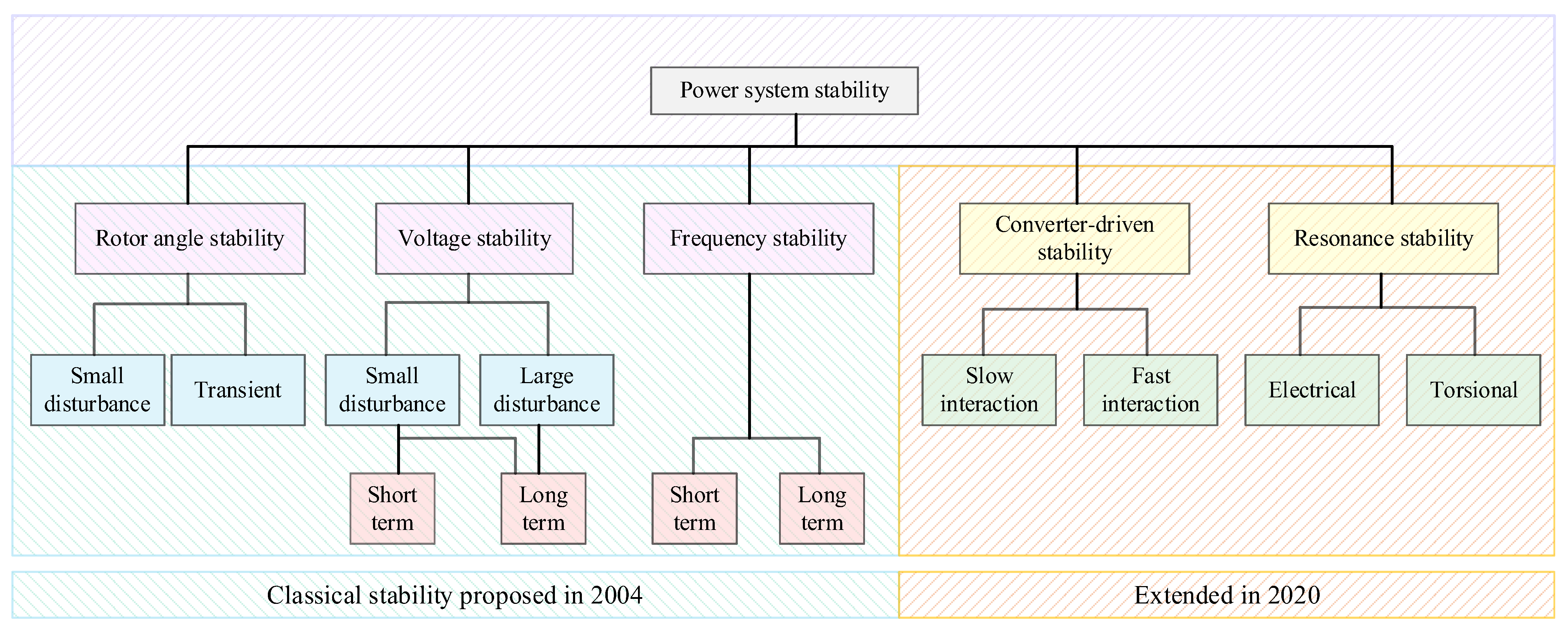
Regarding the classification of power system stability, the stability classification proposed in the 2020 technical report [
4] adds two new branches to the stability classification proposed in the 2004 technical report [
5], namely resonance stability and converter drive stability. The classification structure is shown in the following figure,
Figure 1.
1.2.2. PV System Control Level
Stability control in PV systems refers to the coordinated control framework that regulates key variables, including voltage, frequency, power, and current [
6], to maintain secure and efficient operation under internal disturbances (e.g., irradiance variability) and external contingencies (e.g., load changes and grid faults). The primary objective is to ensure voltage and frequency stability, suppress power oscillations, and meet grid-code requirements while maintaining power quality and reliability [
5].
From a hierarchical control viewpoint, stability control spans three levels:
Device-level control, including maximum power point tracking (MPPT), direct current (DC)-link regulation, and inverter inner-loop dynamics [
7,
8];
Plant-level control, focusing on power balancing and grid-adaptive operation within a PV station [
9];
Grid-level control, enabling coordinated operation among multiple PV plants, energy storage systems, and the wider power grid through distributed and supervisory control strategies [
10].
Unlike conventional stability control based on synchronous generators, PV systems must address the combined challenges of converter-dominated dynamics, reduced inertia, and strong voltage–frequency coupling, necessitating advanced coordination and inertial emulation mechanisms.
1.3. Gap: Why an Updated Review Is Needed
The increasing penetration of PVs and other inverter-based resources has led to a sharp decline in system-equivalent inertia, posing fundamental challenges to grid stability [
11]. PV output variability, often reaching significant fractions of rated capacity within short time intervals [
12], can induce voltage deviations, frequency fluctuations, and even grid oscillations under stressed conditions [
13]. Moreover, PV systems interfaced through power electronic converters lack the inherent inertia and damping of synchronous generators [
14,
15], making them susceptible to emerging stability issues such as weak-grid interactions, subsynchronous oscillations, and insufficient fault ride-through capability [
16,
17].
Meanwhile, grid codes worldwide increasingly mandate active support functionalities, including inertial response, primary frequency regulation, and low-voltage ride-through (LVRT) [
18]. Although numerous control strategies have been proposed, many remain limited by model dependency, insufficient robustness, or poor adaptability across operating scenarios [
19,
20]. Therefore, a systematic and up-to-date review of PV stability control covering control principles, technological pathways, and application performance is essential for identifying limitations, clarifying applicability, and guiding future research [
21,
22].
1.4. Contribution of This Review Paper
Traditional MPPT-based control remains a foundational component of PV system operation [
23]. Classical methods such as perturb and observe (P&O) and incremental conductance (INC) have been extensively studied and enhanced through adaptive step-size design and heuristic optimization techniques to improve tracking accuracy under complex irradiance conditions [
24,
25]. Nonlinear approaches, including fuzzy logic and sliding-mode control, further enhance robustness but face challenges in multi-objective coordination.
Beyond device-level optimization, system-oriented strategies, such as constant power control combined with energy storage, have been proposed to mitigate PV output fluctuations, though limitations remain in harmonic suppression and weak-grid adaptability [
26,
27,
28].
To address synchronization and inertia deficiencies, control paradigms have progressively transitioned from grid-following (GFL) to grid-forming (GFM) architectures [
29]. While GFL converters relying on phase-locked loops (PLLs) suffer from synchronization vulnerability in weak grids [
30], GFM strategies, particularly virtual synchronous generator (VSG) control, enable inertial and damping emulation, significantly enhancing frequency support and transient stability [
31,
32,
33]. Recent studies have further explored voltage-controlled GFM schemes and passivity-based control frameworks to improve robustness and multi-converter coordination [
34,
35].
More recently, data-driven and intelligent control approaches have gained increasing attention. Machine learning and deep learning techniques enable accurate PV power forecasting and predictive control through hybrid models combining signal decomposition and neural networks [
36,
37,
38]. In real-time applications, reinforcement learning-based strategies demonstrate strong adaptability in MPPT optimization and energy storage scheduling, offering improved performance over traditional model predictive control (MPC) methods while achieving a balance among efficiency, stability, and equipment lifespan [
39,
40].
This review systematically categorizes PV stability control strategies across control hierarchies and paradigms, highlighting their theoretical foundations, practical limitations, and future research trends under high-penetration, converter-dominated power systems. Compared with existing reviews, its unique contributions are explicitly summarized as follows:
It establishes a hierarchical “device-system-grid” analytical framework for PV stability control, breaking through the limitations of the single-layer control focus in existing studies.
It integrates emerging technologies (data-driven/AI control, digital twins, advanced GFM inverters) with classical control methods, forming a complete technical system that covers both traditional optimization approaches and innovative solutions.
It constructs systematic mapping between stability types (small-signal, transient, voltage, frequency, converter-driven, resonance stability) and applicable control strategies, providing direct technical references for scenario-specific solution selection.
This is in contrast to key early reviews:
Zhang et al. [
8] focused on inverter-level control and intelligent optimization, while this review expands the research scope to the entire PV power station–grid interaction system, emphasizing multilevel coordination and stability mechanism analysis.
Song et al. [
11] mainly discussed inertia loss challenges caused by high renewable energy penetration, while this review comprehensively covers multiple stability dimensions and integrates emerging technical pathways, presenting a more holistic critical analysis of current technical bottlenecks and future directions.
1.5. Paper Organization
This paper is organized as follows.
Section 2 presents the review methodology and literature screening process.
Section 3 reviews PV system stability, including small-signal transient, voltage, and frequency stability, together with representative modeling approaches.
Section 4 summarizes stability control strategies at the device, plant, and grid levels.
Section 5 discusses emerging approaches such as data-driven and artificial intelligence (AI)-based control, digital twins, and advanced grid-forming inverters.
Section 6 outlines key challenges and future research trends, and
Section 7 concludes the paper.
2. Review Screening Methods
This paper presents a comprehensive review of the stability control technologies for PV power systems using rigorous research methods, covering their control techniques, performance advantages, and optimization directions.
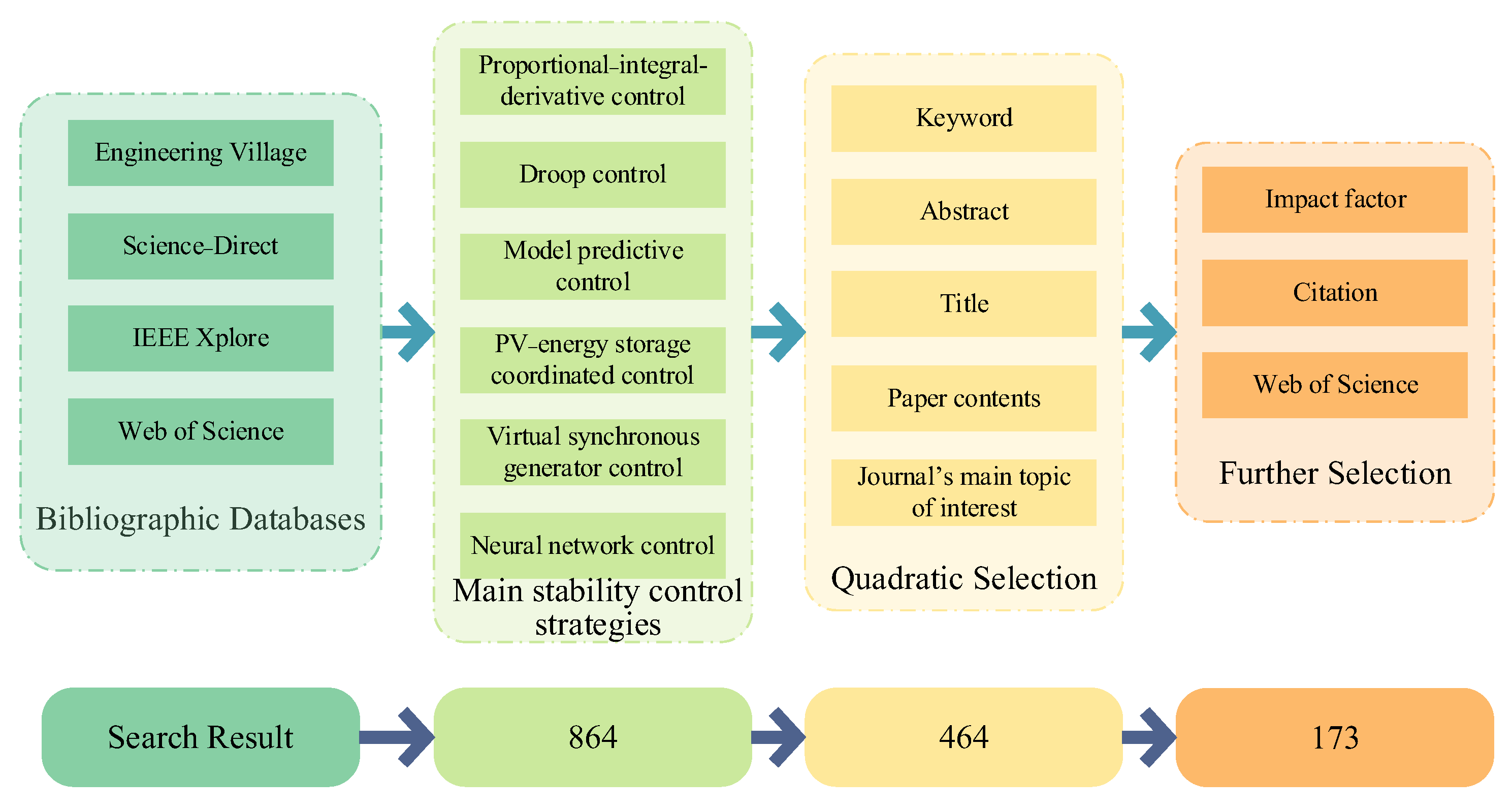
First, four major literature retrieval databases (ScienceDirect, IEEE Xplore, Web of Science, and Engineering Village) were used to retrieve literature related to key stability control strategies of PV power systems including proportional–integral–derivative (PID) control, droop control, model predictive control (MPC), PV-energy storage coordinated control, virtual synchronous generator (VSG) control, and neural network control, where the search time range was specified as January 2016 to January 2026.
The process of the literature retrieval and screening is as shown in
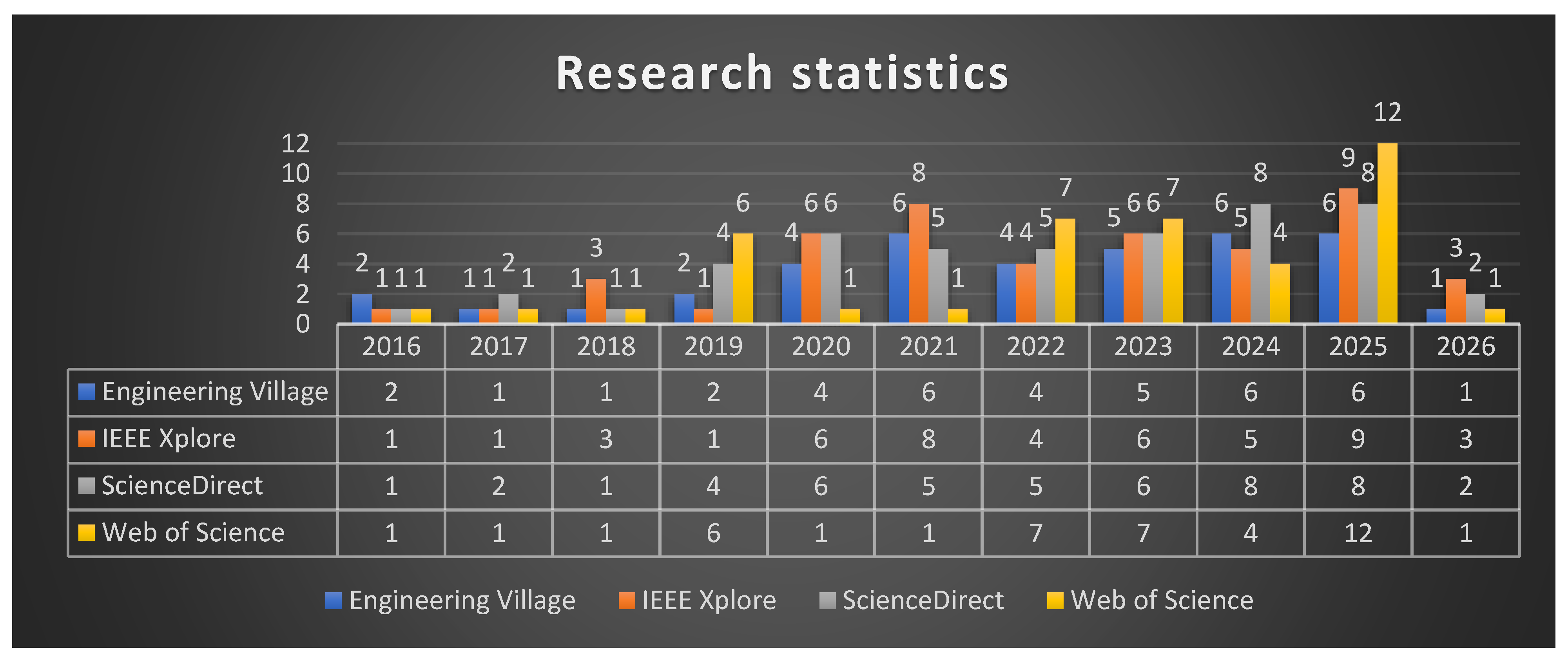
Figure 2 and consistent with the distribution shown in
Figure 3. A total of 864 articles were initially retrieved; we first screened this literature according to the title, abstract, number of citations, and journal impact factors, and gave priority to peer-reviewed journal articles. Conference papers were included only if they had high academic influence and were highly matched with the core research topics. Finally, there were 464 papers left. Subsequently, keyword correlation analysis was performed on the retrieved literature to further screen based on correlation, and 173 articles were finally selected. Among the 173 selected documents, 55 relate to the device level, 64 relate to the system level, and 54 relate to the grid level.
3. Stability Issues in PV Systems
3.1. Modeling of PV Systems
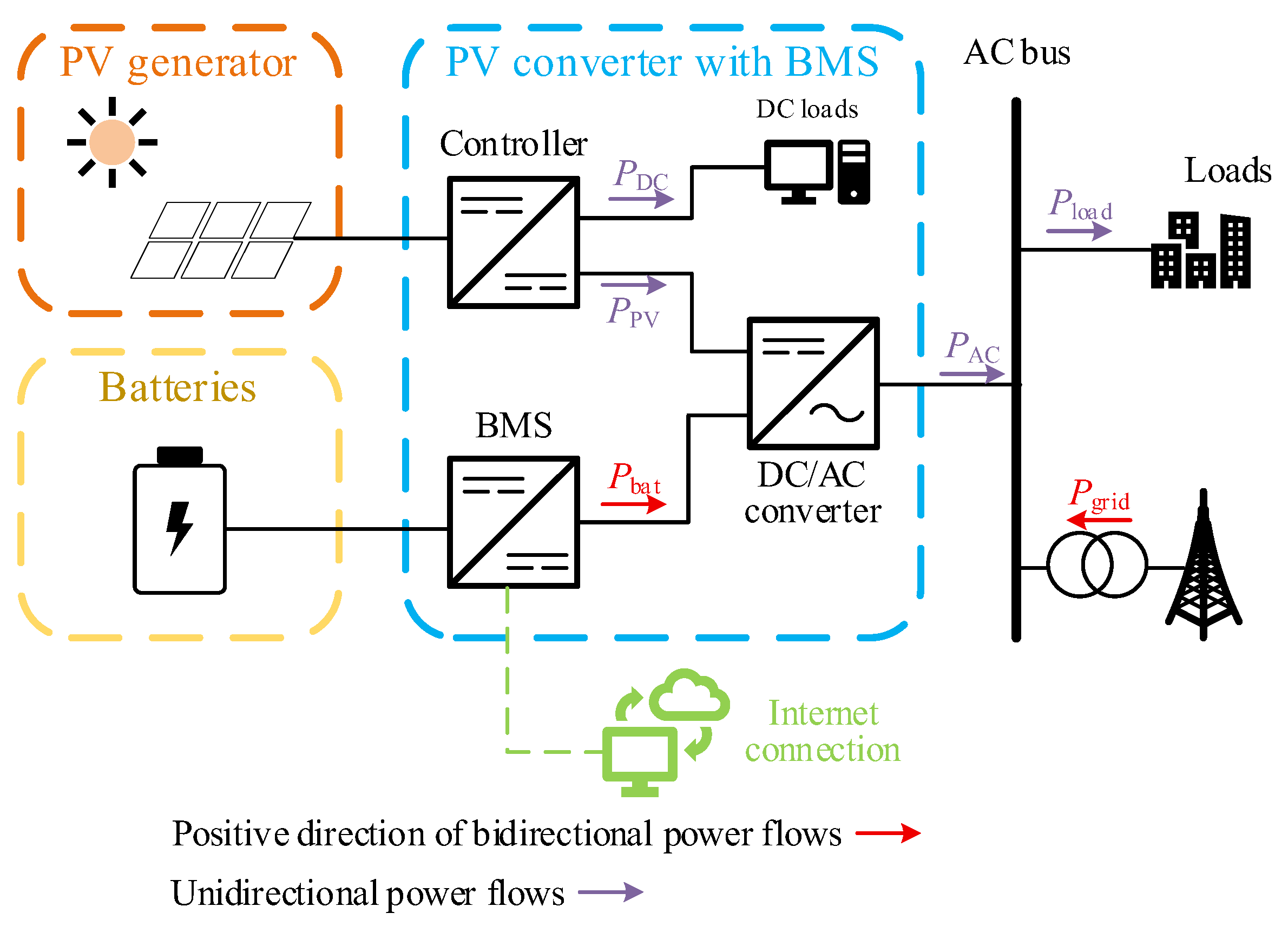
As shown in
Figure 4, the PV system includes a PV generator, battery pack, PV controller and battery management system (BMS), DC/alternating current (AC) converter, AC/DC load, AC bus, power grid, and Internet connection. The output power of the PV generator is optimized by a controller [
41]. On the one hand, it supplies DC load and realizes a bidirectional energy storage/release interaction with a battery pack through the BMS [
42]. On the other hand, it is converted into an AC access bus through the DC/AC converter, supplies power to the AC load, and realizes bidirectional power interaction with the power grid. It has the functions of energy conversion, energy storage, AC/DC power supply, and power grid interaction.
As the core of this paper, the controller module can monitor the output state of the PV generator in real time, and improve the light energy conversion efficiency by adjusting the working parameters of the PV converter. At the same time, it is also responsible for coordinating the distribution of PV power, and cooperates with the BMS and converters to achieve reasonable scheduling of power on the battery, AC, and DC sides to ensure stable operation of the system.
3.2. Classification of Stability in PV Systems
The optimal modeling methods, analysis methods, and applicable scenarios corresponding to different stability types of photovoltaic systems are summarized in
Table 1.
3.2.1. Rotor Angle Stability
Rotor angle stability refers to the ability of all synchronous motors in the system to maintain synchronous operation after the power system is disturbed [
43].
Figure 1 has divided the angular power stability into transient stability and small disturbance stability according to the magnitude of the disturbance.
Transient stability is a key index to evaluate the ability of a power system to maintain generator synchronization after large disturbances [
44]. Its stability is traditionally evaluated by the rotor angle and speed of the synchronous generator [
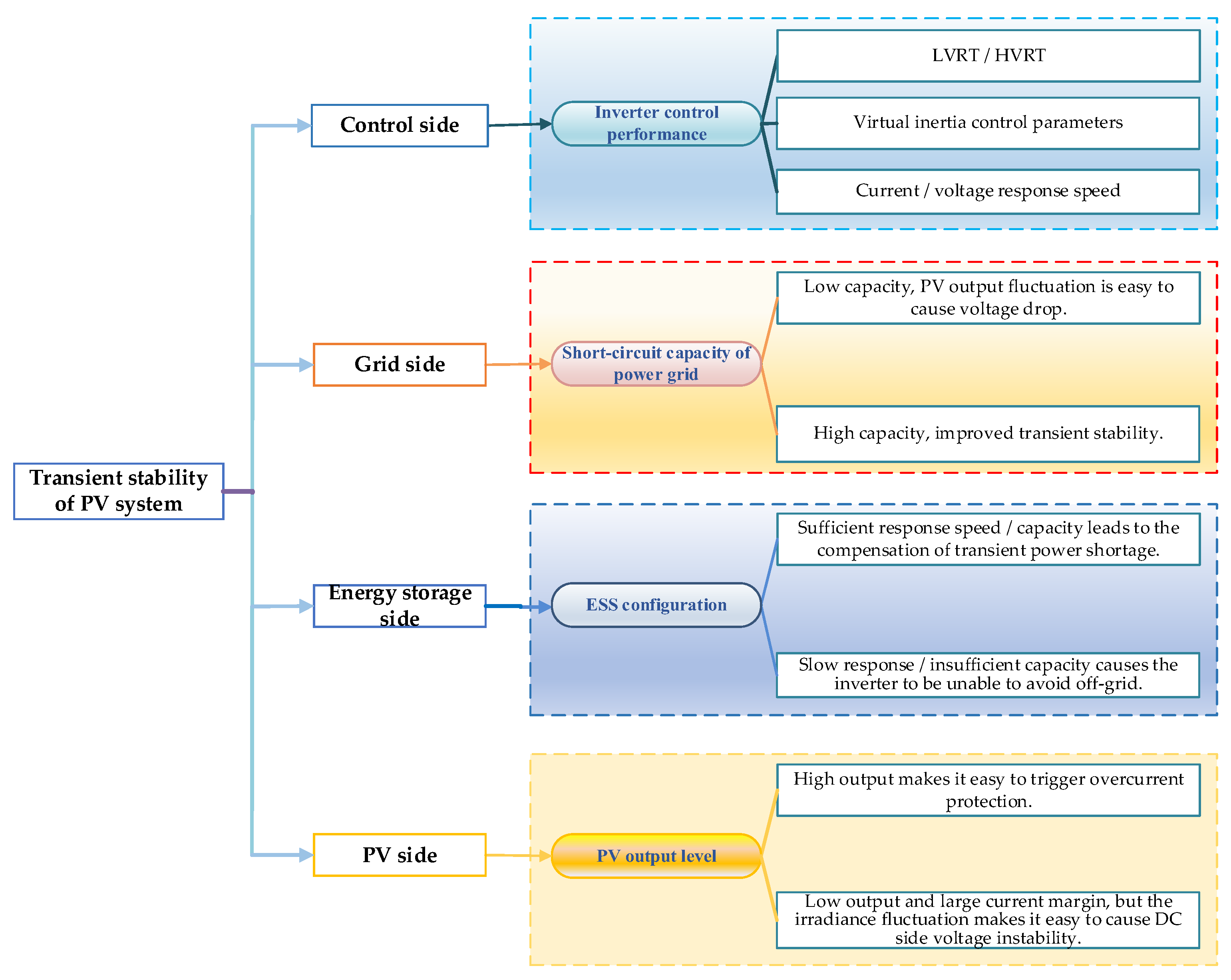
45]. Different from the traditional synchronous generator that relies on the moment of inertia to buffer transient effects, its transient process is faster, usually in the range of milliseconds to seconds, and is more sensitive to disturbance intensity. Transient stability of the PV system is determined by the factors of the PV side, grid side, and control side.
Figure 5 sorts out the influencing factors of the transient stability of the PV system, and clearly shows the logic of each factor.
Transient stability analysis is of great significance for studying the stability control strategy for photovoltaic systems. It can optimize the control strategy of a photovoltaic power station so that the power station can avoid off-grid conditions and recover quickly when it is subjected to large disturbances.
Small disturbance stability refers to the ability of a power system to maintain or be restored to the original stable operation state after small disturbances. In photovoltaic power generation systems, small-signal stability problems are mostly closely related to the dynamic characteristics of power electronic devices [
46]. The analysis method is based on the linearized differential–algebraic equation model. The dynamic characteristics of the system are revealed by eigenvalue analysis, and indexes such as the synchronous torque coefficient and damping ratio are evaluated.
3.2.2. Voltage Stability
Voltage stability of PV systems is one of the core constraints for the grid to accept high-proportion PVs [
47]. It refers to the ability of PV systems to maintain the grid-connected point voltage within the allowable range and avoid voltage collapse or continuous over-limit under disturbances. Different from the traditional power grid that relies on synchronous generator excitation regulation, the PV system is connected to the power grid through power electronic inverters. The voltage response characteristics of the PV system are dominated by the inverter control strategy, and are affected by the coupling of factors such as the intermittence of PV output and the structural strength of the power grid. The unique characteristics of fast response but limited anti-disturbance margin are presented. The time scale is mostly on the second to minute level, and the voltage stability can usually be described by the voltage stability index (VSI).
The voltage stability of a PV system is determined by multiple factors on the PV side, grid side, and control side. The core influencing factors are shown in
Table 2.
Reference [
48] classified voltage stability and introduced various methods of voltage stability evaluation in detail.
3.2.3. Frequency Stability
Frequency stability refers to a power system’s ability to maintain stable frequency following a large disturbance that causes significant imbalance between generation and load power [
49]. When a generation outage occurs, the subsequent frequency drop is mitigated by several auxiliary services: system inertia, load damping, and primary frequency response. However, as the penetration of non-synchronous renewable energy (RES) continues to increase, the system’s inertia level is greatly reduced, thereby elevating the risk of frequency stability violations [
50].
3.2.4. Converter-Driven Stability
Converter-driven stability refers to the ability of power electronic converters to maintain stable operation and ensure system-wide stability in power systems, particularly in scenarios where converters dominate the grid dynamics [
51]. This stability is critical in modern power systems with high penetration of renewable energy sources, energy storage systems, and grid-forming converters.
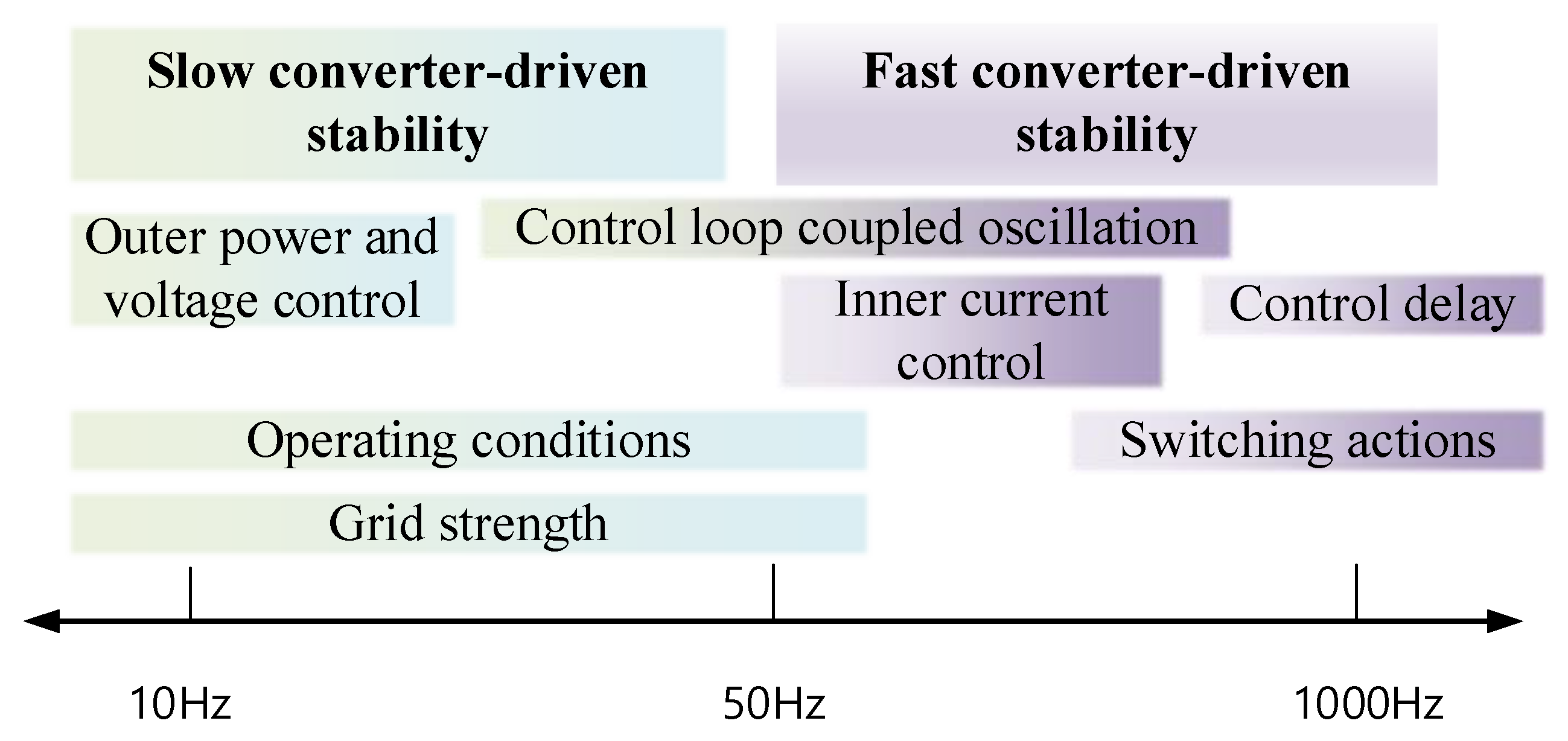
Figure 6 shows the main factors affecting converter-driven stability and its corresponding frequency range.
3.2.5. Resonance Stability
Resonance stability refers to the influence of resonance phenomena on system stability and equipment safety in power systems [
52]. It is mainly used in PV/wind power inverters to avoid resonance coupling with grid impedance, prevent grid-connected current harmonics from exceeding the standard, prevent inverter off-grid scenarios, and ensure stable interconnection between new energy power generation systems and power grids. Its performance is necessary for large-scale PV systems to be connected to the grid.
4. Control Strategy of PV
4.1. Device-Level Control Methods for PV Systems
4.1.1. MPPT and DC-Link Control
MPPT and DC-link voltage regulation constitute the core energy management layer of grid-connected PV systems. MPPT aims to continuously adjust the PV operating point so that the array delivers its maximum available power under time-varying irradiance and temperature conditions [
53]. DC-link control, on the other hand, is responsible for maintaining the stability of the intermediate energy storage capacitor, decoupling the inherently fluctuating PV source from AC-side power injection. Although conceptually distinct, these two functions are strongly coupled in practice. Aggressive MPPT action improves energy capture but introduces power oscillations that directly propagate to the DC link. At the same time, tight DC-link voltage regulation constrains the allowable dynamics of PV-side power extraction [
54]. Under partial shading, the PV power–voltage characteristic becomes multi-peaked, increasing the risk of suboptimal tracking and large transient power excursions [
55]. During grid voltage sags or faults, the inverter’s power transfer capability is suddenly reduced; without coordinated power curtailment, excess PV input energy accumulates in the DC-link capacitor [
56], potentially leading to overvoltage and instability. These interactions indicate that MPPT and DC-link regulation should be treated as a coordinated control subsystem rather than two independent loops.
The interaction between MPPT and DC-link dynamics can be captured using an energy-balance-based control model. The instantaneous PV output power is given by
while DC-link capacitor dynamics satisfy
where
and
denote DC-link capacitance and voltage, respectively, and
is the active power delivered to the grid. In its current form, this relationship can be written as
In typical grid-following architectures, the inverter regulates
through an outer-loop controller that generates an active power or d-axis current reference:
with the corresponding current reference derived from grid voltage measurements. MPPT algorithms provide a reference PV voltage or current:
To address the above challenges, recent research has shifted toward coordinated, adaptive, and stability-aware MPPT/DC-link control strategies. Learning-based and adaptive MPPT methods reduce dependence on fixed perturbation steps and improve tracking performance under rapidly changing irradiance and partial shading. Distributed MPPT using module-level or string-level power electronics further mitigates mismatch effects by localizing control actions. On the DC-link side, advanced nonlinear and adaptive regulators have been introduced to enhance transient performance and robustness. Reference [
57] proposed an adaptive predefined-time backstepping control scheme that guarantees convergence of the DC-link and current dynamics within a prescribed time, significantly improving disturbance rejection compared to classical PI-based approaches. Reference [
58] employed singular perturbation analysis to reveal the intrinsic multi-time-scale coupling between PV control loops and grid synchronization dynamics, providing theoretical justification for coordinated bandwidth design in fault-prone and high-power transmission scenarios. Reference [
59] demonstrated that coordinated fault-ride-through strategies that combine PV-side power curtailment and DC-link energy management are essential to prevent overvoltage and loss of stability in PV–modular multilevel converter (MMC)–high-voltage direct current (HVDC) systems.
4.1.2. Inverter Dynamic Control: Voltage and Current Control Loops
A grid-connected inverter constitutes the dynamic interface between the PV DC source and AC power system, and its control performance directly determines system stability, power quality, and disturbance tolerance [
60]. In practical PV systems, inverter control is typically organized in a hierarchical cascaded structure composed of fast inner current control loops and slower outer voltage or power control loops. The inner loops are responsible for accurate tracking of grid-synchronized current references and for shaping the inverter’s output impedance. In contrast, the outer loops regulate higher-level objectives such as DC-link voltage, active and reactive power, or AC terminal voltage. This hierarchical organization enforces time-scale separation: the current loop reacts rapidly to grid disturbances and filter dynamics, whereas the outer loop governs energy balance and power flow without exciting high-frequency oscillations [
61]. Such separation is essential for maintaining both fast dynamic response and sufficient damping, particularly under fluctuating PV power input and variable grid conditions.
4.1.3. Grid-Following and Grid-Forming Control
Converter-interfaced PV systems typically operate in either GFL or GFM mode, and this choice strongly influences system stability [
62]. Grid-following inverters act as controlled current sources that inject commanded currents into an existing voltage waveform. They rely on a PLL to estimate grid phase and frequency [
63], aligning the control reference frame so that active and reactive power can be regulated through d-q current components. This approach is highly effective in strong grids where voltage and frequency are maintained by synchronous machines or other stiff sources. Under such conditions, GFL control provides high power quality, fast power tracking, and efficient integration of MPPT-driven PV generation.
However, GFL inverters depend on the quality of the grid reference. In weak grids with high impedance or low short-circuit strength, PLL can become a vulnerability: small voltage disturbances can cause phase estimation errors that feed into the current loop and lead to oscillations [
64]. When many GFL inverters operate in close electrical proximity, impedance-coupled interactions may arise, producing wideband oscillations and reduced stability margins [
65]. Moreover, GFL inverters do not inherently provide inertia or frequency-setting capability; without additional control features, they contribute little to arresting frequency excursions during large disturbances.
In grid-following operation, the inverter synchronizes to the grid voltage and injects the current according to predefined active and reactive power references. The outer control loop is typically a DC-link voltage regulator, which ensures power balance between the PV side and grid side by adjusting the active power command [
66]. This loop generates the reference for the
-axis current, while reactive power or voltage support objectives define the
-axis current reference.
The inner current control loop operates in a synchronous reference frame aligned with the grid voltage. Proportional–integral (PI) controllers are commonly adopted due to their simplicity and robustness, with decoupling terms and grid-voltage feedforward used to compensate filter dynamics. With sufficient bandwidth, the inverter behaves as a controlled current source, injecting nearly sinusoidal currents and complying with grid codes on harmonic distortion [
67].
In grid-forming operation, the inverter no longer relies on an external voltage reference but instead establishes and regulates its own AC voltage magnitude and frequency. In this mode, voltage control replaces current tracking as the primary objective [
68]. An inner voltage loop ensures accurate output voltage regulation, while outer control layers implement frequency–power and voltage-reactive power droop characteristics to enable load sharing among multiple inverters.
Compared with grid-following control, grid-forming strategies impose stricter stability requirements, particularly under weak-grid or islanded conditions [
69]. The inverter must remain stable while interacting with passive loads, other converters, and fluctuating renewable sources. Consequently, controller design must explicitly consider system inertia emulation, damping enhancement, and robustness against impedance variation.
To balance strengths and limitations, hybrid and adaptive strategies are increasingly adopted. Dual-mode inverters can operate as GFL under strong-grid conditions to maximize efficiency and energy capture, and transition toward GFM behavior when system strength declines or when islanded operation is required. Such designs aim to combine the mature performance of grid-following control with the stability-support functions of grid-forming control, improving resilience across a wide range of grid conditions.
4.1.4. Virtual Inertia Control
A critical stability challenge in PV-dominated power systems is the loss of rotational inertia as synchronous generators are replaced by inverter-based resources. In conventional grids [
70], the kinetic energy of rotating machines limits the rate of change of frequency (RoCoF) after disturbances, providing an inherent buffer for control and protection actions. PV systems lack this physical inertia, leading to faster and deeper frequency excursions and increased risks of protection trips and under-frequency events.
Virtual inertia control mitigates this issue by enabling inverters to emulate inertial behavior through fast active-power responses to frequency dynamics [
71]. The active power response of virtual inertia control can be expressed as
where
is the virtual inertia active power adjustment,
is the virtual inertia control coefficient, and
is the frequency change rate. In practice, filtering and rate-limiting are applied to ensure fast response while avoiding noise amplification and control-induced oscillations.
Unlike synchronous machines, PV-based virtual inertia is constrained by instantaneous energy availability. The associated energy requirement satisfies
where
is the energy required for virtual inertia, and
is the instantaneous available power of photovoltaics allowed by irradiance. The PV array cannot exceed the instantaneous power permitted by irradiance.
In practical designs, virtual inertia is coordinated with droop-based primary frequency control. Inertia-like action targets the initial seconds of a disturbance by limiting RoCoF and improving the frequency nadir [
72], while droop provides a slower corrective response that supports settling toward a new equilibrium. Stability depends heavily on damping and coordination: overly aggressive gains across many inverters can produce under-damped system-level behavior and secondary frequency swings [
73]. Therefore, well-engineered schemes include explicit damping terms, power and ramp limits, smooth activation logic, and coordination with protection settings.
Overall, virtual inertia enables PV inverters to evolve from passive power injectors to active stability assets. While it cannot remove the fundamental limits of PV-energy availability, it provides an engineerable mechanism to slow frequency dynamics and improve disturbance resilience when combined with appropriate buffering (storage or headroom), careful damping, and coordinated control design.
4.2. System-Level Control
Compared with device-level control, system-level control focuses on the coordinated behavior of PV units within power systems. Its primary objective is to maintain voltage stability, enhance fault tolerance, and ensure acceptable power quality under varying operating conditions. As PV penetration increases, system-level control becomes a critical layer connecting individual inverter control with broader grid requirements.
4.2.1. Reactive Power and Voltage Control
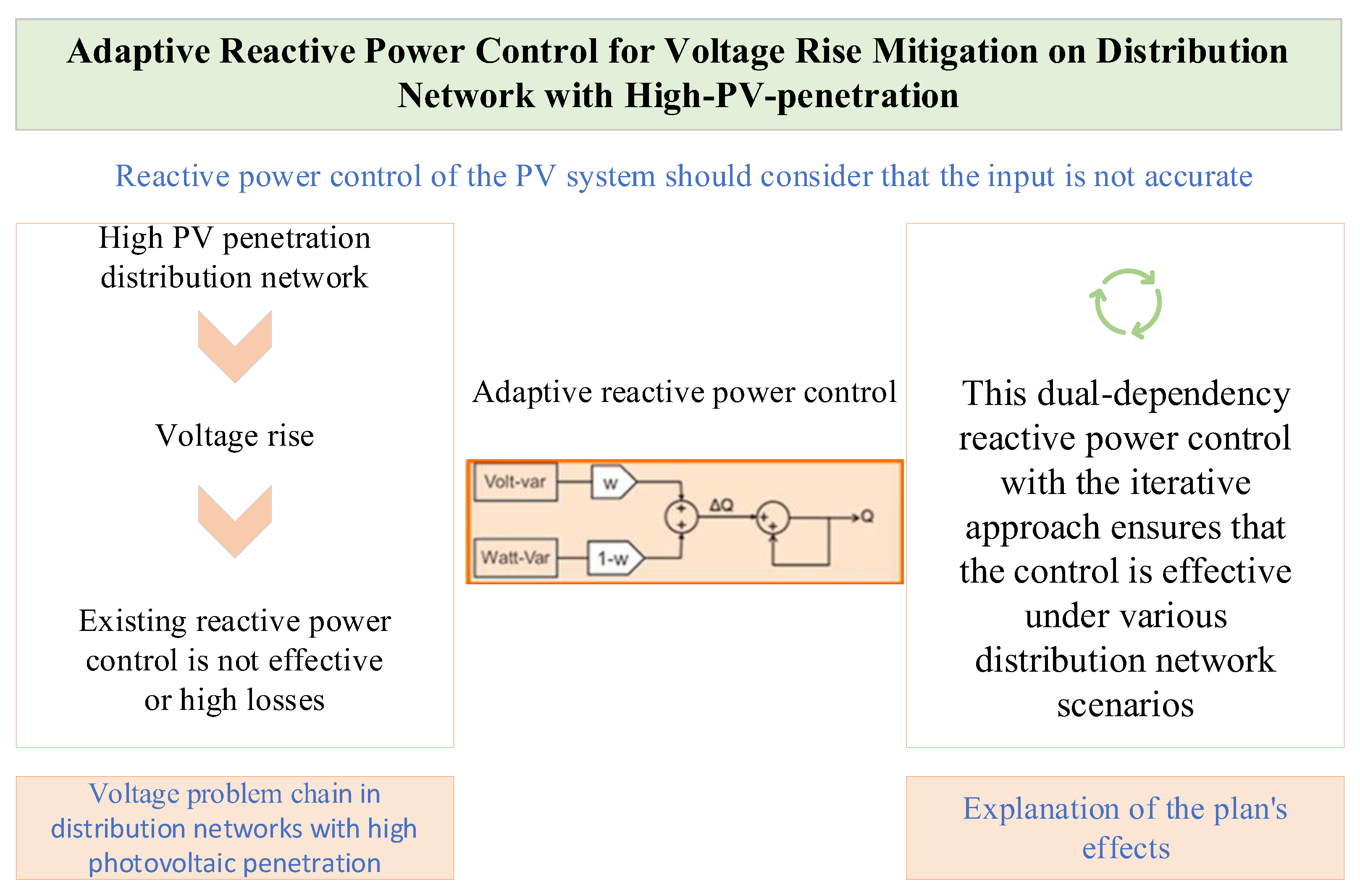
Reactive power and voltage regulation constitute the core tasks of system-level control in PV-integrated power systems. Due to the limited inherent voltage support capability of inverter-based resources, conventional voltage regulation mechanisms based on synchronous generators are no longer sufficient under high-PV-penetration scenarios. As a result, PV inverters are increasingly required to participate actively in voltage control through reactive power modulation.
Figure 7 is the logic diagram of the technical solution to the voltage problem of the distribution network with high PV penetration.
At the system level, voltage control strategies typically coordinate multiple PV units, on-load tap changers, capacitor banks, and flexible AC transmission devices. By adjusting inverter reactive power output according to local voltage measurements or supervisory control signals, voltage deviations can be effectively mitigated across different network nodes [
74]. Both centralized and decentralized voltage control architectures have been widely investigated, with decentralized approaches offering superior scalability and robustness in large-scale distribution networks.
Advanced voltage control strategies further consider the coupling between active and reactive power, as well as the interaction between multiple voltage-regulating devices. Optimization-based and predictive control methods are often employed to balance voltage stability, power losses, and equipment operating constraints, enabling more adaptive and efficient voltage regulation under fluctuating PV generation.
4.2.2. Fault Ride-Through Capability
Fault ride-through capability is a key system-level requirement for PV power systems operating in modern grids. During grid disturbances such as voltage sags or swells, PV systems are no longer permitted to disconnect immediately, as mass disconnection could severely compromise system stability. Instead, PV inverters must remain connected and provide appropriate support to the grid [
75].
LVRT and HVRT control strategies are designed to ensure stable inverter operation under abnormal voltage conditions. At the system level, ride-through control coordinates inverter current injection, reactive power support, and protection logic to prevent cascading failures [
76]. Typically, reactive current is injected proportionally to voltage deviation to assist grid voltage recovery, while active power output may be curtailed to protect inverter components.
System-level LVRT/HVRT strategies must also account for coordination among multiple PV systems and other grid-connected resources. Improper coordination may lead to control conflicts, overcurrent issues, or secondary voltage instability after fault clearance. Therefore, adaptive ride-through schemes and hierarchical coordination mechanisms are increasingly adopted to enhance overall system resilience.
4.2.3. Harmonic Suppression
Harmonic distortion is an inherent challenge in power systems with a high proportion of inverter-based resources. At the system level, harmonic interactions among multiple PV inverters, network impedance [
77], and nonlinear loads can lead to harmonic amplification, resonance phenomena, and degradation of power quality.
System-level harmonic suppression aims to mitigate these issues through coordinated inverter control and network-level mitigation strategies. From a modeling perspective, the harmonic behavior of an inverter-connected PV unit can be described using an output impedance representation [
78]. For a given harmonic order
h, the relationship between harmonic voltage and current at the point of common coupling (PCC) can be expressed as
where
and
denote the harmonic voltage and current components, respectively, and
represents the equivalent grid-inverter impedance at harmonic frequency
. When multiple inverters operate in parallel, mismatches in impedance characteristics may cause unequal harmonic current sharing and resonance amplification.
To address this problem, impedance shaping and virtual impedance control are widely adopted at the system level. By modifying the inverter’s control law, a virtual impedance
can be introduced so that the effective output impedance becomes
where
is the physical impedance of the filter and converter. Properly designed virtual impedance allows harmonic currents to be redistributed among parallel PV inverters, reducing circulating harmonic currents and suppressing resonance with grid impedance.
In addition to impedance-based methods, coordinated active filtering is an important system-level harmonic suppression strategy. In this approach, selected PV inverters inject compensating harmonic currents to counteract dominant harmonic components in the grid. The reference compensating current can be expressed as
where
denotes the set of targeted harmonic orders, and
and
are the magnitude and phase of the detected harmonic currents. Through coordinated control, multiple PV inverters can share the compensation burden, avoiding excessive stress on individual units.
In addition, system-level harmonic management increasingly integrates monitoring, identification, and adaptive control mechanisms. Real-time harmonic detection and coordinated response among distributed PV units allow the system to dynamically suppress dominant harmonic components under changing operating conditions. Such approaches are particularly important in weak grids, where system impedance variations can significantly affect harmonic behavior.
4.3. Grid-Level Control
4.3.1. Distributed Control
As the penetration of PV generation increases, power systems gradually evolve toward highly decentralized structures with multiple PV systems, prosumers, and power electronic interfaces. Under such conditions, purely centralized control architectures face scalability, communication burden, and single-point-of-failure issues. Distributed control has therefore emerged as a key grid-level stability solution.
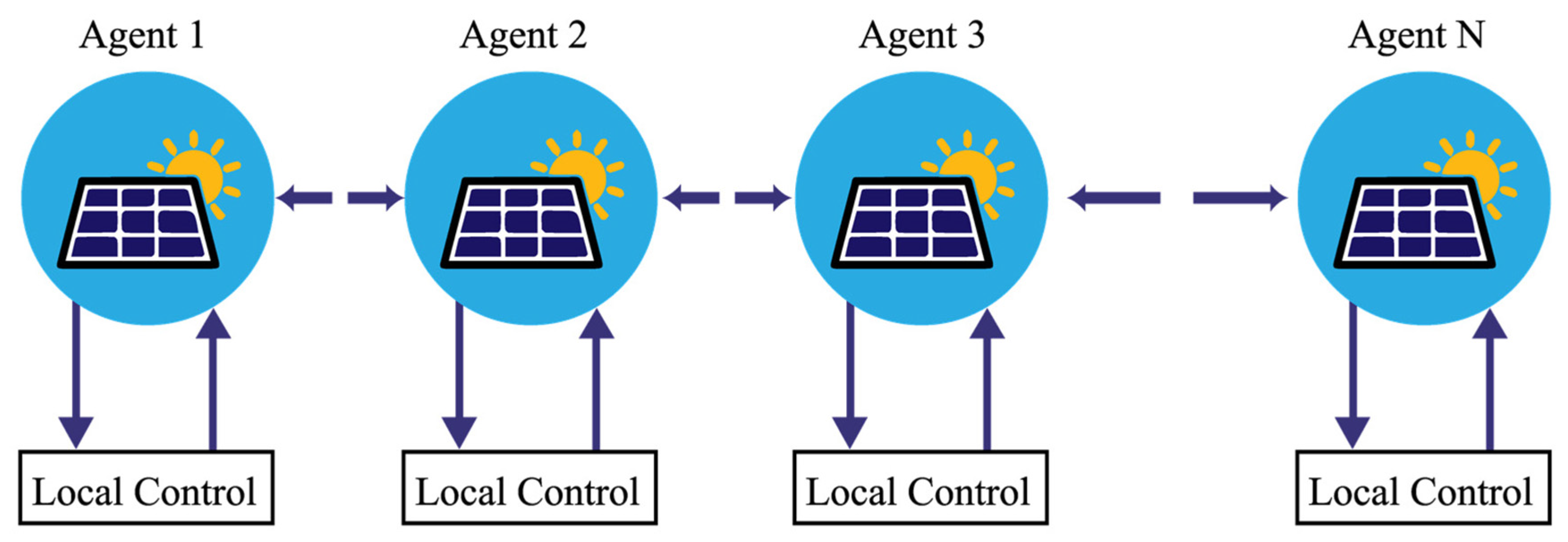
In distributed control frameworks, individual PV inverters or system controllers make decisions based primarily on local measurements, such as voltage, frequency, and power flow, while exchanging limited information with neighboring units or higher-level coordinators [
79]. This architecture reduces reliance on global system information and improves resilience against communication delays or partial failures. Common approaches include consensus-based control, distributed optimization, and multi-agent coordination strategies.
From a stability perspective, distributed control enables faster local responses to disturbances, such as voltage fluctuations or frequency deviations, while preserving coordinated behavior at the grid level. However, careful design is required to guarantee convergence, robustness against communication uncertainty, and compatibility with grid operational constraints.
4.3.2. Coordinated PV-ESS Control
The integration of energy storage systems (ESSs) significantly enhances the controllability of PV-dominated grids. At the grid level, coordinated PV-ESS control focuses on exploiting the complementary characteristics of PV generation and storage to improve voltage regulation [
80], frequency support, and transient stability.
In coordinated control schemes, PV units primarily operate to maximize energy harvesting under normal conditions, while ESS units dynamically compensate for power fluctuations and provide fast active and reactive power support during disturbances [
81]. Grid-level coordination determines how control responsibilities are allocated between PVs and ESSs, considering state-of-charge limits, response speed, converter capacity, and system stability requirements.
Such coordination allows the grid to mitigate PV intermittency, suppress ramp-rate effects, and enhance inertial and damping characteristics. Importantly, PV-ESS coordination must be designed to avoid internal control conflicts and to ensure that storage resources are utilized efficiently over both short-term dynamics and long-term operational cycles.
PV-ESS cooperative control can effectively improve PV consumption capacity, reduce the abandonment of light, and release when PV output is insufficient, so as to solve the intermittent defects of PVs. It has irreplaceable value in improving energy efficiency, reducing grid pressure, and enhancing power supply reliability.
4.3.3. Multi-PV System Cooperative Control
In regions with high renewable penetration, multiple large-scale PV systems may be connected to the same transmission corridor or distribution area. Without coordination, independent system-level control actions can interact adversely, leading to voltage oscillations [
82], reactive power competition, or instability under weak-grid conditions.
Multi-PV system cooperative control aims to coordinate the dynamic behavior of geographically distributed PV systems to achieve system-wide stability objectives. Cooperation can be realized through hierarchical architectures, where a regional coordinator assigns voltage or reactive power targets, or through peer-to-peer schemes that enable systems to adjust outputs based on shared system indicators [
83].
Key challenges include handling heterogeneous system capacities, diverse control capabilities, and varying grid strengths across connection points. Effective cooperative control improves voltage profile smoothness, reduces unnecessary control effort, and enhances the overall stability margin of PV-rich power systems.
4.3.4. Energy Management System-Based Stability Optimization
Energy management systems (EMSs) traditionally focus on economic dispatch and power balance at slower time scales. In PV-dominated grids, EMS functions are increasingly extended to incorporate stability-related objectives [
84], forming a bridge between operational optimization and dynamic control.
By integrating forecasts of solar irradiance, load demand, and grid conditions, EMSs can proactively adjust setpoints for PV systems, ESSs, and flexible loads to prevent instability before it occurs [
85]. Typical optimization objectives include minimizing voltage violations, limiting frequency excursions, preserving dynamic reserves, and maintaining sufficient reactive power margins.
Although EMSs operate at a slower time scale than inverter-level control, their decisions strongly influence system stability by shaping operating points and resource availability. The challenge lies in ensuring consistency between EMS optimization outputs and fast local controllers, especially during rapidly changing conditions.
4.3.5. Interaction with Grid Codes and Dispatch Strategies
Grid-level stability control of PV systems must ultimately comply with grid codes and dispatch requirements defined by system operators. Modern grid codes increasingly mandate advanced control capabilities from PV systems, such as voltage support, fault ride-through, frequency response, and power ramp-rate limits.
Grid-level control strategies must therefore be designed not only for technical effectiveness but also for regulatory compatibility. Dispatch strategies issued by operators may require PV systems to curtail output, provide ancillary services, or switch operating modes under specific system conditions [
86]. Stability-oriented control must interpret and implement these commands without compromising local or system-wide dynamic performance.
As grid codes continue to evolve toward performance-based requirements, the interaction between PV control strategies and regulatory frameworks becomes a critical aspect of system design. Well-aligned control and dispatch mechanisms ensure that high PV penetration can be accommodated without sacrificing grid reliability or operational flexibility.
5. Emerging Control Techniques in Stability Control of PV Systems
5.1. Data-Driven and AI-Based Control
As PV-dominated grids become more nonlinear and uncertain, purely model-based control is increasingly constrained by parameter drift, weak-grid variability, and hard-to-model inverter interactions. Data-driven and artificial intelligence (AI)-based control offers an alternative by learning system behavior directly from measurements, reducing dependence on accurate physical models and improving adaptability to changing operating conditions [
87].
Data-driven approaches use historical and streaming data to estimate key dynamics, detect oscillatory patterns, and update control parameters online. Machine learning methods such as neural networks, support vector machines, and ensemble models have been used to predict system states, stability margins, and disturbance responses, enabling preventive adjustments of setpoints and controller gains [
88]. Deep learning further improves performance in high-dimensional and time-varying environments; recurrent neural networks and LSTMs are well suited to capturing temporal dependencies in PV fluctuations and grid dynamics, thereby supporting early warning of voltage or frequency instability [
89].
Reinforcement learning provides a model-free framework in which an agent learns optimal control policies through interaction with the grid environment, balancing stability, efficiency, and converter constraints [
90]. However, large-scale deployment requires addressing data quality, generalization under unseen conditions, interpretability, and cybersecurity [
91]. For practical adoption, hybrid schemes that combine learning-based components with conventional control loops and physics-informed constraints are increasingly favored to ensure stable and predictable behavior, especially during rare or extreme events. In [
92], a novel AI-enhanced hybrid solar energy framework was proposed. The associated experiment was conducted over an entire year in Sitapura, Jaipur, India. Results demonstrated that the annual energy yield was increased by 41.4%, spectral absorption efficiency was improved by 18.7%, and the average panel temperature was reduced by 11.9 °C relative to the conventional MPPT and static photovoltaic systems. Data-driven and machine learning-based control methods have now advanced to the small-scale field pilot stage. In contrast, reinforcement learning-based control schemes remain primarily at the simulation verification phase, with only a limited number of laboratory-scale microgrids having undergone prototype testing [
93].
Figure 8 shows the distributed multi-agent control architecture of PV system.
5.2. Digital Twins for Predictive Stability Control
Digital twin (DT) technology is emerging as an effective enabler of predictive stability control in PV-dominated power systems [
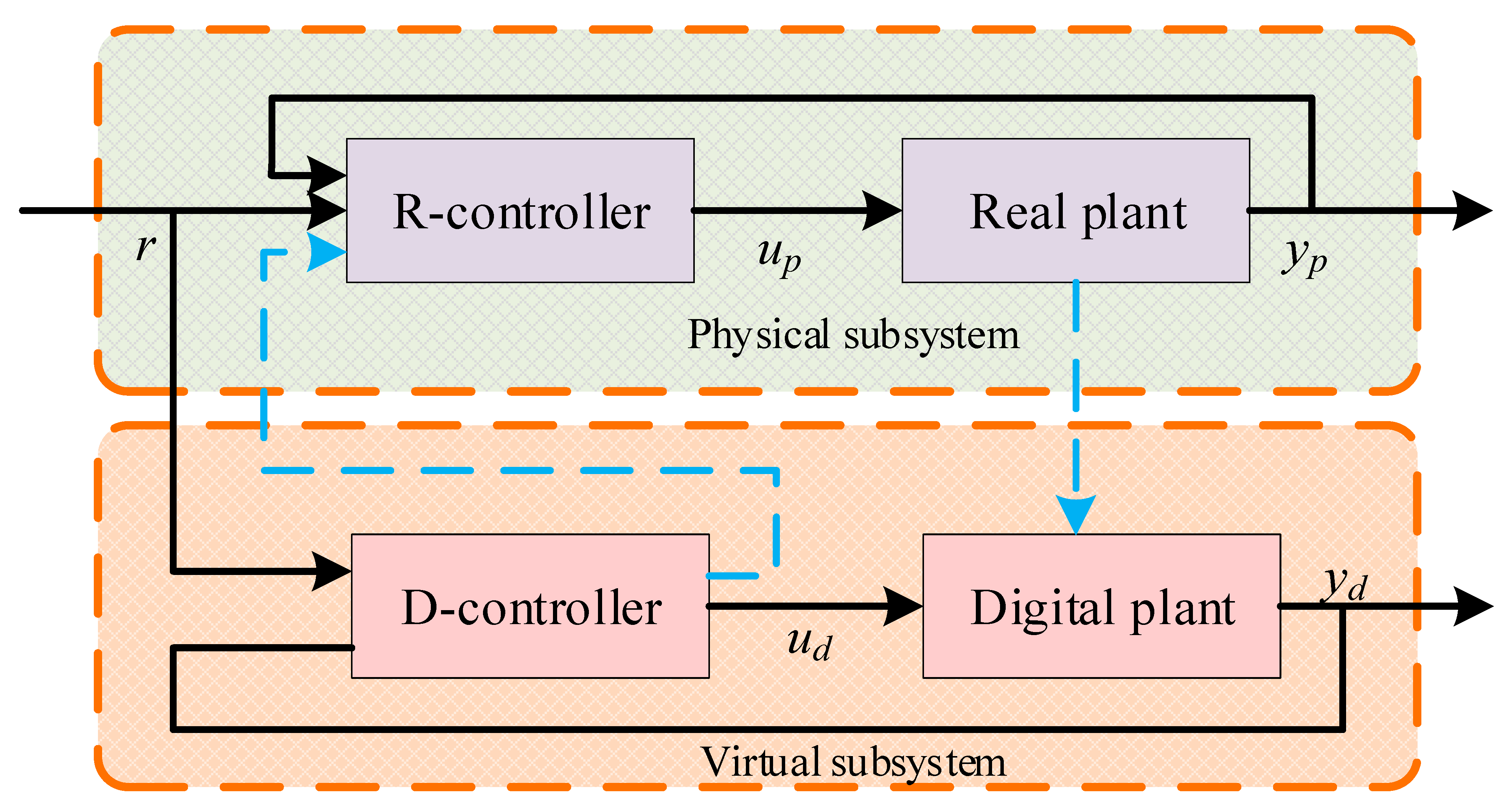
94]. A digital twin is a high-fidelity virtual representation of a physical system that is continuously synchronized with real-time operational data. In PV applications, digital twins capture inverter dynamics, control interactions, and grid coupling, providing a dynamic and data-enriched view of system behavior. A digital twin control system framework is shown in
Figure 9.
The primary advantage of digital twins lies in their ability to predict system responses before they occur in the physical grid [
95]. By combining physics-based models with real-time measurements and data-driven updates, digital twins can forecast the impact of disturbances, operating point changes, or control actions on voltage and frequency stability. This predictive capability supports a shift from reactive control toward preventive and proactive stability management.
At the device and system levels, digital twins can identify early signs of instability such as oscillatory modes, control saturation, or reduced damping, particularly in weak or low-inertia grids. At the system level, they enable coordinated assessment of multiple PV plants, energy storage units, and loads. DTs also support scenario-based analysis, allowing faults, irradiance variations, and topology changes to be evaluated safely in a virtual environment. In [
96], a novel digital twin framework is proposed on the basis of physics-based and data-driven modeling techniques. Two case studies demonstrate explicitly that this framework notably enhances prediction accuracy, analysis efficiency, and system reliability, while also facilitating efficient risk management and control in power systems.
Moreover, digital twins provide a reliable platform for testing and training advanced optimization and AI-based controllers. Key challenges remain in maintaining model accuracy, managing computational complexity, and ensuring data security. Nevertheless, digital twin-based approaches are expected to play a central role in future intelligent and resilient PV-rich power systems.
5.3. Adaptive, Robust, and MPC-Based Control
Adaptive control methods aim to adjust controller parameters online in response to variations in system dynamics, operating points, and grid conditions. In PV systems, adaptive strategies are particularly useful for coping with uncertainties such as fluctuating irradiance, temperature-dependent PV characteristics, and time-varying grid impedance. By continuously updating control gains or internal model parameters, adaptive controllers can maintain stable voltage, current, and power responses without relying on precise a priori system models. This feature makes them well suited for weak grids and inverter-dominated environments, where system parameters may change rapidly and unpredictably.
Robust control focuses on guaranteeing system stability and performance within predefined bounds of uncertainty. Instead of adapting parameters online, robust controllers are designed to tolerate worst-case disturbances and modeling errors. In PV applications, robust control techniques are widely used to address grid disturbances such as voltage sags, frequency deviations, and parameter uncertainties in power electronic converters. By explicitly considering uncertainty sets during controller design, robust control ensures stability margins even under severe grid disturbances [
97], which is particularly important for meeting grid-code requirements related to fault ride-through capability and voltage support.
Model predictive control represents a more advanced control paradigm that combines optimization with system dynamics prediction. MPC utilizes a dynamic model of a PV system and the grid to predict future system behavior over a finite time horizon and determines optimal control actions by solving an optimization problem at each control step [
98]. This approach allows MPC to handle multivariable interactions, constraints on voltages, currents, and power limits, and trade-offs between competing control objectives. In PV systems, MPC has been successfully applied to inverter control [
99], DC-link voltage regulation, coordinated active–reactive power control, and PV-energy storage coordination.
Compared with traditional control methods, MPC offers superior flexibility in dealing with nonlinear dynamics and operational constraints, which are common in PV-integrated systems. However, its practical implementation faces challenges related to computational burden, model accuracy, and real-time feasibility, especially for large-scale systems with fast dynamics. Recent developments in fast optimization algorithms, reduced-order modeling, and hierarchical MPC architectures have significantly improved its applicability in real-time PV control scenarios.
Table 3 compares the traditional control and MPC control.
In practice, hybrid control frameworks that combine adaptive, robust, and MPC-based approaches are increasingly being explored. For example, adaptive mechanisms can be embedded within MPC to update model parameters online, while robust constraints can be incorporated into predictive optimization to enhance disturbance tolerance. Reference [
100] proposed a distribution control paradigm for grid-connected AC microgrid systems based on MPC. The simulation results show that this paradigm successfully mitigates and reduces potential disturbances, and controls the overall average level of Total Harmonic Distortion (THD) at 0.20%. Such integrated strategies provide a promising pathway toward achieving stable, resilient, and flexible control of PV systems under high renewable penetration and complex grid conditions.
5.4. Stability in Ultra-High-PV-Penetration Scenarios
Ultra-high PV penetration fundamentally reshapes power system dynamics, pushing traditional stability assumptions beyond their valid range [
101]. As a result, system stability challenges evolve from generator-centric electromechanical phenomena toward fast, control-driven dynamics governed by power electronics and communication infrastructures.
One of the most critical stability concerns in ultra-high-PV-penetration systems is the severe reduction in system inertia. With limited rotational mass, frequency deviations occur more rapidly following disturbances, leaving less time for corrective control actions. Stability therefore becomes highly dependent on the speed, coordination, and robustness of inverter control strategies.
Voltage stability also exhibits new characteristics under ultra-high PV penetration. High concentrations of PV generation introduce strong coupling between active power, reactive power, and voltage dynamics. Rapid fluctuations in irradiance, combined with limited reactive power margins, may trigger voltage oscillations or sustained instability if not properly managed.
Another defining challenge lies in large-scale control interactions. When thousands of PV inverters operate with similar control structures, parameter settings, or protection logic, collective behavior may emerge that was not anticipated at the individual device level. Ensuring stability therefore requires a system-level perspective that explicitly accounts for aggregation effects and diversity in control responses.
Protection and fault response mechanisms must also be reconsidered in ultra-high PV systems. Conventional protection schemes rely on high fault currents provided by synchronous machines, whereas PV inverters typically offer limited and controlled fault current contributions. This alters fault detection, clearance times, and post-fault recovery dynamics, all of which have direct implications for transient and voltage stability. Adaptive protection strategies and inverter-aware fault ride-through coordination become indispensable in maintaining stable operation.
From an operational standpoint, ultra-high PV penetration demands tighter integration between stability control and system operation planning. Dispatch strategies, reserve allocation, and grid-code enforcement increasingly influence dynamic stability margins. Stability can no longer be guaranteed solely through offline design; instead, it must be continuously monitored and actively managed through real-time control, predictive analytics, and adaptive operating limits.
In summary, stability in ultra-high-PV-penetration scenarios is no longer a marginal issue but a core system design objective. It requires a holistic approach that combines advanced inverter control, coordinated system-level regulation, adaptive protection, and intelligent operation strategies. Successfully addressing these challenges is key to enabling power systems where PV generation serves not only as a primary energy source but also as a reliable backbone of system stability.
6. Challenges and Future Trends
6.1. Main Challenges
PV power output is strongly influenced by environmental conditions such as solar irradiance and ambient temperature, resulting in power fluctuations over multiple time scales. Under high penetration levels, these fluctuations can impose significant stress on voltage and frequency stability and may increase the risk of system instability.
The main objective of PV stability control is to address the intrinsic characteristics of PV generation, including intermittency, volatility, and low inertia. As the penetration of PVs continues to increase, stability control faces several challenges, such as reduced equivalent system inertia, stronger interactions among inverter-based resources, and limited stability margins in weak grids. In addition, control performance may degrade under extreme operating conditions, highlighting the need for more robust and coordinated control strategies.
Furthermore, three critical and under-addressed challenges have emerged with the deep integration of high-proportion PVs:
Multi-inverter coupling oscillation and resonance risks: Large-scale parallel operation of PV inverters easily triggers wideband oscillations and resonance coupling. Existing analysis methods struggle to balance scalability and accuracy when dealing with cluster-level dynamic interactions.
Insufficient coordination between control and protection configurations: The dynamic response of GFM/virtual inertia control lacks synergy with grid protection settings, which may lead to secondary instability after faults.
Inadequate validation of emerging technologies: Data-driven AI and digital twin control methods are mostly confined to simulation environments, with a lack of hardware-in-the-loop testing and field prototype verification, resulting in unclear engineering applicability.
6.2. Development Tendency
PV stability control is gradually shifting from single-device control to coordinated system-level control. Increasing attention is being paid to the joint regulation of PVs, energy storage, flexible loads, and conventional generation to improve overall system stability. Such coordinated approaches can enhance disturbance response and reduce the burden on individual devices.
At the same time, new control and analysis tools are being explored to improve adaptability and robustness. Techniques such as data-driven methods and digital modeling are increasingly used to assist parameter tuning and performance evaluation. In parallel, efforts toward standardized and modular control designs are expected to facilitate large-scale integration and interoperability of PV systems.
To address the aforementioned challenges, future research and development efforts will focus on three key directions:
Synergistic design of control and protection systems
Conduct collaborative optimization of GFM control, virtual inertia control, and grid protection systems. This involves clarifying the matching rules between control parameters and protection settings under fault scenarios, thereby avoiding mutual interference between these components.
Innovative scalable analysis methodologies
Develop distributed impedance modeling and cluster dynamic aggregation technologies to efficiently identify oscillation and resonance mechanisms in multi-inverter systems. These methodologies are tailored to adapt to large-scale PV–grid-connected scenarios.
Engineering validation of emerging technologies
Promote hardware-in-the-loop testing and field pilot applications of artificial AI/DT-based control strategies. A full-process verification system should be established to enhance the technical maturity of these technologies.
6.3. Design Guidelines
Combined with the technical characteristics and limitations of different control methods in
Table 4, differentiated selection of control strategies is required under varying grid conditions to address scenario-specific challenges:
Weak grid scenarios: Device-level GFM control is preferred, as it provides virtual inertia support and exhibits strong robustness against impedance variations. This approach circumvents PLL instability problems associated with GFL control, thereby rendering it more applicable to weak grids characterized by frequent voltage fluctuations. For systems not equipped with energy storage, device-level virtual inertia control can deliver fast frequency response by utilizing the instantaneous PV output; however, it necessitates the mitigation of secondary frequency swing risks.
Strong grid scenarios: Device-level GFL control retains its practical value owing to its superior power quality and low harmonic distortion. Specifically, the low impedance of the strong grid mitigates stability concerns associated with PLL. Additionally, system-level reactive power and voltage coordinated control can be incorporated as a supplementary measure to alleviate local voltage deviations induced by PV output fluctuations.
Remote microgrid scenarios: Robust control is selected as the optimal solution, as remote microgrids are often subject to harsh environmental disturbances and lack precise system models due to weak connectivity. This method eliminates reliance on accurate modeling and exhibits strong anti-disturbance capability, effectively addressing the problem of control performance degradation in complex off-grid/weak-grid operation. Additionally, fault ride-through prevents large-scale PV tripping during local line faults, ensuring uninterrupted power supply for critical loads; PV-ESS coordinated control further mitigates PV intermittency and enhances system inertia, compensating for the lack of conventional generation in remote areas.
Low-PV-penetration scenarios: DC-link control is the preferred choice, as low PV penetration results in minimal impact on system inertia and voltage stability, while the core demand lies in ensuring reliable inverter operation. This method effectively prevents DC-link voltage drift and overvoltage, avoiding inverter malfunctions caused by occasional PV output fluctuations without requiring complex coordination. Harmonic suppression can be supplemented to address harmonic pollution from small-scale nonlinear loads, as it achieves high suppression efficiency without additional filtering hardware, aligning with the low-cost operation requirements of low-penetration systems. Additionally, traditional MPPT control remains a cost-effective auxiliary measure; though it has limitations such as local optima, the stable grid regulation capacity in low-penetration scenarios can offset these drawbacks, ensuring maximum energy utilization at minimal cost.
Ultra-high-penetration scenarios: Grid-level control methods become critical. Distributed control offers scalability and anti-single-point failure capability, making it suitable for large-scale grid coordination; multi-PV plant cooperative control optimizes global voltage profiles and reduces redundant actions. Emerging technologies like DT-Based predictive control further enable early identification of instability risks, addressing the challenge of multi-inverter interaction in ultra-high-penetration systems.
7. Conclusions
The summary of methods is presented in
Table 4 below.
This paper reviews stability control strategies for PV power systems under high-penetration conditions. The discussion covers stability mechanisms, modeling methods, control strategies at different hierarchical levels, and recent technical developments.
First, stability issues in PV systems are examined from the perspectives of small-signal, transient, voltage, and frequency stability. Common modeling approaches for PV arrays, inverters, and grid interaction are summarized to support the analysis of control methods.
Second, stability control strategies are reviewed at the device, system, and grid levels. Device-level control focuses on MPPT, inverter dynamics, and inertial support. System-level control emphasizes coordinated voltage regulation and fault ride-through capability. Grid-level strategies address large-scale coordination through distributed control and PV-energy storage interaction.
Finally, emerging approaches and remaining challenges are discussed. Key issues include interaction among multiple inverter-based resources, heterogeneous control implementations, and reduced robustness under severe environmental conditions. Future research is expected to focus on coordinated control frameworks and improved stability support for high-PV-penetration scenarios.
The systematic analysis in this paper can serve as a reference for the selection of stability control technologies, project implementation, and future research directions for PV power stations, contributing to the construction and development of new power systems dominated by renewable energy.
Author Contributions
Conceptualization, B.Y. and R.M.; methodology, R.M. and Y.Z.; validation, Y.W., X.W. and X.S.; formal analysis, L.S. and D.W.; investigation, L.S. and B.Y.; resources, D.W.; data curation, R.M.; writing—original draft preparation, R.M.; writing—review and editing, B.Y.; visualization, X.S.; supervision, B.Y. All authors have read and agreed to the published version of the manuscript.
Funding
This research received no external funding.
Data Availability Statement
No new data were created or analyzed in this study.
Acknowledgments
We extend our sincere thanks to the editors and anonymous reviewers for their insightful comments and suggestions, which significantly improved the quality of this review.
Conflicts of Interest
Authors Runzhi Mu, Yuming Zhang, Yangyang Wu, Xiongbiao Wan, Xiaolong Song, and Deng Wang were employed by the company Yunnan Electric Power Testing and Research Institute (Group) Co., Ltd. Author LiMing Sun was employed by the company Guangzhou Shuimu Qinghua Technology Co., Ltd. The remaining authors declare that the research was conducted in the absence of any commercial or financial relationships that could be construed as a potential conflict of interest.
Nomenclature
| BIPV | Building-integrated PVs | MPC | Model predictive control |
| BMS | Battery management system | MPPT | Maximum power point tracking |
| DBiLSTM | Dual bidirectional long short-term memory | NPS | New power system |
| DL | Deep learning | PID | Proportional–integral–derivative |
| DRL | Deep reinforcement learning | PCC | Point of common coupling |
| DT | Digital twin | P&O | Perturb and observe |
| EMS | Energy management system | PV | Photovoltaic |
| GA | Genetic algorithm | PV-ESS | PV-energy storage system |
| GFL | Grid-following | PSO | Particle swarm optimization |
| GFM | Grid-forming | PLL | Phase-locked loop |
| GSLC | Grid–source–load–storage coordination | RL | Reinforcement learning |
| INC | Incremental conductance | SVG | Static var generator |
| ML | Machine learning | VFBs | Vanadium flow batteries |
| MMC | Modular multilevel converter | VMD | Variational mode decomposition |
| MLR | Multiple linear regression | VSG | Virtual synchronous generator |
References
- Yang, B.; Duan, J.H.; Yan, Y.F.; Liu, B.Q.; Huang, J.X.; Jiang, L.; Han, R. EMCO-based optimal layout design of hybrid wind-wave energy converters array. Prot. Control Mod. Power Syst. 2024, 9, 142–161. [Google Scholar] [CrossRef] [Scilit]
- Global PV Installed Capacity Forecast Raised, China’s Leading Role Remains Prominent. Available online: https://www.pv-magazine.com/2025/08/01/chinese-pv-industry-brief-china-adds-268-gw-of-renewables-led-by-solar/ (accessed on 28 October 2025).
- GB/T 31464-2022; The Grid Operation Code. Standards Press of China: Beijing, China, 2022.
- Hatziargyriou, N.; Milanovic, J.; Rahmann, C.; Ajjarapu, V.; Canizares, C.; Erlich, I.; Hill, D.; Hiskens, I.; Kamwa, I.; Pal, B.; et al. Definition and classification of power system stability-Revisited & Extended. IEEE Trans. Power Syst. 2021, 36, 3271–3281. [Google Scholar]
- Kundur, P.; Paserba, J.; Ajjarapu, V.; Andersson, G.; Bose, A.; Canizares, C.; Hatziargyriou, N.; Hill, D.; Stankovic, A.; Taylor, C.; et al. Definition and classification of power system stability IEEE/CIGRE joint task force on stability terms and definitions. IEEE Trans. Power Syst. 2004, 19, 1387–1401. [Google Scholar] [CrossRef] [Scilit]
- Al Kez, D.; Foley, A.M.; Ahmed, F.; Morrow, D.J. Overview of frequency control techniques in power systems with high inverter-based resources: Challenges and mitigation measures. IET Smart Grid 2023, 6, 447–469. [Google Scholar] [CrossRef] [Scilit]
- Wang, T.; Chen, K.; Hu, X.Y.; Liu, P.; Huang, Z.R.; Li, H.X. Research on coordinated control strategy of photovoltaic energy storage system. Energy Rep. 2023, 9, 224–233. [Google Scholar] [CrossRef] [Scilit]
- Zhang, Q.; Zhai, Z.; Mao, M.; Wang, S.; Sun, S.; Mei, D.; Hu, Q. Control and intelligent optimization of a photovoltaic (PV) Inverter System: A Review. Energies 2024, 17, 1571. [Google Scholar] [CrossRef] [Scilit]
- Fan, L.; Miao, Z.X.; Shah, S.; Koralewicz, P.; Gevorgian, V. Solar PV and BESS plant-level voltage control and interactions: Experiments and analysis. IEEE Trans. Energy Convers. 2023, 38, 1040–1049. [Google Scholar] [CrossRef] [Scilit]
- Liu, J.; Zhuan, X.; Shang, L.; Su, S.; Xie, Q. The hierarchical structure and control signal transmission of microgrid hierarchical control: A review. IET Power Electron. 2025, 18, e70057. [Google Scholar] [CrossRef] [Scilit]
- Song, J.; Zhou, X.; Zhou, Z.; Wang, Y.; Wang, Y.; Wang, X. Review of low inertia in power systems caused by high proportion of renewable energy grid integration. Energies 2023, 16, 6042. [Google Scholar] [CrossRef] [Scilit]
- Cui, J.; Chen, Y.; Liu, J.; Hu, Y.; Bao, W.; Zhu, K.; Wei, L. Analysis of regional photovoltaic output characteristics based on measured operation data. In Proceedings of the 2022 Power System and Green Energy Conference (PSGEC), Shanghai, China, 25–27 August 2022; pp. 386–391. [Google Scholar]
- Yang, B.; Zheng, R.Y.; Han, Y.M.; Huang, J.X.; Li, M.W.; Shu, H.C.; Su, S.; Guo, Z.X. Recent advances in fault diagnosis techniques for photovoltaic systems: A critical review. Prot. Control Mod. Power Syst. 2024, 9, 36–59. [Google Scholar] [CrossRef] [Scilit]
- Wang, H.; Yang, C.D.; Liao, X.; Wang, J.R.; Zhou, W.C.; Ji, X. Artificial neural network-based virtual synchronous generator dual droop control for microgrid systems. Comput. Electr. Eng. 2023, 111, 108930. [Google Scholar] [CrossRef] [Scilit]
- Alizadeh, M.; Sun, W. Dynamic interactions between inverter-based resources and synchronous generators: A comparative study for cascading failure risk. IEEE Access 2025, 13, 102830–102847. [Google Scholar] [CrossRef] [Scilit]
- Zhang, L.; Jing, T.; Zhang, Z.; Shi, S.; He, X. Coordinated control of multiple dynamic VAR sources in LCC-HVDC systems to mitigate commutation failure and enhance voltage stability. In Proceedings of the 2025 7th Asia Energy and Electrical Engineering Symposium (AEEES), Chengdu, China, 28–31 March 2025; pp. 446–451. [Google Scholar]
- Rezaee, S.; Radwan, A.; Moallem, M.; Wang, J. Voltage source converters connected to very weak grids: Accurate dynamic modeling, small-signal analysis, and stability improvement. IEEE Access 2020, 8, 201120–201133. [Google Scholar] [CrossRef] [Scilit]
- Wang, W.; Liu, X.; Wu, Z.; Li, Y.; Guo, Z.; Sun, Q. Distributed state estimation of interconnected power systems with time-varying disturbances and random communication link failures. Energy Convers. Econ. 2024, 5, 382–395. [Google Scholar] [CrossRef] [Scilit]
- Ayten, K.K.; Dumlu, A.; Golcugezli, S.; Tusik, E.; Kalınay, G. Comparative real-time study of three enhanced control strategies applied to dynamic process systems. Appl. Sci. 2024, 14, 9955. [Google Scholar] [CrossRef] [Scilit]
- Saravanan, G.; Pazhanimuthu, C.; Naveen, P. Performance improvement of DC motor control system using PID controller with kookaburra and red panda optimization algorithm. Sci. Rep. 2025, 15, 20021. [Google Scholar] [CrossRef] [Scilit] [PubMed]
- Chen, X.; Chao, H.; Shi, W.; Li, N. Towards carbon-free electricity: A flow-based framework for power grid carbon accounting and decarbonization. Energy Convers. Econ. 2024, 5, 396–418. [Google Scholar] [CrossRef] [Scilit]
- Yu, Q.Y.; Tang, Y. Characteristic analysis of power oscillations caused by disharmony among voltage-source-controlled units in three-terminal local power grid. J. Mod. Power Syst. Clean Energy 2024, 12, 1295–1308. [Google Scholar]
- Lyu, G.H.; Arsalan, M.S.; Syed, H.H.S.; Shoaib, S.; Piotr, M. Maximum power point tracking strategies for solar PV systems: A review of current methods and future innovations. Results Eng. 2025, 28, 107227. [Google Scholar] [CrossRef] [Scilit]
- Djilali, A.B.; Yahdou, A.; Benbouhenni, H.; Alhejji, A.; Zellouma, D.; Bounadja, E. Enhanced perturb and observe control for addressing power loss under rapid load changes using a buck–boost converter. Energy Rep. 2024, 12, 1503–1516. [Google Scholar] [CrossRef] [Scilit]
- Yang, B.; Zhou, Y.M.; Yan, Y.F.; Su, S.; Li, J.L.; Yao, W.; Li, H.B.; Gao, D.K.; Wang, J.B. A critical and comprehensive handbook for game theory applications on new power systems: Structure, methodology, and challenges. Prot. Control Mod. Power Syst. 2025, 10, 1–27. [Google Scholar] [CrossRef] [Scilit]
- Wang, T.; Lin, C.; Zheng, K.; Zhao, W.; Wang, X. Research on grid-connected control strategy of PV energy storage based on constant power operation. Energies 2023, 16, 8056. [Google Scholar] [CrossRef] [Scilit]
- Armghan, H.; Xu, Y.L.; Xue, Y.X.; Ali, N. Deep learning-based barrier-function super-twisting sliding mode control for integrating renewables in smart grid. IET Smart Grid 2024, 8, 12201. [Google Scholar] [CrossRef] [Scilit]
- Wang, W.; Dong, Y.; Liu, Y.; Li, R.; Wang, C. Inductor current-based control strategy for efficient power tracking in distributed PV systems. Mathematics 2024, 12, 3897. [Google Scholar] [CrossRef] [Scilit]
- Han, C.Y.; Shang, L.; Su, S.; Dong, X.Z.; Wang, B.; Bai, H.; Li, W. Grid synchronization control for grid-connected voltage source converters based on voltage dynamics of DC-link capacitor. J. Mod. Power Syst. Clean Energy 2024, 12, 1678–1689. [Google Scholar] [CrossRef] [Scilit]
- Bao, Y.X.; Pan, J.Y.; Wang, K.; Wu, M.Z.; Lu, Q.W.; Li, Y.D. An improved grid-connected control method combining GFM and GFL merits based on virtual synchronous generator. J. Energy Storage 2025, 112, 115483. [Google Scholar] [CrossRef] [Scilit]
- Bahrani, B. Power-synchronized grid-following inverter without a phase-locked loop. IEEE Access 2021, 9, 112163–112176. [Google Scholar] [CrossRef] [Scilit]
- Zhong, C.; Li, H.Y.; Zhou, Y.; Lv, Y.M.; Chen, J.K.; Li, Y. Virtual synchronous generator of PV generation without energy storage for frequency support in autonomous microgrid. Int. J. Electr. Power Energy Syst. 2022, 134, 107343. [Google Scholar] [CrossRef] [Scilit]
- Lin, G.; Zuo, W.; Li, Y.; Liu, J.; Wang, S.; Wang, P. Comparative analysis on the stability mechanism of droop control and VID control in DC microgrid. Chin. J. Electr. Eng. 2021, 7, 37–46. [Google Scholar] [CrossRef] [Scilit]
- Lamrani, Y.; Colas, F.; Van Cutsem, T.; Cardozo, C.; Prevost, T.; Guillaud, X. On the stabilizing contribution of different grid-forming controls to power systems. IET Gener. Transm. Distrib. 2024, 18, 3863–3877. [Google Scholar] [CrossRef] [Scilit]
- Li, H.; Zhang, Y.; Ju, Y.; Li, K.; Zhang, B.; Vazquez, S. A Multi-timescale stability analysis framework for isolated DC microgrids. Chin. J. Electr. Eng. 2025, 11, 216–230. [Google Scholar] [CrossRef] [Scilit]
- Li, M.; Mao, Y.; Geng, H.; Liu, E.J.; Wang, X.; Zhang, X.; Zhang, P.J. Optimized passivity-based control for grid-forming converter with control delays. IET Renew. Power Gener. 2025, 19, e70148. [Google Scholar] [CrossRef] [Scilit]
- Morgan, M.Y.; Sindi, H.F.; Zeineldin, H.H.; Lasheen, A. Isolated microgrids dominant modes prediction based on machine learning. Prot. Control Mod. Power Syst. 2025, 10, 146–156. [Google Scholar] [CrossRef] [Scilit]
- Yang, B.; Zhang, Z.J.; Li, J.L.; Wang, J.R.; Zhang, R.; Li, S.N.; Jiang, L.; Sang, Y.Y. Efficient multi-objective rolling strategy of photovoltaic/hydrogen system via short-term photovoltaic power forecasting. Int. J. Hydrogen Energy 2024, 80, 1339–1355. [Google Scholar] [CrossRef] [Scilit]
- Hou, Z.; Zhang, Y.; Cheng, X.; Ye, X. Photovoltaic Power forecasting based on variational mode decomposition and long short-term memory neural network. Energies 2025, 18, 3572. [Google Scholar] [CrossRef] [Scilit]
- Zhao, H.; Liu, Z.; Mai, X.; Zhao, J.; Qiu, J.; Liu, G.; Dong, Z.Y.; Ghias, A.M.Y.M. Mobile battery energy storage system control with knowledge-assisted deep reinforcement learning. Energy Convers. Manag. 2022, 3, 381–391. [Google Scholar] [CrossRef] [Scilit]
- Yang, Z.; Wang, H.Y.; Liao, W.L.; Bak, C.L.; Chen, Z. Protection challenges and solutions for AC systems with renewable energy sources: A review. Prot. Control Mod. Power Syst. 2025, 10, 18–39. [Google Scholar] [CrossRef] [Scilit]
- Al-Ezzi, A.S.; Ansari, M.N.M. Photovoltaic solar cells: A review. Appl. Syst. Innovation. 2022, 5, 67. [Google Scholar] [CrossRef] [Scilit]
- Khan, W.; Yousaf, M.Z.; Singh, A.R.; Khalid, S.; Bajaj, M.; Zaitsev, I. Rotor angle stability of a microgrid generator through polynomial approximation based on RFID data collection and deep learning. Sci. Rep. 2024, 14, 28342. [Google Scholar] [CrossRef] [Scilit]
- Aygul, K.; Srivastava, A.K.; Genc, I. Real-time transient stability prediction in power systems using ensemble learning and dynamic state estimation. IEEE Access 2025, 13, 31239–31256. [Google Scholar] [CrossRef] [Scilit]
- Sobbouhi, A.R.; Vahedi, A. Transient stability prediction of power system; a review on methods, classification and considerations. Electr. Power Syst. Res. 2021, 190, 106853. [Google Scholar] [CrossRef] [Scilit]
- Zhang, Q.B.; Gan, D.Q.; Huang, W.; Xu, H.; Wu, S.M.; Huang, R.; Zeng, P.J. Power system small-disturbance stability analysis and control design: A characteristic locus method. Int. J. Electr. Power Energy Syst. 2023, 148, 108998. [Google Scholar] [CrossRef] [Scilit]
- Patil, G.B.; Arya, L.D. Voltage stability assessment of grid connected solar PV system. In Proceedings of the 2021 Third International Conference on Intelligent Communication Technologies and Virtual Mobile Networks (ICICV), Tirunelveli, India, 4–6 February 2021; pp. 563–568. [Google Scholar]
- Salama, H.S.; Vokony, I. Voltage stability indices—A comparison and a review. Comput. Electr. Eng. 2022, 98, 107743. [Google Scholar] [CrossRef] [Scilit]
- He, C.; Geng, H.; Rajashekara, K.; Chandra, A. Analysis and control of frequency stability in low-inertia power systems: A review. IEEE/CAA J. Autom. Sin. 2024, 11, 2363–2383. [Google Scholar] [CrossRef] [Scilit]
- Badesa, L.; Teng, F.; Strbac, G. Conditions for regional frequency stability in power system scheduling—Part I: Theory. IEEE Trans. Power Syst. 2021, 36, 5558–5566. [Google Scholar] [CrossRef] [Scilit]
- Eckel, C.; Babazadeh, D.; Becker, C. Classification of converter-driven stability and suitable modeling and analysis methods. IEEE Access 2024, 12, 53056–53073. [Google Scholar] [CrossRef] [Scilit]
- Guo, H.L.; Zhang, Z.R.; Xu, Z.; Huang, Y. Resonance stability analysis of MMC-based DC grid with coupled multiphase DC lines. Int. J. Electr. Power Energy Syst. 2023, 153, 109366. [Google Scholar] [CrossRef] [Scilit]
- Huang, L.; Wu, C.; Zhou, D.; Blaabjerg, F. Impact of grid strength and impedance characteristics on the maximum power transfer capability of grid-connected inverters. Appl. Sci. 2021, 11, 4288. [Google Scholar] [CrossRef] [Scilit]
- Yang, B.; Xie, R.; Guo, Z.X. Maximum power point tracking technology for PV systems: Current status and perspectives. Energy Eng. 2024, 121, 2009–2022. [Google Scholar] [CrossRef] [Scilit]
- Sezgin-Ugranlı, H.G. Photovoltaic system performance under partial shading conditions: Insight into the roles of bypass diode numbers and inverter efficiency curve. Sustainability 2025, 17, 4626. [Google Scholar] [CrossRef] [Scilit]
- Plazas-Rosas, R.A.; Orozco-Gutierrez, M.L.; Spagnuolo, G.; Franco-Mejía, É.; Petrone, G. DC-Link capacitor diagnosis in a single-phase grid-connected PV system. Energies 2021, 14, 6754. [Google Scholar] [CrossRef] [Scilit]
- Zhang, J.R.; Liu, D.; Cao, K.; Xiong, P.; Ji, X.T.; Xu, Y.Z.; Mu, Y.F. Adaptive predefined-time backstepping control for grid connected photovoltaic inverter. Energy Eng. 2024, 121, 2065–2083. [Google Scholar]
- He, W.; Yao, J.; Xu, H.; Zhong, Q.; Xu, R.; Liu, Y.; Li, X. Transient Synchronous Stability Analysis of Grid-Forming Photovoltaic Grid-Connected Inverters during Asymmetrical Grid Faults. Energies 2024, 17, 1399. [Google Scholar] [CrossRef] [Scilit]
- Sun, Y.F.; Zhao, Z.; Lu, M.Z.; Li, R. Coordinated fault ride-through strategy for DC faults of photovoltaic grid-connected MMC-HVDC systems. Sol. Energy 2025, 296, 113524. [Google Scholar] [CrossRef] [Scilit]
- Wu, H.; Wang, X.B. Passivity-based dual-loop vector voltage and current control for grid-forming VSCs. IEEE Trans. Power Electron. 2021, 36, 8647–8652. [Google Scholar] [CrossRef] [Scilit]
- Durán-Siguenza, J.F.; Minchala, L.L.; Garza-Castañón, L.E.; Zhang, H.Y. Control based on the Koopman operator: A comprehensive review. J. Frankl. Inst. 2025, 362, 108256. [Google Scholar] [CrossRef] [Scilit]
- Alotaibi, S.; Darwish, A. Modular multilevel converters for large-scale grid-connected PV systems: A Review. Energies 2021, 14, 6213. [Google Scholar] [CrossRef] [Scilit]
- Iov, F.; Zhao, W.; Kerekes, T. Robust PLL-based grid synchronization and frequency monitoring. Energies 2023, 16, 6856. [Google Scholar] [CrossRef] [Scilit]
- Zhang, Y.; Unruh, P.; Fischer, B.; Braun, M. Comparative impedance characteristic analysis of grid-following and grid-forming inverters. IET Renew. Power Gener. 2025, 19, e70020. [Google Scholar] [CrossRef] [Scilit]
- Han, F.; Zhang, X.; Li, M.; Li, F.; Zhao, W. Stability control for grid-connected inverters based on hybrid-mode of grid-following and grid-forming. IEEE Trans. Ind. Electron. 2024, 71, 10750–10760. [Google Scholar] [CrossRef] [Scilit]
- Askarian, A.; Park, J.; Salapaka, S. Enhanced grid-following (E-GFL) inverter: A unified control framework for stiff and weak grids. IEEE Trans. Power Electron. 2024, 39, 5089–5107. [Google Scholar] [CrossRef] [Scilit]
- Rathnayake, D.B.; Akrami, M.; Phurailatpam, C.; Me, S.P.; Hadavi, S.; Jayasinghe, G.; Zabihi, S.; Bahrani, B. Grid forming inverter modeling, control, and applications. IEEE Access 2021, 9, 114781–114807. [Google Scholar] [CrossRef] [Scilit]
- Babu, V.V.; Roselyn, J.P.; Nithya, C.; Sundaravadivel, P. Development of grid-forming and grid-following inverter control in microgrid network ensuring grid stability and frequency response. Electronics 2024, 13, 1958. [Google Scholar] [CrossRef] [Scilit]
- Nyamathulla, S.; Dhanamjayulu, C. A review of battery energy storage systems and advanced battery management system for different applications: Challenges and recommendations. J. Energy Storage 2024, 86, 111179. [Google Scholar] [CrossRef] [Scilit]
- Peng, J.; Meng, J.; Chen, D.; Liu, H.; Hao, S.; Sui, X.; Du, X. A review of lithium-ion battery capacity estimation methods for onboard battery management systems: Recent progress and perspectives. Batteries 2022, 8, 229. [Google Scholar] [CrossRef] [Scilit]
- Parvizi, P.; Jalilian, M.; Amidi, A.M.; Zangeneh, M.R.; Riba, J.R. From present innovations to future potential: The promising journey of lithium-ion batteries. Micromachines 2025, 16, 194. [Google Scholar] [CrossRef] [Scilit]
- Sikorski, T.; Jasiński, M.; Ropuszyńska-Surma, E.; Węglarz, M.; Kaczorowska, D.; Kostyla, P.; Leonowicz, Z.; Lis, R.; Rezmer, J.; Rojewski, W.; et al. A case study on distributed energy resources and energy-storage systems in a virtual power plant concept: Technical aspects. Energies 2020, 13, 3086. [Google Scholar] [CrossRef] [Scilit]
- Aramendia, I.; Fernandez-Gamiz, U.; Martinez-San-Vicente, A.; Zulueta, E.; Lopez-Guede, J.M. Vanadium redox flow batteries: A review oriented to fluid-dynamic optimization. Energies 2021, 14, 176. [Google Scholar] [CrossRef] [Scilit]
- Puleston, T.; Clemente, A.; Costa-Castelló, R.; Serra, M. Modelling and estimation of vanadium redox flow batteries: A review. Batteries 2022, 8, 121. [Google Scholar] [CrossRef] [Scilit]
- Huang, Z.B.; Li, K.Z.; Wu, J.J.; Xiao, Z.Y.; Liu, Y.L.; Xie, X.; Deng, Y.S.; Xiong, Z.G.; Huang, Q.; Liu, Y.S.; et al. Performance evaluation of vanadium redox flow battery based on asymmetric flow rate design. Electrochim. Acta 2025, 524, 146046. [Google Scholar] [CrossRef] [Scilit]
- Zou, B.; Zhang, L.; Xue, X.; Tan, R.; Jiang, P.; Ma, B.; Song, Z.; Hua, W. A Review on the fault and defect diagnosis of lithium-Ion battery for electric vehicles. Energies 2023, 16, 5507. [Google Scholar] [CrossRef] [Scilit]
- Abdelemam, A.; Zeineldin, H.; Al-Durra, A.; El-Saadany, E. Interharmonic current differential protection scheme for converter-based hybrid AC/DC microgrids. Prot. Control Mod. Power Syst. 2025, 10, 68–83. [Google Scholar] [CrossRef] [Scilit]
- Salehi, N.; Martínez-García, H.; Velasco-Quesada, G.; Guerrero, J.M. A comprehensive review of control strategies and optimization methods for individual and community microgrids. IEEE Access 2022, 10, 15935–15955. [Google Scholar] [CrossRef] [Scilit]
- Yao, M.; Da, D.; Lu, X.; Wang, Y. A Review of Capacity Allocation and control strategies for electric vehicle charging stations with integrated PV and energy storage systems. World Electr. Veh. J. 2024, 15, 101. [Google Scholar] [CrossRef] [Scilit]
- Li, J.W.; Liu, J.; He, S.C.; Tian, Z.H.; Zhang, S.; Li, J.Q.; Yang, Q.Q. Reliability-aware management strategy for hybrid fuel cell-battery system of electric vehicles based on potential field theory. J. Energy Storage 2025, 110, 115305. [Google Scholar] [CrossRef] [Scilit]
- Zahraoui, Y.; Alhamrouni, I.; Mekhilef, S.; Basir Khan, M.R.; Seyedmahmoudian, M.; Stojcevski, A.; Horan, B. Energy management system in microgrids: A comprehensive review. Sustainability 2021, 13, 10492. [Google Scholar] [CrossRef] [Scilit]
- Yang, B.; Hu, Y.W.J.; Ye, H.Y.; Zhang, J.; Cheng, X.L.; Li, Z.L.; Ren, Y.X.; Yan, Y.F. Design and HIL validation of improved prairie dog optimization based dynamic unitary reconfiguration for partially shaded PV arrays. Sol. Energy 2024, 269, 112361. [Google Scholar] [CrossRef] [Scilit]
- Holechek, J.L.; Geli, H.M.E.; Sawalhah, M.N.; Valdez, R. A global assessment: Can renewable energy replace fossil fuels by 2050? Sustainability 2022, 14, 4792. [Google Scholar] [CrossRef] [Scilit]
- Iturralde Carrera, L.A.; Garcia-Barajas, M.G.; Constantino-Robles, C.D.; Álvarez-Alvarado, J.M.; Castillo-Alvarez, Y.; Rodríguez-Reséndiz, J. Efficiency and sustainability in solar PV systems: A review of key factors and innovative technologies. Engineering 2025, 6, 50. [Google Scholar] [CrossRef] [Scilit]
- Oni, A.N.; Mohsin, A.S.M.; Rahman, M.M.; Bhuian, M.B.H. A Comprehensive evaluation of solar cell technologies, associated loss mechanisms, and efficiency enhancement strategies for PV cells. Energy Rep. 2024, 11, 3345–3366. [Google Scholar] [CrossRef] [Scilit]
- Pavlík, M.; Vojtek, M.; Ševc, K. The impact of renewable generation variability on volatility and negative electricity prices: Implications for the grid integration of EVs. World Electr. Veh. J. 2025, 16, 438. [Google Scholar] [CrossRef] [Scilit]
- Abu Oda, M.M.A.; Tayeh, B.A.; Alhammadi, S.A.; Abu Aisheh, Y.I. Key indicators for evaluating the performance of construction companies from the perspective of owners and consultants. Results Eng. 2022, 15, 100596. [Google Scholar] [CrossRef] [Scilit]
- Poursaeed, A.H.; Namdari, F. Online transient stability assessment implementing the weighted least-square support vector machine with the consideration of protection relays. Prot. Control Mod. Power Syst. 2025, 10, 1–17. [Google Scholar] [CrossRef] [Scilit]
- Chen, S.; Liu, J.X.; Wang, P.K.; Xu, C.; Cai, S.Z.; Chu, J. Accelerated optimization in deep learning with a proportional-integral-derivative controller. Nat. Commun. 2024, 15, 10263. [Google Scholar] [CrossRef] [Scilit]
- Tian, M.; Li, X.X.; Zhu, Z.Y.; Dong, Z.C.; Gong, L.; Lai, J.G. Robust voltage control for active distribution networks via safe deep reinforcement learning against state perturbations. Prot. Control Mod. Power Syst. 2026, 11, 192–207. [Google Scholar] [CrossRef] [Scilit]
- Shen, J.; Zhang, H.; Su, X.; Gao, Y.; Zheng, K.; Long, C.; Liu, X. Smooth droop control strategy for multi-functional inverters in microgrids considering unplanned off-grid transition and dynamic unbalanced loads. Energies 2025, 18, 6161. [Google Scholar] [CrossRef] [Scilit]
- Mamodiya, U.; Kishor, I.; Garine, R.; Ganguly, P.; Naik, N. Artificial intelligence based hybrid solar energy systems with smart materials and adaptive photovoltaics for sustainable power generation. Sci. Rep. 2025, 15, 17370. [Google Scholar] [CrossRef] [Scilit]
- Wang, F.; Tuluhong, A.; Luo, B.; Abudureyimu, A. control methods and AI application for grid-connected PV inverter: A review. Technologies 2025, 13, 535. [Google Scholar] [CrossRef] [Scilit]
- Mohsen, A.; Bilge, G.C. Digital twin: Benefits, use cases, challenges, and opportunities. Decis. Anal. J. 2023, 6, 100165. [Google Scholar] [CrossRef] [Scilit]
- Gu, J.P.; Yang, X.D.; Zhang, Y.B.; Xie, L.Y.; Wang, L.C.; Zhou, W.W.; Ge, X.H. Fuzzy droop control for SOC balance and stability analysis of DC microgrid with distributed energy storage systems. J. Mod. Power Syst. Clean Energy 2024, 12, 1203–1216. [Google Scholar]
- Abo-Khalil, A.G. Digital twin real-time hybrid simulation platform for power system stability. Case Stud. Therm. Eng. 2023, 49, 103237. [Google Scholar] [CrossRef] [Scilit]
- Si, Y.; Korada, N.; Lei, Q.; Ayyanar, R. A robust controller design methodology addressing challenges under system uncertainty. IEEE Open J. Power Electron. 2022, 3, 402–418. [Google Scholar] [CrossRef] [Scilit]
- Wang, Q.; Liu, X.; Wang, L. Predicting the market penetration rate of China’s electric vehicles based on a grey buffer operator approach. Sustainability 2023, 15, 14602. [Google Scholar] [CrossRef] [Scilit]
- Wu, J.W.; Huang, Y.F.; Xu, Q.F.; Lin, C. Linear time-invariant optical voltage sensor for harmonic measurement. IEEE Trans. Instrum. Meas. 2025, 74, 1–12. [Google Scholar] [CrossRef] [Scilit]
- Cai, Z.H.; Liu, X.B.; Li, C.B.; Tai, N.L.; Huang, W.T.; Huang, S.; Wei, J. Dual alternative iteration algorithm-based hierarchical MPC strategy for frequency regulation control and active power allocation of wind-storage coupling system. Prot. Control Mod. Power Syst. 2025, 10, 160–175. [Google Scholar] [CrossRef] [Scilit]
- Valdez, J.; García, E.; Águila, A.; Carrión, D. Quasi-dynamic evaluation of high solar PV penetration effects on voltage stability and power quality in unbalanced distribution networks. Energies 2025, 18, 5809. [Google Scholar] [CrossRef] [Scilit]
| Disclaimer/Publisher’s Note: The statements, opinions and data contained in all publications are solely those of the individual author(s) and contributor(s) and not of MDPI and/or the editor(s). MDPI and/or the editor(s) disclaim responsibility for any injury to people or property resulting from any ideas, methods, instructions or products referred to in the content. |