Data-Driven Estimation of Transmission Loss Coefficients via Linear and Quadratic Programming Under Linear Constraints

 ,
,  ,
,  ,
,  and
and 
Abstract
1. Introduction
- It introduces a novel data-driven estimation method for transmission loss B-coefficients based on two convex optimization models, i.e., LP and QP, within a parameter identification framework.
- It demonstrates that our convex-based approach effectively captures the nonlinear and stochastic nature of power system losses, making it suitable for complex estimation landscapes.
- It ensures the physical meaningfulness of the estimated B-coefficients by enforcing the positive semidefiniteness of the parameter matrix.
2. General Problem Formulation
3. Proposed Reformulation and Solution Methodology
3.1. Linear Programming Modeling
3.1.1. Objective Function Transformation
3.1.2. Linear Programming Reformulation
3.2. Quadratic Programming Modeling
3.3. Data Generation and Solution Approach
4. Numerical Validations
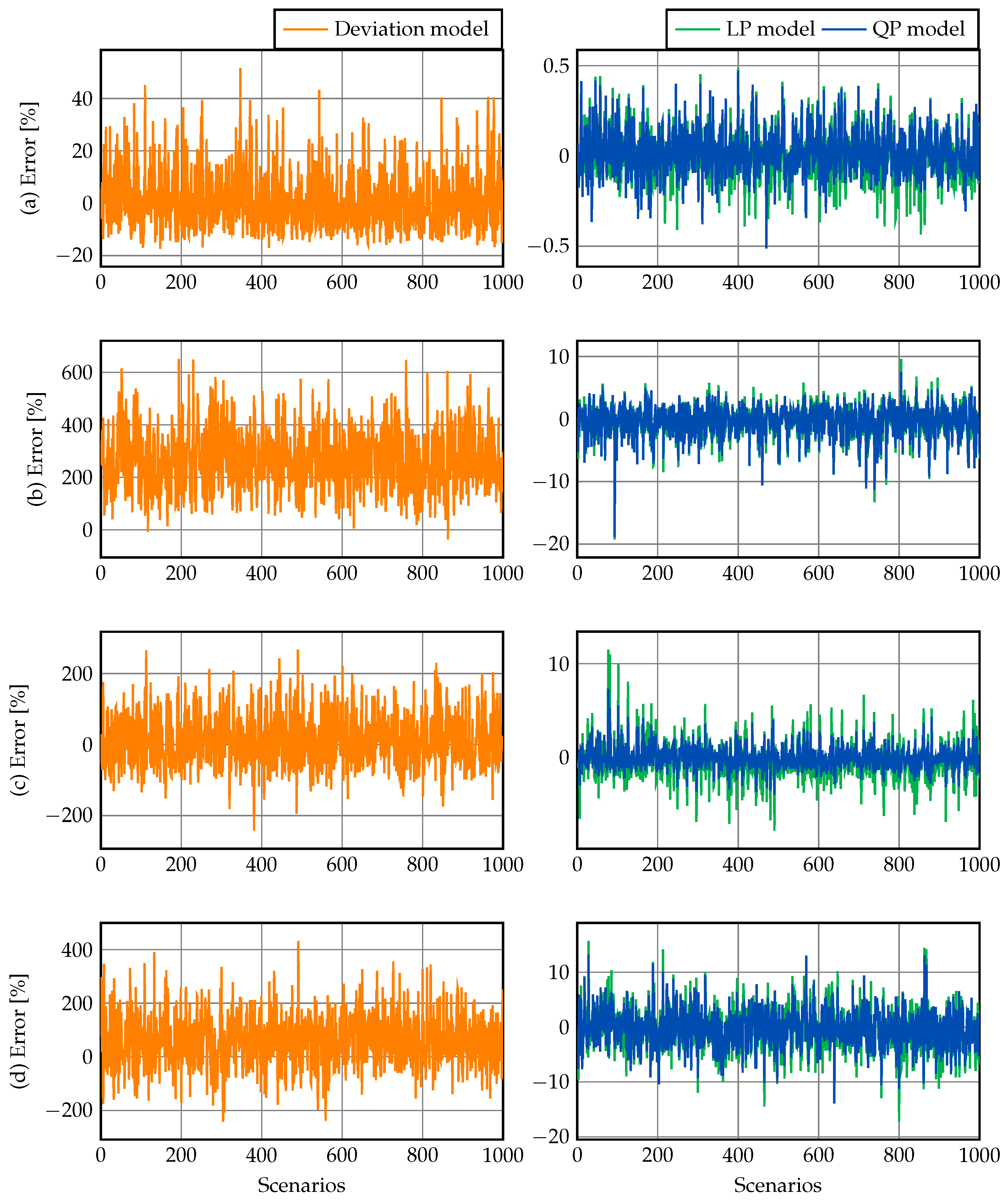
- For the 14-bus system (Figure 4a), the deviation model exhibits errors that approximately range between −20% and 45%, implying significant dispersion and a lack of consistency. In contrast, the LP and QP models maintain a performance similar: within an interval of , with small fluctuations across all scenarios.
- In the IEEE 39-bus system, the deviation model shows increased inaccuracy, with errors spanning roughly from 0% up to 600% and an average error of 266.2786% (Figure 4b). This indicates an increase in error estimation as the system size grows. Meanwhile, both the LP and QP models exhibit estimation errors around −10% and 6%, with the vast majority of estimates close to zero. This behavior is corroborated by their mean errors: −0.4086% and −0.3577% for the LP and QP models, respectively. Although the error range increases in comparison with the 14-bus case, the optimization models still maintain an acceptable performance—even when dealing with medium-sized networks.
- For the 57- and 117-bus systems, the deviation model continues to show large oscillations, with errors ranging approximately from −200% to 200% (Figure 4c,d). Meanwhile, the LP and QP models maintain errors between −12% and 12%. This demonstrates the consistency of our optimization-based models, which remain reliable even in large scale operations.
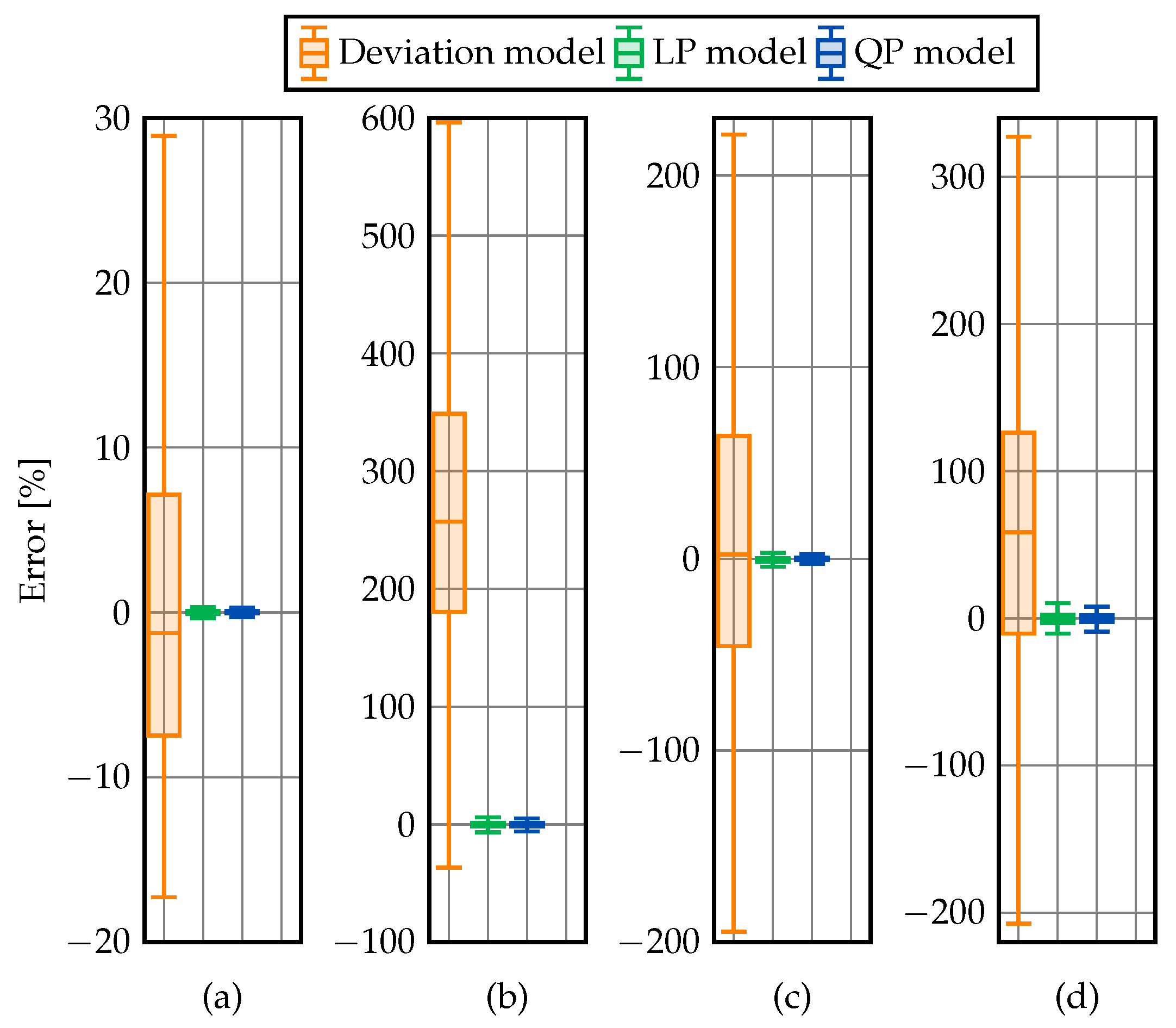
- In the 14-bus test system, the deviation model exhibits a very wide dispersion, with its interquartile range (IQR) roughly extending from −10% to 8%, as well as with an average estimation error close to 1% (Figure 5a). In contrast, the LP and QP models show a tighter clustering: their IQRs remain approximately between −0.25% and 0.35%, with mean errors around 0.03% for LP and 0.05% for QP. These results confirm that both optimization-based methods significantly outperform the deviation model in small systems.
- In the 39-bus test system, the deviation model becomes less reliable, showing an IQR approximately between 90% and 300%. On the other hand, the LP and QP models maintain their estimation accuracy, with their IQRs contained between −3% and 2%. Despite the increase in system complexity, both optimized formulations preserve their strong predictive performance.
- As for the 57- and 118-bus systems, the results reveal similar performance trends. The deviation model again exhibits a very large dispersion, with the IQRs spanning approximately from −100% to 80% (57-bus feeder) and from −120% to 90% (118-bus grid). Moreover, the average errors are around −15% and −18%, respectively. Conversely, the LP and QP models show tightly grouped errors, with the first–third quartiles ranging roughly from −1.2% to 1.0% for both systems. Their mean errors remain close to zero, ranging from −0.25 % to 0.20 %. This demonstrates that the optimization-based methods preserve accuracy even in large-scale networks.
Comparison of LP and QP Models
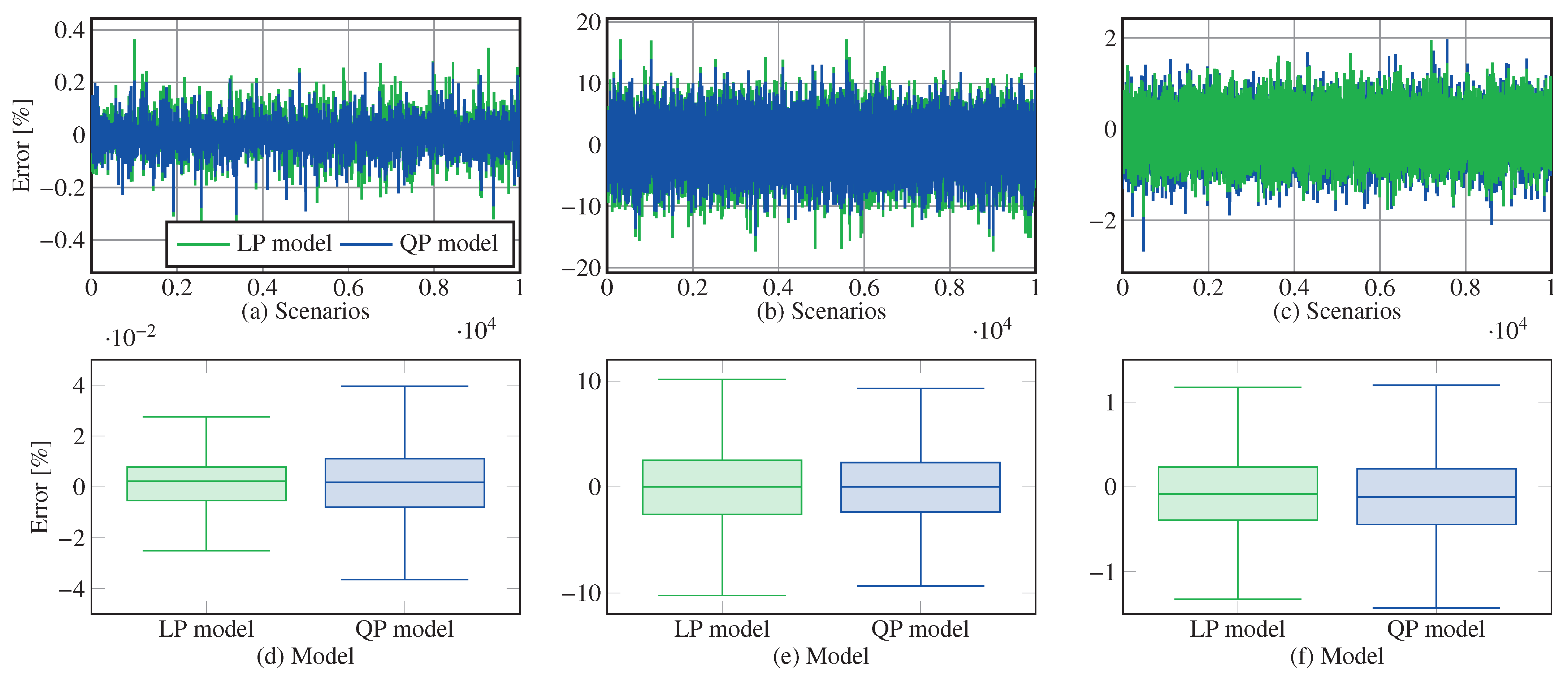
- For the 200-bus system, both models exhibit small and bounded errors, with values below 0.5% in most scenarios. The QP model shows a slightly higher dispersion than the LP model (Figure 6d).
- In the 300-bus test system, both models show noticeably larger variability than in the 200-bus feeder, with a deviation of approximately . Nevertheless, Figure 6e shows that more than 50% of the scenarios exhibit estimation errors below 2%. This indicates that the majority of operating conditions are well captured despite the increased nonlinearities of this medium-sized network.
- As for the 500-bus system, both models achieve significantly reduced percent errors compared to the 300-bus case, suggesting that the relative loss magnitudes scale more favorably with system size in this synthetic grid.
- The computational burden of the QP model remains manageable. Although the QP formulation requires more computational resources than the LP model, the differences in runtime become proportionally smaller as system size increases. For instance, in the 300- and 500-bus systems, the QP model is approximately twice as fast as the LP model, highlighting its favorable scalability and practical suitability for large-scale applications.
- The QP model outperforms its LP counterpart in terms of estimation accuracy. For all systems, the QP formulation yields lower average errors and reduced standard deviations, confirming its superior ability to capture the nonlinear dependence of transmission losses on power flows. This better performance is evident in medium-sized networks such as the 57- and 118-bus systems, where the LP model exhibits larger deviations due to increased nonlinear interactions.
- The estimation variability decreases in the largest synthetic systems (i.e., the 200-, 300-, and 500-bus feeders); the percent errors diminish as absolute transmission losses scale with network size. Even in these cases, the QP model maintains a lower dispersion and more tightly bounded error distributions.
5. Conclusions and Future Works
Author Contributions
Funding
Data Availability Statement
Acknowledgments
Conflicts of Interest
References
- Motta, V.N.; Anjos, M.F.; Gendreau, M. Survey of optimization models for power system operation and expansion planning with demand response. Eur. J. Oper. Res. 2024, 312, 401–412. [Google Scholar] [CrossRef] [Scilit]
- Maghami, M.R.; Yaghoubi, E.; Mohamed, M.; Yaghoubi, E.; Jahromi, M.Z.; Fei, T.K. Multi-objective optimization of unbalanced power distribution systems: A comprehensive approach to address uncertainties and enhance performance. Energy Convers. Manag. X 2025, 27, 101087. [Google Scholar] [CrossRef] [Scilit]
- Liu, B.; Liu, F.; Wei, W.; Wang, J. Estimating B-coefficients of power loss formula considering volatile power injections: An enhanced least square approach. IET Gener. Transm. Distrib. 2018, 12, 2854–2860. [Google Scholar] [CrossRef] [Scilit]
- Zarco, P.; Exposito, A. Power system parameter estimation: A survey. IEEE Trans. Power Syst. 2000, 15, 216–222. [Google Scholar] [CrossRef] [Scilit]
- Montoya, O.D.; Gil-González, W. Accurate measurement-based convex model to estimate transmission loss coefficients in power systems. Electr. Power Syst. Res. 2024, 237, 111036. [Google Scholar] [CrossRef] [Scilit]
- Cárdenas Guerra, C.A.; Ospino Castro, A.J.; Peña Gallardo, R. Analysis of the Impact of Integrating Variable Renewable Energy into the Power System in the Colombian Caribbean Region. Energies 2023, 16, 7260. [Google Scholar] [CrossRef] [Scilit]
- Kunya, A.B.; Abubakar, A.S.; Yusuf, S.S. Review of economic dispatch in multi-area power system: State-of-the-art and future prospective. Electr. Power Syst. Res. 2023, 217, 109089. [Google Scholar] [CrossRef] [Scilit]
- Talbi, E.H.; Abaali, L.; Skouri, R.; Moudden, M.E. Solution of Economic and Environmental Power Dispatch Problem of an Electrical Power System using BFGS-AL Algorithm. Procedia Comput. Sci. 2020, 170, 857–862. [Google Scholar] [CrossRef] [Scilit]
- Raharjo, R.M.; Sarjiya, S.; Wijaya, F.D.; Multa Putranto, L.; Yasirroni, M. Improved Kron Method for Linear Losses Coefficient. In Proceedings of the 2023 IEEE International Conference on Advanced Mechatronics, Intelligent Manufacture and Industrial Automation (ICAMIMIA), Lombok, Indonesia, 14–15 November 2023; pp. 352–357. [Google Scholar] [CrossRef] [Scilit]
- Bretas, A.S.; Rossoni, A.; Trevizan, R.D.; Bretas, N.G. Distribution networks nontechnical power loss estimation: A hybrid data-driven physics model-based framework. Electr. Power Syst. Res. 2020, 186, 106397. [Google Scholar] [CrossRef] [Scilit]
- Gharehchopogh, F.S.; Maleki, I.; Dizaji, Z.A. Chaotic vortex search algorithm: Metaheuristic algorithm for feature selection. Evol. Intell. 2021, 15, 1777–1808. [Google Scholar] [CrossRef] [Scilit]
- Bertozzi, O.; Chamorro, H.R.; Gomez-Diaz, E.O.; Chong, M.S.; Ahmed, S. Application of data-driven methods in power systems analysis and control. IET Energy Syst. Integr. 2023, 6, 197–212. [Google Scholar] [CrossRef] [Scilit]
- Happ, H.H.; Hohenstein, J.F.; Kirchmayer, L.K.; Stagg, G.W. Direct Calculation of Transmission Loss Formula-II. IEEE Trans. Power Appar. Syst. 1964, 83, 702–707. [Google Scholar] [CrossRef] [Scilit]
- Fliscounakis, S.; Lafeuillade, F.; Limousin, C. Estimation of transmission loss coefficients from measurements. In Proceedings of the 2005 IEEE Russia Power Tech, St. Petersburg, Russia, 27–30 June 2005. [Google Scholar] [CrossRef] [Scilit]
- Huang, W.T.; Yao, K.C.; Chen, M.K.; Wang, F.Y.; Zhu, C.H.; Chang, Y.R.; Lee, Y.D.; Ho, Y.H. Derivation and Application of a New Transmission Loss Formula for Power System Economic Dispatch. Energies 2018, 11, 417. [Google Scholar] [CrossRef] [Scilit]
- Chang, Y.C.; Yang, W.T.; Liu, C.C. A new method for calculating loss coefficients of power systems. IEEE Trans. Power Syst. 1994, 9, 1665–1671. [Google Scholar] [CrossRef] [Scilit]
- Alshawawreh, J.A. Power Losses Formula for Optimal Power Flow Problem in Power System. Int. J. Appl. Eng. Res. 2018, 13, 2471–2476. [Google Scholar]
- Alwan, S.H.; Razzaq Altahir, A.A.; Al Tu’ma, A.S. Calculations of Loss Factor Based on Real-Time Data: Determining Technical Power Loss for the Electrical Distribution Network in Karbala City. IOP Conf. Ser. Mater. Sci. Eng. 2020, 671, 012037. [Google Scholar] [CrossRef] [Scilit]
- Jethmalani, C.H.R.; Dumpa, P.; Simon, S.P.; Sundareswaran, K. Transmission Loss Calculation using A and B Loss Coefficients in Dynamic Economic Dispatch Problem. Int. J. Emerg. Electr. Power Syst. 2016, 17, 205–216. [Google Scholar] [CrossRef]
- Ram Jethmalani, C.; Simon, S.P.; Sundareswaran, K.; Srinivasa Rao Nayak, P.; Padhy, N.P. Real coded genetic algorithm based transmission system loss estimation in dynamic economic dispatch problem. Alex. Eng. J. 2018, 57, 3535–3547. [Google Scholar] [CrossRef] [Scilit]
- Asghari, M.; Fathollahi-Fard, A.M.; Mirzapour Al-e hashem, S.M.J.; Dulebenets, M.A. Transformation and Linearization Techniques in Optimization: A State-of-the-Art Survey. Mathematics 2022, 10, 283. [Google Scholar] [CrossRef] [Scilit]
- Hladík, M.; Moosaei, H.; Hashemi, F.; Ketabchi, S.; Pardalos, P.M. An overview of absolute value equations: From theory to solution methods and challenges. Comput. Optim. Appl. 2025, 93, 435–488. [Google Scholar] [CrossRef] [Scilit]
- Martin, R.K. Large Scale Linear and Integer Optimization: A Unified Approach; Springer: New York, NY, USA, 1999. [Google Scholar] [CrossRef] [Scilit]
- Dostál, Z. Optimal Quadratic Programming and QCQP Algorithms with Applications; Springer Nature: Cham, Switzerland, 2025. [Google Scholar] [CrossRef] [Scilit]
- Megantoro, P.; Halim, S.A.; Kamari, N.A.M.; Awalin, L.J.; Ali, M.S.; Rosli, H.M. Optimizing reactive power dispatch with metaheuristic algorithms: A review of renewable distributed generation integration with intermittency considerations. Energy Rep. 2025, 13, 397–423. [Google Scholar] [CrossRef] [Scilit]
- Tian, Z.; Deng, W.; Liu, M.; Lv, L.; Chen, Z. Empowering Sustainability in Power Grids: A Multi-Scale Adaptive Load Forecasting Framework with Expert Collaboration. Sustainability 2025, 17, 10434. [Google Scholar] [CrossRef] [Scilit]
- Hakami, A.M.; Hasan, K.N.; Alzubaidi, M.; Datta, M. A Review of Uncertainty Modelling Techniques for Probabilistic Stability Analysis of Renewable-Rich Power Systems. Energies 2022, 16, 112. [Google Scholar] [CrossRef] [Scilit]
- Guerra, G.; Martinez-Velasco, J.A. Evaluation of MATPOWER and OpenDSS load flow calculations in power systems using parallel computing. J. Eng. 2017, 2017, 195–204. [Google Scholar] [CrossRef] [Scilit]
- Liu, X.; Zhang, T. Analysis of IEEE 14 bus power flow calculation characteristics based on Newton-Raphson method. In Proceedings of the 2022 IEEE 5th International Conference on Automation, Electronics and Electrical Engineering (AUTEEE), Shenyang, China, 18–20 November 2022; pp. 1092–1097. [Google Scholar] [CrossRef] [Scilit]
- Chen, K.; Tie, Y.; Li, M. Importance Evaluation of Power Grid Transmission Lines Based on Multidimensional Information Feature Mapping. Energies 2024, 17, 6013. [Google Scholar] [CrossRef] [Scilit]
- Alanazi, A.; Alanazi, M.; Memon, Z.A.; Mosavi, A. Determining Optimal Power Flow Solutions Using New Adaptive Gaussian TLBO Method. Appl. Sci. 2022, 12, 7959. [Google Scholar] [CrossRef] [Scilit]
- Almutairi, A.; Ahmed, M.H.; Salama, M. Probabilistic generating capacity adequacy evaluation: Research roadmap. Electr. Power Syst. Res. 2015, 129, 83–93. [Google Scholar] [CrossRef] [Scilit]
- Löfberg, J. YALMIP: A Toolbox for Modeling and Optimization in MATLAB. In Proceedings of the 2004 IEEE International Conference on Robotics and Automation (IEEE Cat. No.04CH37508), Taipei, Taiwan, 2–4 September 2004; pp. 284–289. [Google Scholar] [CrossRef] [Scilit]



| Bus | Computation Time [s] | Average Error [%] | Std. Deviation [%] | ||||
|---|---|---|---|---|---|---|---|
| LP | QP | LP | QP | LP | QP | ||
| 14 | 3 | 0.2928 | 0.2160 | −0.0011 | 0.0167 | 0.1420 | 0.1263 |
| 39 | 10 | 0.8591 | 0.4547 | 0.1705 | −0.1896 | 1.5751 | 1.5920 |
| 57 | 7 | 0.5082 | 0.3140 | −0.4934 | −0.4650 | 2.1220 | 1.8562 |
| 118 | 54 | 26.5811 | 14.6094 | −0.2084 | −0.1485 | 3.3206 | 2.9559 |
| 200 | 38 | 7.4315 | 3.0726 | 0.0019 | 0.0002 | 0.0387 | 0.0329 |
| 300 | 69 | 52.1159 | 27.2672 | −0.1027 | −0.0594 | 3.9342 | 3.5895 |
| 500 | 56 | 42.0950 | 20.8765 | −0.0783 | −0.1143 | 0.4680 | 0.4889 |
Disclaimer/Publisher’s Note: The statements, opinions and data contained in all publications are solely those of the individual author(s) and contributor(s) and not of MDPI and/or the editor(s). MDPI and/or the editor(s) disclaim responsibility for any injury to people or property resulting from any ideas, methods, instructions or products referred to in the content. |
© 2026 by the authors. Licensee MDPI, Basel, Switzerland. This article is an open access article distributed under the terms and conditions of the Creative Commons Attribution (CC BY) license.
Share and Cite
Montoya, O.D.; Correa-Flórez, C.A.; Gil-González, W.; Grisales-Noreña, L.F.; Hernández, J.C. Data-Driven Estimation of Transmission Loss Coefficients via Linear and Quadratic Programming Under Linear Constraints. Energies 2026, 19, 405. https://doi.org/10.3390/en19020405
Montoya OD, Correa-Flórez CA, Gil-González W, Grisales-Noreña LF, Hernández JC. Data-Driven Estimation of Transmission Loss Coefficients via Linear and Quadratic Programming Under Linear Constraints. Energies. 2026; 19(2):405. https://doi.org/10.3390/en19020405
Chicago/Turabian StyleMontoya, Oscar Danilo, Carlos Adrián Correa-Flórez, Walter Gil-González, Luis Fernando Grisales-Noreña, and Jesús C. Hernández. 2026. "Data-Driven Estimation of Transmission Loss Coefficients via Linear and Quadratic Programming Under Linear Constraints" Energies 19, no. 2: 405. https://doi.org/10.3390/en19020405
APA StyleMontoya, O. D., Correa-Flórez, C. A., Gil-González, W., Grisales-Noreña, L. F., & Hernández, J. C. (2026). Data-Driven Estimation of Transmission Loss Coefficients via Linear and Quadratic Programming Under Linear Constraints. Energies, 19(2), 405. https://doi.org/10.3390/en19020405