
Article

Policy Synergy Scenarios for Tokyo’s Passenger Transport and Urban Freight: An Integrated Multi-Model LEAP Assessment


1
Graduate School of Global Environmental Studies, Sophia University, Tokyo 102-8554, Japan
2
Department of Engineering and Applied Sciences, Sophia University, Tokyo 102-8554, Japan
*
Authors to whom correspondence should be addressed.
Energies 2026, 19(2), 366; https://doi.org/10.3390/en19020366
Submission received: 4 December 2025 / Revised: 30 December 2025 / Accepted: 5 January 2026 / Published: 12 January 2026
(This article belongs to the Special Issue Sustainable Energy Systems: Progress, Challenges and Prospects)

Abstract

To identify the emission reduction potential and policy synergies of Tokyo’s road passenger and urban road freight transport under the “carbon neutrality target,” this paper constructs an assessment framework for megacities. First, based on macroeconomic socioeconomic variables (population, GDP, road length, and employment), regression equations are used to predict traffic turnover for different modes of transport from 2021 to 2050. Then, the prediction results are imported into the LEAP (Long-range Energy Alternatives Planning) model. By adjusting three policy levers—vehicle technology substitution (ZEV: EV/FCEV), energy intensity improvement, and upstream electricity and hydrogen supply decarbonization—a “single-factor vs. multi-factor (policy synergy)” scenario matrix is designed for comparison. The results show that the emission reduction potential of a single measure is limited; upstream decarbonization yields the greatest independent emission reduction effect, while the emission reduction effect of deploying zero-emission vehicles and improving energy efficiency alone is small. In the most ambitious composite scenario, emissions will decrease by approximately 83% by 2050 compared to the baseline scenario, with cumulative emissions decreasing by over 35%. Emissions from rail and taxis will approach zero, while buses and freight will remain the primary residual sources. This indicates that achieving net zero emissions in the transportation sector requires not only accelerated ZEV penetration but also the simultaneous decarbonization of electricity and hydrogen, as well as policy timing design oriented towards fleet replacement cycles. The integrated modeling and scenario analysis presented in this paper provide quantifiable evidence for the formulation of a medium- to long-term emissions reduction roadmap and the optimization of policy mix in Tokyo’s transportation sector.

1. Introduction

The transportation sector is one of the major sources of global carbon dioxide emissions, which has a serious impact on the global climate [1]. According to the IPCC (2022) [2], transport is one of the largest end-use sectors of global GHG emissions, accounting for about 15% of total emissions [3]. Official statistics from Japan show that the transportation sector accounts for 17% of the country’s total carbon emissions, with road transport accounting for 87.6% and freight transport for 39.2% of that [4,5]. This is largely due to heavy dependence on fossil fuels [6]. Empirical evidence from China indicates that, despite the rapid expansion of the new energy vehicle (NEV) market, the contribution of NEVs to reducing national crude oil imports has so far been modest, implying that transport decarbonization still requires broader systemic changes in the oil-dependent energy system [7]. Therefore, advancing environmental technologies and renewable energy through targeted policies is critical to transforming the sector and achieving zero-carbon urban transport [8,9]. Tokyo has proposed an overall goal and action framework to achieve net-zero emissions by 2050, providing a policy anchor for city-level emissions reduction pathways [10]. Against this backdrop, this paper focuses on a systemic emissions reduction assessment and scenario comparison for public passenger transport and urban road freight.
To achieve the carbon neutrality goal by 2050, the Japanese government and the Tokyo Metropolitan Government have introduced several policies and plans to accelerate the electrification of public transportation. For example, the Japanese government is promoting the popularization of electric vehicles (EVs) by adopting subsidies and improving infrastructure [11]. In addition to EVs, Japan has also been committed to the development of hydrogen fuel cell vehicles (FCEVs) [12], because green hydrogen is seen as a solution for building a zero-emission transportation system in the future [13]. In this context, it is necessary to establish a scientific model framework to estimate the carbon reduction potential to support the formulation and optimization of local climate strategies.
The Long-range Energy Alternatives Planning (LEAP) model has been widely applied in energy system and climate policy research, especially in the transportation sector [14]. However, existing LEAP-based studies have four main limitations. First, they neglect the driving forces of socioeconomic factors, and the forecasts of turnover volume typically use a fixed growth rate. Second, the scenario design is usually based on a single policy factor, rarely considering the synergistic effects of multiple policies. Third, zero-emission vehicles (ZEVs) are not differentiated according to vehicle technology and energy type (pure electric vehicles and hydrogen fuel cell vehicles). Finally, the reduction in energy intensity and emission factors is often based on subjective judgments, lacking objective technical and policy support, thus reducing the reliability and applicability of the studies.
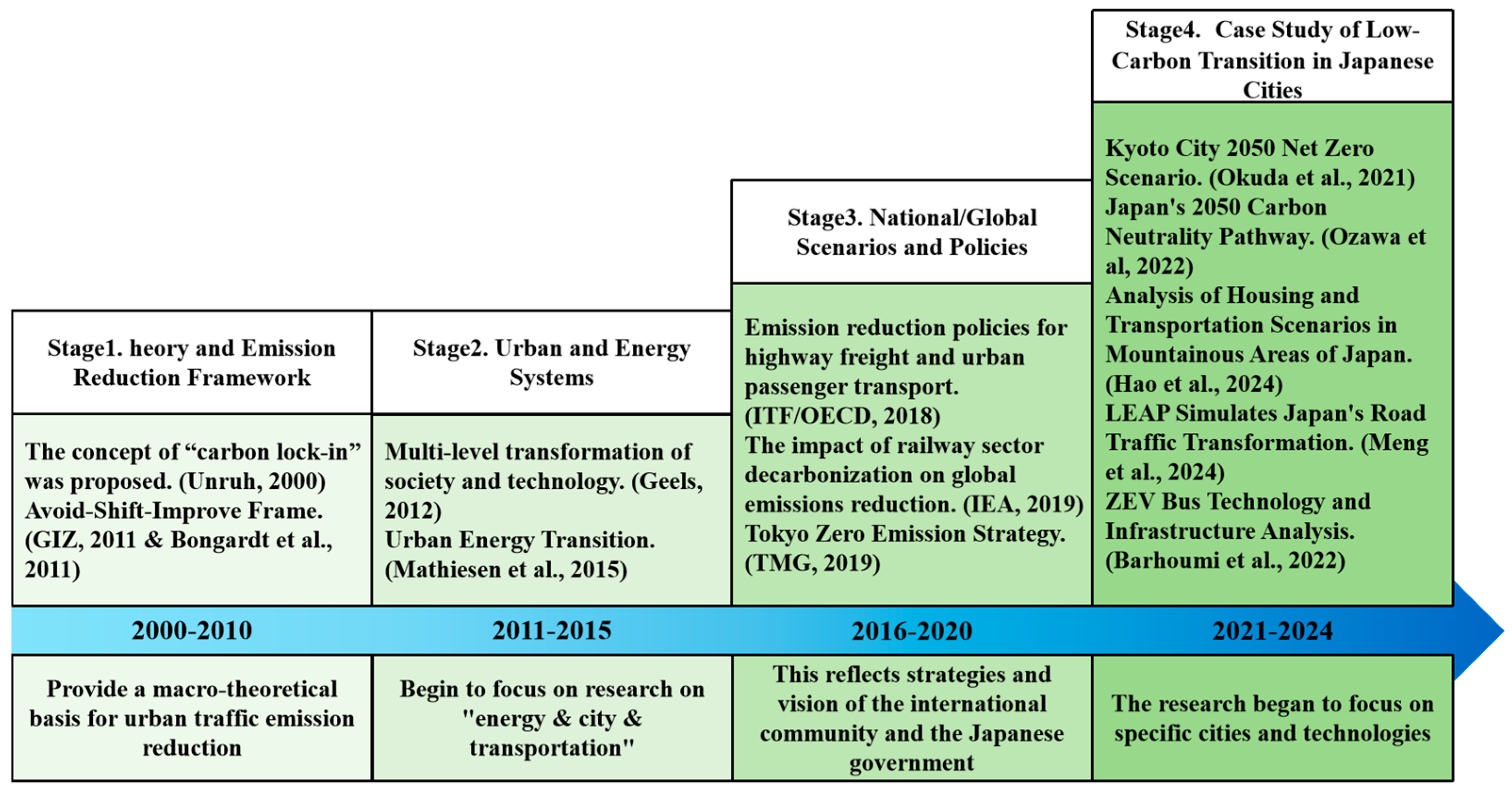
In addition, theoretical and policy discussions related to urban transportation emissions reduction can be roughly divided into four development stages. As shown in Figure 1, early research provided a theoretical framework for emissions reduction in the urban transportation sector. Subsequent research shifted its focus to urban technological and energy transitions. After 2010, with increasing emphasis on carbon emissions reduction, international organizations and the Japanese government released a series of emissions reduction strategies and plans. In recent years, research on carbon neutrality scenarios and technology assessments for specific Japanese cities or sectors has been increasing.
However, as can be seen from Figure 1, previous studies have neglected how broader macro-level conditions (including changes in urban spatial structure, socio-economic transformation, and traveler behavior) affect transportation activities and their carbon emission consequences. Some recent studies have shown that urban carbon emissions do not evolve in a simple linear manner, and the relationship between urban spatial form and carbon emissions is highly nonlinear and spatially heterogeneous [15]. In addition, a study on social media machine learning in Japan’s three major metropolitan areas found that public sentiment fluctuates due to the influence of energy transition, highlighting the importance of integrating social cognition into the design of low-carbon city policies in Japan [16]. Therefore, in this study, socio-economic changes will be regarded as the main factor affecting urban carbon emissions, and the scenario setting will be closer to reality, rather than developing transportation demand and technological innovation independently of the social environment. In addition to interpreting data and policies, it is also necessary to combine theoretical analysis of passenger behavior and transportation-related social forms to assess technological and policy pathways while clarifying their social implications.
There are four main objectives of this research:
  • Building a systematic forecasting and evaluation framework.
  • Evaluating the impact of different policy pathways on carbon emissions in Tokyo’s transport sector.
  • Identify the key drivers to achieve deep emissions reductions and carbon neutrality.
  • Providing quantitative support and scenario analysis for Tokyo to achieve its carbon neutrality goal by 2050.

2. Materials and Methods

2.1. Theoretical Foundation

This study is based on the theoretical foundation of the Sustainable Development Goals (SDGs), urban energy transition and socio-technical transition theories, and the Avoid-Shift-Improve (ASI) framework widely used in the field of sustainable transportation. It combines statistical forecasting models with the LEAP model to provide conceptual support for assessing the emission reduction potential of various policy initiatives for passenger transport and road freight in Tokyo.
First, the Sustainable Development Goals (SDGs) and national carbon neutrality targets provide a normative direction for this study. SDG 11.2 calls for safe, economical, accessible, and sustainable transport systems for all by 2030, while SDG 7 and SDG 13 emphasize the importance of clean energy and climate action [17]. This means that urban transport decarbonization must not only be assessed based on CO2 emission reduction potential but also ensure the service quality and accessibility of its transport system. By simulating CO2 emissions from buses, railways, taxis, and urban freight under different policy combinations, this study quantifies and assesses the requirements for SDGs and carbon neutrality targets at the urban scale.
Secondly, theories of urban energy transition and social-technological transition are based on policy, institutional, and technological levels [18]. The multi-level perspective (MLP) views innovative technologies such as electric vehicles and hydrogen fuel cell vehicles as “niches,” interacting with systems comprising traditional energy transportation technologies and existing transportation networks [19]. From this perspective, this paper, based on the LEAP scenario design, reconstructs Tokyo’s transportation-energy system through different combinations of upstream decarbonization of electricity and hydrogen, promotion of zero-emission vehicles (ZEVs), and energy efficiency improvements.
Third, the Avoid–Shift–Improve (ASI) framework provides an analytical approach for sustainable transportation strategies [20,21]. “Avoid” refers to reducing unnecessary travel and freight demand; “Shift” encourages a shift to low-carbon modes such as public transport; and “Improve” focuses on reducing energy consumption and emissions per unit of transport services through cleaner vehicles and fuels. In this paper, ASI is primarily used to organize and interpret different policy levers, while quantitative modeling focuses on two mechanism dimensions that can be consistently characterized within the LEAP accounting framework: transformation and improvement. Specifically, Scenario A represents the replacement and penetration of zero-emission vehicles on the end-use side; Scenario B represents the decarbonization process of electricity and hydrogen energy in the upstream and downstream supply chains; and Scenario C represents the decline in the energy intensity of existing fossil fuel vehicles on the demand side. In contrast, explicit “Avoid” strategies such as demand management or compact urban planning rely more on behavioral and spatial responses, but it is difficult to generate quantitative parameters that can be consistently extrapolated over the long term and to conduct simulations under existing data conditions. Therefore, this paper does not include them in quantitative simulations but instead conducts qualitative analysis within the policy discussion.
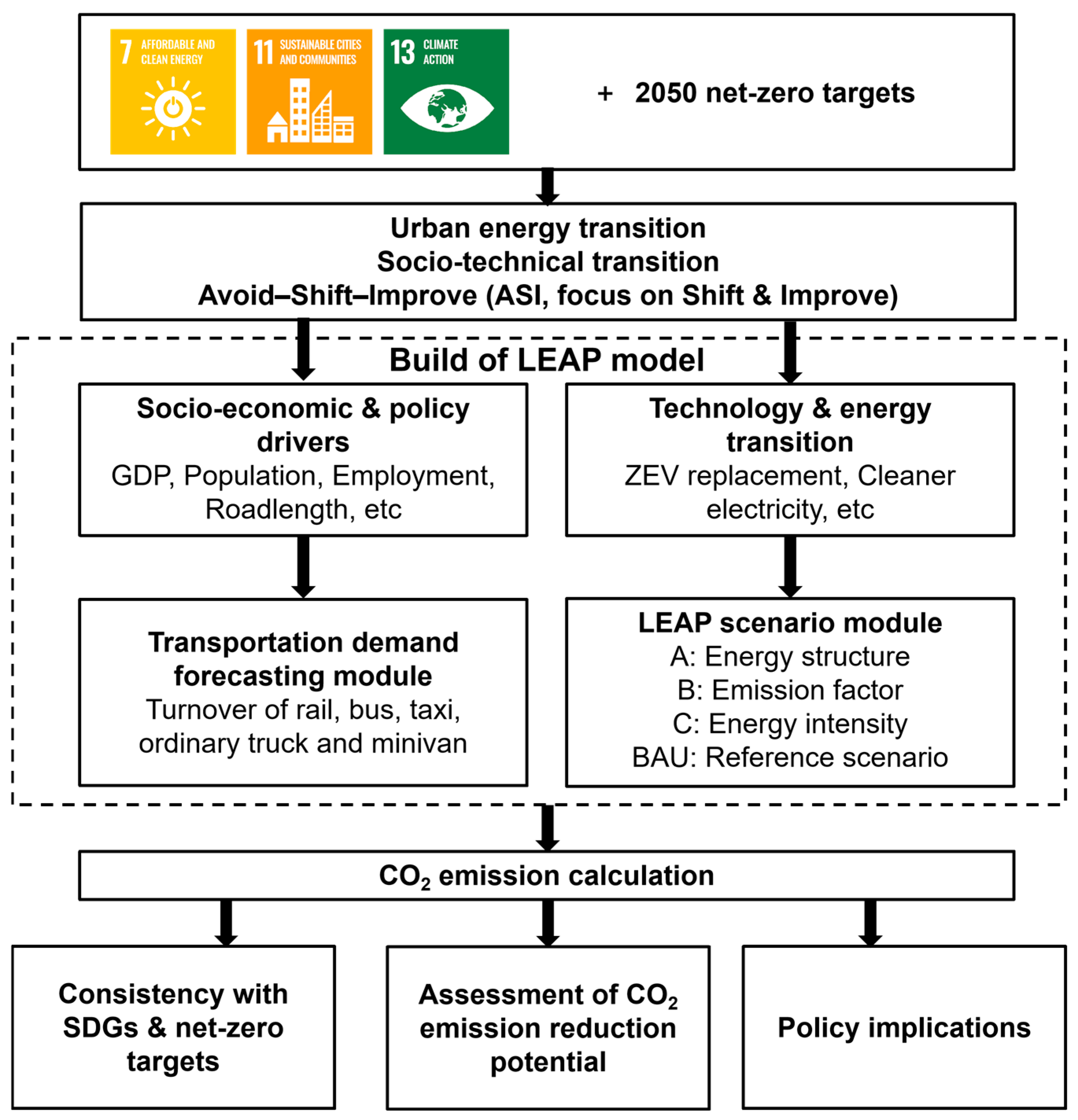
By combining traffic demand forecasting models with the LEAP model, transportation activity is converted into CO2 emissions for policy scenario analysis. Based on this, the “prediction–simulation–explanation” approach adopted in this paper is methodologically supported by the theoretical framework (Figure 2).

2.2. Data Source and Variable Settings

This section defines the dataset and variables used in the integrated forecasting–LEAP framework. Inputs include socioeconomic drivers (GDP, population, employment, road length, vehicle stocks) and activity/technology variables (turnover, EI, energy shares, EF). These inputs are subsequently used to forecast activity levels (Section 2.3) and to parameterize LEAP scenarios (Section 2.4).
Because the Japanese government’s official statistics on some socio-economic and transportation data for 2022–2024 are not complete and consistent, in order to ensure the consistency of the data in this study, 2021 is used as the base year, and the data for 2022 and beyond are all predicted values derived from statistical models, which are used as input and calculation for LEAP.
The data system of this study integrates official statistics, industry reports and corporate technical information, covering multiple dimensions such as socioeconomic development, traffic operation characteristics, energy use and vehicle technical parameters. The time span is 2001–2021, and the spatial scope is the urban transportation system of the Tokyo metropolitan area.
The main variables are divided into three categories:
  • Socioeconomic variables (Data source: Tokyo Metropolitan Statistical Yearbook) [22]: GDP, population, employment, road length, vehicle stock.
  • Transport activity variables: Annual turnover of railway, bus, taxi, ordinary truck and minivan.
  • Energy and technology variables: Energy intensity (EI), energy structure (energy share), emission factor (EF), etc.

2.3. Variable Prediction Models

This section provides exogenous forecasts of socioeconomic factors and traffic turnover rates for the period 2022–2050. Time series models generate trajectories for road length, employed population, and truck stock, while regression/generalized linear models transform socioeconomic factors into turnover rates for each mode of transportation. The resulting activity paths are fixed inputs to LEAP; scenario differences are introduced only through assumptions about energy structure, energy efficiency and emission factors (Section 2.4).
In this research, population and GDP projections were sourced from official forecasts [23,24], but other socioeconomic variables and transport activity variables lacked official projections. Therefore, it was necessary to forecast these variables through modeling.
To quantify the impact of socioeconomic factors on transportation demand, a multi-model forecasting system was constructed (implemented in R, Version 4.5.0; R Core Team, R Foundation for Statistical Computing, Vienna, Austria; using RStudio IDE; Posit Software, PBC, Boston, MA, USA):
  • Time series models were used to predict socioeconomic variables (Employment, road length and vehicle stock).
  • Multiple regression models (MLR) and generalized linear models (GLM) were used to predict the activity levels (turnover) of various transportation modes.

2.3.1. Time Series Model

To enhance the robustness of forecasts for exogenous macroeconomic drivers, this study employs the Auto-ARIMA automatic order identification method (Hyndman–Khandakar procedure) to model and forecast annually (2001–2021 training, 2022–2050 forecast) for employment, road length, ordinary truck stock, and minivan stock.
The general expression of the model is:
Φ B 1 B y t d = C + Θ B ε t
B   is   the   lag   operator   B y t = y t 1
Φ ( B ) = 1 ϕ _ 1   B ϕ _ P   B ^ P
Θ β = 1 + θ 1 B + + θ q B q
ε t is the white noise disturbance term.
When d = 0, the constant term c represents the mean; when d = 1, c corresponds to the drift term, representing the linear change in the mean over time.
To verify the short-term extrapolation performance, a hold-out method was used. Specifically, data from 2001–2018 or 2013–2019 were used for training, and data from 2019–2021 or 2020–2021 were used for testing. Accuracy, stationarity, and residual tests were then performed to ensure that the prediction error was controlled within 10%. Data uncertainty was addressed by generating 80–95% confidence intervals.

2.3.2. Multiple Regression Models

To link socioeconomic development with the level of transportation activity, a multiple regression model for transportation turnover rate was established based on historical data from 2001 to 2021. The model aims to maintain the interpretability and attributability of scenario comparisons by inputting passenger/freight turnover as an exogenous driver into the LEAP demand side, comparing the impact of mechanisms such as energy structure (S), energy intensity (I), and upstream supply transformation (T) on emissions under a unified demand trajectory. These forecasts are then used as inputs to the LEAP model.
For the turnover of railway, bus, ordinary truck and minivan, a multiple linear regression model (MLR) was used to predict the turnover of railway, bus, ordinary truck and minivan. A generalized linear model (GLM) predicted the turnover of taxis. If a multiple linear regression model was used to predict the turnover of taxis, the turnover may become negative after a certain year. Therefore, a different model was used for taxis to ensure the accuracy of the prediction.
The general expression of MLR is:
A i , t = β 0 + β 1 G D P t + β 2 P o p u l a t i o n t + β 3 E m p l o y m e n t t + β 4 R o a d L e n g t h t + ε t
where Ai,t is the annual turnover of the i-t mode of transportation, εt is the residual term.
The general expression of GLM is:
A t a x i , t X t G a m m a ( μ t , ϕ )
log μ t = η t = α 0 + α 1 G D P t + α 2 P o p u l a t i o n t + α 3 E m p l o y m e n t t + α 4 R o a d L e n g t h t
where μt = E (Ataxi,t∣Xt) is the conditional mean, ϕ is the dispersion parameter, and ηt is the linear predictor. In other words, we assume a Gamma distribution for the response variable Ataxi,t with a log-link function.
For the MLR model, the accuracy is evaluated by adjusting R-square, R-square, and p-value. For the GLM model, the prediction accuracy is evaluated by calculating MAE, MAPE, and RMSE. Ensure the accuracy of the prediction.

2.4. LEAP Model Construction and Scenario Design

This section inputs the forecast results into the LEAP model (LEAP, Version 2024.5.0.9; Stockholm Environment Institute, Somerville, MA, USA) and defines the scenario matrix. It also specifies the system boundaries, computational logic, and policy levers for the scenario sequences (A/B/C and their combinations). These scenario settings determine the emissions results reported in Section 3.2.

2.4.1. System Boundary

(1) Spatial Scope: Tokyo Metropolitan Area.
(2) Sectors: railways, buses, taxis, ordinary trucks, and minivans.
(3) Time Scope: 2021 is the base year, and the forecast period is 2022–2050.
(4) Modeling boundary: exogenous-driver scenario framework.

2.4.2. Calculation Formula

The LEAP model’s emissions calculations are based on the formula:
E = A × E I × E F
where
E: Carbon dioxide emissions (unit: kg-CO2);
A: Turnover (thousand person-km or thousand ton-km);
EI: Energy intensity per unit turnover;
EF: Emission factor per unit energy.

2.4.3. Scenario Design

The scenario design followed a hierarchical structure of “baseline-single policy-synergy,” aiming to evaluate the energy transformation path and emission reduction potential of Tokyo’s public transportation sector under different policy combinations. All scenarios shared the same socioeconomic projections and activity level inputs, differing only in their assumptions about technology, energy mix and emission factors. The core objective of this study is to identify and compare the “objective exogenous mechanisms” in transportation system emissions reduction that can be clearly characterized by scenario settings, namely the relative leverage and synergistic relationship between energy structure optimization (S), energy intensity improvement (I), and upstream supply transformation (T) on emissions changes. Based on this research objective, this paper adopts an exogenously driven scenario design: traffic activity levels are kept consistent as the exogenous input, thus allowing emissions differences between different scenarios to be primarily attributed to changes in the S–I–T mechanism setting. In other words, this study’s research question, scenario design, and LEAP simulation caliber are consistent, and the results are more suitable for mechanism identification and scenario comparison, rather than end-to-end prediction of actual policy effects including behavioral responses.
(1)
Baseline scenario (Business-as-Usual, BAU)
This study first defines a baseline scenario (BAU) as a reference: only key socioeconomic drivers evolve over time, while other parameters such as energy structure, energy intensity, and emissions factors remain at 2021 levels. It is important to note that the BAU scenario is not intended to depict the “most likely realistic policy continuation path,” but rather serves as a diagnostic benchmark to support clearer and more attributable comparisons of scenario levers A, B, and C. By keeping technology and supply-side parameters constant, differences between scenarios can be more directly attributed to changes in assumptions introduced by each lever, thereby improving the interpretability of the results and helping to identify dominant drivers and potential synergistic effects.
Compared to a policy-consistent baseline setting, this BAU may make relative differences more significant; however, this is a trade-off made to improve attribution clarity and comparative consistency, ensuring that scenario differences reflect the mechanisms of interest in the study. Therefore, the main role of the BAU scenario is to provide a stable and consistent mechanistic comparative reference for other policy scenarios.
(2)
Energy structure optimization scenario (A)
This scenario is set based on a series of policies and strategic plans designated by the Tokyo Metropolitan Government and the Japanese government, aiming to explore the substitution role of zero-emission vehicles (ZEVs, including electric vehicles and hydrogen fuel cell vehicles) in buses, taxis, and freight vehicles. A policy-driven ZEV proportion model was constructed using some of the annual targets set by the government [25,26,27] and vehicle age [28].
To effectively evaluate different ZEV development paths and amplify the emission reduction differences between them, we set up three sub-scenarios: A1 (hydrogen-first scenario, i.e., all ZEVs are hydrogen-powered vehicles), A2 (electricity-first scenario, i.e., all ZEVs are electric vehicles), and A3 (hybrid scenario, i.e., ZEVs consist of 50% hydrogen-powered vehicles and 50% electric vehicles). This design helps to determine the optimal ZEV deployment strategy.
Furthermore, Scenario A assumes that urban passenger and freight transport turnover remains at least at baseline levels. Therefore, ZEV replacement aims to improve environmental performance while maintaining or even enhancing service quality (e.g., quieter interiors and enhanced passenger experience with smart features), aligning with SDGs Objectives 7 and 11. In other words, this scenario focuses on how different ZEV replacement pathways can achieve urban transport decarbonization without compromising the availability and reliability of public transport and freight services.
(3)
Emission factors optimization scenario (B)
This scenario corresponds to the future development path of green electricity and green hydrogen, aiming to assess the impact of upstream energy purification on carbon emission reduction in the transportation sector. Based on energy development plans published by government departments, target values were set for several time nodes, including 2030, 2040, and 2050, and linear interpolation was used to simulate the decreasing trend of hydrogen and electricity emission factors.
According to MOEJ/NIES and REI data [29,30,31], this scenario assumes that by 2030 the emission factors will fall to 0.37 kg-CO2/kWh (electricity) and 1.50 kg-CO2/kg-H2 (hydrogen). In 2040, the emission factor for hydrogen will continue to decrease to 0.60 kg-CO2/kg-H2. By 2050, the emission factors for both electricity and hydrogen will approach zero. This scenario aims to assess the role of cleaner energy systems in promoting carbon reduction in the transportation sector.
Since the scenario is designed to decarbonize the upstream energy system without restricting transportation activities, Scenario B meets the requirements of SDG 7 by increasing the proportion of green electricity and green hydrogen. At the same time, the scenario also ensures that emissions are significantly reduced without affecting the availability, affordability and reliability of transportation services, supporting SDG 11 and 13.
(4)
Energy intensity optimization scenario (C)
The purpose of this scenario is to assess the impact of declining energy intensity of traditional fossil fuel vehicles on carbon emissions in the transportation sector, driven by future policies and technologies. Therefore, this scenario will calculate the average annual rate of decline in unit energy consumption of fossil fuel vehicles from 2022 to 2050, based on the emission reduction targets set by the Ministry of Land, Infrastructure, Transport and Tourism (MLIT) [32], and use this as input data for LEAP.
Scenario C implies that emissions reductions are achieved through improved efficiency rather than service cuts, thereby helping to control operating costs and support affordable and reliable services. This aligns SDG 7 and 11 on energy efficiency, which aim to improve resource utilization efficiency in the transport sector while maintaining service quality.
(5)
Scenario combination and integrated analysis design
To comprehensively assess the impact of various policy pathways on carbon emissions from Tokyo’s public transportation system, this study combines individual policies to create multiple scenario combinations. These combined scenarios represent the synergistic effects among various policies, demonstrating the emission reduction potential of policy synergy and helping to identify key drivers of deep decarbonization.
By comparing single-factor and multi-factor scenarios, synergies are quantified, dominant mitigation drivers are identified, and net-zero feasibility is assessed, thereby informing policy priorities.
On the other hand, the projected traffic volumes in various scenario combinations will follow socioeconomic trends, rather than deliberately reducing traffic volumes to lower carbon emissions. Therefore, all scenario combinations are simulated under the premise of maintaining or improving accessibility and service quality and reconcile the climate mitigation goals under SDG 13 with the goals of SDG 7 and 11 regarding clean energy and inclusive, high-quality urban transport services.
All scenario combinations are shown in the Table 1:

2.4.4. Sensitivity Analysis Settings

To quantify the impact of uncertainties in upstream decarbonization assumptions on emission pathways, this paper conducts a single-factor sensitivity analysis, applying ±20% perturbations to the emission factors for electricity and hydrogen production from 2022 to 2049 (fixed at 0 in 2050 to maintain the net-zero energy supply endpoint constraint). Given the large number of scenario combinations studied, and to avoid information overload in the Appendix E, the sensitivity analysis selects representative scenarios covering different policy combinations. Since the emission factors for electricity and hydrogen converge to 0 in 2050 as set, this paper uses emissions in 2040 (E_2040) and cumulative emissions from 2022 to 2050 (CumE_2022-2050) as the core indicators for the sensitivity analysis. Specific calculations and results are summarized in Appendix E.

3. Results

3.1. Socioeconomic Factors and Traffic Turnover Forecast Results

This section presents the prediction results of socioeconomic factors such as road length, employment, and truck stock using time series models, as well as the prediction results of turnover for various modes of transportation using regression models based on socioeconomic factors.

3.1.1. Forecasting Results of Time Series Models

The following figure shows the changing trends of employment, road length, ordinary truck and minivan stock from 2022 to 2050, using the time series model forecast. The accuracy, stationarity, and error diagnostic results for each ARIMA model are shown in Appendix A.7.
(1)
Employment
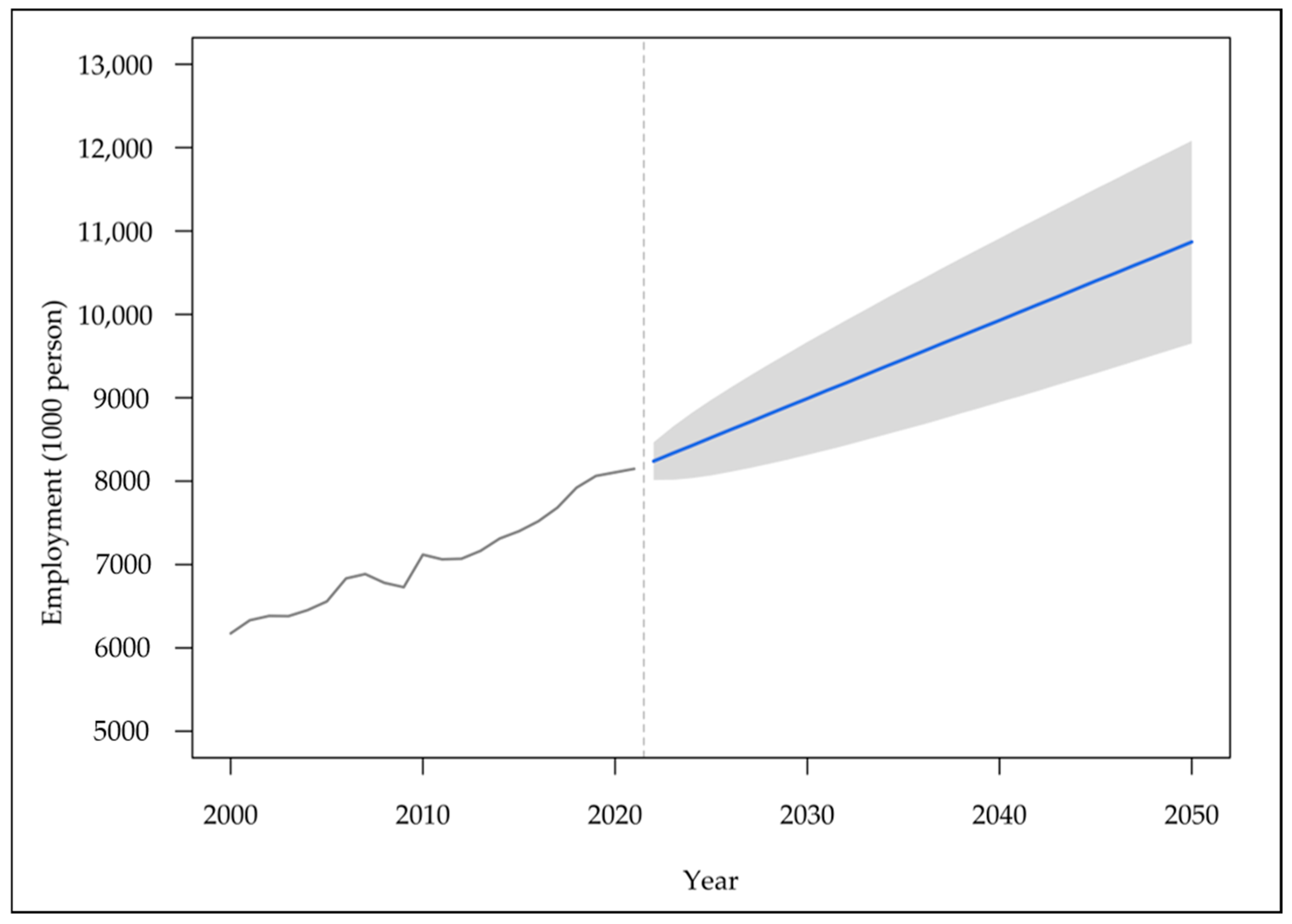
According to time series model projections (Figure 3), the number of employed people in Tokyo will continue to grow from 2021 to 2050, increasing from 8,146,000 in 2021 to 10,868,000 in 2050 (see Appendix A.4), with an average annual growth rate of approximately 1%. Stationarity tests indicate that the original series is non-stationary, but after first differencing, it can be considered basically stationary (see Appendix A.7). Model accuracy tests show that its error level on the test set is low, exhibiting good short-term fit performance; the residual diagnosis is generally acceptable, showing no significant systematic bias.
(2)
Road length
The road length prediction model was validated using the hold-out method: the training set was 2013–2019, and the test set was 2020–2021 (see Appendix A.7). Validation results show that the model has high prediction accuracy on the test set, indicating good short-term extrapolation performance (see Appendix A.7). Stationarity tests and residual diagnosis results show that the model specification is generally reasonable, and the residuals have no obvious systematic structure (see Appendix A.7). Subsequently, the model was re-estimated using the full sample from 2013–2021, and annual forecasts were made for 2022–2050 (see Appendix A.7).
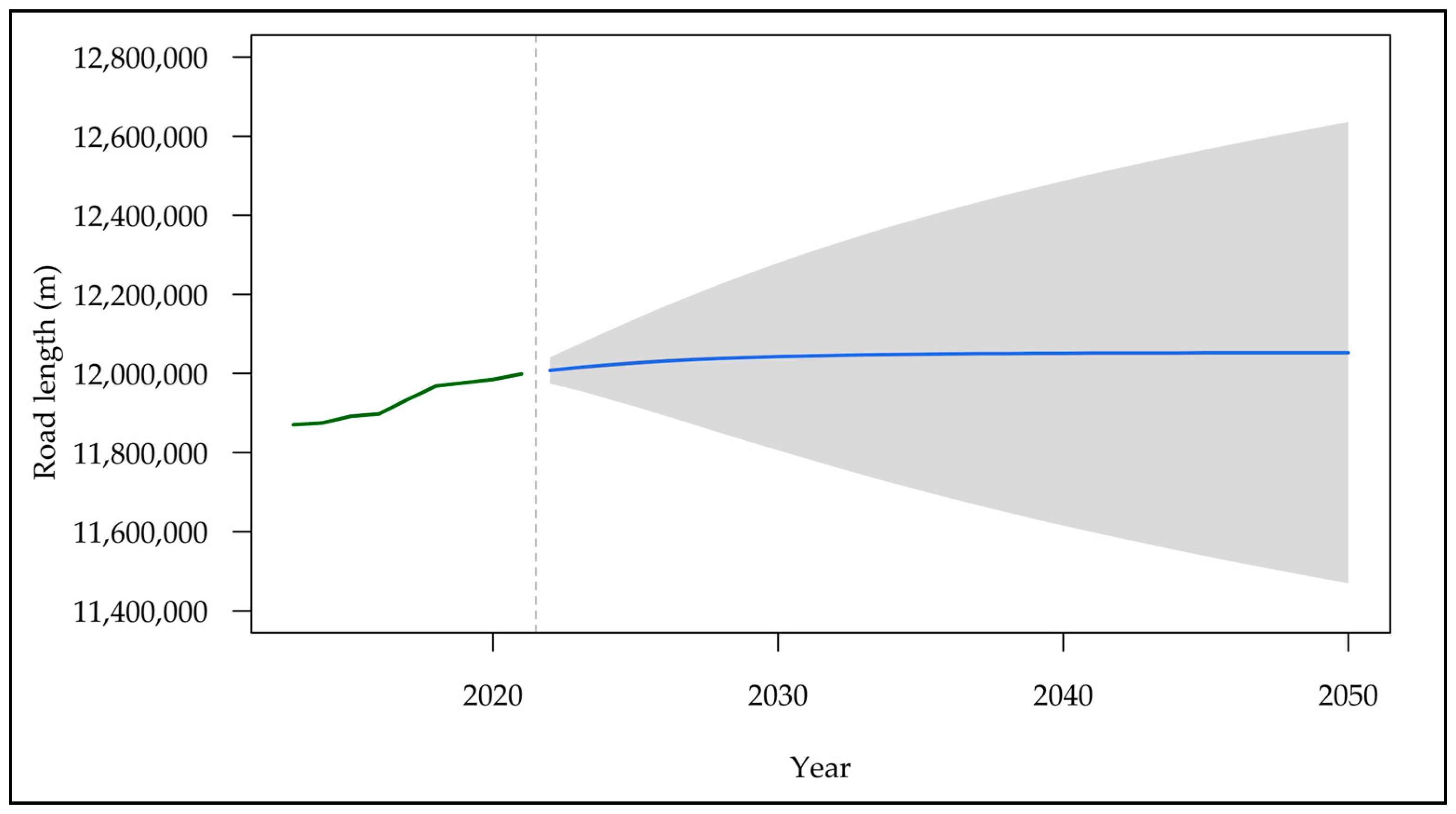
The forecast results (Figure 4) show that the road length in Tokyo will slowly increase from 11,998,427 m in 2021 to 12,052,658 m in 2050 (see Appendix A.3), with an average annual growth rate of approximately 0.2%. This overall trend shows long-term low-speed growth, indicating that road construction is approaching saturation.
(3)
Ordinary truck stock
The model for predicting the stock of ordinary trucks was validated using the hold-out method: the training set was 2001–2018, and the test set was 2019–2021 (see Appendix A.7). Validation results show that the model has high prediction accuracy on the test set and low short-term prediction error (see Appendix A.7). The stationarity test and residual diagnosis results are generally acceptable, indicating that the model specification can well characterize the sequence features (see Appendix A.7). Subsequently, the model was re-estimated using the full sample from 2001–2021, and annual forecasts were made for 2022–2050 (see Appendix A.7).
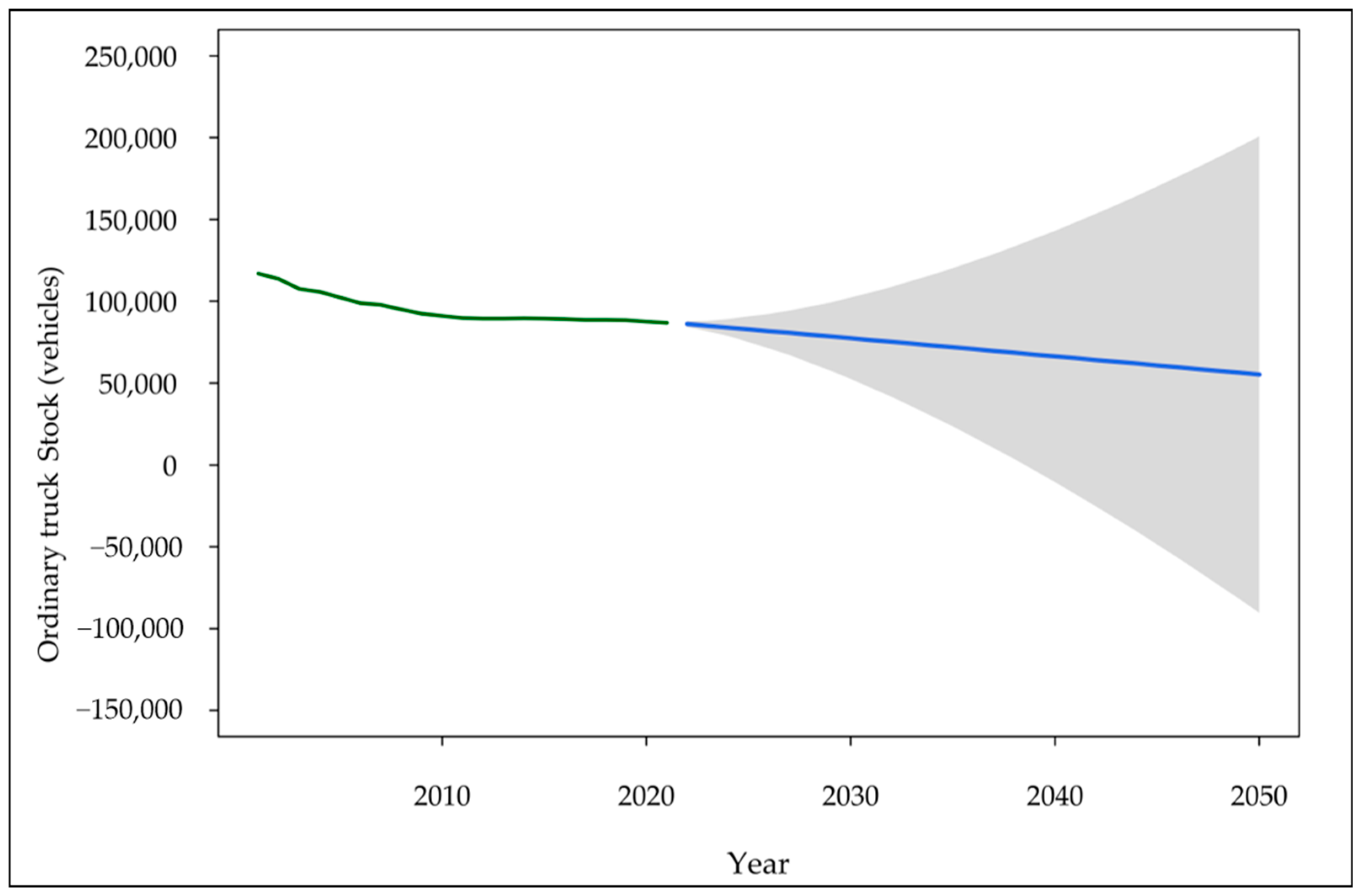
The forecast results (Figure 5) show that the stock of ordinary trucks will be 86,075 in 2022, and is projected to decrease to 77,477 by 2030, and further decrease to 55,247 by 2050 (see Appendix A.5). The overall trend is a continuous and slow decline, with the rate of decline slowing down after 2030.
(4)
Minivan stock
The minivan stock prediction model was validated using the hold-out method: the training set was 2001–2018, and the test set was 2019–2021 (see Appendix A.7). Validation results show that the model has high prediction accuracy on the test set and low short-term prediction error (see Appendix A.7). The stationarity test and residual diagnosis results are generally acceptable, indicating that the model specification can well characterize the sequence features (see Appendix A.7). Subsequently, the model was re-estimated using the full sample from 2001–2021, and annual predictions were made for 2022–2050 (see Appendix A.7).
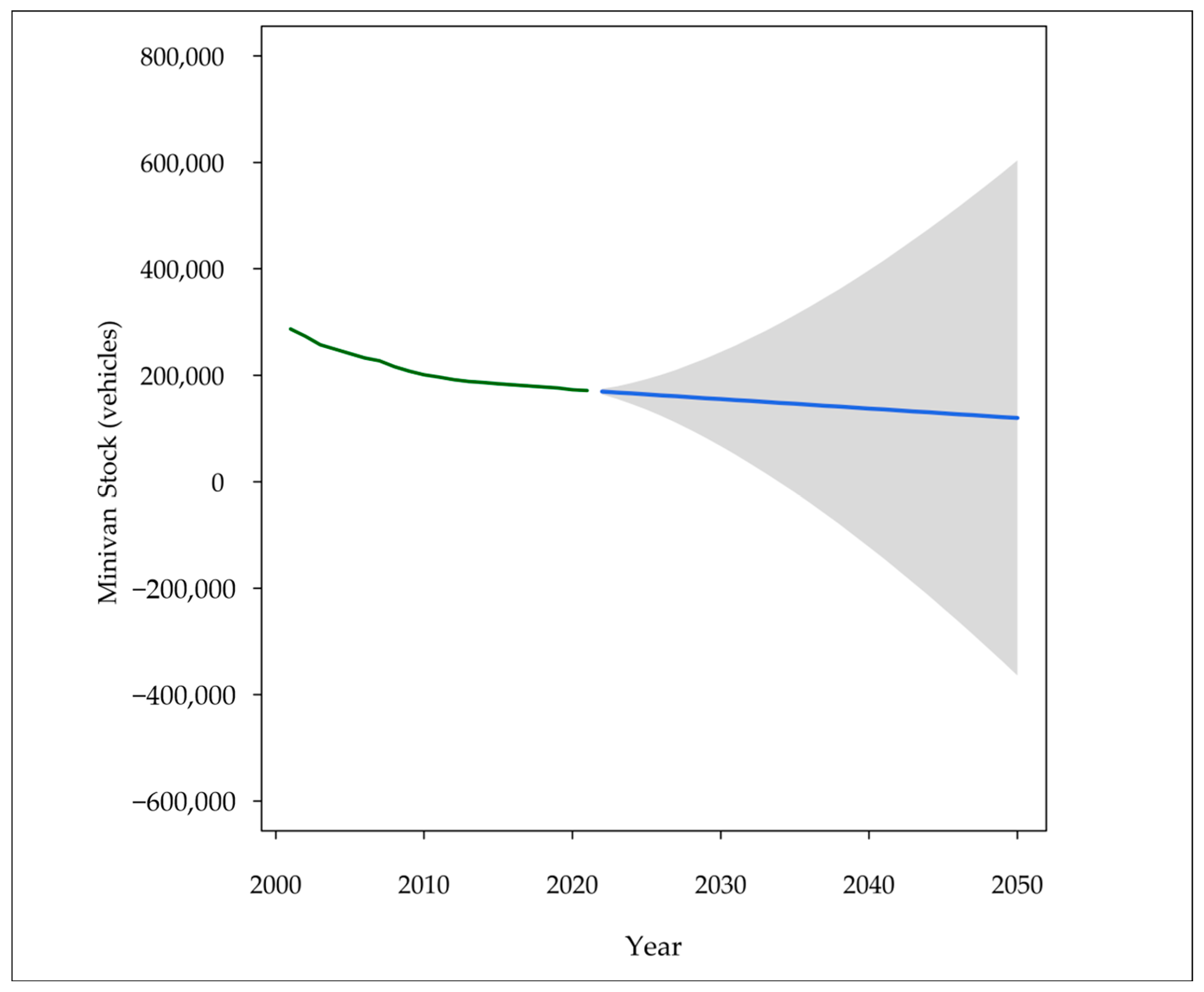
The prediction results (Figure 6) show that the stock of minivans in operation will be 169,480 in 2022, and is projected to decrease to 155,280 by 2030 and further decrease to 119,780 by 2050 (see Appendix A.6). The overall trend is one of continuous decline, and the rate of decline is gradually slowing down. By 2050, the number of small trucks will be reduced by about 30% compared to 2021, reflecting the long-term trend of traditional fuel-powered small trucks existing in the market.

3.1.2. Forecasting Results of Regression Models

After obtaining the prediction results of socioeconomic variables, this study further used MLR and GLM to estimate the activity level of each transportation mode from 2022 to 2050 (i.e., transport turnover, unit: 1000 person·km or ton·km).
Table 2 shows the forecasting regression equations for various modes of transportation and the corresponding accuracy test results. Table 3 shows the multicollinearity and robustness diagnostic results of the regression models for each mode of transportation.
Based on the equations in Table 2 and Table 3, combined with the prediction results of socio-economic data, the turnover volume of each public transportation department is predicted.
(1)
Railway turnover
Railway turnover and GDP show a robust and significant positive correlation: after controlling for other socioeconomic factors, GDP remains statistically significant, indicating its strong explanatory power for rail transit activity. Diagnostic results show some multicollinearity among the explanatory variables and mild autocorrelation in the residuals; however, after adjusting for inference using the Newey–West (HAC) robust standard error, the core conclusions remain consistent (see Table 3). Therefore, within the forecasting framework using GDP as the primary driver, rail transit turnover is projected to continue rising from 2022 to 2050, indicating that rail transit will continue to serve as a relatively stable growth subsystem within Tokyo’s public transportation system and provide a crucial foundation for the implementation of carbon reduction policies.
(2)
Bus turnover
In the final regression model, public transport turnover is primarily influenced by GDP, employment, and road length. GDP and employment have a positive impact on public transport turnover, indicating that increased economic activity and expanded employment will drive up public transport demand. Conversely, road length exhibits a moderating effect, suggesting that under the constraint of saturated road resources, the marginal driving force of road expansion on public transport turnover is limited, thus moderating the growth trend. Diagnostic results show some collinearity among the explanatory variables and mild autocorrelation in the residuals; however, after correction using the Newey–West (HAC) robust standard error, the main inferences remain consistent (see Table 3). Therefore, within the forecasting framework driven by GDP and employment growth, public transport turnover is projected to show a moderate increase from 2022 to 2050, but the overall growth potential is limited by road resource constraints.
(3)
Taxi turnover
A GLM is adopted instead of a standard MLR because taxi turnover exhibits distributional features and error structures that are not well captured by the classical OLS assumptions. In particular, the variance of turnover tends to change with its level (heteroskedasticity), and the relationship between turnover and socio-economic drivers is more plausibly nonlinear on the original scale. By using an appropriate link function and distribution family, the GLM provides more reliable coefficient inference and prediction performance for taxi turnover, while avoiding unrealistic assumptions such as normally distributed, homoscedastic residuals required by MLR.
Regression results show a significant positive correlation between taxi turnover and GDP, and a weak negative correlation with population-related variables. This reflects that the increasing diversification of per capita travel modes and the substitution effect of shared mobility have, to some extent, suppressed the demand for traditional taxis. Diagnostic results show a certain degree of collinearity among explanatory variables and mild autocorrelation in the residuals; however, after correction using the Newey–West (HAC) robust standard errors, the core inferences remain consistent (see Table 3). Based on socioeconomic projections from 2022 to 2050, the taxi turnover calculated by the GLM model exhibits an evolutionary characteristic of “decline in the early stage—stabilization in the middle stage,” reflecting the phased changes under the combined influence of economic growth and travel mode substitution effects.
(4)
Ordinary truck turnover
The turnover of ordinary trucks is significantly positively correlated with the stock of ordinary trucks in use, indicating that vehicle stock has a strong explanatory power for freight activities. Since the model uses a single independent variable, there is no multicollinearity problem; residual diagnosis shows a possible slight autocorrelation, but the conclusions remain consistent under robustness tests (see Table 3). Therefore, in the 2022–2050 forecast results, as the stock of ordinary trucks in use decreases, the turnover of ordinary trucks also shows a corresponding downward trend.
(5)
Minivan turnover
Minivan turnover and minivan stock show a significant and strong positive correlation, indicating that turnover is highly sensitive (and elastic) to changes in stock. Since the model is primarily driven by a single key explanatory variable, multicollinearity is not a problem; after outlier handling and robustness checks, the residual diagnosis results show that the inferences are stable and dependable (see Table 3). Therefore, in the 2022–2050 forecast, as minivan stock declines year by year, minivan turnover will also show a corresponding downward trend.

3.2. LEAP Model Scenario Analysis Results

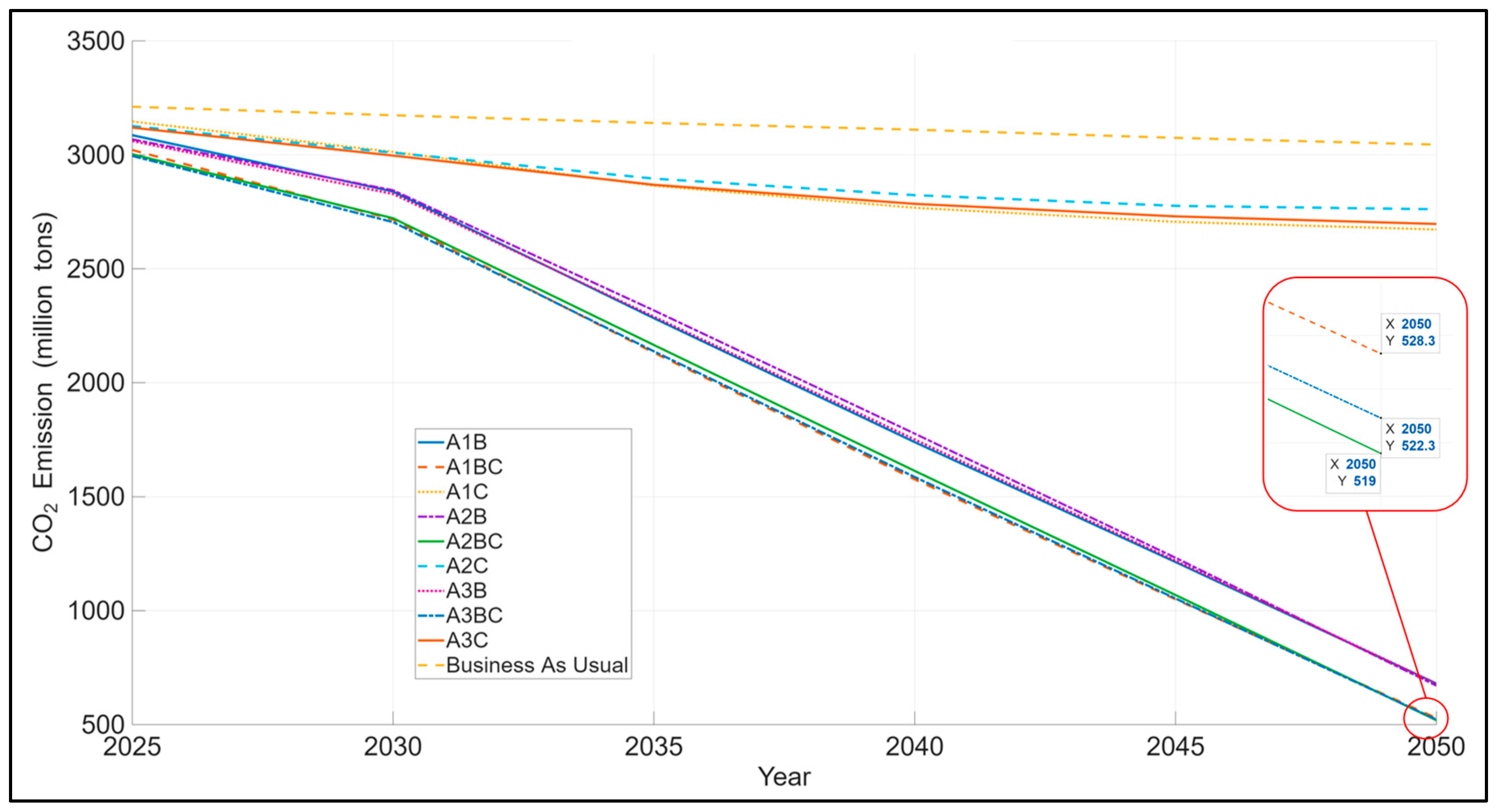
The scenario comparison in this section is based on a unified exogenous turnover trajectory. Therefore, the differences mainly reflect the quantified shift/improve and upstream supply transformation mechanisms, rather than avoidance-type demand reduction. Simulation results based on the LEAP model (Table 4) show that the carbon emission pathways of the Tokyo Metropolitan Transportation System between 2022 and 2050 diverge significantly under different policy scenarios. Under the baseline scenario (BAU), emissions in 2050 reach 3044.90 kt CO2, with cumulative emissions reaching 93,296.10 kt CO2, demonstrating that deep emission reductions are difficult to achieve without policy support. Among the single-factor scenarios, hydrogen energy priority (A1), electricity priority (A2), hydrogen and electricity parallel development (A3), and energy efficiency optimization (C) achieve smaller emission reductions, with declines of approximately 4.00–8.00% by 2050. Emission factor optimization (B) performs the best, with emissions dropping to 1030.00 kt CO2 in 2050, a 66.17% reduction compared to the BAU scenario. Scenario A and Scenario B form a two-factor scenario (A × B), which offers more significant emission reduction benefits compared to other single-factor and two-factor scenarios, reducing emissions by approximately 78% by 2050 compared to the BAU scenario. The scenario with the greatest emission reduction potential is the three-factor scenario (A × B × C), which reduces emissions to 530.00 kt CO2 by 2050, representing a reduction of approximately 83.0% compared to the BAU scenario. It is important to emphasize that all scenario comparisons in this section are based on the same exogenous turnover trajectory. Therefore, the differences in scenarios are mainly attributed to the differences in the setting of energy structure (S), energy intensity (I), and upstream supply transformation (T).
The “2050 emission reduction ratio (vs BAU)” is calculated as “Emissions in 2050” and “Cumulative emissions” are expressed in kilotons of CO2 (kt CO2). The “2050 emission reduction ratio (vs BAU)” is calculated as (E_BAU,2050 − E_scenario,2050)/E_BAU,2050 × 100.
The “Cumulative emission reduction ratio (vs BAU)” is calculated as (CumE_BAU − CumE_scenario)/CumE_BAU × 100, where cumulative emissions refer to the sum of emissions from 2022 to 2050.
All values are rounded to two decimal places.

3.2.1. Comparative Analysis of Single-Factor Scenarios

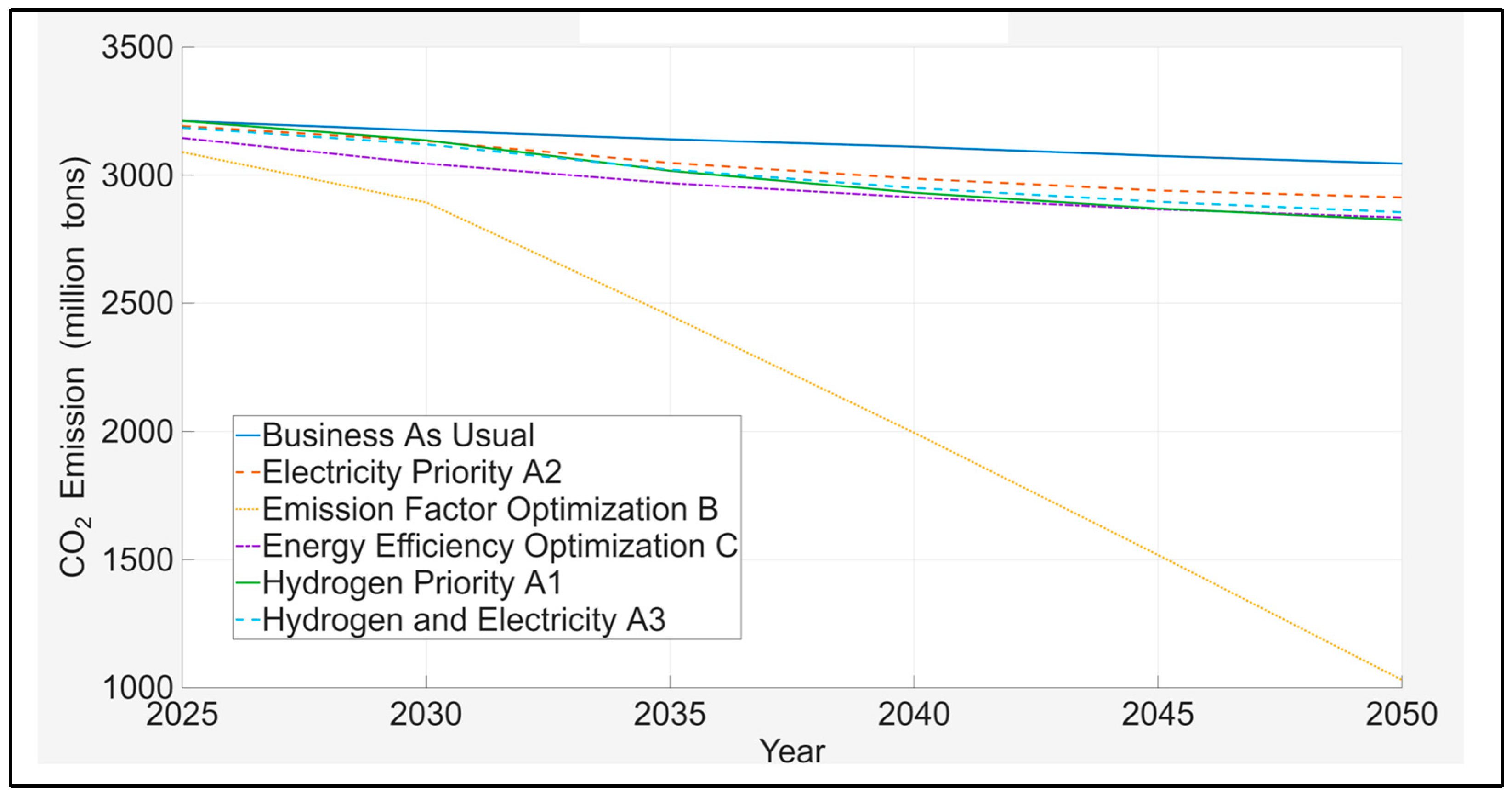
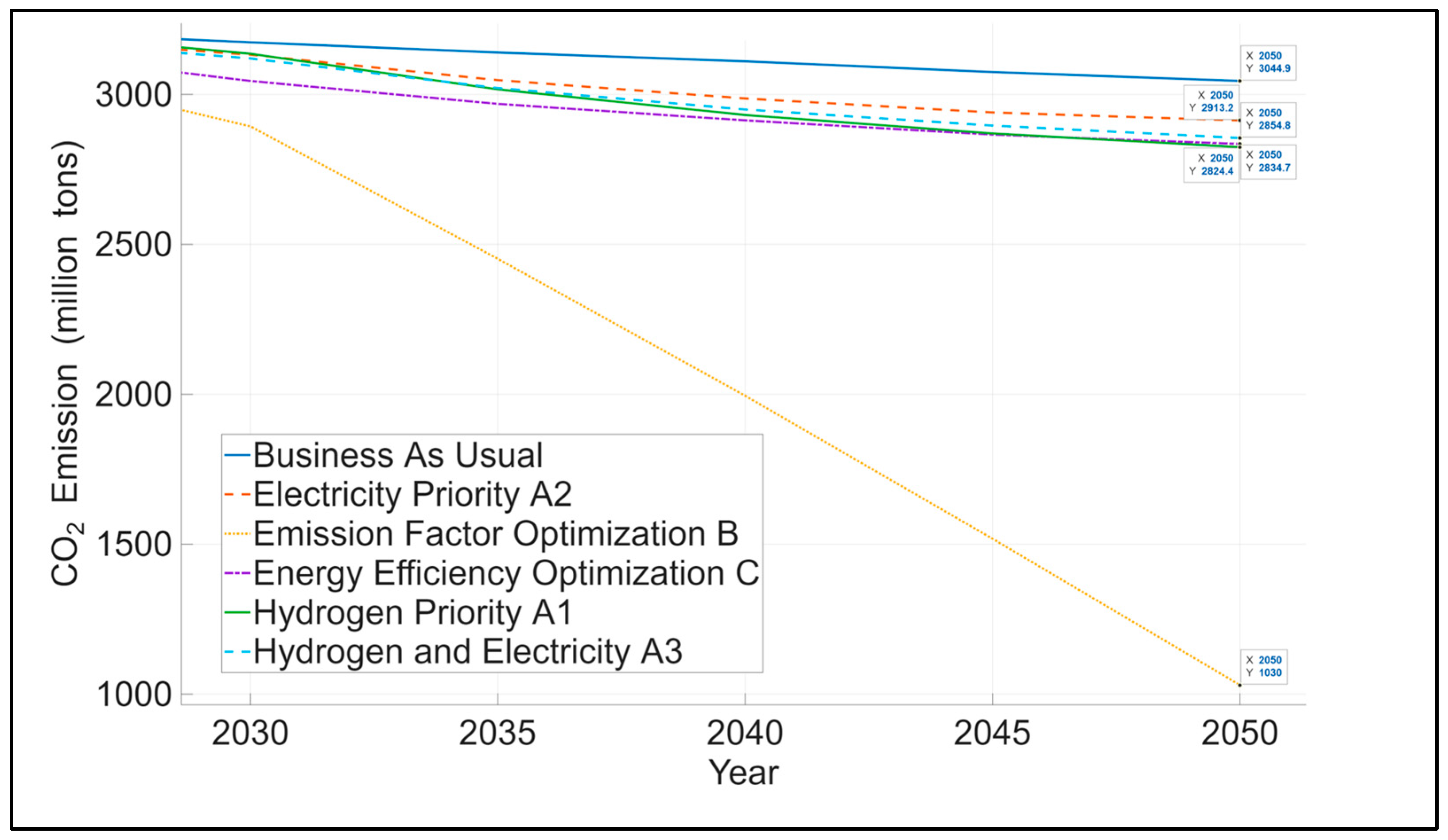
Figure 7 and Figure 8 show that under the baseline scenario (BAU), carbon emissions from Tokyo’s transportation sector remain essentially stable up to 2050, while the emission reduction effects under different single-policy scenarios vary significantly. The emission factor optimization scenario (B) achieves the most significant emission reductions, with a reduction of over 66.00% compared to BAU in 2050, demonstrating that upstream energy decarbonization is key to achieving deep emission reductions. The hydrogen and electrification pathway (A series) has a lower emission reduction efficiency, with A1, A2, and A3 decreasing by approximately 7.24%, 4.33%, and 6.24%, respectively. Due to the high proportion of fossil power and gray hydrogen, the carbon reduction effect of ZEV replacement in the public transportation sector is very limited. The energy efficiency optimization scenario (C) is effective in the early stages, but its long-term impact is limited, with a reduction of only approximately 6.90% compared to BAU in 2050. Overall, it is difficult to achieve zero carbon emissions in public transportation with a single policy driver.

3.2.2. Comparative Analysis of Multi-Factor Scenarios

Figure 9 illustrates the carbon emission pathways for the public transportation sector under a multi-factor policy stacking scenario. The results show that when hydrogen, electrification, and upstream energy decarbonization (A × B) are implemented together, emissions decline significantly, reaching about 78.00% reduction by 2050 compared to the baseline scenario (BAU). Adding energy efficiency optimization measures (A × B × C) achieves maximum emissions reduction, with emissions falling below 530.00 kt CO2 in 2050 (about 83% below BAU), with cumulative reductions of about 33,500 kt CO2. This demonstrates significant synergy between upstream clean energy supply and end-use technology substitution. The former expands the scope of emissions reductions by reducing emission factors, while the latter reduces final energy demand through energy substitution and efficiency improvements. Implementing these policies in combination would allow for sustained emissions reductions by 2050 and would be superior to any single policy path in bringing Tokyo closer to carbon neutrality.

3.2.3. Emission Reduction Characteristics by Sector

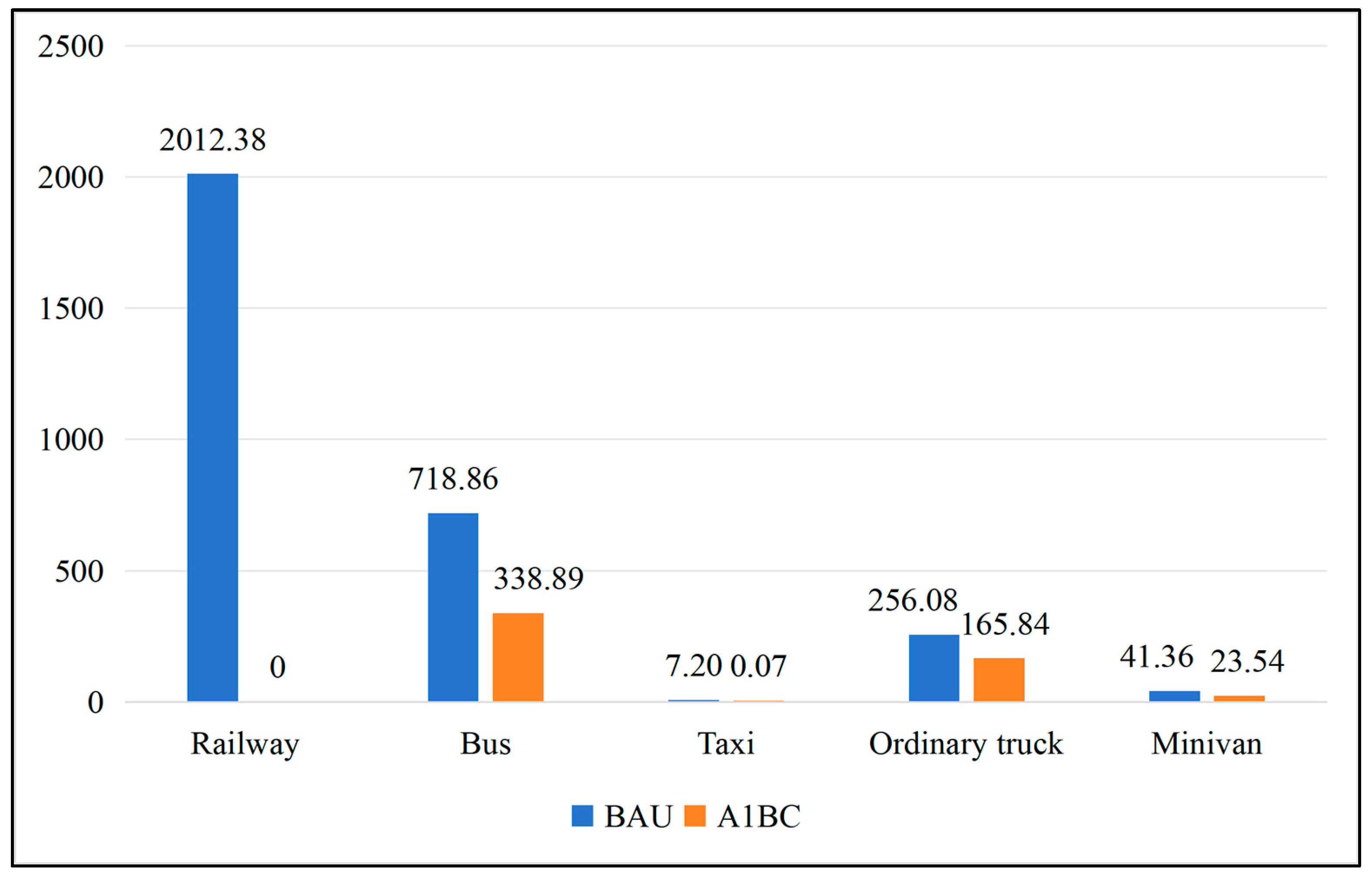
Table 5 shows the projected annual CO2 emissions changes for various modes of transportation in Tokyo’s public transportation system from 2025 to 2050, with 2021 as the base year, under the A1BC scenario, and the projected cumulative emissions from 2021 to 2050. Since 2025, carbon emissions from all sectors have shown a continuous downward trend, but there are significant differences in the magnitude and potential of emission reductions among different modes of transportation. The railway sector, benefiting from the shift to cleaner electricity, is projected to achieve near-zero emissions by 2050, resulting in the most significant emission reduction. While taxis have low base carbon emissions and a negligible impact on overall carbon emissions, their continued downward trend indicates that ZEV replacement is an effective measure to reduce carbon emissions in the taxi sector. However, the emission reduction in the bus sector is much smaller, with emissions still reaching 338.90 kilotons by 2050, making it a major future source of emissions. Ordinary trucks and minivans will still not approach zero emissions by 2050, indicating that the road freight sector still faces significant challenges in energy transition and technological upgrading.
Furthermore, the total emissions for each sector in Table 5 for 2050 are consistent with the carbon emission projections for the A1BC scenario in Table 4, ensuring the consistency of the results of this study.
Figure 10 compares the sectoral emissions composition under BAU and Scenario A1BC in 2050. The comparison shows that under BAU, the main emission sources are electrification-related sectors (especially rail transit) and buses; while under Scenario A1BC, rail transit and taxi emissions can be reduced to near zero, with residual emissions significantly concentrated in public transport and road freight. This “structural shift” indicates that when upstream energy systems and end-use substitution advance simultaneously, the key to further approaching net zero emissions depends primarily on the speed of zero-emission vehicle proliferation, the maturity of energy replenishment systems, and the deep decarbonization capabilities of the public transport and freight sectors under operational constraints. Therefore, this paper clarifies the sectoral priority identification as the residual emissions set of the bus and freight sectors that are difficult to eliminate even under the strongest policy mix; this part is more likely to point to the bottlenecks in subsequent policies and key technological breakthroughs.

3.3. Univariate Sensitivity Analysis Results

After applying ±20% perturbations to the emission factors for electricity generation and hydrogen production from 2022 to 2049 (with 0 fixed in 2050), the changes in 2040 emissions (E_2040)** and cumulative emissions (CumE_2022–2050)** for scenarios B, A3B, and A3BC are relatively small: the relative range for E2040 is approximately 2.6–3.6%, and the relative range for CumE is approximately 2.1–2.6% (see Appendix E, Table A27). Under the low/baseline/high perturbations, the scenario ranking consistently remains A3BC < A3B < B, and the differences between scenarios are significantly greater than the uncertainty range, indicating that the main conclusion of this paper, “upstream decarbonization and synergistic substitution of electricity and hydrogen can significantly reduce emissions during the pathway period,” is robust within a reasonable range of upstream uncertainty.

4. Discussion and Conclusions

4.1. Timing Optimization of Multi-Policy Coordination

In this study, the BAU scenario was intentionally defined as a counterfactual “diagnostic baseline,” rather than a policy-consistent forecast, to clearly separate the marginal effects of the three measures in scenarios A, B, and C, and to more easily identify the main drivers behind the differences between scenarios. While this deliberately neutral baseline may exaggerate the percentage of emissions reductions, making it higher than a baseline that already incorporates existing policies and incremental improvements, the policy-consistent baseline primarily alters absolute emissions levels (and may narrow the relative gap). The comparative analysis results, particularly the qualitative ranking of the measures, will remain robust because all scenarios follow the same activity trajectory, differing only in the assumed measures.
According to the scenario quantification results (Table 4), implementing demand-side structural adjustments alone (Scenario A series) will contribute only a limited amount to emissions reduction by 2050 (approximately 4.33–7.24%), with a cumulative emissions reduction of only approximately 2.63–3.57%. In contrast, improving upstream emission factors (Scenario B) can achieve approximately 66.17% emissions reduction by 2050, with a cumulative emissions reduction of approximately 26.54%. Further combining technological substitution and energy efficiency improvements, the emissions reduction by 2050 under Scenario A × B can increase to approximately 77.65–77.97%, while Scenario A × B × C can reach approximately 82.65–82.96% (cumulative emissions reduction of approximately 35.52–36.02%). Therefore, a single policy cannot effectively achieve decarbonization, and end-use technology substitution (electric vehicles/fuel cell vehicles), decarbonization of upstream electricity and hydrogen supply, and improved vehicle energy efficiency are not simply additive but exhibit significant complementary and amplifying effects. This is consistent with the conclusions of Working Group III of the Intergovernmental Panel on Climate Change (IPCC) Sixth Assessment Report on the mix of emission reduction policies for transportation [33].
First, the emission factors of electricity and hydrogen fundamentally determine the actual emission reduction benefits of ZEV replacement policies. Based on the IEA’s emission factor database and reports, decarbonizing the power system and hydrogen production system can amplify the emission reduction benefits of ZEV replacement [34,35], based on a power system scenario analysis, pointed out that upstream low-carbon supply and end-use substitution must be designed in a coordinated manner; otherwise, they will fall into a dilemma of high cost or high emissions. This aligns closely with the findings of this study: only when low-carbon electricity and low-carbon hydrogen are feasible at the technological and policy levels can ZEV replacement of public transport and freight vehicles achieve effective carbon reduction benefits.
Secondly, Light-duty vehicles show clear fuel-saving effects through engine and transmission system upgrades and optimization of air resistance [36]; medium and heavy-duty vehicles can significantly reduce fuel consumption by improving thermal efficiency, optimizing transmission/rear axle and aerodynamics, strengthening tire management, and using low rolling resistance tires [37]; on the operational side, eco-driving/instant feedback can save an average of 5–7% fuel [38], and platooning can further reduce aerodynamic drag and fuel consumption under applicable operating conditions [37].
Therefore, the order of policy implementation should be emphasized: first, lock in the timetable and intensity of supply-side clean energy transformation, then accelerate the large-scale substitution of end-use vehicles, and at the same time, use the energy efficiency and operation optimization of fossil fuel vehicles as an amplifier to improve the stability and reliability of emission reduction [39,40]. The innovation of this study lies in its direct comparison of the emission reduction effects of single factors and multi-factor synergy between public transportation and road freight in Tokyo through quantitative scenario analysis, rather than merely relying on normative arguments.
To enhance policy operability, this study further organizes the implementing entities of different policy levers from the perspective of governance boundaries. Table 6 summarizes the main division of responsibilities at the national and Tokyo Metropolitan levels and corresponds to the scenario variables (A/B/C) in this paper to support the discussion in the “Policy Coordination and Implementation Sequence” section.

4.2. Industry and Spatial Differences: Characteristics and Significance of Bus and Freight Emission Reduction in Tokyo

Based on the results of scenario A1BC (Table 5), railways are more likely to approach zero emissions due to their high proportion of clean electricity [41]; taxis have a limited impact on the overall emission reduction in the transportation sector due to their scale and replacement cycle. In contrast, the total emissions in 2050 are approximately 528.3 thousand tons, of which public transportation accounts for approximately 338.9 thousand tons and road freight (ordinary trucks) accounts for approximately 165.8 thousand tons, accounting for most of the remaining emissions. This indicates that in the near-net-zero-emission stage, the focus of emission reduction will be more on the technological substitution and operational optimization of public transportation and road freight systems [26].
(a) Buses and road freight require long operating hours and higher turnover rates, thus placing higher demands on range, refueling efficiency and vehicle availability.
(b) The distribution of charging piles and hydrogen refueling stations, vehicle scheduling, and the design of operating routes all depend on the path; if the initial layout is inadequate, it will be very difficult to adjust later [42].
(c) Buses and freight transport are primarily funded and operated by businesses and local governments, thus requiring a dynamic balance between capital expenditures, operating and maintenance costs, technological upgrades and innovations, and service quality [43].
Therefore, for public transportation, priority should be given to upgrading operating routes, stations, and charging facilities, followed by selecting different vehicle models based on different application scenarios [34,44]. Freight operations should be categorized into three types: trunk line transport, urban delivery, and last-mile delivery, with different truck models adapted to different scenarios and needs [45]. Furthermore, efficiency can be improved through measures such as off-peak charging, time-sharing operation, and optimized scheduling [34].
Furthermore, choosing Tokyo as the target city for this study is of great significance. First, as the core area of Japan, Tokyo occupies a central position in terms of population, GDP, passenger and freight transport. Tokyo’s transportation sector has long been one of the major sources of carbon emissions in the region. Therefore, Tokyo’s transportation sector is very suitable as a research subject for exploring deep emission reduction pathways [46]. Tokyo’s Zero Emission Tokyo Strategy sets a net-zero emission target for 2050 and a zero-emission vehicle orientation for public transport and freight, providing boundaries and standards for scenario design [47]. Third, Tokyo has introduced fuel cell buses, built multi-functional hydrogen refueling stations, and issued related policies to promote the demonstration application of hydrogen energy in public transportation, ports, and logistics [48], making the hydrogen transportation scenario not based on theoretical assumptions but on extrapolation based on existing conditions. Finally, compared to other cities or regions, Tokyo has a more comprehensive data statistics system, which is conducive to building a complete LEAP model; this model can also be applied to other megacities.

4.3. Demand and Substitution: Primarily Structural Adjustment

The regression results of this study confirm that socioeconomic factors such as GDP, population, employment, and road mileage have a significant impact on transportation demand, which is consistent with the conclusions of IPCC AR6 on the relationship between income and travel demand [33]. However, given that total travel volume and freight demand are unlikely to decrease significantly, effective reduction in emission intensity per unit can only be achieved by improving the attractiveness of railway, changing users’ travel choices, and reducing the share of other high-carbon travel modes.
The overall cost of travel (economic cost + time cost + reliability + comfort + accessibility) determines users’ choice of travel mode. Research from the ITF and OECD indicates that improving the overall cost of railway is more effective in enhancing emissions reduction than a single ZEV replacement subsidy policy [49]. Therefore, this argument provides a reference for future research. The research framework can be further improved by incorporating research on customer behavior.

4.4. Contributions and Limitations

Compared to previous similar studies, this study makes several significant improvements in terms of methodology and applicability.
Previous studies on transportation energy transition and emission reduction have mostly adopted top-down scenario assumptions, which have limited characterization of the relationship between socio-economic drivers and transportation demand. Furthermore, they have mostly been conducted on a national scale and lack research on transportation in specific cities.
For example, Meng et al. [11] also used LEAP to conduct a multi-scenario assessment of road traffic in Japan, comparing electrification and hydrogen energy pathways, but the evolution of transportation demand was mainly based on the preset growth rate and did not reflect the impact of socio-economic factors on traffic turnover. Ozawa et al. [50] constructed a carbon neutrality path for Japan by 2050 using an energy system model, highlighting that the decarbonization of the power system is the key to achieving carbon neutrality. However, they did not make detailed predictions about transportation demand, nor did they distinguish the differences in transportation structure among different types of cities. Instead, they focus more on the national energy supply-side layout, often neglecting the fact that traffic turnover is the key variable determining energy consumption and carbon emissions in the transportation sector. Studies such as those by Okuda et al. [51] and Hao et al. [52] have not systematically estimated the statistical relationship between traffic turnover and socioeconomic factors such as GDP, employment, and road length. This makes it impossible for changes in traffic conditions to be fully matched with socioeconomic developments.
This study uses Tokyo, a typical megacity, as a case study and incorporates key socioeconomic factors such as population, GDP, road length, and employment to predict the turnover of rail, bus, taxi, and road freight. A LEAP model is constructed to ensure that changes in traffic demand are based on the natural evolution of socioeconomic factors, rather than subjective assumptions. Furthermore, the emission factors and future trends of hydrogen and electricity are derived from official documents and authoritative research reports. Therefore, compared to previous studies, this research is closer to reality and has higher accuracy and applicability. Different carbon intensity scenarios for electricity and hydrogen are compared within the same urban framework to examine the decisive impact of “whether upstream is truly low carbon” on the emission reduction effects of public transport and freight. Based on these three points, this study more accurately reflects the characteristics of Tokyo’s transportation structure and policy constraints, providing a more explanatory and operational analytical framework for assessing the real emission reduction potential of hydrogen and electrified public transport routes in large cities.
However, this study still has certain limitations, which can be summarized in three aspects. First, exogenous demand trajectory settings and behavioral responses were not included. This study employs an exogenously driven scenario accounting framework, using passenger and freight turnover as exogenous inputs generated by a statistical forecasting model. This aims to more clearly identify the relative roles and synergistic relationships of mechanisms such as energy structure (S), energy intensity (I), and upstream supply transformation (T) on emissions under a unified demand trajectory. It should be noted that price elasticity, mode choice, induced demand/rebound effects, and demand adjustments caused by changes in land use and service supply in the real world may affect the absolute level of emissions in the long-term scenario. Due to the lack of behavioral parameters and spatial coupling modules that can be used for consistent long-term extrapolation, this paper does not explicitly model the endogenous behavioral feedback. Therefore, the results of this paper are more suitable to be understood as a “comparison of conditional emission reduction potential and mechanisms under a given demand trajectory,” rather than an end-to-end prediction of the actual policy effects after including behavioral responses. Second, at the model structure level, the framework of this study is still mainly based on “scenario-driven one-way calculation” and has not yet constructed an endogenous feedback mechanism between policy tools, infrastructure expansion, technology learning effects, and energy price changes. Therefore, it is difficult to characterize the impact mechanism with time-series characteristics, path-dependent characteristics, and dynamic coupling characteristics in the ZEV diffusion process. Third, based on the above limitations, the results of this study are more suitable for comparing the emission reduction potential of different policy and technology paths under the premise of consistent activity level assumptions, providing evidence to support government decision-making on relative advantages, disadvantages, and synergistic directions, rather than being interpreted as a precise prediction of future transportation carbon emissions. Meanwhile, although this study has provided prediction ranges for some exogenous variables and presented the outcome ranges for key scenarios by applying ±20% perturbations to upstream emission factors, it is important to emphasize that the LEAP scenario calculation process remains a deterministic calculation within the framework of this study. Future research will further explore multi-parameter joint uncertainty propagation to characterize the superposition and output distribution characteristics of key parameter uncertainties more systematically within the system.
Furthermore, demand-side “Avoid” measures (such as travel demand management, compact cities, remote work, and logistics integration) mainly influence traffic activity levels through behavioral and spatial structural mechanisms, typically requiring more granular travel/freight demand data and specialized demand models. Given the limitations in the availability of behavioral and spatial data in this study, forcibly using exogenous coefficients to define the demand decline path in LEAP may introduce strong subjectivity and additional uncertainties. Therefore, this paper explicitly defines “Avoid” as an important direction that exceeds the scope of this quantitative analysis and proposes corresponding extended paths for future research.
Future research can be further expanded in three directions. First, building upon the S–I–T mechanism accounting framework of this study, future research could further couple demand response (such as generalized travel cost/price elasticity, mode choice, and demand adjustments caused by changes in service levels) or simplified representations of land use-transport interaction, thereby endogenizing key behavioral feedback and providing emission ranges for “achievement effects.” Furthermore, scenario envelopes or sensitivity analysis could be used to incorporate rebound effects and demand management measures into uncertainty propagation, thus testing the robustness of the conclusions under different demand feedback intensities. Second, the construction progress and feasibility constraints of infrastructure such as charging facilities and hydrogen refueling stations can be more clearly incorporated into the analysis to define the upper limit of the ZEV promotion speed more realistically in public transportation and urban freight sectors. Third, the uncertainties of upstream energy system evolution and cost dynamics can be further systematically addressed, more clearly describing the impact of power structure evolution, hydrogen production path selection, and technological cost changes on emission factors and emission reduction effects; simultaneously, by using a multi-parameter joint uncertainty propagation method to jointly perturb key parameters and characterize the result distribution, a more comprehensive presentation of the possible emission outcome range of key scenarios can be obtained; based on this, this framework can also be extended to other megacities for comparative studies to improve the robustness and generalizability of the conclusions.

4.5. Transferability and Boundary Conditions

Although this paper uses Tokyo as the subject for parameter setting and calibration, some conclusions are transferable from a “mechanism level” perspective: First, the emission reduction benefits of end-use electrification and hydrogenation are highly dependent on upstream supply decarbonization. Therefore, the carbon intensity pathways of electricity and hydrogen supply will significantly constrain the actual emission reduction effects of end-use technology substitution in different cities. Second, under the same demand trajectory, a combined strategy that simultaneously covers supply decarbonization, end-use substitution, and efficiency improvement is often superior to a single lever, reflecting the importance of policy combination and timing.
Furthermore, the calculation results are sensitive to urban contexts. Tokyo has a mature rail and public transport system, high urban density, limited road expansion space, and local characteristics in its fleet structure and usage intensity, resulting in regional differences in upstream energy decarbonization pathways. For cities that rely more on private cars, have longer travel distances, different freight organization, or slower decarbonization in the power sector, the absolute emission reduction and strategy priorities may change.
Therefore, when applying this framework to other megacities, the following parameters should be reparametrized: (1) the mode structure and fleet structure of the baseline year; (2) the activity level and driving variable trajectory; (3) the carbon intensity pathway of electricity and hydrogen supply; and (4) the policy implementation constraints. After the above adaptation is completed, this framework is more suitable for comparative assessments of “mechanism comparison and synergy identification,” and it is not recommended to directly transplant the absolute emission values of Tokyo.

Author Contributions

Conceptualization, D.K. (Deming Kong) and L.L.; Methodology, D.K. (Deming Kong) and L.L.; Software, D.K. (Deshi Kong); Formal analysis, D.K. (Deming Kong); Investigation, D.K. (Deshi Kong); Data curation, D.K. (Deshi Kong); Writing—original draft, D.K. (Deming Kong); Writing—review & editing, S.S.; Visualization, L.L., D.K. (Deshi Kong) and S.S.; Supervision, X.Q.; Project administration, X.Q.; Funding acquisition, X.Q. All authors have read and agreed to the published version of the manuscript.

Funding

This research received no external funding.

Data Availability Statement

The original contributions presented in this study are included in the article. Further inquiries can be directed to the corresponding author.

Conflicts of Interest

The authors declare no conflict of interest.

Abbreviations

The following abbreviations are used in this manuscript:
LEAPLong-range Energy Alternatives Planning
ZEVZero-Emission Vehicle
ASIAvoid-Shift-Improve
SDGsSustainable Development Goals
EFEmission Factor
EIEnergy Intensity
MLRMultiple Linear Regression
GLMGeneralized Linear Model

Appendix A. Socioeconomic Data

Appendix A.1. Population

Table A1. This is Tokyo’s population and growth rate from 2001 to 2050.
YearPopulation (Person)Growth Rate
20017,967,602
20028,023,202
20038,081,959
20048,129,801
20058,183,907
20068,247,810
20078,318,841
20088,387,659
20098,451,067
20108,502,527
20118,541,979
20128,575,228
20138,951,575
20149,016,342
20159,102,598
20169,205,712
20179,302,962
20189,396,595
20199,486,618
20209,570,609
20219,572,763
20229,678,0631.10%
20239,784,5221.10%
20249,892,1521.10%
202510,000,9661.10%
202610,110,9771.10%
202710,222,1981.10%
202810,334,6421.10%
202910,448,3231.10%
203010,563,2551.10%
203110,647,7610.80%
203210,732,9430.80%
203310,818,8070.80%
203410,905,3570.80%
203510,992,6000.80%
203611,025,5780.30%
203711,058,6550.30%
203811,091,8310.30%
203911,125,1060.30%
204011,158,4810.30%
204111,136,164−0.20%
204211,113,892−0.20%
204311,091,664−0.20%
204411,069,481−0.20%
204511,047,342−0.20%
204610,981,058−0.60%
204710,915,172−0.60%
204810,849,681−0.60%
204910,784,583−0.60%
205010,719,876−0.60%
Note: (1) Historical data from 2001 to 2021 is sourced from statistics from the Tokyo Metropolitan Government (https://www.toukei.metro.tokyo.lg.jp/juukiy/2013/jy13000001.htm) (accessed on 4 December 2025). (2) Growth rate data are from the National Institute of Population and Social Security Research, Japan (https://view.officeapps.live.com/op/view.aspx?src=https%3A%2F%2Fwww.ipss.go.jp%2Fpp-shicyoson%2Fj%2Fshicyoson23%2F2gaiyo_hyo%2Fhyo2.xlsx&wdOrigin=BROWSELINK) (accessed on 4 December 2025). (3) Population projections for 2022–2050 are calculated based on historical data and growth rates.

Appendix A.2. GDP

Table A2. This is Tokyo’s GDP and growth rate from 2001 to 2050.
YearGDP
(Billion Yen)
Growth Rate
200195,251.5
200294,354.8
200395,275.2
200498,083.6
200599,379.7
200699,870.9
200799,931.5
200897,253.8
200991,673.8
201091,374.8
201192,857.3
201291,908.9
2013106,212.4
2014106,502.9
2015110,018.9
2016111,213.4
2017113,409.8
2018114,983.9
2019115,063.3
2020109,601.6
2021113,685.9
2022114,368.00.60%
2023115,054.20.60%
2024115,744.50.60%
2025116,439.00.60%
2026117,137.60.60%
2027117,840.40.60%
2028118,547.40.60%
2029119,258.70.60%
2030119,974.30.60%
2031120,694.10.60%
2032121,418.30.60%
2033122,146.80.60%
2034122,879.70.60%
2035123,617.00.60%
2036124,358.70.60%
2037125,104.90.60%
2038125,855.50.60%
2039126,610.60.60%
2040127,370.30.60%
2041127,994.40.49%
2042128,621.60.49%
2043129,251.80.49%
2044129,885.10.49%
2045130,521.50.49%
2046131,161.10.49%
2047131,803.80.49%
2048132,449.60.49%
2049133,098.60.49%
2050133,750.80.49%
Note: (1) Historical data from 2001 to 2021 is sourced from the Metropolitan Economic Accounts section of the Tokyo Metropolitan Statistical Yearbook. https://honyaku.j-server.com/LUCTOUKEAI/ns/tl.cgi/https://www.toukei.metro.tokyo.lg.jp/tnenkan/tn-index.htm?SLANG=ja&TLANG=en&XMODE=0&XJSID=0 (accessed on 4 December 2025). (2) The source of growth rate data is 77 Research & Consulting Co., Ltd. (Sendai, Miyagi, Japan) (https://www.77rc.co.jp/article_source/data/newsrelease/files/1f743913fdc6dd3c7ede72fcda8a23f4434b0f82.pdf#:~:text=%E6%9D%B1%E4%BA%AC%E9%83%BD%201,09) (accessed on 4 December 2025). (3) GDP projections for 2022–2050 are calculated based on historical data and growth rates.

Appendix A.3. Road Length

Table A3. This is Tokyo’s road length from 2001 to 2050.
YearRoad Length
(m)
200111,732,964
200211,764,651
200311,779,907
200411,817,413
200511,831,701
200611,845,329
200711,862,644
200811,874,179
200911,883,031
201011,853,075
201111,841,112
201211,863,272
201311,870,062
201411,874,641
201511,891,476
201611,897,638
201711,934,266
201811,967,937
201911,976,665
202011,985,125
202111,998,427
202212,007,695
202312,015,386
202412,021,768
202512,027,065
202612,031,460
202712,035,108
202812,038,135
202912,040,647
203012,042,732
203112,044,462
203212,045,898
203312,047,090
203412,048,078
203512,048,899
203612,049,580
203712,050,145
203812,050,614
203912,051,003
204012,051,326
204112,051,594
204212,051,817
204312,052,001
204412,052,154
204512,052,282
204612,052,387
204712,052,475
204812,052,547
204912,052,608
205012,052,658
Note: (1) Historical data from 2001 to 2021 is sourced from the Tokyo Metropolitan Statistical Yearbook, Transportation section (https://www.toukei.metro.tokyo.lg.jp/tnenkan/tn-index.htm) (accessed on 4 December 2025). (2) The projected data for 2022–2050 were calculated using a time series model based on historical data.

Appendix A.4. Employment

Table A4. This is Tokyo’s Employment from 2001 to 2050.
YearEmployment
(1000 Person)
20016330
20026385
20036379
20046453
20056557
20066832
20076885
20086781
20096728
20107117
20117062
20127070
20137163
20147312
20157400
20167517
20177682
20187922
20198061
20208104
20218146
20228240
20238334
20248428
20258521
20268615
20278709
20288803
20298897
20308991
20319085
20329178
20339272
20349366
20359460
20369554
20379648
20389742
20399835
20409929
204110,023
204210,117
204310,211
204410,305
204510,399
204610,492
204710,586
204810,680
204910,774
205010,868
Note: (1) Historical data from 2001 to 2021 are derived from the Tokyo Metropolitan Government’s labor force survey (https://www.toukei.metro.tokyo.lg.jp/roudou/2021/rd21qd1000.htm) (accessed on 4 December 2025). (2) The projected data for 2022–2050 were calculated using a time series model based on historical data.

Appendix A.5. Ordinary Truck Stock

Table A5. This is stock of ordinary trucks in Tokyo from 2001 to 2050.
YearOrdinary Truck Stock
(Vehicle)
2001116,882
2002113,666
2003107,599
2004105,828
2005102,312
200698,832
200797,732
200895,077
200992,451
201090,948
201189,743
201289,456
201389,413
201489,627
201589,496
201689,090
201788,615
201888,634
201988,505
202087,625
202186,882
202286,075
202384,869
202483,981
202582,924
202681,703
202780,776
202879,604
202978,447
203077,477
203176,258
203275,169
203374,141
203472,921
203571,878
203670,790
203769,600
203868,573
203967,439
204066,289
204165,254
204264,094
204362,983
204461,923
204560,758
204659,675
204758,586
204857,431
204956,362
205055,247
Note: (1) Historical data from 2000 to 2021 is sourced from the Tokyo Metropolitan Statistical Yearbook, Transportation section (https://www.toukei.metro.tokyo.lg.jp/tnenkan/tn-index.htm) (accessed on 4 December 2025). (2) The projected data for 2022–2050 were calculated using a time series model based on historical data.

Appendix A.6. Minivan Stock

Table A6. This is stock of minivans in Tokyo from 2001 to 2050.
YearMinivan Stock
(Vehicle)
2001287,104
2002273,301
2003257,137
2004248,956
2005240,924
2006232,741
2007227,375
2008216,140
2009207,763
2010201,080
2011196,572
2012192,015
2013188,633
2014186,394
2015183,962
2016182,005
2017179,989
2018178,136
2019176,335
2020173,030
2021171,255
2022169,480
2023167,705
2024165,930
2025164,155
2026162,380
2027160,605
2028158,830
2029157,055
2030155,280
2031153,505
2032151,730
2033149,955
2034148,180
2035146,405
2036144,630
2037142,855
2038141,080
2039139,305
2040137,530
2041135,755
2042133,980
2043132,205
2044130,430
2045128,655
2046126,880
2047125,105
2048123,330
2049121,555
2050119,780
Note: (1) Historical data from 2000 to 2021 is sourced from the Tokyo Metropolitan Statistical Yearbook, Transportation section (https://www.toukei.metro.tokyo.lg.jp/tnenkan/tn-index.htm) (accessed on 4 December 2025). (2) The projected data for 2022–2050 were calculated using a time series model based on historical data.

Appendix A.7. Auto-ARIMA Model Detection Results

Table A7. Prediction accuracy results.
VariablesTraining Set/Test Set PartitioningTest RMSETest MAETest MAPERemark
Road lengthTrain: 2013–2019; Test: 2020–20213319.212939.130.0245%The error percentage is extremely small, and the extrapolation is more like a “smooth continuation of the trend”.
EmploymentTrain: 2000–2017; Test: 2018–2021158.05154.631.92%A typical “random walk + drift” pattern is available for short-term fitting.
Ordinary truck stockTrain: 2001–2018; Test: 2019–20211112.11/0.54%The error percentage is low; however, d = 2 will make long-term forecasts more “linear/quadratic trending”.
Minivan stockTrain: 2001–2018; Test: 2019–2021748.57638.410.73%The accuracy is good; residual diagnosis requires combining different lag interpretations.
Table A8. Prediction stationarity results.
VariablesOriginal Sequence ADF p-ValueOriginal Sequence KPSS p-ValueActual Model Difference dKey ResultsRemark
Road length0.0440.074091ADF p = 0.830; KPSS (Level) p = 0.10The short sample size results in limited power of the test; using d = 1 is a safe approach.
Employment0.3450.0131821ADF p = 0.023; KPSS p = 0.10The last two tests after the difference consistently point to “closer to stationary”.
Ordinary truck stock0.990.014362KPSS p = 0.10; PP p = 0.010; ADF p = 0.462KPSS/PP supports stationarity, but ADF is not significant (common in small samples).
Minivan stock0.6230.01545772KPSS p = 0.10; ADF p = 0.520KPSS strongly suggests differential processing is required; KPSS passes after differential processing.
Table A9. Prediction Residual diagnostics results.
VariablesLjung–Box p (Check Residuals)Manual
Ljung–Box
The Final Model for the Full Sample is Ljung–Box p
(Check Residuals)
Remark
Road length0.468lag = 3 (fitdf = 2) p = 0.1410.723The residuals can be regarded as white noise, and the model setting is clean in terms of statistical diagnosis.
Employment0.0546lag = 10 p = 0.35680.0657The residual autocorrelation is “significant at the boundary,” but becomes insignificant after changing to a longer lag.
Ordinary truck stock0.1195lag = 10 p = 0.45170.1062The residuals passed the white noise test; the diagnostic results were stable.
Minivan stock0.0245lag = 8 (fitdf = 1) p = 0.13050.3858The default test on the training set indicated autocorrelation, but it was not significant after customizing the lag; the residuals of the full-sample model passed.

Appendix B. Transportation Turnover

Appendix B.1. Railway

Table A10. This is the projected railway turnover from 2022 to 2050, constructed using historical data on railway turnover and GDP from 2013 to 2021.
YearPassenger Turnover (1000 Person-km)GDP
(Billion Yen)
201383,304,143106,212.4
201483,045,682106,502.9
201585,030,432110,018.9
201685,990,616111,213.4
201787,257,665113,409.8
201888,314,835114,983.9
201987,819,136115,063.3
202058,518,423109,601.6
202168,739,549113,685.9
Turnover = 2.045 × 10⁷ + 647.3 × GDP
202294,480,406114,368.0
202394,924,584115,054.2
202495,371,415115,744.5
202595,820,965116,439.0
202696,273,168117,137.6
202796,728,091117,840.4
202897,185,732118,547.4
202997,646,157119,258.7
203098,109,364119,974.3
203198,575,291120,694.1
203299,044,066121,418.3
203399,515,624122,146.8
203499,990,030122,879.7
2035100,467,284123,617.0
2036100,947,387124,358.7
2037101,430,402125,104.9
2038101,916,265125,855.5
2039102,405,041126,610.6
2040102,896,795127,370.3
2041103,300,775127,994.4
2042103,706,762128,621.6
2043104,114,690129,251.8
2044104,524,625129,885.1
2045104,936,567130,521.5
2046105,350,580131,161.1
2047105,766,600131,803.8
2048106,184,626132,449.6
2049106,604,724133,098.6
2050107,026,893133,750.8
Note: (1) Historical turnover data from 2013 to 2021 are sourced from the annual statistical reports of the railway department of the Ministry of Land, Infrastructure, Transport and Tourism (https://www.mlit.go.jp/tetudo/tetudo_tk6_000032.html) (accessed on 4 December 2025). (2) After screening with R Studio (implemented in R, Version 4.5.0; R Core Team, R Foundation for Statistical Computing, Vienna, Austria; using RStudio IDE; Posit Software, PBC, Boston, MA, USA), it was found that there is a significant correlation between railway turnover and GDP. A regression equation was established, and the predicted turnover values for 2022–2050 were calculated by combining the predicted GDP values with the regression equation.

Appendix B.2. Bus

Table A11. This is the projected bus turnover from 2022 to 2050, constructed using historical data on railway turnover and GDP, road length, and employment from 2013 to 2021.
YearPassenger Turnover (1000 Person-km)GDP
(Billion Yen)
Road Length
(m)
Employment
(1000 Person)
20016,562,72295,251.511,732,9646330
20026,876,03894,354.811,764,6516385
20036,970,14695,275.211,779,9076379
20046,686,38298,083.611,817,4136453
20056,605,57399,379.711,831,7016557
20066,751,82799,870.911,845,3296832
20076,547,95999,931.511,862,6446885
20086,200,81797,253.811,874,1796781
20096,199,80291,673.811,883,0316728
20106,621,29991,374.811,853,0757117
20116,733,02892,857.311,841,1127062
20127,380,84791,908.911,863,2727070
20137,708,862106,212.411,870,0627163
20147,472,885106,502.911,874,6417312
20158,171,069110,018.911,891,4767400
20168,739,225111,213.411,897,6387517
20179,490,794113,409.811,934,2667682
20189,193,662114,983.911,967,9377922
20198,936,956115,063.311,976,6658061
20202,998,425109,601.611,985,1258104
20213,737,046113,685.911,998,4278146
Turnover = 73,070,000 + 70.54 × GDP − 7.069 × Road_length + 1562 × Employment
20229,126,003114,368.012,007,6958240
20239,266,868115,054.212,015,3868334
20249,417,275115,744.512,021,7688428
20259,574,087116,439.012,027,0658521
20269,739,126117,137.612,031,4608615
20279,909,741117,840.412,035,1088709
202810,085,043118,547.412,038,1358803
202910,264,289119,258.712,040,6478897
203010,446,857119,974.312,042,7328991
203110,632,230120,694.112,044,4629085
203210,818,430121,418.312,045,8989178
203311,008,220122,146.812,047,0909272
203411,199,763122,879.712,048,0789366
203511,392,796123,617.012,048,8999460
203611,587,130124,358.712,049,5809554
203711,782,601125,104.912,050,1459648
203811,979,061125,855.512,050,6149742
203912,174,842126,610.612,051,0039835
204012,372,975127,370.312,051,3269929
204112,561,933127,994.412,051,59410,023
204212,751,427128,621.612,051,81710,117
204312,941,409129,251.812,052,00110,211
204413,131,828129,885.112,052,15410,305
204513,322,643130,521.512,052,28210,399
204613,512,284131,161.112,052,38710,492
204713,703,826131,803.812,052,47510,586
204813,895,700132,449.612,052,54710,680
204914,087,877133,098.612,052,60810,774
205014,280,358133,750.812,052,65810,868
Note: (1) Historical turnover data from 2001 to 2021 is sourced from the Tokyo Metropolitan Statistical Yearbook, Transportation section (https://www.toukei.metro.tokyo.lg.jp/tnenkan/tn-index.htm) (accessed on 4 December 2025). (2) After filtering with R Studio, it was found that bus turnover was significantly correlated with GDP, road length, and employment. A regression equation was established, and the turnover forecast values for 2022–2050 were calculated by combining the GDP forecast values with the regression equation.

Appendix B.3. Taxi

Table A12. This is the projected taxi turnover from 2022 to 2050, constructed using historical data on railway turnover and GDP, and population from 2013 to 2021.
YearPassenger Turnover (1000 Person-km)GDP
(Billion Yen)
Population
(Person)
20012,501,79995,251.57,967,602
20022,512,25494,354.88,023,202
20032,571,93195,275.28,081,959
20042,429,26298,083.68,129,801
20052,493,21699,379.78,183,907
20062,501,70799,870.98,247,810
20072,423,08599,931.58,318,841
20082,379,61697,253.88,387,659
20092,277,61791,673.88,451,067
20102,032,32591,374.88,502,527
20111,752,63192,857.38,541,979
20121,598,15791,908.98,575,228
20131,596,038106,212.48,951,575
20141,518,477106,502.99,016,342
20151,473,754110,018.99,102,598
20161,457,567111,213.49,205,712
20171,438,910113,409.89,302,962
20181,425,221114,983.99,396,595
20191,267,885115,063.39,486,618
2020667,959109,601.69,570,609
2021764,770113,685.99,572,763
Turnover = exp(19.99 − 8.072 × 10⁻⁷ × Population + 1.398 × 10⁻⁵ × GDP)
2022961,198114,368.09,678,063
2023890,549115,054.29,784,522
2024824,361115,744.59,892,152
2025762,408116,439.010,000,966
2026704,470117,137.610,110,977
2027650,338117,840.410,222,198
2028599,808118,547.410,334,642
2029552,686119,258.710,448,323
2030508,782119,974.310,563,255
2031480,039120,694.110,647,761
2032452,701121,418.310,732,943
2033426,710122,146.810,818,807
2034402,013122,879.710,905,357
2035378,558123,617.010,992,600
2036372,455124,358.711,025,578
2037366,444125,104.911,058,655
2038360,523125,855.511,091,831
2039354,692126,610.611,125,106
2040348,950127,370.311,158,481
2041358,405127,994.411,136,164
2042368,119128,621.611,113,892
2043378,099129,251.811,091,664
2044388,352129,885.111,069,481
2045398,887130,521.511,047,342
2046424,588131,161.110,981,058
2047451,820131,803.810,915,172
2048480,666132,449.610,849,681
2049511,215133,098.610,784,583
2050543,557133,750.810,719,876
Note: (1) Historical turnover data from 2001 to 2021 is sourced from the Tokyo Metropolitan Statistical Yearbook, Transportation section (https://www.toukei.metro.tokyo.lg.jp/tnenkan/tn-index.htm) (accessed on 4 December 2025). (2) After filtering with R Studio, it was found that taxi turnover was significantly correlated with GDP and population. A regression equation was established, and the turnover forecast values for 2022–2050 were calculated by combining the GDP and population forecast values with the regression equation.

Appendix B.4. Ordinary Truck

Table A13. This is the projected ordinary truck turnover from 2022 to 2050, constructed using historical data on railway turnover and stock of ordinary truck from 2013 to 2021.
YearFreight Turnover (1000 Tons-km)Stock
(Vehicle)
20016,171,446118,740
20025,844,815116,882
20035,682,172113,666
20045,710,084107,599
20055,499,298105,828
20065,776,746102,312
20075,377,40598,832
20085,099,31897,732
20094,989,59595,077
20103,844,67292,451
20115,377,92390,948
20124,832,92889,743
20133,750,56389,456
20144,042,68289,627
20153,887,43689,496
20163,754,99589,090
20173,699,34388,615
20183,759,15688,634
20193,800,92188,505
20203,702,72287,625
20213,479,66586,882
Turnover = −3,605,000 + 86.96 × Stock
20223,880,08286,075
20233,775,20884,869
20243,697,98883,981
20253,606,07182,924
20263,499,89381,703
20273,419,28180,776
20283,317,36479,604
20293,216,75178,447
20303,132,40077,477
20313,026,39676,258
20322,931,69675,169
20332,842,30174,141
20342,736,21072,921
20352,645,51171,878
20362,550,89870,790
20372,447,41669,600
20382,358,10868,573
20392,259,49567,439
20402,159,49166,289
20412,069,48865,254
20421,968,61464,094
20431,872,00262,983
20441,779,82461,923
20451,678,51660,758
20461,584,33859,675
20471,489,63958,586
20481,389,20057,431
20491,296,24056,362
20501,199,27955,247
Note: (1) The historical turnover data from 2001 to 2021 is from e-stat’s annual statistics report on automated vehicle transportation (https://www.e-stat.go.jp/stat-search/files?page=1&toukei=00600330&kikan=00600&tstat=000001078083&cycle_facet=cycle&metadata=1&data=1) (accessed on 4 December 2025). (2) After filtering with R Studio, it was found that the turnover of ordinary trucks is significantly correlated with stock. A regression equation was established, and the turnover forecast values from 2022 to 2050 were calculated by combining the stock of ordinary trucks forecast values with the regression equation.

Appendix B.5. Minivan

Table A14. This is the projected minivan turnover from 2022 to 2050, constructed using historical data on railway turnover and stock of minivan from 2013 to 2021.
YearFreight Turnover (1000 Tons-km)Stock
(Vehicle)
2001237,080287,104
2002227,558273,301
2003210,318257,137
2004202,979248,956
2005204,458240,924
2006201,065232,741
2007198,707227,375
2008185,718216,140
2009182,575207,763
2010116,912201,080
2011120,043196,572
2012148,650192,015
2013137,925188,633
2014115,825186,394
2015117,326183,962
2016102,702182,005
2017103,820179,989
2018103,823178,136
2019104,482176,335
202084,454173,030
202183,765171,255
Turnover = −136,800 + 1.378 × Stock
202299,189169,480
202396,743167,705
202494,297165,930
202591,852164,155
202689,406162,380
202786,960160,605
202884,514158,830
202982,068157,055
203079,622155,280
203177,176153,505
203274,730151,730
203372,284149,955
203469,838148,180
203567,392146,405
203664,946144,630
203762,500142,855
203860,054141,080
203957,608139,305
204055,162137,530
204152,716135,755
204250,270133,980
204347,824132,205
204445,378130,430
204542,933128,655
204640,487126,880
204738,041125,105
204835,595123,330
204933,149121,555
205030,703119,780
Note: (1) The historical turnover data from 2001 to 2021 is from e-stat’s annual statistics report on automated vehicle transportation (https://www.e-stat.go.jp/stat-search/files?page=1&toukei=00600330&kikan=00600&tstat=000001078083&cycle_facet=cycle&metadata=1&data=1) (accessed on 4 December 2025). (2) After filtering with R Studio, it was found that the turnover of minivans is significantly correlated with stock. A regression equation was established, and the turnover forecast values from 2022 to 2050 were calculated by combining the stock of minivans forecast values with the regression equation.

Appendix C. Energy Intensity

Appendix C.1. Railway

This study considers electricity as an energy source for railways, and the energy intensity of electricity remains at the 2021 level under all scenarios. The 2021 railway energy intensity was calculated to be approximately 0.043 kWh per person-kilometer based on the turnover and electricity consumption of major railway lines in Tokyo, as reported in the annual statistical report of the Ministry of Land, Infrastructure, Transport and Tourism’s railway department. (https://www.mlit.go.jp/tetudo/tetudo_tk6_000032.html) (accessed on 4 December 2025).

Appendix C.2. Bus

(1) Diesel: The energy intensity of the light-fuel bus was calculated based on fuel consumption and mileage from the 2021 e-stat autonomous vehicle fuel consumption survey, consuming 0.35 L of light fuel per kilometer. Then, based on the daily vehicle and passenger numbers from the autonomous vehicle transportation statistics annual report, an average of 18.1 people per trip was calculated, resulting in an energy intensity of approximately 0.0196 L per person-kilometer. (https://www.e-stat.go.jp/dbview?sid=0003181442); (https://www.e-stat.go.jp/dbview?sid=0003443766) (accessed on 4 December 2025).
(2) Electricity: The energy intensity of electric buses is mentioned in the reference (Study to Estimate Necessary Specification, Electric Energy, Fuel Cost in the Case of Mass Operation of EV Buses). It states that the energy consumption of electric buses is 0.81 km/kWh, which translates to 1.23 kWh/km. Based on an average passenger size of 18.1 people, this yields 0.0682 kWh per person-kilometer. (https://www.jstage.jst.go.jp/article/jsaeronbun/53/4/53_20224350/_pdf) (accessed on 4 December 2025).
(3) Hydrogen: The energy intensity of the hydrogen-powered bus is based on the technical parameters of the Toyota Sora hydrogen-powered bus. Six hundred liters of hydrogen at 70 MPa can provide a range of two hundred kilometers. Considering the density of hydrogen at 70 MPa and an average passenger capacity of 18.1 people, the calculated energy intensity is 0.00013 standard cubic meters per person-kilometer. (https://media.toyota.co.uk/toyota-equips-sora-hydrogen-fuel-cell-electric-bus-with-preventive-safety-features/) (accessed on 4 December 2025).

Appendix C.3. Taxi

Taxis use a variety of energy sources, so I selected parameters from a wide range of models based on different energy types. I also used the Tokyo Metropolitan Taxi Annual Report to calculate that the average number of passengers is approximately 1.3. I then calculated the energy consumption per unit turnover for each type of taxi. Based on the turnovers of each energy type as recorded in the Tokyo Metropolitan Taxi Annual Report, I performed a weighted average calculation on all fossil fuel vehicles to determine the average energy intensity of fossil fuel vehicles. (https://taxi-tokyo.or.jp/datalibrary/index.html) (accessed on 4 December 2025).
Table A15. This is the energy intensity conversion for taxis of different energy types in base year (2021).
TypeEnergy Consumption
(L/km, m3/km, kWh/km)
Energy Intensity
(L/Person-km, m3/Person-km, kWh/Person-km)
Turnover
(1000 Person-km)
Average Energy Intensity of Fossil Fuels (L/Person-km)
LPG0.10200.07849399,3870.0631
LPG-HV0.05950.04579296,730
HV0.06300.0484661,354
PHV0.03160.024340
Diesel0.06400.04923185
Gasoline0.07460.057416992
Hydrogen0.00020.0001706885
EV0.15000.115381236781

Appendix C.4. Ordinary Truck

(1) Gasoline: The fuel intensity of gasoline vehicles, based on 2021 raw database figures, is 0.1921 L per ton-kilometer. (https://www.env.go.jp/earth//ondanka/supply_chain/gvc/estimate_05.html) (accessed on 4 December 2025).
(2) Diesel: According to data from the Ministry of the Environment in 2023, the CO2 emission intensity of commercial freight trucks in 2021 was approximately 216 g-CO2/ton-km. Based on the diesel CO2 emission factor of 2.585 kg/L, this translates to approximately 0.083 L per ton-km. (https://www.env.go.jp/content/000166770.pdf#:~:text=g,CO%E2%82%82%2F%E3%83%88%E3%83%B3%E3%83%BBkm%20%E3%80%8A%2B10.6%25%E3%80%8B%20%EF%BC%BB%2B0.0%25%EF%BC%BD; https://www.env.go.jp/council/16pol-ear/y164-04/mat04.pdf#:~:text=2.489%20kg,CO2%2F%EF%BD%8C) (accessed on 4 December 2025).
(3) EV and Hydrogen: The energy intensity of hydrogen fuel cells and electric vehicles needs to be estimated by calculating the average load per trip using daily truck data from e-stat, and then referring to the parameters of hydrogen fuel cell trucks and electric trucks
Table A16. Base year (2021) Tokyo ordinary truck average load per vehicle.
Average Daily Load Capacity
(ton/day)
Average Number of Trips Per Day
(trip/day)
Average Load Per Vehicle (ton/trip)
10.342.474.19
Note: Data from https://www.e-stat.go.jp/dbview?sid=0003442539 (accessed on 4 December 2025).
Table A17. Hydrogen-powered ordinary truck energy intensity conversion.
Energy Consumption (km/kg)Energy Consumption
(kg/km)
Energy Intensity (m3/ton-km)
1480.00675680.0000403
Note: Data from https://www.mlit.go.jp/policy/shingikai/content/3_material1_241211.pdf (accessed on 4 December 2025).
Table A18. Electric ordinary truck energy intensity conversion.
Battery Capacity
(kWh)
Theoretical Driving Range
(km)
Energy Consumption (kWh/km)Energy Intensity (kWh/ton-km)
831000.830.1981
Note: Data from https://www.mlit.go.jp/jidosha/content/001334730.pdf (accessed on 4 December 2025).

Appendix C.5. Minivan

(1) Gasoline: The fuel intensity of gasoline vehicles, based on 2021 raw emissions data, is 0.472 L per ton-kilometer. (https://www.env.go.jp/earth//ondanka/supply_chain/gvc/estimate_05.html) (accessed on 4 December 2025).
(2) Diesel: The energy intensity of diesel vehicles, based on 2021 emission unit data and the 2021 freight transport unit data published by the Ministry of Land, Infrastructure, Transport and Tourism, is 0.954 L per ton-kilometer. (https://www.env.go.jp/earth//ondanka/supply_chain/gvc/estimate_05.html; https://www.e-stat.go.jp/stat-search/files?page=1&layout=datalist&toukei=00600330&kikan=00600&tstat=000001078083&cycle=8&year=20211&month=0&result_back=1&tclass1val=0) (accessed on 4 December 2025).
(3) EV: Taking the Nissan e-NV200 minivan, fully loaded with 0.681 tons of EV, as an example, EV-DB data shows that its combined operating condition energy consumption is approximately 183 Wh/km. Therefore, the unit transportation energy consumption is approximately 0.183/0.681 ≈ 0.27 kWh/ton·km.
(4) LPG and Hydrogen: The energy intensity of both types of minivans is estimated based on the average daily load capacity calculated from the average daily freight volume and average daily trips provided by e-stat, and by referring to the vehicle’s technical parameters.
Table A19. Base year (2021) Tokyo minivan average load per vehicle.
Average Daily Load Capacity
(ton/day)
Average Number of Trips Per Day
(trip/day)
Average Load Per Vehicle (ton/trip)
2.172.610.83
Note: Data from https://www.e-stat.go.jp/dbview?sid=0003442539 (accessed on 4 December 2025).
Table A20. Hydrogen-powered minivan truck energy intensity conversion.
hydrogen Volume (m3)Theoretical Driving Range
(km)
Energy Consumption (m3/km)Energy Intensity (m3/ton-km)
0.157 2000.0007650.00092
Note: Data from https://www.env.go.jp/earth/ondanka/cpttv_funds/pdf/db/194.pdf (accessed on 4 December 2025).
Table A21. LPG minivan energy intensity conversion.
Energy Consumption (km/L)Energy Consumption
(L/km)
Energy Intensity (L/ton-km)
17.9 0.0558660.06719

Appendix D. Scenario Design

Appendix D.1. Energy Structure Optimization

Table A22. This is the service life of buses, taxis, and trucks.
TypeService Life
(Year)
Bus5
Taxi4
Ordinary truck4
Minivan3
Table A23. Tokyo Metropolitan Government and Japan’s ZEV replacement policy documents.
YearVehicle TypeIndicators/TargetsSources
2030TruckThe proportion of electrified vehicles (including EVs/PHVs) in new car sales reaches 20–30%.https://www.mlit.go.jp/page/content/001580237.pdf (accessed on 4 December 2025)
2030TruckA total of 5000 fuel cell/electric commercial vehicles have been introduced.
2030TruckThe target for non-fossil fuel vehicles is 5%.https://www.meti.go.jp/shingikai/sankoshin/green_innovation/industrial_restructuring/pdf/030_03_00.pdf (accessed on 4 December 2025)
2030BusThe target for non-fossil fuel vehicles is 5%.
2030TaxiThe target for non-fossil fuel vehicles is 8%.
2040Minivan100% of new cars are electric vehicles or use decarbonized fuels
2030FCV MinivanThe target number of units introduced is approximately 3600.https://www.metro.tokyo.lg.jp/information/press/2025/04/2025041804# (accessed on 4 December 2025)
2030FCV TruckThe target number of units introduced is approximately 500.
2030FCV BusThe target number of units introduced is approximately 300.
2030FCV TaxiThe target number of units introduced is approximately 600.
2035FCV commercial vehicleThe target is at least 300 units (EV or FCV).
2030ZEV BusThe target number of units introduced is approximately 300.https://www.kankyo.metro.tokyo.lg.jp/documents/d/kankyo/zeroemission_tokyo-strategy-files-zero_emission_tokyo_strategy (accessed on 4 December 2025)
2050All vehicles100% Zero Emissions (All ZEVs, such as EVs/FCVs)
Based on the proportion of various vehicle types in 2021, this paper uses R language to combine the usage years of various vehicles with policy indicators to predict the future proportion of ZEVs.

Appendix D.2. Emission Factor Optimization (For Hydrogen and Electricity)

Table A24. Referencing government planning or research literature from research institutions, set anchor points for future hydrogen emission factors.
YearEmission Factor
(kgCO2/kgH2)
Emission Factor
(kgCO2/m3H2)
20213.4136.62
20301.560.27
20400.624.11
205000
Note: (1) The density of hydrogen is 40.18 kg/m3. (2) Data from https://www.renewable-ei.org/pdfdownload/activities/REI_Hydrogen_PositionPaper_2023_EN.pdf?. (accessed on 4 December 2025)
Table A25. Referencing government planning or research literature from research institutions, set anchor points for future electricity emission factors.
YearEmission Factor
(kgCO2/kWh)
Data Sources
20210.436https://e-lcs.jp/news/.assets/2021%E5%B9%B4%E5%BA%A6-CO2%E6%8E%92%E5%87%BA%E5%AE%9F%E7%B8%BE%EF%BC%88%E7%A2%BA%E5%A0%B1%E5%80%A4%EF%BC%89.pdf (accessed on 4 December 2025)
20300.37https://www.meti.go.jp/shingikai/enecho/denryoku_gas/denryoku_gas/sekitan_karyoku_wg/pdf/002_04_00.pdf (accessed on 4 December 2025)
20500https://www.enecho.meti.go.jp/category/others/basic_plan/pdf/20250218_01.pdf (accessed on 4 December 2025)

Appendix D.3. Energy Intensity Optimization (For Traditional Fossil Energy)

Based on the future energy consumption forecasts given in the research report, the annual average fossil fuel energy intensity reduction rate for various types of vehicles was calculated: (https://www.mlit.go.jp/tetudo/tetudo_tk6_000032.html) (accessed on 4 December 2025)
Table A26. Average annual energy intensity declines rate of fossil fuel vehicles in various transportation types.
TypeAverage Annual Decline Rate
Taxi3.60%
Bus0.49%
Ordinary truck1.35%
Minivan2.96%

Appendix E. Univariate Sensitivity Analysis

Appendix E.1. Purpose and Setting

(1)
Perturbation Targets: Electricity and Hydrogen Production Emission Factors
(2)
Perturbation Range: ±20% (2022–2049), fixed at 0 in 2050
(3)
Indicators: E2040 and CumE_2022–2050.

Appendix E.2. Case Selection

Given that scenario dimension B (upstream decarbonization/emission factor changes in electricity and hydrogen energy) is one of the core drivers influencing emissions changes throughout the entire life cycle, this paper conducts a single-factor sensitivity analysis on representative scenarios including dimension B to quantify the impact of upstream emission factor uncertainty on the results. Specifically, three scenarios—B, A3B, and A3BC—are selected: on the one hand, the overall results of similar scenarios A1/A2/A3 are relatively similar; on the other hand, A3 embodies the typical path of “simultaneous substitution of electricity and hydrogen energy,” and therefore can be used as a representative scenario with dimension B; C (efficiency improvement) is also introduced to test the robustness of the conclusions under synergistic conditions.

Appendix E.3. Analysis Results

Table A27. Sensitivity of pathway emissions to upstream EF uncertainty (±20%, 2050 EF fixed at zero).
ScenariosE_2040 Base (kt)E_2040 Low (kt)E_2040 High (kt)Range (kt)Range (%)CumE_2022-2050 Base (kt)CumE_2022-2050 Low (kt)CumE_2022-2050 High (kt)Range (kt)Range (%)
B1994.952024.301972.6951.612.5968,535.2969,361.9567,908.401453.542.12
A3B1751.151783.091726.6156.483.2363,531.7364,410.7562,857.621553.132.44
A3BC1586.421618.361561.8756.483.5659,694.5060,573.5159,020.381553.132.60
Note: Range (kt): The difference between E_Low and E_High. Range (%): The ratio of the difference between E_Low and E_High to E_Base.

References

  1. Hulkkonen, M.; Mielonen, T.; Prisle, N.L. The atmospheric impacts of initiatives advancing shifts towards low-emission mobility: A scoping review. Sci. Total Environ. 2020, 713, 136133. [Google Scholar] [CrossRef] [PubMed]
  2. Intergovernmental Panel on Climate Change (IPCC). Sixth Assessment Report. 2022. Available online: https://www.ipcc.ch/assessment-report/ar6/ (accessed on 8 April 2022).
  3. A National Institute for Environmental Studies (NIES); Ministry of the Environment, Japan (MOEJ). National GHG Inventory Document of Japan (April 2025); NIES: Tsukuba, Japan; MOEJ: Tokyo, Japan, 2025; Available online: https://www.nies.go.jp/gio/en/aboutghg/index.html (accessed on 6 November 2025).
  4. Ministry of Land, Infrastructure, Transport and Tourism (MLIT). Logistics Census; MLIT: Tokyo, Japan, 2022. [Google Scholar]
  5. Kawasaki, T.; Loh, Z.T.; Sugimura, Y.; Hanaoka, S. Geospatial extent of CO2 emission of transportation and the impact of decarbonization policy in Japan. J. Clean. Prod. 2025, 496, 145117. [Google Scholar] [CrossRef]
  6. Mathiesen, B.V.; Lund, H.; Connolly, D.; Wenzel, H.; Østergaard, P.A.; Möller, B.; Nielsen, S.; Ridjan, I.; Karnøe, P.; Sperling, K.; et al. Smart Energy Systems for coherent 100% renewable energy and transport solutions. Appl. Energy 2015, 145, 139–154. [Google Scholar] [CrossRef]
  7. Guo, Z.H.; Sun, S.J.; Wang, Y.S.; Ni, J.R.; Qian, X.P. Impact of New Energy Vehicle Development on China’s Crude Oil Imports: An Empirical Analysis. World Electr. Veh. J. 2023, 14, 46. [Google Scholar] [CrossRef]
  8. Hainsch, K.; Löffler, K.; Burandt, T.; Auer, H.; Crespo del Granado, P.; Pisciella, P.; Zwickl-Bernhard, S. Energy transition scenarios: What policies, societal attitudes, and technology developments will realize the EU Green Deal? Energy 2022, 239, 122067. [Google Scholar] [CrossRef]
  9. Dzwigol, H.; Kwilinski, A.; Lyulyov, O.; Pimonenko, T. The role of environmental regulations, renewable energy, and energy efficiency in finding the path to green economic growth. Energies 2023, 16, 3090. [Google Scholar] [CrossRef]
  10. Tokyo Metropolitan Government, Bureau of Environment. Zero Emission Tokyo Strategy; Tokyo Metropolitan Government: Tokyo, Japan, 2019. Available online: https://www.kankyo.metro.tokyo.lg.jp/en/about_us/zero_emission_tokyo/strategy.html (accessed on 6 November 2025).
  11. Meng, L.H.; Li, M.; Asuka, J. A scenario analysis of the energy transition in Japan’s road transportation sector based on the LEAP model. Environ. Res. Lett. 2024, 19, 044059. [Google Scholar] [CrossRef]
  12. Takeuchi, K.; Nugroho, S.B.; Kawazu, E. Mobility and energy policies to achieve net zero emissions as key opportunities to build a prosperous society. IATSS Rev. 2022, 47, 80–89. [Google Scholar] [CrossRef]
  13. Barhoumi, E.M.; Okonkwo, P.C.; Farhani, S.; Belgacem, I.B.; Zghaibeh, M.; Mansir, I.B.; Bacha, F. Techno-economic analysis of photovoltaic-hydrogen refueling station case study: A transport company Tunis-Tunisia. Int. J. Hydrogen Energy 2022, 47, 24523–24532. [Google Scholar] [CrossRef]
  14. Stockholm Environment Institute. LEAP: Introduction. 2023. Available online: https://leap.sei.org/default.asp?action=introduction (accessed on 25 June 2025).
  15. Li, L.; Sun, S.; Zhong, L.; Han, J.; Qian, X. Novel spatiotemporal nonlinear regression approach for unveiling the impact of urban spatial morphology on carbon emissions. Sustain. Cities Soc. 2025, 125, 106381. [Google Scholar] [CrossRef]
  16. Sun, S.; Guo, Z.; Li, L.; Zheng, Z.; Wang, J.; Anno, S.; Qian, X. Decoding public sentiments on energy transition in Japan’s three major metropolitan areas: Social media analysis using machine learning. J. Clean. Prod. 2025, 495, 145038. [Google Scholar] [CrossRef]
  17. United Nations Department of Economic and Social Affairs (UN DESA). Goal 11: Make Cities and Human Settlements Inclusive, Safe, Resilient and Sustainable; UN DESA: New York, NY, USA, 2024. [Google Scholar]
  18. Rutherford, J.; Coutard, O. Urban energy transitions: Places, processes and politics of socio-technical change. Urban Stud. 2014, 51, 1353–1377. [Google Scholar] [CrossRef]
  19. Geels, F.W. A socio-technical analysis of low-carbon transitions: Introducing the multi-level perspective into transport studies. J. Transp. Geogr. 2012, 24, 471–482. [Google Scholar] [CrossRef]
  20. Deutsche Gesellschaft für Internationale Zusammenarbeit (GIZ). Sustainable Urban Transport: Avoid–Shift–Improve (A-S-I); GIZ: Eschborn, Germany, 2011. [Google Scholar]
  21. Bongardt, D.; Breithaupt, M.; Creutzig, F. Beyond the Fossil City: Towards Low-Carbon Transport and Green Growth. In Sustainable Urban Transport Technical Document No. 6; Deutsche Gesellschaft für Technische Zusammenarbeit (GTZ): Eschborn, Germany, 2011. [Google Scholar]
  22. Tokyo Metropolitan Government. Tokyo Statistical Yearbook (Annual Issues 2000–2021); Bureau of General Affairs, Statistics Division: Tokyo, Japan. Available online: https://www.toukei.metro.tokyo.lg.jp/tnenkan/tn-index.htm (accessed on 4 January 2026).
  23. National Institute of Population and Social Security Research. Future Population Projections by Municipality: Table 2. Total Population by Municipality [Excel File]. 2024. Available online: https://www.ipss.go.jp/pp-shicyoson/j/shicyoson23/2gaiyo_hyo/hyo2.xlsx (accessed on 4 January 2026).
  24. 77 Research and Consulting Co., Ltd. Tokyo’s Population Outlook and Economic Trends: Population Forecast and Implications for Regional Development [PDF Report]. 2023. Available online: https://www.77rc.co.jp/article_source/data/newsrelease/files/1f743913fdc6dd3c7ede72fcda8a23f4434b0f82.pdf (accessed on 4 December 2025).
  25. Tokyo Metropolitan Government. New Target for Introduction of Fuel Cell Commercial Vehicles in Tokyo Has Been Set! Target for Introduction of Approximately 10,000 Fuel Cell Taxis by 2035 also Set [Press Release]. 18 April 2025. Available online: https://www.metro.tokyo.lg.jp/information/press/2025/04/2025041804.html (accessed on 4 December 2025).
  26. C40 Cities Climate Leadership Group; Tokyo Metropolitan Government. Zero Emission Tokyo Strategy [Case Study]. 2020. Available online: https://www.c40.org/case-studies/zero-emission-tokyo-strategy/ (accessed on 4 December 2025).
  27. InfluenceMap. Need for Vehicle Electrification–Japan: Electrified Vehicles Target by 2035 [Webpage]. 2023. Available online: https://japan.influencemap.org/policy/2035-vehicle-electrification-target-5357?lang=EN (accessed on 4 December 2025).
  28. National Tax Agency. Table of Useful Lives for Depreciable Assets [PDF]. n.d. Available online: https://www.nta.go.jp/taxes/shiraberu/taxanswer/shotoku/pdf/2100_01.pdf (accessed on 4 December 2025).
  29. Ministry of the Environment; National Institute for Environmental Studies. Greenhouse Gas Emissions and Removals in Fiscal Year 2021 (Final Figures) [PDF]. 21 April 2023. Available online: https://www.env.go.jp/content/000168210.pdf (accessed on 4 December 2025).
  30. Renewable Energy Institute. Revised Basic Hydrogen Strategy Offers No Clear Path to Carbon Neutrality [Position Paper]. 2023. Available online: https://www.renewable-ei.org/pdfdownload/activities/REI_Hydrogen_PositionPaper_2023_EN.pdf (accessed on 4 December 2025).
  31. Renewable Energy Institute. Energy Mix to Support a Decarbonized Japan in 2050: Toward the Formulation of the Next Basic Energy Plan. 2021. Available online: https://www.enecho.meti.go.jp/committee/council/basic_policy_subcommittee/2021/044/044_006.pdf (accessed on 4 December 2025).
  32. Ministry of Land, Infrastructure, Transport and Tourism (MLIT). Measures for Automotive Decarbonization by the Ministry of Land, Infrastructure, Transport and Tourism [Presentation]. 2024. Available online: https://www.ntsel.go.jp/Portals/0/resources/forum/2024files/NTSELForum2024_Inv01.pdf (accessed on 4 December 2025).
  33. IPCC. Climate Change 2022: Mitigation of Climate Change. In Working Group III Contribution to the IPCC Sixth Assessment Report; Cambridge University Press: Cambridge, UK; New York, NY, USA, 2022. [Google Scholar]
  34. International Energy Agency (IEA). Global EV Outlook 2024; IEA: Paris, France, 2024; Available online: https://iea.org/reports/global-ev-outlook-2024 (accessed on 4 December 2025).
  35. Bistline, J.E.T.; Young, D.T. The role of natural gas in reaching net-zero emissions in the electric sector. Nat. Commun. 2022, 13, 4743. [Google Scholar] [CrossRef]
  36. National Academies of Sciences, Engineering, and Medicine. Assessment of Technologies for Improving Light-Duty Vehicle Fuel Economy—2025–2035; The National Academies Press: Washington, DC, USA, 2021. [Google Scholar] [CrossRef]
  37. National Academies of Sciences, Engineering, and Medicine. Reducing Fuel Consumption and Greenhouse Gas Emissions of Medium- and Heavy-Duty Vehicles, Phase Two: Final Report; The National Academies Press: Washington, DC, USA, 2020. [Google Scholar] [CrossRef]
  38. Sanguinetti, A.; Queen, E.; Yee, C.; Akanesuvan, K. Average impact and important features of onboard eco-driving feedback: A meta-analysis. Transp. Res. Part F Traffic Psychol. Behav. 2020, 70, 1–14. [Google Scholar] [CrossRef]
  39. Meckling, J.; Sterner, T.; Wagner, G. Policy sequencing toward decarbonization. Nat. Energy 2017, 2, 918–922. [Google Scholar] [CrossRef]
  40. OECD. Packaging and Sequencing Policies for More Effective Climate Action; OECD Net Zero+ Policy Papers, No. 10; OECD Publishing: Paris, France, 2025. [Google Scholar] [CrossRef]
  41. International Energy Agency (IEA). The Future of Rail; IEA: Paris, France, 2019; Available online: https://iea.blob.core.windows.net/assets/fb7dc9e4-d5ff-4a22-ac07-ef3ca73ac680/The_Future_of_Rail.pdf (accessed on 4 December 2025).
  42. Unruh, G.C. Understanding carbon lock-in. Energy Policy 2000, 28, 817–830. [Google Scholar] [CrossRef]
  43. International Council on Clean Transportation (ICCT). Total Cost of Ownership for Tractor-Trailers in Europe: Battery-Electric Versus Diesel; ICCT: Washington, DC, USA, 2021; Available online: https://theicct.org/publication/total-cost-of-ownership-for-tractor-trailers-in-europe-battery-electric-versus-diesel/ (accessed on 4 December 2025).
  44. Avishan, F.; Yanıkoğlu, İ.; Alwesabi, Y. Electric bus fleet scheduling under travel time and energy consumption uncertainty. Transp. Res. Part C Emerg. Technol. 2023, 156, 104357. [Google Scholar] [CrossRef]
  45. International Transport Forum (ITF/OECD). Towards Road Freight Decarbonisation; ITF: Paris, France, 2018; Available online: https://www.itf-oecd.org/towards-road-freight-decarbonisation (accessed on 4 December 2025).
  46. Tokyo Metropolitan Government (TMG). Final Energy Consumption and Greenhouse Gas Emissions in Tokyo; Tokyo Metropolitan Government: Tokyo, Japan, 2021.
  47. Tokyo Metropolitan Government (TMG). Outline of Zero Emission Tokyo Strategy; Tokyo Metropolitan Government: Tokyo, Japan, 2019. Available online: https://www.kankyo.metro.tokyo.lg.jp/documents/d/kankyo/outline-of-zero-emission-tokyo-strategy (accessed on 6 November 2025).
  48. Tokyo Metropolitan Government, Bureau of Industrial and Labor Affairs. Tokyo Metropolitan Government’s Efforts to Expand and Promote the Use of Hydrogen Energy: As of June 2025; Tokyo Metropolitan Government: Tokyo, Japan, 2025.
  49. OECD/International Transport Forum. Policy Priorities for Decarbonising Urban Passenger Transport; OECD Publishing: Paris, France, 2018. [Google Scholar]
  50. Ozawa, A.; Tsani, T.; Kudoh, Y. Japan’s pathways to achieve carbon neutrality by 2050—Scenario analysis using an energy modeling methodology. Renew. Sustain. Energy Rev. 2022, 169, 112943. [Google Scholar] [CrossRef]
  51. Okuda, K.; Ochi, Y.; Hasegawa, T.; Gomi, K. Quantification of the vision of net zero CO2 emissions in 2050 for Kyoto City. J. Jpn. Soc. Civ. Eng. Ser. G Environ. Res. 2021, 77, I_285–I_292. [Google Scholar]
  52. Hao, X.; Yan, C.; Narumi, D. Assessing CO2 reduction effects through decarbonization scenarios in the residential and transportation sectors: Challenges and solutions for Japan’s hilly and mountainous areas. Sustainability 2024, 16, 10342. [Google Scholar] [CrossRef]
Figure 1. Evolution of theoretical frameworks, policy documents, and scenario studies related to urban traffic emission reduction from 2000 to 2024. (green shading indicates chronological progression; darker = more recent).
Energies 19 00366 g001
Figure 2. Conceptual framework.
Energies 19 00366 g002
Figure 3. Forecasting result of employment (2022–2050). The black line shows historical observations, the blue line indicates the forecast mean, and the gray shaded area represents the prediction interval. The vertical dashed line marks the start of the forecast period.
Energies 19 00366 g003
Figure 4. Forecasting result of road length (2022–2050). The green line shows historical observations, the blue line indicates the forecast mean, and the gray shaded area represents the prediction interval. The vertical dashed line marks the start of the forecast period.
Energies 19 00366 g004
Figure 5. Forecasting result of ordinary truck stock (2022–2050). The green line shows historical observations, the blue line indicates the forecast mean, and the gray shaded area represents the prediction interval.
Energies 19 00366 g005
Figure 6. Forecasting result of minivan stock (2022–2050). The green line shows historical observations, the blue line indicates the forecast mean, and the gray shaded area represents the prediction interval.
Energies 19 00366 g006
Figure 7. Single-factor scenario trends in CO2 emissions.
Energies 19 00366 g007
Figure 8. Single-factor scenario trends in CO2 emissions zoom-in.
Energies 19 00366 g008
Figure 9. Multi-factor scenario trends in CO2 emissions.
Energies 19 00366 g009
Figure 10. Sectoral CO2 emissions in 2050 under BAU and A1BC scenarios.
Energies 19 00366 g010
Table 1. Overview of scenario combinations.
TypeScenario Codes
Single-FactorA1, A2, A3, B, C
Two-FactorA1B, A2B, A3B, A1C, A2C, A3C
Multi-FactorA1BC, A2BC, A3BC
Table 2. Regression equations and model accuracy evaluation for public transport turnover in Tokyo.
Regression ModelTransportation
Mode
Regression EquationAccuracy Testing
Adjusted R2R2p-Value
MLRRailwayTurnover = 2.045 × 10⁷ + 647.3 × GDP0.98900.9900 3.06 × 10 6
BusTurnover = 73,070,000 + 70.54 × GDP − 7.069 × Road_length + 1562 × Employment0.84660.8722 6.078 × 10 7
Ordinary truckTurnover = −3,605,000 + 86.96 × Stock0.70040.7154 1.37 × 10 6
MinivanTurnover = −136,800 + 1.378 × Stock0.89010.8956 9.07 × 10 11
Accuracy Testing
MAEMAPERMSE
GLMTaxiTurnover = exp(19.99 − 8.072 × 10⁻⁷ × Population + 1.398 × 10⁻⁵ × GDP)168,618.0110.99%205,007.77
Table 3. Multicollinearity and robustness diagnostic results of regression models for various modes of transportation.
ModesMaximum VIFDW ValueLjung–Box p-ValueADF (p)Conservative Inference AdjustmentRemark
Rail6.311.860.190.95HAC Steady SEResidual stationarity is generally good
Bus8.361.460.220.39Newey–West correction Slight autocorrelation exists, but the residuals are acceptable.
Taxi7.281.160.058/Newey–West Remains Stable After AdjustmentThe residuals showed slight autocorrelation but did not constitute a spurious regression.
Ordinary truck1.001.160.27/Log-diff robustness testSlight autocorrelation but acceptable residual randomness.
Minivan1.002.890.09/No corrections neededautocorrelation disappears.
Table 4. Comparison of cumulative emission reduction effects under various scenarios.
ScenariosEmissions in 2050
(kt CO2)
Cumulative Emissions
(kt CO2)
2050 Emission Reduction Ratio
(VS BAU)
(%)
Cumulative Emission Reduction Ratio
(VS BAU)
(%)
BAU3044.9093,296.10//
A12824.4089,963.807.243.57
A22913.2090,845.204.332.63
A32854.8090,051.906.243.48
B1030.0068,535.3066.1726.54
C2834.7088,801.706.904.82
A1B680.2063,627.3077.6631.80
A2B670.8063,955.2077.9731.45
A3B680.5063,531.7077.6531.90
A1C2672.5086,168.3012.237.64
A2C2761.3087,049.409.316.70
A3C2696.7086,214.7011.447.59
A1BC528.3059,831.8082.6535.87
A2BC519.0060,159.4082.9635.52
A3BC522.3059,694.5082.8536.02
Table 5. CO2 emission changes in various transport sectors under the A1BC scenario (2021–2050).
SectorsCO2 Emissions (kt)
2021202520302035204020452050Cumulative Emission
Railway1292.501680.501565.501202.30820.90418.60031,574.60
Bus188.10444.90439.80390.40354.30344.30338.9011,539.00
Taxi10.108.904.903.002.001.500.10127.60
Ordinary truck769.10749.70602.90464.10348.00250.40165.8014,245.40
Minivan112.80137.30103.2072.1050.8034.9023.502345.30
Total2372.603021.302716.302131.901576.001049.70528.3059,831.90
Table 6. Governance relevance of policy levers and implementation responsibilities (Tokyo vs. national level).
Policy LeverageNational LevelTokyo Metropolitan AreaScenario Correspondence
Decarbonization of power systemsPower structure objectives, market rules, power grid planning and investment, national carbon policy and subsidy framework.Local renewable energy promotion, green electricity procurement for public buildings/public institutions, demand-side management and demonstration.B (Electricity Emission Factor)
Decarbonization of Hydrogen SupplyHydrogen Energy Strategy, Supply Chain Planning, Standards and Certification, National Subsidies/Demonstrations.Site Layout and Permit Coordination, Demonstration Operations, Public Procurement-Driven.B (Hydrogen Emission Factor)
Vehicle Technology and AccessVehicle Regulations and Standards, Fuel Efficiency/Emission Controls, National Purchase Subsidies and Tax System.Local Subsidies, Government Procurement Priority, Low Emission Zones/Delivery Management.A (ZEVs replacement)
InfrastructureNational Subsidy Mechanism, Technical Standards, Cross-Regional Trunk Network Planning.Site Selection, Permitting, Land Use Coordination, Public Station Renovation.A (ZEVs replacement Feasibility)
Operational efficiency and demand managementIndustry guidelines and standards, partial funding support.Bus route and fleet scheduling optimization, urban logistics organization, congestion/parking management, public transportation guidance.C (Energy efficiency)
Disclaimer/Publisher’s Note: The statements, opinions and data contained in all publications are solely those of the individual author(s) and contributor(s) and not of MDPI and/or the editor(s). MDPI and/or the editor(s) disclaim responsibility for any injury to people or property resulting from any ideas, methods, instructions or products referred to in the content.