Review

Unmanned Aerial Vehicles (UAVs) in the Energy and Heating Sectors: Current Practices and Future Directions


1
Department of Environmental Management and Protection, Faculty of Geo-Data Science, Geodesy and Environmental Engineering, AGH University of Krakow, 30-059 Krakow, Poland
2
Departamento Arqueologia, Conservação e Restauro e Património, Polytechnic Institute of Tomar, 300-313 Tomar, Portugal
3
Department of Integrated Geodesy and Cartography, AGH University of Krakow, 30-059 Krakow, Poland
4
Construction and Building Engineering Department, College of Engineering and Technology, Arab Academy for Science, Technology and Maritime Transport, Aswan 81511, Egypt
*
Authors to whom correspondence should be addressed.
Energies 2026, 19(1), 5; https://doi.org/10.3390/en19010005
Submission received: 11 November 2025 / Revised: 8 December 2025 / Accepted: 17 December 2025 / Published: 19 December 2025
(This article belongs to the Special Issue Sustainable Energy Systems: Progress, Challenges and Prospects)

Abstract

Dynamic social and legal transformations drive technological innovation and the transition of energy and heating sectors toward renewable sources and higher efficiency. Ensuring the reliable operation of these systems requires regular inspections, fault detection, and infrastructure maintenance. Unmanned Aerial Vehicles (UAVs) are increasingly being used for monitoring and diagnostics of photovoltaic and wind farms, power transmission lines, and urban heating networks. Based on literature from 2015 to 2025 (Scopus database), this review compares UAV platforms, sensors, and inspection methods, including thermal, RGB/multispectral, LiDAR, and acoustic, highlighting current challenges. The analysis of legal regulations and resulting operational limitations for UAVs, based on the frameworks of the EU, the US, and China, is also presented. UAVs offer high-resolution data, rapid coverage, and cost reduction compared to conventional approaches. However, they face limitations related to flight endurance, weather sensitivity, regulatory restrictions, and data processing. Key trends include multi-sensor integration, coordinated multi-UAV missions, on-board edge-AI analytics, digital twin integration, and predictive maintenance. The study highlights the need to develop standardised data models, interoperable sensor systems, and legal frameworks that enable autonomous operations to advance UAV implementation in energy and heating infrastructure management.

1. Introduction

Dynamic social and legal changes are enforcing technological development and the transformation of the energy and heat production sectors towards renewable sources, and increasing energy and network efficiency. Changes in the global energy balance are evident not only in the constantly growing energy demand and the diversification of energy sources. In 2024, the share of clean energy in global electricity production exceeded 40% [1]. That was driven by a record increase in the share of renewable energy sources, especially solar power. In 2024, global electricity consumption from renewable sources reached 9842 TWh, accounting for 31.9% of total electricity consumption [2], including electricity from wind and solar PV (solar photovoltaic), which covered 8% and 7% of demand, respectively [1]. The selected pathway for the energy transition powerfully underscores the importance of distribution infrastructure. Infrastructure, including photovoltaic farms, wind farms, and transmission networks, is crucial to the strategy for transforming the energy sector. The operational reliability of these systems requires regular, safe, and rapid inspections, defect detection, minimisation of energy losses, and maintenance of extensive and complex infrastructure. Traditional methods (manual inspections, ground or aerial surveys) are costly, time-consuming, highly weather-dependent, and require long-term planning [3,4,5,6,7]. Therefore, along with the development of technologies for Unmanned Aerial Vehicles (UAVs), there is a growing interest and opportunities for their use in monitoring energy and heating infrastructure. The last decade has seen extremely rapid development of UAVs for civilian applications, as well as a reduction in their purchase and operating costs. UAVs are increasingly used in the energy sector due to their ability to detect defects, efficiency losses, and heat loss in installations. Unmanned aerial vehicles enable fast, safe, and relatively low-cost monitoring. UAVs can provide high-resolution thermal and visual data, enabling rapid monitoring of large installations, access to difficult locations (e.g., turbine blades, heating pipelines), and, when combined with artificial intelligence (AI) algorithms for image analysis, the automation of fault detection [4,5,8,9,10].
The utility of drones extends to monitoring complex infrastructure such as wind turbines, photovoltaic arrays, and extensive housing complexes, providing significant operational advantages. Technological advancements, including the integration of Lidar and thermal imaging, further augment these benefits by offering enhanced data acquisition capabilities and considerable cost efficiencies in inspection and maintenance regimes [11]. These technologies enable precise defect detection and performance assessment, which is crucial for optimising energy production and ensuring the longevity of critical infrastructure [12,13].
The integration of machine learning further optimizes UAV performance, expanding their functionality and enabling sophisticated data analysis for predictive maintenance and operational efficiency [14]. For instance, deep learning algorithms like “You Only Look Once” facilitate autonomous flight and real-time detection of defects such as cracks, corrosion, and leaks during pipeline inspections, thereby improving reliability and accuracy [15]. This advanced analytical capacity allows for early identification of potential issues, significantly reducing downtime and preventing catastrophic failures across the energy infrastructure [6]. These sophisticated imaging techniques, particularly thermal infrared, facilitate the detection of anomalies in solar photovoltaic farms that are not discernible through visible light, thereby allowing for rigorous estimates of performance losses [16].
Furthermore, advanced image processing techniques, particularly deep learning approaches, are critical for anomaly detection and classification within photovoltaic systems, enhancing the accuracy and scalability of UAV-based inspections [17]. Such autonomous monitoring and analysis, integrating various techniques and systems, enhance accuracy and improves the performance, reliability, and service life of photovoltaic systems [18]. This improved capability is particularly vital given that conventional visual inspections and signal injection measurements are often time-consuming, expensive, and pose substantial safety risks to personnel, especially in challenging terrain or over water bodies [19]. Conversely, UAVs equipped with high-definition cameras and infrared sensors can swiftly cover large areas, reduce inspection times, and enhance personnel safety [20]. The purpose of this article is to provide a comprehensive overview of the current applications of Unmanned Aerial Vehicles (UAVs) in the monitoring and management of energy and heating infrastructure, including photovoltaic farms, wind farms, power grids, and heating networks. Figure 1 shows the most popular applications of UAVs for monitoring energy and heating infrastructure.
The review includes differences in the use of airframes and multi-rotor drones, inspection methodologies (e.g., thermal imaging, optical imaging, 3D photogrammetry), sensors used (e.g., IR, RGB cameras, LiDAR), and the integration of modern technologies, in particular AI used for image processing and automatic defect detection and classification. The article highlights practical challenges and new directions for development.

2. Materials and Methods

The review was based on articles containing original works, review papers, case studies, and comparisons of results in practical applications, published in English between 2015 and 2025. However, due to the rapidly changing technology, the focus is mainly on papers published after 2020 (almost 85% of the articles found in the database were published since 2000). This systematic literature review was conducted using the Scopus database. The search and screening methodology was guided by the PRISMA principles to ensure transparency and rigor [21]. The search strategy involved four independent queries targeting the application of Unmanned Aerial Vehicles (UAVs) across four distinct energy and heating sectors (Table 1). The search was restricted to the Article title, Abstract, and Keywords fields. The search queries were constructed using Boolean operators (AND, OR) to combine synonyms for UAVs with key terms related to four distinct energy infrastructure topics.
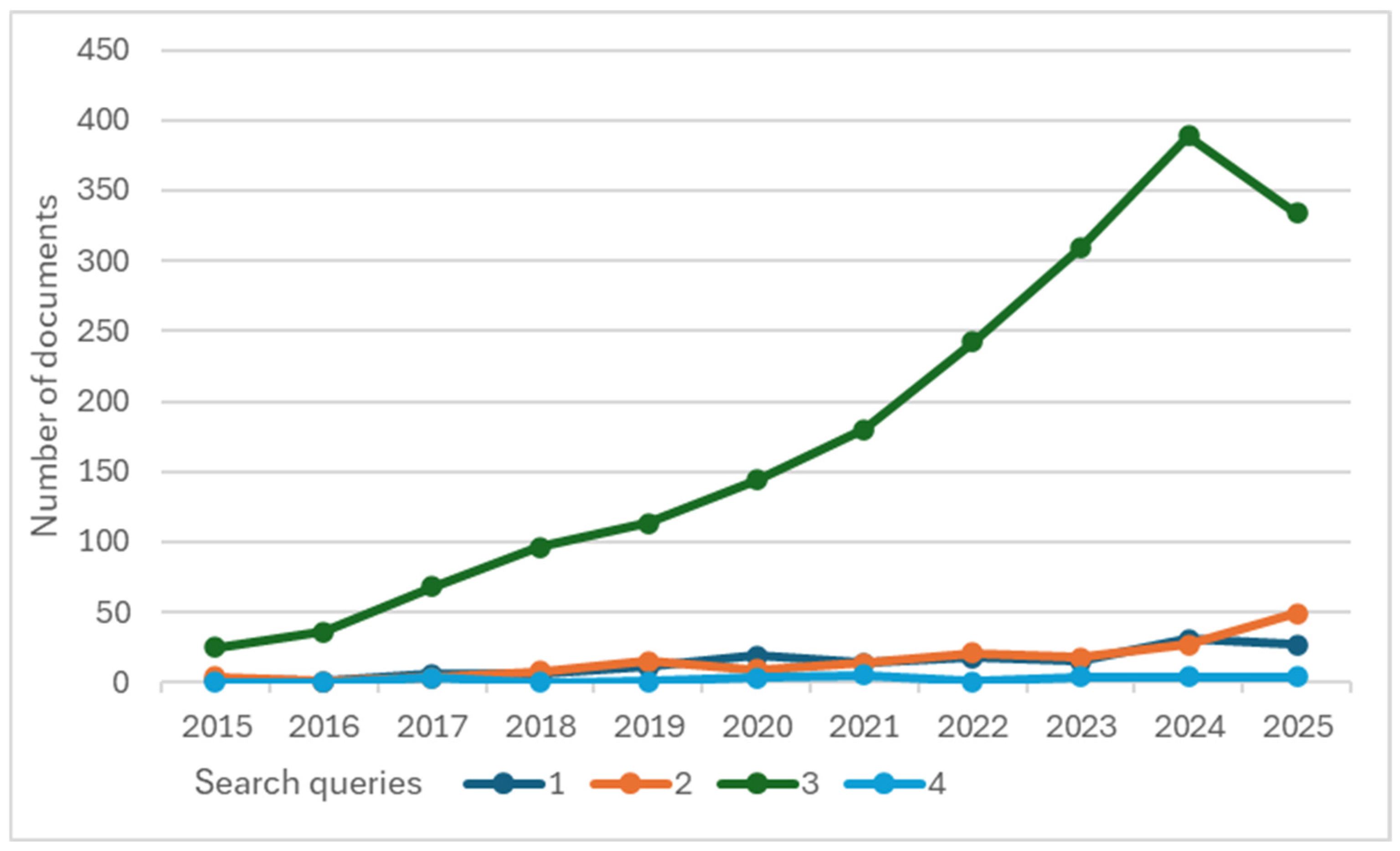
The systematic literature search was conducted using a modified PRISMA framework [21]. The four queries yielded an initial cumulative pool of 2293 documents. The search results were dominated by articles regarding the use of UAVs for power line inspection (Table 1). An analysis of the year the articles were published clearly shows a sharp increase in interest in the use of UAVs in the energy and heating sector in the third decade of the 20th century (1881 articles published between 2020 and 2025) (Figure 2).
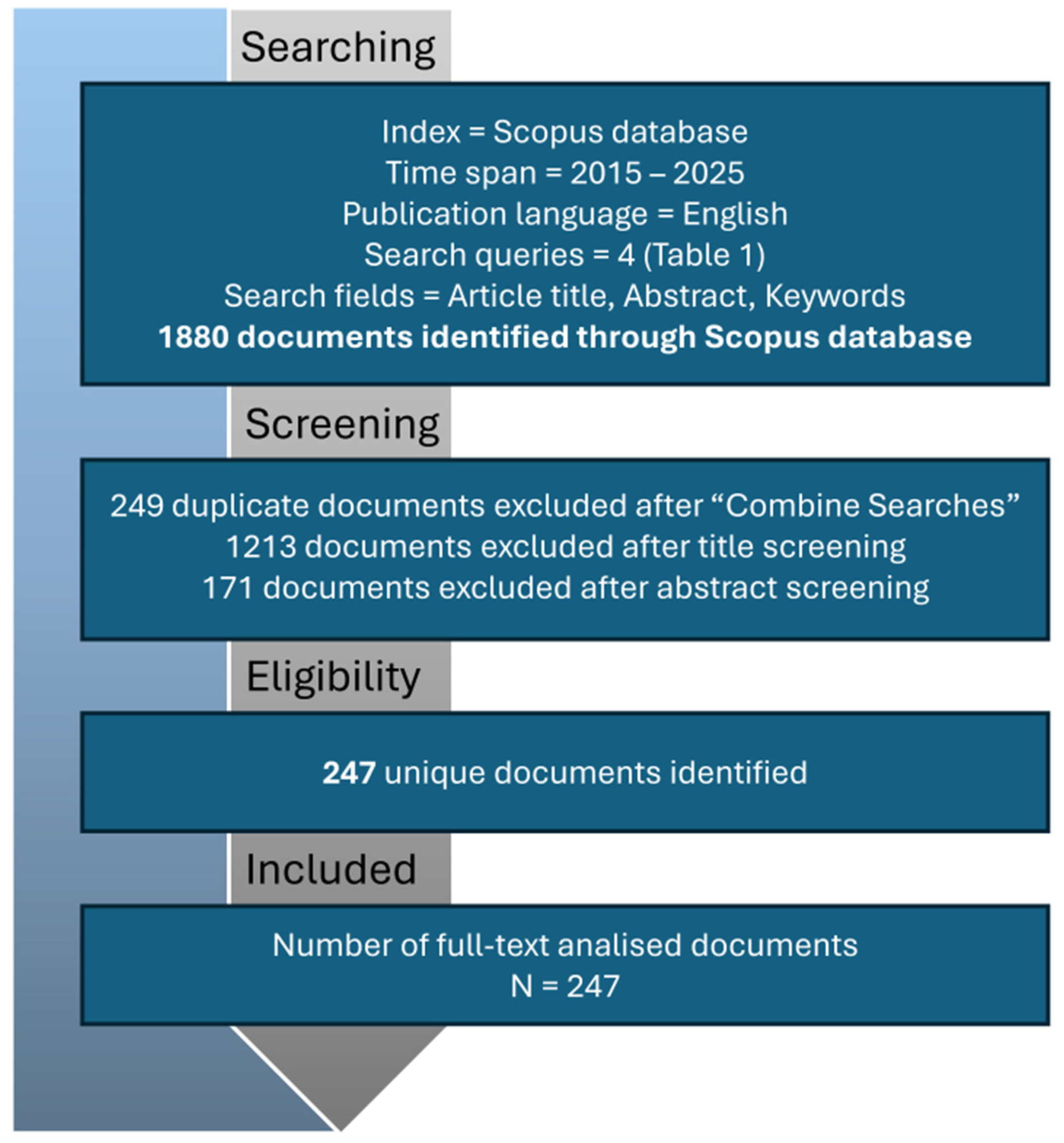
After completing these four independent searches, the results were aggregated using the Scopus “Combine Searches” function. The system automatically identified and removed duplicate articles resulting from the intersection of these queries. This process yielded a final pool of 1631 unique records. The final set of articles for in-depth review was selected from the total set of unique records using a three-stage screening process to ensure relevance to the review’s objectives (Figure 3). The primary focus of inclusion was articles that described the methodology for using UAVs for the inspection, maintenance, or monitoring of energy and heating infrastructure.
Stage 1: Title Screening
The initial pool of 2277 unique documents was first screened by article title. Records were excluded if the title did not clearly indicate a focus related to UAV technology and the specified energy infrastructure sectors. The 515 articles remain for further analysis.
Stage 2: Abstract Screening
The remaining articles were screened for their abstracts. During this stage, 268 documents were excluded because they met the following criteria:
  • The focus was exclusively on the optimization or design of the UAV itself, rather than its practical application in the energy sector.
  • The article’s primary subject was peripherally related (e.g., security or logistics) with only marginal reference to energy sector inspection.
Stage 3: Full-Text Review
The 247 articles that successfully passed the Title and Abstract screening stages were downloaded and assessed by reading the full text. This final stage confirmed the papers’ eligibility based on the following Inclusion Criteria (IC):
  • (IC1) The article clearly described the methodology of using UAVs for inspection, maintenance, or monitoring of the defined energy or district heating infrastructure.
  • (IC2) The research provided sufficient data (quantitative or qualitative) on the practical application of UAVs.
The final selection process is systematically summarized in the flow diagram adapted from the PRISMA guidelines (Figure 3) [21].

3. The Development of UAVs—An Emerging Technology Sector

The UAVs, commonly known as drones, have become one of the fastest-developing and most powerful technologies of the 21st century. The term “drone” means an unmanned or uncrewed aerial vehicle (UAV). The specific definitions of UAVs may vary by organization. The European Union has defined ‘unmanned aircraft’ as “any aircraft operating or designed to operate autonomously or to be piloted remotely without a pilot on board” [22]. The US Federal Aviation Administration defined an unmanned aircraft as a component of an unmanned aircraft system (UAS), which is an aircraft that is operated without the possibility of direct human intervention from within or on the aircraft. The whole UAS consists of unmanned aircraft and the equipment that is necessary for the safe and efficient operation of that aircraft UAS [23].
Drones were initially developed for military purposes. The first UAVs were flying bombs, which meant carrying large explosive warheads. These were precursors to modern cruise missiles. After World War I, UAVs began to be used as training targets for anti-aircraft defence. Developed in the United Kingdom, the first such remotely controlled aircraft, named “Queen Bee”, was also the first aircraft to be nicknamed “Drone” [24]. After World War II, rapid technological advances led to the development of unmanned aerial vehicles (UAVs). The UAVs were developed as reconnaissance drones to take high-quality photographs deep inside enemy-controlled territory (e.g., the Mastiff, Scout, and Pioneer). Subsequently, they also began to be used as unmanned combat aerial vehicles (UCAVs) capable of carrying missiles (e.g., Predator and Reaper) [25,26]. Nowadays, the armed forces of all developed countries have various types of unmanned aerial vehicles for military purposes.
Recent decades have also brought the development of UAVs for civilian applications. In the 2020s, the use of drones for scientific and commercial purposes has become increasingly common. Initially, civilian drones were primarily used to capture high-resolution images of the Earth’s surface, create orthophotography maps, and obtain videos and photos. UAVs enable the collection of high-resolution data that is significantly more accurate than that obtained through satellite remote sensing [27,28]. Data acquisition using UAVs speeds up operations and allows access to areas that are inaccessible from the ground [29]. The range of civilian applications is expanding significantly with technological developments, the miniaturisation of equipment, and longer flight durations. Drones are now used not only in surveying, but also in agriculture, forestry, documenting archaeological sites, creating 3D images, managing fires and other disasters, infrastructure management, search and rescue operations, animal inventory, searching for illegal waste dumps, monitoring of large areas, atmospheric sensing, logistics and transportation, traffic surveillance, public security as well as in the energy sector for monitoring of energy and heating infrastructure [13,28,30,31,32,33,34,35].
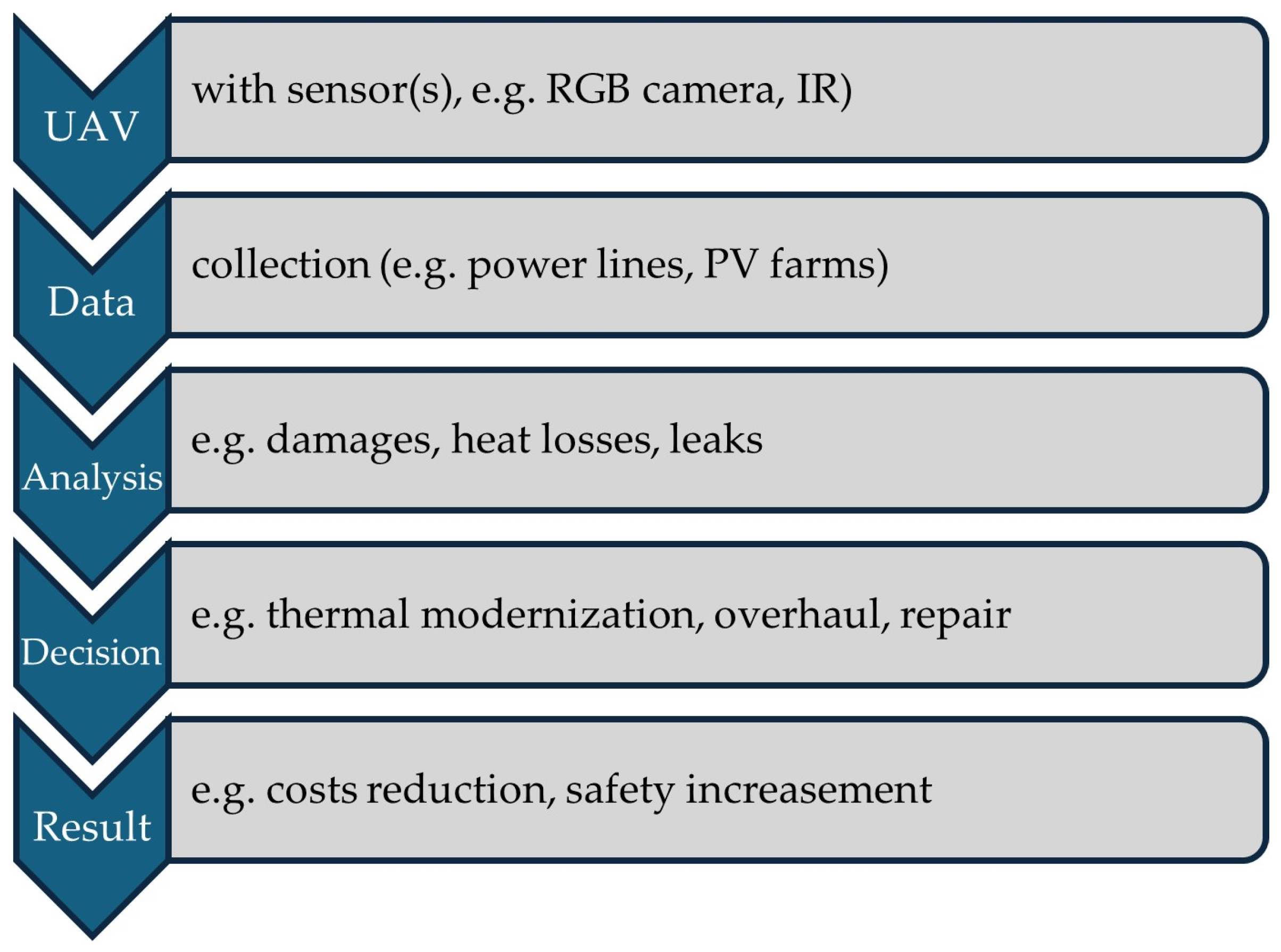
Individual drone models may vary significantly in terms of design, equipment, size, and potential applications. Standard equipment for civilian UAVs includes systems for obstacle detection, barrier avoidance, and collision avoidance with other airborne objects. These systems are most often based on artificial intelligence and sensors (e.g., visual, radar, acoustic, ultrasonic) that monitor the space around the drone in real time. Figure 4 shows the schema of data acquisition and processing using UAVs.
The design of unmanned aerial vehicles can be divided into two basic categories: rotary-wing and fixed-wing UAVs. Rotary-wing UAVs have gained the most incredible popularity in civil applications. The most common design is a quadcopter (4 motors with propellers). These drones can hover in a fixed position and do not require a large landing area because they are capable of vertical take-off and landing (VTOL). These features make them ideal for missions requiring precise positioning, spot inspections, or operations in hard-to-reach and narrow spaces, such as dense forests or urban areas [31]. Moreover, the rotary-wing UAVs are typically characterised by simpler configurations and lower operating costs [3]. However, their main limitations are lower payload capacity and relatively short flight times (10–45 min, depending on the model, weather conditions, and load) due to significant energy consumption [31,36]. Among UAVs for highly professional applications, there are also designs with six (hexacopters) and even eight (octocopters) motors [32]. A larger number of motors is used to ensure greater lift capacity (e.g., in agricultural drones for spraying plant protection products or spreading synthetic fertilizers), greater stability, and the ability to land safely in the event of an engine failure. Fixed-wing UAVs enable significantly longer flight times (up to several hours) and greater range, making them more suitable for long-term monitoring missions over large areas, such as power lines, river corridors, or vast agricultural fields. The disadvantage of their design is limited manoeuvrability in narrow spaces and the need for adequate take-off and landing space [3,37]. The appropriate UAV choice depends on the intended application, the area of operation, mission time requirements, terrain complexity, and the type and weight of sensors to be equipped on the drone. There is no universally best solution; each kind of UAV has its own advantages adjusted to specific application requirements.
The widespread use of UAVs is primarily due to significant technological advancements in recent years. The key innovations include advancements in construction materials, enhancements in power supply efficiency, and efforts to reduce overall weight. The use of carbon fiber (a composite material) provides structures with high strength at minimal weight. The development of lightweight and efficient lithium-polymer (Li-Po) batteries enables the provision of the required energy to power rotors, sensors, and navigation systems, while minimising total weight [38]. There are also ongoing studies on extending flight time by using photovoltaic cells or solar paint on the UAV’s surface to recharge the battery during flight [38,39]. Advances in microprocessors enable drones to operate effectively in extreme environmental conditions, including temperature, humidity, and vibration. The use of Global Positioning Systems and Inertial Measurement Units allows drones to stabilise, accurately calculate altitude, and follow programmed or dynamic flight paths. Advanced artificial intelligence algorithms can help optimise mission progress during flight based on observed variables. Control and feedback to the operator are provided via radio links with a range of up to several kilometres. Many professional UAVs also enable first-person-view flight through real-time video transmission [31,32]. The capabilities of modern UAVs are further expanded by the integration of advanced technologies such as AI and machine learning (ML) [12] which opens up new perspectives for their applications and autonomy.

4. The Applications of UAVs in the Energy and Heating Sectors

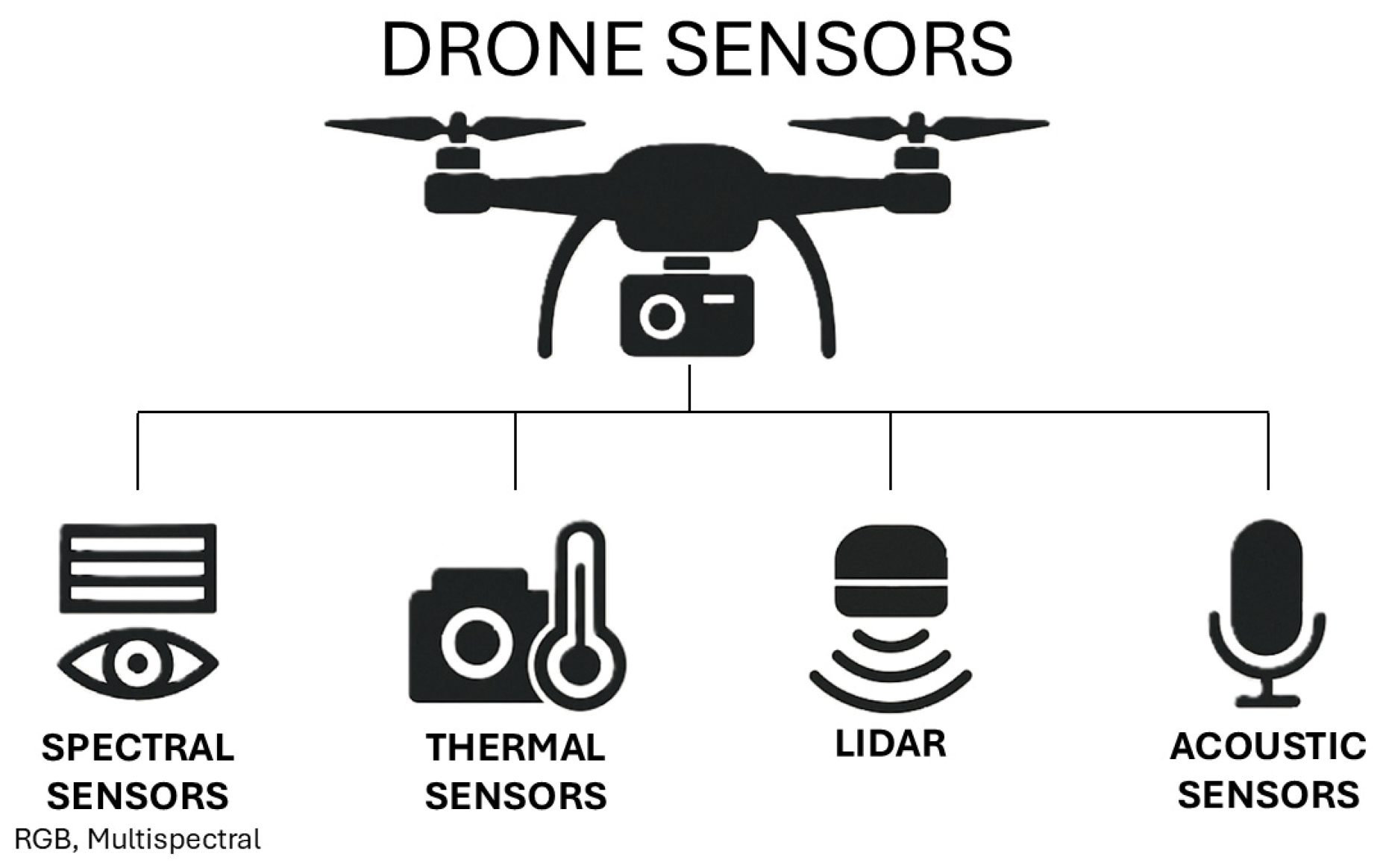
Unmanned Aerial Vehicles (UAVs) are increasingly becoming essential tools for the diagnostics and maintenance of energy infrastructure. Their capability to gather data from hard-to-reach locations, along with precise navigation and the potential to integrate various sensors, makes them an effective complement to or alternative for traditional inspection methods. Depending on the type of infrastructure (wind farms, photovoltaic farms, electricity transmission networks, or heating systems), different configurations of sensors and analytical algorithms are used. RGB and multispectral cameras, thermal cameras, LIDAR, and sometimes acoustic sensors are widely used (Figure 5). RGB and multispectral cameras are the basic tools for visual diagnostics. RGB cameras operate in three basic channels of the visible spectrum (R—red, G—green, B—blue), reproducing images in a similar way to the human eye’s perception. Multispectral cameras record data across several narrow bands spanning visible light and near-infrared (NIR) wavelengths. Images from multispectral cameras enable the analysis of physical and chemical properties of surfaces, including material condition and degradation levels. Thermal cameras, also known as infrared cameras (IR), record thermal radiation emitted by the surfaces of objects. Thermal images, also known as thermograms, help identify thermal anomalies. LiDAR monitoring provides data for creating 3D models, aiding in topographic studies and the detection of deformations in installations and facilities. Acoustic sensors are an increasingly common tool in wind turbine diagnostic systems, enabling non-visual detection of mechanical faults by analysing sound emissions and vibrations generated by operating components.

4.1. Use of UAVs in Photovoltaic Farms

The solar energy sector is the fastest-growing renewable energy sector. Global energy production from photovoltaic installations has doubled between 2021 and 2024 [2]. This rapidly growing sector is seeking new technologies to improve energy production efficiency. UAVs are becoming a key tool in modern solar farm management. The use of drones significantly improves the monitoring, diagnostics, and maintenance of photovoltaic installations [39]. The use of UAVs can reduce operating costs, improve employee safety, and increase energy efficiency by automating panel inspection and cleaning processes [8,40]. Properly programmed and supervised drone fleets can be remotely managed based on a distributed communication architecture, enabling autonomous inspection, surveillance, and damage detection missions for photovoltaic panels [39].
The RGB and IR cameras are most used in solar installation monitoring (Table 2). The key application is the inspection of degradation and analysis of panel performance, which can be effectively performed from the air [41]. To perform these tasks, UAVs are primarily equipped with thermal imaging sensors that allow them to map the modules’ surface temperature distribution and identify thermal anomalies [42,43]. This data is essential for detecting hidden defects, such as hotspots (overheating points), which indicate severe module defects [41] or bypass diode issues and faulty interconnections [44].
For detailed diagnostics, UAVs are increasingly utilized for Electroluminescence (EL) inspection. This technique involves forward-biasing photovoltaic modules to induce near-infrared light emission, which is captured by a specialized camera to reveal defects such as micro-cracks, cell degradation, and manufacturing faults not easily detectable by thermal imaging. To manage the challenges of large data volumes and environmental interference (e.g., motion blur, varying lighting) inherent in UAV-based EL inspection, recent research has leveraged edge computing and deep learning. Tang et al. [45] proposed an IoT-based framework that distributes task training models in the cloud and performs real-time detection on UAV edge devices to minimize latency. Additionally, Zhang et al. [46] developed a lightweight deep learning vision model optimized for edge deployment, enhancing detection accuracy and robustness against harsh outdoor conditions.
The comprehensive application of drones has led to the development of multifunctional UAVs capable of performing both diagnostics and automatic panel cleaning. Equipped with built-in spray nozzles and high-pressure pumps, these systems effectively remove contaminants such as dust and bird excrement, restoring module performance while eliminating the safety risks associated with manual work at heights [8,47]. This capability is particularly advantageous for floating photovoltaic installations where manual access is difficult, though operational stability remains sensitive to wind and weather conditions [40]. Beyond physical maintenance, UAVs equipped with thermal imagers and meteorological instruments can also be used to estimate the real-time power efficiency of photovoltaic farms [48].
Despite the benefits, there are several challenges to using drones in solar power plants. These challenges include legal issues related to autonomous flights, especially in Europe, as well as difficulties with data transmission in areas with poor network coverage. Additionally, there is the challenge of processing large image data sets and the need to standardize defect detection algorithms [39,49]. Further technological developments primarily involve integrating UAVs with AI and ML systems for automatic damage classification, known as AI-Powered Fault Detection. Pu et al. developed a deep learning-based method for segmenting photovoltaic panel images, enabling automatic defect detection and UAV flight-path planning. Their solution increased object detection accuracy to 93%, which significantly improved the location of faults in the module [49].

4.2. Use of UAVs in Wind Farms

With the growing importance of wind energy as the second key element of the global energy transition [2], regular maintenance and inspection of wind turbine blades is critical to optimising performance and ensuring safety [50]. Conventional inspection methods mainly rely on ground-based visual inspections, rope access, or cranes. These methods can be time-consuming and costly, often putting staff at risk. They also require halting turbine operations and favourable weather conditions [4,13,51]. The UAVs are a revolutionary alternative to traditional inspections. Drones can reduce monitoring costs by up to 70% and turbine downtime by 90%, thereby increasing the operational efficiency of wind farms [4]. Developing tech enables the use of UAVs in offshore wind farms, where traditional inspection methods are particularly demanding [13,51]. UAV systems equipped with RGB or IR cameras (Table 3) enable remote, fast, and safe acquisition of high-resolution images, even in hard-to-reach locations [9,13]. High-resolution cameras (RGB) are most commonly used for surface defect detection. IR cameras enable the detection of subsurface anomalies by monitoring dynamic thermal changes on the blade surface. Blade damage reduces thermal conductivity, leading to higher temperatures at the defect location. LiDAR systems are also used in wind turbine monitoring to improve anomaly detection and categorisation. Ultrasonic and acoustic emission techniques are less common. They use high-frequency sound waves to detect internal defects (e.g., voids) in the blades’ composite structure [13,51]. In addition, drones can autonomously perform inspections by locating and tracking moving turbine components [45], potentially allowing turbines to be monitored without stopping them. Ultrasonic sensors are also used to inspect wind turbine blades. However, contact between the sensor and the inspected surface is necessary. This makes the direct use of drones impossible. Nonetheless, UAVs can be used as platforms for the precise placement of negative-pressure absorption robots on blades [52]. Currently, various acoustic monitoring systems for wind turbine operations are being tested. This system uses acoustic sensors mounted on UAVs to capture and transmit sounds emitted from the nacelle to an acoustic receiver at a ground station. The transmitted acoustic signal is analysed to detect anomalies [53]. The application of UAVs in combination with deep learning methods and intelligent processing of results (fuzzification) enables precise detection of blade defects, such as cracks, corrosion, coating defects, and leading-edge erosion. [9]. UAV applications include both preventive inspections and responses to critical damage. Locating and classifying damage using drones allows for early repair planning and minimises shutdown costs [54].
UAVs are increasingly being employed to create and update digital twins of wind turbines, enabling automated, detailed structural health monitoring. To generate these digital twins, UAVs equipped with high-resolution RGB cameras and Real-Time Kinematic (RTK) positioning systems collect extensive image datasets, which are processed using photogrammetry or combined with LiDAR scans to create precise 3D geometric reconstructions of the structure [55]. Advanced artificial Intelligence, intense learning models, is utilized to detect, classify automatically, and segment surface damages, including rust, cracks, and paint peeling, directly from these inspection images. These detected 2D damage features are subsequently mapped onto the 3D model using sophisticated techniques, ensuring accurate localization and size quantification of defects within the virtual environment [56]. This continuous synchronization between the physical asset and its digital counterpart allows for real-time structural health monitoring and the implementation of predictive maintenance strategies, thereby optimizing asset management and reducing downtime. Hu et al. [57] proposed a deep learning approach for real-time damage detection, validated through field testing across three wind farms. Their results demonstrated that the digital twin accurately mirrors turbine conditions and can detect damage on rotating blades, provided the time a blade remains in the drone’s field of view is sufficient for the neural network to complete its inference.
The integration of UAVs into offshore wind farm maintenance strategies significantly enhances operational efficiency by executing tasks such as routine inspections and the delivery of light spare parts [58,59]. Specifically, the deployment of UAV swarms has been found to dramatically reduce mission times compared to traditional single-UAV methods, with some studies reporting efficiency gains of up to 70% [60]. To manage the complexity of these multi-agent systems, researchers have developed advanced optimization techniques, including Multi-Stage Bees algorithms [61], improved Particle Swarm Optimization [62], and Genetic Algorithms [63] which dynamically coordinates routing, task allocation, and charging schedules to minimize energy consumption and operational costs while adapting to environmental constraints. Recent methodologies propose using service vessels as mobile control centres and battery swap stations, allowing for flexible, scalable operations [61,63].
Despite numerous advantages, the use of UAVs also faces challenges, including limited flight autonomy, sensitivity to weather conditions, difficulties with sensor calibration, and the need for accurate positioning of drones relative to the gondolas and blades [9]. Current research trends include integrating UAVs with digital twin systems, using hyperspectral sensors, and implementing predictive maintenance algorithms based on UAV inspection data [54]. The development of fully autonomous UAV systems with continual learning and edge AI could completely revolutionise wind farm management in the future.

4.3. Use of UAVs in Electricity Infrastructure Monitoring

Efficient power infrastructure is crucial to ensuring an uninterrupted electricity supply to consumers. Maintaining transmission networks requires timely, thorough inspections to enable early detection of anomalies. Traditional monitoring of power infrastructure relies mainly on ground inspections, fixed cameras, helicopter inspections, or satellite imagery. Ground inspections are labour-intensive and dangerous. They require technical staff to work at heights and in challenging areas. Satellite images do not allow for fast and accurate inspections, and aerial inspections are expensive [33,64,65]. The use of UAVs makes inspections safer, more efficient, and more economical. It eliminates risky manual inspections and minimizes the costs of high-priced aerial inspections. Furthermore, UAVs enable precise monitoring of installation components that are difficult to access from the ground [5,6]. The primary use of UAVs is to collect high-resolution RGB camera imagery and video of infrastructure. Images of transmission lines and their components are further processed with deep learning algorithms to detect anomalies, malfunctioning components, and diagnose faults [64]. An example of application is the detection of defects in transmission line dampers, line insulation (bare conductor, missing or broken insulator), missing or damaged gaskets, nuts, bolts, or corrosion [66]. UAVs are also used to monitor the condition of transmission towers [67,68], measure current in transmission lines [69], and clean power-line insulators [70]. IR cameras are used to detect overheating components in energy infrastructure before they cause a failure (Table 4) [6,65]. LIDAR technology enables precise scanning and the creation of three-dimensional models used in planning autonomous mission routes for monitoring power lines [5,64].
Modern inspection strategies employ multi-sensor platforms that integrate LiDAR, infrared thermal imagers, and high-resolution visual cameras to achieve synchronized inspection of all power line components and surrounding objects [71]. Advanced frameworks now incorporate Artificial Intelligence to process this data; for example, Transformer-based multimodal data fusion algorithms have been shown to significantly enhance defect recognition robustness, achieving an F1-score of about 90% even in extreme environments [72]. Beyond structural defects, UAVs are increasingly used for environmental infringement assessment by fusing 3D LiDAR and thermal data to estimate conductor sag and predict tension behaviour under extreme operational temperatures, utilizing uncertainty quantification to enhance the reliability of risk assessments [73]. Recent advancements in UAV-based transmission line inspection focus on developing lightweight, high-efficiency deep learning models that process aerial imagery in real-time while maintaining high detection accuracy. To address the computational constraints of edge devices on UAVs, researchers have introduced optimized object detection frameworks such as SCCFM-YOLO [74] and ES-YOLOv8 [75], as well as segmentation models like PL-UNet [76].
The main challenges of using drones to inspect energy infrastructure include increasing the resilience of UAVs to harsh weather conditions and achieving large-scale automation of image transmission and processing (simultaneously from multiple sources) [33]. Electromagnetic interference from strong electromagnetic fields near power lines can cause issues for UAV control systems and accelerate battery drain [77,78,79]. Due to the complexity and scale of energy infrastructure, development work is underway on multi-UAV operations, i.e., the use of multiple drones with different sensors in coordinated missions. This approach poses challenges in terms of synchronisation, recording, transmission, and efficient processing of collected data by algorithms, which is crucial for increasing inspection accuracy [33,66].

4.4. Use of UAVs in District Heating Infrastructure Monitoring

District heating systems are essential components of energy infrastructure in densely populated urban areas. Most pipelines are installed underground, making it challenging to locate leaks or broken insulation accurately [34,80]. The loss of heating medium, such as water or steam, from the transmission system incurs additional costs and negative environmental impacts [10,81]. The consequences of leaks underscore the urgent need for rapid, effective fault detection. However, pinpointing the exact location of a leak is challenging due to the lack of reliable monitoring systems for underground pipelines. The conventional method of leak detection involves comparing the volume of hot water entering and leaving the network. While this approach can confirm the existence of a leak, it does not indicate its precise location. As a result, expensive ground excavation work is often required to pinpoint and carry out repairs [82]. The second traditional method is acoustic analysis and detection of sound waves generated by escaping hot fluid. Unfortunately, this approach is often hampered by external noise, making it challenging to locate the leak accurately [83]. The other methods used have limitations in detection accuracy, require significant investment, or are limited in scale [7,84]. More precise inspections of the underground heating network are carried out using thermal imaging from manned aircraft [81]. These are high-cost inspections that require suitable weather conditions, aircraft and crew availability, advance planning, and typically involve large-scale operations. The use of UAVs for monitoring urban heating networks is a low-cost and flexible alternative [7]. However, based on the literature review, it can be concluded that the use of UAVs for monitoring district heating infrastructure is in the phase of developing methods and tools for broader application (Figure 1). The primary sensors for heating networks leak detection on UAV platforms are IR cameras (Table 5). Hot heating fluid leaking from damaged underground pipelines raises the surrounding temperature, allowing for detection. Thermal images capture heat fluctuations, revealing potential leaks as hot spots on the surface [82,84]. Drones enable efficient, rapid mapping of the entire network and its critical components. Acquiring thermal images using UAV platforms requires fewer human resources and saves time [10] and can be carried out using innovative semiautonomous inspection methods [84]. To enhance monitoring precision, UAV systems employ multimodal imaging sources. IR and optical cameras are used together to verify thermal anomaly detection. A hot spot is only a thermal anomaly if it is visible in the IR image but not in the optical image. This combined data facilitates the generation of an infrared saliency map, enabling better detection of leak sources [83,85]. Successful data acquisition also relies heavily on environmental conditions; flights are best conducted in the early morning to minimize interference from sunlight and maximize the temperature contrast between the leakage and the background. Furthermore, flight parameters such as altitude (e.g., 120–150 m) must be optimized to balance spatial resolution with coverage area [83]. UAVs can also be used to monitor above-ground transmission pipelines. The accuracy of determining geometric shape using UAV scanning (ULS) might be similar to that of ground scanning. In studies, differences in results were observed only sporadically and did not exceed 20 mm [86]. Accuracy depends on the quality of the scanner and the class of positioning systems (GNSS, INS) installed on board [87,88].
As with other large-scale applications of UAVs for monitoring in the energy sector, the development of automated processing for large image datasets is crucial. The use of AI to identify anomalies indicating leaks from heating networks is bringing promising results. The urban environment is particular and is replete with warm elements (e.g., manholes, building heat, streetlights, cars, and other man-made objects) that complicate the automated, precise identification of leaks [34,81,89]. Some of the problems with classification can be eliminated by using data from Digital Surface Models. Elevation data enables distinguishing actual pipeline leaks at ground level from false alarms caused by taller objects, such as poorly insulated building roofs [85]. Conventional machine-learning classifiers and deep-learning algorithms based on neural networks are used to analyse IR images and automatically detect leaks. The use of appropriate AI models enables an exceptionally high detection rate for leaks. Sledz and Heipke created a model with an accuracy rate of 98.7% [85], and in two other studies, models achieved 98.6% accuracy in leak diagnosis [82,90]. The obtained high level of accuracy by automated leak detection is achieved by combining data from multiple sources. Accurate pipeline location data, derived from GIS or visual imagery, provides preliminary input to eliminate false alarms outside the pipeline corridor [83].

5. Regulatory Barriers to the UAV Use in the Energy and Heating Sectors

The use of unmanned aerial vehicles for autonomous and beyond-visual-line-of-sight (BVLOS) missions to monitor energy and heating infrastructure faces significant legal and regulatory obstacles in many parts of the world. These challenges arise primarily from the inherent risks associated with autonomous operations in airspace, the need to ensure the safety of people and property, and the complexity of existing legal frameworks, which do not always keep pace with the rapid development of drones [91,92,93]. Legal and regulatory challenges for UAV missions for monitoring energy and heating infrastructure were analysed under three legal systems in force in the European Union (EU), the United States (US), and the People’s Republic of China (PRC). Each of these three areas has a legally established main regulatory body governing civil aviation, including drones. These agencies are responsible, among other things, for shaping the regulatory framework and ensuring human safety and environmental protection in the use of drones. In the EU, these issues are the responsibility of the European Union Aviation Safety Agency (EASA); in the US, the Federal Aviation Administration (FAA); and in the People’s Republic of China, the Civil Aviation Administration of China (CAAC). The main regulatory issues affecting the ability to perform missions, including autonomous ones, can be divided into several key areas.

5.1. Authorisation of BVLOS and Autonomous Operations

Due to their nature, autonomous and BVLOS flights eliminate the traditional safety layer provided by the pilot’s vision. As a result, regulatory authorities treat such operations as high-risk. Autonomous/BVLOS flights require the technical capability for UAVs to detect, identify, and avoid other airspace users and obstacles without a visual observer [94]. This usually requires obtaining formal authorization based on a detailed safety analysis. To receive individual approval for a mission, UAV operators prepare a risk assessment and propose mitigation measures (technical, operational, procedural). Typical elements include Detect-and-Avoid (DAA) capability, reliable command-and-control (C2) links, and fail-safe behaviours. Such requirements slow down the approval process due to high evidentiary and technical burdens.
Within the EU, EASA implements flight categorization based on potential risk (Open/Specific/Certified). Autonomous and BVLOS flights are classified as Specific or Certified categories. Operators in these categories must use the Specific Operations Risk Assessment (SORA) methodology to determine the risks in the air and on the ground and should propose countermeasures. The flight requires an operating permit from the competent authority [22,95]. The FAA in the United States requires special waivers or specific approvals for BVLOS flights. Obtaining waivers requires the applicant to submit equivalent safety measures, including DAA, observers, and technical mitigations [96,97]. The CAAC in China imposes requirements on commercial flights, including registration under a real name, licensing, mandatory insurance, and altitude restrictions. BVLOS/autonomous flights are permitted only with special permits and are often subject to strict geographic controls and security checks (sensitive infrastructure, such as power plants, is frequently located in restricted areas). Large-scale UAV operations and BVLOS or autonomous flights require formal licensing (prior CAAC approval) and coordination with civil aviation and public safety authorities [98,99,100].

5.2. Airspace Integration and Traffic Management (UTM/U-Space)

Autonomous missions and missions involving multiple UAVs require coordinated traffic management to avoid collisions with manned aircraft, emergency services, and other UAVs. To reduce the risk of conflicts in shared airspace during autonomous missions, it is necessary to implement efficient Unmanned Traffic Management (UTM) services. It is essential to implement legal regulations specifying who is responsible for airspace management, who prepares flight plans, and the procedures for handling dynamic conflicts. Uncertainty in the above areas constitutes a significant barrier to autonomous UAV operations [92]. To improve airspace management, many systems divide it into classes with varying levels of access [101].
The EU has been actively developing the U-Space concept (the European UTM model), which provides a set of services and regulatory requirements for traffic information, deconfliction, and geofencing. The system includes both flight services, such as drone registration, weather information, operation plan processing, and strategic deconfliction, as well as in-flight services, such as e-identification, UAV position reporting, monitoring, traffic information, and emergency management. U-Space implementation is still ongoing, and its level varies by EU member countries [95,101,102,103]. U-Space and harmonized service standards are undoubtedly essential to enabling BVLOS and autonomous missions in the entire EU area [92].
In the US, UTM for drones in national airspace is being developed by the FAA in collaboration with the National Aeronautics and Space Administration (NASA) [104]. The FAA supports the development of the UTM concept, but a fully federated commercial UTM with mandatory legal status is still under development. The FAA’s Part 107 regulations impose restrictions on where and how UAVs can operate for commercial purposes (e.g., near people or in special areas, such as the vicinity of airports). Until the national UTM is fully developed and implemented, operators of high-risk flights are required to obtain individual waivers, operational restrictions, and coordination with local air traffic services [96,97,105].
China has developed a centrally coordinated airspace management system, administered by the state. The system is linked to national geofencing and requires pre-flight registration (using a real ID). Air traffic management agencies prioritize military, police, customs, and emergency management missions. The problem is not only the restrictions on autonomous flights and VLOS flights, but also strict no-fly zones near sensitive or restricted infrastructure (e.g., airports, military facilities, or other critical installations). However, the integrated management in China may enable the rapid implementation of state-sponsored autonomous or multi-scale UAV projects [98,100,106].

5.3. Certification, Airworthiness, and Operator Competence (Including AI/Autonomy Certification)

Manned-aviation style airworthiness and certification frameworks cannot be directly applied to small autonomous systems. Regulatory authorities must ensure the safety of systems and the competence of operators without imposing disproportionate requirements specific to manned aviation. Operators of UAVs used in the energy and heating sectors need to be confident that unmanned aerial vehicles, their onboard autonomy systems, and maintenance procedures meet acceptable reliability standards. Autonomous systems are sometimes equipped with opaque AI/black-box components. This raises questions about what “airworthiness” means in the context of software-controlled UAV behaviour and how to certify it. Mitigation measures may include adopting a system-of-systems certification approach that encompasses hardware, software, and the operational environment, as well as requiring explainable AI (XAI) or evidence of deterministic behaviour for certification. Furthermore, it is possible to introduce operator/organizational accreditation (e.g., RPAS Operator Certificates like Canada’s RPOC or Australia’s ReOC) and mandatory training/qualification for remote pilots and maintainers of autonomous/BVLOS UAV missions [91,95,107,108].
EASA’s Certified category is intended for missions with the highest risk. This category is based on certification methods analogous to manned aviation (including Type Certification and continuing airworthiness). For autonomous flights, EASA requires safety objectives for software and human competence in accordance with the Specific Operations Risk Assessment (SORA) methodology. EU guidelines also point to the necessary transparency in automated decision systems where safety is critical [95,101,109].
For flights of advanced autonomous systems, the FAA has used waivers and special air operator certificates, and is developing new procedures through the proposed legislative process. The FAA’s main expectations include demonstrating evidence of safety equivalence, software integrity, and operator competence. However, standards for AI explainability are in the early stages of development [97,105]. The FAA requires UAV pilots to pass a knowledge test and obtain a certificate. The Advanced Operations Certificate for high-risk operations (including BLOS) requires pilots to hold an Advanced Operations Certificate (theoretical and practical exam) and obtain a Special Flight Operations Certificate for each flight [18,96]. Intensive work is ongoing in China to test and certify UAVs for industry, including energy infrastructure. Requirements for autonomous flights using AI emphasize the need for operator control, cybersecurity, and centralized oversight. Obtaining the necessary CAAC approvals for autonomous UAV or BVLOS operations can be very difficult. Companies planning to use autonomous UAVs to inspect energy infrastructure face a wide range of requirements (registration, airspace permits, and possibly local permits). The CAAC requires pilots to obtain certificates in operational safety by passing theoretical training and examinations, as well as completing control skills training and passing the practical test [98,106,110].

5.4. Data Protection, Privacy, and Surveillance Law

Monitoring energy and heating infrastructure using UAVs involves collecting high-resolution or thermal images. In addition to the intended infrastructure, monitoring may also unintentionally record private property or persons (personal data), strategic facilities, or confidential information. The large scale of data obtained from continuous/regular infrastructure monitoring causes challenges within the context of data protection and privacy regulations [18]. Privacy and national security laws impose strict restrictions on the collection, processing, storage, and international transfer of sensitive data [91].
The European Union has regulations known as the General Data Protection Regulation (GDPR), which also apply to personal data obtained from drone images. For monitoring missions, the key principles are compliance with current regulations, data minimization, and mandatory Data Protection Impact Assessments (DPIA). The EASA guidelines draw evident attention to privacy and data protection issues in risk assessment (SORA) [18,92].
In the US, privacy regulations are sectoral and state-level. There is no uniform federal privacy law equivalent to the EU’s GDPR. Public utilities and private entities must comply with state privacy laws and company policies. Some states or even municipalities also impose additional drone restrictions (take-off/landing/operational areas). In addition, the risk of court disputes affects the minimization of data collected and stored [96,111].
China has strict regulations on data management, with particular emphasis on data flows outside the country. The authorities strictly limit access to images of critical infrastructure. Therefore, commercial databases may be subject to control. Privacy is understood through the prism of strong state control and the provisions of the Personal Information Protection Law (PIPL) [99,112,113].

6. Conclusions

Review analysis shows that UAVs are highly effective tools for inspecting and diagnosing photovoltaic panels, wind turbines, electrical transmission infrastructure, and district heating networks. Sensors carried by drones are primarily used to provide updated, high-resolution thermal and optical imagery. The main conclusions regarding the use of UAVs in the energy and heating sector include:
  • UAVs significantly reduce inspection time and operational costs while increasing safety by replacing manual, high-risk inspections.
  • Multi-sensor UAVs (RGB, multispectral, IR, LiDAR, acoustic) provide complementary information essential for effective defect detection.
  • Integration of artificial intelligence and machine learning enables automated detection and classification, as well as supports predictive maintenance.
Despite numerous advantages and rapid technical development, the use of UAVs in the energy and heating sectors still poses specific challenges that require addressing. The main future tasks include:
  • Developing solutions for key technical constraints: limited flight time, limited autonomy, weather sensitivity, and limited resistance to electromagnetic interference.
  • Further development and refinement of solutions for the transmission/processing of large amounts of data.
  • Development of protocols for coordinating the simultaneous collection and processing of data from multiple UAVs equipped with different sensors.
Implementation of regulations enabling the use of autonomous flights.
Promising research directions to increase the potential applications of UAVs in the energy and heating sectors also include edge AI, digital twin integration, multi-sensor UAVs, and platforms with extended flight times.
Various legal systems regulate the commercial use of UAVs worldwide. As this is a relatively new and rapidly developing field, legal regulations vary in terms of their sophistication and complexity. Some countries have no rules governing UAVs in their legal systems. This study compares the approaches of three important civil aviation agencies: FAA/EASA/CAAC. Their regulations are characterized by different regulatory philosophies: case-by-case waivers and evolution (US), harmonized, risk-based frameworks (EU), and centralized, strict control with strong registration/airspace management (China). Legal challenges are most acute for UAV operators intending to implement autonomous flights to monitor energy and heating infrastructure.

Author Contributions

Conceptualization, M.J.; methodology, M.J.; validation, M.J., K.S., K.M., A.A., A.K. and L.S.; formal analysis, M.J.; investigation, M.J., K.M., A.A. and L.S.; resources, M.J. and L.S.; data curation, M.J.; writing—original draft preparation, M.J., K.M., A.A. and L.S.; writing—review and editing, M.J., K.S., K.M., A.A., A.K. and L.S.; visualization, M.J. and K.M.; supervision, M.J. and L.S.; project administration, M.J. and K.S.; funding acquisition: M.J. and K.S. Authors contribution: M.J. (50%); L.S. (15%); K.S. (10%); K.M. (10%), A.A. (10%), A.K. (5%). All authors have read and agreed to the published version of the manuscript.

Funding

This research project was supported by the program “Excellence initiative—research university” for the AGH University and the statutory research fund (No. 16.16.150.008) of the Faculty of Geo-Data Science, Geodesy, and Environmental Engineering, AGH University.

Data Availability Statement

The original contributions presented in this study are included in the article. Further inquiries can be directed to the corresponding authors.

Conflicts of Interest

The authors declare no conflicts of interest.

Abbreviations

The following abbreviations are used in this manuscript:
UAVUnmanned Aerial Vehicle
IRInfrared
AIArtificial intelligence
RGBVisible spectrum (R—red, G—green, B—blue)
LiDARLight Detection and Ranging
PVPhotovoltaics
BVLOSBeyond Visual Line of Sight
EASAEuropean Union Aviation Safety Agency
FAAFederal Aviation Administration (US)
CAACCivil Aviation Administration of China
SORASpecific Operations Risk Assessment
UTMUnmanned Traffic Management
DIPAData Protection Impact Assessments
GDPRGeneral Data Protection Regulation

References

  1. International Energy Agency. Global Energy Review 2025; International Energy Agency: Paris, France, 2025.
  2. Graham, E.; Fulghum, N.; Altieri, K. Global Electricity Review 2025; EMBER: London, UK, 2025. [Google Scholar]
  3. Chen, B.; Maurer, J.; Gong, W. Applications of UAV in Landslide Research: A Review. Landslides 2025, 22, 3029–3048. [Google Scholar] [CrossRef]
  4. Pratt, R.; Allen, C.; Masoum, M.A.S.; Seibi, A. Defect Detection and Classification on Wind Turbine Blades Using Deep Learning with Fuzzy Voting. Machines 2025, 13, 283. [Google Scholar] [CrossRef]
  5. Guan, H.; Sun, X.; Su, Y.; Hu, T.; Wang, H.; Wang, H.; Peng, C.; Guo, Q. UAV-Lidar Aids Automatic Intelligent Powerline Inspection. Int. J. Electr. Power Energy Syst. 2021, 130, 106987. [Google Scholar] [CrossRef]
  6. Santos, T.; Cunha, T.; Dias, A.; Moreira, A.P.; Almeida, J. UAV Visual and Thermographic Power Line Detection Using Deep Learning. Sensors 2024, 24, 5678. [Google Scholar] [CrossRef]
  7. Koolivand, Y.; Jan Szczerek, W.; Kofod Dahl, M.; Bendtsen, J.M.H.; Rezaeiyan, Y.; Richter, S.; Laursen, K.; Mosalmani, A.; Maurya, P.; Sadeghi, M.; et al. Thermally Powered Autonomous Water Leakage Detection System for District Heating Pipes. IEEE Sens. J. 2025, 25, 32953–32963. [Google Scholar] [CrossRef]
  8. Shinde, P. Solar Panel Inspection and Cleaning Drone. Int. J. Res. Appl. Sci. Eng. Technol. 2025, 13, 2951–2954. [Google Scholar] [CrossRef]
  9. Davis, M.; Nazario Dejesus, E.; Shekaramiz, M.; Zander, J.; Memari, M. Identification and Localization of Wind Turbine Blade Faults Using Deep Learning. Appl. Sci. 2024, 14, 6319. [Google Scholar] [CrossRef]
  10. Protić, M.P.; Ilić, Z.M.; Krstić, V.; Stojanović, M.B. Utilizing Unmanned Aerial Vehicles for Detecting Heat Losses in District Heating Networks. In Proceedings of the 2024 59th International Scientific Conference on Information, Communication and Energy Systems and Technologies (ICEST), Sozopol, Bulgaria, 1–3 July 2024. [Google Scholar]
  11. Ince, E. Transmission Line Inspection with UAVs: A Review of Technologies, Applications, and Challenges. Int. J. Energy Smart Grid 2024, 9, 60–69. [Google Scholar] [CrossRef]
  12. Bayomi, N.; Fernandez, J.E. Eyes in the Sky: Drones Applications in the Built Environment under Climate Change Challenges. Drones 2023, 7, 637. [Google Scholar] [CrossRef]
  13. Heo, S.-J.; Na, W.S. Review of Drone-Based Technologies for Wind Turbine Blade Inspection. Electronics 2025, 14, 227. [Google Scholar] [CrossRef]
  14. Hariharan, R.; Saxena, A.; Dhote, V.; Srisathirapathy, S.; Almusawi, M.; Raja Kumar, J.R. Advancements in Solar-Powered UAV Design Leveraging Machine Learning: A Comprehensive Review. In Proceedings of the E3S Web of Conferences; EDP Sciences: Les Ulis, France, 2024; Volume 540. [Google Scholar]
  15. Aromoye, I.A.; Lo, H.H.; Sebastian, P.; Mustafa Abro, G.E.; Ayinla, S.L. Significant Advancements in UAV Technology for Reliable Oil and Gas Pipeline Monitoring. CMES-Comput. Model. Eng. Sci. 2025, 142, 1155–1197. [Google Scholar] [CrossRef]
  16. Corley, I.; Wallace, C.; Agrawal, S.; Putrah, B.; Lwowski, J. Aerial Infrared Health Monitoring of Solar Photovoltaic Farms at Scale. arXiv 2025, arXiv:2503.02128. [Google Scholar] [CrossRef]
  17. Barraz, Z.; Sebari, I.; Ait El Kadi, K.; Ait Abdelmoula, I. Towards a Holistic Approach for UAV-Based Large-Scale Photovoltaic Inspection: A Review on Deep Learning and Image Processing Techniques. Technologies 2025, 13, 117. [Google Scholar] [CrossRef]
  18. Aghaei, M.; Kolahi, M.; Nedaei, A.; Venkatesh, N.S.; Esmailifar, S.M.; Moradi Sizkouhi, A.M.; Aghamohammadi, A.; Oliveira, A.K.V.; Eskandari, A.; Parvin, P.; et al. Autonomous Intelligent Monitoring of Photovoltaic Systems: An In-Depth Multidisciplinary Review. Prog. Photovolt. Res. Appl. 2025, 33, 381–409. [Google Scholar] [CrossRef]
  19. Olayiwola, O.; Camara, F. Challenges and Opportunities for Autonomous UAV Inspection in Solar Photovoltaics. In Proceedings of the E3S Web of Conferences; EDP Sciences: Les Ulis, France, 2024; Volume 572. [Google Scholar]
  20. Liao, K.-C.; Lu, J.-H. Using UAV to Detect Solar Module Fault Conditions of a Solar Power Farm with Ir and Visual Image Analysis. Appl. Sci. 2021, 11, 1835. [Google Scholar] [CrossRef]
  21. Page, M.J.; McKenzie, J.E.; Bossuyt, P.M.; Boutron, I.; Hoffmann, T.C.; Mulrow, C.D.; Shamseer, L.; Tetzlaff, J.M.; Akl, E.A.; Brennan, S.E.; et al. The PRISMA 2020 Statement: An Updated Guideline for Reporting Systematic Reviews. BMJ 2021, 372, n71. [Google Scholar] [CrossRef]
  22. Regulation (EU). Regulation (EU) 2018/1139 of the European Parliament and of the Council of 4 July 2018 on Common Rules in the Field of Civil Aviation and Establishing a European Union Aviation Safety Agency; European Union: Brussels, Belgium, 2018. [Google Scholar]
  23. U.S. Government Publishing Office. An Act to Amend Title 49, United States Code, to Authorize Appropriations for the Federal Aviation Administration for Fiscal Years 2011 Through 2014, to Streamline Programs, Create Efficiencies, Reduce Waste, and Improve Aviation Safety and Capacity, to Provide Stable Funding for the National Aviation System, and for Other Purposes; Public Law 112-95, S. 331(8); U.S. Government Publishing Office: Washington, DC, USA, 2012.
  24. Dekoulis, G. Introductory Chapter: Drones. In Drones: Applications; Dekoulis, G., Ed.; IntechOpen: London, UK, 2018; pp. 3–6. [Google Scholar]
  25. Studiawan, H.; Choo, K.-K.R. Drone and UAV Forensics. A Hands-On Approach; Studiawan, H., Choo, K.-K.R., Eds.; Springer: Cham, Switzerland, 2025. [Google Scholar]
  26. Kahvecioglu, S.; Oktal, H. Historical Development of UAV Technologies in the World: The Case of Turkey. In Sustainable Aviation. Energy and Environmental Issues; Karakoc, T.H., Ozerdem, M.B., Sogut, M.Z., Colpan, C.O., Altuntas, O., Açıkkalp, E., Eds.; Springer: Cham, Switzerland, 2016; pp. 323–331. [Google Scholar]
  27. Mazur, R.; Kowalewski, Z.; Głowienka, E.; Santos, L.; Jakubiak, M. Sustainability in Aquatic Ecosystem Restoration: Combining Classical and Remote Sensing Methods for Effective Water Quality Management. Sustainability 2024, 16, 3716. [Google Scholar] [CrossRef]
  28. Jakubiak, M. The Use of Unmanned Aerial Vehicles to Retard the Transformation of Environmental Resources. Pol. J. Sustain. Dev. 2024, 28, 107–112. [Google Scholar] [CrossRef]
  29. Pyka, K.; Wiącek, P.; Guzik, M. Surveying with Photogrammetric Unmanned Aerial Vehicles. Arch. Photogramm. Cartogr. Remote Sens. 2020, 32, 79. [Google Scholar] [CrossRef]
  30. Stöcker, C.; Bennett, R.; Nex, F.; Gerke, M.; Zevenbergen, J. Review of the Current State of UAV Regulations. Remote Sens. 2017, 9, 459. [Google Scholar]
  31. Mohsan, S.A.H.; Khan, M.A.; Noor, F.; Ullah, I.; Alsharif, M.H. Towards the Unmanned Aerial Vehicles (UAVs): A Comprehensive Review. Drones 2022, 6, 147. [Google Scholar] [CrossRef]
  32. Ucgun, H.; Yuzgec, U.; Bayilmis, C. A Review on Applications of Rotary-Wing Unmanned Aerial Vehicle Charging Stations. Int. J. Adv. Robot. Syst. 2021, 18, 17298814211015863. [Google Scholar] [CrossRef]
  33. Mendu, B.; Mbuli, N. State-of-the-Art Review on the Application of Unmanned Aerial Vehicles (UAVs) in Power Line Inspections: Current Innovations, Trends, and Future Prospects. Drones 2025, 9, 265. [Google Scholar] [CrossRef]
  34. Vollmer, E.; Ruck, J.; Volk, R.; Schultmann, F. Detecting District Heating Leaks in Thermal Imagery: Comparison of Anomaly Detection Methods. Autom. Constr. 2024, 168, 105709. [Google Scholar] [CrossRef]
  35. Jakubiak, M.; Sroka, K.; Kovalova, A. Multifunctional Applications of Unmanned Aerial Vehicles (UAVs) in Ecosystem Management: Agriculture and Forestry Perspective. J. Int. Sci. Publ. Ecol. Saf. 2025, 19, 22–28. [Google Scholar] [CrossRef]
  36. Bianchi, D.; Borri, A.; Cappuzzo, F.; Di Gennaro, S. Quadrotor Trajectory Control Based on Energy-Optimal Reference Generator. Drones 2024, 8, 29. [Google Scholar] [CrossRef]
  37. Telli, K.; Kraa, O.; Himeur, Y.; Ouamane, A.; Boumehraz, M.; Atalla, S.; Mansoor, W. A Comprehensive Review of Recent Research Trends on Unmanned Aerial Vehicles (UAVs). Systems 2023, 11, 400. [Google Scholar] [CrossRef]
  38. Shakhatreh, H.; Sawalmeh, A.H.; Al-Fuqaha, A.; Dou, Z.; Almaita, E.; Khalil, I.; Othman, N.S.; Khreishah, A.; Guizani, M. Unmanned Aerial Vehicles (UAVs): A Survey on Civil Applications and Key Research Challenges. IEEE Access 2019, 7, 48572–48634. [Google Scholar] [CrossRef]
  39. Bemposta Rosende, S.; Sánchez-Soriano, J.; Gómez Muñoz, C.Q.; Fernández Andrés, J. Remote Management Architecture of UAV Fleets for Maintenance, Surveillance, and Security Tasks in Solar Power Plants. Energies 2020, 13, 5712. [Google Scholar] [CrossRef]
  40. Walpita, H.L.; Roosloot, N.; Otnes, G.; Aarseth, B.L.; Selj, J.; Nysted, V.S.; Marstein, E.S. Operation and Maintenance of Floating PV Systems: A Review. IEEE J. Photovolt. 2025, 15, 400–415. [Google Scholar] [CrossRef]
  41. Pruthviraj, U.; Kashyap, Y.; Baxevanaki, E.; Kosmopoulos, P. Solar Photovoltaic Hotspot Inspection Using Unmanned Aerial Vehicle Thermal Images at a Solar Field in South India. Remote Sens. 2023, 15, 1914. [Google Scholar] [CrossRef]
  42. Bommes, L.; Pickel, T.; Buerhop-Lutz, C.; Hauch, J.; Brabec, C.; Peters, I.M. Computer Vision Tool for Detection, Mapping, and Fault Classification of Photovoltaics Modules in Aerial IR Videos. Prog. Photovolt. Res. Appl. 2021, 29, 1236–1251. [Google Scholar] [CrossRef]
  43. Akay, S.S.; Özcan, O.; Özcan, O.; Yetemen, Ö. Efficiency Analysis of Solar Farms by UAV-Based Thermal Monitoring. Eng. Sci. Technol. Int. J. 2024, 53, 101688. [Google Scholar] [CrossRef]
  44. Kamarulzaman, A.M.M.; Jaafar, W.S.W.M.; Bakar, N.A.A.; Chew, K.; Anuar, N.I.K.; Anuar, A.I.; Som, A.F.M.; Zamri, S.M.; Zainorzuli, M.Z.H. Comprehensive Analysis of Solar Photovoltaic System Defects and Inspection Techniques in Tropical Environments Using Thermal UAV: Study Case in Marang, Terengganu. In Proceedings of the E3S Web of Conferences; EDP Sciences: Les Ulis, France, 2025; Volume 599. [Google Scholar]
  45. Tang, W.; Yang, Q.; Hu, X.; Yan, W. Edge Intelligence for Smart EL Images Defects Detection of PV Plants in the IoT-Based Inspection System. IEEE Internet Things J. 2023, 10, 3047–3056. [Google Scholar] [CrossRef]
  46. Zhang, H.; Gong, B.; Ma, B.; Tao, Z.; Wang, S. Lightweight Vision Architecture with Mutual Distillation for Robust Photovoltaic Defect Detection in Complex Environments. Sol. Energy 2025, 291, 113386. [Google Scholar] [CrossRef]
  47. Zhang, Y.T.; Zhang, J.T.; Liu, Y.; Liu, K.; Wang, Q.P. Spray-on Steady-State Study of Multi-Rotor Cleaning Unmanned Aerial Vehicle in Operation of Photovoltaic Power Station. Energy Rep. 2024, 11, 5638–5653. [Google Scholar] [CrossRef]
  48. Chiang, W.H.; Wu, H.S.; Wu, J.S.; Lin, S.J. A Method for Estimating On-Field Photovoltaics System Efficiency Using Thermal Imaging and Weather Instrument Data and an Unmanned Aerial Vehicle. Energies 2022, 15, 5835. [Google Scholar] [CrossRef]
  49. Pu, J.; Zhang, Q.; Zhao, W.; Zhang, W.; Qin, Z.; Zhang, Y. Research on Refined UAV Inspection Method of Wind/Solar Power Stations Based on YOLOv8. J. Eng. Appl. Sci. 2025, 72, 10. [Google Scholar] [CrossRef]
  50. Dai, Z. Image Acquisition Technology for Unmanned Aerial Vehicles Based on YOLO—Illustrated by the Case of Wind Turbine Blade Inspection. Syst. Soft Comput. 2024, 6, 200126. [Google Scholar] [CrossRef]
  51. Masita, K.; Hasan, A.N.; Shongwe, T.; Hilal, H.A. Deep Learning in Defect Detection of Wind Turbine Blades: A Review. IEEE Access 2025, 13, 98399–98425. [Google Scholar] [CrossRef]
  52. Zhang, Z.; Shu, Z. Unmanned Aerial Vehicle (UAV)-Assisted Damage Detection of Wind Turbine Blades: A Review. Energies 2024, 17, 3731. [Google Scholar] [CrossRef]
  53. Bernalte Sánchez, P.; Segovia Ramírez, I.; García Márquez, F.; Pedro Marugán, A.P. Acoustic Signals Analysis from an Innovative UAV Inspection System for Wind Turbines. Struct. Health Monit. 2025, 24, 2762–2775. [Google Scholar] [CrossRef]
  54. Gohar, I.; Yew, W.K.; Halimi, A.; See, J. Review of State-of-the-Art Surface Defect Detection on Wind Turbine Blades through Aerial Imagery: Challenges and Recommendations. Eng. Appl. Artif. Intell. 2025, 144, 109970. [Google Scholar] [CrossRef]
  55. Benzon, H.-H.; Chen, X.; Belcher, L.; Castro, O.; Branner, K.; Smit, J. An Operational Image-Based Digital Twin for Large-Scale Structures. Appl. Sci. 2022, 12, 3216. [Google Scholar] [CrossRef]
  56. von Benzon, H.-H.; Chen, X. Mapping Damages from Inspection Images to 3D Digital Twins of Large-Scale Structures. Eng. Rep. 2025, 7, e12837. [Google Scholar] [CrossRef]
  57. Hu, W.; Fang, J.; Zhang, Y.; Liu, Z.; Verma, A.S.; Liu, H.; Cong, F.; Tan, J. Digital Twin of Wind Turbine Surface Damage Detection Based on Deep Learning-Aided Drone Inspection. Renew. Energy 2025, 241, 122332. [Google Scholar] [CrossRef]
  58. Banaszak, Z.; Radzki, G.; Nielsen, I.; Frederiksen, R.; Bocewicz, G. Proactive Mission Planning of Unmanned Aerial Vehicle Fleets Used in Offshore Wind Farm Maintenance. Appl. Sci. 2023, 13, 8449. [Google Scholar] [CrossRef]
  59. Jiang, Z.; Jovan, F.; Moradi, P.; Richardson, T.; Bernardini, S.; Watson, S.; Weightman, A.; Hine, D. A Multirobot System for Autonomous Deployment and Recovery of a Blade Crawler for Operations and Maintenance of Offshore Wind Turbine Blades. J. Field Robot. 2023, 40, 73–93. [Google Scholar] [CrossRef]
  60. Fontenla-Carrera, G.; Aldao Pensado, E.; Veiga-López, F.; González-Jorge, H. Efficient Offshore Wind Farm Inspections Using a Support Vessel and UAVs. Ocean Eng. 2025, 332, 121416. [Google Scholar] [CrossRef]
  61. Ismail, A.H.; Song, X.; Ouelhadj, D.; Al-Behadili, M.; Fraess-Ehrfeld, A. Unmanned Surface Vessel Routing and Unmanned Aerial Vehicle Swarm Scheduling for Off-Shore Wind Turbine Blade Inspection. Expert Syst. Appl. 2025, 284, 127534. [Google Scholar] [CrossRef]
  62. Zhang, D.; Li, W.; Liu, C.; He, X.; Li, K. A High-Efficiency Task Allocation Algorithm for Multiple Unmanned Aerial Vehicles in Offshore Wind Power Under Energy Constraints. J. Mar. Sci. Eng. 2025, 13, 1711. [Google Scholar] [CrossRef]
  63. Huang, X.; Wang, G.; Lu, Y.; Jia, Z. Study on a Boat-Assisted Drone Inspection Scheme for the Modern Large-Scale Offshore Wind Farm. IEEE Syst. J. 2023, 17, 4509–4520. [Google Scholar] [CrossRef]
  64. Faisal, M.A.A.; Mecheter, I.; Qiblawey, Y.; Fernandez, J.H.; Chowdhury, M.E.H.; Kiranyaz, S. Deep Learning in Automated Power Line Inspection: A Review. Appl. Energy 2025, 385, 125507. [Google Scholar] [CrossRef]
  65. Shams, F.; Omar, M.; Usman, M.; Khan, S.; Larkin, S.; Raw, B. Thermal Imaging of Utility Power Lines: A Review. In Proceedings of the 2022 International Conference on Engineering and Emerging Technologies (ICEET), Kuala Lumpur, Malaysia, 27–28 October 2022. [Google Scholar]
  66. Lyu, C.; Lin, S.; Lynch, A.; Zou, Y.; Liarokapis, M. UAV-Based Deep Learning Applications for Automated Inspection of Civil Infrastructure. Autom. Constr. 2025, 177, 106285. [Google Scholar] [CrossRef]
  67. Lu, Z.; Gong, H.; Jin, Q.; Hu, Q.; Wang, S. A Transmission Tower Tilt State Assessment Approach Based on Dense Point Cloud from UAV-Based LiDAR. Remote Sens. 2022, 14, 408. [Google Scholar] [CrossRef]
  68. Savino, P.; Graglia, F.; Scozza, G.; Di Pietra, V. Automated Corrosion Surface Quantification in Steel Transmission Towers Using UAV Photogrammetry and Deep Convolutional Neural Networks. Comput.-Aided Civ. Infrastruct. Eng. 2025, 40, 2050–2070. [Google Scholar] [CrossRef]
  69. Osmani, K.; Schulz, D. A Drone-Deployable Remote Current Sensor for Non-Invasive Overhead Transmission Lines Monitoring. IEEE Access 2025, 13, 62393–62411. [Google Scholar] [CrossRef]
  70. Lopez, R.L.; Sanchez, M.J.B.; Jimenez, M.P.; Arrue, B.C.; Ollero, A. Autonomous UAV System for Cleaning Insulators in Power Line Inspection and Maintenance. Sensors 2021, 21, 8488. [Google Scholar] [CrossRef]
  71. Xie, X.; Liu, Z.; Xu, C.; Zhang, Y. A Multiple Sensors Platform Method for Power Line Inspection Based on a Large Unmanned Helicopter. Sensors 2017, 17, 1222. [Google Scholar] [CrossRef]
  72. Gao, H.; Dekyi, D.; Metok, M. Efficient Unmanned Aerial Vehicle Inspection and Management of Transmission Lines in Modern Electric Power Enterprises. Energy Inform. 2025, 8, 117. [Google Scholar] [CrossRef]
  73. Jeong, S.; Jeon, M.; Lee, J.K.; Oh, K.Y. Environmental Infringement and Sag Estimation for Power Transmission Lines with Unmanned Aerial Vehicles and Multi-Modal Sensors. Comput.-Aided Civ. Infrastruct. Eng. 2025, 40, 4342–4363. [Google Scholar] [CrossRef]
  74. Tan, G.; Liu, L.; Liu, Z.; Wen, B.; Li, L.; Ye, Y. Real-Time Detection Method of Typical Defects in Transmission Line under Complex Lighting and Backgrounds. Clust. Comput. 2025, 28, 1039. [Google Scholar] [CrossRef]
  75. Song, X.; Sun, Q.; Liu, J.; Liu, R. ES-YOLOv8: A Real-Time Defect Detection Algorithm in Transmission Line Insulators. J. Real Time Image Process. 2025, 22, 69. [Google Scholar] [CrossRef]
  76. Zhao, Q.; Fang, H.; Pang, Y.; Zhu, G.; Qian, Z. PL-UNet: A Real-Time Power Line Segmentation Model for Aerial Images Based on Adaptive Fusion and Cross-Stage Multi-Scale Analysis. J. Real Time Image Process. 2025, 22, 39. [Google Scholar] [CrossRef]
  77. Jim Hassan, T.; Jangula, J.; Ramchandra, A.R.; Sugunaraj, N.; Chandar, B.S.; Rajagopalan, P.; Rahman, F.; Ranganathan, P.; Adams, R. UAS-Guided Analysis of Electric and Magnetic Field Distribution in High-Voltage Transmission Lines (Tx) and Multi-Stage Hybrid Machine Learning Models for Battery Drain Estimation. IEEE Access 2024, 12, 4911–4939. [Google Scholar] [CrossRef]
  78. Li, W.; Chen, M.; Jin, H.; Zhang, Y.; Wu, H.; Yi, L.; Cai, L. Research on Electromagnetic Safety of UAV Inspection in Substation. IEEE Access 2025, 13, 78097–78106. [Google Scholar] [CrossRef]
  79. Salehi Rad, S.; Zheng, Z.; Kheirollahi, R.; Mostafa, A.; Zhao, S.; Wang, Y.; Chevinly, J.; Nadi, E.; Bensala, T.; Zhang, H.; et al. Electromagnetic Interference on Unmanned Aerial Vehicles (UAVs): A Case Study of High Power Transmission Line Impacts. IEEE Trans. Transp. Electrif. 2025, 11, 7501–7513. [Google Scholar] [CrossRef]
  80. Vollmer, E.; Volk, R.; Schultmann, F. Automatic Analysis of UAS-Based Thermal Images to Detect Leakages in District Heating Systems. Int. J. Remote Sens. 2023, 44, 7263–7293. [Google Scholar] [CrossRef]
  81. Sledz, A.; Unger, J.; Heipke, C. UAV-Based Thermal Anomaly Detection for Distributed Heating Networks. Int. Arch. Photogramm. Remote Sens. Spat. Inf. Sci. 2020, XLIII-B1-2020, 499–505. [Google Scholar]
  82. Hossain, K.; Villebro, F.; Forchhammer, S. UAV Image Analysis for Leakage Detection in District Heating Systems Using Machine Learning. Pattern Recognit. Lett. 2020, 140, 158–164. [Google Scholar] [CrossRef]
  83. Zhong, Y.; Xu, Y.; Wang, X.; Jia, T.; Xia, G.; Ma, A.; Zhang, L. Pipeline Leakage Detection for District Heating Systems Using Multisource Data in Mid- and High-Latitude Regions. ISPRS J. Photogramm. Remote Sens. 2019, 151, 207–222. [Google Scholar] [CrossRef]
  84. Usamentiaga, R. Semiautonomous Pipeline Inspection Using Infrared Thermography and Unmanned Aerial Vehicles. IEEE Trans. Ind. Inform. 2024, 20, 2540–2550. [Google Scholar] [CrossRef]
  85. Sledz, A.; Heipke, C. Thermal Anomaly Detection Based on Saliency Analysis from Multimodal Imaging Sources. ISPRS Ann. Photogramm. Remote Sens. Spat. Inf. Sci. 2021, 5, 55–64. [Google Scholar] [CrossRef]
  86. Lenda, G.; Borowiec, N.; Marmol, U. Study of the Precise Determination of Pipeline Geometries Using UAV Scanning Compared to Terrestrial Scanning, Aerial Scanning and UAV Photogrammetry. Sensors 2023, 23, 8257. [Google Scholar] [CrossRef] [PubMed]
  87. Borowski, L.; Kudrys, J.; Kubicki, B.; Slámová, M.; Maciuk, K. Phase Centre Corrections of GNSS Antennas and Its Consistency with ATX Catalogues. Remote Sens. 2022, 14, 3226. [Google Scholar] [CrossRef]
  88. Kudrys, J.; Prochniewicz, D.; Zhang, F.; Jakubiak, M.; Maciuk, K. Identification of BDS Satellite Clock Periodic Signals Based on Lomb-Scargle Power Spectrum and Continuous Wavelet Transform. Energies 2021, 14, 7155. [Google Scholar] [CrossRef]
  89. Vollmer, E.; Ruck, J.; Volk, R.; Schultmann, F. Leak Detection Using Thermal Imagery: Deep Learning versus Traditional Computer Vision State-of-the-Art. ISPRS J. Photogramm. Remote Sens. 2025, 228, 505–518. [Google Scholar] [CrossRef]
  90. Ye, S.; Yu, F.; Hao, M.; Wu, M.; Chen, D.; Bu, C.; Lu, P.; Du, Y.; Cui, K. Leakage Diagnosis Technologies for Heating Pipe Networks: A Comprehensive Review of Currently Used Methods. Int. J. Energy Res. 2025, 2025, 8824853. [Google Scholar] [CrossRef]
  91. Fadhil, T.H.; Al-Haddad, L.A.; Al-Karkhi, M.I. Legal Accountability and UAV Fault Diagnosis Explainable AI in Aviation Safety and Regulatory Compliance for Liability Challenges. Discov. Artif. Intell. 2025. [Google Scholar] [CrossRef]
  92. Safie, S.; Khairil, R. Regulatory, Technical, and Safety Considerations for UAV-Based Inspection in Chemical Process Plants: A Systematic Review of Current Practice and Future Directions. Transp. Res. Interdiscip. Perspect. 2025, 30, 101343. [Google Scholar] [CrossRef]
  93. Postorino, M.N.; Sarnè, G.M.L. Operational Performance of a 3D Urban Aerial Network and Agent-Distributed Architecture for Freight Delivery by Drones. Drones 2025, 9, 759. [Google Scholar] [CrossRef]
  94. Hashim, H.A. Advances in UAV Avionics Systems Architecture, Classification and Integration: A Comprehensive Review and Future Perspectives. Results Eng. 2025, 25, 103786. [Google Scholar] [CrossRef]
  95. European Union Commission. Commission Implementing Regulation (EU) 2019/947 of 24 May 2019 on the Rules and Procedures for the Operation of Unmanned Aircraft; Regulation (EU) 2019/947; European Union Commission: Brussels, Belgium, 2019. [Google Scholar]
  96. Federal Aviation Administration. Small Unmanned Aircraft Systems (UAS) Regulations. 14 C.F.R. Part 107. 2016. Available online: https://www.faa.gov/newsroom/small-unmanned-aircraft-systems-uas-regulations-part-107 (accessed on 16 December 2025).
  97. Office of Inspector General, U.S. Department of Transportation. FAA Has Made Progress in Advancing BVLOS Drone Operations but Can Do More to Achieve Program Goals and Improve Data Analysis; Office of Inspector General, U.S. Department of Transportation: Washington, DC, USA, 2025.
  98. The State Council of the People’s Republic of China; The Central Military Commission of the People’s Republic of China. Interim Regulation on the Administration of the Flight of Unmanned Aircraft; Order No. 761; The State Council of the People’s Republic of China: Beijing, China; The Central Military Commission of the People’s Republic of China: Beijing, China, 2023.
  99. Civil Aviation Administration of China (CAAC). Regulations on Real-Name Registration of Civil Unmanned Aircraft Systems; No. AP-45-AA-2017-03; Civil Aviation Administration of China (CAAC): Beijing, China, 2017.
  100. Liu, M.; Liu, S. Comparative Study on the Legal Supervision System of Low-Altitude Aircraft in China and Europe Based on Key Risks. Eng. Proc. 2024, 18, 13. [Google Scholar] [CrossRef]
  101. Grote, M.; Pilko, A.; Scanlan, J.; Cherrett, T.; Dickinson, J.; Smith, A.; Oakey, A.; Marsden, G. Sharing Airspace with Uncrewed Aerial Vehicles (UAVs): Views of the General Aviation (GA) Community. J. Air Transp. Manag. 2022, 102, 102218. [Google Scholar] [CrossRef]
  102. EASA. Guidelines for UAS Operations in the Open and Specific Category—Ref to Regulation (EU) 2019/947; EASA: Brussels, Belgium, 2025. [Google Scholar]
  103. Konert, A.; Kotlinski, M. U-Space—Civil Liability for Damages Caused by Unmanned Aircraft. Transp. Res. Procedia 2020, 51, 304–312. [Google Scholar] [CrossRef]
  104. Hatfield, M.; Cahill, C.; Webley, P.; Garron, J.; Beltran, R. Integration of Unmanned Aircraft Systems into the National Airspace System-Efforts by the University of Alaska to Support the FAA/NASA UAS Traffic Management Program. Remote Sens. 2020, 12, 3112. [Google Scholar] [CrossRef]
  105. Federal Aviation Administration (FAA). Normalizing Unmanned Aircraft Systems Beyond Visual Line of Sight Operations; No. FAA-2025-1908; Notice No. 25-07; Federal Aviation Administration (FAA): Washington, DC, USA, 2025.
  106. Yao, J. The Practice and Problems of UAVs Regulation and Legislation in Local China from the Perspective of Public Safety. Open J. Soc. Sci. 2021, 9, 54–64. [Google Scholar] [CrossRef]
  107. Kolahi, M.; Esmailifar, S.M.; Moradi Sizkouhi, A.M.; Aghaei, M. Digital-PV: A Digital Twin-Based Platform for Autonomous Aerial Monitoring of Large-Scale Photovoltaic Power Plants. Energy Convers. Manag. 2024, 321, 118963. [Google Scholar] [CrossRef]
  108. Rohi, G.; Ejofodomi, O.; Ofualagba, G. Autonomous Monitoring, Analysis, and Countering of Air Pollution Using Environmental Drones. Heliyon 2020, 6, e03252. [Google Scholar] [CrossRef]
  109. EASA. Guidelines for the Assessment of the Critical Area of an Unmanned Aircraft; EASA: Brussels, Belgium, 2024. [Google Scholar]
  110. Civil Aviation Administration of China (CAAC). Regulations on the Management of Civil Unmanned Aerial Vehicle Operation Safety; No. AC-91-03; Civil Aviation Administration of China (CAAC): Beijing, China, 2017.
  111. Fehling, C.; Saraceni, A. Technical and Legal Critical Success Factors: Feasibility of Drones & AGV in the Last-Mile-Delivery. Res. Transp. Bus. Manag. 2023, 50, 101029. [Google Scholar] [CrossRef]
  112. Guo, S.; Li, X. Cross-Border Data Flow in China: Shifting from Restriction to Relaxation? Comput. Law Secur. Rev. 2025, 56, 106079. [Google Scholar] [CrossRef]
  113. He, M.; Chen, Y. Personal Data Protection in China: Progress, Challenges and Prospects in the Age of Big Data and AI. Telecomm. Policy 2025, 49, 103076. [Google Scholar] [CrossRef]
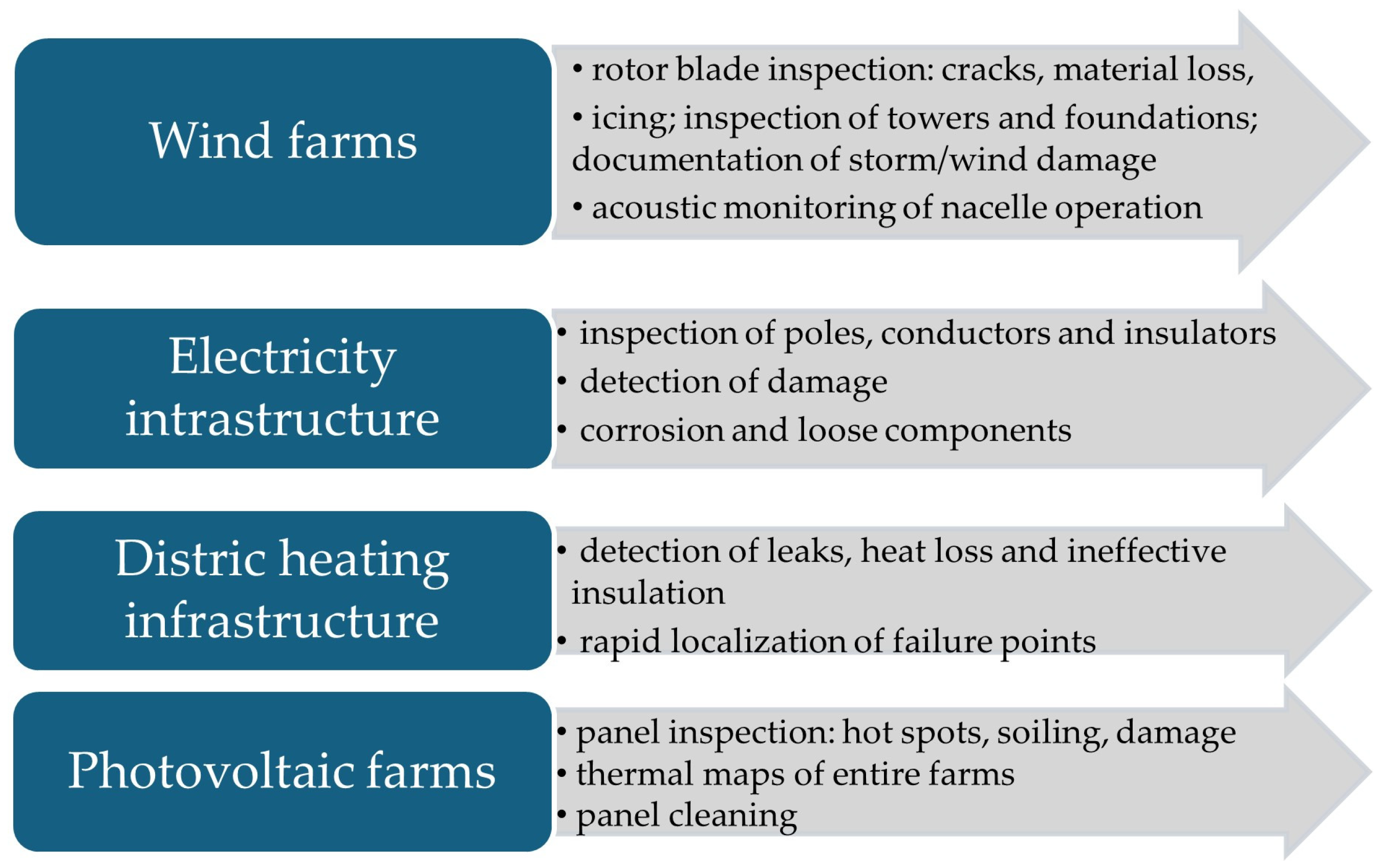
Figure 1. The applications of UAVs in the energy and heating infrastructures.
Energies 19 00005 g001
Figure 2. Analysis of the publication year of articles for each of the four search queries.
Energies 19 00005 g002
Figure 3. The article selection research framework depicted in a flow chart adapted from the PRISMA guidelines [21].
Energies 19 00005 g003
Figure 4. Complete schema of data processing using drones.
Energies 19 00005 g004
Figure 5. The most common drone sensors used in the energy and heating sector are for monitoring.
Energies 19 00005 g005
Table 1. The four search queries and the number of results obtained in the initial search.
Search Query No.TopicSearch StringNumber of Results
1Photovoltaic farms(“UAV” OR “Unmanned Aerial Vehicles” OR “drone”) AND (“photovoltaic farm” OR “solar farm” OR “solar power plant”)150
2Wind farms(“UAV” OR “drone” OR “Unmanned Aerial Vehicles”) AND (“wind farm” OR “wind power plant”)170
3Power lines(“UAV” OR “Unmanned Aerial Vehicles” OR “drone”) AND (“power line” OR “transmission line”)1948
4District Heating(“UAV” OR “Unmanned Aerial Vehicles” OR “drone”) AND (“district heating” OR “heat network” OR “heating pipes” OR “city heating”)25
Table 2. Comparative analysis of UAV-mounted sensors for photovoltaic farms monitoring.
SensorPurposeAdvantagesLimitationsLiterature Sources
Thermal Infrared (IR) CameraMeasuring surface temperature distribution.
Detecting hotspots, which indicate potential cell failure.
Capability to identify thermal anomalies invisible to RGB.Higher cost compared to RGB sensors.
Susceptibility to environmental conditions.
[20,39,41,42,43,44]
RGB CameraInspecting surface physical conditions.
Detecting visible contaminants.
Geolocating and mapping modules.
Low cost and widely available.
High spatial resolution for visualizing fine surface details.
Inability to detect internal electrical defects.
Dependence on lighting conditions.
[20,39,43]
Electroluminescence (EL) CameraDetecting internal defects such as micro-cracks, cell breakage.Superiority in detecting structural defects missed by thermal and RGB.Necessity of applying current to the PV module.
High sensitivity to ambient daylight
[45,46]
Table 3. Comparative analysis of UAV-mounted sensors for wind farms monitoring.
SensorPurposeAdvantagesLimitationsLiterature Sources
RGB CameraDetecting surface damage.
Creating a 3D model.
Provision of high-definition visual data for surface assessment.
Cost-effectiveness and wide availability
Limitation to visible surface defects.
Dependence on lighting and weather conditions.
[13,51,55,56,57]
LiDARCreating accurate 3D point clouds.
Analysing blade deformation and tower lean.
Provision of accurate geometric measurements.
Independence from lighting conditions.
High cost.
Lower resolution for surface textures compared to photogrammetry.
[13,55]
Thermal Infrared (IR) CameraIdentifying overheating components.Early identification of potential mechanical failures.Higher cost compared to RGB sensors.
Susceptibility to environmental conditions.
[13,51]
UltrasonicIdentifying internal cracks and voids.Capability to verify subsurface defects.Requirement for physical contact with the surface.
Requirement for complex, stable UAV.
[13]
Acoustic EmissionDetecting stress waves passively during active damage events.Capability to capture dynamic structural issues.Interference from drone rotor noise.
Requirement for an active stress event to generate a signal.
[13,53]
Table 4. Comparative analysis of UAV-mounted sensors for electricity infrastructure monitoring.
SensorPurposeAdvantagesLimitationsLiterature Sources
RGB CameraInspecting conductors, insulators, and towers.
Detecting visible structural damage and rust.
Provision of high-detail imagery.
Low cost and widely available.
Limitation to visible, surface-level issues.
Requirement for good lighting and proximity.
[6,33,64,65,66,71,72]
Thermal Infrared (IR) CameraDetecting overheating components.Early identification of problems before failure or outages.
Effectiveness for nighttime inspections.
Susceptibility to environmental conditions.
Requirement for expert analysis to prioritize severity.
[6,71,72,73]
LiDARCreating precise 3D models.
Measuring distances and modelling tower deformation.
Provision of accurate geometric measurements.
Independence from lighting conditions.
High cost.
Lower resolution for surface textures compared to photogrammetry.
[5,71,72,73]
Ultraviolet (UV) CameraMonitoring electrical discharges on fittings and insulators.Unique capability to visualize corona discharges invisible to IR/RGB.Limitation to specific electrical faults. [71]
Table 5. Comparative analysis of UAV-mounted sensors for district heating infrastructure monitoring.
SensorPurposeAdvantagesLimitationsLiterature Sources
Thermal Infrared (IR) CameraIdentifying thermal anomalies or hot spots.Suitability for detecting leaks in buried pipelines.Susceptibility to environmental conditions.
Requirement for specific flight times (e.g., early morning) to avoid solar influence.
[34,80,81,82,83,84,89]
RGB CameraAcquiring auxiliary data, visual context, and spatial reference.Provision of geographical context.
Reduction of false alarms by creating a pipeline buffer/mask.
Inability to directly detect leaks. [81,83]
Disclaimer/Publisher’s Note: The statements, opinions and data contained in all publications are solely those of the individual author(s) and contributor(s) and not of MDPI and/or the editor(s). MDPI and/or the editor(s) disclaim responsibility for any injury to people or property resulting from any ideas, methods, instructions or products referred to in the content.