1. Introduction
Energy constitutes a fundamental determinant of economic activity and long-term development. It serves as a key input enabling production processes, technological progress, and structural transformation of the economy. Economic growth and development are most assessed using GDP, which provides a synthetic measure of overall economic performance. A substantial body of empirical research confirms the existence of a strong relationship between energy consumption and economic growth. In modern economies, electricity—generated primarily from primary energy sources such as coal, natural gas, and oil—plays a central role as a versatile and flexible form of secondary energy, widely utilized across all sectors of the economy. In recent years, the share of renewable energy sources has been growing among energy sources. This is a consequence of the Paris Agreement (2015) [
1], whose participants committed to taking action to stop global climate warming.
In the EU, the currently applicable and fundamental document in the field of renewable energy sources is the Renewable Energy Directive of 2023/2413 (RED III) [
2]. It contains a target set for 2030 to achieve the share of renewable energy, i.e., solar, wind, ocean, and hydropower, as well as biomass and biofuels, in the final energy consumption in the EU of at least 42.5%, or even 45% [
2]. The original directive (RED II), adopted in 2009, had a target of 20% of RES in the total gross final energy consumption in the EU and 10% of energy consumption in transport in all EU countries by 2020 [
3].
Following the introduction of the “Clean Energy for all Europeans” [
4], an amended directive came into force, establishing a new binding target for 2030 with RES accounting for at least 32% of gross final energy consumption in the EU. The package of documents, as part of Fit for 55 [
5], is intended to contribute to reducing CO
2 emissions and meeting international commitments under the Paris Agreement [
1]. The main goal of the EU’s climate policy is to achieve climate neutrality by 2050. Being climate neutral means achieving net zero greenhouse gas emissions by neutralizing the amount of gases released into the atmosphere, i.e., reducing emissions as much as possible while absorbing them as much as possible [
5].
The EU’s climate policy has become the starting point for the planning and implementation of energy policies by member states. Poland, an EU member since 2004, has developed a strategic plan for the Polish energy sector, the so-called PEP 2040 [
6]. The energy sector in Poland is gradually changing in favor of renewable energy sources, thus reducing the share of coal (hard and lignite) as an energy source in overall electricity production [
7]. The driving force behind this transformation is the goal of reducing greenhouse gas emissions, adopted in the EU’s climate policy.
Climate policy in Poland focuses on reducing the share of coal in energy production while increasing the contribution of renewable energy sources (RES) [
6]. Despite these efforts, the energy mix remains heavily dominated by fossil fuels. In 2023, total electricity generation reached 165,614 GWh, of which coal accounted for 100,293 GWh (60.65%). Other sources included wind energy at 23,249 GWh (14.04%), solar energy at 11,344 GWh (6.85%), natural gas at 16,983 GWh (10.25%), biomass at 7787 GWh (4.7%), hydropower at 3733 GWh (2.25%), and crude oil at 2225 GWh (1.34%) [
8].
At the same time, the capacity of RES installations has been increasing rapidly, particularly in the case of solar and wind energy. In 2023, the capacity of micro-installations alone exceeded 11,000 MW [
9], reflecting the dynamic development of decentralized energy systems. As a result, solar and wind have become the key drivers of renewable energy growth in Poland.
Nevertheless, coal continues to play a dominant role in the energy system, with its share still exceeding 57% of total energy production. This highlights the structural challenge of Poland’s energy transition: the simultaneous expansion of renewables and persistent reliance on coal.
For comparison, in the EU, coal and coal products together accounted for only 11.2% of total energy supply in 2023 [
10]. There is no nuclear energy in Poland’s energy mix (Poland does not have a nuclear power plant), while in the EU the share of nuclear energy is 11.4% [
10]. Moreover, the energy system in Poland needs imported gas. The average annual gas consumption in Poland is 17.53 billion cubic meters, of which 45.4% of imported gas fuels are delivered to Poland via the Baltic Pipe gas pipeline and 40.5% directly to the LNG terminal in Świnoujście [
11]. Poland stopped importing gas from Russia (due to the embargo related to the ongoing war between Russia and Ukraine). Poland’s economy is relatively sensitive to the costs of fossil fuels and the regulatory costs resulting from EU climate policy. As a result, the transition may generate both positive effects (technological modernization, increased productivity, new investments) and transitional costs (increased energy prices, risk of decreased competitiveness, pressure on the mining sector and coal-producing regions) [
11]. For this reason, it is justified to conduct empirical analyses to estimate the direction and strength of the relationship between changes in the structure of energy consumption (coal, gas, RES) and GDP growth and CO
2 emissions.
The aim of the article is to identify and quantitatively assess the relative importance of structural and scale-related determinants of CO2 emissions in Poland, with particular emphasis on disentangling the role of the energy mix composition from overall economic growth dynamics in a coal-dependent economy undergoing energy transition.
Despite the growing number of publications on energy transition and climate policy, several significant research gaps emerge in the Polish context. Firstly, there is a lack of publications on the role of the energy mix composition in relation to the overall dynamics of economic growth in a coal-dependent economy undergoing energy transition. Secondly, in order to understand the problems of countries where coal was the only fuel for energy and heat production throughout the history of economic development, an analysis is needed that takes into account dynamic interdependencies over time (GDP, CO2 emissions, and energy sources (coal, gas, and RES)). Third, the continued dominance of coal in the energy market in Poland highlights the gap in understanding the actual pace and limits of the transformation processes. The analysis carried out is consistent with the research on economic disparities, especially in countries that use coal intensively.
The study seeks to evaluate whether emission patterns are primarily driven by changes in the structure of energy consumption—especially the dominance of coal—or by the scale of economic activity, and to examine how these relationships evolve in both static and dynamic frameworks. By combining OLS and ARDL approaches, the paper aims to provide a context-sensitive, empirically grounded understanding of short-run adjustment mechanisms and conditional associations within the energy–economy–emissions nexus, thereby contributing to the interpretation of transition processes in systems characterized by persistent fossil fuel dependence.
The selection of GDP, coal, natural gas, and RES as base variables is based both on their theoretical significance and on the structural characteristics of the Polish energy system. GDP is a standard indicator of economic activity and is widely used in the literature to account for the scale of production, which is typically associated with energy demand and emissions. Coal, gas, and RES are key components of the Polish energy mix and reflect the ongoing transition from a high-emission system toward a more diversified and low-emission structure. Coal was included because it remains the dominant energy source and is widely regarded as the energy carrier most closely associated with CO2 emissions. Natural gas is treated as a transition fuel, often considered less carbon-intensive than coal but still associated with dependence on fossil fuels. RES, particularly wind and solar energy, reflect the decarbonization pathway and technological transformation toward cleaner energy production. Together, these variables allow for an assessment of how changes in the energy mix are related to economic growth and environmental outcomes.
With this research objective in mind, the authors formulated the following research questions (RQs):
RQ1: Does GDP have a statistically significant association with CO2 emissions in Poland in both short-run and dynamic perspectives over the period 2000–2023?
RQ2: What is the impact of energy consumption structure, particularly coal and natural gas, on CO2 emissions, and how does this relationship evolve over time?
RQ3: Does the increasing share of RES contribute to CO2 emission reduction in Poland, considering both contemporaneous and lagged relationships?
The paper consists of the following main sections:
Section 1: Introduction, where the authors describe the research problem;
Section 2: Background of analysis with importance of examining the relationship between economic growth, energy consumption, and CO
2 emissions in Poland;
Section 3: Materials and Methods;
Section 4: Results with estimated model parameters, statistical significance, and economic interpretation;
Section 5: Discussion according to the title of the paper, and finally
Section 6: Conclusions with main findings, policy implications for energy and climate strategy as well as directions for future research.
This study positions its contribution within a relatively underexplored segment of the literature, namely the structural and dynamic examination of the energy–economy–emissions nexus in coal-dependent systems, with Poland serving as an empirical reference point. Much of the existing research tends to rely either on static modelling strategies or on broad cross-country comparisons, where country-level specificities are often diluted. Here, the analytical focus shifts. Toward a more granular, context-sensitive perspective. In particular, limited attention has been devoted to cases where coal remains structurally embedded in the energy mix over extended periods, and where transition processes unfold under constraints that are not easily generalizable. Poland represents such a case. Its persistent reliance on coal introduces a distinct configuration of emission drivers, one that cannot be fully captured through aggregated or purely comparative approaches. The added value of this study emerges from the methodological design. Not entirely conventional. The combined use of OLS and ARDL frameworks enables the simultaneous exploration of long-run structural associations and short-run adjustment mechanisms within a small-sample time-series setting. This is important because standard approaches often privilege one dimension at the expense of the other. Here, both are retained, although not necessarily with equal clarity. The dual-model strategy allows for a form of internal cross-validation: results observed in one specification can be contrasted with those obtained in another, revealing consistencies, but also tensions. In this way, the analysis moves beyond single-model inference. It becomes more layered.
What follows from this is a more differentiated understanding of emission dynamics in a transitional energy system. The findings suggest, though not in a perfectly uniform manner, that the composition of the energy mix plays a more decisive role than aggregate economic growth in shaping emission trajectories. Coal, again, appears central. GDP less so. This reorientation of emphasis, from scale effects to structural factors, constitutes a key contribution. Not entirely new in theoretical terms, but empirically grounded in a context where such dynamics are particularly pronounced.
2. Background of Analysis
Energy transformation is an important topic of scientific research. This section focuses on considerations of energy transformation, gross domestic product, and economic growth, considering the specificity of energy production in countries where coal is the main source of energy and heat, a situation that applies to the Polish economy. Strong scientific interest in the specificity of energy transformation intensified after the Paris Agreement (2015), when global climate policy became active through actions at the level of countries that signed the Agreement [
1]. However, it is not possible to omit key publications that appeared before the Agreement was signed and that addressed the explanation of the relationship between energy consumption and the level of GDP (example publications [
12,
13]). In publication [
12], the authors demonstrated that at the industrial level, where relative changes in energy consumption contribute to relative changes in output, a long-term stable economic equilibrium emerged, and energy consumption exerted a positive impact on GDP. There is a causal relationship between GDP and energy consumption because of economic activity. It was shown that energy is a driving force of economic growth in the short term, while in the long term, the level of energy consumption depends on economic growth. Feedback between GDP and energy consumption is also confirmed by other models [
13,
14]. Earlier publications from the 1990s also included studies confirming feedback relationships between economic growth and energy consumption (the Stern model [
13]: the level of energy consumption influenced the level of GDP). In publications appearing before the signing of the Paris Agreement, the first studies emerged [
15] that included RES, indicating a causal relationship between renewable energy consumption and GDP. The results of researchers [
16] showed that both renewable and non-renewable energy consumption are significant for economic growth, and that an extended production function (of the Cobb–Douglas type) effectively explains the relationship between GDP and energy consumption, especially in the long term. The authors of paper [
16] demonstrated the rationale for the transformation of energy-intensive sectors. Paper [
17] identified the existence of feedback between industrial energy consumption and economic growth. An analysis for 29 OECD countries on the relationship between renewable and non-renewable energy consumption and industrial production and GDP growth was the result of the work of the authors of paper [
17]. The authors showed [
17] a bidirectional relationship between industrial production and renewable and non-renewable energy consumption in both the short and long term. Renewable and non-renewable energy consumption and economic growth are interdependent [
18].
The literature on the energy–economy nexus does not point to one uniform causal pattern. Rather, prior studies suggest that the direction and strength of the relationship between energy use and GDP depend on the structural characteristics of the economy, including the composition of the energy mix and the degree of dependence on carbon-intensive fuels. This means that the energy–GDP nexus should be interpreted not as a fixed mechanism, but as a context-dependent relationship that may generate different emission outcomes under different energy structures.
Table 1 synthesizes the relevant theoretical and factual issues in the pertinent literatures on the energy–GDP–CO
2 nexus, compartmentalizing previously existing evidence into eight different but complementary dimensions of analytical relevance. It elucidates three types of effects: unidirectional (energy-driven growth and growth-driven energy demand), bidirectional (feedback effects), as well as the relevance of structural variables, such as the energy mix composition and the role of fossil fuels. It is noteworthy that these issues assume relevance for countries with predominantly coal-based energy systems, such as Poland. It is precisely because of these issues that the integration of climacteric pressure necessitates assessment within the framework of climate policy. Furthermore, by providing a link among previously established issues and pertinent features of models,
Table 1 seeks to establish a rationale for assessing the effects of coal, gas, and renewable energy sources on emissions.
From this perspective, aggregate relationships between energy use and economic growth are not sufficient to explain emission dynamics in coal-dependent economies. What becomes analytically important is whether economic growth is accompanied by changes in the internal structure of energy consumption, especially by a gradual substitution away from coal toward less carbon-intensive sources. This provides the rationale for moving from the general literature to the Poland-specific context. Regarding the specificity of the Polish energy market, characterized by a significant share of coal in the energy mix, research focuses on strategies and scenarios of energy transformation. The authors of paper [
19] presented the results of an analysis of the hard coal market used for electricity generation in professional power plants and combined heat and power plants in Poland, examining the possibilities of determining the degree of substitution of individual conventional sources through the growth of installed capacity in photovoltaic installations. The rationale for selecting the scope of the analysis stemmed from the fact that, within the framework of EU climate policy, photovoltaics recorded the highest growth among RES in Poland. The development of the prosumer installation market has been accelerating in Poland [
8,
20,
21]. Based on a 2023 survey of 1407 Polish households, the 2024 study by Gajdzik et al. finds a significant positive correlation between economic awareness—knowledge of energy tariffs, prices, and efficiency classes—and sustainable energy consumption behaviors [
22]. According to Wicki et al. [
21] (the authors applied a multilevel model), the level of wages and GDP explain 90% of the variability in installed photovoltaic capacity. The level of development of prosumer photovoltaic installations (per capita) in regions depends primarily on economic factors represented by wage levels in each region. An increase in wages by one unit was associated with an increase in installed capacity of 3.52 per person. In turn, researchers [
22] demonstrated the contribution of the hard coal mining sector to GDP in Poland. The results clearly indicate that a reduction in domestic hard coal extraction, under all analyzed energy transformation scenarios, leads to a decline in GDP [
23]. The current level of coal reduction in the energy mix does not threaten the maintenance of balance in the power system, as its share remains high (over 50%). Coal remains a necessary energy raw material in Poland, at least until the commissioning of a nuclear power plant, which is realistically expected around 2040. Considering Poland’s limited domestic natural gas resources and the risks associated with gas supplies, a complete transition to natural gas is not justified from the perspective of energy security. In the governmental document KPEiK (National Energy and Climate Plan) [
24], analyzing scenarios for the transformation of the energy market in Poland, it was indicated that a well-designed energy transition—supported by investment programs—can mitigate the negative economic effects of closing the coal sector and may even generate a positive impact on GDP through the development of new technologies. The governmental program “Mój Prąd” [
25] (currently in its sixth edition) provides effective support for the development of the prosumer market. Households can obtain subsidies of up to 50% of eligible costs, with a maximum amount of PLN 28,000 under the latest edition (Mój Prąd 6.0), for photovoltaic installations and devices increasing energy self-consumption (electricity storage, heat storage, and energy management systems—EMS/HEMS). In Poland, energy cooperatives [
26] have recently begun to operate (their number increased from several dozen at the beginning of the second decade to over 200 by the end of 2025), enabling residents, companies, and local governments to jointly generate, trade, and consume energy from RES, mainly photovoltaics, thereby reducing bills and increasing independence. Researchers of the Polish energy market [
23] emphasize the need to coordinate the development of low-emission technologies with other macroeconomic factors. It is recommended that energy transformation be implemented at a pace adjusted to the country’s economic and infrastructural capacities, to maintain energy security until new energy sources are fully deployed [
27]. In the face of the global climate problem, Poland has developed a long-term energy strategy reducing the share of coal in electricity generation to approximately 60% by 2030 (PEP2040). However, given the current high share of coal in the energy mix, researchers present both the risks of transformation [
26,
27,
28] and, through econometric modeling, confirm the justification for reducing coal in energy production [
21,
28]. According to the authors of the paper [
28], Poland is likely to achieve its climate targets, but the current transformation model still requires refinement. Compared with the experiences of Germany, the Czech Republic, and the United Kingdom, there is a need [
29] to strengthen the integration of strategic and spatial planning activities; establish a national institution coordinating mine closure and revitalization processes; improve access to financing at the local level; and adjust participatory mechanisms to enable broad involvement of different social groups. The problem of moving away from coal concerns not only industries [
30] but also households, which are replacing traditional sources of energy and heat with new ones [
23,
31].
Table 2 provides a structured synthesis of the Poland-focused literature on the coal-based energy transition by consolidating evidence on (i) the substitution potential of photovoltaics in reducing coal and lignite use in electricity generation, (ii) the economic determinants of PV diffusion—especially wages and GDP as key drivers of prosumer installation growth, (iii) the macroeconomic sensitivity of Poland to coal phase-down scenarios through measurable GDP effects, and (iv) the security-of-supply constraints that shape feasible transition pathways, including limited reliance on natural gas and the long time horizon for nuclear deployment. In addition, the table integrates policy and governance perspectives by linking national transition scenarios (KPEiK, PEP2040) and support instruments (e.g., the “Mój Prąd” program) with the need for coordinated investment planning, institutional capacity, and inclusive transition management, thereby clarifying why empirical modelling of coal, gas, and RES alongside GDP and CO
2 is particularly justified in the Polish context.
The Poland-focused literature shows that the energy transition is shaped by simultaneous structural, economic, and institutional constraints. Although previous studies provide valuable insights into selected elements of this process, they usually examine them separately. The research gap therefore concerns the need for an integrated empirical assessment of how GDP growth and the main components of the energy mix jointly relate to CO
2 emissions in Poland as a coal-dependent economy undergoing transition. Based on the relationships presented in
Table 1 and
Table 2, we aimed to demonstrate the specific nature of energy transition in Poland. The Polish case study contributes something truly new to the existing literature, as it combines several dimensions that are typically studied separately and embeds them in a single, structurally coherent framework. In most EU countries, coal already plays a marginal role, so the transition is less structurally disruptive. In Poland, however, the literature points to a clear tension between economic dependence on coal and the rapid diffusion of renewable energy sources. This coexistence allows researchers to examine the relationships underlying the transition (as illustrated by the statistical model presented in the empirical section of this paper). The unique nature of the Polish economy lies in its duality (a bidirectional mechanism), as economic growth both accelerates the transition (through investments in renewable energy) and is partly dependent on the existing fossil fuel infrastructure (coal). Coal cannot be rapidly phased out without risking system stability, gas is constrained by import dependence and geopolitical risk, and nuclear capacity will only emerge in the long term. The situation in Poland adds an important dimension to the literature and research, which often underestimates the limitations of coal-dominated economies. Based on the analyzed government documents (the PEP energy transition policy) and literature, the scope of planned actions is outlined. The situation in Poland provides new insights into the role of policymaking and institutional capacity (the need to coordinate the transition away from coal with the development of renewable energy sources). The Polish case is valuable because it illustrates a transformation that is currently underway, rather than one that has already been completed. Thanks to clearly defined strategic goals (e.g., reducing the share of coal to ~60% by 2030) and measurable structural changes, Poland is becoming a natural laboratory for testing the dynamics of the transition in real time—including trade-offs between economic growth, emissions, and RES development. In summary, Poland brings a unique context to the literature: a coal-based economy undergoing rapid expansion of renewable energy sources, where economic growth, the energy mix, and constraints (the absence of a nuclear power plant, gas imports) interact simultaneously. This makes it particularly suitable for conducting empirical research on the combined economic and environmental effects of the energy transition, rather than treating them as separate phenomena.
3. Materials and Methods
To examine the relationship between economic growth, the structure of energy consumption, and CO
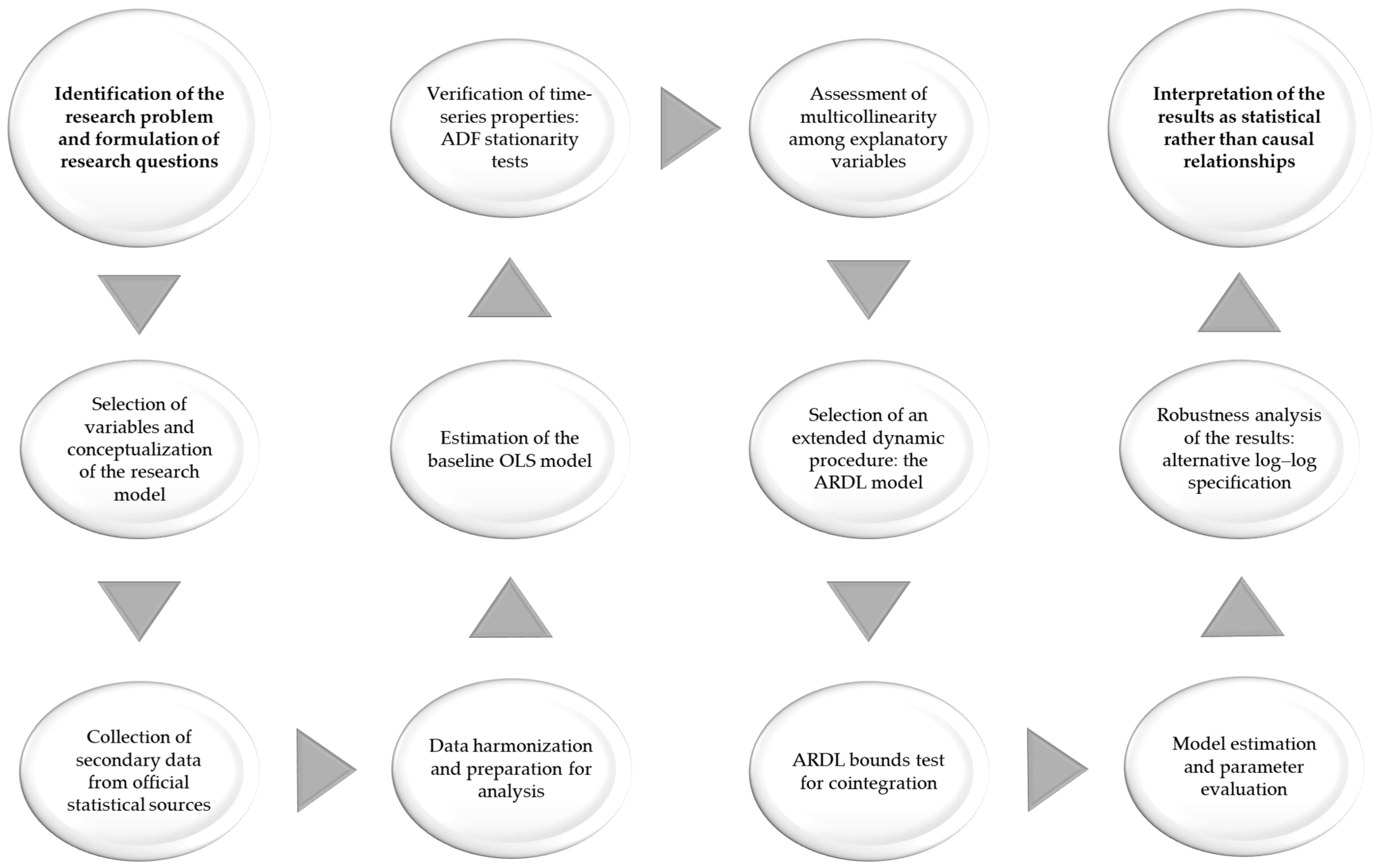
2 emissions in Poland over the period 2000–2023, a structured methodological framework was adopted. The research procedure began with the identification of the research problem, the formulation of research questions, the selection of variables, and the preparation of secondary statistical data, and then proceeded to econometric modelling and diagnostic verification. In line with the study objective, the empirical analysis combined a baseline OLS specification with a dynamic ARDL approach, supported by stationarity testing, multicollinearity assessment, and robustness analysis. The overall logic and sequence of the analytical procedure are presented in
Figure 1.
The empirical part of the study is based on annual data covering the years 2000–2023, which provides a total of twenty-four observations (t = 24). The data were obtained from national energy and macroeconomic statistics and harmonized in terms of units of measurement. The dataset used in the analysis is presented in
Table 3. The data came from the following sources:
The data was published by Statistics Poland (GUS,
www.stat.gov.pl) (accessed on 20 March 2026).
Table 3.
Data used for analysis.
Table 3.
Data used for analysis.
| Year | RES Production
[GWh] | Carbon Emissions
[Thousand Tons] | Hard Coal Consumption
[Thousand Tons] | Natural Gas Consumption [PJ] | Gross Domestic Product (GDP) at Current Prices
[Millions of PLN] | GDP Constant Prices
[Millions of PLN] |
|---|
| 2000 | 2332 | 333,253 | 83,372 | 453 | 744,622 | 744,622.0 |
| 2001 | 2783 | 330,900 | 82,841 | 471 | 779,205 | 753,557.5 |
| 2002 | 2767 | 317,546 | 82,257 | 459 | 807,859 | 767,875.1 |
| 2003 | 2250 | 330,900 | 85,367 | 509 | 842,120 | 794,750.7 |
| 2004 | 3074 | 325,382 | 82,774 | 534 | 922,157 | 835,283.0 |
| 2005 | 3848 | 323,385 | 80,438 | 551 | 983,302 | 862,847.3 |
| 2006 | 4291 | 329,599 | 83,483 | 494 | 1,060,031 | 916,343.8 |
| 2007 | 5429 | 328,511 | 84,230 | 500 | 1,176,737 | 978,655.2 |
| 2008 | 6606 | 325,381 | 80,323 | 506 | 1,275,432 | 1,021,716.0 |
| 2009 | 8679 | 312,248 | 73,842 | 488 | 1,343,366 | 1,048,280.7 |
| 2010 | 10,889 | 334,888 | 81,979 | 520 | 1,445,060 | 1,081,825.6 |
| 2011 | 13,137 | 330,309 | 79,108 | 515 | 1,566,557 | 1,139,162.4 |
| 2012 | 16,879 | 320,862 | 75,165 | 553 | 1,628,992 | 1,156,249.8 |
| 2013 | 17,067 | 322,900 | 77,300 | 560 | 1,656,341 | 1,164,343.6 |
| 2014 | 19,842 | 310,307 | 72,768 | 543 | 1,720,430 | 1,209,753.0 |
| 2015 | 22,684 | 313,419 | 72,283 | 554 | 1,800,228 | 1,262,982.1 |
| 2016 | 22,807 | 323,022 | 74,176 | 592 | 1,863,487 | 1,300,871.6 |
| 2017 | 24,122 | 336,557 | 74,637 | 629 | 1,989,835 | 1,368,516.9 |
| 2018 | 21,617 | 336,992 | 74,232 | 660 | 2,126,506 | 1,453,365.0 |
| 2019 | 25,459 | 318,488 | 68,302 | 692 | 2,288,492 | 1,520,219.7 |
| 2020 | 28,227 | 303,523 | 62,404 | 695 | 2,337,672 | 1,489,815.4 |
| 2021 | 30,569 | 302,630 | 69,621 | 741 | 2,661,518 | 1,592,612.6 |
| 2022 | 37,689 | 315,278 | 64,464 | 598 | 3,100,850 | 1,677,021.1 |
| 2023 | 45,853 | 283,619 | 55,418 | 638 | 3,415,274 | 1,680,375.1 |
Since GDP is measured at current prices, it should not be interpreted in this study as a pure indicator of real economic activity. Nominal GDP combines changes in real output with changes in the general price level; therefore, its coefficient cannot be used to isolate the real production effect on CO2 emissions. For this reason, GDP is treated primarily as a scale-related macroeconomic control variable rather than as a direct measure of real economic growth. This distinction is important for the interpretation of the results. The empirical objective of the paper is not to estimate the causal impact of real GDP growth on emissions, but to assess whether aggregate macroeconomic scale, together with the structure of energy consumption, is statistically associated with CO2 emissions in a coal-dependent economy undergoing transition. Although the logarithmic transformation reduces scale effects and compresses exponential growth patterns, it does not remove the inflationary component embedded in GDP at current prices. Therefore, the coefficient of ln(GDP) should still be interpreted cautiously as reflecting nominal macroeconomic scale rather than real economic activity.
A similar interpretative caution applies to the operationalization of coal consumption. The coal variable incorporated into the empirical specification refers explicitly to hard coal consumption, which represents a major and dynamically changing component of Poland’s fossil-based energy system. This choice is analytically justified because hard coal exhibits sufficient temporal variability to be meaningfully captured in a time-series framework and can therefore function as an informative explanatory variable. Lignite, although relevant, particularly in electricity generation, enters the Polish energy system in a more spatially concentrated and technologically rigid manner. Its consumption is largely tied to specific mining–power generation complexes, which often operate under relatively stable output regimes. Consequently, its time-series profile may display less variation, reducing its usefulness for explaining annual fluctuations in emissions in a small-sample econometric framework.
The exclusion of lignite should therefore be interpreted as a modelling simplification rather than as a claim that lignite is environmentally or economically irrelevant. Within the present model, hard coal consumption should be understood as an empirical proxy for the broader structural role of coal in Poland’s energy mix, rather than as a complete measure of all coal-based energy use. Changes in hard coal consumption are likely to reflect, at least directionally, broader changes in fossil-fuel intensity within the Polish energy system. Accordingly, the estimated relationship between hard coal consumption and CO2 emissions should be interpreted as an approximation of system-level coal dependence, not as a fuel-specific effect limited exclusively to hard coal. This simplification is acknowledged as a limitation of the study. Future research should extend the analysis by separating hard coal, lignite, and other fossil inputs, provided that consistent and sufficiently variable annual data are available.
The renewable energy variable used in the analysis is conceptualized as a composite index based on three major renewables—solar, wind, and hydropower. The rationale behind this formulation is twofold. On the one hand, there is the issue of degrees of freedom. Given the rather limited sample period (t = 24), estimating too many parameters runs the risk of losing statistical reliability. On the other hand, using separate variables for each renewable component creates risks of multicollinearity because these variables tend to move together in response to common incentives. In particular, all major renewables are growing in parallel with each other. Estimating separate regression coefficients in these circumstances will likely result in statistically insignificant estimates, which is counterproductive. In this regard, using a composite indicator as a proxy of renewables’ share in the energy mix is preferred, which reflects their joint contribution without accounting for technological pathways.
The drawback of using a composite indicator is its inability to reflect technology-specific aspects of substitution and complementarities. It must be noted that different renewables have their unique characteristics. Solar and wind generation are intermittent and thus require certain flexibility in the form of fossil-fuel backup generation, whereas hydropower is more flexible. This difference matters especially in the context of a transition system where the structure of renewable generation is continuously changing. Thus, using a composite indicator of renewable energy growth implies overlooking potential substitution and complementary effects related to the technological specifics of various renewables. This can be considered a limitation of the present model specification, but it can be addressed with further research. Specifically, it would be possible to estimate an expanded model with separate indicators for each type of renewable generation in case sufficient data is collected.
The econometric modelling consisted of identifying the (quantitative) fundamental relationships between the level of greenhouse gas emissions and key macroeconomic and energy variables in an aggregated framework.
In order to verify the reliability of the proposed time-series model, it is necessary to analyze the stationarity characteristics of all considered variables. The stationarity of all variables has been tested with the help of the Augmented Dickey-Fuller (ADF) test. The ADF test was run on all considered variables at the level of the model, which includes an intercept parameter and is based on the proper number of lags due to the small number of observations (t = 24). According to the results obtained by the ADF test, all considered variables, such as CO
2 emissions, GDP, coal consumption, natural gas consumption, and renewables generation, prove to be non-stationary at the level (
Table 4). In all cases, the assumption about a unit root cannot be rejected at conventional levels of statistical significance. It means that the considered variables have a stochastic trend, are integrated of order one, I(1), and require first differencing before being used in a regression model. However, the use of OLS estimations for non-stationary variables leads to spurious regression results. Thus, the obtained results can be viewed only as indicators of the structure of relations between the studied variables. Taking into account the integration orders of the considered variables and their sample sizes, the most appropriate tool to use in our case is the Autoregressive Distributed Lag (ARDL) model.
Augmented Dickey-Fuller tests were also performed on the first differences of all variables to establish their order of integration (
Table 5). It can be noted that CO
2 emissions, coal consumption, and natural gas consumption turn stationary following first differencing, as the null hypothesis of the unit root test is decisively rejected at conventional levels of significance. Therefore, CO
2 emissions, coal consumption, and natural gas consumption are classified as I(1) variables.
The Augmented Dickey–Fuller (ADF) test with intercept (constant-only specification) was applied to verify the stationarity properties of the key variables. The results indicate that both GDP and RES are non-stationary in levels, with test statistics remaining far from conventional critical values and
p-values equal to 1.000, which implies that the null hypothesis of a unit root cannot be rejected. First-differenced series also fail to achieve stationarity, as reflected by persistently high
p-values (GDP:
p = 1.000; RES:
p ≈ 0.97). These findings suggest that the stochastic properties of GDP and RES are more complex than standard I(1) processes and may indicate higher-order integration or strong deterministic trends embedded in the data [
37].
The Augmented Dickey–Fuller (ADF) test with intercept and deterministic trend was additionally applied to account for the strong trending behavior of the series. The results confirm that both GDP and RES remain non-stationary in levels, with p-values equal to 1.000 for GDP and approximately 0.997 for RES, indicating that the null hypothesis of a unit root cannot be rejected even after controlling for a linear trend. Furthermore, the first-differenced series also fail to achieve stationarity under this specification, as reflected by p-values of approximately 0.553 for ΔGDP and 0.147 for ΔRES. Although the latter is closer to conventional significance thresholds, it still does not provide sufficient statistical evidence to reject the unit root hypothesis. Overall, these findings suggest that the non-stationarity of GDP and RES cannot be explained solely by the presence of a deterministic trend and may reflect more complex stochastic properties of the data.
On the other hand, GDP and renewable energy generation are not found to be stationary even after first differencing, as shown by relatively large p-values. It appears that these variables may be following more sophisticated stochastic processes that cannot be easily determined using unit root testing. Therefore, the order of integration of the data set is heterogeneous, which makes it even more necessary to conduct ARDL modeling on the data.
To evaluate the presence of a stable long-run equilibrium among the analyzed variables, the Pesaran, Shin and Smith ARDL bounds test was implemented (
Table 6). The specification adopted includes an intercept without a deterministic trend, corresponding to Case 3 within the bounds testing framework. The calculated F-statistic equals 2.694. This value does not cross the upper critical threshold; it remains situated between the lower and upper bounds at the 5% significance level. Not low enough to confirm absence decisively, not high enough to confirm presence. An intermediate zone is analytically inconvenient. As a consequence, the result falls into the inconclusive region. The test, therefore, does not provide sufficiently strong statistical grounds to assert the existence of cointegration, and the hypothesis of a stable long-run relationship linking CO
2 emissions with GDP, coal consumption, natural gas consumption, and renewable energy production cannot be substantiated in a robust manner.
Looking at the outcome from a slightly different angle, the same numerical result—F = 2.694—again positions the model precisely in that indeterminate interval between critical bounds. This has a specific implication: the null hypothesis of no cointegration cannot be rejected with confidence, but neither can it be definitively accepted. A kind of statistical suspension. In empirical terms, this suggests that the joint evolution of emissions, economic activity, and the energy mix does not conform to a clearly identifiable long-term equilibrium path. The variables move together at times, yes, but without the persistence required for equilibrium interpretation. The absence of a well-defined cointegrating vector implies that long-run coefficients, if estimated, would lack strong theoretical anchoring.
From an analytical standpoint, this lack of confirmed cointegration shifts the interpretive emphasis toward short-run dynamics, adjustment processes, and structural discontinuities. The Polish energy–economy–emissions system—particularly over the period considered—appears to operate through episodic adjustments rather than smooth convergence. Structural breaks and policy shifts cause fluctuations. The persistent dominance of coal introduces inertia into the system, limiting the emergence of stable long-term relationships. In this context, the ARDL framework remains useful, but primarily as a tool for capturing short-run interactions and conditional dependencies. Any long-run inferences should be approached with caution, almost provisionally. More broadly, the findings reinforce the interpretation that emission dynamics are governed by structural characteristics embedded in the energy mix, rather than by a stable and predictable linkage with macroeconomic growth trajectories.
To assess potential multicollinearity among the explanatory variables, the Variance Inflation Factor (VIF) statistics were calculated (
Table 7). The results indicate the presence of substantial multicollinearity, particularly for GDP (VIF = 37.39) and renewable energy production (VIF = 42.32), both of which exceed commonly accepted thresholds. Coal consumption also exhibits a relatively high VIF (8.81), while natural gas remains within an acceptable range (2.86). These findings suggest that several variables share strong common trends over time, which may inflate standard errors and reduce the statistical significance of individual coefficients.
Multicollinearity may partly explain the lack of statistical significance for the lack of statistical significance observed for GDP, natural gas, and renewable energy variables across model specifications. Given the systematic co-movement of these variables over the analyzed period, their individual effects may be difficult to disentangle within a linear regression framework. As a result, the estimated coefficients should be interpreted with caution, particularly for variables exhibiting high VIF values, while greater emphasis should be placed on the robustness of the strongest estimated association observed for coal consumption.
The model specification included:
Y (dependent variable): total carbon dioxide (CO2) emissions expressed in thousand tons. The choice of this variable allows the study to capture the scale of emission pressure generated by the economy each year.
X1–X4 (independent variables): four factors that are recognized in the literature as fundamental macroeconomic determinants of emissions:
X1—gross domestic product (GDP) at current prices, as a measure of the level of economic activity and energy demand (millions of PLN),
X2—hard coal consumption (thousand tons), representing the energy carrier most closely associated with emissions in the Polish energy mix,
X3—natural gas consumption (PJ), treated as a transition fuel with lower unit emissions,
X4—electricity generation from renewable energy sources (RES) in GWh, reflecting progress in energy transformation on the supply side.
The following linear model was proposed (Formula (1)):
where ε
t denotes the random error term satisfying the standard assumptions of the classical linear regression model [
38,
39]. The model is not of a forecasting nature but serves analytical and diagnostic purposes [
40].
The statistical significance of individual model coefficients (Formula (1)) was assessed using Student’s t-tests, while the significance of the entire model was evaluated using the F-statistic. As measures of goodness of fit, the coefficient of determination R2 and the adjusted R2 were applied. The adopted model (Formula (1)) served as a baseline model, whose purpose was not to fully reproduce the complex mechanisms of energy transformation, but rather to identify the main directions of association of fundamental energy variables on the level of emissions. The model is not an end, but a diagnostic and interpretative tool. It supports the identification of key empirical regularities in emission patterns, supports the assessment of the effectiveness of energy policies, and provides a solid foundation for further structural and dynamic analyses. It is results can be directly used both in scientific research and in decision-making processes related to long-term energy transformation.
The empirical analysis was extended by employing the ARDL model to analyze short-run dynamics and long-run relationships between CO
2 emissions and macro-energy variables. The employment of the ARDL model can be justified on several methodological grounds. First and foremost, the available data set offers a small number of observations on a panel of time series data (t = 24), and this data set can be regarded as particularly well-suited to employing the ARDL model to estimate long-run relationships. This model offers reliable results with small data sets. Second, the results of applying the Augmented Dickey-Fuller test [
41,
42] to the available data set confirmed that all variables can be regarded as non-stationary; this makes employing OLS regression problematic on grounds of spurious relationships.
The employment of the ARDL model allows [
37] for incorporating lagged values of both dependent and independent variables; this allows for model adjustment processes in the energy-economy-emissions system. This feature of the model can be regarded as particularly relevant to analyzing energy transitions; in this case, adjustment processes may occur over a series of periods rather than instantaneously.
The model specification employs one lag on the dependent variable and one lag on all independent variables; this can be regarded as a parsimonious specification that does not over-parameterize the model.
In a formal sense, the ARDL (1,1,1,1,1) model may be specified as a function of the current and lagged levels of CO2 emissions, GDP, coal consumption, natural gas consumption, and renewable energy production. Conditional maximum likelihood estimation was used for the estimation of the parameters of the model. The lag selection was a compromise between model simplicity and statistical reliability, given the sample size.
The ARDL model makes it possible to estimate contemporaneous and lagged associations of the independent variables on the dependent variable. Unlike the OLS method, the ARDL model provides a better sense of the dynamics of the system. Even though there was a lack of evidence of cointegration in the preliminary study, the ARDL model would be a useful tool for the identification of short-run relationships.
The log–log specification was estimated as a specification addressing non-stationarity and deterministic trends to assess the robustness of the baseline results and to enable interpretation of coefficients as elasticities. In this approach, all variables were transformed using natural logarithms, which allows for a scale-invariant analysis and reduces potential heteroskedasticity. The model is specified as follows (Formula (2)):
where
denotes carbon dioxide emissions,
represents economic activity,
,
, and
correspond to energy consumption components, and
is the error term. The model parameters were estimated using the OLS method, and their statistical significance was evaluated using standard
t-tests, while overall model fit was assessed using the coefficient of determination (R
2) and the F-statistic.
The Augmented Dickey–Fuller (ADF) test applied to the logarithmically transformed variables confirms that all series remain non-stationary in levels (
Table 8). For ln(CO
2), the test statistic equals −1.744 (
p = 0.409) under the intercept specification and −2.596 (
p = 0.282) with trend, indicating no rejection of the unit root hypothesis. A similar pattern is observed for ln(Gas), with statistics of −1.476 (
p = 0.545) and −2.818 (
p = 0.191), respectively. In the case of ln(GDP), the result remains non-stationary under the intercept (ADF = 0.433,
p = 0.983), although the inclusion of a deterministic trend reduces the
p-value to 0.097, suggesting borderline stationarity at the 10% level. For ln(Coal) and ln(RES), the test statistics (ln(Coal): 2.283,
p = 0.999; ln(RES): 2.884,
p = 1.000) clearly indicate strong non-stationarity in levels, even when a trend component is included.
The first-differenced series exhibits substantially improved stochastic properties. In particular, Δln(CO2) becomes strongly stationary under both specifications (ADF = −4.904, p < 0.001; with trend: −4.386, p = 0.002), and Δln(Gas) also shows clear stationarity (ADF = −5.804, p < 0.001; with trend: −5.684, p < 0.001). For Δln(GDP), stationarity is confirmed under the intercept specification (ADF = −2.950, p = 0.040), although not when a trend is included (p = 0.460). In the case of Δln(Coal) and Δln(RES), stationarity is only achieved when a deterministic trend is incorporated, with test statistics of −7.078 (p < 0.001) and −5.173 (p < 0.001), respectively, while remaining non-stationary under the intercept-only specification. Overall, these results indicate that, after logarithmic transformation, the variables can be generally classified as integrated of order one, I(1), although for some series this classification depends on the treatment of deterministic trends. For some variables, stationarity is achieved only after controlling for deterministic trends, which suggests that their stochastic properties are influenced by underlying structural growth patterns. Results should be interpreted as short-run associations.
The extended unit root diagnostics and the logarithmic transformation indicate that the apparent higher-order integration observed in level variables is largely driven by deterministic trends, and that the log-transformed variables can be treated as I(1), which justifies the application of the ARDL framework.
The level specification is treated as a diagnostic baseline, while the log–log specification is considered the primary econometric framework due to improved stochastic properties of the variables.
To improve the analytical robustness of the empirical framework, the model was re-specified using gross domestic product expressed in constant prices. The use of real GDP allows for the elimination of inflationary effects and ensures that the estimated relationships reflect actual changes in economic activity rather than nominal scale variations. This adjustment is particularly important in time-series analysis, where price-level dynamics may introduce spurious correlations and distort statistical inference.
Logarithmization of all variables was undertaken, producing a log-log model formulation. The reasons for such an undertaking are numerous. The log-transformation diminishes heteroskedasticity. The effect of exponential trends found often in macroeconomic and energy-related data is minimized. Also, the logarithmization process allows for the economic interpretation of the regression coefficients as elasticities. Thus, in our analysis, each coefficient represents the proportional change in CO2 emissions due to 1% increase in the respective regressor.
The estimated model takes the following functional form:
where CO
2t denotes total carbon dioxide emissions, Coal
t represents hard coal consumption, Gas
t corresponds to natural gas consumption, RES
t captures electricity generation from renewable energy sources, and GDP
t refers to real gross domestic product expressed in constant prices. The error term ε
t satisfies the standard assumptions of the classical linear regression model.
The model was estimated via the OLS technique. Considering the small size of the sample and trended regressors, the specification should be viewed as diagnostic and descriptive, not as a causal one, with the primary goal being the detection of predominant empirical regularities in the nexus of energy-economy-emissions, paying special attention to the role of structural aspects concerning the energy mix.
4. Results
Given the time-series nature of the data and the absence of confirmed cointegration, the results should be interpreted as statistical associations rather than causal relationships. Also, because of the lack of statistical significance for several variables across model specifications, the results should be interpreted as an absence of evidence rather than evidence of absence. For statistically insignificant variables, the sign of the estimated coefficient should not be interpreted as evidence of an underlying economic mechanism.
Table 9 presents the results obtained by applying the OLS method for estimating the linear regression equation, where the dependent variable is the level of CO
2 emissions, and the independent or explanatory variables include: GDP, coal consumption, natural gas consumption, and production of RES. Additionally, in
Table 9, the results of the estimation of the parameters of β, the standard error of the parameters of β, and the direction of the impact of the independent variables on the level of CO
2 emissions are presented. Furthermore, in
Table 9, the results of the estimation of the goodness of the linear regression model, namely: determination coefficient R
2, adjusted determination coefficient, and F-statistic for overall significance of the linear regression model, are presented. The results of the diagnostic tests show the absence of autocorrelation in the error term of the linear regression model, which verifies the correct specification of the linear regression model in a dynamic framework.
The results suggest that the linear regression model has a moderate ability to describe the variability of CO2 emissions in the selected period. The coefficient of determination, R2, is close to 0.718, which means that 72% of the variance of emissions is explained by the selected set of variables. This may be considered a rather good result, taking into account that it is not always easy to select an appropriate set of macroeconomic models. At the same time, the adjusted coefficient of determination, adjusted R2, is close to 0.658, which means that some portion of the variance explained is due to the number of variables included in the model. The statistical significance of the overall model is confirmed by the low value of the p-value of the F-statistic.
The strongest result is the statistically significant positive association between coal consumption and CO2 emissions. The coefficient value, β ≈ 2.54, indicates that higher coal consumption is associated with higher emissions, ceteris paribus. The low p-value (below 0.001) and relatively small standard error show that the parameter is highly stable. This relationship is consistent with the high emission intensity of coal. However, given the model design, it should be interpreted as a robust statistical association rather than direct causal evidence.
The GDP variable, interpreted here as a proxy for nominal macroeconomic scale, does not show statistical significance. The coefficient for this variable is small, and the high p-value indicates that there is no ground to reject the null hypothesis. This suggests that, once the structure of energy consumption is taken into account, no statistically significant association is observed between nominal macroeconomic scale and emission variability. From an interpretative perspective, this may suggest a relatively stronger role of energy structure compared to aggregate macroeconomic scale, although the lack of statistical significance for GDP limits the strength of this inference.
Natural gas consumption is positively associated with emissions, but the estimated relationship is not statistically significant. Renewable energy production is also positively associated with emissions, but this coefficient is likewise not statistically significant. Accordingly, neither variable provides robust evidence of a systematic association with emissions in the estimated OLS specification.
Table 10 presents the results of the dynamic ARDL model, where the dependent variable is the level of CO
2 emissions, while the independent variables are their current and lagged values, i.e., GDP, coal consumption, natural gas consumption, and RES. In the table, the values of the coefficients of all the independent variables, both at their current values (i.e., time t) and their lagged values (i.e., time t − 1), along with their standard errors and level of significance, are presented. This allows for the simultaneous estimation of short-run associations between individual factors and emissions, while their cumulative effect would also be considered, with the possibility of system inertia effects through the inclusion of the lagged dependent variable.
The results obtained from the ARDL model point to the following conclusion: the system of CO2 emissions in the analyzed period is characterized by weak autoregressive properties and the contemporaneous association effect of a single factor. The value of the explanatory variable “CO2(t − 1)” is positive, although not statistically significant. The coefficient on CO2(t − 1) is not statistically significant, which means that this specification does not provide evidence of strong autoregressive dynamics. This result does not provide statistical evidence that past emission levels significantly influence current emissions.
The most notable result concerns the statistically significant coefficient for current coal consumption. Indeed, the value of the parameter for “coal(t)” has the highest value among all other parameters, and is statistically significant at a high confidence level. This points to a strong contemporaneous association between coal consumption and emissions. The scale-related GDP variable is not statistically significant in the model, either in current or lagged form. Indeed, the values of the parameters for “GDP(t)” and “GDP(t − 1)” are opposite, although not statistically significant. No statistically significant dynamic relationship between nominal macroeconomic scale and emissions is identified in the ARDL specification. From an interpretative point of view, no statistically significant contemporaneous or lagged association is identified between GDP at current prices and CO2 emissions when the structure of energy consumption is controlled for. The association between natural gas consumption and CO2 emissions follows an ambiguous pattern. The current coefficient is negative, and the lagged coefficient is positive, but in any case, they are not statistically significant and have large standard errors. This means that no clear direction of association is identified and that this variable may be sensitive to some other systemic factors, such as changes in the energy mix and/or market conditions. Thus, it is not possible to determine the role of natural gas as a it is not possible to determine whether natural gas is systematically associated with lower or higher emissions in the level of emissions in the short run.
Renewable energy production is not statistically significant in either current or lagged form. The coefficients of RES(t) and RES(t − 1) are small and positive, which means that no statistically significant short-run association is identified between renewable energy production and lower emission levels of the level of emissions in the short run. The coefficients for renewable energy are not statistically significant in either current or lagged form, which prevents drawing conclusions about its short-run or long-run influence on emissions. Any interpretation regarding the dynamic properties of the emissions system should remain tentative and conditional on the adopted specification.
Table 11 presents the results of the log–log OLS estimation, where the coefficients can be interpreted as elasticities of CO
2 emissions with respect to the explanatory variables. The results indicate that coal consumption is the only statistically significant variable in the log–log specification, with an elasticity of 0.494, while GDP, natural gas, and renewable energy production exhibit small and statistically insignificant effects. Overall, the table shows that the variation in emissions is most strongly associated with changes in coal use, whereas other variables do not contribute meaningfully to explaining emission dynamics in relative terms.
The log–log formulation introduces a perspective that is both scale-invariant and analytically more transparent, allowing the interpretation of coefficients directly in elasticity terms. In this setting, the relationship between emissions and their determinants becomes less dependent on absolute magnitudes and more on proportional adjustments—this matters, especially in long time series where variables co-evolve. What emerges quite clearly is the dominant role of coal consumption in structuring CO2 dynamics. The estimated elasticity for coal equals 0.494 (p < 0.001), which suggests that a 1% increase in coal use is associated with roughly a 0.5% increase in emissions. Not perfectly proportional, but close enough to suggest a strong coupling. Statistically robust, yes, but also economically non-trivial. This is not a marginal effect. Rather, it reflects a deeply embedded mechanism linked to the historical reliance on coal in Poland’s energy system over the 2000–2023 period. The relatively tight confidence interval—important here—indicates that this relationship is stable across the sample, not driven by isolated fluctuations or episodic shocks.
The remaining variables behave differently. GDP at current prices, for instance, exhibits an elasticity of 0.026 with a p-value of 0.687, which effectively removes it from the set of statistically meaningful drivers in this specification. This suggests that nominal macroeconomic scale, once energy structure is accounted for, is not statistically associated with proportional changes in emissions. This does not imply that macroeconomic scale is irrelevant, but it indicates that it is not a decisive explanatory factor in this specification. A similar, somewhat diffuse pattern appears in the case of natural gas: elasticity estimated at 0.037 (p = 0.567). The sign is positive, yet the lack of statistical significance weakens any strong interpretation. Gas does not seem to function here as a clear transitional lever in emission terms. Renewable energy, in turn, shows an elasticity of 0.008 (p = 0.731), which is practically negligible. This near-zero response suggests that increases in RES output—at least within the observed period and scale—do not translate into proportional emission reductions. Possibly because they expand alongside total energy demand, rather than displacing fossil inputs in a one-to-one manner. The data trajectories support this reading: GDP at current prices and RES trend upward rather smoothly, while emissions appear to track coal consumption more closely, almost synchronously at times.
From the standpoint of model performance, the log–log specification yields a relatively high explanatory capacity (R2 = 0.750; adjusted R2 = 0.698). This indicates that approximately 70–75% of the variance in logarithmic emissions is accounted for by the included regressors. The overall F-statistic () confirms joint significance—so the model, as a system, holds together statistically. Yet there is a certain imbalance in how this explanatory power is distributed. It is concentrated, to a large extent, in a single variable, Coal. The structure that emerges is therefore asymmetric: one dominant driver, surrounded by variables whose contributions are either weak or statistically indistinct. Not a diversified explanatory system, but rather a concentrated one. This has implications beyond estimation itself: it suggests that emission dynamics in Poland are governed primarily by the composition of the energy mix, with coal acting as the central axis, while nominal macroeconomic scale and other energy variables remain secondary within this empirical framework.
Table 12 presents the estimated coefficients (β),
p-values, and their statistical interpretation for the explanatory variables included in the log–log OLS model using real GDP. It shows that only coal is statistically significant, while gas, renewable energy, and real GDP do not exhibit statistically significant effects on CO
2 emissions.
Based on the results obtained, it can be observed that the consumption of coal has the most statistical significance and economic relevance when related to carbon dioxide emissions. From the elasticity coefficient (β ≈ 0.50), one may state that every 1 percent increase in the consumption of coal will lead to a 0.5 percent increase in emissions, while the remaining factors remain unchanged. This finding proves the importance of coal as the main contributor to emissions in Poland’s energy sector. The sub-unitary elasticity value means that the effect is not proportional.
Neither the consumption of natural gas nor the production of renewable energy nor the real GDP demonstrates a statistically significant impact on the emissions in the estimated model. It is interesting to note that the real GDP lacks a statistically significant relationship with emissions, since it means that there is no systematic dependence between the volume of economic activity and variations in emissions when the structure of energy use is taken into account. At the same time, the insignificant impact of renewable energy production suggests that the development of such energy sources in Poland has not yet led to lower levels of emissions, probably because of the high shares of coal used.
To evaluate the robustness of the findings, the model was estimated again, but instead of using GDP in nominal terms, it was applied in real GDP terms (
Table 13 and
Table 14). The analysis shows that the general structure of the findings remains the same. In both cases, the consumption of coal is the only variable that shows a strong correlation with carbon dioxide emissions, whereas the GDP variable turns out to be statistically insignificant. Even though using real GDP improves the goodness-of-fit statistics slightly, it does not change the essence of the results. This means that the findings were not affected by inflation and that the process of emissions generation is dictated mainly by the structure of the energy balance.
The presence of autocorrelation among the residuals was tested using the Durbin-Watson statistic and the Breusch-Godfrey test (
Table 15 and
Table 16). For both regression models (GDP nominal and GDP real), the Durbin-Watson statistic stays close to 2, suggesting the lack of any autocorrelation issues. This conclusion is supported by the results of the Breusch-Godfrey test, which fails to reject the null hypothesis of no autocorrelation at conventional levels of statistical significance.
5. Discussion
The interpretation of the coefficients associated with renewable energy and natural gas requires a more nuanced, context-dependent reading rather than a straightforward causal narrative. This issue has been present in the literature for a long time and remains actively debated. Earlier contributions on the energy–growth nexus already showed that the relationship between economic activity and energy use is dynamic, bidirectional, and structurally conditioned [
43,
44,
45,
46]. More recent studies reach a similar conclusion in relation to renewable energy, indicating that the effects of renewables on emissions and growth are heterogeneous, nonlinear, and sensitive to institutional and structural conditions [
47,
48,
49]. In particular, the positive yet statistically insignificant coefficient for renewable energy should not be read as an indication that renewables contribute to higher emissions. That would be a misinterpretation. What is more likely captured here is a parallel expansion process: renewable capacity increased alongside GDP growth and rising aggregate energy demand. These processes unfolded simultaneously. In a system where total consumption expands, and coal retains a dominant share, the incremental growth of renewables is insufficient to counterbalance the scale effect. The substitution mechanism remains weak. Or delayed [
48,
50]. A comparable interpretation applies to natural gas. Its coefficient—also statistically insignificant—appears to reflect its intermediate, transitional function within the energy structure [
51]. In coal-based systems, gas often substitutes only partially, reducing emission intensity at the margin while still contributing to total emissions. The resulting statistical signal becomes diffuse, sometimes unstable, particularly in aggregated time-series specifications [
51,
52].
These empirical patterns need to be situated within the structural configuration of Poland’s energy system. This is not a neutral background. Compared to other European Union member states, Poland remains markedly dependent on coal, both in electricity generation and broader energy use [
50,
51,
52]. Such dependence shapes the entire adjustment process. It introduces a specific set of trade-offs—between energy security, cost stability, and decarbonization objectives—that are not easily reconciled [
51]. Coal, as a domestically available and historically entrenched resource, provides system stability. At the same time, it constrains the pace and direction of transformation [
51,
52]. Policy choices become path-dependent.
Within this framework, emission dynamics exhibit limited sensitivity to fluctuations in GDP or to gradual increases in renewable capacity. Instead, they remain closely anchored in the composition of the energy mix [
50]. This interpretation should also be read in light of the measurement of GDP at current prices. Since nominal GDP combines changes in real activity with price-level dynamics, the estimated GDP coefficient cannot be interpreted as a clean measure of the effect of real economic growth on CO
2 emissions. A statistically significant coefficient would therefore require cautious interpretation. In the present results, however, GDP does not emerge as a robust, statistically significant determinant of CO
2 emissions across the estimated specifications. Consequently, the main empirical conclusion of the paper does not rest on the GDP coefficient. Rather, the results indicate that coal consumption is the variable most strongly associated with CO
2 emissions, while the role of GDP remains weak and statistically unstable. This supports the interpretation that, in the Polish case, emission dynamics are more closely linked to the carbon intensity and structure of the energy mix than to aggregate economic scale alone.
The results, therefore, are not merely econometric artefacts. They reflect deeper institutional and structural conditions embedded in the national energy system. In a coal-dependent economy undergoing transition, changes in emissions are shaped less by aggregate macroeconomic expansion per se and more by the persistence of carbon-intensive energy infrastructure, the pace of coal substitution, and the limited short-run capacity of renewable energy expansion to offset fossil-fuel dependence. This does not imply that economic activity is irrelevant to emissions. Rather, it indicates that, during the period analyzed, the emission trajectory in Poland was mediated primarily through the structure of energy supply and the continued dominance of coal in the energy mix.
At the same time, an exclusive focus on short-run constraints may lead to an incomplete, perhaps even distorted, interpretation of the transition process. The shift away from coal is associated with tangible adjustment costs—this is evident. Infrastructure reconfiguration, labor reallocation across sectors, and upward pressure on energy prices. These are real frictions [
51,
52]. Yet the broader literature increasingly points toward potential gains that materialize over a longer horizon. Productivity improvements driven by technological upgrading. Innovation effects linked to investment in low-carbon technologies. Structural competitiveness in emerging sectors aligned with decarbonization pathways. Capital flows, too, begin to reorient toward sustainability-driven assets [
43,
53]. In this perspective, the absence of a statistically significant short-term emission-reducing effect from renewable energy should not be interpreted as evidence of ineffectiveness. Rather, it signals a transitional phase. An early stage, where scale effects—associated with growing demand—continue to dominate over substitution effects. The latter may emerge more clearly only once structural thresholds are crossed [
50,
51].
This interpretation is consistent with findings reported in the study of Oliveira et al. [
43], which shows that reducing dependence on conventional energy sources does not necessarily constrain economic growth and may, in fact, contribute to long-term economic modernization. The evidence presented in that study suggests that energy transition processes can generate positive structural effects, including improved efficiency, technological upgrading, and enhanced competitiveness. Although the geographical context differs, the underlying mechanism is comparable: the transition away from fossil fuels should not be interpreted solely through the lens of short-term costs but also in terms of its capacity to reshape the economic system toward more productive and innovation-driven pathways. In the Polish case, this suggests that the currently limited observable impact of renewable energy on emissions may coexist with broader, longer-term economic benefits that are not yet fully captured within the time horizon of the present analysis.
The interpretation of non-significant coefficients should remain conservative, as the small sample size, multicollinearity, and non-stationarity may obscure underlying relationships.
It would be beneficial to consider some limitations of the analysis in regard to the interpretation of its results. Firstly, the sample used to estimate the coefficients of the time series model is rather small (t = 24), which means that one needs to be cautious when interpreting the coefficients, especially when they involve several explanatory variables. Secondly, since the aim of the research is to examine the dynamics of the relationship between emissions and economic growth in general, it should be recognized that there is no intention to create an extremely complicated model that would include all possible variables, such as changes in energy prices, technological innovations, policies, and others. Thirdly, the absence of cointegration makes it problematic to discuss long-term relationships between the variables, and therefore only short-term associations can be examined here. Moreover, it is worth noting that some of the variables have quite similar trends and show multicollinearity. Finally, since causality is not examined in this model due to its complexity, it would be misleading to use terms like ‘cause’ when discussing the results obtained.
6. Conclusions
The findings generated in this study offer a structured, although necessarily qualified, interpretation of the interrelations between economic activity, the composition of energy consumption, and CO2 emissions in Poland over the period 2000–2023. Across the estimated specifications, coal consumption appears as the only variable that maintains a relatively stable statistical association with emission levels. In substantive terms, this reinforces the systemic centrality of coal in Poland’s existing energy architecture. By contrast, the coefficients for GDP, natural gas, and renewable energy remain statistically insignificant across most model variants. This does not imply that these variables are irrelevant to the energy–economy–emissions nexus. Rather, it suggests that within the adopted modelling framework, their effects may be indirect, temporally lagged, or obscured by co-movement, common trends, and structural dependencies. Consequently, the observed emission patterns appear to align more closely with the internal structure of the energy mix than with the aggregate scale of economic output. This interpretation, however, should be treated as model-bound, sample-bound, and sensitive to specification choices.
At a more aggregated analytical level, the results expose the layered complexity of the energy–economy–emissions nexus in a system historically anchored in coal and only gradually undergoing structural transformation. The absence of statistical significance for several explanatory variables does not resolve the problem of interpretation; rather, it indicates that the underlying relationships may be more complex than the current specification can capture. Overlapping deterministic trends, partial substitution effects, institutional rigidities, and possible structural breaks may interact in ways that cannot be fully identified in a short annual time series. Policy-induced, technological, or geopolitical shifts may also interrupt otherwise gradual adjustment processes. The econometric evidence remains inconclusive with regard to long-run equilibria. No clear cointegration pattern emerges, and the presence of non-stationary series further complicates inference. Given the limited sample size (t = 24), these issues result in reduced statistical power, wider confidence intervals, and coefficients that may be unstable under alternative specifications. Therefore, the empirical results should be interpreted as evidence of possible statistical associations rather than as confirmation of stable structural mechanisms or causal effects.
The weak and statistically unstable role of GDP should be interpreted in light of the use of GDP at current prices. Since nominal GDP includes both real output changes and price-level effects, the estimated coefficient cannot be read as evidence of the estimated association between of real economic growth on CO2 emissions. This represents an important limitation of the study. However, this limitation does not undermine the central empirical finding, because the article does not base its conclusions on a statistically significant GDP effect. Instead, the results point to the dominant role of coal consumption and, more broadly, to the structural composition of the energy mix. In this sense, the analysis suggests that the Polish emission trajectory during 2000–2023 was shaped less by aggregate macroeconomic expansion per se and more by the persistence of a coal-intensive energy system.
The study also indicates that the strong trending behavior of key macroeconomic and energy variables requires particular caution in time-series modelling. The additional diagnostics suggest that logarithmic transformation improves the stochastic properties of the variables by reducing scale effects and compressing exponential growth patterns. However, this transformation should not be interpreted as a substitute for deflating GDP. It does not remove the inflationary component embedded in GDP at current prices. Therefore, the log–log specification should be treated as a robustness-oriented diagnostic extension rather than as definitive evidence of the relationship between real economic activity and emissions.
The robustness check using GDP expressed in constant prices confirms that the main findings are not sensitive to the choice of economic activity measure. This strengthens the conclusion that emission dynamics in Poland are primarily driven by the structure of the energy mix rather than the scale of economic growth.
Several methodological limitations must be acknowledged. First, OLS estimation in levels with non-stationary variables creates a risk of spurious regression. According to the Augmented Dickey–Fuller test results, most of the analyzed variables exhibit unit-root properties, indicating the presence of stochastic trends. Under such conditions, high values of R2 or statistically significant coefficients may reflect common time trends rather than economically meaningful relationships. For this reason, the OLS results should be interpreted primarily as informative evidence of co-movement, not as robust structural estimates. Second, non-stationarity complicates standard inference and parameter interpretation, particularly in a small sample. Third, the inconclusive result of the ARDL bounds test means that no stable long-run equilibrium relationship among the analyzed variables can be confirmed. Consequently, long-run interpretations should remain cautious. Fourth, the model specification does not allow for causal inference, because no identification strategy was applied to address endogeneity, reverse causality, or omitted-variable bias. Finally, the use of GDP at current prices instead of real GDP in constant prices may strengthen the common trending structure of the data and reduce the interpretability of the GDP coefficient in real economic terms.
From the perspective of further research, the analysis points to the need to extend both the empirical dataset and the modelling framework. Future studies should incorporate real, inflation-adjusted macroeconomic variables, GDP per capita, industrial value added, energy intensity indicators, and sectoral output measures. Such variables would allow for a clearer separation of real activity effects from nominal price dynamics. The modelling framework should also be extended to include variables related to energy prices, technological diffusion, regulatory interventions, carbon pricing, system flexibility constraints, and investment in renewable and storage infrastructure. These factors may mediate or condition the observed relationships between economic activity, energy structure, and emissions. Alternative econometric approaches, including dynamic models, structural specifications, vector autoregressive models, or regime-switching frameworks, may help distinguish short-term adjustments from longer-term transition mechanisms. Longer time series or higher-frequency data would further improve identification and make it possible to test whether the dominance of coal in explaining Polish emission dynamics persists as the energy transition progresses.




 ,
,