Article

Improving Large Wind Turbine Power Curve by Integrating Lidar-Measured Multiple Wind Parameters: A Coastal Case Study


1
State Key Laboratory of Atmospheric Environment and Extreme Meteorology, Chinese Academy of Sciences, Beijing 100029, China
2
University of Chinese Academy of Sciences, Beijing 100049, China
3
State Power Investment Co., Ltd., Beijing 100029, China
4
Aerospace Newsky Technology Co., Ltd., Beijing 100854, China
*
Author to whom correspondence should be addressed.
Energies 2025, 18(24), 6398; https://doi.org/10.3390/en18246398
Submission received: 4 September 2025 / Revised: 14 November 2025 / Accepted: 3 December 2025 / Published: 7 December 2025
(This article belongs to the Special Issue Wind Power Generation and Wind Energy Utilization)

Abstract

A new power curve that is suitable for describing large wind turbines with long blades is proposed in this study. Improving the accuracy of power generation curves for large wind turbines not only involves current wind turbine development trends but also facilitates the conversion to low-carbon energy. A large wind turbine in a coastal area (with a hub height of 135 m and a long blade length of 118 m) and multidimensional wind parameters observed by lidar were integrated. Correction factors such as the turbulence intensity (TI), gust factor, and wind shear exponent (WSE) were integrated into the velocity parameter Uc to establish a multi-parameter correction prediction model suitable for describing the power generation of large wind turbines. The daily variation and distribution depending on the atmospheric stability of the correction factor were analyzed. The power generation was closer to the classical power output curve after the correction factor was applied, and the corresponding correction coefficients were proposed. The power output was enhanced with the correction factor for small winds (<4 m s−1), however, the combined effects of turbulence, gust and wind shear mainly weakened the power generation for large winds of the wind turbine.

1. Introduction

With the global energy consumption towards low-carbon, wind energy, as a representative of clean and renewable energy, continues to expand in its development and utilization scale. Renewable energy plays a crucial role in achieving Carbon Neutrality goals. Wind energy is the kinetic energy generated by uneven heating of the Earth’s surface caused by solar radiation, resulting in uneven pressure distribution in the atmosphere and the flow of air [1,2]. By the end of 2024, the global cumulative installed wind power capacity reached 1136 GW [3]. Wind energy is currently a relatively mature renewable energy source for large-scale development and commercial prospects [4,5,6].
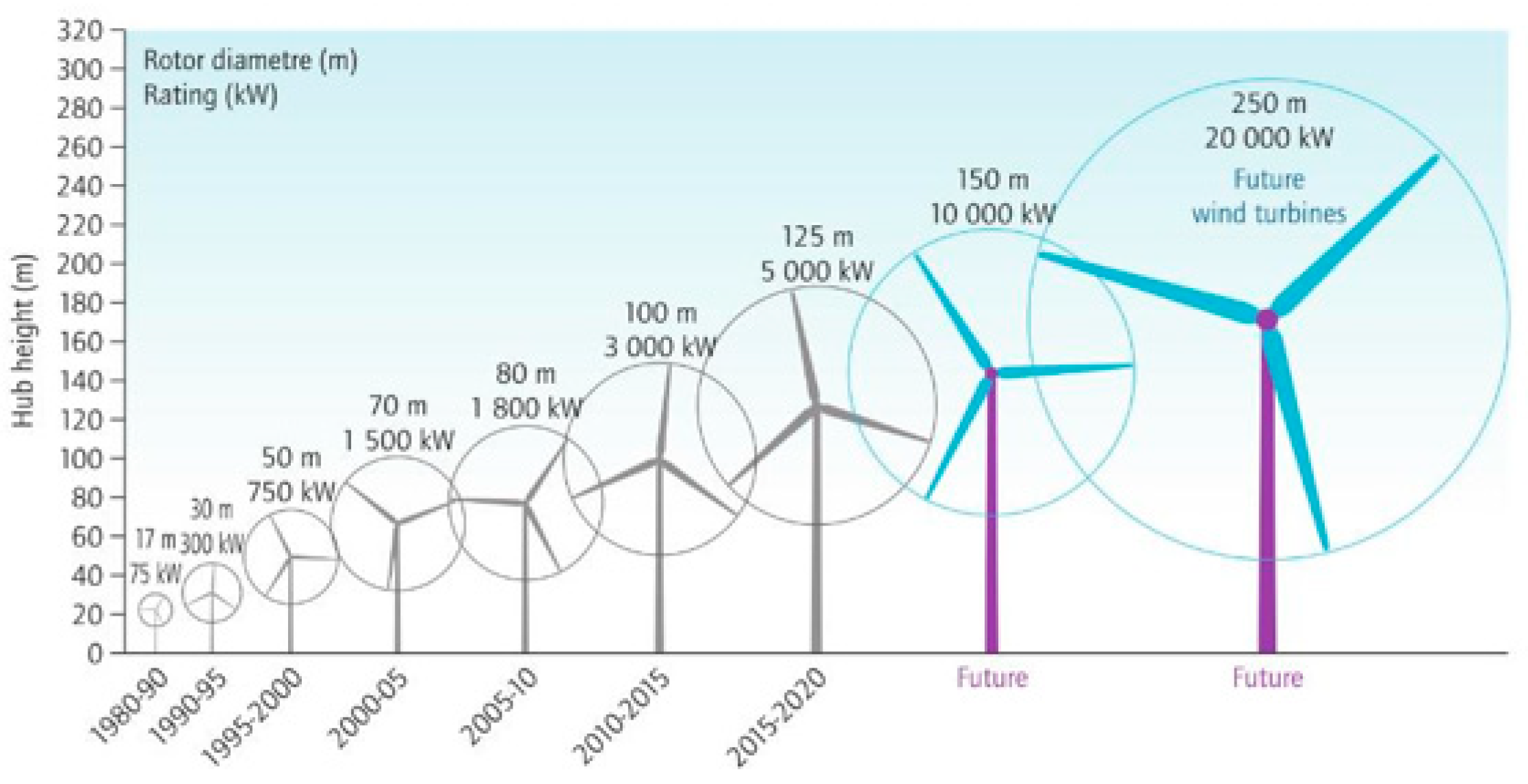
Over the past two decades, the size of wind turbines has rapidly increased. With the development of wind turbine technology, the size of wind turbines continues to increase. Large wind turbines (rated power greater than 5 MW) have gradually become the hot development trend for onshore and offshore wind power because they have the advantages of high effective utilization rate of wind energy and low power generation cost, etc. The International Energy Agency (IEA) reviewed and forecasted the development of wind turbine blade size (shown in Figure 1). The vertical height of wind turbines can reach about nearly 300 m after adding the length of the wind turbine blade.
The standard power curve is based on the steady-state uniform flow assumption; consequently, some important factors, such as turbulence, wind shear, and wind direction changes [8], are disregarded. However, actual atmospheric flows are very complex, and the effects of various wind parameters on large wind turbines have rarely been investigated. The instantaneous wind speed (WS) fluctuations caused by atmospheric turbulence often cause actual power generation to deviate from the theoretical power generation value. Turbulence activities not only substantially affect the efficiency of wind power generation but also cause fatigue damage to wind turbine structures, greatly reducing their service life [9]. The turbulence intensity (TI) is the most fundamental method for measuring turbulence in wind farms [10]. The TI is defined as the ratio of the normalized standard deviation of the WS [11]. According to statistical data, for every 10% increase in the TI, the fatigue load may increase by 15% to 30%, severely decreasing the reliability of key components such as blades and gearboxes [12]. The largest influence of turbulence on power was found in the region around rated WS [13,14].
Other inflow conditions could also affect the power generation of wind turbines. For example, wind shear data reveal wind conditions at different levels. Traditionally, to calculate the expected power generation of a wind turbine, only the WS at a single height corresponding to the hub height is considered [15,16]. Wind shear reveals the vertical distribution of WS, directly affecting the power generation of wind turbines [17], especially for large wind turbines, because of the larger swept area. Strong wind shear may result in a uniform load on wind turbine blades, which affects the power stability. Weak wind shear could also affect the power output of wind turbines, making it difficult to achieve the expected prediction results. Extreme wind shear conditions may cause a brief shutdown of the wind turbine and a direct interruption of the power output. Introducing the wind shear term to correct the power generation of large wind turbines could avoid overestimation or underestimation of the power generation caused by the uneven vertical distribution of WS. Wind shear coefficients have been introduced to assess the urban wind energy potential based on a combination of model and field data [18].
Gustiness, in the context of wind parameters, also has a significant effect on power generation, and instantaneous over-speed could cause sudden changes in the power generation of the wind turbine. The gust factor measures the ratio of the instantaneous peak WS to the average WS [19]. Extreme gusts may cause accidents such as wind turbine disconnection and structural damage. Previous study has revealed that gusts can enhance wind turbine performance based on a synthetic approach coupling a computational fluid dynamics gust model [20]. The influence of the above parameters as correction terms on the wind power curve has been relatively less studied, especially for large wind turbines.
Previous WS used for wind power generation usually had to be corrected by tower, lidar, or numerical simulation in order to obtain more accurate input WS. However, the meteorological tower is limited by the observation height, and new measurement technologies are needed to collect the necessary wind information. Wind lidar has the advantages of high precision, high spatiotemporal resolution, and easy installation and maintenance [21,22]. The wind turbine nacelle anemometer speed measurement power curve commonly used in wind farms is used for wind power prediction. Generally, wind farms use the nacelle anemometer of a wind turbine to estimate power generation. The advantage of using a nacelle anemometer is that it does not require the installation of a wind measurement tower, has low economic costs, and is easy to measure. However, the impeller rotation and the cabin itself cause airflow distortion, which affects the measurement of WS by the cabin anemometer. Therefore, measuring the power curve directly with the nacelle WS would cause significant errors. Moreover, the multidimensional wind parameters mentioned in the above analysis, exerting significant effects on power generation, are difficult to obtain. The real-time assimilation of high-precision wind field information detected by lidar into the control system is the forefront development of further intelligent wind turbines.
Based on the above analysis, the observation results of a large wind turbine (with a hub height of 135 m and a blade length of 118 m) and lidar in the coastal region were used in this study. Lidar measured the inflow wind conditions in front of the wind turbine. The characteristics of the multidimensional wind parameters measured by lidar were analyzed, and a new WS parameter suitable for describing large wind turbines that involves multidimensional wind parameters was subsequently proposed.

2. Data and Methodology

2.1. Observation Site and Instruments

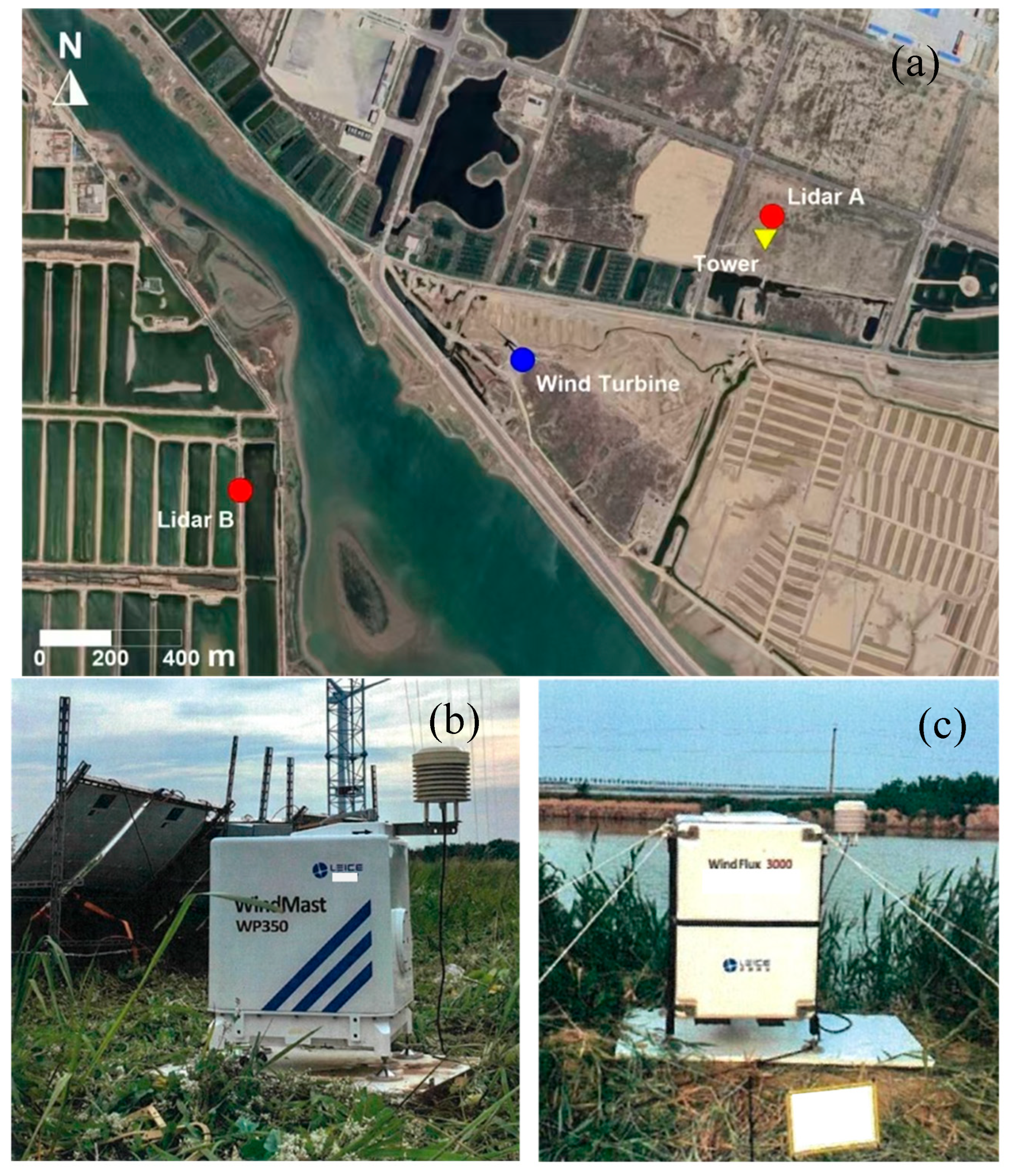
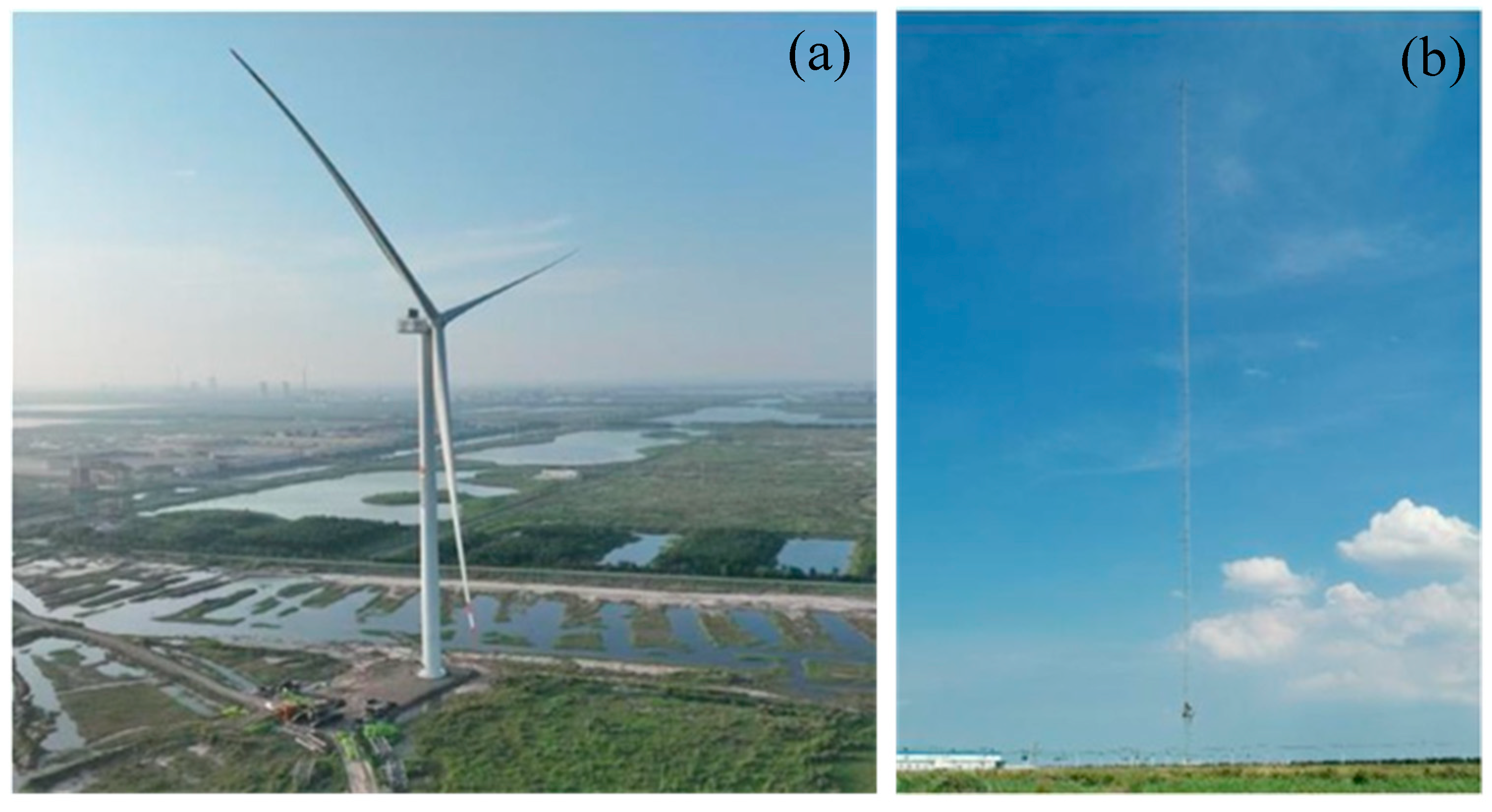
From 4 August (Aug) to 11 September (Sep) 2024, experimental observations of large wind turbines were conducted in Dongying city, Shandong Province, China. Dongying is located in northeast Shandong Province, adjacent to the Bohai Sea to the east. During the observation period (shown in Figure 2), it was summer in the local area. Generally speaking, the air density in summer is relatively low compared to winter, further resulting in the reduced power generation efficiency. In addition, the occurrence of high temperature and rainy days could also trigger the protection system and cause shutdown to protect the wind turbine. The large-scale wind turbine (Wind turbine in Figure 3, 37°22′24.51″ N, 118°53′16.59″ E) has a hub height of 135 m and a blade length of 118 m. The large wind turbine parameters are listed in Table 1. Two high-resolution, ground-based wind lidars were also installed in the northeast and southwest directions of the large wind turbine (as shown in Figure 2) to obtain the mean WS and WD at different heights and to retrieve more wind information, such as turbulence parameters. The reference tower (shown in Figure 3b) was located near lidar A. The meteorological tower is equipped with the observation of wind, temperature, humidity and pressure (shown in Table 2).
Wind measurement equipment A was a set of Windmast-WP350 lidars (lidar A in Figure 2: 37°22′13.23″ N, 118°52′44.47″ E, 4.75 m above the sea). The minimum observation height is 17 m, and the vertical resolution is 15 m from 45 m to 225 m, and above 250 m the vertical resolution is 10 m. The maximum measurable height is 350 m. Wind measurement equipment B was a set of Wind Flux 3000 lidars (lidar B in Figure 2: 37°22′12.98″ N, 118°52′44.28″ E, 4.89 m above the sea). The observation height below 250 m is consistent with wind measurement equipment A, and the vertical resolution above 250 m was still 15 m. The maximum measurable height is 1090 m. The temporal resolution of both the Windmast-WP350 and the Wind Flux 3000 is 1 s. The geographical map of the two lidars and the large wind turbine are shown in Figure 2. The large wind turbine is located in the middle of the two lidars, with a distance of approximately 800 m from the lidars, approximately 7 times the diameter of the wind turbine rotor. We selected 6 layers as key representative heights for analysis, namely, the height of the bottom wind turbine tip is 17 m, the height near the center of the hub is 60 m, the hub height is 135 m, the height of the middle of the upper blade tip is 195 m, the height of the top turbine tip is 253 m, and the highest height is 340 m, which can be measured by lidar A. All the data and results in this study are presented in Beijing Standard Time (BST).
The observation data from rainy days were removed because of their effects on the data quality. Negative and obviously unreasonable power generation values were flagged and removed. The power values exceeding 5 times the standard deviation based on the 1 min averaged value were removed to obtain more reasonable wind power. WSs greater than 20 m s−1 and ground temperatures exceeding 35 °C were also removed. The measurement period when both lidar and tower had observation data was used in this study, mainly during the daytime. The actual observation days used were a total of 17 days.

2.2. Calculated Multiple Parameters and Fitting Models

2.2.1. Bulk Richardson Number

The bulk Richardson number is derived from the flux Richardson number, but the flux observation is clearly more difficult than the averaged quantities. The gradient Richardson number is also an alternative parameter for measuring stability but requires vertical profiles of temperature and WS. One of the most widely used parameters to characterize the atmospheric stability condition is the dimensionless Bulk Richardson number (Rb), which corresponds to the ratio between buoyancy forces and shear production of turbulence, and Rb is defined as follows [11]:
R b = g θ v z θ v ¯ ( u 2 + v 2 )  
where g represents the acceleration due to gravity (9.8 m s−2 used in this paper), θ v denotes the virtual potential temperature change of two measurement levels, z indicates the difference in height, θ v ¯ represents the mean virtual potential temperature within the layer analyzed, and u and v denote the changes in the WS components within z . The meteorological tower is equipped with temperature and humidity sensors, cup anemometers at 128 m. Parameters such as temperature, humidity, and air pressure were used to calculate the potential temperature, and then obtain the bulk Richardson number. The observation data at 128 m and at the surface were used to calculate Rb. In this work, according to previous studies, stratification was largely classified into moderately unstable (u2, −2 ≤ Rb < −0.5), slightly unstable (u1, −0.5 ≤ Rb < −0.17), neutral (n, −0.17 ≤ Rb < 0.02), and stable (s, Rb ≥ 0.02) regimes on the basis of Rb [23].

2.2.2. Wind Shear Exponent

The power law is the most common method for describing the relationship between WS and height, and the dimensionless wind shear exponent (WSE) is defined as the difference between the wind speed at two separate heights [24]:
U 2 = U 1 ( z 2 z 1 ) α
where U2 and U1 represent the WS at heights z2 and z1, respectively. In this study, two heights, i.e., 135 m and 36 m on the tower, were used. The WSE is an indirect measure of stability that indicates the level of atmospheric stability [25]. Generally, for WSE, a constant value of 0.14 is used for open terrain during the day [26,27].

2.2.3. Turbulence Intensity

The turbulence intensity (TI) is a very important index in wind energy resources [10] and is defined as the ratio of the standard deviation of the WS to the mean WS [11,28]:
I = σ U ¯
where σ represents the standard deviation of the WS and U ¯ denotes the average WS within a given period. The TI characterizes the relative magnitude of WS fluctuations.

2.2.4. Gust Factor

In accordance with the recommendations of the World Meteorological Organization and other literature [29,30], the gust factor (G) is defined as the ratio of the peak gust value to the 10 min average wind speed:
G = U m a x U ¯
The peak gust Umax is defined as the maximum 3 s moving averaged wind speed within a 10 min interval. The gust factor characterizes the intensity of the wind speed fluctuations relative to the average wind speed and is closely related to TI. A high gust factor indicates that Umax is much greater than U ¯ . The power-law model was used to describe the relationship between the gust factor and WS:
G = a U b
The relationship between the gust factor G and turbulence intensity TI is expressed as follows:
G = 1 + c T I d ln T t  
where c and d represent the fitting parameters; T denotes the average interval (10 min in this study) and t denotes the interval between gusts (3 s in this study).

2.2.5. JohnsonSU Distribution Function

The JohnsonSU distribution is a four-parameter family of probability distributions first investigated in 1949 [31,32], and is especially suitable for describing cases where normal distribution or other standard distributions cannot fit well. Its PDF f(x) is as follows:
f ( x )   = γ + δ sin h 1 ( x ξ λ )
where f(x)~N(0, 1), γ, δ, λ and ξ are shape parameter 1, shape parameter 2, scale parameter and position parameter, respectively.

2.2.6. Corrections to the Power Curves for Large Wind Turbine

The power coefficient Cp is a measure of the efficiency of a wind turbine in converting wind energy to electricity and is commonly used by the wind power industry [25]. Cp is generally defined as the ratio of the actual electrical power generation of the wind turbine to the total wind power flowing into the turbine rotor disc at a specific wind speed [25,33]:
C p   = P 1 2 ρ A U 3  
P = 1 2 ρ A C P U 3  
where P represents the generated power (kW), A denotes the blade swept area, U indicates the incoming wind velocity, and ρ denotes the air density. In this study, after the TI, gust factor and WSE were introduced, the improved U was U multiplied by the correction factor expressed as follows:
U c = U [ 1 + C 1 T I + C 2 ( G 1 ) + C 3 ( W S 0.14 ) ]  
where C1, C2 and C3 denote fitting parameters that represent correction coefficients according to the actual measurements. Uc means the corrected wind parameter by integrating lidar-measured multiple wind parameters TI, G, and WSE. Generally speaking, the Cp is higher than 0.485 for this kind of large wind turbine, and the maximum Cp value for this newly designed large wind turbine is about 0.492. The actual power generation observation values were compared through regression statistical analysis by means of the least squares method with the theoretical curve in order to obtain correction coefficients C1, C2, and C3.
The root mean square error (RMSE) was also used in this study to evaluate the accuracy of the model [34], with the TI as an example:
R M S E = 1 N i = 1 N   X o b X f i 2    
where Xob denotes the observed quantity, Xfi denotes the fitted or predicted quantity, and N denotes the amount of data. Smaller values indicate that they are closer to zero and indicate a better model. All the data and results in this study are presented in Beijing Standard Time (BST).

3. Results and Discussion

3.1. Characteristics of the Atmospheric Turbulence Intensity, Gust Factor, and Wind Shear Exponent

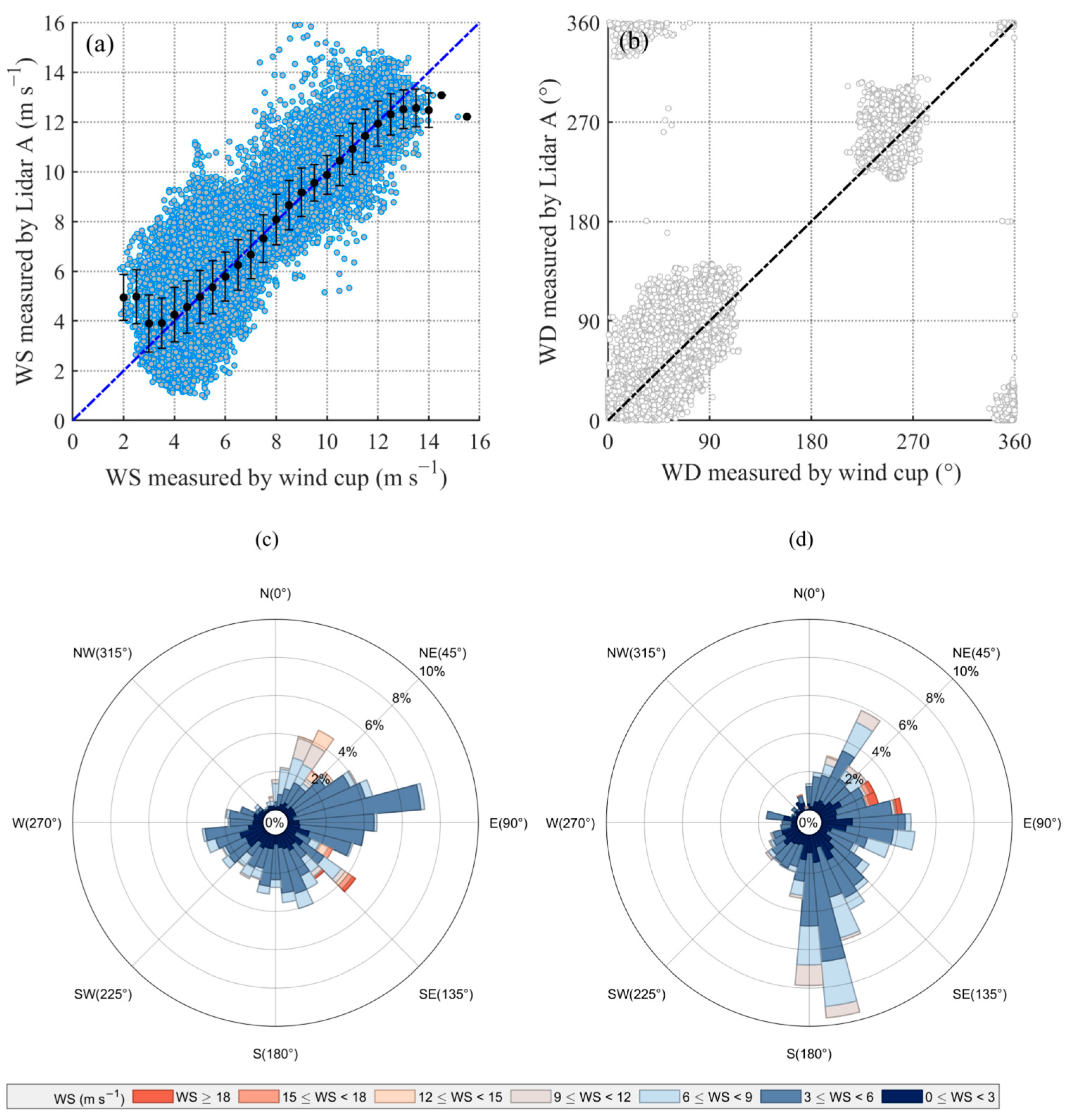
First, we compared the WS and WD measured by the lidar and the wind cup on the tower to confirm the accuracy of the lidar measurements (shown in Figure 4). For WS, the values measured by the wind cup were very consistent with the values measured by the wind lidar within the WS range of 3–12 m s−1, which is also the effective working range of the wind turbine. For small WSs (WS ≤ 3 m s−1), the lidar overestimated the WS compared with the wind cup, whereas for high WSs greater than 12 m s−1, the lidar slightly underestimated the WS. This phenomenon is attributed mainly to the different measurement mechanisms used to detect WS. When the WS exceeds 12 m s−1, it is not conducive to the accumulation of aerosols, resulting in a slight decrease in the accuracy of lidar measurements because lidar detects the Doppler shift of aerosol particles to retrieve the WS. For WD, the wind cup measurement results were essentially consistent with the lidar observation results. When the WD measured by the wind cup ranged from 0–90°, the lidar measurement results near 360° corresponded mainly to the meteorological definition of WD. Both were essentially northerly winds [11,35].
A significant change in WD during the observation period in the local area was observed during the day and night, mainly because the observation site was adjacent to the Bohai Sea to the east and the prevailing sea breeze during the day was slightly easterly. The proportion of southerly winds at night significantly increased.
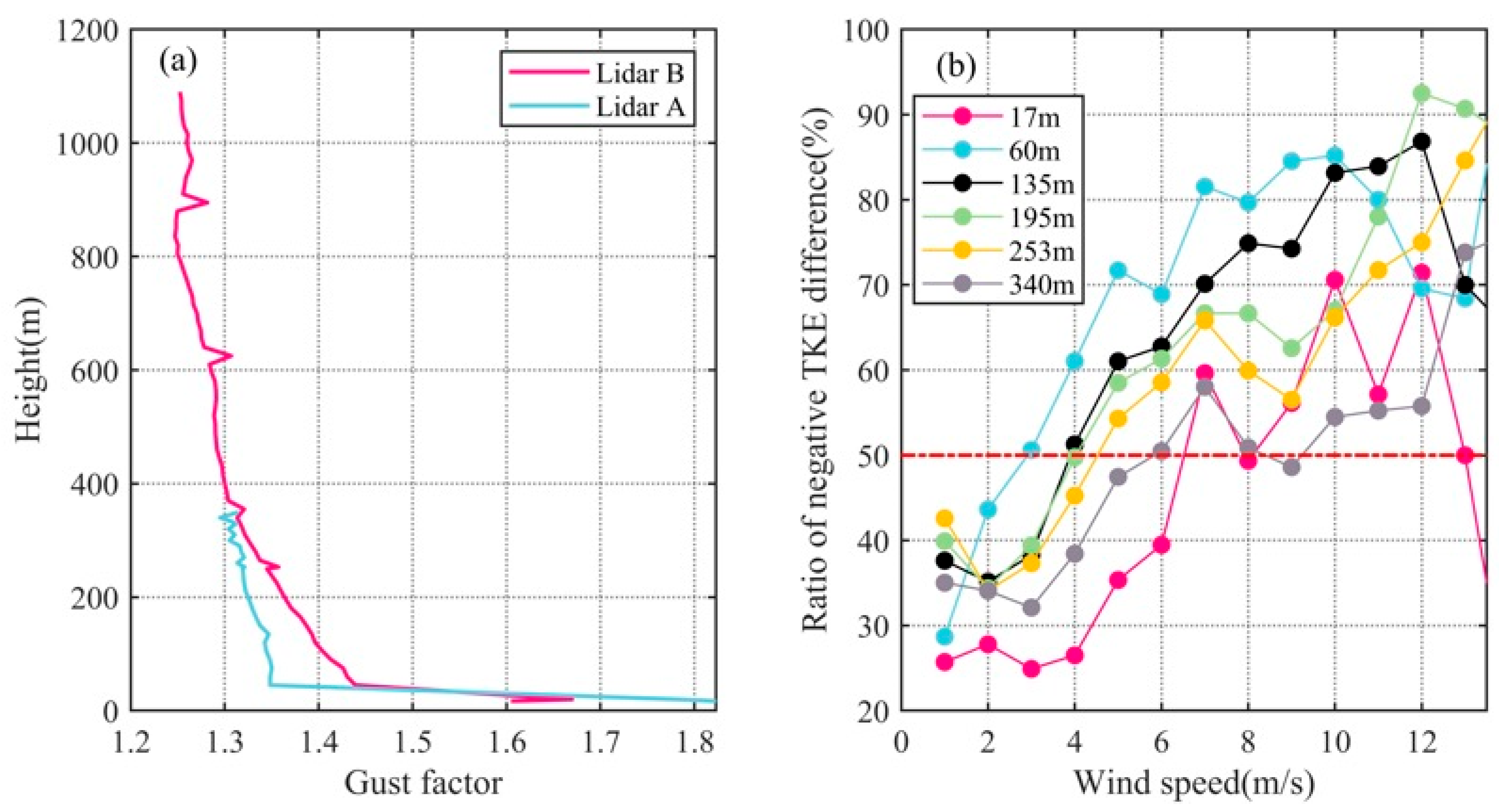
The vertical profiles of the gust factors calculated via lidar A and lidar B are shown in Figure 5a. The gust factors calculated by the two lidars were significantly highest near the surface and then gradually decreased with height. The air layer closer to the ground could exert a greater effect of surface friction on turbulence activities near the surface; therefore, the gust factor was usually greater at low heights. As the height increased, the frictional drag effect of the ground on the airflow weakened, and the gust factor gradually decreased. The gust factor of lidar B was generally greater than that of lidar A. Considering the dominant WD in the wind rose diagram in Figure 4 and the locations of the two lidars in Figure 2, lidar A was located upwind of the wind turbine, whereas lidar B was located downwind of the wind turbine. Lidar B was located approximately 7 times the diameter of the wind turbine rotor, with an obviously greater gust factor in the downwind direction than in the upwind direction. This finding indirectly reflects the increased TI in the downwind direction of the wind turbine.
Figure 5b shows the distribution of the proportion of turbulent kinetic energy (TKE) differences (TKE_lidar A–TKE_lidar B) to WS calculated by two lidars that are less than zero. TKE is defined as 1 2 ( u 2 ¯ + v 2 ¯ + w 2 ¯ ). A ratio less than zero indicates that the TKE of lidar B is greater than that of lidar A. Figure 5b shows that the TKE at lidar A was generally lower than that at lidar B. This phenomenon became more pronounced with increasing WS, especially at 60–195 m, which is largely affected by the wind turbine. When the WS exceeded 5 m s−1, the ratio at 60 m exceeded 70%. On the basis of the above analysis, when the power generation of large wind turbines was corrected, the observation results at lidar A in the upwind direction of the wind turbine were chosen because the observed turbulent flows were less affected by the wakes, and lidar A was closer to the wind turbine. Thus, the correction of the power generation of the wind turbine would be more accurate.
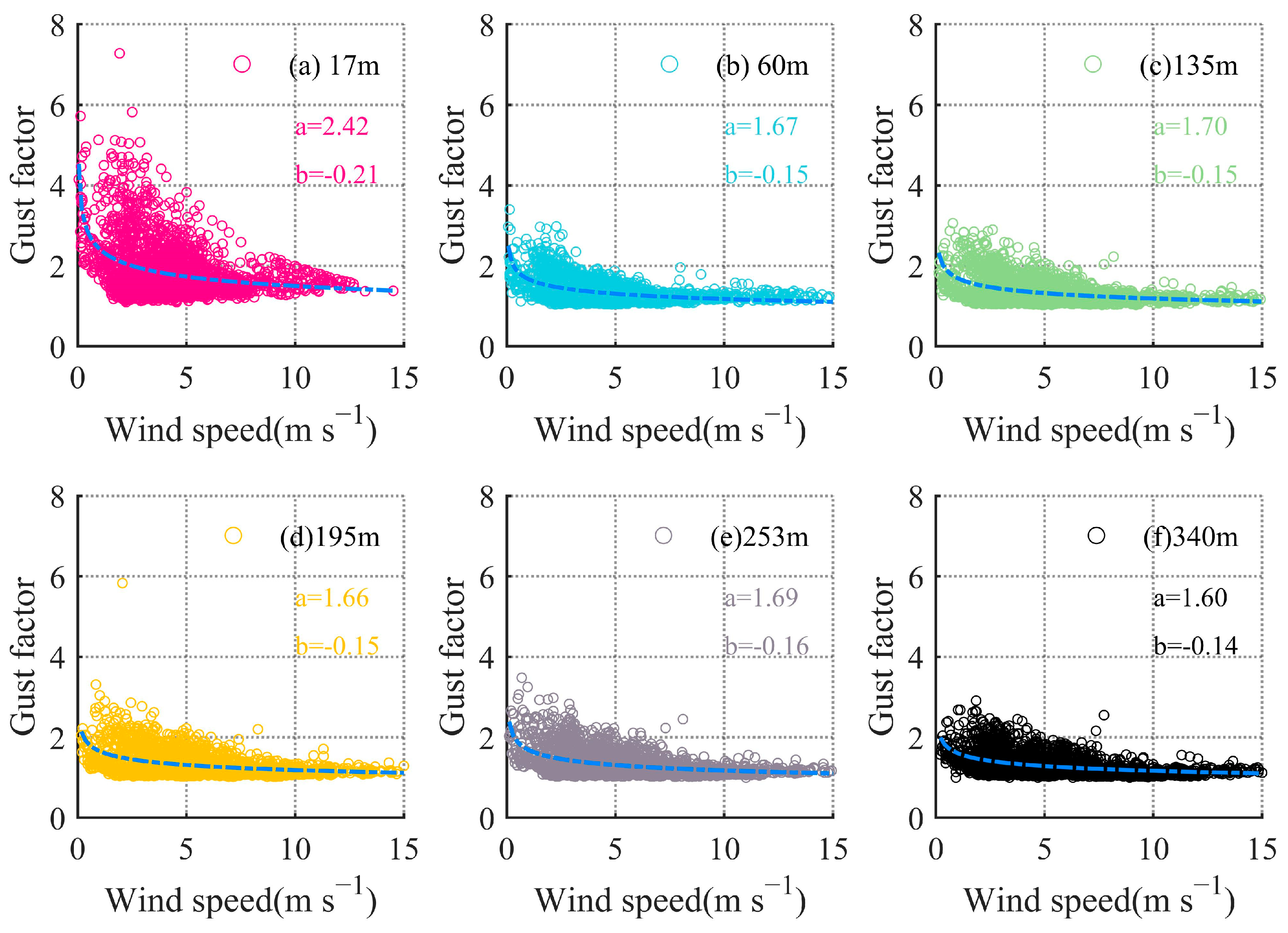
Figure 6 shows the scatter plot and power-law model fitting curve of the relationship between the gust factor and average WS at six heights. We selected 6 layers as key representative heights for analysis, namely, the height of the bottom wind turbine tip (17 m), near the center of the hub (60 m), the hub height (135 m), the middle of the upper blade tip (195 m), the top turbine tip (253 m), and the highest height (340 m) that can be measured by lidar A. The gust factor was inversely correlated with the WS, and the WS played a very important role in gusts. A high WS indicates not only sufficient wind energy but also the danger of larger gusts. The observation results for the Shanghai World Financial Center Building also revealed this pattern. It is clearly inappropriate to use a linear function to represent this relationship. Therefore, we used a power-law model (Equation (5)) to describe the relationship between the gust factor and WS, and the six fitting parameters corresponding to the different heights are listed in Figure 6.
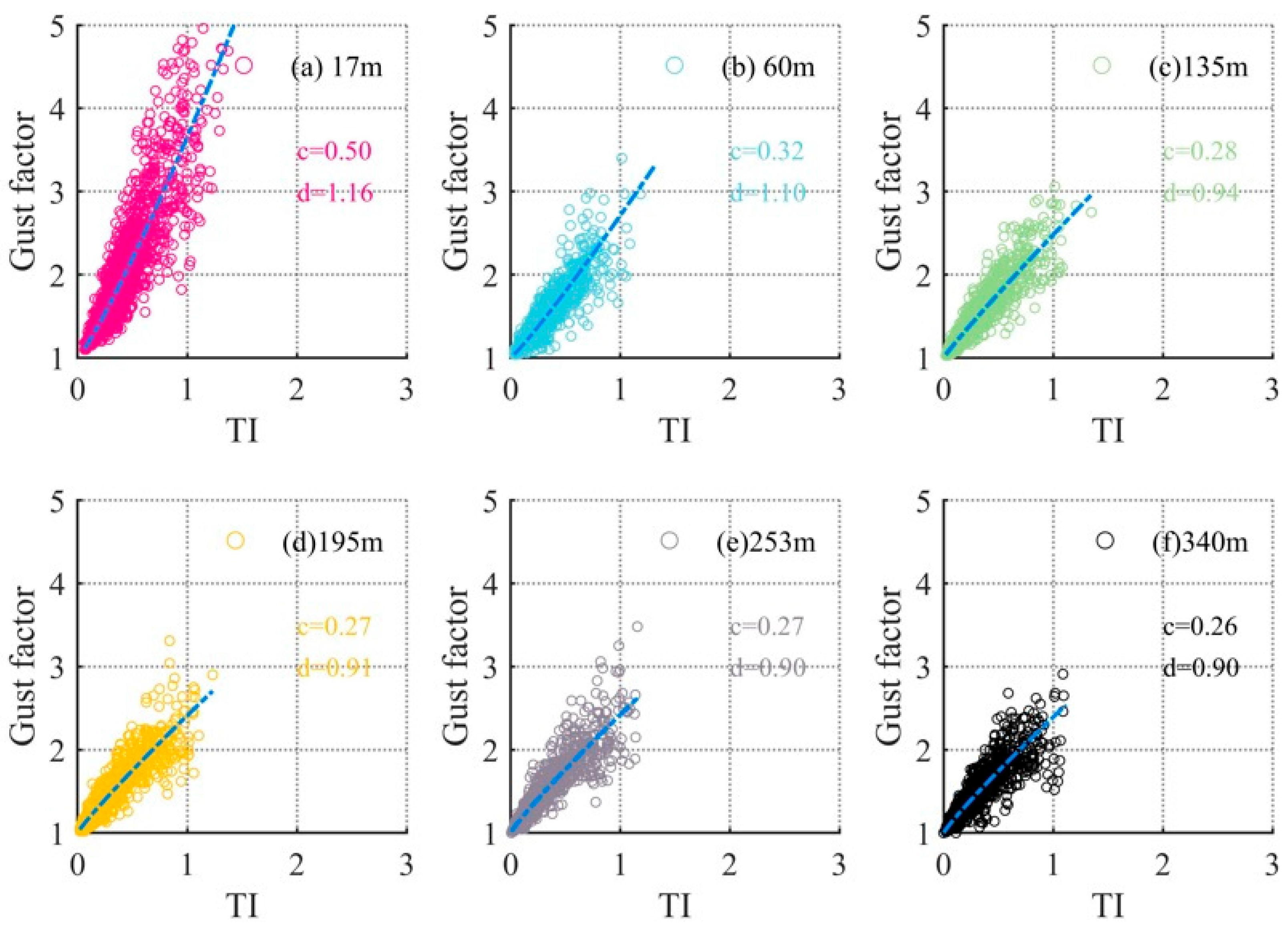
Figure 7 shows the relationship between the gust factor and TI. Generally, the gust factor increased with increasing TI. This study calculated the relationship between the gust factor and TI at various heights by fitting the data observed via Equation (6). The fitting parameters c and d for the relationship between the gust factor and TI were approximately 0.3 and 1, respectively, and the c value was slightly smaller than the observation results for the building roof [36], whereas the d value had good consistency.
The gust factors at low levels were more sensitive to changes in TI, as verified by the high slope at 17 m or 60 m. At 17 m, the coefficient of determination R2 was 0.79 and increased to 0.87 at 253 m. Many influencing factors exist and complex turbulence occurs near the surface, and the turbulence at high altitudes is reduced by the effect of the surface.
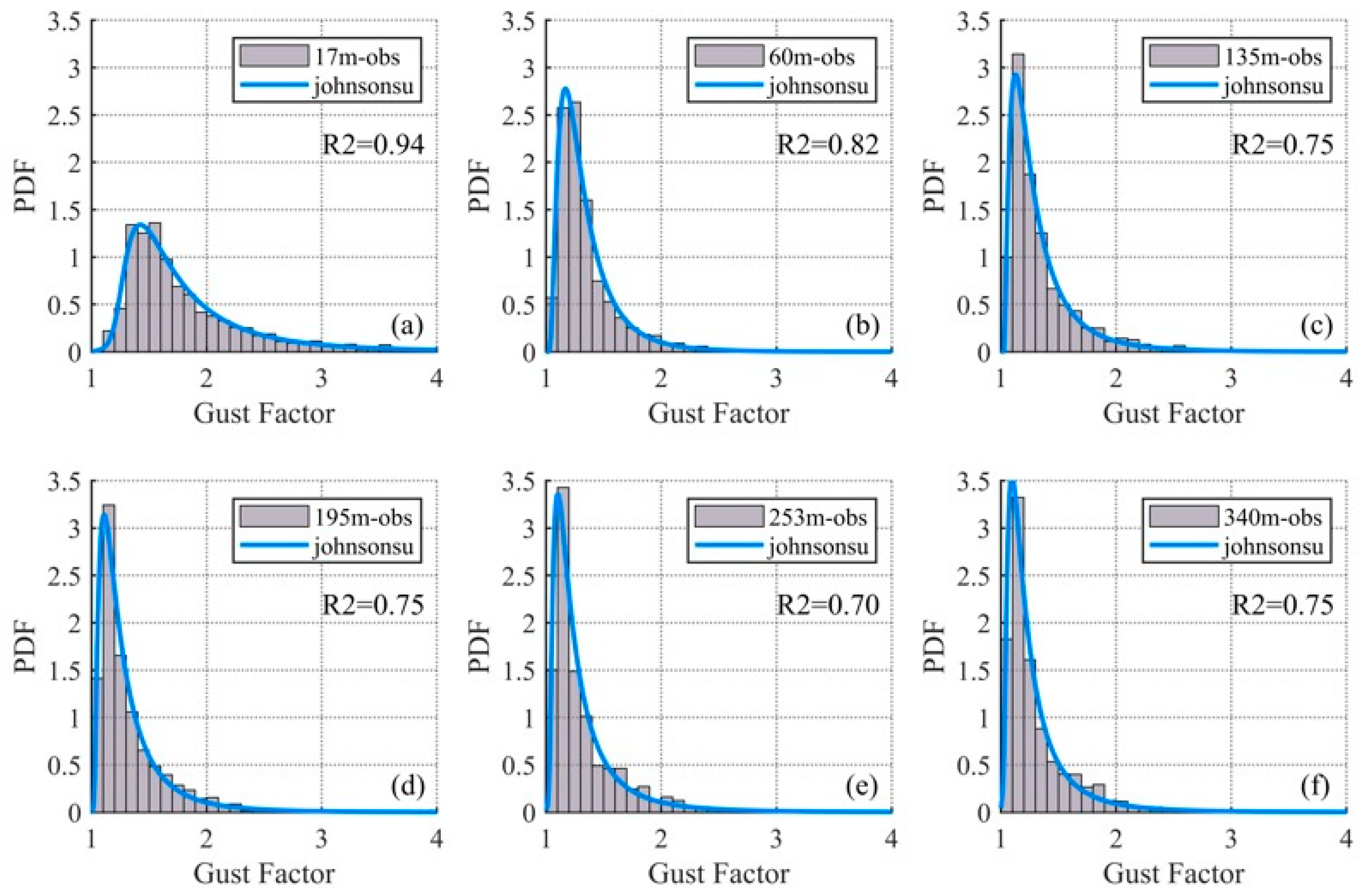
Many previous studies have used different probability density functions to describe gust factors [37,38,39]. The JohnsonSU distribution function was used in this study to fit the gust factors. Accurately describing the distribution of gust parameters would also help establish more reasonable parameterization methods. Choosing a distribution function with strong adaptability is recommended to describe the gust parameters.
Figure 8 shows the distributions of the gust factors at the six heights, and the corresponding fitted JohnsonSU distribution parameters are listed in Table 3. Although the Weibull distribution is commonly used to describe the average WS in wind energy, it is not suitable for describing gust factors. As shown in Figure 8, the actual distribution of the measured gust factors was relatively right skewed, and the JohnsonSU function distribution revealed good fitting performance with the actual gust factors, with the highest R2 about 0.94 at 17 m. Figure 8 shows that the distributions of the gust factors at these six heights were concentrated in the range of 1 to 4. The gust factor at 17 m in the lower layer was slightly greater than the gust factor of 1.4 provided by the IEC standard [28]. All peak values at these six heights were smaller than 1.4, and a large proportion of the gust factors were less than 1.4. The absolute value of the shape parameter γ was maximal around the hub height, whereas the shape parameter δ, scale parameter λ, and position parameter ξ were generally maximal near the lower blade tip height. These fitted parameters tended to decrease with increasing height.

3.2. Analysis of Different Atmospheric Stabilities

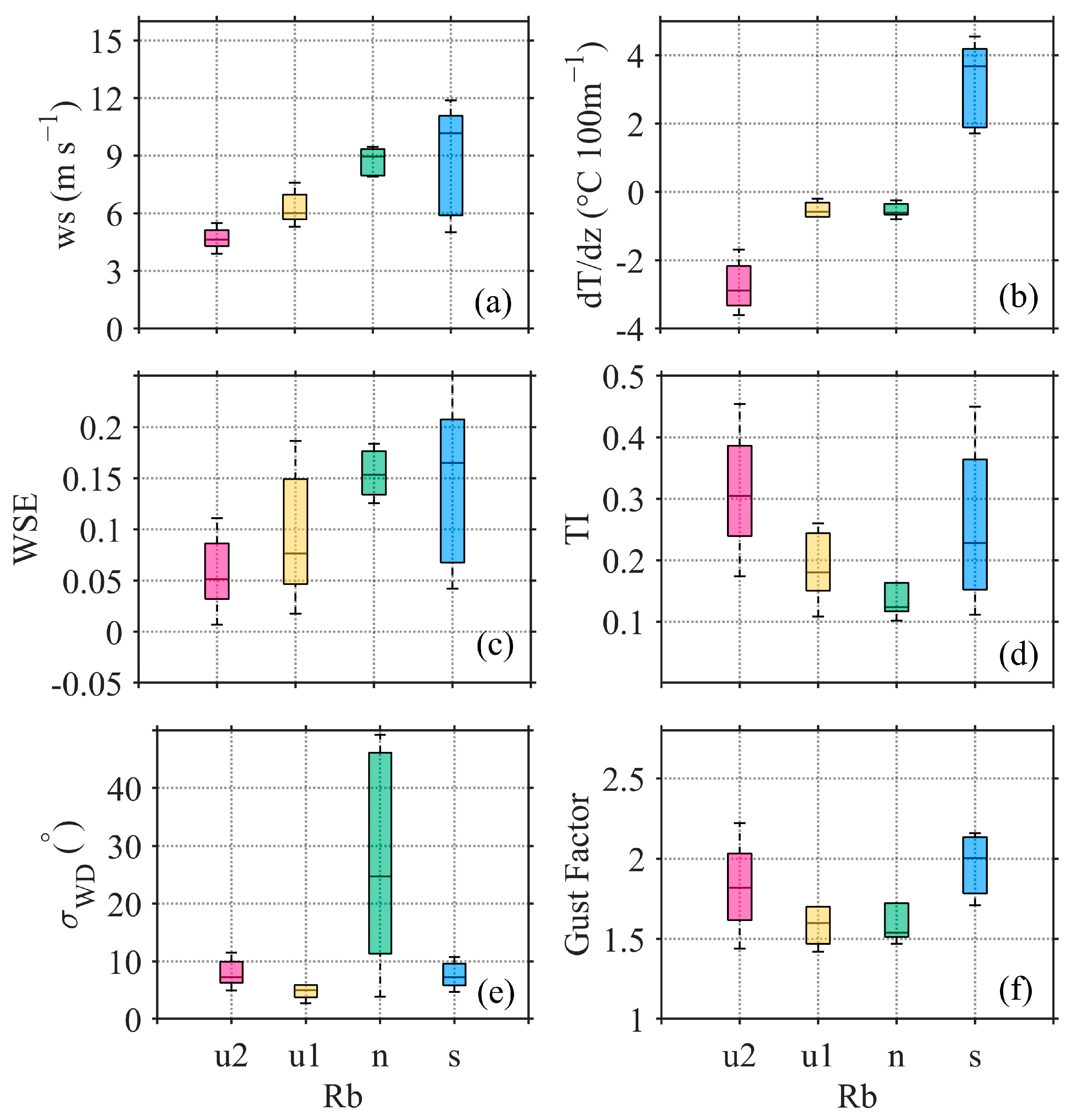
Figure 9a presents a box plot of the WS according to the atmospheric stability Rb. The frequency of high WS increased significantly under the stratified near-neutral atmosphere, with Rb near zero. The median WS under neutral stratification was nearly 9 m s−1. The frequency of high WS was particularly high when the atmosphere was stable, and the WS exhibited a less concentrated distribution under stable atmospheric stratification than under the other three classifications of atmospheric stratification. The maximum WS under stable conditions was nearly 12 m s−1, and the difference between the maximum WS and the minimum WS exceeded 6 m s−1. When the atmospheric stratification changed from neutral to moderately unstable, the WS tended to decrease. The median value, first quartile, and third quartile of WS under moderately unstable conditions were 4.62 m s−1, 4.29 m s−1, and 5.12 m s−1, respectively, and under neutral conditions, the corresponding values increased to 8.94 m s−1, 7.96 m s−1, and 9.33 m s−1, respectively.
The thermal stability parameter dT/dz (unit: °C 100 m−1) in Figure 9b shows that under neutral and slightly unstable conditions, the distributions were very similar, with a minimum value of nearly −0.75 °C 100 m−1 and a maximum value of nearly −0.2 °C 100 m−1. The minimum value decreased to −3.60 °C 100 m−1 under an unstable atmosphere, and the vertical exchange momentum caused by the thermal factor near the surface seemed strong. The values under stable stratification were relatively high, with a median value of nearly 3.68 °C 100 m−1, indicating that sporadic inversion stratification occurred in the lower layer from the ground to the hub height.
As shown in Figure 9c, the variation trends of the WSE at different stability classifications were very similar to the performance of WS. As the Rb value progressed from zero (near neutral) towards a positive value, the atmosphere was stratified into a more stable state. The more stable the atmosphere became, the greater the WSE became. The median value of the neutral condition was nearly 0.14, which conforms to the previous values under neutral stratification [26,27]. The median WSE increased to 0.16, and a larger WSE indicates a wind profile with an increased vertical gradient. In the box plot of the stable condition, the minimum, first quartile (25%), third quartile (75%), and maximum values were 0.04, 0.06, 0.20, and 0.26, respectively. There was a wider difference between the maximum value and the minimum value. As the Rb value increased from zero to a negative value, the atmosphere was stratified to a more unstable condition, and the WSE distribution tended to decrease. The median WSE values of the box plot were 0.15 (n), 0.07 (u1), and 0.05 (u2), indicating a wind profile with a reduced vertical gradient.
Figure 9d shows the box plot of the TI according to the atmospheric stability Rb. The distribution of the TI shows that the TI of the unstable regime was generally greater than those of the other regimes. When Rb decreased from zero to a negative value towards an unstable atmosphere, a high TI became more frequent, and the TI distribution became more sporadic.
The median values of the TI were 0.22 (s), 0.12 (n), 0.17 (u1), and 0.30 (u2) according to the box plot in Figure 9d. When the atmosphere changed from neutral to moderately unstable, the TI gradually increased. In particular, the first quartile and third quartiles of the moderately unstable condition, where the ratio of high TIs was maximal, were 0.23 and 0.38, respectively, revealing strong turbulence mixing flows. During the observation period, stable stratification also occurred during the daytime, and the distribution dispersion of the TI was high, with a maximum value near 0.45. The median value of the TI under stable conditions was 0.22, which was slightly greater than that under neutral and slightly unstable stratification. The stable stratification classified by the bulk Richardson number during the day may have been related to the local special circulation, and the bulk Richardson number threshold does not play an important role in the evolution of strong turbulence into stable atmospheric stratification.
This study also provides the distribution of WD standard deviations under different atmospheric stability on the basis of Rb. The fluctuation in WD could represent the degree of atmospheric turbulence activity. The magnitude of WD fluctuation is directly related to the atmospheric diffusion ability and therefore can be used as a classification index for atmospheric stability [40]. As shown in Figure 9e, the neutral atmosphere had the highest dispersion, and only the minimum value of the neutral condition was near those of the other three classifications. The median and maximum values under neutral conditions were much greater than those under the other three stratifications, possibly because the neutral layer was accompanied by greater vertical wind shear in the horizontal direction. The median standard deviations of WD under the other three atmospheric stabilities were less than 10.
The box plot of the gust factor according to the atmospheric stability Rb showed a variation trend similar to that of TI. The minimum values for moderately unstable (u2), slightly unstable (u1), and neutral conditions (n)s were concentrated at approximately 1.44, whereas the minimum value for stable conditions was approximately 1.71. The dispersion of gust factors under moderate instability was relatively large, with a maximum value of approximately 2.22, followed by stable conditions of approximately 2.16. The gustiness of the wind was relatively high. The maximum values of the neutral and slightly unstable conditions were approximately 1.7.
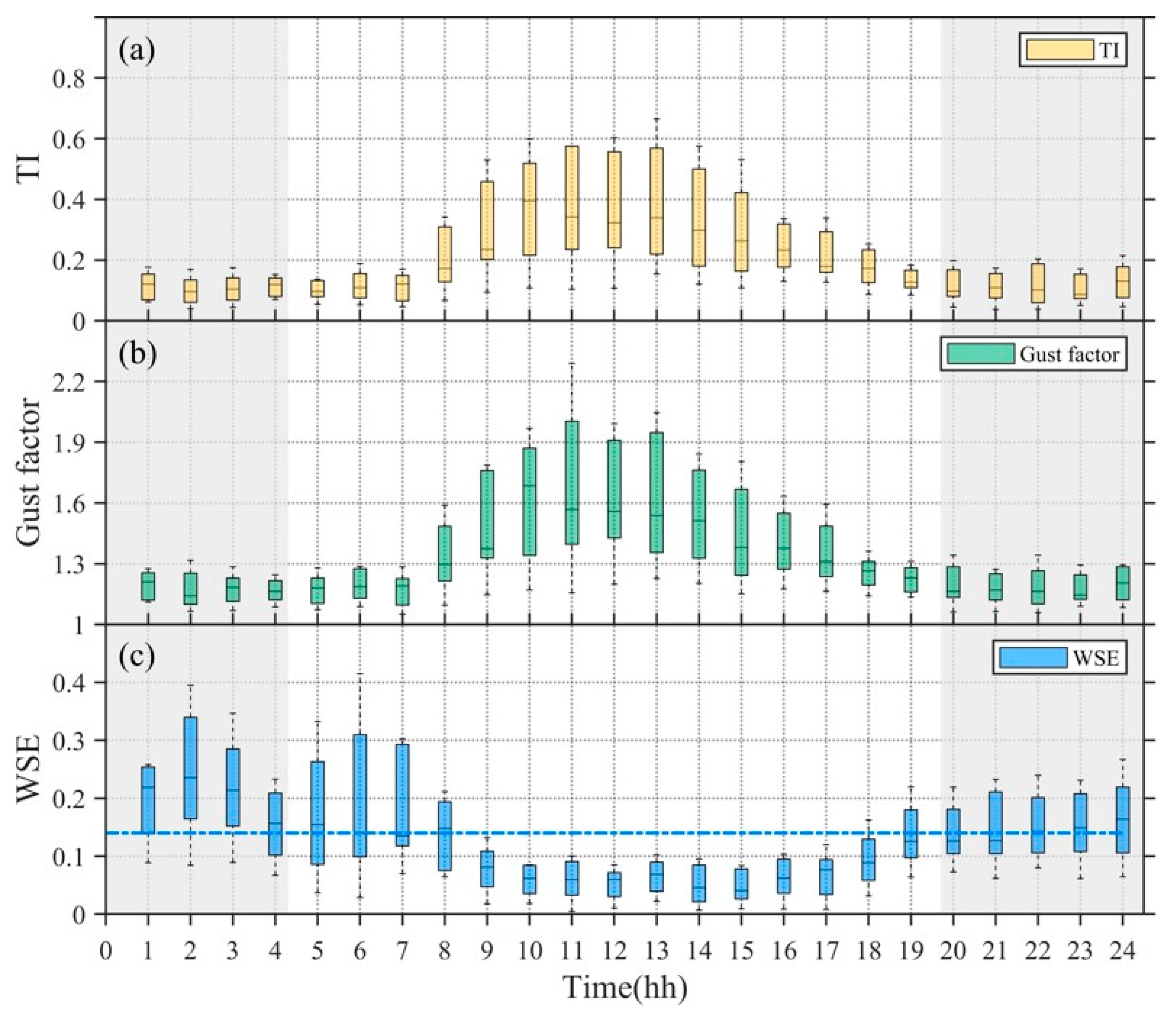
Figure 10 shows the daily variations in the TI (a), gust factor (b), and WSE (c) at the hub height. The TI, gust factor, and WSE exhibited obvious diurnal variations; the TI and gust factor generally reached their maxima at approximately 11:00. The median values and the first and third quartiles of the TI from 11:00–13:00 were almost the same. Compared with the daily variation in TI analyzed in previous studies, the TI observed was greater because it was during the summer observation period. According to a reference based on observation data, the TI is generally <10% in the night boundary layer. The nighttime TI in this study was generally greater than 10%, but the maximum values were generally less than 20%. The value of the TI during the transition period or neutral stratification was approximately 20% in this study. In the daytime convective boundary layer, the first quartile of the TI was greater than 20%, and the maximum median value of the TI was nearly 40%. Compared with the nighttime values, the randomness of the daytime TI difference was relatively strong.
The daily variation in the gust factor was very similar to that in the TI, as shown in Figure 10b. The daytime gust factor was generally high, with the maximum value exceeding 2.2 from 11:00–13:00, and the third quartile values of the gust factor exceeded 1.9. The difference between the maximum and minimum values of the gust factor during the day was significant, and the fluctuation amplitude of the wind gust factor was significant. At noon, the first quarter of the gust factor was greater than 1.3. The difference between the maximum and minimum values of the nighttime gust factor at different moments decreased compared with that in the daytime. For both the stable boundary layer and the neutral boundary layer at night, the median values of the gust factor were smaller than 1.3.
The diurnal variation in the WSE was opposite to that in TI and the gust factor, as shown in Figure 10c. The daytime turbulence mixing effect in the convective boundary layer is strong, as indicated by the small WSE in the wind profile, with maximum values generally less than 0.1 and median values of approximately 0.05. The difference in WS between the upper layer and the lower layer was very small. The difference between the maximum and minimum values of the daytime WSE was significantly smaller than that of the nighttime WSE. The neutral stratification in this study was defined as 2 h centered on sunrise or sunset, on the basis of solar geometry. The median values were almost 0.14 at approximately 05:00 or 19:00, revealing that the results in coastal terrain also conform to the values obtained from the wind tunnel laboratory under neutral stratification. After sunset, the WSE gradually increased to over 0.1 and reached its maximum after midnight. The difference between the maximum and minimum WSE values after midnight was obvious, with the maximum gap exceeding 0.3 and the median WSE values after midnight being greater than 0.2. A larger WSE indicates large differences in WS between the upper layer and the lower layer, which may also be attributed to the formation of low-level jet streams after midnight.

3.3. Power Performance of Wind Turbines and Improvements in Power Curve

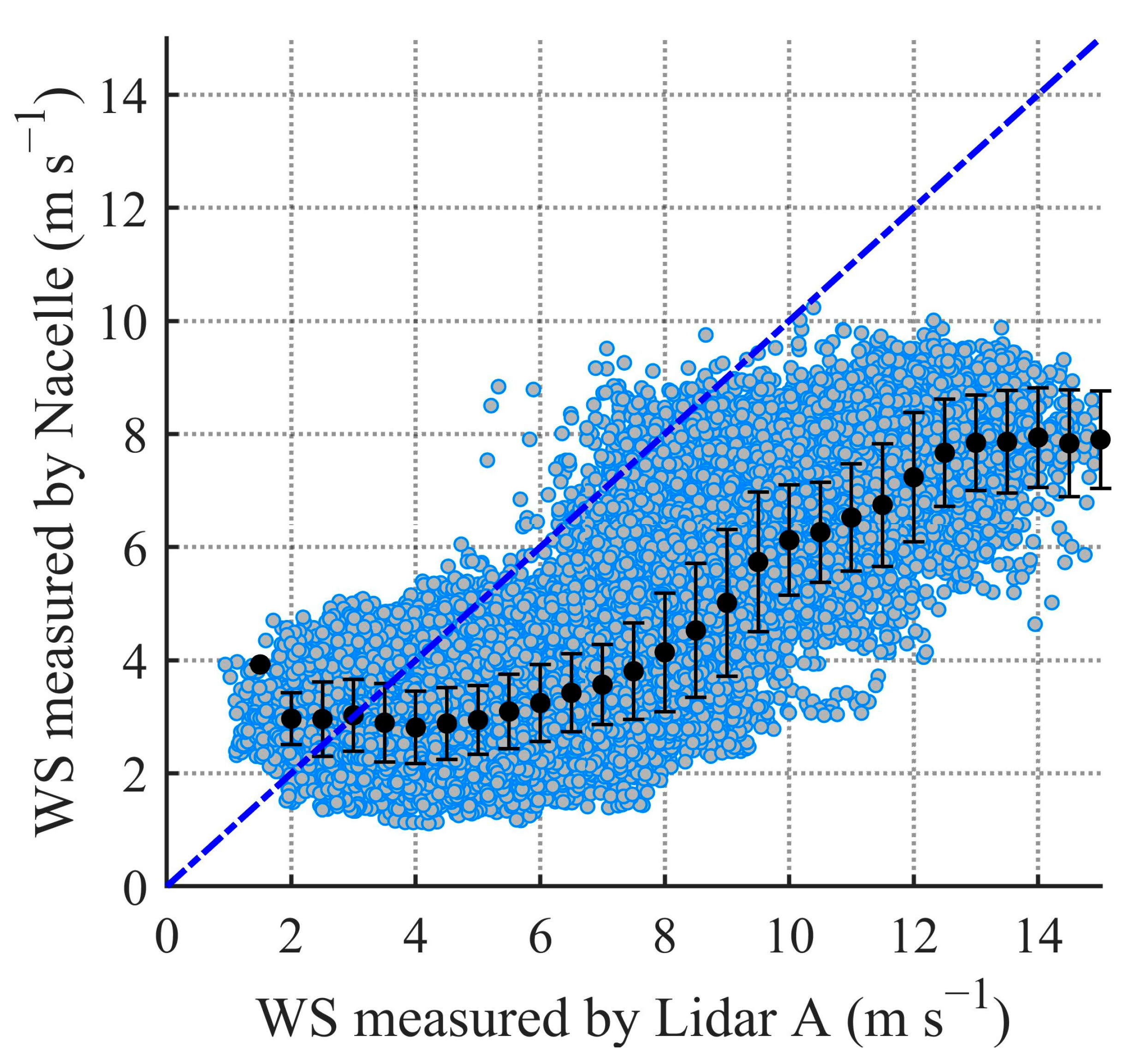
The classical power curve of a wind turbine is generally calculated on the basis of the WS to predict power generation [25,33]. This WS usually needs to be corrected through towers near the wind turbine or numerical simulations, but actual observations often only include the nacelle wind speed. However, airflow distortion caused by the rotation of the wind turbine affects the accuracy of the WS measured by the nacelle. Therefore, directly using the WS measured by the nacelle to estimate power generation inevitably causes great uncertainty. The above analysis revealed that the WS measured by lidar was consistent with the WS directly observed by the wind cup, confirming the accuracy of the lidar WS observations. The WSs measured by lidar and the nacelle were then compared and analyzed (shown in Figure 11). The results revealed that there was a significant difference between the WSs observed by the lidar and that measured by the nacelle. The WS measured by the nacelle was essentially lower than the lidar observation results. When the WS was approximately 4 m s−1, as observed by the nacelle, the WS observed by the lidar exceeded 8 m s−1; when the WS was nearly 6 m s−1, the WS observed by the lidar exceeded 10 m s−1. The WS observed by the lidar was essentially 4 m s−1 higher than the WS measured by the nacelle in this study.
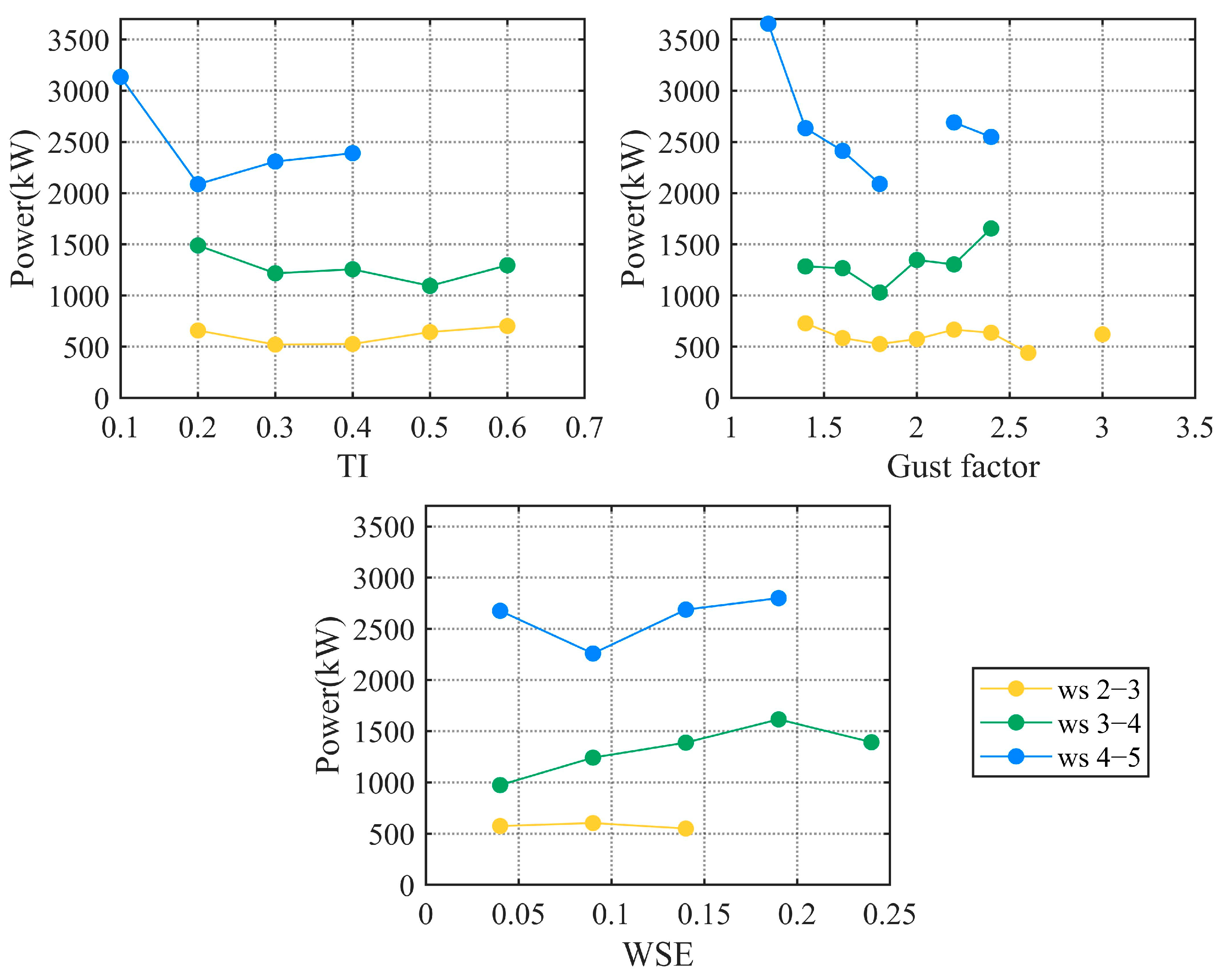
The bin distributions of TI, gust factor, and WSE with power generation within different WS ranges are shown in Figure 12. When the WS was low (2–3 m s−1), the TI, gust factor, and WSE had relatively small effects on the power generation efficiency, within the range of 500–750 kW. With increasing WS, the power generation significantly improved. The power generation was between 1000 and 1500 kW within a WS of 3–4 m s−1, and the effects of the TI, gust factor, and WSE gradually developed. Compared with the TI, power generation tends to increase with increasing gust factor and WSE. For example, when the gust factor was 1.3–1.5, the power generation was approximately 1250 kW, and the power generation increased by 500 kW when the gust factor was within 2.3–2.5. The power generation was approximately 1000 kW with low WSE, and the power generation reached nearly 1500 kW when the WSE exceeded 0.2. The power generation exceeded 2000 kW when the WS increased to 4–5 m s−1. The power energy increased as WSE increased after a minimum was reached [41]. At this time, when the TI is relatively low, it may indicate a higher WS, so the power generation is greater. Moreover, within the range of 0.2–0.4 TI, power generation tended to increase with TI. The power generation exceeded 2500 kW with a gust factor exceeding 2, and the power generation also showed an increasing trend after the WSE exceeded 0.1.
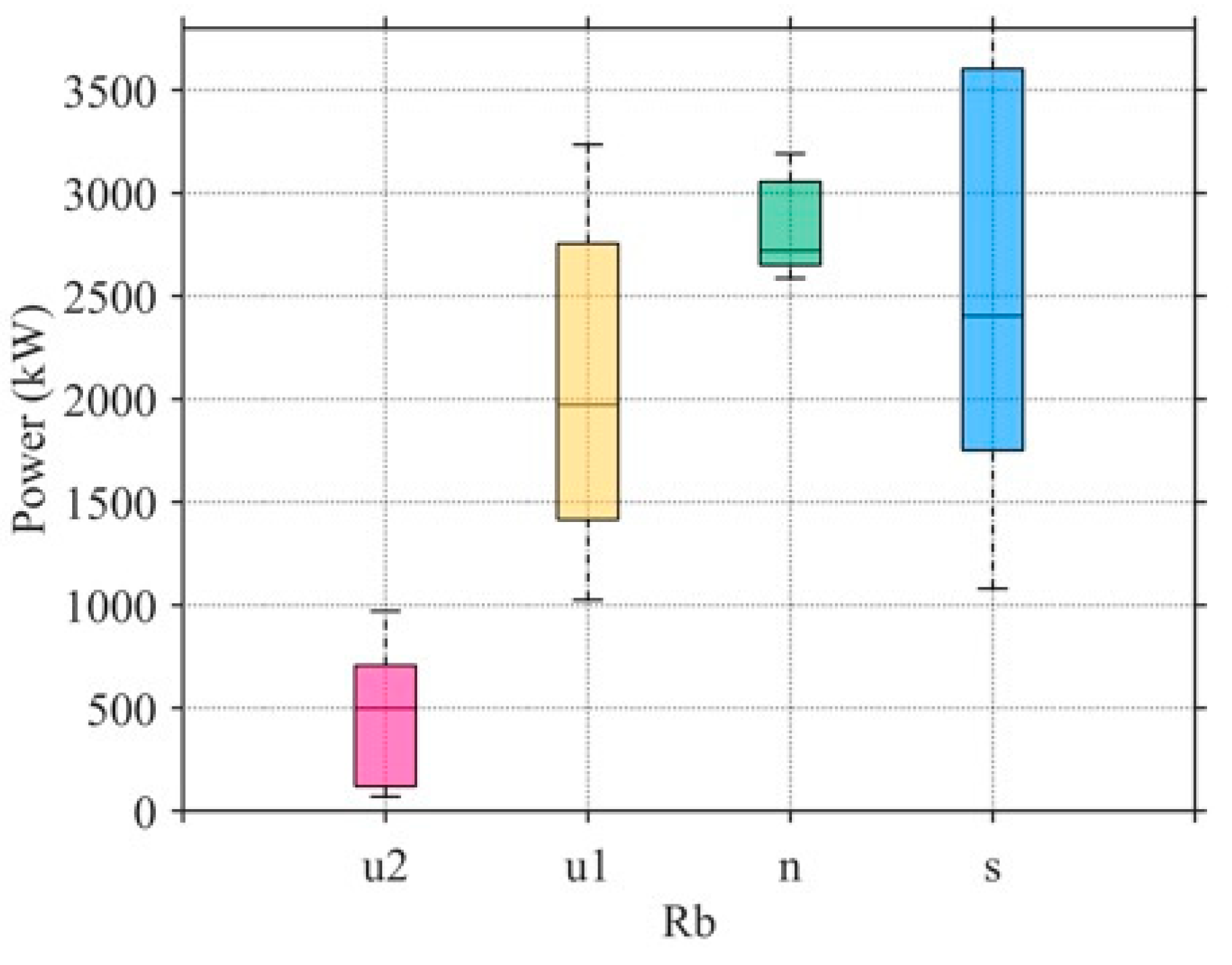
The distribution of power generation with atmospheric stability determined by the bulk Richardson number was further analyzed (shown in Figure 13), and the distribution of power generation with stability was essentially affected by the wind speed. When the neutral stratification progressed towards slightly and moderate unstable conditions, the power generation rapidly decreased, the dispersion of power generation under neutral conditions was small, and the median power generation power was nearly 2700 kW. However, in the case of moderately unstable stratification, the median value was approximately 500 kW. The variation in power generation under stable conditions was significant, with a median value of nearly 2500 kW, which was lower than that under neutral conditions but higher than that under slightly and moderately unstable conditions.
In the case of moderate instability, the median value was approximately 500 kW. The variation in power generation under the stable layer structure was significant, with a median value of nearly 2500 kW, which was lower than that of the neutral layer structure but higher than that of the mild and moderate instability situations.
As analyzed in the previous section, the variation tendencies of WSE and WS with the atmospheric stability Rb were very consistent. Similarly, the trends of the TI and gust factor with respect to stability were also very similar. Because WS and TI play two important roles in affecting the power generation of wind turbines [42], we selected the TI, WSE, and gust factor as correction terms to modify the traditional power curve and obtain a more accurate power curve that more closely reflects the actual power generation. For complex wind conditions along coastal terrain, a new power curve that integrates multidimensional wind parameters (TI, gust factor, and WSE) measured by lidar with WS observed by a nacelle was proposed in this study.
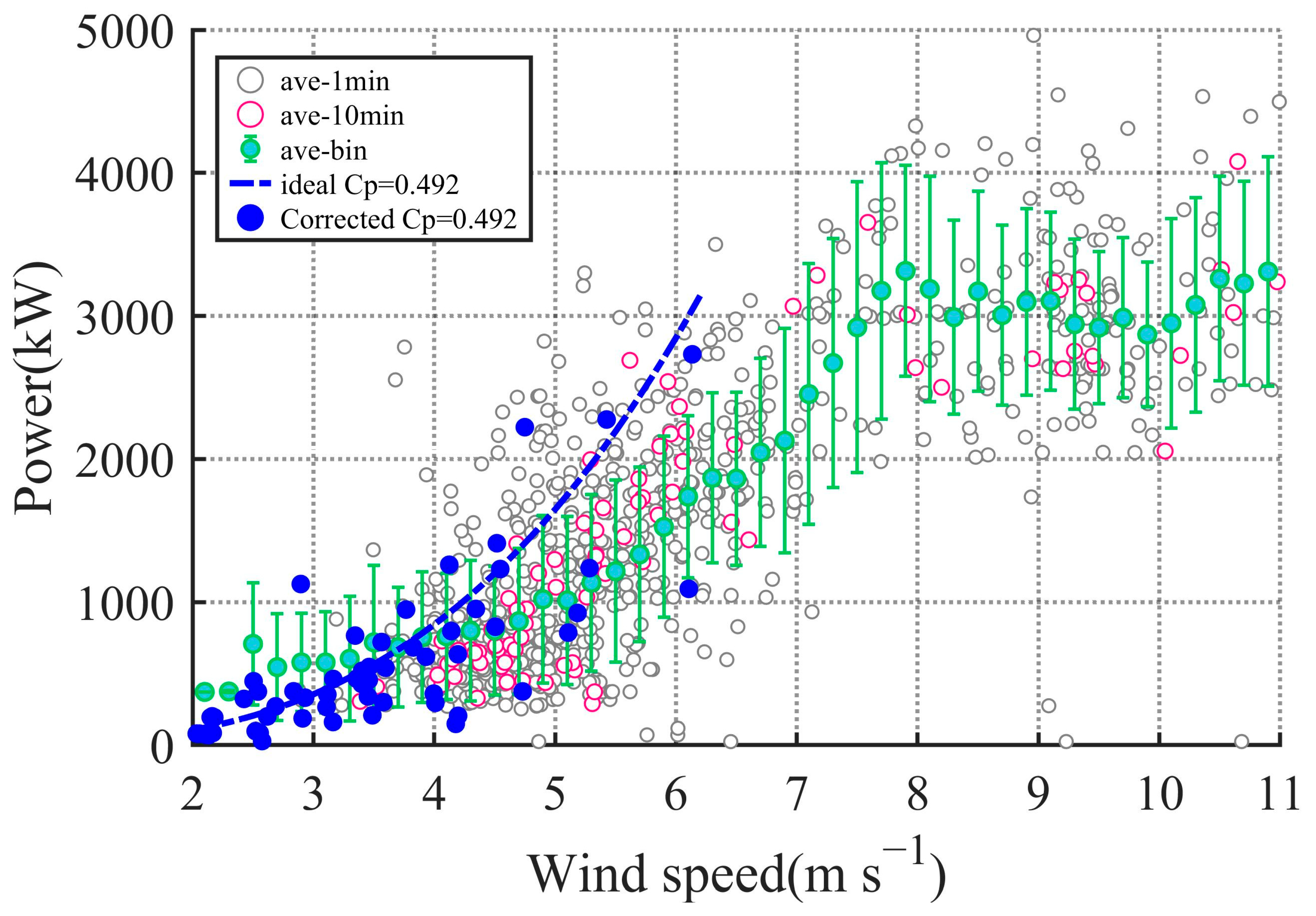
Figure 14 shows the relationship between power generation and WS. The grey dots and pink dots represent the 1 min and 10 min average power generation, respectively. The green dots represent the average power generation based on WS bins, and a WS bin of 0.2 m s−1 was used in this study. The blue dashed curve represents the traditional classical output power curve (Equation (9)) with the Cp of 0.492, the maximum designed value for this wind turbine in this study. The blue dots represent the power generation corrected by the new wind parameter Uc (Equation (10)), with the power coefficient Cp value of 0.492.
Although the grey and pink dots in Figure 14 have a large degree of dispersion, they clearly indicate the distribution trend of power generation with WS. The power generation of the large wind turbine increased rapidly when the WS was greater than 3 m s−1, and this increasing pattern was not linear but was similar to a power-law function. When the WS measured by the lidar exceeded 8 m s−1, the power generation no longer rapidly increased with increasing WS but remained relatively steady at approximately 3000 kW, and this value was much higher than the power generation of general common wind turbines. The average power generation of the large wind turbine on the basis of the WS bin values clearly exhibited this variation pattern. However, according to the traditional output power curve (Equation (9), blue dashed curves), the actual power generation of the large wind turbine was smaller than the given power of the traditional curve. On the basis of the traditional power curve and the analysis above, the correction factors TI, gust factor, and WSE were utilized to construct a new velocity parameter Uc (Equation (10)), and the relationship between Uc and power generation was much more reasonable and closer to the theoretical curve (blue dots in Figure 14). As shown in Figure 14, the theoretical curve and green dots had almost the same power generation at WS of about 4 m s−1. For small winds (less than 4 m s−1 in this paper), the actual power generations were slightly higher than the calculated power values according to the power curve, and the correction factor enhanced the power generation efficiency. However, the actual power generation declined lower than the theoretical power generation for the winds exceeding 4 m s−1, and the effects of turbulence, gust and wind shear mainly weakened the power generation of the wind turbine.
Table 4 shows the correction coefficients C1, C2, and C3, and the corresponding determination coefficients R2 and RMSE between the corrected power values and the ideal power output based on different Cp values. As shown in Table 4, the determination coefficients R2 and RMSE of different Cp values were not significantly different, and the effect of the correction factors was relatively minimal, with a Cp of about 0.486.

4. Conclusions

This study analyzed the observation results of large wind turbines (with a hub height of 135 m and a blade length of 118 m) and remote sensing equipment lidar in coastal regions in Dongying, Shandong Province, China. The corresponding atmospheric boundary layer WS and turbulence distribution are more complex for a large wind turbine. The winds measured by lidar were used to construct a new wind parameter Uc that integrated multi-layer and multidimensional wind parameters TI, gust, and wind shear; furthermore, a corrected power generation model was proposed.
The wind speed measured by the wind cup was highly consistent with the values measured by the lidar within the WS range of 3–12 m s−1. The gust factor measured by the downwind lidar was generally greater than that measured in the upwind direction, and these wake effects were observed at approximately 7 times the diameter of the wind turbine rotor downwind of the wind turbine. The wake effects in the wind farm cannot be disregarded.
The gust factor was inversely correlated with the WS, and the power-law function model had good fitting performance. The closer to the ground, the greater the effect of surface friction, the gust factor is usually greater, and the gust factor gradually decreases with increasing height. The gust factor was closely related to TI, especially at lower heights. The JohnsonSU distribution function could accurately fit the probability density function of the gust factor. The absolute value of the shape parameter γ was maximal around the hub height, whereas the shape parameter δ, scale parameter λ, and position parameter ξ were essentially maximal near the lower blade tip height.
The wind parameters varied greatly with the atmospheric stability defined by Rb. The frequency of high WS was particularly high when the atmosphere was stable or neutral, and the WS showed a concentrated distribution under stable atmospheric stratification compared with the other three classifications of atmospheric stratification. The variation model of WSE at different stability regimes was very similar to that of WS. As the atmosphere progressed from a nearly neutral state towards a more stable state, the WSE values increased, indicating a wind profile with an increased vertical gradient of WS. The median value (~0.14) of the neutral layer conformed to that reported in a previous study. As the Rb value progressed from zero to a negative value, the atmosphere was stratified to a more unstable condition. The WSE distribution tended to decrease under unstable conditions. The TI of the unstable regime was generally higher than those of the other regimes. A high TI became more frequent and more sporadic under an unstable atmosphere. The change trend of the gust factor with respect to stability was very similar to that of TI. For moderately unstable, slightly unstable, and neutral conditions, the minimum values were concentrated at approximately 1.44.
The TI, gust factor, and WSE near the hub height exhibited obvious diurnal variations, and the TI and gust factor generally reached their maxima at approximately 12:00. The values of TI in this study were relatively higher than the values reported in the previous study. Compared with that of the nighttime results, the distribution randomness of the daytime TI was strong. The daily variation in the gust factor was very similar to that in the TI. The daytime gust factor was generally high, and the maximum value of the gust factor exceeded 2.2. The daytime turbulence mixing effects were stronger in the convective boundary layer, which was further proven by the small WSE, and most of the daytime values were less than 0.1. The WSE gradually increased and reached its maximum after midnight, which may also be attributed to the formation of low-level jet streams after midnight.
On the basis of the analysis of multidimensional wind parameters above, this study utilized the TI, gust factor, and WSE measured by lidar to form a new wind parameter Uc that suitable for the use of traditional classical power output curve for the larger wind turbine. The relationship between Uc and power generation was consistent with the theoretical curve after the correction factor was introduced. The correction factor caused a decreased power generation lower than the theoretical values for large winds (>4 m s−1), however, for small winds, the combined effects of TI, gust, and wind shear increased the power output.
Due to limitations in observation duration and location site, further exploration would still consider multi-parameter wind power correction models and their influencing factors. Our future work will further explore the improvement of power generation integrated by more wind characteristics and study the real-world advantages of enhanced power curve prediction such as component lifespan extension, greater grid integration, or lower maintenance costs.

Author Contributions

Y.S.: Conceptualization, Methodology, Software, Writing original draft and review, Funding acquisition. F.H.: Observation experiment design, Theoretical framework, Visualization, Writing review. X.L.: Data Validation. Z.Z.: Writing analysis. K.Z.: Writing analysis. All authors have read and agreed to the published version of the manuscript.

Funding

This work was supported by the National Natural Science Foundation of China (Grant No. 42250204, Grant No. 42105093); the Open Project of State Key Laboratory of Wind Power Generation Equipment and Control (FDKT2024-02); and the National Key Research and Development Program of China (2022YFF0802500).

Data Availability Statement

The original contributions presented in this study are included in the article. Further inquiries can be directed to the corresponding author.

Acknowledgments

The authors thank the State Power Investment Corporation Limited for the technical support and for providing the datasets employed for the study.

Conflicts of Interest

Author Xuelin Li was employed by the company State Power Investment Corporation Limited. Author Zhe Zhang was employed by the company Aerospace Newsky Technology Co., Ltd. The remaining authors declare that the research was conducted in the absence of any commercial or financial relationships that could be construed as a potential conflict of interest.

References

  1. Osman, A.I.; Chen, L.; Yang, M.; Msigwa, G.; Farghali, M.; Fawzy, S.; Rooney, D.W.; Yap, P.S. Cost, environmental impact, and resilience of renewable energy under a changing climate: A review. Environ. Chem. Lett. 2023, 21, 741–764. [Google Scholar] [CrossRef]
  2. Kandy, D.M.; Mörtberg, U.; Wretling, V.; Kuhlefelt, A.; Byström, G.; Polatidis, H.; Barney, A.; Balfors, B. Spatial multicriteria framework for sustainable wind-farm planning–Accounting for conflicts. Renew. Sustain. Energy Rev. 2024, 189, 113856. [Google Scholar] [CrossRef]
  3. GWEC. Global Wind Report 2023. Available online: https://gwec.net/globalwindreport2023/ (accessed on 28 July 2025).
  4. Emeis, S. Current issues in wind energy meteorology. Meteorol. Appl. 2014, 21, 803–819. [Google Scholar] [CrossRef]
  5. Veers, P.; Dykes, K.; Lantz, E.; Barth, S.; Bottasso, C.L.; Carlson, O.; Clifton, A.; Green, J.; Green, P.; Holttinen, H. Grand challenges in the science of wind energy. Science 2019, 366, eaau2027. [Google Scholar] [CrossRef] [PubMed]
  6. Abdallah, A.; William, M.A.; Moharram, N.A.; Zidane, I.F. Boosting H-Darrieus vertical axis wind turbine performance: A CFD investigation of J-Blade aerodynamics. Results Eng. 2025, 27, 106358. [Google Scholar] [CrossRef]
  7. International Energy Agency (IEA). Wind turbines-Part 2: Small Wind Turbines. Available online: https://webstore.iec.ch/publication/5433 (accessed on 30 November 2025).
  8. Vanderwende, B.J.; Lundquist, J.K. The modification of wind turbine performance by statistically distinct atmospheric regimes. Environ. Res. Lett. 2012, 7, 034035. [Google Scholar] [CrossRef]
  9. Sathe, A.; Mann, J. A review of turbulence measurements using ground-based wind lidars. Atmospheric Meas. Tech. 2013, 6, 3147–3167. [Google Scholar] [CrossRef]
  10. Manwell, J.F.; McGowan, J.G.; Rogers, A.L. Wind Energy Explained: Theory, Design and Application, 2nd ed.; Manwell, J.F., McGowan, J.G., Rogers, A., Eds.; John Wiley: Chichester, UK, 2009. [Google Scholar]
  11. Stull, R.B. An Introduction to Boundary Layer Meteorology; Kluwer Academic Publishers: Dordrecht, The Netherlands, 1988. [Google Scholar]
  12. Larsén, X.G.; Davis, N.; Hannesdóttir, Á.; Kelly, M.; Svenningsen, L.; Slot, R.; Imberger, M.; Olsen, B.T.; Floors, R. The Global Atlas for Siting Parameters project: Extreme wind, turbulence, and turbine classes. Wind Energy 2022, 25, 1841–1859. [Google Scholar] [CrossRef]
  13. Bardal, L.M.; Sætran, L.R. Influence of turbulence intensity on wind turbine power curves. Energy Procedia 2017, 137, 553–558. [Google Scholar] [CrossRef]
  14. Asadi, M.; Pourhossein, K. Wind farm site selection considering turbulence intensity. Energy 2021, 236, 121480. [Google Scholar] [CrossRef]
  15. Ryu, G.H.; Kim, D.H.; Lee, H.W.; Park, S.Y.; Yoo, J.W.; Kim, H.G. Accounting for the Atmospheric Stability in Wind Resource Variations and Its Impacts on the Power Generation by Concentric Equivalent Wind Speed. J. Korean Sol. Energy Soc. 2016, 36, 49–61. [Google Scholar] [CrossRef]
  16. Scheurich, F.; Enevoldsen, P.B.; Paulsen, H.N.; Dickow, K.K.; Fiedel, M.; Loeven, A.; Antoniou, I. Improving the Accuracy of Wind Turbine Power Curve Validation by the Rotor Equivalent Wind Speed Concept. J. Phys. Conf. Ser. 2016, 753, 072029. [Google Scholar] [CrossRef]
  17. Ryu, G.H.; Kim, D.; Kim, D.Y.; Kim, Y.G.; Kwak, S.J.; Choi, M.S.; Jeon, W.; Kim, B.S.; Moon, C.J. Analysis of Vertical Wind Shear Effects on Offshore Wind Energy Prediction Accuracy Applying Rotor Equivalent Wind Speed and the Relationship with Atmospheric Stability. Appl. Sci. 2022, 12, 6949. [Google Scholar] [CrossRef]
  18. Kong, S.; Xiao, Y.L.; Cao, J.L.; Han, Z.T. Adapting wind shear coefficients to urban morphology: Unlocking urban wind energy potential. Sustain. Cities Soc. 2025, 121, 106217. [Google Scholar] [CrossRef]
  19. Ryu, G.H.; Kim, Y.G.; Kwak, S.J.; Choi, M.S.; Jeong, M.S.; Moon, C.J. Atmospheric Stability Effects on Offshore and Coastal Wind Resource Characteristics in South Korea for Developing Offshore Wind Farms. Energies 2022, 15, 1305. [Google Scholar] [CrossRef]
  20. Wu, Z.; Bangga, G.; Cao, Y. Effects of lateral wind gusts on vertical axis wind turbines. Energy 2019, 167, 1212–1223. [Google Scholar] [CrossRef]
  21. Kim, D.; Ryu, G.; Moon, C.; Kim, B. Accuracy of a short-term wind power forecasting model based on deep learning using LiDAR-SCADA integration: A case study of the 400-MW Anholt offshore wind farm. Appl. Energy 2024, 373, 123882. [Google Scholar] [CrossRef]
  22. Shi, Y.; Zeng, Q.C.; Liu, L.; Huo, J.T.; Zhang, Z.; Ding, W.C.; Hu, F. Observed evidence that subsidence process stabilizes the boundary layer and increases the ground concentration of secondary pollutants. J. Geophys. Res. Atmos. 2022, 127, e2021JD035244. [Google Scholar] [CrossRef]
  23. Kim, D.Y.; Kim, Y.H.; Kim, B.S. Changes in wind turbine power characteristics and annual energy production due to atmospheric stability, turbulence intensity, and wind shear. Energy 2021, 214, 119051. [Google Scholar] [CrossRef]
  24. Elliott, D.L.; Holliday, C.; Barchet, W.; Foote, H.; Sandusky, W. Wind Energy Resource Atlas of the United States; Solar Energy Research Institute: Golden, CO, USA, 1987; p. 210. [Google Scholar]
  25. Wharton, S.; Lundquist, J.K. Atmospheric stability affects wind turbine power collection. Environ. Res. Lett. 2012, 7, 014005. [Google Scholar] [CrossRef]
  26. Kubik, M.L.; Coker, P.J.; Barlow, J.F.; Hunt, C. A Study into the Accuracy of Using Meteorological Wind Data to Estimate Turbine Generation Output. Renew. Energy 2013, 51, 153–158. [Google Scholar] [CrossRef]
  27. Göçmen, T.; Van Der Laan, P.; Réthoré, P.-E.; Diaz, A.P.; Larsen, G.C.; Ott, S. Wind Turbine Wake Models Developed at the Technical University of Denmark: A Review. Renew. Sustain. Energy Rev. 2016, 60, 752–769. [Google Scholar] [CrossRef]
  28. International Electrotechnical Commission. Wind Turbines Generator Systems-Part 1: Safety Requirements, IEC61400-1.[S]; International Electro Technical Commission: Geneva, Switzerland, 2019. [Google Scholar]
  29. Suomi, I.; Vihma, T.; Gryning, S.; Fortelius, C. Wind-gust parametrizations at heights relevant for wind energy: A study based on mast observations. Q. J. R. Meteorol. Soc. 2013, 139, 1298–1310. [Google Scholar] [CrossRef]
  30. Wang, B.L.; Hu, F.; Cheng, X.L. Wind gust and turbulence statistics of typhoons in South China. Acta Meteorol. Sin. 2011, 25, 113–127. [Google Scholar] [CrossRef]
  31. Johnson, N.L. Bivariate distributions based on simple translation systems. Biometrika 1949, 36, 297–304. [Google Scholar] [CrossRef]
  32. Johnson, N.L. Systems of Frequency Curves Generated by Methods of Translation. Biometrika 1949, 36, 149. [Google Scholar] [CrossRef]
  33. Tian, L.L.; Song, Y.L.; Zhao, N.; Shen, W.Z.; Wang, T.G.; Zhu, C.L. Numerical investigations into the idealized diurnal cycle of atmospheric boundary layer and its impact on wind turbine’s powerperformance. Renew. Energy 2020, 145, 419–427. [Google Scholar] [CrossRef]
  34. Zhang, Z.; Liu, L.; Shi, Y.; Zhang, K.; Liu, K.W.; Wang, S.; Hu, F. Analysis of urban turbulence intensity observed by Beijing 325-m tower and comparison with the IEC turbulence model for small wind turbines. J. Wind. Eng. Ind. Aerodyn. 2023, 241, 105511. [Google Scholar] [CrossRef]
  35. Liao, H.L.; Jing, H.M.; Ma, C.M.; Tao, Q.Y.; Li, Z.G. Field measurement study on turbulence field by wind tower and Windcube Lidar in mountain valley. J. Wind. Eng. Ind. Aerodyn. 2020, 197, 104090. [Google Scholar] [CrossRef]
  36. Zou, Q.; Li, Z.; Zeng, X.; Wang, C.; Zou, F. The analysis of characteristics of wind field on roof based on field measurement. Energy Build. 2021, 240, 110877. [Google Scholar] [CrossRef]
  37. Sparks, P.R.; Huang, Z. Gust factors and surface-to-gradient wind-speed ratios in tropical cyclones. J. Wind. Eng. Ind. Aerodyn. 2001, 89, 1047–1058. [Google Scholar] [CrossRef]
  38. Shu, Z.R.; Li, Q.S.; He, Y.C.; Chan, P.W. Gust factors for tropical cyclone, monsoon and thunderstorm winds. J. Wind Eng. Ind. Aerodyn. 2015, 142, 1–14. [Google Scholar] [CrossRef]
  39. Fang, G.S.; Zhao, L.; Cao, S.Y.; Ge, Y.J.; Li, K. Gust characteristics of near-ground typhoon winds. J. Wind Eng. Ind. Aerodyn. 2019, 188, 323–337. [Google Scholar] [CrossRef]
  40. Mohan, M.; Siddiqui, T. Analysis of various schemes for the estimation of atmospheric stability classification. Atmos. Environ. 1998, 32, 3775–3781. [Google Scholar] [CrossRef]
  41. Antoniou, I.; Pedersen, S.M.; Enevoldsen, P.B. Wind Shear and Uncertainties in Power Curve Measurement and Wind Resources; SAGE Publications: Thousand Oaks, CA, USA, 2009. [Google Scholar] [CrossRef]
  42. Dörenkämper, M.; Tambke, J.; Steinfeld, G.; Heinemann, D.; Kühn, M. Atmospheric Impacts on Power Curves of Multi-Megawatt Offshore Wind Turbines. J. Phys. Conf. 2014, 555, 012029. [Google Scholar] [CrossRef]
Figure 1. Evolution of wind turbine size with time. The graph was obtained from © IEA [7].
Energies 18 06398 g001
Figure 2. (a) Map of the local topography of the observation site at Dongying city in Northeast Shandong Province, China. The map was retrieved from Google Maps©. Blue circle represents the large wind turbine. Lidar A: Windmast-WP350, red circle (b), lidar B: Wind Flux 3000, red circle (c) utilized during the observation period in Dongying city.
Energies 18 06398 g002
Figure 3. The large wind turbine (a) and the meteorological tower (b) utilized during the observation period. The location are shown in Figure 1. The large wind turbine is equipped with a hub height 135 m and a blade length of 118 m.
Energies 18 06398 g003
Figure 4. Comparison of the wind speed (a) and wind direction (b) at the hub height 135 m measured by the wind cup and the lidar A. The daytime (c) and nighttime (d) wind rose measured by lidar A at 135 m during the observation period. The blue dashed line in (a) and the black dashed line in (b) respectively represent cases where the wind speed and wind direction measured by the wind cup are the same as those measured by the lidar.
Energies 18 06398 g004
Figure 5. (a) The vertical profile of gust factor calculated based on lidar A and lidar B. (b) The ratio frequency of the difference in turbulent kinetic energy measured by lidar A and lidar B less than zero during the observation period. The red dashed line represents the ratio of negative TKE difference at 50%.
Energies 18 06398 g005
Figure 6. The relationship between gust factor and 10 min averaged wind speed. The dotted lines represent the corresponding power-law fitting functions and the corresponding fitting parameters of the different heights are also listed.
Energies 18 06398 g006
Figure 7. The relationship between gust factor and turbulence intensity (TI). The dotted lines represent the corresponding fitting functions and the corresponding fitting parameters are also listed.
Energies 18 06398 g007
Figure 8. Probability density function histogram and corresponding fitting function line of gust factor.
Energies 18 06398 g008
Figure 9. Box whiskers plot of wind speed (WS) (a), dT/dz (b), wind shear exponent (WSE) (c), turbulence intensity (TI) (d), standard deviation of wind direction (σWD) (e), and gust factor (f) according to the change in atmospheric stability at the hub height 135 m. Rb—bulk Richardson number, u2—moderately unstable (−2 ≤ Rb < −0.5), u1—slightly unstable (−0.5 ≤ Rb < −0.17), n—neutral (−0.17 ≤ Rb < 0.02), and s—stable (0.02 ≤ Rb).
Energies 18 06398 g009
Figure 10. Box whiskers plot of diurnal variation of (a) turbulence intensity (TI), (b) gust factor, and (c) wind shear exponent (WSE) during the observation period. The shaded area indicates nighttime periods. The blue dashed line represents the value of WSE at 0.14.
Energies 18 06398 g010
Figure 11. Comparison of the wind speed measured by lidar A and nacelle at the hub height. The blue dashed line represent cases where the wind speeds measured by the lidar are the same as those measured by the nacelle.
Energies 18 06398 g011
Figure 12. The power versus turbulence intensity (TI), gust factor, and wind shear exponent (WSE) according to different wind speed bins.
Energies 18 06398 g012
Figure 13. Box whiskers plot of power according to the change in atmospheric stability. Rb—bulk Richardson number, u2—moderately unstable (−2 ≤ Rb < −0.5), u1—slightly unstable (−0.5 ≤ Rb < −0.17), n—neutral (−0.17 ≤ Rb < 0.02), and s—stable (0.02 ≤ Rb).
Energies 18 06398 g013
Figure 14. The 1 min averaged power (gray dots, ave-1 min); 10 min averaged power (pink dots, ave-10 min); the bin-averaged values of the power data (green dots, ave-bin) and the standard deviations of the bin-averaged values versus wind speed measured by the lidar. The blue dashed curve represents the traditional classical power output curve with the Cp of 0.492. The blue dots represent the power generation corrected by the new wind parameter Uc.
Energies 18 06398 g014
Table 1. Parameters of the large wind turbine used during the observation period.
ParametersValue
Cut-in wind speed3 m s−1
Rated wind speed11.5 m s−1
blade length118 m
Swept area43,700 m2
Number of blades3
Hub height135 m
Table 2. Summary of the observational variables measured by equipment on the meteorological tower used during the observation period.
Measured VariableDeviceResolution
Wind speedThies (Thies Clima, Göttingen, Germany)0.1 m s−1
Wind directionThies (Thies Clima, Germany)0.1°
PressurePTB110 (VAISALA, Vantaa, Finland)0.1 hPa
TemperatureKPC1.S/6-ME (Ammonit, Berlin, Germany)0.01 K
HumidityKPC1.S/6-ME (Ammonit, Germany)0.01%
Table 3. The fitting parameters of the JohnsonSU function at 17, 60, 135, 195, 253, and 340 m.
Height (m)1760135195253340
γ (shape parameter 1)−2.082−7.258−6.593−3.464−2.648−2.539
δ (shape parameter 2)1.1271.3841.1651.1081.0121.029
λ (scale parameter)0.1410.0020.0010.0180.0270.030
ξ (position parameter)1.2111.0141.0161.0151.0281.024
Table 4. Decisive coefficients R2 and RMSE of different correction coefficients under Cp.
CpCorrection CoefficientsR2RMSE
C1C2C3
0.4850.492−0.5461.4290.451400.26
0.4860.462−0.5301.3870.450400.42
0.4870.466−0.5321.3930.450400.59
0.4880.470−0.5351.3990.449400.76
0.4890.475−0.5371.4050.449400.94
0.490.479−0.5391.4110.448401.11
0.4910.483−0.5421.4170.447401.29
0.4920.487−0.5441.4230.447401.48
Disclaimer/Publisher’s Note: The statements, opinions and data contained in all publications are solely those of the individual author(s) and contributor(s) and not of MDPI and/or the editor(s). MDPI and/or the editor(s) disclaim responsibility for any injury to people or property resulting from any ideas, methods, instructions or products referred to in the content.