Article

Optimal Operation of Battery Energy Storage Systems in Microgrid-Connected Distribution Networks for Economic Efficiency and Grid Security

by
Ahmed A. Alguhi
1,2,* and
Majed A. Alotaibi
1,2,*
1
Electrical Engineering Department, Faculty of Engineering, King Saud University, Riyadh 12372, Saudi Arabia
2
Saudi Electricity Company Chair in Power System Reliability and Security, King Saud University, Riyadh 12372, Saudi Arabia
*
Authors to whom correspondence should be addressed.
Energies 2025, 18(23), 6335; https://doi.org/10.3390/en18236335
Submission received: 16 September 2025 / Revised: 27 November 2025 / Accepted: 1 December 2025 / Published: 2 December 2025

Abstract

The increasing penetration of microgrids (MGs) in modern power distribution systems requires advanced operational strategies to ensure both economic efficiency and technical reliability. This study developed an optimal economic framework for battery energy storage in MG connected to distribution systems in order to minimize operational costs while considering renewable integration and battery charging and discharging cost and degradation cost as well, and their impact on grid technical constraint. An MG is interconnected to the IEEE-33 radial distribution feeder through an additional bus, where the BESS operates to minimize the total operating cost over a 24 h horizon. The formulation captures the charging and discharging dynamics of the BESS, BESS degradation, state-of-charge constraints, electricity price signals, and the network’s operational limits. The optimization problem is solved using Mixed Integer Linear Program (MILP) to obtain the optimal scheduling of BESS charging and discharging which minimizes the total operating cost and maintains grid constraint within the allowable limit by optimizing the power exchange between the MG and the distribution grid. Simulation results showed that the proposed approach reduces operational costs and optimize grid power exchange, while maintaining technical reliability of the distribution system by enhancing its voltage profiles, improving its feeder loading capability, and reducing the system losses. This study provides a practical tool for enhancing both economic and technical performance in MG-connected distribution systems.

1. Introduction

The integration of energy storage systems (ESS) in distribution networks has become a key solution for enhancing energy efficiency, reliability, and flexibility in distribution networks. Furthermore, the advent of Microgrids (MGs), which is characterized by their integration of renewable energy sources (RES) and various ESSs play a crucial role in enhancing the flexibility, reliability, and economic viability, mitigating the environmental impact and reducing the fossil fuel dependence of current power systems for sustainable development [1] by shifting load demand, managing renewable variability, reducing dependence of traditional generation, and providing ancillary services such as voltage support. Economic dispatch is fundamentally centered on minimizing operational costs while maintaining system reliability, and for MGs, it consists of the coordination of RES, demand management, and BESS. Therefore, the optimal operation of BESS requires advanced optimization techniques that can handle both technical and economic objectives.
The economic dispatch of BESS in MG-integrated distribution networks has become an essential factor in enhancing the performance and reliability of modern power systems. As RER sources such as solar and wind power become increasingly integrated into these MGs, the role of BESS is evolving into a pivotal one, not only facilitating energy management but also improving cost efficiency in grid operations. Economic dispatch involves determining the optimal operating costs for power generation while meeting load demands and ensuring grid safety. Economic distribution assessment can greatly benefit from the inclusion of BESS systems, which are capable of storing excess energy during periods of low demand and releasing it back into the grid during peak usage periods.
Several studies have highlighted the economic and operational benefits of BESS in MG environments. For instance, Ma et al. [2] demonstrated that integrating renewable energy with diesel generators and BESS enhances reliability and reduces costs in isolated MGs, underscoring the importance of effective dispatch strategies that account for generator ramp rates and battery constraints. This approach underscores the complexity of integrating multiple generation sources, particularly in scenarios where renewable output is variable, thus necessitating a well-coordinated energy dispatch strategy that encompasses the operational characteristics of both conventional and renewable generators [3]. Similarly, Bansal et al. [4] emphasized the contribution of storage systems to grid reliability and power quality, pointing to their increasing role in enabling broader participation in energy markets. Moreover, demand response integrated with BESS scheduling has been shown to provide real-time balancing between supply and demand, significantly improving the economic operation of MGs [5].
The economic dispatch models that integrate BESS can also employ advanced computational techniques like Genetic Algorithms and model predictive control, as noted in [6]. This methodology allows for the optimization of BESS operations, effectively balancing the costs associated with battery degradation and maintenance against the benefits realized from their usage in peak shaving and load shifting processes. Additionally, Nguyen and Lee emphasized the importance of maintaining battery operations within safe parameters to ensure longevity and economic feasibility, which plays an essential role in defining the overall dispatch strategy [7].
Moreover, recent studies indicate that BESS plays a fundamental role in addressing the variability and intermittency inherent in renewable energy sources, such as solar and wind power, which are increasingly prevalent in MGs. Their incorporation allows for various functionalities including energy arbitrage, peak shaving, and improving self-consumption rates within MGs, enabling users to mitigate reliance on external energy sources [8]. The economic dispatch of BESS can be significantly affected by the chosen optimization methodologies. For instance, the use of intelligent algorithms like Grey Wolf Optimization has demonstrated efficacy in sizing BESS within MG scenarios, tailoring their capacities based on specific renewable generation profiles and operational constraints [9]. A comprehensive energy management strategy that incorporates demand response mechanisms can further enhance the economic operation of MGs with integrated BESS. This can be achieved through real-time balancing of supply and demand, which optimally schedules battery charging and discharging cycles of the BESS in relation to variable electricity pricing [10].
Moreover, the optimal configuration of energy storage capacities in grid-connected MGs contributes significantly to the overall economics and efficiency of these systems [11]. Research indicates that hybrid energy storage configurations, which may include combinations of batteries and ultracapacitors, lead to improved performance in terms of both energy reliability and cost-effectiveness [12].
The economic viability of integrating BESS into MGs is also contingent on advances in battery technology and enhanced lifecycle management strategies. The aging effects of batteries necessitate effective schedules and operational strategies to prolong their lifespan while minimizing capacity degradation [13]. BESS can thus be operated in ways that not only address immediate energy demands but also account for long-term performance metrics, enhancing the overall operational strategy within the MG framework [14]. Furthermore, beyond economic consideration, the technical implications of BESS operation in MGs are critical. Previous studies have demonstrated that appropriate allocation and operation of BESS can significantly enhance system performance, improve voltage profiles, reduce power losses, and strengthen overall grid reliability [15].
Furthermore, significant potential lies in the use of decentralized control strategies which harmonize the functionalities of various energy resources within MGs, particularly those involving BESS and variable renewable energy technologies like photovoltaic systems. Efficient coordination of these resources can lead to optimal dispatching strategies that enhance system profitability through minimized operational constraints [16]. The synergy between demand response initiatives and optimal energy management paradigms ultimately underscores the need for a holistic approach towards MG design and operation.
The interplay between energy storage and demand response mechanisms in optimizing energy costs is increasingly recognized. By shifting and scheduling loads based on available generation and storage capacities, MG operators can yield substantial economic benefits [17]. Despite the growing body of research on economic dispatch of BESS in MGs, several gaps remain unaddressed. Much of the existing work focuses on isolated or stand-alone MGs, with limited attention to the integration of BESS into distribution-level networks. In addition, many studies simplify battery modeling by neglecting realistic charging and discharging dynamics, and SOC limits, which reduces the practicality of the proposed solutions. Furthermore, electricity price signals are often underrepresented in optimization models, limiting their economic accuracy. While heuristic and metaheuristic approaches have been widely applied, the adoption of exact and computationally efficient methods such as MILP for BESS dispatch in grid-connected MGs remains insufficient. Finally, most research emphasizes cost minimization while giving less attention to technical benefits such as grid power smoothing and voltage profile enhancement, which are equally important for reliable distribution system operation. So, BESS has become a cornerstone in economic dispatch (ED) strategies for both grid-connected MGs and larger distribution-integrated energy systems. In these contexts, BESS contributes to dynamic economic dispatch (DED) by coordinating renewable and conventional energy resources, thereby improving system reliability and reducing operational costs [18]. One of the key advantages of BESS lies in its ability to balance supply and demand while accommodating the variability of renewable energy sources such as solar and wind [19]. By charging during low-price or low-demand periods and discharging during peak demand, BESS enables cost-effective energy management and reduces stress on the grid.
To address the uncertainties associated with renewable generation, advanced optimization approaches such as MILP have been applied to integrate BESS into economic dispatch frameworks. These methods enable efficient scheduling of charging and discharging cycles while accounting for operational constraints, electricity price fluctuations, and renewable intermittency [20]. As modern energy systems become increasingly complex, there is a growing need for dispatch models that incorporate BESS not only to minimize costs but also to enhance resilience against operational and market uncertainties [21].
Economic dispatch in MGs aims to minimize operational costs while meeting demand and maintaining system reliability. For distribution-integrated MGs, this requires optimal scheduling of RES, demand response, and BESS, while respecting technical constraints of the network. The unique capability of BESS to store excess energy during low-demand or low-price periods and discharge it during peak-demand or high-price periods makes it a powerful tool for improving both economic and operational performance. However, achieving optimal operation requires advanced optimization frameworks capable of handling charging/discharging dynamics, state-of-charge (SOC) constraints, and electricity price variations over time.
Despite extensive work on BESS integration in MGs, several gaps remain. Many studies focus on storage sizing and investment planning but overlook short-term operational scheduling [11,17]. Others employ heuristic optimization approaches, such as Genetic Algorithms or Grey Wolf Optimization [20], which may not guarantee global optimality or computational efficiency. In contrast, MILP offers a robust and practical optimization tool, providing globally optimal solutions while incorporating detailed operational constraints. Recent real-time consensus-based frameworks [21] emphasize communication robustness but often neglect practical network constraints and cost minimization under normal operation, limiting their applicability to realistic distribution-level MGs.
Recent studies further highlight complementary contributions. Reference [22] investigated the stability of isolated microgrids, demonstrating that BESS can improve voltage and frequency response, particularly under varying generation conditions, although economic dispatch was not considered. Reference [23] proposed hybrid optimization frameworks combining MILP and metaheuristic approaches for microgrid operation, achieving cost minimization and improved load management, but without explicitly addressing battery degradation or network-level technical constraints. Reference [24] focused on optimized battery sizing and economic dispatch in wind-powered microgrids, incorporating depth-of-discharge (DoD) constraints to prolong battery life and reduce operating costs by 40–50%, though the study was limited to wind-dominated systems without full distribution network modeling.
To address these gaps, this study develops a MILP-based economic dispatch framework for BESS in MG-connected distribution systems. The proposed formulation explicitly models battery SOC dynamics, degradation costs, charging and discharging constraints, and electricity price, while ensuring compliance with voltage and thermal limits of the IEEE-33 distribution feeder over a 24 h horizon. The objective is to minimize total operating costs while simultaneously improving technical performance indicators, such as voltage profile and grid power exchange, ensuring both realistic and cost-effective operation.
Unlike previous MILP-based studies that primarily target cost minimization in isolated microgrids or simplified network models, the present work introduces a comprehensive MILP framework for a microgrid-connected distribution feeder that jointly optimizes both economic and technical objectives. The proposed model integrates detailed BESS degradation cost modeling, time-coupled SOC dynamics, charging/discharging decisions, dynamic energy price signals, and real 24 h RES within the optimization while maintaining the operational limits of the IEEE 33-bus network. Additionally, it extends the MILP formulation to improve feeder loading capability, minimize power losses, and enhance voltage stability within a 24 h operational horizon. These features distinguish the proposed work as a practical and technically comprehensive approach for real-world distribution-level MG integration.
The main contribution of this study is as follows:
  • Development of a MILP-based economic dispatch framework for optimal operation scheduling of BESS in a MG connected with the IEEE-33 radial distribution feeder, ensuring a balance between economic efficiency and technical reliability.
  • Comprehensive modeling of BESS operations, incorporating state-of-charge dynamics, charging/discharging constraints, BESS degradation, and electricity price variations over a 24 h horizon to derive realistic scheduling decisions.
  • Demonstration of both economic and technical benefits, showing how the proposed strategy reduces operational costs, smooths grid power exchange, and enhances voltage profiles, improves feeder loading capability, and reduces system losses in the distribution feeder.

2. Proposed System Model

This section presents the mathematical model of the system proposed, which integrates MG and distribution network. The model is structured into four components. First, the MG model is presented, which captures the coupling between local demand and renewable generation. Second, the BESS model is presented, its state-of-charge dynamics, and operation constraints. Third, the RES model is presented. Fourth, the power exchange model is presented to account for import and export interactions between MG and the distribution network. Finally, the Distribution Network Power Flow Model is provided to ensure that active/reactive power balances and voltage constraints are met. All these formulations combined constitute the foundation of the economic dispatch problem stated in the next section.

2.1. MG Model

The MG considered in this study is connected to the main distribution network at bus 34, where both local demand and renewable energy sources are present.

2.1.1. MG Net Demand

The net demand of the MG is calculated as:
P M G n e t t = P M G L o a d t P M G P V t P M G W T t
where P M G L o a d t represents the demand, while P M G P V t   a n d   P M G W T t represents the power generated by photovoltaic (PV) systems and wind turbines (WT), respectively.
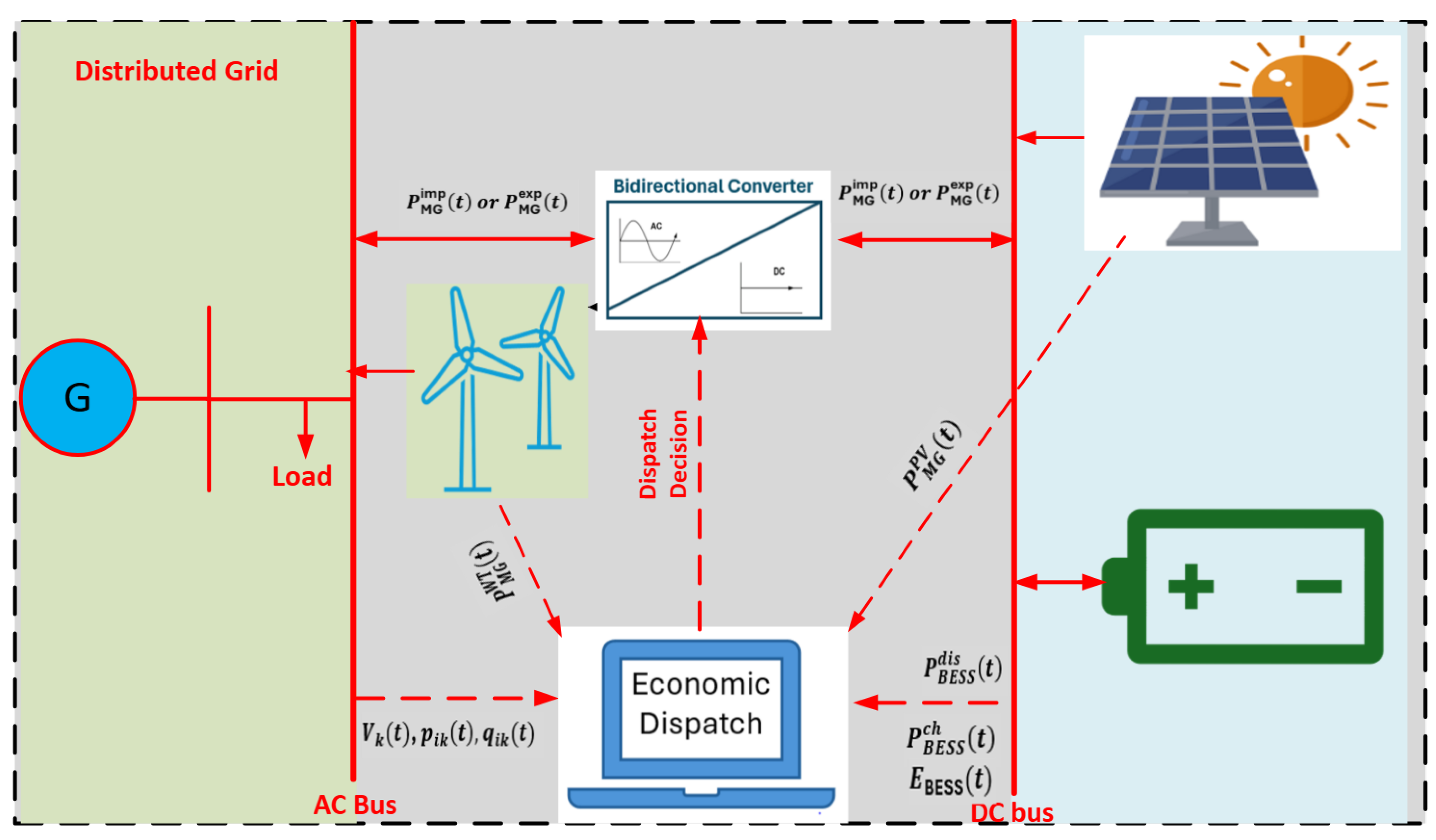
The proposed MG is equipped with a BESS, wind turbine, and PV and a bidirectional converter, which enables flexible power exchange between the DC and AC buses. The economic dispatch framework governs the operation of these components to minimize operational costs while ensuring reliable power supply.

2.1.2. Wind Turbine Output Power Modeling

The operational behavior of a wind turbine can be divided into three main regions: zero power, partial (de-rated) power, and rated power. The zero-power region occurs when the wind speed is below the turbine’s cut-in speed ( v i n ), where the rotor cannot generate sufficient torque to overcome mechanical friction. In the de-rated power region, the turbine’s output rapidly rises with increasing wind speed until it reaches the rated power. Once the wind speed exceeds the turbine’s cut-out speed, the turbine automatically shuts down to protect the rotor and structural components from excessive forces. The power output of the wind turbine in this region is calculated using Equation (1) [25]. The specific parameters of the turbine and the corresponding wind speed data used in this study are summarized in Table 1.
P w i n d v = 0 ,                   0 < v < v i n     and   v > v o u t P w r v v i n v r v i n ,                         v i n < v < v r P w i n d                                                                 v r < v < v r  

2.1.3. PV Output Power Modeling

Similarly to wind turbine modeling, the power generated by a photovoltaic (PV) system is strongly dependent on the solar irradiance ( s ). The PV output power can be determined using Equation (2) [25]. The key parameters of the PV system and the corresponding solar irradiance data employed in this study are listed in Table 2.
P P V s = P P V r s 2 s S T D × r C     f o r   0 < s < r C P P V r s s S T D   f o r   r C s < s S T D P P V r   f o r   s > s S T D
Figure 1 shows the overall structure of the proposed MG model, highlighting the interaction between the distributed grid, renewable energy sources, BESS, and the economic dispatch unit. This figure illustrates the main measurement points within the MG. The instantaneous renewable power outputs P MG P V ( t ) and P MG W T ( t ) are measured at the PV and wind generation interfaces, while the BESS controller provides the charging and discharging power signals P BESS c h ( t ) and P BESS d i s ( t ) , as well as the stored energy E BESS ( t ) . On the AC side, nodal voltage magnitudes V i ( t ) and branch power flows P i k ( t ) ,   Q i k ( t ) are monitored to evaluate feeder loading against its thermal limit. These measurements feed into the economic dispatch unit in order to determine the optimal power exchange between MG and the distribution grid and which ensures a balance between economic efficiency and technical reliability.

2.2. BESS Model

BESS is a key component of the proposed MG model, enabling energy shifting, peak shaving, and integration of intermittent renewable resources. The mathematical formulation of the BESS includes its SoC dynamics, operational constraints, and its role in power exchange with the grid.

2.2.1. SoC Dynamics

The state of energy in the BESS at any time step t is expressed as:
E B E S S t =   E B E S S t 1 + η c h × P B E S S c h a r g e t t 1 η d i s × P B E S S d i s c h a r g e ( t ) t
where P B E S S c h a r g e t and P B E S S d i s c h a r g e represent the charging and discharging power, respectively, while η c h and η d i s are the charging and discharging efficiencies.

2.2.2. Operational Constraints

To ensure reliable and safe operation of the BESS, the following constraints are imposed:
E B E S S m i n E B E S S t E B E S S m a x
0 P B E S S c h P B E S S c h , m a x
0 P B E S S d i s P B E S S d i s , m a x
S O C m i n S O C ( t ) S O C m a x
The state of charge at time t is defined as:
S O C t = E B E S S t E B E S S M a x × 100
To prevent simultaneous charging and discharging, the following binary condition is applied:
μ c h t + μ d i s t = 1 ,             μ c h , μ d i s { 0,1 }

2.3. Power Exchange Model

In the proposed MG, power can be exchanged with the distribution grid to ensure that local demand is continuously met while maximizing the utilization of renewable energy resources and the BESS. The power exchange is defined as the difference between the imported and exported power at time t:
P M G e x t = P M G i m p P M G e x p
where P M G i m p is the power imported from the distribution grid and P M G e x p is the power exported to the grid.
The overall power balance of the MG is governed by the interaction of load demand, renewable generation, and BESS operation. This relationship is expressed as:
P M G n e t t + P B E S S c h ( t ) P B E S S d i s ( t ) = P M G i m p P M G e x p
Equation (10) ensures that any mismatch between the net MG demand and the renewable supply is compensated either by charging/discharging the BESS or by importing/exporting power from the distribution grid. This formulation links the operation of renewable energy resources, BESS, and the external grid, providing the foundation for the economic dispatch problem.

2.4. Distribution Network Power Flow Model

The proposed system is embedded within the IEEE 33-bus radial distribution network. The operation of the distribution network is governed by power flow equations that ensure the balance between active and reactive power at each bus while maintaining voltage stability across the system.

2.4.1. Active Power Balance

At any bus k, the active power balance is expressed as:
j Ω k i n p j k t i Ω k o u t p k i t = P k G t P k L o a d ( t )
where p j k t  and p k i t are the active power flows into and out of bus k, respectively. P k G t and P k L o a d t denote the active power generation and load at bus k.

2.4.2. Reactive Power Balance

The reactive power balance at bus k is similarly defined as:
j Ω k i n q j k t i Ω k o u t q k i t = Q k G t Q k L o a d ( t )
where q j k t  and q k i t are the active power flows into and out of bus k, respectively. Q k G t and Q k L o a d t denote the active power generation and load at bus k.
Equations (13)–(15) are applied at every bus k and at every time interval t of the 24 h scheduling horizon. All power flow, generation, and load terms are explicitly modeled as time-dependent variables.
For bus 34, where the MG is integrated, the active power balance incorporates the import and export between the MG and the distribution grid:
P 34 G t P 34 L o a d t = P M G i m p P M G e x p

2.4.3. Grid Operational Limits

Voltage Operational Limits
The distribution network must also satisfy voltage constraints to ensure secure operation:
V m i n V k ( t ) V m a x                   ,   k , t
Equations (13)–(16) collectively define the distribution network power flow model, ensuring that all power exchanges between the IEEE 33-bus system and the MG at bus 34 are balanced while maintaining voltage stability.
Thermal Operation Limits (Line Loading)
This constraint ensures that the apparent power flow through each distribution line does not exceed its rated capacity. This constraint is expressed as in (17). Enforcing this constraint prevents overheating of conductors, safeguards insulation integrity, and maintains the secure operation of the distribution network.
p i k t 2 + q i k t 2 S i k m a x , i k , t
where p i k t and q i k t represent the active and reactive power flows on feeder ik at time t, and S i k m a x denotes the thermal capacity of line ik.

2.5. Objective Function

The optimization objective of the proposed model is to minimize the total operating cost of the MG over a 24 h scheduling horizon. The cost function accounts for electricity transactions with the distribution grid as well as the degradation cost of the BESS. The objective function is expressed as:
m i n t = 1 24 P M G n e t t t + P B E S S c h t P B E S S d i s t P M G P V t t P M G W T t t × T a r ( t ) + δ d e g B E S S P B E S S d i s ( t ) t
δ d e g B E S S = γ B E S S r e p   ×   C C a p i t a l   B E S S N c y c l e
where P M G n e t is the net MG-grid power, P B E S S c h and P B E S S d i s are BESS charge/discharge powers, P M G P V t   and P M G W T are renewable generation, T a r ( t ) is the electricity tariff, δ d e g B E S S is the depredation cost of BESS in (USD/kwh) γ B E S S r e p is the replacement fraction, C C a p i t a l   B E S S is BESS capital cost, and N c y c l e is the BESS lifetime in cycles.

2.6. Proposed Model Implementation

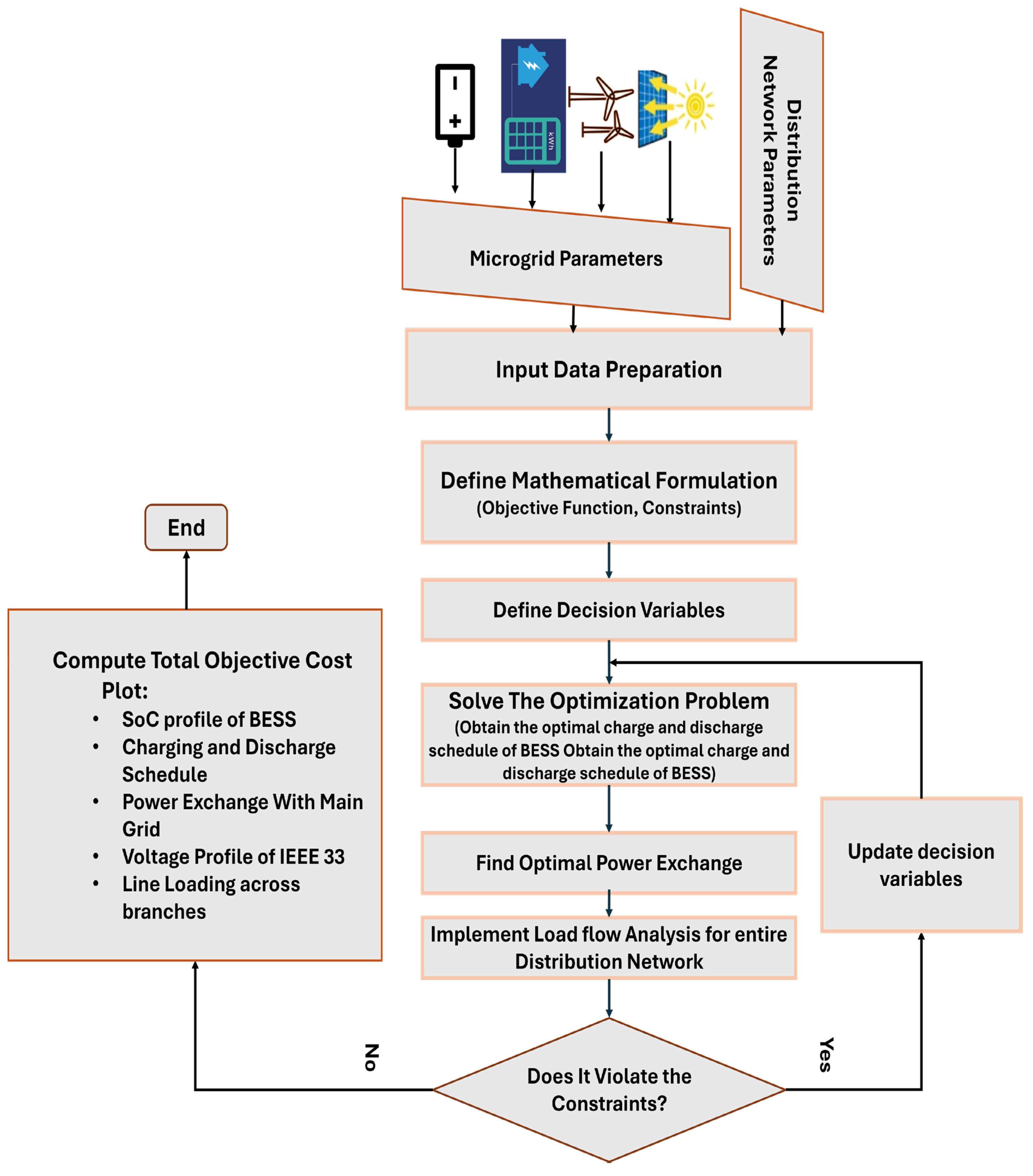
The proposed economic dispatch model was implemented in MATLAB using a Mixed-Integer Linear Programming (MILP) technique. The process as shown in Figure 2 begins with input data preparation, where the IEEE-33 radial distribution system is represented with its line parameters, nodal loads, and operational limits. The MG, connected at bus 34, is modeled with its demand, renewable generation profiles, and time-varying electricity prices. BESS is characterized by its rated energy capacity, charging and discharging power limits, round-trip efficiency, SoC limit, and degradation cost derived from its capital and replacement costs.
The objective function minimizes the total operating cost of the integrated system, which is expressed as the sum of the cost of energy exchanged with the upstream grid and the degradation cost incurred from battery cycling. To achieve this, the model introduces several decision variables, including the charging power P B E S S c h , discharging power P B E S S d i s and the state of energy in the BESS at any time step E B E S S t and SoC of the BESS, as well as the grid import and export powers P M G i m p , P M G e x p . Binary variables μ c h t    and μ d i s t which enforce the complementarity condition that prevents simultaneous charging and discharging. For the distribution system, the branch active and reactive power flows and bus voltages are also defined as optimization variables, ensuring compliance with the full set of power flow and operational constraints of the IEEE-33 feeder.
These variables and constraints are incorporated into the MILP framework by constructing the objective vector, equality constraints (e.g., SoC dynamics and power balance at the point of common coupling), and inequality constraints (e.g., power and voltage limits, and line capacity constraints). The resulting optimization problem is solved using MATLAB, which efficiently handles the mixed-integer structure of the formulation.
Upon convergence, the model provides the optimal BESS operating schedule, including its charging and discharging profile, SoC trajectory, and the power exchanged with the upstream grid. In addition, the solution yields the bus voltage magnitudes and branch flow profiles of the IEEE-33 system. Post-processing of the results includes calculating the total operating cost, quantifying the contribution of degradation costs, and visualizing the 24 h profiles of SoC, grid exchange, voltage magnitudes, and line loadings. This comprehensive implementation ensures that both the economic benefits and technical impacts of BESS integration are fully captured.
The optimization was carried out in MATLAB R2023a using the intlinprog solver from the Optimization Toolbox, which efficiently handles MILP problems. The solver settings included a relative optimality tolerance of 1 × 10⁻⁶, maximum iterations of 105, and automatic presolve and cut generation enabled to ensure convergence. Simulations were performed on a laptop with an Intel i7 CPU and 16 GB RAM, with an average computation time of approximately 57 s for the 24 h optimization horizon with 1 h resolution. These implementation details are included to enhance the reproducibility and transparency of the proposed MILP-based optimization framework.

3. Results

This section provides a concise and precise description of the results and their interpretation as follows.

3.1. System Under Study

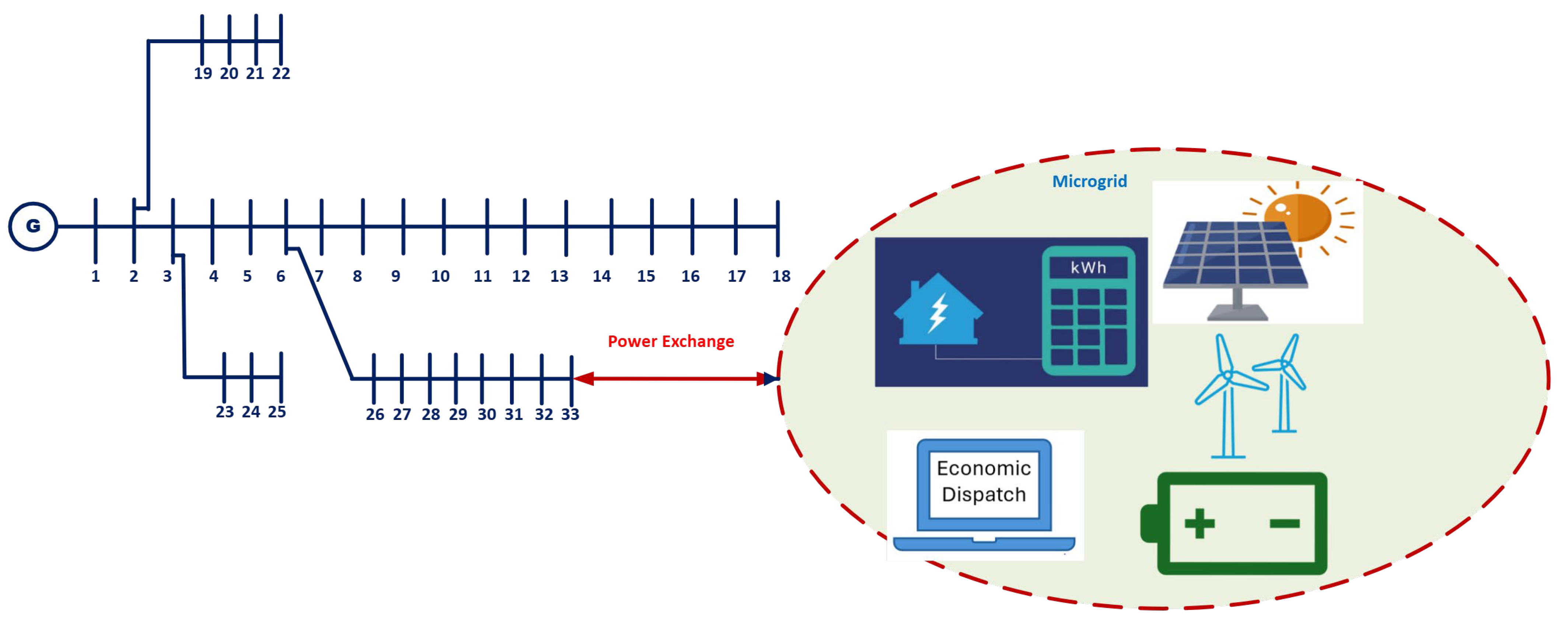
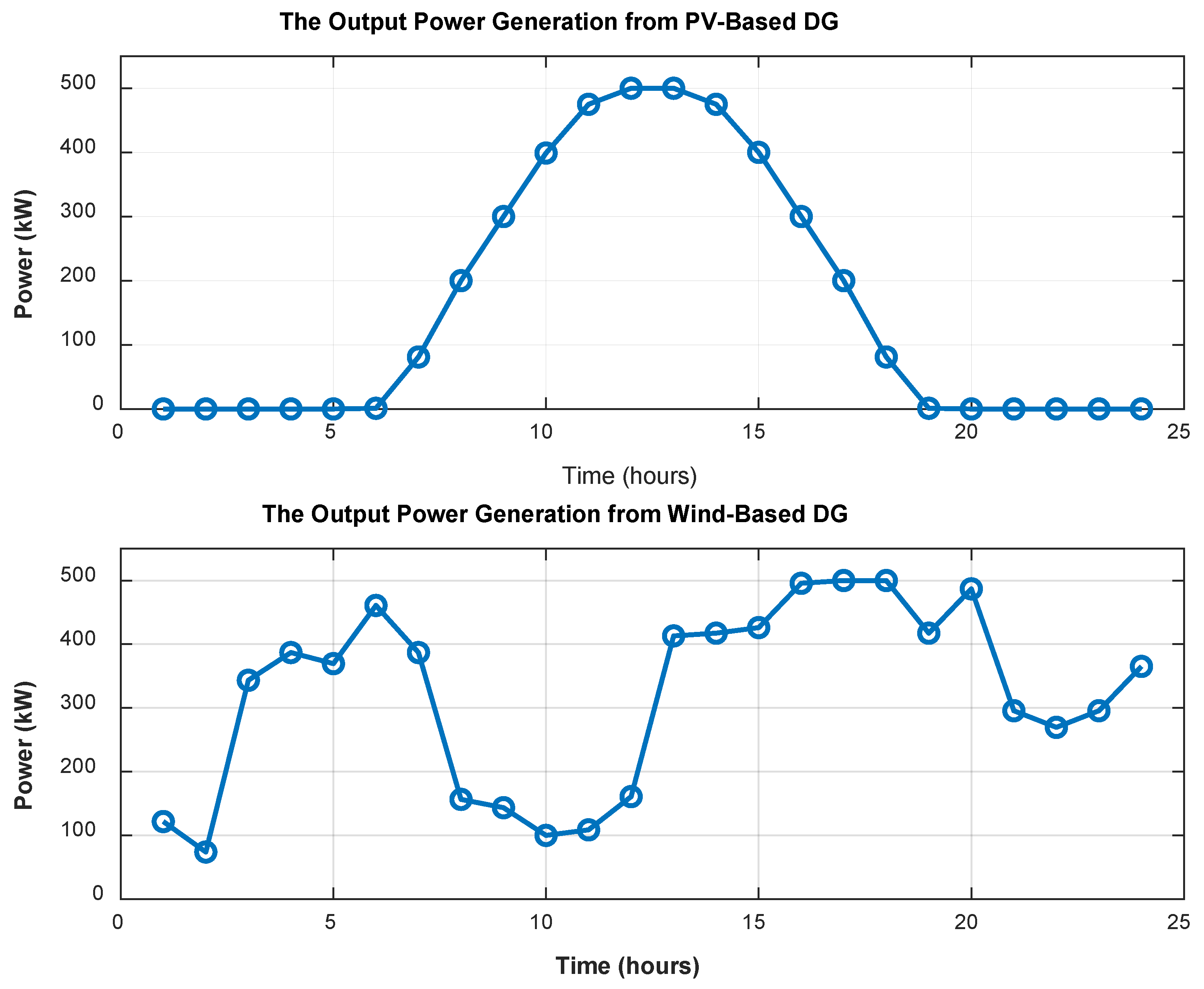
The proposed model is applied to the IEEE 33-bus radial distribution test system, which has a total active power demand of 3.72 MW and reactive power demand of 2.3 Mvar, with base values of 100 MVA and 12.66 kV [26]. In this study, an MG (MG) is integrated into the distribution system through new tie line connected between bus 33 and new additional bus as shown in Figure 3. Also, the RES, including PV and wind turbine generation units, have been added to the system under study, each with a maximum capacity of 500 kW. The MG has a maximum local demand of 1000 kW, while the PV and WT provide 24 h renewable generation profiles and the demand profile as in [25]. These profiles are based on actual measured solar irradiance and wind speed data collected from Al Jouf College of Technology’s weather monitoring station in Saudi Arabia and sourced from K.A. CARE, ensuring that typical daily variability of renewable resources is captured. The resulting output generation power over 24 h from PV and WT is illustrated in Figure 4. The profile was adapted from the IEEE Reliability Test System (RTS) [27]. Although these data sets provide realistic daily patterns, the optimization does not account for stochastic fluctuations or forecast errors. Incorporating uncertainty through stochastic or robust optimization techniques could further enhance the model’s applicability under real-world conditions and is considered for future work. The BESS is utilized to optimize dispatch by shifting load and minimizing operation costs. The BESS is defined with a maximum storage capacity of 4000 kWh, maximum charging/discharging power of 500 kW, state-of-charge (SOC) limits between 10% and 95% of capacity, charging and discharging efficiencies of 95%, an initial stored energy of 1000 kWh, and a cycle life of 3500 cycles, with an assumed 1 h charge/discharge rate, a capital cost of 469 USD/kWh, and a replacement cost equal to 79% of the capital cost [28,29,30,31]. A Time-of-Use (ToU) pricing scheme is adopted, with electricity costs set at 0.27 USD/kWh during off-peak hours, 1.16 USD/kWh during mid-peak hours, and 1.78 USD/kWh during on-peak hours. The MG operates in grid-connected mode, exchanging power with the main grid as required, while the IEEE 33-bus system is constrained by voltage limits between 0.9 and 1.0 p.u. and thermal limits of 5MVA on feeder 1, 4 MVA for feeder 2, and 3.18 MVA on all other feeders.

3.2. Results and Discussion

3.2.1. Economic Analysis

Table 3 shows the results of the proposed model which consists of total energy and total operating cost of the MG and evaluation of its impact on MG operating cost and distribution of grid constraints.
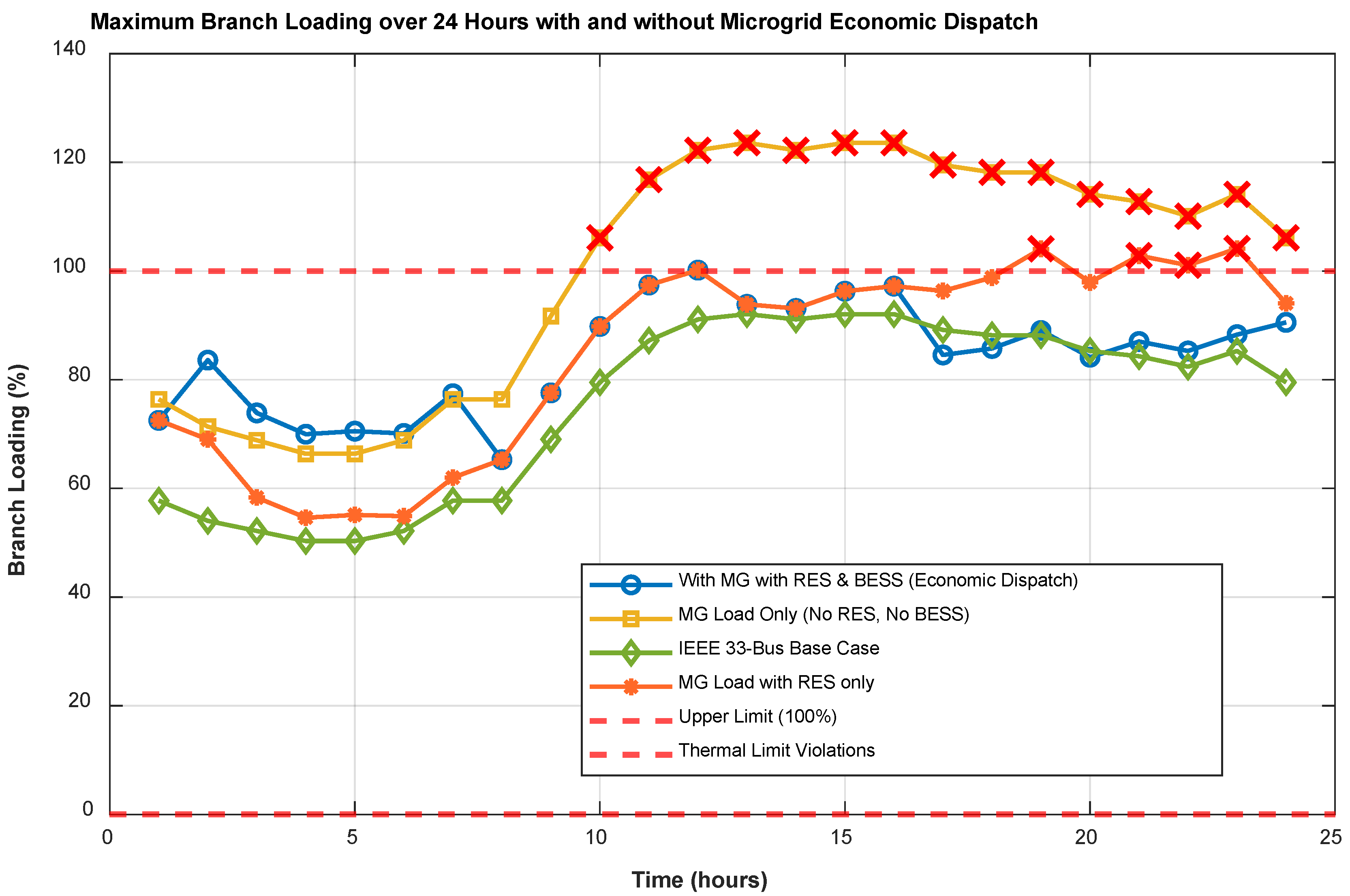
These results demonstrated the effectiveness of integrating BESS into MG. As shown in this table, In the MG load only (No RES, No BESS) scenario, where MG operates with load only without RES and BESS, the system experiences both thermal and voltage limit violations due to additional demand of MG which result in total daily energy of 19,820 kWh and the highest operating cost of USD 23,914. When RESs are introduced, the net demand is reduced to 8213 kWh, and the operating cost decreases to USD 10,314, corresponding to a 57% saving compared to the baseline. However, due to the intermittent nature of RES, thermal and voltage violations persist. The best performance is achieved when both RES and BESS are coordinated under the proposed model. In this scenario, the distribution system limit violations are fully eliminated and the work within allowable limit. Furthermore, the total daily energy is further reduced to 7550.8 kWh, a reduction of 61.9%, and the operating cost drops to USD 6118. This cost includes a degradation component of USD 1433 associated with BESS cycling, but even after accounting for this, the overall savings reach 74.4% compared to the baseline; all of this enhancement is due to the optimal power exchange between the grid and MG due to optimal economic operation of BESS in MG. These results confirm that while RES alone can deliver cost reductions, the optimal dispatch of BESS in MG ensures not only greater economic benefits but also technical reliability by maintaining both voltage stability and thermal security and reduce system losses in the distribution grid.

3.2.2. BESS Operation

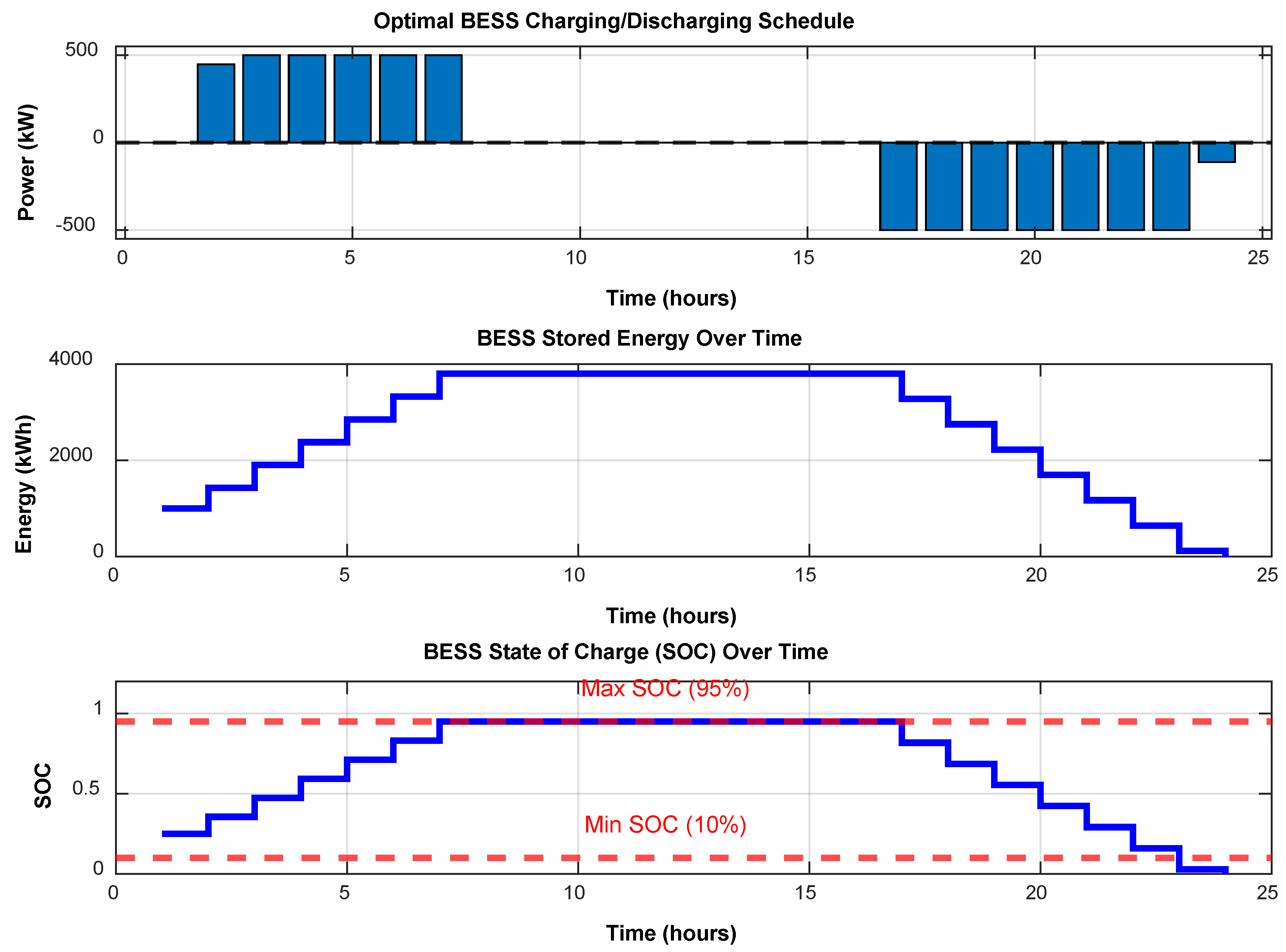
Figure 5 consists of three subplots that illustrate the operational schedule of the BESS in MG under the proposed economic operation of the BESS model. The top subplot, a bar graph, shows the optimal charging and discharging of BESS in kW over a 24 h horizon, as it shown in this bar plot (i.e., the top subplot) the BESS charges during low-demand and off-peak periods at 2 a.m. to 7 a.m. and discharges during high-demand and on-peak 5 p.m. to 12 a.m. This charging and discharging behavior of BESS effectively reduces the system’s net demand during peak hours while taking advantage of lower electricity prices during off-peak hours to minimize the total energy demand of MG, which leads to minimizing total system operating cost. The middle subplot illustrates the cumulative energy in kWh stored in the BESS, rising stepwise from 0 to a peak around 4000 kWh by 7 a.m., stabilizing until discharge starting time at 5 p.m. and then the battery gradually discharging until close to depletion at the end of the day. This refers to optimal charging and discharging behavior cycle of BESS in MG. The bottom subplot shows the SOC limit of BESS over 24 h which confirms that the BESS operates strictly within the defined operational bounds of 10% and 95%. These results from these plots highlight the effectiveness of the proposed MILP-based optimization framework in economic dispatch of BESS by scheduling BESS operations, ensuring both technical feasibility and economic efficiency by efficiently managing charge–discharge cycles within safe operational limits, supporting load balance and cost minimization over the horizon.

3.2.3. Net Demand and Power Exchange Between Grid and MG

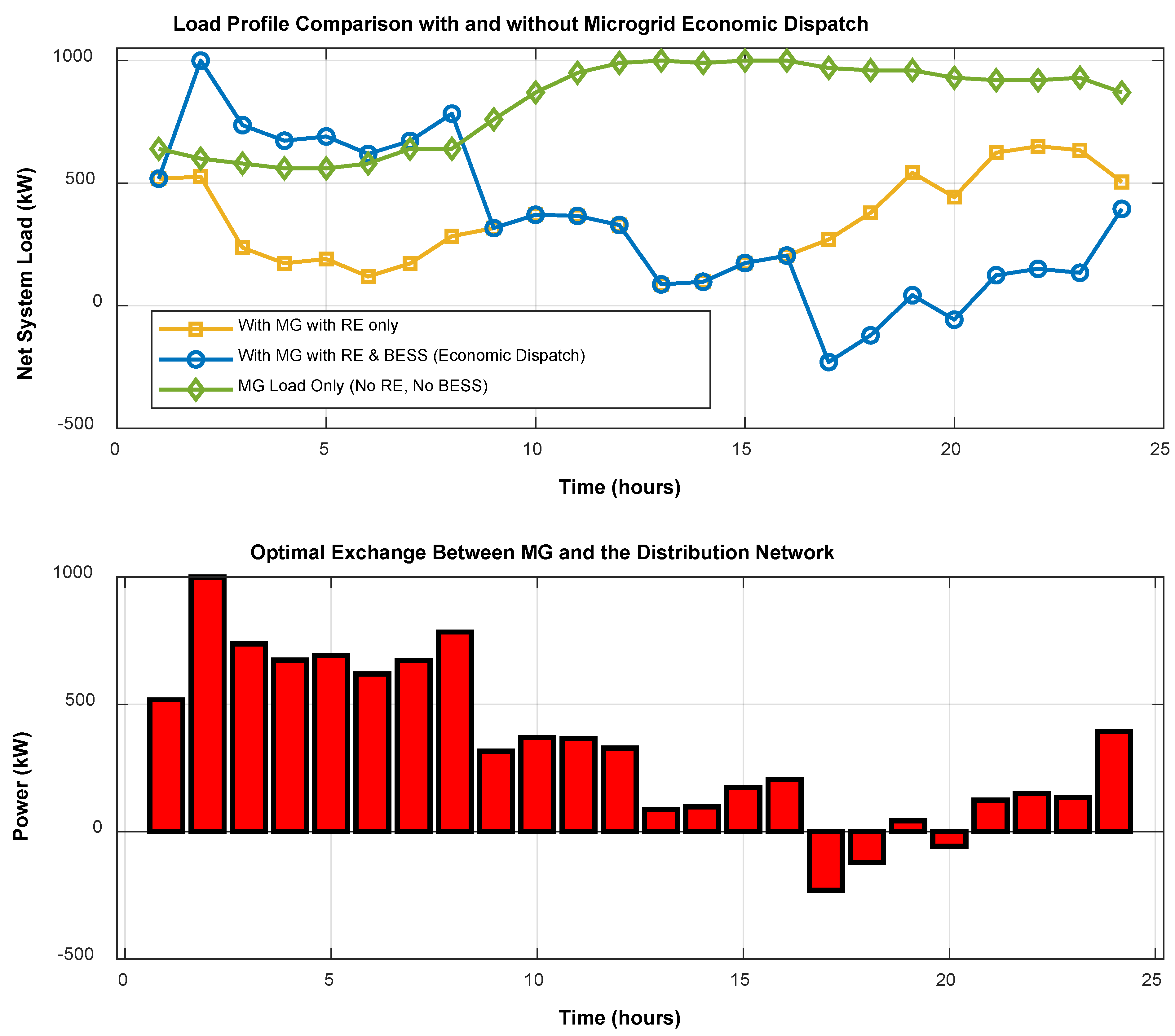
Figure 6 illustrates the impact of integrating BESS with RES on the optimal economic dispatch of MG-connected distribution systems. The top line graph compares the net MG demand over three scenarios over a 24-period horizon: the green line shows the MG load only scenario which shows a baseline load profile peaking at 1000 kW with demand between 560 kW and 1000 kW, the orange line shows MG with RES Only; in this scenario when RES are introduced, net demand decreases during the hours when renewable energy is available. However, due to solar and wind power intermittency, this situation still experiences fluctuations and periods of high demand, which can challenge grid stability and lead to constraint violations as observed in Table 3. The blue line shows MG with RES and BESS scenario. In this scenario the integration of the BESS under the proposed economic dispatch model achieves a significant impact on net demand. By charging during off-peak, and discharging during on-peak hours, the BESS effectively reduces peak demand and shifts to lower-cost periods. This results in the optimal net demand profile among the three scenarios, with improved demand stability and the elimination of both voltage and thermal violations. The bottom bar graph represents the optimal power exchange between MG and distribution system through the tie line; this plot shows how the proposed economic dispatch of BESS in MG connected to the distribution grid can optimize the exchange power between them while maintaining technical reliability of the distribution system by enhancing its voltage profiles, improving its feeder loading capability, and reducing the system losses. These results confirm the critical role of optimal BESS scheduling in reducing grid stress, ensuring constraint compliance, and minimizing operating costs.

3.2.4. Distributed System Performance

Voltage Profile Across Buses
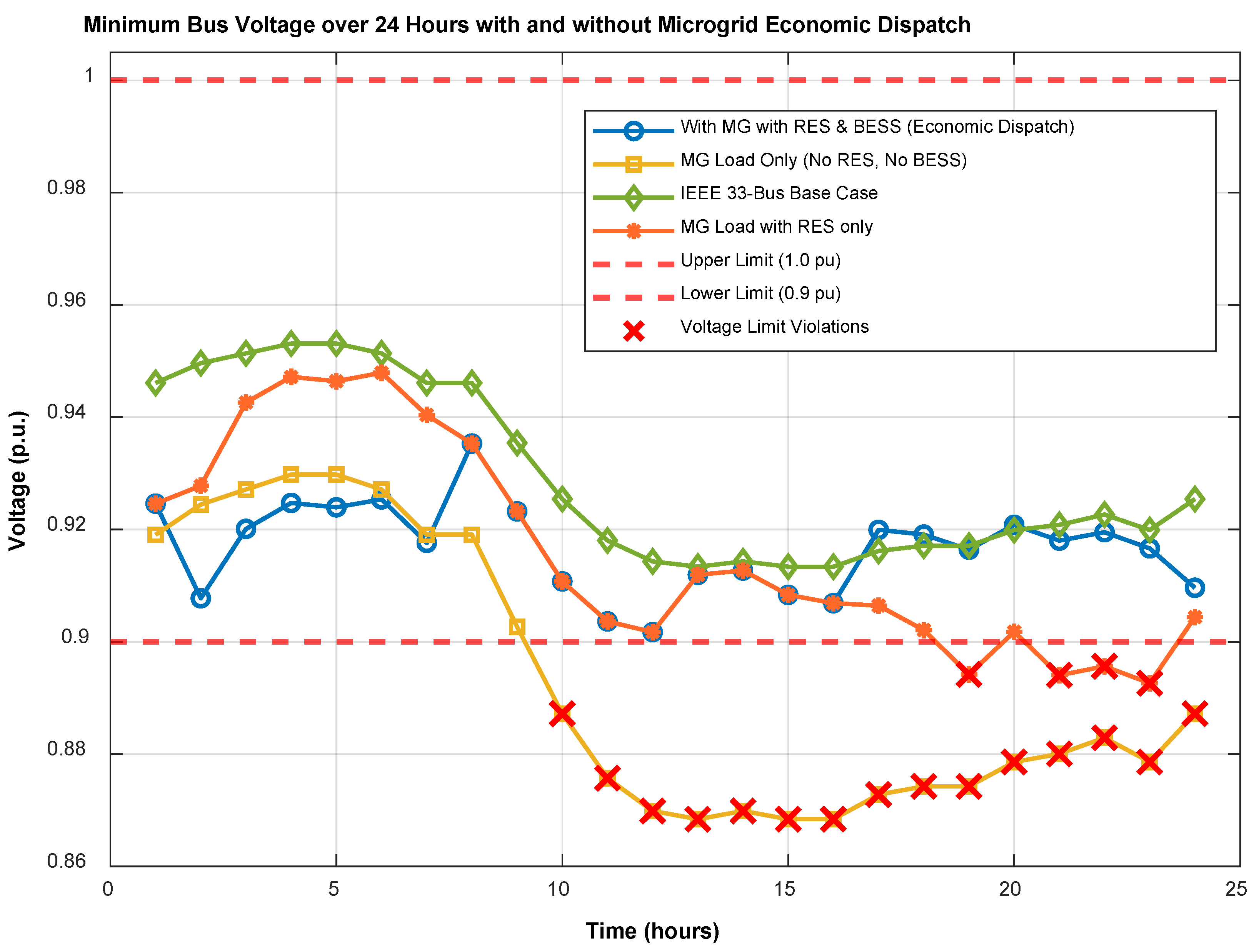
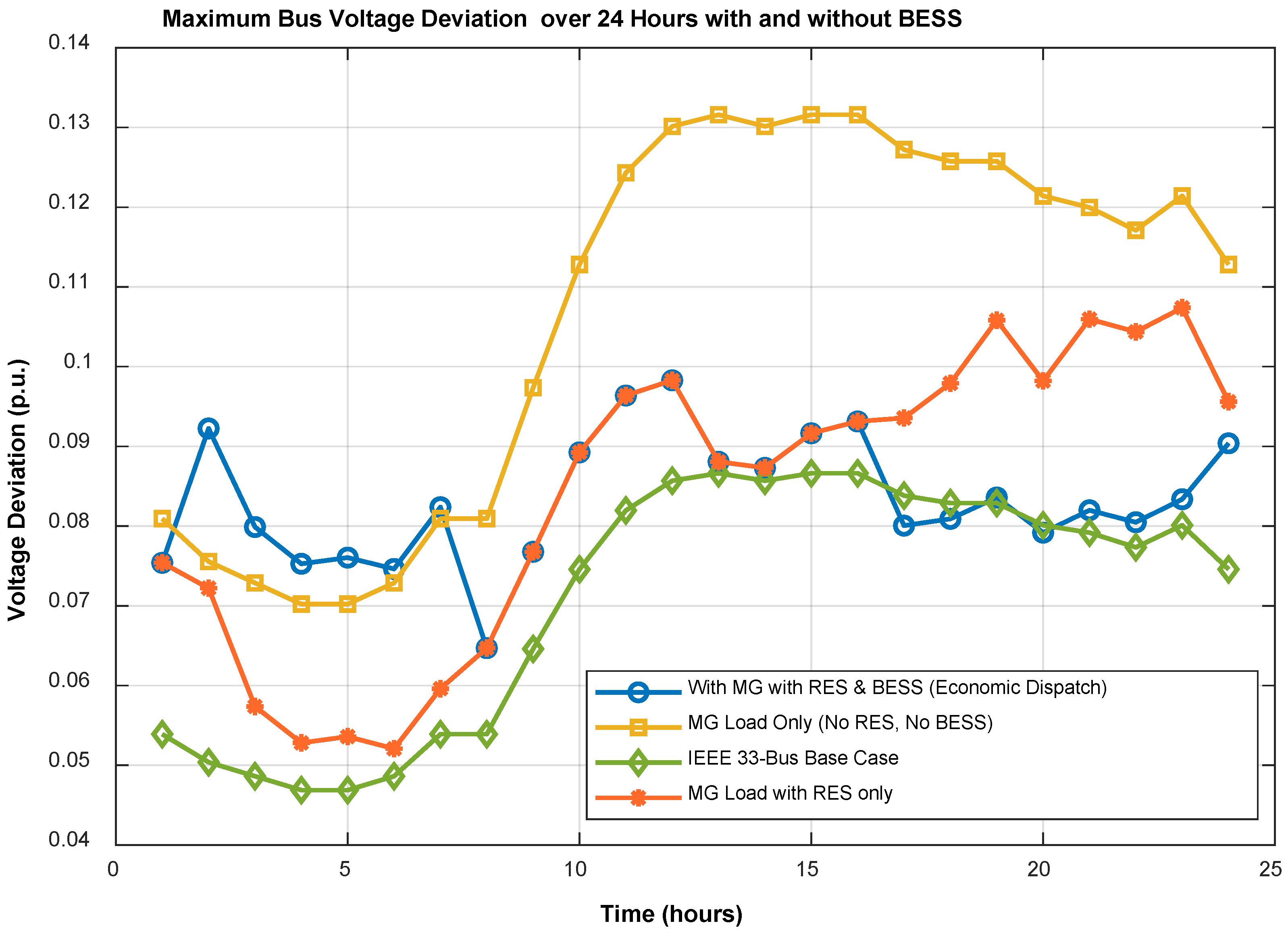
Figure 7 presents a voltage profile analysis over a 24 h period horizon across scenarios (i.e., IEEE 33-Bus Base Case, MG Load Only (No RES, No BESS), MG Load with RES only, with MG with RES and BESS (Economic Dispatch)) by focusing on the impact on voltage profile limit in distribution grid over 24 h, which is critical on optimal economic dispatch MG-connected to the distribution grid. In the base IEEE 33-bus scenario (i.e., the green line), bus voltages remain within acceptable bounds (0.9 to 1.0 p.u). At MG Load Only (No RES, No BESS) scenario (i.e., the yellow line) there are voltage violations observed, with several values approaching the lower limit of 0.9 p.u; this is due to the MG demand supplied from the main distribution grid without RES and BESS. In the MG Load with RES only scenario (i.e., the orange line), the addition of RES alone improves performance during certain hours but still results in multiple violations of the voltage constraint as shown by the red markers; this is due to solar and wind power intermittency. This situation still experiences fluctuations and periods of high demand, which can challenge grid stability and lead to violations in voltage constraint. However, in the With MG with RES and BESS (Economic Dispatch) scenario (i.e., blue line) the voltage is maintained within the acceptable limit (0.9 to 1.0 p.u). Unlike other scenarios, the integration of both RES and BESS under the proposed economic dispatch strategy ensures that all bus voltages remain strictly within the operational limits. This confirms that the BESS not only provides cost savings but also plays a critical role in voltage regulation by shifting load and supporting the grid during high demand periods by reducing the power export from the distribution grid at this time. Overall, these results highlight the dual technical and economic benefits of the proposed dispatch model in maintaining system reliability while reducing operational costs. Figure 8 shows the maximum voltage deviation on each bus over 24 h. Maximum voltage deviation is reduced from 0.13 p.u in the MG Load Only scenario to 0.09 p.u in the MG with RES and BESS scenario, representing a ~30.8% improvement, and maintaining all bus voltages within the 0.9–1.0 p.u range.
Branch Loading Across Feeders
Figure 9 shows the branch loading percentage 24 h period horizon across four scenarios (i.e., IEEE 33-Bus Base Case, MG Load Only (No RES, No BESS), MG Load with RES only, with MG with RES and BESS (Economic Dispatch)) by focusing on their impact on thermal limit in distribution feeder over 24 h, which is critical on optimal economic dispatch MG-connected to distribution grid. In the base IEEE 33-bus scenario (i.e., the green line), maintains branch loading between below 100% of the branch thermal limit constraint while ensuring its maximum power flow on each line does not exceed its rated capacity. The MG load only (No RES, No BESS) scenario (i.e., the yellow line) exhibits significant thermal limit violations, especially during peak hours (10:00–24:00), with branch loading exceeding 120%; this is because the entire MG demand is supplied only from the main distribution grid without RES and BESS. In the MG Load with RES only scenario (i.e., the orange line), the addition of RES alone improves performance during certain hours but still results in multiple thermal limit violations; this is because the RES only is insufficient to prevent overloading due to the intermittent nature of renewable generation. However, the With MG with RES and BESS (Economic Dispatch) scenario (i.e., blue line) demonstrates the most effective performance, maintaining branch loading well below the thermal limit (100%) throughout the day and avoiding any overload on distribution network feeders. This confirms that the BESS not only provides cost savings but also plays a critical role in loading capacity limit of distribution network feeders by shifting load and supporting the grid during high demand periods by reducing the power export from the distribution grid at this time. The results clearly highlight that optimal economic dispatch of BESS in MG-connected distribution network effectively mitigates overloading and enhancing grid reliability by optimizing power flow between MG and grid which ensuring the secure operation of the distribution system when operated under an optimized dispatch strategy.
System Losses
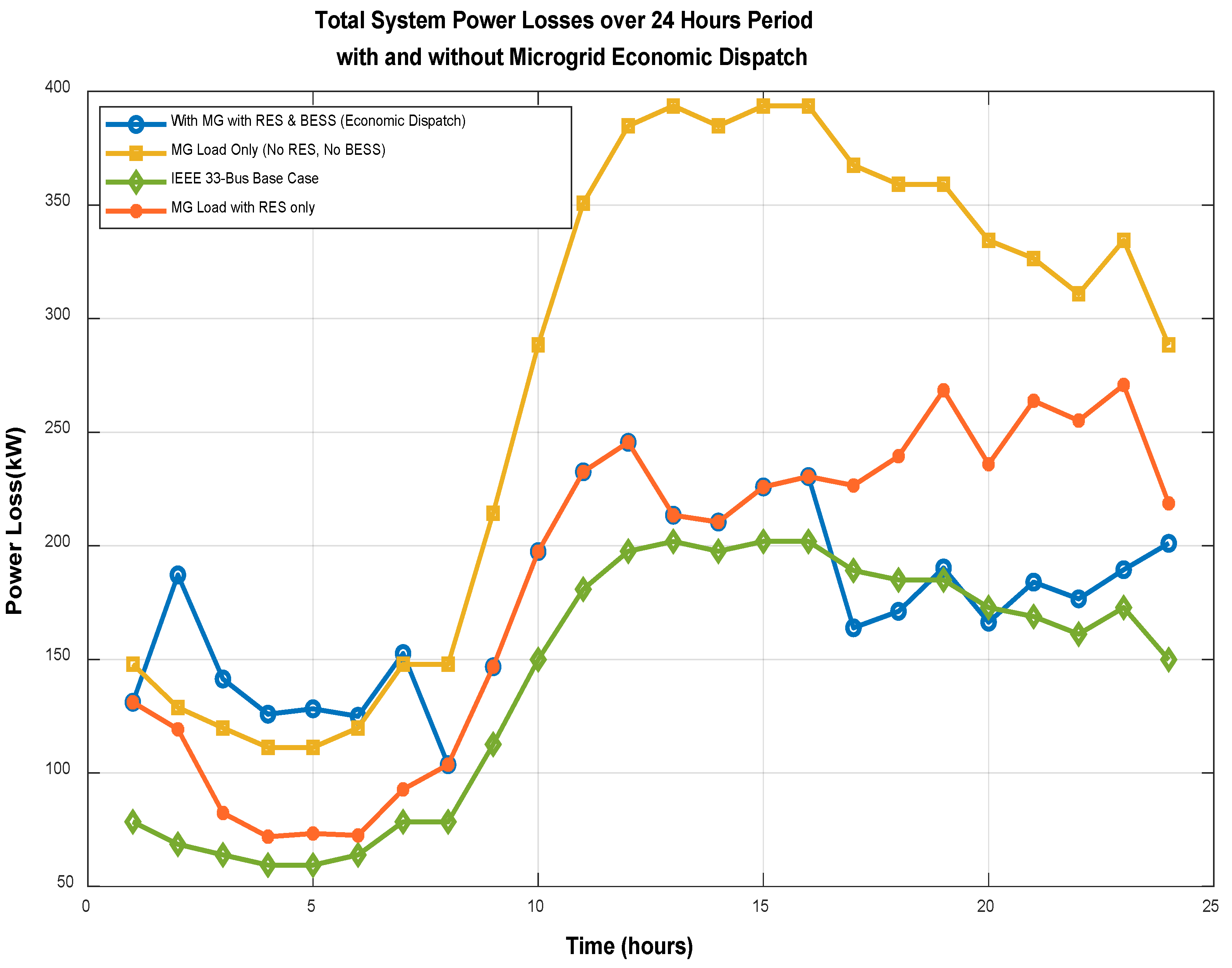
Figure 10 shows the variation in system power losses over a 24 h period horizon across four scenarios (i.e., IEEE 33-Bus Base Case, MG Load Only (No RES, No BESS), MG Load with RES only, with MG with RES and BESS (Economic Dispatch)) by focusing on their impact on thermal limit in a distribution feeder over 24 h, which is critical on optimal economic dispatch MG-connected to distribution grid. The base IEEE 33-bus scenario (i.e., the green line), achieved the lowest losses over 24 h with maximum losses around 201.89 kW. In the MG load only (No RES, No BESS) scenario (i.e., the yellow line) BESS resulted in the highest power losses, particularly during peak demand hours (10:00–24:00), reaching values above 393.6 kW; this was because the entire MG demand is supplied only from the main distribution grid without RES and BESS. In the MG Load with RES only scenario (i.e., the orange line), these losses reduced significantly, but fluctuations remain noticeable due to the intermittent nature of renewables. However, in the With MG with RES and BESS (Economic Dispatch) scenario (i.e., blue line) the lowest losses are achieved in the scenario where both RES and BESS are employed with optimal economic dispatch. In this case, power losses are consistently minimized throughout the day, which shows a clear improvement over other scenario of MG-connected to distribution network. The Peak system losses are reduced by approximately 36.5% to 47%, from 393.6 kW to between 250 and 210 kW, demonstrating the effectiveness of the proposed optimal BESS dispatch This result showed the effectiveness of the proposed model of optimal economic dispatch of BESS in MG ensures not only greater economic benefits but also technical reliability by reducing system losses in the distribution grid.

4. Discussion

The results obtained in this study confirm that the proposed optimal economic operation framework for BESS in MG-connected distribution systems can significantly reduce operating costs while enhancing the reliability of the grid by maintaining both voltage stability and thermal security and reduce system losses in the distribution grid. Therefore, this model not only minimizes total daily energy costs but also eliminates violations of voltage and thermal limits and reduces overall system losses, which are common issues when renewables are integrated without storage due to their intermittent nature. For example, as shown in Table 3, the integration of RES alone reduced operating costs but still resulted in grid constraint violations. In contrast, incorporating BESS with the proposed economic dispatch strategy achieved both technical feasibility and the highest cost savings (74.4%), even after including the degradation cost of the battery. This demonstrates that careful scheduling of charging and discharging can balance renewable intermittency, optimize power exchange with the main grid, and sustain long-term operational viability.
Compared to previous studies, our findings demonstrate several important contributions. Earlier works, such as [11,17], primarily focused on optimal BESS configuration and sizing, considering investment cost or tariff sensitivity, but did not fully address daily operational scheduling under network constraints. Other studies, such as [18,20], explored economic dispatch and BESS optimization, but either relied on heuristic approaches or did not incorporate battery degradation and distribution-level technical constraints. Real-time scheduling frameworks, such as [21], emphasized resilience under cyberattacks, yet their focus diverged from cost minimization under normal operational conditions.
More research has extended these perspectives. Alsalman (2023) [22] investigated the role of BESS in enhancing the stability of isolated microgrids, analyzing the impact of BESS capacity and location on voltage and frequency response, but without considering economic dispatch or cost optimization. Ref. [23] proposed hybrid optimization frameworks for microgrids, combining MILP and metaheuristic methods for cost minimization and load management under variable RES generation; however, their approach did not explicitly model BESS degradation or enforce distribution network constraints. Ref. [24] studied optimal battery sizing and economic dispatch in wind-powered microgrids with depth-of-discharge (DoD) constraints, achieving 40–50% cost reductions and prolonging battery lifespan, yet this approach was limited to wind-dominated microgrids and did not consider full distribution-level operational limits.
Table 4 summarizes these prior studies, their focus, limitations, and how the present work extends them. The proposed MILP-based framework combined a mathematically rigorous MILP formulation with BESS degradation, renewable, distribution network constraints, and optimal economic dispatch, ensuring both technical feasibility and significant cost savings in MG-connected distribution systems.

4.1. Sensitivity Analysis

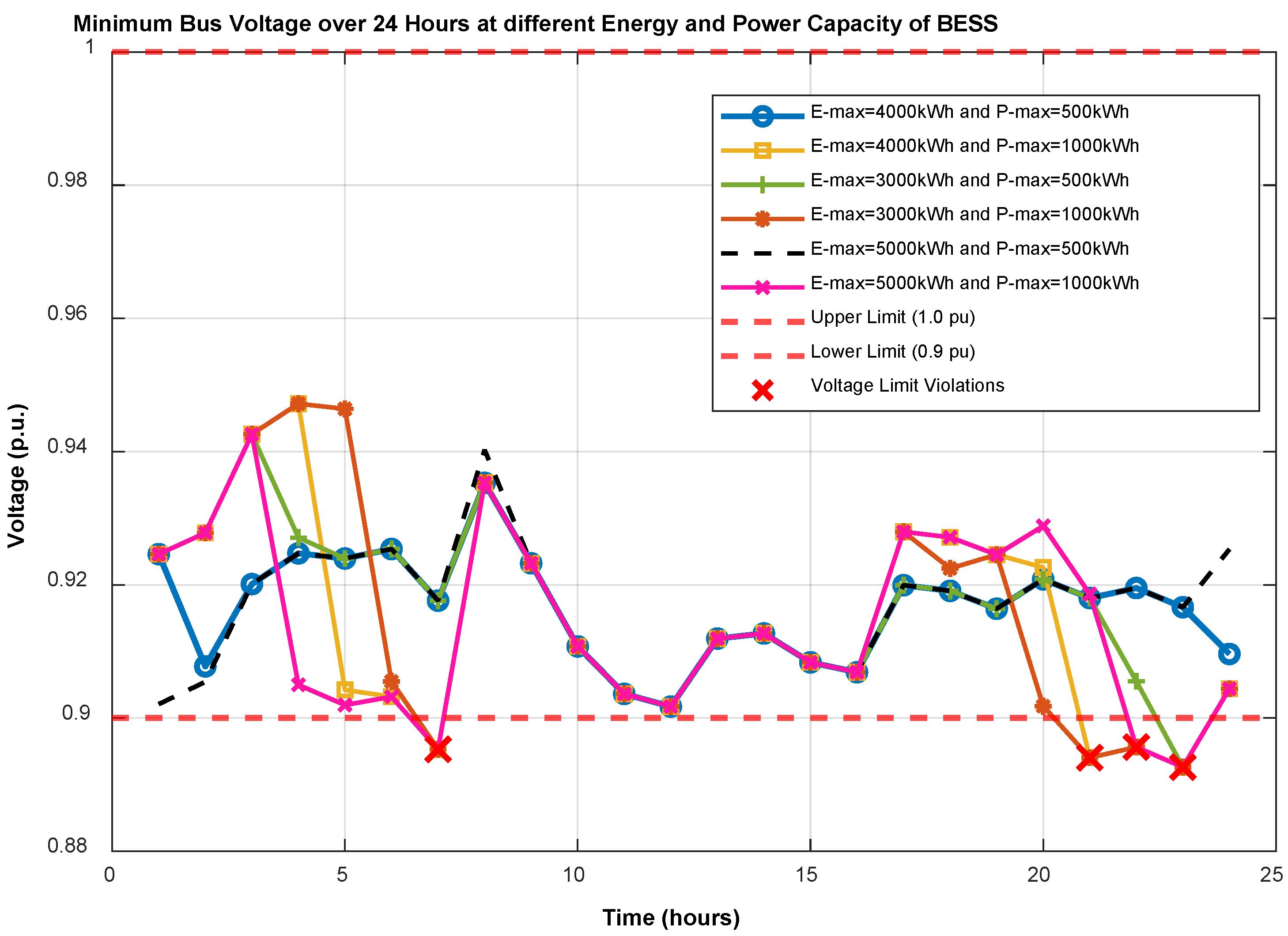
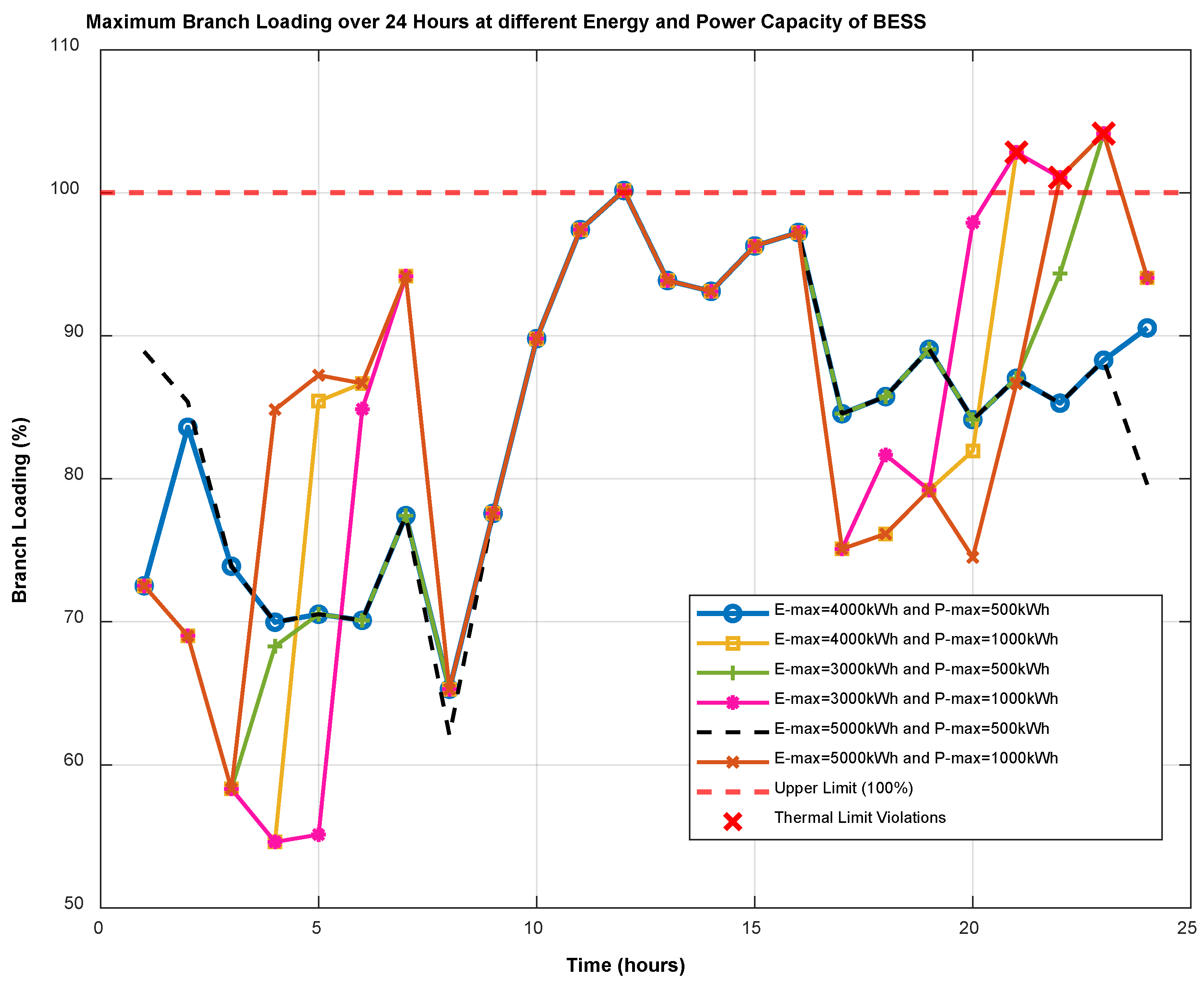
Sensitivity analysis results are shown in Table 5 and Figure 11 and Figure 12, on different BESS capacities and power ratings. This analysis showed that increasing the energy capacity generally will reduce the total operating cost by enabling greater energy shifting from low- to high-price periods. For example, the 5000 kWh BESS with 500 kW rating achieved the lowest feasible operating cost without violating thermal or voltage limits as shown in Figure 11 and Figure 12. However, when the BESS power rating was increased to 1000 kW, thermal and voltage violations were observed, indicating that higher instantaneous charging/discharging power stresses the distribution feeder beyond its limits. Smaller BESS sizes, such as 3000 kWh, resulted in higher operating costs despite lower degradation expenses, as their limited capacity prevented effective peak shaving and arbitrage. Moreover, degradation costs were found to rise with larger capacities and higher power ratings due to increased cycling. These results highlight the trade-off between economic benefit and network security: larger energy capacities are beneficial for cost reduction, but excessive power capability leads to technical violations, underscoring the need to co-optimize both BESS size and network constraints. Moreover, the sensitivity analysis reveals an interesting interaction between the BESS energy capacity and its power rating. For the 3000 kWh and 4000 kWh cases, the total daily energy exchanged with the grid remains unchanged when increasing the maximum power from 500 kW to 1000 kW. This indicates that these systems are energy-constrained, meaning that the limited storage capacity prevents further energy shifting regardless of the charging/discharging rate. In contrast, for the 5000-kWh case, the total daily energy utilization increases slightly when the power rating is raised from 500 kW to 1000 kW. This outcome highlights that at 500 kW, the system is power-limited, and the battery cannot fully deploy its available energy within peak demand or high-price windows. By increasing the power capacity, the BESS can inject and absorb energy more rapidly, leading to increase daily energy consumption. Although both the 4000 kWh and 5000 kWh BESS configurations with 500 kW power rating meet technical requirements, the 4000 kWh system is more cost-effective, with only a 0.7% reduction in energy delivery but significantly lower degradation costs. This makes it a more efficient and financially practical choice, avoiding overinvestment and ensuring optimal utilization in real-world microgrid operation. These findings emphasize that both energy and power ratings must be jointly optimized, since a mismatch can reduce the effectiveness of the BESS in system operation. This sensitivity analysis demonstrated the effectiveness of the proposed optimal economic dispatch model in identifying the most suitable BESS configuration that ensures both grid stability and cost efficiency which demonstrates the model’s capability to balance technical constraints with economic objectives. The results also show that increasing BESS power or energy capacity beyond optimal levels can lead to diminishing returns or even operational issues, such as constraint violations or higher degradation costs. This confirms that the proposed model not only optimizes daily dispatch decisions but also guides appropriate BESS sizing, leading to practical and scalable solutions for microgrid-connected distribution systems.

4.2. Recommendations and Future Work

In terms of future research, the framework can be extended by incorporating uncertainty in renewable generation and electricity prices through stochastic or robust optimization techniques. Moreover, extending the analysis to multi-MG systems or peer-to-peer energy trading environments would provide deeper insights into distributed flexibility markets. Another valuable extension would be to consider multi-objective formulations that simultaneously optimize cost, emissions, and reliability. Additionally, exploring the co-optimization of demand response, EV integration, and ancillary service provision can further enhance the applicability of the proposed method for smart and sustainable power system planning.


5. Conclusions

The research presented an optimal economic operation model of BESS in MG-connected distribution systems. It has successfully addressed the challenges of integrating MGs into modern distribution systems by developing a MILP-based economic dispatch framework. This framework, applied to an MG interconnected with the IEEE-33 radial distribution feeder to optimize the charging and discharge behavior of BESS over a 24 h horizon in order to maintain balancing between economic efficiency and technical reliability of the overall distribution system. The comprehensive modeling of BESS operations, including SOC dynamics, charging/discharging constraints, and electricity price variations, which enables realistic and effective scheduling decisions, as evidenced by the simulation results. The results have demonstrated a significant improvement of the voltage profile by maintaining it within acceptable limits (0.9–1.0 p.u), maintaining branch loading below the 100% which ensuing that the maximum power flow on each line does not exceed its rated capacity, and the SOC profile adheres to 10–95% constraints which ensures sustainable BESS operation. Furthermore, the proposed approach reduces total daily energy from 19,820 kWh (baseline) to 7550.8112 kWh and operating costs from USD 23,914 to USD 6118.1802 (including BESS degradation costs), achieving a 74.4% cost saving compared to the baseline. These results highlight the proposed model ability to optimize grid power exchange, enhance voltage stability, and minimize operational costs, providing a practical tool for utilities and operators to improve the economic and technical performance of MG-integrated distribution systems. Future work could extend the analysis to multi-MG systems or peer-to-peer energy trading environments would provide deeper insights into distributed flexibility markets and explore seasonal variations or real-time data integration to further validate and expand the model’s applicability.

Author Contributions

Conceptualization, A.A.A. and M.A.A.; methodology, A.A.A. and M.A.A.; software, A.A.A.; validation, M.A.A.; formal analysis, A.A.A.; investigation, M.A.A.; resources, M.A.A.; data curation, A.A.A.; writing—original draft preparation, A.A.A.; writing—review and editing, M.A.A.; visualization, M.A.A.; supervision, M.A.A.; project administration, M.A.A.; funding acquisition, M.A.A. All authors have read and agreed to the published version of the manuscript.

Funding

This work was supported by the King Saud University, Saudi Arabia, Deanship of Scientific Research, Saudi Electricity Company Research Chair in Power System Reliability and Security.

Data Availability Statement

The original contributions presented in this study are included in the article. Further inquiries can be directed to the corresponding authors.

Acknowledgments

The authors would like to thank the reviewers who helped in improving the paper. The Authors also would like to extend their gratitude to the King Saud University, Saudi Arabia, Deanship of Scientific Research, Saudi Electricity Company Research Chair in Power System Reliability and Security for supporting this work.

Conflicts of Interest

The authors declare no conflicts of interest.

References

  1. Zahraoui, Y.; Korõtko, T.; Rosin, A.; Agabus, H. Market Mechanisms and Trading in MG Local Electricity Markets: A Comprehensive Review. Energies 2023, 16, 2145. [Google Scholar] [CrossRef]
  2. Ma, Y.; Yang, P.; Guo, H.; Wang, Y. Dynamic economic dispatch and control of a stand-alone MG in dongao island. J. Electr. Eng. Technol. 2015, 10, 1433–1441. [Google Scholar] [CrossRef]
  3. Mehdizadeh, A.; Taghizadegan, N. Robust optimisation approach for bidding strategy of renewable generation-based MG under demand side management. IET Renew. Power Gener. 2017, 11, 1446–1455. [Google Scholar] [CrossRef]
  4. Bansal, R.K.; You, P.; Gayme, D.F.; Mallada, E. A market mechanism for truthful bidding with energy storage. Electr. Power Syst. Res. 2022, 211, 108284. [Google Scholar] [CrossRef]
  5. Al-Sakkaf, S.; Kassas, M.; Khalid, M.; Abido, M.A. An Energy Management System for Residential Autonomous DC MG Using Optimized Fuzzy Logic Controller Considering Economic Dispatch. Energies 2019, 12, 1457. [Google Scholar] [CrossRef]
  6. Gong, Q.; Wang, Y. Economic Dispatching Strategy of Double Lead-Acid Battery Packs Considering Various Factors. J. Electr. Eng. Technol. 2021, 16, 191–203. [Google Scholar] [CrossRef]
  7. Nguyen, C.; Lee, H. Effective power dispatch capability decision method for a wind-battery hybrid power system. IET Gener. Transm. Distrib. 2016, 10, 661–668. [Google Scholar] [CrossRef]
  8. Saldarini, A.; Longo, M.; Brenna, M.; Zaninelli, D. Battery Electric Storage Systems: Advances, Challenges, and Market Trends. Energies 2023, 16, 7566. [Google Scholar] [CrossRef]
  9. Nimma, K.S.; Al-Falahi, M.D.A.; Nguyen, H.D.; Jayasinghe, S.D.G.; Mahmoud, T.S.; Negnevitsky, M. Grey Wolf Optimization-Based Optimum Energy-Management and Battery-Sizing Method for Grid-Connected MGs. Energies 2018, 11, 847. [Google Scholar] [CrossRef]
  10. Zhuo, W.; Savkin, A.V.; Meng, K. Decentralized Optimal Control of a MG with Solar PV, BESS and Thermostatically Controlled Loads. Energies 2019, 12, 2111. [Google Scholar] [CrossRef]
  11. Li, J.; Xue, Y.; Tian, L.; Yuan, X. Research on Optimal Configuration Strategy of Energy Storage Capacity in Grid-Connected MG. Prot. Control Mod. Power Syst. 2017, 2, 35. [Google Scholar] [CrossRef]
  12. Feng, F.; Chi, C. Research on Bus Voltage of DC MG Containing Hybrid Energy Storage System. In E3S Web of Conferences; EDP Sciences: Les Ulis, France, 2021; Volume 261, p. 01019. [Google Scholar]
  13. Butt, H.Z.; Li, X. Enhancing Optimal MG Planning with Adaptive BESS Degradation Costs and PV Asset Management: An Iterative Post-Optimization Correction Framework. Electr. Power Syst. Res. 2025, 247, 111785. [Google Scholar] [CrossRef]
  14. Torkzadeh, R.; Chamorro, H.R.; Rye, R.; Eliassi, M.; Toma, L.; Gonzalez-Longatt, F. Reactive Power Control of Grid Interactive BESSfor WADC. In Proceedings of the 2019 IEEE PES Innovative Smart Grid Technologies Europe (ISGT-Europe), Bucharest, Romania, 29 September–2 October 2019; pp. 1–5. [Google Scholar]
  15. Zhang, D.; Shafiullah, G.; Das, C.K.; Wong, K.W. Optimal Allocation of Battery Energy Storage Systems to Enhance System Performance and Reliability in Unbalanced Distribution Networks. Energies 2023, 16, 7127. [Google Scholar] [CrossRef]
  16. Kinhekar, N.; Padhy, N.P.; Li, F.; Gupta, H.O. Utility oriented demand side management using smart AC and micro DC grid cooperative. IEEE Trans. Power Syst. 2016, 31, 1151–1160. [Google Scholar] [CrossRef]
  17. Javeed, I.; Khezri, R.; Mahmoudi, A.; Yazdani, A.; Shafiullah, G.M. Optimal Sizing of Rooftop PV and Battery Storage for Grid-Connected Houses Considering Flat and Time-of-Use Electricity Rates. Energies 2021, 14, 3520. [Google Scholar] [CrossRef]
  18. Aguilar-Mejía, O.; Minor-Popocatl, H.; Caballero-Morales, O.S.; Miranda-Pérez, A.F. Effect of a Storage System in a MG with EDR and Economic Dispatch Considering Renewable and Conventional Energy Sources. Sustainability 2024, 16, 568. [Google Scholar] [CrossRef]
  19. Odero, H.; Wekesa, C.; Irungu, G. Wind Energy Resource Prediction and Optimal Storage Sizing to Guarantee Dispatchability: A Case Study in the Kenyan Power Grid. J. Electr. Comput. Eng. 2022, 2022, 4044757. [Google Scholar] [CrossRef]
  20. Vaka, S.S.K.R.; Sailaja Kumari, M. Optimal Sizing of Battery Energy Storage Systems Considering Degradation Effect for Operating and Electricity Cost Minimization in MGs. Energy Technol. 2024, 12, 2300704. [Google Scholar] [CrossRef]
  21. Akbari, R.; Tajalli, S.Z.; Kavousi-Fard, A.; Izadian, A. Economic Operation of Utility-Connected MGs in a Fast and Flexible Framework Considering Non-Dispatchable Energy Sources. Energies 2022, 15, 2894. [Google Scholar] [CrossRef]
  22. Alsalman, A.S.; Alharbi, T.; Mahfouz, A.A. Enhancing the Stability of an Isolated Electric Grid by the Utilization of Energy Storage Systems: A Case Study on the Rafha Grid. Sustainability 2023, 15, 13269. [Google Scholar] [CrossRef]
  23. Ali, M.A.; Besheer, A.H.; Emara, H.M.; Bahgat, A. Optimal Micro-Grid Battery Scheduling within a Comprehensive Smart Pricing Scheme. Sci. Rep. 2025, 15, 20098. [Google Scholar] [CrossRef] [PubMed]
  24. Hosen, M.M.; Alam, M.S.; Rashid, S.; Mostafa, S.M.G. Optimized Economic Dispatch and Battery Sizing in Wind Microgrids: A Depth of Discharge Perspective. Electricity 2025, 6, 51. [Google Scholar] [CrossRef]
  25. Alguhi, A.A.; Al-Ammar, E.A.; Ko, W.; Choi, H.-J.; Park, S.; Khan, M. Optimizing EVs penetration levels in smart grids using dynamic pricing and renewable energy backed by BESS while maintaining grid constraints. IET Gener. Transm. Distrib. 2025, 19, e70120. [Google Scholar] [CrossRef]
  26. Venkatesh, B.; Ranjan, R.; Gooi, H.B. Optimal reconfiguration of radial distribution systems to maximize loadability. IEEE Trans. Power Syst. 2004, 19, 260–266. [Google Scholar] [CrossRef]
  27. Shahidehpour, M.; Yamin, H.; Li, Z. Appendix C: RTS Load Data. In Market Operations in Electric Power Systems: Forecasting, Scheduling, and Risk Management; IEEE: Piscataway, NJ, USA, 2002; pp. 467–468. [Google Scholar]
  28. Mongird, K.; Viswanathan, V.; Balducci, P.; Alam, J.; Fotedar, V.; Koritarov, V.; Hadjerioua, B. An evaluation of energy storage cost and performance characteristics. Energies 2020, 13, 3307. [Google Scholar] [CrossRef]
  29. Alguhi, A.A.; Alotaibi, M.A.; Al-Ammar, E.A. Probabilistic Planning for an Energy Storage System Considering the Uncertainties in Smart Distribution Networks. Sustainability 2024, 16, 290. [Google Scholar] [CrossRef]
  30. Lazard. Levelized Cost of Energy+; Lazard: New York, NY, USA, 2023; Available online: https://www.lazard.com/research-insights/2023-levelized-cost-of-energyplus/ (accessed on 10 September 2025).
  31. Steckel, T.; Kendall, A.; Ambrose, H. Applying levelized cost of storage methodology to utility-scale second-life lithium-ion battery energy storage systems. Appl. Energy 2021, 300, 117309. [Google Scholar] [CrossRef]
Figure 1. Overall structure of the MG model integrated with the distribution network, consisting of PV system, WT, BESS, and coordinated through the economic dispatch framework.
Energies 18 06335 g001
Figure 2. Flowchart of the proposed optimization framework for BESS economic dispatch in a MG-connected IEEE 33-bus distribution system.
Energies 18 06335 g002
Figure 3. Modified IEEE 33-Bus System with MG connected to additional bus no 34.
Energies 18 06335 g003
Figure 4. The output power generation from both PV and Wind-based DG.
Energies 18 06335 g004
Figure 5. The operation and state of charge (SOC) management of BESS within a proposed economic dispatch MG-connected distribution system.
Energies 18 06335 g005
Figure 6. The net system demand and the optimal power exchange during the optimal economic dispatch of MG (MG)-connected distribution systems.
Energies 18 06335 g006
Figure 7. Voltage profile analysis over 24 h for an MG-connected distribution system.
Energies 18 06335 g007
Figure 8. Voltage deviation analysis over 24 h for a MG-connected distribution system.
Energies 18 06335 g008
Figure 9. Distribution branch loading analysis over 24 h for a MG-connected distribution system.
Energies 18 06335 g009
Figure 10. Total system losses over a 24 hour period horizon for a MG-connected distribution system.
Energies 18 06335 g010
Figure 11. Voltage profile analysis over 24 h for different BESS capacities and power ratings in MG-connected distribution system.
Energies 18 06335 g011
Figure 12. Distribution branch loading analysis over 24 h for different BESS capacities and power ratings in an MG-connected distribution system.
Energies 18 06335 g012
Table 1. The wind speed and wind turbine parameters [25].
ParametersValue
Rated   Power   ( P w r )500 kW
Cut   in   speed   ( v i n )  m/s3
Rated   speed   ( v r )  m/s14
Cut   out   speed   ( v o u t ) m/s25
Table 2. The PV and solar irradiance parameters [25].
ParametersValue
Rated   PV   Power   ( P P V r )500 kW
Adjustable   value   of   irradiance   ( r C ) 200 W/m2
Standard   irradiance   ( s S T D ) 1000 W/m2
Table 3. Results of the Proposed Model: Evaluation of Its Impact on MG Operating Cost and Distribution of Grid Constraints.
ScenariosIs There Any Violation in Thermal Limit in Distribution Grid?Is There Any Violation in Voltage Limit in Distribution Grid?Total Daily Energy (kWh)Total Operating Cost (USD)Saving (%)
MG Load Only (No RES, No BESS)YesYes19,82023,914
MG with RES onlyYesYes8213.347810,314.979657%
With MG with RES and BESS (Economic Dispatch)NoNo7550.81126118.180274.4%
Table 4. Comparison of Previous Studies and the Proposed Model, Highlighting Limitations and Improvements Introduced in This Work.
Ref./Author/(Year)FocusLimitationHow This Work Addresses It
[11]/Li, J et al./(2017)Optimal configuration of BESS in grid-connected MG (two-layer decision model)Focused mainly on sizing and minimizing power fluctuations; investment cost onlyExtends to operational dispatch with MILP, considering battery degradation, price signals, and grid constraints
[17]/Javeed, I et al./(2021)Sizing PV and BESS for residential houses under TOU and flat tariffsLimited to residential rooftop systems and tariff sensitivity; no grid-wide technical constraintsConsiders distribution grid operation, renewable resource aim, and voltage profile and thermal improvement across IEEE-33 system
[18]/Aguilar-Mejía et al./(2024)Economic dispatch with diesel, PV, wind, hydro, BESS, and demand response (EDR)Scenario-based optimization; limited mathematical rigor; less emphasis on degradationProvides a mathematically exact MILP-based formulation, capturing BESS degradation and ensuring feasibility under system limits
[20]/Vaka, S et al./(2024)BESS optimization using GWOThese methods may lack global optimality and robustnessMILP ensures optimal solution with efficient computation for 24 h horizon
[21]/Akbari, R et al./(2022)Real-time distributed consensus-based optimization for utility-connected and islanded MGs with dispatchable/non-dispatchable sources; cloud–fog framework for DRFocused on resilience and security, not cost minimization and grid impactThis work focuses on economic dispatch with network constraints, explicitly modeling BESS degradation and RES in a distribution feeder (IEEE-33), ensuring both economic efficiency and technical feasibility
[22]/Alsalman, A.S/(2023)Enhancing stability of isolated microgrids using BESSFocused on transient and steady-state stability; no economic dispatch or cost analysisIntegrates BESS into MG-connected distribution networks considering both economic dispatch and network constraints
[23]/Ali et al./(2025)Hybrid optimization of MGs combining MILP and metaheuristicsFocused on cost minimization and load management; no explicit degradation modeling or voltage/thermal limitsCaptures battery degradation, RES intermittency, and distribution network operational constraints using a mathematically rigorous MILP
[24]/Hosen, M.M/(2025)Optimized battery sizing and economic dispatch in wind-powered microgrids with DoD constraintsLimited to wind microgrids; did not address distribution-level operational constraintApplies MILP to IEEE-33 feeder with real renewable profiles, including both BESS degradation and network constraints
Table 5. Comparing the proposed model to the previous work.
BESS Capacity (kWh)BESS Max Power kWIs There Any Violation in Thermal Limit in Distribution Grid?Is There Any Violation in Voltage Limit in Distribution Grid?Total Daily Energy (kWh)Total Operating Cost (USD)
Energy CostBESS Degradation
4000 kWh500 kWNoNo7550.81124685.13821433.042
1000 kWYesYes7550.81124685.13821433.042
3000 kWh500 kWYesYes7453.31126021.58811074.7721
1000 kWYesYes7453.31126021.58811074.7721
5000 kWh500 kWNoNo7604.69284013.97311631.0333
1000 kWYesYes7648.31123383.66751791.312
Disclaimer/Publisher’s Note: The statements, opinions and data contained in all publications are solely those of the individual author(s) and contributor(s) and not of MDPI and/or the editor(s). MDPI and/or the editor(s) disclaim responsibility for any injury to people or property resulting from any ideas, methods, instructions or products referred to in the content.