The Process of Using Power Supply Technical Solutions for Electronic Security Systems Operated in Smart Buildings: Modelling, Simulation and Reliability Analysis

 ,
,  ,
,  ,
,  ,
,  ,
,
Abstract
1. Introduction
- -
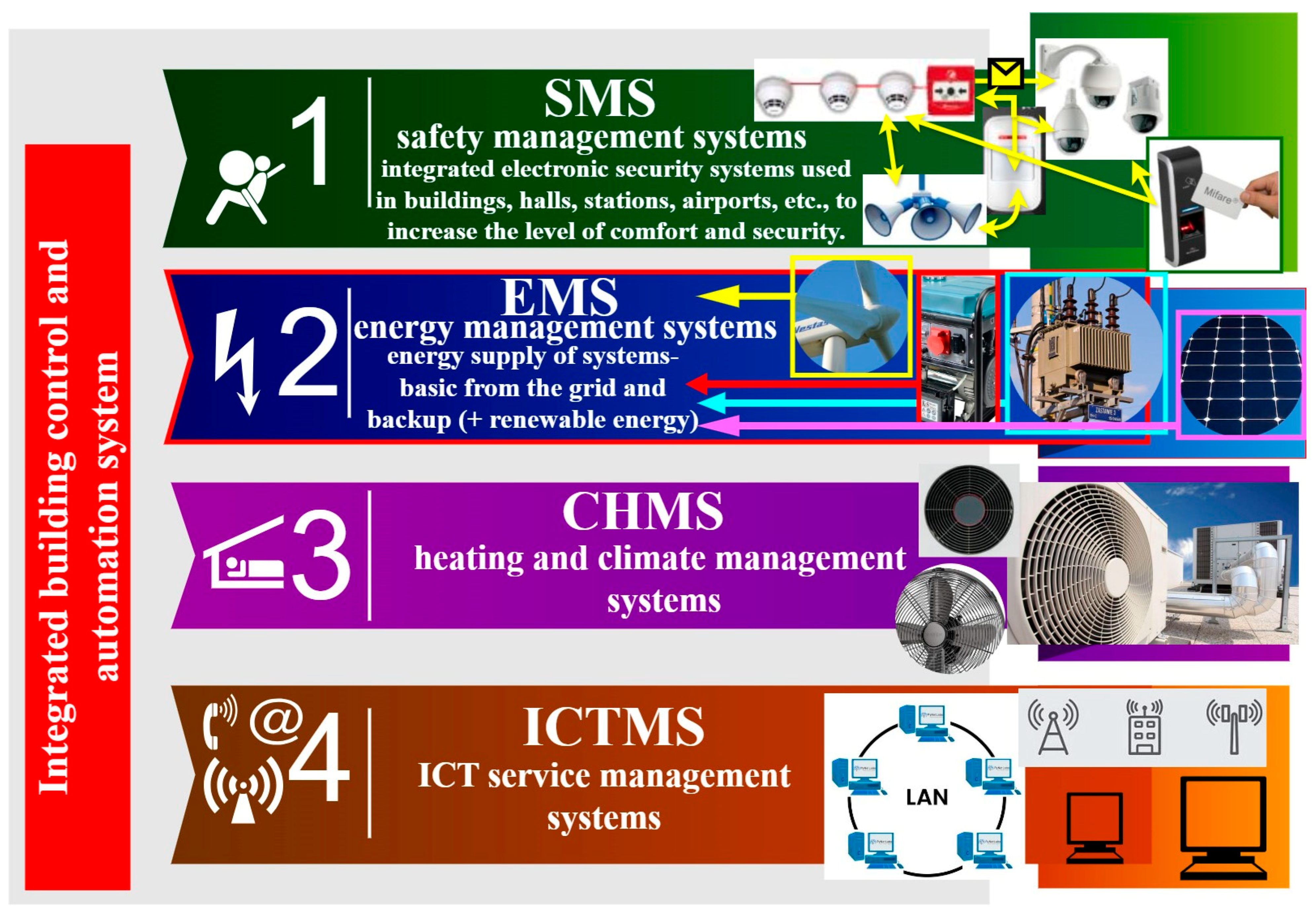
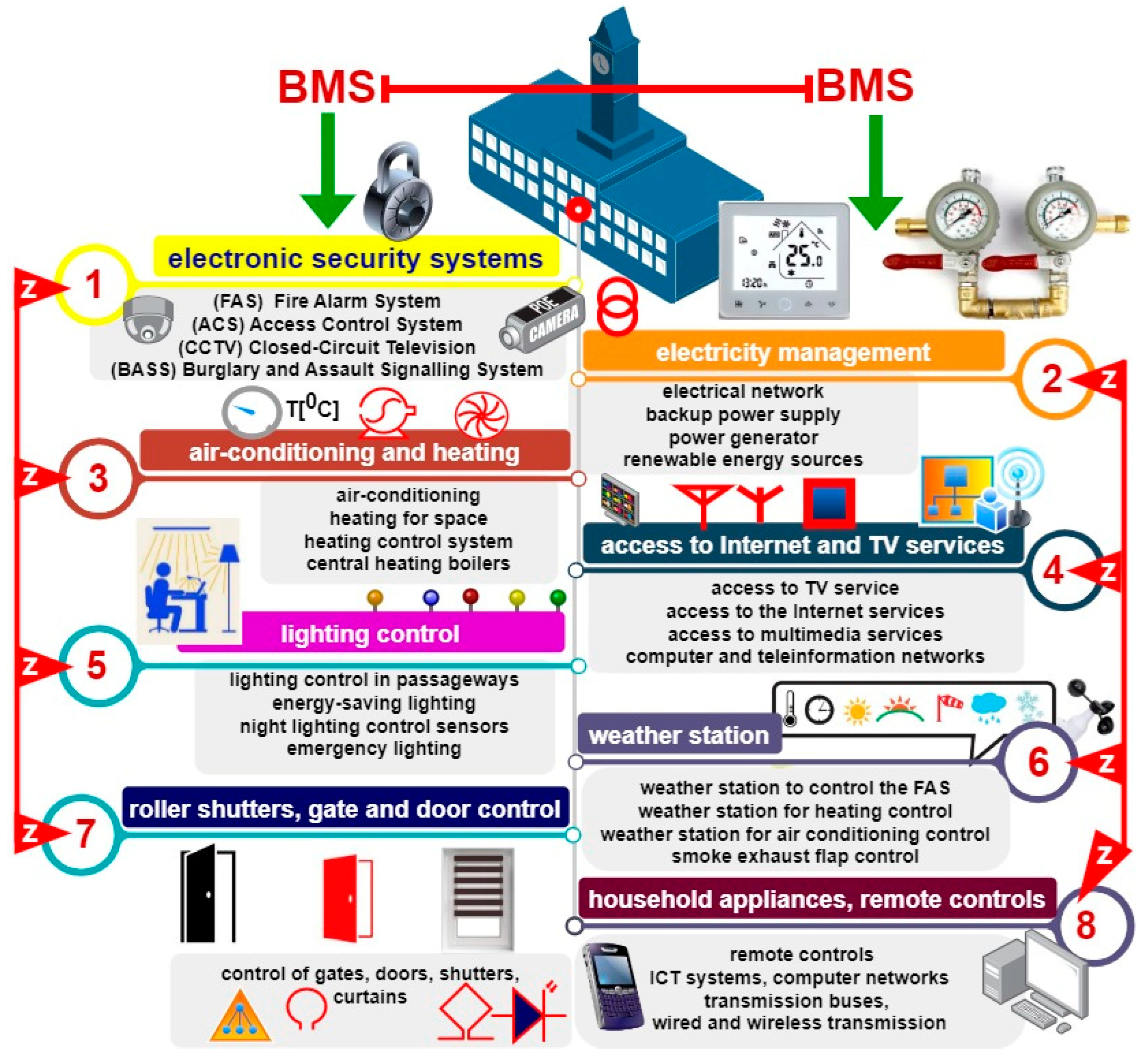
- Building automation system (BAS), responsible for managing the technical functions of the facility—heating, lighting, air-conditioning, etc.;
- -
- -
- -
- SB HVAC systems also based on renewable energy;
- -
- -
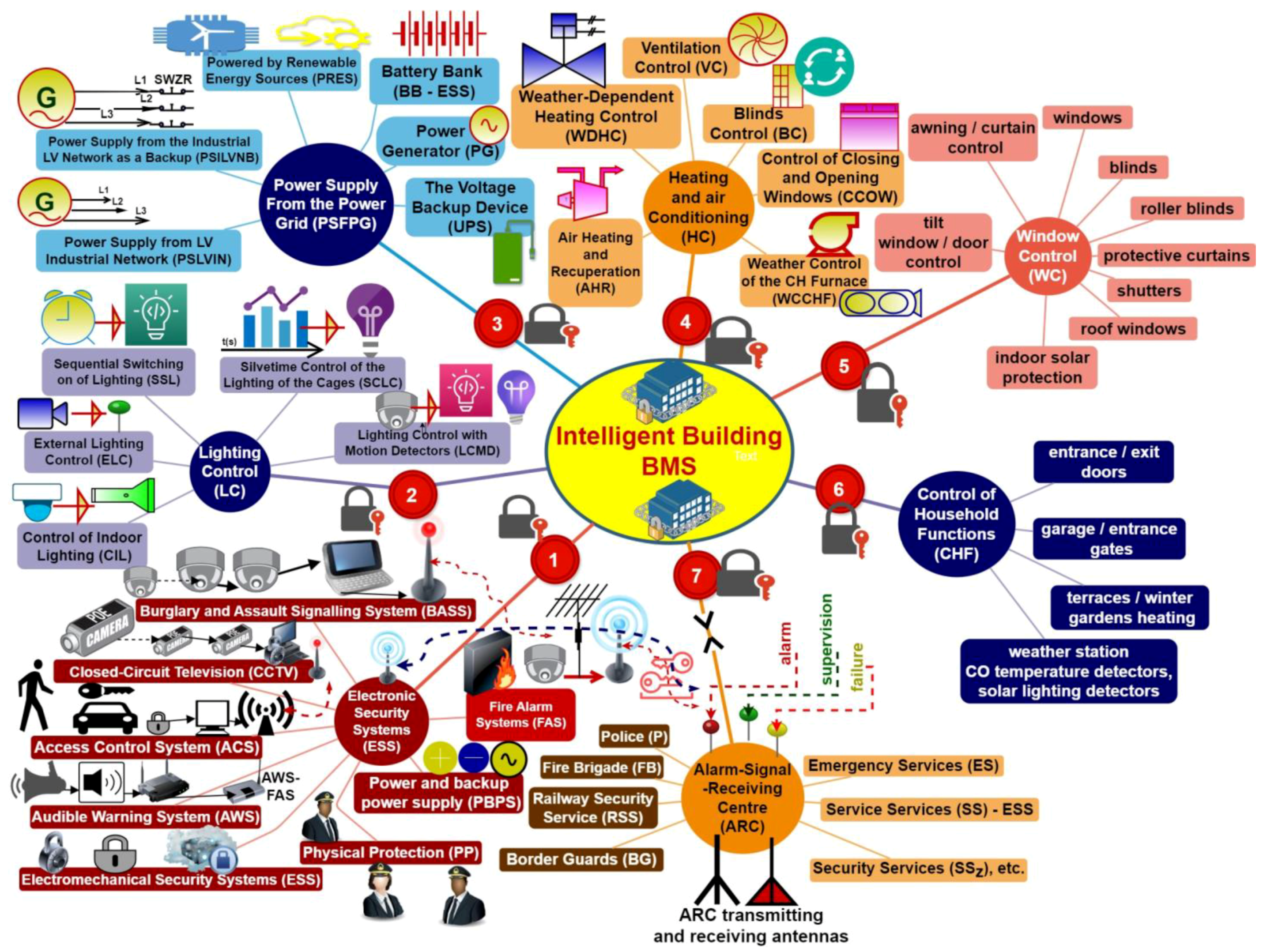
- Smart control for shutters, entrance gates, building entrances involving CCTV, ACSs and AWSs;
- -
2. Literature Review
2.1. Overview of SB System Operational Issues and Conditions Related to Processes Associated with the Occurrence of Natural Environment Interference
2.2. Issues Related to the Continuous Online Diagnosis Process for Electronic Systems Operated in SBs, ESSs in Particular
2.3. Operation Process of Sensors and Activators Employed in SB Electronic Systems—Overview of Issues Related to the Operation Process
2.4. Overview of Operation-Related Issues and Operation Processes Regarding Power Supply in SB Facilities
3. Power Supply in Selected ESSs in Smart Buildings and over a Vast Area
3.1. Implementation of Power Supply for Selected Unmanned Aerial Vehicles Monitoring a Vast Forest Area and an Airfield
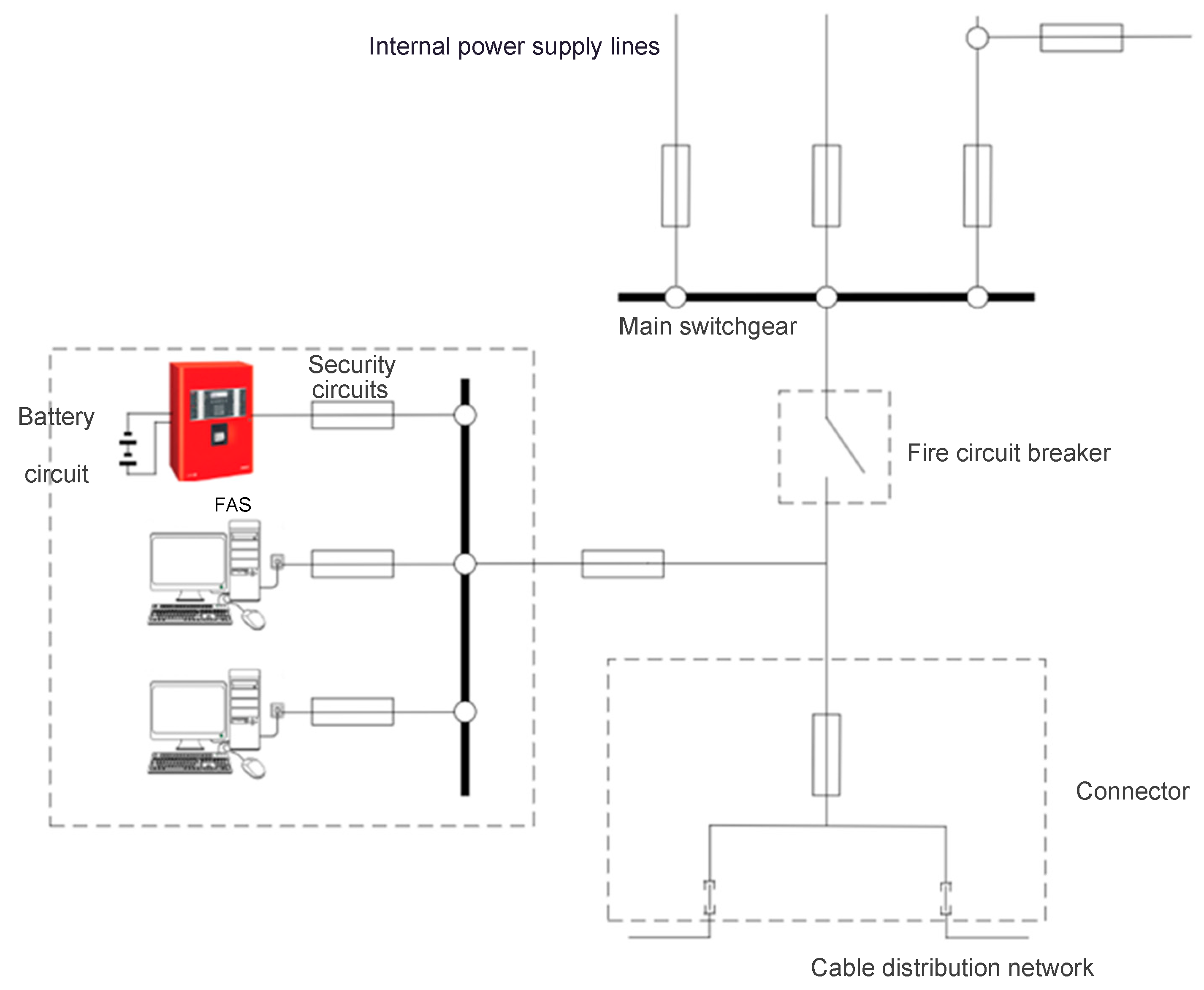
3.2. Power Supply of Selected Fire Alarm Systems and Fixed Extinguishing Devices Monitoring Civil Structures
- —current drawn from the batteries in the event of primary power failure in the monitoring state. It is the power consumption by all active FAS elements;
- —current drawn from the batteries in the event of primary power failure in the alarm state;
- —backup power supply time in the monitoring state;
- —backup power supply time in the alarm state;
- k—coefficient of 1.25. It takes into account the battery ageing process;
- —coefficient associated with reducing battery capacity due to I1 power consumption in the monitoring state;
- —coefficient associated with reducing battery capacity due to I2 power consumption in the alarm state.
- n—number of battery strings;
- k—coefficient of 0.1;
- —rated supply voltage;
- —current drawn from the batteries in the event of primary power failure in the alarm state.
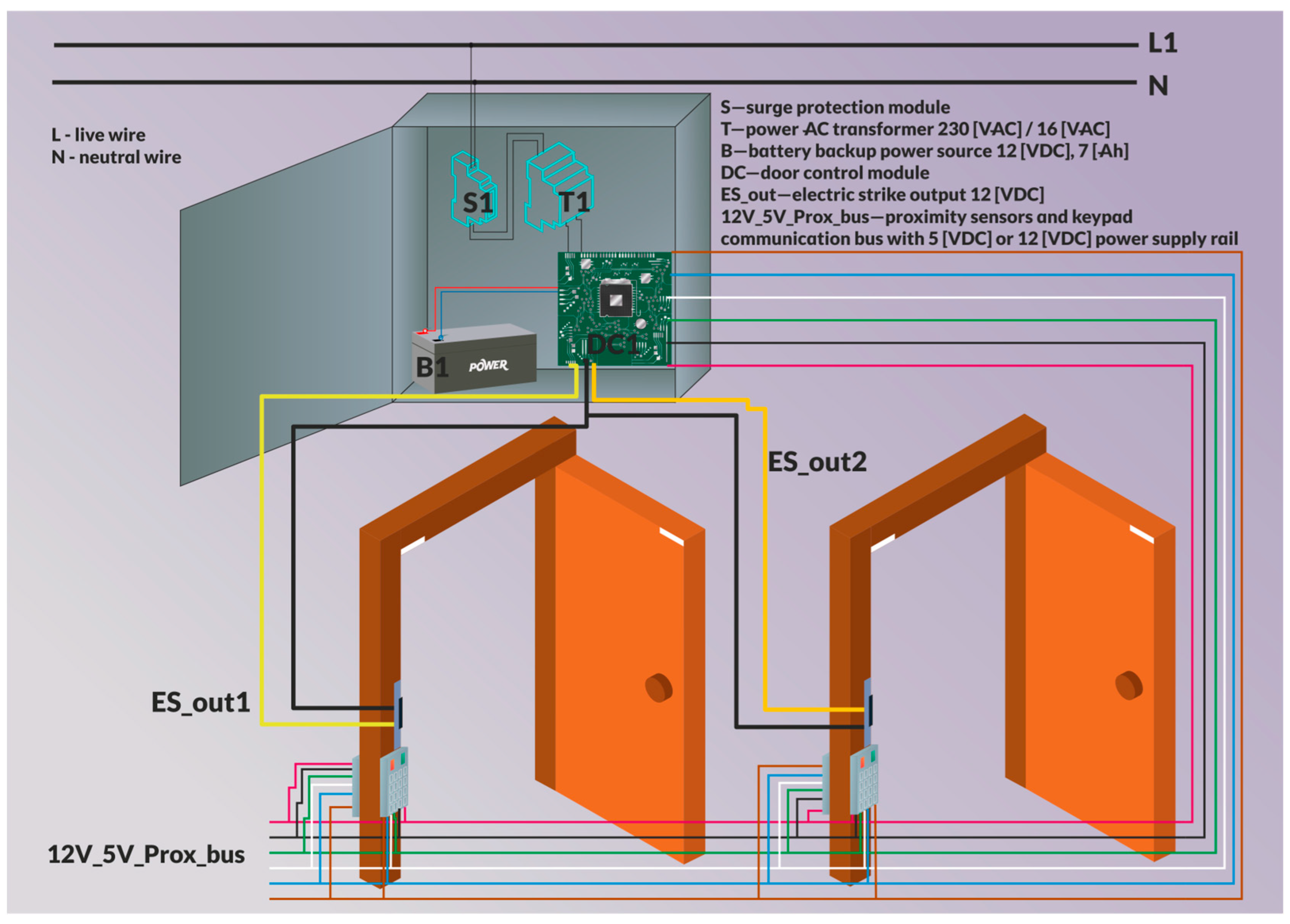
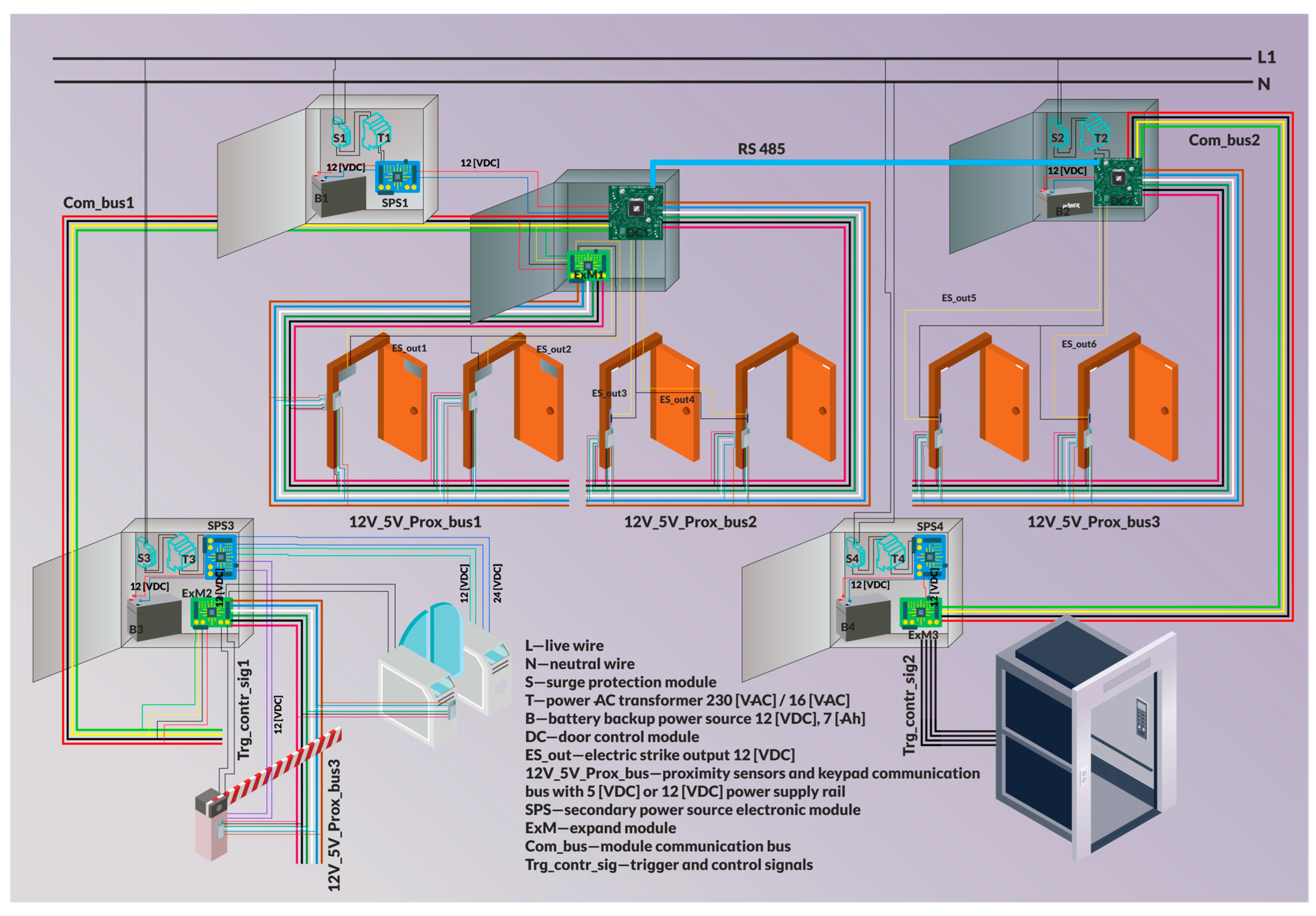
3.3. Power Supply of Access Control Systems Monitoring a Vast Area and State-Critical Infrastructure Facilities
- A primary (single-phase) AC power supply system must be operating under 230 [V], with a tolerance of (+10 ÷ −15)% and a frequency of 50 [Hz] ± 2%;
- A primary power supply point must be clearly separated and equipped with individual overcurrent and overvoltage protection;
- A primary power supply point must be located inside a protected area;
- An electronic technical protection system must be equipped with a backup power source that ensures the operation of the entire system for 15 min in the alarm state and, depending on more specific requirements and the technical potential of the facility itself, operation in normal mode for 12, 36 or 72 h;
- A process of switching between primary and backup power should be automatic in both directions, depending on the circumstances, and the transitions themselves must be indicated at a local control centre of the protected facility.
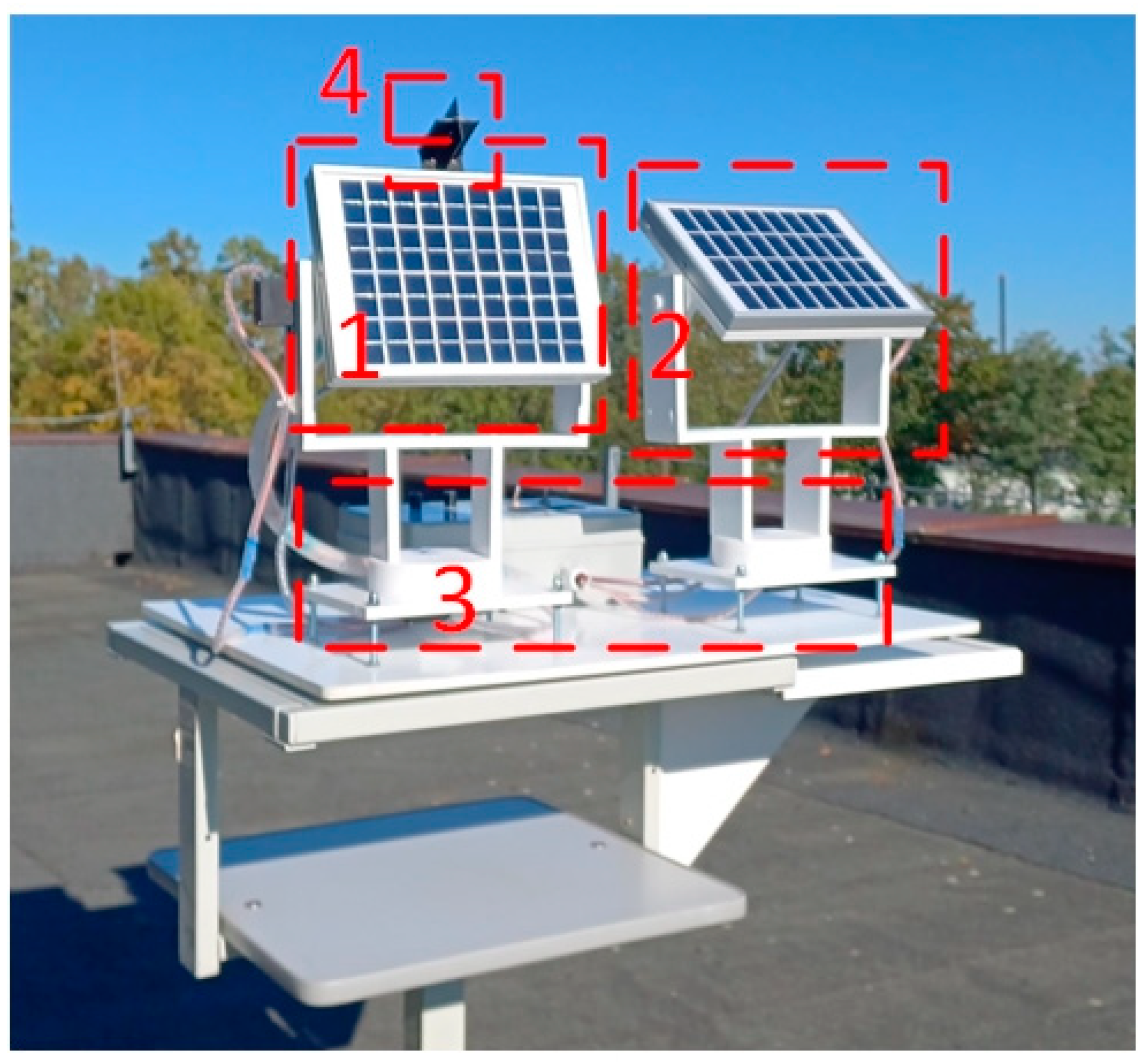
4. Alternative ESS Power Sources: Studies and an Analysis of the Technical Feasibility of Implementing Alternative Power Sources in Visual Surveillance Systems
5. Power Supply Reliability Models for Integrated ESSs Based on Conventional and Alternative Energy Sources
5.1. Fundamental Technical Assumptions Related to the Operation of an ESS Within an SB and over a Vast Area Associated with the Modelling of Such Systems
- The μ recovery (repair) rate of individual ESS components and devices depends on the availability of service personnel within an SB or ARC. Reducing ESS unfitness time is a crucial issue. This means the implementation of proper organisation and the functioning of the so-called on-site storage. This storage houses components, which usually lead to ESS unfitness.
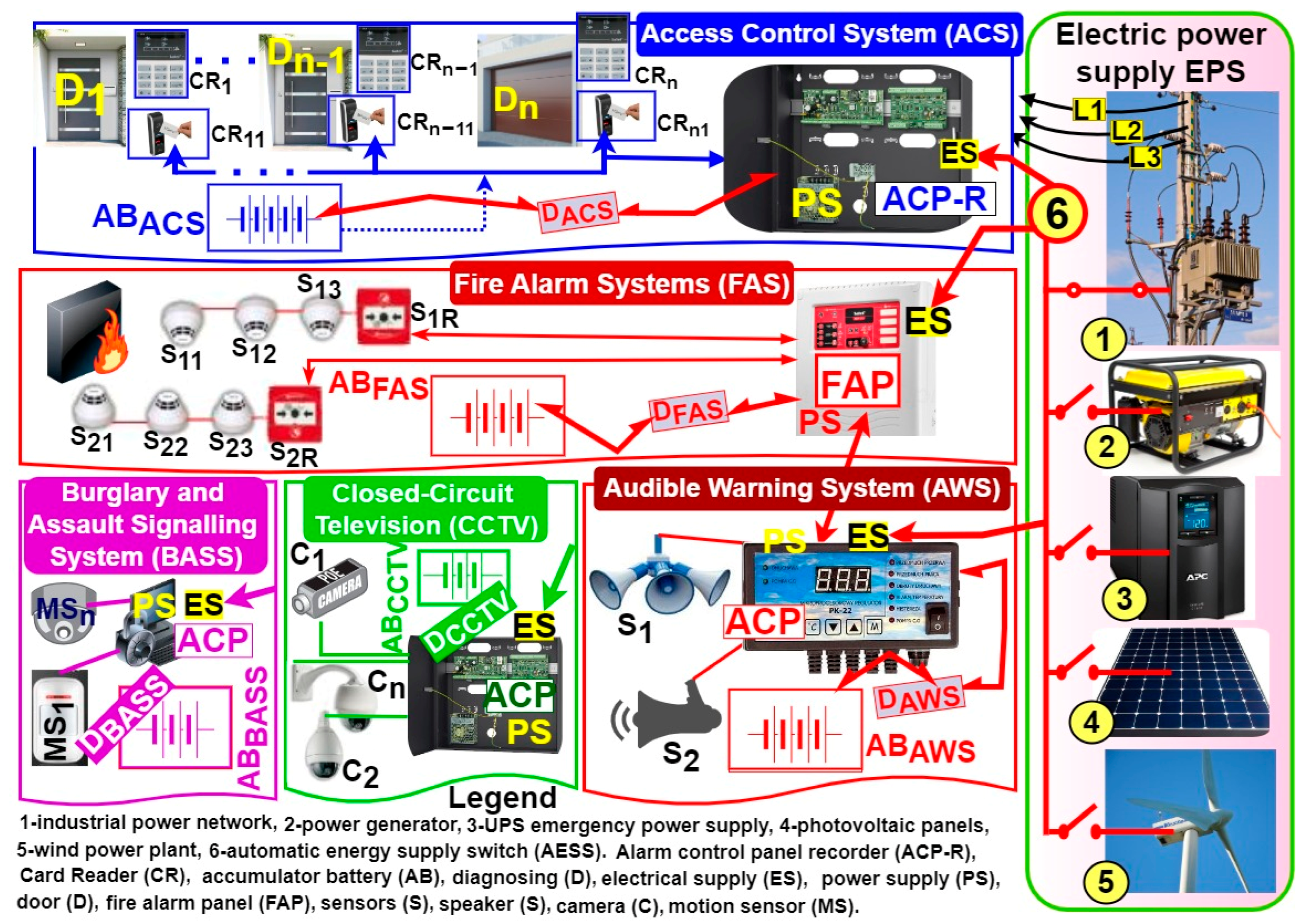
- The λ failure rate of components and devices employed for ESS operation is at a constant level throughout the entire modelling time of these systems. Adopting such an assumption for the calculations takes the so-called initial ageing process into account. This process is executed for all ESS components. Components should operate as in an actual ESS, i.e., implement all assumed functionalities, such as the permissible maximum current load of a power supply or UPS. These components should be located within detection lines and be powered with rated voltage from a power supply consuming electricity from an EPS—Figure 13. Implementing this process leads to elimination of the so-called infancy period in the course of the normal operation of all ESS components, including power supply equipment. ESS components and power supply equipment are not operated until they are completely worn out. They are replaced with other units in the course of retrofitting or expansion. Such a process is taken into account in ESS modelling.
- If the components and devices are incorrectly stored in warehouses (e.g., at the wrong temperature or humidity level), this should be taken into account in the change of λ rates.
- The ESS operation process in an SB is ahistorical. The technical state of a given ESS is a function of the history of the previous operation process for this system. Current technical state(s) of an ESS is (are) always a state (set of states) wherein these systems are at time t0.
- The operation process of ESSs in SBs does not include the so-called absorbing states, which prevent the complete functioning of a given system. Anti-destructive systems and proper ESS organisation enable this issue to be implemented.
- All technical states within the process of operating ESSs in an SB—e.g., monitoring, alarm, blocking, etc., are permissible and mutually communicated.
- The process of operating ESSs in SBs does not involve catastrophic failures.
5.2. Developing Assumptions for the Modelling Process Involving ESSs Operated in SBs
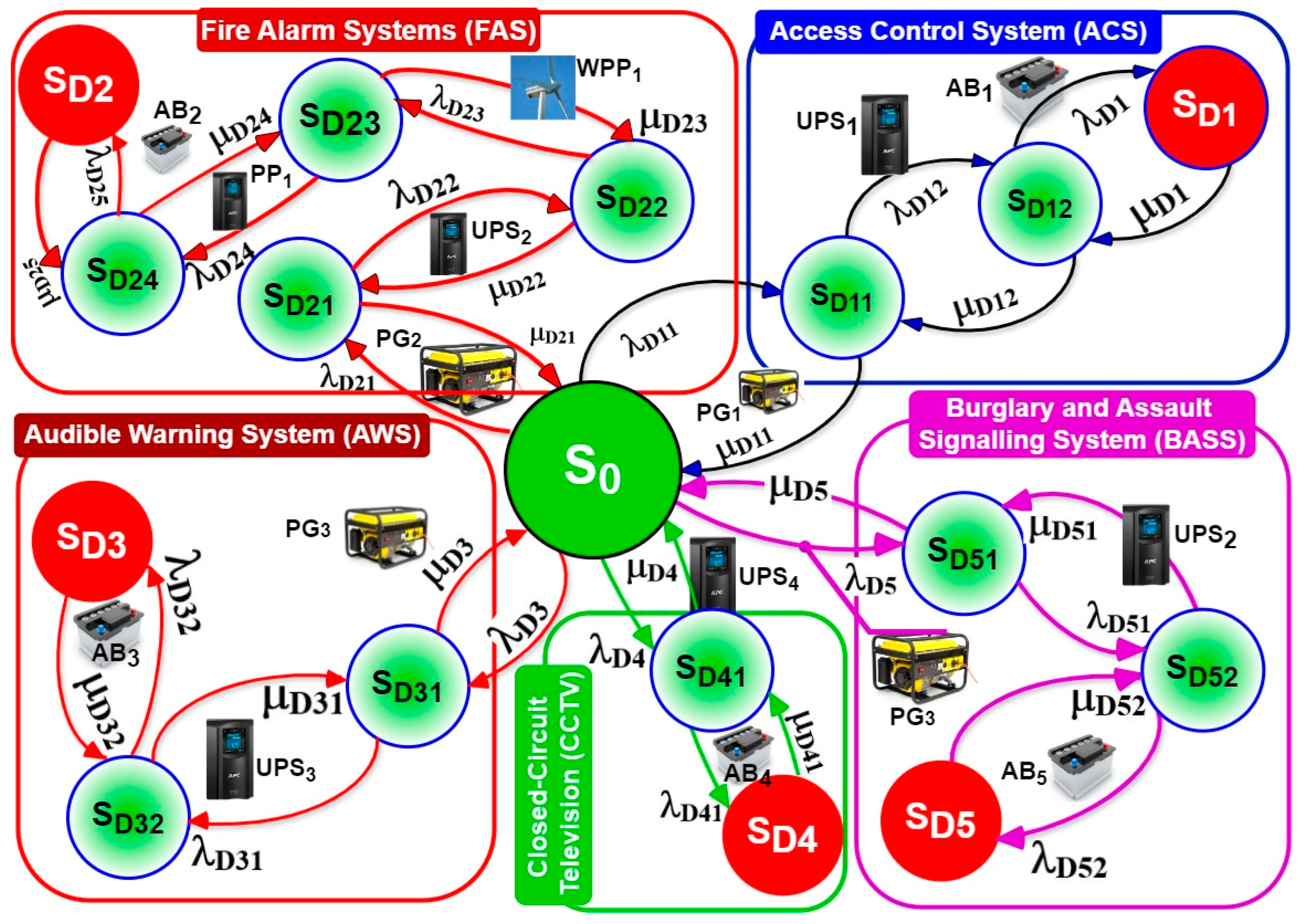
- SPZ—state of full fitness of all integrated ESSs operated within an SB and over a vast area. ESSs implement all pre-planned operational tasks, and power is supplied from an industrial power grid—Figure 14 (marked in green, S0 state, all redundant power sources are functional and ready to accept house-load associated with, e.g., ACS, FAS, AWS, etc.). Redundant power systems are always diagnosed online.
- SZB—state of ESS safety hazard (industrial grid primary power failure, redundant power sources), where, e.g., the UPS, power generator (PG), battery banks (AB), etc., take over an appropriate power supply system role. All ESSs in a technical state (SZB) implement operational tasks with a preset functionality, and the information on unfitness detected by diagnostic modules is forwarded via alarm control panels (ACP) to local service groups and the alarm-receiving centre (ARC). Operational tasks—and security monitoring by individual ESSs—are implemented further down the road. These states are also marked with partially filled green in Figure 14 due to the partial unfitness of one, two or more power sources, for example, an FAS (SZB is the following distinguished hazard states: SD21 (industrial power supply and PG failure), SD22 (UPS unfitness), SD23 (wind power plant unfitness) and SD24 (PP1 panel failure)). ESB—BASS (Figure 14) has only two SZB states—i.e., SD51 and SD52. The available local service personnel immediately take remedial actions associated with the recovery of all power supply systems, whereas the service personnel in the ARC receive remote information on unfitness and have a preset time frame to intervene in order to check the entire redundant power supply system.
- SB—state of safety unreliability for ESSs operated in IBs. States belonging to the SB set can be interpreted as follows: ESS full fitness and safety hazard for FAS (1,2,3,4), ACS (1,2), AWS (1,2), CCTV (1) and BASS (1,2), respectively; and safety unreliability (Figure 14, states marked in red—SD1, SD2, SD3, SD4 and SD5). Marking individual states in an operation process graph enables technical discussions related to ESS operation within an SB and the security model in terms of its functioning and the implementation of assumed operational tasks.
- The second element, RE, found in Expression (1) for the ordered M triple is always a set of the following pairs with elements interpreted as follows (Figure 14):
- is always the information on the possible transition of SB-operated ESSs from the SPZ state to the SZB (SD21, SD22, SD23, SD24) state for the FAS or for the AWS (SD31, SD32), BASS (SD51, SD52), etc. ESSs implement their assigned operational tasks; however, these systems are powered from backup power sources, which are characterised by a specified, finite current capacity. Security systems are fully fit, and building or SB rooms have functional motion detectors for, e.g., smoke, flame or unauthorised motion. At an appropriate μ recovery rate, the service personnel located in the SB restore full functionality of the power supply systems—e.g., in an FAS, it is μD21—PG2 fitness restoration, μD22—UPS2 fitness restoration, etc. Power supply repair rate (μ) is a function dependent on numerous variables, e.g., time of repair, replacement, failure identification, delivery of repair parts, etc.
- is the information on the potential transition of ESSs operated in SBs from the SZB state to the SB state. All power supply systems—primary and redundant (Figure 13)—have failed. ESSs not powered by electricity fail to ensure security within an entire SB-type facility. This described event related to power supply, wherein all sources are subject to failure, is very unlikely, and the operation time of a given ESS on AB1, AB2, AB3, …, AB5 is sufficiently long to enable selected power sources to be improved—restoring the fitness state. All ESSs operated in SBs are appropriately protected against, e.g., atmospheric discharge pulses or surges occurring within a power grid. Such safeguards, associated with the impact of interference on an ESS, are implemented already at the ESS engineering stage and it is impossible to switch from the state S0 to, e.g., SD2 (FAS), SD3 (AWS), SD4 (CCTV), etc. However, failure to undertake ESS recovery results in a transition to the safety unreliability state. Therefore, the RE element can be described with Expression (5):
- is interpreted as a transition rate for a given ESS from a state of full fitness (SPZ) to a state of safety hazard—SZB (unfitness of individual redundant power sources, e.g., PG2, UPS2, WPP1, PP1 or AB2 in the case of an FAS);
- is interpreted as the intensity of SB-operated ESS transitions from a state of safety hazard (SZB) to a state of safety unreliability—SB (fully unfit FAS, AWS, ACS, CCTV or BASS). All ESSs operated in an SB are fully unfit, i.e., they do not implement tasks associated with ensuring security within a facility. Security in this case can be guaranteed by physical guards within the facility or relevant uniformed services;
- λ is the overall intensity of the ESS transition from a state of full fitness (SPZ) to a state of safety unreliability (SB). All ESSs in an SB are fully unfit. This unfitness case was not taken into account in Figure 14 since all power sources—primary and backup—have extensive anti-destructive protections. Only deliberate actions, e.g., at time t0, via a strong pulse, e.g., of an electromagnetic weapon, can lead to the transition in the graph shown in Figure 14.
- -
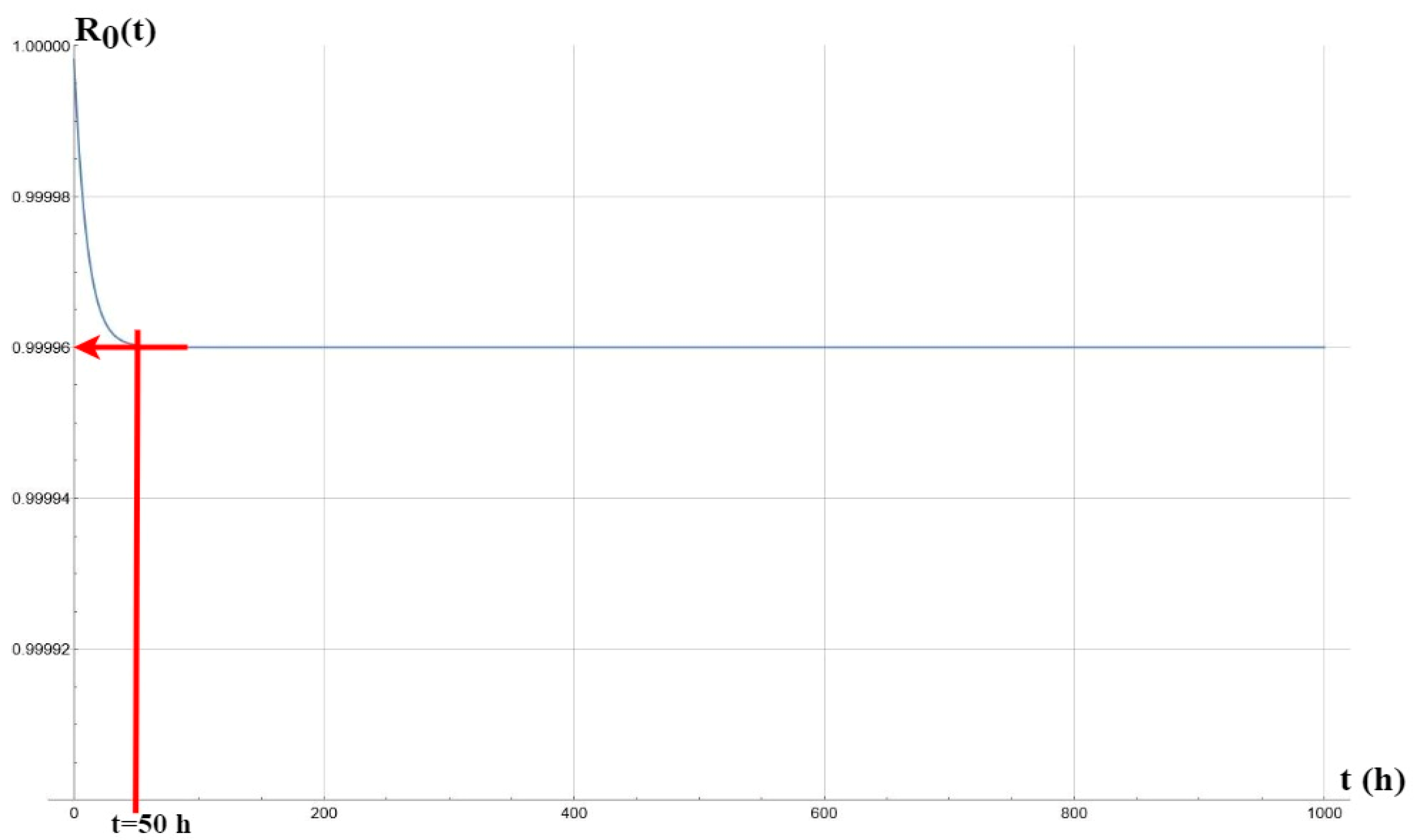
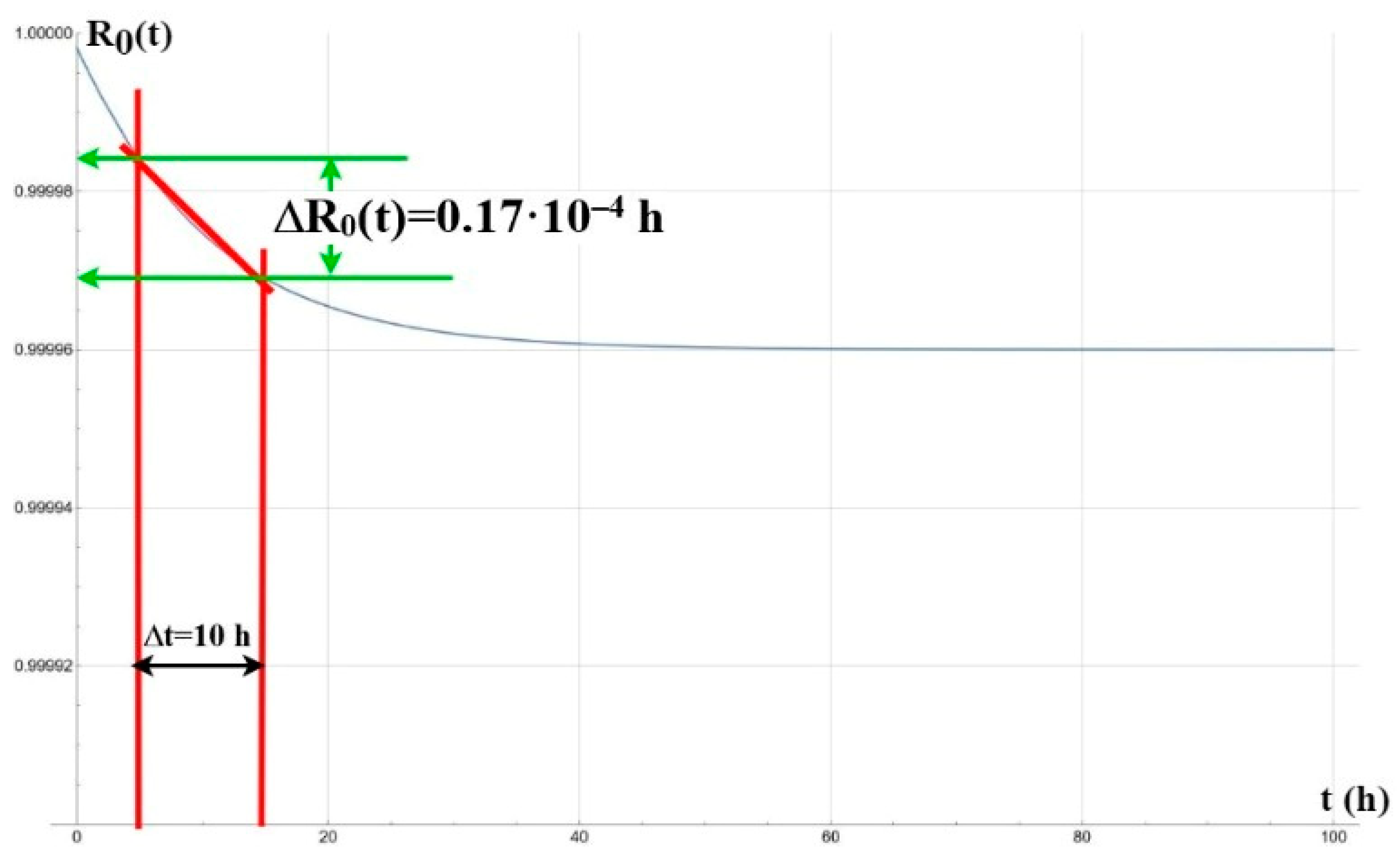
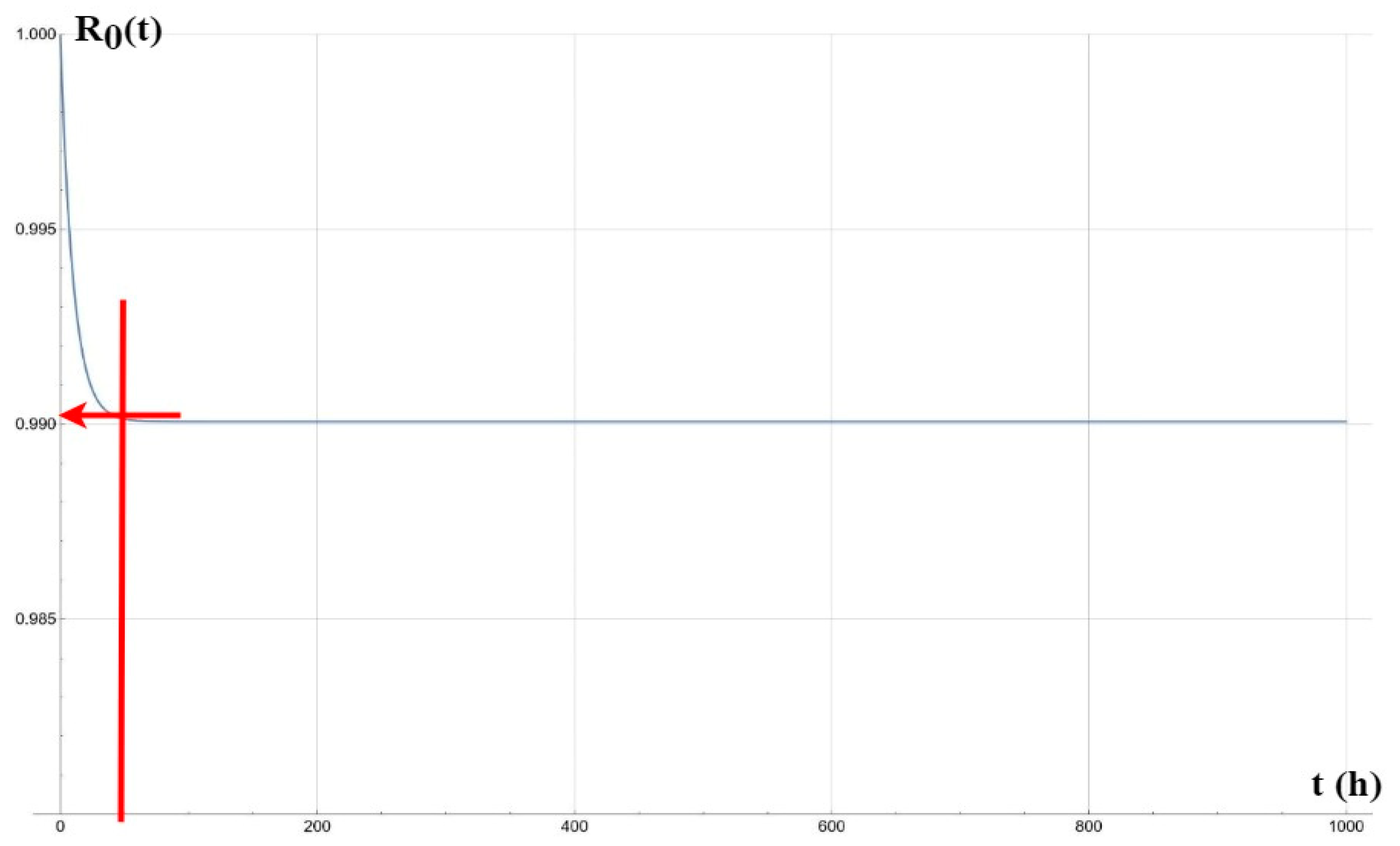
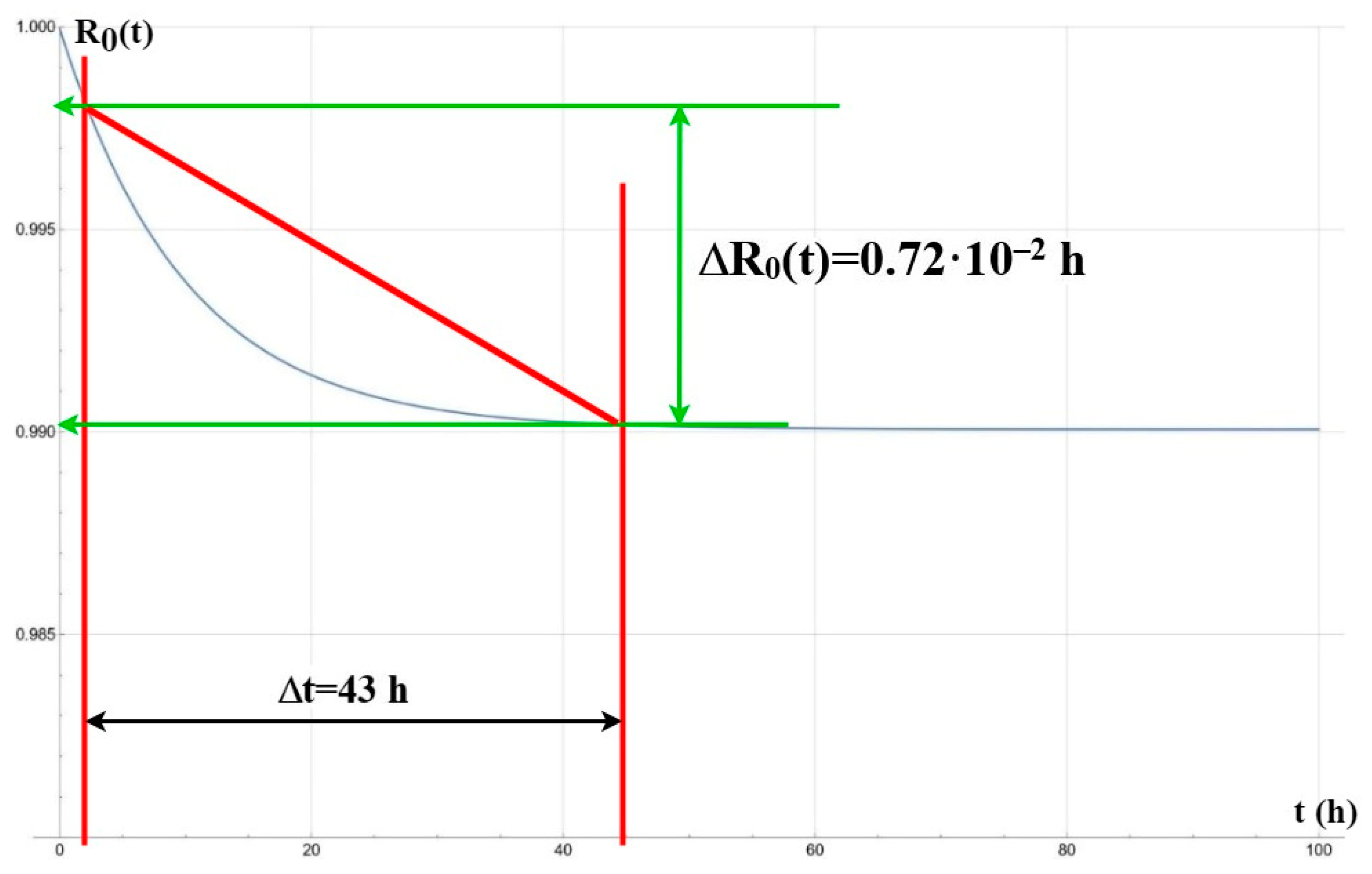
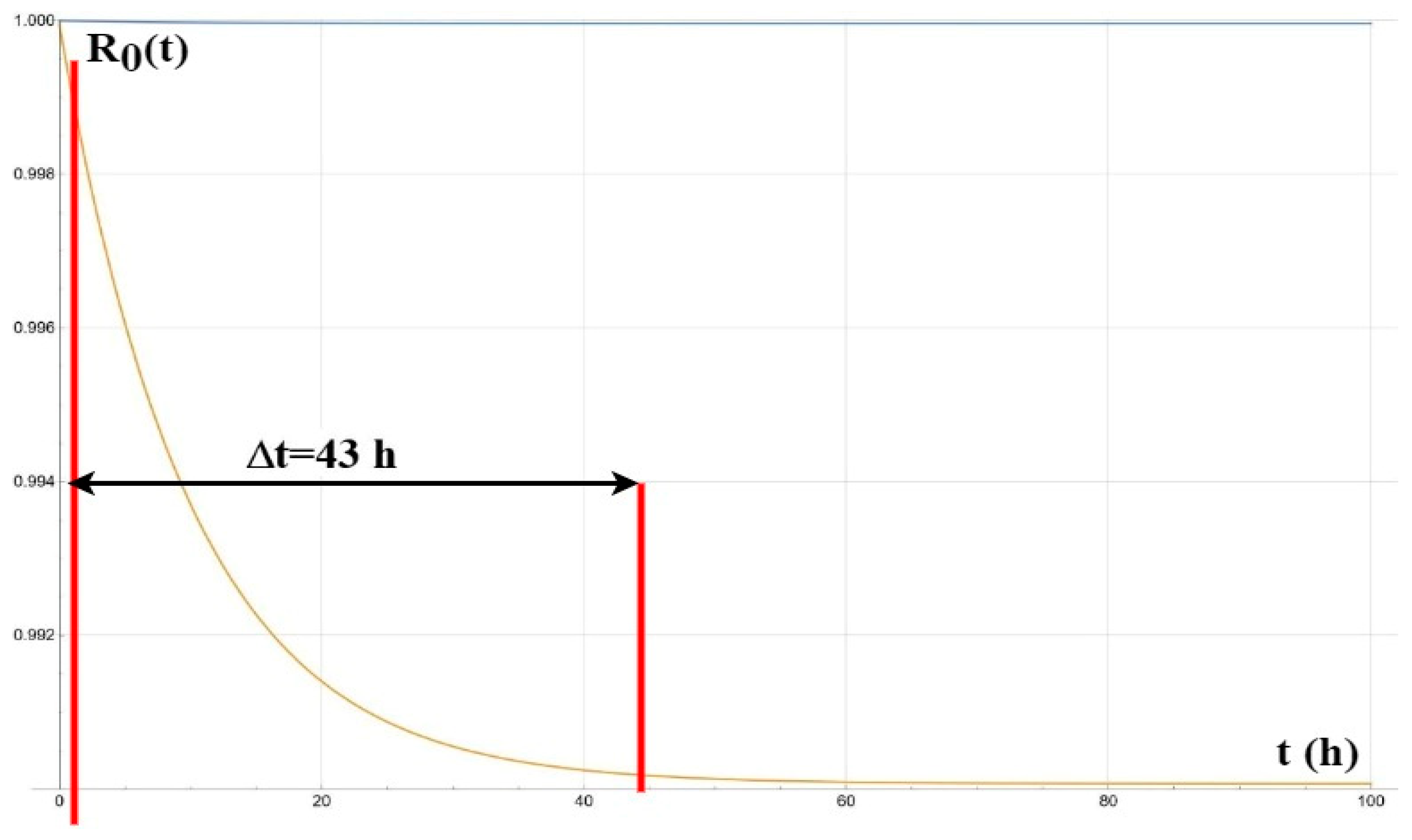
- SO(t)—probability function for ESSs operated in an SB staying in a state of full fitness (the t variable indicates time). All security systems execute a complex and in-house operational task programmed into the ACP, and associated with facility protection.
- -
- [SD21(t), SD22(t), SD23(t), SD24(t)—FAS], [SD11(t), SD12(t)—ACS], …, [SD51(t), SD52(t)—BASS] is the probability function for an ESS staying in a state of safety hazard. It is the unfitness of the primary or redundant power supply source—Figure 14. In this technical state, local service staff, at the SB site or remote in an ACR, immediately undertake improvement activities—recovery of damaged power sources or replacement with new equipment;
- -
- SD1(t), SD2(t), SD3(t), SD4(t), SD5(t) is the probability function required for ESSs operated in an SB to stay in a safety unreliability state. Unfitness of all power sources—primary and redundant—prevents the implementation of basic tasks, i.e., monitoring, throughout the entire civil structure. The battery bank—the last backup power source in all ESSs—is also discharged by currents flowing in the monitoring circuits, lines and loops of these systems. In such a case, the recovery process to be implemented within an ESS operated in an SB will always be first conducted within an FAS. It is the security system that is responsible for life, health and property, as well as internal and external environments.
6. Conclusions
Author Contributions
Funding
Data Availability Statement
Conflicts of Interest
Abbreviations
| ESS | Electronic security systems |
| CTMS | Communication and Telecommunication Information for ESS Transmission Modules and Systems |
| ICS | Information channel systems |
| IDS | Intrusion Detection System |
| SB | Smart building |
| FAS | Fire Alarm System |
| ACS | Access control system |
| AWS | Audio warning system |
| PP | Photovoltaic panels |
| IDS | Intrusion Detection System |
| µ | Recovery rate coefficient |
| λ | Failure rate coefficient |
| RO(t) | Probability function of an FAS staying in the SPZ state (full fitness) |
| QZB(t) | Probability function of an FAS staying in the SZB state (safety hazard) |
| QB(t) | Probability function of an FAS staying in the SPZ state (safety unreliability) |
| λ | Failure rate, transition of a selected FAS from the SPZ state to the SZB state |
| μ | Recovery rate, transition from the SZB state to the SPZ state |
| ACP | Alarm control panel |
| FACP | Fire alarm control panel |
| SCI | State-critical infrastructure |
| BMS | Building Management System |
| BAS | Building automation system |
| SMS | Security management system |
| EMS | Energy management system |
| CCTV | Closed-circuit television |
| PRES | Renewable energy sources |
| PSFFPG | Electricity management system |
| L1, L2, L3 | Power supply phases |
| PG | Power generator |
| AOSD | Acoustic and optical signalling devices |
| UAV | Unmanned aerial vehicles |
| ABPS | Automatic backup power switch |
References
- Kozłowski, E.; Borucka, A.; Oleszczuk, P.; Jałowiec, T. Evaluation of the maintenance system readiness using the semi-Markov model taking into account hidden factors. Eksploat. I Niezawodn. Maint. Reliab. 2023, 25, 172857. [Google Scholar] [CrossRef] [Scilit]
- Veit, S.; Steiner, F. Defect Trends in Fire Alarm Systems: A Basis for Risk-Based Inspection (RBI) Approaches. Safety 2024, 10, 95. [Google Scholar] [CrossRef] [Scilit]
- Saeed, F.; Paul, A.; Rehman, A.; Hong, W.H.; Seo, H. IoT-Based Intelligent Modeling of Smart Home Environment for Fire prevention and Safety. J. Sens. Actuator Netw. 2018, 7, 11. [Google Scholar] [CrossRef] [Scilit]
- Aslan, Y.E.; Korpeoglu, I.; Ulusoy, Ö. A framework for use of wireless sensor networks in forest fire detection and monitoring. Comput. Environ. Urban Syst. 2012, 36, 614–625. [Google Scholar] [CrossRef] [Scilit]
- Olivares-Mercado, J.; Toscano-Medina, K.; Sánchez-Perez, G.; Hernandez-Suarez, A.; Perez-Meana, H.; Sandoval Orozco, A.L.; García Villalba, L.J. Early Fire Detection on Video Using LBP and Spread Ascending of Smoke. Sustainability 2019, 11, 3261. [Google Scholar] [CrossRef] [Scilit]
- Caban, D.; Walkowiak, T. Dependability analysis of hierarchically composed system-of-systems. In Proceedings of the Thirteenth International Conference on Dependability and Complex Systems DepCoS-RELCOMEX, Brunów, Poland, 2–6 July 2018; Springer: Cham, Switzerland, 2019; pp. 113–120. [Google Scholar] [CrossRef] [Scilit]
- Li, Y.; Guldenmund, F.W. Safety management systems: A broad overview of the literature. Saf. Sci. 2018, 103, 94–123. [Google Scholar] [CrossRef] [Scilit]
- Park, J.H.; Lee, S.; Yun, S.; Kim, H.; Kim, W.T. Dependable fire detection system with multifunctional artificial intelligence framework. Sensors 2019, 19, 2025. [Google Scholar] [CrossRef] [Scilit]
- Sarwar, B.; Bajwa, I.; Ramzan, S.; Ramzan, B.; Kausar, M. Design and Application of Fuzzy logic Based Fire Monitoring and Warning Systems for Smart Buildings. Symmetry 2018, 10, 615. [Google Scholar] [CrossRef] [Scilit]
- Chiang, S.Y.; Kan, Y.C.; Chen, Y.S.; Tu, Y.C.; Lin, H.C. Fuzzy computing model of activity recognition on WSN movement data for ubiquitous healthcare measurement. Sensors 2016, 16, 2053. [Google Scholar] [CrossRef] [Scilit] [PubMed]
- Hosoz, M.; Kaplan, K.; Aral, M.C.; Suhermanto, M.; Ertunc, H.M. Support vector regression modeling of the performance of an R1234yf automotive air conditioning system. Energy Procedia 2018, 153, 309–314. [Google Scholar] [CrossRef] [Scilit]
- Jadczak, K.; Białek, R.; Wiśnios, M. Laboratory stand for measuring the IR diode directivity characteristics. Prz. Elektrotech. 2020, 96, 87–89. [Google Scholar] [CrossRef] [Scilit]
- Sabat, W.; Klepacki, D.; Kamuda, K.; Kuryło, K.; Jankowski-Mihułowicz, P. Estimation of the Immunity of an AC/DC Converter of an LED Lamp to a Standardized Electromagnetic Surge. Electronics 2024, 13, 4607. [Google Scholar] [CrossRef] [Scilit]
- Tien Bui, D.; Khosravi, K.; Li, S.; Shahabi, H.; Panahi, M.; Singh, V.; Chapi, K.; Shirzadi, A.; Panahi, S.; Chen, W.; et al. New hybrids of ANFIS with several optimization algorithms for flood susceptibility modeling. Water 2018, 10, 1210. [Google Scholar] [CrossRef] [Scilit]
- Bao, Y.; Huang, Y.; Hoehler, M.; Chen, G. Review of fiber optic sensors for structural fire engineering. Sensors 2019, 19, 877. [Google Scholar] [CrossRef] [Scilit]
- Munir, M.; Bajwa, I.S.; Cheema, S.M. An Intelligent and Secure IoT based Smart Watering System using Fuzzy logic and Blockchain. Comput. Electr. Eng. 2019, 77, 109–119. [Google Scholar] [CrossRef] [Scilit]
- Shah, A.U.A.; Christian, R.; Kim, J.; Kim, J.; Park, J.; Kang, H.G. Dynamic Probabilistic Risk Assessment Based Response Surface Approach for FLEX and Accident Tolerant Fuels for Medium Break LOCA. Spectrum. Energ. 2021, 14, 2490. [Google Scholar] [CrossRef] [Scilit]
- Sodhro, A.H.; Pirbhulal, S.; Luo, Z.; de Albuquerque, V.H.C. Towards an optimal resource management for IoT based Green and sustainable smart cities. J. Clean. Prod. 2019, 220, 1167–1179. [Google Scholar] [CrossRef] [Scilit]
- Kwasiborska, A.; Skorupski, J. Assessment of the Method of Merging Landing Aircraft Streams in the Context of Fuel Consumption in the Airspace. Sustainability 2021, 13, 12859. [Google Scholar] [CrossRef] [Scilit]
- Sodhro, A.H.; Pirbhulal, S.; de Albuquerque, V.H.C. Artificial Intelligence Driven Mechanism for Edge Computing based Industrial Applications. IEEE Trans. Ind. Inform. 2019, 15, 4235–4243. [Google Scholar] [CrossRef] [Scilit]
- Antosz, K.; Machado, J.; Mazurkiewicz, D.; Antonelli, D.; Soares, F. Systems Engineering: Availability and Reliability. Appl. Sci. 2022, 12, 2504. [Google Scholar] [CrossRef] [Scilit]
- Kołowrocki, K.; Soszyńska-Budny, J. Critical Infrastructure Safety Indicators. In Proceedings of the IEEE International Conference on Industrial Engineering and Engineering Management (IEEM), Bangkok, Thailand, 16–19 December 2018; pp. 1761–1764. [Google Scholar]
- De Almeida, R.V.; Crivellaro, F.; Narciso, M.; Sousa, A.I.; Vieira, P. Bee2Fire: A deep learning powered forest fire detection system. In Proceedings of the ICAART 2020—12th International Conference on Agents and Artificial Intelligence, Valletta, Malta, 22–24 February 2020; SciTePress: Setúbal, Portugal, 2020; Volume 2, pp. 603–609. [Google Scholar]
- Vinogradov, A.; Bolshev, V.; Vinogradova, A.; Jasiński, M.; Sikorski, T.; Leonowicz, Z.; Goňo, R.; Jasińska, E. Analysis of the power supply restoration time after failures in power transmission lines. Energies 2020, 13, 2736. [Google Scholar] [CrossRef] [Scilit]
- Paś, J.; Rosiński, A.; Wiśnios, M.; Stawowy, M. Assessing the Operation System of Fire Alarm Systems for Detection Line and Circuit Devices with Various Damage Intensities. Energies 2022, 15, 3066. [Google Scholar] [CrossRef] [Scilit]
- Jakubowski, K.; Paś, J.; Duer, S.; Bugaj, J. Operational Analysis of Fire Alarm Systems with a Focused, Dispersed and Mixed Structure in Critical Infrastructure Buildings. Energies 2021, 14, 7893. [Google Scholar] [CrossRef] [Scilit]
- Soszyńska-Budny, J. General approach to critical infrastructure safety modelling. In Safety Analysis of Critical Infrastructure; Lecture Notes in Intelligent Transportation and Infrastructure; Springer: Cham, Switzerland, 2021. [Google Scholar]
- Klimczak, T.; Paś, J.; Duer, S.; Rosiński, A.; Wetoszka, P.; Białek, K.; Mazur, M. Selected Issues Associated with the Operational and Power Supply Reliability of Fire Alarm Systems. Energies 2022, 15, 8409. [Google Scholar] [CrossRef] [Scilit]
- Soliman, H.; Sudan, K.; Mishra, A. A smart forest-fire early detection sensory system: Another approach of utilizing wireless sensor and neural networks. In Proceedings of the 2010 IEEE Sensors, Waikoloa, HI, USA, 1–4 November 2010; Institute of Electrical and Electronics Engineers (IEEE): New York, NY, USA, 2010; pp. 1900–1904. [Google Scholar]
- Pritam, D.; Dewan, J.H. Detection of fire using image processing techniques with LUV color space. In Proceedings of the 2017 2nd International Conference for Convergence in Technology (I2CT), Mumbai, India, 7–9 April 2017; Volume I2CT, pp. 1158–1162. [Google Scholar]
- Borucka, A.; Kozłowski, E.; Parczewski, R.; Antosz, K.; Gil, L.; Pieniak, D. Supply sequence modelling using hidden Markov models. Appl. Sci. 2022, 13, 231. [Google Scholar] [CrossRef] [Scilit]
- Stawowy, M.; Rosiński, A.; Siergiejczyk, M.; Perlicki, K. Quality and Reliability-Exploitation Modeling of Power Supply Systems. Energies 2021, 14, 2727. [Google Scholar] [CrossRef] [Scilit]
- Laneve, G.; Castronuovo, M.; Cadau, E. Continuous Monitoring of Forest Fires in the Mediterranean Area Using MSG. IEEE Trans. Geosci. Remote. Sens. 2006, 44, 2761–2768. [Google Scholar] [CrossRef]
- Wiśnios, M.; Tatko, S.; Mazur, M.; Paś, J.; Łukasiak, J.M.; Klimczak, T. Identifying Characteristic Fire Properties with Stationary and Non-Stationary Fire Alarm Systems. Sensors 2024, 24, 2772. [Google Scholar] [CrossRef] [Scilit]
- Muhammad, K.; Rodrigues, J.J.P.C.; Kozlov, S.; Piccialli, F.; De Albuquerque, V.H.C. Energy-Efficient Monitoring of Fire Scenes for Intelligent Networks. IEEE Netw. 2020, 34, 108–115. [Google Scholar] [CrossRef] [Scilit]
- Łukasiak, J.; Rosiński, A.; Wiśnios, M. The Impact of Temperature of the Tripping Thresholds of Intrusion Detection System Detection Circuits. Energies 2021, 14, 6851. [Google Scholar] [CrossRef] [Scilit]
- Kubica, P.; Boroń, S.; Czarnecki, L.; Węgrzyński, W. Maximizing the retention time of inert gases used in fixed gaseous extinguishing systems. Fire Saf. J. 2016, 80, 1–8. [Google Scholar] [CrossRef] [Scilit]
- Drzazga, M.; Kołowrocki, K.; Soszyńska-Budny, J. Methodology for oil pipeline critical infrastructures safety and resilience to climate change analysis. J. Pol. Saf. Reliab. Assoc. Summer Saf. Reliab. Semin. 2016, 7, 173–178. [Google Scholar]
- Mohapatra, S.; Khilar, P. Forest fire monitoring and detection of faulty nodes using wireless sensor network. In Proceedings of the 2016 IEEE Region 10 Conference (TENCON), Singapore, 22–25 November 2016; pp. 3232–3236. [Google Scholar]
- Sadeghi, B.; Westerlund, P.; Giri, M.; Bollen, M. Analysis of the Measurements of the Radiated Emission from 9 kHz to 150 kHz from Electric Railways. Energies 2024, 17, 4951. [Google Scholar] [CrossRef] [Scilit]
- Slowak, P.; Kaniewski, P. Stratified Particle Filter Monocular SLAM. Remote Sens. 2021, 13, 3233. [Google Scholar] [CrossRef] [Scilit]
- Liu, L.; Sun, R.; Sun, Y.; Al-Sarawi, S. A smart bushfire monitoring and detection system using GSM technology. Int. J. Comput. Aided Eng. Technol. 2010, 2, 218–233. [Google Scholar] [CrossRef] [Scilit]
- Buemi, A.; Giacalone, D.; Naccari, F.; Spampinato, G. Efficient fire detection using fuzzy logic. In Proceedings of the 2016 IEEE 6th International Conference on Consumer Electronics Berlin (ICCE-Berlin), Berlin, Germany, 5–7 September 2016; Volume 2016, pp. 237–240. [Google Scholar]
- Azmil, M.S.A.; Ya’Acob, N.; Tahar, K.N.; Sarnin, S.S. Wireless fire detection monitoring system for fire and rescue application. In Proceedings of the 2015 IEEE 11th International Colloquium on Signal Processing & Its Applications (CSPA), Kuala Lumpur, Malaysia, 6–8 March 2015; Volume 10, pp. 84–89. [Google Scholar]
- Reis, M.S.; Gins, G. Industrial Process Monitoring in the Big Data/Industry 4.0 Era: From Detection, to Diagnosis, to Prognosis. Processes 2017, 5, 35. [Google Scholar] [CrossRef] [Scilit]
- Pas, J.; Klimczak, T.; Rosinski, A.; Stawowy, M. The analysis of the operational process of a complex fire alarm system used in transport facilities. In Building Simulation; Special Issue; Springer Nature: Berlin/Heidelberg, Germany, 2022; Volume 15, pp. 615–629. [Google Scholar] [CrossRef] [Scilit]
- Weese, M.; Martinez, W.; Megahed, F.M.; Jones-Farmer, L.A. Statistical Learning Methods Applied to Process Monitoring: An Overview and Perspective. J. Qual. Technol. 2016, 48, 4–24. [Google Scholar] [CrossRef] [Scilit]
- Bae, J.; Lee, M.; Shin, C. A Data-Based Fault-Detection Model for Wireless Sensor Networks. Sustainability 2019, 11, 6171. [Google Scholar] [CrossRef] [Scilit]
- Zieja, M.; Szelmanowski, A.; Pazur, A.; Kowalczyk, G. Computer Life-Cycle Management System for Avionics Software as a Tool for Supporting the Sustainable Development of Air Transport. Sustainability 2021, 13, 1547. [Google Scholar] [CrossRef] [Scilit]
- Szczupak, P.; Kossowski, T.; Szostek, K.; Szczupak, M. Tests of pulse interference from lightning discharges occurring in unmanned aerial vehicle housings made of carbon fibers. Eksploat. I Niezawodn. Maint. Reliab. 2024, 27, 2025. [Google Scholar] [CrossRef] [Scilit]
- Paś, J.; Rosiński, A.; Wetoszka, P.; Białek, K.; Klimczak, T.; Siergiejczyk, M. Assessment of the Impact of Emitted Radiated Interference Generated by a Selected Rail Traction Unit on the Operating Process of Trackside Video Monitoring Systems. Electronics 2022, 11, 2554. [Google Scholar] [CrossRef] [Scilit]
- Pham, H. Safety and RiskModeling and Its Applications; Springer Series in Reliability Engineering; Springer: London, UK, 2011; p. 125. [Google Scholar]
- Saleh, J.H.; Haga, R.A.; Favarò, F.M.; Bakolas, E. Texas City refinery accident: Case study in breakdown of defense-in-depth and violation of the safety—Diagnosability principle in design. Eng. Fail. Anal. 2014, 36, 121–133. [Google Scholar] [CrossRef] [Scilit]
- Li, N. The Construction of a Fire monitoring system based on multi-sensor and neural network. Int. J. Inf. Technol. Syst. Approach 2023, 16, 1–12. [Google Scholar] [CrossRef] [Scilit]
- Chen, S.J.; Hovde, D.C.; Peterson, K.A.; Marshall, A.W. Fire detection using smoke and gas sensors. Fire Saf. J. 2007, 42, 507–515. [Google Scholar] [CrossRef] [Scilit]
- Duer, S.; Rokosz, K.; Zajkowski, K.; Bernatowicz, D.; Ostrowski, A.; Woźniak, M.; Iqbal, A. Intelligent Systems Supporting the Use of Energy Devices and Other Complex Technical Objects: Modeling, Testing, and Analysis of Their Reliability in the Operating Process. Energies 2022, 15, 6414. [Google Scholar] [CrossRef] [Scilit]
- Oszczypała, M.; Ziółkowski, J.; Małachowski, J. Analysis of Light Utility Vehicle Readiness in Military Transportation Systems Using Markov and Semi-Markov Processes. Energies 2022, 15, 5062. [Google Scholar] [CrossRef] [Scilit]
- Duer, S.; Zajkowski, K.; Harničárová, M.; Charun, H.; Bernatowicz, D. Examination of Multivalent Diagnoses Developed by a Diagnostic Program with an Artificial Neural Network for Devices in the Electric Hybrid Power Supply System “House on Water”. Energies 2021, 14, 2153. [Google Scholar] [CrossRef] [Scilit]
- Duer, S.; Duer, R. Diagnostic system with an artificial neural network which determines a diagnostic information for the servicing of a reparable technical object. Neural Comput. Appl. 2010, 19, 755–766. [Google Scholar] [CrossRef] [Scilit]
- Fonollosa, J.; Solórzano, A.; Marco, S. Chemical sensor systems and associated algorithms for fire detection: A review. Sensors 2018, 18, 553. [Google Scholar] [CrossRef] [Scilit] [PubMed]
- Guar, A.; Singh, A.; Kumar, A.; Kulkarni, K.S.; Lala, S.; Kapoor, K.; Srivastava, V. Fire sensing technologies: A Review. IEEE Sens. J. 2019, 19, 3191–3202. [Google Scholar] [CrossRef] [Scilit]
- Zajkowski, K.; Rusica, I.; Palkova, Z. The use of CPC theory for energy description of two nonlinear receivers. MATEC Web Conf. 2018, 178, 09008. [Google Scholar] [CrossRef] [Scilit]
- Baek, J.; Alhindi, T.J.; Jeong, Y.S.; Jeong, M.K.; Seo, S.; Kang, J.; Choi, J.; Chung, H. Real-time fire detection algorithm based on support vector machine with dynamic time warping kernel function. Fire Technol. 2021, 57, 2929–2953. [Google Scholar] [CrossRef] [Scilit]
- Milke, J.A.; Hulcher, M.E.; Worrell, C.L.; Gottuk, D.T.; Williams, F.W. Investigation of multi-sensor algorithms for fire detection. Fire Technol. 2003, 29, 363–382. [Google Scholar] [CrossRef] [Scilit]
- Adib, M.; Eckstein, R.; Hernandez-Sosa, G.; Sommer, M.; Lemmer, U. SnO2 nanowire-based aerosol jet printed electronic nose as fire detector. IEEE Sens. J. 2017, 18, 494–500. [Google Scholar] [CrossRef] [Scilit]
- Li, J.; Yan, B.; Zhang, M.; Zhang, J.; Jin, B.; Wang, Y.; Wang, D. Long-range Raman distributed fiber temperature sensor with early warning model for fire detection and prevention. IEEE Sens. J. 2019, 19, 3711–3717. [Google Scholar] [CrossRef] [Scilit]
- Kaniewski, P. Extended Kalman Filter with Reduced Computational Demands for Systems with Non-Linear Measurement Models. Sensors 2020, 20, 1584. [Google Scholar] [CrossRef] [Scilit] [PubMed]
- JiJi, R.D.; Hammond, M.H.; Williams, F.W.; Rose-Pehrsson, S.L. Multivariate statistical process control for continuous monitoring of networked early warning fire detection (EWFD) systems. Sens. Actuators B Chem. 2003, 93, 107–116. [Google Scholar] [CrossRef] [Scilit]
- Baek, J.; Alhindi, T.J.; Jeong, Y.S.; Jeong, M.K.; Seo, S.; Kang, J.; Heo, Y. Intelligent multi-sensor detection system for monitoring indoor building fires. IEEE Sens. J. 2021, 21, 27982–27992. [Google Scholar] [CrossRef] [Scilit]
- De Amorim, L.B.; Cavalcanti, G.D.; Cruz, R.M. The choice of scaling technique matters for classification performance. Appl. Soft Comput. 2023, 133, 109924. [Google Scholar] [CrossRef] [Scilit]
- Yu, J.; Yoo, J.; Jang, J.; Park, J.H.; Kim, S. A novel hybrid of auto-associative kernel regression and dynamic independent component analysis for fault detection in nonlinear multimode processes. J. Process Control 2018, 68, 129–144. [Google Scholar] [CrossRef] [Scilit]
- Gajjar, S.; Palazoglu, A. A data-driven multidimensional visualization technique for process fault detection and diagnosis. Chemom. Intell. Lab. Syst. 2016, 154, 122–136. [Google Scholar] [CrossRef] [Scilit]
- Lucu, M.; Martinez-Laserna, E.; Gandiaga, I.; Liu, K.; Camblong, H.; Widanage, W.D.; Marco, J. Data-driven nonparametric Li-ion battery ageing model aiming at learning from real operation data-Part B: Cycling operation. J. Energy Storage 2020, 30, 101410. [Google Scholar] [CrossRef] [Scilit]
- Kang, Y.; Duan, B.; Zhou, Z.; Shang, Y.; Zhang, C. A multi-fault diagnostic method based on an interleaved voltage measurement topology for series connected battery packs. J. Power Sources 2019, 417, 132–144. [Google Scholar] [CrossRef] [Scilit]
- Stawowy, M.; Perlicki, K.; Sumiła, M. Comparison of uncertainty multilevel models to ensure ITS services. In Safety and Reliability: Theory and Applications, Proceedings of the European Safety and Reliability Conference ESREL 2017, Portoroz, Slovenia, 18–22 June 2017; Cepin, M., Bris, R., Eds.; CRC Press/Balkema: London, UK, 2017; pp. 2647–2652. [Google Scholar]
- Ganguly, S.; Das, S.; Kargupta, K.; Bannerjee, D. Optimization of Performance of Phosphoric Acid Fuel Cell (PAFC) Stack using Reduced Order Model with Integrated Space Marching and Electrolyte Concentration Inferencing. Comput. Aided Chem. Eng. 2012, 31, 1010–1014. [Google Scholar]
- Haile, S.M.; Boysen, D.A.; Chisholm, C.R.I.; Merie, R.B. Solid acids as fuel cell electrolytes. Nature 2001, 410, 910–913. [Google Scholar] [CrossRef] [Scilit]
- Saravanakumar, Y.N.; Sultan, M.T.H.; Shahar, F.S.; Giernacki, W.; Łukaszewicz, A.; Nowakowski, M.; Holovatyy, A.; Stępień, S. Power Sources for Unmanned Aerial Vehicles. Appl. Sci. 2023, 13, 11932. [Google Scholar] [CrossRef] [Scilit]
- Suzuki, K.A.O.; Kemper Filho, P.; Morrison, J.R. Automatic Battery Replacement System for UAVs: Analysis and Design. J. Intell. Robot. Syst. 2011, 65, 563–586. [Google Scholar] [CrossRef] [Scilit]
- Meng, J.; Luo, G.; Gao, F. Lithium polymer battery state-of-charge estimation based on adaptive unscented kalman filter and support vector machine. IEEE Trans. Power Electron. 2016, 31, 2226–2238. [Google Scholar] [CrossRef] [Scilit]
- Vanchiappan, A.; Joe, G.; Lee, Y.S.; Srinivasan, M. Insertion-type electrodes for nonaqueous Li-ion capacitors. Chem. Rev. 2014, 114, 11619–11635. [Google Scholar]
- PN-EN 54-4:2001/A2:2004; Fire Alarm Systems—Part 4: Power Supplies. Polski Komitet Normalizacyjny: Warszawa, Poland, 2024.
- Stowarzyszenie Inżynierów i Techników Pożarnictwa. Wytyczne Projektowania Instalacji Sygnalizacji Pożarowej; Stowarzyszenie Inżynierów i Techników Pożarnictwa: Warszawa, Poland, 2021; pp. 88–90. [Google Scholar]
- PN-EN 12845:2015-10 [EN]; Fixed Fire-Fighting Systems—Automatic Sprinkler Systems—Design, Installation and Maintenance. Polski Komitet Normalizacyjny: Warszawa, Poland, 2024.
- Wiśnios, M.; Dąbrowski, T.; Bednarek, M. The security increasing level method provided by biometric access control system. Przegląd Elektrotechniczny 2015, 1, 231–234. [Google Scholar] [CrossRef] [Scilit]
- Wisnios, M.; Pas, J. The assessment of exploitation process of power for access control system. Int. Conf. Energy Environ. Mater. Syst. 2017, 19, 01034. [Google Scholar] [CrossRef] [Scilit]
- PN-EN 50131-1:2009; Systemy Alarmowe—Systemy Sygnalizacji Włamania i Napadu. The Polish Committee for Standardization (Polski Komitet Normalizacyjny—PKN): Warsaw, Poland, 2009.
- Inspektorat Wsparcia Sił Zbrojnych: Oddział Operacyjny. Wymaganiom Eksploatacyjno-Technicznym dla XIX Grupy SpW-Systemy i Urządzenia Specjalistyczne do Ochrony Obiektów z Dnia 8 Maja 2020 r; Inspektorat Wsparcia Sił Zbrojnych: Oddział Operacyjny: Bydgoszcz, Poland, 2020. [Google Scholar]
- Rosiński, A.; Paś, J.; Szulim, M.; Łukasiak, J. The Reliability and Operational Analysis of ICT Equipment Exposed to the Impact of Strong Electromagnetic Pulses. In Theory and Engineering of Dependable Computer Systems and Networks, Proceedings of the Sixteenth International Conference on Dependability of Computer Systems DepCoS-RELCOMEX, Brunów, Poland, 28 June–2 July 2021; Zamojski, W., Mazurkiewicz, J., Sugier, J., Walkowiak, T., Kacprzyk, J., Eds.; Advances in Intelligent Systems and Computing; Springer: Berlin/Heidelberg, Germany, 2021; Volume 1389, pp. 380–390. ISBN 978-3-030-76772-3. [Google Scholar] [CrossRef] [Scilit]
- Rosiński, A.; Paś, J.; Łukasiak, J.; Szulim, M. Safety Analysis for the Operation Process of Electronic Systems Used Within the Mobile Critical Infrastructure in the Case of Strong Electromagnetic Pulse Impact. In Theory and Applications of Dependable Computer Systems, Proceedings of the Fifteenth International Conference on Dependability of Computer Systems DepCoS-RELCOMEX, Brunów, Poland, 29 June–3 July 2020; Zamojski, W., Mazurkiewicz, J., Sugier, J., Walkowiak, T., Kacprzyk, J., Eds.; Advances in Intelligent Systems and Computing; Springer: Berlin/Heidelberg, Germany, 2020; Volume 1173, pp. 513–522. ISBN 978-3-030-48255-8. [Google Scholar] [CrossRef] [Scilit]
- Akbar, M.A.; Azhar, T.N. Concept of Cost Efficient Smart CCTV Network for Cities in Developing Country. In Proceedings of the 2018 International Conference on ICT for Smart Society (ICISS), Semarang, Indonesia, 10–11 October 2018; pp. 1–4. [Google Scholar] [CrossRef] [Scilit]
- Pfaffel, S.; Faulstich, S.; Rohrig, K. Performance and Reliability of Wind Turbines: A Review. Energies 2017, 10, 1904. [Google Scholar] [CrossRef] [Scilit]
- Katinas, V.; Marčiukaitis, M.; Tamašauskienė, M. Analysis of the wind turbine noise emissions and impact on the environment. Renew. Sustain. Energy Rev. 2016, 58, 825–831. [Google Scholar] [CrossRef] [Scilit]
- Li, M.; Ren, B. Design and Implementation of PoE System Compliant with IEEE802.3af. Adv. Mater. Res. 2011, 422, 146–149. [Google Scholar] [CrossRef] [Scilit]
- Łukasiak, J.; Wiśnios, M.; Rosiński, A. Method for Evaluating the Effectiveness of Electrical Circuit Protection with Miniature Fuse-Links. Energies 2023, 16, 960. [Google Scholar] [CrossRef] [Scilit]


Disclaimer/Publisher’s Note: The statements, opinions and data contained in all publications are solely those of the individual author(s) and contributor(s) and not of MDPI and/or the editor(s). MDPI and/or the editor(s) disclaim responsibility for any injury to people or property resulting from any ideas, methods, instructions or products referred to in the content. |
© 2024 by the authors. Licensee MDPI, Basel, Switzerland. This article is an open access article distributed under the terms and conditions of the Creative Commons Attribution (CC BY) license (https://creativecommons.org/licenses/by/4.0/).
Share and Cite
Wiśnios, M.; Mazur, M.; Tatko, S.; Paś, J.; Rosiński, A.; Łukasiak, J.M.; Koralewski, W.; Dyduch, J. The Process of Using Power Supply Technical Solutions for Electronic Security Systems Operated in Smart Buildings: Modelling, Simulation and Reliability Analysis. Energies 2024, 17, 6453. https://doi.org/10.3390/en17246453
Wiśnios M, Mazur M, Tatko S, Paś J, Rosiński A, Łukasiak JM, Koralewski W, Dyduch J. The Process of Using Power Supply Technical Solutions for Electronic Security Systems Operated in Smart Buildings: Modelling, Simulation and Reliability Analysis. Energies. 2024; 17(24):6453. https://doi.org/10.3390/en17246453
Chicago/Turabian StyleWiśnios, Michał, Michał Mazur, Sebastian Tatko, Jacek Paś, Adam Rosiński, Jarosław Mateusz Łukasiak, Wiktor Koralewski, and Janusz Dyduch. 2024. "The Process of Using Power Supply Technical Solutions for Electronic Security Systems Operated in Smart Buildings: Modelling, Simulation and Reliability Analysis" Energies 17, no. 24: 6453. https://doi.org/10.3390/en17246453
APA StyleWiśnios, M., Mazur, M., Tatko, S., Paś, J., Rosiński, A., Łukasiak, J. M., Koralewski, W., & Dyduch, J. (2024). The Process of Using Power Supply Technical Solutions for Electronic Security Systems Operated in Smart Buildings: Modelling, Simulation and Reliability Analysis. Energies, 17(24), 6453. https://doi.org/10.3390/en17246453