Review

Green Hydrogen Energy Systems: A Review on Their Contribution to a Renewable Energy System

1
Instituto Superior Técnico, University of Lisbon, 1049-001 Lisboa, Portugal
2
INESC-ID/IST, University of Lisbon, 1649-004 Lisboa, Portugal
*
Author to whom correspondence should be addressed.
Energies 2024, 17(13), 3110; https://doi.org/10.3390/en17133110
Submission received: 16 May 2024 / Revised: 19 June 2024 / Accepted: 21 June 2024 / Published: 24 June 2024

Abstract

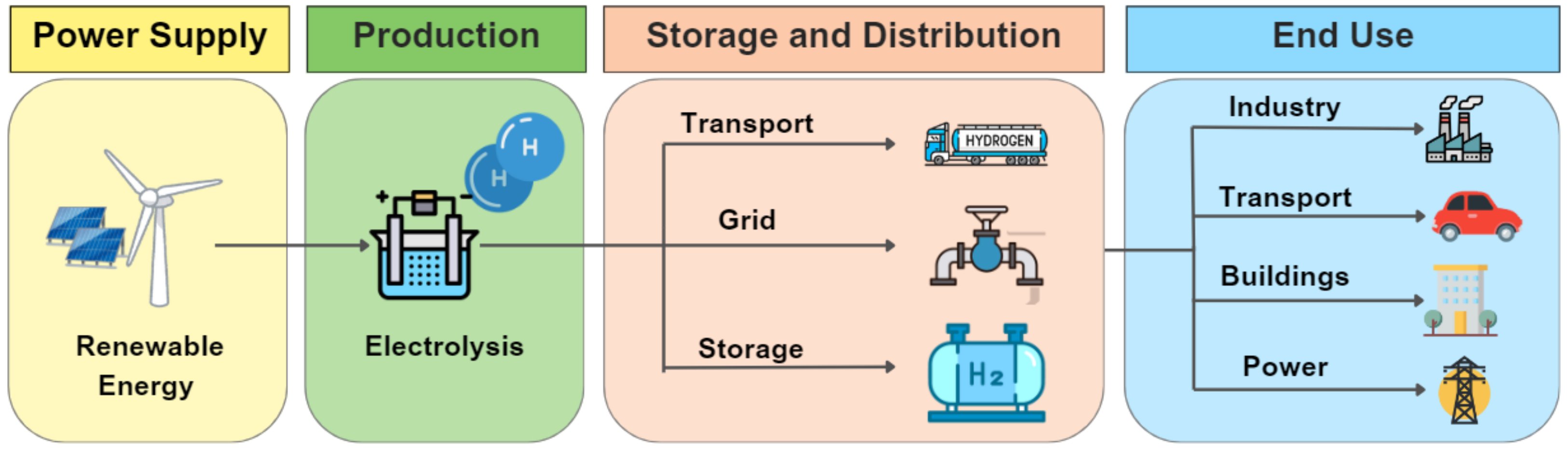
Accelerating the transition to a cleaner global energy system is essential for tackling the climate crisis, and green hydrogen energy systems hold significant promise for integrating renewable energy sources. This paper offers a thorough evaluation of green hydrogen’s potential as a groundbreaking alternative to achieve near-zero greenhouse gas (GHG) emissions within a renewable energy framework. The paper explores current technological options and assesses the industry’s present status alongside future challenges. It also includes an economic analysis to gauge the feasibility of integrating green hydrogen, providing a critical review of the current and future expectations for the levelized cost of hydrogen (LCOH). Depending on the geographic location and the technology employed, the LCOH for green hydrogen can range from as low as EUR 1.12/kg to as high as EUR 16.06/kg. Nonetheless, the findings suggest that green hydrogen could play a crucial role in reducing GHG emissions, particularly in hard-to-decarbonize sectors. A target LCOH of approximately EUR 1/kg by 2050 seems attainable, in some geographies. However, there are still significant hurdles to overcome before green hydrogen can become a cost-competitive alternative. Key challenges include the need for further technological advancements and the establishment of hydrogen policies to achieve cost reductions in electrolyzers, which are vital for green hydrogen production.
Keywords: green hydrogen; electrolyzers; renewable energy sources; hydrogen storage; hydrogen applications; economic assessment; levelized cost of hydrogen green hydrogen; electrolyzers; renewable energy sources; hydrogen storage; hydrogen applications; economic assessment; levelized cost of hydrogen