


Abstract
The application of fuzzy hybrid methods has significantly increased in recent years across various sectors. However, the application of fuzzy hybrid methods for modeling systems or processes, such as fuzzy machine learning, fuzzy simulation, and fuzzy decision-making, has been relatively limited in the energy sector. Moreover, compared to standard methods, the benefits of fuzzy-hybrid methods for capturing complex problems are not adequately explored for the solar energy sector, which is one of the most important renewable energy sources in electric grids. This paper investigates the application of fuzzy hybrid systems in the solar energy sector compared to other sectors through a systematic review of journal articles published from 2012 to 2022. Selection criteria for choosing an appropriate method in each investigated fuzzy hybrid method are also presented and discussed. This study contributes to the existing literature in the solar energy domain by providing a state-of-the-art review of existing fuzzy hybrid techniques to (1) demonstrate their capability for capturing complex problems while overcoming limitations inherent in standard modeling methods, (2) recommend criteria for selecting an appropriate fuzzy hybrid technique for applications in solar energy research, and (3) assess the applicability of fuzzy hybrid techniques for solving practical problems in the solar energy sector.
1. Introduction
Solar energy has been effectively used as a valuable energy source in the energy sector in response to the rising global energy demand for housing and industrial production. The advantages of solar energy use have become more pronounced because of the rising energy demand across industries and the infeasibility and environmental impact of alternative energy sources such as fuel. According to Pérez et al. [1], the photovoltaic (PV) solar system lifecycle can be divided into four main stages: evaluation/diagnosis, installation, operation, and disposal. In the evaluation/diagnosis stage, the technical and economic feasibility of the project is analyzed, and the elements that will make up the system are also decided, taking into account the technical and social needs of the project. In the installation stage, the elements chosen during evaluation are mounted. The operation stage refers mainly to the functioning of the system, considering its maintenance and monitoring. Finally, the disposal stage marks the end of the system’s lifecycle. In this last stage, all elements are analyzed in terms of whether they can be reused or recycled, and those that cannot must be disposed of according to current regulations in order to guarantee correct waste management.
This breakdown of the lifecycle of PV solar systems is important in this study because, as will be demonstrated in this paper, there are fuzzy hybrid methods that can be applied for one or several specific stages. Problems studied in the solar energy literature can include (1) simulation of manufacturing processes or system modeling; (2) prediction or forecasting of elements such as energy demand, maintenance, or system output; and (3) decision-making, such as selecting a suitable energy source, assessing an energy source’s or infrastructure’s performance, and identifying the optimal location of the energy facility. Other challenges to the adoption of renewable energy technologies were identified by Saraji et al. [2], including financial issues, governmental support, local engagement, underdeveloped business models, land use, a lack of regulations, technical issues, and awareness and knowledge.
Zadeh first introduced fuzzy set theory in 1965 [3]. This concept transformed the perception of modeling uncertainties, as fuzzy sets extended the notion of classical sets and Boolean logic. Hence, the fuzzy logic approach is capable of handling natural language and approximate reasoning by mathematically translating linguistic variables into numeric form, allowing the user to draw definite conclusions from ambiguous information and incomplete data [3]. Fuzzy sets are represented using membership functions. In fuzzy hybrid models, it is crucial to appropriately represent linguistic variables and fuzzy rules, employ the correct fuzzy arithmetic method, and select the most suitable defuzzification methods [4].
Fuzzy hybrid systems have been applied to solve different types of problems in the literature. This is achieved by integrating fuzzy logic with standard techniques to produce hybrid systems, such as fuzzy machine learning, fuzzy simulation, and fuzzy decision-making, which combines the advantages of fuzzy and standard methods. In the renewable energy sector, fuzzy simulation methods are used to capture the behavior of systems and processes to predict or forecast critical variables such as energy load, energy usage, and so on. Moreover, fuzzy decision-making methods entail a combination of evaluating alternative policies, identifying the optimal energy source, identifying the optimal location of an energy facility, and/or selecting the optimal type of renewable energy source [5].
Despite the presence of extensive research on the use of fuzzy hybrid techniques in other sectors, the literature on fuzzy hybrid techniques in the solar energy sector is lacking. Moreover, no detailed systematic review or content analysis exists that synthesizes the existing limited literature to guide researchers in selecting appropriate fuzzy hybrid techniques to apply to their specific problems. This study has three objectives: (1) investigate the application of fuzzy hybrid systems in the solar energy sector in comparison to other sectors, and demonstrate the capability of these methods in comparison to standard modeling/simulation; (2) recommend selection criteria for applying a suitable fuzzy hybrid method in solar energy research; and (3) provide a systematic review of fuzzy hybrid methods to assess the applicability of fuzzy hybrid techniques in the solar energy sector.
This paper contributes significantly to the literature review on applying fuzzy hybrid techniques in solar PV systems. The insights provided in this paper can help advance research and development in this field and ultimately lead to more effective and efficient use of solar energy on electric grids. The main contributions are as follows:
- State-of-the-art review of existing fuzzy hybrid techniques: This paper provides a comprehensive review of existing fuzzy hybrid techniques, including fuzzy machine learning, fuzzy simulation, and fuzzy decision-making, as they are applied in the solar energy sector. This review helps identify each technique’s strengths and weaknesses and provides guidance for selecting the appropriate technique for specific applications in solar PV systems;
- Showing the capability of fuzzy hybrid techniques: This paper shows the capability of fuzzy hybrid techniques that could be implemented to capture complex problems in solar PV systems that standard modeling methods cannot adequately address. The use of fuzzy hybrid techniques can help overcome standard methods’ limitations and provide more accurate and reliable results;
- Criteria for selecting appropriate fuzzy hybrid techniques: This paper provides criteria for selecting the appropriate fuzzy hybrid technique for specific applications in the solar energy sector. These criteria consider factors such as the type of problem, data availability, and complexity level;
- Assessment of the applicability of fuzzy hybrid techniques: This paper assesses the applicability of fuzzy hybrid techniques for solving practical problems in the solar energy sector. The results of this assessment can help researchers identify areas where fuzzy hybrid techniques can be most effective, and they can be used to guide future research in this field.
The rest of this paper is organized as follows: After a brief introduction to fuzzy logic and the application of fuzzy hybrid methods in the solar energy sector, an overview of fuzzy logic applications in different sectors (e.g., construction, mining, and electronics) is presented. Next, the methodology is discussed, which details the steps used to perform a systematic review of articles with fuzzy hybrid applications in the solar energy domain. Then, the results of the content analysis of the literature are presented for three main categories of fuzzy hybrid systems: fuzzy machine learning, fuzzy decision-making, and fuzzy simulation. Then, a checklist for selection criteria for fuzzy hybrid methods for solving problems in the solar energy sector is presented. The last section provides conclusions and recommendations for future work.
2. Methodology
This paper presents a systematic analysis of the extensive literature on fuzzy hybrid methods used in solar energy research that has been published in high-ranking journals. Figure 1 illustrates the methodology used, which consists of two main steps: (1) a review of the literature on fuzzy logic application across different sectors (e.g., construction, automotive, and mining), and (2) a content analysis of existing literature on the applications of fuzzy hybrid techniques to solve problems in the solar energy sector.
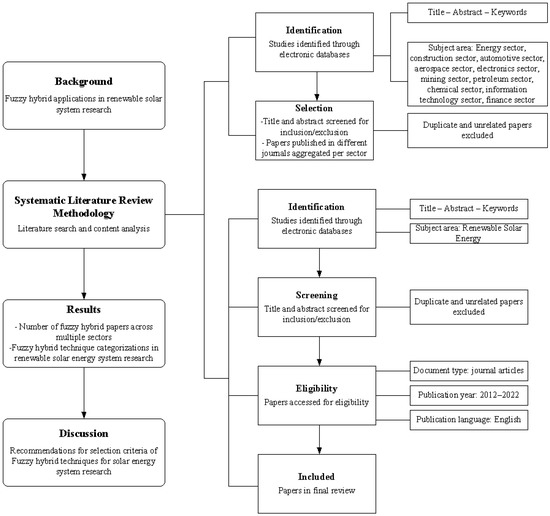
Figure 1.
Methodology for the systematic literature search and content analysis used in this study.
This study used the Preferred Reporting Items for Systematic Reviews and Meta-Analyses (PRISMA) method to conduct the systematic review. A description of the PRISMA methodology can be synthesized into two main steps [6]:
- Identification and screening: This step involves identifying the research question, creating a protocol, searching multiple databases and sources, and screening the titles, abstracts, and full texts of potentially relevant studies to determine inclusion or exclusion;
- Data extraction and synthesis: This step involves extracting relevant data using a standardized data extraction form, managing and organizing the data for analysis, and synthesizing the findings across the included studies through statistical analysis, meta-analysis, or a narrative synthesis.
These two steps ensure that the systematic review or meta-analysis is conducted rigorously and transparently, focusing on identifying all relevant studies and synthesizing the findings in a reproducible and replicable way.
The research questions for the systematic review using the PRISMA methodology for this study were:
- What are the existing fuzzy hybrid techniques used in the solar energy sector for modeling systems or processes, such as fuzzy machine learning, fuzzy simulation, and fuzzy decision-making?
- How do fuzzy hybrid techniques compare to standard methods for capturing complex problems in the solar energy sector?
- What criteria can be used to select an appropriate fuzzy hybrid technique for applications in solar energy research?
- What are the practical problems in the solar energy sector that can be solved using fuzzy hybrid techniques?
- How does applying fuzzy hybrid techniques in the solar energy sector compare to their application in other sectors?
One limitation of the methodology is that only published studies are considered, so it might not capture all relevant research in the field. Reliance on published studies can introduce a risk of publication bias, which occurs when only studies with statistically significant findings are published while non-significant findings are not reported.
2.1. Literature Review Process
The literature review began with six searches in Scopus with a filter for articles published from 2012 to 2022 (the last ten years as of this writing). Each search included the relevant set of words with AND as the Boolean operator. The resulting list of articles from each search was analyzed using Bibliometrix software version 4.1.2 [7]. The Bibliometrix analysis was conducted to obtain the number of fuzzy-related articles across various sectors, or specifically within the solar energy sector, for each of three areas of study: fuzzy machine learning, fuzzy decision-making, and fuzzy simulation. Each search resulted in a list of articles, and the analysis of each list gives the number of different sources (journals) and authors involved, the annual scientific production (in articles per year), the annual average growth rate in the number of articles, and the average number of times the articles were cited.
In addition, a keyword co-occurrence network (KCN) was generated for each Scopus search using VOSviewer software version 1.6.18. KCN is a method that aims to comprehend the constituents and arrangement of knowledge in scientific or technical fields through the analysis of connections between keywords in the relevant literature. In a KCN, keywords are represented as nodes and links that connect pairs of words that co-occur. The strength of the link between a pair of words is determined by the frequency with which they co-occur in multiple articles and is represented as the weight of the link. This network allows for the identification of meaningful knowledge components and insights by analyzing the patterns and strength of links between keywords that appear in the literature [8].
2.2. Selecting an Appropriate Fuzzy Application
Identified criteria can be used to assess the capabilities of various fuzzy applications by identifying their advantages and disadvantages. This study followed two basic steps to select a fuzzy hybrid method for modeling solar energy processes. First, the advantages and disadvantages of each possible fuzzy hybrid method were listed. Then, detailed selection criteria were listed based on various categories (e.g., accuracy, computational complexity, and data availability). Researchers and practitioners can utilize the content analysis offered in this paper and the listed advantages, disadvantages, and criteria to choose an appropriate fuzzy hybrid machine learning, decision-making, or simulation method to resolve a particular PV solar problem. This analysis allows them to select a methodology that best meets their needs while considering the possible drawbacks associated with each one.
3. Results and Discussion
3.1. Literature Search and Content Analysis Results
3.1.1. Fuzzy Hybrid Machine Learning
A Scopus search carried out for “fuzzy AND hybrid AND machine AND learning” (fuzzy-hybrid-machine-learning) yielded 1409 articles. These articles were published in 678 different sources by 3253 authors. Figure 2 shows the annual scientific production (articles per year) of the articles analyzed. Significant growth in the publication of articles on this topic has occurred, with an average annual growth rate of 19.83%. The year with the most articles published was 2022, and the average number of citations per article is 12.4.
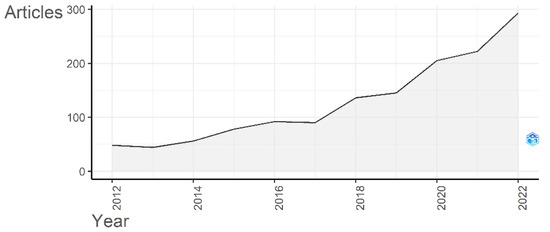
Figure 2.
Annual scientific production (articles per year) for fuzzy-hybrid-machine-learning.
Table 1 presents the most relevant sources, according to the number of articles published on fuzzy-hybrid-machine-learning.

Table 1.
The most relevant sources are based on the number of articles published for fuzzy-hybrid-machine-learning.
The countries with the greatest scientific production (i.e., number of articles) for fuzzy-hybrid-machine-learning were India (with 794 articles), China (155), Iran (95), Malaysia (38), Saudi Arabia (28), Türkiye (28), Korea (23), the United Kingdom (19), Canada (17), and the USA (17). The countries that produced articles with the most citations for fuzzy-hybrid-machine-learning were China (2836 citations), India (2220), Iran (1940), Norway (803), the United Kingdom (660), Malaysia (569), Australia (527), the USA (476), Canada (345), and Korea (315). India, China, and Iran rank highest in both cases, and only three countries from the Americas appear (Canada, the USA, and Brazil).
Table 2 presents the most globally cited articles for fuzzy-hybrid-machine-learning. These articles primarily focus on water, electric vehicles, and health. The most-cited article has 502 citations and was published in 2018 in the journal Water.
Table 2.
Most globally cited articles for fuzzy-hybrid-machine-learning.
The most frequent keywords that occurred as a result of the keyword search for fuzzy-hybrid-machine-learning were machine learning (appearing in 395 articles), fuzzy inference (324), learning systems (308), fuzzy neural networks (289), fuzzy systems (267), fuzzy logic (240), forecasting (237), learning algorithms (183), support vector machines (166), and artificial intelligence (162). A KCN was created with these keywords in order to analyze the links between them. As Figure 3 shows, four main clusters were found for fuzzy hybrid machine learning, and the term machine learning had the most links; this node is also the largest, which means it is the term with the highest frequency. Fuzzy inference, fuzzy neural networks, and learning systems are terms with higher frequency, which matches the previous keyword analysis. This KCN also shows a closer relationship between some keywords, such as machine learning, fuzzy systems, forecasting, fuzzy inference, learning, systems, and artificial intelligence, as represented by the thicker lines joining them. On the other hand, small nodes, such as GIS, groundwater, computer crime, and semantics, represent keywords with lower frequency, and the lack of a link connecting them to other nodes indicates these keywords are in the margins of this field of research.
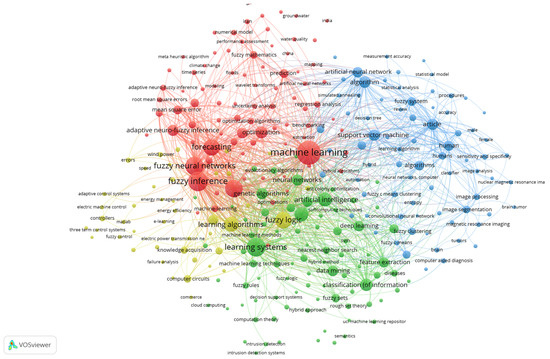
Figure 3.
Keyword co-occurrence network for fuzzy-hybrid-machine-learning.
Table 3 shows the most frequently addressed types of problems across various sectors and the fuzzy hybrid methods applied to them.
Table 3.
Fuzzy hybrid machine learning applications across industry sectors.
3.1.2. Fuzzy Logic in the Solar Energy Sector
A Scopus search of “fuzzy AND solar AND energy” (fuzzy-solar-energy) for articles related to solar energy that implement fuzzy methods yielded a total of 2934 articles published between 2012 and 2022. The average number of citations per article is 11.90. These articles were published in 1200 sources by 6830 authors. Figure 4 shows the number of articles published annually, with an average annual growth rate of 19.33%.
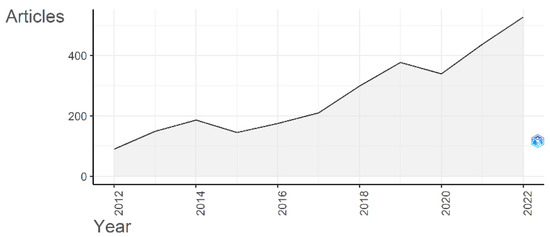
Figure 4.
Annual scientific production (in articles per year) for fuzzy-solar-energy.
Table 4 presents the most relevant sources, according to the number of articles published on fuzzy-solar-energy.
Table 4.
Most relevant sources are based on the number of articles published for fuzzy-solar-energy.
The countries with the greatest scientific production for fuzzy-solar-energy were India (with 1742 articles), China (305), Iran (136), Türkiye (95), Algeria (69), Indonesia (44), Egypt (30), Malaysia (30), Morocco (27), and Saudi Arabia (26). The countries that produced articles with the most citations for fuzzy-solar-energy were China (4661 citations), India (4523), Iran (3544), Türkiye (1959), the USA (1406), Algeria (980), Egypt (835), Australia (663), the United Kingdom (642), and Japan (500). In short, most of the articles published and cited are from countries in the Middle East and Asia. India, China, Iran, and Türkiye are the countries with the most published articles and therefore the most citations by country for this search. India and China are by far the countries with the most articles published about fuzzy methods applied to solar energy. The USA is the only country in the Americas that appears in these two analyses.
Table 5 presents the most influential articles from 2012 to 2022 based on the number of citations they have received. The one with the most citations was published in 2013 in the journal IEEE Transactions in Industrial Electronics, with 384 citations.
Table 5.
Most globally cited articles for fuzzy-solar-energy.
The most frequent keywords for the fuzzy-solar-energy search results are fuzzy logic (appearing in 1097 articles), solar energy (1077), solar power generation (729), photovoltaic cells (545), controllers (540), computer circuits (517), maximum power point trackers (469), fuzzy inference (414), maximum power point tracking (362), and MATLAB (345). Figure 5 presents the KCN for fuzzy solar energy, showing five main clusters. The largest nodes in this KCN, and thus the keywords with the highest frequency, are fuzzy logic, solar energy, and solar power generation. The terms with the closest relationship, represented by the thickest lines, are solar energy, fuzzy logic, photovoltaic cells, decision-making, renewable energy sources, and fuzzy inference. Conversely, the keywords located in the margins of this field of research, based on their size and the lack of a link connecting them to other nodes, are press load control, biogas, carbon, backpropagation, P&O (perturbation and observation), and electric current control.
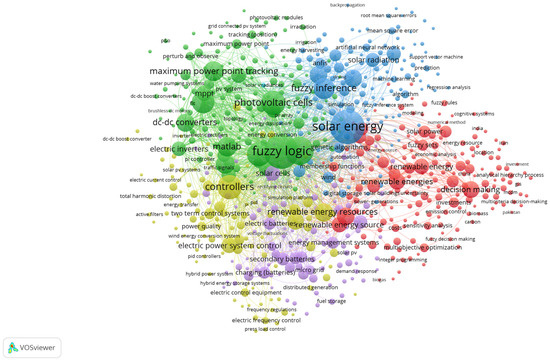
Figure 5.
Keyword co-occurrence network for fuzzy-solar-energy.
3.1.3. Fuzzy Decision-Making in Different Sectors
According to a Scopus search carried out for “fuzzy AND decision AND making” (fuzzy-decision-making), a total of 30,561 articles on this topic were published between 2012 and 2022. However, Scopus only allows downloading the bibliographical information for a maximum of 20,000 items. Therefore, the analysis covers 20,000 articles on fuzzy-decision-making fuzzy decision-making that were published between 2017 and 2022. These articles were written by 28,872 authors and published in 3694 sources, with an annual growth rate of 19.02% and an average number of citations of 11.53 per document. Figure 6 summarizes these results and shows significant growth in the number of publications on fuzzy-decision-making during this period.
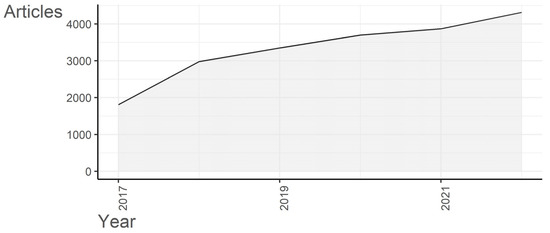
Figure 6.
Annual scientific production (articles per year) for fuzzy-decision-making.
Table 6 shows the sources with the highest number of articles published about fuzzy-decision-making. The Journal of Intelligent and Fuzzy Systems is the journal with the most articles (721) published on this topic.
Table 6.
Most relevant sources based on the number of articles published for fuzzy-decision-making.
The countries with the greatest scientific production for fuzzy-decision-making were China (9672), India (2288), Iran (1189), Türkiye (1144), Pakistan (581), Spain (367), Malaysia (300), USA (287), Poland (270), and the United Kingdom (210). The countries that produced articles with the most citations for fuzzy-decision-making were China (87,990), India (29,144), Iran (14,614), Türkiye (14,266), Pakistan (8511), Spain (6031), the United Kingdom (3719), the USA (3670), Malaysia (3610), and Australia (2994). In both cases, China has the highest rank by far, followed by India, Iran, and Türkiye.
Table 7 contains the five articles most frequently cited worldwide for fuzzy-decision-making. The article with the most citations was cited 463 times and published in 2017 in the International Journal of Intelligent Systems.
Table 7.
Most globally cited articles for fuzzy-decision-making.
For the fuzzy decision-making search, the keywords with the highest number of appearances are decision-making (13,964), fuzzy sets (4257), fuzzy logic (2965), linguistics (1243), decision theory (1223), fuzzy mathematics (1147), fuzzy inference (1145), mathematical operators (1082), fuzzy rules (1075), and risk assessment (1038). Figure 7 shows the KCN for the articles analyzed. There are four main clusters of words, with decision-making having the greatest number of appearances, followed by fuzzy logic, as shown by the size of their node. The thickest links indicate a closer relationship between decision-making, fuzzy logic, fuzzy sets, and decision theory. On the other hand, some of the words located in the margins of this field of research are city, landfill, river, energy resource, image analysis, and diagnostic accuracy.
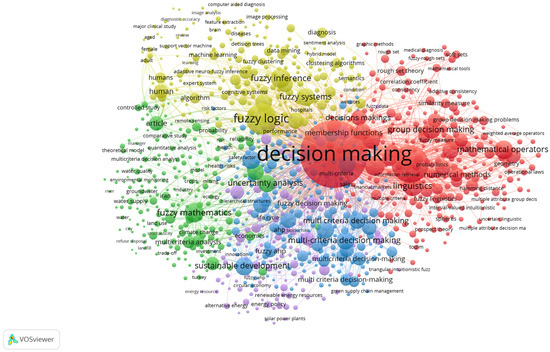
Figure 7.
Keyword co-occurrence network for fuzzy-decision-making.
Table 8 shows the fuzzy hybrid decision-making problems addressed in the greatest number of articles across various industry sectors, including the fuzzy hybrid methods applied to solve them.
Table 8.
Fuzzy hybrid decision-making applications across industry sectors.
3.1.4. Fuzzy Decision-Making in the Solar Energy Sector
A Scopus search on “fuzzy AND decision AND making AND solar AND energy” (fuzzy-decision-making-solar-energy) and the corresponding Bibliometrix analysis yielded 346 articles published between 2012 and 2022 by 930 authors in 179 sources, with an annual growth rate of 25.25% and an average of 16.85 citations per article. Figure 8 shows the scientific production of articles over this period.
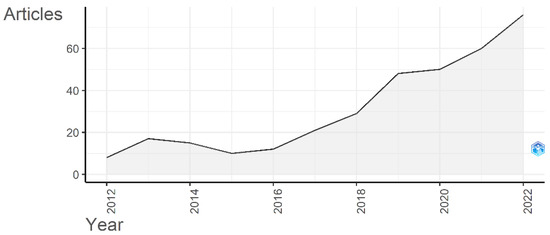
Figure 8.
Annual scientific production (in articles per year) for fuzzy-decision-making-solar-energy.
Table 9 shows the five journals with the highest number of publications. The journal Renewable Energy published the most articles related to fuzzy-decision-making-solar-energy. It is essential to mention that no substantial difference exists between the number of publications in the journals shown in the ranking, with a three-way tie for second place.
Table 9.
Most relevant sources based on the number of articles published for fuzzy-decision-making-solar-energy.
The countries with the greatest scientific production for fuzzy-decision-making-solar-energy were China (160), Türkiye (40), Iran (35), India (28), Spain (6), the USA (6), Italy (5), Morocco (5), Thailand (5), and Australia (4). The countries that produced articles with the most citations for fuzzy-decision-making-solar-energy were China (1676 citations), Türkiye (1008), Iran (841), India (269), France (154), Spain (112), Australia (103), Denmark (88), Colombia (82), and Italy (66). Note that China leads by far in both groups, with 160 articles published and more than 1670 citations.
Table 10 shows the five articles most cited worldwide for fuzzy-decision-making-solar-energy. The article with the most citations was published in 2013 in the journal Energy Conversion and Management and was cited 216 times.
Table 10.
Most globally cited articles for fuzzy-decision-making-solar-energy.
The most frequent keywords of the articles analyzed for fuzzy-decision-making-solar-energy are decision-making (in 286 articles), solar energy (144), solar power generation (73), fuzzy logic (68), renewable energies (60), sustainable development (60), energy policy (56), investments (51), fuzzy sets (47), and wind power (46). Figure 9 presents the KCN and the four main clusters of words for this search, which show that the nodes with the greatest number of occurrences are decision-making and solar energy. There is a closer relationship between the terms decision-making, solar energy, and solar power generation, as represented by the thicker link that joins them. In this case, there are no terms in the margins of this field of research, since all the words are connected between them, but the less frequent terms can be identified by the smallest nodes.
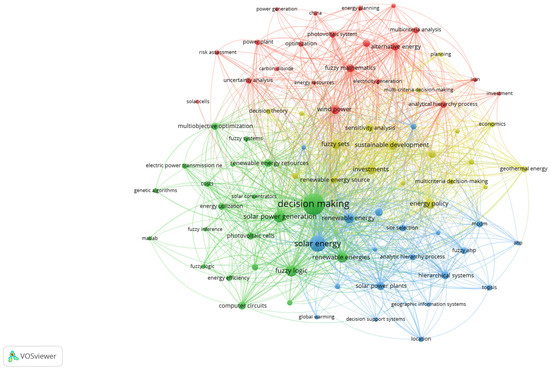
Figure 9.
Keyword co-occurrence network for fuzzy-decision-making-solar-energy.
3.1.5. Fuzzy Simulation in Different Sectors
A Scopus search using the words “fuzzy AND simulation” (fuzzy-simulation) yielded a list of 42,585 articles published between 2012 and 2022. As noted previously, because of Scopus limitations, bibliographic information was downloaded and analyzed for 20,000 articles. The articles analyzed were published from 2018 to 2022, written by 29,301 authors, published in 4120 sources, and had an annual publication growth rate of 18.59%, as shown in Figure 10. The average number of citations per document is 6.57.
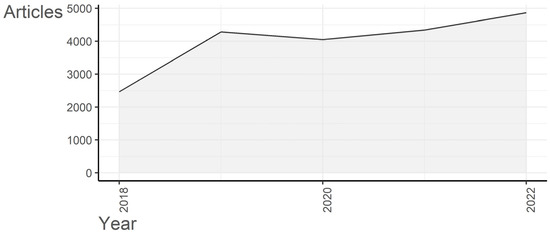
Figure 10.
Annual scientific production (in articles per year) for fuzzy-simulation.
The countries with the greatest scientific production for fuzzy-simulation were China (12,986), India (1663), Iran (1001), Algeria (315), Korea (303), the USA (193), Morocco (192), Türkiye (183), Egypt (182), and Malaysia (174). The countries that produced articles with the most citations for fuzzy-simulation were China (57,172), Iran (10,305), India (10,266), Korea (3217), the USA (2248), the United Kingdom (1909), Algeria (1820), Canada (1779), Egypt (1778), and Türkiye (1586).
Table 11 shows the most relevant sources that have published the greatest number of articles related to fuzzy-simulation.
Table 11.
Most relevant sources based on the number of articles published for fuzzy-simulation.
Table 12 shows the five articles most frequently cited worldwide for fuzzy-simulation. The article with the most citations has 527 and was published in 2018 in the journal Water.
Table 12.
Most globally cited articles for fuzzy-simulation.
The keywords with the greatest number of appearances are fuzzy logic (5886), controllers (4210), fuzzy inference (2863), fuzzy control (2855), computer circuits (2585), MATLAB (2386), adaptative control systems (2113), fuzzy systems (2101), fuzzy neural networks (1849), and three-term control systems (1297). Figure 11 presents the KCN of the keywords from the articles analyzed for this search. As shown, there are four main clusters, and the largest nodes match the most frequent keywords of fuzzy logic, controllers, fuzzy inference, fuzzy control, and computer circuits. In this case, the words with the thickest link, and thus the closest relationship, are fuzzy logic, computer circuits, controllers, MATLAB, and adaptative control systems. On the other hand, the keywords in the margin of this field of research, because they are not connected to other words and have the smallest nodes, are diagnostic imaging, female, stochastic model, validity, chattering phenomenon, and smart grid.
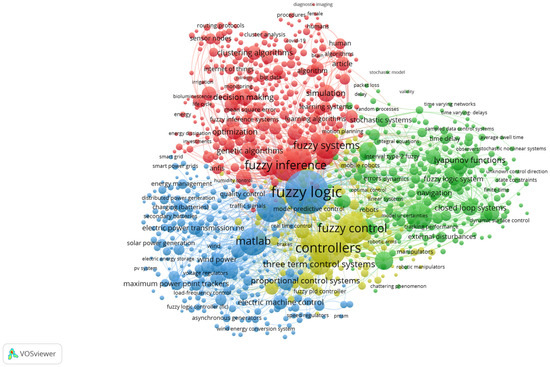
Figure 11.
Keyword co-occurrence network for fuzzy-simulation.
Table 13 shows the types of problems most frequently addressed across various industry sectors and the fuzzy methods applied to solve them.
Table 13.
Fuzzy hybrid simulation applications across industry sectors.
3.1.6. Fuzzy Simulation in the Solar Energy Sector
The bibliographic information of 1025 articles based on the Scopus search for “fuzzy AND simulation AND solar AND energy” (fuzzy-simulation-solar-energy) listed 2586 authors. These articles were published in 534 sources, had an average annual publication growth rate of 22.29% (see Figure 12), and had an average of 9.82 citations per article. The publication of articles on this topic has grown significantly over the period investigated, with decreases in 2015 and 2020.
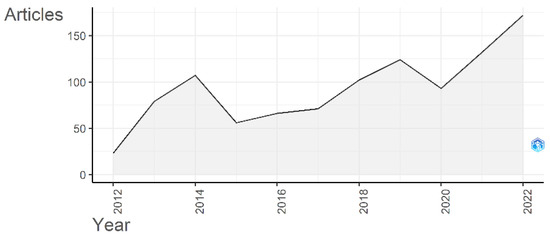
Figure 12.
Annual scientific production (in articles per year) for fuzzy-simulation-solar-energy.
Table 14 presents the five sources with the largest number of articles published related to fuzzy-simulation-solar-energy. The journal Applied Mechanics and Materials had the most articles published related to this topic.
Table 14.
Most relevant sources based on the number of articles published for fuzzy-simulation-solar-energy.
The countries with the greatest scientific production for fuzzy-simulation-solar-energy were India (599), China (109), Algeria (45), Iran (38), Tunisia (19), Indonesia (17), Türkiye (17), Egypt (15), Morocco (14), and Saudi Arabia (13). The countries that produced articles with the most citations for fuzzy-simulation-solar-energy were India (1170), China (1158), Iran (1103), Algeria (608), Türkiye (395), Japan (353), Egypt (247), Saudi Arabia (218), Denmark (181), and Spain (174). India and China had the greatest number of articles published and citations by country for this topic.
The five articles most cited worldwide for fuzzy-simulation-solar-energy are presented in Table 15. The top article has been cited 382 times and was published in 2013 in the journal IEEE Transactions on Industrial Electronics.
Table 15.
Most globally cited articles for fuzzy-simulation-solar-energy.
The most frequently appearing keywords for fuzzy simulation solar energy are fuzzy logic (396 articles), solar energy (336), MATLAB (268), solar power generation (268), controllers (240), photovoltaic cells (234), maximum power point trackers (228), computer circuits (209), maximum power point tracking (172), and DC–DC converters (159). The KCN for these articles is presented in Figure 13, which shows that the most frequent keywords for this search are fuzzy logic, solar energy, and MATLAB, since they have the biggest nodes. The thickest links show that the closest relationship is between fuzzy logic, fuzzy logic controllers, MATLAB, computer circuits, and solar energy. The lack of links indicates that the keywords in the margin of this field of research are harmonic distortion, efficiency, P&O, FLC, DC motors, neural networks, Monte Carlo methods, and scheduling.
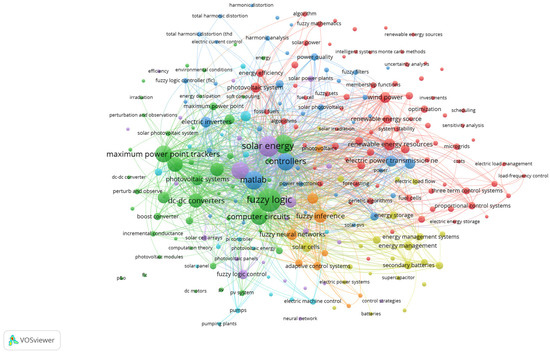
Figure 13.
Keyword co-occurrence network for fuzzy-simulation-solar-energy.
3.1.7. Content Analysis and Discussion
Table 16 presents the total number of publications analyzed and their classification per application category of the articles published in 2012–2022 that were analyzed for the applications of fuzzy hybrid machine learning, decision-making, and simulation in the solar energy sector. Table 17 gives more details on these articles.
Table 16.
Application of fuzzy hybrid machine learning, decision-making, and simulation categories (2012–2022).
Table 17.
Application categories for fuzzy hybrid method articles (2012–2022).
The results of the literature review and analysis illustrate a lack of scientific production based on designing, implementing, and deploying hybrid fuzzy logic methods in the solar energy sector, which is extremely important in the effort to reduce CO2 and greenhouse emissions worldwide.
The analysis of articles indicated that between 2012 and 2022, more than 2900 articles related to fuzzy solar energy were published in 1200 different sources. Moreover, two countries dominate the scientific production on this topic: India and China. The data presented in this paper support the possibility of implementing hybrid fuzzy logic systems in solar energy because the countries leading PV solar energy installations are also leading research in hybrid fuzzy logic systems [201].
On the topic of fuzzy hybrid machine learning, the publication of articles increased substantially during 2012–2022, with 1409 articles in all. The greatest number of these articles are from India and are primarily focused on the information technology, mining, electronics, chemical, and construction sectors. In contrast, the application of fuzzy hybrid machine learning in the energy sector is still low and mainly centered on decision-making, optimization, prediction, and simulation problems.
With respect to fuzzy decision-making, more extensive scientific production is observed for 2012–2022, with more than 30,500 articles published. This analysis considered 20,000 articles published from 3694 different sources for 2017–2022, of which almost 30% were from China and focused on the mining sector. With respect to the energy sector, fuzzy hybrid decision-making is mainly applied in energy management, multi-objective optimization, energy policy, decision support systems, and planning problems. Focusing only on solar energy and decision-making, only 346 articles were published, most of them in China.
During 2012–2022, more than 42,500 articles were published related to fuzzy simulation, although this study analyzed only 20,000 articles published in 2018–2022 due to Scopus’s limitation of only being able to download bibliographical information for that maximum number of articles. For this topic, scientific production has remained almost linear since 2019, with China publishing 65% of the total articles published, and more articles were published on the energy sector, focusing on energy efficiency, energy management, and system modeling. Other sectors dominating the fuzzy simulation articles publication are electronics, construction, and mining. Between 2012 and 2022, 1025 articles related to “fuzzy simulation and solar energy” were published in 534 sources. India led the publication of these works, followed by China.
As Figure 14 and Table 17 show, out of the four stages of solar system lifecycles (evaluation/diagnosis, installation, operation, and disposal), most applications of fuzzy hybrid machine learning, decision-making, and simulation focused on prediction/forecasting, manufacturing process/system modeling, and evaluation/assessment, and therefore addressed the evaluation/diagnosis stage. Just a few focus on the operation stage, and thus all focus on maintenance.
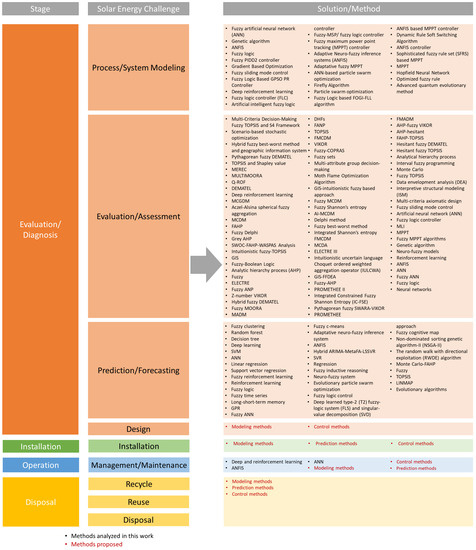
Figure 14.
Challenges for solar energy systems and possible methods for their solution.
3.2. Selecting Fuzzy Hybrid Applications
As discussed above, there is a considerable lack of applications of fuzzy hybrid machine learning, decision-making, and simulation in research on the installation, operation, and disposal stages of solar energy systems. No application has been explored for solving problems in the installation and disposal stages, and just a few applications have been explored for the operation stage. For these three stages, methods of modeling, prediction, and control are proposed here.
Numerous hybrid fuzzy logic methods have been effectively designed and implemented in several areas, but hybrid fuzzy logic methods regarding solar energy are poorly implemented. Hybrid fuzzy logic methods can be used to help improve solar energy generation and operation at specific stages. This review presents how methodologies using fuzzy logic can be deployed in the solar energy sector, especially when combined with some conventional methodologies to improve their performance. Table 18 presents the advantages (pros) and disadvantages (cons) of fuzzy hybrid machine learning, decision-making, and simulation methods.
Table 18.
Advantages and disadvantages of fuzzy hybrid machine learning, decision-making, and simulation methods.
After the advantages and disadvantages of each method are reviewed, criteria for selecting an appropriate method must be considered. Table 19 summarizes the criteria for selecting fuzzy hybrid techniques and the characteristics of each based on the literature review and content analysis.
Table 19.
Selection criteria for fuzzy hybrid techniques in solar energy systems research.
This study offers a wider view of all the fuzzy hybrid methods available in the literature, with their advantages, disadvantages, and applications in fuzzy machine learning, fuzzy decision-making, and fuzzy simulation. The goal of this study is to enable practitioners to make more informed and complete decisions about what method to use, and they must also consider appropriate selection criteria depending on the solar energy problem to be solved. This method can be applied to problems presented at any stage of the PV system lifecycle, from analysis to installation, operation, and disposal. The method selected will depend on the complexity of the problem and the selected category criteria.
After the fuzzy hybrid methods available in the solar energy literature were reviewed, it was observed that there are several areas in which the performance of solar PV panels could be improved so the main and local grids can provide a better quality of energy. Hybrid fuzzy systems can be implemented in the following areas:
- Fault Detection and Diagnosis: This is an area in which hybrid fuzzy systems can be deployed to detect and diagnose faults in solar PV systems. The information from sensors and hybrid fuzzy systems can detect potential fault conditions and recommend maintenance or repairs;
- System Controls: Hybrid fuzzy systems can also be implemented to enhance the performance of MPPT control techniques in solar PV systems through the analysis of data from sensors and other sources. Hybrid fuzzy systems can be employed to adjust the voltage and current of a PV system to increase efficiency;
- Energy Management: This is an important area in which hybrid fuzzy systems can be used to incrementally improve the efficiency of electric systems, reduce CO2 emissions, and thus enhance the energy management of solar PV systems. Since hybrid fuzzy systems can adjust the system’s energy consumption to maximize its efficiency and reduce costs, they are an excellent alternative to be implemented in solar PV systems;
- Prediction and Forecasting Systems: In systems used to predict and forecast the performance of solar PV systems and weather conditions, hybrid fuzzy systems can be used to analyze data from weather patterns, solar irradiance, and other factors. They can generate an accurate prediction of the amount of energy produced by the solar PV system. Thus, fuzzy hybrid systems can help utilities better manage the main and local grids.
The results of this study highlight the potential benefits of adopting fuzzy hybrid systems in the PV solar energy sector. The implementation of such systems could lead to improvements in the analysis, installation, operation, and disposal stages of solar energy projects. In light of these findings, it is recommended that development policies be put in place to promote the adoption of fuzzy hybrid systems in the sector.
One proposed policy is the development of pilot projects to demonstrate the effectiveness and feasibility of fuzzy hybrid systems in the PV solar energy sector. These projects could be funded by the government or industries and involve collaborations between researchers, industry professionals, and end users. Another policy proposal is the establishment of standards and guidelines to guide the implementation of fuzzy hybrid systems in the sector. These guidelines could cover various areas, such as the evaluation, operation, installation, and disposal stages of solar energy projects. Additionally, standards could be established for performance metrics of fuzzy hybrid systems and best practices for selecting appropriate systems. Incentives such as tax credits or subsidies could be provided to encourage the adoption of fuzzy hybrid systems in the PV solar energy sector. This could include incentives for research and development, pilot projects, and the implementation of these systems in commercial projects. Furthermore, public-private partnerships could be fostered by the government to promote the adoption of fuzzy hybrid systems in the sector. Such partnerships could involve collaborations between academic researchers, industry professionals, and government agencies to develop and implement these systems in the field.
Training programs should be established to educate stakeholders in the PV solar energy sector about the benefits of fuzzy hybrid systems. These programs could target policymakers, industry professionals, and end users, covering areas such as fuzzy machine learning, fuzzy simulation, and fuzzy decision-making. In addition, it is recommended that the government and industry fund research and development to promote the use of fuzzy hybrid systems in the PV solar energy sector. This could include funding for academic research and industry-academic collaborations.
Finally, the results of studies on fuzzy hybrid systems in the PV solar energy sector should be disseminated to stakeholders such as installers, operators, and disposal teams to promote the adoption of these systems. Workshops and training programs could also be organized to educate stakeholders about the benefits of these systems. These proposed policies could accelerate the adoption of fuzzy hybrid systems in the PV solar energy sector and help improve solar energy projects’ efficiency and effectiveness.
4. Conclusions
This paper presents a review of fuzzy hybrid systems implemented in several sectors as well as the possibility of using them in PV systems. Additionally, this paper describes the trends in using hybrid fuzzy logic in PV solar energy applications, including the low number of published research papers using hybrid fuzzy logic methods in PV solar energy compared to other sectors. Thus, it promotes the use of well-known hybrid fuzzy logic methodologies in solar energy. Since fuzzy hybrid systems have been designed and deployed successfully in several applications, an excellent opportunity exists for implementing those methodologies in the PV solar sector. Further, by presenting the main advantages and disadvantages of several fuzzy logic hybrid systems, the information provided in this paper can be used as a guide for selecting and implementing hybrid fuzzy logic systems in the solar energy sector to improve the analysis, installation, operation, and disposal stages of solar energy projects. This paper also demonstrates that hybrid fuzzy logic systems could be used in the solar energy sector to improve performance by applying specific fuzzy techniques in the evaluation, operation, installation, and disposal stages. Finally, the methodology presented in this study can be used to support research on other renewable energy sources, such as wind energy.
Author Contributions
Conceptualization, P.H.D.N., N.K., C.P., P.P. and A.R.F.; methodology, P.H.D.N., N.K., C.P., P.P. and A.R.F.; software, P.H.D.N., N.K., C.P., P.P. and A.R.F.; validation, P.H.D.N., N.K., C.P., P.P. and A.R.F.; formal analysis, P.H.D.N., N.K., C.P., P.P. and A.R.F.; investigation, P.H.D.N., N.K., C.P., P.P. and A.R.F.; resources, P.P. and A.R.F.; data curation, P.H.D.N., N.K. and C.P.; writing—original draft preparation, P.H.D.N., N.K., C.P., P.P. and A.R.F.; writing—review and editing, P.H.D.N., N.K., C.P., P.P. and A.R.F.; visualization, P.H.D.N., N.K. and C.P.; supervision, P.P. and A.R.F.; project administration, P.P. and A.R.F.; funding acquisition, P.P. and A.R.F. All authors have read and agreed to the published version of the manuscript.
Funding
We express our gratitude for the generous funding provided by the University of Alberta, Canada, and The Institute of Advanced Materials for Sustainable Manufacturing, specifically the research group on enabling technologies at Tecnológico de Monterrey, Mexico. Such financial support has been crucial in enabling us to conduct our academic research with dedication and diligence. This research was made possible in part thanks to funding from the Canada First Research Excellence Fund, grant number FES-T11-P01, held by Dr. Aminah Robinson Fayek.
Data Availability Statement
Not applicable.
Acknowledgments
The authors acknowledge the University of Alberta, Canada, and Tecnológico de Monterrey, Mexico, for supporting this research. The authors are immensely grateful for the technical review and editing expertise provided by Renata Brunner Jass from the University of Alberta.
Conflicts of Interest
The authors declare no conflict of interest.
References
- Pérez, C.; Ponce, P.; Meier, A.; Dorantes, L.; Sandoval, J.O.; Palma, J.; Molina, A. S4 framework for the integration of solar energy systems in small and medium-sized manufacturing companies in Mexico. Energies 2022, 15, 6882. [Google Scholar] [CrossRef]
- Saraji, M.K.; Aliasgari, E.; Streimikiene, D. Assessment of the challenges to renewable energy technologies adoption in rural areas: A Fermatean CRITIC-VIKOR approach. Tech. Forecast. Soc. Change 2023, 189, 122399. [Google Scholar] [CrossRef]
- Zadeh, L.A. The concept of a linguistic variable and its application to approximate reasoning-I. Inf. Sci. 1975, 8, 199–249. [Google Scholar] [CrossRef]
- Fayek, A.R.; Lourenzutti, R. Introduction to fuzzy logic in construction engineering and management. In Fuzzy Hybrid Computing in Construction Engineering Management: Theory and Application; Fayek, A.R., Ed.; Emerald Publishing, Limited: Bingley, UK, 2018; pp. 3–35. [Google Scholar] [CrossRef]
- Ponce, P.; Pérez, C.; Fayek, A.R.; Molina, A. Solar energy implementation in manufacturing industry using multi-criteria decision-making fuzzy TOPSIS and S4 framework. Energies 2022, 15, 8838. [Google Scholar] [CrossRef]
- Elshater, A.; Abusaada, H. Developing process for selecting research techniques in urban planning and urban design with a PRISMA compliant review. Soc. Sci. 2022, 11, 471. [Google Scholar] [CrossRef]
- Aria, M.; Cuccurullo, C. bibliometrix: An R-tool for comprehensive science mapping analysis. J. Informetr. 2017, 11, 959–975. [Google Scholar] [CrossRef]
- Radhakrishnan, S.; Erbis, S.; Isaacs, J.A.; Kamarthi, S. Novel keyword co-occurrence network-based methods to foster systematic reviews of scientific literature. PLoS ONE 2017, 12, e0172778. [Google Scholar] [CrossRef]
- Mosavi, A.; Ozturk, P.; Chau, K.W. Flood prediction using machine learning models: Literature review. Water 2018, 10, 1536. [Google Scholar] [CrossRef]
- Liu, T.; Hu, X.; Li, S.E.; Cao, D. Reinforcement learning optimized look-ahead energy management of a parallel hybrid electric vehicle. IEEE/ASME Trans. Mechatron. 2017, 22, 1497–1507. [Google Scholar] [CrossRef]
- Seera, M.; Lim, C.P. A hybrid intelligent system for medical data classification. Expert Syst. Appl. 2014, 41, 2239–2249. [Google Scholar] [CrossRef]
- Mohan, G.; Subashini, M.M. MRI based medical image analysis: Survey on brain tumor grade classification. Biomed. Signal Process. Control. 2018, 39, 139–161. [Google Scholar] [CrossRef]
- Bui, D.T.; Bui, Q.T.; Nguyen, Q.P.; Pradhan, B.; Nampak, H.; Trinh, P.T. A hybrid artificial intelligence approach using GIS-based neural-fuzzy inference system and particle swarm optimization for forest fire susceptibility modeling at a tropical area. Agric. For. Meteorol. 2017, 233, 32–44. [Google Scholar] [CrossRef]
- Njoya Motapon, S.; Dessaint, L.A.; Al-Haddad, K. A comparative study of energy management schemes for a fuel-cell hybrid emergency power system of more-electric aircraft. IEEE Trans. Ind. Electron. 2014, 61, 1320–1334. [Google Scholar] [CrossRef]
- Eltawil, M.A.; Zhao, Z. MPPT techniques for photovoltaic applications. Renew. Sustain. Energy Rev. 2013, 2013, 815280. [Google Scholar] [CrossRef]
- Suganthi, L.; Iniyan, S.; Samuel, A.A. Applications of fuzzy logic in renewable energy systems—A review. Renew. Sustain. Energy Rev. 2015, 48, 585–607. [Google Scholar] [CrossRef]
- Yang, H.T.; Huang, C.M.; Huang, Y.C.; Pai, Y.S. A weather-based hybrid method for 1-day ahead hourly forecasting of PV power output. IEEE Trans. Sustain. Energy 2014, 5, 917–926. [Google Scholar] [CrossRef]
- Liu, P.; Wang, P. Some q-rung orthopair fuzzy aggregation operators and their applications to multi-attribute decision making. Int. J. Intell. Syst. 2018, 33, 259–280. [Google Scholar] [CrossRef]
- Guo, S.; Zhao, H. Fuzzy best-worst multi-criteria decision-making method and its applications. Knowl. Based Syst. 2017, 121, 23–31. [Google Scholar] [CrossRef]
- Qin, J.; Liu, X.; Pedrycz, W. An extended TODIM multi-criteria group decision making method for green supplier selection in interval type-2 fuzzy environment. Eur. J. Oper. Res. 2017, 258, 626–638. [Google Scholar] [CrossRef]
- Si, S.L.; You, X.Y.; Liu, H.C.; Zhang, P. DEMATEL technique: A systematic review of the state-of-the-art literature on methodologies and applications. Math. Probl. Eng. 2018, 2018, 3696457. [Google Scholar] [CrossRef]
- Kutlu Gündoǧdu, F.; Kahraman, C. Spherical fuzzy sets and spherical fuzzy TOPSIS method. J. Intell. Fuzzy Syst. 2019, 36, 337–352. [Google Scholar] [CrossRef]
- Ahmadi, M.H.; Sayyaadi, H.; Dehghani, S.; Hosseinzade, H. Designing a solar powered Stirling heat engine based on multiple criteria: Maximized thermal efficiency and power. Energy Convers. Manag. 2013, 75, 282–291. [Google Scholar] [CrossRef]
- Aydin, N.Y.; Kentel, E.; Sebnem Duzgun, H. GIS-based site selection methodology for hybrid renewable energy systems: A case study from western Turkey. Energy Convers. Manag. 2013, 70, 90–106. [Google Scholar] [CrossRef]
- Wu, Y.; Xu, C.; Zhang, T. Evaluation of renewable power sources using a fuzzy MCDM based on cumulative prospect theory: A case in China. Energy 2018, 147, 1227–1239. [Google Scholar] [CrossRef]
- Ahmadi, M.H.; Mohammadi, A.H.; Dehghani, S.; Barranco-Jiménez, M.A. Multi-objective thermodynamic-based optimization of output power of Solar Dish–Stirling engine by implementing an evolutionary algorithm. Energy Convers. Manag. 2013, 75, 438–445. [Google Scholar] [CrossRef]
- Zoghi, M.; Houshang Ehsani, A.; Sadat, M.; Amiri, M.j.; Karimi, S. Optimization solar site selection by fuzzy logic model and weighted linear combination method in arid and semi-arid region: A case study Isfahan-IRAN. Renew. Sustain. Energy Rev. 2017, 68, 986–996. [Google Scholar] [CrossRef]
- He, W.; Dong, Y. Adaptive fuzzy neural network control for a constrained robot using impedance learning. IEEE Trans. Neural Netw. Learn. Syst. 2018, 29, 1174–1186. [Google Scholar] [CrossRef]
- Qiu, J.; Sun, K.; Wang, T.; Gao, H. Observer-based fuzzy adaptive event-triggered control for pure-feedback nonlinear systems with prescribed performance. IEEE Trans. Fuzzy Syst. 2019, 27, 2152–2162. [Google Scholar] [CrossRef]
- Tong, S.; Min, X.; Li, Y. Observer-based adaptive fuzzy tracking control for strict-feedback nonlinear systems with unknown control gain functions. IEEE Trans. Cybern. 2020, 50, 3903–3913. [Google Scholar] [CrossRef]
- Bai, C.; Dallasega, P.; Orzes, G.; Sarkis, J. Industry 4.0 technologies assessment: A sustainability perspective. Int. J. Prod. Econ. 2020, 229, 107776. [Google Scholar] [CrossRef]
- García, P.; García, C.A.; Fernández, L.M.; Llorens, F.; Jurado, F. ANFIS-Based control of a grid-connected hybrid system integrating renewable energies, hydrogen and batteries. IEEE Trans. Ind. Inform. 2014, 10, 1107–1117. [Google Scholar] [CrossRef]
- Yin, H.; Zhou, W.; Li, M.; Ma, C.; Zhao, C. An adaptive fuzzy logic-based energy management strategy on battery/ultracapacitor hybrid electric vehicles. IEEE Trans. Transp. Electrif. 2016, 2, 300–311. [Google Scholar] [CrossRef]
- García, P.; Torreglosa, J.P.; Fernández, L.M.; Jurado, F. Optimal energy management system for stand-alone wind turbine/photovoltaic/ hydrogen/battery hybrid system with supervisory control based on fuzzy logic. Int. J. Hydrogen Energy 2013, 38, 14146–14158. [Google Scholar] [CrossRef]
- Yi, Z.; Etemadi, A.H. Fault detection for photovoltaic systems based on multi-resolution signal decomposition and fuzzy inference systems. IEEE Trans. Smart Grid. 2017, 8, 1274–1283. [Google Scholar] [CrossRef]
- Fahim, P.; Vaezi, N. Data-driven techniques for optimizing the renewable energy systems operations. In Handbook of Smart Energy Systems; Fathi, M., Zio, E., Pardalos, P.M., Eds.; Springer: Cham, Germany, 2022; pp. 1–22. [Google Scholar] [CrossRef]
- Gao, Y.; Matsunami, Y.; Miyata, S.; Akashi, Y. Operational optimization for off-grid renewable building energy system using deep reinforcement learning. Appl. Energy 2022, 325, 119783. [Google Scholar] [CrossRef]
- Mostafa, N.; Ramadan, H.S.M.; Elfarouk, O. Renewable energy management in smart grids by using big data analytics and machine learning. Mach. Learn. Appl. 2022, 9, 100363. [Google Scholar] [CrossRef]
- Ahmad, T.; Zhang, D.; Huang, C.; Zhang, H.; Dai, N.; Song, Y.; Chen, H. Artificial intelligence in sustainable energy industry: Status quo, challenges and opportunities. J. Clean. Prod. 2021, 289, 125834. [Google Scholar] [CrossRef]
- Alkhayat, G.; Mehmood, R. A review and taxonomy of wind and solar energy forecasting methods based on deep learning. Energy AI 2021, 4, 100060. [Google Scholar] [CrossRef]
- Bakay, M.S.; Ağbulut, Ü. Electricity production based forecasting of greenhouse gas emissions in Turkey with deep learning, support vector machine and artificial neural network algorithms. J. Clean. Prod. 2021, 285, 125324. [Google Scholar] [CrossRef]
- Chen, X.; Qu, G.; Tang, Y.; Low, S.; Li, N. Reinforcement learning for decision-making and control in power systems: Tutorial, review, and vision. arXiv 2021, arXiv:2102.01168. [Google Scholar] [CrossRef]
- Devaraj, J.; Madurai Elavarasan, R.; Shafiullah, G.M.; Jamal, T.; Khan, I. A holistic review on energy forecasting using big data and deep learning models. Int. J. Energy Res. 2021, 45, 13489–13530. [Google Scholar] [CrossRef]
- Garud, K.S.; Jayaraj, S.; Lee, M.Y. A review on modeling of solar photovoltaic systems using artificial neural networks, fuzzy logic, genetic algorithm and hybrid models. Int. J. Energy Res. 2021, 45, 6–35. [Google Scholar] [CrossRef]
- Jamil, F.; Iqbal, N.; Imran; Ahmad, S.; Kim, D. Peer-to-peer energy trading mechanism based on blockchain and machine learning for sustainable electrical power supply in smart grid. IEEE Access 2021, 9, 39193–39217. [Google Scholar] [CrossRef]
- Jebli, I.; Belouadha, F.Z.; Kabbaj, M.I.; Tilioua, A. Prediction of solar energy guided by pearson correlation using machine learning. Energy 2021, 224, 120109. [Google Scholar] [CrossRef]
- Malik, H.; Yadav, A.K. A novel hybrid approach based on relief algorithm and fuzzy reinforcement learning approach for predicting wind speed. Sustain. Energy Technol. Assess. 2021, 43, 100920. [Google Scholar] [CrossRef]
- Perera, A.T.D.; Kamalaruban, P. Applications of reinforcement learning in energy systems. Renew. Sustain. Energy Rev. 2021, 137, 110618. [Google Scholar] [CrossRef]
- Rangel-Martinez, D.; Nigam, K.D.P.; Ricardez-Sandoval, L.A. Machine learning on sustainable energy: A review and outlook on renewable energy systems, catalysis, smart grid and energy storage. Chem. Eng. Res. Des. 2021, 174, 414–441. [Google Scholar] [CrossRef]
- Severiano, C.A.; Silva, P.C.L.; Weiss Cohen, M.; Guimarães, F.G. Evolving fuzzy time series for spatio-temporal forecasting in renewable energy systems. Renew. Energy 2021, 171, 764–783. [Google Scholar] [CrossRef]
- Zhou, H.; Liu, Q.; Yan, K.; Du, Y. Deep learning enhanced solar energy forecasting with AI-driven IoT. Wirel. Commun. Mob. Comput. 2021, 2021, 9249387. [Google Scholar] [CrossRef]
- Zulkifly, Z.; Baharin, K.A.; Gan, C.K. Improved machine learning model selection techniques for solar energy forecasting applications. Int. J. Renew. Energy Res. 2021, 11, 308–319. [Google Scholar] [CrossRef]
- Ahmad, T.; Zhang, H.; Yan, B. A review on renewable energy and electricity requirement forecasting models for smart grid and buildings. Sustain. Cities Soc. 2020, 55, 102052. [Google Scholar] [CrossRef]
- Ali, S.S.; Choi, B.J. State-of-the-art artificial intelligence techniques for distributed smart grids: A review. Electronics 2020, 9, 1030. [Google Scholar] [CrossRef]
- Antonopoulos, I.; Robu, V.; Couraud, B.; Kirli, D.; Norbu, S.; Kiprakis, A.; Flynn, D.; Elizondo-Gonzalez, S.; Wattam, S. Artificial intelligence and machine learning approaches to energy demand-side response: A systematic review. Renew. Sustain. Energy Rev. 2020, 130, 109899. [Google Scholar] [CrossRef]
- Çinar, Z.M.; Nuhu, A.A.; Zeeshan, Q.; Korhan, O.; Asmael, M.; Safaei, B. Machine learning in predictive maintenance towards sustainable smart manufacturing in industry 4.0. Sustainability 2020, 12, 8211. [Google Scholar] [CrossRef]
- Ibrahim, M.S.; Dong, W.; Yang, Q. Machine learning driven smart electric power systems: Current trends and new perspectives. Appl. Energy 2020, 272, 115237. [Google Scholar] [CrossRef]
- Lai, J.P.; Chang, Y.M.; Chen, C.H.; Pai, P.F. A survey of machine learning models in renewable energy predictions. Appl. Sci. 2020, 10, 5975. [Google Scholar] [CrossRef]
- Li, P.; Zhou, K.; Lu, X.; Yang, S. A hybrid deep learning model for short-term PV power forecasting. Appl. Energy 2020, 259, 114216. [Google Scholar] [CrossRef]
- Nam, K.J.; Hwangbo, S.; Yoo, C.K. A deep learning-based forecasting model for renewable energy scenarios to guide sustainable energy policy: A case study of Korea. Renew. Sustain. Energy Rev. 2020, 122, 109725. [Google Scholar] [CrossRef]
- Solyali, D. A comparative analysis of machine learning approaches for short-/long-term electricity load forecasting in Cyprus. Sustainability 2020, 12, 3612. [Google Scholar] [CrossRef]
- Stefenon, S.F.; Kasburg, C.; Nied, A.; Klaar, A.C.R.; Ferreira, F.C.S.; Branco, N.W. Hybrid deep learning for power generation forecasting in active solar trackers. IET Gener. Transm. Distrib. 2020, 14, 5667–5674. [Google Scholar] [CrossRef]
- Xu, X.; Jia, Y.; Xu, Y.; Xu, Z.; Chai, S.; Lai, C.S. A multi-agent reinforcement learning-based data-driven method for home energy management. IEEE Trans. Smart Grid. 2020, 11, 3201–3211. [Google Scholar] [CrossRef]
- Zhang, Z.; Zhang, D.; Qiu, R.C. Deep reinforcement learning for power system applications: An overview. CSEE J. Power Energy Syst. 2020, 6, 213–225. [Google Scholar] [CrossRef]
- Carvalho, T.P.; Soares, F.A.A.M.N.; Vita, R.; da P. Francisco, R.; Basto, J.P.; Alcalá, S.G.S. A systematic literature review of machine learning methods applied to predictive maintenance. Comput. Ind. Eng. 2019, 137, 106024. [Google Scholar] [CrossRef]
- Chou, J.-S.; Hsu, S.-C.; Ngo, N.-T.; Lin, C.-W.; Tsu, C.-C. Hybrid machine learning system to forecast electricity consumption of smart grid-based air conditioners. IEEE Syst. J. 2019, 13, 3120–3128. [Google Scholar] [CrossRef]
- Hong, Y.Y.; Rioflorido, C.L.P.P. A hybrid deep learning-based neural network for 24-h ahead wind power forecasting. Appl. Energy 2019, 250, 530–539. [Google Scholar] [CrossRef]
- Mosavi, A.; Salimi, M.; Ardabili, S.F.; Rabczuk, T.; Shamshirband, S.; Varkonyi-Koczy, A.R. State of the art of machine learning models in energy systems, a systematic review. Energies 2019, 12, 1301. [Google Scholar] [CrossRef]
- Phan, B.C.; Lai, Y.C. Control strategy of a hybrid renewable energy system based on reinforcement learning approach for an isolated microgrid. Appl. Sci. 2019, 9, 4001. [Google Scholar] [CrossRef]
- Shamshirband, S.; Rabczuk, T.; Chau, K.W. A survey of deep learning techniques: Application in wind and solar energy resources. IEEE Access 2019, 7, 164650–164666. [Google Scholar] [CrossRef]
- Sharifzadeh, M.; Sikinioti-Lock, A.; Shah, N. Machine-learning methods for integrated renewable power generation: A comparative study of artificial neural networks, support vector regression, and Gaussian process regression. Renew. Sustain. Energy Rev. 2019, 108, 513–538. [Google Scholar] [CrossRef]
- Wang, H.; Lei, Z.; Zhang, X.; Zhou, B.; Peng, J. A review of deep learning for renewable energy forecasting. Energy Convers. Manag. 2019, 198, 111799. [Google Scholar] [CrossRef]
- Weichert, D.; Link, P.; Stoll, A.; Rüping, S.; Ihlenfeldt, S.; Wrobel, S. A review of machine learning for the optimization of production processes. Int. J. Adv. Manuf. Technol. 2019, 104, 1889–1902. [Google Scholar] [CrossRef]
- Cheng, L.; Yu, T. A new generation of AI: A review and perspective on machine learning technologies applied to smart energy and electric power systems. Int. J. Energy Res. 2019, 43, 1928–1973. [Google Scholar] [CrossRef]
- Fallah, S.N.; Deo, R.C.; Shojafar, M.; Conti, M.; Shamshirband, S. Computational intelligence approaches for energy load forecasting in smart energy management grids: State of the art, future challenges, and research directions. Energies 2018, 11, 596. [Google Scholar] [CrossRef]
- Voyant, C.; Notton, G.; Kalogirou, S.; Nivet, M.L.; Paoli, C.; Motte, F.; Fouilloy, A. Machine learning methods for solar radiation forecasting: A review. Renew. Energy 2017, 105, 569–582. [Google Scholar] [CrossRef]
- Zahraee, S.M.; Khalaji Assadi, M.; Saidur, R. Application of artificial intelligence methods for hybrid energy system optimization. Renew. Sustain. Energy Rev. 2016, 66, 617–630. [Google Scholar] [CrossRef]
- Faquir, S.; Yahyaouy, A.; Tairi, H.; Sabor, J. Implementing a fuzzy logic based algorithm to predict solar and wind energies in a hybrid renewable energy system. Int. J. Fuzzy Syst. Appl. 2015, 4, 10–24. [Google Scholar] [CrossRef]
- Jurado, S.; Nebot, À.; Mugica, F.; Avellana, N. Hybrid methodologies for electricity load forecasting: Entropy-based feature selection with machine learning and soft computing techniques. Energy 2015, 86, 276–291. [Google Scholar] [CrossRef]
- Osório, G.J.; Matias, J.C.O.; Catalão, J.P.S. Short-term wind power forecasting using adaptive neuro-fuzzy inference system combined with evolutionary particle swarm optimization, wavelet transform and mutual information. Renew. Energy 2015, 75, 301–307. [Google Scholar] [CrossRef]
- Akram, M.; Ullah, K.; Pamucar, D. Performance evaluation of solar energy cells using the interval-valued T-spherical fuzzy Bonferroni mean operators. Energies 2022, 15, 292. [Google Scholar] [CrossRef]
- Asakereh, A.; Soleymani, M.; Safieddin Ardebili, S.M. Multi-criteria evaluation of renewable energy technologies for electricity generation: A case study in Khuzestan province, Iran. Sustain. Energy Technol. Assess. 2022, 52, 102220. [Google Scholar] [CrossRef]
- Atwongyeire, J.R.; Palamanit, A.; Bennui, A.; Shakeri, M.; Techato, K.; Ali, S. Assessment of suitable areas for smart grid of power generated from renewable energy resources in Western Uganda. Energies 2022, 15, 1595. [Google Scholar] [CrossRef]
- Azmi, A.I.; Lin, R.J.T.; Bhattacharyya, D. Tool wear prediction models during end milling of glass fibre-reinforced polymer composites. Int. J. Adv. Manuf. Technol. 2013, 67, 701–718. [Google Scholar] [CrossRef]
- Fard, M.B.; Moradian, P.; Emarati, M.; Ebadi, M.; Gholamzadeh Chofreh, A.; Klemeŝ, J.J. Ground-mounted photovoltaic power station site selection and economic analysis based on a hybrid fuzzy best-worst method and geographic information system: A case study Guilan province. Renew. Sustain. Energy Rev. 2022, 169, 112923. [Google Scholar] [CrossRef]
- Bilgili, F.; Zarali, F.; Ilgün, M.F.; Dumrul, C.; Dumrul, Y. The evaluation of renewable energy alternatives for sustainable development in Turkey using intuitionistic fuzzy-TOPSIS method. Renew. Energy 2022, 189, 1443–1458. [Google Scholar] [CrossRef]
- Dinçer, H.; Yüksel, S.; Martínez, L. Collaboration enhanced hybrid fuzzy decision-making approach to analyze the renewable energy investment projects. Energy Rep. 2022, 8, 377–389. [Google Scholar] [CrossRef]
- Guo, G.; Gong, Y. Energy management of intelligent solar parking lot with EV charging and FCEV refueling based on deep reinforcement learning. Int. J. Electr. Power Energy Syst. 2022, 140, 108061. [Google Scholar] [CrossRef]
- Khorshidi, M.; Erkayman, B.; Albayrak, Ö.; Kılıç, R.; Demir, H.İ. Solar power plant location selection using integrated fuzzy DEMATEL and fuzzy MOORA method. Int. J. Ambient. Energy 2022, 43, 7400–7409. [Google Scholar] [CrossRef]
- Li, J.; Chen, J.; Yuan, Z.; Xu, L.; Zhang, Y.; Al-Bahrani, M. Multi-objective risk-constrained optimal performance of hydrogen-based multi energy systems for future sustainable societies. Sustain. Cities Soc. 2022, 87, 104176. [Google Scholar] [CrossRef]
- Memari, P.; Mohammadi, S.S. A multi-criteria location selection model based on fuzzy ANP and Z -number VIKOR methods: A case study. Int. J. Inf. Decis. Sci. 2022, 14, 133–148. [Google Scholar] [CrossRef]
- Naeem, M.; Ali, J. A novel multi-criteria group decision-making method based on Aczel-Alsina spherical fuzzy aggregation operators: Application to evaluation of solar energy cells. Phys. Scr. 2022, 97, 085203. [Google Scholar] [CrossRef]
- Narayanamoorthy, S.; Parthasarathy, T.N.; Pragathi, S.; Shanmugam, P.; Baleanu, D.; Ahmadian, A.; Kang, D. The novel augmented Fermatean MCDM perspectives for identifying the optimal renewable energy power plant location. Sustain. Energy Technol. Assess. 2022, 53, 102488. [Google Scholar] [CrossRef]
- Nhi, T.H.T.; Wang, C.-N.; Thanh, N.V. Fuzzy multi-criteria decision making for solar power plant location selection. Comput. Mater. Contin. 2022, 72, 4853–4865. [Google Scholar] [CrossRef]
- Noorollahi, Y.; Ghenaatpisheh Senani, A.; Fadaei, A.; Simaee, M.; Moltames, R.A. framework for GIS-based site selection and technical potential evaluation of PV solar farm using fuzzy-Boolean logic and AHP multi-criteria decision-making approach. Renew. Energy 2022, 186, 89–104. [Google Scholar] [CrossRef]
- Pandya, S.; Jariwala, H.R. Single- and multiobjective optimal power flow with stochastic wind and solar power plants using moth flame optimization algorithm. Smart Sci. 2022, 10, 77–117. [Google Scholar] [CrossRef]
- Shah, S.A.A.; Longsheng, C. Evaluating renewable and sustainable energy impeding factors using an integrated fuzzy-grey decision approach. Sustain. Energy Technol. Assess. 2022, 51, 101905. [Google Scholar] [CrossRef]
- Singh, S. Knowledge and accuracy measure based on dual-hesitant fuzzy sets with application to pattern recognition and site selection for solar power plant. Granul. Comput. 2023, 8, 157–170. [Google Scholar] [CrossRef]
- Subba, R.; Shabbiruddin. Optimum harnessing of solar energy with proper selection of phase changing material using integrated fuzzy-COPRAS Model. Int. J. Manag. Sci. Eng. Manag. 2022, 17, 269–278. [Google Scholar] [CrossRef]
- Sun, L.; Peng, J.; Dinçer, H.; Yüksel, S. Coalition-oriented strategic selection of renewable energy system alternatives using q-ROF DEMATEL with golden cut. Energy 2022, 256, 124606. [Google Scholar] [CrossRef]
- Thanh, N.V.; Lan, N.T.K. Solar energy deployment for the sustainable future of Vietnam: Hybrid SWOC-FAHP-WASPAS analysis. Energies 2022, 15, 2798. [Google Scholar] [CrossRef]
- Tufail, F.; Shabir, M. VIKOR method for MCDM based on bipolar fuzzy soft β-covering based bipolar fuzzy rough set model and its application to site selection of solar power plant. J. Intell. Fuzzy Syst. 2022, 42, 1835–1857. [Google Scholar] [CrossRef]
- Xu, X.; Yüksel, S.; Dinçer, H. An integrated decision-making approach with golden cut and bipolar q-ROFSs to renewable energy storage investments. Int. J. Fuzzy Syst. 2022, 25, 168–181. [Google Scholar] [CrossRef]
- Behera, S.; Behera, S.; Barisal, A.K.; Sahu, P. Dynamic economic emission dispatch of thermal-wind-solar system with constriction factor-based particle swarm optimization algorithm. World J. Eng. 2021, 18, 217–227. [Google Scholar] [CrossRef]
- Ezbakhe, F.; Pérez-Foguet, A. Decision analysis for sustainable development: The case of renewable energy planning under uncertainty. Eur. J. Oper. Res. 2021, 291, 601–613. [Google Scholar] [CrossRef]
- Hsueh, S.L.; Feng, Y.; Sun, Y.; Jia, R.; Yan, M.R. Using AI-MCDM model to boost sustainable energy system development: A case study on solar energy and rainwater collection in guangdong province. Sustainability 2021, 13, 12505. [Google Scholar] [CrossRef]
- Mostafaeipour, A.; Alvandimanesh, M.; Najafi, F.; Issakhov, A. Identifying challenges and barriers for development of solar energy by using fuzzy best-worst method: A case study. Energy 2021, 226, 120355. [Google Scholar] [CrossRef]
- Pang, N.; Meng, Q.; Nan, M. Multi-criteria evaluation and selection of renewable energy battery energy storage system-A case study of Tibet, China. IEEE Access 2021, 9, 119857–119870. [Google Scholar] [CrossRef]
- Pour, A.K.; Shahraki, M.R.; Saljooghi, F.H. Solar PV power plant site selection using GIS-FFDEA based approach with application in Iran. J. Renew. Energy Environ. 2021, 8, 28–43. [Google Scholar] [CrossRef]
- Ramezanzade, M.; Karimi, H.; Almutairi, K.; Xuan, H.A.; Saebi, J.; Mostafaeipour, A.; Techato, K. Implementing mcdm techniques for ranking renewable energy projects under fuzzy environment: A case study. Sustainability 2021, 13, 12858. [Google Scholar] [CrossRef]
- Saraswat, S.K.; Digalwar, A.K. Evaluation of energy alternatives for sustainable development of energy sector in India: An integrated Shannon’s entropy fuzzy multi-criteria decision approach. Renew. Energy 2021, 171, 58–74. [Google Scholar] [CrossRef]
- Türk, S.; Koç, A.; Şahin, G. Multi-criteria of PV solar site selection problem using GIS-intuitionistic fuzzy based approach in Erzurum province/Turkey. Sci. Rep. 2021, 11, 5034. [Google Scholar] [CrossRef]
- Chen, T.; Wang, Y.; Wang, J.; Li, L.; Cheng, P.F. Multistage decision framework for the selection of renewable energy sources based on prospect theory and PROMETHEE. Int. J. Fuzzy Syst. 2020, 22, 1535–1551. [Google Scholar] [CrossRef]
- Çoban, V. Solar energy plant project selection with AHP decision-making method based on hesitant fuzzy linguistic evaluation. Complex Intell. Syst. 2020, 6, 507–529. [Google Scholar] [CrossRef]
- Mokarram, M.; Mokarram, M.J.; Gitizadeh, M.; Niknam, T.; Aghaei, J. A novel optimal placing of solar farms utilizing multi-criteria decision-making (MCDA) and feature selection. J. Clean. Prod. 2020, 261, 121098. [Google Scholar] [CrossRef]
- Papageorgiou, K.; Carvalho, G.; Papageorgiou, E.I.; Bochtis, D.; Stamoulis, G. Decision-making process for photovoltaic solar energy sector development using fuzzy cognitive map technique. Energies 2020, 13, 1427. [Google Scholar] [CrossRef]
- Rani, P.; Mishra, A.R.; Mardani, A.; Cavallaro, F.; Štreimikiene, D.; Khan, S.A.R. Pythagorean fuzzy SWARA-VIKOR framework for performance evaluation of solar panel selection. Sustainability 2020, 12, 4278. [Google Scholar] [CrossRef]
- Sitorus, F.; Brito-Parada, P.R. A multiple criteria decision making method to weight the sustainability criteria of renewable energy technologies under uncertainty. Renew. Sustain. Energy Rev. 2020, 127, 109891. [Google Scholar] [CrossRef]
- Aktas, A.; Kabak, M. A hybrid hesitant fuzzy decision-making approach for evaluating solar power plant location sites. Arab. J. Sci. Eng. 2019, 44, 7235–7247. [Google Scholar] [CrossRef]
- Dinçer, H.; Yüksel, S. Multidimensional evaluation of global investments on the renewable energy with the integrated fuzzy decision-making model under the hesitancy. Int. J. Energy Res. 2019, 43, 1775–1784. [Google Scholar] [CrossRef]
- Gnanasekaran, S.; Venkatachalam, N. A review on applications of multi-criteria decision making (MCDM) for solar panel selection. Int. J. Mech. Prod. Eng. Res. Dev. 2019, 9, 11–20. [Google Scholar] [CrossRef]
- Issa, U.H.; Miky, Y.H.; Abdel-Malak, F.F. A decision support model for civil engineering projects based on multi-criteria and various data. J. Civ. Eng. Manag. 2019, 25, 100–113. [Google Scholar] [CrossRef]
- Mohamad, F.; Teh, J.; Abunima, H. Multi-objective optimization of solar/wind penetration in power generation systems. IEEE Access 2019, 7, 69094–169106. [Google Scholar] [CrossRef]
- Ren, T.; Li, X.; Chang, C.; Chang, Z.; Wang, L.; Dai, S. Multi-objective optimal analysis on the distributed energy system with solar driven metal oxide redox cycle based fuel production. J. Clean. Prod. 2019, 233, 765–781. [Google Scholar] [CrossRef]
- Sasikumar, G.; Ayyappan, S. Multi-criteria decision making for solar panel selection using fuzzy analytical hierarchy process and technique for order preference by similarity to ideal solution (TOPSIS): An empirical study. J. Inst. Eng. Ser. C 2019, 100, 707–715. [Google Scholar] [CrossRef]
- Serrano-Gomez, L.; Munoz-Hernandez, J.I. Monte Carlo approach to fuzzy AHP risk analysis in renewable energy construction projects. PLoS ONE 2019, 14, e0215943. [Google Scholar] [CrossRef] [PubMed]
- Solangi, Y.A.; Shah, S.A.A.; Zameer, H.; Ikram, M.; Saracoglu, B.O. Assessing the solar PV power project site selection in Pakistan: Based on AHP-fuzzy VIKOR approach. Environ. Sci. Pollut. Res. 2019, 26, 30286–30302. [Google Scholar] [CrossRef]
- Wu, Y.; Zhang, B.; Wu, C.; Zhang, T.; Liu, F. Optimal site selection for parabolic trough concentrating solar power plant using extended PROMETHEE method: A case in China. Renew. Energy 2019, 143, 1910–1927. [Google Scholar] [CrossRef]
- Xie, Y.; Fu, Z.; Xia, D.; Lu, W.; Huang, G.; Wang, H. Integrated planning for regional electric power system management with risk measure and carbon emission constraints: A case study of the Xinjiang Uygur autonomous region, China. Energies 2019, 12, 601. [Google Scholar] [CrossRef]
- Zeng, S.; Garg, H.; Munir, M.; Mahmood, T.; Hussain, A. A multi-attribute decision making process with immediate probabilistic interactive averaging aggregation operators of T-spherical fuzzy sets and its application in the selection of solar cells. Energies 2019, 12, 4436. [Google Scholar] [CrossRef]
- Çoban, V.; Onar, S.Ç. Pythagorean fuzzy engineering economic analysis of solar power plants. Soft Comput. 2018, 22, 5007–5020. [Google Scholar] [CrossRef]
- Dettori, S.; Iannino, V.; Colla, V.; Signorini, A. An adaptive Fuzzy logic-based approach to PID control of steam turbines in solar applications. Appl. Energy 2018, 227, 655–664. [Google Scholar] [CrossRef]
- Otay, I.; Kahraman, C. Solar PV power plant location selection using a Z-fuzzy number based AHP. Int. J. Anal. Hierarchy Process. 2018, 10. [Google Scholar] [CrossRef]
- Wang, C.N.; Thanh, N.V.; Thai, H.T.N.; Duong, D.H. Multi-criteria decision making (MCDM) approaches for solar power plant location selection in Viet Nam. Energies 2018, 11, 1504. [Google Scholar] [CrossRef]
- Wang, T.C.; Tsai, S.Y. Solar panel supplier selection for the photovoltaic system design by using fuzzy multi-criteria decision making (MCDM) approaches. Energies 2018, 11, 1989. [Google Scholar] [CrossRef]
- Yuan, J.; Li, C.; Li, W.; Liu, D.; Li, X. Linguistic hesitant fuzzy multi-criterion decision-making for renewable energy: A case study in Jilin. J. Clean. Prod. 2018, 172, 3201–3214. [Google Scholar] [CrossRef]
- Abdullah, L.; Najib, L. Interval type-2 fuzzy analytic hierarchy process for sustainable energy sources selection. Int. J. Fuzzy Syst. Appl. 2017, 6, 124–137. [Google Scholar] [CrossRef]
- Ahmadi, M.H.; Mehrpooya, M.; Abbasi, S.; Pourfayaz, F.; Bruno, J.C. Thermo-economic analysis and multi-objective optimization of a transcritical CO2 power cycle driven by solar energy and LNG cold recovery. Therm. Sci. Eng. Prog. 2017, 4, 185–196. [Google Scholar] [CrossRef]
- Gangothri, V.M.; Kiranmayi, R. Modeling and control of solar and wind based hybrid system with fuzzy controller. J. Adv. Res. Dyn. Control. Syst. 2017, 9. [Google Scholar]
- Lee, A.H.I.; Kang, H.Y.; Liou, Y.J. A hybrid multiple-criteria decision-making approach for photovoltaic solar plant location selection. Sustainability 2017, 9, 184. [Google Scholar] [CrossRef]
- Lee, A.H.I.; Kang, H.Y.; Lin, C.Y.; Shen, K.C. An integrated decision-making model for the location of a PV solar plant. Sustainability 2015, 7, 13522–13541. [Google Scholar] [CrossRef]
- Samanlioglu, F.; Aya, Z. A fuzzy AHP-PROMETHEE II approach for evaluation of solar power plant location alternatives in Turkey. J. Intell. Fuzzy Syst. 2017, 33, 859–871. [Google Scholar] [CrossRef]
- Boran, F.E.; Boran, K.; Dizdar, E. A fuzzy multi criteria decision making to evaluate energy policy based on an information axiom: A case study in Turkey. Energy Sources Econ. Plan. Policy 2012, 7, 230–240. [Google Scholar] [CrossRef]
- Kader, M.O.A.; Akindeji, K.T.; Sharma, G. A Novel solution for solving the frequency regulation problem of renewable interlinked power system using fusion of AI. Energies 2022, 15, 3376. [Google Scholar] [CrossRef]
- Bouhouta, A.; Moulahoum, S.; Kabache, N. A novel combined fuzzy-M5P model tree control applied to grid-tied PV system with power quality consideration. Energy Sources Recover. Util. Environ. Eff. 2022, 44, 3125–3147. [Google Scholar] [CrossRef]
- Cao, Y.; Mohammadzadeh, A.; Tavoosi, J.; Mobayen, S.; Safdar, R.; Fekih, A. A new predictive energy management system: Deep learned type-2 fuzzy system based on singular value decommission. Energy Rep. 2022, 8, 722–734. [Google Scholar] [CrossRef]
- Zhu, Y.; Chen, G. Advanced control for grid-connected system with coordinated photovoltaic and energy storage. Front. Energy Res. 2022, 10, 901354. [Google Scholar] [CrossRef]
- Giurgi, G.I.; Szolga, L.A.; Giurgi, D.V. Benefits of fuzzy logic on MPPT and PI controllers in the chain of photovoltaic control systems. Appl. Sci. 2022, 12, 2318. [Google Scholar] [CrossRef]
- Hemalatha, N.; Seyezhai, R. Implementation of fuzzy MPPT controller for PV-based three-phase modified capacitor-assisted extended boost q-ZSI. Appl. Nanosci. 2023, 13, 1971–1979. [Google Scholar] [CrossRef]
- Kurian, G.M.; Jeyanthy, P.A.; Devaraj, D. FPGA implementation of FLC-MPPT for harmonics reduction in sustainable photovoltaic system. Sustain. Energy Technol. Assess. 2022, 52, 102192. [Google Scholar] [CrossRef]
- Salman, U.H.; Nawaf, S.F.; Salih, M.O. Studying and analyzing the performance of photovoltaic system by using fuzzy logic controller. Bull. Electr. Eng. Inform. 2022, 11, 1687–1695. [Google Scholar] [CrossRef]
- Septiarini, F.; Dewi, T.; Rusdianasari, R. Design of a solar-powered mobile manipulator using fuzzy logic controller of agriculture application. Int. J. Comput. Vis. Robot. 2022, 12, 506–531. [Google Scholar] [CrossRef]
- Vaibhav, G.N.S.; Srikanthan, B.S. A novel fuzzy logic based GPSO PR controller for minimization of steady state errors and harmonics in standalone wind and solar PV hybrid system. Int. J. Renew. Energy Res. 2022, 12, 2068–2081. [Google Scholar] [CrossRef]
- Yahiaoui, F.; Chabour, F.; Guenounou, O.; Zaouche, F.; Belkhier, Y.; Bajaj, M.; Shouran, M.; Elgamli, E.; Kamel, S. Experimental validation and intelligent control of a stand-alone solar energy conversion system using dSPACE platform. Front. Energy Res. 2022, 10, 971384. [Google Scholar] [CrossRef]
- Abdellatif, W.S.E.; Mohamed, M.S.; Barakat, S.; Brisha, A. A fuzzy logic controller based MPPT technique for photovoltaic generation system. Int. J. Electr. Eng. Inform. 2021, 13, 394–417. [Google Scholar] [CrossRef]
- Ali, M.N.; Mahmoud, K.; Lehtonen, M.; Darwish, M.M.F. An efficient fuzzy-logic based variable-step incremental conductance MPPT method for grid-connected PV systems. IEEE Access 2021, 9, 26420–26430. [Google Scholar] [CrossRef]
- Cioccolanti, L.; De Grandis, S.; Tascioni, R.; Pirro, M.; Freddi, A. Development of a fuzzy logic controller for small-scale solar organic Rankine cycle cogeneration plants. Appl. Sci. 2021, 11, 5491. [Google Scholar] [CrossRef]
- Palacios, A.; Amaya, D.; Ramos, O. Solar tracking control of a parabolic trough collector by traditional pid, fuzzy sets and particle swarm optimization algorithm. Int. Rev. Autom. Control. 2021, 14. [Google Scholar] [CrossRef]
- Ramakrishna, E.; Bharath Kumar, P.; Jaya Krishna, G.; Sujatha, P. A modular multilevel converter with fuzzy logic based phase disposition PWM for grid-connected photovoltaic systems. J. Green Eng. 2021, 11, 1367–1381. [Google Scholar]
- Şahin, M.E.; Okumuş, H.İ. Parallel-connected buck-boost converter with FLC for hybrid energy system. Electr. Power Compon. Syst. 2021, 48, 2117–2129. [Google Scholar] [CrossRef]
- Yussif, N.; Sabry, O.H.; Abdel-Khalik, A.S.; Ahmed, S.; Mohamed, A.M. Enhanced quadratic v/f-based induction motor control of solar water pumping system. Energies 2021, 14, 104. [Google Scholar] [CrossRef]
- Thakur, A.K.; Singh, R.; Kaviti, A.K.; Gehlot, A.; Jeyan, J.V.M.L. (Eds.) Applied Soft Computing Techniques for Renewable Energy; Nova Science Publishers: Hauppauge, NY, USA, 2020; p. 266. ISBN 978-1-5361-8209-5. [Google Scholar]
- Chouksey, A.; Awasthi, S.; Singh, S.K. Fuzzy cognitive network-based maximum power point tracking using a self-tuned adaptive gain scheduled fuzzy proportional integral derivative controller and improved artificial neural network-based particle swarm optimization. Fuzzy Sets Syst. 2020, 381, 26–50. [Google Scholar] [CrossRef]
- El Hichami, N.; Abbou, A.; Rhaili, S.E.; Marhraoui, S.; Cabrane, Z. Comparison the three commands photovoltaic MPPT, using converter BOOST to power stepper motor drive. J. Adv. Res. Dyn. Control. Syst. 2020, 12, 440–451. [Google Scholar] [CrossRef]
- Hamdi, H.; Ben Regaya, C.; Zaafouri, A. A sliding-neural network control of induction-motor-pump supplied by photovoltaic generator. Prot. Control. Mod. Power Syst. 2020, 5, 22. [Google Scholar] [CrossRef]
- Mohapatra, M.; Panda, A.K.; Panigrahi, B.P. Real-time implementation of interleaved soft-switching boost converter connected to stand-alone photovoltaic system using adaptive fuzzy MPPT. J. Inst. Eng. Ser. B 2020, 101, 397–409. [Google Scholar] [CrossRef]
- Ontiveros, J.J.; Avalos, C.D.; Loza, F.; Galan, N.D.; Rubio, G.J. Evaluation and design of power controller of two-axis solar tracking by PID and FL for a photovoltaic module. Int. J. Photoenergy 2020, 2020, 8813732. [Google Scholar] [CrossRef]
- Choudhury, S.; Rout, P.K. Modelling and simulation of fuzzy-based MPPT control of grid connected PV system under variable load and irradiance. Int. J. Intell. Syst. Technol. Appl. 2019, 18, 531–559. [Google Scholar] [CrossRef]
- Bansal, B. Microgrid controlling in grid connected mode using fuzzy logic controller with optimization of Der’s. Int. J. Eng. Adv. Technol. 2019, 8, 1128–1136. Available online: https://www.ijeat.org/wp-content/uploads/papers/v8i5/E7367068519.pdf (accessed on 29 March 2023).
- Farajdadian, S.; Hosseini, S.M.H. Design of an optimal fuzzy controller to obtain maximum power in solar power generation system. Sol. Energy 2019, 182, 161–178. [Google Scholar] [CrossRef]
- Perveen, G.; Rizwan, M.; Goel, N. Comparison of intelligent modelling techniques for forecasting solar energy and its application in solar PV based energy system. IET Energy Syst. Integr. 2019, 1, 34–51. [Google Scholar] [CrossRef]
- Ramya, K.C.; Vinoth Kumar, K.; Irfan, M.; Mesforush, S.; Mohanasundaram, K.; Vijayakumar, V. Fuzzy based hybrid incorporating wind solar energy source by reduced harmonics. J. Intell. Fuzzy Syst. 2019, 36, 4247–4256. [Google Scholar] [CrossRef]
- Sutar, A.A.; Butale, M.C. A fuzzy logic control method for MPPT to improve solar system efficiency. Int. J. Eng. Adv. Technol. 2019, 9, 888–892. [Google Scholar] [CrossRef]
- Assahout, S.; Elaissaoui, H.; El Ougli, A.; Tidhaf, B.; Zrouri, H. A neural network and fuzzy logic based MPPT algorithm for photovoltaic pumping system. Int. J. Power Electron. Drive Syst. 2018, 9, 1823–1833. [Google Scholar] [CrossRef]
- Benaissa, M.O.; Hadjeri, S.; Zidi, S.A.; Kobibi, Y.I.D. Photovoltaic solar farm with high dynamic performance artificial intelligence based on maximum power point tracking working as statcom. Rev. Roum. Des Sci. Tech. Ser. Electrotech. Energ. 2018, 63, 156–161. Available online: https://www.researchgate.net/publication/325945633_Photovoltaic_solar_farm_with_high_dynamic_performance_artificial_intelligence_based_on_maximum_power_point_tracking_working_as_statcom (accessed on 29 March 2023).
- Jemaa, A.; Zarrad, O.; Hajjaji, M.A.; Mansouri, M.N. Hardware implementation of a fuzzy logic controller for a hybrid wind-solar system in an isolated site. Int. J. Photoenergy 2018, 2018, 5379864. [Google Scholar] [CrossRef]
- Kanagasakthivel, B.; Devaraj, D.; Banu, R.N.; Selvi, V.A.I. A hybrid wind-solar energy system with ANFIS based MPPT controller. J. Intell. Fuzzy Syst. 2018, 35, 1579–1595. [Google Scholar] [CrossRef]
- Perveen, G.; Rizwan, M.; Goel, N. Intelligent model for solar energy forecasting and its implementation for solar photovoltaic applications. J. Renew. Sustain. Energy 2018, 10, 063702. [Google Scholar] [CrossRef]
- Shah, P.; Hussain, I.; Singh, B. Fuzzy logic based FOGI-FLL algorithm for optimal operation of single-stage three-phase grid interfaced multifunctional SECS. IEEE Trans. Ind. Inform. 2018, 14, 3334–3346. [Google Scholar] [CrossRef]
- Almaraashi, M. Short-term prediction of solar energy in Saudi Arabia using automated-design fuzzy logic systems. PLoS ONE 2017, 12, e0182429. [Google Scholar] [CrossRef]
- Andigounder, A.; Arulmozhiyal, R.; Murali, M. ANFIS controlled solar power generation system for domestic applications. Ecol. Environ. Conserv. 2017, 23, 235–241. Available online: http://www.envirobiotechjournals.com/article_abstract.php?aid=8082&iid=233&jid=3 (accessed on 29 March 2023).
- Goh, H.H.; Anwar, M.S.; Chua, Q.S.; Ling, C.W.; Goh, K.C. Analysis between perturb and observe controller and fuzzy logic controller for a photovoltaic system with CUK and SEPIC converter. J. Telecommun. Electron. Comput. Eng. 2017, 9, 81–88. [Google Scholar]
- Hariprabhu, M.; Sundararaju, K. Sophisticated fuzzy rule set (SFRS) based MPPT technique for grid-connected photovoltaic power plant with DC-DC boost converter. J. Adv. Res. Dyn. Control. Syst. 2017, 9, 2541. [Google Scholar] [CrossRef]
- Mayilvahanan, A.L.; Stalin, N.; Sutha, S. Performance enhancement of photovoltaic systems using dynamic rule soft switching controller based maximum power point tracker. J. Comput. Theor. Nanosci. 2017, 14, 5215–5225. [Google Scholar] [CrossRef]
- Sukumar, S.; Marsadek, M.; Ramasamy, A.; Mokhlis, H.; Mekhilef, S. A fuzzy-based PI controller for power management of a grid-connected PV-SOFC hybrid system. Energies 2017, 10, 1720. [Google Scholar] [CrossRef]
- Ben Smida, M.; Sakly, A. A comparative study of different MPPT methods for grid-connected partially shaded photovoltaic systems. Int. J. Renew. Energy Res. 2016, 6, 1082–1090. [Google Scholar] [CrossRef]
- Bouzeria, H.; Fetha, C.; Bahi, T.; Abadlia, I.; Layate, Z.; Lekhchine, S. Sensorless speed control of IM pumping system fed by solar power generation. Int. J. Simul. Process Model. 2016, 11, 108–118. [Google Scholar] [CrossRef]
- El Filali, A.; Laadissi, E.M.; Zazi, M. Modeling and simulation of photovoltaic system employing perturb and observe MPPT algorithm and fuzzy logic control. J. Theor. Appl. Inf. Technol. 2016, 89, 470. Available online: https://www.researchgate.net/publication/305776249_Modeling_and_simulation_of_photovoltaic_system_employing_perturb_and_observe_MPPT_algorithm_and_fuzzy_logic_control (accessed on 29 March 2023).
- Nader, A.M.; Abderrahmane, D. Direct power control for a photovoltaic conversion chain connected to a grid. Rev. Roum. Des Sci. Tech. Ser. Electrotech. Energ. 2016, 61, 378–382. Available online: http://revue.elth.pub.ro/upload/50340612_ANader_RRST_4_2016_pp_378-382.pdf (accessed on 29 March 2023).
- Wang, H.; Tang, C.; Zhao, Z.; Tang, H. Fuzzy logic based admission control for on-grid energy saving in hybrid energy powered cellular networks. KSII Trans. Internet Inf. Syst. 2016, 10, 4724–4747. [Google Scholar] [CrossRef]
- Arulmurugan, R.; Suthanthiravanitha, N. Model and design of a fuzzy-based Hopfield NN tracking controller for standalone PV applications. Electr. Power Syst. Res. 2015, 120, 184–193. [Google Scholar] [CrossRef]
- Kang, C.S.; Hyun, C.H.; Park, M. Fuzzy logic-based advanced on-off control for thermal comfort in residential buildings. Appl. Energy 2015, 155, 270–283. [Google Scholar] [CrossRef]
- Muthuramalingam, M.; Manoharan, P.S. Energy comparative analysis of MPPT techniques for PV system using interleaved soft-switching boost converter. World J. Model. Simul. 2015, 11, 83–93. Available online: https://www.researchgate.net/profile/Dr-M-Muthuramalingam/publication/281804943_Energy_comparative_analysis_of_MPPT_techniques_for_PV_system_using_interleaved_soft-switching_boost_converter/links/562504cf08ae4d9e5c4b991c/Energy-comparative-analysis-of-MPP (accessed on 29 March 2023).
- Prakash, J.; Sahoo, S.K. Design of soft switching interleaved boost converter for photovoltaic application. Res. J. Appl. Sci. Eng. Technol. 2015, 9, 296–308. [Google Scholar] [CrossRef]
- Shiau, J.K.; Wei, Y.C.; Chen, B.C. A study on the fuzzy-logic-based solar power MPPT algorithms using different fuzzy input variables. Algorithms 2015, 8, 100–127. [Google Scholar] [CrossRef]
- Shiau, J.K.; Wei, Y.C.; Lee, M.Y. Fuzzy controller for a voltage-regulated solar-powered MPPT system for hybrid power system applications. Energies 2015, 8, 3292–3312. [Google Scholar] [CrossRef]
- Chakraborty, S.; Ito, T.; Senjyu, T. Fuzzy logic-based thermal generation scheduling strategy with solar-battery system using advanced quantum evolutionary method. IET Gener. Transm. Distrib. 2014, 8, 410–420. [Google Scholar] [CrossRef]
- Othman, A.M.; El-Arini, M.M.; Fathy, A. Realworld maximum power point tracking based on fuzzy logic control. WSEAS Trans. Power Syst. 2014, 9, 186–194. [Google Scholar]
- Shiau, J.K.; Lee, M.Y.; Wei, Y.C.; Chen, B.C. Circuit simulation for solar power maximum power point tracking with different buck-boost converter topologies. Energies 2014, 7, 5027–5046. [Google Scholar] [CrossRef]
- Chakraborty, S.; Ito, T.; Senjyu, T.; Saber, A.Y. Intelligent economic operation of smart-grid facilitating fuzzy advanced quantum evolutionary method. IEEE Trans. Sustain. Energy 2013, 4, 905–916. [Google Scholar] [CrossRef]
- Kumar Sahu, B. A study on global solar PV energy developments and policies with special focus on the top ten solar PV power producing countries. Renew. Sustain. Energy Rev. 2015, 43, 621–634. [Google Scholar] [CrossRef]
- Chan, A.P.C.; Chan, D.W.M.; Yeung, J.F.Y. Overview of the application of “fuzzy techniques” in construction management research. J. Constr. Eng. Manag. 2009, 135, 1241–1252. [Google Scholar] [CrossRef]
- Debrah, C.; Chan, A.P.C.; Darko, A. Artificial intelligence in green building. Autom. Constr. 2022, 137, 104192. [Google Scholar] [CrossRef]
- Gerami Seresht, N.; Lourenzutti, R.; Salah, A.; Fayek, A.R. Overview of fuzzy hybrid techniques in construction engineering and management. In Fuzzy Hybrid Computing in Construction Engineering and Managagement: Theory and Application; Fayek, A.R., Ed.; Emerald Puiblishing, Limited: Bingley, UK, 2018; pp. 37–107. [Google Scholar] [CrossRef]
- Nguyen, P.H.D.; Fayek, A.R. Applications of fuzzy hybrid techniques in construction engineering and management research. Autom. Constr. 2022, 134, 104064. [Google Scholar] [CrossRef]
- Tiruneh, G.G.; Fayek, A.R.; Sumati, V. Neuro-fuzzy systems in construction engineering and management research. Autom. Constr. 2020, 119, 103348. [Google Scholar] [CrossRef]
- Shihabudheen, K.V.; Mahesh, M.; Pillai, G.N. Particle swarm optimization based extreme learning neuro-fuzzy system for regression and classification. Expert Syst. Appl. 2018, 92, 474–484. [Google Scholar] [CrossRef]
- de Campos Souza, P.V. Fuzzy neural networks and neuro-fuzzy networks: A review the main techniques and applications used in the literature. Appl. Soft Comput. 2020, 92, 106275. [Google Scholar] [CrossRef]
- Shamshirband, S.; Anuar, N.B.; Kiah, M.L.M.; Rohani, V.A.; Petković, D.; Misra, S.; Khan, A.N. Co-FAIS: Cooperative fuzzy artificial immune system for detecting intrusion in wireless sensor networks. J. Netw. Comput. Appl. 2014, 42, 102–117. [Google Scholar] [CrossRef]
- Islam, M.S.; Nepal, M.P.; Skitmore, M.; Attarzadeh, M. Current research trends and application areas of fuzzy and hybrid methods to the risk assessment of construction projects. Adv. Eng. Inform. 2017, 33, 112–131. [Google Scholar] [CrossRef]
- Huang, J.; Angelov, P.P.; Yin, C. Interpretable policies for reinforcement learning by empirical fuzzy sets. Eng. Appl. Artif. Intell. 2020, 91, 103559. [Google Scholar] [CrossRef]
- Zhang, K.; Zhan, J.; Wu, W.Z. On multicriteria decision-making method based on a fuzzy rough set model with fuzzy α-neighborhoods. IEEE Trans. Fuzzy Syst. 2021, 29, 2491–2505. [Google Scholar] [CrossRef]
- Liang, W.; Goh, M.; Wang, Y.M. Multi-attribute group decision making method based on prospect theory under hesitant probabilistic fuzzy environment. Comput. Ind. Eng. 2020, 149, 106804. [Google Scholar] [CrossRef]
- Erharter, G.H.; Weil, J.; Tschuchnigg, F.; Marcher, T. Potential applications of machine learning for BIM in tunnelling. Geomech. Tunn. 2022, 15, 216–221. [Google Scholar] [CrossRef]
- Liu, Y.; Eckert, C.M.; Earl, C. A review of fuzzy AHP methods for decision-making with subjective judgements. Expert Syst. Appl. 2020, 161, 113738. [Google Scholar] [CrossRef]
- Velasquez, M.; Hester, P. An analysis of multi-criteria decision making methods. Int. J. Oper. Res. 2013, 10, 56–66. Available online: http://www.orstw.org.tw/ijor/vol10no2/ijor_vol10_no2_p56_p66.pdf (accessed on 29 March 2023).
- Lin, Z.; Jianping, Y. Risk assessment based on fuzzy network (F-ANP) in new campus construction project. Syst. Eng. Procedia 2011, 1, 162–168. [Google Scholar] [CrossRef]
- Valipour, A.; Yahaya, N.; Md Noor, N.; Kildiene, S.; Sarvari, H.; Mardani, A. A fuzzy analytic network process method for risk prioritization in freeway PPP projects: An Iranian case study. J. Civ. Eng. Manag. 2015, 21, 933–947. [Google Scholar] [CrossRef]
- Zavadskas, E.K.; Turskis, Z.; Volvaciovas, R.; Kildiene, S. Multi-criteria assessment model of technologies. Stud. Inform. Control. 2013, 22, 249–258. [Google Scholar] [CrossRef]
- Sabaei, D.; Erkoyuncu, J.; Roy, R. A review of multi-criteria decision making methods for enhanced maintenance delivery. Procedia CIRP 2015, 37, 30–35. [Google Scholar] [CrossRef]
- San Cristóbal Mateo, J.R. Multi Criteria Analysis in the Renewable Energy Industry; Springer: Berlin/Heidelberg, Germany, 2012. [Google Scholar] [CrossRef]
- Piszcz, A.; Soule, T. Genetic programming: Optimal population sizes for varying complexity problems. In Proceedings of the 8th Annual Conference on Genetic and Evolutionary Computation, Seattle, WA, USA, 8–12 July 2006; pp. 953–954. [Google Scholar] [CrossRef]
- Sivanandam, S.N.; Deepa, S.N. Introduction to Genetic Algorithms; Springer: Berlin/Heidelberg, Germany, 2008. [Google Scholar]
- Ronald, S. Robust encodings in genetic algorithms: A survey of encoding issues. In Proceedings of the 1997 IEEE International Conference on Evolutionary Computation (ICEC), Indianapolis, IN, USA, 13–16 April 1997; pp. 43–48. [Google Scholar] [CrossRef]
- Katoch, S.; Chauhan, S.S.; Kumar, V. A review on genetic algorithm: Past, present, and future. Multimed. Tools Appl. 2021, 80, 8091–8126. [Google Scholar] [CrossRef]
- Rahman, M.A.; Anwar, S.; Izadian, A. Electrochemical model parameter identification of a lithium-ion battery using particle swarm optimization method. J. Power Sources 2016, 307, 86–97. [Google Scholar] [CrossRef]
- Valdez, F.; Melin, P.; Castillo, O. Evolutionary method combining particle swarm optimization and genetic algorithms using fuzzy logic for decision making. In Proceedings of the 2009 IEEE International Conference on Fuzzy Systems, Jeju, Republic of Korea, 20–24 August 2009; pp. 2114–2119. [Google Scholar] [CrossRef]
- Iç, Y.T. An experimental design approach using TOPSIS method for the selection of computer-integrated manufacturing technologies. Robot. Comput. Integr. Manuf. 2012, 28, 245–256. [Google Scholar] [CrossRef]
- Opricovic, S.; Tzeng, G.H. Extended VIKOR method in comparison with outranking methods. Eur. J. Oper. Res. 2007, 178, 514–529. [Google Scholar] [CrossRef]
- Alsalem, M.A.; Alamoodi, A.H.; Albahri, O.S.; Dawood, K.A.; Mohammed, R.T.; Alnoor, A.; Zaidan, A.A.; Albahri, A.S.; Zaidan, B.B.; Jumaah, F.M.; et al. Multi-criteria decision-making for coronavirus disease 2019 applications: A theoretical analysis review. Artif. Intell. Rev. 2022, 55, 4979–5062. [Google Scholar] [CrossRef] [PubMed]
- Perrone, G.; Zinno, A.; La Diega, N. Fuzzy discrete event simulation: A new tool for rapid analysis of production systems under vague information. J. Intell. Manuf. 2001, 12, 309–326. [Google Scholar] [CrossRef]
- Alvanchi, A.; Lee, S.H.; AbouRizk, S. Modeling framework and architecture of hybrid system dynamics and discrete event simulation for construction. Comput. Civ. Infrastruct. Eng. 2011, 26, 77–91. [Google Scholar] [CrossRef]
- Raoufi, M.; Gerami Seresht, N.; Siraj, N.B.; Fayek, A.R. Fuzzy simulation techniques in construction engineering and management. In Fuzzy Hybrid Computing in Construction Engineering and Management; Fayek, A.R., Ed.; Emerald Publishing, Limited: Bingley, UK, 2018; pp. 149–178. [Google Scholar] [CrossRef]
- Raoufi, M.; Fayek, A.R. Fuzzy agent-based modeling of construction crew motivation and performance. J. Comput. Civ. Eng. 2018, 32, 4018035. [Google Scholar] [CrossRef]
- Sterman, J.D. System dynamics modeling: Tools for learning in a complex world. IEEE Eng. Manag. Rev. 2002, 30, 42. [Google Scholar] [CrossRef]
- Boateng, P.; Chen, Z.; Ogunlana, S.; Ikediashi, D. A system dynamics approach to risks description in megaprojects development. Organ. Technol. Manag. Constr. Int. J. 2012, 4, 593–603. [Google Scholar] [CrossRef]
- Siraj, N.B.; Fayek, A.R. Hybrid fuzzy system dynamics model for analyzing the impacts of interrelated risk and opportunity events on project contingency. Can. J. Civ. Eng. 2021, 48, 979–992. [Google Scholar] [CrossRef]
- Lyneis, J.M.; Ford, D.N. System dynamics applied to project management: A survey, assessment, and directions for future research. Syst. Dyn. Rev. 2007, 23, 157–189. [Google Scholar] [CrossRef]
- Mostafavi, A.; Abraham, D.; DeLaurentis, D. Ex-ante policy analysis in civil infrastructure systems. J. Comput. Civ. Eng. 2014, 28, A4014006. [Google Scholar] [CrossRef]
- Kedir, N.S.; Raoufi, M.; Fayek, A.R. Fuzzy agent-based multicriteria decision-making model for analyzing construction crew performance. J. Manag. Eng. 2020, 36, 04020053. [Google Scholar] [CrossRef]
- Khanh, T.T.; Nguyen, V.; Huh, E.N. Fuzzy-based mobile edge orchestrators in heterogeneous IoT environments: An online workload balancing approach. Wirel. Commun. Mob. Comput. 2021, 2021, 5539186. [Google Scholar] [CrossRef]
- Raoufi, M.; Fayek, A.R. Fuzzy Monte Carlo agent-based simulation of construction crew performance. J. Constr. Eng. Manag. 2020, 146, 04020041. [Google Scholar] [CrossRef]
- Arunraj, N.S.; Mandal, S.; Maiti, J. Modeling uncertainty in risk assessment: An integrated approach with fuzzy set theory and Monte Carlo simulation. Accid. Anal. Prev. 2013, 55, 242–255. [Google Scholar] [CrossRef] [PubMed]
- Mitropoulos, L.K.; Prevedouros, P.D.; Yu, X.; Nathanail, E.G. A Fuzzy and a Monte Carlo simulation approach to assess sustainability and rank vehicles in urban environment. Transp. Res. Procedia 2017, 24, 296–303. [Google Scholar] [CrossRef]
- Gerami Seresht, N.; Fayek, A.R. Modeling earthmoving operations in real time using hybrid fuzzy simulation. Can. J. Civ. Eng. 2022, 49, 627–635. [Google Scholar] [CrossRef]
Disclaimer/Publisher’s Note: The statements, opinions and data contained in all publications are solely those of the individual author(s) and contributor(s) and not of MDPI and/or the editor(s). MDPI and/or the editor(s) disclaim responsibility for any injury to people or property resulting from any ideas, methods, instructions or products referred to in the content. |
© 2023 by the authors. Licensee MDPI, Basel, Switzerland. This article is an open access article distributed under the terms and conditions of the Creative Commons Attribution (CC BY) license (https://creativecommons.org/licenses/by/4.0/).