The Association between mHealth App Use and Healthcare Satisfaction among Clients at Outpatient Clinics: A Cross-Sectional Study in Inner Mongolia, China

Abstract
:1. Introduction
2. Materials and Methods
2.1. Study Design and Setting
2.2. Participants
2.3. Procedure
2.4. Variables
2.5. Statistical Analysis
3. Results
3.1. Demographic and Economic Factors
3.2. mHealth App Use
3.3. EFA Model of mHealth App Use
3.4. CFA Model of Client Satisfaction
4. Discussion
5. Conclusions
Author Contributions
Funding
Institutional Review Board Statement
Informed Consent Statement
Data Availability Statement
Acknowledgments
Conflicts of Interest
References
- WHO. mHealth New Horizons for Health through Mobile Technologies. 2011. Available online: https://www.who.int/goe/publications/goe_mhealth_web.pdf (accessed on 1 October 2019).
- Becker, S.; Miron-Shatz, T.; Schumacher, N.; Krocza, J.; Diamantidis, C.; Albrecht, U.-V. mHealth 2.0: Experiences, Possibilities, and Perspectives. JMIR mHealth uHealth 2014, 2, e24. [Google Scholar] [CrossRef]
- Ming, L.C.; Untong, N.; Aliudin, N.A.; Osili, N.; Kifli, N.; Tan, C.S.; Goh, K.W.; Ng, P.W.; Al-Worafi, Y.M.; Lee, K.S.; et al. Mobile Health Apps on COVID-19 Launched in the Early Days of the Pandemic: Content Analysis and Review. JMIR mHealth uHealth 2020, 8, e19796. [Google Scholar] [CrossRef] [PubMed]
- Grill, E.; Eitze, S.; De Bock, F.; Dragano, N.; Huebl, L.; Schmich, P.; Wieler, L.H.; Betsch, C. Sociodemographic characteristics determine download and use of a Corona contact tracing app in Germany—Results of the COSMO surveys. PLoS ONE 2021, 16, e0256660. [Google Scholar] [CrossRef]
- Salathé, M.; Althaus, C.L.; Neher, R.; Stringhini, S.; Hodcroft, E.; Fellay, J.; Zwahlen, M.; Senti, G.; Battegay, M.; Wilder-Smith, A. COVID-19 epidemic in Switzerland: On the importance of testing, contact tracing and isolation. Swiss Med. Wkly. 2020, 150, w20225. [Google Scholar] [CrossRef]
- Association CHIM. 2019–2020 Investigation Report on the State of Informatization of Chinese Hospitals. 2020. Available online: https://online.cpdf360.cn/creader/share/M2E3MTIz (accessed on 1 June 2021).
- Mosconi, P.; Radrezza, S.; Lettieri, E.; Santoro, E. Use of Health Apps and Wearable Devices: Survey Among Italian Associations for Patient Advocacy. JMIR mHealth uHealth 2019, 7, e10242. [Google Scholar] [CrossRef] [PubMed]
- Hannemann, N.; Götz, N.A.; Schmidt, L.; Hübner, U.; Babitsch, B. Patient connectivity with healthcare professionals and health insurer using digital health technologies during the COVID-19 pandemic: A German cross-sectional study. BMC Med. Inf. Decis. Mak. 2021, 21, 250. [Google Scholar] [CrossRef]
- Yan, A.; Zou, Y.; Mirchandani, D.A. How hospitals in mainland China responded to the outbreak of COVID-19 using information technology–enabled services: An analysis of hospital news webpages. J. Am. Med. Inform. Assoc. 2020, 27, 991–999. [Google Scholar] [CrossRef] [PubMed] [Green Version]
- Xie, W.; Cao, X.; Dong, H.; Liu, Y. The Use of Smartphone-Based Triage to Reduce the Rate of Outpatient Error Registration: Cross-Sectional Study. JMIR mHealth uHealth 2019, 7, e15313. [Google Scholar] [CrossRef]
- To, W.-M.; Lee, P.K.C.; Lu, J.; Wang, J.; Yang, Y.; Yu, Q. What Motivates Chinese Young Adults to Use mHealth? Healthcare 2019, 7, 156. [Google Scholar] [CrossRef] [Green Version]
- Zhao, D.; Zhao, H.; Cleary, P.D. Understanding the determinants of public trust in the health care system in China: An analysis of a cross-sectional survey. J. Health Serv. Res. Policy 2018, 24, 37–43. [Google Scholar] [CrossRef]
- Prakash, B. Patient satisfaction. J. Cutan. Aesthetic Surg. 2010, 3, 151–155. [Google Scholar] [CrossRef]
- Hussain, A.; Asif, M.; Jameel, A.; Hwang, J. Measuring OPD Patient Satisfaction with Different Service Delivery Aspects at Public Hospitals in Pakistan. Int. J. Environ. Res. Public Health 2019, 16, 2340. [Google Scholar] [CrossRef] [PubMed] [Green Version]
- Ahmed, F.; Burt, J.; Roland, M. Measuring Patient Experience: Concepts and Methods. Patient-Patient-Cent. Outcomes Res. 2014, 7, 235–241. [Google Scholar] [CrossRef] [Green Version]
- Tsai, T.C.; Orav, E.J.; Jha, A.K. Patient satisfaction and quality of surgical care in US hospitals. Ann. Surg. 2015, 261, 2–8. [Google Scholar] [CrossRef] [Green Version]
- Ham, H.S.; Peck, E.H.; Moon, H.S.; Yeom, H.A. Predictors of patient satisfaction with tertiary hospitals in Korea. Nurs. Res Pract. 2015, 2015, 749754. [Google Scholar] [CrossRef]
- Almeida, R.S.; Bourliataux-Lajoinie, S.; Martins, M. Satisfaction measurement instruments for healthcare service users: A systematic review. Cad. Saude Publica 2015, 31, 11–25. [Google Scholar] [CrossRef] [PubMed]
- Studer, Q.; Robinson, B.C.; Cook, K. The HCAHPS Handbook: Hardwire Your Hospital for Pay-for-Performance Success; Fire Starter Pub.: Gulf Breeze, FL, USA, 2010; ISBN1 9780982850305. ISBN2 9780982850301. [Google Scholar]
- Liang, H.; Xue, Y.; Zhang, Z.-R. Patient satisfaction in China: A national survey of inpatients and outpatients. BMJ Open 2021, 11, e049570. [Google Scholar] [CrossRef]
- Williams, S.; Weinman, J.; Dale, J. Doctor-patient communication and patient satisfaction: A review. Fam. Pract. 1998, 15, 480–492. [Google Scholar] [CrossRef]
- Thapa, R.; Saldanha, S.; Bucker, N.; Rishith, P. An Assessment of Patient Waiting and Consultation Time in the Outpatient Department at a Selected Tertiary Care Teaching Hospital. J. Evol. Med. Dent. Sci. 2018, 7, 984–988. [Google Scholar] [CrossRef]
- Al-Harajin, R.S.; Al-Subaie, S.A.; Elzubair, A.G. The association between waiting time and patient satisfaction in outpatient clinics: Findings from a tertiary care hospital in Saudi Arabia. J. Fam. Community Med. 2019, 26, 17–22. [Google Scholar] [CrossRef]
- Tang, L. The influences of patient’s satisfaction with medical service delivery, assessment of medical service, and trust in health delivery system on patient’s life satisfaction in China. Health Qual. Life Outcomes 2012, 10, 111. [Google Scholar] [CrossRef] [PubMed] [Green Version]
- Zhang, M.; Zhang, C.; Sun, Q.; Cai, Q.; Yang, H.; Zhang, Y. Questionnaire survey about use of an online appointment booking system in one large tertiary public hospital outpatient service center in China. BMC Med. Inf. Decis. Mak. 2014, 14, 49. [Google Scholar] [CrossRef] [PubMed] [Green Version]
- Li, X.; Tian, D.; Li, W.; Dong, B.; Wang, H.; Yuan, J.; Li, B.; Shi, L.; Lin, X.; Zhao, L.; et al. Artificial intelligence-assisted reduction in patients’ waiting time for outpatient process: A retrospective cohort study. BMC Health Serv. Res. 2021, 21, 237. [Google Scholar] [CrossRef] [PubMed]
- Zhao, P.; Yoo, I.; Lavoie, J.; Lavoie, B.J.; Simoes, E. Web-Based Medical Appointment Systems: A Systematic Review. J. Med. Internet Res. 2017, 19, e134. [Google Scholar] [CrossRef] [PubMed] [Green Version]
- Brault, M.A.; Curry, L.A.; Kershaw, T.S.; Singh, K.; Vash-Margita, A.; Camenga, D.R. Supporting Patient-centered Communication on Adolescent Sexual and Reproductive Health-Perspectives to Build an Appointment Planning Tool. J. Pediatr. Adolesc. Gynecol. 2021, 34, 725–731. [Google Scholar] [CrossRef] [PubMed]
- Gimpel, H.; Manner-Romberg, T.; Schmied, F.; Winkler, T.J. Understanding the evaluation of mHealth app features based on a cross-country Kano analysis. Electron. Mark. 2021, 31, 765–794. [Google Scholar] [CrossRef]
- Xie, W.; Yang, X.; Cao, X.; Liu, P. Effects of a comprehensive reservation service for non-emergency registration on appointment registration rate, patient waiting time, patient satisfaction and outpatient volume in a tertiary hospital in China. BMC Health Serv. Res. 2019, 19, 782. [Google Scholar] [CrossRef]
- Lu, C.; Hu, Y.; Xie, J.; Fu, Q.; Leigh, I.; Governor, S.; Wang, G. The Use of Mobile Health Applications to Improve Patient Experience: Cross-Sectional Study in Chinese Public Hospitals. JMIR mHealth uHealth 2018, 6, e126. [Google Scholar] [CrossRef]
- Free, C.; Phillips, G.; Felix, L.; Galli, L.; Patel, V.; Edwards, P. The effectiveness of M-health technologies for improving health and health services: A systematic review protocol. BMC Res. Notes 2010, 3, 250. [Google Scholar] [CrossRef] [Green Version]
- WHO/ITU. BE HE@LTHY BE MOBILE Annual Report 2017. 2017. Available online: https://www.itu.int/en/ITU-D/ICT-Applications/Documents/Reports-BeHealthy-BeMobile/BD_BeHealthyBeMobile-FactPack_2017.pdf (accessed on 9 May 2022).
- Yoo, S.; Jung, S.Y.; Kim, S.; Kim, E.; Lee, K.H.; Chung, E.; Hwang, H. A personalized mobile patient guide system for a patient-centered smart hospital: Lessons learned from a usability test and satisfaction survey in a tertiary university hospital. Int. J. Med. Inf. 2016, 91, 20–30. [Google Scholar] [CrossRef]
- Lulejian, A.; Cantor, M.N. Measuring Patient and Staff Satisfaction Before and After Implementation of a Paperless Registration System. J. Healthc. Manag. 2018, 63, e20–e30. [Google Scholar] [CrossRef] [PubMed]
- Jin, H.J.; Cheng, A.L.; Qian, J.Y.; Lin, L.M.; Tang, H.M. Effect and satisfaction of outpatient services by precision valuation reservation registration. World J. Clin. Cases 2021, 9, 7750–7761. [Google Scholar] [CrossRef]
- Datillo, J.R.; Gittings, D.J.; Sloan, M.; Hardaker, W.M.; Deasey, M.J.; Sheth, N.P. “Is There An App For That?” Orthopaedic Patient Preferences For A Smartphone Application. Appl. Clin. Inf. 2017, 8, 832–844. [Google Scholar] [CrossRef] [PubMed] [Green Version]
- Sun, J.; Lin, Q.; Zhao, P.; Zhang, Q.; Xu, K.; Chen, H.; Hu, C.J.; Stuntz, M.; Li, H.; Liu, Y. Reducing waiting time and raising outpatient satisfaction in a Chinese public tertiary general hospital-an interrupted time series study. BMC Public Health 2017, 17, 668. [Google Scholar] [CrossRef] [PubMed] [Green Version]
- Jones, G.; Brennan, V.; Jacques, R.; Wood, H.; Dixon, S.; Radley, S. Evaluating the impact of a ‘virtual clinic’ on patient experience, personal and provider costs of care in urinary incontinence: A randomised controlled trial. PLoS ONE 2018, 13, e0189174. [Google Scholar] [CrossRef]
- Fan, Y.; Chen, J.; Shirkey, G.; John, R.; Wu, S.R.; Park, H.; Shao, C. Applications of structural equation modeling (SEM) in ecological studies: An updated review. Ecol. Processes 2016, 5, 19. [Google Scholar] [CrossRef] [Green Version]
- Beran, T.N.; Violato, C. Structural equation modeling in medical research: A primer. BMC Res. Notes 2010, 3, 267. [Google Scholar] [CrossRef] [Green Version]
- Li, M.; Fan, Y.; McNeil, E.B.; Chongsuvivatwong, V. Traditional Mongolian, Traditional Chinese, and Western Medicine Hospitals: System Review and Patient Survey on Expectations and Perceptions of Quality of Healthcare in Inner Mongolia, China. Evid. Based Complementary Altern. Med. 2018, 2018, 2698461. [Google Scholar] [CrossRef] [PubMed]
- Hu, Y.; Zhang, Z.; Xie, J.; Wang, G. The Outpatient Experience Questionnaire of comprehensive public hospital in China: Development, validity and reliability. Int. J. Qual. Health Care 2016, 29, 40–46. [Google Scholar] [CrossRef]
- Lauritsen, J.M.; Bruus, M. EpiData: A comprehensive tool for validated entry and documentation of data. EpiData Association. 2021. Available online: https://www.epidata.dk/index.htm (accessed on 10 March 2021).[Green Version]
- R Core Team. R: A Language and Environment for Statistical Computing. R Foundation for Statistical Computing. 2021. Available online: https://cran.r-project.org/ (accessed on 10 October 2021).
- Chang, C.; Gardiner, J.; Houang, R.; Yu, Y.L. Comparing multiple statistical software for multiple-indicator, multiple-cause modeling: An application of gender disparity in adult cognitive functioning using MIDUS II dataset. BMC Med. Res. Methodol. 2020, 20, 275. [Google Scholar] [CrossRef]
- Revelle, W. Psych: Procedures for Psychological, Psychometric, and Personality Research. 2021. Available online: http://CRAN.R-project.org/package=psych (accessed on 1 March 2022).
- Yves Rosseel, T.D.J.; Rockwood, N.; Oberski, D.; Vanbrabant, J.B.L.; Savalei, V.; Merkle, E.; Hallquist, M.; Rhemtulla, M.; Katsikatsou, M.; Barendse, M.; et al. Lavaan: Latent Variable Analysis. Software. 2021. Available online: https://CRAN.R-project.org/package=lavaan (accessed on 5 April 2022).
- Soper, D.S. A-priori Sample Size Calculator for Structural Equation Models. Software. 2018. Available online: http://www.danielsoper.com/statcalc (accessed on 10 September 2021).
- National Bureau of Statistics of China. Households’ Income and Consumption Expenditure in the First Half Year of 2021. 16 July 2021. Available online: http://www.stats.gov.cn/enGliSH/PressRelease/202107/t20210716_1819567.html (accessed on 1 May 2022).
- Fabrigar, L.R.; Wegener, D.T. Exploratory Factor Analysis; Oxford University Press: Oxford, UK, 2011; ISBN 0199813515. [Google Scholar]
- Arifin, W.N. Exploratory Factor Analysis and Cronbach’s Alpha. 2017. Available online: https://wnarifin.github.io/workshop/qvw2017/efa.pdf (accessed on 8 February 2022).
- Brown, T.A. Confirmatory Factor Analysis for Applied Research, 2nd ed.; The Guilford Press: New York, NY, USA, 2015; ISBN 9781462515363. [Google Scholar]
- Kamel Gana, G.B. Structural Equation Modeling with Lavaan; Wiley-ISTE: London, UK, 2018; pp. 1–51. ISBN 9781786303691. [Google Scholar]
- Hair, J.F. Multivariate Data Analysis: A Global Perspective, 7th ed.; Prentice Hall: Upper Saddle River, NJ, USA, 2009; ISBN 9780135153093. [Google Scholar]
- Krebs, P.; Duncan, D.T. Health App Use Among US Mobile Phone Owners: A National Survey. JMIR mHealth uHealth 2015, 3, e101. [Google Scholar] [CrossRef] [Green Version]
- Ye, Q.; Deng, Z.; Chen, Y.; Liao, J.; Li, G.; Lu, Y. How Resource Scarcity and Accessibility Affect Patients’ Usage of Mobile Health in China: Resource Competition Perspective. JMIR mHealth uHealth 2019, 7, e13491. [Google Scholar] [CrossRef]
- Albrecht, U.V.; Afshar, K.; Illiger, K.; Becker, S.; Hartz, T.; Breil, B.; Wichelhaus, D.; von Jan, U. Expectancy, usage and acceptance by general practitioners and patients: Exploratory results from a study in the German outpatient sector. Digit Health 2017, 3, 2055207617695135. [Google Scholar] [CrossRef] [PubMed]
- Sun, J.; Hu, G.; Ma, J.; Chen, Y.; Wu, L.; Liu, Q.; Hu, J.; Livoti, C.; Jiang, Y.; Liu, Y. Consumer satisfaction with tertiary healthcare in China: Findings from the 2015 China National Patient Survey. Int. J. Qual. Health Care 2017, 29, 213–221. [Google Scholar] [CrossRef] [PubMed] [Green Version]
- Hu, L.; Ding, H.; Hu, G.; Wang, Z.; Liu, S.; Liu, Y. How Perceived Quality of Care Affects Outpatient Satisfaction in China: A Cross-Sectional Study of 136 Tertiary Hospitals. Inquiry 2019, 56, 46958019895397. [Google Scholar] [CrossRef] [PubMed] [Green Version]


| Variable | n (%) |
|---|---|
| Age (years), mean (SD) | 42.3(14.4) |
| Gender | |
| Male | 908 (48.1) |
| Female | 981 (51.9) |
| Area of location | |
| Rural | 410 (21.7) |
| Urban | 1479 (78.3) |
| Education | |
| Primary or less | 195 (10.3) |
| Secondary | 672 (35.6) |
| Tertiary | 1022 (54.2) |
| Monthly household income (RMB) | |
| 0–2000 | 153 (8.1) |
| 2001–4000 | 372 (19.7) |
| 4001–6000 | 420 (22.2) |
| 6001–8000 | 309 (16.4) |
| 8001–9999 | 304 (16.1) |
| 10,000 | 331 (17.5) |
| First visit | |
| Yes | 496 (26.3) |
| No | 1393 (73.7) |
| Having an mHealth App | |
| Yes | 1239 (65.5) |
| No | 650 (34.5) |
| eHealth code | |
| Yes | 1342 (71.0) |
| No | 547 (29.0) |
| Appointment online | |
| Yes | 1046 (55.4) |
| No | 843 (44.6) |
| Consultation online | |
| Yes | 225 (11.9) |
| No | 1664 (88.1) |
| E-payment | |
| Yes | 937 (49.6) |
| No | 952 (50.4) |
| Record checking | |
| Yes | 664 (35.2) |
| No | 1225 (64.8) |
| Rating on healthcare | |
| Yes | 308 (16.3) |
| No | 1581 (83.7) |
| Never use any mHealth | |
| Yes | 328 (17.4) |
| No | 1561 (82.6) |
| Dimension | Item | Loading | Communality |
|---|---|---|---|
| mHealth app use | Having mHealth apps | 0.86 | 0.74 |
| Having eHealth code | 0.70 | 0.49 | |
| Appointment of doctors | 0.90 | 0.82 | |
| Using e-payment | 0.97 | 0.95 | |
| Health record checking | 0.93 | 0.86 | |
| Consultation online | 0.77 | 0.59 | |
| Rating on healthcare | 0.73 | 0.53 |
| Dimension | Item | Loading |
|---|---|---|
| Environment/convenience | 1. Waiting time was short | 0.702 |
| 2. Registration procedure was easy | 0.750 | |
| 3. Dispensary/payment was convenient | 0.732 | |
| 4. Visiting instructions and signs were clear | 0.814 | |
| 5. Physical environment of OPD was clean | 0.771 | |
| 6. OPD was quiet | 0.689 | |
| Doctor-patient communication | 7. Doctors explained things clearly and understandably | 0.833 |
| 8. Doctors listened to you carefully | 0.839 | |
| 9. Enough time to communicate with doctors | 0.801 | |
| 10. Doctors treated you with courtesy and respect | 0.821 | |
| 11. Doctors cared about your anxieties or fears | 0.825 | |
| 12. You were involved in decision making about treatment | 0.833 | |
| 13. Your opinions/thoughts were respected by doctors | 0.856 | |
| 14. Doctors protected your personal privacy | 0.783 | |
| Health information | 15. You received explanations concerning your illness | 0.859 |
| 16. You received information about the signals of dangerous conditions related to your illness when you were at home | 0.838 | |
| 17. You received health knowledge related to your illness | 0.814 | |
| 18. You received explanation about the following examination or treatment | 0.861 | |
| 19. You received explanation about the results of examination/test | 0.864 | |
| 20. Doctors explained the drug effects in a way you could understand | 0.815 | |
| 21. You received medication precautions (directions and dosage, side effects, contraindications, etc.) | 0.817 | |
| Medical service fees | 22. Charges of this visit were reasonable | 0.820 |
| 23. Charges of this visit were transparent | 0.888 | |
| 24. You could not afford the expenses of this visit | 0.839 | |
| Short-term outcome | 25. This visit could help you reduce or prevent your health problems | 0.922 |
| 26. You know how to handle such health problems after this visit | 0.916 | |
| General satisfaction | 27. You were satisfied with this visit in general | 0.925 |
| 28. You would choose this hospital again if the need arises | 0.883 |
| Dimension | Mean | SD | AVE | 1 | 2 | 3 | 4 | 5 | 6 |
|---|---|---|---|---|---|---|---|---|---|
| 1. Environment/convenience | 3.93 | 0.65 | 0.543 | 1 | |||||
| 2. Doctor-patient communication | 4.13 | 0.60 | 0.679 | 0.807 | 1 | ||||
| 3. Health information | 4.14 | 0.62 | 0.701 | 0.772 | 0.895 | 1 | |||
| 4. Medical service fees | 3.96 | 0.73 | 0.719 | 0.748 | 0.742 | 0.823 | 1 | ||
| 5. Short-term outcome | 4.10 | 0.67 | 0.845 | 0.707 | 0.787 | 0.818 | 0.787 | 1 | |
| 6. General satisfaction | 4.18 | 0.65 | 0.819 | 0.736 | 0.798 | 0.805 | 0.758 | 0.863 | 1 |
| Link | Coefficient | 95% Confidence Interval | p Value |
|---|---|---|---|
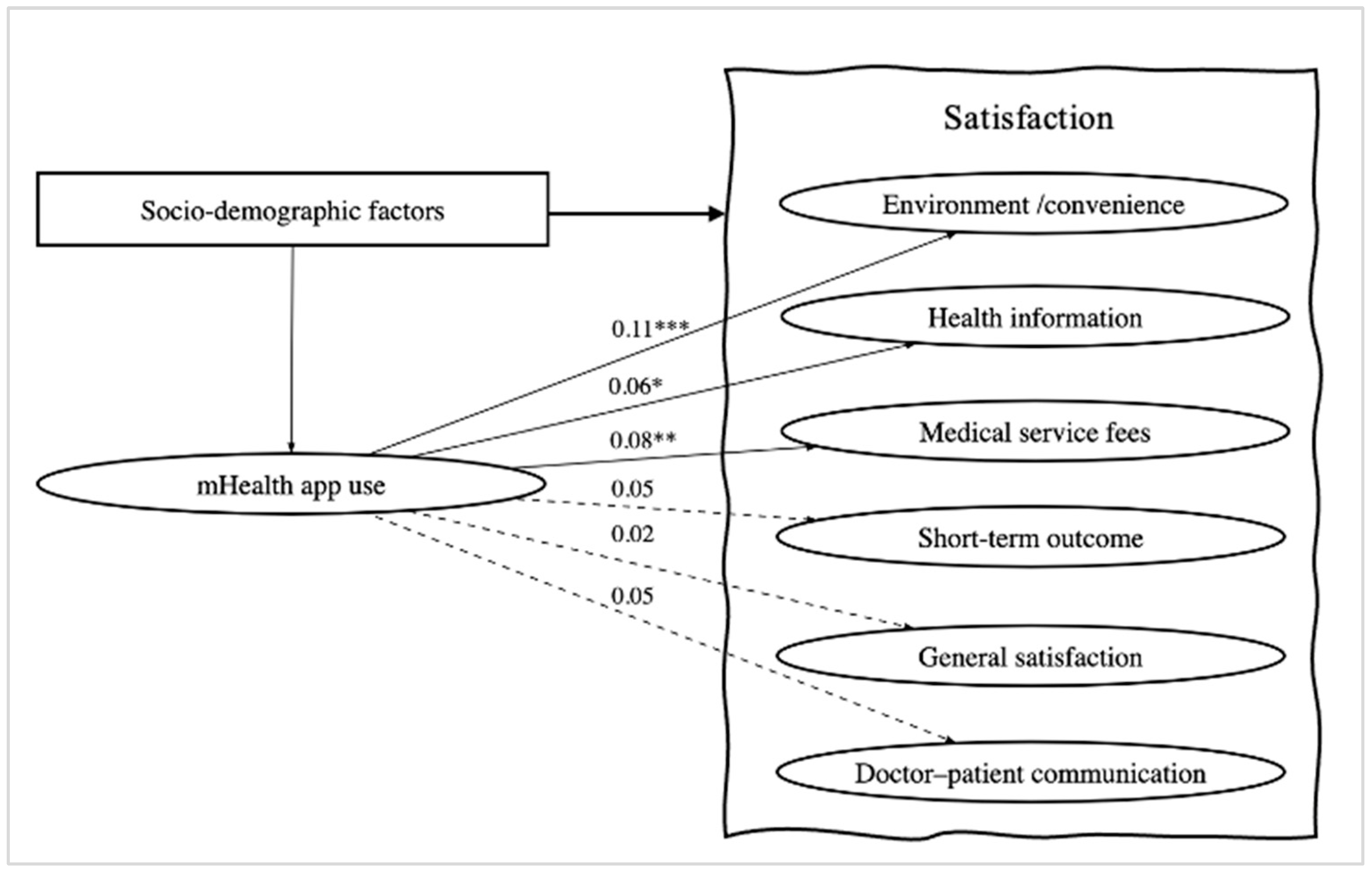
| Environment/convenience←mHealth app use | 0.11 | [0.05, 0.17] | <0.001 |
| Health information←mHealth app use | 0.06 | [0.00, 0.11] | 0.039 |
| Medical service fees←mHealth app use | 0.08 | [0.03, 0.13] | 0.004 |
| Short-term outcome←mHealth app use | 0.05 | [0.00, 0.11] | 0.054 |
| General satisfaction←mHealth app use | 0.02 | [−0.03,0.08] | 0.429 |
| Doctor–patient communication←mHealth app use | 0.05 | [0.00, 0.10] | 0.069 |
| Environment/convenience←Age | −0.07 | [−0.13, −0.01] | 0.015 |
| Environment/convenience←Education level | 0.11 | [0.02, 0.20] | 0.021 |
| Environment/convenience←Household income | 0.03 | [0.00, 0.07] | 0.041 |
| Environment/convenience←Area of residence | 0.14 | [0.02, 0.27] | 0.023 |
| Environment/convenience←First visit | −0.03 | [−0.15, 0.08] | 0.596 |
| Health information←Age | −0.05 | [−0.10, 0.01] | 0.103 |
| Health information←Education level | 0.13 | [0.04, 0.22] | 0.006 |
| Health information←Household income | 0.05 | [0.02, 0.09] | 0.002 |
| Health information←Area of residence | 0.12 | [0.01, 0.24] | 0.035 |
| Health information←First visit | −0.04 | [−0.15, 0.07] | 0.506 |
| Medical service fees←Age | −0.10 | [−0.16, −0.04] | <0.001 |
| Medical service fees←Education level | 0.15 | [0.06, 0.24] | 0.002 |
| Medical service fees←Household income | 0.05 | [0.02, 0.08] | 0.004 |
| Medical service fees←Area of residence | 0.15 | [0.03, 0.27] | 0.018 |
| Medical service fees←First visit | 0.03 | [−0.08, 0.14] | 0.587 |
| Short-term outcome←Age | −0.06 | [−0.12, 0.00] | 0.056 |
| Short-term outcome←Education level | 0.10 | [0.01, 0.18] | 0.031 |
| Short-term outcome←Household income | 0.05 | [0.01, 0.08] | 0.005 |
| Short-term outcome←Area of residence | 0.08 | [−0.03, 0.20] | 0.164 |
| Short-term outcome←First visit | −0.06 | [−0.17, 0.04] | 0.242 |
| General satisfaction←Age | −0.06 | [−0.12, 0.00] | 0.038 |
| General satisfaction←Education level | 0.05 | [−0.04, 0.14] | 0.241 |
| General satisfaction←Household income | 0.06 | [0.03, 0.10] | <0.001 |
| General satisfaction←Area of residence | 0.08 | [−0.04, 0.19] | 0.219 |
| General satisfaction←First visit | −0.12 | [−0.24, −0.01] | 0.034 |
| Doctor–patient communication←Age | −0.04 | [−0.09, 0.02] | 0.187 |
| Doctor–patient communication←Education level | 0.06 | [−0.02, 0.15] | 0.140 |
| Doctor–patient communication←Household income | 0.07 | [0.04, 0.10] | <0.001 |
| Doctor–patient communication←Area of residence | 0.07 | [−0.04, 0.19] | 0.225 |
| Doctor–patient communication←First visit | −0.06 | [−0.17, 0.05] | 0.265 |
| mHealth app use←Age | −0.40 | [−0.46, −0.34] | <0.001 |
| mHealth app use←Education level | 0.35 | [0.26, 0.44] | <0.001 |
| mHealth app use←Household income | 0.08 | [0.04, 0.11] | <0.001 |
| mHealth app use←Area of residence | 0.04 | [−0.08, 0.16] | 0.525 |
| mHealth app use←First visit | −0.43 | [−0.55, −0.31] | <0.001 |
Publisher’s Note: MDPI stays neutral with regard to jurisdictional claims in published maps and institutional affiliations. |
© 2022 by the authors. Licensee MDPI, Basel, Switzerland. This article is an open access article distributed under the terms and conditions of the Creative Commons Attribution (CC BY) license (https://creativecommons.org/licenses/by/4.0/).
Share and Cite
Cao, L.; Chongsuvivatwong, V.; McNeil, E.B. The Association between mHealth App Use and Healthcare Satisfaction among Clients at Outpatient Clinics: A Cross-Sectional Study in Inner Mongolia, China. Int. J. Environ. Res. Public Health 2022, 19, 6916. https://doi.org/10.3390/ijerph19116916
Cao L, Chongsuvivatwong V, McNeil EB. The Association between mHealth App Use and Healthcare Satisfaction among Clients at Outpatient Clinics: A Cross-Sectional Study in Inner Mongolia, China. International Journal of Environmental Research and Public Health. 2022; 19(11):6916. https://doi.org/10.3390/ijerph19116916
Chicago/Turabian StyleCao, Li, Virasakdi Chongsuvivatwong, and Edward B. McNeil. 2022. "The Association between mHealth App Use and Healthcare Satisfaction among Clients at Outpatient Clinics: A Cross-Sectional Study in Inner Mongolia, China" International Journal of Environmental Research and Public Health 19, no. 11: 6916. https://doi.org/10.3390/ijerph19116916
APA StyleCao, L., Chongsuvivatwong, V., & McNeil, E. B. (2022). The Association between mHealth App Use and Healthcare Satisfaction among Clients at Outpatient Clinics: A Cross-Sectional Study in Inner Mongolia, China. International Journal of Environmental Research and Public Health, 19(11), 6916. https://doi.org/10.3390/ijerph19116916