


Abstract
As multiprocessor systems continue to grow in processor scale, the incidence of faults also increases. As a result, fault diagnosis is becoming a key mechanism for maintaining the normal operation of multiprocessor systems. To explore more effective diagnostic methods, Somani et al. introduced a generalized pessimistic diagnostic strategy, named -diagnosis, in which all faulty nodes are isolated in a set of nodes and at most k fault-free nodes are misdiagnosed, provided that the quantity of faults is limited by t. By imposing certain conditions or restrictions, the -diagnosability of some regular networks under the Preparata, Metze, and Chien (PMC) model has been determined. However, the -diagnosability of many networks under the comparison model remains unidentified. In this paper, we provide new insights into the study of -diagnosability under the comparison model. After introducing some new notions, such as the 0-test unit, 0-test set and 0-test subgraph, under the comparison model, we study the relationship in a system G between the 0-test subgraphs and the components of , where F is the set of faulty nodes, and we obtain some important correlation properties. Based on these results, we study -diagnosability under the comparison model. As a result, the -diagnosability of some regular interconnection networks can be efficiently determined.
1. Introduction
With the rapid advancement of information technology, the precision of very large-scale integration (VLSI) is becoming increasingly sophisticated. Today’s supercomputers may have thousands of processors. Take the US supercomputer Summit, which was crowned the world’s fastest super computer in 2018 and 2019, for example; it has 9216 processors. The large scale of its processor numbers may cause many unreliability problems. Therefore, reliability is an important issue to consider in the design, operation, and maintenance of such a large-scale multiprocessor system. To maintain system reliability, it is necessary to quickly identify all faults. The procedure of recognizing faults is known as fault diagnosis. System-level diagnosis is considered an ideal fault diagnostic method [1].
Many important diagnostic strategies have been proposed in the course of the development of system-level fault diagnosis theory. Among them, the diagnostic capability of the original diagnostic strategy introduced by Preparata et al. [1], named t-diagnosis, is relatively weak. To improve the diagnostic capability, another important diagnostic strategy, called -diagnosis [2], which requires all faulty nodes to be isolated in a set of nodes, was proposed by Somani et al. In this approach, at most k nodes can be misdiagnosed if the fault node number does not exceed t. For the system G, its -diagnosability is the maximum value of t satisfying the condition that G is -diagnosable. For example, the hypercube is an important network topology, which has been applied to many parallel and distributed systems such as iWarp [3] and Cray T3D [4]. For and , it is proved by Somani et al. [2] that the hypercube is -diagnosable. The -diagnosability of several networks under the PMC model has been determined, including hypercubes [2], star graphs [2,5], mesh-based systems [2], and bijective connection (BC) networks [6,7]. Recently, by utilizing the properties of the 0-test subgraph under the PMC model, Lin et al. [8] studied the -diagnosability of regular graphs under the PMC model.
It is well known that there are three system-level diagnosis models: the BGM model [9], the comparison model [10], and the PMC model. The BGM model is not often used in the existing literature as a fault diagnosis model due to its flaws. It is worth mentioning as Sengupta and Dahbura state[10], the comparison diagnosis model can be obtained by generalizing the PMC model. In other words, in terms of diagnosis model, the comparison model is often more suitable than the PMC model for studying the system fault diagnosis. However, to the best of our knowledge, to date, few studies have investigated -diagnosability under the comparison model. In this paper, we study the problem of -diagnosability for regular networks under the comparison model.
The main contributions of this paper are described below.
- To study -diagnosability based on the comparison model, the paper introduces some important definitions, such as the 0-test unit and 0-test subgraph, and present their related properties;
- We present the description of the -diagnosability of regular networks under the comparison model. At the same time, we propose a -diagnosis algorithm for regular networks under the comparison model, which is, to the best of our knowledge, the first such -diagnosis algorithm for regular networks under the comparison model;
- We give the -diagnosabilities for some famous network systems such as hypercube networks, star networks, complete cubic networks, and so on.
The rest of the paper is organized as follows. In the following section, some necessary terminologies and notations are presented. We introduce the definition and properties of the 0-test subgraph in Section 3. Section 4 presents the main results of this paper. We discuss some applications in Section 5. Section 6 concludes the paper.
2. Preliminaries
A multiprocessor system can be modeled as a graph , with being the node set and being the edge set. For , is the set of all the neighbors of x, and is the degree of x in G. Let and . Then, and , where and .
In a connected graph, nodes with degree 1 are known as pendant nodes. A pendant edge is incident to at least one pendant node. Then, all the nodes and edges in G can be classified into two types: pendant and non-pendant. Let and be the sets of pendant nodes and non-pendant nodes, and let and be the sets of pendant edges and non-pendant edges, respectively, (see Figure 1). Then, we have the following properties.
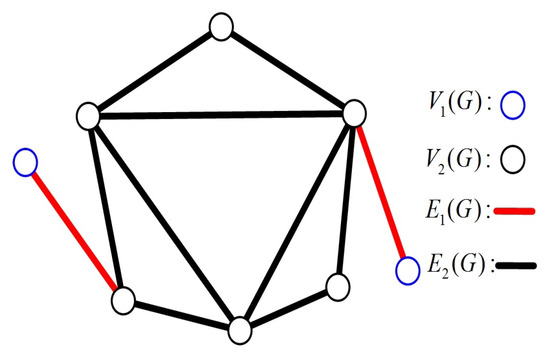
Figure 1.
Illustration of pendant nodes and pendant edges.
Lemma 1.
If G is a connected graph with , then .
Proof of Lemma 1.
Since G is connected with , there exist no edges whose two endpoints are pendant nodes. That is, each pendant edge corresponds to a different pendant node (see Figure 1). Therefore, . □
Lemma 2.
is connected.
Proof of Lemma 2.

For any two nodes , since G is connected, there exists a path that connects x and y (see Figure 2). Since each node in has degree 1, the path will not pass through any node in . Thus, there is a path that connects x and y in . Therefore, is connected. □
Figure 2.
An illustration of Lemma 2.
Lemma 3.
Let be a connected graph satisfying and . Then, .
Proof of Lemma 3.
We have . By Lemma 2, is connected. That is, all nodes in are connected by edges in . Clearly, . Assume the average degree in is a with . By Lemma 1, . According to Euler’s handshaking lemma, we have
Therefore, . □
In system-level diagnosis, the PMC model [1] and comparison model [10] are two widely adopted diagnostic models. Under the comparison model, a comparator will distribute a task to its two adjacent nodes and compare the responses they provide. The comparison of nodes x and y performed by z is denoted by , where and denote two test edges, respectively. The outcome of test is represented by . In Table 1, the invalidation rules for the comparison model are summarized. By Table 1, if , all three nodes are fault-free or the tester z is faulty. Moreover, if x and z are fault-free, we can identify y as fault-free by or as faulty by .

Table 1.
Invalidation rules for the comparison model.
A collection of all the test results is called a syndrome . For a given syndrome , F is called an allowable faulty set if can be produced from F, i.e., if the following two conditions hold:
- (a)
- for ;
- (b)
- for and (or ).
For a given syndrome , if there are several allowable faulty sets , we cannot accurately diagnose the set. As a result, the faulty nodes can only be isolated into a set F, such that .
3. 0-Test Subgraph under the Comparison Model
For a given a syndrome under the comparison model, test is a 0-test unit if , where and are two test edges. The two tests, and , belong to the same 0-test set because they share at least one common test edge (see Figure 3). The graph induced by a 0-test set is called a 0-test subgraph.
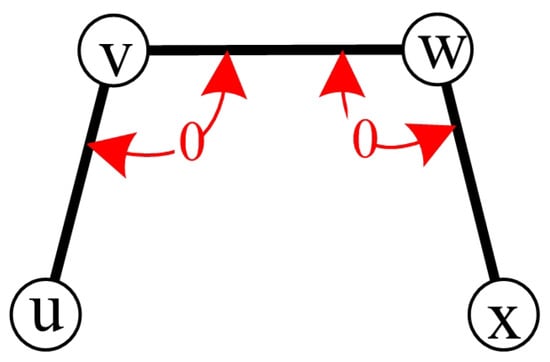
Figure 3.
Illustration of a 0-test set.
For instance, we have (see Figure 4). The syndrome under the comparison model is represented in Figure 4, where , , , , , , , , and , and the outcomes of other tests are 1. Hence, there are nine 0-test units, , , , , , , , , and . Furthermore, there are three 0-test sets, A={, , }, B={, , , , }, and C={} (see Figure 5). Then, let , , and be the 0-test subgraphs induced by 0-test sets A, B, and C, respectively, (see Figure 6). The set of all 0-test subgraphs of G is written as . For any , .
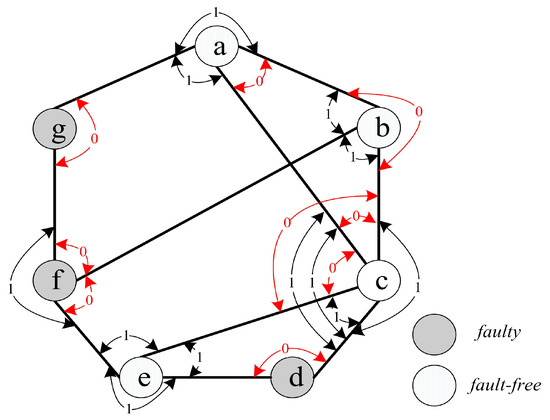
Figure 4.
Syndrome of graph G with 7 nodes .
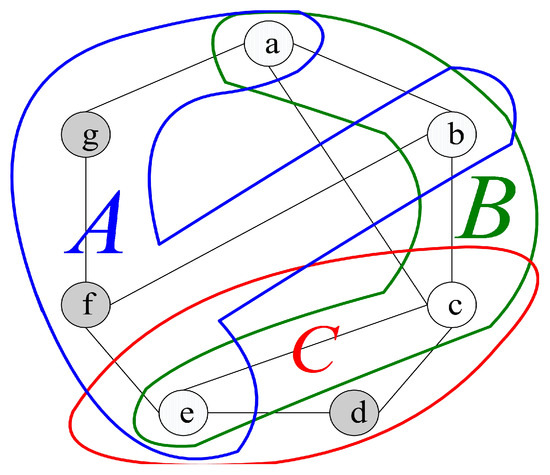
Figure 5.
0-test sets and C of graph G with 7 nodes .
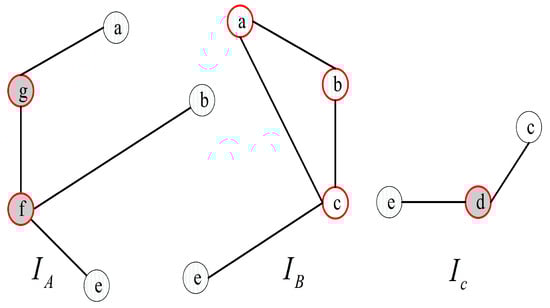
Figure 6.
of graph G with 7 nodes .
Let H be a 0-test set under the comparison model. Let represent the set consisting all testers in H. Clearly, all the testers in H are connected in H or . In the previous example, we have , , and . Then, we have the following properties.
Lemma 4.
Let H be a 0-test set of G under the comparison model. Either all the nodes in H are fault-free or each node in is faulty.
Proof of Lemma 4.
For arbitrary , . By Table 1, all the nodes of a, b, and c are fault-free or tester a is faulty. Let be another 0-test unit in H that has a common test edge with . We have . If a, b, and c are fault-free, e is also fault-free because . This process continues until all 0-test units in H have been examined. Therefore, all the nodes in H are fault-free. Otherwise, a is faulty, since , c is also faulty by Table 1. As a result, all the nodes in are faulty. □
Lemma 5.
Assume that F represents a fault set of G. For any component C of , C is a 0-test subgraph under the comparison model.
Proof of Lemma 5.
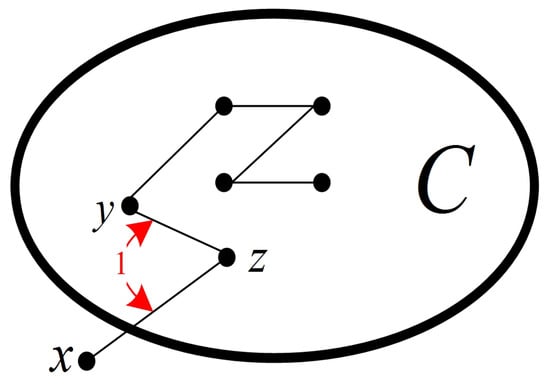
Since C is a component of , C is connected, and all the nodes in C are fault-free with . Hence, under the comparison model, any test in C is a 0-test unit. Therefore, C belongs to a 0-test subgraph . For any , without loss of generality, suppose that with (see Figure 7). Then, we have . Hence, . That is, each node in does not belong to S. Therefore, . □
Figure 7.
An illustration of Lemma 5.
Lemma 6.
Let S represent a 0-test subgrapht corresponding a component C of under the comparison model. Then, .
Proof of Lemma 6.
Since C is connected and all the nodes in C are fault-free, we have . For an arbitrary 0-test unit in S, tester a has at least two neighbors x and y in C. Thus, . Then, we have . Therefore, . □
Lemma 7.
Let F be a fault set of G and let with ; then, S is a component of .
Proof of Lemma 7.
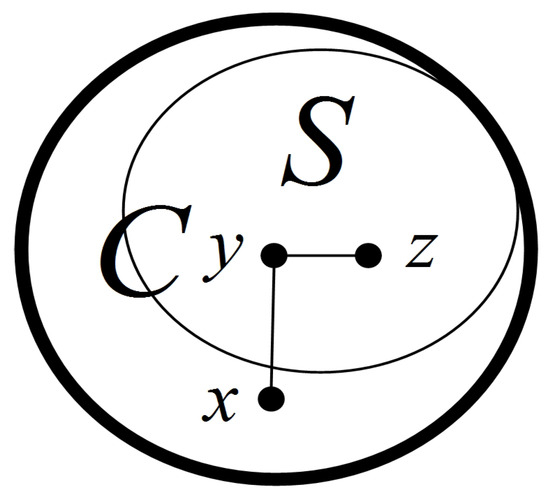
Since , by Lemma 4, all the nodes in S are fault-free. Moreover, since S is a connected subgraph, S belongs to component C of , denoted by . Suppose that . Since C is connected, satisfying (see Figure 8). We let such that . Since , . There exists another node with . Furthermore, since C is a component of , . Thus, . By the definition of the 0-test subgraph, , which contradicts . Therefore, . □
Figure 8.
An illustration of Lemma 7.
4. -Diagnosability and a -Diagnosis Algorithm under the Comparison Model
In the section, we discuss the -diagnosability for a given regular network . The outline of the section is as follows. First, we prove that for a fault set S with and , contains a large component H with and the number of nodes in is no more than nodes. Next, we discuss the sufficient conditions for the result that G is -diagnosable under the comparison model. Finally, based on the obtained sufficient conditions and depth-first search strategy, we design a -diagnosis algorithm for computing a fault set F with for the regular network G such that at most k free-fault nodes belong to F.
Suppose that is a function of integer k with and ; the following three conditions are used in the rest of this paper.
Condition 1.
For any with , contains a large component H such that and ;
Condition 2.
;
Condition 3.
.
Then, we can derive some theorems and corollaries as follows.
Corollary 1.
Let S be a fault set of G with and . If Conditions 1 and 3 hold, has a large component H with , and the union of the remaining components M has a maximum nodes.
Proof of Corollary 1.
Let F be a set with . By Condition 1, contains a large component L such that and .
By Condition 3, . According to the conclusion of the previous paragraph, for any with , has a large component H such that and . □
Theorem 1.
Let F be a fault set of G with . If Condition 2 holds and contains a large component L with , then with .
Proof of Theorem 1.
By Condition 2 and , we can obtain
Therefore, we have , for .
Since and L is a connected component, . By Lemma 3, we have . By Lemma 5, L is a 0-test subgraph under the comparison model, denoted by . Moreover, by Lemma 6, we have . □
Theorem 2.
If Conditions 1 and 2 hold, G is -diagnosable under the comparison model.
Proof of Theorem 2.
Let F be a fault set of G with . According to Condition 1, contains a large component L with . By Theorem 1, with . That is, there exists a 0-test subgraph L such that and . By Lemma 7, all the nodes in L can be identified as fault-free. Since , there are fewer than nodes that are unidentified. Hence, all the faulty nodes can be isolated into a node set, in which the number of fault-free nodes is no more than k. Therefore, under the comparison model, G is -diagnosable. □
Furthermore, we continue to search for a higher value of t such that the system is -diagnosable.
Theorem 3.
If Conditions 1–3 hold, then, under the comparison model, G is -diagnosable.
Proof of Theorem 3.
Let F be a fault set of G with . Now, we discuss the situation by considering the following scenarios.
Case 1.
According to Condition 1, contains a large component H with and . By Theorem 1, with . Moreover, by Lemma 7, all the nodes in H can be identified as fault-free. Since , there are fewer than unidentified nodes. Therefore, all the faulty nodes can be isolated in a node set containing a maximum bound of k fault-free nodes.
Case 2.
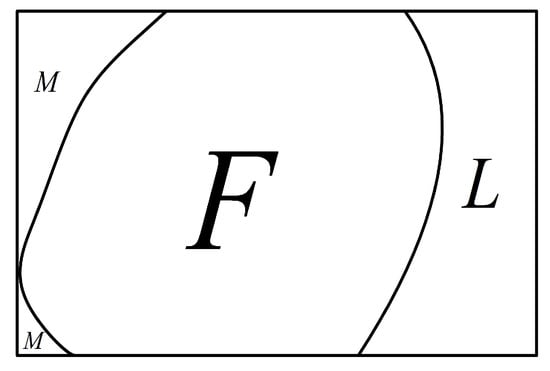
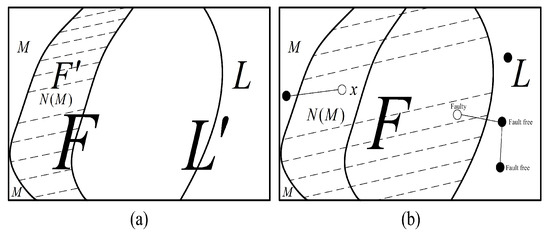
By Corollary 1, has a large component L with , and the union of the remaining components M has a maximum of nodes (see Figure 9). We have . By Theorem 1, L is a 0-test subgraph with . Hence, by Lemma 7, all the nodes in L can be identified as fault-free. There is a total of nodes that remain unidentified.
Figure 9.
An illustration of case 2.
Case 2.1. .
Since , all faulty nodes can be isolated within a node set that at most k fault-free nodes are contained.
Case 2.2. .
Suppose that . Let ; we have . By Condition 1, has a large component and a union of remaining components with (see Figure 10a). Since and , . Therefore, and . Then, , which contradicts . Therefore, . Since and , we have and . That is, each node in F has a neighbor in M.
Figure 10.
An illustration of case 2.2: (a) An illustration of and . (b) An illustration of showing and identifying F to be fault set.
Suppose that and (see Figure 10b). Let ; we have . According to Condition 1, has a union of smaller components with and a large component. Then, . Therefore, , which contradicts . Hence, each node in F is connected to at least one neighbor in L. That is, .
Since all the nodes belonging to L are fault-free, all the nodes in F can be identified as faulty (see Figure 10b), where . Note that , all nodes in M are identified as fault-free. Thus, all faulty nodes can be isolated within a node set, and no fault-free node is misidentified as faulty. Therefore, under the comparison model, G is -diagnosable. □
Inspired by Lin et al. [8], we introduce a t/k-diagnosis Algorithm 1 under the comparison model.
| Algorithm 1: t/k-diagnosis algorithm under the comparison model |
Require: Conditions 1–3. Ensure: , where H is the set of nodes that are identified as fault-free and is the set of nodes that are isolated. Step 1. , ; Step 2. Use a depth-first traversal algorithm to derive all the 0-test units under the comparison model; Step 3. Obtain the tester of each 0-test units and merge 0-test units to construct , and set ; Step 4. Compute for , by merging testers in ; Step 5. For each 0-test subgraph , if , then ; Step 6. ; Step 7. If , then ; else, ; Step 8. Return . |
The correctness of the -diagnosis algorithm under the comparison model follows from Theorem 3. In this algorithm, steps 1 and 4–8 take time. In step 2, the main computational process is based on pairs of adjacent edges. There are pairs of adjacent edges. Step 3 is based on 0-test units. In the worst case, step 3 need iterations to compare each pair of 0-test units to see if they have a common test edge. Take an n-dimensional hypercube network as an example, is an n-regular graph with [11]. Let , we have . Then, . Hence, steps 2 and 3 take time. As a result, the total time needed by this algorithm for n-dimensional hypercube networks is , where .
5. Applications
5.1. Applications to Hypercube-like Networks
Hypercube-like networks are a class of networks (also called BC networks), which are defined recursively by a perfect matching operation [11] (see Figure 11). An n-dimensional hypercube-like network is written as , where [11]. Since is n-regular [12], we have . Note that both and are integers, let ; then, we have for . Then, has the following properties.
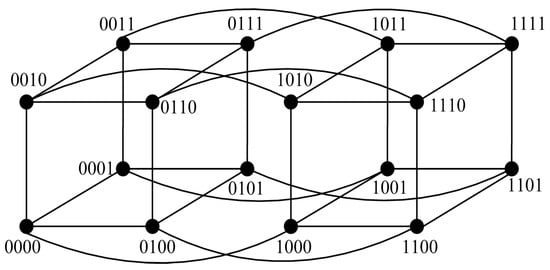
Figure 11.
Topology of for .
Lemma 8.
, where and .
Proof of Lemma 8.
Since and , we have
Therefore, for . □
Lemma 9
([13,14]). Let g and n be two positive integers with and , and let with . If is disconnected, there exists a large component in that includes a minimum of nodes.
Corollary 2.
Let with , and . If is disconnected, has a large component L and a union of smaller components of at most k nodes, where .
Proof of Corollary 2.
Let ; we have . By Lemma 9, has a large component L and a union of smaller components of at most k nodes. By Lemma 8, . Then, we have
□
Lemma 10.
, where and .
Proof of Lemma 10.
Since and , we have
Hence, when and , it holds that . □
Lemma 11.
for .
Proof of Lemma 11.
Since for , we have
Therefore, for . □
Then, the following result can be derived.
Theorem 4.
is -diagnosable under the comparison model for and .
Proof of Theorem 4.
By Corollary 2 and Lemmas 10 and 11, satisfies Conditions 1–3 for and . By Theorem 3, it is true that under the comparison model is -diagnosable. □
5.2. Applications to Folded Hypercubes
An n-dimensional folded hypercube is constructed by augmenting a hypercube with extra edges (see Figure 12), where and [15]. Let for ; then, the following properties can be derived.
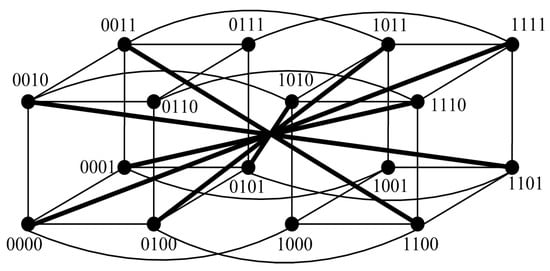
Figure 12.
Topology of for .
Lemma 12.
, where and .
Proof of Lemma 12.
Since and , we have
Therefore, for . □
Lemma 13
([16]). Given two positive integers n and g with and , let with . If is disconnected, has a large component and a union of smaller components of at most nodes.
Corollary 3.
Suppose that and are integers, let with . If is disconnected, has a large component L and a union of smaller components of at most k nodes such that .
Proof of Corollary 3.
Let , . By Lemma 13, if is disconnected, has a large component and a union of smaller components of at most k nodes. By Lemma 12, . Then, we have
□
Lemma 14.
, where and .
Proof of Lemma 14.
Since and , we have
Hence, when and , . □
Lemma 15.
for .
Proof of Lemma 15.
Since for , we have
Therefore, for . □
Then, we can obtain the following theorem.
Theorem 5.
is -diagnosable under the comparison model for and .
Proof of Theorem 5.
By Corollaries 3 and Lemmas 14–15, Conditions 1–3 hold for and . Therefore, by Theorem 3, is -diagnosable under the comparison model for and . □
5.3. Applications to Star Graphs
The star graph is a sparsely connected graph with and [17]. Figure 13 shows for . Let , where ; then, has the following lemmas.
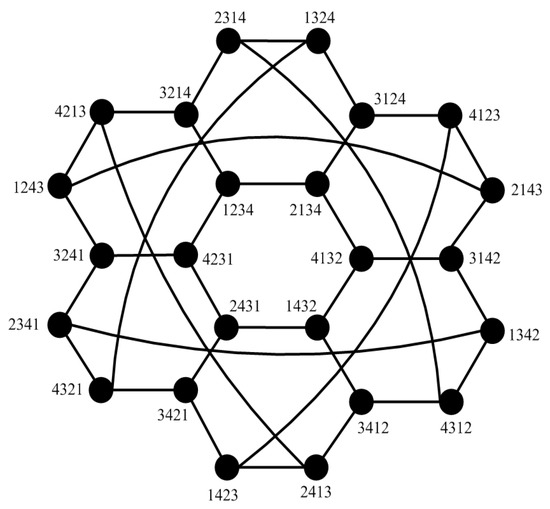
Figure 13.
Topology of for .
Lemma 16.
for and .
Proof of Lemma 16.
Since and , we have
Therefore, for and . □
Lemma 17
([18,19]). Suppose that and F is a subset of such that . has a large component and at most one singleton.
Lemma 18
([18,19]). Let F be a subset of with and . consists of a large component and a collection of smaller components containing no more than two nodes.
Lemma 19
([17]). Let F be a subset of with and . If is disconnected, has a large component and a union of smaller components of at most three nodes.
Motivated by Lemmas 16–19, we have the following lemmas.
Lemma 20.
Let F be a subset of with , and . If is disconnected, consists of a large component L and a collection of smaller components containing no more than k nodes such that .
Proof of Lemma 20.
By Lemmas 17–19, consists of a large component L and a collection of smaller components containing no more than k nodes for . Then, by Lemma 16, we have
Hence, . □
Lemma 21.
Suppose that and . Then, .
Proof of Lemma 21.
We have and [17]. Since and ,
Hence, when and , it is true that . □
Lemma 22.
for and .
Proof of Lemma 22.
Note that , where , we have
Therefore, for and . □
Therefore, for , we obtain the following theorem.
Theorem 6.
is -diagnosable under the comparison model for and .
Proof of Theorem 6.
By Lemmas 20–22, Conditions 1–3 hold for and . Therefore, by Theorem 3, is -diagnosable under the comparison model for and . □
5.4. Applications to Complete Cubic Networks
An n-dimensional complete cubic network, written as , is a special class of hierarchical cubic networks [20]. Figure 14 shows for . According to the definition of , we have and . Let for ; then, the following properties can be obtained.
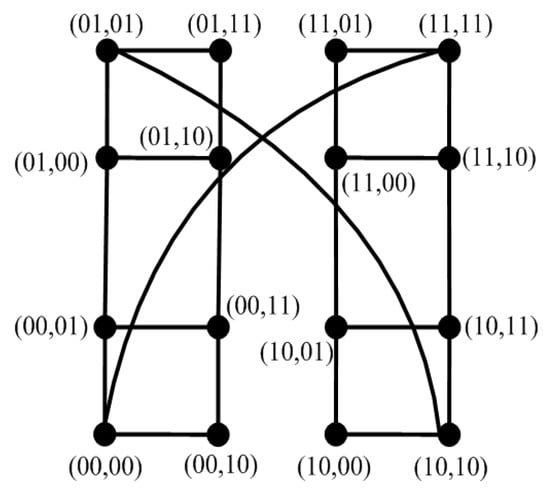
Figure 14.
The topology of for .
Lemma 23.
for and .
Proof of Lemma 23.
Since and , we have
Therefore, for and . □
Lemma 24
([20]). Let and . For any with , there exists a large component and several smaller components containing a maximum of nodes in .
By Lemma 24, we can deduce the following corollary.
Corollary 4.
Let with , and . In , there exists a large component L and several smaller components containing a maximum of k nodes, where .
Proof of Corollary 4.
By Lemma 24, let , we have . Then, there exists a large component L and several smaller components containing a maximum of g nodes in , where and . Then, we have . By Lemma 23,
Hence, . □
Lemma 25.
for and .
Proof of Lemma 25.
We have and . Since and ,
Hence, for and . □
Lemma 26.
for .
Proof of Lemma 26.
Since for , we have
Therefore, for . □
Theorem 7.
is -diagnosable under the comparison model for and .
Proof of Theorem 7.
By Corollary 4 and Lemmas 25 and 26, Conditions 1–3 hold for and . Therefore, by Theorem 3, is -diagnosable for and . □
6. Conclusions
-diagnosability is an important diagnostic strategy that can improve the self-diagnosing capability of multiprocessor systems. While significant progress has been made in -diagnosability under the PMC model in the last half century, -diagnosability and -diagnosis algorithms for many regular networks under the comparison model have yet to be determined. In this paper, inspired by the 0-test subgraph under the PMC model, we introduce some useful notions for the comparison model, such as the 0-test unit, 0-test set, and 0-test subgraph. Then, we study the properties of 0-test subgraphs under the comparison model. Furthermore, we derive some key theorems about -diagnosability and the -diagnosis algorithm under the comparison model. Finally, the applications of our results to some regular networks are demonstrated.
In the article, we calculate the -diagnosability for regular networks based on the comparison model. Considering that N-ary M-cube networks are more general than regular networks in terms of network topology, in the future, we will investigate the -diagnosability problem of N-ary M-cube networks under the comparison model.
Author Contributions
Conceptualization, J.L. and C.L.; methodology, J.L.; validation, J.L. and C.L.; investigation, J.L., M.X. and Z.L.; resources, J.L. and C.L.; writing—original draft preparation, J.L.; writing—review and editing, J.L. and C.L.; visualization, J.L., M.X. and Z.L.; supervision, J.L. and C.L.; project administration, J.L. and C.L.; funding acquisition, J.L. All authors have read and agreed to the published version of the manuscript.
Funding
This work was supported by the National Natural Science Foundation of China under grant no. 61862003.
Institutional Review Board Statement
Not applicable.
Informed Consent Statement
Not applicable.
Data Availability Statement
Data are contained within the article.
Conflicts of Interest
The authors declare no conflicts of interest.
References
- Preparata, F.P.; Metze, G.; Chien, R.T. On the Connection ssignment problem of diagnosable systems. IEEE Trans. Electron. Comput. 1967, 6, 848–854. [Google Scholar] [CrossRef]
- Somani, A.K.; Peleg, O. On Diagnosability of Large Fault Sets in Regular Topology-Based Computer Systems. IEEE Trans. Comput. 1996, 45, 892–903. [Google Scholar] [CrossRef]
- IKessler, R.E.; Cray, J.L. T3D: A new dimension for Cray Research. In Proceedings of the 38th IEEE Computer Society International Conference; Compeon Spring’93, San Francisco, CA, USA, 22–26 February 1993; pp. 176–182. [Google Scholar]
- Adiga, N.R.; Blumrich, M.A.; Chen, D.; Coteus, P.; Gara, A.; Giampapa, M.E.; Heidelberger, P.; Singh, S.; Steinmacher-Burow, B.D.; Takken, T.; et al. Blue gene torus interconnection network. IBM J. Res. Dev. 2005, 49, 265–276. [Google Scholar] [CrossRef]
- Zhou, S.; Lin, L.; Xu, L.; Wang, D. The t/k-diagnosability of star graph networks. IEEE Trans. Comput. 2015, 64, 547–555. [Google Scholar] [CrossRef]
- Fan, J.; Lin, X. The t/k-diagnosability of the BC graphs. IEEE Trans. Comput. 2005, 54, 176–184. [Google Scholar]
- Yang, W.; Lin, H.; Qin, C. On the t/k-diagnosability of BC networks. Appl. Math. Comput. 2013, 225, 366–371. [Google Scholar]
- Lin, L.; Xu, L.; Zhou, S.; Hsieh, S.-Y. The t/k-diagnosability for regular networks. IEEE Trans. Comput. 2016, 65, 3157–3170. [Google Scholar] [CrossRef]
- Barsi, F.; Grandoni, F.; Masetrini, P. A theory of diagnosability of digital systems. IEEE Trans. Comput. 1976, 25, 585–593. [Google Scholar] [CrossRef]
- Sengupta, A.; Dahbura, A.T. On self-diagnosable multiprocessor systems: Diagnosis by the comparison approach. IEEE Trans. Comput. 1992, 41, 1386–1396. [Google Scholar] [CrossRef]
- Vaidya, A.S.; Rao, P.S.N.; Shankar, S.R. A Class of HypercubeLike Networks. In Proceedings of the 1993 5th IEEE Symposium on Parallel and Distributed Processing, Dallas, TX, USA, 1–4 December 1993; pp. 800–803. [Google Scholar]
- Fan, J.; He, L. BC interconnection networks and their properties. Chin. J. Comput. 1998, 126, 84–90. [Google Scholar]
- Zhu, Q.; Wang, X.-K.; Cheng, G. Reliability evaluation of BC networks. IEEE Trans. Comput. 2013, 62, 2337–2340. [Google Scholar] [CrossRef]
- Zhou, J.-X. On g-extra connectivity of hypercube-like networks. J. Comput. Syst. Sci. 2017, 88, 208–219. [Google Scholar] [CrossRef]
- El-Amawy, A.; Latifi, S. Properties and performance of folded hypercubes. IEEE Trans. Parallel Distrib. Syst. 1991, 2, 31–42. [Google Scholar] [CrossRef]
- Lin, Y.; Lin, L.; Huang, Y.; Wang, J. The t/s-diagnosability and t/s-diagnosis algorithm of folded hypercube under the PMC/comparison model. Theor. Comput. Sci. 2021, 887, 85–98. [Google Scholar] [CrossRef]
- Chang, N.-W.; Hsieh, S.-Y. Structural properties and conditional diagnosability of star graphs by using the PMC model. IEEE Trans. Parallel Distrib. Syst. 2014, 25, 3002–3011. [Google Scholar] [CrossRef]
- Cheng, E.; Lipták, L. Structural Properties of Cayley Graphs Generated by Transposition Trees. Congr. Numer. 2006, 180, 81–96. [Google Scholar]
- Yuan, A.; Cheng, E.; Lipták, L. Linearly many faults in (n; k)-star graphs. Int. J. Found. Comput. Sci. 2011, 22, 1729–1745. [Google Scholar] [CrossRef]
- Cheng, E.; Qiu, K.; Shen, Z. Connectivity results of complete cubic networks as associated with linearly many faults. J. Interconnect. Netw. 2015, 15, 1550007. [Google Scholar] [CrossRef]
Disclaimer/Publisher’s Note: The statements, opinions and data contained in all publications are solely those of the individual author(s) and contributor(s) and not of MDPI and/or the editor(s). MDPI and/or the editor(s) disclaim responsibility for any injury to people or property resulting from any ideas, methods, instructions or products referred to in the content. |
© 2024 by the authors. Licensee MDPI, Basel, Switzerland. This article is an open access article distributed under the terms and conditions of the Creative Commons Attribution (CC BY) license (https://creativecommons.org/licenses/by/4.0/).