1. Introduction
Performance optimization in flexible manufacturing systems has received great attention in recent decades [
1]. Such automated systems with synchronization, concurrency, and time delay can usually be modeled by timed marked graphs (TMGs), an important subclass of PNs that are proven to be useful in modeling manufacturing systems, queue systems, and railway transportation systems [
2,
3,
4,
5,
6,
7,
8,
9,
10]. The performance of a system modeled with TMGs is usually characterized by the cycle time that represents the normalized time for one cycle of production. This issue was first studied in ordinary TMG (i.e., TMGs in which the weights on the arcs are unitary). In the literature, ordinary TMGs are simply called “TMGs” by omitting the term “ordinary”. The cycle time can be obtained by exploring the periodic dynamic evolution of a TMG [
11]. On the other hand, the exact cycle time of a TMG can also be computed analytically by using the linear programming technique [
12]. Algebraic approaches based on (max,+) or (min,+) algebra have also been applied for computing the cycle time of TMGs [
13]. Based on these results, various methods have been developed for the performance optimization problems in TMGs, i.e., to minimize the total cost of the system’s resources (machines, devices, tasks, etc.) without compromising the desired level of throughput. The optimization targets include the initial resource allocation [
14,
15,
16,
17,
18,
19,
20] and the server-type selection under a given budget [
21,
22,
23].
Timed weighted marked graphs (TWMGs) are more general than ordinary TMGs and are useful in modeling systems with batch processes (i.e., instead of processing tasks one by one, they wait until a batch of tasks are available and process them simultaneously) [
24,
25]. Nevertheless, obtaining the exact cycle time of a TWMG is much more complicated than that of a TMG. In [
26], the authors prove that for a given TWMG, the optimization of the server type is NP-hard. A widely used method for computing the cycle time of a TWMG is to first transform it into an equivalent TMG [
27,
28] followed by the linear programming technique in [
12]. However, such a transformation is computationally heavy, initially marking-dependent, and usually yields a TMG much larger than the original TWMG. To overcome such a problem, in [
29], a method is proposed to transform a TWMG (with an undetermined initial marking) into an equivalent parametric TMG so that the scale of the corresponding linear programming remains solvable. Some approximation methods [
30] are also developed to estimate the upper bound of the cycle time of a TWMG. A linearization method for TWMGs to obtain linear representation in (min,+) was developed [
31]. Based on the obtained linear model, the performance of the TWMGs can be analyzed.
The performance optimization problem in TWMGs is also more complex than that of TMGs. Relatively few works have been conducted on the performance optimization of TWMGs in the literature. Since the equivalent TMG classes of a TWMG is finite, by solving a mixed-integer linear programming problem (MILPP) for each equivalent TMG class, a globally optimal initial marking can be obtained [
32,
33]. Nevertheless, the computational load of this precise algorithm is unsatisfactory, since the number of equivalent TMG classes is exponential in the number of places in the corresponding TWMG. Therefore, people turn to hybrid algorithms, such as heuristics combined with simulation and MILPPs, which are fast and provide near-optimal solutions [
34,
35,
36]. In [
34], a TWMG is initialized with a sufficiently large initial marking so that the performance requirement is satisfied. Then, a greedy algorithm is applied to decrease the total cost in which tokens are iteratively removed until the cycle time reaches a lower bound threshold. A heuristic method combined with integer linear programming was proposed in [
35]. However, both heuristics in [
34,
35] rely on the detection of the so-called critical places and, hence, a time-consuming simulation of the TWMG has to be performed in each iteration. This method is further improved in [
36] in which the critical places are determined by linear programming, which greatly improves the efficiency of the heuristic algorithm. Computational efficient solutions for the performance optimization of TWMGs are still missing.
In practice, the execution time of a process may vary when different types of resources (machine, robot, transporting vehicle, etc.) are deployed. Therefore, the optimization of the types and quantities of resources, (so that the performances are maximized) has also received considerable attention in different areas, such as manufacturing systems [
37,
38,
39] and enterprise systems [
40]. However, as far as we know, no work has been done on such a problem in TWMGs. Solving this problem is challenging since it is a nonlinear quadratic optimization (which we will see in
Section 3) and, thus, a globally optimal solution is hard to achieve. The search space for selecting the types and quantities of resources is quite huge even though the system size is small.
In this paper, we explore the performance optimization problem in TWMGs where both quantities and types of resources are simultaneously optimized. The exact value of the cycle time of TWMGs is efficiently evaluated by using linear algebraic methods. Precisely speaking, our aim is to minimize the cycle time of a given TWMG subject to a given budget limit, while both quantities and types of resources are variables.
The main contribution of this work is summarized as follows. We developed a hybrid method that is a genetic heuristic combined with MILP. Initially, a set of candidate resource allocation strategies, i.e., the choices of the number of resources, are first generated by solving a MILPP. Then, among all of the possible types of resources whose numbers grow exponentially with respect to the system size, we originally developed a MILPP to determine the optimal one. This was done by transforming the determined TWMG of the candidate strategy into an equivalent TMG with parametric firing delays. In the latter, a MILPP was applied to compute its cycle time and the gross cost (scored as fitness). The promising strategies, i.e., those with high fitness, were used to spawn the next generation of candidate strategies. The procedure above was repeated for a pre-set number of generations, and eventually, a near-optimal resource allocation strategy was obtained. Simulation results show that the developed approach can provide a good trade-off between the near-optimality of the solution and the computational load.
This paper is structured as follows. The basic concepts used in this paper are discussed in
Section 2.
Section 3 formulates the performance optimization problem studied in this paper. In
Section 4, a genetic algorithm-based approach is presented. Simulation studies are investigated in
Section 5. Conclusions and future work are presented in
Section 6.
2. Background
2.1. Generalities
A PN is a 4-tuple , where P is a set of n places; T is a set of m transitions; and are the pre- and post-incidence functions that specify the arcs, respectively, and are also denoted by matrices in , where ; is the incidence matrix, where . A PN is said to be ordinary when all of its arc weights are unitary, i.e., .
A vector (resp., ) such that and (resp., and ) is a P-semiflow (resp., T-semiflow). The support of a P-semiflow (resp., T-semiflow) is defined by = (resp., =). A P-semiflow (resp., T-semiflow ) is minimal if (i) (resp., ) is not a superset of the support of any other P-semiflow (resp., T-semiflow), and (ii) all (resp., ) where are mutually prime.
The set of output (resp., input ) places of transition is defined as (resp., ). The notions for and are analogously defined.
A marking is a mapping that assigns to each place of a PN a non-negative integer number of tokens, which is also described as an n-component vector . The number of tokens of place p at marking is denoted by . A Petri net system is a net N with an initial marking .
A weighted marked graph (WMG) is a PN in which each place has exactly one input and one output transition. A marked graph (MG) is a WMG whose weights on arcs are unitary.
Given a PN N, a path is a sequence of nodes where for all and holds for all . A PN is said to be strongly connected if, for any , there exists a path from o to . A path is a circuit if . A circuit is an elementary circuit, denoted by , if for all , indicates . The set of all elementary circuits of N is denoted by .
A WMG is neutral if for each elementary circuit it holds that . In the rest of this paper, we limit our study to neutral and strongly connected WMGs.
2.2. Timed Petri Nets
In the literature, two types of timed Petri nets (TPNs) [
41] are mainly studied, namely transition-timed PNs (TTPNs) and place-timed PNs (PTPNs) [
42]. A transition-timed Petri net is a pair
=
where
is a PN;
is an m-component vector, called the firing delay vector of , which assigns a non-negative rational value to each transition to represent its firing delay, where denotes the set of rational numbers.
For a PTPN, a non-negative rational duration is assigned to each place p to represent the residual time that a token must spend in p before it becomes available for its output transitions.
Given a TTPN
, the enabling degree of a transition
t logically enabled at a marking
, denoted as
, is the largest integer
r, such that
. The TTPNs considered in this paper follow the so-called infinite server semantics [
42]. In plain words, each transition represents an operation that can be executed as many times as the number of available servers, i.e., each enabled transition can fire as many times as its enabling degree.
A TTPN is called a TWMG if net N is a weighted marked graph. A TWMG system is a triple , where is a TWMG and is an initial marking.
2.3. Cycle Time of TWMGs
The cycle time of a TWMG system
, denoted by
, is the average period to fire one time the minimal T-semiflow
[
28,
34]. The steady evolution of a strongly connected TWMG system is repetitive. Let
denote the firing frequency of transition
during the repetitive period. Then, the cycle time of a TWMG system
can be defined as:
We denote by
the cycle time of elementary circuit
and by
the critical time. For a TMG system, the cycle time is equal to the critical time, i.e.,
However, for a TWMG system, reference [
35] shows that the cycle time is greater than or equal to the critical time, i.e.,
The cycle time of a TWMG can be determined by the simulation. The work of [
12,
30] provides a lower bound and an upper bound of the cycle times that are easy to compute. However, in general, such approximations may be far from the actual cycle time and, hence, cannot be used as guidelines for performance optimization. On the other hand, a TWMG system
can be transformed into an equivalent place-timed marked graphs (PTMGs) system
as shown in Algorithm 1, which describes the same behavior, transition firing language, and cycle time [
28]. Then, the cycle time
of the original TWMG system can be obtained by solving the following linear programming problem (LPP) for the equivalent PTMG system
[
12,
33]:
where
,
,
is the visit ratio vector, and
is a diagonal matrix such that
Note that
,
,
, and
in Algorithm 1 represent the unique input transition of place
, the unique output transition of place
, the floor operator, and the ceiling operator, respectively.
| Algorithm 1 Transformation of a TWMG into a PTMG [12]. |
Input: A TWMG system and the minimal T-semiflow of net N; Output: An equivalent PTMG system such that ; for each transition do delete and its corresponding arcs; add transitions , , …, and places , , …, such that , , ; end for for each place begin do delete and its corresponding arcs; let , ; repeat if then Add place such that , end if until end for
|
3. Problem Statement
In a TWMG that models a practical system, each transition models an operation performed by machines, robots, etc., which we call the servers. A server is modeled by a server place self-looped with . We consider the performance optimization problem in TWMGs where both quantities and types of servers are variables to be simultaneously optimized. Precisely speaking:
For each transition,
with
choices of server types, we use a
-component binary vector
to describe the server type selection of it, where
Moreover, to ensure that the operation is consistent, we require that—among all of the
types of servers of transition
—only one type can be selected, i.e.,
For each transition , different servers have different performances (i.e., the firing delay) and costs. We use and () to denote the firing delay and the unit cost of server type j, respectively. We denote the firing delay vector of transition and the unit cost vector of transition by , and , respectively.
For each transition , we use to denote the server quantity of it, i.e., the number of servers to equip. Then, we use to represent the server quantity of all servers in the gross TWMG system.
Therefore, the firing delay
and the unit cost
of transition
are determined by the following equation:
Moreover, the choices of server types and quantities must be subject to a given budget limit . Then, we can formulate the performance optimization problem as the following.
Problem 1 (Performance optimization problem). Given a TWMG model N, a budget , a unit cost vector , and a firing delay vector , determine a server-type selection and a server quantity , such that while the cycle time is minimized (i.e., the performance is maximized).
In plain words, solving Problem 1 is equivalent to solving the following optimization problem
where
represents the cycle time of the TWMG system ,
represents the cost vector of the TWMG,
is the server quantity of the TWMG,
is the firing delay vector of the TWMG.
However, we note that solving this problem is challenging since it is a quadratic optimization: in general, a globally optimal solution is hard to achieve. Therefore, in the next section, we develop a hybrid method composed of genetic heuristics and MILP. The following example will be used as a running example in the sequel of this paper.
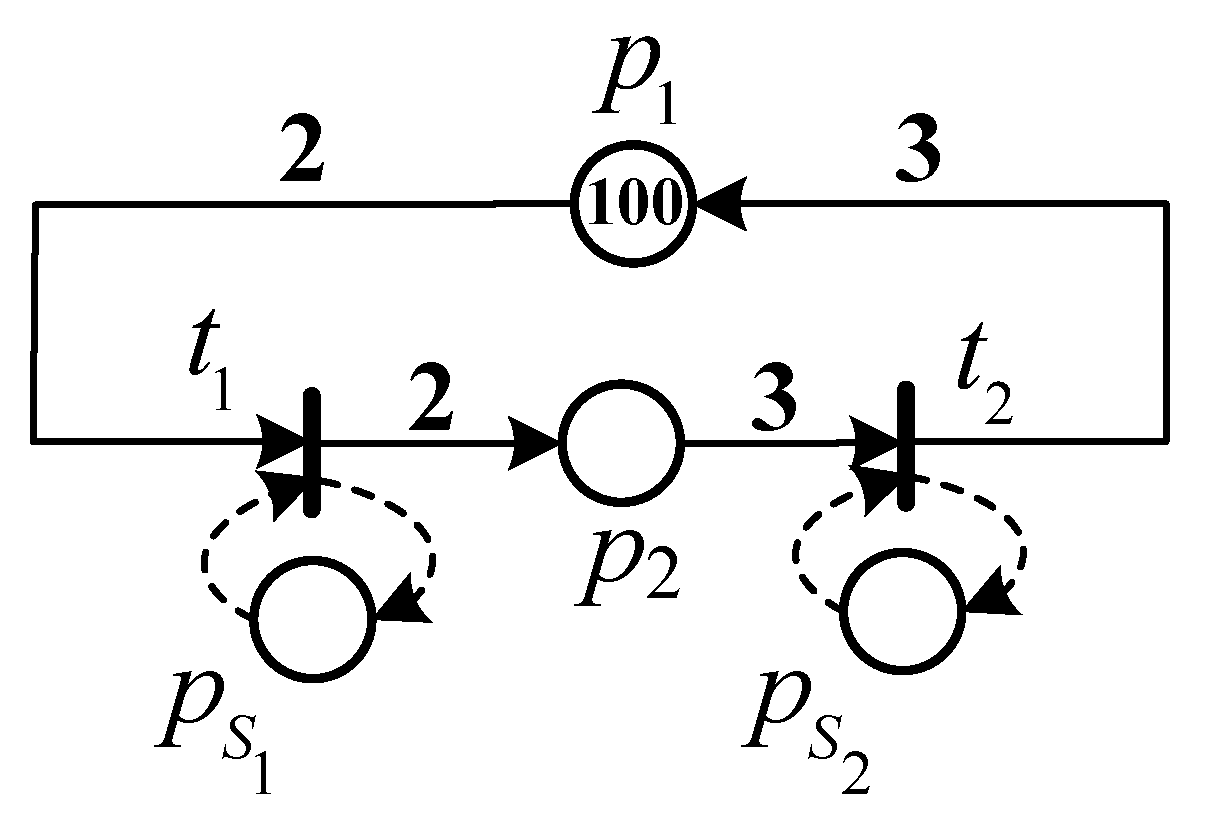
Example 1. Consider the TWMG model N depicted in Figure 1 that represents a cyclic manufacturing system. It is composed of two different operations performed by machines and , respectively. Transitions and represent the operation performed by machines and , respectively. Place is an idle place that represents the raw material to proceed, place is an activity place that represents the manufacturing process, and places and are the server places corresponding to and , respectively. Tokens in places and represent the numbers of machines and , respectively. Initially, there are one hundred raw materials to be proceeded, i.e., , and no semi-products are being produced, i.e., . Assume that we have , i.e., transition has three choices of server types and transition has two choices. The firing delay and the unit cost of each type choice are listed in Table 1. The performance optimization problem (11) is to determine the quantities of servers of transitions and the server-type selections and subject to a given budget R so that the cycle time of the system is minimized. 4. Genetic MILP Approach for Performance Optimization in TWMGs
Due to the existence of weights on arcs of the TWMGs and the nonlinear constraint (
11a), it is quite difficult to find an analytical approach to solve problem (
11). Hence, in this section, we develop a hybrid method composed of genetic heuristics and mixed-integer linear programming, which makes the problem solvable.
As mentioned before, a possible server allocation strategy consists of two parts
where
characterizes the choice of the quantity while
characterizes the choice of the server type. In our method, the two parts are optimized in an alternative manner. For small systems, it could be possible to enumerate the server type
first and determine the quantity
subsequently. However, it is not possible for practical systems even with medium sizes. In addition, it was shown in [
33] that for a TWMG whose server type
is given, the optimal quantity
can be obtained by transforming it into a finite number of equivalent PTMG classes and solving a MILPP for each equivalent class. The computational cost of this approach is high since the number of equivalent PTMG classes increases exponentially w.r.t. the number of places of the original TWMG. In practice, it is inefficient to solve the performance optimization in TWMGs by exploring all the equivalent PTMGs.
In this paper, the quantity-component
, i.e., the initial token distribution for server places in the TWMG, is first treated as a chromosome in the genetic heuristics. Then, among all the possible server types
whose number grows exponentially with respect to the system size, we originally develop a MILPP to determine the optimal one. Therefore, the computational cost can be reduced significantly compared with the existing methods in [
33]. Moreover, the result from the MILPP is also used to score the chromosome, i.e., the fitness of the quantity–component
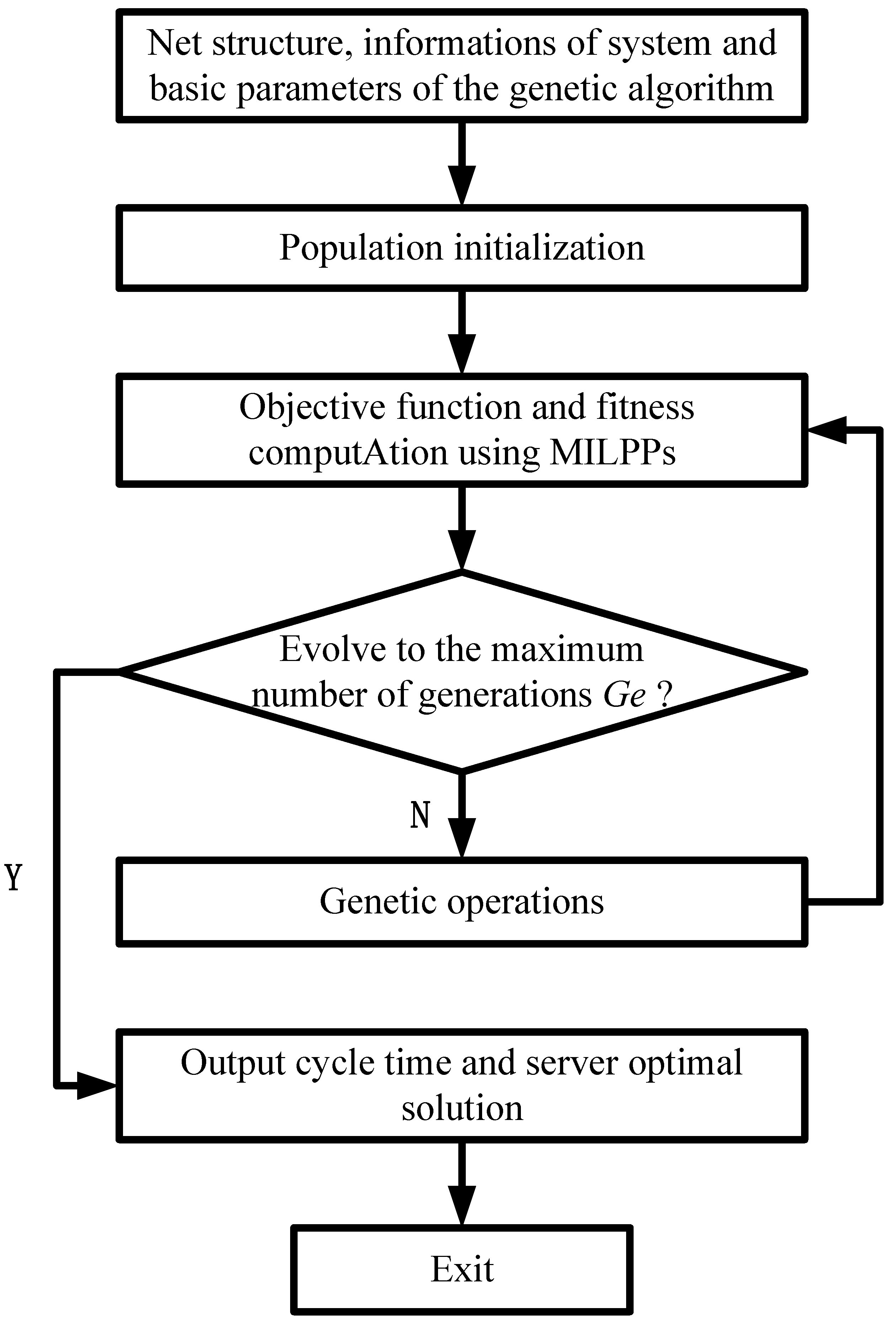
, which provides a guideline for generating the next generation of candidate chromosomes. This alternated optimization is done when a pre-given number (
) that represents the maximum number of generation is reached. The main steps of the approach are sketched in the flow chart in
Figure 2.
In the following subsections, we will discuss the main elements of the developed approach:
Coding and decoding;
Initial population generation;
Calculation of the objective function and fitness value;
The overall genetic algorithm: selection, crossover, and mutation.
4.1. Coding and Decoding
A server allocation strategy (i.e., server quantity)
can be coded as a chromosome
that is an
m-dimensional nonnegative integer vector such that
where
represents the quantities of servers of transition
, i.e., the number of tokens in the server place
. For instance, the chromosome of the TWMG model
N depicted in
Figure 1 can be expressed as
, where
and
. Therefore, we can decode
into a marking
of the TWMG model.
4.2. Population Generation and Feasibility Screening
In each iteration in the genetic algorithm, a set of candidate chromosomes are generated from promising ones in the previous generation. However, not all of the newly generated chromosomes—in our case the initial server distribution—are feasible. For example, some initial server distribution may result in the system eventually dying. Hence, a pre-screening step is performed to remove such unfeasible chromosomes from the pool of candidates.
First, a marking
that is decoded by a chromosome
should guarantee the liveness of a TWMG. A TWMG is live if and only if each elementary circuit is live [
24]. Hence, a feasible chromosome necessarily satisfies the following condition:
where
is the minimal T-semiflow corresponding to
and
is a marking restricted to
.
On the other hand, a chromosome
is feasible only if there exists at least one server-type selection
for every transition
, such that the total cost of servers does not beyond the budget
R. This indicates that the following constraint is necessarily feasible:
Combining the results in (
13) and (
14), both the liveness and feasibility of a chromosome
can be guaranteed by the following constraints:
where
is a marking decoded from chromosome
.
4.3. Objective Function and Fitness Score: A MILPP Approach
Given a chromosome and its decoded marking of a TWMG model N, we aim to determine the optimal server-type selection , such that the cycle time of the TWMG system is minimized while the cost of the servers corresponding to do not exceed the budget R.
As we discussed in
Section 2.3, a TWMG system
with a known initial marking
can be transformed into an equivalent PTMG system
with the same cycle time. Hence, the cycle time
of
G can be obtained by solving LPP (
2) for its equivalent PTMG system
. Note that here the firing delay vector
of
G is dependent on the server-type selection
which is undetermined yet. Hence, the firing delays in the corresponding equivalent PTMG system
is also to be determined. Now we show such an optimal server-type selection can be obtained by solving a MILPP for the equivalent PTMG.
Proposition 1. Given a performance optimization problem (11) for a TWMG system G whose equivalent PTMG system is , let be the optimal solution of the following MILPP: Then, () is an optimal server-type selection of problem (11) with respect to a given server quantity . Proof. Constraint (
16b) ensures that the choice of server types subject to server quantity
does not exceed the budget
R. Constraints (
16c), (
16d), and (
16e) jointly enforce Equation (
10). Combining the results in Equations (2) and (6), constraint (
16f) ensures the correctness of the firing delay equivalence between the original TWMG and the PTMG. According to the results in [
12,
33], constraint (
16a) can provide an optimal solution for performance optimization if
and
are given. Therefore,
(
) is an optimal server-type selection of problem (
11) restricted to a given server quantity
. □
Given a chromosome
, the cycle time
in the optimal solution of MILPP (
16) is denoted as
. Let
denote the pool of chromosomes in the
i-th iteration, i.e., the
i-th generation, we define
and
the minimum and maximum objective functions (i.e., cycle time) of the population in the current generation, respectively. Then, the fitness of a chromosome
is defined as
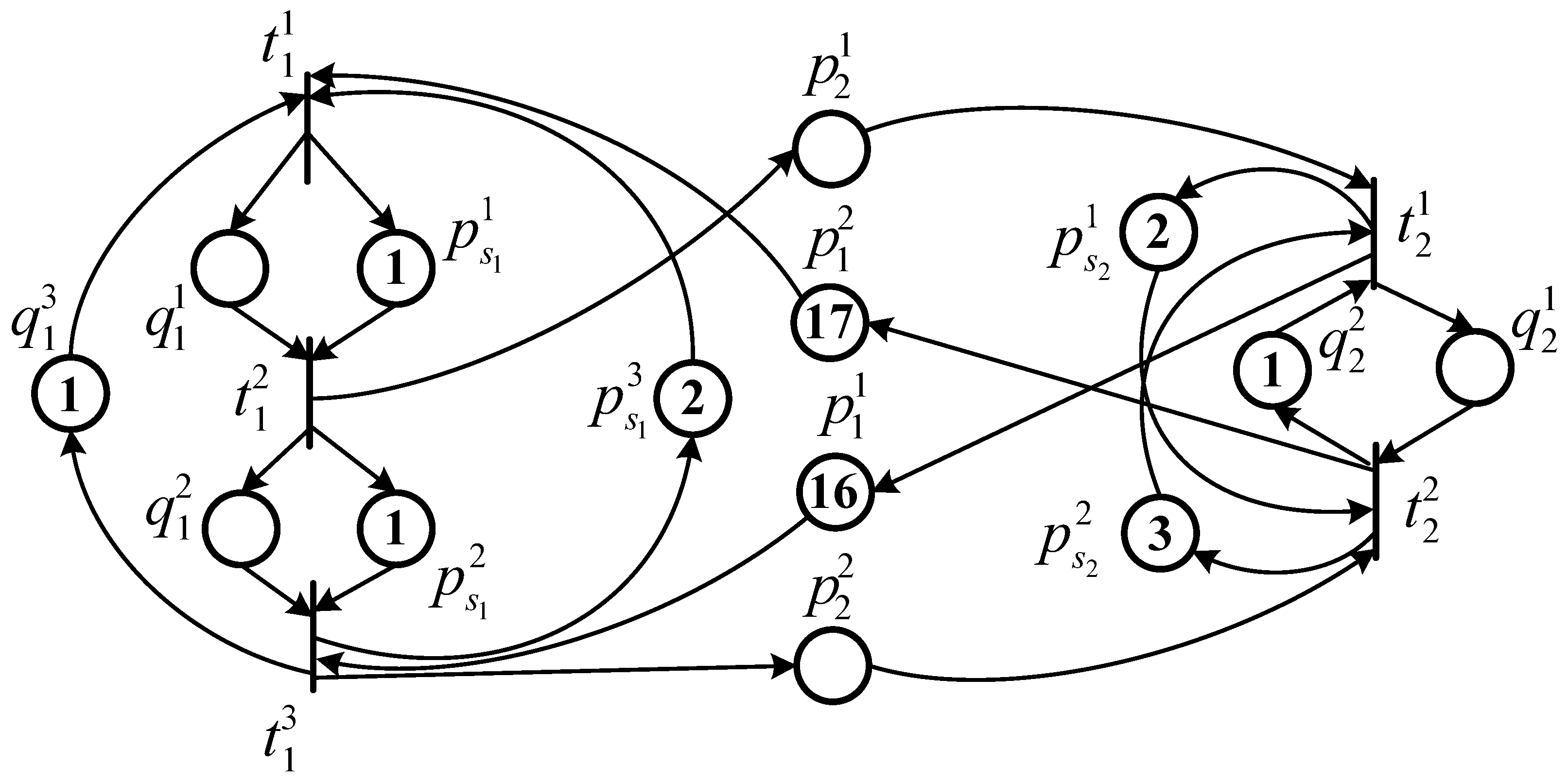
Example 2. Let us consider again the TWMG model N discussed in Example 1 with a minimal T-semiflow and a chromosome . Then, the decoded initial marking is . The equivalent PTMG system corresponding to is shown in Figure 3, where the firing delay vector is to be determined. Let be the budget limit. According to Proposition 1, a MILPP can be established as shown in Equation (18). By solving MILPP (18), we obtain where and . Thus, to optimize the performance of the PTMG (which is equal to that of the original TWMG), transition should be equipped with the second type of server while transition should be equipped with the second type. The optimal cycle time of the TWMG system . Finally, the objective function of chromosome is , and its fitness can be computed according to Equation (17). 4.4. The Overall Genetic Algorithm
Now we are ready to introduce the overall genetic algorithm in our approach.
4.4.1. Selection
The purpose of the selection operation is to save chromosomes with higher fitness values in the parent population and to eliminate chromosomes with low fitness values. The selection rule we used here combines the classical roulette wheel selection [
43] (also called the proportional selection, which ensures the diversity of genes inherited by the next generation) and the optimal retention [
43] (that can effectively retain the optimal individual of each generation). In a roulette selection, the probability of each chromosome
to be selected is proportional to its fitness value
. In generation
i with population
, the probability of selecting a chromosome
is given by:
Note that it may eliminate chromosomes with large fitness values during the roulette wheel selection operation. Therefore, we retain the chromosome with the highest fitness value through the optimal retention method before the roulette wheel selection operation.
4.4.2. Crossover
In the genetic algorithm, new chromosomes are generated through the crossover operation by exchanging gene segments from two parent chromosomes to find better offspring. In the literature, several crossover operations have been proposed, such as single-point crossover, multi-point crossover, and uniform crossover [
43]. In this paper, we used a single-point crossover operation for the genetic algorithm.
4.4.3. Mutation
The mutation operation is to randomly—usually with a pre-set probability—perturb one or several genes of a chromosome. The mutation operation is of great significance in the genetic algorithm to maintain population diversity, prevent falling into the local optimal solution, and enrich the gene pool. The mutation operation uses site mutation, i.e., one or more genes of a chromosome are randomly selected and changed with a mutation probability. In this paper, we use the single-point mutation operation, i.e., at most one gene in each chromosome is mutated for each operation.
Note that during the crossover operation and mutation operation, a newly generated chromosome
may not always satisfy the constraints in Equation (
15), i.e., the TWMG may not be live at the decoded marking
, or the total cost of servers corresponding to
exceeds the budget. In such a case, the chromosome that leads to an infeasible solution is immediately discarded, and a fully randomized chromosome, which satisfies the constraint (
15) is added to the pool.
The entire hybrid method that combines genetic heuristics with MILP is presented as Algorithm 2, whose inputs are: a TWMG model
N, the budget
R, the unit cost vector
, the firing delay vector
, the population size
(i.e.,
), the maximum number of generations
, the crossover probability
, and the mutation probability
.
| Algorithm 2 Genetic MILP method for performance optimization in TWMGs. |
Input: A TWMG model N, , , , , , , , , , and ; Output: Server-type selection and server quantity ; while do for do Transform into according to Algorithm 1; Solve MILPP ( 16) for ; Calculate according to Equation ( 17); end for Let ; Let be the server quantity and be the server type selection corresponding to chromosome ; if then ; Execute selection, crossover, and mutation to generate an offspring generation ; else Output and end if end while
|