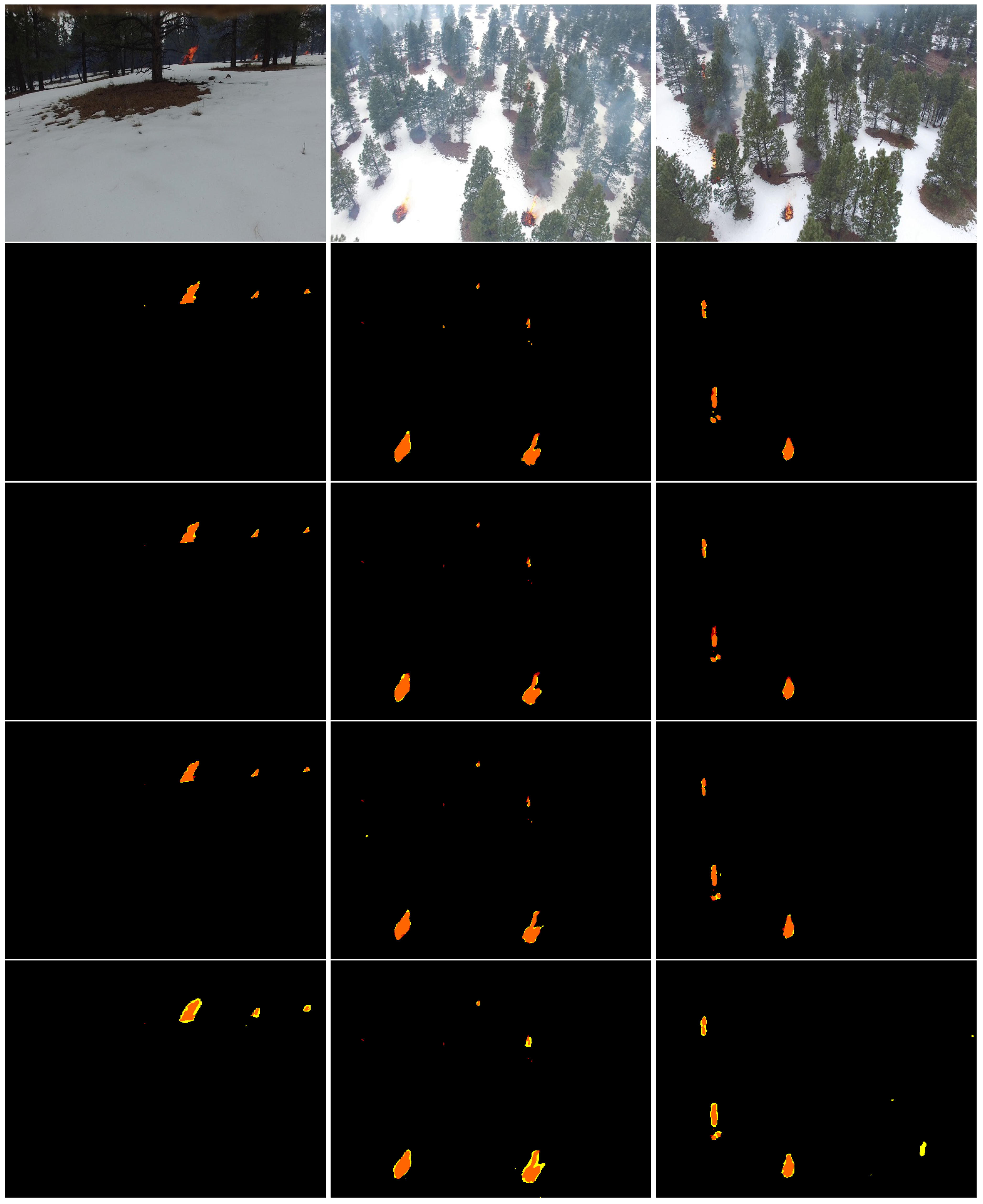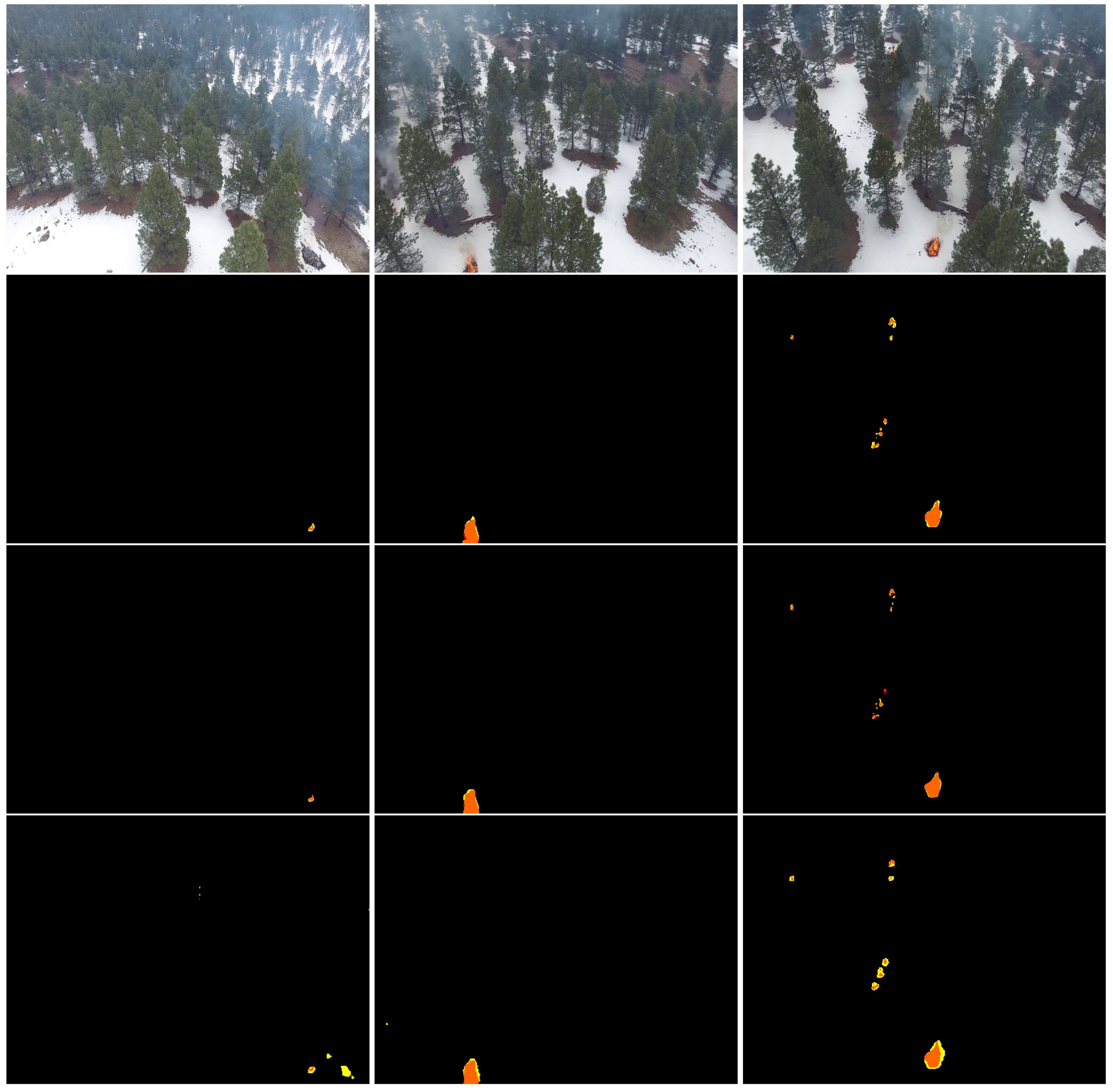
Deep Learning and Transformer Approaches for UAV-Based Wildfire Detection and Segmentation


Abstract
:1. Introduction
2. Related Works
2.1. Fire Classification Using Deep Learning Approaches for UAV Images
- Convolution layers are a set of filters designed to extract basic and complex features such as edges, corners, texture, colors, shapes, and objects from the input images. Then, activation functions are used to add the non-linearity transformation. It helps CNN to learn complex features in the input data. Various activation functions were employed, such as Rectified Linear Unit (ReLU) function [30], Leaky ReLU (LReLU) function [31], parametric ReLU (PReLU) function [32], etc.
- Pooling layers reduce the size of each feature map resulting from the convolutional layers. The most used pooling methods are average pooling and max pooling.
- The fully connected layer is fed by the final flattened pooling or convolutional layers’ output, and the class scores for the objects present in the input image are computed.
- AlexNet includes eleven layers: five convolutional layers with ReLU activation function, three max-pooling layers, and three fully connected layers;
- VGG13 is a CNN with 13 convolutional layers;
- GoogLeNet contains 22 inception layers, which employ, simultaneously and in parallel, multiple convolutions with various filters and pooling layers;
- Modified VGG13 is a VGG13 model with a number of channels of each convolutional layer and fully connected layers equal to half of that of the original VGG13;
- Modified GoogLeNet is a GoogLeNet model with a number of channels of each convolutional layer and fully connected layer equal to half of that of the original GoogLeNet.
2.2. Fire Detection Using Deep Learning Approaches for UAV
2.3. Fire Segmentation Using Deep Learning Approaches for UAV
3. Materials and Methods
3.1. Proposed Method for Wildfire Classification
3.2. Proposed Methods for Wildfire Segmentation
3.2.1. TransUNet
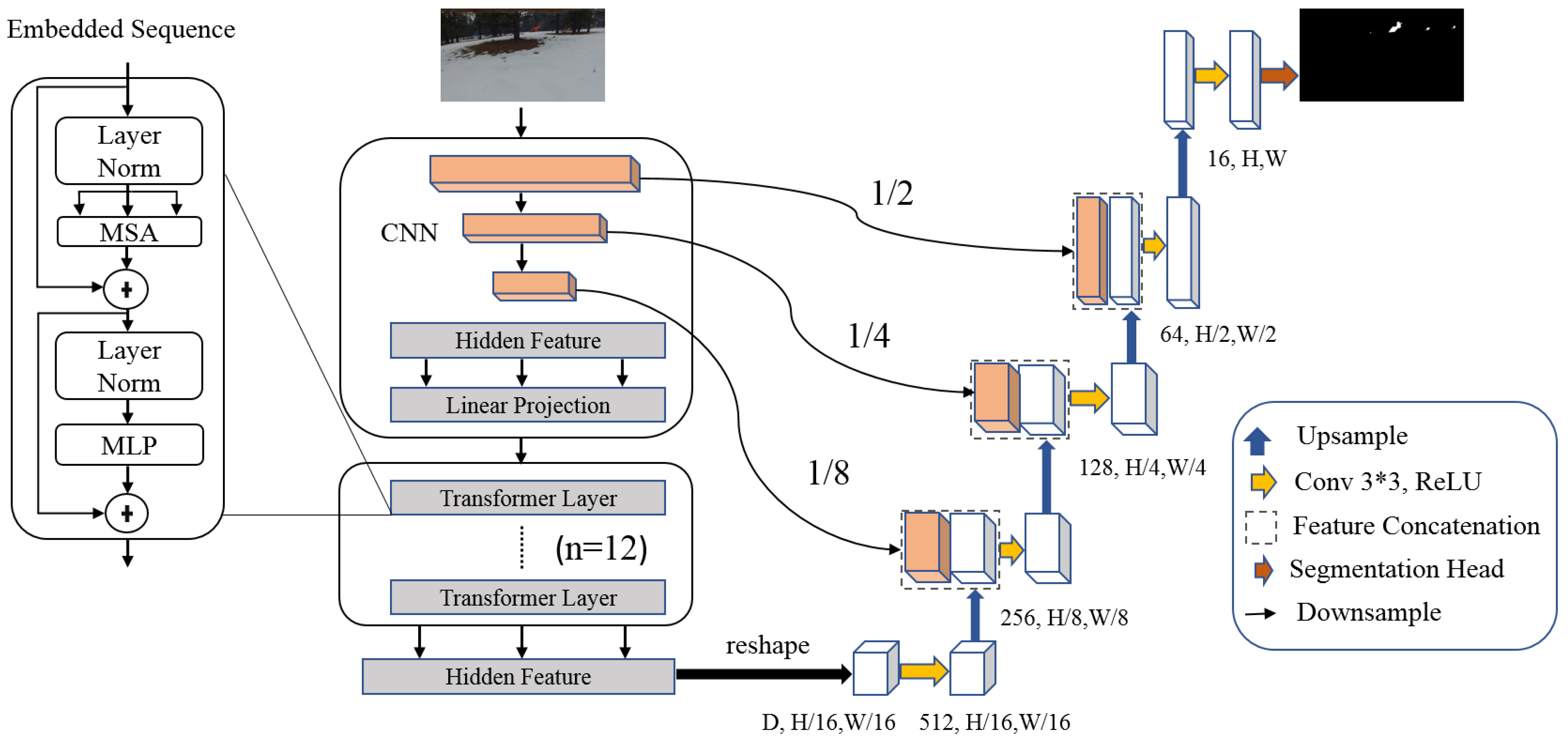
3.2.2. TransFire
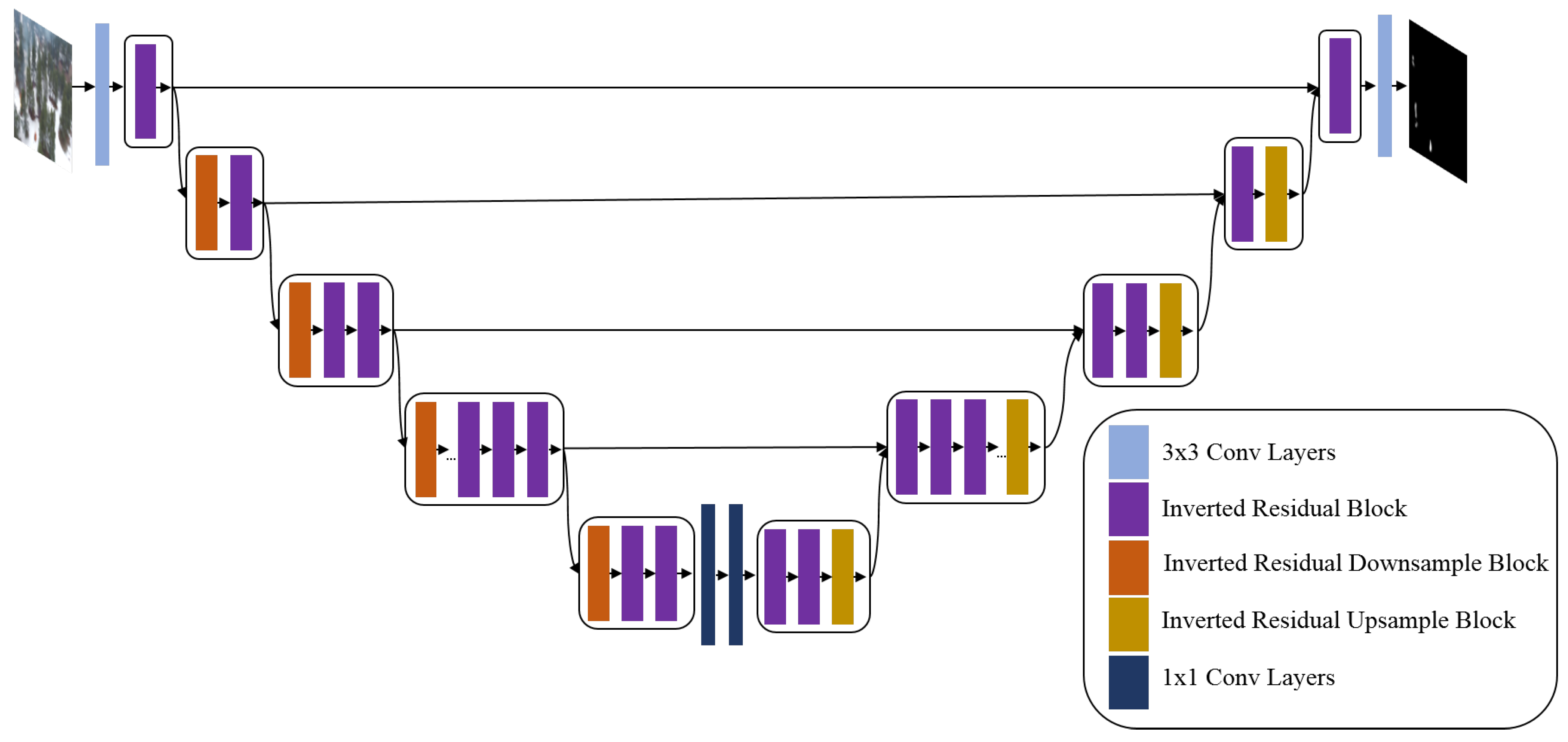
3.2.3. EfficientSeg
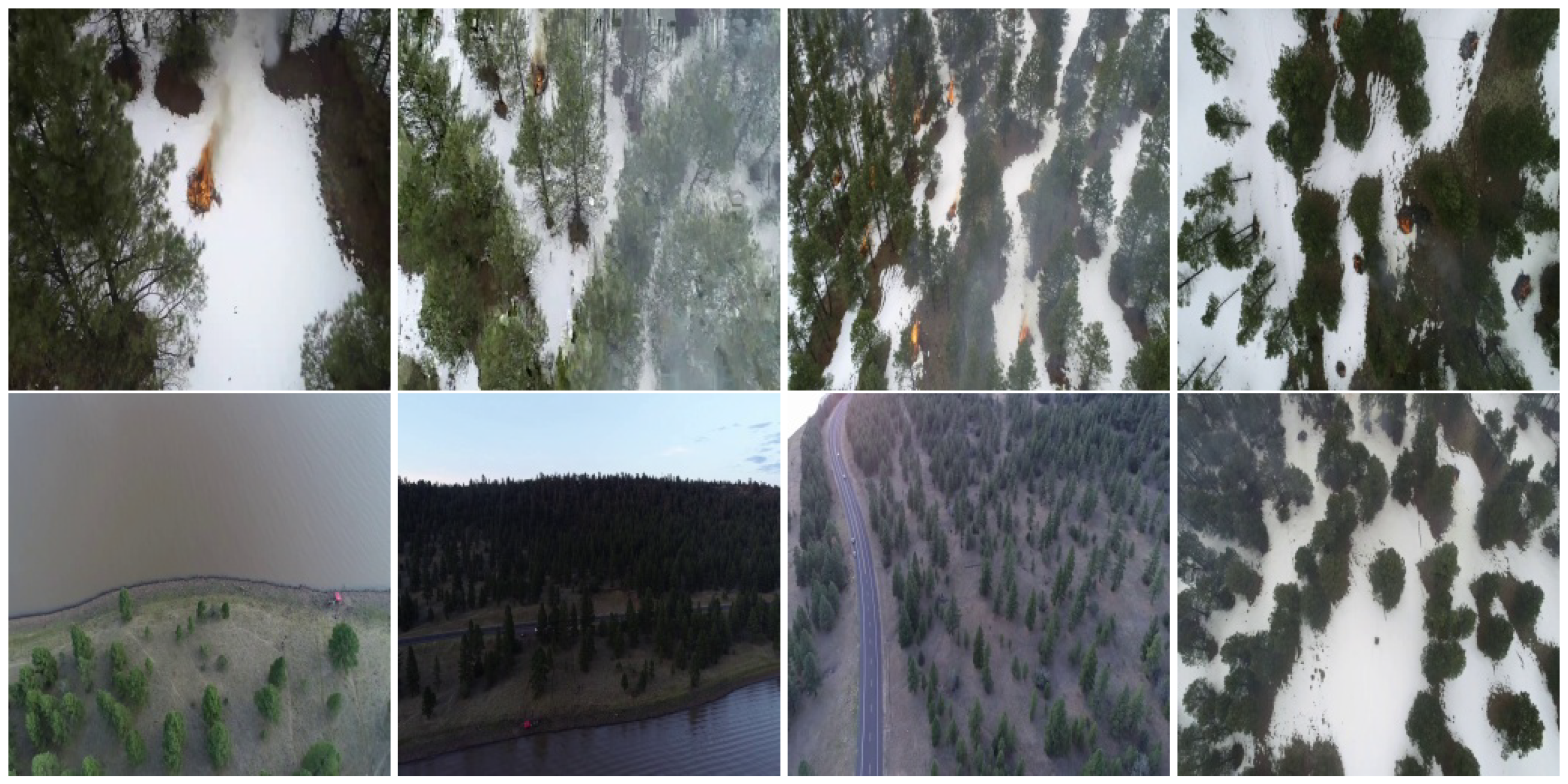
3.3. Dataset
3.4. Evaluation Metrics
- F1-score combines precision and recall metrics to determine the ability of the model in detecting wildfire pixels (as shown by Equation (1)):where is the true positive rate, is the false positive rate, and is the false negative rate.
- Accuracy is the proportion of correct predictions over the number of total ones, achieved per the proposed model (as given by Equation (4)):where is the true negative rate, is the false negative rate, is the true positive rate, and is the false positive rate.
- Inference time is the average time of segmentation or classification using our testing images.
4. Results and Discussion
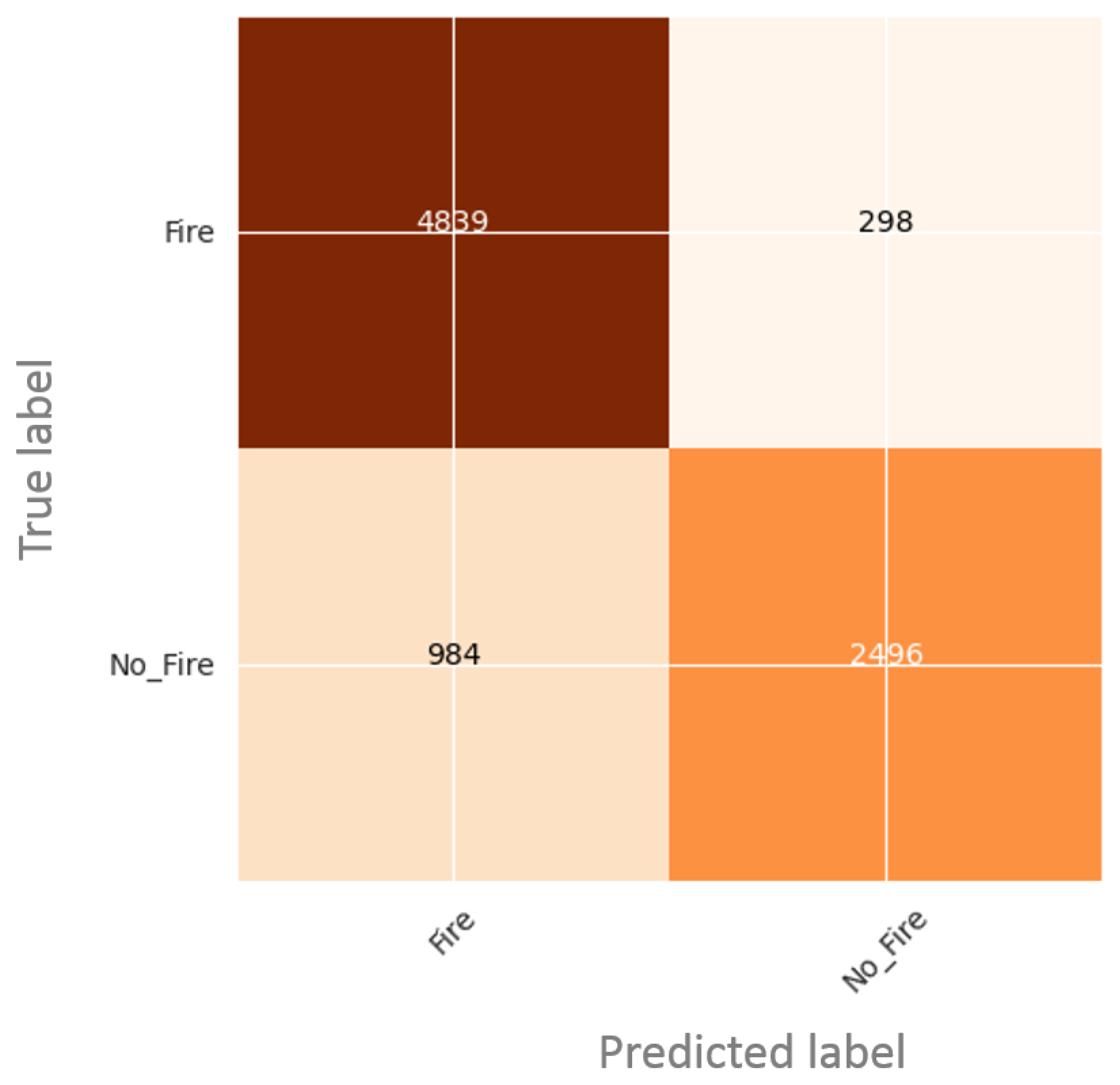
4.1. Wildfire Classification Results
4.2. Wildfire Segmentation Results
5. Conclusions
Author Contributions
Funding
Institutional Review Board Statement
Informed Consent Statement
Data Availability Statement
Acknowledgments
Conflicts of Interest
References
- Aytekin, E. Wildfires Ravaging Forestlands in Many Parts of Globe. 2021. Available online: https://www.aa.com.tr/en/world/wildfires-ravaging-forestlands-in-many-parts-of-globe/2322512 (accessed on 20 November 2021).
- Dimitropoulos, S. Fighting fire with science. Nature 2019, 576, 328–329. [Google Scholar] [CrossRef] [Green Version]
- Westerling, A.L.; Hidalgo, H.G.; Cayan, D.R.; Swetnam, T.W. Warming and Earlier Spring Increase Western U.S. Forest Wildfire Activity. Science 2006, 313, 940–943. [Google Scholar] [CrossRef] [PubMed] [Green Version]
- Canadian Wildland Fire Information System. Canada Wildfire Facts. 2021. Available online: https://www.getprepared.gc.ca/cnt/hzd/wldfrs-en.aspx (accessed on 20 November 2021).
- Gaur, A.; Singh, A.; Kumar, A.; Kulkarni, K.S.; Lala, S.; Kapoor, K.; Srivastava, V.; Kumar, A.; Mukhopadhyay, S.C. Fire Sensing Technologies: A Review. IEEE Sens. J. 2019, 19, 3191–3202. [Google Scholar] [CrossRef]
- Ghali, R.; Jmal, M.; Souidene Mseddi, W.; Attia, R. Recent Advances in Fire Detection and Monitoring Systems: A Review. In Proceedings of the 18th International Conference on Sciences of Electronics, Technologies of Information and Telecommunications (SETIT’18), Genoa, Italy, 18–20 December 2018; Springer International Publishing: Berlin/Heidelberg, Germany, 2018; Volume 1, pp. 332–340. [Google Scholar]
- Gaur, A.; Singh, A.; Kumar, A.; Kumar, A.; Kapoor, K. Video flame and smoke based fire detection algorithms: A literature review. Fire Technol. 2020, 56, 1943–1980. [Google Scholar] [CrossRef]
- Dao, M.; Kwan, C.; Ayhan, B.; Tran, T.D. Burn scar detection using cloudy MODIS images via low-rank and sparsity-based models. In Proceedings of the IEEE Global Conference on Signal and Information Processing GlobalSIP), Washington, DC, USA, 7–9 December 2016; pp. 177–181. [Google Scholar]
- Töreyin, B.U.; Dedeoğlu, Y.; Güdükbay, U.; Çetin, A.E. Computer vision based method for real-time fire and flame detection. Pattern Recognit. Lett. 2006, 27, 49–58. [Google Scholar] [CrossRef] [Green Version]
- Zhang, J.S.; Cao, J.; Mao, B. Application of deep learning and unmanned aerial vehicle technology in traffic flow monitoring. In Proceedings of the International Conference on Machine Learning and Cybernetics (ICMLC), Ningbo, China, 9–12 July 2017; Volume 1, pp. 189–194. [Google Scholar]
- Chen, C.J.; Huang, Y.Y.; Li, Y.S.; Chang, C.Y.; Huang, Y.M. An AIoT Based Smart Agricultural System for Pests Detection. IEEE Access 2020, 8, 180750–180761. [Google Scholar] [CrossRef]
- Geraldes, R.; Gonçalves, A.; Lai, T.; Villerabel, M.; Deng, W.; Salta, A.; Nakayama, K.; Matsuo, Y.; Prendinger, H. UAV-Based Situational Awareness System Using Deep Learning. IEEE Access 2019, 7, 122583–122594. [Google Scholar] [CrossRef]
- Lee, H.; Jung, S.; Kim, J. Distributed and Autonomous Aerial Data Collection in Smart City Surveillance Applications. In Proceedings of the IEEE VTS 17th Asia Pacific Wireless Communications Symposium (APWCS), Osaka, Japan, 30–31 August 2021; pp. 1–3. [Google Scholar]
- Giang, T.L.; Dang, K.B.; Toan Le, Q.; Nguyen, V.G.; Tong, S.S.; Pham, V.M. U-Net Convolutional Networks for Mining Land Cover Classification Based on High-Resolution UAV Imagery. IEEE Access 2020, 8, 186257–186273. [Google Scholar] [CrossRef]
- Aposporis, P. Object Detection Methods for Improving UAV Autonomy and Remote Sensing Applications. In Proceedings of the IEEE/ACM International Conference on Advances in Social Networks Analysis and Mining (ASONAM), The Hague, The Netherlands, 7–10 December 2020; pp. 845–853. [Google Scholar]
- Akhloufi, M.A.; Castro, N.A.; Couturier, A. UAVs for wildland fires. In Autonomous Systems: Sensors, Vehicles, Security, and the Internet of Everything; International Society for Optics and Photonics: Orlando, FL, USA, 3 May 2018; pp. 134–147. [Google Scholar]
- Khennou, F.; Ghaoui, J.; Akhloufi, M.A. Forest fire spread prediction using deep learning. In Geospatial Informatics XI; Palaniappan, K., Seetharaman, G., Harguess, J.D., Eds.; International Society for Optics and Photonics: Bellingham, WA, USA, 2021; pp. 106–117. [Google Scholar]
- Akhloufi, M.A.; Couturier, A.; Castro, N.A. Unmanned Aerial Vehicles for Wildland Fires: Sensing, Perception, Cooperation and Assistance. Drones 2021, 5, 15. [Google Scholar] [CrossRef]
- Ghali, R.; Akhloufi, M.A.; Jmal, M.; Souidene Mseddi, W.; Attia, R. Wildfire Segmentation Using Deep Vision Transformers. Remote Sens. 2021, 13, 3527. [Google Scholar] [CrossRef]
- Yuan, C.; Zhang, Y.; Liu, Z. A survey on technologies for automatic forest fire monitoring, detection, and fighting using unmanned aerial vehicles and remote sensing techniques. Can. J. For. Res. 2015, 45, 783–792. [Google Scholar] [CrossRef]
- Mseddi, W.S.; Ghali, R.; Jmal, M.; Attia, R. Fire Detection and Segmentation using YOLOv5 and U-NET. In Proceedings of the 29th European Signal Processing Conference (EUSIPCO), Dublin, Ireland, 23–27 August 2021; pp. 741–745. [Google Scholar]
- Ghali, R.; Akhloufi, M.A.; Jmal, M.; Mseddi, W.S.; Attia, R. Forest Fires Segmentation using Deep Convolutional Neural Networks. In Proceedings of the IEEE International Conference on Systems, Man, and Cybernetics (SMC), Melbourne, Australia, 17–20 October 2021; pp. 2109–2114. [Google Scholar]
- Tan, M.; Le, Q. EfficientNet: Rethinking Model Scaling for Convolutional Neural Networks. In Proceedings of the 36th International Conference on Machine Learning, Long Beach, CA, USA, 9–15 June 2019; pp. 6105–6114. [Google Scholar]
- Huang, G.; Liu, Z.; van der Maaten, L.; Weinberger, K.Q. Densely Connected Convolutional Networks. In Proceedings of the IEEE Conference on Computer Vision and Pattern Recognition (CVPR), Honolulu, HI, USA, 21–26 July 2017; pp. 4700–4708. [Google Scholar]
- Yesilkaynak, V.B.; Sahin, Y.H.; Unal, G.B. EfficientSeg: An Efficient Semantic Segmentation Network. arXiv 2020, arXiv:2009.06469. [Google Scholar]
- Chen, J.; Lu, Y.; Yu, Q.; Luo, X.; Adeli, E.; Wang, Y.; Lu, L.; Yuille, A.L.; Zhou, Y. TransUNet: Transformers Make Strong Encoders for Medical Image Segmentation. arXiv 2021, arXiv:2102.04306. [Google Scholar]
- Howard, A.; Sandler, M.; Chu, G.; Chen, L.C.; Chen, B.; Tan, M.; Wang, W.; Zhu, Y.; Pang, R.; Vasudevan, V.; et al. Searching for MobileNetV3. In Proceedings of the IEEE/CVF International Conference on Computer Vision (ICCV), Seoul, Korea, 27 October– 2 November 2019; pp. 1314–1324. [Google Scholar]
- Shamsoshoara, A.; Afghah, F.; Razi, A.; Zheng, L.; Fulé, P.Z.; Blasch, E. Aerial imagery pile burn detection using deep learning: The FLAME dataset. Comput. Netw. 2021, 193, 108001. [Google Scholar] [CrossRef]
- Treneska, S.; Stojkoska, B.R. Wildfire detection from UAV collected images using transfer learning. In Proceedings of the 18th International Conference on Informatics and Information Technologies, Skopje, North Macedonia, 6–7 May 2021. [Google Scholar]
- Glorot, X.; Bordes, A.; Bengio, Y. Deep Sparse Rectifier Neural Networks. In Proceedings of the Fourteenth International Conference on Artificial Intelligence and Statistics, Fort Lauderdale, FL, USA, 11–13 April 2011; Volume 15, pp. 315–323. [Google Scholar]
- Maas, A.L.; Hannun, A.Y.; Ng, A.Y. Rectifier nonlinearities improve neural network acoustic models. In Proceedings of the ICML, Atlanta, GA, USA, 16–21 June 2013; p. 3. [Google Scholar]
- Jin, X.; Xu, C.; Feng, J.; Wei, Y.; Xiong, J.; Yan, S. Deep Learning with S-shaped Rectified Linear Activation Units. arXiv 2015, arXiv:1512.07030. [Google Scholar]
- Zhao, B.; Feng, J.; Wu, X.; Yan, S. A survey on deep learning-based fine-grained object classification and semantic segmentation. Int. J. Autom. Comput. 2017, 14, 119–135. [Google Scholar] [CrossRef]
- Chen, Y.; Zhang, Y.; Xin, J.; Wang, G.; Mu, L.; Yi, Y.; Liu, H.; Liu, D. UAV Image-based Forest Fire Detection Approach Using Convolutional Neural Network. In Proceedings of the 14th IEEE Conference on Industrial Electronics and Applications (ICIEA), Xi’an, China, 19–21 June 2019; pp. 2118–2123. [Google Scholar]
- Lee, W.; Kim, S.; Lee, Y.T.; Lee, H.W.; Choi, M. Deep neural networks for wild fire detection with unmanned aerial vehicle. In Proceedings of the IEEE International Conference on Consumer Electronics (ICCE), Taipei, Taiwan, 12–14 June 2017; pp. 252–253. [Google Scholar]
- Zhao, Y.; Ma, J.; Li, X.; Zhang, J. Saliency Detection and Deep Learning-Based Wildfire Identification in UAV Imagery. Sensors 2018, 18, 712. [Google Scholar] [CrossRef] [Green Version]
- Srinivas, K.; Dua, M. Fog Computing and Deep CNN Based Efficient Approach to Early Forest Fire Detection with Unmanned Aerial Vehicles. In Proceedings of the International Conference on Inventive Computation Technologies, Coimbatore, India, 26–28 February 2020; pp. 646–652. [Google Scholar]
- Wu, H.; Li, H.; Shamsoshoara, A.; Razi, A.; Afghah, F. Transfer Learning for Wildfire Identification in UAV Imagery. In Proceedings of the 54th Annual Conference on Information Sciences and Systems (CISS), Princeton, NJ, USA, 18–20 March 2020; pp. 1–6. [Google Scholar]
- Chen, Y.; Zhang, Y.; Xin, J.; Yi, Y.; Liu, D.; Liu, H. A UAV-based Forest Fire Detection Algorithm Using Convolutional Neural Network. In Proceedings of the 37th Chinese Control Conference (CCC), Wuhan, China, 25–27 July 2018; pp. 10305–10310. [Google Scholar]
- Krizhevsky, A.; Sutskever, I.; Hinton, G.E. ImageNet classification with deep convolutional neural networks. Adv. Neural Inf. Process. Syst. (NIPS) 2012, 25, 1097–1105. [Google Scholar] [CrossRef]
- Szegedy, C.; Liu, W.; Jia, Y.; Sermanet, P.; Reed, S.; Anguelov, D.; Erhan, D.; Vanhoucke, V.; Rabinovich, A. Going Deeper with Convolutions. In Proceedings of the IEEE Conference on Computer Vision and Pattern Recognition (CVPR), Boston, MA, USA, 7–12 June 2015; pp. 1–9. [Google Scholar]
- Simonyan, K.; Zisserman, A. Very deep convolutional networks for large-scale image recognition. arXiv 2014, arXiv:1409.1556. [Google Scholar]
- Chollet, F. Xception: Deep Learning With Depthwise Separable Convolutions. In Proceedings of the IEEE Conference on Computer Vision and Pattern Recognition (CVPR), Honolulu, HI, USA, 21–26 July 2017; pp. 1251–1258. [Google Scholar]
- Szegedy, C.; Vanhoucke, V.; Ioffe, S.; Shlens, J.; Wojna, Z. Rethinking the Inception Architecture for Computer Vision. In Proceedings of the IEEE Conference on Computer Vision and Pattern Recognition (CVPR), Las Vegas, NV, USA, 27–30 June 2016; pp. 2818–2826. [Google Scholar]
- Shamsoshoara, A.; Afghah, F.; Razi, A.; Zheng, L.; Fulé, P.; Blasch, E. The FLAME Dataset: Aerial Imagery Pile Burn Detection Using Drones (UAVs); IEEE DataPort: New York, NY, USA, 2020. [Google Scholar] [CrossRef]
- He, K.; Zhang, X.; Ren, S.; Sun, J. Deep Residual Learning for Image Recognition. In Proceedings of the IEEE Conference on Computer Vision and Pattern Recognition (CVPR), Las Vegas, NV, USA, 27–30 June 2016; pp. 770–778. [Google Scholar]
- Sandler, M.; Howard, A.; Zhu, M.; Zhmoginov, A.; Chen, L.C. MobileNetV2: Inverted Residuals and Linear Bottlenecks. In Proceedings of the IEEE/CVF Conference on Computer Vision and Pattern Recognition, Salt Lake City, UT, USA, 18–23 June 2018; pp. 4510–4520. [Google Scholar]
- Howard, A.G.; Zhu, M.; Chen, B.; Kalenichenko, D.; Wang, W.; Weyand, T.; Andreetto, M.; Adam, H. MobileNets: Efficient Convolutional Neural Networks for Mobile Vision Applications. arXiv 2017, arXiv:1704.04861. [Google Scholar]
- Liu, L.; Ouyang, W.; Wang, X.; Fieguth, P.; Chen, J.; Liu, X.; Pietikäinen, M. Deep learning for generic object detection: A survey. Int. J. Comput. Vis. 2020, 128, 261–318. [Google Scholar] [CrossRef] [Green Version]
- Jiao, Z.; Zhang, Y.; Xin, J.; Mu, L.; Yi, Y.; Liu, H.; Liu, D. A Deep Learning Based Forest Fire Detection Approach Using UAV and YOLOv3. In Proceedings of the 1st International Conference on Industrial Artificial Intelligence (IAI), Shenyang, China, 23–27 July 2019; pp. 1–5. [Google Scholar]
- Redmon, J.; Farhadi, A. YOLOv3: An Incremental Improvement. arXiv 2018, arXiv:1804.02767. [Google Scholar]
- Jiao, Z.; Zhang, Y.; Mu, L.; Xin, J.; Jiao, S.; Liu, H.; Liu, D. A YOLOv3-based Learning Strategy for Real-time UAV-based Forest Fire Detection. In Proceedings of the Chinese Control And Decision Conference (CCDC), Hefei, China, 22–24 August 2020; pp. 4963–4967. [Google Scholar]
- Alexandrov, D.; Pertseva, E.; Berman, I.; Pantiukhin, I.; Kapitonov, A. Analysis of Machine Learning Methods for Wildfire Security Monitoring with an Unmanned Aerial Vehicles. In Proceedings of the 24th Conference of Open Innovations Association (FRUCT), Moscow, Russia, 8–12 April 2019; pp. 3–9. [Google Scholar]
- Liu, W.; Anguelov, D.; Erhan, D.; Szegedy, C.; Reed, S.; Fu, C.Y.; Berg, A.C. Ssd: Single shot multibox detector. In Proceedings of the European Conference on Computer Vision (ECCV), Amsterdam, The Netherlands, 8–16 October2016; pp. 21–37. [Google Scholar]
- Redmon, J.; Farhadi, A. YOLO9000: Better, Faster, Stronger. In Proceedings of the IEEE Conference on Computer Vision and Pattern Recognition (CVPR), Honolulu, HI, USA, 21–26 July 2017; pp. 7263–7271. [Google Scholar]
- Ren, S.; He, K.; Girshick, R.B.; Sun, J. Faster R-CNN: Towards Real-Time Object Detection with Region Proposal Networks. arXiv 2015, arXiv:1506.01497. [Google Scholar] [CrossRef] [Green Version]
- Tang, Z.; Liu, X.; Chen, H.; Hupy, J.; Yang, B. Deep Learning Based Wildfire Event Object Detection from 4K Aerial Images Acquired by UAS. AI 2020, 1, 10. [Google Scholar] [CrossRef]
- Barmpoutis, P.; Stathaki, T.; Dimitropoulos, K.; Grammalidis, N. Early Fire Detection Based on Aerial 360-Degree Sensors, Deep Convolution Neural Networks and Exploitation of Fire Dynamic Textures. Remote Sens. 2020, 12, 3177. [Google Scholar] [CrossRef]
- Chen, L.C.; Zhu, Y.; Papandreou, G.; Schroff, F.; Adam, H. Encoder-Decoder with Atrous Separable Convolution for Semantic Image Segmentation. In Proceedings of the European Conference on Computer Vision (ECCV), Munich, Germany, 8–14 September 2018; pp. 801–818. [Google Scholar]
- Ronneberger, O.; Fischer, P.; Brox, T. U-net: Convolutional networks for biomedical image segmentation. In Proceedings of the International Conference on Medical Image Computing and Computer-Assisted Intervention, Munich, Germany, 5–9 October 2015; Springer International Publishing: Cham, Switzerland, 2015; pp. 234–241. [Google Scholar]
- Frizzi, S.; Bouchouicha, M.; Ginoux, J.M.; Moreau, E.; Sayadi, M. Convolutional neural network for smoke and fire semantic segmentation. IET Image Process. 2021, 15, 634–647. [Google Scholar] [CrossRef]
- Real, E.; Aggarwal, A.; Huang, Y.; Le, Q.V. Regularized Evolution for Image Classifier Architecture Search. In Proceedings of the AAAI Conference on Artificial Intelligence, Honolulu, HI, USA, 27 January–1 February 2019; Volume 33, pp. 4780–4789. [Google Scholar] [CrossRef] [Green Version]
- Liu, C.; Zoph, B.; Neumann, M.; Shlens, J.; Hua, W.; Li, L.J.; Fei-Fei, L.; Yuille, A.; Huang, J.; Murphy, K. Progressive Neural Architecture Search. In Proceedings of the European Conference on Computer Vision (ECCV), Munich, Germany, 8–14 September 2018; pp. 19–34. [Google Scholar]
- Xie, S.; Girshick, R.; Dollar, P.; Tu, Z.; He, K. Aggregated Residual Transformations for Deep Neural Networks. In Proceedings of the IEEE Conference on Computer Vision and Pattern Recognition (CVPR), Honolulu, HI, USA, 21–26 July 2017; pp. 1492–1500. [Google Scholar]
- Szegedy, C.; Ioffe, S.; Vanhoucke, V. Inception-v4, Inception-ResNet and the Impact of Residual Connections on Learning. In Proceedings of the Thirty-First AAAI Conference on Artificial Intelligence, San Francisco, CA, USA, 4–9 February 2017; pp. 4278–4284. [Google Scholar]
- Valanarasu, J.M.J.; Oza, P.; Hacihaliloglu, I.; Patel, V.M. Medical Transformer: Gated Axial-Attention for Medical Image Segmentation. arXiv 2021, arXiv:2102.10662. [Google Scholar]
- Dillon, J.V.; Langmore, I.; Tran, D.; Brevdo, E.; Vasudevan, S.; Moore, D.; Patton, B.; Alemi, A.; Hoffman, M.D.; Saurous, R.A. TensorFlow Distributions. arXiv 2017, arXiv:1711.10604. [Google Scholar]
- Ma, Y.; Liu, Q.; Qian, Z. Automated image segmentation using improved PCNN model based on cross-entropy. In Proceedings of the International Symposium on Intelligent Multimedia, Video and Speech Processing, Hong Kong, China, 20–22 October 2004; pp. 743–746. [Google Scholar]
- Paszke, A.; Gross, S.; Massa, F.; Lerer, A.; Bradbury, J.; Chanan, G.; Killeen, T.; Lin, Z.; Gimelshein, N.; Antiga, L.; et al. PyTorch: An Imperative Style, High-Performance Deep Learning Library. Adv. Neural Inf. Process. Syst. 2019, 32, 8026–8037. [Google Scholar]
- Sudre, C.H.; Li, W.; Vercauteren, T.; Ourselin, S.; Jorge Cardoso, M. Generalised Dice Overlap as a Deep Learning Loss Function for Highly Unbalanced Segmentations. In Deep Learning in Medical Image Analysis and Multimodal Learning for Clinical Decision Support; Springer: Cham, Switzerland, 2017; pp. 240–248. [Google Scholar]
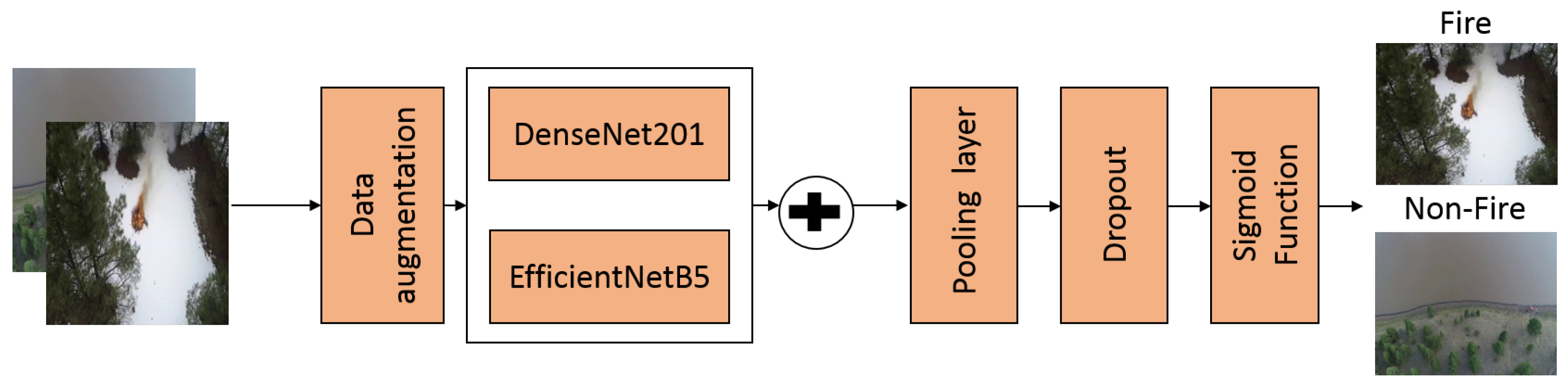

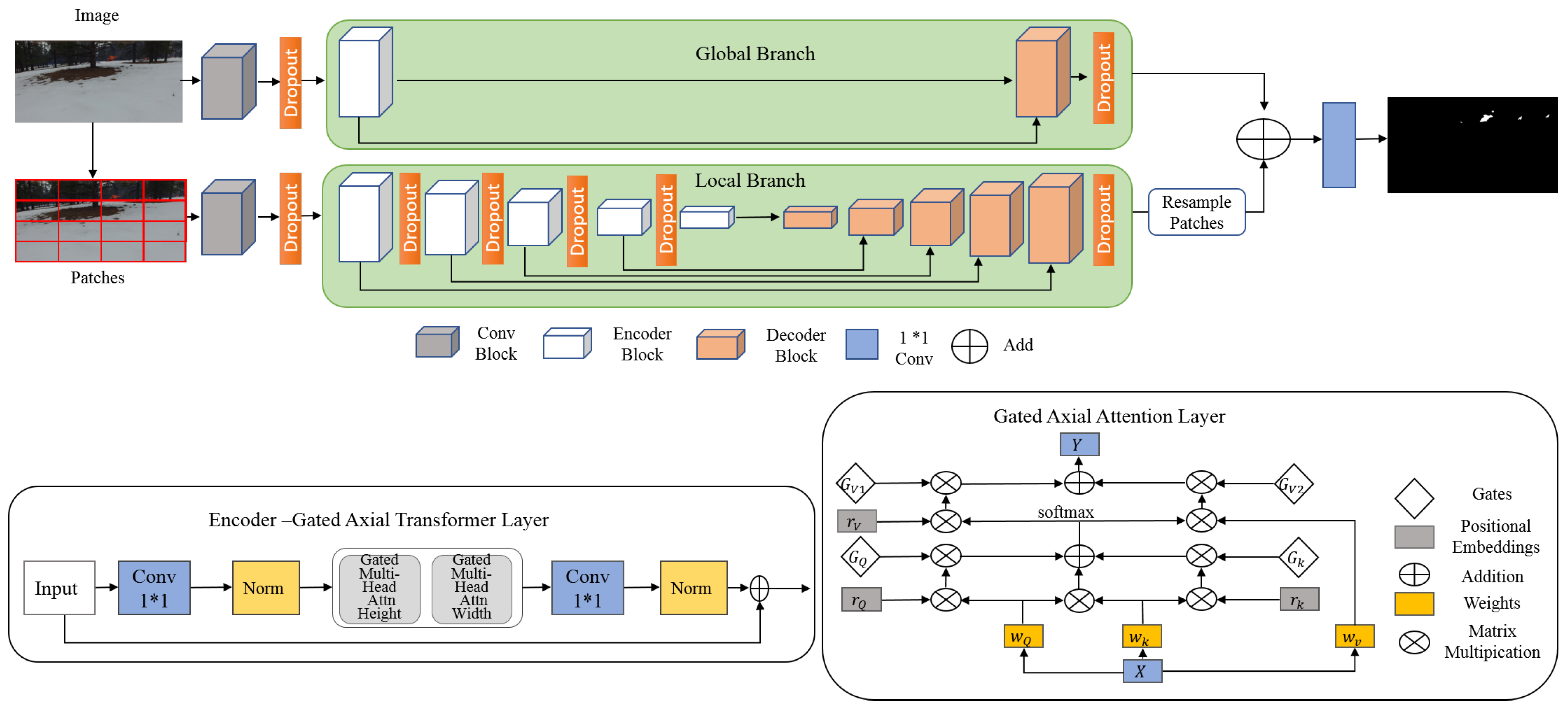





| Ref. | Methodology | Smoke/Flame | Dataset | Accuracy (%) |
|---|---|---|---|---|
| [34] | CNN-17 | Flame/Smoke | Private dataset: 2100 images | 86.00 |
| [35] | AlexNet GoogLeNet Modified GoogLeNet VGG13 Modified VGG13 | Flame | Private dataset: 23,053 images | 94.80 99.00 96.90 86.20 96.20 |
| [28] | Xception | Flame | FLAME dataset: 48,010 images | 76.23 |
| [36] | Fire_Net AlexNet | Flame | UAV_Fire dataset: 1540 images | 98.00 97.10 |
| [29] | VGG16 VGG19 ResNet50 InceptionV3 Xception | Flame | FLAME dataset: 8617 images | 80.76 83.43 88.01 87.21 81.30 |
| [37] | Fog computing and simple CNN | Flame | Private dataset: 2964 images | 95.07 |
| [38] | Fire_Net AlexNet MobileNetv2 | Flame/Smoke | Private dataset: 2096 images | 97.50 95.00 99.30 |
| Ref. | Methodology | Smoke/Flame | Dataset | Results (%) |
|---|---|---|---|---|
| [50] | YOLOv3 | Flame | Private dataset: 3,840,000 images | F1-score = 81.0 |
| [53] | YOLOv2 Faster R-CNN SSD | Smoke | Private dataset: 12,000 images | Accuracy = 98.3 Accuracy = 95.9 Accuracy = 81.1 |
| [52] | YOLOv3 | Flame/Smoke | Private dataset: 3,684,000 images | F1-score = 81.0 |
| [57] | YOLOv3 and ARSB method | Flame | Private dataset: 1400 K images | mAP = 67.0 |
| Ref. | Methodology | Smoke/Flame | Dataset | Results (%) |
|---|---|---|---|---|
| [58] | DeepLabV3+ DeepLabV3+ + validation approach | Flame/Smoke | Fire detection 360-degree dataset: 150 360-degree images | F1-score = 81.4 F1-score = 94.6 |
| [60] | U-Net | Flame | FLAME dataset: 5137 images | F1-score = 87.7 |
| [61] | U-Net CNN based on VGG16 | Flame/Smoke | Private dataset: 366 images | Accuracy = 90.2 Accuracy = 93.4 |
| Dataset | Fire Images | Non-Fire Images |
|---|---|---|
| Training set | 20,015 | 11,500 |
| Validation set | 5003 | 2875 |
| Testing set | 5137 | 3480 |
| Models | Accuracy (%) | F1-Score (%) | Inference Time (s) |
|---|---|---|---|
| Xception | 78.41 | 78.12 | 0.002 |
| Xception [28] | 76.23 | — | — |
| EfficientNet-B5 | 75.82 | 73.90 | 0.010 |
| EfficientNet-B4 | 69.93 | 65.51 | 0.008 |
| EfficientNet-B3 | 65.81 | 64.02 | 0.004 |
| EfficientNet-B2 | 66.04 | 60.71 | 0.002 |
| InceptionV3 | 80.88 | 79.53 | 0.002 |
| DenseNet169 | 80.62 | 79.40 | 0.003 |
| MobileNetV3-Small | 51.64 | 44.97 | 0.001 |
| MobileNetV3-Large | 65.10 | 60.91 | 0.001 |
| Proposed ensemble model | 85.12 | 84.77 | 0.018 |
| Models | Accuracy (%) | F1-Score (%) | Inference Time (s) |
|---|---|---|---|
| TransUNet-R50-ViT | 99.90 | 99.90 | 0.51 |
| TransUNet-ViT | 99.86 | 99.86 | 0.40 |
| TransFire | 99.83 | 99.82 | 1.00 |
| EfficientSeg | 99.63 | 99.66 | 1.38 |
| U-Net | 99.00 | 99.00 | 0.29 |
Publisher’s Note: MDPI stays neutral with regard to jurisdictional claims in published maps and institutional affiliations. |
© 2022 by the authors. Licensee MDPI, Basel, Switzerland. This article is an open access article distributed under the terms and conditions of the Creative Commons Attribution (CC BY) license (https://creativecommons.org/licenses/by/4.0/).
Share and Cite
Ghali, R.; Akhloufi, M.A.; Mseddi, W.S. Deep Learning and Transformer Approaches for UAV-Based Wildfire Detection and Segmentation. Sensors 2022, 22, 1977. https://doi.org/10.3390/s22051977
Ghali R, Akhloufi MA, Mseddi WS. Deep Learning and Transformer Approaches for UAV-Based Wildfire Detection and Segmentation. Sensors. 2022; 22(5):1977. https://doi.org/10.3390/s22051977
Chicago/Turabian StyleGhali, Rafik, Moulay A. Akhloufi, and Wided Souidene Mseddi. 2022. "Deep Learning and Transformer Approaches for UAV-Based Wildfire Detection and Segmentation" Sensors 22, no. 5: 1977. https://doi.org/10.3390/s22051977
APA StyleGhali, R., Akhloufi, M. A., & Mseddi, W. S. (2022). Deep Learning and Transformer Approaches for UAV-Based Wildfire Detection and Segmentation. Sensors, 22(5), 1977. https://doi.org/10.3390/s22051977