

A Review on Vehicle Classification and Potential Use of Smart Vehicle-Assisted Techniques

 ,
,  ,
,  and
and 
Abstract
1. Introduction
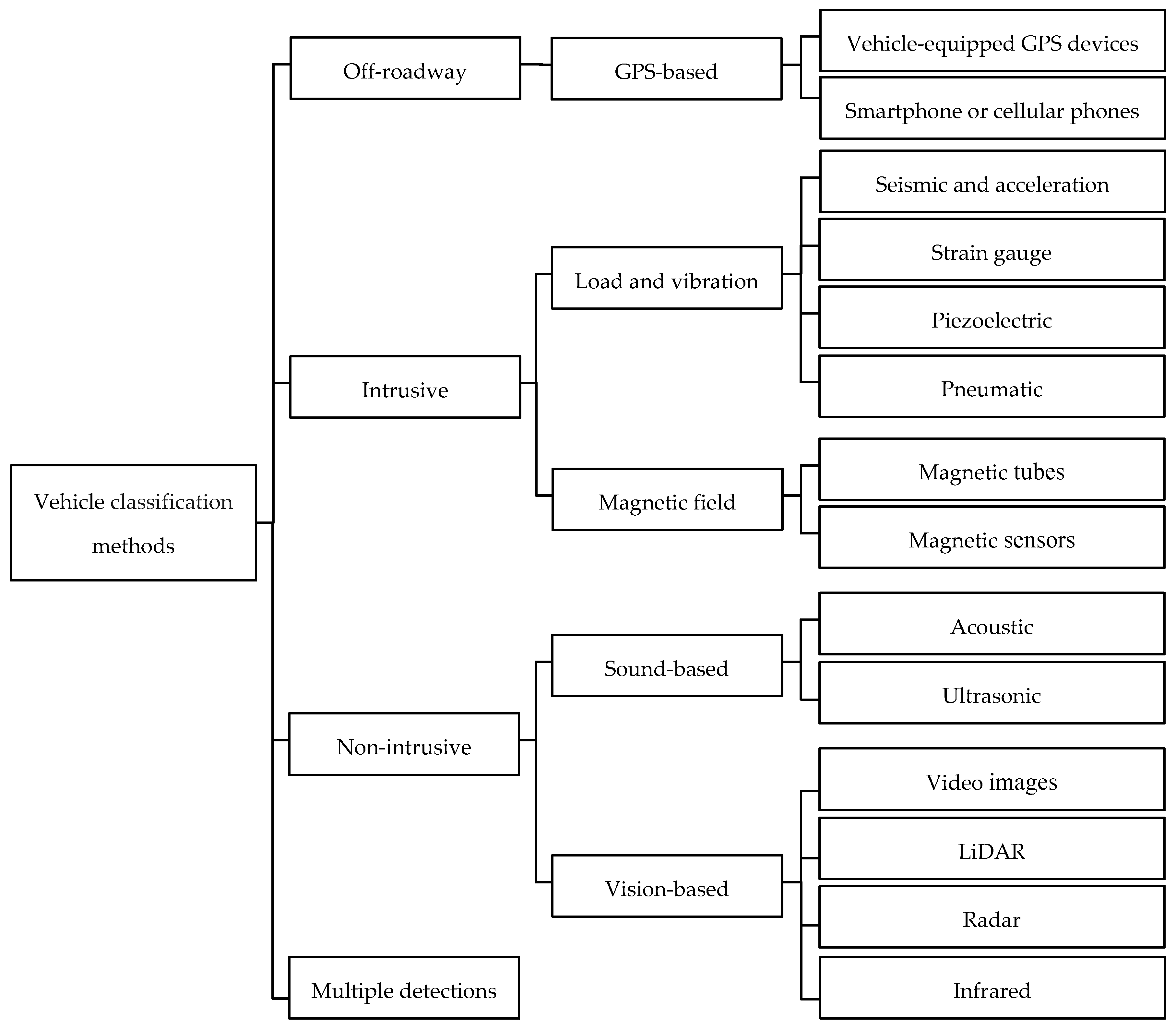
2. Conventional Vehicle Classification Methods
2.1. Vision-Based Methods
2.2. Remote Sensing Methods
2.3. Magnetic Sensors
2.4. Pneumatic Tubes and other Sensors
3. Potential Smart Vehicle-Assisted Technologies
3.1. VANET-Based Methods
3.1.1. Mobility Parameters of Vehicles
3.1.2. Physical Characteristic Parameters
3.2. Internet of Vehicles (IoV)-Based Methods
4. Future Works
5. Conclusions
Author Contributions
Funding
Acknowledgments
Conflicts of Interest
References
- Sliwa, B.; Piatkowski, N.; Wietfeld, C. The Channel as a Traffic Sensor: Vehicle Detection and Classification based on Radio Fingerprinting. IEEE Internet Things J. 2020. [Google Scholar] [CrossRef]
- Won, M. Intelligent traffic monitoring systems for vehicle classification: A survey. IEEE Access 2020, 8, 73340–73358. [Google Scholar] [CrossRef]
- Jo, S.Y.; Ahn, N.; Lee, Y.; Kang, S.-J. Transfer Learning-based Vehicle Classification. In Proceedings of the 2018 International SoC Design Conference (ISOCC), Daegu, Korea, 12–15 November 2018; IEEE: Piscataway, NJ, USA, 2018; pp. 127–128. [Google Scholar]
- Ke, R.; Zhuang, Y.; Pu, Z.; Wang, Y. A Smart, Efficient, and Reliable Parking Surveillance System with Edge Artificial Intelligence on IoT Devices. arXiv 2020, arXiv:200100269. [Google Scholar]
- Tamam, M.T.; Dwiono, W.; Safian, R.J.P. Design a Prototype of The Application System of Classification and Calculating Motor Vehicles on Highway. MSE 2020, 771, 12002. [Google Scholar]
- Shokravi, H.; Bakhary, N.H. Comparative analysis of different weight matrices in subspace system identification for structural health monitoring. IOP Conf. Ser. Mater. Sci. Eng. 2017, 271, 12092. [Google Scholar] [CrossRef]
- Shokravi, H.; Shokravi, H.; Bakhary, N.; Koloor, S.S.R.; Petrů, M. Health Monitoring of Civil Infrastructures by Subspace System Identification Method: An Overview. Appl. Sci. 2020, 10, 2786. [Google Scholar] [CrossRef]
- Shokravi, H.; Shokravi, H.; Bakhary, N.; Koloor, S.S.R.; Petru, M. A Comparative Study of the Data-driven Stochastic Subspace Methods for Health Monitoring of Structures: A Bridge Case Study. Appl. Sci. 2020, 10, 3132. [Google Scholar] [CrossRef]
- Shokravi, H.; Shokravi, H.; Bakhary, N.; Heidarrezaei, M.; Koloor, S.S.R.; Petru, M. Vehicle-assisted techniques for health monitoring of bridges. Sensors (Basel) 2020, 20. (Under review). [Google Scholar]
- Shokravi, H.; Shokravi, H.; Bakhary, N.; Koloor, S.S.R.; Petru, M. Application of the Subspace-based Methods in Health Monitoring of the Civil Structures: A Systematic Review and Meta-analysis. Appl. Sci. 2020, 10, 3607. [Google Scholar] [CrossRef]
- Sotheany, N.; Nuthong, C. Vehicle classification using neural network. In Proceedings of the 2017 14th International Conference Electrical Engineering/Electronics, Computer, Telecommunications and Information Technology (ECTI-CON), Phuket, Thailand, 27–30 June 2017; IEEE: Piscataway, NJ, USA, 2017; pp. 443–446. [Google Scholar]
- Siddiqui, N.; Husain, M.S. CTS: A credit based threshold system to minimize the dissemination of faulty data in vehicular adhoc networks. Int. J. Control. Theory Appl. 2016, 9, 8499–8508. [Google Scholar]
- Kim, C.-W.; Chang, K.-C.; McGetrick, P.J.; Inoue, S.; Hasegawa, S. Utilizing moving vehicles as sensors for bridge condition screening-A laboratory verification. Sens. Mater. 2017, 29, 153–163. [Google Scholar] [CrossRef][Green Version]
- Velazquez-Pupo, R.; Sierra-Romero, A.; Torres-Roman, D.; Shkvarko, Y.V.; Santiago-Paz, J.; Gómez-Gutiérrez, D.; Robles-Valdez, D.; Hermosillo-Reynoso, F.; Romero-Delgado, M. Vehicle detection with occlusion handling, tracking, and OC-SVM classification: A high performance vision-based system. Sensors (Switzerland) 2018, 18, 374. [Google Scholar] [CrossRef] [PubMed]
- Ji, Q.; Jin, B.; Cui, Y.; Zhang, F. Using Mobile Signaling Data to Classify Vehicles on Highways in Real Time; State Key Laboratory of Computer Sciences, Institute of Software, Chinese Academy of Sciences: Beijing, China; University of Chinese Academy of Sciences: Beijing, China; Institute of Electrical and Electronics Engineers Inc.: Piscataway, NJ, USA, 2017; pp. 174–179. [Google Scholar] [CrossRef]
- Simoncini, M.; Taccari, L.; Sambo, F.; Bravi, L.; Salti, S.; Lori, A. Vehicle classification from low-frequency GPS data with recurrent neural networks. Transp. Res. Part C Emerg. Technol. 2018, 91, 176–191. [Google Scholar] [CrossRef]
- Yan, L.; Fraser, M.; Elgamal, A.; Fountain, T.; Oliver, K. Neural networks and principal components analysis for strain-based vehicle classification. J. Comput. Civ. Eng. 2008, 22, 123–132. [Google Scholar] [CrossRef]
- De, S.; Matos, F.M.; De Souza, R.M.C.R. Vehicle image classification based on edge: Features and Distances Comparison. In Proceedings of the International Conference on Neural Information Processing, Doha, Qatar, 12–15 November 2012; Volume 7666, pp. 691–698. [Google Scholar] [CrossRef]
- Rajab, S.; Al Kalaa, M.O.; Refai, H. Classification and speed estimation of vehicles via tire detection using single-element piezoelectric sensor. J. Adv. Transp. 2016, 50, 1366–1385. [Google Scholar] [CrossRef]
- Lamas-Seco, J.J.; Castro, P.M.; Dapena, A.; Vazquez-Araujo, F.J.; Garcia-Zapirain, B. Influence of vehicle characteristics on an inductive sensor model for traffic applications. Int. J. Simul. Syst. Sci. Technol. 2016, 17, 4.1–4.6. [Google Scholar] [CrossRef]
- Kwon, J.; Petty, K. Vehicle Re-Identification Using Weigh-in-Motion Data for Truck Travel Time Measurement and Sensor Calibration; Intelligent Transport Systems (ITS); Berkeley Transportation Systems, Inc.: Berkeley, CA, USA, 2010. [Google Scholar]
- Haider, S.W.; Buch, N.; Chatti, K.; Brown, J. Development of traffic inputs for Mechanistic-Empirical Pavement Design Guide in Michigan. Transp. Res. Rec. 2011, 179–190. [Google Scholar] [CrossRef]
- Sun, Z.; Ban, X. Vehicle classification using GPS data. Transp. Res. Part C Emerg. Technol. 2013, 37, 102–117. [Google Scholar] [CrossRef]
- Manzoor, M.A.; Morgan, Y. Vehicle Make and Model Recognition Using Random Forest Classification for Intelligent Transportation Systems; Institute of Electrical and Electronics Engineers Inc.: Piscataway, NJ, USA, 2018; Volume 2018, pp. 148–154. [Google Scholar] [CrossRef]
- Ghassemi, S.; Fiandrotti, A.; Caimotti, E.; Francini, G.; Magli, E. Vehicle joint make and model recognition with multiscale attention windows. Signal Process. Image Commun. 2019, 72, 69–79. [Google Scholar] [CrossRef]
- Boukerche, A.; Siddiqui, A.J.; Mammeri, A. Automated vehicle detection and classification: Models, methods, and techniques. ACM Comput. Surv. 2017, 50. [Google Scholar] [CrossRef]
- Mushiri, T.; Mbohwa, C.; Sarupinda, S. Intelligent control of vehicles’ number plates on toll gates in developing nations. In Computer Vision: Concepts, Methodologies, Tools, and Applications; IGI Global: Hershey, PA, USA, 2018; pp. 1023–1071. [Google Scholar] [CrossRef]
- Biglari, M.; Soleimani, A.; Hassanpour, H. A Cascaded Part-Based System for Fine-Grained Vehicle Classification. IEEE Trans. Intell. Transp. Syst. 2018, 19, 273–283. [Google Scholar] [CrossRef]
- Sun, C.; Ritchie, S.G. Heuristic vehicle classification using inductive signatures on freeways. Transp. Res. Rec. 2000, 17, 130–136. [Google Scholar] [CrossRef]
- Sun, C. An Investigation in the Use of Inductive Loop Signatures for Vehicle Classification; California Partners for Advanced Transportation Technology: Richmond, CA, USA, 2000. [Google Scholar]
- Yao, Y.; Tian, B.; Wang, F.Y. Coupled Multivehicle Detection and Classification with Prior Objectness Measure. IEEE Trans. Veh. Technol. 2017, 66, 1975–1984. [Google Scholar] [CrossRef]
- Tripathi, J.; Chaudharya, K.; Joshia, A.; Jawaleb, J.B. Automatic vehicle counting and classification. Int. J. Innov. Emerg. Res. Eng. 2015, 2, 32–36. [Google Scholar]
- Uy, A.C.P.; Bedruz, R.A.R.; Quiros, A.R.F.; Jose, J.A.C.; Dadios, E.P.; Bandala, A.; Sybingco, E.; Sapang, O. Automated vehicle class and color profiling system based on fuzzy logic. In Proceedings of the 2017 5th International Conference Information and Communication Technology, Melaka, Malaysia, 17–19 May 2017; IEEE: Piscataway, NJ, USA, 2017; pp. 1–6. [Google Scholar]
- Meng, H.; Deng, C.; Su, Y.; Wang, P. Microwave radar and video sensor fusion for vehicle classification using a Bayesian network. J. Tsinghua Univ. 2011, 51, 135–140. [Google Scholar]
- Lim, C.W.; Park, J.-S.; Lee, C.-S.; Kim, N.C. Vehicle detection and classification using robust shadow feature. In Visual Communications and Image Processing; International Society for Optics and Photonics: Bellingham, WA, USA, 1998; Volume 3653, pp. 1248–1257. [Google Scholar]
- Otto, C.W. Development of a Mobile Vehicle Classification System; University of Southern Queensland: Darling Heights, Australia, 2006. [Google Scholar]
- Gupte, S.; Masoud, O.; Papanikolopoulos, N.P. Vision-based vehicle classification. 2000 IEEE Intelligent Transportation Systems. In Proceedings of the ITSC 2000, Oakland, CA, USA, 8–11 May 2000; pp. 46–51. [Google Scholar]
- Mishra, P.K.; Athiq, M.; Nandoriya, A.; Chaudhuri, S. Video-based vehicle detection and classification in heterogeneous traffic conditions using a novel kernel classifier. IETE J. Res. 2013, 59, 541–550. [Google Scholar] [CrossRef]
- Zhang, X.; Wei, Q. Vehicle Model Recognition System Based on Sparse Bayesian Classification. Mini-Micro Syst. 2005, 26, 31–34. [Google Scholar]
- Ha, D.M.; Lee, J.M.; Kim, Y.D. Neural-edge-based vehicle detection and traffic parameter extraction. Image Vis. Comput. 2004, 22, 899–907. [Google Scholar] [CrossRef]
- Wu, B.F.; Juang, J.H. Adaptive vehicle detector approach for complex environments. IEEE Trans. Intell. Transp. Syst. 2012, 13, 817–827. [Google Scholar] [CrossRef]
- Unzueta, L.; Nieto, M.; Cortés, A.; Barandiaran, J.; Otaegui, O.; Sánchez, P. Adaptive multicue background subtraction for robust vehicle counting and classification. IEEE Trans. Intell. Transp. Syst. 2012, 13, 527–540. [Google Scholar] [CrossRef]
- Wang, H.; Cai, Y. A Multistep Framework for Vision Based Vehicle Detection. J. Appl. Math. 2014, 2014. [Google Scholar] [CrossRef]
- Murrugarra, R.; Wallace, W.; Wojtowicz, J. Task 30: Data Fusion Methodology; Technical Report 10-06; Center for Infrastructure, Transportation and the Environment, Department of Civil and Environmental Engineering, Rensselaer Polytechnic Institute: Troy, NY, USA, 2010. [Google Scholar]
- Mocholí-Salcedo, A.; Arroyo-Núñez, J.H.; Milián-Sánchez, V.M.; Palomo-Anaya, M.J.; Arroyo-Núñez, A. Magnetic Field Generated by the Loops Used in Traffic Control Systems. IEEE Trans. Intell. Transp. Syst. 2017, 18, 2126–2136. [Google Scholar] [CrossRef]
- Meta, S.; Cinsdikici, M.G. Vehicle-classification algorithm based on component analysis for single-loop inductive detector. IEEE Trans. Veh. Technol. 2010, 59, 2795–2805. [Google Scholar] [CrossRef]
- Wu, L.; Coifman, B. Improved vehicle classification from dual-loop detectors in congested traffic. Transp. Res. Part C Emerg. Technol. 2014, 46, 222–234. [Google Scholar] [CrossRef]
- Gajda, J.; Mielczarek, M. Automatic vehicle classification in systems with single inductive loop detector. Metrol. Meas. Syst. 2014, 21, 619–630. [Google Scholar] [CrossRef]
- Ahn, S.; Kandala, S.; Uzan, J.; El-Basyouny, M.; Uzan, J. Impact of traffic data on the pavement distress predictions using the mechanistic empirical pavement design guide. Road Mater. Pavement Des. 2011, 12, 195–216. [Google Scholar] [CrossRef]
- Abdullah, N.F.; Rashid, N.E.A.; Othman, K.A.; Khan, Z.I.; Musirin, I. Ground vehicles classification using multi perspective features in FSR micro-sensor network. J. Telecommun. Electron. Comput. Eng. 2017, 9, 49–52. [Google Scholar]
- Urazghildiiev, I.; Ragnarsson, R.; Ridderström, P.; Rydberg, A.; Öjefors, E.; Wallin, K.; Enochsson, P.; Ericson, M.; Lofqvist, G. Vehicle classification based on the radar measurement of height profiles. IEEE Trans. Intell. Transp. Syst. 2007, 8, 245–253. [Google Scholar] [CrossRef]
- Yang, W.D.; Gao, Z.M.; Wang, K.; Liu, H.Y. A privacy-preserving data aggregation mechanism for VANETs. J. High Speed Netw. 2016, 22, 223–230. [Google Scholar] [CrossRef]
- Khamayseh, Y.; Mardini, W.; Tbashate, H. Leveraging The Data Gathering and Analysis Phases to Gain Situational Awareness. Intell. Autom. Soft Comput. 2015, 21, 523–542. [Google Scholar] [CrossRef]
- Mei, X.; Ling, H. Robust visual tracking and vehicle classification via sparse representation. IEEE Trans. Pattern Anal. Mach. Intell. 2011, 33, 2259–2272. [Google Scholar] [CrossRef]
- Alexandre, E.; Cuadra, L.; Salcedo-Sanz, S.; Pastor-Sánchez, A.; Casanova-Mateo, C. Hybridizing Extreme Learning Machines and Genetic Algorithms to select acoustic features in vehicle classification applications. Neurocomputing 2015, 152, 58–68. [Google Scholar] [CrossRef]
- Peters, R.J. Culway, an Unmanned and Undetectable Highway Speed Vehicle Weighing System. In Australian Road Research Board Proceedings; The National Academies of Sciences, Engineering and Medicine: Washington, DC, USA, 1986. [Google Scholar]
- Roh, H.J.; Sharma, S.; Sahu, P.K. Modeling snow and cold effects for classified highway traffic volumes. KSCE J. Civ. Eng. 2016, 20, 1514–1525. [Google Scholar] [CrossRef]
- Romanoschi, S.A.; Momin, S.; Bethu, S.; Bendana, L. Development of traffic inputs for new Mechanistic-Empirical Pavement Design Guide. Transp. Res. Rec. 2011, 142–150. [Google Scholar] [CrossRef]
- Rožić, P.; Rožić, P. Structuring of road traffic flows. Promet Traffic Transp. 2005, 17, 289–294. [Google Scholar]
- Wu, L.; Coifman, B. Vehicle length measurement and length-based vehicle classification in congested freeway traffic. Transp. Res. Rec. 2014, 2443, 1–11. [Google Scholar] [CrossRef]
- Sen, S.; Charles, M.B.; Kortt, M.A. Australian Passenger Vehicle Classification and Distance-Based Charging: Current Practices and the Way Forward. Econ. Pap. 2019, 38, 1–14. [Google Scholar] [CrossRef]
- Hyun, E.; Jin, Y.-S. Human-vehicle classification scheme using doppler spectrum distribution based on 2D range-doppler FMCW radar. J. Intell. Fuzzy Syst. 2018, 35, 6035–6045. [Google Scholar] [CrossRef]
- Buch, N.; Velastin, S.A.; Orwell, J. A review of computer vision techniques for the analysis of urban traffic. IEEE Trans. Intell. Transp. Syst. 2011, 12, 920–939. [Google Scholar] [CrossRef]
- Fu, T.; Stipancic, J.; Zangenehpour, S.; Miranda-Moreno, L.; Saunier, N. Automatic traffic data collection under varying lighting and temperature conditions in multimodal environments: Thermal versus visible spectrum video-based systems. J. Adv. Transp. 2017, 2017. [Google Scholar] [CrossRef]
- Zambrano-Martinez, J.L.; Calafate, C.T.; Soler, D.; Lemus-Zúñiga, L.-G.; Cano, J.-C.; Manzoni, P.; Gayraud, T. A Centralized Route-Management Solution for Autonomous Vehicles in Urban Areas. Electronics 2019, 8, 722. [Google Scholar] [CrossRef]
- Zhang, Y.; Chen, H.; Waslander, S.L.; Gong, J.; Xiong, G.; Yang, T.; Liu, K. Hybrid trajectory planning for autonomous driving in highly constrained environments. IEEE Access 2018, 6, 32800–32819. [Google Scholar] [CrossRef]
- Moreno-Navarro, F.; Iglesias, G.R.; Rubio-Gámez, M.C. Encoded asphalt materials for the guidance of autonomous vehicles. Autom. Constr. 2019, 99, 109–113. [Google Scholar] [CrossRef]
- Leiva-Padilla, P.; Moreno-Navarro, F.; Iglesias, G.; Rubio-Gamez, M. A Review of the Contribution of Mechanomutable Asphalt Materials Towards Addressing the Upcoming Challenges of Asphalt Pavements. Infrastructures 2020, 5, 23. [Google Scholar] [CrossRef]
- Baruah, J.K.; Kumar, A.; Bera, R.; Dhar, S. Autonomous Vehicle—A Miniaturized Prototype Development. In Advances in Communication, Devices and Networking; Springer: Berlin/Heidelberg, Germany, 2019; pp. 317–324. [Google Scholar]
- Hermann, D.S. Automotive Displays-Trends, Opportunities and Challenges. In Proceedings of the 2018 25th International Workshop on Active-Matrix Flatpanel Displays and Devices, Kyoto, Japan, 3–6 July 2018; IEEE: Piscataway, NJ, USA, 2018; pp. 1–6. [Google Scholar]
- Ingle, S.; Phute, M. Tesla autopilot: Semi autonomous driving, an uptick for future autonomy. Int. Res. J. Eng. Technol. 2016, 3, 369–372. [Google Scholar]
- Yerdon, V.A.; Marlowe, T.A.; Volante, W.G.; Li, S.; Hancock, P.A. Investigating cross-cultural differences in trust levels of automotive automation. In Advances in Cross-Cultural Decision Making; Springer: Cham, Swizerland, 2017; pp. 183–194. [Google Scholar]
- Kim, J.; Rajkumar, R.R.; Jochim, M. Towards dependable autonomous driving vehicles: A system-level approach. ACM SIGBED Rev. 2013, 10, 29–32. [Google Scholar] [CrossRef]
- Gerla, M.; Lee, E.-K.; Pau, G.; Lee, U. Internet of vehicles: From intelligent grid to autonomous cars and vehicular clouds. In Proceedings of the 2014 IEEE World Forum Internet Things, Seoul, Korea, 6–8 March 2014; IEEE: Piscataway, NJ, USA, 2014; pp. 241–246. [Google Scholar]
- Zeadally, S.; Hunt, R.; Chen, Y.S.; Irwin, A.; Hassan, A. Vehicular ad hoc networks (VANETS): Status, results, and challenges. Telecommun. Syst. 2012, 50, 217–241. [Google Scholar] [CrossRef]
- Chaubey, N.K. Security analysis of vehicular Ad hoc networks (VANETs): A comprehensive study. Int. J. Secur. Appl. 2016, 10, 261–274. [Google Scholar] [CrossRef]
- Yang, Q.; Wang, L.; Xia, W.; Wu, Y.; Shen, L. Development of on-board unit in vehicular ad-hoc network for highways. In Proceedings of the 2014 International Conference Connected Vehicles and Expo (ICCVE), Messe Wien, Vienna, 3–7 November 2014; IEEE: Piscataway, NJ, USA, 2014; pp. 457–462. [Google Scholar]
- Wang, Q.; Fan, P.; Letaief, K.B. On the joint V2I and V2V scheduling for cooperative VANETs with network coding. IEEE Trans. Veh. Technol. 2012, 61, 62–73. [Google Scholar] [CrossRef]
- Chaurasia, B.K.; Verma, S. Infrastructure based authentication in VANETs. Int. J. Multimed. Ubiquitous Eng. 2011, 6, 41–53. [Google Scholar]
- ur Rehman, S.; Khan, M.A.; Zia, T.A.; Zheng, L. Vehicular ad-hoc networks (VANETs)-an overview and challenges. J. Wirel. Netw. Commun. 2013, 3, 29–38. [Google Scholar]
- Liang, X.; Li, X.; Luan, T.H.; Lu, R.; Lin, X.; Shen, X. Morality-driven data forwarding with privacy preservation in mobile social networks. IEEE Trans. Veh. Technol. 2012, 61, 3209–3222. [Google Scholar] [CrossRef]
- Vijayakumar, P.; Azees, M.; Chang, V.; Deborah, J.; Balusamy, B. Computationally efficient privacy preserving authentication and key distribution techniques for vehicular ad hoc networks. Clust. Comput. 2017, 20, 2439–2450. [Google Scholar] [CrossRef]
- Shukla, A.P.; Saini, M. Moving object tracking of vehicle detection: A concise review. Int. J. Signal Process. Image Process. Pattern Recognit. 2015, 8, 169–176. [Google Scholar] [CrossRef]
- Yousaf, K.; Iftikhar, A.; Javed, A. Comparative analysis of automatic vehicle classification techniques: A survey. Int. J. Image Graph. Signal Process. 2012, 4, 52. [Google Scholar] [CrossRef]
- Jain, N.K.; Saini, R.K.; Mittal, P. A review on traffic monitoring system techniques. In Soft Computing: Theories and Applications; Springer: Berlin/Heidelberg, Germany, 2019; pp. 569–577. [Google Scholar]
- Daigavane, P.M.; Bajaj, P.R.; Daigavane, M.B. Vehicle detection and neural network application for vehicle classification. In Proceedings of the 2011 International Conference Computational Intelligence and Communication Networks, Gwalior, India, 7–9 October 2011; IEEE: Piscataway, NJ, USA, 2011; pp. 758–762. [Google Scholar]
- Abdulrahim, K.; Salam, R.A. Traffic surveillance: A review of vision based vehicle detection, recognition and tracking. Int. J. Appl. Eng. Res. 2016, 11, 713–726. [Google Scholar]
- Chandran, R.; Raman, N. A review on video-based techniques for vehicle detection, tracking and behavior understanding. Int. J. Adv. Comput. Electron. Eng. 2017, 2, 7–13. [Google Scholar]
- Hadi, R.A.; Sulong, G.; George, L.E. Vehicle detection and tracking techniques: A concise review. arXiv 2014, arXiv:14105894. [Google Scholar] [CrossRef]
- Atiq, H.M.; Farooq, U.; Ibrahim, R.; Khalid, O.; Amar, M. Vehicle detection and shape recognition using optical sensors: A review. In Proceedings of the 2010 2nd International Conference Machine Learning and Computing, Bangalore, India, 12–13 February 2010; IEEE: Piscataway, NJ, USA, 2010; pp. 223–227. [Google Scholar]
- Mokha, B.S.; Kumar, S. A review of computer vision system for the vehicle identification and classification from online and offline videos. Int. J. Signal Image Process. 2015, 6, 63–76. [Google Scholar] [CrossRef]
- Narhe, M.C.; Nagmode, M.S. Vehicle classification using SIFT. Int. J. Eng. Res. Technol. 2014, 3, 1735–1738. [Google Scholar]
- Moussa, G.S. Vehicle type classification with geometric and appearance attributes. Int. J. Civil. Archit. Sci. Eng. 2014, 8, 273–278. [Google Scholar]
- Bhardwaj, D.; Mahajan, S. Review paper on automated number plate recognition techniques. Int. J. Emerg. Res. Manag. Technol. 2015, 4, 319–324. [Google Scholar]
- Misman, N.; Awang, S. Camera-Based Vehicle Recognition Methods and Techniques: Systematic Literature Review. Adv. Sci. Lett. 2018, 24, 7623–7629. [Google Scholar] [CrossRef]
- Ahmed, W.; Arafat, S.Y.; Gul, N. A Systematic Review on Vehicle Identification and Classification Techniques. In Proceedings of the 2018 IEEE 21st International Multi Topic Conference, Karachi, Pakistan, 1–2 November 2018; IEEE: Piscataway, NJ, USA, 2018; pp. 1–6. [Google Scholar]
- Borkar, P.; Malik, L.G. Review on vehicular speed, density estimation and classification using acoustic signal. Int. J. Traffic Transp. Eng. 2013, 3. [Google Scholar] [CrossRef]
- Guerrero-Ibáñez, J.; Zeadally, S.; Contreras-Castillo, J. Sensor technologies for intelligent transportation systems. Sensors 2018, 18, 1212. [Google Scholar] [CrossRef]
- Idris, M.Y.I.; Leng, Y.Y.; Tamil, E.M.; Noor, N.M.; Razak, Z. Car park system: A review of smart parking system and its technology. Inform. Technol. J. 2009, 8, 101–113. [Google Scholar] [CrossRef]
- Balid, W.; Tafish, H.; Refai, H.H. Versatile real-time traffic monitoring system using wireless smart sensors networks. In Proceedings of the 2016 IEEE Wireless Communications and Networking Technology, Doha, Qatar, 3–6 April 2016; IEEE: Piscataway, NJ, USA, 2016; pp. 1–6. [Google Scholar]
- Balid, W.; Tafish, H.; Refai, H.H. Intelligent vehicle counting and classification sensor for real-time traffic surveillance. IEEE Trans. Intell. Transp. Syst. 2017, 19, 1784–1794. [Google Scholar] [CrossRef]
- Karaimer, H.C.; Baris, I.; Bastanlar, Y. Detection and classification of vehicles from omnidirectional videos using multiple silhouettes. Pattern Anal. Appl. 2017, 20, 893–905. [Google Scholar] [CrossRef]
- Audebert, N.; Le Saux, B.; Lefèvre, S. Segment-before-detect: Vehicle detection and classification through semantic segmentation of aerial images. Remote Sens. 2017, 9, 368. [Google Scholar] [CrossRef]
- Li, F.; Li, S.; Zhu, C.; Lan, X.; Chang, H. Cost-effective class-imbalance aware CNN for vehicle localization and categorization in high resolution aerial images. Remote Sens. 2017, 9, 494. [Google Scholar] [CrossRef]
- Chen, Z.; Pears, N.; Freeman, M.; Austin, J. A Gaussian mixturemodel and support vector machine approach to vehicle type and colour classification. IET Intell. Transp. Syst. 2014, 8, 135–144. [Google Scholar] [CrossRef]
- Chen, Z.; Ellis, T. Semi-automatic annotation samples for vehicle type classification in urban environments. IET Intell. Transp. Syst. 2015, 9, 240–249. [Google Scholar] [CrossRef]
- Lee, J.J.; Shinozuka, M. A vision-based system for remote sensing of bridge displacement. NDT E Int. 2006, 39, 425–431. [Google Scholar] [CrossRef]
- Li, C.; Ikeuchi, K.; Sakauchi, M. Acquisition of traffic information using a video camera with 2D Spatio-Temporal Image transformation technique. In Proceedings of the IEEE Conference Intelligent Transportation Systems Proceedings, ITSC 1999, Tokyo, Japan, 5–8 October 1999; pp. 634–638. [Google Scholar]
- Chen, Y.; Qin, G. Video-based vehicle detection and classification in challange scenarios. Int. J. Smart Sens. Intell. Syst. 2014, 7, 1077–1094. [Google Scholar]
- Singh, A.; Kumar, A.; Goudar, R.H. Online traffic density estimation and vehicle classification management system. Indian J. Sci. Technol. 2014, 7, 508–516. [Google Scholar]
- Abinaya, P.; Ravichandran, K.S.; Santhi, B. Watershed segmentation for vehicle classification and counting. Int. J. Eng. Technol. 2013, 5, 770–775. [Google Scholar]
- Zhang, Z.; Yu, X.; You, F.; Siedel, G.; He, W.; Yang, L. A front vehicle detection algorithm for intelligent vehicle based on improved Gabor filter and, S.V.M. J. Food Sci. Technol. 2015, 8, 32–40. [Google Scholar]
- Jehad, A.E.; Rahmat, R.A.O.K. Developing and validating a real time video based traffic counting and classification. J. Eng. Sci. Technol. 2017, 12, 3215–3225. [Google Scholar]
- Asaidi, H.; Aarab, A.; Bellouki, M. Shadow elimination and vehicles classification approaches in traffic video surveillance context. J. Vis. Lang. Comput. 2014, 25, 333–345. [Google Scholar] [CrossRef]
- Yang, M.T.; Jhang, R.K.; Hou, J.S. Traffic flow estimation and vehicle-type classification using vision-based spatial-temporal profile analysis. IET Comput. Vis. 2013, 7, 394–404. [Google Scholar] [CrossRef]
- Yu, Y.; Yu, M.; Yan, G.; Zhai, Y. Length-based vehicle classification in multi-lane traffic flow. Trans. Tianjin Univ. 2011, 17, 362–368. [Google Scholar] [CrossRef]
- Meher, S.K.; Murty, M.N. Efficient method of moving shadow detection and vehicle classification. AEU-Int. J. Electron. Commun. 2013, 67, 665–670. [Google Scholar] [CrossRef]
- Moutakki, Z.; Ouloul, I.M.; Afdel, K.; Amghar, A. Real-time video surveillance system for traffic management with background subtraction using codebook model and occlusion handling. Transp. Telecommun. 2017, 18, 297–306. [Google Scholar] [CrossRef]
- Wang, Y.; Luo, X.; Ding, L.; Wu, J. Object tracking via dense SIFT features and low-rank representation. Soft Comput. 2019, 23, 10173–10186. [Google Scholar] [CrossRef]
- Sun, W.; Zhang, X.; Shi, S.; He, X. Vehicle classification approach based on the combined texture and shape features with a compressive, D.L. IET Intell. Transp. Syst. 2019, 13, 1069–1077. [Google Scholar] [CrossRef]
- Yang, B.; Zhang, S.; Tian, Y.; Li, B. Front-vehicle detection in video images based on temporal and spatial characteristics. Sensors 2019, 19, 1728. [Google Scholar] [CrossRef]
- Liu, K.; Wang, J. Fast dynamic vehicle detection in road scenarios based on pose estimation with Convex-Hull model. Sensors 2019, 19, 3136. [Google Scholar] [CrossRef]
- Shih, H.-C.; Wang, H.-Y. A robust object verification algorithm using aligned chamfer history image. Multimed. Tools Appl. 2019, 78, 29343–29355. [Google Scholar] [CrossRef]
- Prasad, S.A.; Mary, L. A Comparative Study of Different Features for Vehicle Classification. In Proceedings of the 2019 International Conference Computational Intelligence in Data Scienc, Gurugram, Haryana, 6–7 September 2019; IEEE: Piscataway, NJ, USA, 2019; pp. 1–5. [Google Scholar]
- Manzoor, M.A.; Morgan, Y.; Bais, A. Real-Time Vehicle Make and Model Recognition System. Mach. Learn. Knowl. Extr. 2019, 1, 611–629. [Google Scholar] [CrossRef]
- Jayadurga, R.; Gunasundari, R. Hybrid of statistical and spectral texture features for vehicle object classification system. Indian J. Sci. Technol. 2016, 9. [Google Scholar] [CrossRef]
- Khanaa, V.; Sundararajan, M. Counting and classification of highway vehicles by using raspberry Pi. Int. J. Pure Appl. Math. 2018, 119, 1517–1524. [Google Scholar]
- Ambardekar, A.; Nicolescu, M.; Bebis, G.; Nicolescu, M. Vehicle classification framework: A comparative study. Eurasip J. Image Video Process. 2014, 2014. [Google Scholar] [CrossRef]
- Song, H.; Wang, X.; Hua, C.; Wang, W.; Guan, Q.; Zhang, Z. Vehicle trajectory clustering based on 3D information via a coarse-to-fine strategy. Soft Comput. 2018, 22, 1433–1444. [Google Scholar] [CrossRef]
- Xu, C.; Wang, Y.; Zhan, Y. Vehicle classification under different feature sets with a single anisotropic magnetoresistive sensor. IEICE Trans. Fundam. Electron. Commun. Comput. Sci. 2017, E100A, 440–447. [Google Scholar] [CrossRef]
- Haj Mosa, A.; Kyamakya, K.; Junghans, R.; Ali, M.; Al Machot, F.; Gutmann, M. Soft Radial Basis Cellular Neural Network (SRB-CNN) based robust low-cost truck detection using a single presence detection sensor. Transp. Res. Part C Emerg. Technol. 2016, 73, 105–127. [Google Scholar] [CrossRef]
- Hussain, K.F.; Moussa, G.S. On-road vehicle classification based on random neural network and bag-of-visual words. Probab. Eng. Inform. Sci. 2016, 30, 403–412. [Google Scholar] [CrossRef]
- Hannan, M.A.; Gee, C.T.; Javadi, M.S. Automatic vehicle classification using fast neural network and classical neural network for traffic monitoring. Turkish J. Electr. Eng. Comput. Sci. 2015, 23, 2031–2042. [Google Scholar] [CrossRef]
- Almehmadi Tarig Saeed, S.; Htike, Z.Z. Automatic vehicle classification system. Int. J. Appl. Eng. Res. 2015, 10, 19633–19646. [Google Scholar]
- Tong, L.; Li, Z. Study on the road traffic survey system based on micro-ferromagnetic induction coil sensor. Sens. Trans. 2014, 170, 73–79. [Google Scholar]
- Zhang, P.; Chen, X.; Ruan, Y.; Chen, Q. A vehicle classification technique based on sparse coding. Hsi-An Chiao Tung Ta Hsueh J. Xi’an Jiaotong Univ. 2015, 49, 137–143. [Google Scholar] [CrossRef]
- Lao, Y.; Zhang, G.; Corey, J.; Wang, Y. Gaussian mixture model-based speed estimation and vehicle classification using single-loop measurements. J. Intell. Transp. Syst. 2012, 16, 184–196. [Google Scholar] [CrossRef]
- Bai, S.; Liu, Z.; Yao, C. Classify vehicles in traffic scene images with deformable part-based models. Mach. Vis. Appl. 2018, 29, 393–403. [Google Scholar] [CrossRef]
- Nam, Y.; Nam, Y.C. Vehicle classification based on images from visible light and thermal cameras. Eurasip J. Image Video Process. 2018, 2018. [Google Scholar] [CrossRef]
- Chen, X.J.; Ruan, Y.D.; Chen, Q.M.; Ye, F.Y. Sparse representation of vehicle image and its’ application in surveillance video. Beijing Youdian Daxue Xuebao J. Beijing Univ. Posts Telecommun. 2016, 39, 81–86. [Google Scholar]
- Fu, W.; Xin, X.; Guo, P.; Zhou, Z. A practical intrusion detection system for Internet of vehicles. China Commun. 2016, 13, 263–275. [Google Scholar] [CrossRef]
- Li, H.J.; Dong, H.H.; Shi, Y.C.; Jia, L.M.; Guo, W.F. Vehicle classification with a single magnetic sensor for urban road. Jilin Daxue Xuebao (Gongxueban) J. Jilin Univ (Eng. Technol. Ed.) 2015, 45, 97–103. [Google Scholar] [CrossRef]
- Cretu, A.M.; Payeur, P. Biologically-inspired visual attention features for a vehicle classification task. Int. J. Smart Sens. Intell. Syst. 2011, 4, 402–423. [Google Scholar] [CrossRef]
- Lan, J.; Xiang, Y.; Wang, L.; Shi, Y. Vehicle detection and classification by measuring and processing magnetic signal. Measurement 2011, 44, 174–180. [Google Scholar] [CrossRef]
- Silva RR, V.; Aires, K.R.T.; Veras, R.M.S. Detection of helmets on motorcyclists. Multimed. Tools Appl. 2018, 77, 5659–5683. [Google Scholar] [CrossRef]
- Saville, M.A.; Saini, D.K.; Smith, J. Commercial vehicle classification from spectrum parted linked image test-attributed synthetic aperture radar imagery. IET Radar Sonar Navig. 2016, 10, 569–576. [Google Scholar] [CrossRef]
- Muthu Vaanathi, M.P.; Narasimhan, K. Vehicle classification and traffic density calculation for automated traffic control systems. Int. J. Appl. Eng. Res. 2014, 9, 2685–2691. [Google Scholar]
- Jeng, S.T.; Chu, L.; Hernandez, S. Wavelet-k nearest neighbor vehicle classification approach with inductive loop signatures. Transp. Res. Rec. 2013, 72–80. [Google Scholar] [CrossRef]
- Hsieh, J.W.; Chen, L.C.; Chen, S.Y.; Chen, D.Y.; Alghyaline, S.; Chiang, H.F. Vehicle color classification under different lighting conditions through color correction. IEEE Sens. J. 2015, 15, 971–983. [Google Scholar] [CrossRef]
- Basyoni, Y.; Talaat, H. A Bilevel Traffic Data Extraction Procedure via Cellular Phone Network for Intercity Travel. J. Intell. Transp. Syst. 2015, 19, 289–303. [Google Scholar] [CrossRef]
- Zhang, B.; Pan, H. Vehicle identification by improved stacking via kernel principal component regression. Int. J. Intell. Comput. Cybern. 2014, 7, 415–435. [Google Scholar] [CrossRef]
- Yu, S.; Wu, Y.; Li, W.; Song, Z.; Zeng, W. A model for fine-grained vehicle classification based on deep learning. Neurocomputing 2017, 257, 97–103. [Google Scholar] [CrossRef]
- Kafai, M.; Bhanu, B. Dynamic bayesian networks for vehicle classification in video. IEEE Trans. Ind Inform. 2012, 8, 100–109. [Google Scholar] [CrossRef]
- Aziz, N.H.A.; Md Thani, M.A. Vehicle classification using passive forward scattering radar. Adv. Sci. Lett. 2017, 23, 11432–11436. [Google Scholar] [CrossRef]
- Lee, S.; Yoon, Y.J.; Lee, J.E.; Kim, S.C. Human-vehicle classification using feature-based SVM in 77-GHz automotive FMCW radar. IET Radar Sonar Navig. 2017, 11, 1589–1596. [Google Scholar] [CrossRef]
- Chen, H.; Lin, P.; Emrith, K.; Narayan, P.; Yao, Y. Ensemble-empirical-mode-decomposition based micro-Doppler signal separation and classification. Int. J. Comput. Appl. Technol. 2017, 56, 253–263. [Google Scholar] [CrossRef]
- Lee, H.; Coifman, B. Using LIDAR to Validate the Performance of Vehicle Classification Stations. J. Intell. Transp. Syst. 2015, 19, 355–369. [Google Scholar] [CrossRef]
- Lee, H.; Coifman, B. Side-fire lidar-based vehicle classification. Transp. Res. Rec. 2012, 173–183. [Google Scholar] [CrossRef]
- Markevicius, V.; Navikas, D.; Zilys, M.; Andriukaitis, D.; Valinevicius, A.; Cepenas, M. Dynamic vehicle detection via the use of magnetic field sensors. Sensors 2016, 16, 78. [Google Scholar] [CrossRef]
- Lamas-Seco, J.J.; Castro, P.M.; Dapena, A.; Vazquez-Araujo, F.J. Vehicle classification using the discrete fourier transform with traffic inductive sensors. Sensors (Switzerland) 2015, 15, 27201–27214. [Google Scholar] [CrossRef] [PubMed]
- Coifman, B.; Kim, S. Speed estimation and length based vehicle classification from freeway single-loop detectors. Transp. Res. Part C Emerg. Technol. 2009, 17, 349–364. [Google Scholar] [CrossRef]
- Wei, H.; Liu, H.; Ai, Q.; Li, Z.; Xiong, H.; Coifman, B. Empirical innovation of computational dual-loop models for identifying vehicle classifications against varied traffic conditions. Comput. Civ. Infrastruct. Eng. 2013, 28, 621–634. [Google Scholar] [CrossRef]
- Li, B. Bayesian inference for vehicle speed and vehicle length using dual-loop detector data. Transp. Res. Part B Methodol. 2010, 44, 108–119. [Google Scholar] [CrossRef][Green Version]
- Jeng, S.T.; Nesamani, K.S.; Ritchie, S.G. A new approach to estimate vehicle emissions using inductive loop detector data. J. Intell. Transp. Syst. 2013, 17, 179–190. [Google Scholar] [CrossRef]
- He, Y.; Du, Y.; Sun, L.; Wang, Y. Improved waveform-feature-based vehicle classification using a single-point magnetic sensor. J. Adv. Transp. 2015, 49, 663–682. [Google Scholar] [CrossRef]
- Šarčević, P. Vehicle classification using neural networks with a single magnetic detector. Stud. Comput. Intell. 2014, 530, 103–115. [Google Scholar] [CrossRef]
- Yang, B.; Lei, Y. Vehicle detection and classification for low-speed congested traffic with anisotropic magnetoresistive sensor. IEEE Sens. J. 2015, 15, 1132–1138. [Google Scholar] [CrossRef]
- Taghvaeeyan, S.; Rajamani, R. Portable roadside sensors for vehicle counting, classification, and speed measurement. IEEE Trans. Intell. Transp. Syst. 2014, 15, 73–83. [Google Scholar] [CrossRef]
- Xiang, W.; Otto, C.; Wen, P. Automated vehicle classification system for AUSTROADS standard based upon laser sensor technology. Aust. J. Electr. Electron. Eng. 2009, 5, 95–106. [Google Scholar] [CrossRef]
- Nordback, K.; Kothuri, S.; Phillips, T.; Gorecki, C.; Figliozzi, M. Accuracy of bicycle counting with pneumatic tubes in Oregon. Transp. Res. Rec. 2016, 2593, 8–17. [Google Scholar] [CrossRef]
- Santoso, D.R.; Nurriyah, A.L. Development of a simple traffic sensor and system with vehicle classification based on PVDF film element. Sens. Trans. 2011, 126, 74–84. [Google Scholar]
- Al-Tarawneh, M.; Huang, Y.; Lu, P.; Tolliver, D. Vehicle Classification System Using In-Pavement Fiber Bragg Grating Sensors. IEEE Sens. J. 2018, 18, 2807–2815. [Google Scholar] [CrossRef]
- Du, K.; Fang, X.; Zhang, W.P.; Ding, K. Fractal Dimension Based on Morphological Covering for Ground Target Classification. Shock Vib. 2016, 2016. [Google Scholar] [CrossRef]
- Zhou, Q.; Li, B.; Kuang, Z.; Xie, D.; Tong, G.; Hu, L.; Yuan, X. A quarter-car vehicle model based feature for wheeled and tracked vehicles classification. J. Sound Vib. 2013, 332, 7279–7289. [Google Scholar] [CrossRef]
- Kumaran, U. Vertical handover in vehicular ad-hoc networks—A survey. Int. J. Latest Trends Eng. Technol. 2014, 3, 132–138. [Google Scholar]
- Kuhr, J.; Juri, N.R.; Bhat, C.R.; Archer, J.; Duthie, J.C.; Varela, E.; Zheng, H. Travel Modeling in an Era of Connected and Automated Transportation Systems: An Investigation in the Dallas-Fort Worth Area; Data-Supported Transportation Operations; University of Texas at Austin: Austin, TX, USA, 2017. [Google Scholar]
- Dua, A.; Kumar, N.; Bawa, S. ReIDD: Reliability-aware intelligent data dissemination protocol for broadcast storm problem in vehicular ad hoc networks. Telecommun. Syst. 2017, 64, 439–458. [Google Scholar] [CrossRef]
- Barnwal, R.P.; Ghosh, S.K. Heartbeat message based misbehavior detection scheme for vehicular ad-hoc networks. In Proceedings of the 2012 International Conference Conference on Connected Vehicles & Expo (ICCVE 2012), Beijing, China, 12–16 December 2012; IEEE: Piscataway, NJ, USA, 2012; pp. 29–34. [Google Scholar]
- Lee, W.-H.; Tseng, S.-S.; Shieh, J.-L.; Chen, H.-H. Discovering traffic bottlenecks in an urban network by spatiotemporal data mining on location-based services. IEEE Trans. Intell. Transp. Syst. 2011, 12, 1047–1056. [Google Scholar] [CrossRef]
- Kim, Y.; Park, S.; Chi, J. Absorbing Markov Chain-based roadside: Units deployment. Contemp. Eng. Sci. 2016, 9, 579–586. [Google Scholar] [CrossRef]
- Yin, K.; Wang, X.B.; Zhang, Y. Vehicle-to-vehicle connectivity on two parallel roadways with a general headway distribution. Transp. Res. Part C Emerg Technol. 2013, 29, 84–96. [Google Scholar] [CrossRef]
- Raya, M.; Hubaux, J.-P. The security of VANETs. In Proceedings of the 2nd ACM International Workshop Vehicular Ad Hoc Networks, Cologne, Germany, 2 Sepember 2005; ACM: New York, NY, USA, 2005; pp. 93–94. [Google Scholar]
- Shrestha, R.; Bajracharya, R.; Nam, S.Y. Centralized approach for trustworthy message dissemination in VANET. In Proceedings of the NOMS 2018-2018 IEEE/IFIP Network Operations and Management Symposium, Taipei, Taiwan, 23–27 April 2018; IEEE: Piscataway, NJ, USA, 2018; pp. 1–5. [Google Scholar]
- Fang, M.; Li, L.; Huang, W. Research of Hybrid Positioning Based Vehicle Interactive Navigation System; School of Computer and Information Technology, Xinyang Normal University: Xinyang, China, 2010; pp. 974–978. [Google Scholar] [CrossRef]
- Hou, Y.; Zhao, Y.; Hulme, K.F.; Huang, S.; Yang, Y.; Sadek, A.W.; Qiao, C. An integrated traffic-driving simulation framework: Design, implementation, and validation. Transp. Res. Part C Emerg. Technol. 2014, 45, 138–153. [Google Scholar] [CrossRef]
- Luo, X.; Wang, X.; Wang, P.; Liu, F.; Van, N.N. Local Density Estimation Based on Velocity and Acceleration Aware in Vehicular Ad-Hoc Networks. In Proceedings of the International Conference on Machine Learning and Intelligent Communications, Hangzhou, China, 6–8 July 2018; Volume 227 LNICST, pp. 463–471. [Google Scholar] [CrossRef]
- Padron, F.M.; Mahgoub, I.; Rathod, M. VANET-Based Privacy Preserving Scheme for Detecting Traffic Congestion; Department of Computer and Electrical Engineering and Computer Science, Florida Atlantic University: Boca Raton, FL, USA, 2012; pp. 66–71. [Google Scholar] [CrossRef]
- Shao, Z.; Li, W.; Wu, Y.; Shen, L. Multi-Layer and Multi-Dimensional Information Based Cooperative Vehicle Localization in Highway Scenarios; National Mobile Communications Research Laboratory, Southeast University: Nanjing, China, 2010; pp. 567–571. [Google Scholar] [CrossRef]
- Nayak, R.P.; Sethi, S.; Bhoi, S.K. PHVA: A Position Based High Speed Vehicle Detection Algorithm for Detecting High Speed Vehicles Using Vehicular Cloud; Institute of Electrical and Electronics Engineers Inc.: Piscataway, NJ, USA, 2018; pp. 227–232. [Google Scholar] [CrossRef]
- King, T.; Füßler, H.; Transier, M.; Effelsberg, W. Dead-reckoning for position-based forwarding on highways. In Proceedings of the 3rd International Workshop on Intelligent Transportation (WIT 2006), Hamburg, Germany, 14–15 March 2006; pp. 199–204. [Google Scholar]
- Krakiwsky, E.J.; Harris, C.B.; Wong, R.V.C. A Kalman filter for integrating dead reckoning, map matching and GPS positioning. In Proceedings of the IEEE PLANS’88., Position Location and Navigation Symposium. Record. Navigation into the 21st Century, Orlando, FL, USA, 29 November–2 December 1988; IEEE: Piscataway, NJ, USA, 1988; pp. 39–46. [Google Scholar]
- Smith, I.; Tang, K.; Sohn, T.; Potter, F.; LaMarca, A.; Hightower, J.; Varshavsky, A. Are GSM phones THE solution for localization? In Proceedings of the 7th IEEE Workshop on Mobile Computing Systems & Applications (WMCSA’06 Supplement), Washington, DC, USA, 6–7 April 2006; IEEE: Piscataway, NJ, USA, 2005; pp. 34–42. [Google Scholar]
- Chen, M.Y.; Sohn, T.; Chmelev, D.; Haehnel, D.; Hightower, J.; Froehlich, J.; de Lara, E.; Chen, M.Y.; Varshavsky, A. Practical metropolitan-scale positioning for gsm phones. In Proceedings of the International Conference Ubiquitous Computing, Orange County, CA, USA, 17–21 September 2006; Springer: Berlin, Germany, 2006; pp. 225–242. [Google Scholar]
- Boukerche, A.; Oliveira, H.A.B.F.; Nakamura, E.F.; Loureiro, A.A.F. Vehicular Ad Hoc Networks: A New Challenge for Localization-Based Systems. Comput. Commun. 2008, 31, 2838–2849. [Google Scholar] [CrossRef]
- Nakamura, E.F.; Loureiro, A.A.F.; Frery, A.C. Information fusion for wireless sensor networks: Methods, models, and classifications. ACM Comput. Surv. 2007, 39, 9. [Google Scholar] [CrossRef]
- Boeira, F.; Asplund, M.; Barcellos, M.P. Vouch: A Secure Proof-of-Location Scheme for VANETs; Association for Computing Machinery, Inc.: New York, NY, USA, 2018; pp. 241–248. [Google Scholar] [CrossRef]
- Teshnizi, S.H.; Koloor, S.S.R.; Sharifishourabi, G.; Ayob, A.B.; Yazid, Y.M. Effect of Ply Thickness on Displacements and Stresses in Laminated GFRP Cylinder Subjected to Radial Load. Adv. Mater. Res. 2012, 488, 367–371. [Google Scholar] [CrossRef]
- Teshnizi, S.H.; Koloor, S.S.R.; Sharifishourabi, G.; Ayob, A.B.; Yazid, Y.M. Mechanical behavior of GFRP laminated composite pipe subjected to uniform radial patch load. Adv. Mater. Res. 2012, 488, 542–546. [Google Scholar] [CrossRef]
- Rahimian Koloor, S.S.; Karimzadeh, A.; Tamin, M.N.; Abd Shukor, M.H. Effects of Sample and Indenter Configurations of Nanoindentation Experiment on the Mechanical Behavior and Properties of Ductile Materials. Metals (Basel) 2018, 8, 421. [Google Scholar] [CrossRef]
- Wisitpongphan, N.; Tonguz, O.K.; Parikh, J.S.; Mudalige, P.; Bai, F.; Sadekar, V. Broadcast storm mitigation techniques in vehicular ad hoc networks. IEEE Wirel. Commun. 2007, 14, 84–94. [Google Scholar] [CrossRef]
- Alwan, M.H.; Ramli, K.N.; Al-Jawher, Y.A.; Sameen, A.Z.; Mahdi, H.F. Performance comparison between 802.11 and 802.11p for high speed vehicle in VANET. Int. J. Electr. Comput. Eng. 2019, 9, 3687–3694. [Google Scholar] [CrossRef]
- Jackson, J.C.; Vijayakumar, V. A review on congestion control system using APU and D-FPAV in VANET. Int. J. Adv. Intell. Paradig. 2018, 10, 391–400. [Google Scholar] [CrossRef]
- Mitra, S.; Mondal, A. Secure inter-vehicle communication: A need for evolution of vanet towards the internet of vehicles. In Connectivity Frameworks for Smart Devices; Springer: Cham, Swizerland, 2016; pp. 63–96. [Google Scholar]
- Jain, A.S.; Kundargi, J.M. Automatic number plate recognition using artificial neural network. Int. Res. J. Eng. Technol. 2015, 2, 633–639. [Google Scholar]
- Du, S.; Ibrahim, M.; Shehata, M.; Badawy, W. Automatic license plate recognition (ALPR): A state-of-the-art review. IEEE Trans. Circuits Syst. Video Technol. 2012, 23, 311–325. [Google Scholar] [CrossRef]
- Puranic, A.; Deepak, K.T.; Umadevi, V. Vehicle number plate recognition system: A literature review and implementation using template matching. Int. J. Comput. Appl. 2016, 134, 12–16. [Google Scholar] [CrossRef]
- Gaikwad, D.Y.; Borole, P.B. A Review Paper on Automatic Number Plate Recognition (ANPR) System. Int. J. Innov. Res. Adv. Eng. 2014, 1, 88–92. [Google Scholar]
- Yamada, M. On-Vehicle Data Collection Apparatus, Center, and on-Vehicle System. U.S. Patent No. 12/081,166, 16 October 2008. [Google Scholar]
- Jalooli, A.; Shaghaghi, E.; Jabbarpour, M.R.; Md Noor, R.; Yeo, H.; Jung, J.J. Intelligent advisory speed limit dedication in highway using VANET. Sci. World J. 2014, 2014. [Google Scholar] [CrossRef]
- Alhammad, A.; Siewe, F.; Al-Bayatti, A.H. An InfoStation-based context-aware on-street parking system. In Proceedings of the 2012 International Conference computer systems and industrial informatics, Dubai, UAE, 18–20 December 2012; IEEE: Piscataway, NJ, USA, 2012; pp. 1–6. [Google Scholar]
- Ye, N.; Wang, Z.; Malekian, R.; Zhang, Y.; Wang, R. A method of vehicle route prediction based on social network analysis. J. Sens. 2015, 2015. [Google Scholar] [CrossRef]
- Sakiz, F.; Sen, S. A survey of attacks and detection mechanisms on intelligent transportation systems: VANETs and IoV. Ad Hoc Netw. 2017, 61, 33–50. [Google Scholar] [CrossRef]
- Pathak, S.; Mani, A.; Sharma, M.; Chatterjee, A. Augmenting Industrial Transportation System with the Internet-of Vehicles Paradigm. In Proceedings of the 2018 IEEE Punecon, Pune, India, 30 November 2018; IEEE: Piscataway, NJ, USA; pp. 1–6. [Google Scholar]
- Wang, J.; Jiang, C.; Han, Z.; Ren, Y.; Hanzo, L. Internet of vehicles: Sensing-aided transportation information collection and diffusion. IEEE Trans. Veh. Technol. 2018, 67, 3813–3825. [Google Scholar] [CrossRef]
- Gu, M.-S.; Miao, F.; Gao, C.-B.; He, Z.-S.; Fan, W.-J.; Li, L. Research of Localization Algorithm of Internet of Vehicles Based on Intelligent Transportation. In Proceedings of the 2018 International Conference Wavelet Analysis and Pattern Recognition, Chengdu, China, 15–18 July 2018; IEEE: Piscataway, NJ, USA, 2018; pp. 13–16. [Google Scholar]

| Definition | Reference |
|---|---|
| “Vehicle classification is the process of separating vehicles according to various predefined classes”. | [29,30] |
| “Vehicle Classification is to classify all detected vehicles into their specific sub-classes”. | [31] |
| “Vehicle classification is used to classify vehicles into categories in order to provide information of vehicle’s types that pass the monitoring area”. | [11] |
| “Vehicle classification is to categorize the detected vehicles into their respective types”. | [32] |
| “Vehicle classification is one of the many ways to identify a vehicle”. | [33] |
| “Vehicle classification is an important part of intelligent transportation systems by enabling collection of valuable information for various applications, such as road surveillance and system planning”. | [34] |
| “Vehicle classification is performed by estimating the size or shape of a passing vehicle”. | [35] |
| “Vehicle classification is the classification of the vehicle into one of a number of distinct groups”. | [36] |
| Level | Autonomy Level | Role of the Human Driver | Example |
|---|---|---|---|
| 0 | No automation | Completely controlled by driver. | Sensors may provide alarms. |
| 1 | Driver assistance | Driver controls the vehicle but some driving assistance features are available. | Adaptive cruise control, parking assistance and lane-keeping assistance. |
| 2 | Partial automation | Driver must remain engaged for any intervene on notice. Contact between the driver’s hands and the wheel is necessary. | Adaptive cruise control with lane-changing ability. |
| 3 | Conditional automation | Driver is necessary, an autonomous system is available for occasional full control such as emergency braking but the driver must be ready to take control. | Traffic jam pilot. |
| 4 | High automation | No driver control is required. This is for specific areas and circumstances such as traffic jams. Driver control is optional. | Autonomous driving in some parts of a city. |
| 5 | Full automation | The vehicle can perform all functions under all conditions. The driving wheel is optional. | - |
| Reference | Detection Medium | |||||||
|---|---|---|---|---|---|---|---|---|
| Vision | GPS | Sound | Magnetic | Contact | Hybrid | Vibration | Smart Vehicle | |
| Shukla and Saini [83] | ✓ | ✕ | ✕ | ✕ | ✕ | ✕ | ✕ | ✕ |
| Yousaf et al. [84] | ✓ | ✕ | ✕ | ✕ | ✕ | ✕ | ✕ | ✕ |
| Jain et al. [85] | ✓ | ✕ | ✓ | ✓ | ✓ | ✓ | ✓ | ✕ |
| Daigavane et al. [86] | ✓ | ✕ | ✕ | ✕ | ✕ | ✕ | ✕ | ✕ |
| Buch et al. [63] | ✓ | ✕ | ✕ | ✕ | ✕ | ✕ | ✕ | ✕ |
| Abdulrahim and Salam [87] | ✓ | ✕ | ✕ | ✕ | ✕ | ✕ | ✕ | ✕ |
| Chandran and Raman [88] | ✓ | ✕ | ✕ | ✕ | ✕ | ✕ | ✕ | ✕ |
| Hadi et al. [89] | ✓ | ✕ | ✕ | ✕ | ✕ | ✕ | ✕ | ✕ |
| Atiq et al. [90] | ✓ | ✕ | ✕ | ✕ | ✕ | ✕ | ✕ | ✕ |
| Mokha and Kumar [91] | ✓ | ✕ | ✕ | ✕ | ✕ | ✕ | ✕ | ✕ |
| Chandran and Raman [88] | ✓ | ✕ | ✕ | ✕ | ✕ | ✕ | ✕ | ✕ |
| Narhe and Nagmode [92] | ✓ | ✕ | ✕ | ✕ | ✕ | ✕ | ✕ | ✕ |
| Moussa [93] | ✓ | ✕ | ✕ | ✕ | ✕ | ✕ | ✕ | ✕ |
| Bhardwaj and Mahajan [94] | ✓ | ✕ | ✕ | ✕ | ✕ | ✕ | ✕ | ✕ |
| Misman and Awang [95] | ✓ | ✕ | ✕ | ✕ | ✕ | ✕ | ✕ | ✕ |
| Ahmed et al. [96] | ✓ | ✕ | ✕ | ✕ | ✕ | ✕ | ✕ | ✕ |
| Borkar and Malik [97] | ✕ | ✕ | ✓ | ✕ | ✕ | ✕ | ✕ | ✕ |
| Type of Algorithms | Purpose | Details of the Algorithms |
|---|---|---|
| Neural networks | Classification, training, pattern recognition | Recurrent neural networks [16], convolutional neural networks (CNN) [31,103], Recurrent Convolutional Neural Networks (R-CNN), deep neural networks [103], Back-Propagation Neural Network (BPN) [126,130], soft radial basis cellular neural network [131], random neural networks (RNNs) [132], Fast Neural Network (FNN) [133], multi-layer perceptron neural network [134], Radial Basis Function (RBF) neural network [135], backpropagation neural networks [126]. |
| Adaptive Gaussian mixture model (GMM) | Segmentation | Gaussian mixture model [136,137], Recursively updated GMM [105]. |
| Support vector machine (SVM) | - | Multiclass SVM [138], SVM [118,139], linear support vector machine (LSVM) [28,112,140], fuzzy SVM [109], multiclass SVM [12], multi SVM [141], C-SVM [142], kernelled SVM [109], binary SVM [143], Individual SVM (ISVM) [144]. |
| Category | Method | Pros and Cons | Count | Speed | Acceleration | Direction | Global Locus | Weight | Axle Configuration | Type and Model | Automatic |
|---|---|---|---|---|---|---|---|---|---|---|---|
| Vision-based | Video image detection | Sensitive to environmental conditions; automatic classification, relatively low operational and maintenance costs and high capital cost; non-intrusive, expensive computational burden, privacy concerns. | ✓ | ✓ | ✓ | ✓ | ✕ | ✕ | ✕ | ✓ | ✓ |
| Infrared | Low quality of the infrared images; sensitive to environmental conditions; suitable for night vision and precipitation time; generally used for classification of the battlefield vehicles; expensive. | ✓ | ✓ | ✓ | ✓ | ✕ | ✕ | ✕ | ✕ | ✓ | |
| Radar | Insensitive to inclement weather; somehow inexpensive; non-intrusive; automatic classification; generally not suitable for stop-and-go traffic. | ✓ | ✓ | ✓ | ✓ | ✕ | ✕ | ✕ | ✕ | ✓ | |
| LiDAR | LiDAR is less expensive to produce and the application is easier than radar. LiDAR does not perform as well as radar in rain and snow. | ✓ | ✓ | ✓ | ✓ | ✕ | ✕ | ✕ | ✕ | ✓ | |
| Aerial images | Aerial images have high spatial resolution and easier data acquisition. Vehicle detection aerial images is a challenging task due to a large number of objects. | ✓ | ✕ | ✕ | ✕ | ✕ | ✕ | ✕ | ✓ | ✕ | |
| GPS-based methods | Vehicle equipped GPS devices | Need to overcome institutional, privacy and security, and technical challenges; Speeds, accelerations can be obtained by processing GPS data. | ✕ | ✓ | ✓ | ✓ | ✓ | ✕ | ✕ | ✕ | ✕ |
| Smartphone or cellular phones | Smartphones are equipped with sensors like accelerometers; gyroscopes, etc. Smartphones are not custom-designed or attached to vehicles’ body thus their relative orientation to the reference vehicle frame may vary all the time. | ✕ | ✓ | ✓ | ✓ | ✓ | ✕ | ✕ | ✕ | ✕ | |
| Sound-based methods | Ultrasonic | Ultrasonic sensors are easy to install, immune to dirt and other contaminants, comparatively less expensive but are weather-sensitive and cannot determine the orientation, type, or brand of the target vehicle. | ✓ | ✕ | ✕ | ✕ | ✕ | ✕ | ✕ | ✕ | ✓ |
| Acoustic | Acoustic sensors are low cost, simple and non-intrusive, but at the same time, they require a sophisticated algorithm to extract useful information not. Moreover, they are not suitable for stop-and-go traffic. | ✓ | ✓ | ✓ | ✓ | ✕ | ✕ | ✕ | ✕ | ✓ | |
| Magnetic field | Magnetic sensors | Magnetic sensors are small size, relatively low cost, and less sensitive to capricious weather conditions, noise and Doppler effects. Magnetic sensors are not absolute, so they need to be calibrated. | ✓ | ✓ | ✓ | ✓ | ✕ | ✕ | ✕ | ✕ | ✓ |
| Inductive loops | Inductive loops are low-cost solutions but they need a long installation process, and sensor installation is intrusive. | ✓ | ✓ | ✓ | ✓ | ✕ | ✕ | ✕ | ✕ | ✓ | |
| Contact and vibration | Pneumatic | Pneumatic tubes are black, deform easily, and have a low profile. Pneumatic tubes are generally used for temporary traffic counts, and have a modest capability for VC. | ✓ | ✓ | ✓ | ✓ | ✕ | ✓ | ✓ | ✕ | ✓ |
| Piezoelectric | Piezoelectric sensors are independent time and speed. Piezoelectric sensors are sensitive to temperature changes. | ✓ | ✓ | ✓ | ✓ | ✕ | ✕ | ✓ | ✕ | ✓ | |
| Fiber optic | Fiber optic sensors are small, low weight, have a large bandwidth and immune to electromagnetic interfaces. Fiber optic sensors have a limited range of angles that it can sense. | ||||||||||
| Strain gauge | Strain gauges are subject to challenges regarding the adhesion of the sensors and compensation for temperature drift. | ✓ | ✓ | ✓ | ✓ | ✕ | ✕ | ✓ | ✕ | ✓ | |
| Seismic and vibration | Seismic and vibration sensors provide a good detection range but they need very careful calibration. | ✓ | ✕ | ✕ | ✕ | ✕ | ✕ | ✕ | ✕ | ✓ | |
| Manual | Manual observation | No problems or ambiguities in the manual counts; however, it is time-consuming and labor-intensive. | ✓ | ✕ | ✕ | ✓ | ✕ | ✕ | ✓ | ✓ | ✕ |
| Multi detection | WIM | WIM systems are safe, efficient, and provide a continuous method for collecting traffic. WIM are expensive and provide low accuracy for estimating weight. | ✓ | ✓ | ✓ | ✓ | ✕ | ✓ | ✓ | ✕ | ✓ |
© 2020 by the authors. Licensee MDPI, Basel, Switzerland. This article is an open access article distributed under the terms and conditions of the Creative Commons Attribution (CC BY) license (http://creativecommons.org/licenses/by/4.0/).
Share and Cite
Shokravi, H.; Shokravi, H.; Bakhary, N.; Heidarrezaei, M.; Rahimian Koloor, S.S.; Petrů, M. A Review on Vehicle Classification and Potential Use of Smart Vehicle-Assisted Techniques. Sensors 2020, 20, 3274. https://doi.org/10.3390/s20113274
Shokravi H, Shokravi H, Bakhary N, Heidarrezaei M, Rahimian Koloor SS, Petrů M. A Review on Vehicle Classification and Potential Use of Smart Vehicle-Assisted Techniques. Sensors. 2020; 20(11):3274. https://doi.org/10.3390/s20113274
Chicago/Turabian StyleShokravi, Hoofar, Hooman Shokravi, Norhisham Bakhary, Mahshid Heidarrezaei, Seyed Saeid Rahimian Koloor, and Michal Petrů. 2020. "A Review on Vehicle Classification and Potential Use of Smart Vehicle-Assisted Techniques" Sensors 20, no. 11: 3274. https://doi.org/10.3390/s20113274
APA StyleShokravi, H., Shokravi, H., Bakhary, N., Heidarrezaei, M., Rahimian Koloor, S. S., & Petrů, M. (2020). A Review on Vehicle Classification and Potential Use of Smart Vehicle-Assisted Techniques. Sensors, 20(11), 3274. https://doi.org/10.3390/s20113274

