You are currently viewing a new version of our website. To view the old version click .
Sensors
  • Article
  • Open Access

30 January 2019

Vehicle Detection in Urban Traffic Surveillance Images Based on Convolutional Neural Networks with Feature Concatenation


,
and
School of Mechanical Electronic and Information Engineering, China University of Mining and Technology, Beijing, Beijing 100083, China
*
Author to whom correspondence should be addressed.
This article belongs to the Special Issue Deep Learning-Based Image Sensors

Abstract

Vehicle detection with category inference on video sequence data is an important but challenging task for urban traffic surveillance. The difficulty of this task lies in the fact that it requires accurate localization of relatively small vehicles in complex scenes and expects real-time detection. In this paper, we present a vehicle detection framework that improves the performance of the conventional Single Shot MultiBox Detector (SSD), which effectively detects different types of vehicles in real-time. Our approach, which proposes the use of different feature extractors for localization and classification tasks in a single network, and to enhance these two feature extractors through deconvolution (D) and pooling (P) between layers in the feature pyramid, is denoted as DP-SSD. In addition, we extend the scope of the default box by adjusting its scale so that smaller default boxes can be exploited to guide DP-SSD training. Experimental results on the UA-DETRAC and KITTI datasets demonstrate that DP-SSD can achieve efficient vehicle detection for real-world traffic surveillance data in real-time. For the UA-DETRAC test set trained with UA-DETRAC trainval set, DP-SSD with the input size of 300 × 300 achieves 75.43% mAP (mean average precision) at the speed of 50.47 FPS (frames per second), and the framework with a 512 × 512 sized input reaches 77.94% mAP at 25.12 FPS using an NVIDIA GeForce GTX 1080Ti GPU. The DP-SSD shows comparable accuracy, which is better than those of the compared state-of-the-art models, except for YOLOv3.

1. Introduction

Automatic analysis of vehicle activities in urban traffic surveillance is an important and urgent issue due to a large number of vehicle traffic rule violations and their adverse effects on daily traffic management. Compared with traditional machine learning tasks, deep learning-based methods have made great breakthroughs in traffic surveillance techniques, and have achieved good performance in practical applications such as vehicle detection, feature extraction and vehicle track identification [1,2,3,4,5]. In these areas of research, accurate and real-time vehicle detection and preliminary classification are the most fundamental and important work.
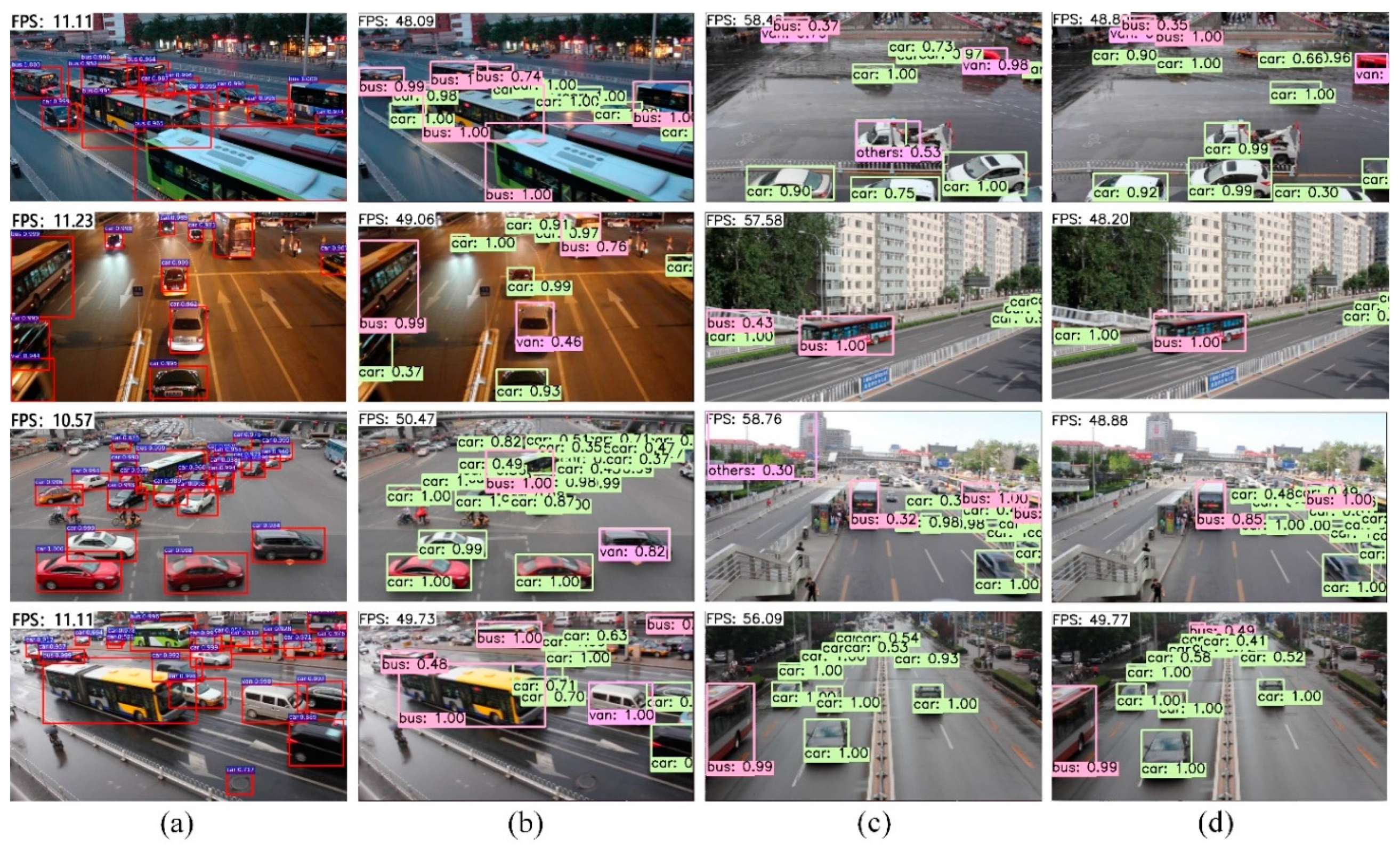
Among the various vehicle detection algorithms of traffic surveillance, convolutional neural network (CNN) based methods have been widely applied and can be categorized into region-based and regression-based approaches. For region-based CNNs, Regions with CNN features (R-CNN) [6], Spatial Pyramid Pooling Network (SSP-Net) [7], Fast R-CNN [8] and Faster R-CNN [9] are some recent advances often utilized in vehicle detection. These approaches, although achieving state-of-the-art accuracy through the improvement from Selective Search [10] to Region Proposal Network (RPN) [9], are too computationally intensive for bounding boxes to be too slow for real-time or near real-time. As shown in Figure 1a, which demonstrates the detection results of the fastest high-accuracy region-based method (Faster R-CNN), the detection frame rate of each image does not exceed 12 FPS, which is not enough for real-time detection in traffic surveillance. To achieve real-time detection performance, a wide range of detectors have been put forward by attacking either classifiers or region proposals. However, most of these attempts increase the speed at the expense of the detection accuracy.
Figure 1. Conventional methods vs. the proposed DP-SSD300 framework on UA-DETRAC dataset. (a) Faster R-CNN with low FPS for vehicle detection; (b) DP-SSD300 with high FPS for vehicle detection; (c) In SSD300, one white vehicle is labeled with two bounding boxes, and some small objects are error detected or miss detected; (d) In DP-SSD300, the white vehicle is well labeled, and small objects are well detected.
With the advance of novel methods for predicting bounding boxes and class probabilities directly in a single neural network, a regression-based You Only Look Once (YOLO) approach [11] processes images in real-time at 45 FPS, but with less accuracy than Faster R-CNN. To further increase the speed vs accuracy trade-off, SSD [12] adopts an anchor mechanism similar to Faster R-CNN, and produces predictions through several feature maps of different aspect ratios and scales. Although it performs well in both speed and accuracy, SSD neglects the relationship between different layers of the feature pyramid. Thus, SSD has a relatively poor performance in traffic surveillance of small vehicles, and produces multiple scale bounding boxes for one vehicle. Specifically, in Figure 1c, two boxes are produced on one car, and the bus in the distance is not detected.
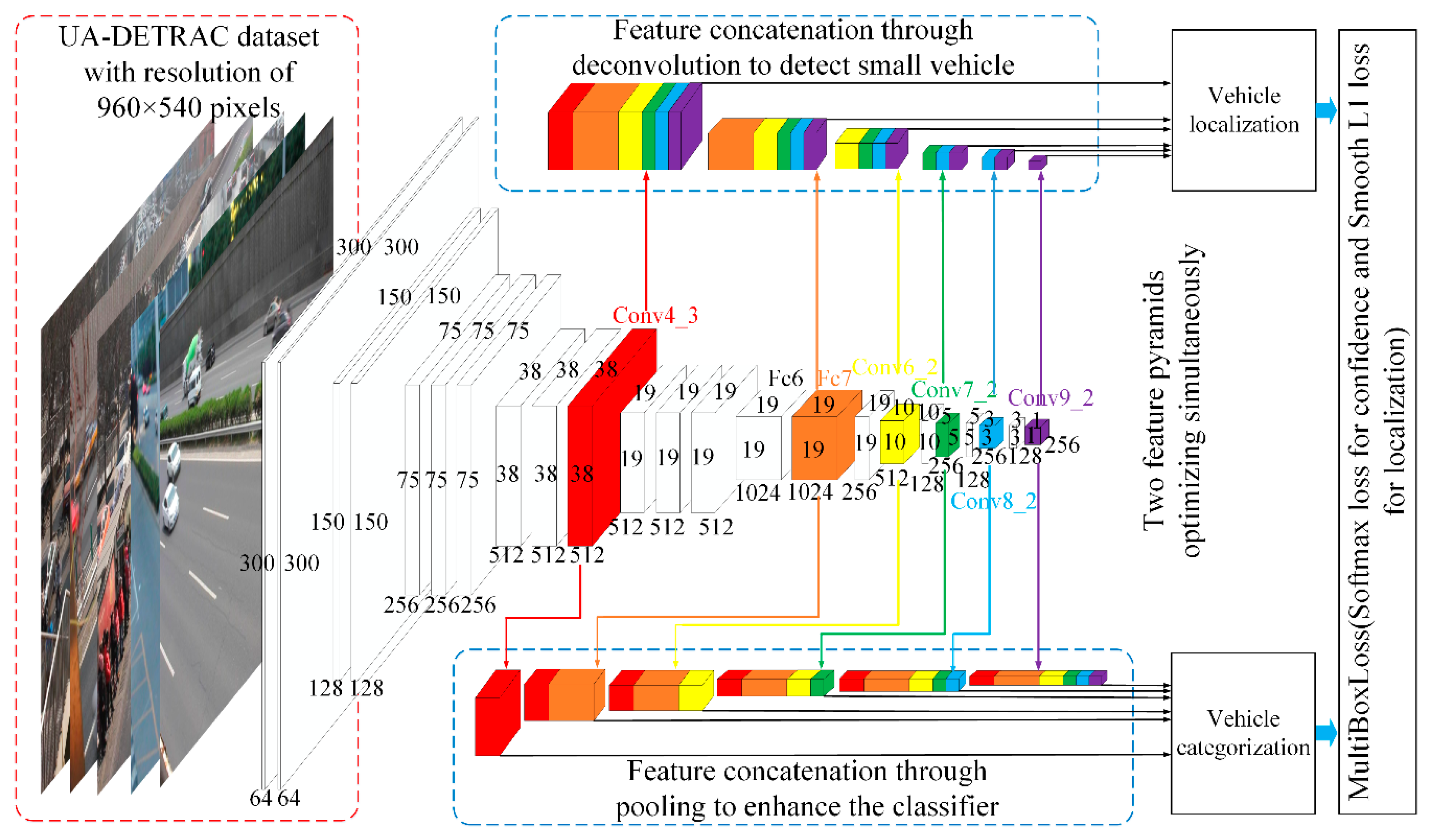
Inspired by the conclusions of previous research, in this paper, we propose an enhanced framework DP-SSD based on a single deep neural network, as shown in Figure 2, for accurate and real-time vehicle detection in urban traffic surveillance. Specifically, DP-SSD is based on conventional SSD, and expands the feature pyramid for vehicle detection into two parts: feature pyramid for localization and feature pyramid for classification. The localization feature pyramid concatenates the upper layer feature maps into lower layer features through deconvolution, which is able to predict all the bounding boxes of vehicles. In the process of predicting, a set of default boxes over multiple scales and aspect ratios are applied to better match the vehicle shape. The latter classification feature pyramid concatenated feature maps of the upper layers through pooling can precisely infer vehicle categories for each positive default box. Therefore, DP-SSD is derived from the idea of feature concatenation through deconvolution (D) and pooling (P), respectively. Compared with the complex rainbow concatenation in R-SSD [13], the novelty of DP-SSD is that two different concatenated feature pyramids are used to perform localization task and classification task respectively, which improves the detection effect while reducing the computational complexity. Section 4 verifies the excellence of DP-SSD. This is because previous works [14] have shown that the upper feature maps are able to achieve high recall but have poor localization in predictions, and the lower feature maps are capable of improving the localization accuracy but with reduced recall. It is noteworthy that both feature pyramids take advantage of the relationship between different layers and increase the number of channels for each feature map layer. In this way, the proposed method can prevent various boxes for one vehicle and predict smaller vehicles in real-time.
Figure 2. Training architecture of DP-SSD for vehicle detection. Our DP-SSD model utilizes conventional SSD, but divides the feature pyramid for detection into two parts: feature pyramid for localization and feature pyramid for classification. For localization, we enhance the representation power of lower layers by concatenating feature maps through deconvolution. The classification feature pyramid concatenates feature maps of the upper layers through pooling.
The main contributions of our work are summarized as follows:
(1)
We propose for the first time the use of different feature extractors (enhanced through deconvolution and enhanced through pooling) for the localization and classification tasks, respectively, in the vehicle detection process, which results in a significant improvement of speed and detection accuracy trade-off.
(2)
In order to enhance the representation power of feature pyramids, we concatenate lower feature maps of basic feature pyramid through deconvolution to precisely produce vehicle bounding boxes, and concatenate upper feature maps of basic feature pyramid through pooling to accurately and simultaneously classify vehicle categories.
(3)
For each concatenated feature pyramid, we increase the number of channels for each feature layer in the pyramid. In this way, the multiple scale boxes for one vehicle can be effectively eliminated.
(4)
As for the size of default box, we allow the predictions to produce smaller bounding boxes than conventional SSD by adjusting the min _ size and max _ size parameters, thus can accurately detect small vehicles in real-time.
This paper is organized as follows: in Section 2, we briefly discuss the related works of vehicle detection in the area of deep learning, and then propose a feature concatenation framework, which we call DP-SSD, in Section 3. In Section 4, the experiments and results of the proposed method are presented. Finally, this paper is concluded in Section 5.

3. The Proposed Vehicle Detection Method

The framework of our proposed vehicle detection method is a single deep neural network, which directly performs to regress the vehicle locations and classify vehicle categories simultaneously. As illustrated in Figure 2, the network layers of the detection approach are based on an extended architecture (VGG-16) with converting the fully connected layers fc6 and fc7 to convolutional layers and adding auxiliary convolutional feature layers (e.g., conv6_1, conv6_2, conv7_1, conv7_2, conv8_1, conv8_2, conv9_1, and conv9_2) to the end of the fc7 layer to produce more lower resolution feature maps, which we call the base network. At prediction time, conventional methods use conv4_3, fc7, conv6_2, conv7_2, conv8_2 and conv9_2 as the basic feature pyramid to predict both location and confidences. To make the detection more accurate, we increase the number of feature maps in each feature pyramid layers by concatenating feature maps of lower layers through deconvolution to enhance the localization performs and concatenating feature maps of the upper layers through pooling to strengthen the categorization performs. This method proves to be able to enhance the performance of vehicle location and the presence of each vehicle categories, respectively. The details of feature concatenation and the enhanced default box for predictions will be described in the following subsections.

3.1. Feature Concatenation

Searching the whole image to locate potential vehicle positions and classify its categories in a single feature map is limited by the detection accuracy. The conventional SSD method combines both lower and upper feature maps in the classifier network to address this problem, but the relationship between each feature map is not considered, which lowers the efficiency to some extent. Particularly for the specific application, we expect significantly increased detection accuracy can be achieved in the case of real-time. Our proposed feature concatenation method is a way to enrich the representation power of the feature maps in different layers (the original conv4_3, fc7, conv6_2, conv7_2, conv8_2 and conv9_2 layers), which aims to not only precisely localize all the vehicle-like objects but also accurately classify the presence of each vehicle-like objects in real-time.

3.1.1. Feature Concatenation through Deconvolution for Localization

We concatenate feature maps of the lower layers through deconvolution, as depicted in the top part of Table 1, to enhance representation power of lower feature maps. From up to low, the first convolutional layer (conv9_2) remains unchanged as the first new deconvolution layer. In the second stage, we filter the new deconvolution layer (conv9_2) with 256 kernels of size 3 × 3 and a stride of one pixel to the same size with the second convolutional layer (conv8_2), which we call deconvolution feature map (deconv9_2). Then, after a batch normalization step with both layers [45], we concatenate convolutional layer (conv8_2) with deconvolution feature map (deconv9_2), to enrich the representation power of lower feature map (conv8_2) by increasing the number of feature maps efficiently. In the third stage, the third convolutional layer (conv7_2) takes as input the concatenated feature maps obtained from the previous layer and filters them with 256 kernels of size 3 × 3 and a stride of one pixel to generate deconvolution feature map (deconv8_2), afterwards, we concatenate both conv7_2 and deconv8_2 in the same way as the second stage. Meanwhile, the feature maps at the third stage consists of three feature maps. Similarly, the fourth (conv6_2), fifth (fc7), and sixth (conv4_3) convolutional layers are concatenated with deconvolution feature map (deconv7_2) filtered by 256 kernels of size 2 × 2 and a stride of two pixels, deconvolution feature map (deconv6_2) filtered by 512 kernels of size 1 × 1 and a stride of two pixels, and deconvolution feature map (defc7) filtered by 1024 kernels of size 2 × 2 and a stride of two pixels, respectively. It is noteworthy that a normalization step needs to be performed before concatenating feature maps. This is because the size of the feature map in different layers are quite different.
Table 1. Network architectures of the feature concatenation through deconvolution and pooling.
In addition, the number of channels in the feature pyramid is increased efficiently. By concatenating feature maps, from up to low, each of deconvolution layer contains 256, 512, 768, 1280, 2304 and 2816 feature maps, respectively. This method will directly achieve precise localization, especially for small vehicles from whole image or frames in video.

3.1.2. Feature Concatenation through Pooling for Categorization

The bottom part of Table 1 shows the architecture details of pooling concatenation. In order to make the network be trained with more meticulous vehicle features, from low to up, we use the first convolutional layer (conv4_3) unchanged as the first new pooling layer. Next, we pool the new convolutional layer (conv4_3) with kernel of size 2 × 2 and a stride of two pixels by means of max pooling, which we call pooling feature map (pooling4_3). At the same time, we need to ensure the same size as the second convolutional layer (fc7). Then, by utilizing a batch normalization step, we concatenate convolutional layer (fc7) with pooling feature map (pooling4_3) to strengthen the representation power of upper feature map (fc7) by increasing the number of feature maps efficiently. Similar to the deconvolution process, in the next, the third (conv6_2), fourth (conv7_2) and fifth (conv8_2) convolutional layers are concatenated with pooling feature maps poolingfc7, pooling6_2 and pooling7_2 that pooled by kernel of size 2 × 2 and a stride of two pixels by means of max pooling respectively. At last, we concatenate the sixth (conv9_2) convolutional layers with pooling feature map (pooling8_2) pooled by kernel of size 3 × 3 and a stride of one pixel by means of max pooling. In this way, the network with large receptive fields can have enhanced representation power for vehicle classification. Therefore, from low to up, each of pooling layer contains 512, 1536, 2048, 2304, 2560 and 2816 feature maps, respectively.
In all of the above, we use a single deep neural network for detecting vehicles, but different feature extractors are used for the localization task and classification task, respectively. The classifier used in the localization task is obtained by concatenating feature maps of lower layers through deconvolution, and the classifier for the classification task combines the feature maps of upper layers through pooling. The advantage of this method is that the network can executed with information from other layers in each of the feature maps, which will precisely detect vehicles in real-time.

3.2. Default Box with Feature Concatenation

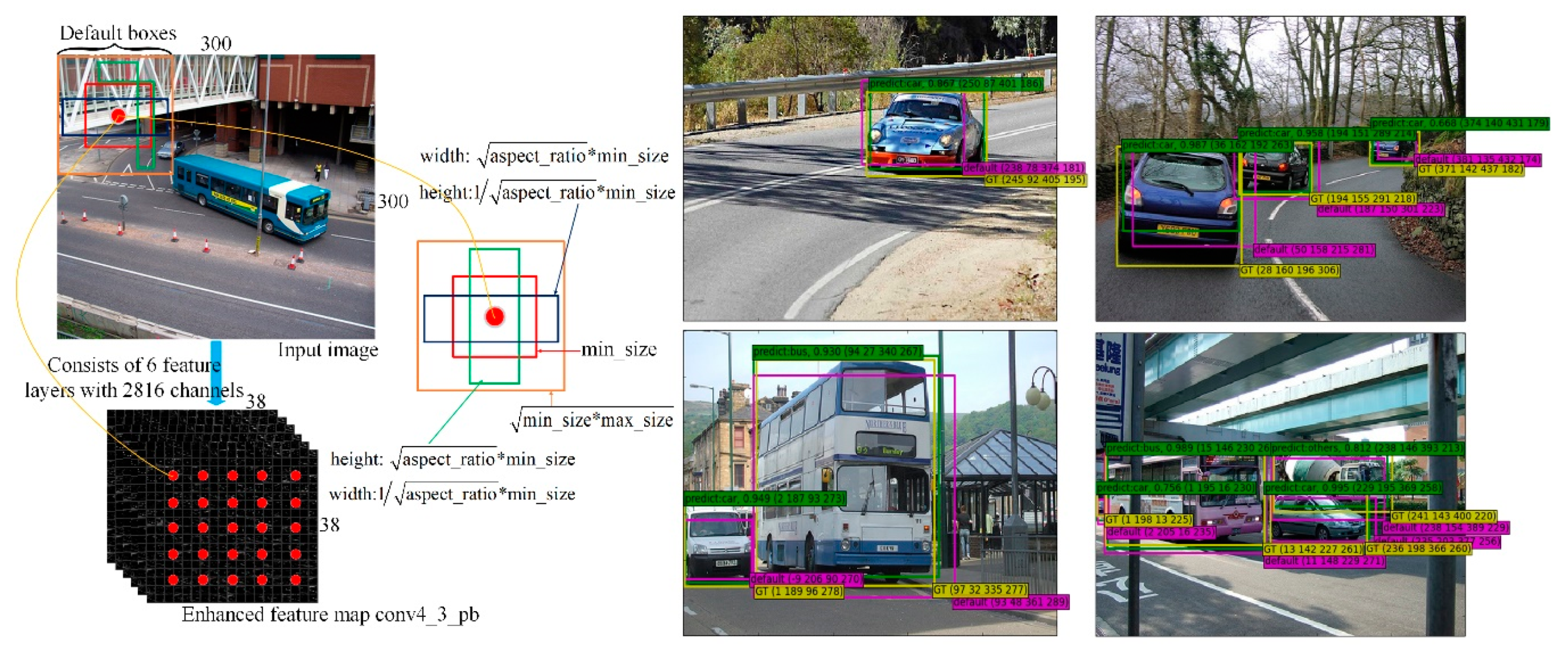
For vehicle detection predictions, we adopt a small convolution kernel of 3 × 3 to filter the feature map output by the top of the network to produce a score for the vehicle category and a rectangular offset relative to the default box coordinates. Motivated by References [22,46,47], the conventional SSD method uses a feature pyramid that includes both the lower and upper feature maps to fit the default box. Previous work [13] has demonstrated that the greater the number of channels in the feature map, the better the performance becomes. Simultaneously, Reference [14] showed that the upper feature maps can find the object of interest with high recall, and the lower feature maps can better localize the object of interest. Inspired by these works, we use concatenated feature maps of different resolutions obtained by deconvolution for predicting vehicle localization, and feature maps of multiple layers concatenated through pooling for calculating confidences, respectively. Figure 3 left shows the concatenated feature map conv4_3_pb consisting of six feature layers including 2816 channels, which is used in our framework, and other feature maps are similar.
Figure 3. Left: Feature map concatenation and the calculation of default boxes with multiple aspect ratios and scales in the process; Right: Example detections using DP-SSD300 with new default box size in Table 2 on PASCAL VOC 2007 car dataset.
Our approach, concatenation-based feature pyramid, fits the predicted bounding boxes into a set of default boxes through different scales and aspect ratios at each feature map location. To generate default boxes that can match the specific vehicle shape, suppose m feature maps of different resolutions are used, and two parameters of the default box scale m i n _ s i z e and m a x _ s i z e are defined as follows:
min _ size = min _ dim × ratio 100
max _ size = min _ dim × ( ratio + step ) 100
where   step = max _ ratio min _ ratio m 2
Here, min _ dim is the size of input image, meanwhile we set min _ raito as 15 and max _ ratio as 90. Starting at 15, we generate a set of data regularly spaced at step intervals between 15 and 90, and we assign them to ratio respectively. Table 2 and Table 3 show the specific values of min _ size and max _ size in several feature layers of different resolutions for the 300 and 512 input models, respectively. In addition, we use 6 aspect ratios of 1:1, 1:1, 1:2, 2:1, 1:3, 3:1 for the default boxes in each feature map location. For the two 1:1 aspect ratios, we compute the scales as min _ size and min _ size × max _ size , respectively. Besides, for the rest aspect ratios, we define the width as aspect _ ratio × min _ size , and height as min _ size / aspect _ ratio for each default box. In detail, Figure 3 left also shows the calculation of default boxes with different aspect ratios and scales.
Table 2. The learned average default box size for each feature map cell in different concatenated feature layers using the extend VGGNet (300 × 300 input).
Table 3. The learned average default box size for each feature map cell in different concatenated feature layers using the extend VGGNet (512 × 512 input).

3.3. Deep Nets Training

The vehicle detection network with feature concatenation can be trained end-to-end by stochastic gradient descent (SGD) [48]. To make a full training, we randomly initialize all layers used for predicting confidences by drawing weights from the Xavier algorithm [49]. All other layers (i.e., predicting localization layers) are initialized by the pretrained truncated VGG model for ImageNet classification [9]. The reason is that offsets are independent of category, and the classification layers cannot share weights due to different number of categories.
At training time, we assign a positive label to default boxes by matching them to the ground truth in two ways: (i) each of the ground truth box with the best jaccard overlap with the default box, and (ii) each of the default box that has a jaccard overlap higher than 0.5 with any ground truth box. Otherwise, we assign a negative label to a non-positive default box if its jaccard overlap is lower than 0.5 for all ground truth boxes. The jaccard overlap calculation is as follows:
( A , B ) = | A B | | A B | = | A B | | A | + | B | | A B | [ 0 , 1 ]
where | A B | denotes the intersection of ground truth box and default box, and | A B | indicates their union.
In addition, after matching step, positive samples are much more than negative samples, which leads to a significant imbalance between the positive boxes and negative boxes. In order to make the training converge quickly, hard negative mining strategy is applied to balance the ratio of negative and positive training examples to 3:1 at most.
We employ a multi-task loss L ( x , c , l , g ) on each training batch to jointly optimize multiple vehicle classification and offsets regression from the proposed deep network as the following function:
L ( x , c , l , g ) = 1 N ( L c o n f ( x , c ) + α L l o c ( x , l , g ) )
Here, g is the ground truth box and l is the corresponding predicted box. x denotes whether the matched box (between default box and the ground truth box) belongs to category p , and c indicates the confidence value if x is 1. If the default box is negative, x is 0. The confidence loss L c o n f is the softmax loss over four classes (i.e., car, bus, van, and others), and is defined as follows:
L c o n f ( x , c ) = i P o s N x i j p log ( c ^ i p ) i N e g log ( c ^ i 0 ) ,   where   c ^ i p = exp ( c i p ) p exp ( c i p )
where x i j p indicates the i -th default box matches the j -th ground truth box with category p , and c ^ i p represents the probability that the i -th default box belongs to p . For the regression loss L l o c , we use the Smooth L1 loss [8] to predict the offsets of default box, and is defined as:
L l o c ( x , l , g ) = i P o s N m ( c x , c y , w , h ) x i j k smooth L 1 ( l i m g ^ j m ) , where   smooth L 1 ( x ) = { 0.5 x 2   i f | x | < 1 | x | 0.5   otherwise
Especially, g ^ j m is a four-point vector with m ( c x , c y , w , h ) , and we apply the following parameterizations of the four coordinates:
g ^ j c x = ( g j c x d i c x ) / d i w g ^ j c y = ( g j c y d i c y ) / d i h g ^ j w = log ( g j w d i w ) g ^ j h = log ( g j h d i h )
where ( c x ,   c y ) is the bounding box center, and w , h are its width and height, respectively. In addition, ( g ^ j c x ,   g ^ j c y ,   g ^ j w ,   g ^ j h ) represents the coordinates of the j -th ground truth box, ( d i w ,   d i h ) is the width and height of the i -th default box, and l i m indicates the offsets of the predicted box relative to the default box.
Furthermore, in Equation (5), the term is normalized by N and weighted by a balancing parameter α . By default, the weight term α is set to 1 by cross validation, and N denotes the number of positive default boxes.

4. Experiments and Results

In this section, we evaluate our proposed network DP-SSD for vehicle localization and classification on two public vehicle datasets: the UA-DETRAC dataset [50,51] and the KITTI dataset [52]. Experiments are implemented based on the deep learning framework Caffe [53] and run on Ubuntu 14.04 LTS with an Intel Core i7-7700K CPU @ 4.2 GHz, 32 GB of DDR4 memory and an NVIDIA GeForce GTX 1080Ti GPU.

4.1. Dataset and Experimental Configuration

4.1.1. Training Dataset and Data Augmentation

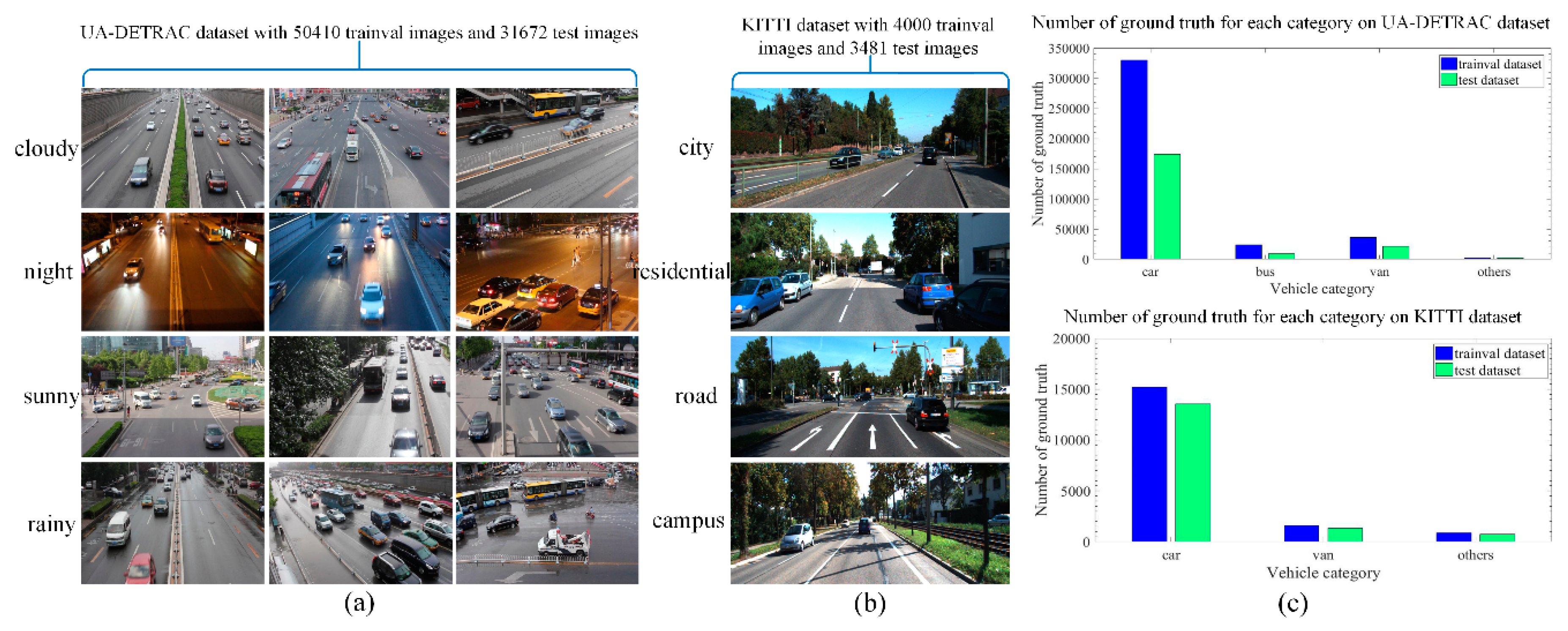
We evaluate our method on two public vehicle datasets. First, we adopt a quarter high definition (960 × 540) UA-DETRAC Benchmark Dataset [50,51] with 40 videos for more than 50,000 real-world vehicle images as the training samples, which are annotated with tight bounding-boxes and multiple vehicle types such as car, bus, van and others. The dataset is captured with an EOS 550D camera (Canon, Beijing and Tianjin, China) at 24 different locations. In detail, the real-world part of the UA-DETRAC dataset is captured under three occlusion status as fully visible, partially occluded by other vehicles and partially occluded by background, and different degrees of truncation as vehicle parts outside the frame. To achieve an even training distribution, the multi-scale vehicles including small (0–50 pixels), medium (50–150 pixels) and large (more than 150 pixels) are used to train our model. Besides, since weather condition is another important factor in vehicle detection, we intentionally employ the dataset with four weather conditions as cloudy, night, sunny and rainy to train our final model.
To make our model more convincing, we also use a representative (1224 × 370) KITTI Benchmark Dataset [52] with 4000 vehicle images for training. The KITTI dataset utilized here is captured in the mid-size city of Karlsruhe (Germany) under four scenarios: city, residential, road, and campus. Up to 15 vehicles are visible per image, and each bounding box is marked as either visible, semi-occluded, fully occluded or truncated. The examples of the two datasets are illustrated in Figure 4a,b.
Figure 4. Different datasets for vehicle detection. (a) UA-DETRAC dataset: We classify the vehicles into four categories (i.e., car, bus, van, and others) with multiple scales, occlusion ratios and truncation ratios in each weather condition; (b) KITTI dataset: We classify the vehicles into three categories (i.e., car, van, and others) with different degrees of occlusion and truncation in multiple scenes; (c) Number of ground truth for each category on UA-DETRAC dataset and KITTI dataset, respectively.
For data augmentation, we first randomly sample each of the training data by the options as Reference [12] for making our final model more robust to various vehicle sizes and shapes. In addition, image adjusting brightness, contrast, hue and saturation with probability of 0.5 are introduced to enable that vehicles with blurry edges can be detected as precisely as possible. Then, a strategy of expanding the image ratio is utilized to enhance the classification accuracy of vehicles. Moreover, in order to fully learn the information of vehicles, each training data is horizontally flipped with probability of 0.5.

4.1.2. Implementation Details

The entire training structure of our proposed network is illustrated in Figure 2. We re-scale the images such that their width and height are 300 × 300 pixels. To make a better performance of prediction, we concatenate feature maps of the lower layers through deconvolution to regress vehicle bounding boxes, and concatenate feature maps of the upper layers through pooling to classify vehicle categories. During training, we definitely discover that the enhanced feature extractors can indeed benefit training the network to detect small vehicles. Unfortunately, we remove the BatchNorm layer which ensuring that the feature maps in each concatenated layer are in the same size, due to the consumption of a large amount of memory resources. In the next section, we will provide ablation experiments on different feature pyramids.
For default box, we use four or six different shapes in several feature maps of different resolution with aspect ratios of 1:1, 1:2, 1:3, 2:1, and 3:1. In addition, for the aspect ratio of 1:1, we add another larger scale to resulting in six default boxes per concatenated feature map location. To account for smaller vehicle sizes, we reduce the minimal width and height of default boxes by setting min _ ratio as 15 and max _ ratio as 90. Figure 3 right shows the capability of our method over different aspect ratios and scales. Table 2 and Table 3 show the learned average default box size for each feature map cell in different concatenated feature layers using the extended VGGNet, with the values of parameters min _ size and max _ size display on the left. We note that the default box can larger than the underlying receptive field, thus predictions can make adjustment to better match the vehicle shape.
In detail, we directly train the detection and classification network for about 60 epochs on the selected real-world data that contains four vehicle types of car, bus, van and others from the UA-DETRAC dataset. Throughout the training process, the network with 300 × 300 input is trained with a batch size of 24, while 512 × 512 input with a batch size of 8. As in Reference [12], the momentum and weight decay in both nets are configured as 0.9 and 0.0005, respectively. Learning rate in 300 × 300 input net is reduced from 10−3 to 10−5 by 10−1, while in 512 × 512 input net is reduced from 10−4 to 10−6 by 10−1. With each learning rate, we trained 40, 10, 10 epochs, respectively. However, for KITTI dataset with three vehicle types of car, van and others, we first train our models with 10−4 learning rate for 480 epochs, followed by 10−5 learning rate for 120 epochs, and then continue training for another 120 epochs with 10−6, in order to avoid a gradient explosion during training. The other parameter settings are the same as UA-DETRAC dataset. Number of ground truth histograms for each category on UA-DETRAC and KITTI dataset are depicted in Figure 4c.

4.2. Experiments on UA-DETRAC Dataset

We comprehensively evaluate our proposed method on the UA-DETRAC Train Images. This dataset consists of 60 sequences with 82,082 real-world vehicle images over four vehicle categories of car, bus, van and others, and we divided it into two parts: 40 sequences with 50,410 images for trainval dataset as mentioned before, and 20 sequences with 31,672 images for test dataset. All methods in this section use the same training and testing data. For the ImageNet pre-trained network, we use the truncated VGG-16 [17] that has 16 convolution layers.

4.2.1. The Importance of Feature Concatenation

We evaluate the performance of DP-SSD by mean average precision (mAP) and frames per second (FPS), respectively.
Table 4 (top) shows DP-SSD results when trained and tested using different size input images. Both DP-SSDs use our new default boxes as adjusted in Table 2 or Table 3. For 300 × 300 input and 512 × 512 input, as shown in Table 5, DP-SSD generates about 8732 and 24,656 default boxes by default settings, respectively. The 300 input model achieves an mAP of 75.43% at 50.47 FPS under our proposed DP-SSD framework. For the 512 input model, there is a 2.51% improvement in accuracy with 77.94% mAP compared to the 300 input model, because more information can be obtained in large images. However, due to the increased computational complexity, the speed is reduced to 25.12 FPS but still achieves in real-time.
Table 4. Detection results on UA-DETRAC test set (trained on UA-DETRAC trainval dataset in this paper). The input size is 300 or 512, but using various detectors for training and testing. * denotes using the new default box size in Table 2 or Table 3.
Table 5. Detection results of DP-SSD on UA-DETRAC test set using different number of default boxes in multiple feature maps. The training data is UA-DETRAC trainval dataset in this paper. The multiple feature maps are conv4_3_pb, fc7_pb, conv6_2_pb, conv7_2_pb, conv8_2_pb and conv9_2_pb, respectively. The default setting of using different number of default boxes (75.43% or 77.94%) is the same as that in Table 4. All models use the new default box size in Table 2 or Table 3.
To investigate the performance of default box with feature concatenation as a proposal method, we conducted several ablation experiments for comparation. In the first part of the ablation studies, we show the behaviors of different networks with the same 300 × 300 input images. To do this, first, we train the traditional SSD300 model only by replacing the training and testing datasets with UA-DETRAC dataset, which achieves a lower mAP of 74.18% and a higher FPS at 58.78 than DP-SSD300 input model. We observe that this is because of weak feature pyramid and relatively simple computations for vehicle detection. We use this result as a baseline for the following comparisons.
Next, we separately investigate the results of single feature concatenation for pooling concatenation and deconvolution concatenation outputs by eliminating either of them in DP-SSD framework. When feature concatenation through deconvolution is removed (thus the representation power of feature pyramid for vehicle localization is the same as SSD), it results in mAP of 73.49% which is 0.69% lower than conventional SSD. In addition, the speed drops to 52.36 FPS.
On the other hand, when the feature concatenation through pooling is removed in both training and testing time (so the feature pyramid for vehicle categorization becomes conventional SSD), the mAP drops to 73.27%, and the speed is degraded to 51.78 FPS. Somewhat surprisingly, the enhanced feature pyramids in these two models have not played a positive role, the reason can be speculated that unilaterally enhancing low-level or high-level feature pyramids in conventional SSD can make a great difference in computational complexity between localization task and categorization task, resulting in inadequate learning of different tasks in a single network.
Then, we also evaluate the roles of simultaneous integration of deconvolution and pooling. For this purpose, we train a DP-SSD model that only enhances the feature pyramid without adjusting the default box scales. It is observed that the mAP improves from 74.18% (conventional SSD) to 74.77% (DP-SDD using feature concatenation only), but still 0.66% lower than 75.43% (our DP-SSD using feature concatenation and new default box scale), indicating that our feature concatenation method can effectively improve the detection result because of the features for both localization and categorization have been properly learned. Moreover, this shows that the adjusted default box scale in Table 2 can also account for the accuracy of our DP-SSD model, because the default boxes in Table 2 have a wider range. In addition, the speed drops to 49.22 FPS, because this model performs more operations than conventional SSD.
For the 512 input models, in the second part of the ablation experiments, we observe that they have the similar variation tendency as the 300 input models. At 27.75 FPS, conventional SSD gets 76.83% mAP, while the two single feature concatenation models (pooling concatenation and deconvolution concatenation) decrease by 0.96% at 26.79 FPS and 1.63% at 25.83 FPS, respectively. For the DP-SDD using feature concatenation only, there is a 0.21% improvement in accuracy with 77.04% mAP compared to traditional SSD.
Looking at the results from Table 4, the 512 input models achieve higher accuracy than the corresponding 300 input models due to more information can be learned in the larger input images. As for speed, although still reach real-time, the 512 input models are significantly reduced, because of the increased computational complexity. It is noteworthy, both DP-SSD300 and DP-SSD512 obtain the best accuracy at real-time, indicating that our feature concatenation method and default box adjustment strategy have played a positive role.
Table 5 shows the experimental results of three types of DP-SSD for different default box settings. For the 300 input models, the first one, which checks 4 or 6 default boxes per feature map location for a total of 8732 boxes, results in mAP of 75.43%. In the model with 4 default boxes for each layer with a 7760 total boxes, the mAP drops to 75.10%, likewise, for the model which makes a 11,640 total boxes, the mAP becomes 73.62%. For the 512 input models, the model contains 24,656 boxes in total achieves the best mAP of 77.94%. In the case of a 21,968 and a 32,952 total boxes, it has 2.34% and 1.4% mAP drops when they use 4 and 6 default boxes, respectively. All these demonstrate that the different number of boxes for each feature layers is better than that of the same number of boxes.
Figure 1b,d shows the qualitative detection results of our proposed DP-SSD300 on UA-DETRAC dataset. As shown in Figure 1b, DP-SSD300 is robust to detect vehicles in real-time for urban traffic surveillance. Furthermore, DP-SSD300 can prevent detecting multiple boxes for one vehicle and improve the detection rate for small vehicles as shown in Figure 1d.

4.2.2. Comparisons with State-of-the-art Detection Methods

Table 6 shows the performance comparison between DP-SSD, Faster R-CNN [9], YOLO [11], YOLOv2 [24], SSD [12], DSSD [25], R-SSD [13], RefineDet [26], SIN [27] and YOLOv3 [29]. In addition to YOLOv3, our DP-SSD512 outperforms all the other methods significantly. Specifically, regardless of the 300 or 512 input model, DP-SSD has better performance than Faster R-CNN in both accuracy and speed. Because DP-SSD eliminates the proposal generation stage and uses a concatenated feature pyramid of different resolutions in a single neural network.
Table 6. Detection results between different methods on UA-DETRAC dataset. In addition to YOLOv3, DP-SSD512 outperforms all other methods on accuracy in real-time, and YOLOv2 achieves the highest speed of 64.65 FPS. * denotes using the new default box size in Table 2 or Table 3.
Both the YOLOv2 models (YOLOv2 416 × 416 [24] and YOLOv2 544 × 544 [24]) obviously improve the performance compared to YOLO [11] by 11.3% and 13.44% of mAP respectively due to the elimination of fully connected layers and introduction of anchor boxes, but they are 4.12% and 1.98% lower than DP-SSD512, respectively. In addition, DP-SSD512 obtains an increased mAP of 1.11% compared to state-of-the-art SSD512 detection model [12], and the lower resolution network DP-SSD300 achieves 75.43%, which is worse than SSD512 but is 1.25% higher than SSD300 [12]. Although residual network is utilized by DSSD, there is still a 1.91% mAP degraded in accuracy with 76.03% mAP compared to DP-SSD512. In particular, compared to R-SSD512 and R-SSD300, DP-SSD512 and DP-SSD300 have 0.21% and 0.41% mAP improvement in accuracy, respectively. This suggests that using our proposed feature concatenation method with adjusted default box scales can help improve the vehicle detection results on UA-DETRAC dataset. The other two models, RefineDet (including 320 input and 512 input models) and SIN, produce better results than DP-SSD300, but there is still a small gap with DP-SSD512. Surprisingly, YOLOv3 achieves 88.09% in mAP, which beats all models and is better than DP-SSD512 by 10.15%, the reason is the good residual structure and multi-scale prediction method used in YOLOv3. However, DP-SSD has fewer network parameters than YOLOv3 (138M vs 214M), thus it is easy to train. As for speed, all models except Faster R-CNN [9], DSSD (ResNet-101) [25], and SIN [27] in Table 6 can detect vehicles in real-time, and YOLOv2 [24] outperforms all other methods with a processing speed of 64.65 FPS.
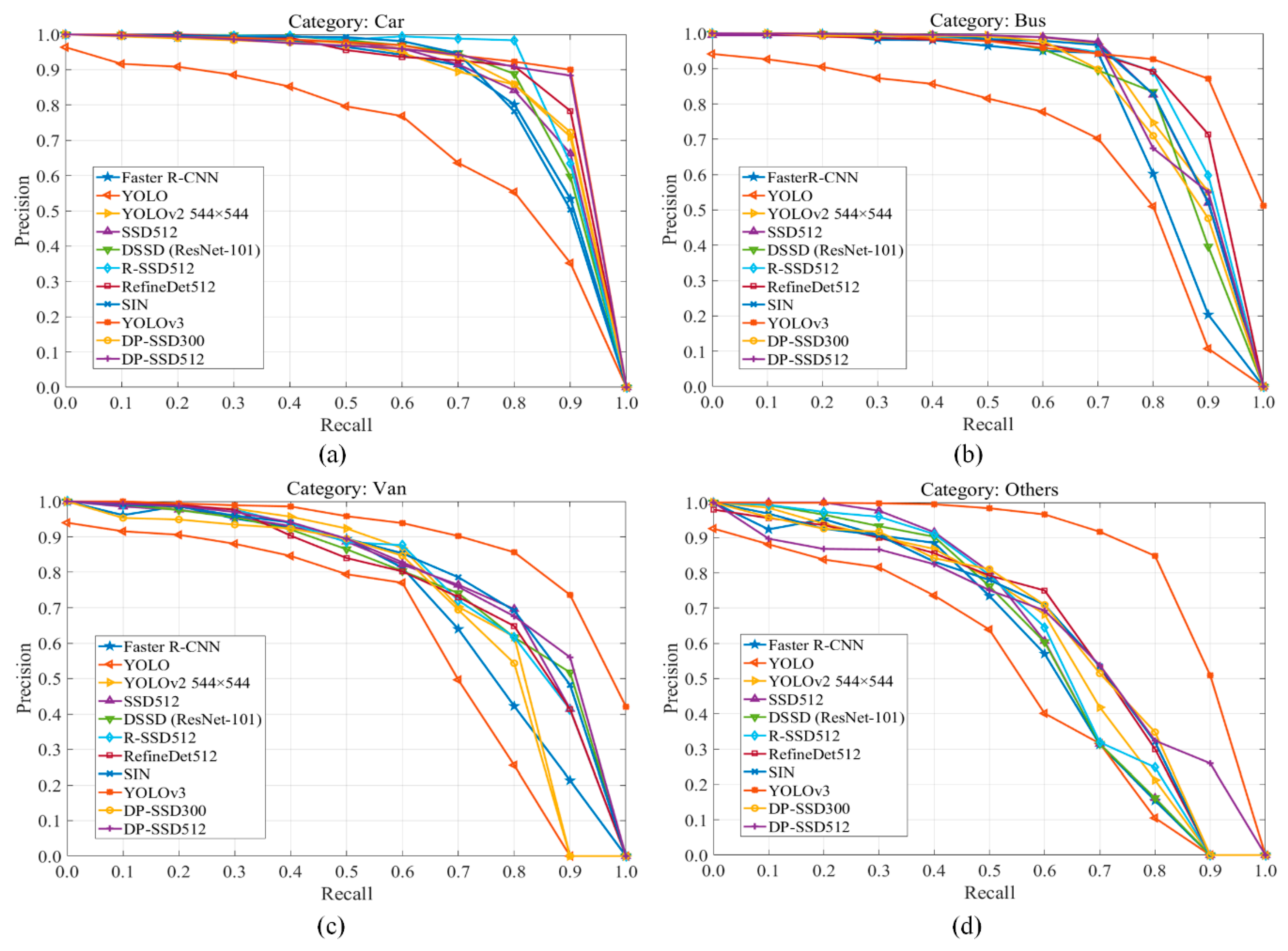
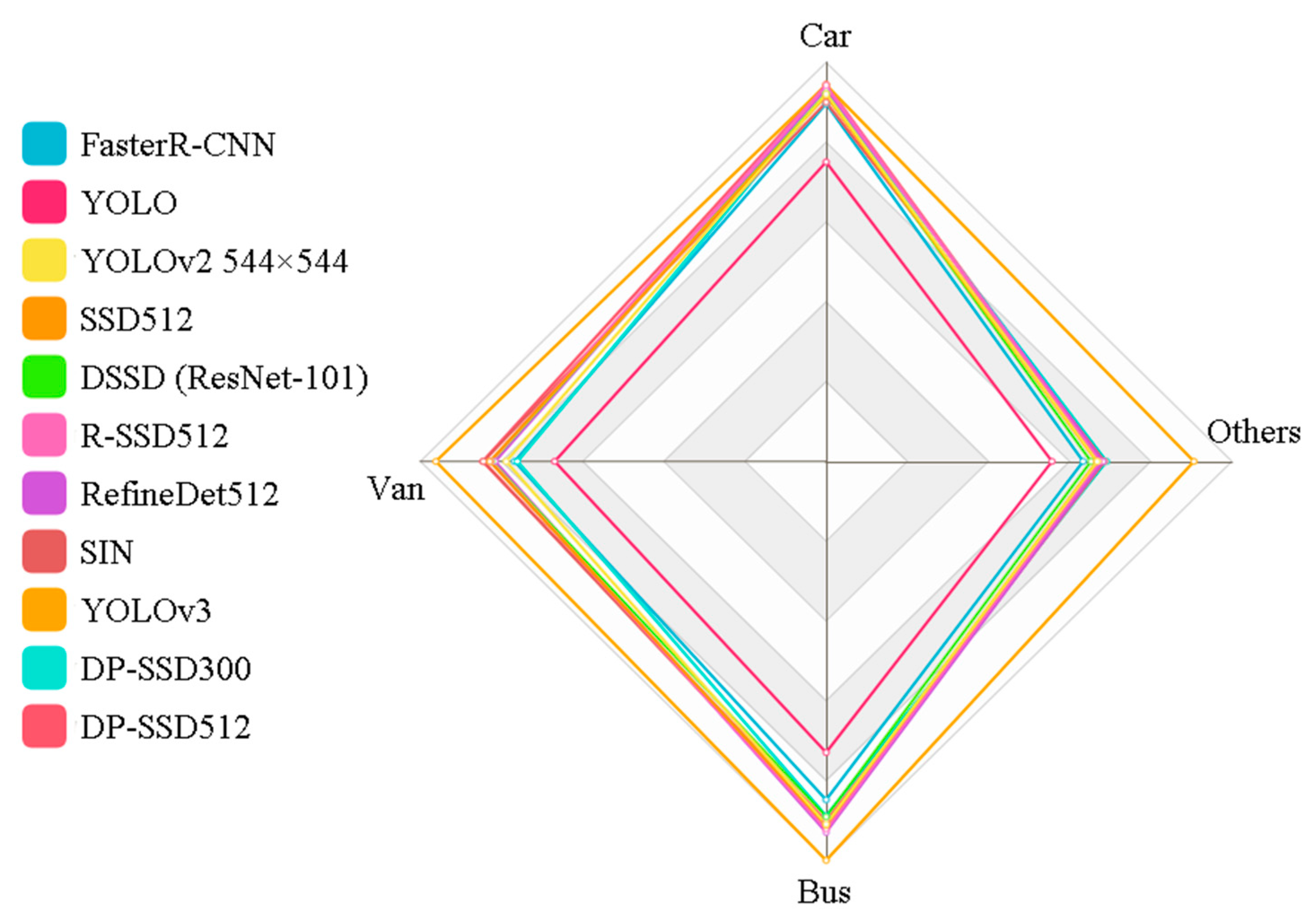
In Figure 5, we present the precision-recall curves of all the compared models on UA-DETRAC dataset for categories of car, bus, van and others, respectively. We can see, YOLOv3 achieves the best performance with obvious gaps in all four categories by comparing Area Under the Curve (AUC). In addition to YOLOv3, for category car and van, we can further discover that, DP-SSD512 obtains better performance than other methods. Meanwhile, compared with DP-SSD512, DP-SSD300 and RefineDet512 perform slightly better in the others and bus categories, respectively. Specifically, the capacity to detect for each category over these methods is shown in Figure 6. It can be observed that only YOLOv3 has a relatively balanced ability to detect all types of vehicles, while YOLO has relatively poor performance on each type. Apart from this, all the other methods are insufficient for handling the others category, due to the uncertainty of vehicle shapes and the lack of training samples. In our on-going work, we are exploring data augmentation techniques, such as Generative Adversarial Networks, to improve the detection effect of DP-SSD.
Figure 5. Precision-recall curves between different methods on UA-DETRAC dataset over four categories of car, bus, van, and others. (a) Precision-recall curves for the car category; (b) Precision-recall curves for the bus category; (c) Precision-recall curves for the van category; (d) Precision-recall curves for the others category.
Figure 6. Radar chart of AP values for four vehicle categories of car, bus, van, and others, to show the ability of each model for detecting each type of vehicle.

4.3. Experiments on KITTI Dataset

We further evaluate our DP-SSD300 and DP-SSD512 architectures on the KITTI Images. The dataset we utilized here consists of 7481 images, and we divided it into two parts: 4000 images for the trainval dataset as mentioned before, and 3481 images for the test dataset.
After training, we test our final model on the KITTI test set with 7518 images, and upload test files to the KITTI website for results at three levels: easy, moderate and hard. We use the same framework as those for UA-DETRAC dataset.
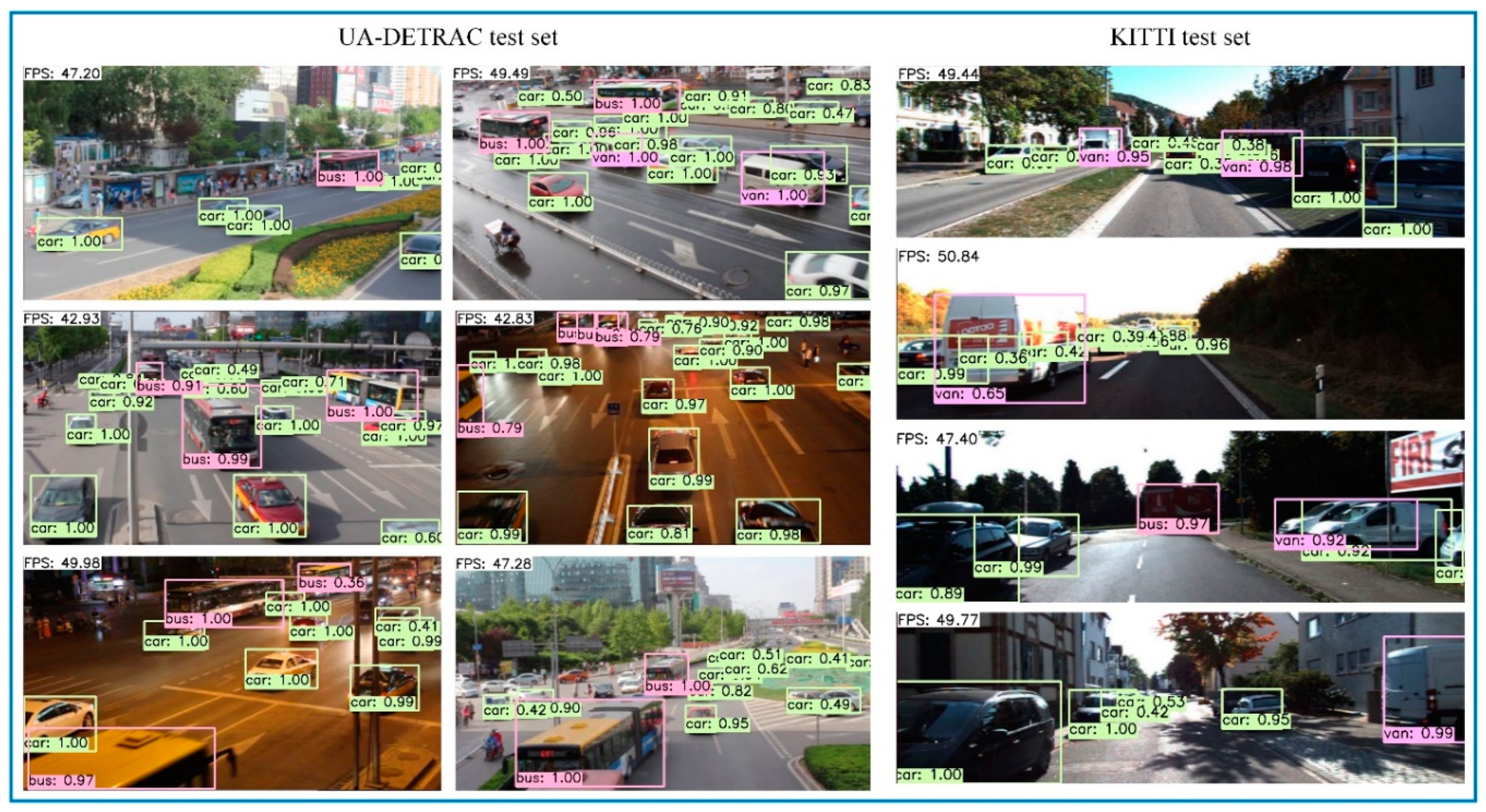
Table 7 shows the results of our DP-SSD300 and DP-SSD512 model on KITTI test set. Similar to what we observed on UA-DETRAC dataset, DP-SSD512 achieves 85.32% in mAP on the moderate case, which outperforms R-SSD512 by 0.61%. Likewise, DP-SSD300 can also obtain a relatively high mAP of 83.86%, which is better than R-SSD300. It is clear that both DP-SSD512 and DP-SSD300 perform better than some existing methods in accuracy. However, compared to the best method (e.g., THU CV-AI) published on the KITTI website, there is still a large gap in DP-SSD. Meanwhile, our methods obtain a relatively fast inference speed. In Figure 7, we show some qualitative detection examples on UA-DETRAC and KITTI test sets with the DP-SSD300 model. It can be observed that our proposed method is robust to detect vehicles with different categories simultaneously for urban traffic surveillance.
Table 7. Detection results between different methods on KITTI test set. All methods are ranked based on the “Moderate”.
Figure 7. Selected examples of vehicle detection results on UA-DETRAC test set and KITTI test set using our proposed DP-SSD300 framework. Both UA-DETRAC and KITTI test sets are made into video sequence for testing. We display high quality detections with scores higher than 0.3. The detected frame rate is displayed in the upper left corner, and each output box is associated with a category label and a specific score.

5. Conclusions

In this paper, we have developed DP-SSD, a single deep neural network for vehicle detection in urban traffic surveillance, which concatenates the feature pyramid of conventional SSD [12] and adjusts the scales of default box to detect small vehicles more accurately. The improved detection network predicts bounding-boxes with scores for each vehicle and infers their categories simultaneously. Extensive experiments on the UA-DETRAC and KITTI datasets show that our method outperforms some existing algorithms on accuracy and achieves real-time detection. One of the shortcomings of this paper is that due to the limitations of GPU memory, the batch normalization layer was removed, which is considered to speed up the network training and improve the accuracy of the model. In our on-going work, we are adding multi-label classification task into DP-SSD to simultaneously learn more vehicle attributes such as color, make and model, and ultimately investigate vehicle re-identification tasks in urban traffic surveillance images.

Author Contributions

F.Z. collected and processed the data, developed the method, performed the experiments, analyzed the test results, and wrote this paper. C.L. and F.Y. contributed in reviewing and improving the manuscript. All authors read and approved the final manuscript.

Funding

The work was supported by National Natural Science Foundation of China under Contract 61601466, in part by the State Key Laboratory of Coal Resources and Safe Mining under Contract SKLCRSM16KFD04, in part by the Fundamental Research Funds for the Central Universities under Contract 2016QJ04.

Acknowledgments

The authors would like to thank Qiangyu Wang, who shared his experience in testing on the KITTI dataset.

Conflicts of Interest

The authors declare no conflict of interest.

References

  1. Chu, W.; Liu, Y.; Shen, C.; Cai, D.; Hua, X.S. Multi-Task Vehicle Detection With Region-of-Interest Voting. IEEE Trans. Image Process. 2018, 27, 432–441. [Google Scholar] [CrossRef] [PubMed]
  2. Hu, X.; Xu, X.; Xiao, Y.; Chen, H.; He, S.; Qin, J.; Heng, P.A. SINet: A Scale-insensitive Convolutional Neural Network for Fast Vehicle Detection. arXiv, 2018; arXiv:1804.00433v1. [Google Scholar] [CrossRef]
  3. Loukas, G.; Vuong, T.; Heartfield, R.; Sakellari, G.; Yoon, Y.; Gan, D. Cloud-Based Cyber-Physical Intrusion Detection for Vehicles Using Deep Learning. IEEE Access 2018, 6, 3491–3508. [Google Scholar] [CrossRef]
  4. Sivaraman, S.; Trivedi, M.M. A General Active-Learning Framework for On-Road Vehicle Recognition and Tracking. IEEE Trans. Intell. Transp. Syst. 2010, 11, 267–276. [Google Scholar] [CrossRef]
  5. Niknejad, H.T.; Takeuchi, A.; Mita, S.; McAllester, D. On-Road Multivehicle Tracking Using Deformable Object Model and Particle Filter With Improved Likelihood Estimation. IEEE Trans. Intell. Transp. Syst. 2012, 13, 748–758. [Google Scholar] [CrossRef]
  6. Girshick, R.; Donahue, J.; Darrell, T.; Malik, J. Rich feature hierarchies for accurate object detection and semantic segmentation. In Proceedings of the IEEE Conference on Computer Vision and Pattern Recognition (CVPR), Columbus, OH, USA, 23–28 June 2014; pp. 580–587. [Google Scholar]
  7. He, K.; Zhang, X.; Ren, S.; Sun, J. Spatial Pyramid Pooling in Deep Convolutional Networks for Visual Recognition. arXiv, 2015; arXiv:1406.4729v4. [Google Scholar] [CrossRef]
  8. Girshick, R. Fast R-CNN. In Proceedings of the IEEE International Conference on Computer Vision (ICCV), Santiago, Chile, 7–13 December 2015; pp. 1440–1448. [Google Scholar]
  9. Ren, S.; He, K.; Girshick, R.; Sun, J. Faster R-CNN: Towards Real-Time Object Detection with Region Proposal Networks. IEEE Trans. Pattern Anal. Mach. Intell. 2017, 39, 1137–1149. [Google Scholar] [CrossRef] [PubMed]
  10. Uijlings, J.R.R.; Sande, K.E.A.; Gevers, T.; Smeulders, A.W.M. Selective Search for Object Recognition. Int. J. Comput. Vis. 2013, 104, 154–171. [Google Scholar] [CrossRef]
  11. Redmon, J.; Divvala, S.; Girshick, R.; Farhadi, A. You Only Look Once: Unified, Real-Time Object Detection. In Proceedings of the IEEE Conference on Computer Vision and Pattern Recognition (CVPR), Las Vegas, NV, USA, 26 June–1 July 2016. [Google Scholar]
  12. Liu, W.; Anguelov, D.; Erhan, D.; Szegedy, C.; Reed, S.; Fu, C.Y.; Berg, A.C. SSD: Single Shot MultiBox Detector. In Proceedings of the Computer Vision—ECCV, Amsterdam, The Netherlands, 11–14 October 2016; pp. 21–37. [Google Scholar]
  13. Jeong, J.; Park, H.; Kwak, N. Enhancement of SSD by concatenating feature maps for object detection. arXiv, 2017; arXiv:1705.09587v1. [Google Scholar]
  14. Ghodrati, A.; Diba, A.; Pedersoli, M.; Tuytelaars, T.; Gool, L.V. DeepProposal: Hunting Objects by Cascading Deep Convolutional Layers. In Proceedings of the IEEE International Conference on Computer Vision, Santiago, Chile, 7–13 December 2015; pp. 2578–2586. [Google Scholar]
  15. Krizhevsky, A.; Sutskever, I.; Hinton, G.E. ImageNet classification with deep convolutional neural networks. In Proceedings of the Neural Information Processing Systems (NIPS), Lake Tahoe, NV, USA, 3–6 December 2012. [Google Scholar]
  16. Szegedy, C.; Liu, W.; Jia, Y.; Sermanet, P.; Reed, S.; Anguelov, D.; Erhan, D.; Vanhoucke, V.; Rabinovich, A. Going Deeper with Convolutions. arXiv, 2014; arXiv:1409.4842v1. [Google Scholar]
  17. Simonyan, K.; Zisserman, A. Very Deep Convolutional Networks for Large-Scale Image Recognition. In Proceedings of the Neural Information Processing Systems (NIPS), Montréal, QC, Canada, 7–12 December 2015. [Google Scholar]
  18. He, K.; Zhang, X.; Ren, S.; Sun, J. Deep Residual Learning for Image Recognition. In Proceedings of the IEEE Conference on Computer Vision and Pattern Recognition (CVPR), Las Vegas, NV, USA, 26 June–1 July 2016. [Google Scholar]
  19. Erhan, D.; Szegedy, C.; Toshev, A.; Anguelov, D. Scalable Object Detection using Deep Neural Networks. In Proceedings of the IEEE Conference on Computer Vision and Pattern Recognition (CVPR), Columbus, OH, USA, 23–28 June 2014. [Google Scholar]
  20. Szegedy, C.; Reed, S.; Erhan, D.; Anguelov, D.; Ioffe, S. Scalable, High-Quality Object Detection. arXiv, 2015; arXiv:1412.1441v3. [Google Scholar]
  21. Bell, S.; Zitnick, L.; Bala, K.; Girshick, R. Inside-Outside Net: Detecting Objects in Context with Skip Pooling and Recurrent Neural Networks. In Proceedings of the IEEE Conference on Computer Vision and Pattern Recognition (CVPR), Las Vegas, NV, USA, 26 June–1 July 2016. [Google Scholar]
  22. Liu, W.; Rabinovich, A.; Berg, A.C. ParseNet: Looking Wider to See Better. arXiv, 2015; arXiv:1506.04579. [Google Scholar]
  23. Kong, T.; Yao, A.; Chen, Y.; Sun, F. HyperNet: Towards Accurate Region Proposal Generation and Joint Object Detection. In Proceedings of the IEEE Conference on Computer Vision and Pattern Recognition (CVPR), Las Vegas, NV, USA, 26 June–1 July 2016. [Google Scholar]
  24. Redmon, J.; Farhadi, A. YOLO9000: Better, Faster, Stronger. arXiv, 2016; arXiv:1612.08242v1. [Google Scholar]
  25. Fu, C.Y.; Liu, W.; Ranga, A.; Tyagi, A.; Berg, A.C. DSSD: Deconvolutional Single Shot Detector. arXiv, 2017; arXiv:1701.06659v1. [Google Scholar]
  26. Zhang, S.; Wen, L.; Bian, X.; Lei, Z.; Li, S.Z. Single-Shot Refinement Neural Network for Object Detection. arXiv, 2018; arXiv:1711.06897. [Google Scholar]
  27. Liu, Y.; Wang, R.; Shan, S.; Chen, X. Structure Inference Net: Object Detection Using Scene-Level Context and Instance-Level Relationships. In Proceedings of the IEEE Conference on Computer Vision and Pattern Recognition (CVPR), Salt Lake City, UT, USA, 18–22 June 2018. [Google Scholar]
  28. Zhou, P. Scale-Transferrable Object Detection. In Proceedings of the IEEE Conference on Computer Vision and Pattern Recognition (CVPR), Salt Lake City, UT, USA, 18–22 June 2018. [Google Scholar]
  29. Redmon, J.; Farhadi, A. YOLOv3: An Incremental Improvement. arXiv, 2018; arXiv:1804.02767v1. [Google Scholar]
  30. Huang, S.C.; Do, B.H. Radial basis function based neural network for motion detection in dynamic scenes. IEEE Trans. Cybern. 2014, 44, 114–125. [Google Scholar] [CrossRef] [PubMed]
  31. Candès, E.J.; Li, X.; Ma, Y.; Wright, J. Robust principal component analysis. J. ACM 2011, 58, 1–37. [Google Scholar] [CrossRef]
  32. Xu, H.; Caramanis, C.; Sanghavi, S. Robust PCA via outlier pursuit. IEEE Trans. Inf. Theory 2012, 58, 3047–3064. [Google Scholar] [CrossRef]
  33. Chen, B.H.; Huang, S.C. Probabilistic neural networks based moving vehicles extraction algorithm for intelligent traffic surveillance systems. Inf. Sci. 2015, 299, 283–295. [Google Scholar] [CrossRef]
  34. Wang, L.; Lu, Y.; Wang, H.; Zheng, Y.; Ye, H.; Xue, X. Evolving Boxes for Fast Vehicle Detection. arXiv, 2017; arXiv:1702.00254v3. [Google Scholar]
  35. Cai, Y.; Wang, H.; Zheng, Z.; Sun, X. Scene-Adaptive Vehicle Detection Algorithm Based on a Composite Deep Structure. IEEE Access 2017, 5, 22804–22811. [Google Scholar] [CrossRef]
  36. Kuang, H.; Zhang, X.; Li, Y.J.; Yan, H. Nighttime Vehicle Detection Based on Bio-Inspired Image Enhancement and Weighted Score-Level Feature Fusion. IEEE Trans. Intell. Transp. Syst. 2017, 18, 927–936. [Google Scholar] [CrossRef]
  37. Ji, X.; Zhang, G.; Chen, X.; Guo, Q. Multi-Perspective Tracking for Intelligent Vehicle. IEEE Trans. Intell. Transp. Syst. 2018, 19, 518–529. [Google Scholar] [CrossRef]
  38. Zhou, Y.; Liu, L.; Shao, L.; Mellor, M. DAVE: A Unied Framework for Fast Vehicle Detection and Annotation. arXiv, 2016; arXiv:1607.04564v3. [Google Scholar]
  39. Yang, L.; Luo, P.; Loy, C.C.; Tang, X. A Large-Scale Car Dataset for Fine-Grained Categorization and Verification. In Proceedings of the IEEE Conference on Computer Vision and Pattern Recognition (CVPR), Boston, MA, USA, 7–12 June 2015. [Google Scholar]
  40. Everingham, M.; Gool, L.V.; Williams, C.K.I.; Winn, J.; Zisserman, A. The Pascal Visual Object Classes (VOC) Challenge. Int. J. Comput. Vis. 2010, 88, 303–338. [Google Scholar] [CrossRef]
  41. Tang, T.; Zhou, S.; Deng, Z.; Lei, L.; Zou, H. Arbitrary-Oriented Vehicle Detection in Aerial Imagery with Single Convolutional Neural Networks. Remote Sens. 2017, 9, 1170. [Google Scholar] [CrossRef]
  42. Tang, T.; Zhou, S.; Deng, Z.; Zou, H.; Lei, L. Vehicle Detection in Aerial Images Based on Region Convolutional Neural Networks and Hard Negative Example Mining. Sensors 2017, 17, 336. [Google Scholar] [CrossRef]
  43. Deng, Z.; Sun, H.; Zhou, S.; Zhao, J.; Zou, H. Toward Fast and Accurate Vehicle Detection in Aerial Images Using Coupled Region-Based Convolutional Neural Networks. IEEE J. Sel. Top. Appl. Earth Obs. Remote Sens. 2017, 10, 3652–3664. [Google Scholar] [CrossRef]
  44. Qu, T.; Zhang, Q.; Sun, S. Vehicle detection from high-resolution aerial images using spatial pyramid pooling-based deep convolutional neural networks. Multimedia Tools Appl. 2017, 76, 21651–21663. [Google Scholar] [CrossRef]
  45. Ioffe, S.; Szegedy, C. Batch Normalization: Accelerating Deep Network Training by Reducing Internal Covariate Shift. arXiv, 2015; arXiv:1502.03167v3. [Google Scholar]
  46. Shelhamer, E.; Long, J.; Darrell, T. Fully Convolutional Networks for Semantic Segmentation. In Proceedings of the IEEE Conference on Computer Vision and Pattern Recognition (CVPR), Boston, MA, USA, 7–12 June 2015. [Google Scholar]
  47. Hariharan, B.; Arbeláez, P.; Girshick, R.; Malik, J. Hypercolumns for Object Segmentation and Fine-grained Localization. In Proceedings of the IEEE Conference on Computer Vision and Pattern Recognition (CVPR), Boston, MA, USA, 7–12 June 2015. [Google Scholar]
  48. Lecun, Y.; Boser, B.; Denker, J.S.; Henderson, D.; Howard, R.E.; Hubbard, W. Backpropagation Applied to Handwritten Zip Code Recognition. Neural Comput. 1989, 1, 541–551. [Google Scholar] [CrossRef]
  49. Glorot, X.; Bengio, Y. Understanding the difficulty of training deep feedforward neural networks. In Proceedings of the thirteenth international conference on artificial intelligence and statistics, Sardinia, Italy, 13–15 May 2010; pp. 249–256. [Google Scholar]
  50. Lyu, S.; Chang, M.C.; Du, D.; Wen, L.; Qi, H.; Li, Y.; Wei, Y.; Ke, L.; Hu, T.; Coco, M.D.; et al. UA-DETRAC 2017: Report of AVSS2017 & IWT4S Challenge on Advanced Traffic Monitoring. In Proceedings of the IEEE International Conference on Advanced Video and Signal Based Surveillance (AVSS), Lecce, Italy, 29 August–1 September 2017. [Google Scholar]
  51. Wen, L.; Du, D.; Cai, Z.; Lei, Z.; Chang, M.C.; Qi, H.; Lim, J.; Yang, M.H.; Lyu, S. UA-DETRAC: A New Benchmark and Protocol for Multi-Object Detection and Tracking. arXiv, 2015; arXiv:1511.04136v3. [Google Scholar]
  52. Geiger, A.; Philip, G.; Urtasun, R. Are we ready for Autonomous Driving? The KITTI Vision Benchmark Suite. In Proceedings of the IEEE Conference on Computer Vision and Pattern Recognition (CVPR), Providence, RI, USA, 16–21 June 2012. [Google Scholar]
  53. Jia, Y.; Shelhamer, E.; Donahue, J.; Karayev, S.; Long, J.; Girshick, R.; Guadarrama, S.; Darrell, T. Caffe: Convolutional Architecture for Fast Feature Embedding. arXiv, 2014; arXiv:1408.5093v1. [Google Scholar]
  54. Fredrik, G.; Erik, L.N. Automotive 3D Object Detection Without Target Domain Annotations. Master’s Thesis, Linköping University, Linköping, Sweden, 2018. [Google Scholar]
  55. Yang, F.; Choi, W.; Lin, Y. Fast and Accurate CNN Object Detector with Scale Dependent Pooling and Cascaded Rejection Classifiers. In Proceedings of the IEEE Conference on Computer Vision and Pattern Recognition (CVPR), Las Vegas, NV, USA, 26 June–1 July 2016. [Google Scholar]
  56. Chen, X.; Ma, H.; Wan, J.; Li, B.; Xia, T. Multi-View 3D Object Detection Network for Autonomous Driving. In Proceedings of the IEEE Conference on Computer Vision and Pattern Recognition (CVPR), Honolulu, HI, USA, 21–26 July 2017. [Google Scholar]
  57. Rajarm, R.; Bar, E.; Trivedi, M. RefineNet: Refining Object Detectors for Autonomous Driving. IEEE Trans. Intell. Veh. 2016, 1, 358–368. [Google Scholar] [CrossRef]
  58. Rajarm, R.; Bar, E.; Trivedi, M. RefineNet: Iterative Refinement for Accurate Object Localization. In Proceedings of the Intelligent Transportation Systems Conference, Rio de Janeiro, Brazil, 1–4 November 2016. [Google Scholar]
  59. Hu, Q.; Paisitkriangkrai, S.; Shen, C.; Hengel, A.; Porikli, F. Fast Detection of Multiple Objects in Traffic Scenes With a Common Detection Framework. IEEE Trans. Intell. Transp. Syst. 2016, 17, 1002–1014. [Google Scholar] [CrossRef]
  60. Stewart, R.; Andriluka, M.; Ng, A. End-to-End People Detection in Crowded Scenes. In Proceedings of the IEEE Conference on Computer Vision and Pattern Recognition (CVPR), Las Vegas, NV, USA, 26 June–1 July 2016. [Google Scholar]

Article Metrics

Citations

Article Access Statistics

Multiple requests from the same IP address are counted as one view.